RESEARCH OUTPUTS / RÉSULTATS DE RECHERCHE
Author(s) - Auteur(s) :
Publication date - Date de publication :
Permanent link - Permalien :
Rights / License - Licence de droit d’auteur :
Bibliothèque Universitaire Moretus Plantin
Institutional Repository - Research Portal
Dépôt Institutionnel - Portail de la Recherche
researchportal.unamur.be
University of Namur
Description languages for multimodal interaction: A set of guidelines and its
illustration with SMUIML
Dumas, Bruno; Lalanne, Denis; Ingold, Rolf
Published in:
Journal on Multimodal User Interfaces
DOI:
10.1007/s12193-010-0043-3 Publication date:
2010
Document Version
Peer reviewed version
Link to publication
Citation for pulished version (HARVARD):
Dumas, B, Lalanne, D & Ingold, R 2010, 'Description languages for multimodal interaction: A set of guidelines and its illustration with SMUIML', Journal on Multimodal User Interfaces, vol. 3, no. 3, pp. 237-247.
https://doi.org/10.1007/s12193-010-0043-3
General rights
Copyright and moral rights for the publications made accessible in the public portal are retained by the authors and/or other copyright owners and it is a condition of accessing publications that users recognise and abide by the legal requirements associated with these rights. • Users may download and print one copy of any publication from the public portal for the purpose of private study or research. • You may not further distribute the material or use it for any profit-making activity or commercial gain
• You may freely distribute the URL identifying the publication in the public portal ? Take down policy
If you believe that this document breaches copyright please contact us providing details, and we will remove access to the work immediately and investigate your claim.
(will be inserted by the editor)
Description Languages for Multimodal Interaction: A Set
of Guidelines and its Illustration with SMUIML
Bruno Dumas · Denis Lalanne · Rolf Ingold
Received: date / Accepted: date
Abstract This article introduces the problem of mod-eling multimodal interaction, in the form of markup languages. After an analysis of the current state of the art in multimodal interaction description languages, nine guidelines for languages dedicated at multimodal inter-action description are introduced, as well as four differ-ent roles that such language should target: communi-cation, configuration, teaching and modeling. The ar-ticle further presents the SMUIML language, our pro-posed solution to improve the time synchronicity aspect while still fulfilling other guidelines. SMUIML is finally mapped to these guidelines as a way to evaluate their spectrum and to sketch future works.
Keywords Markup languages · Multimodal in-terfaces · Multimodal modelling · Human-machine interaction
1 Introduction
Multimodal interfaces have drawn much interest since the last decades. The promise of a more natural in-teraction by using and combining different modalities such as speech, gestures, emotions or gaze direction, along with the perspective of giving better expressive power to humans when interacting with computers and electronic devices, helped the creation of multiple mul-timodal systems and applications. This decade saw also the development and enhancement of a number of nat-ural communication means recognizers, such as speech
B. Dumas · D. Lalanne · R. Ingold
Computer Science Department, University of Fribourg Boulevard de P´erolles 90, 1700 Fribourg
Switzerland
E-mail: {firstname.lastname}@unifr.ch
recognizers or posture recognizers. Meanwhile, studies on the use of multimodal systems, as well as new al-gorithms for the fusion and fission of modalities were achieved.
But multimodal interfaces still remain difficult to create. On one hand, the use of state-of-the-art tech-nologies such as speech or gesture recognition implies advanced knowledge in those state-of-the-art technolo-gies from people wishing to develop multimodal inter-faces; on the other hand, research fields such as modal-ities fusion, fission and synchronization remain only partly explored. To resolve this, tools and frameworks targeted at easing the creation of multimodal inter-faces have been developed, and in the same process opened another broad question: how to best represent and model multimodal human-machine interaction? This article explores one of the possible ways to address this problem: description languages, and some of their char-acteristics. In particular, this article tries to answer two questions: what would be the uses of description languages for multimodal interaction? And how should such languages be able to describe best multimodal in-teraction and its distinctive features? Answering this last question leads us to introduce a set of nine guide-lines, covering different user- and system-centered as-pects that should be handled by such description lan-guages. The article finally presents SMUIML (Synchro-nized Multimodal User Interaction Modeling Language), a description language for multimodal human-machine interaction, which served as a testbed for these guide-lines.
Section 2 of this article presents multimodal inter-action description languages and multimodal interfaces toolkits related to this study. The third section presents different approaches to the problem of formal descrip-tion and modeling of multimodal interfaces. Guidelines
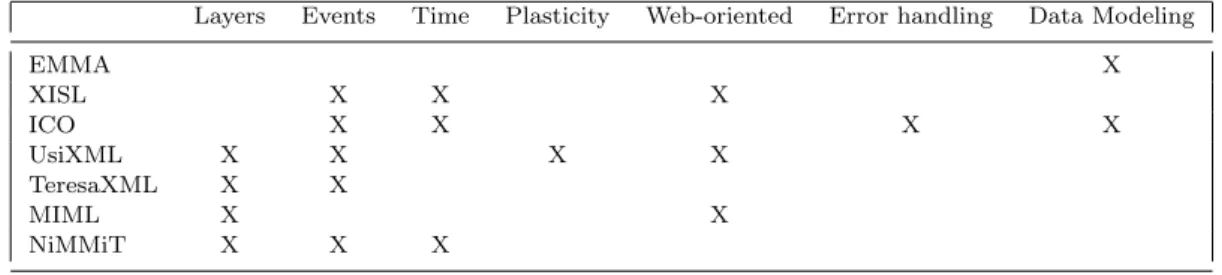
Table 1 State of the art languages and their features.
Layers Events Time Plasticity Web-oriented Error handling Data Modeling
EMMA X XISL X X X ICO X X X X UsiXML X X X X TeresaXML X X MIML X X NiMMiT X X X
for languages targeted at describing multimodal inter-action are described in the fourth section. The fifth section introduces the SMUIML language, a language for description and modeling of multimodal human-machine interaction derived from those guidelines. Eval-uation and positioning of the SMUIML languages are presented in the sixth section. The seventh and final section concludes this article.
2 Description Languages for Multimodal Interaction
Interesting attempts at creating a full-fledged language for description of user-machine multimodal interaction have come up in the past few years. A number of the approaches presented below revolve around the concept of a “multimodal web”, enforced by the World Wide Web Consortium (W3C) Multimodal Interaction Ac-tivity and its proposed multimodal architecture. This theoretical framework describes major components in-volved in multimodal interaction, as well as potential or existent markup languages used to relate those different components. Many elements described in this frame-work are of practical interest for multimodal HCI prac-titioners, such as the W3C EMMA markup language, or modality-focused languages such as VoiceXML or InkML. The works of the W3C inspired Katsurada et al. [15] for their work on the XISL XML language. XISL fo-cuses on synchronization of multimodal input and out-put, as well as dialog flow and transition. Another ap-proach of the problem is the one of Araki et al. [1], who propose MIML (Multimodal Interaction Markup Lan-guage). One of the key characteristics of this language is its three-layered description of interaction, focusing on interaction, tasks and platform. Ladry et al. [16] proposed the ICO notation for the description of mul-timodal interaction. This approach is closely related to a visual tool allowing edition and simulation of interac-tive systems, while being able to monitor at a low level a systems operation. Stanciulescu et al. [22] followed a transformational approach for developing multimodal web user interfaces based on UsiXML, also in the steps
of the W3C. Four steps are achieved to go from a generic model to the final user interface. Thus, one of the main features of their work is a strong independence to the actual input and output available channels. This trans-formational approach is also used in Teresa XML (see Paterno et al. [18]). Finally, at a higher level of mod-eling, NiMMiT (see De Boeck et al. [7]) is a graphical notation associated to a language used for expressing and evaluating multimodal user interaction.
All these approaches seem, at first glance, rather dif-ferent one from the other. Some features are however common between most of them. Table 1 lists a number of features that could be extracted between the differ-ent approaches, as well as some more specific features, related to current research in multimodal interaction. EMMA is included in the table, even if this language targets primarily data transfer between entities of a given multimodal system; in this regard, EMMA per-fectly addresses input and output data source represen-tation; in fact, this is the only language to fully address this. XISL is a language targeted at web interaction, and offering a SMIL-like language for multimodal inter-action; thus, it provides control over time synchronic-ity (e.g. with parallel or sequential playing), at least on the output side. The ICO notation targets safety-critical applications, with simulation capabilities; it has events description capabilities but lacks layers of ab-straction. On the contrary, UsiXML and TeresaXML were based on specific layers of abstraction, namely AUI (abstract user interface), CUI (concrete user inter-face) and FUI (final user interinter-face), with XSLT trans-formations managing crossing from one layer to an-other. UsiXML also takes into account plasticity. Fur-thermore, TeresaXML offered extensive events manage-ment capabilities. MIML, targeted at multimodal web interaction, also offers layers of abstraction: it is com-posed of three different languages, managing user/ma-chine interaction, events description, and input/out-put representation, respectively. Finally, NiMMiT also takes into account separate layers and events manage-ment capabilities.
Fig. 1 Different purposes for a multimodal user interaction description language.
A detailed analysis of Table 1 reveals that descrip-tion languages for multimodal user-machine interacdescrip-tion either are complete on a input/output data stream man-agement point of view, but lack abstraction and expres-sion power, or focus on higher levels of user-machine interaction description, thus losing control over data or even events. For example, ICO, which addresses multi-modal interaction at a low-level, is thus forced to have precise data modeling and error handling; on the con-trary, a language such as UsiXML offers higher-level abstraction, with fewer control over the lower layers. It is also to be noted that particular features are incom-pletely addressed by state of the art languages. Con-trol over time synchronicity has been addressed on the output side of multimodal interaction, but those lan-guages still lack capability to manage complementary, assigned, redundant or equivalent (see CARE proper-ties in Coutaz et al. [6]) input events. As for error han-dling, most languages lack ways to express graceful re-covery from recognition errors, data fusion mistakes, or event system errors. Most languages also lack context and user model modeling, and furthermore plasticity (user and context adaptability) control, with the ex-ception of UsiXML.
Most of the languages described above focus on the ”multimodal web”, and thus assume interpretation by browser plugins, or even future versions of the browsers themselves. Description languages for multimodal inter-action can however be used to be interpreted by ded-icated tools for the creation of standalone multimodal applications. On the subject of tools allowing creation of multimodal interfaces, the use of specific languages for configuration has been frequent, but sparsely stud-ied. Cohen et al. [5] worked on Quickset, a speech/pen multimodal interface, based on Open Agent Architec-ture, which served as a test bed for different fusion methods. Bourguet [3] endeavored in the creation of a multimodal toolkit in which multimodal scenarios could be modeled using finite state machines. This multi-modal toolkit is composed of two components, a graph-ical user interface named IMBuilder, which interfaces the multimodal framework itself, named MEngine. Mul-timodal interaction models created with IMBuilder are saved as a XML file. Flippo et al. [13] also worked on the design of a multimodal framework, geared to-ward direct integration into a multimodal application. The general framework architecture is based on agents,
while the fusion technique itself uses frames. Configura-tion of the fusion is done via a XML file, specifying for each frame a number of slots to be filled and direct link to actual resolvers implementations. Lastly, Bouchet et al. [2] proposed a component-based approach called ICARE thoroughly based on the CARE (see Coutaz et al. [6]) design space. These components cover elemen-tary tasks, modality-dependent tasks or generic tasks like fusion. The components-based approach of ICARE has been used to create a comprehensive open-source toolkit called OpenInterface [19]. Components are con-figured via CIDL XML files.
3 Description Languages Spectrum
An interesting question to ponder is: who is the user of description languages? The answer is not as obvious as it could appear. People who would want to design multimodal interaction with such languages could be either engineers creating multimodal systems based on programming tools, designers using higher-level tools for creating multimodal interfaces without having to delve too much into code, or even advanced users wish-ing to customize interaction. These different users will not have the same approach to multimodal interaction description languages. Through various workshops, in-formal discussions with colleagues and students, and a study of the current state-of-the-art, we envisioned three types of approaches for a description language: a highly formal language approach, perfectly fit for con-figuring a tool, a loosely formal language approach, good at communicating the details of an application, and a “middle” approach, focused on modeling. Along those three purposes, a fourth purpose for formal lan-guages can be added: learning tool. In summary, formal languages can be used for the following purposes:
– configuration – communication – modeling – learning
Hence, formal languages can help configure a mul-timodal system, thus working as scripting or program-ming languages; they can be used as communication tools to help exchange and structure ideas about a mul-timodal systems; formal languages with a thoroughly
Fig. 2 Different levels for a multimodal user interaction descrip-tion language.
thought structure can encourage careful modeling of a multimodal application; finally, as potential commu-nication and modeling tools, they can be interesting learning means to tackle multimodal interaction. Thus, every description language is expected to find a bal-anced place on an axis running from highly formal to loosely formal, from configuration to communication (see Figure 1).
Formal languages for description of multimodal in-teraction can be approached from two different direc-tions: either from expressiveness, or from usability (see De Boeck et al. [7]). Expressiveness covers technical fea-tures such as extensibility, completeness, reusability, or temporal aspects consideration; usability covers more human features such as programmability or readabil-ity. Any formal language will have to find its place be-tween those two general requirements. Some languages will for example tend more toward expressiveness, let-ting all edition be done through a dedicated GUI (vi-sual programming tool); others will focus on usability. In case of a visual programming tool, the usability of the description language is not that important, since it is hidden to users and to be read by the toolkit us-ing the description. An interestus-ing approach is to seek balance between usability and expressiveness: that is, a language able to configure a multimodal system, with high level modeling, and readable enough to be used as a learning tool, or even a communication tool. To attain those objectives, such a language will need to have a number of clearly separated and specifically dedicated parts, closely tied together (see Windgrave [23]). We introduce three different levels that will be used in the rest of this paper: a human-machine dialog-level, an in-put/output level, and a middle events-level in order to create a link between the human-centered part and the machine-centered part (see Figure 2).
4 Guidelines For Languages For Multimodal Toolkits
Sire and Chatty [21] describe what one should want from a multimodal user interfaces programming lan-guage. The requirements they express in their article include features such as modality agnosticity, extensible event definition mechanisms or reusable components. From their proposal, the analysis of the state of the art languages referenced in Section 2 and Table 1, and open changes described in key bibliographic references [17] [11], the following guidelines for a multimodal de-scription language have been derived. These guidelines are to be seen as a “checklist” of potential features a given multimodal interaction description language can provide. By no means should every language follow all of them. Guidelines should be used as design tools, or as language analysis criterias.
G1 Abstraction levels: different abstraction levels are advised, as multimodal interaction description can be huge: for example, a description language should separate description of the events and description of the human-machine dialog. Also, reusable parts or structures can greatly help programmability. G2 Modeling the human-machine dialog: there should
be some way to model the human-machine dialog, be it with a state machine, with an imperative proach with control structures, a declarative ap-proach, or another approach.
G3 Adaptability to context and user (input and output): as multimodal interfaces often offer redundancy be-tween modalities, adaptability to context and user (also called plasticity) should be taken into account by a language dedicated at describing multimodal interaction. It is worth noting that adaptability can be considered from an input and an output point of view. On the input side, adaptability would focus on using user information and context to help recogni-tion and fusion processes; on the output side, mes-sage selection, modalities and output coordination would be achieved according to user and context. G4 Control over fusion mechanism: algorithms used to
fuse multimodal input data can be quite complex and deliver different results according to the algo-rithm or its settings. Thus, description languages should take into account fusion parameters and ways to control them, for example by allowing choice be-tween different algorithms, or by allowing manage-ment of fusion parameters.
G5 Control over time synchronicity: actual human-machine dialog description should give control over time syn-chronicity: when multiple events can all lead to a given action, how should the system fuse data if
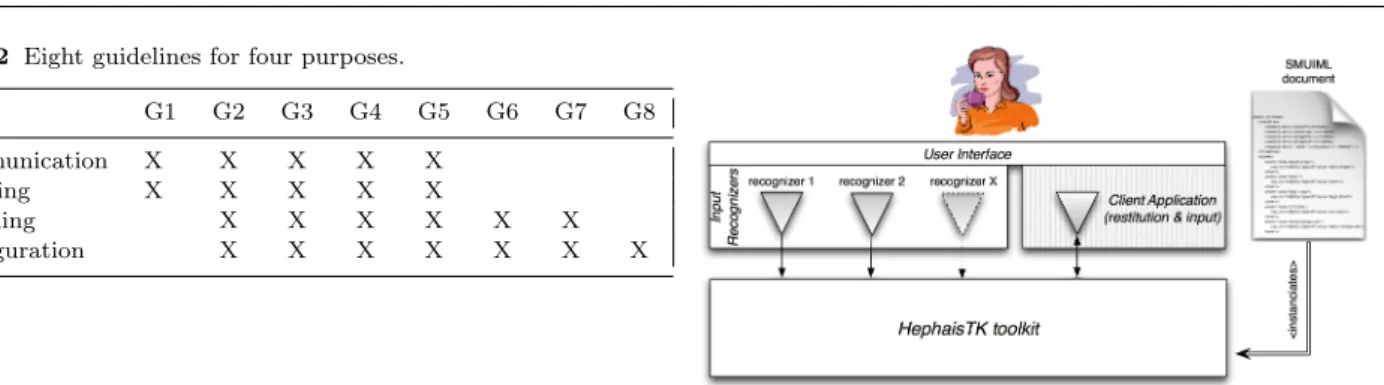
Table 2 Eight guidelines for four purposes. G1 G2 G3 G4 G5 G6 G7 G8 Communication X X X X X Learning X X X X X Modeling X X X X X X Configuration X X X X X X X
those events are activated at the same time? Thus, the fusion process would greatly benefit from con-trol over time synchronicity, for example by taking into account the CARE properties [6].
G6 Error handling: error handling should be taken into account early on. Multimodal systems feature a large number of potential error sources, from the recog-nizers to the integration to the answer selection. Hence, a language for description of multimodal in-teraction should provide some way to handle errors and recognition mistakes, for example by allowing default choices to be specified, or encouraging the design of guided dialogues.
G7 Events management : a mechanism for events de-scription and management should be taken into con-sideration, as events seem a natural way for people to think about how their multimodal application should work (see section 6 for more details). G8 Input and output sources representation: some way
to represent the actual input and output sources can also be interesting, as the creator of the multimodal user interface wants to have control over which rec-ognizer is used, and possibly be able to tune some parameters.
G* Find the right balance between usability and expres-siveness: this follows from the discussion in Section 2, and is maybe the single most important guide-line: any description language should find its place (and role) between usability and expressiveness, be-tween the human and the machine. This guideline is at a higher level and thus is not integrated in the following tables.
Table 2 presents the eight guidelines above and matches them with the four different purposes of a description language identified in section 3. Guideline were ranked from the most user-focused (abstraction levels) to the most system-focused (input/output data representation), hence the diagonal shape adopted by the crosses in the table. The next section presents SMUIML, a language for description of multimodal interaction, which will help illustrate most of the presented guidelines.
Fig. 3 The link between the HephaisTK toolkit and the SMUIML document.
5 SMUIML
SMUIML stands for Synchronized Multimodal User In-teraction Modeling Language. As its name implies, the language seeks to offer developers a language for de-scribing multimodal interaction, expressing in an easy-to-read and expressive way the modalities used, the rec-ognizers attached to a given modality, the user-machine dialog modeling, the various events associated to this dialog, and the way those different events can be tem-porally synchronized.
Description languages can be used as configuration scripts for tools allowing creation of multimodal in-terfaces. The SMUIML language has been primarily designed with this goal in mind. Thus, the SMUIML language is able to configure a toolkit for creation of multimodal interfaces (Figure 3). This toolkit, named HephaisTK, is outlined in the subsection 5.6. It is how-ever to be noted that the subject of this article lies in description languages and guidelines for the creation of such languages. A deeper discussion on multimodal toolkits architectures and the HephaisTK toolkit can be found in Dumas et al. [9]. Besides the goal of configura-tion scripting, SMUIML follows the goal of multimodal interaction modeling as it tries to guide the user by giving them a pattern for the creation of their appli-cations; SMUIML is also used as a tool in a course on multimodal interaction, so, obviously, has also the goal of a learning tool.
Developers can find a complete XML Schema refer-ence description of SMUIML available in [8].
The SMUIML language itself is described in the fol-lowing subsections. The subsection 5.1 gives an overview of the language structure, followed by subsections 5.2 to 5.5, which give a detailed view of the three different levels described by the language. Finally, subsection 5.6 shows how SMUIML is used in the context of the Hep-haisTK toolkit.
Fig. 4 The three levels of SMUIML.
5.1 SMUIML structure
The way a SMUIML file is split allows a clear separa-tion between three levels necessary to the integrasepara-tion process. As shows Figure 4, <recognizers> are at the lower, input/output level, <triggers> and <actions> form a middle level, devoted to events management, and the upper level contains the <dialog> description. This abstraction in three different levels allows com-ponents definition and reusability. In order to enhance reusability, the upper dialog level allows definition of clauses that can be later used and extended.
A typical SMUIML document is divided in a num-ber of sections (see Figure 5). First, the overall integra-tion descripintegra-tion is proper to a given client applicaintegra-tion. Whenever a new client application asks the HephaisTK toolkit for a handle, it will have to give some identi-fier name (in the case of Figure 5, “client app”). This identifier is used in the SMUIML file to identify which integration description is to be used for the current ap-plication. Hence, multiple applications can be described in a same script, for example in a case where multiple small applications could access concurrently a number of available input modalities.
For a given client application, four main sections form the description of the multimodal interaction sce-nario. The first part, <recognizers>, indicates which particular recognizer will be tied to which modality. It also allows definition, per recognizer, of a number of variables that will be of use to the client applica-tion. The second section, <triggers>, lists the different events that will be of interest for the client application. The focus of this section is to model as generic trig-gers all events coming from the different recognizers. <actions> form the third section, and have the same
<?xml version=” 1 . 0 ” e n c o d i n g=”UTF−8” ?> <smuiml> < i n t e g r a t i o n d e s c r i p t i o n c l i e n t =” c l i e n t a p p ”> < r e c o g n i z e r s> < !−− . . . −−> </ r e c o g n i z e r s> < t r i g g e r s> < !−− . . . −−> </ t r i g g e r s> <a c t i o n s> < !−− . . . −−> </ a c t i o n s> <d i a l o g> < !−− . . . −−> </ d i a l o g> </ i n t e g r a t i o n d e s c r i p t i o n> <smuiml>
Fig. 5 General SMUIML layout
goal of giving a generic model to the output side of the toolkit. In particular, those <actions> will serve as a description of the toolkit-to-client application mes-sages, as well as indicate the potential variables that would have to be transferred to the client application. < triggers> and <actions> form a set of building blocks, using the results of the various recognizers defined in the first section, and further called in the definition of the <dialog>. This dialog is described by means of a finite state machine. States are described by means of <context> elements, and to a given <context> are at-tached a number of <transition> elements.
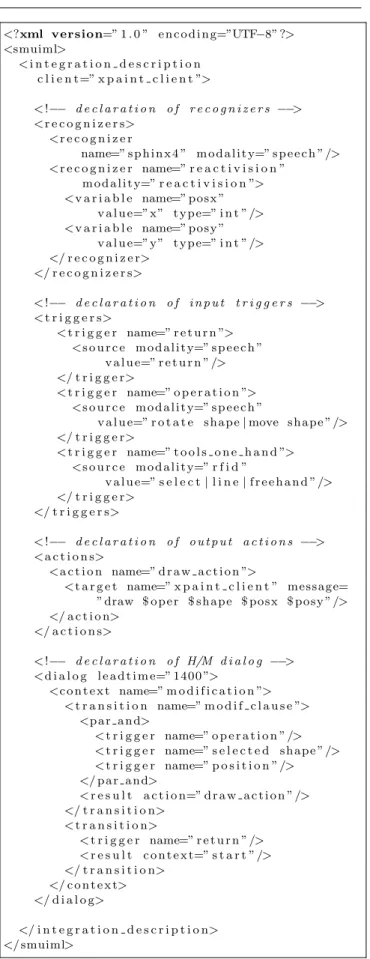
A complete SMUIML example is given in Figure 6. This example is taken from a multimodal drawing application realized with help of the Reactivision [14] computer vision framework and Sphinx 4 speech recog-nition system. The example features two recognizers, three input triggers, one output action and part of the overall human-machine interaction dialog. All these el-ements will be detailed in the coming subsections.
5.2 SMUIML recognizers
At the recognizers level, the goal is to tie the multi-modal dialog scenario with the actual recognizers that the developer wishes to use for his application. In the context of the HephaisTK toolkit, all recognizers are identified by a general name throughout the toolkit. This general identifier is hence used in SMUIML. The HephaisTK toolkit keeps a list of recognizers, and their associated modality (or modalities). For example, if a number of speech recognizers are available, using one of them or the other is a matter of changing the “name” attribute of the speech-related ¡recognizer¿ element. As every events are defined afterwards in relation to the
modality, and not a particular recognizer, this allows for more flexibility in the creation of the implemen-tation, Moreover, design-wise, it enhances readability and allows developers to design their application be-fore thinking about which recognizer they intend to use. It is to be noted that the <recognizers> part is the only one where a tight link between the SMUIML language and a given tool (in this case, the HephaisTK toolkit) appears. The modality the different recognizers provide is also indicated. The “modality” attribute is a string of characters, chosen from a list of keywords. This keywords list is created by the HephaisTK toolkit (see subsection 5.6) at runtime against the available recog-nizers. In other words, the toolkit knows in real time which modality it is able to offer.
Finally, SMUIML offers the possibility to declare variables attached to a given recognizer.Data types vary from modality to modality, but are expected to be con-sistent within one modality; for example, every speech recognizers are expected to deliver text outputs.
5.3 SMUIML triggers
Triggers are at the core of the transition mechanism of SMUIML. They describe a sub-set of interest from all the possible events coming from the different recog-nizers. A set of input events can hence be abstracted behind one trigger name, enhancing as much the script readability.
A standard trigger declaration is shown in Figure 6. In this example, two triggers are defined for the speech modality, regardless of the recognizer actually used. For example, the speech recognizer is simply as-sumed to send its results as strings of characters, and be scripted by means of a BNF-style grammar. A unique name or number identifies each <trigger>. As for the last trigger, attached to a Phidget (see Greenberg et al. [12]) RFID tags reader in this example, the three values declared are linked to actual tags numbers in the <variable> declarations in the recognizers; the tag numbers could also be used in place of variables.
5.4 SMUIML actions
<actions> are the output equivalent of <triggers>. They describe the messages and their content that will form the communication channel between HephaisTK toolkit and its client application. A typical <action> declara-tion is shown on Figure 6.
The goal of those messages is to let the client appli-cation know in which state the toolkit finds itself in, by
<?xml version=” 1 . 0 ” e n c o d i n g=”UTF−8” ?> <smuiml> < i n t e g r a t i o n d e s c r i p t i o n c l i e n t =” x p a i n t c l i e n t ”> < !−− d e c l a r a t i o n o f r e c o g n i z e r s −−> < r e c o g n i z e r s> < r e c o g n i z e r name=” s p h i n x 4 ” m o d a l i t y=” s p e e c h ” /> < r e c o g n i z e r name=” r e a c t i v i s i o n ” m o d a l i t y=” r e a c t i v i s i o n ”> < v a r i a b l e name=” p o s x ” v a l u e=” x ” t y p e=” i n t ” /> < v a r i a b l e name=” p o s y ” v a l u e=” y ” t y p e=” i n t ” /> </ r e c o g n i z e r> </ r e c o g n i z e r s> < !−− d e c l a r a t i o n o f i n p u t t r i g g e r s −−> < t r i g g e r s> < t r i g g e r name=” r e t u r n ”> <s o u r c e m o d a l i t y=” s p e e c h ” v a l u e=” r e t u r n ” /> </ t r i g g e r> < t r i g g e r name=” o p e r a t i o n ”> <s o u r c e m o d a l i t y=” s p e e c h ” v a l u e=” r o t a t e s h a p e | move s h a p e ” /> </ t r i g g e r> < t r i g g e r name=” t o o l s o n e h a n d ”> <s o u r c e m o d a l i t y=” r f i d ” v a l u e=” s e l e c t | l i n e | f r e e h a n d ” /> </ t r i g g e r> </ t r i g g e r s> < !−− d e c l a r a t i o n o f o u t p u t a c t i o n s −−> <a c t i o n s> <a c t i o n name=” d r a w a c t i o n ”> <t a r g e t name=” x p a i n t c l i e n t ” m e s s a g e= ” draw $ o p e r $ s h a p e $ p o s x $ p o s y ” /> </ a c t i o n> </ a c t i o n s> < !−− d e c l a r a t i o n o f H/M d i a l o g −−> <d i a l o g l e a d t i m e=” 1400 ”> <c o n t e x t name=” m o d i f i c a t i o n ”> < t r a n s i t i o n name=” m o d i f c l a u s e ”> <p a r a n d> < t r i g g e r name=” o p e r a t i o n ” /> < t r i g g e r name=” s e l e c t e d s h a p e ” /> < t r i g g e r name=” p o s i t i o n ” /> </ p a r a n d> < r e s u l t a c t i o n=” d r a w a c t i o n ” /> </ t r a n s i t i o n> < t r a n s i t i o n> < t r i g g e r name=” r e t u r n ” /> < r e s u l t c o n t e x t=” s t a r t ” /> </ t r a n s i t i o n> </ c o n t e x t> </ d i a l o g> </ i n t e g r a t i o n d e s c r i p t i o n> </ smuiml>
means of a clearly defined set of messages. Those mes-sages can contain variables previously defined, such as the $posx variable defined in Figure 6. The client appli-cation will then be able to know what content is to be restituted to the user. The choice was made not to offer extensive control over fission of modalities in SMUIML, for two reasons. First, having extensive control over the way content is restituted can go as far as recreating a full rendering language, which was not the goal of this work. Second, mixing as little as possible the model and the view allows for better readability of the language. Hence, restitution of the content is up to the client ap-plication. This choice can however be a source of errors, as heavily modal applications would need some way to ensure synchronicity between the toolkit and the appli-cation.
5.5 SMUIML dialog
The <dialog> element describes the integration mech-anisms of a SMUIML script. In essence, a <dialog> is a finite state machine, with transitions defined by the <triggers> and <actions> events that were pre-sented in the former sections. We are currently working on adding other fusion algorithms into the HephaisTK platform, some of which will need us go beyond the simple state machine paradigm for the description of the human-machine interaction. States of the dialog are described by <context> elements. Each context has a unique name identifying it. One context must have a “start context” attribute, defining it as the starting state. An “end context” attribute also exists to describe a final state. A simple example of a <dialog> is repre-sented in Figure 6.
When multiple triggers are present, the developer should be able to clarify time synchronicity issues, i.e. how the incoming multimodal triggers should be con-sidered. The approach of SMUIML is to distinguish between parallel and sequential triggers, and between coupled and individual triggers. To denote those dif-ferent cases, a set of keywords has been selected. Key-word “par” is for parallel triggers, “seq” for sequential triggers, “and” for coupled triggers, “or” for individual triggers.
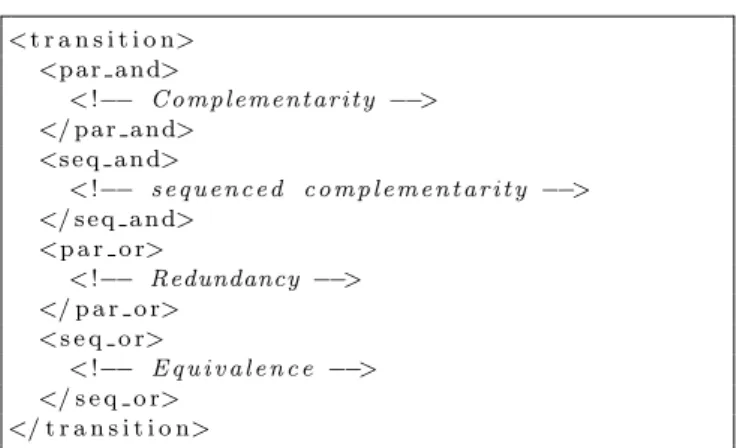
Four elements to describe the different behaviors have been designed by mixing those four CARE proper-ties. <par and> is to be used when multiple properties are to be fused together, as they all are necessary for the meaning extraction process. <seq and> describes one or multiple individual triggers all necessary in sequence to trigger a transition. <par or> describes redundant multimodal triggers having similar meanings. Each one is sufficient for the correct meaning to be extracted, but
< t r a n s i t i o n> <p a r a n d> < !−− C o m p l e m e n t a r i t y −−> </ p a r a n d> <s e q a n d> < !−− s e q u e n c e d c o m p l e m e n t a r i t y −−> </ s e q a n d> <p a r o r> < !−− Redundancy −−> </ p a r o r> <s e q o r> < !−− E q u i v a l e n c e −−> </ s e q o r> </ t r a n s i t i o n>
Fig. 7 Triggers combination elements in SMUIML
they all can be expressed at the same time by the user, increasing as such the robustness and recognition rate (for example, a user issuing a “play” vocal command and simultaneously pushing a play button). Finally, the <seq or> element is to be used when multiple triggers can lead to the same result, but only one of them is to be provided. Those four integration describer elements can also be combined in order to express all kinds of multimodal interactions. In fact, as shows comments in Figure 7, three of those four elements correspond to three of the four CARE properties of multimodal in-teractive systems (Complementarity, Redundancy and Equivalence) as defined in Coutaz et al. [6]. The only integration describer element not matched to a CARE property is <seq and>. The choice to drop the Assign-ment CARE property was made because we felt it was more meaningful to be able to differentiate sequenced and un-sequenced complementarity, than to differenti-ate equivalence of choice (one of a number of modali-ties is required, does not matter if two are selected at the same time) and assignment (one and only one of a number of modalities is required); In fact, assignment can be expressed by using one transition per modal-ity. The CARE properties have revealed themselves a handy tool used by a number of toolkits to help formal-ize relationships between different modalities; choice was made to include them into SMUIML in order to answer the guideline of time synchronicity control.
5.6 SMUIML language interpretation
In order to provide a tool allowing developers to pro-totype multimodal interfaces in an easier way than by building them from scratch, a toolkit named HephaisTK has been developed. This toolkit has been designed to plug itself in a client application that wishes to receive notifications of multimodal input events received from
a set of modality recognizers. Output restitution, be it multimodal or not, is managed by the client application. To give an example of an application using HephaisTK and SMUIML, a binding declaration in Java can be:
new HephaistkInitManager(”client app”);
“client app” refers to the application name every SMUIML script has to specify, and which is described in subsection 5.1. To enhance flexibility, callbacks to the client application are generated following the SMUIML script. Changing a few lines of the script can completely change the behavior of the multimodal toolkit, and as the callbacks are rather loosely tied, the developers are completely free to adapt their application, do testing on, or simply ignore, etc. those callbacks.
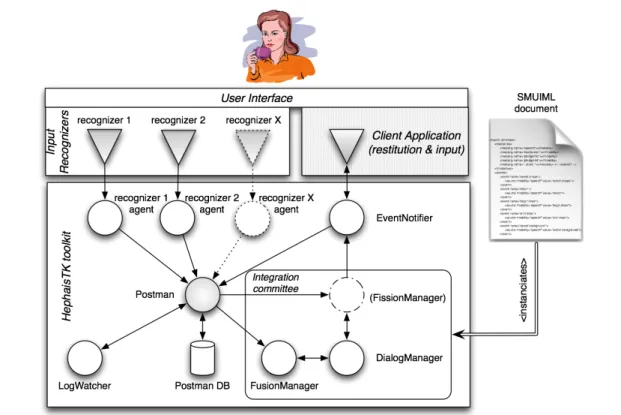
HephaisTK is built on an architecture based on soft-ware agents, as depicted in Figure 8. Agents are dis-patched to manage individual modality recognizers, re-ceive and encapsulate data from the recognizers, and send them to an individual central agent named the “postman”. This postman agent centralizes all data coming from the dispatched recognizers agents in a database, and distributes the data to other interested agents in the toolkit, which can subscribe to be informed of spe-cific types of data. An “integration committee” of three different agents achieves integration of data. A first agent manages fusion of input modalities, helped by a dialog agent; a fission agent encapsulates the fused data and sends it to the client application, which will be notified of the incoming data by means of an event listener.
HephaisTK is an integrated tool, which needs to be configured in order to send satisfactory information to its client application. Thus, a configuration file, de-scribing the human-machine multimodal dialog wished for the client application, needs to be specified when us-ing the toolkit. This configuration script also has other goals, for example the specification of which recognizers need to be used with the toolkit. Hence, the SMUIML language has been developed as a configuration lan-guage for the HephaisTK toolkit. The lanlan-guage is linked to this toolkit, and conversely the toolkit is linked to the language. Nevertheless, the SMUIML language has been created as being as generic as possible, and should be able to model multimodal human-machine interac-tion independently from the subsequent tool used to interpret the script.
6 Evaluation and positioning of SMUIML The SMUIML language allowed modeling of a number of different multimodal use cases, from a music player with simple multimodal commands, to an application
allowing classification and visualization of documents based on different criterias, to a drawing table with speech and tangible input. Thus, the ability to model and manage different multimodal applications was em-pirically verified. Nevertheless, the user-friendliness of SMUIML had still to be considered.
In order to compare the languages expressiveness and usability, masters degree students from a course on multimodal interaction were asked to devise their own version of a language allowing description of mul-timodal interaction. These students had all already a bachelor in computer science degree, and were pursu-ing their studies to get a master degree. The course on multimodal interaction delivered at the University of Fribourg (Switzerland) is an optional course in their curriculum and amongst the 30 students which were present the year this evaluation was done, six of them chose to delve deeper in multimodal interaction model-ing. They already had an introductory course on mul-timodal interaction, but no extended experience. Thus, they represented developers with a strong interest and passing knowledge on multimodal interaction. These students had to first imagine a multimodal application, draw a storyboard detailing the main use cases of their application, and then they were given three weeks to invent a formalization to describe more deeply their application. They had no knowledge of SMUIML or any other description language on multimodal interac-tion, although they had already followed a course on multimedia-aimed description languages such as SMIL. The idea behind this task was to see how develop-ers think about modeling multimodal interaction when they only have passing knowledge about multimodality. First, most of the students tackled the problem by describing what “happens” in the system, i.e. events. Some of them built their language proposal only around events, others made a difference between “input” events and “result” events, and still others built chain of events. Nonetheless, non-specialists of multimodal interfaces, faced with the problem of describing multimodal human-machine interaction, show a tendency to first think about the actual events and their awaited results. Thereafter, most proposals offered a way to model human-machine interaction dialog, either by “knitting” events and ac-tions to and from the system, or by describing fixed chains of events. Then, some students tried to give a description of the actual hardware used; some others did not see the interest of giving this level of detail. It is nonetheless to be noted that the students were to create a high-level formalization of multimodal human-machine interaction. In a more “complete” approach, some link to the actual hardware would have to be
Fig. 8 HephaisTK toolkit architecture.
Table 3 The SMUIML language and the eight guidelines.
SMUIML <dialog> <triggers> <actions> <recognizers>
G1. Abstraction levels X X X X
G2. HMI modeling X X
G3. Adaptability to context/user
G4. Control over fusion process X X X G5. Time synchronicity X X
G6. Error handling
G7. Events management X X X
G8. I/O data representation X X
specified, and some of the students paid attention to this.
Finally, the students were confronted with SMUIML, and give a qualitative evaluation of it. Once again, the basic idea behind it was to get the opinion of non-experts in the field of multimodal interaction about the language. In regard to usability, two remarks were raised about the <dialog> part: first, with complex ap-plication, the whole context diagram could become te-dious to analyze and read; second, every trigger, action or context is identified with a unique name, without distinction, which can easily lead to duplicate names. Thus, as usable as a description language can be, pro-ducing such documents for large-sized applications can become tedious. On a final note, interestingly enough, a final feature that was not addressed by most of the
students is error handling. In fact, modality recogniz-ers and multimodal integration are often considered as being error-free when designing the first draft of a mul-timodal system; it is obviously not the case, and even early design should take into account error reduction techniques such as tap-to-speak interfaces, restricted grammars or guided dialogues (See Bourguet [4] for more information on error handling strategies).
When confronted with the guidelines introduced in section 4, SMUIML takes into account abstraction lev-els by its three layers structure, events description with help of the <triggers> and <actions> elements, and representation of input sources with the <recognizers > elements. Control over the fusion process is allowed by specifying attributes in the <dialog> part: for ex-ample, the time frame in which a given meaning frame
has to be fused can be specified with help of the “lead-time” attribute. Time synchronicity aspects are man-aged by the different <par or>, <par and>, <seq or> and <seq and> elements. On the case of data eling, as SMUIML is tied to a toolkit, all data mod-eling is supposed to be managed inside this toolkit. Sire et Chatty admit in this regard that data mod-eling can be present in multiple places, but could be present in XML modeling, for example to be compli-ant with EMMA. We believe data modeling could be based on EMMA description but should not be part of the multimodal interaction description itself, mainly for readability reasons. Control structures are a relevant point: basically, a state machine such as the one present in SMUIML dialog description is able to describe any application process, however control structures such as “switch” or “while” statements can enhance the read-ability of a given language. But control structures imply an imperative programming-oriented language; the way SMUIML dialog description was designed would make unnatural the use of standard control structures such as switch statements or loops: control structures are in-herent to the state machine model. A complete overhaul of the language would be needed for the integration of such control structures. Adaptability to user and con-text is not taken into account yet in HephaisTK and SMUIML, though mechanisms to ease plasticity inte-gration are present. Finally, error handling is also not yet present in the language, as can be seen in Table 3, but is a planned work, that will take place jointly with the enhancement of HephaisTK toolkit on error handling.
Finally, about guideline G* (Usability vs. expres-siveness balancing), SMUIML was created with read-ability in mind, as well as keeping as much expressive-ness as possible. Nonetheless, on the usability side, be-ing able to use a Graphical User Interface to create a SMUIML script would go a long way toward better user-friendliness.
7 Conclusion and future works
This article discusses the advantages of having a model-ing language for describmodel-ing multimodal human-machine interaction. It further presents the state of the art and various approaches to this problem. From experiments and study of the state of the art, we propose a set of guidelines for the design of modeling languages for mul-timodal toolkits.
As mentioned in the article, such modeling languages role is not restricted to the configuration of a toolkit, but could serve as a modeling and communication lan-guage. Our thesis is that this kind of language should
balance between readability (human-side) and expres-siveness (machine-side). In fact, a balance should also be found between the different user-focused and system-focused guidelines: a single description language would have difficulty answering every guideline while still keep-ing readability.
When considering the SMUIML language in respect to the guidelines devised in section 5, guideline G3 (adaptability to user and context) and G6 (error han-dling) are lacking. Adaptability to user and context is not planned for the moment, although the software ar-chitecture on which HephaisTK is based upon could be extended to help take into account user profile and context when managing and interpreting input events. Plasticity on the output side would be harder to man-age, and we have decided to leave it aside. Error han-dling is a planned future work, in parallel with the in-tegration of advanced error handling in the HephaisTK toolkit, which will take into account errors coming from recognizers, mistakes from the fusion engine and excep-tion. A second planned future work will concentrate on creation of a visual programming tool which would gen-erate the SMUIML script. The challenge will lie in par-ticular in keeping the abstraction levels and in promot-ing a careful modelpromot-ing of the multimodal application, which were prominent benefits of the markup language. Furthermore, such a tool would enhance usability, while keeping expressiveness. Lastly, a field study with devel-opers interactive multimodal systems will have to be achieved in order to assess the capabilities of SMUIML in a real context of use.
Acknowledgements Thanks to Raphael Boesch, Guillaume Gnaegi, Andreas Ruppen, Mario Sitz and Tony Svenson for their work on formalization languages in the frame of the MMI course at Uni-versity of Fribourg. The work on HephaisTK and SMUIML are funded by the Hasler Foundation (http://www.haslerstiftung.ch) in the context of the MeModules project (http://www.memodules.ch), and by the Swiss National Center of Competence in Research on Interactive Multimodal Information Management – NCCR IM2 project (http://www.im2.ch).
References
1. Araki M, Tachibana K (2006) Multimodal Dialog Description Language for Rapid System Development. In: Proc. of the 7th SIGdial Workshop on Discourse and Dialogue, Sydney, Aus-tralia, July 2006
2. Bouchet J, Nigay L, Ganille T (2004) ICARE Software Com-ponents for Rapidly Developing Multimodal Interfaces. In: Conference Proceedings of ICMI’2004, State College, Pennsyl-vania, USA, October 2004, ACM Press, pp 251-258
3. Bourguet ML (2002) A Toolkit for Creating and Testing Multimodal Interface Designs. In: companion proceedings of UIST’02, Paris, Oct. 2002, pp 29-30
4. Bourguet ML (2006) Towards a taxonomy of error-handling strategies in recognition-based multi-modal human-computer interfaces. Signal Processing Vol. 86 Issue 12,December 2006 5. Cohen PR, Johnston M, Mcgee D, Oviatt S, Pittman J, Smith
I, Chen L, Clow J (1997) QuickSet: multimodal interaction for distributed applications. In: Proc. of the Fifth ACM interna-tional Conference on Multimedia, Seattle, USA, 1997 6. Coutaz J, Nigay L, Salber D, Blandford A, May J, Young R
(1995) Four Easy Pieces for Assessing the Usability of Multi-modal Interaction: The CARE properties. In: Proceedings of the INTERACT’95 conference, S. A. Arnesen & D. Gilmore Eds., Chapman & Hall Publ., Lillehammer, Norway, June 1995, pp 115-120
7. De Boeck J, Vanacken D, Raymaekers C, Coninx K (2007) High-Level Modeling of Multimodal Interaction Techniques Us-ing NiMMiT, 4(2007), no. 2, September 2007, urn:nbn:de:0009-6-11615, ISSN 1860-2037
8. Dumas B (2009) SMUIML XML Schema reference. http://diuf.unifr.ch/diva/web/downloads/documents/other/ 2009/smuiml v04.xsd. Accessed 28 Sept 2009
9. Dumas B, Lalanne D, Ingold R (2008) Prototyping Multi-modal Interfaces with SMUIML Modeling Language. In: work-shop User Interface Description Languages for Next Generation User Interfaces, CHI 2008, Firenze, Italy, pp 63-66
10. Dumas B, Lalanne D, Oviatt S (2009) Multimodal Inter-faces: A Survey of Principles, Models and Frameworks. In: De-nis Lalanne, Jrg Kohlas eds. (2009). Human Machine Inter-action, LNCS 5440, State-of-the-Art Survey, Springer-Verlag, Berlin/Heidelberg, pp 1-25
11. Garofolo J (2008) Overcoming Barriers to Progress in Mul-timodal Fusion Research. In AAAI Fall 2008 Symposium Pro-ceedings
12. Greenberg S, Fitchett C (2001) Phidgets: easy development of physical interfaces through physical widgets. In:User Inter-face Software & Technology, CHI Letters 2001
13. Flippo F, Krebs A, Marsic I (2003) A Framework for Rapid Development of Multimodal Interfaces. In: Proc. of ICMI’03, Vancouver, BC, Nov. 5-7, 2003
14. Kaltenbrunner M, Bencina R (2007) ReacTIVision: A Computer-Vision Framework for Table-Based Tangible Inter-action. In Proceedings of the first international conference on ”Tangible and Embedded Interaction” (TEI07). Baton Rouge, Louisiana, 2007
15. Katsurada K, Nakamura Y, Yamada H, Nitta T (2003) XISL: a language for describing multimodal interaction scenarios. In: Proc. of the 5th Intl. Conference on Multimodal interfaces (ICMI 2003), Vancouver, British Columbia, Canada, Novem-ber 05 - 07, 2003
16. Ladry JF, Palanque P, Basnyat S, Barboni E, Navarre D (2008) Dealing with Reliability and Evolvability in Description Techniques for Next Generation User Interfaces. In: Proceed-ings of User interface description languages for next generation user interface workshop at CHI08, Florence, Italy, 2008 17. Oviatt, SL (2008) Multimodal interfaces. In: J. Jacko, J.,
Sears, A. (eds), The Human-Computer Interaction Handbook: Fundamentals, Evolving Technologies and Emerging Applica-tions, 2nd edition, CRC Press, 2008, chap. 14, pp. 286-304 18. Patern`o F, Santoro C, M¨antyj¨arvi J, Mori G, Sansone S
(2008) Authoring pervasive multimodal user interfaces. In: Int. J. Engineering and Technology, Vol. 4, No. 2, pp 235-261 19. Serrano M, Nigay L, Lawson JYL, Ramsay A, Murray-Smith
R, Denef S (2008) The OpenInterface framework: a tool for multimodal interaction. In: Adjunct Proceedings of CHI2008 (April 5-10, Florence, Italy), ACM Press, pp 3501-3506 20. Shaer O, Jacob RJ, Green M, Luyten K (2008) User interface
description languages for next generation user interfaces. In: CHI ’08 Extended Abstracts on Human Factors in Computing
Systems (Florence, Italy, April 05 - 10, 2008). CHI ’08. ACM, New York, NY, pp 3949-3952
21. Sire S, Chatty C (2002) The Markup Way to Multimodal Toolkits, W3C Multimodal Interaction Workshop, 2002 22. Stanciulescu A, Limbourg Q, Vanderdonckt J, Michotte B,
Montero F (2005) A transformational approach for multimodal web user interfaces based on UsiXML. In: Proc. of the 7th Intl. Conference on Multimodal interfaces (ICMI 2005), Torento, Italy, October 04 - 06, 2005
23. Windgrave C (2008) Chasm: A Tiered Developer-Inspired 3D Interface Representation. In Proceedings of User interface de-scription languages for next generation user interface workshop at CHI08, Florence, Italy, 2008