Numerical Optical Low-Coherence Holographie Microscopy
Cuche E., *Poscio R, Depeursinge Ch.Institut d'Optique Appliquoe, EPFL, CH-1015 Lausanne, Switzerland. * Institut de Recherche en Ophtalmologie (IRO), CH-1950 Sion 4, Switzerland.
ABSTRACT:
The Oprical Low-Coherence Holographie Microscopy (OLCHM) is a three dimensional imaging method which mixes the concepts of low coherence holography and holographic microscopy. We present here a numerical application of this method that consists of recording a dig-ital hologram on a CCD camera, the reconstmction of which is perfbrmed numerically by means of a Fast Fres-nel Transform algorithm. The transverse resolution of the reconstructed images mainly depends on the resolution limit of the optics components used («Ιμπι). As a conse-quence of the low coherence, the depth resolution is reduced to about 25 um.
INTRODUCΉON:
In conventional optical holography, the light intensity in the hologram plane Iy(x>y) is recorded on a photographic plate. After development, the hologram is illuminated with a wave identical to the reference and the transmitted wave front contains four terms:
Ψ (*, y) = RR2 + RO2 + R2O* + R2O (1) Where O and R are the complex amplitudes of the object and reference waves respectively and O, R their modulus. The two first terms correspond to the zero order diffrac-tion, the third term to the real image and the fourth to the twin image [1]. If the hologram has been recorded accord-ing to the Fresnel condition:
4^LV9~·»/ · vi ~jt i max (2) with λ the wavelength and d the distance between the hologram plane Oxy and the object plane Οξη, the trans-mitted wave front Ψ(ξ,ΐ]) can be calculated at a distance d from the hologram with the Fresnel-Kirchoff integral:
Γ(/πΔξ,/ζΔη) = 6*/?
Where F is the Fourier transform operator. In our case, the hologram intensity is recorded on a CCD camera and the reconstmction must be performed by means of a discrete formulation [2] of equation (3):
(4)
Where k,l,m,n=l..N are integers and Δξ, Δη are the sam-pling intervals after the discrete Fresnel Transform. DFT is the Discrete Fourier Transform operator which can be very quickly computed using FFT algorithms. Finally
is a matrix ofN
2elements which results from the
sampling ofI
H(x,y):
l H (k, /) = 1H (x, y) rect (x/Lx, y/LJ NX Ny
(5)
Where Lx and Ly are the dimensions of the CCD array and Ac, Δ)^ its pixel sizes. According to equations (3) and (4), the pixel sizes in the image and hologram plane are con-nected s follow [3]:
" c Δη ' Nty ~ Ly (6) Thus, for a given CCD camera, if the object size is greater than the quantity Lξ=NΔξ, aliasing problems will appear and if a detail of the object is smaller than Δξ it will not be reproduced by the numerical reconstruction.
METHODS:
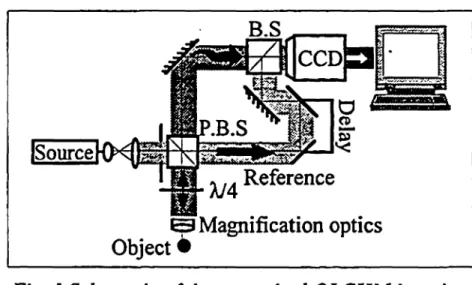
Reference @Magnification optics Object ·
Fig. l Schematic ofihe numerical OLCHM imaging setup (PBS: Polarizing Beam Splitter)
The experimental setup designed is shown in figure 1. After enlargement of the spot size, a polarizing beam Splitter (PBS) separates the incident light. On one hand, the horizontal component of the polarized beam crosses the PBS and forms the reference wave whose incidence angle θ on the CCD can be controlled by changing the ori-entation of a mirror. On the other hand, the vertical com-ponent is reflected by the PBS in the direction of the object and a quarter wave plate ensures that the back scat-tered light crosses the PBS and reaches the CCD after reflection on a mirror. A frame grabber captures the holo-gram from a Standard CCD camera with 512x768 pixels of 6.8x6.8 um2 area. Finally the holographic
reconstmc-tion is performed by a Computer. For microscopic investi-gations magnification optics can be installed between the object and the PBS. Two kinds of configurations have been studied here; a single lens of 30 mm focal length and 5mm diameter and an microscope objective of
tion x20 and 0.35 numerical aperture. Two kinds of sources have been used, an He-Ne laser for preliminaiy results and a Tiisapphire laser with ~80 fs pulse duration for low-coherence investigations
RESULTS AND DISCUSSION:
Figure 2 shows a typical result of numerical OLCHM. The hologram (fig. 2a) has been recorded with an He-Ne laser and the groups 2 and 3 of the USAF lest target s object. No magnification optics were used here. Figure 2b shows the corresponding numerically reconstructed image using algorithm (4) with a reconstruction distance d=\35 mm. It is important here to note that ί/must be equal to the optical path and doesn't match the effective distance sepa-rating the object and the CCD, essentially because of the presence of beam Splitters. The four different tenns of the
2mm
a)
Fig. 2 Typical result of numerical OLCHM. a) The hologram b) The reconstructed image.
transmitted wave IFmentioned in the introduction (equ. 1) are clearly observable in figure 2b. In the centre of the image appears the zero order diffraction intensity inside which a term proportional to the square ofthe object wave modulus is distinguishable. In the top left corner one can observe the real image and symmetrically with respect to the centre, a blurred twin image. These three tenns are spatially separated because an angle θ has been intro-duced between the reference and object waves at their incidence on the CCD. With these experimental condi-tions, the smallest observable object is the element number 6 of group 3 of the USAF target. This means a resolution of around 35μιη which is comparable to the 21 μηι calculated from equation (6) for d=l35 mm, λ=632.8 nm and the parameters ofthe CCD s specified above.
a) b)
Fig. 3 Resolution limit: a) obtained with a single lens b) obtained with a microscope objective
Images of figures 3a and 3b have been obtained with a single lens and a microscope objective s magnification
optics respectively. In the first case, we can see the second element of the group 6 and in the second case the sixth element ofthe group 7. This means a resolution of about 7.5 μηι for the single lens and 2.25 μπι for the objective. These two results are quite equal to the theoretical of 5 μηι and 2.2 μηι resolutions limits obtained by application ofthe Rayleigh criterion for these two optics.
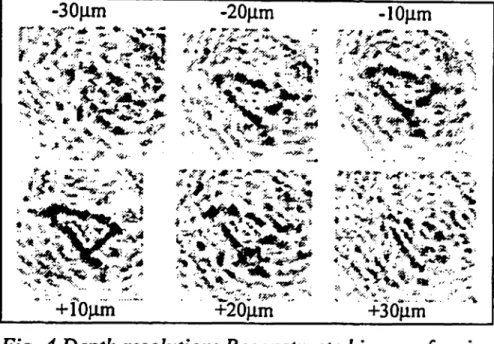
Images in figure 4 have been reconstructed from holo-grams recorded with the Tiisapphire laser and the charac-ter "4" ofthe title ofthe fourth group ofthe USAF test target s object. Firstly, the delay device was set on the ideal position for which the optical paths are the same along the reference and object arms. Then six holograms have been recorded after displacement with 10 μπι Steps ofthe delay device backward and forward its initial posi-tion. We can clearly see that the image disappear along the
-30um χ · ·* % ^jk*-+£>? • *,,* V* '·Ν - <* ·v . ;*;·/* *>· ^ ^€!«^" XV;
'!&&*£-4
*· ·· '"JX* +10um -ΙΟμίΏ r-r*JK*% -~*c* ^ 'J-X^t-^^^s « •-fx^^^i^v ^^vVi^C^NiVVX* *'
^Hf-C7!^-^-, > +30iim' ^Fig. 4 Depth resolution: Reconstructed imagesfor six different positions ofthe delay device.
both direction for displacement higher than 20 μηι. Thus the depth resolution can be estimated to 25 μηι which cor-responds to the length of our 80 fs pulse duration.
CONCLUSION:
The numerical reconstruction algorithm and the experi-mental setup have been successfully tested with an USAF test target. The transverse resolution is limited by the magnification optics used via the Rayleigh criterion and the depth resolution is equal to coherence length of the source. With a specialized hardware the numerical recon-struction could be performed at the video frequency. This opens a wide r nge of exciting perspectives for new appli-cations of low-coherence holography.
ACKNOWLEDGMENTS:
This work was supported by the Swiss National Founda-tion (grant FN 2100-042323.94/1) and the UNIL-EPFL grant (New optical methods in ophtalmology). The authors thank Fr^doric Bevilacqua and Olivier Coquoz for interesting remarks about the manuscript.
REFERENCES
[1]J. W. Goodman, An Introduction to Fowier Optics and
Holography, (McGraw-Hill, New York, 1968).
[2]U. Schnars, W. J ptner, Applied Optics, 33 (1994), 179. [3]L. P. Yaroslavskii, N.S. Merzlyakov, Methods of Digital
Holography (Consultant Bureau, New York, 1980).