Institute of Literature and Language
Department of Foreign Languages
Branch: English
A Dissertation Submitted in Partial Fulfillment for the Requirement of the Master Degree in“Language Sciences and Didactics of Language”
Presented by
Supervisor
Sonia Fethi Miss Boughouas Lemya
Rima Bouhaddad
Board of Examiners
Chairman:Miss Sabah Bouguern Supervisor: Miss Lemiya Boughouas Examiner: Miss Leila Zourez
Academic year 2016 - 2017
PEOPLE’S DEMOCRATIC REPUBLIC OF ALGERIA
MINISTRY OF HIGER EDUCATION AND SCIENTIFIC RESEARCH
Abd Elhafid Boussouf University center Mila
Investigating Students' Perceptions about the Effect of Metacognitive
Strategies on Reading Comprehension
The Case of Third Year EFL Students at Mila University Center
Institute of Literature and Language
Department of Foreign Languages
Branch: English
A Dissertation Submitted in Partial Fulfillment for the Requirement of the Master Degree in“Language Sciences and Didactics of Language”
Presented by
Supervisor
Sonia Fethi Miss Boughouas Lemya
Rima Bouhaddad
Board of Examiners
Chairman:Miss Sabah Bouguern Supervisor: Miss Lemiya Boughouas Examiner: Miss Leila Zourez
Academic year 2016 - 2017
PEOPLE’S DEMOCRATIC REPUBLIC OF ALGERIA
MINISTRY OF HIGER EDUCATION AND SCIENTIFIC RESEARCH
Abd Elhafid Boussouf University center Mila
Investigating Students' Perceptions about the Effect of Metacognitive
Strategies on Reading Comprehension
The Case of Third Year EFL Students at Mila University Center
Institute of Literature and Language
Department of Foreign Languages
Branch: English
A Dissertation Submitted in Partial Fulfillment for the Requirement of the Master Degree in“Language Sciences and Didactics of Language”
Presented by
Supervisor
Sonia Fethi Miss Boughouas Lemya
Rima Bouhaddad
Board of Examiners
Chairman:Miss Sabah Bouguern Supervisor: Miss Lemiya Boughouas Examiner: Miss Leila Zourez
Academic year 2016 - 2017
PEOPLE’S DEMOCRATIC REPUBLIC OF ALGERIA
MINISTRY OF HIGER EDUCATION AND SCIENTIFIC RESEARCH
Abd Elhafid Boussouf University center Mila
Investigating Students' Perceptions about the Effect of Metacognitive
Strategies on Reading Comprehension
Dedication
My deepest and most sincere thanks go to the Almighty “Allah” for giving me the opportunity to carry out my studies
To the spirit of my beloved grandmother I dedicate this work to:
To my parents
To my brothers, and sisters-in- law To all my cousins
To my dearest friend Rahima, who has been of a great support for me, in all aspects of my life
And To the cutest babies ever, my nieces; Soujoud and Miral
Dedication
They say behind every great man a great woman; I say behind every success there is great support and great people that I would really like to thank. The first ones are my dear parents, my father and my mother to whom I send the deepest waves of love, may Allah the almighty sustain my effort to reward them. The second are certainly my sisters and brothers Iman, Amel, Nassima, Bilel, Kamel and Hakim. Without naming the others whose mere smile I consider a great aid, I say to all thanks my dears; I will never forget your favour, and to Allah I say praise to your majesty merciful god, without your mercy those people would never have been able to help me.
Acknowledgment
We would like to address our most sincere thanks to Miss Boughouas for her great help and support and to all the members of the jury who accepted to read our work. We would also like to thank all the teachers and students who accepted to answer the questionnaires.
Abstract
Reading is an important skill to be implanted in the students’ educational spirit; thus, it is still perceived as a very complex paradigm. Due to the complexity of acquiring this skill, many students still face reading comprehension problems. To address this issue, the current research has been initiated to raise learners’ awareness about the use of metacognitive strategies as a tool that might improve their reading comprehension ability. The hypothesis states that using metacognitive strategies appropriately would enhance students’ reading comprehension and the more students have a positive perception about metacognitive strategies, the more likely they would use them to improve their reading comprehension. To test this hypothesis two questionnaires were administered; one for teachers and the other for students. The former was given to know the teachers’ opinions about their learners’ reading comprehension level and whether they teach them how to implement these strategies; whereas, the latter was handed out to know if students implement metacognitive strategies while reading. The data gathered demonstrate that third year English as a Foreign Language (EFL) students in Mila university center have a positive perception about metacognitive strategies though they do not use them frequently and they are not completely aware of their cognition, and ability to adjust their cognitive resources to achieve good reading outcomes. From the results, the research proves that more attention should be given to metacognitive strategies in the classroom, and that reading should be included in the curriculum. This modest study can provide a platform for future implementation of metacognitive strategies in Mila university center; it predicts the readiness of the third year EFL students to receive instruction in metacognitive strategies. Furthermore, it encourages the teachers to include reading in the curriculum as a separate module where learners can have ample time to learn and practice these strategies.
List of Abbreviations
1.APICPEM: Analyzing Planning Implementing Comprehending Problem-solving Evaluating Modifying.
2. CALLA: Cognitive Academic Language Learning Approach. 3. EFL: English as a Foreign Language.
4. ESP: English for Specific Purposes. 5. Etc: et cetera.
6. FL: Foreign Language.
7. IELTS: International English Language Testing Service. 8. L1: First Language.
9
.
L2: Second Language.10. MSI: Metacognitive Strategy Instruction. 11. RAND: Research and Development. 12. RT: Reciprocal Teaching
13. SD: Standard Deviation.
14. SRSL: Self-Regulated Approach for Strategic Learning. 15. TEFL: Teaching English as a Foreign Language.
List of Figures
Figure 01: SRSL Processing Framework ...13
Figure 02: Active Reading Strategies...20
Figure 03: Gradual Release of Responsibility ...22
Figure 04: The Simple View of Reading ...31
Figure 05: The Bottom-up Model of Reading...32
Figure 06: The Top down Aspect of Reading ...34
Figure 07: An Interactive Activation Model Reading...36
Figure 08: A Heuristic for Thinking about Reading Comprehension ...42
Figure9: The Enhancement of the Students’ Schema of Thinking through Classroom Discussions...67
Figure10: Thoughts’ Questioning, before, during, and after Task Performance ...68
Figure11: Strategy Adjustment during Task Performance...70
Figure12: Planning Strategy before Task Performance ...71
Figure13: Cognitive Capacities Enhancement before, during, and after Task Performance ...72
Figure14: Conditional Knowledge and Strategy Use...73
Figure15: Activity Performance for Goal Attainment ...74
Figure16: The Importance of Strategy Use in Facilitating the Learning Tasks ...75
Figure17: The Importance of Strategy Use in the Facilitation of the Analysis and Synthesis Processes ...76
Figure18: Setting a Purpose for Reading ...78
Figure19: Background Knowledge Use and Text Comprehension...79
Figure20: Previewing Strategy and Idea Formation ...80
Figure22: Inferring Strategy and Vocabulary and Grammar knowledge...82
Figure23: The Role of Summarizing in the Statement of the Main Ideas of the Text ...83
Figure24: Strategy Use While Facing comprehension Difficulties ...84
Figure25: Visualization Strategy in Linking Ideas and Memorization ...85
Figure26: Read-aloud Strategy and Information Processing ...86
List of Tables
Table1: Characteristics of Proficient Readers. ... 43
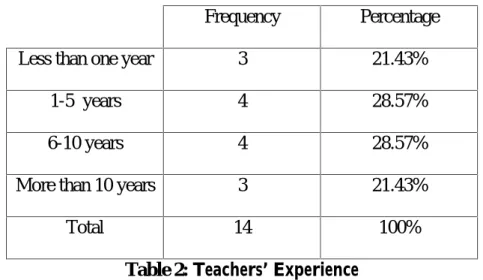
Table 2: Teachers’ Experience. ... 50
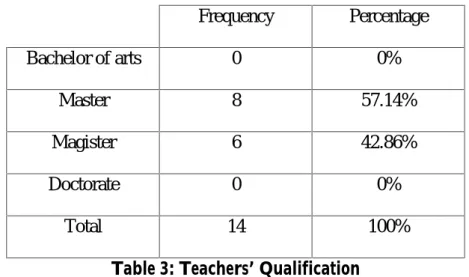
Table 3: Teachers’ Qualification. ... 51
Table 4: Questions of Reflection Given by Teachers to the Students... 52
Table 5: Teachers’ Opinions about the Use of Metacognitive Strategies. ... 53
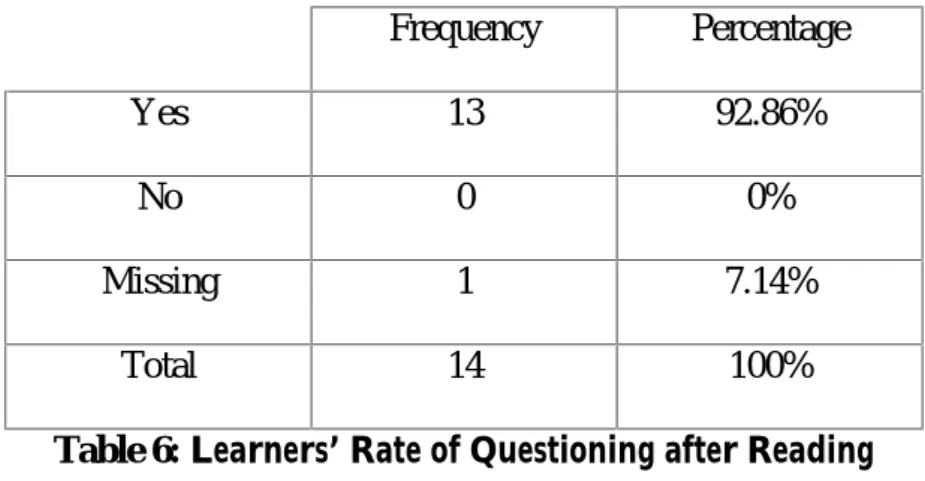
Table 6: Learners’ Rate of Questioning after Reading... 54
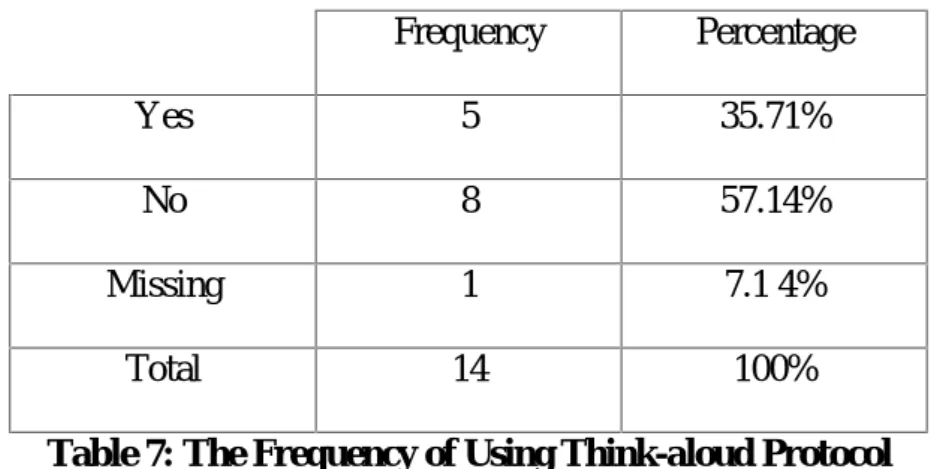
Table 7: The Frequency of Using Think-aloud Protocols ... 55
Table 8: Checking students’ opinions about the text ... 55
Table 9: The Frequency of Teaching about the Conditional Knowledge ... 56
Table 10: The Teachers’ Opinions about their Learners’ Comprehension Level ... 57
Table11: The Importance of Classroom Discussions in Improving Learners Text Comprehension ... 58
Table 12: Teachers’ Opinions about Students’ Frequency in Metacognitive Strategy Use... 58
Table 13: The Development of Higher Order Thinking via Metacognitive Strategy Use . 59 Table 14: The Effect of Metacognitive Strategy Use on Autonomous Learning ... 59
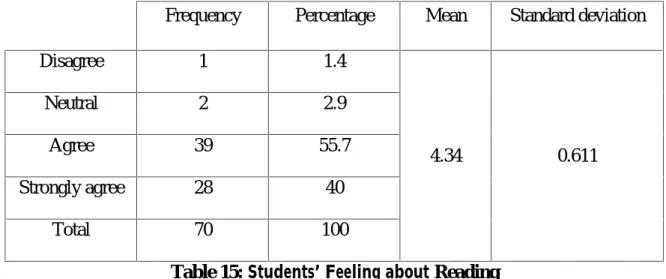
Table 15: Students’ Feeling about Reading ... 61
Table 16: The Importance of Reading in Foreign Language Learning ... 61
Table 17: Connection and Synthesization of Thoughts through Reading ... 62
Table 18: The Joy of Reading in Arabic ... 63
Table 19: Difficulty of Reading in English ... 63
Table 20: The Effect of Mental Representation on Understanding English Texts... 64
Table 21: The Difficulty of Reading Literary and non-Academic Texts ... 65
Table 23: The Effect of the Teacher’s Questions on Students’ Reflection ... 66
Table 24: The Enhancement of the Students’ Schema of Thinking through Classroom Discussions... 67
Table 25: Thoughts’ Questioning, before, during, and after Task Performance ...68
Table 26: Strategy Adjustment during Task Performance ... 70
Table 27: Planning Strategy before Task Performance ... 69
Table 28: Cognitive Capacity Enhancement before, during, and after Task Performance 70 Table 29: Conditional Knowledge and Strategy Use ...71
Table 30: Activity Performance for Goal Attainment ... 72
Table 31: The Importance of Strategy Use in Facilitating the Learning Tasks... 73
Table 32: The Importance of Strategy Use in the Facilitation of the Analysis and Synthesis Processes ...74
Table 33: Strategy Transfer during all Courses...75
Table 34: Setting a Purpose for Reading...76
Table 35: Background Knowledge Use and Text Comprehension ...77
Table 36: Previewing Strategy and Idea Formation ...78
Table 37: Rereading Strategy and Text Comprehension...79
Table 38: Inferring Strategy and Vocabulary and Grammar knowledge ...80
Table 39: The Role of Summarizing in the Statement of the Main Ideas of the Text ...81
Table 40: Strategy Use While Facing comprehension Difficulties ...82
Table 41: Visualization Strategy in Linking Ideas and Memorization ...83
Table 42: Read-aloud Strategy and Information Processing...84
Table of Content
Dedications ...I Acknowledgment ...III Abstract ...IV List of Abbreviations ...V List of Figures ...VIList of Tables...VIII
Introduction ... 2
1. Statement of the Problem ...2
2. Aim of the Study ...3
3. Research Questions ...3
4. Hypothesis ...3
5. Methodology ...3
6. Structure of the Dissertation...3
Chapter One: Metacognition and Strategic Reading
Introduction ...71. Definition of Metacognition...7
2. The Interplay between Metacognition and Cognition...8
3. Flavell conceptualization of Metacognition ...9
3.1. Metacognitive Knowledge ...9
3.1.1. The Person Variable ...9
3.1.2. The Task Variable ...10
3.2. Metacognitive Experience ...10 3.3. Goal ...10 3.4. Actions ...10 4. Components of Metacognition ...11 4.1. Knowledge of Cognition ...11 4.1.1. Declarative Knowledge ...11 4.1.2. Procedural Knowledge ...11 4.1.3. Conditional Knowledge...12 4.2. Regulation of Cognition ...12
5. The Use of Metacognitive Reading Strategies ...13
5.1. Metacognitive Strategy Use in Reading Comprehension ...13
5.2. Classification of Metacognitive Strategies...17
5.2.1. Before Reading Strategies (Planning) ...17
5.2.2. During Reading Strategies (Monitoring)...18
5.2.3. After reading Strategies (Evaluating)...19
6. Metacognitive Strategy Instruction ...20
6.1. Explicit Strategy Instruction...21
6.2. Modeling ...21
6.3. Practice ...21
7. Models for Teaching Metacognitive Strategies for Improving Reading Comprehension23 7.1. Cognitive Academic Language Learning Approach (CALLA) ...22
7.1.1. Preparation ...23
7.1.2. Presentation ...23
7.1.3. Practice ...23
7.1.5. Expansion ...24
7.2.
Reciprocal Teaching (RT) ...248.
Definition of Perception...25Conclusion ...25
Chapter Two
:Reading Comprehension and Metacognitive Strategies
Introduction ...28 1. Definition of Reading... 28 2. Components of Reading ...30 2.1. Decoding ...30 2.2. Linguistic Comprehension ...31 3. Models of Reading ...32 3.1. Bottom-up Model (1950- 1960) ...32 3.2. Top-down Model (1970s)...33 3.3. Interactive Model (1980- 1990) ...344. Factors Effecting Reading ...36
4.1.Automaticity in Word and Sentence Recognition ...36
4.2. Content and Formal Schemata ...37
4.3. Strategies and Metacognitive Skills ...37
4.4. Purpose ...38
4.5. Context ...38
5.Definition and Assessment of Comprehension ...39
6.Reading Comprehension and Metacognitive Strategies in FL Reading ...41
7.The Effectiveness of Metacognitive Strategies on Reading Comprehension ...45
Chapter Three
:Fieldwork investigation
Introduction ...49
1. The Teachers’ Questionnaire ...49
1.1. Description of the Teachers’ Questionnaire ...49
1.2. The Aim of the Teachers’ Questionnaire ...50
1.3. The Analysis of the Teachers’ Questionnaire ...50
2. The Students’ Questionnaire ...60
2.1. Description of the Students’ Questionnaire...60
2.2. The aim of the Students’ Questionnaire ...60
2.3. Analysis of the Students’ Questionnaire ...60
3. Discussion ...87
4. Recommendations and Suggestions ...88
5. Limitations of the Study ... 89
Conclusion...89 General Conclusion ...91 References ...92 Appendices ...102 Appendix1 ...102 Appendix 2 ...105 ﺺﺨﻠﻤﻟا ...108
Introduction ... 2
1. Statement of the Problem ...2
2. Aim of the Study ...3
3. Research Questions ...3
4. Hypothesis ...3
5. Methodology ...3
Introduction
Reading has stirred the interest of many disciplines such as linguistics, psycholinguistics, cognitive psychology and sociolinguistics. As one of the four skills, reading was long identified as merely the ability to recognize words. A learner’s reading proficiency was measured by his ability to read quickly. At first, reading was used as a means to enrich the learners’ knowledge of vocabulary; meaning and comprehension were completely neglected. As a matter of fact, the old approaches sought to teach reading by simply identifying, memorizing and then implementing the unfamiliar words found in the text in the learner’s speech. In contrast, nowadays, reading is more than vocabulary knowledge; it is an opportunity for the learner to interact with the text and gain some world knowledge. In this new view, reading is tightly related to comprehension, and a necessary skill that fosters the learner’s language proficiency. However, understanding a foreign text is not always an easy task to do. To make comprehension more accessible, learners need to implement some metacognitive strategies to help them overcome their reading comprehension problems. “Metacognitive strategies involve thinking about the learning process, planning for learning, monitoring the learning task and evaluating how well one has learned” (Chamot & Kupper, 1989, p.248). These strategies are used at different stages of the reading process to incapacitate comprehension problems that might occur at every stage of reading.
1. Statement of the Problem
EFL students encounter many difficulties to comprehend foreign texts. They think that knowing the meaning of every single word in the text is crucial for understanding and they are unconscious about the existence of compensatory strategies that would help them to better build their comprehension. Pressley et al. (1998) found that students’ comprehension improves not only by reading more texts, but it improves also by the use of even one single
strategy. For that reason, learners should be aware of the existence of metacognitive strategies to overcome their comprehension problems and develop their selves as good strategic readers.
2. Aim of the Study
The implementation of metacognitive strategies in reading comprehension is of paramount importance for EFL learners. The aim of this study is to investigate how 3rd year Mila university center students perceive the effect of metacognitive strategy use on their reading comprehension. Moreover, it seeks to know their awareness about the use of these strategies, that is, if they use them consciously or unconsciously. In addition, this study aims to know if teachers implement these strategies during the reading activities. All in all, this study aims to raise both teachers’ and learners’ awareness about the importance of using metacognitive strategies to develop higher order thinking.
3. Research Questions
Are learners aware of the existence of metacognitive strategies as tools that can facilitate their reading comprehension? Do learners have a positive perception about metacognitive strategies?
4. Hypothesis
In the light of the previous questions and in line with the current research intentions, It is hypothesized that:
Developing students’ positive perceptions about the use of metacognitive strategies in EFL classes would likely lead to the improvement of text comprehension.
5. Methodology
In a descriptive study aiming to test the research hypothesis, two questionnaires will be used. The first questionnaire will be administered to third year university students and the other will be handed out for the university teachers. The two questionnaires aim at
investigating teachers’ and students’ perceptions about the use of metacognitive strategies as a means to enhance reading comprehension in English language classrooms.
6. Structure of the Dissertation
This dissertation is made up of three chapters: two theoretical and one practical. The first chapter is about metacognition and strategic reading. It includes a definition of metacognition, the interplay between cognition and metacognition, Flavell’s model of metacognition, components of metacognition, metacognitive strategy use in reading comprehension and approaches for teaching metacognitive strategies. The second chapter sheds light on reading comprehension in foreign language learning. It includes a definition of reading, its components, models, and the factors affecting it. Furthermore, it provides a definition of comprehension and reading comprehension as well as the effectiveness of metacognitive strategy use in reading comprehension sessions. The third chapter is a field work investigation. It describes, analyses and discusses the teachers’ and students’ questionnaires and then it provides some recommendations and suggestions for both of them.
Chapter One
Metacognition and Strategic Reading
Chapter One: Metacognition and Strategic Reading
Introduction ...7
1. Definition of Metacognition...7
2. The Interplay between Metacognition and Cognition...8
3. Flavell conceptualization of Metacognition ...9
3.1. Metacognitive Knowledge ...9
3.1.1. The Person Variable ...9
3.1.2. The Task Variable ...10
3.1.3. The Strategy Variable...10
3.2. Metacognitive Experience ...10 3.3. Goal ...10 3.4. Actions ...10 4. Components of Metacognition ...11 4.1. Knowledge of Cognition ...11 4.1.1. Declarative Knowledge ...11 4.1.2. Procedural Knowledge ...11 4.1.3. Conditional Knowledge...12 4.2. Regulation of Cognition ...12
5. The Use of Metacognitive Reading Strategies ...13
5.1. Metacognitive Strategy Use in Reading Comprehension ...13
5.2. Classification of Metacognitive Strategies...17
5.2.1. Before Reading Strategies (Planning) ...17
5.2.3. After reading Strategies (Evaluating)...19
6. Metacognitive Strategy Instruction ...20
6.1. Explicit Strategy Instruction...21
6.2. Modeling ...21
6.3. Practice ...21
7. Models for Teaching Metacognitive Strategies for Improving Reading Comprehension23 7.1. Cognitive Academic Language Learning Approach (CALLA) ...22
7.1.1. Preparation ...23 7.1.2. Presentation ...23 7.1.3. Practice ...23 7.1.4. Evaluation...24 7.1.5. Expansion ...24
7.2.
Reciprocal Teaching (RT) ...248.
Definition of Perception...25 Conclusion ...25Chapter One: Metacognition and Strategic Reading
Introduction
Metacognition brought a new view to learning where the learner can do a lot to change and promote his learning, and the teacher is merely a guide and a facilitator. Reading which is found as one of the least developed skill according to Educational Testing Service, Test of English as a Foreign Language, Internet Based Test, International English Language Testing Service (IELTS) (in Meniado, 2016), can be developed by the use of metacognitive strategies. The idea is that the learner, who speaks to himself during the attempt to understand a text, seems to be more reflective and tends to question the author’s ideas and doubt about them. These behaviors are thought to be very effective in helping the learner to construct his understanding of the text. This chapter offers an overview of metacognition, its definition, its interaction with cognition, Flavell’s model of metacognition, components of metacognition, and it also provides a view of metacognitive strategies and their application in the classroom.
1. Definition of Metacognition
It is a concept that is composed of two words, the prefix “meta” which means after and the root “cognition” which refers to the cognitive processes like understanding and thinking that are involved in a particular cognitive task or activity (Aebersold & Field, 1997). This definition means to explore what was happening after every accomplishment of a cognitive activity; that is, how can some people understand or recall information they studied and others cannot. It is the secret power that enables some learners to accomplish a particular task successfully.
According to Korotaeva (2014), metacognition is neither a skill nor a personality trait. She describes it as one aspect of self- regulation in which actions or orders are given from the interior of the student depending on his knowledge of himself, she said:
Metacognition is closely related with the concept of self-regulated learning, it can be seen as an internal management process of self –regulation which can not be seen as a personality trait or a specific skill, student guided by knowledge of his personality, uses the necessary strategies of learning. Learning in this sense is not something that aimed at student but comes from students themselves. (p.40)
Flavell who is known as the first to introduce the term “metacognition” tried to understand the interaction between cognition and consciousness. He identifies metacognition as one’s knowledge of one’s own mental processes and the ability to regulate them to achieve the learning goals. Flavell (1976, cited in Iway, 2011) comments that metacognition is: “one’s knowledge concerning one’s own cognitive processes and outcomes or anything related to them […] The active monitoring and consequent regulation and orchestration of these processes in relation to the cognitive objects or data on which they bear, usually in the service of some concrete goal or objective” (p.232), or it is simply awareness of cognition and its adjustment (Flavell, 1979; Çubukçu, 2008).
Metacognition is widely defined as: “cognition of cognition” (Takollou, 2011; Koda, 2004; Day & Bamford, 1998). Metacognition is generally one’s knowledge of one’s own thinking or cognitive processes during task performance.
In reading, Kelly and Clausen-Grace (2013) say that metacognition takes place when a person tries to make his thoughts visible during reading. In other words, the reader speaks to himself about what he is reading. In their own words: “metacognition also means to make thinking visible or to take silence out of reading” (p.4).
2. The Interplay between Metacognition and Cognition
Metacognition was considered for many years as a concept separable from cognition, but now researchers need to take into consideration metacognition as one factor to understand a person‘s performance in particular cognitive task (Beall & Baker, 2009). Veenman et al.
cognition, they contend that metacognition is the series of self-instructions that are carried out by cognition, and in addition the person’s cognitive activities are under the supervision and control of metacognition. This indicates that one cannot imagine metacognition without cognition and vice versa; they work together to achieve the learning goals.
This strong relation is apparent in the attempt to distinguish between metacognitive strategies and cognitive strategies in reading activities. Williams and Atkins (2009) confirm that this distinction is impossible, because there is no reading activity that is purely metacognitive or that is purely cognitive. Even book’s designers cannot make a clear cut between both. Sometimes they consider some activities as metacognitive and other times as cognitive.
3. Flavell Conceptualization of Metacognition
Flavell (1979) provides a model of metacognition which is considered as the basis of research in metacognition. He divided metacognition into four major components: metacognitive knowledge, metacognitive experience, goals and actions.
3.1.
Metacognitive knowledge
It is primarily used to refer to a person’s awareness of his cognition as well as his knowledge of the person, task and strategy factors around him that may affect his comprehension during the performance of a particular activity (Flavell, 1979). Devine (1993) points out to the importance of metacognitive knowledge, which he relates to successful language learning. He says that “a successful learner is one who has ample metacognitive knowledge about the self as learner, about the nature of the cognitive task and about the appropriate strategies for achieving goals” (cited in, El-Kouny, 2004, p.6).
3.1.1. The Person Variable
According to Flavell (1979), it is the learner’s knowledge of his abilities and weaknesses as a reader or processor. It can be clear, as Philip and Kim Hua (2006) exemplify,
in the learner’s tendency to use underlining instead of note taking because he knows that he is good at underlining and poor at note-taking
3.1.2. The Task Variable
It is the knowledge of the task’s nature, demands, type, purposes, length ….etc (Flavell, 1979; Philip & Kim khua, 2006). The reader must be aware of the characteristics of the text he is going to read.
3.1.3. The Strategy Variable
It refers to the learner’s knowledge or awareness of the metacognitive strategies that help him in the accomplishment of the task at hand (Flavell, 1979). He should learn the strategies that are used by good readers like making inferences, summarizing, previewing …ect.
3.2.
Metacognitive Experience
Flavell (1979) defines it as “any conscious cognitive or affective experiences that accompany and pertain to any intellectual enterprise” (p. 906). Thus it can be understood as what the learner knows about his cognition and feeling during reading. The learner knows that he has or has not understood the written material, and that he feels anxious, motivated, and satisfied or that he loses his concentration.
3.3.
Goal
It is the purpose or the goal for doing an activity. It is what aimed as achievement from doing something, like reading for the gist or for particular details (Flavell, 1979). Thus, the reader should set an objective for reading before he initiates the act of reading.
3.4.
Actions
It is the use of strategies like metacognitive strategies to monitor and control the cognitive activities, and to evaluate the degree of success in task performance or in achieving
4. Components of Metacognition
Researchers agree that metacognition has two dimensions. They said that metacognition is composed of both knowledge of cognition and regulation of cognition (Flavell, 1976, in Iwai, 2011; Philip & Kim Hua, 2006; McCormick, 2003).
4.1.
Knowledge of Cognition
Philip and Kim Hua (2006) define it as “knowledge about one’s own cognitive resources and knowledge about how compatible the demands of learning situations are with one’s own resources” (p. 4). It is the awareness of the mental processes and how well they are used to carry out the task. In reading, it is the awareness of the reading purpose and the strategies that help in achieving that purpose (Meloth, 1990). Knowledge of cognition is divided into three types mainly, declarative knowledge, procedural knowledge and conditional knowledge.
4.1.1. Declarative Knowledge
McCormick (2003) defines it as the “knowledge of a person about his or her abilities and the salient learning characteristics that affect cognitive processing” (p.80). It is the person’s knowledge of his abilities concerning a particular learning task and his awareness of what he should have as characteristics to accomplish it successfully. In addition to his knowledge about his strengths, the person who has declarative knowledge also knows about his weaknesses, self efficacy and motivation during the task performance (Zimmerman & Risemberg, 1997). It also incorporates learners’ knowledge of different strategies. In reading, for example, he knows about skimming, scanning, inferring …etc. (Iwai, 2011).
4.1.2. Procedural Knowledge
It is the knowledge and ways of how to apply metacognitive strategies (McCormick, 2003; Iwai, 2011). They are also called skills because they are distinctive from declarative knowledge in that they refer to the person’s ability to use metacognitive strategies to regulate
his comprehension. It gives the learner feedback about his performance which is a real judgment about his ability to plan and regulate his reading comprehension (Veenman et al., 2006).
4.1.3. Conditional Knowledge
It is the knowledge about when, where and why to use metacognitive strategies, or the selection of the appropriate time and situation for implementing metacognitive strategies (Hudson, 2007; Iwai, 2011; McCormick, 2003).
4.2.
Regulation of Cognition
It is the regulation and control of our mental processes in relation to a particular goal (Zhang & Wu, 2009). In addition, it is the subsequent planning, monitoring and evaluation of the implemented strategies to achieve the goal (Flavell, 1979; Veenman et al., 2006; McCormick, 2003).
Philip and Kim Hua (2006) divided regulation of cognition into two components respectively: strategic formulation and strategic implementation. Strategic formulation is the examination of the conditions and the context in which the task‘s performance is actually taking place and the planning of the potential strategy that help in the successful accomplishment of the task. Strategic implementation is the application of the selected strategy and the evaluation of its effectiveness regarding the goal’s achievement.
Philip (2005) develops an approach self-regulated approach to strategic learning (SRSL) whereby he provides a path for learners in their strategy use and describes what actually happens in the regulation of cognition. First, the learner makes some predictions about the text by skimming, looking at the titles, and pictures in the text. In addition, the learner should be aware of his reading goal, task demands and the circumstances around him such as his feelings, abilities and weaknesses. It is also important in this first stage that the learner makes decisions about the strategy or strategies he/ she is going to use in reading the
text. For instance, the learner might decide to use underlining, inferences, note-taking as strategies to understand the main ideas. Second, as he starts reading, the learner monitors and evaluates these strategies to see if they helped him to achieve his desired goal; in case he failed, he modified his plan and re-implements new strategies. In a curricular way, the learner follows the same first steps analyzing, planning, implementing, comprehending, problem solving, evaluating and modifying (APICPEM) until he can reach his goal. These steps are presented in figure (1).
Figure1: SRSL Processing Framework (Philip, 2005).
5. The Use of Metacognitive Reading Strategies
Metacognitive strategies are implemented as strategies that can improve learners’ comprehension of the texts. They are classified into three main classes according to the period of reading.
5.1.
Metacognitive Strategy use in Reading Comprehension
Their name for many researchers is associated with the processes of planning, monitoring and evaluating the learning process (Tavakoli, 2015; Pei, 2014; Chamot & Kupper, 1989; Santana, 2014).
They were described as a sign of high mental engagement or practices (Tavakoli, 2015) because they make use of high cognitive processes like predicting, inferring, hypothesizing …etc. (Ismail & Tawalbeh, 2014). Because they were described as intentional (Sheory & Mokhtari, 2001) and self-regulatory strategies (Kupper & Chamot ,1989); they can help the learner to evaluate and be aware of his learning (Santana, 2014; Kupper & Chamot, 1989; Tavakoli, 2015).
For many researchers, the credit for promoting effective reading and developing good readers must be given to metacognitive strategies (Ismail & Tawlbeh, 2014; Santana, 2014). Learners who do not use metacognitive strategies are unguided and without clear goal, as O’Malley and Chamot (1990) put it: “Students without metacognitive approaches are essentially learners without direction or opportunity to plan their learning, monitor their progress, or review their accomplishments and future learning directions” (p.8).
A wide range of metacognitive strategies are mentioned by many researchers (Aebersold & Field, 1997; Pie, 2014; Hudson, 2007; Duke & Pearson, 2001). The most common ones are listed below:
Using background knowledge: The learner activates or recalls what he already knows about the topic that is initiated by the author in order to understand new information (Duke & Pearson, 2002)
Setting a purpose for reading: It is the reason behind reading a particular text which can be for complete understanding, for particular details, or for getting the gist (Aebersold & Field, 1997).
Previewing the text (title, subtitle, pictures, graphs, tables): Looking at the title, picture, graphs help the learner to have an idea about the text because they all reflect the text’s content (Aebersold & Field, 1997).
Using the text’s structure: Knowing the structure of a text. For the learner, knowing that a story has a setting, a problem, a resolution, a theme … helps him to relate parts of the text together and organize ideas in his mind in a meaningful way, which in turn, helps him to recall or remember information or events in the story easily (Duke & Pearson, 2002). Making inferences: It is an attempt to interpret the text. Based on what the author stated
in his text and included as contextual clues, the reader guesses the meaning of unfamiliar words and tries to understand the author’s intention or message. For example, identifying the pronoun of the referent in the text (Pressley & Gaskins, 2006).
Rereading: The reader pays more attention to a particular part of a text or to the whole of it. It is, in fact, a monitoring strategy because it enables the learner to adjust his reading comprehension as he feels that he does not understand the main ideas or loses his concentration during reading (Pressley, 2002).
Focusing on the important ideas and skipping the unimportant ideas: The reader gives more time and attention to particular statements or ideas or even passages in the text that seem relevant to his goal (Pressley, 2002).
Skimming and Scanning: In fact they are interrelated strategies. As the learner skims the text, he will locate the important ideas, as well as, he can have an idea about the content and the general features of the text like its length, structure, difficulty …etc (Pressley, 2002).
Making predictions and confirming them: The reader can form predictions about the text’s content either before or during reading with the aid of his background knowledge. Updating and changing these predictions as the learner encounters every new statement help him to build his understanding of the author’s ideas step by step (Pressley, 2002). Thus the reader will add to his background knowledge new information or question it or even change it.
Asking questions about the text and answering them: The reader asks questions about confusing statements or passages to confirm or disconfirm his predictions, and to be able to make a link between different parts of the text and virtually to understand the text appropriately (Duke & Pearson, 2001).
Evaluating information in the text in relation to prior knowledge and world
knowledge: Interesting, boring, credible are the adjectives that the reader might use to
evaluate the text he reads (Pressley, 2002; Pressley & Gaskins, 2006). The information presented by the author should not be taken for granted and accepted by the reader, but they should be compared to what the reader already knows about the topic; the reader should also evaluate the author’s ideas, if they were well presented in a good way and supported with enough arguments (Abersold & field, 1997).
Making a summary or an outline of the text: They are one of the ways used by good readers along with paraphrasing, underlining and note-taking to represent the main ideas of the text (Pressley, 2002). In outlining, the reader states the order of the ideas as they are expressed by the author (Aebersold & Field, 1997). Summary involves a synthesis of the main ideas in a written version similar to the original text (Dole et al., 1991).
Create a mental picture of the text (mental imagery): In a story, for example, the reader imagines how the characters and the scene would be like according to the author’s description. This allows him as Duke and Pearson (2001) say: “… to add in all those little details that authors have left unsaid” (p. 454). This in turn, as they noted, helps him to understand and recall what he has read.
Making personal connections to the text: By using this strategy, the reader makes a link between what he has read and his personal and academic experiences. As Duke and Pearson (2001) exemplify, the reader can compare characters, incidents to aspects of his experience.
Monitoring comprehension: It involves both awareness and regulation of reading comprehension. The reader is aware of all the surrounding conditions or factors that might influence his reading comprehension. For example, he is aware of the text’s difficulty, of the relevance of the text to his goal and prior knowledge, of when he loses his concentration during reading, and when he understands or does not understand the author’ ideas. This awareness allows him to adjust his strategies to regulate his comprehension. Furthermore, he might reread the text, search for other texts …etc (Pressley, 2002; Pressley & Gaskins, 2006).
5.2. Classification of Metacognitive Strategies
Researchers tend to categorize metacognitive strategies in reading comprehension into three types. They divide them into before, during and after reading strategies. Thus, each of the previous mentioned strategies falls under one of the categories (Pressley, 2002; Pressley & Gaskins, 2006; Duke & Pearson, 2001; Hudson, 2007).
5.2.1. Before Reading Strategies (Planning)
They are also called planning strategies, because they help the learner to prepare a clear plan to deal with the text, or to predetermine the appropriate strategy and all the necessary steps and procedures to accomplish the task successfully (Phakiti, 2006). The strategies that can be put within this category are:
Setting a purpose for reading. Using text’s structure.
Activating background knowledge.
Making hypotheses or predictions about the text’s content.
Deciding which part of the text to focus on and which one to ignore. Previewing and skimming the text.
Pressley and Gaskins (2006) conclude that a good reader will have at the end an idea about the text he is going to read. They say: “The good reader leaves the preview with an idea about what is to come in the text” (p.100).
5.2.2. During Reading Strategies (Monitoring)
They are activated as the reader actually starts reading (Pressley, 2002). It is the learner’s regulation of his reading comprehension if he sees that there is a contradiction or a mismatch between his predictions or understandings and the author’s ideas (Aebersold & Field, 1997).
The learner might also monitor his reading to check the relevance of the text’s content to his goal and to his prior knowledge and when he feels that he loses his concentration during reading. This regulation can be achieved by adjusting his strategies like rereading, slowing down his reading, searching for other texts (Pressley, 2002; Pressley & Gaskins, 2006). Researchers mention many strategies that can be grouped under this category (Pressley, 2002; Pressley & Gaskins, 2006; Duke & Pearson, 2001).
Rereading. Inferring.
Linking information in the text to prior knowledge.
Relating the parts of the text to each others to get the overall meaning. Making and modifying predictions.
Skipping the unimportant ideas and focusing on the main ideas. Evaluating the information presented in the text.
Reacting emotionally and intellectually to the text. Monitoring comprehension.
5.2.3. After Reading Strategies (Evaluating)
They are also called self-assessment strategies (El-Kouny, 2004). After finishing reading, the reader assesses and judges his understanding of the information presented by the author in relation to his background knowledge, life experiences and peer’s understanding and if the information he extracted from the text are presented in a logical way and whether they are supported by enough details and by a famous author (Aebersold & Field, 1997).
The reader might also reprocess the text; he might reread some parts of it, and continue to reflect upon it. He can also monitor his reading to see if he has understood the text appropriately. More interestingly, he might think of how to apply the information he learned to new situations (Pressley, 2002; Pressley & Gaskins, 2006).
Duke and Pearson (2001) add other strategies: Deciding if the goals are achieved. Making personal connections to the text. Updating and confirming predictions. Summarizing the major ideas.
Seeking additional information.
Reacting intellectually or emotionally to the text.
Figure2: Active Reading Strategies (Helgeson, 2010).
6. Metacognitive Strategy Instruction
It seems that teaching metacognitive strategies would alleviate the teacher’s burden of explaining, clarifying and reviewing every text for his/her learners, before, during or after reading, as Nuttal (1996) contends:
It is impossible to familiarize them (students) with every text they will ever want to read; but what we can do is give them techniques for approaching texts of various kinds, to be used for various purposes. That is the essence of teaching reading. (p.38)
One of these techniques that are suggested by many researchers are metacognitive strategies. They help the learner to understand the text (Phakiti, 2006; Tavakoli & Koosha, 2015). In their studies; for example, Phakiti (2006) and Tavakoli (2014) and Koosha (2015) found that students who use metacognitive strategies perform in a good way in the reading test and course.
In fact, researchers do not agree on the number of strategies that should be taught; some would defend the teaching of multiple strategies, while others do not. The aim of that is to enable the learners to select the appropriate strategies from a large repertoire of strategies in a particular situation (National Reading Panel, 2000; Palincsar & Brown, 1984). Others stand against this option and insist on teaching only few strategies for better reading comprehension (Pressley, 2002; Duke & Pearson, 2001, 2002). As Duke and Pearson (2001) put it: “comprehension is best when it focuses on few well taught, well-learned strategies” (236).
There are several steps for teachers to follow in their teaching of metacognitive strategies which are as follows:
6.1. Explicit Strategy Instruction
First, the teacher describes and explains how, when, and where to use the intended strategies. It is important in this presentation stage that he shows his learners the importance of each strategy in solving comprehension problems, because the more learners know about the value of a particular strategy, the more likely they will be motivated to implement it in their readings (Iwai, 2011; Duke & Pearson, 2001; Chamot & Kupper, 1989).
6.2. Modeling
It is the time when the teacher shows his students how to apply the learned strategies, generally by using think-aloud protocol (Takallou, 2011; Iwai, 2011). He models the strategy use and demonstrates to his learners how to deal with the text.
6.3. Practice
Under the teacher’s guidance, the learners would practice the strategies either collaboratively or independently. This will allow them to receive feedback from their teacher and peers regarding their strategy use. It is noteworthy in this phase that the learner has ample time to practice the strategies (Veenman et al., 2006), and that teacher gradually reduces scaffolding as his learners begin to employ the strategies independently and gain some
experience in using them (Tavakoli & Koosha, 2015; Iwai, 2011; Takallou, 2011; Chamot & Kupper,1989; Santana, 2014; Duke & Pearson, 2001; Kraayenoord, 2010). The strategy instruction starts as more teacher-centered approach and ends as a learner-centered one as in shown in figure (3).
Figure3: Gradual Release of Responsibility (Duke & Pearson, 2002).
The effectiveness of metacognitive strategy instruction cannot be guaranteed unless it is integrated into regular classroom activities, that is to say, teaching learners how to use and apply different strategies while they are learning or acquiring the input, and while the teacher is accomplishing the courses’ objectives (Takallou, 2011; Tavakoli & Koosha, 2015). In addition, strategy instruction cannot be successful unless teachers take into consideration individual differences in the classroom when planning for and teaching metacognitive strategies (Vennman et al., 2006; Kraayenoord, 2010). In this respect, Kraayenoord claims that it has been shown that instructions in metacognitive knowledge, monitoring, control improve comprehension, but it is not always the case for all students, like students with disabilities, second language learners….etc. Instruction should be varied in a way as to respond to students’ needs.
7. Models of Teaching Metacognitive Strategies for Improving Reading
Comprehension
There are many approaches to strategy instruction for teaching reading comprehension, but the most common ones in the literature are cognitive academic language learning approach (CALLA) and reciprocal teaching models (RT):
7.1. Cognitive Academic Language Learning Approach
It is based on explicit and direct strategy instruction (Pei, 2015; Takallou, 2011). The teacher who uses CALLA should follow five steps as was explained by many researchers (Koosha & Tavakoli, 2015; Takallou, 2011; Çubukçu, 2008).
7.1.1. Preparation
The teacher shows his students the advantages of using metacognitive strategies in reading and that it fosters comprehension, and enables them to discover the strategies they are using, and explains to them how their own cognitive abilities would help them to succeed in their learning.
7.1.2. Presentation
The teacher presents the strategies to his learners and explains to them when, where and how to use them. At the end of this phase, the learner can acquire the three types of metacognitive knowledge. That is, the declarative knowledge, the conditional knowledge and the procedural knowledge.
7.1.3. Practice
Learners, in this stage, are given opportunities to practice the strategies that were introduced by their teacher as an integral part of the lesson. It means to apply the strategies on the content, the input or texts that are given by the teacher and which are part of the curriculum.
7.1.4. Evaluation
After practicing the learned strategies, the learners are encouraged to reflect upon their performance in the reading task, and evaluate the effectiveness of their strategy use. They see whether the strategies they have used during the task, helped them to better understand the text.
7.1.5. Expansion
Learners are encouraged to apply the learned strategies to new contexts and to justify their strategy use. In this way learners will be strategic in solving all types of tasks.
7.2. Reciprocal Teaching
This approach to strategy instruction is based on developing four strategies that are believed to be used by expert readers: clarifying, predicting, summarizing and questioning (El-Kouny, 2004; Palincsar & Brown, 1984; Kraayenoord, 2010).The selection of the four strategies was not random. In summarizing and questioning, the learner is asked to focus on the main idbeas and check if he has understood the content. Furthermore, asking the learner to clarify his answers is in turn an attempt to engage them in critical thinking. Making predictions helps learner to set hypotheses about the content of the text and testing them in every new sentence or content (Palincsar & Brown, 1984).
After the teacher’s explanation and modeling of these strategies, both he and his learners would practice them on texts by taking turns in dialogue to discuss their strategy use (Kraayenoord, 2010; Palincsar & Brown, 1984). In their study, Palincsar and Brown (1984) found that the four strategies can develop sophisticated readers. They concluded that these strategies promote both comprehension and comprehension monitoring; the learner is not only aware of his understanding, bu he is also able to regulate it, they say:
in summary, these four strategies were selected because they provide a dual function, that of enhancing comprehension and the same time affording an
opportunity for the students to check whether it is accruing .That is, they can be both comprehension-fostering and comprehension –monitoring activities if purely used. (p.4)
8. Definition of Perception
According to Noë (2004), perception is not an internal process that happens in the mind, but rather a skillful activity which depends on human senses. In other words, there is no perception without the ability to see, touch, smell, taste, or hear. She says: “perception is not something that happens to us or in us, it is something we do” (p.1). Rooks and Willson (2000) add that perception is the recognition and interpretation of the input or stimuli that comes from the environment. They say: “perception refers to how we make sense of our environment” (p.2). Furthermore, Gould (1990) defines perception as the process of making hypotheses about the stimuli that comes from both the internal and the external world and the testing of these hypotheses and the selection of the one that best suit the individual. He claims that the person is not aware of this process which is described as an individualized experience that can be wrong, incomplete and unreliable.
Conclusion
The use of metacognitive strategies in reading allows learners to reflect upon the text, monitor, regulate and evaluate their reading comprehension. During the attempt to understand a text, learners seems active, they make inferences; they paraphrase, summarize the main ideas, underline the important sentences, evaluate and criticize the ideas of the author. Thus, implementing these strategies can improve the learners’ reading comprehension and help them to get rid of their bad habits like dictionary overuse and the focus on word and sentence meaning. Though, in the new approaches of teaching, the teacher is just a facilitator and a guide, his role remains difficult. In addition to the burden of preparing and explaining the
lesson, his role in implementing metacognitive strategy instruction is asked to be more effective.
Chapter Two
Reading Comprehension and Metacognitive Strategies
Introduction ...28 1. Definition of Reading... 28 2. Components of Reading ...30 2.1. Decoding ...30 2.2. Linguistic Comprehension ...31 3. Models of Reading ...32 3.1. Bottom-up Model (1950- 1960) ...32 3.2. Top-down Model (1970s)...33 3.3. Interactive Model (1980- 1990) ...34 4. Factors Effecting Reading ...36 4.1.Automaticity in Word and Sentence Recognition ...36
4.2. Content and Formal Schemata ...37 4.3. Strategies and Metacognitive Skills ...37 4.4. Purpose ...38 4.5. Context ...38 5.Definition and Assessment of Comprehension ...39 6.Reading Comprehension and Metacognitive Strategies in FL Reading ...41
7.The Effectiveness of Metacognitive Strategies on Reading Comprehension ...45 Conclusion...47
Chapter Two:
Reading Comprehension and Metacognitive Strategies
Introduction
Reading is one of the four skills necessary for acquiring a language. The reading ability is of extreme importance for second language (SL) and foreign language (FL) learners; researchers consider it as the most important skill to develop for it fosters the improvement of other skills. The reading activity is not carried out randomly, instead; readers must adopt some strategies and skills that will enable them to comprehend what lies beneath the written word. This chapter deals both with reading and comprehension; it tries to explain each term separately, and then it tackles the interrelation between both concepts. First, it discusses the definition of reading, factors affecting reading, and models of reading. Second it defines comprehension in relation to reading. Finally, the last element dealt with in this chapter is reading comprehension as a metacognitive process.
1. Definition of Reading
The views of researchers towards reading have evolved through time. At first, reading was solely viewed as the process of putting written symbols into sounds or word recognition. Then, it was viewed as a process of identifying words and their meanings. During that period, reading was simply perceived as a passive skill in which the reader is only a receiver of information from the text. Nowadays, reading is perceived differently; it is the ability to derive meaning from a printed material (Alyousef, 2006). In other words, the reader tries to build his understanding of the author’s ideas and messages. More deeply, it is considered as an “interactive, constructive and contextualized process” (Usó-Juan & Martínez-Flor, 2006, p.261).This means that reading cannot be understood only in the specific context, where it actually takes place and where many factors interact to influence the reader’s comprehension of the text. Taking a similar perspective, Dutcher (1990) says that reading is the process through which the dynamic interaction of the reader’s background knowledge, the
information inferred from the written material, and the reading situation work together to build understanding of the text.
From a cognitive perspective, reading is considered as a cognitive activity (Flavell, 1979). It entails the use of higher cognitive processes such as thinking, reasoning and evaluating, as Gates (1949, in Stuart & Stainthorp, 2016) states: “reading is a complex organization of patterns of higher mental processes…that should embrace all types of thinking, evaluating, judging, imagining, reasoning and problem solving” (p.23). Similarly, Goodman (1967) describes reading as a psycholinguistic process. For him it consists of the reader’s ability to make inferences with the aid of some cues without paying attention to every word in the text. This skill is critical in every reading activity, he says:
More simply stated, reading is a psycholinguistic guessing game. It involves an interaction between thought and language. Efficient reading does not result from precise perception and identification of all elements, but from skill in selecting the fewest, most productive cues necessary to produce guesses which are right the first time. The ability to anticipate that which has not been seen, of course, is vital in reading, just as the ability to anticipate what has not yet been heard is vital in listening. (p.104)
Forrest-Pressley and Walle (1984) add that reading requires both cognition and metacognition. According to them, cognition is subsumed in metacognition. They say that many are not aware of the difference between the two concepts. They define cognition as the processes and strategies used by the reader such as memory use, attention, decoding …etc., whereas metacognition is both one’s awareness of his or her cognitions and his or her ability to control them. So, in addition to the reader’s use of these cognitive abilities and strategies to perform the reading task, the reader should be aware of his cognition and be able to control and regulate it. That is to say, he must be aware of his understanding, abilities and weaknesses, the task’s demands and difficulties, and aware of the different strategies that help
him to perform the task. According to Flavell (1979), this awareness is what result in good reading outcomes.
2. Components of Reading
Overtime, many researchers have tried to decompose reading Gates (1949 ,cited in Stuart and Stainthorp, 2016). This componential approach to reading seeks to identify elements forming the reading process. This approach is also called “the Simple View of Reading”. The most known version of it is proposed by Ghough and Tunmer (1986, in Cain, 2010), and then revisited by Hoover and Gough (1990, in Cain, 2010). These researchers’ work claims that word recognition, linguistic comprehension, and reading comprehension are the three essential elements necessary for reading to occur. According to this view comprehension is the product of two components: decoding and language comprehension (Ghough & Tunmer, 1986; Hoover & Gough, 1990, in Cain, 2010).
2.1. Decoding
Decoding or phonics is “the efficient, context-free word recognition” (Cain, 2010, p.2014). It might also being referred to as fluency. It is the ability to recognize words rapidly and automatically without paying attention to the meaning of the words in the reading context. Put in another way, it is the ability to acknowledge the words in a very short time. Though, word recognition does not always mean comprehension, developing this skill allows the learner to allocate his time and energy exclusively to the text comprehension. The problem in foreign and second language reading is that the development of skilled decoding requires a long period of time and a lot of practice, as Pressley (2002) states:
If a student is not fluent in word recognition, he/she is thinking about the sounds of the individual letters and letter combinations rather than using that energy to make sense of the text being read. In contrast, because a fluent reader dedicates
little capacity to word recognition, most of his/her capacity is available for comprehension. (p.292)
2.2. Linguistic Comprehension
Linguistic comprehension is “the ability to access word meanings and produce sentence and discourse interpretations” (Ghough & Tunmer, 1986; Hoover & Gough, 1990, in Cain, 2010, p.214). It involves both the ability to understand the literal and the intended meaning of sentences. In other words, the learner has to identify the meaning of the words and sentences in the text and predict what the author meant by using them in relation to the topic, the context and his background knowledge. Thus, comprehension does not only entail the ability to decode the words’ meaning but also the ability to interpret them in the context.
The Simple View of Reading represents the reading comprehension process in a simple equation: R= D × L. R is reading, D is decoding and L is linguistic comprehension. The figure 4 represents the Simple View of Reading:
Figure4: The Simple View of Reading (Gough & Tunmer, 1986).
As shown in the figure (4), the relationship between decoding and linguistic comprehension is one of multiplication rather than addition. This entails that both elements are of equal importance. The value of each variable ranges from 0 to 1. It suggests that if the reader has poor skills in one of the two components, this will hinder his reading comprehension performance. So, in order to be able to comprehend a foreign text, the second language reader needs to have a certain level of automaticity in reading and in vocabulary knowledge to access successful comprehension.
Linguistic Comprehension
Reading Comprehension Decoding
3. Models of Reading
Reading models are an attempt “to explain how an individual perceives a word, processes a clause, and comprehends a text.” (Singer & Ruddel, 1985, p.375, in Wu, 2016).Different models with different principles have been set through time. These models make the process of reading comprehension easier and help readers to interpret texts and solve their problems while reading (Eskey, 2005). Furthermore, they provide an overview on how comprehension is built during reading. There are three models: “bottom-up”, “top-down” and “interactive” model.
3.1.
The Bottom-up Model ( 1950- 1960)
The bottom-up approach or the text driven approach relies on the decoding skills. This model simply focuses on putting into sound the written words. It draws heavily on the behaviourist learning theory established by B.F. Skinner. The bottom-up models “starts with the printed stimuli and work their way up to the higher level stages” (Samuels & Kamil, 1988, p. 31). It perceives the act of reading as a mechanical process of decoding words and sentences. In other word, reading in a bottom-up approach is linking words to form sentences, sentences to form paragraphs, and paragraphs to form texts. As demonstrated below in figure (5), the bottom-up approach moves from the identification and connection of words and phonemes to their pronunciation and last to building meaning.
Some of the shortcomings of the bottom-up theory are that it considers the learner as a passive recipient that has no contribution in the reading activity. It neglects his potential and ability to make predictions (Eskey, 1973, in Khaokaew, 2012). As a matter of fact, this might prevent him from learning and acquiring new information, as it might also be a barrier for using reading for learning purposes. This is mainly due to the fact that readers in this model just focus on improving their pronunciation skill without paying attention to gain knowledge from the texts they encounter.
3.2.
The Top down
Model (1970’s)
The top down model or concept driven model came as a reaction to the bottom-up theory. This view of reading was proposed by Goodman who coined this model “reading as a psycholinguistic guessing game” (1967). This model emphasizes on the higher level processes of thinking. The reader makes inferences and predictions about the text and confirms them in continuous endeavor to understand the main ideas of the text, as Kamil and Samuel point out: “start with hypothesis and predictions and attempt to verify them by working down to the printed stimuli” (Samuels & Kamil, 1988, p.31). As the reader reads the text he processes it and compares it with what he already knows, he also might make connections with his personal experiences. All these previous mentioned strategies are what shape the predictions the readers make. At each stage of the reading passage, he stops and makes some presuppositions and predictions and along the way his predictions might be confirmed or disconfirmed.
The bottom-up approach focuses on what the reader brings to the process of reading (Goodman, 1967) as it considers him as the most important element for comprehension to occur. While reading, the reader relies on his background knowledge and his past experiences to build understanding of a text, and the written symbols are just considered as a means to