HAL Id: hal-03110204
https://hal.archives-ouvertes.fr/hal-03110204
Submitted on 14 Jan 2021
HAL is a multi-disciplinary open access
archive for the deposit and dissemination of
sci-entific research documents, whether they are
pub-lished or not. The documents may come from
teaching and research institutions in France or
abroad, or from public or private research centers.
L’archive ouverte pluridisciplinaire HAL, est
destinée au dépôt et à la diffusion de documents
scientifiques de niveau recherche, publiés ou non,
émanant des établissements d’enseignement et de
recherche français ou étrangers, des laboratoires
publics ou privés.
Isotopic composition of sulfur in size-resolved marine
aerosols above the Atlantic Ocean
Nicolas Patris, Nikolaos Mihalopoulos, Evangelos Baboukas, Jean Jouzel
To cite this version:
Nicolas Patris, Nikolaos Mihalopoulos, Evangelos Baboukas, Jean Jouzel. Isotopic composition of
sul-fur in size-resolved marine aerosols above the Atlantic Ocean. Journal of Geophysical Research:
At-mospheres, American Geophysical Union, 2000, 105 (D11), pp.14449-14457. �10.1029/1999JD901101�.
�hal-03110204�
JOURNAL OF GEOPHYSICAL RESEARCH, VOL. 105, NO. Dll, PAGES 14,449-14,457, JUNE 16, 2000
Isotopic composition of sulfur in size-resolved marine aerosols
above the Atlantic
Ocean
Nicolas Patris
•
Laboratoire des Sciences du Climat et de l'Environnement, CEA-CNRS, Gif-sur-Yvette, France
Nikolaos Mihalopoulos and Evangelos D. Baboukas
Department of Chemistry, University of Crete, Heraklion, Greece Jean JouzelLaboratoire des Sciences du Climat et de l'Environnement, CEA-CNRS, Gif-sur-Yvette, France
Abstract. Sulfur isotope measurements were performed on size-segregated aerosols collected during the Albatross oceanographic campaign from 61øN to 35øS above the Atlantic Ocean in October and November 1996. Results obviously showed the dependence
of the
sulfur
isotope
ratio
upon
particle
size,
the
finest
particles
being
depleted
in*4S
compared to coarse particles, suggesting a heavier continental influence in the fine mode. In the coarse mode, 50-90% of the excess sulfate in both hemispheres was found to be of biogenic origin. In the fine mode a different picture was obtained. In the NorthernHemisphere the contribution ofbiogenic sulfur was found to be less than 35% of the excess sulfur even in relatively clean air masses. On the other hand, in the Southern Hemisphere the participation of biogenic sulfur was about 60% of the excess sulfur in purely marine air. The contribution of continental sulfur to the fine fraction in the Southern Hemisphere was
up to 40 + 25% even under pure oceanic
conditions
and far more in the Northern
Hemisphere. These results attest to the possible importance of long-range transport of fine sulfate particles or SO2, possibly through the free troposphere, or the importance of anthropogenic emissions due to shipping.
1. Introduction
It is well established that aerosols and especially fine
particles
play an important
climatic
role since
they can scatter
the solar radiation and they can act as cloud condensation nuclei (CCN), thus influencing the Earth's albedo andsubsequently
climate [Intergovernmental
Panel on Climate
Change (IPCC), 1995]. Sulfur is one of the major components of fine aerosol particles over continental areas and the mostimportant
in the marine atmosphere
[tfeintzenberg,
1989;
Quinn and Coffman,
1998]. The oxidation
of atmospheric
dimethylsulfide
(DMS) emitted
from the oceans
is proposed
to be the main source of sulfur in fine aerosols in the remote marine atmosphere [Charlson et al., 1987; Bates et al., 1992b; Pandis et al., 1994]. However, its ability to produce newparticles
is still unclear.
Savoie
and Prospero
[1989]
claimed
that one of the factors that complicates a clear assessment ofclimate effects of non-sea-salt sulfate (nss-SO4, or "excess
sulfate")
is the non-uniform
distribution
of its sources.
Indeed,
continental sources are known to produce important amounts
1Now at Department of Chemistry and Biochemistry, University
of California, San Diego, La Jolla, California. Copyright 2000 by the American Geophysical Union
Paper number 1999JD901101
0148-0227/00/1999JD901101 $09.00
of submicronic
nss-SO42-
(at least
2 to 3 times
more
than
the
biogenic ones). In addition, submicronic aerosols due to their
lifetime (of the order of a few days to a week) can influence
the atmospheric composition not only in the regions
downwind of industrialized areas, but even in remote areas of the world [Polian et al., 1986]. Thus defining the relative
contribution of biogenic and continental sources to the sulfur budget, especially above large oceanic areas, should highlight the potential climatic roles of biogenic and anthropogenic
sulfur emissions.
One method to estimate the relative contributions of
biogenic and continental sources is based on the
MSA/nss-SO42-
ratio.
Methanesulfonic
acid
(MSA) is known
to be derived exclusively from the oxidation of biogenic
compounds
(predominantly
DMS). As MSA and ns$-SO42-
have similar physical and chemical properties, they could be subject to similar removal mechanisms and rates. On the basis
of the MSA/nss-5042-
ratio, Savoie
and Prospero
[1989]
estimated that the biogenic source accounts for about 80% of
the annual
average
nss-SO42-
over the midlatitude
North
Pacific. Several authors followed the same procedure to estimate the relative contributions of continental and biogenic
compounds
to n$$-SO42-
[see,
e.g., Prospero
et al., 1991;
Ayers and Gras, 1991]. However, the lack of knowledge on the exact mechanisms of MSA production and on the reasons
of the latitudinal
dependence
of MSA/nss-SO42-
ratio
prohibits
a very confident use of this ratio [Barone et al., 1995; Legrand and Pasteur, 1998].
14,450 PATRIS ET AL.' ISOTOPIC COMPOSITION OF SULFUR IN MARINE AEROSOLS
Another approach in estimating the relative contributions of continental and marine biogenic sources is the use of sulfur isotopes. Sulfur isotopes have been successfully used in the
past for several geochemical implications and for source tracing of sulfur compounds in precipitation [e.g., Wakshal
and Nielsen, 1982; Wadleigh et al., 1994; Ohizumi et al.,
1997] and aerosols [Calhoun et al., 1991; Li and Bartie,
1993; McArdle et al., 1998; Norman et al., 1999]. For the northern Atlantic region, McArdle and Liss [1995] have
shown, by analyzing bulk aerosol samples collected at a
marine site (Mace Head, Ireland), that about 30% of the non-
sea-salt sulfate during summer was derived from DMS
oxidation. Sulfur isotopic composition is useful in
distinguishing between overall continental (anthropogenic, biogenic, volcanic, or mineral) and marine (sea-salt or biogenic) sources. Sulfur isotope ratios are presented in the
usual delta notation (equation (1)), in the Vienna-CDT (VCDT) scale [Coplen and Krouse, 1998]:
•34
S
=
l (34
(34
S/32
S/32
S)
S)
reference
sample
-11x1000
(l)
where the reference is the meteoritic sulfur from the Cation
Diablo Troilite (CDT).
Isotopic domains representative of main sulfur sources can be defined along the VCDT scale: continental sulfur
emissions mostly range between 0%0 and +7%0 [e.g., Nielsen
et al., 1991; Nriagu et al., 1991; McArdle et al., 1998;
Norman
et al. 1999].
Sea-salt
sulfate
is enriched
in the 34S
isotope,
and
the isotopic
ratio
is well defined
at 334S
= +21%0
[Rees et al., 1978]. The isotopic signature of the marine biogenic sulfate is still not well constrained. The theoretical
range is +14 to +22%0 [Calhoun et al., 1991], and the few measurements yet achieved cover almost the whole predicted
range [Calhoun et al., 1991; McArdle and Liss, 1995; Patris et al., 1999].
In this paper we report on the isotopic composition of sulfur in size-segregated aerosols collected during the Albatross oceanographic campaign conducted in the Atlantic
Ocean along the 30øW meridian between 61øN and 45øS in October and November 1996. Using the size segregation of aerosols, this work aims at (1) the study of the relative contributions of biogenic and anthropogenic sources to
particulate sulfur along the Atlantic and (2) the estimate of the extent to which continental sulfur sources can impact remote marine regions. This information will contribute to the
assessment of climatic effects of anthropogenic sulfur
emissions.
This is the first attempt to our knowledge to characterize
the isotopic composition of sulfur in size-segregated aerosols.
This has been made possible by the use of the Continuous
Flow-Isotope Mass Ratio Spectrometry (CF-IRMS)
technique, allowing precise stable isotope measurements at
the micromole level.
2. Experiment
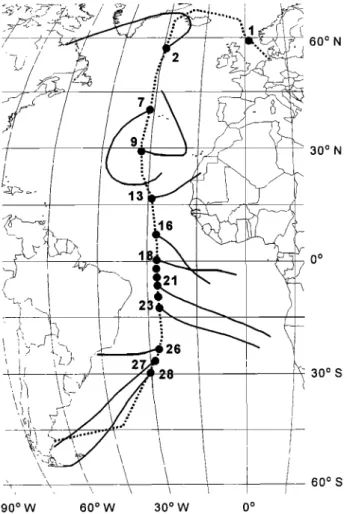
Size-segregated aerosols were collected on Whatman-41 filter paper aboard the German icebreaker R/V Polarstern during the Albatross campaign. Figure 1 presents the ship
track as well as the location of analyzed samples. The cruise
was conducted from Bremerhaven (Germany) to Punta Quilla
60 ø N 30 ø N 0 ø ' 2 26 90øW 60øW 30øW 0 ø 30 ø S 60 ø S
Figure 1. Ship route with sampling positions and 5-day air mass back trajectories.
(Argentina) from October 5 to November 11, 1996. The sampling time ranged from 12 to 24 hours, and the size- segregation was achieved by means of a six-stage cascade impactor (Sierra-Andersen, Model 235). The cascade
impactor
was operated
at a flow rate
of 85 m 3 h -• and
at this
flow rate separated the particles into the following aerodynamic equivalent diameter (Dp) ranges: Stage 1:>6.40 gm, stage 2:2.67-6.40 gm, stage 3:1.33-2.67 gm, stage 4: 0.84-1.33 gm, stage 5:0.44-0.84 gm. Particles with diameters lower than 0.44 gm were collected on the backup Whatman- 41 filter (stage 6). The particle size fractions were determined using the empirical equations reported by Willeke [1975] and Fuchs [1978] which relate Dp to the flow rate and are derived from a similar type of impactor. The sampling was performed at the working deck at the front of the ship about 25 m above sea level, and was not directionally controlled. However, our reported nss-SO4 values agree very well with those reported by Krischke et al. [this issue] during the same cruise, for which a directionally controlled sampling system was used.
The filters were extracted in 20 mL of Milli-Q water for
45 min in ultrasonic bath. The extraction efficiency with this method was higher than 98% for all compounds of interest. In sample extracts, 50-100 gL chloroform were added as a biocide, and all the extracts were analyzed for their ionic
composition
(including
SO42-
and MSA) within a week
PATRIS ET AL.: ISOTOPIC COMPOSITION OF SULFUR IN MARINE AEROSOLS 14,451
100 mL) were determined with isocratic elution at
1.0
mL min
-• of a 20 mM MSA eluent.
The
separation
column
was a Dionex CS12 with CSRS-I suppressor in
autosuppression mode of operation. Details on the analysis of
inorganic and organic anions, the detection limits, and the overall experimental precision for all ionic species are given by Baboukas e! al. [this issue].
The amount of total sulfur contained in the impactor stages as revealed by ion chromatography ranged from 0.3 up to a few micromoles. Isotope analyses were carried out on the stage filters that contained approximately 1 tzmol or more of total sulfate. The technique used is specifically adapted to micromolar samples. Special attention was directed to contamination prevention and yield optimization at each step of the procedure. Stringent washing techniques were followed for the decontamination of the experimental equipment in a particulate-free room. Glassware were cleaned in successive heated bathes of nitric acid diluted in ultrapure water (18.2 MC/), thoroughly rinsed in ultrapure water, and dried in
an oven.
The following treatment took place in a class 100 laminar flow bench to avoid particulate contamination. Evaporation of 20 to 30 mL solutions was conducted in small glass containers under gentle heating, in a pure argon stream to avoid possible gas contamination. The last 2 to 4 mL were picked up with a polypropylene syringe checked free of sulfur contamination (i.e., no measurable sulfate discharge in 5 mL of ultrapure water after 48 hours storage). The final drying step was carried out in a glass tube placed on a heated aluminum base supporting tin capsules. A pure argon stream was maintained in the tube during evaporation. Samples were introduced drop by drop in the heated tin capsules containing acid-washed
Chromosorb resin, on which CF-IRMS blank tests
demonstrated the absence of sulfur. Sulfate precipitated in the capsule as the solution dried out. The tin foil was then wrapped up and compacted, ready to be introduced in the elemental analyzer (Carlo Erba NC-2500) for on-line CF-IRMS analysis [Giesemann et al., 1994; Parris et al.,
1999]. Tin encapsulated samples were combusted in a flash of oxygen at temperature reaching locally 1800øC. Sulfate was thermally decomposed to SO2 and SO3. Sulfur trioxide was reduced to SO2 on hot reduced copper wires. Evolved gases were carried by pure helium through a desiccating trap, separated by gas chromatography, and introduced in the source of the Finnigan MAT-252 mass spectrometer via a silica capillary.
The isotopic
ratio 66SO2/64SO2
was integrated
along
the
whole SO2 peak detected by the mass spectrometer. Isotopic composition of the sample is compared to that of international standards processed the same way. The homogeneity and the large excess of the oxygen gas used for sample combustion assure reproducibility of oxygen isotopic interference on SO2.
The combustion
of standards
of known •534S
composition
(IAEA-S1, S2, and NBS-127) was used to perform the
calibration
between
measured
666(802)
and corrected
6348.
The procedure employed does not allow replicate measurements. The mass spectrometer was not at optimum configuration while these analyses were done which mainly reduced signal sensitivity. The experimental uncertainties
quoted
here
(+ 1%0
on 1534S
values)
take
this
fact
into account,
but are most probably overestimated.
Excess sulfate isotopic signature (denoted 15nss) has been retrieved from the measured value for total sulfate (•tot), considering the well defined sea-salt component (taking sea- salt sulfate isotopic signature •5ss = +21%o and mass fraction
fss
= k [Mg2+]/[8042-],
where
k is the seawater
(804/Mg)
mass
ratio). Mg
2+ has been used
instead
of Na
+ to calculate
the
excess sulfate due to the much lower and more reproducible
blanks
compared
to Na+:
or•tot--As•ss + (1-fss) •nss (2) •nss-- (•tot-As•ss)/( 1 ½•) (3) Owing to error bars divergence whenf• is close to 1, only samples with sea-salt sulfate component under 90% of total sulfate have been calculated for 15n•. This was generally the
30 -- 1.2 D• nss-S04
25
,
•" ... NO3
-- 1.0
•
',
---O---
MSA
• 20
0.8
,-,
• 15 /[ /'
0.6
•
10
,
t i,
0.4 •
,%
0.2
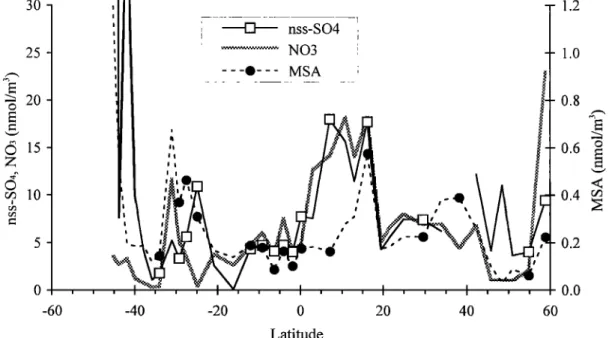
0 , , , 0.0 -60 -40 -20 0 20 40 60 LatitudeFigure 2. Measurements of total nss-SO4, NO3, and MSA (sum of the six stages of the cascade impactor)
14,452 PATRIS ET AL.: ISOTOPIC COMPOSITION OF SULFUR IN MARINE AEROSOLS
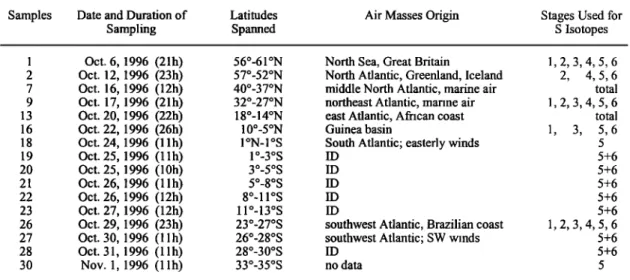
Table 1. Description of Aerosol Samples Analyzed for S Isotopes
Samples Date and Duration of Latitudes Air Masses Origin Stages Used for
Sampling Spanned S Isotopes
1 Oct. 6, 1996 (21h) 56ø-61øN North Sea, Great Britain 1, 2, 3, 4, 5, 6
2 Oct. 12, 1996 (23h) 57ø-52øN North Atlantic, Greenland, Iceland 2, 4, 5, 6
7 Oct. 16, 1996 (12h) 40ø-37øN middle North Atlantic, marine air total 9 Oct. 17, 1996 (21h) 32ø-27øN northeast Atlantic, marine air 1, 2, 3, 4, 5, 6
13 Oct. 20, 1996 (22h) 18ø-14øN east Atlantic, African coast total
16 Oct. 22, 1996 (26h) 10ø-5øN Guinea basin 1, 3, 5, 6
18 Oct. 24, 1996 (1 lh) IøN-IøS South Atlantic; easterly winds 5
19 Oct. 25, 1996 (11h) 1ø-3øS ID 5+6
20 Oct. 25, 1996 (1 Oh) 3ø-5øS ID 5+6
21 Oct. 26, 1996 (1 lh) 5ø-8øS ID 5+6
22 Oct. 26, 1996 (12h) 8 ø- 11 øS ID 5+6
23 Oct. 27, 1996 (12h) 11ø-13øS ID 5+6
26 Oct. 29, 1996 (23h) 23ø-27øS southwest Atlantic, Brazilian coast 1, 2, 3, 4, 5, 6 27 Oct. 30, 1996 (1 lh) 26ø-28øS southwest Atlantic; SW winds 5+6
28 Oct. 31, 1996 (1 lh) 28ø-30øS ID 5+6
30 Nov. 1, 1996 (1 lh) 33ø-35øS no data 5
Air masses origins were deduced from 5-day back trajectories. All samples were collected along the 30øW meridian above the Atlantic Ocean, except the first one above the North Sea.
case, except for a few coarse fractions (samples 1 and 2) and
one
total
filter (filter 7). Error
bars
were
calculated
taking
into
account uncertainties on •tot and on fss. Uncertainties on •nss are in some cases substantially higher than on •tot due to highfss [Patris, 1999].3. Results and Discussion
3.1. Ions: Major Features
3.1.1. Sulfur ions. The measurements of total nss-SO4
(sum of the six stages of the cascade impactor) during the
as well as nine fine particle fractions (Dp<0.84 gm) collected between the equator and 35øS. Two bulk aerosol filters were also analyzed, collected at 38øN and 16øN, respectively. Detailed description of the samples analyzed is presented in Table 1. The isotopic results for total sulfur from the impactor series are shown in Figure 3 and numerically presented in Table 2 together with calculated/Snss.
3.2.1. Bulk aerosol. The two bulk aerosol backup filters were sampled in quite different conditions. Sample 7 was exposed during night (October 15, 0910 LT to October 16, 1025 LT) between 39.7øN and 36.7øN. The 5-day back
campaign are reported in Figure 2. The mean value of trajectory analysis clearly indicates a marine origin of the air
7.8
nmol/m
3 observed
during
the experiment
is among
the masses,
situated
within
30ø-45øW
longitude
and
20ø-40øN
lowest recorded over the Atlantic Ocean [Sciare et al., this issue], suggesting that pure marine conditions occurred during the major part of the cruise. Total particulate MSA
concentrations are also depicted in Figure 2. They ranged
from
0.03 to 1.2 nmol/m
3 (mean
of 0.26
+ 0.22
nmol/m
3) and
agree well with previous observations above the Atlantic
Ocean. More information about the sulfur species
measurements and previous studies are given by $ciare et al. [this issue].
3.1.2. Nitrate. NO3- measurements in aerosol phase are
shown in Figure 2. In agreement with Prospero et al. [1995] we consider our measured NO3- concentrations on Whatman-41 filters as the sum of gaseous HNO3 and
particulate NO3-. Since no marine source is known for NO3-, it
can be used as an excellent indicator of anthropogenic influence. During the campaign, NO3- concentrations ranged
between
0.3 and
23 nmol/m
3 (average
at 6.1 + 5.6 nmol/m3).
With the exception of three events at the beginning, at the end of the cruise, and around 10øN, which were probably
influenced by continental emissions, all other values are
among the lowest reported for the Atlantic [Prospero et al.,
1995]. More details on the factors controlling the NO3- and HNO3 concentrations will be reported elsewhere.
3.2. Sulfur Isotopes
The isotopic composition of sulfur has been measured on five impactor filter series, collected between 61 øN and 25øS,
latitude intervals during that time. Sample 13 was collected during 22 hours (October 20, 1115 LT to October 21, 0935 LT) from 18.3øN to 14.2øN. Air masses came from the African coast within the preceding 5 days. Table 3 shows
concentrations of ionic tracers of maritime and continental
influences, confirming trajectories analysis: major ions of mainly marine origin (sulfate, chloride, sodium, magnesium) are at higher levels in filter 7 than in filter 13; in contrast, nitrate and oxalate ions concentrations are noticeably higher
in the latter.
Sulfur isotopic composition of sulfate from filter 7 is quite representative of seawater sulfate (+20.8 + 1%0). The sea-salt fraction of sulfate determined by chemical analysis is
overestimated
(110%
of total
sulfate,
as calculated
using
Mg
2+
as the sea-salt tracer). Sulfur isotopes and chemical composition consistently show the strong domination of ss-SO4 in this sample. The very high total sulfate level
observed
(31 •tg/m
3, which
is 1 order
of magnitude
higher
than average) strongly suggests a very large sea-spray impact on this filter. Excess sulfate content, and therefore its isotopic
composition, cannot be defined with acceptable precision. Excess sulfate concentration from filter 13 represents
1.7 ].tg/m
3, which
is 62% of the total
sulfate.
The measured
/534S
for total
sulfate
is •tot--'
+13.8
+ 1%o,
and
the calculated
/534S
for excess
sulfate
is/Snss
= +9.4 + 2.6%0.
These
values
are
consistent with results from a previous study by Gravenhorst [1978], where isotopic composition of particulate excess
PATRIS ET AL.: ISOTOPIC COMPOSITION OF SULFUR IN MARINE AEROSOLS 14,453 25- 20-
i
[ 0 Cutoff diameter (gm) 0.44 0.84 1.33 2.67 6.40-/-,Z-
-:.-•--ø7'
/
...
--•
....
;6-66;N
'.•.•/•
- - -•"•-
- - 32-27øN
-- -O- - - 10-5øN -- • - 23_27oS 6 5 4 3 2 1 Impactor stageFigure
3. The •34S
measured
for total
particulate
sulfate
versus
impactor
stages.
Spanned
latitudes
are displayed
in the
legend
frame.
Error
bars
of + 1%0
are not shown.
sulfate above the North Atlantic was •nss-- +7 to +9%0 for
samples
under
direct
continental
influence,
and •nss--
+11 to
+13%0
for aerosols
in Sahara
trade
winds.
This •34S
range
is
intermediate between typical continental (up to +7%0) and biogenic marine (+14 to +22%0) signatures, suggesting abalanced mixing of the two terms.
Sulfur isotope results on these two total filters are consistent with meteorological and chemical data. They are a
valuable tool for the assessment of atmospheric sulfur sources
and will be used further to study the source distribution of particulate sulfur in relation to the particle size.
3.2.2. Size-segregated aerosols. Coarse particles (collected on stages 1 and 2; cutoff diameter 2.7 •m) are
primary
aerosols,
mostly
sea-spray
produced
locally. Their
residence time in the marine boundary layer (MBL) stronglydepends
on meteorological
conditions
(wind speed,
rain
events) and is of the order of a few hours to a few days.As can be seen in Figure 3, coarse particles exhibit rather constant sulfur isotopic compositions through the latitudinal
range
investigated
(from 60øN to 27øS).
Chemical
analyses
showed that approximately 80% of sulfate is of sea-salt originin these aerosols. The •34S values obtained are close to that of
seawater sulfate; however, a shift toward lighter values can be pointed out (close to +19%o; see Table 2). Sample 1 was
collected above the North Sea in air masses that passed above
the British Islands during the last few days before sampling,
as deduced from meteorological maps. Nonetheless, isotopic
ratios for coarse particles (+19.5%0) show a dominant sea-salt source for sulfate in this size range, which is consistent with
the short lifetime of these aerosols.
Calculated excess sulfate isotopic compositions for coarse fractions, when sufficient accuracy is reached (ss-SO4<90%
of total SO4), show mean values (+13.7%o and +12.5%o for stages 1 and 2, respectively) close to but below the lower estimate of the theoretical signature of DMS-derived sulfate (between +14%o and +22%0, as mentioned earlier). Air mass back trajectories do not suggest direct continental influences on these samples (numbers 9, 16, and 26) within 5 days. Sample 9 corresponds to descending air masses from a purely
marine area of the North Atlantic (between 20 ø and 30øW in
longitude; 40 ø and 25øN in latitude), whereas filter 16 sampled air masses coming from the northeastern part of the South Atlantic. Sample 26 was probably influenced by air from coastal areas along the Brazilian shore. Coarse particle analyses show similar S isotope ratios for total sulfate and for
Table 2. Sulfur
Isotopic
Composition
(Measured
•tot
and
Calculated
•nss)
of Sulfate
From Size-Segregated
Aerosols
Sample Stage 6 Stage 5 Stage 4 Stage 3 Stage 2 Stage 1 Sample Stages 5+61 5.9 5.5 8.9 16.3 19.7 19.4 19 14.3 (5.6 +1.0) (5.2 +1.1) (6.5 +1.5) (10.1 +3.8) (13.4 +1.3) 2 13.5 19.7 18.3 21.3 20 13.2 (-0.3+6.8) (18.8+1.9) (14.9+3.0) (13.1 +1.1) 9 9.1 6.6 14.2 16.5 19.1 19.2 21 14.6 (1.0+3.1) (6.1 +1.1) (12.8+1.4) (12.8+2.5) (12.8+7.1) (16.7+3.0) (13.6+1.6) 16 11.7 11.5 14.0 17.1 22 12.3 (11.1 +1.1) (8.8+1.2) (10.1 +2.3) (11.5+3.8) (11.5+1.2) 18 11.1 23 13.7 (10.9+1.0) (13.5+1.1) 26 7.4 ! 4.5 16.1 16.5 18.5 ! 8.8 27 13.6 (6.3 +1.2) (13.8 +1.3) (14.2 +1.7) (9.7 +4.3) (12.1 +6.4) (13.0 +6.4) (13.5 +1.1) 30 15.8 28 12.6 (12.6+1.1) Mean •tot and Dispersion
3tot +9.5 + 12.1 + 14.4 + 15.8 + 19.7 + 18.6 + 13.5
+ o 3.1 5.0 4.0 1.2 1.2 1.0 0.8
Mean •,ss and Dispersion
•nss +4.7 +10.6 +12.1 +10.7 +12.5 +13.7 +13.0
+o 4.6 5.1 3.8 1.4 0.5 2.7 0.8
Plain text values are for 8tot, and parentheses are for 8 .... Uncertainties on 8tot (+1%0) are not indicated. Dispersion ranges do not
14,454 PATRIS ET AL.' ISOTOPIC COMPOSITION OF SULFUR IN MAR1NE AEROSOLS
Table 3. Aerosol Ion Concentrations and S Isotopes for Total Filters
SO42- NO3- C1- Na + Mg 2+ C2042- MSA f•s 1534S
Sample 7 30.9 0.28 276 159 16.1 0.03 0.04 100% +20.8%0
Sample 13 2.7 1.13 8.4 4.1 0.49 0.14 0.06 38% +13.8%o
Concentrations are in •tg/m 3. Sea-salt sulfate fractionf•s is determined on the basis of the SO4/Mg seawater ratio.
excess sulfate when it could have been calculated, regardless of the meteorological and geographic situations encountered. Although the marine biogenic source is expected to represent a predominant supplier to excess sulfate in these mid-ocean coarse particles, results suggest the existence of one
supplementary
source,
depleted
in 34S
isotope
as compared
to
oceanic sulfur, which should then be continental.
In a general view, micrometric and submicrometric
aerosols
(stages
3 to 6) feature
widely spread
•534S
values,
showing great sensitivity to local and regional conditions. Calculated •nss for aerosol sulfate from stages 3 to 5 (i.e., in the 0.44 to 2.7 •tm range) show constant mean values around +11%o, but dispersion gets wider as particle size decreases. Excess sulfate from the backup filters exhibits an isotopic signature quite representative of continental S emissions (ranging from -0.3 + 6.8%0 for sample 2, up to + 11.1 + 1.1%0 for sample 16). Sea-salt sulfate accounts for less than 16% of total sulfate in all fine fractions analyzed, except for one case (sample 2: 57ø-52øN) where it represents half of the total SO4 on both stages 5 and 6.
The two extreme data series (samples 1 and 2, showing
lowest
and
highest
•534S
values,
respectively,
of the data
set
for particles under 1.3 •tm) correspond to samples collected in the same latitudinal range (between 50 ø and 60øN). As mentioned earlier, impactor 1 sampled air masses above the North Sea that passed over the British Islands, whereas sample 2 was collected in the North Atlantic, where air masses originated from over Greenland or Labrador within the last 5 days.
Excess sulfate isotopic composition for the North Sea particles is rather constant for the three aerosol classes under 1.3 [tm and is measured between +5 and +7%0. This value is representative of anthropogenic sulfur emissions in the north of Europe [Nriagu et al., 1991; Pichlmayer et al., 1998] and especially in Great Britain [McArdle et al., 1998]. There is little doubt that nss-sulfate in fine particles collected above the North Sea is predominantly of anthropogenic origin.
On the contrary, sulfate collected on impactor 2 shows a
rather
high 534S
on the four stages
analyzed,
ranging
from
+13.5%o for stage 6 (<0.44 •tm) up to +21.3%o for stage 2 (between 2.7 and 6.4 [tm). Excess sulfate isotopic signatures were calculated for particles under 1.3 •tm diameter only (stages 4 to 6). Nss-SO4 from stages 5 and 4 show high 5nss values, in the marine biogenic range (+19 and +15%o respectively). However, •nss calculated for excess sulfate from finer particles (stage 6) is -0.3 + 6.8%0, which is unequivocally representative of continental sources (anthropogenic or volcanic). Large error bars do not allow us to estimate accurately the marine biogenic contribution in this excess sulfate, but results suggest a strong predominance of continental sources in the finest mode of this sample (>70%). Krischke et al. [this issue] report the influence of a volcanic plume which could have potentially been crossed by the ship
in the vicinity of Iceland. The sampling for sample 2 started on October 12 in the evening, by the end of the detected volcanic influence. The very low •nss observed in the finest particle mode of this sampling could possibly be the result of a contamination by volcanic material. In this situation the absence of obvious volcanic influence in other particle modes (Dp>0.4 •tm) could be the result of the exclusive gas-to- particle conversion oxidation pathway of volcanic effluents
within 24 to 48 hours.
Samples specifically analyzed for fine fractions (stages 5+6 together, collected between 1 øS and 30øS, n = 7) gave rather constant values of •tot, ranging between +12.3%o and +14.6%o. Air mass back trajectories show southeastern winds carrying air from marine areas off the South African coasts for samples collected between IøS and 14øS, and a southwestern influence for samples collected south of this line (air masses from South American coasts, see Figure 1). Calculated •nss values stand between + 10%o and +15%o, error bars included. There again, isotopic composition is intermediate between continental and marine biogenic sources, though meteorological data suggested a purely marine origin of the air masses for most of these samples.
Nitrate in the marine atmosphere can be used as an indicator of continental influence, being mainly emitted by, or resulting from, human activity. A relationship between nitrate and sulfur isotopic composition in the particle phase cannot be assessed accurately, due to the few data available.
Moreover,
transport
characteristics
are different
for nitrate
and sulfur species. However, a striking similarity exists between data from the three coarser modes (stages 1, 2, and 3)
on one hand, and between the three finer modes on the other
hand
[Patris,
1999].
The 534S
values
for particles
over
1.3 •tm
show no sensitivity to nitrate content, the slope of the regression line being almost zero. In contrast, micrometric
and
submicro-metric
aerosol
sulfate
•34S
drifts
toward
lighter
(i.e., typically "more continental") values as nitrate
concentration
increases
(clearly
negative
slopes
with
r 2 - 0.93
(n = 4), 0.55 (n = 14), and 0.34 (n = 12) for stages 4, 5, and 6,
respectively). This additional observation tends to confirm the
importance of continentally derived sulfate in the fine particle population in the Atlantic boundary layer.
3.3. Discussion
Total sulfur isotopic compositions are presented in
Figure 4 as a function of the sea-salt sulfate fraction f•s. Except points which exceed 100% for calculated ss-SO4 contribution, all points lie within a triangle representative of a three-terms blend, similar to the one described by McArdle
and Liss [1995] and McArdle et al. [1998], for samples
collected in northern Atlantic regions (Ireland, Wales, and Spitzbergen). One apex of the triangle represents seawater
sulfate
(at
f•s= 100%
and
•34S
-- +21%o),
and
the other
two lie
PATRIS ET AL.' ISOTOPIC COMPOSITION OF SULFUR IN MARINE AEROSOLS 14,455 20 15 10 El Stage 6 O Stage 5 O Stage 4 Stage 3 Stage 2 , Stage 1 0 I ' ' ' I ' ' ' I ' ' ' I ' ' ' 0 20 40 60 80 100 ss-SO 4 fraction (%)
Figure 4. S-isotopic composition of total sulfate as a function of sea-salt sulfate percentage. Sea-salt sulfate
is calculated on the basis of Mg concentrations.
(634S--•
0%0)
and
marine
biogenic
(3345
"• +22%0)
contributors.
The variety of meteorological and geographic situations
undergone during the cruise does not allow precise
determination of two excess sulfate end-members. However, results obtained along the wide geographical and meteorological panel covered suggest that the figure described by these authors for coastal areas of the northeastern Atlantic could be extrapolated for most of the Atlantic atmosphere.
Relative contributions of continental and biogenic marine sulfate are difficult to assess with fair confidence, as isotopic signatures of both contributors may vary noticeably at limited
scale. On the basis of their representative isotopic domains we can estimate rough proportions of DMS-derived sulfate (denoted fm•,) to overall excess sulfate. For this estimate we consider that continental isotope particularities are partially smoothed after regional-scale mixing and transport, reducing the width of the isotope domain. Marine biogenic sulfur isotopic signature is taken in the center of the predicted range. Values considered for these two contributions are 3c = +3 + 2%0 and •mb-- nt-1 8 + 2%0 respectively. Estimates of the marine biogenic contribution to excess sulfate are presented in Table 4.
Owing to a higher sea-salt content, uncertainties on •nss and
Table 4. Fraction of the Marine Biogenic Contribution fm•, to Excess Sulfate
Filter Stage 5+6 Stage 6 Stage 5 Stage 4 Stage 3 Stage 2 Stage 1
1 2 9 16 18 19 20 21 22 23 26 27 28 704- 20 65 4- 20 70 4- 20 60 4- 25 70 4- 20 70 4- 20 65 4- 20 15 + 20 15 + 20 0 + 30 100 + 15 04- 15 20+ 20 55 4- 25 40 + 25 55+20 25 + 20 80 4. 30 65+20 50+ 35 65 4. 30 65 + 50 90 4. 25 45 4. 30 55 4. 35 20 4- 20 70 4- 20 75 4- 20 45 4- 40 60 4- 50 65 4- 45
Range estimates are based on isotopic signatures of the marine biogenic and continental sulfate taken at 15rob = + 18 4- 2%0 and 15c = +3 + 2%0, respectively. Uncertainties on 15 .... 15rob and 15c are taken into account. Units are in percent.
14,456 PATRIS ET AL.: ISOTOPIC COMPOSITION OF SULFUR IN MARINE AEROSOLS
therefore uncertainties on fmb are larger in the coarser modes.
However, we can notice that the contribution of marine
biogenic sulfur to coarse particles (sized over 2.7 gm) is centered around 65% of the excess sulfate along the latitudinal range investigated. For medium-range and micrometric particles (2.7 down to 0.8 gm), fmb stands around 50% on the average. Excess sulfate from fine particles (<0.8 gm) present in purely marine air masses from the
southern Atlantic is estimated between 50 and 90% to be of
marine biogenic origin (samples 18-23), whereas this contribution is generally under 35% in fine particles sampled in the northern Atlantic (samples 1-9).
Our estimates of the biogenic sulfur contribution using S isotope results have been compared to estimates based on the MSA/nss-SO4 ratio R. The marine biogenic contribution is then estimated by comparing observed R ratios to those expected using the empirical formula from Bates et al. [1992a], relating R to the air temperature (following: R(%)=-1.5 T(øC)+42.2). A reasonable agreement (+20%)
was observed in most cases, except for one sample
(sample 13), for which trajectory analysis showed that the air mass originated from the middle free troposphere and thus
from a cooler environment. We can estimate on the basis of
the isotope results that fmO amounts to 45 ñ 25% of the nss-sulfate in this sample; the estimate based on R gives fmO = 93% (taking T = 25.8øC). Consideration of the ambient temperature at the time of sampling tends to underestimate the R ratio and consequently to overestimate the biogenic S
contribution.
Excess sulfate present in coarse marine aerosols is thought to get efficiently absorbed in preexisting liquid sea-spray particles, as fine particles or as gaseous species [Pszenny et al., 1989; Sievering et al., 1992; Quinn et al., 1993]. Local washout by sea spray may be a major sink of oxidized biogenic sulfur species in the marine boundary layer [Chameides and Stelson, 1992], thus reducing significantly
the lifetime of these compounds in the atmosphere. Air mass back trajectories show that most of the air masses sampled
during the campaign came from elevations higher than the boundary layer height, within the preceding 5 days. Subsiding air may convey material, including sulfur compounds, from the free troposphere down to the boundary layer. Raes [ 1995] proposed that entrainment of newly formed particles from the free troposphere down to the MBL could explain the relatively constant condensation nuclei number concentration near the sea surface. Sulfur present in the free troposphere may therefore be the potential dominant source of secondary sulfate aerosol in the marine boundary layer [Rodhe, 1999].
Continental influence on the nss-sulfate budget in remote marine atmosphere has already been observed [e.g., Prospero etal., 1985]. Thornton et al. [1999] carried out extensive measurements of SO2 above the Pacific Ocean over the years 1991 to 1996 and concluded that the marine biogenic source of SO2 (via DMS oxidation) is only important in the tropical MBL. These authors showed that anthropogenic SO2 is of importance in the lower troposphere as far as 1500 km from the source areas, and much further in the mid and upper troposphere in the Northern Hemisphere. They also indicated that background volcanism may control the tropospheric SO2
budget in the Southern Hemisphere. Recently, Capaldo et al. [1999] demonstrated that emissions from ships may also be a significant source of sulfur within the marine troposphere. The ubiquitous presence of continental sulfur in the marine free troposphere, and its apparent involvement in new particle
formation, implies that so-called pristine marine conditions are under significant continental influence as far as the excess sulfur cycle is concerned. The free tropospheric burden appears to be controlled by continental emissions, and is able to replenish the marine boundary layer with fine and ultrafine sulfate particles. The induced radiative impact over the sea surface may be of importance since these particles play an important role in solar radiation backscattering and may act as cloud condensation nuclei inducing albedo increase [Murphy et al., 1998].
4. Conclusion
Sulfur stable isotopes were measured in size-segregated
marine aerosols collected above the Atlantic between 61øN
and 35øS and were used as sulfur source tracer. A striking feature of the results is the progressive relation linking
particle size and S isotope ratios through the whole cruise.
The obvious
dependence
of 634S
distributions
upon
particle
size confirms the distinct transport and fate of atmospheric sulfur compounds, according to the characteristics of their
emission.
Excess sulfate isotopic signature was calculated, and showed on the whole the clear trend of a more continentally contributed excess sulfate in smaller particles. In the finest
mode the lowest continental influences were observed in the
Southern Hemisphere as long as sampled air masses did not pass over continents more than 5 days before sampling; the biogenic contribution to fine particulate sulfate accounted in this case approximately for 50-90% of the total nss-sulfate
budget. Marine biogenic sulfur in the Northern Hemisphere
was less than 35% of the excess sulfur in the fine particles, even when back trajectories showed pure marine origin of the
air masses.
Savoie and Prospero [ 1989] estimated up to 20% of excess sulfate at Midway (North Pacific; 180øW, 30øN) being of continental origin on a yearly average. Our isotope measurements on Atlantic MBL aerosols support the extrapolation of the Pacific atmospheric sulfur budget to the Atlantic atmosphere in general lines. Our results support the hypothesis that continental sulfur could be responsible, via free tropospheric long-range transport and subsidence, or
direct ship emissions, for a significant fraction of fine sulfate
particles in the MBL, and suggest that continental sulfate may
play an important radiative role. This suggestion agrees with
the correlation observed by Parungo et al. [1994] between
anthropogenic sulfur emissions and the marine cloud cover
increase during the last few decades, especially in the
northern midlatitudes.
Acknowledgments. We would like to thank A. Gogou and J. Sciare for their help in sampling, ß ß ß 34 M. Sti6venard ß and J.-J. Poupeau ß
for their contribution •n the S analys•s, and S. Belwso, B. Bonsang,
J. Sciare, and M. Kanakidou for their helpful comments and discussions. This work has been supported by the EU-MARATHON program ENV4-CT95-0004. LSCE contribution Nø328.
References
Ayers, G.P., and J.L. Gras, Seasonal relationship between cloud condensation nuclei and aerosol methanesulphonate in marine air,
Nature, 353, 834-835, 1991.
Baboukas, E.D., M. Kanakidou, and N. Mihalopoulos, Carboxylic acids in gas and particulate phase above the Atlantic Ocean, d. Geophys. Res., this issue.
PATRIS ET AL.: ISOTOPIC COMPOSITION OF SULFUR IN MARINE AEROSOLS 14,457
adducts in the atmospheric oxidation of dimethyl sulfide, Faraday
Discuss., 100, 39-54, 1995.
Bates, T.S., J.A. Calhoun, and P.K. Quinn, Variations in the
methanesulfonate to sulfate molar ratio in submicrometer marine
aerosol particles over the South Pacific Ocean, d. Geophys. Res.,
97(D9), 9859-9865, 1992a.
Bates, T.S., B.K. Lamb, A. Guenther, J. Dignon, and R.E. Stoiber,
Sulfur emissions to the atmosphere from natural sources, d.
Atmos. Chem., 14, 315-337, 1992b.
Calhoun, J.A., T.S. Bates, and R.J. Charlson, Sulfur isotope measurements of submicrometer sulfate aerosol particles over the Pacific Ocean, Geophys. Res. Lett., 18(10), 1877-1880, 1991.
Capaldo, K., J. Corbett, P. Kasibhalta, P. Fischbeck, and S. Pandis,
Effects of ship emissions on sulphur cycling and radiative climate
forcing over the ocean, Nature, 400, 743-746, 1999.
Chameides, W.L., and A.W. Stelson, Aqueous-phase chemical
processes in deliquescent sea-salt aerosols: A mechanism that
couples the atmospheric cycles of S and sea salt, d. Geophys. Res.,
97(D 18), 20,565-20,580, 1992.
Chadson, R.J., J.E. Lovelock, M.O. Andreae, and S.G. Warren,
Oceanic phytoplankton, atmospheric sulphur, cloud albedo and
climate, Nature, 326, 655-661, 1987.
Coplen, T.B., and H.R. Krouse, Sulphur isotope data consistency improved, Nature, 392, 32, 1998.
Fuchs, N.A., Aerosol impactors (a review), in Fundamentals of Aerosol Science, edited by. D.T. Shaw, pp. 1-84, John Wiley,
New York, 1978.
Giesemann, A., H.J. J•iger, A.L. Norman, H.R. Krouse, and W.A. Brand, On-line sulfur isotope determination using an elemental analyzer coupled to a mass spectrometer, Anal. Chem., 66(18),
2816-2819, 1994.
Gravenhorst, G., Maritime sulfate over the North Atlantic, Atmos.
Environ., 12, 707-713, 1978.
Heintzenberg, J., Fine particles in the global troposphere, a review,
Tellus, Ser. B, 41,149-160, 1989.
Intergovernmental Panel on Climate Change (IPCC), Climate
Change 1994: Radiative Forcing on Climate Change, edited by
J.T. Houghton et al., Cambridge Univ. Press, New York, 1995. Krischke, U., R. Staubes, T. Brauers, M. Gautrois, J. Burkert, D.
St6bener, and W. Jaeschke, Removal of SO2 from the marine
boundary layer over the Atlantic Ocean: A case study on the kinetics of the heterogeneous S(IV) oxidation on marine aerosols,
d. Geophys. Res., this issue.
Legrand, M., and E.C. Pasteur, Methane sulfonic acid to non-sea-salt sulfate ratio in coastal Antarctic aerosol and surface snow, d. Geophys. Res., 103(D9), 10,991-11,006, 1998.
Li, S.-M., and L.A. Barfie, Biogenic sulfur aerosol in the Arctic troposphere, 1, Contributions to total sulfate, d. Geophys. Res.,
98(D11), 20,613-20,622, 1993.
McArdle, N.C., and P.S. Liss, Isotopes and atmospheric sulphur,
Atmos. Environ., 29, 2553-2556, 1995.
McArdle, N.C., P.S. Liss, and P. Dennis, An isotopic study of atmospheric sulphur at three sites in Wales and at Mace Head, Eire, d. Geophys. Res., 103(D23), 31,079-31,094, 1998.
Murphy, D.M., J.R. Anderson, P.K. Quinn, L.M. McInnes, F.J. Brechtel, S.M. Kreidenweis, A.M. Middlebrook, M. Posfai, D.S.
Thomson, and P.S. Buseck, Influence of sea-salt on aerosol
radiative properties in the Southern Ocean marine boundary layer,
Nature, 392, 62-65, 1998.
Nielsen, H., J. Pilot, L.N. Grinenko, V.A. Grinenko, A.Y. Lein, J.W. Smith, and R.G. Pankina, Lithospheric sources of sulphur, in Stable Isotopes: Natural and Anthropogenic Sulphur in the Environment., edited by H.R. Krouse and V.A. Grinenko, pp. 65- 132, John Wiley, New York, 1991.
Norman, A.L., L.A. Barfie, D. Toom-Sauntry, A. Sirois, H.R.
Krouse, S.-M. Li, and S. Sharma, Sources of aerosol sulphate at
Alert: Apportionment using stable isotopes, d. Geophys. Res., 104(D9), 11,619-11,631, 1999.
Nriagu, J.O., R.D. Coker, and L.A. Barfie, Origin of sulphur in Canadian Arctic haze from isotope measurements, Nature, 349,
142-145, 1991.
Ohizumi, T., N. Fukuzaki, and M. Kusakabe, Sulfur isotopic view on
the sources of sulfur in atmospheric fallout along the coast of the
sea ofJapan, Atmos. Environ., 31, 1339-1348, 1997.
Pandis, S.N., L.M. Russell, and J.H. Seinfeld, The relationship
between DMS flux and CCN concentration in remote marine
regions, d. Geophys. Res., 99(D8), 16,945-16,957, 1994. Parungo, F., J. Boatman, H. Sieveting, S.W. Wilkison, and B.B.
Hicks, Trends in global marine cloudiness and anthropogenic
sulfur, d. Clim., 7, 434-440, 1994.
Paths, N., Isotopie du soufre dans les glaces polaires et les a6rosols matins (in French), Ph.D. thesis, 225 pp., Univ. Paris 7, Paris,
1999.
Paths, N., R.J. Delmas, and J. Jouzel, Isotopic signatures of sulfur in shallow Antarctic ice cores, d. Geophys. Res., in press, 1999. Pichlmayer, F., W. Sch6ner, P. Seibert, and W. Stichler, Stable
isotope analysis for characterization of pollutants at high elevation alpine sites, Atmos. Environ., 32, 4075-4085, 1998.
Polian, G., G. Lambert, B. Ardouin, and A. J6gou, Long-range
transport of continental radon in Subantarctic and Antarctic areas,
Tellus, Ser. B, 38, 178-189, 1986.
Prospero, J.M., D.L. Savoie, R.T. Nees, R.A. Duce, and J. Merrill,
Particulate sulfate and nitrate in the boundary layer over the North
Pacific Ocean, d. Geophys. Res., 90(D6), 10,586-10,596, 1985. Prospero, J.M., D.L. Savoie, E.S. Saltzman, and R.J. Larsen, Impact
of oceanic sources of biogenic sulphur on sulphate aerosol
concentrations at Mawson, Antarctica, Nature, 350, 221-223,
1991.
Prospero, J.M., D.L. Savoie, R. Arimoto, H. Olafsson, and H. Hjartarson, Sources of aerosol nitrate and non-sea-salt sulfate in the Iceland region, Sci. Total Environ., 160, 181-191, 1995. Pszenny, A.A.P., A.J. Castelie, J.N. Galloway, and R.A. Duce, A
study of the sulfur cycle in the Antarctic marine boundary layer, d. Geophys. Res., 94(D7), 9818-9830, 1989.
Quinn, P.K., and D.J. Coffman, Local closure during the First Aerosol Characterization Experiment (ACE 1): Aerosol mass concentration and scattering and backscattering coefficients, d. Geophys. Res., 103(D13), 16,575-16,596, 1998.
Quinn, P.K., D.S. Covert, T.S. Bates, V.N. Kapustin, D.C. Ramsey- Bell, and L.M. McInnes, Dimethylsulfide/cloud condensation nuclei/climate system: Relevant size-resolved measurements of the chemical and physical properties of atmospheric aerosol particles, J. Geophys. Res., 98(D6), 10,411-10,427, 1993. Raes, F., Entrainment of free tropospheric aerosols as a regulating
mechanism for cloud condensation nuclei in the remote marine
boundary layer, J. Geophys. Res., 100(D2), 2893-2903, 1995. Rees, C.E., W.J. Jenkins, and J. Monster, The sulphur isotopic
composition of ocean water sulphate, Geochim. Cosmochim. Acta,
42, 377-381, 1978.
Rodhe, H., Human impact on the atmospheric sulfur balance, Tellus,
Ser. A-B, 51, 110-122, 1999.
Savoie, D.L., and J.M. Prospero, Comparison of oceanic and continental sources of non-sea-salt sulphate over the Pacific
Ocean, Nature, 339, 685-687, 1989.
Sciare, J., E. Baboukas, M. Kanakidou, S. Belviso, H. Bardouki, and
N. Mihalopoulos, Spatial and temporal variability of atmospheric sulfur-containing gases and particles during the ALBATROSS campaign, J. Geophys. Res., this issue.
Sievering, H., J. Boatman, E. Gorman, Y. Kim, L. Anderson, G. Ennis, M. Luria, and S.N. Pandis, Removal of sulphur from the marine boundary layer by ozone oxidation in sea-salt aerosols,
Nature, 360, 571-573, 1992.
Thornton, D.C., A.R. Bandy, B.W. Blomquist, A.R. Driedger, and T.P. Wade, Sulfur dioxide distribution over the Pacific Ocean 1991-1996, J. Geophys. Res., 104(D5), 5845-5854, 1999.
Wadleigh, M.A., H.P. Schwarcz, and J.R. Kramer, Sulphur isotope
tests of sea-salt correction factors in precipitation: Nova Scotia, Canada, Water Air Soil Pollut., 77, 1-16, 1994.
Wakshal, E., and H. Nielsen, Variations of •34S(SO4), •180(H20)
and C1/SO 4 ratio in rainwater over northern Israel, from the
Mediterranean Coast to Jordan Rift Valley and Golan Heights, Earth Planet. Sci. Lett., 61,272-282, 1982.
Willeke, K., Performance of the slotted impactor, Am. Ind. Hyg.
Assoc. J., 683-691, 1975.
E. D. Baboukas and N. Mihalopoulos, Environmental Chemical Processes Laboratory, Department of Chemistry, University of Crete, P.O.
Box 1470, GR-71409 Heraklion, Greece. (mihalo•chemistry.uch.gr)
J. Jouzel, Laboratoire des Sciences du Climat et de l'Environnement,
UMR CEA/CNRS 1572, CEA Saclay, 91191 Gif-sur-Yvette, France. N. Patris, Department of Chemistry and Biochemistry-UH5112, University of California, San Diego, 9500 Gilman Drive, La Jolla, CA 92093-0356. (npatris•chem.ucsd.edu)
(Received August 3, 1999; revised October 26, 1999;