On the use of the energy norm in trust-region and adaptive cubic regularization subproblems
E. Bergou
∗Y. Diouane
†S. Gratton
‡March 6, 2017
Abstract
We consider solving unconstrained optimization problems by means of two popular glob- alization techniques: trust-region (TR) algorithms and adaptive regularized framework using cubics (ARC). Both techniques require the solution of a so-called “subproblem” in which a trial step is computed by solving an optimization problem involving an approximation of the objective function, called “the model”. The latter is supposed to be adequate in a neigh- borhood of the current iterate. In this paper, we address an important practical question related with the choice of the norm for defining the neighborhood. More precisely, assuming here that the HessianB of the model is symmetric positive definite, we propose the use of the so-called “energy norm” – defined by kxkB =√
xTBxfor allx∈Rn – in both TR and ARC techniques. We show that the use of this norm induces remarkable relations between the trial step of both methods that can be used to obtain efficient practical algorithms. We furthermore consider the use of truncated Krylov subspace methods to obtain an approxi- mate trial step for large scale optimization. Within the energy norm, we obtain line search algorithms along the Newton direction, with a special backtracking strategy and an accept- ability condition in the spirit of TR/ARC methods. The new line search algorithm, derived by ARC, enjoys a worst-case iteration complexity ofO(−3/2). We show the good potential of the energy norm on a set of numerical experiments.
Keywords: Nonlinear optimization, unconstrained optimization, trust-region algorithm, adaptive regularized framework using cubics, line search algorithm, energy norm, Krylov subspace methods,
conjugate gradient.
1 Introduction
In this paper, we consider the following unconstrained optimization problem:
x∈
min
Rnf(x), (1)
where f :
Rn→Ris a given smooth function. We propose to solve (1) by means of trust-region (TR) methods [7] or an adaptive regularized framework using cubics (ARC) [6]. In recent years,
∗MaIAGE, INRA, Universit´e Paris-Saclay, 78350 Jouy-en-Josas, France ([email protected]).
†Institut Sup´erieur de l’A´eronautique et de l’Espace (ISAE-SUPAERO), Universit´e de Toulouse, 31055 Toulouse Cedex 4, France ([email protected]).
‡INP-ENSEEIHT, Universit´e de Toulouse, 31071 Toulouse Cedex 7, France ([email protected]).
there has been a constant interest in the TR techniques [7, 11, 9], while ARC algorithms for unconstrained optimization enjoy a growing interest [3, 6, 5, 16, 14, 4]. The key principle of these two approaches is the (possibly iterative) minimization of objective function models (often, but not always, quadratic or cubic). During such minimization process, a control of the step length is used either trough an explicit constraint formulation or through a specific penalization term; that minimization stage is known as the “subproblem”. Both TR and ARC frameworks can also be seen as regularization techniques as they control and impose restrictions on a certain parameter (a TR radius or a regularization parameter). TR algorithms are well established and studied, see [7] and references therein, whereas ARC methods are relatively newer and exhibit good performance in terms of global and local convergence properties as we briefly describe now.
Numerical experiments indicate that ARC algorithms can be competitive with TR approaches when solving small-scale problems [6]. ARC algorithms are also famous since they improve substantially the worst-case iteration and gradient evaluation complexity over the classical TR methods [5]. Such improvement has been recently extended to modified TR methods [9] where a specific step update mechanism is proposed. The proposed TR algorithm exhibits the same worst-case complexity bound as ARC algorithms and enjoys the same convergence properties (fast local and global convergence) as the classical TR methods.
For both frameworks, the trial step from one iterate to the next is approximated by min- imizing a given model of the objective function while the next iterate is maintained in a pre- specified neighborhood of the current iterate. An important practical aspect of TR and ARC techniques is on the use of an appropriate description of the neighborhood. In this paper, we focus on the neighborhoods defined as spheres for some scaled versions of the Euclidean norm, i.e.
kxkM=
√
x
TM x where M is a symmetric positive definite (SPD) matrix. Under such consideration, approximating the subproblem solution requires (approximately) solving a non-linear system, derived from the optimality conditions, by applying a zero-finding solver to the so-called “secular equation” [7]. Practical approaches to get an approximate solution are proposed in [7, 4, 6, 11], where the solution of the secular equation is typically approximated over specific evolving subspaces using Krylov methods. The main drawback of such approaches is there expensive computational cost as they may require solving multiple linear systems in sequence.
Our approach for choosing M is related to ideas developed, for instance, when solving infinite-
dimensional linear problems arising in elliptic partial differential equations. In fact, it is common
to recourse to iterative techniques for solving the corresponding linear systems after discretiza-
tion. In this setting, finding a sound stopping criterion is essential to overcome both over- and
under- solving the regarded problem, i.e. appropriately balance the error due to the truncation
of the iterative solver and the discretization error. It can be shown that it is theoretically nat-
ural and practically relevant to work with the scaled Euclidean norm where M is chosen as the
matrix of the linear system itself [2, 1]. For optimization problems, the use of the absolute-value
of the Hessian (that corresponds to the energy norm in the case of a positive definite Hessian)
to define the trust region in the TR algorithms was proposed in [7, Section 7.7.1] as “the ideal
trust region” that reflects the proper scaling of the underlying problem. For a large scale indef-
inite Hessian, computing the absolute-value is certainly a computationally expensive task. This
means that for large scale optimization problems the use of the absolute-value energy norm can
be seen as out of reach, and was not further considered in [7]. In this paper, we investigate the
use of the energy norm instead of a general scaled norm for both the TR and ARC algorithms in
the situation where the Hessian of the model is SPD, which we believe is common. To mention
only one widespread application, it occurs when a Gauss-Newton approach is used for solving nonlinear least-squares problems.
In this paper we show that, for locally convex model in TR/ARC framework, the compu- tational cost of the associated subproblem is nearly the same as solving a linear system (i.e., approximating a minimizer of the associated quadratic model), and does not involve nonlinear iterations. We also consider a large-scale variant for the case where matrix factorizations are not affordable, implying that only iterative methods for computing a trial step can be used. In this case, we propose a truncated Krylov subspace method for the subproblem. Using our subprob- lem solvers, we also consider the performance of the overall unconstrained optimization solver and show that the energy norm may produce much better results than a standard Euclidean norm based algorithm. Most notably, our approach is very economical because the dominant computational cost of our TR/ARC algorithms is mainly the cost of successful iterations in the TR/ARC algorithms, solving the subproblem for unsuccessful iterations being straight-forward and inexpensive. The proposed approaches are in practice line search algorithms along the New- ton direction, with a special backtracking strategy and an acceptability condition in the spirit of TR/ARC methods. We show that the proposed line search approach, derived by the ARC framework, enjoys a worst-case iteration complexity of
O(−3/2).
The outline of this paper is as follows. In Section 2 we recall a unified framework for uncon- strained optimization gathering both TR algorithms and the ARC approaches and assuming a general scaled norm is used for the step size control. In Section 3, we present closed formulas for the solution of the subproblem when the energy norm is considered, and propose both direct and iterative scheme for computing it. In Section 4 we derive the overall unconstrained optimization algorithm and discuss possible stopping criteria to maintain the complexity of TR and ARC when the subproblem is solved iteratively. In Section 5, preliminary numerical experiments with basic implementations are presented that show the good behavior of our energy norm algorithm.
Finally, in Section 6 we draw some perspectives and conclusions.
2 TR/ARC algorithms
In this section, we describe the subproblem that occurs in the k
thiteration when solving the optimization problem (1) in both the TR algorithms (e.g., [7]) and ARC algorithms (e.g., [6]).
Formally in a basic TR algorithm, one computes a trial step s
TRkby approximately solving
s∈
min
Rnf (x
k) + s
Tg
k+
12s
TB
ks = m
Qk(s) (2) s. t.
kskMk ≤∆
k,
where ∆
k> 0 is known as the TR radius, g
k=
∇f(xk) is the gradient of f at the current iterate x
k, and B
kis a symmetric approximation to the local Hessian of f at the point x
k. The scaled norm
k.kMkmay vary along the iterations and M
kis a symmetric positive definite matrix.
Once the trial step s
TRkis determined, the objective function is computed at x
k+ s
TRkand
compared with the value predicted by the model at this point. If the model value predicts
sufficiently well the objective function, the trial point x
k+ s
TRkwill be accepted and the TR is
eventually expanded. If the model turns out to predict poorly the objective function, the trial
point is rejected and the TR is contracted. For a basic ARC algorithm, the trial step s
ARCkis
computed as an approximate minimizer of a cubic model m
Ck: s
ARCk= arg min
s∈Rn
m
Ck(s) = m
Qk(s) + 1
3 σ
kksk3Mk
, (3)
where σ
k> 0 is a dynamic positive parameter that more or less plays the same role as the inverse of the TR radius (see [6]). Similarly to TR algorithms, the update of the parameter σ
ktakes into account the agreement between the objective function f and the model m
Ck. The parameter σ
kand the current iterate are updated following similar principles as those used for
∆
kand x
kin the TR methods. More formally, for both frameworks, a ratio between the actual reduction and the predicted reduction plays an important role to decide whether the trial step is acceptable or not. In the TR case, the ratio is of the following form:
ρ
TRk= f (x
k)
−f (x
k+ s
TRk)
f (x
k)
−m
Qk(s
TRk) , (4) and in the adaptive cubic regularization case is of the form
ρ
ARCk= f (x
k)
−f (x
k+ s
ARCk)
f (x
k)
−m
Ck(s
ARCk) . (5) To keep the notation simple, and unless it introduces some ambiguity, we will use ρ
kfor both ρ
TRkand ρ
ARCk. For a given scalars 0 < η
1≤η
2< 1, the k
thiteration will be said very successful if ρ
k≥η
2, successful if ρ
k ∈[η
1, η
2), and unsuccessful otherwise. In all successful iterations we set x
k+1= x
k+ s
k; otherwise the current iterate is kept unchanged x
k+1= x
k. Algorithm 1 gives a detailed description of both algorithms (TR and ARC frameworks). The generic name
‘ALGO’ stands either for ‘TR’ or ‘ARC’ in the sequel.
For the purpose of this paper, we will assume that the approximate Hessian matrix B
kis positive definite for all iterations.
Assumption 2.1 For all k, the approximate Hessian matrix B
kof the model is symmetric positive definite.
To ensure the global convergence of Algorithm 1, the trial step is required to provide a decrease greater than or equal to the reduction attained by the so-called Cauchy step which, in the TR case, is defined as follows:
s
TRk,Cauchy=
−αTRk,Cauchyg
k, where α
TRk,Cauchy= arg min
t>0
;
kxk−tgkkMk≤∆km
Qk(−tg
k), (6) and in the adaptive cubic regularization case:
s
ARCk,Cauchy=
−αARCk,Cauchyg
k, where α
ARCk,Cauchy= arg min
t>0
m
Ck(−tg
k). (7) The Cauchy step associated to the minimization of the unconstrained quadratic model m
Q(s) is of the following form:
s
Qk,Cauchy=
−αQk,Cauchyg
k, where α
Qk,Cauchy= arg min
t>0
m
Qk(−tg
k) =
kgkk2 kgkk2Bk
. (8)
Under classical assumptions, convergence results of Algorithm 1 can be found in [6, 7]. In
the rest of the paper, we will mostly focus on the subproblem minimization for a given iteration
k. The iteration subscript k will therefore be dropped to keep the notations simple.
Algorithm 1: A generic TR/ARC algorithm.
Initialization: Select an initial point x
0and constants 0 < η
1< η
2< 1. If ALGO=‘TR’, set the initial radius ∆
0and the constants 0
≤τ
1 ≤τ
2 ≤1. Else set the initial regularization σ
0> 0 and the constants 1 < ν
1 ≤ν
2. Set k = 0.
Until convergence:
1. Model definition :
Compute the model gradient g
kand its Hessian B
k. 2. Compute the step :
If ALGO=‘TR’, compute the step s
kas an approximate solution of (2). Else compute the step s
kas an approximate solution of (3).
3. Accept the trial point :
If ALGO=‘TR’, compute ρ
k= ρ
TRkas in (4). Else, compute ρ
k= ρ
ARCkas in (5).
If ρ
k ≥η
1, set x
k+1= x
k+ s
k; otherwise x
k+1= x
k. 4. Parameter update:
If ALGO=‘TR’ set
∆
k+1 ∈
[∆
k, +∞) if ρ
k≥η
2, [very successful ] [τ
2∆
k, ∆
k] if η
1 ≤ρ
k< η
2, [successful ] [τ
1∆
k, τ
2∆
k] Otherwise. [unsuccessful ] Else set
σ
k+1 ∈
(0, σ
k] if ρ
k ≥η
2, [very successful ] [σ
k, ν
1σ
k] if η
1 ≤ρ
k< η
2, [successful]
[ν
1σ
k, ν
2σ
k] Otherwise. [unsuccessful]
Increment k by one.
3 TR/ARC subproblems with the energy norm
In the following, we suppose that Assumption 2.1 holds and that the matrix M in the scaled norm is equal to the model Hessian matrix B. In this section we derive the formula for computing the subproblem solution of the TR/ARC algorithms when the energy norm is used.
Each iteration of Algorithm 1 requires mainly to solve (possibly inexactly) a subproblem of
type (2)-(3). Finding an efficient solver to the subproblem is obviously essential to keep the
work-per-iteration low. We prove that in the energy norm setting, approximating the solutions
of (2)-(3) is as expensive as approximating the solution of a single unconstrained quadratic
optimization problem.
3.1 Exact solution of the TR/ARC subproblem
In what follows, we will denote by s
Q∗the exact solution of the unconstrained quadratic opti- mization problem:
s
Q∗= arg min
s∈Rn
m
Q(s) =
−B−1g. (9)
Theorem 3.1 The exact solutions s
TR∗and s
ARC∗of the subproblems (2)-(3) are respectively of the following form:
s
TR∗= δ
TR∗s
Q∗, where δ
∗TR= min 1, ∆
ksQ∗kB!
, (10)
and
s
ARC∗= δ
ARC∗s
Q∗, where δ
∗ARC= 2 1 +
q
1 + 4σks
Q∗kB. (11)
Proof. Let s
TR∗be a solution of (2). The matrix B is positive definite, thus if
ksQ∗kB ≤∆, then the optimization problem (2) has a unique solution s
TR∗= s
Q∗. The case where
ksQ∗kB> ∆ implies that the solution s
TR∗lies on the boundary of the TR (i.e.
ksTR∗ kB= ∆). It follows from the first and second-order necessary and sufficient (as B is positive definite) optimality conditions on the subproblem (2), that s
TR∗is unique and satisfies
g + Bs
TR∗+ λ
TR∗Bs
TR∗= 0,
with λ
TR∗ ≥0 is the so-called Lagrange multiplier. Which implies that s
TR∗= 1
1 + λ
TR∗s
Q∗. Since
ksTR∗ kB= ∆, one concludes that
λ
TR∗=
ksQ∗kB∆
−1 and s
TR∗= ∆
ksQ∗kBs
Q∗.
On the other hand, let s
ARC∗be a solution of (3). It follows from the first and second-order necessary optimality conditions at s
ARC∗:
∇s
m
C(s
ARC∗) = g + (1 + λ
ARC∗)Bs
ARC∗= 0, and for all vectors w
∈Rn,
w
T ∇ssm
C(s
ARC∗)
w = w
T(1 + λ
ARC∗)B + λ
ARC∗
Bs
ARC∗ ksARC∗ kBBs
ARC∗ ksARC∗ kBT!
w
≥0.
where λ
ARC∗= σks
ARC∗ kB.
The matrix B is definite positive, hence for all w
6= 0w
T(1 + λ
ARC∗)B + λ
ARC∗
Bs
ARC∗ ksARC∗ kBBs
ARC∗ ksARC∗ kBT!
w
≥w
T(1 + λ
ARC∗)B w > 0, thus s
ARC∗is the unique minimizer of (3) and of the following form
s
ARC∗= 1
1 + λ
ARC∗s
Q∗where λ
ARC∗= σks
ARC∗ kB= σ
1 + λ
ARC∗ ksQ∗kB. Then λ
∗is solution of the following equation
λ
ARC∗ 2+ λ
ARC∗ −σks
Q∗kB= 0.
Since λ
ARC∗ ≥0, one has
λ
ARC∗=
−1 + q
1 + 4σks
Q∗kB2 ,
and hence, s
ARC∗= δ
∗ARCs
Q∗, where δ
∗ARC=
1+λ1ARC∗
=
21+
√
1+4σksQ∗kB
.
A direct consequence of this result is that solving exactly the TR or ARC subproblem (in the energy norm setting) is as expensive as minimizing the model m
Qwithout constraints. It simply amounts to scaling the solution of the linear system Bs =
−gby a scalar that is easy to evaluate.
This means that solving the subproblem for any values of ∆ or σ is inexpensive once the solution of Bs =
−gis found. This remark will be essential when considering unsuccessful steps in the overall optimization algorithm. Another consequence is that the subproblem solution can be obtained by using a direct method based on the Cholesky factorization provided that B is not too large for such an approach. In the next section we consider the case where Bs =
−gis solved iteratively.
3.2 Approximate solution of the subproblem using Krylov subspace methods Theorem 3.1 shows that the dominant computational cost to get the exact solution of the subproblem is that of the computation of s
Q∗. For large scale optimization problems, computing s
Q∗can be prohibitively computationally expensive. We relax this requirement by letting the step s
Q∗be an approximation of the exact solution.
As far as the global convergence of Algorithm 1 is concerned, all what we need is that the
solution of the subproblems (2)-(3) yields a decrease in the model (quadratic or cubic) that is
as good as a fraction of the Cauchy decrease. The latter is obtained by minimizing the model
along the negative gradient direction [6, 7]. In practice, a version of Algorithm 1 solely based
on the Cauchy step would suffer from the same drawbacks as the steepest descent algorithm
on ill-conditioned problems and faster convergence can be expected if the matrix B influences
also the computation. This idea is, for instance, implemented in the standard Steihaug-Toint
conjugate gradient algorithm for the TR method [7], in which a Cauchy step is computed and
the model is further decreased by projection onto a sequence embedded Krylov subspaces. We
now show how to use a similar idea to compute a solution of the subproblem in the energy norm
that is cheap to compute and yields a global convergence of the minimization algorithm.
The truncated CG method belongs to the class of methods relying on Krylov subspaces, which are spanned by the current gradient g and by vectors formed by repeated multiplication of g by the system matrix B. Formally, the i
thKrylov subspace defined by B and g is defined by:
Ki
(B, g) = span{g, Bg, . . . , B
i−1g}.
The short-hand notation
Kiwill be used in the sequel since the dependence on B and g is clear from the context. Note that these subspaces are nested, i.e.,
Ki⊂ Ki+1.
Let A
idenote any matrix whose columns form a basis of
Ki. We will denote by s
Qithe exact solution of the unconstrained quadratic optimization problem over the subspace
Ki:
s
Qi= arg min
s∈Ki
m
Q(s) =
−Ai(A
TiBA
i)
−1A
Tig. (12) The Cauchy step can be regarded as the first iteration of a Krylov subspace method when applied to the unconstrained quadratic model m
Q. Since the Krylov subspaces are nested, the decrease attained on the quadratic model at the first iteration of the subspace method (i.e., the Cauchy step) is kept along the iterations [17]:
m
Q(s
Qi+1)
≤m
Q(s
Qi)
≤m
Q(s
QCauchy), i = 1, . . . . (13) In Theorem 3.1, we showed that the exact solutions of the subproblems (2)-(3) are collinear to the step of the unconstrained quadratic subproblem. We now show that explicit formula can also be derived when using projection on Krylov subspace and that the TR and ARC projected solutions enjoy similar collinearity properties as in Theorem 3.1.
Theorem 3.2 The exact solutions s
TRiand s
ARCiof the subproblems (2)-(3) over the i
−th Krylov subspace
Kiare respectively of the following form:
s
TRi= δ
TRis
Qi, where δ
iTR= min 1, ∆
ksQi kB!
, (14)
and
s
ARCi= δ
ARCis
Qi, where δ
iARC= 2 1 +
q
1 + 4σks
Qi kB. (15)
Proof. Let l denote the dimension of the subspace
Kiand A
ibe an n
×l matrix whose columns form a basis of
Ki. Thus for all s
∈ Ki, we have s = A
iz, for some z
∈Rl.
For the TR algorithm, let s
TRibe the exact solution of the subproblem (2) over the subspace
Ki, and letting
s
TRi= A
iz
∗TR, (16)
we have that z
∗TRis the exact solution of the following optimization problem
kzkAT
min
iM Ai≤∆
f(x) + z
TA
Tig + 1
2 z
TA
TiBA
iz. (17)
Hence, applying Theorem 3.1 to the reduced minimization problem (17), it follows that arg min
kzkAT
iBAi≤∆
f (x) + z
TA
Tig + 1
2 z
TA
TiBA
iz = min 1, ∆
kzQ∗kATiBAi
!
z
Q∗where z
∗Qis the exact solution of the following unconstrained quadratic optimization problem : z
∗Q= arg min
z∈Rl
f(x) + z
TA
Tig + 1
2 z
TA
TiBA
iz =
−(ATiBA
i)
−1A
Tig. (18) Thus, from equation (16), one concludes that
s
TRi= A
imin 1, ∆
kz∗QkATiBAi
!
z
∗Q!
= min 1, ∆
kAi
z
∗QkB!
A
iz
∗Q= min 1, ∆
ksQi kB
!
s
Qi.
In the other hand, for the ARC algorithm, let s
ARCibe the exact solution of the subproblem (3) over the subspace
Ki, and letting
s
ARCi= A
iz
∗ARC, (19)
we have that z
∗ARCis the exact solution of the following optimization problem min
z∈Rl
f (x) + z
TA
Tig + 1
2 z
TA
TiBA
iz + 1
3 σkzk
3ATiBAi
(20)
Hence, applying Theorem 3.1 to the reduced minimization problem (20), it follows that arg min
z∈Rl
f (x) + z
TA
Tig + 1
2 z
TA
TiBA
iz + 1
3 σkzk
3ATiBAi
= 2
1 +
q1 + 4σkz
∗QkAT iBAiz
∗QThus, from equation (19), one concludes that s
ARCi= A
i
2 1 +
q1 + 4σkz
Q∗kAT iBAiz
∗Q
= 2
1 +
q1 + 4σkA
iz
Q∗kBA
iz
∗Q= 2
1 +
q1 + 4σks
Qi kBs
Qi.
Since the first iteration of the Krylov subspace method when applied to the unconstrained
quadratic m
Q(s) corresponds exactly to the Cauchy point (i.e., s
Q1= s
QCauchy). Theorem 3.2
implies that s
TR1and s
ARC1correspond respectively to the Cauchy steps s
TRCauchyand s
ARCCauchy.
Corollary 3.1 The Cauchy steps s
TRCauchyand s
ARCCauchycan be obtained from s
QCauchy=
−kgkkgk22B
g as follows:
s
TRCauchy= δ
CauchyTRs
QCauchy, where δ
TRCauchy= min 1, ∆
ksQCauchykB!
, (21)
and
s
ARCCauchy= δ
CauchyARCs
QCauchy, where δ
CauchyARC= 2 1 +
q
1 + 4σks
QCauchykB. (22)
4 TR/ARC algorithms using the energy norm
In [7, 6], the convergence of the TR/ARC algorithms is established in the case where the norms that are used to control the step size are iteration dependent and uniformly equivalent. In practice, the most common choices for these norms are the l
1, l
2, or l
∞norms or scaled variant of those. For a general scaled norm (different from the energy norm) Newton or secant methods are used to solve the subproblem which require to solve iteratively many linear systems [6, 7].
When using the energy norm, notice that unsuccessful iterations of Algorithm 1 require only a parameter update (∆ if the TR method is used and σ otherwise) and the current step direction is kept unchanged. In this case, the approximate solutions of the subproblems are obtained only by updating the step-sizes δ
TRand δ
ARC, which just involve one additional energy norm computation. This means that the computational cost of unsuccessful iterations is getting limited (see Theorems 3.1-3.2) compared to solving linear system as required in, say, the l
2norm approach. As a consequence, the use of the energy norm in Algorithm 1 leads to a new algorithm where the dominant computational cost is mainly the cost of successful iterations. Algorithm 2 details the adaptation of the classical algorithms ARC and TR when the energy norm is used.
The obtained algorithms are in practice line search algorithms along the direction s
Qkwith a special backtracking strategy and an acceptability condition of the form ρ
k ≥η
1, instead of the standard Armijo rule. We denote the new TR/ARC algorithm by TR-EN/ARC-EN algorithm, where EN is standing for the Energy Norm. Again the string ALGO denotes the name of the algorithm, i.e., it is either ‘TR-EN’ or ‘ARC-EN’.
Based on the references [5, 6], the TR-EN/ARC-EN algorithm ensures convergence to first- order critical points and with steepest descent like function evaluation complexity bound of order
−2to guarantee
kgkM ≤
(23)
where > 0 is pre-specified constant and M is a given symmetric positive definite matrix.
By imposing a more stringent termination condition on the solution of the trial step s
ARC, one can improve function-evaluation complexity to be of the order of
−3/2to ensure (23) for the ARC-EN algorithm (see [5]). Such termination condition, known as the “s-rule”, is of the type
k∇mC
(s
ARC)k
M ≤κ s
ksARCk2M(24)
Algorithm 2: A generic TR-EN/ARC-EN algorithm.
Initialization: Select an initial point x
0as well as constants 0 < η
1< η
2< 1. If
ALGO=‘TR-EN’, set the initial radius ∆
0and the constants 0
≤τ
1≤τ
2≤1. Else set the initial regularization σ
0> 0 and the constants 01 < ν
1 ≤ν
2. Set k = 0.
Until convergence:
1. Model definition :
Compute the gradient model g
kand its Hessian B
k. 2. Compute an approximated quadratic step :
Compute a step s
Qkfor which
m
Qk(s
Qk)
≤m
Qk(s
Qk,Cauchy), where the Cauchy point
s
Qk,Cauchy=
−αQk,Cauchyg
k, and α
Qk,Cauchy= arg min
t>0
m
Qk(−tg
k) =
kgkk2 kgkk2Bk
.
3. Until the iteration is successful
(i) Compute TR-EN/ARC-EN step:
If ALGO=‘TR-EN’, set δ
k= min(1,
∆kksQkkBk
). Else δ
k=
21+
q
1+4σkksQkkBk
. Set s
k= δ
ks
Qk. (ii) Accept the trial point:
If ALGO=‘TR-EN’, compute ρ
k= ρ
TRkas in (4). Else, compute ρ
k= ρ
ARCkas in (5). If ρ
k≥η
1, set x
k+1= x
k+ s
kand the iteration is successful; otherwise x
k+1= x
k, B
k+1= B
k, g
k+1= g
kand s
Qk+1= s
Qk.
(iii) Parameter update:
If ALGO=‘TR-EN’ set
∆
k+1∈
[∆
k, +∞) if ρ
k ≥η
2, [τ
2∆
k, ∆
k] if η
1 ≤ρ
k< η
2, [τ
1∆
k, τ
2∆
k] Otherwise.
Else set
σ
k+1∈
(0, σ
k] if ρ
k≥η
2, [σ
k, ν
1σ
k] if η
1≤ρ
k< η
2, [ν
1σ
k, ν
2σ
k] Otherwise.
Increment k by one.
for some constant κ s > 0 chosen at the start of the algorithm.
Using the energy norm, in the next proposition, we show that the “s-rule” condition (24) can be expressed only in terms of s
Qand
∇mQ.
Proposition 4.1 For ARC-EN algorithm, imposing the “s-rule” condition (24) is equivalent to the following condition
k∇mQ
(s
Q)k
M ≤κ s δ
2ksQk2M= 4κ s
ksQkM1 +
p1 + 4σks
QkB!2
(25) Proof. Indeed, one has s
ARC= δ
ARCs
Qthus
∇mC
(s
ARC) = g + Bs
ARC+ σks
ARCkBBs
ARC= g + δ
ARC+ σ(δ
ARC)
2ksQkBBs
QBy definition of δ
ARC, one has σks
QkB(δ
ARC)
2+ δ
ARC= 1, which implies
∇mC
(s
ARC) = g + Bs
Q=
∇mQ(s
Q).
Hence, the “s-rule” condition (24) is being equivalent to the termination condition (25).
First order optimality conditions imply that
k∇mQ(s
Q∗)k
M= 0; the termination condition (25) is therefore satisfied when s
Qis the exact solution of the quadratic minimization problem.
One hopes of course that the termination condition will occur well before convergence to the exact solution. Algorithm 3 summarized a second-order variant of ARC-EN which is guaranteed to have improved function-evaluation worst-case complexity of order
−3/2to ensure (23). Using Proposition 4.1, the proof is exactly the same as in [5]. In other words, we showed a possible way to derive a line search approach (i.e., ARC-EN(s) ) enjoying a worst-case iteration complexity of
O(−3/2).
Finally and most importantly, using the energy norm still leaves the important freedom to add an additional preconditioner to the problem. In this case, one would solve the quadratic problem with preconditioning until the criterion (24) is met. This is expected to happen early along the Krylov iterations when the preconditioner for the linear system Bs =
−gis good enough. The next section investigates how TR-EN/ARC-EN algorithms perform in practice.
5 Numerical results
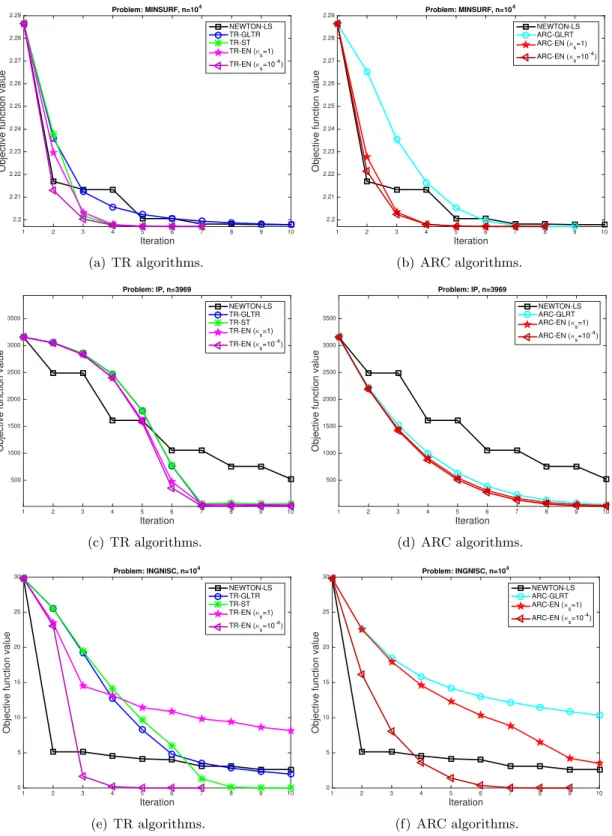
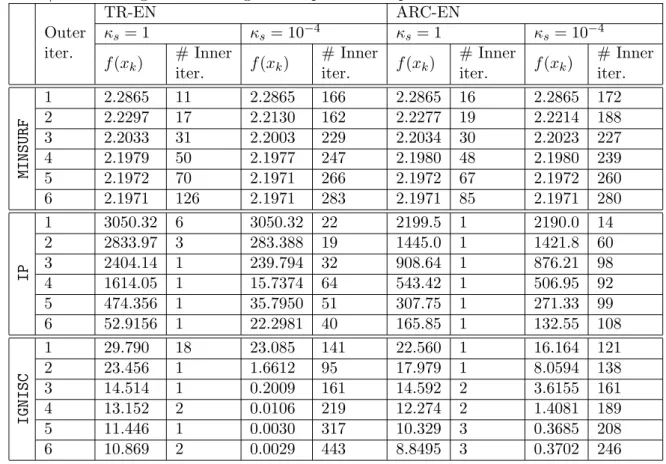
In this section we report the results of some preliminary experiments performed in order to assess the efficiency and the robustness of the proposed algorithms (TR-EN and ARC-EN). At the end of this section we report results of our proposed algorithms when different methods for approximating the solution of the subproblem are used. We implement all the algorithms as Matlab m-files.
5.1 Implementation details and test strategy
For the numerical experiments in this section, we solve exactly the subproblem (9) using the
backslash operator (which uses the LAPACK Fortran library).
Algorithm 3: ARC-EN(s) Algorithm.
In each iteration k of Algorithm 2, compute s
Qkin Step 2 as an approximate solution of B
ks =
−gk,
such that the termination condition
kBk
s
Qk+ g
kkM ≤κ s δ
k2ksQkk2M(26) is satisfied, where δ
k=
21+
q
1+4σkksQkkBk
and κ s > 0 is a contant chosen at the beginning of the algorithm.
Since our proposed approach behaves in practice as line search procedures, in all our tests, we add a comparison with Newton method using a line search strategy (standard Armijo rule).
The trial step is of the form s
k= α
ks
Qkwhere s
Qkis the solution of the the the subproblem (9), and the step length α
k> 0 is chosen such as
f(x
k+ s
k)
≤f (x
k) + 10
−3g
kTs
k,
The appropriate value of α
kis estimated using a backtracking approach with a contraction factor set to 0.9 and where the step length is initially chosen to be 1. The Newton method with the line search will be called NEWTON-LS.
The solvers TR-EN/ARC-EN and NEWTON-LS are compared with TR/ARC using the Lanczos- based solver GLTR/GLRT implemented in GALAHAD [12]. The two subproblem solvers are coded in Fortran and interfaced with Matlab using the default parameters. The matrix M
kin the scaled norms is fixed to identity matrix. The other parameters defining the original TR-GLTR/ARC-GLRT method (Algorithm 1) and the proposed TR-EN/ARC-EN algorithm (Algorithm 2) are chosen as described in [6]. We add also in our TR comparison the TR-DOGLEG method of Powell [18] as its computational cost for solving the subproblem is comparable with that of TR-EN.
For all algorithms the maximum number of “outer iterations”, that are iterations in the un- constrained minimizer, is set to 100000. Similarly to NEWTON-LS, only successful outer iterations of TR-EN/ARC-EN algorithm will be counted as outer iterations. In fact, unsuccessful iterations in Algorithm 2 can be seen as a specific backtracking strategy to satisfy the acceptance criterion ρ
k≥η
1. All the algorithms stop when
kgkk ≤
with = 10
−5.
We use the Mor´ e/Garbow/Hillstrom test problems [15] which are implemented in Matlab.
All the test problems are smooth and have a least-squares structure (meaning that the objective function is of the form f (x) =
12kF(x)k
2where F :
Rn7→Rm). Unlike the CUTEr test problems, the Jacobian matrix of the residual function F for all the test problems [15] is available in Matlab.
Thus, one can obtain locally convex models (i.e., symmetric positive definite approximation of the local Hessian) using a Gauss-Newton approximation of the type:
B (x) = J
F(x)
TJ
F(x) +
BI
n,
where J
F(x) is the Jacobian matrix of the residual vector function F at the point x, I
nis the identity matrix.
Bis a regularization parameter used to avoid a possible singularity of the matrix B , in our experiments we fixed
B= 10
−5.
The problems description is reported in Table 1. We use the standard starting points sug- gested in [15] for all the problems. To have a large bed-test, we create additional problems by varying the problem dimension n when it is possible (typically n = 10, 50, 100, 200 and 300).
Dimension n of problems 2
≤n
≤9 10
≤n
≤20 21
≤n
≤50 51
≤n
≤300
# of problems 22 13 8 19
Table 1: The distribution of the number of variables of the problems in the test set.
To compare the performance of the algorithms we use performance profiles proposed by Dolan and Mor´ e [10] over a variety of problems. Given a set of problems
P(of cardinality
|P|)and a set of solvers
S, the performance profileρ(τ ) of a solver s is defined as the fraction of problems where the performance ratio r
p,sis at most τ
ρ(τ ) = 1
|P|
size{p
∈ P: r
p,s ≤τ
}.The performance ratio r
p,sis in turn defined by r
p,s= t
p,smin{t
p,s: s
∈ S},
where t
p,s> 0 measures the performance of the solver s when solving problem p (seen here as the function evaluation and the outer iteration number). Better performance of the solver s, relatively to the other solvers on the set of problems, is indicated by higher values of ρ(τ ). In particular, efficiency is measured by ρ(1) (the fraction of problems for which solver s performs the best) and robustness is measured by ρ(τ ) for τ sufficiently large (the fraction of problems solved by s). Following what is suggested in [10] for a better visualization, we will plot the performance profiles in a log
2-scale (for which τ = 1 will correspond to τ = 0).
5.2 Results
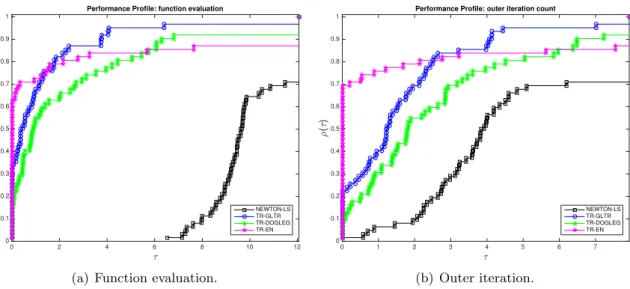
We consider first the TR algorithms. In Figure 1 the performance profiles show that TR-EN improves the efficiency of the TR algorithms on the tested problems. In fact, the outer iteration performance profiles (see Figure 1(b)) show that the use of the energy norm leads to a significant improvement on terms of the efficiency (for τ = 0, on 70% of the tested problems TR-EN performs the best, 23% for TR-GLTR, and around 10% for TR-DOGLEG). The use of the l
2norm leads to a better robustness (i.e., TR-GLTR and TR-DOGLEG are solving a large percentage of the tested problem for large τ values). The same analysis applies in terms of function evaluation (see Figure 1(a)) where the efficiency of TR-GLTR and TR-DOGLEG is slightly improved compared to the out iterations performance profiles (but not as good as TR-EN). NEWTON-LS method is performing the worst on the tested problems, both in terms of efficiency and robustness.
For the ARC algorithms, see Figure 2, the performance profiles show that the use of the
energy norm (i.e., ARC-EN) improves the efficiency of the ARC algorithms over the tested prob-
lems. Unlike the TR performance profiles, NEWTON-LS is the most efficient method in terms of the
τ
0 2 4 6 8 10 12
ρ(τ)
0 0.1 0.2 0.3 0.4 0.5 0.6 0.7 0.8 0.9 1
Performance Profile: function evaluation
NEWTON-LS TR-GLTR TR-DOGLEG TR-EN
(a) Function evaluation.
τ
0 1 2 3 4 5 6 7
ρ(τ)
0 0.1 0.2 0.3 0.4 0.5 0.6 0.7 0.8 0.9 1
Performance Profile: outer iteration count
NEWTON-LS TR-GLTR TR-DOGLEG TR-EN
(b) Outer iteration.
Figure 1: TR performance profiles for the 62 optimization problems under consideration.
outer iteration number, see Figure 2(b). In fact, on over 50% of the tested problems NEWTON-LS performs the best, while ARC-EN solves 28% and ARC-GLTR around 20%. Regarding the function evaluation performance profile, see Figure 2(a), NEWTON-LS method looses its efficiency due to the backtracking strategy employed for each outer iteration. ARC-EN outperforms (by far) both solvers on terms of efficiency (in over 76% of the tested problems ARC-EN performs the best, and around 24% for ARC-GLTR). In terms of robustness, ARC-GLTR and ARC-EN exhibit similar performance. Again, as for TR algorithms, NEWTON-LS is performing the worst on the tested problems regarding the robustness.
τ
0 1 2 3 4 5 6 7 8
ρ(τ)
0 0.1 0.2 0.3 0.4 0.5 0.6 0.7 0.8 0.9 1
Performance Profile: function evaluation
NEWTON-LS ARC-GLRT ARC-EN
(a) Function evaluation.
τ
0 1 2 3 4 5 6 7 8
ρ(τ)
0 0.1 0.2 0.3 0.4 0.5 0.6 0.7 0.8 0.9 1
Performance Profile: outer iteration count
NEWTON-LS ARC-GLRT ARC-EN
(b) Outer iteration.