Publisher’s version / Version de l'éditeur:
Vous avez des questions? Nous pouvons vous aider. Pour communiquer directement avec un auteur, consultez la
première page de la revue dans laquelle son article a été publié afin de trouver ses coordonnées. Si vous n’arrivez pas à les repérer, communiquez avec nous à [email protected].
Questions? Contact the NRC Publications Archive team at
[email protected]. If you wish to email the authors directly, please see the first page of the publication for their contact information.
https://publications-cnrc.canada.ca/fra/droits
L’accès à ce site Web et l’utilisation de son contenu sont assujettis aux conditions présentées dans le site LISEZ CES CONDITIONS ATTENTIVEMENT AVANT D’UTILISER CE SITE WEB.
Internal Report (National Research Council of Canada. Institute for Research in Construction), 2000-06-01
READ THESE TERMS AND CONDITIONS CAREFULLY BEFORE USING THIS WEBSITE.
https://nrc-publications.canada.ca/eng/copyright
NRC Publications Archive Record / Notice des Archives des publications du CNRC : https://nrc-publications.canada.ca/eng/view/object/?id=ce9f03f8-79ac-489f-b6e6-c2df743107a0 https://publications-cnrc.canada.ca/fra/voir/objet/?id=ce9f03f8-79ac-489f-b6e6-c2df743107a0
NRC Publications Archive
Archives des publications du CNRC
For the publisher’s version, please access the DOI link below./ Pour consulter la version de l’éditeur, utilisez le lien DOI ci-dessous.
https://doi.org/10.4224/20331209
Access and use of this website and the material on it are subject to the Terms and Conditions set forth at
FIERAsystem Theory Report: Suppression Effectiveness Model
National Research Conseil national
I
MI
C ouncil Canada de recherches Canada ~ ~ k P ) r z i -FIERAsystem Theory Report=
Suppression Effectiveness Model
David Tomi, Ph.D., P.Eng., Don Raboud, Ph.D. and George Hadjisophocleous, Ph.D., P.Eng.
Internal Report 787
FlERAsystem Theory Report: Suppression Effectiveness Model David T o ~ i , Ph.D., P.Eng., Don Raboud, Ph.D. and
George Hadjisophocleous, Ph.D., P.Eng. June 16,2000
Abstract
The Suppression Effectiveness Model of FlERAsystem modifies the heat release rate, temperature and heat flux data from the FlERAsystem Fire
Development Models to account for the effects of sprinklers that activate. This calculation uses a single suppression effectiveness value, which is input by the user. Information from the Suppression Effectiveness Model is used to calculate the fire spread and life hazard in the building.
TABLE OF CONTENTS
Notation
1. Introduction
2.0 Suppression Effectiveness Value 3.0 Modified Heat Release Rate 4.0 Modified Diameter of the Fire
5.0 Modified Thermal Radiation Heat Fluxes 6.0 Modified Fire Plume Temperature 7.0 Flame Temperature
8.0 Heat Flux Boundary Conditions and Modified Equivalent Temperature
9.0 Modified Time to Flashover 10.0 References
Notation
diameter (m)
radiative fraction (dimensionless) height (m)
convective heat transfer coefficient (W/m2."c) factor (dimensionless)
heat release rate (W)
heat flux (W/m2) distance (m) temperature ("C) time (s) Greek Letters E emissivity (dimensionless)
11 suppression effectiveness value (dimensionless)
o Stefan Boltzmann constant (5.67(10)" w/m2.K4)
Subscripts act amb at time of activation ambient compartment equivalent flame flashover
modified value considering automatic suppression system value with no automatic suppression system
plume
ceiling surface total
1.0 Introduction
As Canada and other countries move from prescriptive-based building codes to performance/objective-based codes, new design tools are needed to demonstrate that compliance with these new codes has been achieved. One such tool is the computer model FiRECAMm, which has been developed over the past decade by the Fire Risk Management Program of the Institute for Research in Construction at the National Research Council of Canada (NRC). FiRECAMTM is a computer model for evaluating fire protection systems in residential and office buildings and can be used to compare the expected safety and cost of candidate fire protection options.
To evaluate fire protection systems in light industrial buildings, a new computer model has been developed. This model, whose current focus is aircraft hangars and warehouses, is based on a framework that allows designers to establish objectives, select fire scenarios which may occur in the building and evaluate the impact of each of the selected scenarios on life safety, property protection and business interruption. The new computer model is called FIERAsystem, which stands for Fire Evaluation and Risk Assessment system.
FlERAsystem uses time-dependent deterministic and probabilistic models to evaluate the impact of selected fire scenarios on lie, property and business interruption. The main FlERAsystem submodels calculate fire development, smoke movement through a building, time of failure of building elements and occupant response and evacuation. In addition, there are submodels dealing with the effectiveness of fire suppression systems and the response of fire departments. In this paper, the model used to calculate suppression effectiveness will be described. 4
The Suppression Effectiveness Model of FlERAsystem modifies the heat release rate, temperature and heat flux data from the FlERAsystem Fire
Development Models (e.g., [I]) to account for the effects of sprinklers that
activate. This calculation uses a single suppression effectiveness value, which is input by the user. Information from the Suppression Effectiveness Model is used to calculate the fire spread [2] and life hazard [3] in the building.
In this report, the theory underlying the equations used for each of the calculations in the Suppression Effectiveness Model is described. Particular emphasis is placed onthe assumptions inherent in the equations used in the model. These assumptions must be kept in mind when considering any results of the FlERAsystem Suppression Effectiveness Model.
2.0 Suppression Effectiveness Value
The Suppression Effectiveness Model requires the user to input a suppression effectiveness value (q) from 0 to 1 .O, which quantifies the ability of the automatic suppression devices to extinguish the fire scenarios being considered. This value is then used to modify the fire heat release rate,
diameter, thermal radiation heat fluxes and plume temperature. Work is ongoing to identify the factors that can be used to calculate this suppression effectiveness
2
value. The calculation of the suppression effectiveness value will be incorporated in future versions of the Suppression Effectiveness Model. 3.0 Modified Heat Release Rate
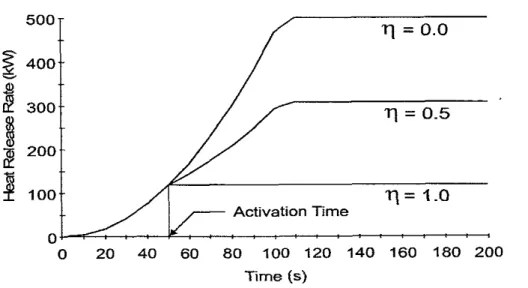
The heat release rate curve (Q(t)) from the Fire Development Model or another source) is input to the Suppression Effectiveness Model. The
suppression effectiveness value is used to produce a modified heat release rate curve (Qm(t)) (Figure 1). It is assumed that if the suppression system
effectiveness is 1 .O, the fire is controlled so that the heat release rate remains at its value at the time of automatic suppression system activation (i.e., Q, = Qaa). This assumption is conservative, as the sprinkler may in fact extinguish the fire. If the effectiveness is 0, the original heat release rate curve (Q,) will not be modified (i.e., Q, = Qa). If the effectiveness is between 0 and 1 .O, the modified heat release rate will be calculated at each time step using the following equation:
Qm(t) = (1 .O-qY( Qo(t)
-
Qad(t) ) + Qad (t)Where
m = modifed by the Suppression Effectiveness Model, and
.
= the original value of the parameter input to the Suppression Effectiveness ModelIn the case where heat release rate values decay, any value of Q(t) which is below Qad is not modified in any way. This helps ensure that the suppression effectiveness model does not increase the value of Q(t) in this situation.
Figure 1. Correction of Heat Release Rate Using Suppression Effectiveness Value, q
q =
1.0/--
Activation Time - 0 20 40 60 80 100 120 140 160 180 200 Time ( s )4.0 Modified Diameter of the Fire
The diameter of the fire, entered by the user or from one of the
FlERAsystem Fire Development Models, is assumed to remain unchanged due to suppression. Suppression is assumed to only affect the height of the flames. Therefore, the diameter is not modified by the Suppression Effectiveness Model (i.e., Dm = 0,).
5.0 Modified Thermal Radiation Heat Fluxes
The thermal radiation heat fluxes (q"(t)) at a distance
(r)
from a fire of heat release rate (Q(t)) can be calculated, assuming a point source model, using the following equation [4]:fQ(t) q" (t) =
-
4nr2 Where:
f = the fraction of the total heat release rate that is considered to be radiative.
In Equation (2). the thermal radiation heat flux is proportional to Q(t). Therefore, the Suppression Effectiveness model modifies the thermal radiation heat fluxes using the following equation:
The assumption that heat flux values are proportional to heat release rate is used for all heat flux modifications, even though the Enclosed Pool Fire Development Model [ I ] uses a different two-zone approach to calculate heat fluxes.
6.0 Modified Fire Plume Temperature
The temperature of the plume near the ceiling (T,) at any time is calculated using the following equation in the FlERAsystem Fire Development Models 141.
Tp (t) = Tamb
+
0.22 ( k ~ ( t ) ) " ~H:I3 Where:
Tamb = the ambient temperature (OC);
k = a factor to take into account the effect of the compartment walls on the
temperature of the hot plume gases;
= 1 (i no walls are nearby);
= 2 (if the fire is close to one wall
-
default value);= 4 (if the fire is in a corner); and H c = the compartment height (rn).
In Equation (4), the difference between the plume and ambient temperature is proportional to Q ~ ~ . Therefore, the modified plume temperature (T,(t)) is determined using the following equation:
The ambient temperature (Tamb) in Equation (6) is assumed to be 20°C.
7.0 Flame Temperature
The flame temperature (Tf) is assumed to be 1000°C by the Suppression Effectiveness Model. If an emissivity of 1.0 is also assumed, this corresponds to a thermal radiation heat flux of approximately 150 kw/m2. These temperatures and heat flux values are consistent with estimates of these quantities reported in the literature (e.g., 141, [5]).
8.0 Heat Flux Boundary Conditions and Modified Equivalent Temperature The heat flux boundary conditions in the FlERAsystem Boundary Element Failure Model use the plume temperature and an equivalent temperature
m.
In the case of the ceiling, the plume temperature is used to calculate the heat transfer to the compartment boundary. The equations used to calculate this plume temperature are dependent on the heat release rate (e.g., see Equation(4)). As discussed earlier, the FlERAsystem Suppression Effectiveness Model is able to take into account the effect of suppression systems on heat transfer to the ceiling by recalculating the plume temperature using the modified heat release rate (Equation (5)).
The walls of the compartment will be subjected to convective and radiative heat fluxes from both the flame and the plume gases. The FlERAsystem Boundary Element Failure Model [7] uses only a single
temperature to represent the effects of the fire on the walls (e.g., the hot gas temperature in a fire resistant test furnace). Therefore, the FlERAsystem Fire Development Models (e.g., [I]) calculate an equivalent temperature (T,) to account for heat transfer from both the flames and fire plume to the walls using the following equation:
The original equivalent (T,,(t)) and plume temperature (T,(t)) are input to the Suppression Effectiveness Model for each time step. First, the original ratio of the flame to compartment height is calculated from Equation (7) using the original equivalent and plume temperature and an assumed flame temperature of
1000°C (discussed earlier in Section 7.0).
The Suppression Effectiveness Model then modifies the ratio of the flame to compartment height. The height of the flames above a fire can be calculated using Heskestad's correlation [4]:
H'(t) = 0.01 l(k~(t))"4 (7) Where:
k = a factor to take into account the effect of the compartment walls on the temperature of the hot plume gases;
= 1 (5 no walls are nearby);
= 2 (5 the fire is close to one wall -default value); and
From Equation (7), the flame height is proportional to Qo4. Therefore, the Suppression Effectiveness Model modifies the ratio of the flame to compartment height using the following equation:
The modified flame to compartment height ratio (Hf,(t)) and plume temperature (T,(t) in Equation (5)) are then used along with the assumed flame temperature of 1000
"C
to calculate the modified equivalent temperature using the following equation:Equivalent temperatures based on the flame and plume temperatures are then output to the FlERAsystem Boundary Element Failure Model [7] in order to determine the heat transfer to the boundaries and the time of failure of these boundaries.
9.0 Modified Time to Flashover
The Occupant Response and Evacuation Models, and the Life Hazard Model require a critical time, which is the time after which occupants will be unable to evacuate the compartment. As one of the possible values of this critical time, the fire development model calculates the time required for flashover to occur, using Thomas' flashover correlation 181.
Q, =7.8AT +378~,& Where:
Qta = heat release rate at flashover (kW);
AT = total surface area of the compartment (m2); A,
=
total area of openings (m2); andHe = equivalent height of openings (m).
The original time to flashover is input to the Suppression Effectiveness Model. Using the original heat release rate data (Qo(t)), the heat release rate at
flashover (Qb) is determined. The modified time to flashover is then determined by comparing the modified, timedependent heat release rate data (Q,(t))
calculated earlier by the Suppression Effectiveness Model using Equation (1) with the heat release rate necessary for flashover.
10.0 References
1. Torvi, D., Raboud, D. and Hadjisophocleous, G., "FIERAsystem Model
Theory Report: Enclosed Pool Fire Development Model", Internal Report IRC- IR-784, Institute for Research in Construction, National Research Council, Ottawa, ON (in press).
2. "FIERAsystem Model Theory Report: Fire Spread Model", Internal Report, lnstitute for Research
in
Construction, National Research Council, Ottawa, ON (in press).3. Torvi, D., Raboud, D. and Hadjisophocleous, G., "FIERAsystem Model Theory Report: Life Hazard Model", Internal Report IRC-IR-781, Institute for Research in Construction, National Research Council, Ottawa, ON (in press). 4. Alpert, R.L. and Ward, E.J., "Evaluation of Unsprinklered Fire Hazards", Fire
Safety Journal, Vol. 7, 1984, pp. 127-143.
5. Mudan, K.S. and Croce, P.A., "Fire Hazard Calculations for Large Open Hydrocarbon Pool Fires", SFPE Handbook of Fire Protection Engineering, Second Edition, National Fire Protection Association, Quincy, MA, 1995, pp. 3-1 97
-
3-240.6. Cooper, J. and Yung, D., "Fire Growth Model for Apartment Buildings", Internal Report No. 734, Institute for Research in Construction, National Research Council, Ottawa, ON, 2997.
7. Benichou, N. and Hadjisophocleous, G., "FIERAsystem Theory Report: Boundary Element Failure Model", IRC Internal Report IRC-IR-796, Institute for Research in Construction, National Research Council, Ottawa, ON (in press).
8. Walton, W.D. and Thomas, P.H., "Estimating Temperatures in Compartment Fires", SFPE Handbook of Fire Protection Engineering, Second Edition, National Fire Protection Association, Quincy, MA, 1995, pp. 3-134