Publisher’s version / Version de l'éditeur:
Vous avez des questions? Nous pouvons vous aider. Pour communiquer directement avec un auteur, consultez
la première page de la revue dans laquelle son article a été publié afin de trouver ses coordonnées. Si vous n’arrivez pas à les repérer, communiquez avec nous à [email protected].
Questions? Contact the NRC Publications Archive team at
[email protected]. If you wish to email the authors directly, please see the first page of the publication for their contact information.
https://publications-cnrc.canada.ca/fra/droits
L’accès à ce site Web et l’utilisation de son contenu sont assujettis aux conditions présentées dans le site
LISEZ CES CONDITIONS ATTENTIVEMENT AVANT D’UTILISER CE SITE WEB.
International Association of Media and Communications Researchers (IAMCR)
Annual Conference [Proceedings], 2006
READ THESE TERMS AND CONDITIONS CAREFULLY BEFORE USING THIS WEBSITE. https://nrc-publications.canada.ca/eng/copyright
NRC Publications Archive Record / Notice des Archives des publications du CNRC :
https://nrc-publications.canada.ca/eng/view/object/?id=3c0e77a6-8184-4ad0-b2b1-80fba58cc4a2 https://publications-cnrc.canada.ca/fra/voir/objet/?id=3c0e77a6-8184-4ad0-b2b1-80fba58cc4a2
NRC Publications Archive
Archives des publications du CNRC
This publication could be one of several versions: author’s original, accepted manuscript or the publisher’s version. / La version de cette publication peut être l’une des suivantes : la version prépublication de l’auteur, la version acceptée du manuscrit ou la version de l’éditeur.
Access and use of this website and the material on it are subject to the Terms and Conditions set forth at
Serving Canadians Better On-Line?
Rideout, Vanda; Reddick, Andrew; McIver Jr., W. J.; O'Donnell, Susan;
Kitchen, Sandra; Milliken, Mary
National Research Council Canada Institute for Information Technology Conseil national de recherches Canada Institut de technologie de l'information
Serving Canadians Better On-Line? *
Rideout, V., Reddick, A., W. McIver, Jr., O'Donnell, S.,
Kitchen, S. Milliken, M.
July 2006
* published at the International Association of Media and Communications Researchers (IAMCR) Annual Conference. Cairo, Egypt. July 23-28, 2006. NRC 48770.
Copyright 2006 by
National Research Council of Canada
Permission is granted to quote short excerpts and to reproduce figures and tables from this report, provided that the source of such material is fully acknowledged.
IAMCR (International Association of Media and Communications Researchers) Annual Conference
Cairo, Egypt, July 23-28, 2006
Serving Canadians Better On-Line?
Authors: Vanda Rideout, Andrew Reddick, W.J. McIver Jr., Susan O’Donnell, Sandy Kitchen, Mary C. Milliken
Introduction
The Canadian government’s 1999 Speech from the Throne set the goal of being known around the world as the government most connected to its citizens with Canadians able to access all government services on-line at any time and place of their choosing. As part of achieving this advancement to a knowledge society, the government made a series of investments in infrastructure, content and access. Underlying these commitments and activities is a broadly held expectation by
government and other social actors that social and economic activities in the country are, and will be, predominately conducted using electronic communications. The federal government’s approach to information and service delivery is primarily framed by a broad on-line policy framework, to be implemented through the citizen-centred Government On-Line/Service Improvement Initiative (Canada, 2006; Treasury Board of Canada, 2002, 2003). Within this context however, there continues to be debate about variation of access (digital divides) and the veracity for different means of information and service access by citizens.
This paper assesses to what degree community level provision of on-line employment resource and health and wellness services achieves the policy initiative of an
inclusive knowledge society, based on empirical research conducted over a two-year period (2004-6). The authors conducted research study at four non-government community-based organizations (NGOs) in different parts of Canada that deliver social services and information to their clients. The study involved investigating the specific communication practices of these organizations, located in different parts of Canada, which act as community intermediaries delivering federal, provincial or municipal government services and information. The researchers examined the community context in which the intermediaries operated, the challenges, opportunities and problems they face, and the means by which they provide electronic client services and information.
The authors argue that these community organizations do not have the financial, human or technological resources to deliver their existing client programs, let alone more advanced on-line government services and information. The serious problem combined with inadequate communication infrastructure and client barriers, helps to perpetuate social exclusion in the Canadian knowledge society.
Section one of the paper discusses the major funding problems these organizations have experienced and the impact these have on client service delivery. The research found that three employment resource organizations without core funding did not have the capacity for on-line government information and service delivery. Relying on program, contract and fee-for-service funding meant the organizations were under great pressure due to inadequate financial, human and technological resources, both
to sustain their organizations and to adequately provide electronic client services. The health and wellness organization with core funding, however, was organizationally stable, with the capacity for successful program development and electronic service delivery.
Section two examines the organizations’ internal out-dated IT networks and their access to inadequate local communication infrastructure (high-speed service). This section also discusses the range of barriers clients face using on-line government services. These barriers include: low education and literacy levels; disability and aging; on-line privacy concerns; fear of electronic technology; inadequate staff and client information technology training; living in a rural or remote area; and language barriers for minority language groups, First Nations people, new immigrants and people with disabilities. Our findings reveal that existing social, cultural and
technological problems need to be resolved in order for citizens to be included in a knowledge society.
The research discussed in the paper is based on the authors’ Community
Intermediaries Research Project (CIRP) two-year study and subsequent final report Community Intermediaries in the Knowledge Society (2006). The primary objective of the study was to investigate the opportunities, challenges and problems facing four community intermediaries (non-government organizations NGOs) as they deliver adult formal and informal learning, skills and training services, health information and services, and general community information and community development activities. These organizations are called “community intermediaries” because they act as links between the various levels of government (federal, provincial, and municipal) and citizens, providing social services and information to their clients and respective communities, located in different parts of Canada.
The research investigated the specific communication practices of the intermediaries, the community context in which they operate, and the means by which they provide electronic client services and information. The study was guided by the following questions: What are the means employed by community organizations to successfully provide education, skills, literacy, health information and other resources for citizen engagement? How do these organizations use information and communication technologies (ICTs)? What are the opportunities, barriers and restraints for using electronic technology to deliver client information and services?
A mixed methods approach was used to gather data1 from in-depth staff interviews, client and staff focus panel discussions as well as client and staff surveys. Staff information environment mapping (IEM) interviews were conducted2. Demographic profiles of the geographic area where each organization is located were created. Data was also collected and analyzed from the organizations’ documents and web sites. A representative sample was chosen for the client survey that reflected income levels, gender, ages and languages spoken.
1 Thirty-three staff interviews and eight focus group panel interviews (36 staff members and 39
clients) were conducted. Survey questionnaires were distributed to 50% of the clients at each organization. The completed survey response rate for the clients was 45% (n=514) and 62% for staff members, Community Intermediaries in the Knowledge Society, 2006, p.16.
Section 1: Community intermediaries’ funding and client composition impact on service and information delivery
Client composition and funding impact
The authors found that the composition of the clients at each community organization is an important factor that has to be taken into consideration when delivering services and information. Also, how a community intermediary is funded has a major impact on client services and information delivery. Funding for the three employment resource organizations consists of a mixture of core, fee-for-service and program delivery funding. Our findings reveal that funding arrangements for these intermediaries are contingent, variable and not sustainable, either for current program delivery or new program development. Core funding is being phased out, or has been drastically reduced. Moreover, short-term, fee-for-service and project funding is inadequate to cover the current operating costs of each of these organizations. Securing
sustainable funding for these organizations is a major problem. Funding arrangements also impact human and technological resources.
The community intermediary client composition and funding arrangements are discussed below in terms of their impact on the services and information delivered to clients by each of the job placement, the skills and training, the community
development and employee resource, and the health and wellness organizations.
Job placement organization
Services and client composition
Located in a large city, the job placement organization delivers employment information and services to clients with mental health challenges. For the past ten years the organization has continued to provide services over a larger geographic area to people with mental disabilities, homeless people and to people with ‘concurrent disorders’ such as mental health and substance abuse.
Throughout this period, the number of clients has increased substantially, particularly with homeless people and people living at risk. Concurrently the organization has had to make major structural changes to adjust to a new provincial funding regime and subsequent changes to the grant application process.
The organization provides employment programs and services ranging from
vocational training, job placement and job coaching, to on-site job training. Additional employment services include group and casual work placement leading to paid employment. Job searches are part of the organization’s targeted job development program. A few clients conduct their own job searches on the government on-line Job Bank with less assistance, but most clients rely on staff members to help with their job searches. One of the programs, employment quest, helps clients find permanent, temporary or casual work. Another employment program is an agency-sponsored entrepreneurial business that offers individual or group on-the-job training for industrial kitchen employment.
The organization also offers additional pre-employment services, such as resume writing and interview workshops. Beyond employment services, mental and physical
health programs are also provided to address health and wellness needs. Other support functions involve finding and maintaining housing, medical appointments and referrals. The clients benefit from all of these programs by gaining work experience, and being better prepared to find and hold employment. A staff member explained that preparing the clients for the work environment involves finding work and developing the social skill set needed for:
… working with individuals, how to communicate with other people and being assisted to integrate into society (Job placement organization, SI-4).
A majority of clients at the job placement organization are middle-aged - between 35 and 55 years old. Income levels are low; clients receive from five to fifteen thousand dollars per annum (Rideout et al, 2006:27). The organization’s staff members explained that although client needs are primarily employment-related, the
organization addresses learning and social needs as well. Clients have many needs, including such basics as food, income and housing security. Some clients cannot afford to pay for public transportation to visit the organization. Many clients have cognitive impairments and learning difficulties, and some have psychiatric conditions. Delivering information and services appropriately to these clients requires more energy and time than staff members have at their disposal.
Staff members also identified illiteracy, hearing disabilities and physical disabilities as possible barriers to the services that the organization offers. Clients with literacy barriers receive additional levels of service from staff, such as verbal explanation and the reading of written documents and forms. Clients with walking difficulties and those using a wheelchair are able to access all staff members and programs by using the elevator.
Funding
The organization’s funding is a mixture of core, fee-for-service and program funding. Project-based and fee-for-service funding is received from both federal and provincial levels of government. With the recent change to fee-for-service project funding, the organization’s funding was reduced by almost 50 per cent. Annual core funding of approximately $600,000 from the provincial government funds most of the programs and outreach services the organization provides to homeless people. The
organization receives a small amount of core funding from the municipal government. There is, however, a possibility this funding arrangement may not continue. A
significant amount of staff resources is used to fundraise in the process of applying for 25 to 35 grants per year.
Inadequate financial resources have had a major impact on the staffing situation as well as the service and program delivery. The fee-for-service funding model means even more staff time is spent on administrative tasks rather than addressing client needs. Staff salaries are not competitive because in most cases, the provincial departments funding the organization do not augment the salary rates or recognize that many staff members are unionized. In 2005 a provincial department allowed staff a 3 per cent salary increase, which was the first increase in 12 years. The short duration of project funding as compared to core funding means that job insecurity is widespread. Some staff members are on short-term contracts – two-week contracts
were mentioned – and have no job security, adding to the general stress levels.
Funding insecurity contributes to levels of frustration expressed by a staff member as: Whenever our contract is coming up you are getting a little
stressed because you haven’t heard anything and they won’t tell you until the day of, like your last day, whether or not you are going to be renewed. … You are worrying about all your clients, you are worrying about yourself. What types of supports can you provide referral wise? (Job placement organization, SI-4).
This organization, like the other community-based organizations, has found it increasingly difficult to use volunteers. There is not a ready supply of volunteers anymore, and it is extremely difficult either to get volunteers either to serve on the organization’s Board of Directors, or to work directly with clients.
The lack of secure sustainable funding has resulted in uncertainty that has affected many aspects of the organization. The organization can no longer maintain its model of service delivery with reduced staffing levels. The Directors are under-resourced in their fundraising activities, and the writing of grant applications requires considerable resources from the remaining staff. There is no staff available to collect follow-up data on project outcomes, which would be useful information for funders and for
applications for future funding. Moreover, the organization has no administrative support staff or receptionist; so many day-to-day tasks also fall to the two Directors.
Skills and training organization
Services and client composition
The organization delivers both formal and informal training and skills development services and programs to clients living in more than 90 small communities in a rural/remote, geographically dispersed area. Services and programs include one-on-one assistance for clients conducting labour market research, as well as teaching resume writing and the basic skills needed to conduct an Internet job search. A program that combines education upgrading, retraining and job placement as described on the organization’s web site is highly popular, as reflected in the 75 applications that the organization received for 10 to 20 participant spaces. The web site is not only informative, but it answers commonly asked questions so people do not have to physically visit the organization in order to check their eligibility for the program. Information and communication training is mandatory for the clients accepted into this program. A majority of the clients are young adults between the ages of 19 and 35, with low and lower middle-income levels, the majority in the five to fifteen thousand dollars per annum range (Rideout et al, 2006:28).
To identify employment options, employment counselors conduct a client
assessment, taking the client’s interests into consideration. Goals are established such as completing secondary education, acquiring a community college diploma, pursuing a university degree, or obtaining a trade certificate. In addition, employment counselors provide career planning. Client barriers included the frequency of low literacy skills, the prevalence of level one secondary education (grade 8 to 10) and the lack of a certificate, diploma or a grade twelve-education level. Low education
levels and a lack of employment skills affect the ability of clients to progress both in their work and personal lives. Social barriers range from a lack of a work ethic to a lack of experience with fulltime employment and not understanding the responsibility of full-time work. Staff members thought some of the clients were afraid of full-time employment and the commitment it requires. These barriers can be traced to previous seasonal work patterns and not understanding the concept of working all year
around. Other barriers involve the frequency of alcohol and/or drug addiction or the presence of a mental or physical disability.
These barriers result in staff making a considerable investment of time and effort before a client can be trained or (re)trained to enter the work force. First, an employment counsellor conducts an aptitude test. If the client reaches level two or three, he or she is then eligible to go to an Adult Basic Education (ABE) centre to obtain a grade twelve education. Once the client receives the ABE certificate, (s)he can proceed to a trade school, community college or university. People with
disabilities are referred to the Ability Employment Cooperation (AEC) program where, after an assessment, the AEC contacts employers on behalf of the clients for work placements.
The criteria for service programs, however, do not always meet clients’ needs. Many clients do not meet the minimum educational requirements – often a high school diploma – for the skills training programs. They often do not score high enough in the aptitude test to apply for educational upgrading. In these cases, the clients have to get help on their own before trying the aptitude test again. Because it may take years of intense training for clients to reach the required aptitude level, the challenge for the organization is keeping clients motivated.
Funding
Funding is also a major problem for this community intermediary. The organization receives all of its funding from both federal and provincial government departments, with monthly fee-for-service payments attached to each program delivered. Program and project funding is inadequate to cover the core costs of running the organization. The most obvious impact, aside from the low ICT capacity discussed further in
section two, is the effect on human resources. Because there is no core funding, staff members are hired on contract, and work without secure employment or good
working conditions. As contract workers, staff members do not belong to a union or representative association. There is inconsistency in salaries, dictated by how the government funds different geographical areas: some staff members are receiving less pay than others for doing the same work because of where they are located. The staff has not had a salary increase, even for cost of living, for six years. Low staff salaries have contributed to rising rates of staff turnover. Staff members also put in long volunteer hours to write funding applications, and all of the staff has to work long hours to ensure they are paid an adequate income.
The most significant challenge to the skills and training organization is its precarious income situation, which limits what the organization can do. In some of its offices, the number of staff is adequate to deliver the required services. In other offices, more staff is needed but there are no resources to hire more people. Volunteers to help paid staff are rare, with some former volunteers having left the province to seek
employment.
I spend, I guess six days a week and a lot of nights, some weeks I have to go seven days just steady at it in order to be having enough programs up and going in order to be able to I guess keep myself employed. It gets really hard especially with me, I am by myself and I don’t have any assistance at it. … I find it rather difficult at times (Skills and training organization, SI-1).
The organization is in an unsustainable funding situation and, despite great effort by the staff, this has had a negative impact on its capacity to deliver information and services. Inadequate funding creates a domino effect resulting in not enough
resources to hire more people or to upgrade IT or adequately access on-line services.
Community development and employment resource organization
Services and client composition
The community development and employment resources organization provides information and services to urban residents in a city with one of the lowest incomes per-capita in Canada. The organization’s innovative programs and services address basic community needs such as housing and food security, green spaces and
gardening. The healthy food club and farm volunteers offer economic benefits (food in exchange for labour) as well as social benefits.
Currently the organization has reached the end of its federal government Community Learning Networks project funding and so has cancelled the client ICT education service training. Any service and information delivery by electronic services will depend on the direction the organization plans to take in the near future. Clients at the organization tend to have low and lower middle-income levels. A
majority have incomes of five to fifteen thousand dollars per annum. For the most part the clientele is young, between the ages of 19 and 35 (Rideout et al, 2006: 29). These clients have many basic needs including food, shelter and clothing. Clients require information and services to help address a combination of social, cultural and economic needs. These include: more education; employment and financial security; child-care services; a space to meet and interact; literacy; or learning to read, write and speak English as a second language.
Staff members pointed out that some clients do not have much self-reliance.
Stigmatized by living for long periods of time on social or partial assistance, they lack confidence in their own abilities. Having low or partial levels of income or no income at all contributes to senses of alienation and lack of purpose. Some staff members expressed frustration at not being able to address community needs because of the specific parameters of the individual services they offer. Other problems include the high number of transient residents in the area, which makes it challenging both to reach potential clients and to offer longer-term services.
Provincial, federal and municipal levels of government, as well as foundations and private donors fund the organization. The municipal government provides yearly core funding that has been reduced to $75,000 for all administration, rent, legal,
accounting, audit and other expenses. Most of the organization’s funding is project-based, which has created many organizational challenges. Until fairly recently, the organization had serious management problems, but that situation was recently addressed. The organization cannot charge user fees because of the low-income levels of its clients. The organization has very limited funding considering its broad range of services and the needs of the community. Service areas are budgeted tightly and the scope of projects is curtailed by the available funding.
Staff members are also concerned about starting any new programming without assurances of sustainable funding, fearing that “it will be just another well-intentioned program that’s fallen by the wayside and it will be another disappointment and
frustration for people in the community who are left hanging with half an education or reduced access” (Community development and employment resource organization, SI-3). All of the service areas are stretched and many current activities rely on volunteers.
The restricted funding also limits the range of services available. For example, assistance with rental housing has been identified as a huge need in the community. While the organization has services for homebuyers and owners, it does not have any additional resources to develop programs for renters. Most recently, funding cuts to this organization required discontinuing a youth program and a computer-training program. The funding situation means insecure work contracts, resulting in stress and anxiety among staff, which then has a further negative impact on the ability to deliver services.
Health and wellness organization
Information/services and client composition
The health and wellness organization provides health information and services to minority language clients in a medium to large city. Client barriers at the health and wellness centre include language barriers, aging, mental health problems and social isolation. Clients come from the complete spectrum of income levels, and while the majority tend to have lower incomes, some are in the higher income bracket of more than sixty-five thousand dollars per annum. A majority of the clients who use the health and wellness centre are middle aged, 25-54 years old and seniors 65 years and over. This concentration of seniors places particular demands on service delivery, which are likely to increase in the future.
Staff members identified a number of challenges and barriers to delivering client services and information. The first challenge is one of geography – delivering services and information to people living over a large region. The second is the challenge of language – all health and wellness information has to be translated. A third challenge is ensuring that the members of the larger majority language health services network remain aware of, and engaged with, the organization. A fourth challenge is being aware of the needs of the clients so the centre is ready with required reliable, up-do-date information that the organization can give to clients
when needed. A fifth challenge is ensuring that the centre is included in all aspects of the integration of the health IT system, currently being developed.
A combination of language barriers and aging creates additional barriers. Receiving health services in one’s first language, particularly as a person ages (clients 65 years of age and older), helps to ensure that diagnosis, treatments and services are
understood. At this stage in a persons’ life a lack of support and a lack of knowledge about health and wellness services often contributes to further isolation. Additionally, staff pointed out that some clients, particularly the elderly, find technologies to be very intimidating.
Funding
The community health and wellness organization has a significant advantage over the three employment resource organizations because it receives core funding from the provincial government on an annual basis. The staff members speculated that more services could be provided as long as funding was made available for hiring
additional professionals to deliver services such as rehabilitation, physiotherapy, occupational, psychology, and client-intensive social services. This rate of growth in service and information provision indicates that there are still unmet needs in the minority language community that the centre could expand to serve.
Although the general consensus was that the organization currently has adequate staff, several staff members suggested the organization could use a technical support person in the form of a clinical staff member who is also trained in technology use, such as “a nurse computer whiz or a social worker computer whiz” (Health and wellness centre, SI-5).
ICT funding
The current funding situations affect the organizations’ ICT resources in all areas, be it software, hardware, training, access, or maintenance and upgrades. Yet, federal, provincial and municipal grants and programs exclude supportive funding for these technologies and services such as computers, access to the Internet, high-speed Internet services, IT maintenance and upgrades and integration of IT systems, along with client and staff ICT training. These generally unsustainable funding situations and the subsequent effects on staffing, ICT and Internet services have a negative impact on the capacity of the three employment intermediaries’ to deliver existing information and services to clients.
Section 2: Community intermediaries and e-government
Meeting the client needs for information and services is the primary objective of these organizations, and the potential to improve on using the Internet and ICTs is the main attraction for using technologies. The essence of federal communication policy is that all Canadians will be able to access all government services on-line irrespective of location or time of day. In this view, social and economic activities, as these relate to government, will increasingly be conducted using electronic communications.
Moreover, at the levels of community and individual, this is supposed to result in a more inclusive knowledge society.
All four organizations play an intermediary role by delivering information and services to their communities, linking various levels of governments with citizens. The
organizations also play a role as intermediaries in e-government, using information and communication technologies (ICTs), particularly the Internet, to deliver public information and services to citizens.
The role of each of the four organizations as intermediaries in e-government is specific to the particular social, economic, cultural and geographic contexts of each organization and its client base. Clearly the most significant factor shaping the role of the organizations as intermediaries in e-government is organization funding. Many of the challenges of using ICT discussed in this and the previous section are directly related to the precarious funding situations for the organizations. The health and wellness centre, the only organization studied with adequate and sustainable core funding, is the organization best prepared of the four to deliver on-line government services and information and meet the ongoing challenges related to being an e-government intermediary.
The benefits, and particularly the challenges to the organizations using ICT to deliver information and services to their clients, are discussed in this section beginning with the health and wellness, and followed by the job placement, skills and training and the community development and employment resources organizations.
Organization ICT infrastructure constraints
An information environment mapping interviews at the four organizations revealed a number of ways in which constraints on ICT infrastructure have impacted the
exchange and use of information by the organizations studied and many of their clients. Lack of access to, or missing technology were the most common constraints on information sharing for the organizations. Key examples were the absences of networking infrastructure and data integration capabilities in these organizations. As a result, staff devised both electronic and physical schemes for managing and sharing data, but there is still undeveloped potential. Many staff members want the ability to collaborate through the use of common versions of documents, for example. One organization does have an internal network and server that would allow for this, but they do not have the technical capacity to set it up and configure it to do so. A related constraint is the inability to access office networks from the outside. Staff in several organizations indicated that the ability to work from home or other remote locations could increase productivity. Technology was also not available to help organizations cope with the frequent changes that occur within external sponsoring agencies. Such reorganizations require the organizations to change their internal processes and often result in the loss or delay in the exchange of client information.
Most organizations did have access to common advanced electronic ICT, including advanced telephone services, mobile telephony; advanced software applications, e-mail and web services. The use of other common electronic ICT was observed in various subsets of the organizations. This included web-based collaboration tools, text messaging, video, video conferencing, and TTY-based text messaging for the hearing impaired.
Physical aspects of ICT infrastructure have had significant impacts on the exchange of information by community intermediaries and their clients. Accessibility for clients
with physical disabilities is the key issue in this context. One organization lacked elevators and ramps, which has limited the ability of some clients to access certain facilities and programs.
ICT has not always been seen as desirable or necessary by staff, however. Social networking by staff has been critical to gathering information to assist their clients. Priority was given by staff to using simple, interpersonal modes of communication. Telephone was a key technology, but face-to-face communication was often the preferred mode
Job placement organization
The job placement organization plays a supporting, rather than a leading role as an intermediary for e-government. It lacks both the staff and the financial resources to champion electronic delivery of employment information and services. Most staff members did not think the organization is very well prepared to deliver e-government services and information. As one staff member said: “Well if this was on a scale of 1 to 5, probably about a 2” (Job placement organization, SI-1).
The reasons the organization is not better prepared are due to its unsustainable funding situation primarily, which does not allow capital investment for computer equipment or staff training, as well as a shortage of staff with IT skills. Before the organization invests in computer hardware, software and training, it must upgrade its current electrical power service and put a reliable LAN system in place. These challenges are discussed later in this section.
Another major deterrent to e-government for the job placement organization is that its clients need considerable support to access and use ICT effectively. Because the organization uses a client-centred service delivery model, and many of its clients are just learning how to use technology, clients need a lot of guidance from staff. One staff member explained:
I think a huge thing with working with clients is that you need to be with them. A huge thing is providing the support and self-esteem and I don’t think a computer screen can do that… (Job placement organization, SI-4).
The organization provides a drop-in space to deliver services and information informally. It also provides venues for social interaction where clients can exchange information and learn about new services informally. Some staff members have concerns that using ICT to communicate with clients is less beneficial than face-to-face contact, which builds relationships.
Clients surveyed were asked to identify which methods they used to communicate with the organization to find out information about the services they provide. As Figure 1 indicates, respondents across all four organizations preferred to use the telephone to communicate, followed by in-person communication above all other methods. The job placement clients also relied on a newsletter and information mail-outs for communication purposes. Even though there is an increasing reliance on email communication, website notice board and e-newsletter communication were used the least.
The clients who participated in the focus group panels provided similar responses. The consensus was that clients want to speak with a real person, not ‘press one for this and six for that’ (Rideout et al, 2006). Clients tended to drop in to the
organizations to find information about the programs offered and to look for
government information. This way if they had any questions or concerns they would get an immediate answer. Our findings indicate that the clients use multiple means to communicate with the each of the four intermediaries and with government. There is a significant preference among all clients for personal contact and telephone
communication as indicated in Figure 1.
Figure 1: Methods Clients Use to Communicate with the Organization telephone email Types of Methods face to face CDER (n=40) e-newsletter S&T (n=210) JP (n=96) newsletter mailout information mailout website notice board other
100
0 20 40 60 80
Percent of Respondents
H&W (n=168)
Community Development and Employment Resources (CDER), Skills and Training (S&T),
Job Placement (JP), Health and Wellness (H&W)
Clients who took part in the focus group panel at the job placement intermediary were asked if they were aware of the organization’s web site and what they thought of it. About one third of the clients knew about the site and had used it. A third were aware of the site but had not used it and the remaining third did not know that it existed. Student volunteers set up the web site from a local college, but as the participants from the staff focus group panel explained, keeping it updated has been a problem because of a shortage of human resources.
Our web site it is horribly out of date… There was a staff person at the job placement organization who was, let’s
call it web-friendly. But this person was laid off due to lack of funding so now there is nobody within the organization’s staff that has the time and technical skill to do this (Job placement organization, SF).
ICT benefits and barriers
The organization has found that e-mail and cell phones are effective ways for staff to liaise with other community workers and referring agencies. A local community economic development list-serve keeps staff plugged-in to local resources and information. Networking by e-mail has helped the organization develop more extensive links with various levels of government.
The organization has significant ICT hardware and software barriers in addition to network barriers. Furthermore it lacks capital funds for computer equipment and necessary infrastructure upgrades. Not all staff members have computer and Internet access at work, making it impossible to communicate internally by e-mail. There is no central server, and the client database is long overdue for an upgrade and so crashes consistently. The organization has acquired computers through donations or private foundation grants. It has many older computers, which are incapable of running newer versions of even basic software. After attempts to upgrade the phone system, staff concluded it needs a complete overhaul, which the organization cannot currently afford.
I would say that our phone system is really terrible ... in terms of people calling in… So that poses a problem because it is very difficult for employers and clients to contact us. Sometimes especially employers, it makes a really bad impression if they can’t get a hold of us. (Job placement organization, SI-5).
Using ICT to deliver information and services is a challenge for all of the
Organizations’ studied, given that many of their clients with the greatest needs do not use computers and the Internet. Clients indicated that there was a range of issues that would encourage them to use the Internet more often to access community and government information and services. Some of these issues, more than others, are unique to the organization itself. For example, in Figure 2 we see that the majority of clients in the job placement as well as community development and employment resource organizations indicated Internet training. The community development and employment resources and the skills and training organization also indicated speed of service. Owning a computer and being able to easily find relevant content followed this.
Staff members at the job placement organization have specific concerns about ensuring confidentiality of digitalized files particularly for the clients with mental disabilities. Concern was also expressed that the organization does not have the ICT expertise to ensure that these files will remain secure.
The clients’ low capacity for using ICT is another significant barrier to service delivery using ICT. Some clients were very proficient with computers but many were not, and
they would need extensive training in order to access and use ICT more effectively as indicated in Figure 2. Literacy levels vary among clients, so providing written
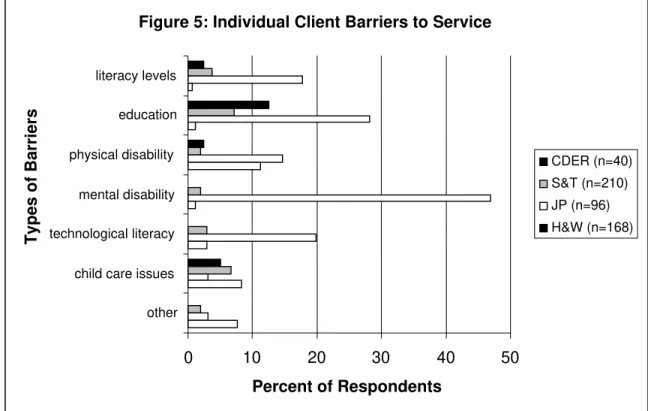
instructions for using computers would not be adequate. The job placement clients identified a number of barriers beginning with mental disabilities, education followed by technological literacy and literacy levels to intermediary services (Figure 5).
Community Development and Employment Resources (CDER), Skills and Training Figure 2: What Would Encourage Clients to Use the Internet More
Often to Access Community and Gov't Information and Services Internet training T y p es o f En co u rag emen t
content easier to find more time for use reliability of Internet service
CDER (n=40)
speed of service S&T (n=210)
trust in online security JP (n=96)
owning a computer home Internet service Internet easier to use computer easier to use
0 10 20 30 40 50 60
Percent of Respondents
H&W (n=168)
(S&T),
Job Placement (JP), Health and Wellness (H&W)
Many clients do not use computers, do not want to use computers, or are not familiar with computers. Clients who are interested in learning how to use computers need considerable support. A number of clients do not know how to type so they cannot use a keyboard. Although the job placement organization has neither the funds nor the staff for client computer training, staff members try to provide ICT support for clients. Especially for clients with cognitive difficulties, learning computer skills requires a systematic approach, all of which takes time. Staff members pointed out that some clients are very afraid of computers and do not want to conduct an on-line job search. When this occurs, staff members try to introduce the client to the
technology slowly on a step-by-step basis.
Skills and training organization
Similarly the skills and training organization is also struggling with its role as an intermediary in e-government. The organization delivers information and services to clients living in more than 90 small communities in a rural/remote, geographically dispersed area. Most of the organization’s staff members believe that it does not have the human, technological or financial capacity to use ICT to deliver either the services
that they already provide, or additional government services. In order to deliver e-government services, the organization would need reliable and affordable access to high-speed Internet service, as well as new computers. It would also need additional trained staff and training for the existing personnel, all of which would necessitate additional financial support. One staff member explained just one of the challenges related to the organization’s low ICT capacity:
Most computers can’t handle none of that stuff and a lot of the new government services on the Internet that are coming out there are very technical, very complicated, and the computer needs to be doing stuff at all time. But our computers, aside from X’s are not able to do none of that stuff because they are just so old and slow. It is all dial-up too (Skills and training organization, SI-3).
The organization employs multiple means to communicate with and disseminate information to clients and potential clients living in the more than 90 communities in the region. The organization conducts a significant amount of advertising using pamphlets, brochures, posters, flyers, business cards and community television and radio, as well as postings on the provincial web site. Some communication methods work better than others in different communities, so the skills and training
organization’s information and communication strategies are targeted to what works best in each community. Similar to the job placement organization, staff members at the skills and training organization confirmed that many clients find out about the organization and its services through word of mouth.
I think word of mouth probably gives us the best feedback. Clients come in to our office and we have a high
percentage of clients who are very satisfied with the service that we provide and when people like the service they usually talk a lot about it (Skills and training
organization, SI-4).
It is interesting to note that the telephone is the preferred method of finding
information about all types of services. The telephone was the most popular method of finding federal, provincial and municipal government information by clients at the skills and training organization, as it was for the other organizations. Results for each area of service were very similar and this general pattern is well illustrated in Figure 3.
Figure 3: Methods Used to Find Information about Federal Services telephone email Ty pe s of Me th ods brochure CDER (n=40) S&T (n=210) website JP (n=96) face to face info mailout other 0 10 20 30 40 50 60 Percentage of Respondents H&W (n=168)
Community Development and Employment Resources (CDER), Skills and Training (S&T),
Job Placement (JP), Health and Wellness (H&W)
The skills and training organization, as well as the other two employment resources organizations provide computers on their premises for clients to access on-line information and services, with assistance when required. Until recently, these three organizations also delivered IT training programs to clients, with program-specific funding from Human Resources and Skills Development Canada. The focus of the training programs was to overcome fears and increase the comfort level of clients using computers.
Of the four organizations, only the skills and training organization has a high use of e-mail for internal communications among staff. Two of the satellite offices of this organization have access to high-speed Internet service and can now communicate via videoconference. E-mail is useful not only for the dispersed satellite offices but also for both communication and collaboration with contract workers; for example most of the documents staff works on are e-mailed back and forth. Lack of high-speed Internet infrastructure has an impact on information and service delivery for two organizations.
Clients were asked to indicate which infrastructures were missing or inadequate in their community. One of these was identified as broadband Internet. As Figure 4 shows, high-speed infrastructure is uneven between the communities served by the skills and training organization. While in some locations, there is adequate high-speed and cell phone coverage; in others neither is locally available. One of the
satellite offices does not have access to broadband. Dial-up Internet is adequate in some areas and slow in others. Dial-up in general is a constraint to delivering government on-line services because it ties up a telephone line, and as one staff member described, using the Internet to do research meant that she could not receive phone calls. Once on-line, the dial-up Internet service combined with out-dated hardware means that computers are slow and often crash. Although one of the offices has satellite Internet service, a staff member explained the difficulties they experience with government information: “I tried to download government files before; I had to step away from the computer for an hour to let them download. That’s … an hour of your work-day” (Skills and training organization, SF).
Figure 4: Broadband Availability Within Site Community 50 45 40 Pe rce n t of Re s ponde nts 35 30 Missing 25 20 15 10 5 0
CDER (n=40) S&T (n=210) JP (n=96) H&W (n=168)
Sites
Inadequate
Community Development and Employment Resources (CDER), Skills and Training (S&T),
Job Placement (JP), Health and Wellness (H&W)
Finding information about federal services on the government’s web site was
particularly important to clients at the skills and training organization. Since 2002, the clients at this organization are now required to use government on-line employment related services. Clients must use the on-line Job Bank (JB) to search for job openings that are posted electronically. The clients also advertise their skills,
education and work experience on the Electronic Labour Exchange (ELE) in hopes of finding a business that will employ them. All Employment Insurance (EI) filings are now conducted electronically (Treasury Board of Canada, 2003).
Clients in some of the communities served by the skills and training organization experience considerable difficulty accessing federal government EI, ELE, and JS
services on-line because of the lack of access to high-speed Internet infrastructure. A staff member described the difficulty for clients attempting to complete on-line
applications for Employment Insurance (EI) in an area without high-speed Internet: Right now there is no such thing as completing an
application form to apply for EI anymore, everything has to be done on-line and with the service out in [one of the satellite offices], clients have gone in there and they have been trying to complete their application forms and there have been some of them who have been booted off the Internet probably a half dozen times before they could get the process completed. … There have been some [that] … just couldn’t do it all and they just had to give up and walk out (Skills and training organization, SI-1).
The organization also has a more complex use of ICT than the other two employment resource organizations. The skills and training organization uses client-dedicated computers to train clients to use the Internet to conduct HRSDC job database searches. It also has a web-based computer system called Accountable Resource Management System (ARMS) to manage client cases. Client statistics are entered into ARMS, which tabulates client case results. The system generates weekly, monthly and yearly statistical reports for program tracking and accountability. ICT benefits and barriers
Low levels of access to ICT were a considerable barrier to using ICT for information and service delivery at all of the organizations. Those clients without Internet access cannot access information and services on-line. Clients had varying levels of home Internet access, and cited the high cost of computers and the Internet as the primary reason for not having either at home. In some cases, clients with a bad credit rating or no credit rating at all were unable to buy ICT.
Barriers to services for clients at the skills and training organization are low education and literary levels as Figure 5 indicates. As previously noted literacy levels in
particular are often not identified by clients. Literacy levels vary among clients, so providing written instructions for using computers would not be adequate. Education and literacy levels may in part help to explain why most of the clients at the
organization who took part in the focus panel preferred to learn how to use ICT by having experienced staff or counsellors show them how. One participant explained, “hands-on is a lot easier to learn than reading a pamphlet or a book about new technology” (Skills and training organization, CF).
The clients also expressed frustration with not having ICT support when problems arise, such as dealing with outdated and pornographic web sites. One staff member explained that some clients are very fearful of technologies such as fax machines and cellular phones. Many who live in rural and remote communities are apprehensive about using on-line services to complete an application. In addition, a number of the older people in these communities are very resistant to technological changes and uncomfortable doing on-line job searches. One of the major benefits of the Internet to the skills and training organization is getting information to clients more quickly. Given
its rural location and its remote satellite offices, Internet access is essential for providing services and information to clients as well as for inter-staff communication. The organization does almost everything on-line, from accessing funding and
developing proposals, to obtaining job applications.
The staff members were unanimous that the organization does not have adequate ICT hardware and software capacity to deliver client services and information. Some of the fax machines in the satellite offices do not work properly. Not enough
computers are available for client job bank searches and resume writing. Client demand has resulted in long waiting times. Staff spoke of not having computers at all or not having enough computers for themselves. In one location, the seven staff members share one computer. Because of funding constraints, the organization purchases the least expensive computers. Other problems were described as outdated computers, cheap computers, computer crashes, inadequate technical support, no high-speed access, dial-up access tying up the phone line, and in some locations, dial-up access being very slow. There is also inadequate IT technical support for computer and network troubleshooting and maintenance. As one staff member explained “we just kind of go on a wing and a prayer” (Skills and training organization, SI-7).
Community development and employment resources organization
Of the four organizations studied, the community development and employment resources organization is the most challenged in its role as an intermediary for e-government. The organization relies on multiple means for information delivery, including its community newspaper, brochures, posters, fliers, sidewalk messages written in chalk and word-of-mouth. In addition to considerable human, financial and technical constraints, the organization has a client base with very low levels of access to, and understanding of, ICT. A staff member explained:
We could send them all we want but if we are sending a signal that they don’t understand or are not up-to-date with there is no point. There really isn’t because I meet with neighbours here in the block who wouldn’t have a clue when I was talking about e-mail. What’s that? Just common sense, like what is that? Never seen a computer, what is a computer. So that would be completely out. So I am talking almost half the population wouldn’t know what a web site is, they’d think about spiders (Community development and employment resources organization, SI-5). Some of the staff members believe that with a sustainable ICT infrastructure, the organization would be able to deliver more services using ICT. However, a program to encourage clients to use ICT needs to be sustainable. If funding is not present to ensure sustainability, community residents who have invested time and energy in a program will be disappointed and frustrated.
The organization’s services are delivered in such a way that builds self-reliance by encouraging clients to learn by making decisions and taking responsibility for themselves. The organization provides life-long learning opportunities, where information is passed on through practical activities, such as community gardening. Given that a number of Aboriginal clients, particularly the elderly ones, are more comfortable with oral communication, the organization’s runs a specific Aboriginal program that focuses group activities that encourage communication.
Although the organization’s job centre and community access program (CAP) site are intended to be drop-in services with access computers and ICT and support as required, the centre’s office space is not conducive to drop-in situations. Most services and information are delivered out in the community. One staff member explained:
…I really think that what I have accomplished in my program in the last year is as a consequence of (a) ignoring the computer and (b) being forced into a position of ignoring the computer… because I had such an
unreliable piece of hardware, I went out and talked to people because I had a responsibility as their liaison and their contact to make sure that they were getting what they wanted (Community development and employment
resources organization, SF).
Several staff members at the community development and employment resources organization are also reluctant to use ICT for delivering services to clients, saying it “depersonalizes” the relationship and that community residents need more face-to-face contact. Yet clients of the organization line up at 10 a.m. to use the computers and Internet.
The community development and employment resources organization’s web site is also severely out of date. One client in the focus group called it “pathetic,” saying she would not use it again. A staff member explained that part of the problem is that web site maintenance is not a staff function and nobody in the organization has web site maintenance skills.
ICT benefits and barriers
Staff members at the community development and employment resources
organization were divided over the benefits and problems of ICT use. Some staff did not identify any specific benefits of ICT to the organization and staff, while others saw potential benefits, but cited a lack of resources to realize them – for example the organization has considerable accumulated client data it cannot analyse because it does not have the software or staff trained in using the software.
Figure 5: Individual Client Barriers to Service
literacy levels
education
Types of Barriers
physical disability CDER (n=40)
S&T (n=210) mental disability
JP (n=96) technological literacy
child care issues
other
10 20 30 40 50
0
Percent of Respondents
H&W (n=168)
Community Development and Employment Resources (CDER), Skills and Training (S&T),
Job Placement (JP), Health and Wellness (H&W)
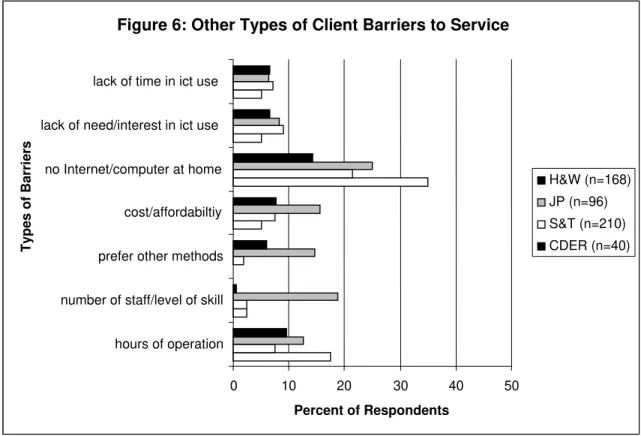
Clients of all four organizations face a myriad of barriers, or challenges, that make it difficult for them to access or use the services and information provided by the respective organizations. Two of the most common individual barriers among all clients are low education and literacy levels as indicated in Figure 5. Other barriers include no Internet or computer at home, cost and affordability, as well as hours of operation for computer access indicated in Figure 6
Figure 6: Other Types of Client Barriers to Service
lack of time in ict use
lack of need/interest in ict use
Ty pe s of Ba rri e rs no Internet/computer at home H&W (n=168) JP (n=96) cost/affordabiltiy S&T (n=210) prefer other methods
number of staff/level of skill
hours of operation
50
0 10 20 30 40
Percent of Respondents
CDER (n=40)
Community Development and Employment Resources (CDER), Skills and Training (S&T),
Job Placement (JP), Health and Wellness (H&W) Staff members at the community development and employment resources
organization identified other barriers. Blocking pornography sites is a problem for the public access computers at its Job Centre facility. Currently, if the centre blocks the porn sites, a number of health sites are also blocked. The physical constraints of space limit the organization in its attempts to deliver services using ICT. For example, it has a video camera that staff would like to use for doing mock interviews for job seekers, but currently there is no space to set up the equipment to conduct them.
Health and wellness organization
The health and wellness organization plays a leading role as an intermediary in e-government for health services and information. It is currently adequately supported to deploy and sustain its information and service delivery using ICT. It has taken a pro-active approach to ensure it is linked to the proper resources and has adequate funding and staff to deliver its services. As part of the provincial government’s health system, it has ICT support and maintenance through the government’s Techno Centre.
The organization incorporates resources for long-term support to use ICT in its regular budget and planning. At least one staff member has an older computer but in general the organization’s ICTs meet its current needs. To date, resources have been adequate for computers and other ICTs for its staff and operations. The
capacity of clients to use ICT is low, it is often easier to intervene, for example, by printing out a web page for a client rather than talking a client through the process of dealing with an automated government information telephone service. As more government services are delivered electronically, it is possible more staff time will be required to assist clients to access these services.
The centre will soon become part of a new electronic provincial medical program requiring all patient and client information be sent and processed electronically. Currently, the organization is in the early stages of what will become a significant future challenge of integration with the computer systems of the five health and wellness centre partner organizations. At this point, the centre and its partner
organizations have discrete IT systems and different databases that do not interface well with each other. The integration of the disparate systems is an effort to improve the flow of information and communication, and to ensure that clients do not fall between the cracks.
The organization accesses many web sites to locate minority-language materials, which can be developed and delivered in information sessions for staff, as well as to locate minority-language health resources for clients. The centre is linked to the provincial government’s health network database so it can receive client referrals from hospitals, physicians and the community health and social services centres. Overall, the organization is well prepared and well placed in its intermediary role to deliver health information and services to clients using ICT.
The organization communicates primarily by telephone with its clients. It also uses as many media outlets and communication mechanisms as possible to disseminate health information and to ensure that its service offerings are known in the minority language community. This strategy was developed through consultations with clients and the minority language community as a whole. As a result of these consultations, preference was given to traditional media and communication including a biannual newsletter, pamphlets, brochures, posters, radio and telephone chain calls. The organization promotes its services and disseminates health information in the local minority-language weekly paper’s “Wellness Page.” The local radio station broadcasts messages about the centre. The centre’s staff members also conduct interviews and submit public service announcements to local radio, to publicize particular activities in advance. Occasionally advertisements are taken out at the local television station. The centre’s web site is perceived as a valuable, but additional, tool to reach the minority language population. To reach teens, young people and new families who move to the region, new pages on the organization’s web site have been added, as well as some e-mail lists for specific group activities. The health and wellness centre web site has links to community health centres as well as the provincial health web site, among others. Although the health and wellness centre provides services locally, theoretically clients across the province can access its web site. High-speed Internet is not available in rural and remote areas of the province and consequently
individuals and organizations living in these areas can neither receive electronic files nor download documents easily or at all. The health and wellness centre participated in a pilot video-conferencing health network program, but experienced problems when clients in some rural areas were unable to participate effectively due to the lack of high-speed infrastructure in their region (see Figure 4).
Health and wellness clients and those at the other organizations indicated that there was a range of factors that would encourage them to interact with health care professionals on-line. As Figure 7 shows, these factors include assured health information reliability, security when interacting with health care professionals on-line and making sure that using online health information is easy.
Figure 7: Factors Which Would Encourage Clients to Interact With
Health Care Professionals Online
ease of use security
Types of Factors
access CDER (n=40) knowledge S&T (n=210) JP (n=96) medical problem H&W (n=168) reliability of health infoprivacy other
10 20 30 40 50 60
0
Percent of Respondents
Community Development and Employment Resources (CDER), Skills and Training (S&T),
Job Placement (JP), Health and Wellness (H&W)
ICT benefits and barriers
The primary benefit of ICT for the organization is its easy access to the provincial government’s health network and database. Staff at the centre regularly uses ICT – including the telephone, voicemail, e-mail and the Internet – for research, networking and to facilitate daily communications. The centre has experienced benefits from innovative use of technologies. Its use of on-line interactive learning modules, such as defibrillator programs used as teaching units for staff, has been effective. This organization, however, is the only organization studied that does not provide clients with dedicated computer and Internet access. Clients’ expressed an interest in accessing the Internet at the centre if staff would be available for informal coaching on computer and Internet use. Yet staff expressed concern that its large senior clientele, many aged 75 years and older, are intimidated by many information
technologies such as telephone messaging. A few clients were terrified of computers and cell phones.
The most significant barrier for clients at this organization is that although Internet access is available at local libraries, these computers have keyboards and operating systems in the provinces’ majority language. Library staff may not be willing or able to assist clients in the minority language that they speak.
Conclusion
Do the policy objectives and public investments by government for on-line information and service delivery meet the needs of community organizations and individuals? In many respects, the evidence of these case studies leads to a conclusion that the focus on ‘technological’ solutions should realistically only be considered for solving ‘technology problems’ such as the digital divide. Our evidence indicates that
technological solutions do not effectively ameliorate social disparities or inequalities of unemployment, low income, low literacy or education, and so forth. The technical solutions address, with variable levels of success, the circumstances of many clients and greatly benefit them. The largest obstacle is financial. Cost is a barrier both to individuals for technology such as computer and on-line access, and to organizations for investment, equipment upgrades, staff expertise, and system sustainability, however, remain barriers. Without ongoing government support, these barriers may remain immutable.
As well, continued government support to address social inequalities will be needed extant of e-government or on-line policy and program initiatives. The Internet and ICTs need to be seen as a new additional tool, or a new layer, to help address these inequalities
For the organizations, the Internet and ICTs serve as a complementary means for delivering services and information – an enhancement, as opposed to a displacement of other communication methods. This general intent about the benefits of using the Internet and ICTs to meet client needs is shared with governments but the most substantive component of the federal government’s long-term approach to on-line service delivery is to replace services available by traditional means. However, our research demonstrates that the clients and the community intermediary staff prefer traditional means of service delivery. The type of service delivery preferred depends on a number of factors, among which literacy, disability and language are important. Additionally, the proclivity for governments to continually adopt and deliver on-line services and information using state-of-the-art Internet conflicts in a number of ways, both with the capabilities of the community organizations to keep pace given their financial, human and technology constraints, and the social, cultural and economic circumstances of their clients. The goal for governments, intermediary organizations and citizens is to be included in Canada’s knowledge society. Yet, as our research demonstrates, despite great effort by intermediary organizations, citizens are in some cases either not well or barely served at all.
References
Canada. (2006) Government On-Line: Serving Canadians Better. http://www.gol-ged.gc.ca accessed 5/2/2006
Vanda Rideout, Andrew Reddick, Susan O’Donnell, William J. McIver Jr., Sandy Kitchen and Mary Milliken. (2006) Community Intermediaries in the Knowledge