Publisher’s version / Version de l'éditeur:
Vous avez des questions? Nous pouvons vous aider. Pour communiquer directement avec un auteur, consultez la
première page de la revue dans laquelle son article a été publié afin de trouver ses coordonnées. Si vous n’arrivez pas à les repérer, communiquez avec nous à [email protected].
Questions? Contact the NRC Publications Archive team at
[email protected]. If you wish to email the authors directly, please see the first page of the publication for their contact information.
https://publications-cnrc.canada.ca/fra/droits
L’accès à ce site Web et l’utilisation de son contenu sont assujettis aux conditions présentées dans le site
LISEZ CES CONDITIONS ATTENTIVEMENT AVANT D’UTILISER CE SITE WEB. Structures Congress '05 [Proceedings], pp. 1-6, 2005-04-21
READ THESE TERMS AND CONDITIONS CAREFULLY BEFORE USING THIS WEBSITE. https://nrc-publications.canada.ca/eng/copyright
NRC Publications Archive Record / Notice des Archives des publications du CNRC :
https://nrc-publications.canada.ca/eng/view/object/?id=41cfe899-110c-4962-a5ff-a4b7556e5a1c https://publications-cnrc.canada.ca/fra/voir/objet/?id=41cfe899-110c-4962-a5ff-a4b7556e5a1c
NRC Publications Archive
Archives des publications du CNRC
This publication could be one of several versions: author’s original, accepted manuscript or the publisher’s version. / La version de cette publication peut être l’une des suivantes : la version prépublication de l’auteur, la version acceptée du manuscrit ou la version de l’éditeur.
Access and use of this website and the material on it are subject to the Terms and Conditions set forth at Achieving fire resistance in steel columns through composite construction
Achieving fire resistance through steel concrete composite construction
Kodur, V.K.R.
NRCC-47730
A version of this document is published in / Une version de ce document se trouve dans : Structures Congress ’05, New York, April 21-23, 2005, pp. 1-6
Achieving Fire Resistance through Steel-Concrete Composite Construction
V.K.R. Kodur
Institute for Research in Construction, National Research Council of Canada, Ottawa, Canada
Abstract
Hollow structural steel columns, which are widely used in the construction of framed structures in industrial buildings, are often filled with concrete in order to achieve an increased load-bearing capacity. In recent years, high strength concrete is becoming an attractive alternative, to traditional plain concrete, since it increases the load-carrying capacity of hollow structural sections (HSS). . In this paper the fire performance of high strength concrete-filled steel hollow structural section (HSS) columns is presented for various types of concrete filling. A comparison is made of the fire resistance performance of HSS columns filled with normal strength concrete (NSC) and high strength concrete (HSC). The factors that influence the behaviour of HSC-filled HSS columns, under fire conditions, are discussed.
Keywords: high strength concrete, steel HSS columns, fire resistance, high temperature
behaviour, concrete-filled columns.
Introduction
Steel hollow structural section (HSS) columns are very efficient structurally in carrying compression loads and moments and are widely used in the construction of framed structures in office and industrial buildings. Often these sections are filled with concrete to enhance the load-bearing capacity. The two components of the composite column complement each other ideally, in that the steel casing confines the concrete laterally allowing it to develop its optimum compressive strength, while the concrete, in turn, enhances resistance to elastic local buckling of the steel wall.
Another advantage of concrete filling is that it also increases fire resistance of the column without the need for external fire protection for the steel. This increases usable space in the building. Properly designed concrete-filled columns can lead economically to the realization of architectural and structural design with visible steel without any restrictions on fire safety ( Klingsch and Wuerker 1985; Kodur and Lie 1995).
In recent years, high strength concrete (HSC) has become an attractive alternative to traditional normal strength concrete (NSC), since it further increases the load-carrying capacity of HSS columns (Prion and Baraka 1994; Kodur 1998). As well, the high stiffness of HSC prevents elastic local buckling in the steel wall while the confinement within the steel HSS, enhances the ductility, which sometimes is a major concern for HSC. These advantages have led to the increased use of HSC-filled HSS columns (Ghosh 1997)
The benefits from the use of HSC filling can be maximised if the external fire protection is eliminated. The enhancement of fire resistance of HSS columns, leading to the use of
unprotected concrete-filled HSS columns, has been established for NSC filling (concrete strength below 55 MPa) by a number of studies (Kodur and Lie 1995, Lie and Kodur 1996a, Kodur 1999). However, there is little information available in the literature on the fire performance of HSS columns filled with HSC (strength above 55 MPa). Further, the behaviour of HSC at elevated temperatures, is significantly different from that of NSC (Phan 1996, Kodur 1998).
In this paper, results of the fire resistance of HSS columns filled with HSC concrete are presented for three types of concrete filling (plain, bar reinforced and steel fiber reinforced). A comparison is made of the fire resistance of NSC and HSC-filled HSS columns.
Experimental Studies
Six concrete-filled steel columns, designated HSS1 to HSS6, were tested to failure by exposing the columns to the standard fire. The columns had circular cross-sections and were filled with concrete of varying strength and type: HSS1 and HSS3 were filled with NSC, HSS3 with plain HSC, HSS4 and HSS5 with fibre-reinforced HSC (FC), while HSS6 was filled with bar-reinforced HSC (RC). No external fire protection was provided for the steel.
All columns were 3810 mm long. The average 28-day cylinder strength of the NSC was 36 and 43 MPa while the corresponding strength for HSC varied from 82 to 91 MPa. For the RC-filling, the reinforcing bars were tied together to form a steel cage, which was placed inside the column. For FC-filling, steel fibres, 1.77 percent by mass, were mixed with the concrete. Thermocouples, with a thickness of 0.91 mm, were installed at the mid-height of the column to measure temperatures at different locations in the cross section.
The tests were carried out by exposing the loaded concrete-filled columns to heat in a furnace especially built for testing the loaded columns (ASTM 1990). The test furnace was designed to produce conditions such as temperature, structural loads and heat transfer, to which a member might be exposed during a fire. The furnace facility includes a hydraulic loading system with a capacity of 1,000 t. Full details of the fire tests, including test procedures, are documented by and Kodur (1998).
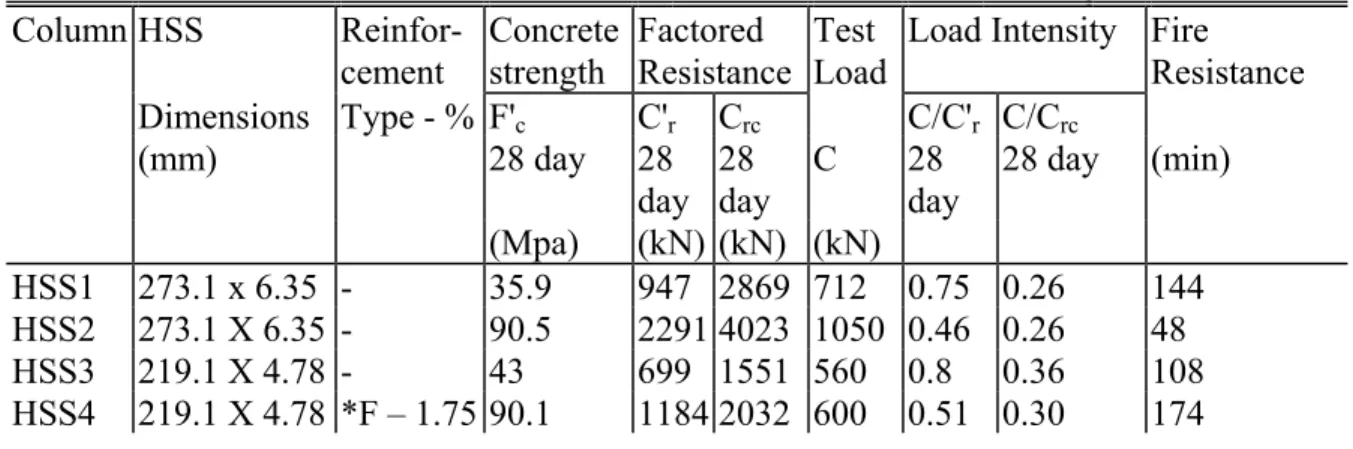
A summary of the column specifications and results, as obtained from tests, is presented in Table 1.
Table 1. Summary of results for HSS columns filled with high strength concrete
Column HSS Reinfor- cement Concrete strength Factored Resistance Test Load
Load Intensity Fire
Resistance Dimensions Type - % F'c C'r Crc C/C'r C/Crc (mm) 28 day 28 day 28 day C 28 day 28 day (min) (Mpa) (kN) (kN) (kN) HSS1 273.1 x 6.35 - 35.9 947 2869 712 0.75 0.26 144 HSS2 273.1 X 6.35 - 90.5 2291 4023 1050 0.46 0.26 48 HSS3 219.1 X 4.78 - 43 699 1551 560 0.8 0.36 108 HSS4 219.1 X 4.78 *F – 1.75 90.1 1184 2032 600 0.51 0.30 174
HSS5 203.2 X 6.35 *F – 1.75 90.1 1236 2777 900 0.73 0.32 128 HSS6 203.2 X 6.35 *B - 2.2 81.7 1152 2693 1150 1.00 0.43 89 *F – steel fibers
*B – steel rebars
Results and Discussion
Results presented in Table 1 are used to discuss the performance of the HSC-filled HSS columns and to determine the factors influencing fire resistance. The effect of concrete strength on the behaviour of HSS columns is illustrated by comparing the data from an NSC-filled column (HSS1) with an HSC-filled column (HSS2). The effect of steel fiber reinforcement in HSC mix on the fire resistance is illustrated by comparing results from Columns HSS3 and HSS4, while the effect of bar reinforcement on fire performance is discussed with reference to Columns HSS5 and HSS6. Detailed comparisons and discussion of results, including temperature variations, are provided elsewhere (Kodur 2004). Only the main results are highlighted in this paper.
Effect of Concrete Strength
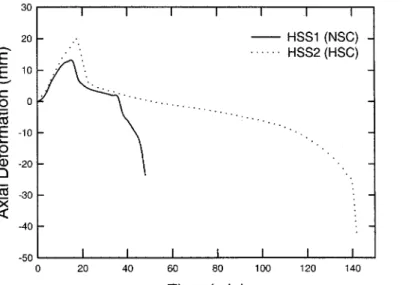
The effect of concrete strength on the behaviour of concrete-filled HSS columns can be assessed by comparing the results from Columns HSS1 and HSS2 shown in Table 1. Except for concrete strength, these columns had similar characteristics and were subjected to a load intensity (C/Crc) of 0.26. Fire resistance of the HSC-filled steel column (HSS2) is 48 min which
is much less than that for the NSC-filled column, HSS1, which was 144 min. In comparison, the fire resistance of a similar unprotected and unfilled HSS column is about 20 minutes.
Figure 1 Axial Deformations of Columns HSS1 an HSS2 as a Function of Exposure Time The variation in axial deformation with time for Columns HSS1 and HSS2 are shown in Figure 1. As expected, both columns expand, in the initial stages, with the expansion of the steel section and then contract leading to failure. The deformation results from several factors such as load, thermal expansion, water vapour pressure in concrete and creep. While the effect of load, water vapour pressure and thermal expansion is significant in the early stages, the effect of creep
becomes pronounced in the later stages. The deformation behaviour, in the later stages (after about 20-25 minutes), is mostly influenced by the strength of concrete inside the HSS section. For Column HSS1, failure is by gradual contraction while, for Column HSS2, it is by sudden contraction. This can be attributed to the brittle nature of HSC.
Effect of Adding Fibre-Reinforcement
The fire resistance, as well as its behaviour under fire conditions, of HSC can be improved by adding steel fibres to the concrete mix. This can be seen by comparing the fire resistance of NSC-filled and steel fiber-reinforced HSC-filled HSS columns (Table 1). The fire resistance of steel fiber reinforced HSC-filled HSS column (HSS4) is enhanced to 174 minutes as compared to 108 minutes for a similar HSS column filled with NSC (HSS3).
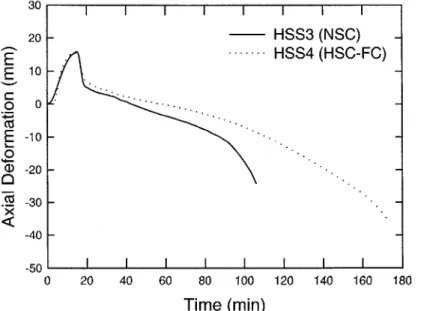
Figure 2 Axial Deformations of Columns HSS3 and HSS4 as a Function of Exposure Time
Improved performance in steel fiber-reinforced HSC-filled HSS column (HSS4) can further be seen in Figure 2 which shows the axial deformation as a function of time for Columns HSS3 and HSS4. The deformation behaviour of the fibre-reinforced HSC-filled column, HSS4, is similar, during the early stages of the test, to that of the NSC-filled steel Column HSS3. At the later stages, Column HSS4 performs better than Column NSC1 since the presence of steel fibres enhanced the ductility of Column HSS4. While the lower load intensity on Column HSS4 contributed to an increased fire resistance to some extent, much of the contribution is from the presence of steel fibres in the HSC (Kodur 1998, Kodur 1997). This increased performance of HSC can be attributed to the superior mechanical properties of steel fibre-reinforced concrete and
to the containment effect provided by the steel fibres to the concrete core (Lie and Kodur 1996b; Kodur 1998).
Effect of Adding Bar-Reinforcement
Another alternative for enhancing the fire performance of HSC-filled HSS columns is to provide conventional rebars and ties inside the HSS column. The fire resistance of the
fiber-reinforced filled HSS column (HSS5) is 128 minutes while that for bar-fiber-reinforced HSC-filled HSS column (HSS6) is 89 minutes. The lower fire resistance in Column HSS6, as compared to HSS5, can be attributed to higher load intensity on this column. This illustrates that fire resistance of 1 hour or more can be obtained, even under loads equivalent to the strength of concrete core, for HSC-filled steel column through the addition of bar reinforcement. A lower load intensity (0.73 or less) would have resulted in a higher or at least similar fire resistance as that for column HSS5 (Kodur 2004).
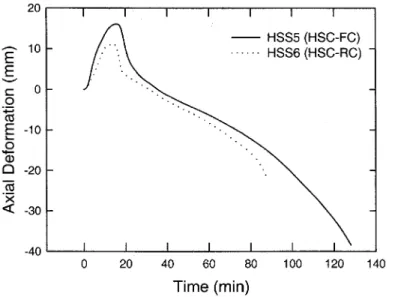
Figure 3 Axial Deformations of Columns HSS5 and HSS6 as a Function of Exposure Time
The variation in axial deformation with time for the two columns is shown in Figure 3. As expected, both columns expand in the initial stages and then contract leading to failure. The deformation behaviour of fibre-reinforced HSC-filled steel column is similar, during the later stages of the test, to that of the bar-reinforced HSC-filled steel column. The higher deformations in column HSS5, as compared to Column HSS6, is partly due to lower load intensity and higher thermal expansion of fibre-reinforced concrete. The deformation in column HSS6, prior to failure, is much smaller than the deformation in columns HSS5. Both columns failed in compression mode by gradual contraction. In the bar-reinforced concrete-filled HSS column, the presence of rebars not only decreases the propagation of cracks and sudden loss of strength, but also contributes to the load-carrying capacity of the concrete core (Kodur and Lie 1995).
Summary
Concrete filling offers an attractive alternative for achieving fire resistance in HSS columns. The behaviour of HSC-filled steel columns is significantly different from that of NSC-filled HSS columns. The fire resistance of HSC-NSC-filled HSS columns can be significantly improved by adding bar reinforcement or steel fibre reinforcement to concrete.
American Society for Testing and Materials, 1990, Standard Methods of Fire Tests on Building Construction and Materials. ASTM E119-88, Philadelphia, PA, USA.
CSA. 1989. Limit State Design of Steel Structures. CAN/CSA-S16.1-M89, Canadian Standard Association, Toronto, Ontario, Canada.
Ghosh, S.K., 1997, "High strength concrete in Regions of High Seismicity”, Proceedings, 1997 ASCE Structures Congress, Vol. 2, Portland, Oregon, U.S.A., pp. 1001-1005.
Klingsch, W., and Wuerker, K., 1985, “New developments in fire resistance of hollow section structures.” Symposium on Hollow Structural Sections in Building Construction, ASCE, Chicago, Illinois, USA.
Kodur, V.K.R. 1997. Design Equations for Evaluating Fire Resistance of SFRC-filled Steel Columns, ASCE Journal of Structural Engineering, 124(6), pp. 671-678.
Kodur, V.K.R. 1998, "Performance of high strength concrete-filled steel columns exposed to fire" Canadian Journal of Civil Engineering , 25(6), pp. 975-981.
Kodur, V.R., 1999, "Performance based fire resistance design of concrete-filled steel columns" Journal of Constructional Steel Research Institute, 51, 21-36.
Kodur, V.K.R. 2004, "Solutions for enhancing the fire endurance of HSS columns filled with high strength concrete" submitted to AISC Steel Construction Journal, 37(1), 13-24.
Kodur, V.K.R., and Lie, T.T. 1995, Fire Performance of Concrete-filled Hollow Steel Columns. Journal of Fire Protection Engineering, 7(3): 89-98.
Lie, T.T., and Chabot, M. 1992. Experimental Studies on the Fire Resistance of Hollow Steel Columns Filled with Plain Concrete, IRC Internal Report No. 611, National Research Council of Canada, Institute for Research in Construction, Ottawa, Ontario, Canada.
Lie, T.T., and Kodur, V.K.R. 1996a. Fire Resistance of Steel Columns Filled with Bar-reinforced Concrete, ASCE Journal of Structural Engineering, 121(1): 30-36.
Lie, T.T., and Kodur, V.K.R. 1996b. Thermal and Mechanical Properties of Steel Fibre-reinforced Concrete at Elevated Temperatures, Canadian Journal of Civil Engineering, 23 (4): 511-517.
Phan, L.T. 1996. Fire Performance of High-strength Concrete: A Report of the State-of-the-Art. National Institute of Standards and Technology, Gaithersburg, MD, USA.
Prion, H.G.L. and Baraka, M. 1994. Thin-Walled Tubes Filled with High Strength Concrete, Canadian Journal of Civil Engineering, 21(1): 207-218.