HAL Id: cea-02329393
https://hal-cea.archives-ouvertes.fr/cea-02329393
Submitted on 23 Oct 2019
HAL is a multi-disciplinary open access
archive for the deposit and dissemination of
sci-entific research documents, whether they are
pub-lished or not. The documents may come from
teaching and research institutions in France or
abroad, or from public or private research centers.
L’archive ouverte pluridisciplinaire HAL, est
destinée au dépôt et à la diffusion de documents
scientifiques de niveau recherche, publiés ou non,
émanant des établissements d’enseignement et de
recherche français ou étrangers, des laboratoires
publics ou privés.
NMR-Driven Reverse Monte Carlo Study of Sodium
Borate Glasses
T. Charpentier, Erwan Chesneau, Laurent Cormier, G. Tricot
To cite this version:
T. Charpentier, Erwan Chesneau, Laurent Cormier, G. Tricot. NMR-Driven Reverse Monte Carlo
Study of Sodium Borate Glasses. 14th international Conference on the Structure of Non-Crystalline
Materials, Nov 2019, Kobe, Japan. �cea-02329393�
i 4'h international Conference on the Structure of Non-Crystalline Materials
3-8 November 2019, Kobe, Japan
NMR-Driven Reverse Monte Carlo Study of Sodium Borate Glasses
*Thibault Charpentier
l,Erwan Chesneau
I,Laurent Cormier
2,Gregory Tricot
3I NIMBE, CEA, CNRS, Universite Paris-Saclay, CEA Paris-Saclay, Gif-sur-Yvette, 91191, France, 2 Sorbonne Universite, Museum National d'Histoire Naturelle, UMR CNRS 7590, IRD, Institut de Mineralogie, de Physique
des Materiaux et de Cosmochimie, IMPMC, Paris, 75005, France, 3 Universite de Lille, CNRS, UMR 8516
-LASIR - Laboratoire de Spectrochimie Infrarouge et Raman, Lille, 59000, France
Keywords: Glasses, NMR, Ab initio simulation, RMC modeling, Machine Learning, Borate
Borate glasses are known to have a large fraction of the boron atoms involved in superstructural units like boroxol or pentaborate rings, in addition to the double coordination of boron atoms (3 and 4). Th is generates the boron's anomaly, which is a non-linear evolution of properties upon the addition of sodium oxide. I For example the glass transition temperature reaches a maximum for alkali content around 25%. In this work, we investigate theoretically and experimentally the structure of sodium borate glasses using liB and 23Na NMR, molecular dynamics (MD) simulations and neutron diffraction.
Comparison of classical MD (CMD) with ab-initio MD (aiMD) shows that only aiMD produces structural
models with a non-negligible fraction of super-structural units (6 membered rings) but still below the one determined by two-dimensional liB MQMAS NMR spectroscopy.2 With the help ofDFT-GIPAW computation of NMR shifts,3 the NMR fingerprint of the various boron and sodium environments could be predicted and are found to be in good agreement with experimental data. These calculations improve our understanding of the impact of the structural disorder on the distribution of NMR parameters, typically the effect of the bond angle
distribution (BAD) on the isotropic chemical shift of boron-II.
In order to improve our structural models, in particular to include a larger fraction of superstructural units, we
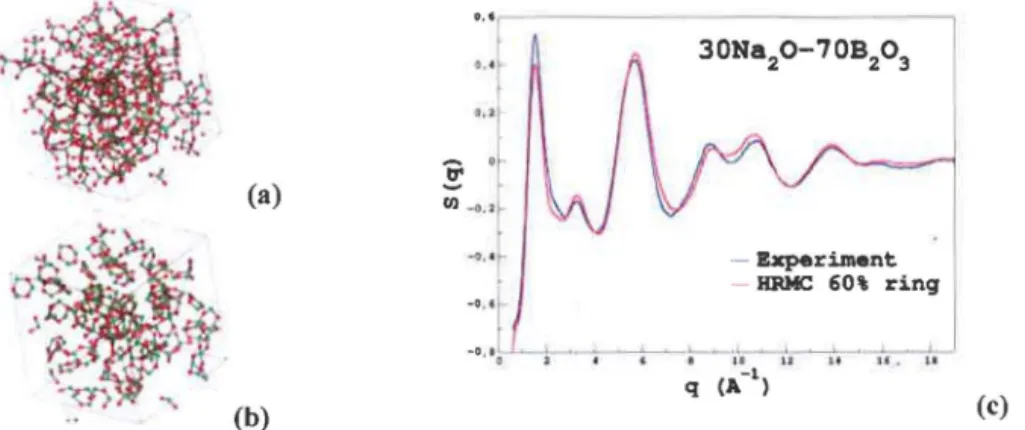
develop a hybrid reverse monte carlo (HRMC) scheme combi,ning MD with NMR and neutron data. The fraction
of superstructural units is taken as an adjustable parameter and we observe that neutron data are not sufficiently sensitive to discriminate the various structural models, in contrast to liB NMR for both B03 and B04 units (i.e., ring and non-rings species). Simulated liB and 23Na 2D MQMAS NMR are found to be in good agreement with experiments but the DFT-GIPAW NMR calculations limits the size of systems that can be studied (from 500 to 1000 atoms). In order to overcome this limitation, we have recently developed a Machine Learning (ML)4 approach for computing NMR shifts and first applications of these emerging methodologies to borate glasses will be presented.
(a)
(c)
Figure 1. (a) Structural model of 30Na20-70B203 glass, highlighting rings (b). (c) Experimental and theoretical neutron structure factors.
References
1) K. Vignarooban, P. Boolchand, M. Micoulaut, M. Malki, et W. J. Bresser, EPL Europhys. Lett. 108,56001 (2014).
2) E. Chesneau, T. Charpentier, G. Tricot, S. Cristol, submitted.
3) T. Charpentier, M.e. Menziani, A. Pedone, RSC Adv. 3,10550-10578 (2013).