HAL Id: hal-00668006
https://hal-iogs.archives-ouvertes.fr/hal-00668006
Submitted on 8 Feb 2012
HAL is a multi-disciplinary open access
archive for the deposit and dissemination of
sci-entific research documents, whether they are
pub-lished or not. The documents may come from
teaching and research institutions in France or
abroad, or from public or private research centers.
L’archive ouverte pluridisciplinaire HAL, est
destinée au dépôt et à la diffusion de documents
scientifiques de niveau recherche, publiés ou non,
émanant des établissements d’enseignement et de
recherche français ou étrangers, des laboratoires
publics ou privés.
Comparative study of nonlinear-optical polymers for
guided-wave second-harmonic generation at
telecommunication wavelengths
Tomas Pliska, Wook-Rae Cho, Anne-Claire Le Duff, Vincent Ricci, Akira
Otomo, Michael Canva, Paul Raimond, F. Kajzar
To cite this version:
Tomas Pliska, Wook-Rae Cho, Anne-Claire Le Duff, Vincent Ricci, Akira Otomo, et al.. Comparative
study of nonlinear-optical polymers for guided-wave second-harmonic generation at telecommunication
wavelengths. Journal of the Optical Society of America B, Optical Society of America, 2000, 17 (9),
pp.1554-1564. �hal-00668006�
Comparative study of nonlinear-optical polymers
for guided-wave second-harmonic
generation at telecommunication wavelengths
Toma´sˇ Plisˇka,*Wook-Rae Cho, Joachim Meier, Anne-Claire Le Duff,†Vincent Ricci, Akira Otomo,‡Michael Canva,†and George I. Stegeman
School of Optics, Center for Research and Education in Optics and Lasers, University of Central Florida, P.O. Box 162 700, 4000 Central Florida Boulevard, Orlando, Florida 32816-2700
Paul Raimond and Franc¸ois Kajzar
Commissariat a` l’E´nergie Atomique, Centre d’E´tudes de Saclay, 91191 Gif sur Yvette Cedex, France
Received February 29, 2000; revised manuscript received June 5, 2000
We report on the linear and nonlinear-optical properties of 4-dimethylamino-4⬘-nitrostilbene (DANS), 4-diethylamino-1-nitrobenzyl (DANB), and 4-关N-ethyl-N-(2-hydroxyethyl)兴amino-4⬘-nitroazobenzene) (Dis-perse Red 1;DR1) side chain polymers whose second-harmonic generation at the telecommunication wave-length of 1.55m was investigated. Measured ultraviolet–visible–near-infrared spectra were analyzed with an inhomogeneously broadened line-shape model, in particular, in the long-wavelength tail of the electronic transitions, which determines the absorption loss at the second-harmonic wavelength. The nonlinear-optical coefficients were measured at different poling temperatures and poling fields by the Maker fringe technique. On the basis of the measured material parameters we calculated the normalized conversion efficiencies for guided-wave second-harmonic generation at 1.55 m. The DR1 polymer exhibited the best nonlinearity– absorption trade-off, with a calculated normalized conversion efficiency of several hundred percent per watt, whereas the figures of merit for DANS and DANB are lower and comparable with each other. © 2000 Optical Society of America [S0740-3224(00)01809-9]
OCIS codes: 190.4400, 190.4390, 190.4410, 160.4330, 160.5470, 160.4890.
1. INTRODUCTION
Second-order nonlinear-optical phenomena such as sum-and difference-frequency generation, parametric genera-tion, and, most notably, second-harmonic generation have been studied in waveguide configurations in a large vari-ety of materials over the past two decades. Waveguides provide ideal structures for efficient frequency conversion because of the high optical intensity that can be main-tained over a long interaction distance.1 More-recently emerging applications of parametric mixing include wave-length division multiplexing and cascading of second-order processes for all-optical signal processing in the 1.3-and 1.55-m telecommunication bands.2,3
Quasi-phase-matched lithium niobate (LiNbO3)
waveguides are currently the standard against which all nonlinear-optical waveguides are compared for paramet-ric mixing applications in the near and midinfrared.4,5 There are, however, other phase-matchable waveguide systems such as semiconductors and polymers with po-tentially higher nonlinearities.6–8 Chromophore-doped poled polymers have been used for electro-optic applica-tions, in particular for high-speed, low-half-wave voltage modulators.9 Poled polymers have also been used for fre-quency conversion, namely, for second-harmonic genera-tion of blue and green light10,11as well as for parametric interactions and 2:2 cascading at the
telecommunica-tion wavelength of 1.55m.12
The classic inorganic nonlinear-optical materials, e.g.,
lithium niobate (LiNbO3), potassium niobate (KNbO3),
and potassium titanyl phosphate (KTiOPO4, KTP), are
usually used at wavelengths within their transparency range where material absorption can be neglected. The situation is different for many of the currently used nonlinear-optical polymers that have been developed mostly for electro-optic applications at either 1.3 or 1.55 m. In parametric mixing processes, however, there are at least two wavelengths involved. For example, in second-harmonic generation and cascading at 1.55 m, the properties of the polymer at both the fundamental and the second-harmonic (0.775m) wavelengths are rel-evant. At present, many polymers exhibit much higher losses than inorganic materials at the harmonic wave-length, which limits the effective length and hence the harmonic conversion efficiency.
With a view to taking advantage of the potentially high nonlinearity of organic chromophores, the trade-off be-tween the nonlinear coefficient and linear absorption has been extensively studied, mainly by relating the hyperpo-larizability of the chromophore to the wavelength at which the peak of the electronic ultraviolet–visible ab-sorption occurs.13 It was found for many chromophore classes that, as a general rule, the hyperpolarizability grows with the redshift of the ultraviolet–visible elec-tronic absorption.13,14 However, for second-harmonic generation there is also a trade-off between nonlinearity and absorption at the harmonic wavelength. It is
tant to realize that the conversion efficiency grows not only with increasing nonlinearity but also with decreas-ing loss at the harmonic wavelength.15 The latter phe-nomenon depends on both the position of the absorption peak and the width of the absorption band. In only a few investigations has the role of the shape of the absorption band been considered so far.16,17 An ideal chromophore for second-harmonic generation should possess the follow-ing properties: a significantly redshifted linear absorp-tion peak for enhanced nonlinearity and, at the same time, a narrow absorption bandwidth to minimize the ab-sorption at the second-harmonic wavelength.
One of the best known nonlinear chromophores is 4-dimethylamino-4⬘-nitrostilbene (DANS). It has been successfully used in waveguide structures for second-harmonic generation at 1.55 m.18 However, DANS has been found to exhibit relatively high absorption losses at the second-harmonic wavelength16 and rather poor photostability.19 Therefore we have undertaken the present study of the linear absorption and non-linear-optical coefficients of two other nonlinear
chromophores in addition to DANS, namely,
4-diethylamino-1-nitrobenzyl (DANB) and 4-[N-ethyl-N-(2-hydroxyethyl)]amino-4
⬘
-nitroazobenzene (Disperse Red 1; DR1). These three chromophores represent three dif-ferent classes of nonlinear organic compound, all of which have been studied in the literature for their molecular properties, i.e., benzenes (DANB), stilbenes (DANS), and azobenzenes (DR1). Here, we have investigated their ab-sorption spectra and nonlinearities to discuss their poten-tial use in polymeric integrated optical devices for second-harmonic generation and cascading at 1.55 m, and we shall calculate their second-harmonic conversion efficien-cies in guided-wave interactions.2. THEORETICAL BACKGROUND
A. Molecular and Macroscopic Properties of Nonlinear-Optical Polymers
The relation between molecular and macroscopic proper-ties of nonlinear-optical polymers was discussed previ-ously in the literature.20,21 To calculate the linear and nonlinear-optical susceptibilities ij(1) and ijk(2),
respec-tively, from the molecular linear polarizability ␣IJ and
hyperpolarizability IJK, one usually assumes that the
molecule is rod-like with mm⬁ symmetry, and its re-sponse is assumed to be dominated by the tensor ele-ments along the charge transfer axis (Z axis), i.e.,␣ZZand
ZZZ. The indices (I, J, K) denote molecular
coordi-nates, and (i, j, k) are the laboratory frame coordinates. The second-order nonlinear-optical tensor dijkfor
second-harmonic generation contains then only the elements
dzzz⬅ d33and dxzx⫽ dzxx⬅ d31, if Kleinman’s
symme-try rule applies, given by
d31共⫺2, , 兲 ⫽1/2Nfz2fxfxZZZ共⫺2, , 兲
⫻具1/2cos sin2典, (1)
d33共⫺2, , 兲 ⫽1/2Nfz2fzfzZZZ共⫺2, , 兲
⫻具cos3典, (2)
where N represents the number density of chromophores,
fi are the local field correction factors, and is the angle
between the molecular dipole moment and the electric poling field, which defines the z axis in the laboratory frame. Angle brackets indicate the thermodynamic aver-age over all molecular orientations. The local field at op-tical frequencies can be described in the Lorenz–Lorentz approximation in which the molecule is assumed to be in a spherical environment, and the f tensor contains only diagonal elements fi, given by
fi⫽
ni2共兲 ⫹ 2
3 , (3)
where ni is the refractive index at frequency . For
static poling fields the correction factor fi0is given by the
Onsager expression
fi0⫽
⑀i共ni2⫹ 2兲
ni2⫹ 2⑀i
, (4)
where ⑀i denotes the static dielectric constant.22,23 For
practical purposes the small dispersion and birefringence of the refractive indices in the off-resonant regime allow the approximation fx⬇ fz⬇ fz2⬅ f, which permits us
to define the quantity d33,maxin Eqs. (1) and (2) by
d33,max⬅ 1/2Nf3ZZZ. (5)
d33,max represents the maximum attainable
nonlinear-optical coefficient for the case of perfect polar order,
具cos3典⫽ 1.
To describe the orientational average of chromophores in a poled polymer film21we use for thermodynamic aver-aging a mean field potential U() given by the sum of the energy of a permanent dipole moment 0 and a linearly
induced dipole momentindin a local field E⬘:
U共兲 ⫽ ⫺共0⫹ ind兲E⬘⫽ ⫺0,IEI⬘⫺1/2EI⬘␣IJEJ⬘. (6)
The-dependent part of the energy of the induced dipole moment can be rewritten as ⫺1/3⌬␣E⬘2P
2(cos), where
P2(cos) ⫽ (3 cos2 ⫺ 1)/2 is the second-order Legendre
polynomial and ⌬␣ ⬅ ␣ZZ⫺␣XX⬇ ␣ZZ. The
calcula-tion of orientacalcula-tional averages yields, as its main result, a linear relation between the nonlinearity d33 and the
ex-ternal poling field E in the low-field limit20:
d33⬇
Nfz2fzfzfz0ZZZ0, ZE
10kT . (7)
In addition, a simple relation between d31and d33exists:
d33⬇ 3d31. (8)
This relation is of practical importance because it implies that in most devices d33should be used as the active
non-linear coefficient.
B. Inhomogeneously Broadened Absorption Profiles The linear absorption of a nonlinear-optical polymer in the wavelength range 0.3–1.6 m is dominated by two mechanisms: in the ultraviolet and the visible parts of the spectrum the electronic resonances of the chro-mophore are responsible for strong transition bands,
whereas for wavelengths above 1m most of the absorp-tion is due to much weaker vibraabsorp-tional overtones of C—H bonds.24
Assuming first unpoled isotropic polymer films and thus using scalar notation, we can obtain the linear power attenuation coefficient ␣ from the relations n2() ⫽ 1 ⫹ (1)() at optical frequencies and ␣() ⫽ 2/
c Im关n()兴. An inhomogeneously broadened linear
sus-ceptibility model is appropriate to reproduce the details of the absorption band.16 In this model the linear
suscepti-bility(1)() is described by 共1兲共兲 ⫽ Nf ⌰
冑
⑀0ប兺
n 0n2 ⌬n冕
⫺⬁ ⫹⬁冉
1 0n⬘⫺ ⫹ i⌫n/2 ⫹ 1 0n⬘⫹ ⫺ i⌫n/2冊
⫻ exp冋
⫺冉
0n⬘⫺0n ⌬n冊
2册
d共0n⬘⫺0n兲, (9) where ⌰ is a molecular orientational factor (⌰ ⫽ 1/3 for randomly oriented dipoles), 0n is the transition dipolemoment from the ground to the nth excited state at fre-quency 0n, and⌫n is the population decay rate of the
nth level. The inhomogeneous broadening is described by an asymmetric Gaussian function of the form
Gn共0n⬘⫺0n兲 ⫽ 1
冑
⌬n exp冋
⫺冉
0n⬘⫺0n ⌬n冊
2册
, (10) where the asymmetric linewidth⌬nis modeled by1 ⌬n ⫽ 1 ⌬n0
冋
1⫺ n⫹n冉
0n 冊
2册
(11)andnis the asymmetry parameter. According to Eq. (9)
the linear susceptibility is described as a sum over the transitions from the ground state to the excited states. The line shape of each of these transitions is given by the convolution of an asymmetric Gaussian function dominat-ing the line shape near the absorption peak and a Lorent-zian function prevailing in the tail of the spectrum.
Experimentally, one fits the imaginary part of(1)()
to the measured absorption spectrum to evaluate the un-known parameters0n, 0n, ⌫n,⌬n0, andn. In the
measured absorption spectrum, usually only the peak of the 0–1 transition is sufficiently well resolved. Thus the fit yields reliable values only for01,01, and⌬10. ⌫1
is uncertain because it is small compared with⌬10. All
other parameters (n⭓ 2) are used strictly for fitting pur-poses without any further physical significance being as-signed to them.
One can derive orientational effects on the absorption spectrum by calculating the orientational average of the chromophores and its corresponding linear susceptibility. One finds for the absorption coefficients␣a,储and␣a,⬜for
light polarized parallel and perpendicular, respectively, to the axis defined by the poling field (z axis) the expressions
␣a,储共兲 ⫽ cnz共兲 NfzIm关␣ZZ共兲兴具cos2典, (12) ␣a,⬜共兲 ⫽ cnx共兲 NfxIm关␣ZZ共兲兴具1/2sin2典. (13)
Here, we have assumed that the absorption is dominated by the chromophore contribution to the linear susceptibil-ity. Equations (12) and (13) provide a link between the molecular polarizability and the macroscopic absorption of a poled polymer. In an unpoled isotropic polymer film one finds that 具cos2典⫽具1/2sin2典⫽ 1/3, n
x⫽ nz, fx
⫽ fz, and a corresponding isotropic absorption coefficient
␣a,isogiven by ␣a,iso共兲 ⫽ 1 3 cn共兲Nf Im关␣ ZZ共兲兴. (14)
In the wavelength range where chromophore absorption dominates, Eqs. (12)–(14) allow us to determine the ab-sorption coefficient for a given poling field from measure-ments of the absorption spectrum of an unpoled film. In most practical devices that use the d33 nonlinear
coeffi-cient, the absorption will be given by␣a,储. C. Second-Harmonic Generation in Channel Waveguides
The normalized second-harmonic conversion efficiency in a channel waveguide of length L is given by
⬅ P2共L兲 关P共0兲兴2 ⫽ 22 ⑀0c3 deff2 N2共N兲2⌫h共⌬, ␣,␣2, L兲. (15)
P2(L) is the second-harmonic power, P(0) is the funda-mental power launched into the guide, deffdenotes the
ef-fective nonlinear coefficient,⌫ is the overlap integral (in-verse effective cross section), ⌬ ⫽ 2⫺ 2 is the
phase mismatch, and␣and␣2are the losses at the fun-damental and the second-harmonic wavelengths, respec-tively. Under phase-matched conditions (⌬ ⫽ 0) the dependence on loss is contained in the expression
h共␣,␣2, L兲 ⫽ L2exp
冋
⫺冉
␣2 2 ⫹␣冊
L册冉
sinh⌬␣L 2冊
2冉
⌬␣L 2冊
2 , (16) with ⌬␣ ⫽ ␣2/2⫺␣. h will exhibit a maximum as afunction of L at a length Lmaxof
Lmax⫽
1 ⌬␣ln
冉
␣2
2␣
冊
. (17)This maximum useful length has been shown to be of the order of several millimeters in present polymer waveguides.18 In addition to absorption loss, the guided light can be attenuated by scattering losses owing to im-perfections at the guide interfaces.25 We thus write the total waveguide loss␣ as the sum of the absorption and scattering losses␣ ⫽ ␣a ⫹␣s.
3. MATERIALS
Since the discovery of the first good organic nonlinear-optical chromophores such as nitroaniline and nitropyri-dine derivatives, many new materials have been investi-gated. Most of the research has concentrated on materials with two or more benzene rings, such as stil-benes and azobenzenes,8that are superior with regard to
their molecular hyperpolarizability. However, because of the nonlinearity–transparency trade-off, chromophores with optimized nonlinearity are not necessarily the most suitable ones for parametric mixing applications; there-fore, simpler compounds with, for example, only one ben-zene ring as a-electron system also merit consideration. Whereas both DANS and DR1 are well known for their large hyperpolarizability,26 the use of the DANB chro-mophore in the present study was driven by the well-established high transparency in the visible and in the near infrared of single benzene ring systems such as
ni-troanilines and related compounds. Waveguiding struc-tures for second-harmonic generation at 1.55 m have been proposed for all three materials;12,27–29however, all devices were far from being optimized. We have thus performed this study to assess their potential further.
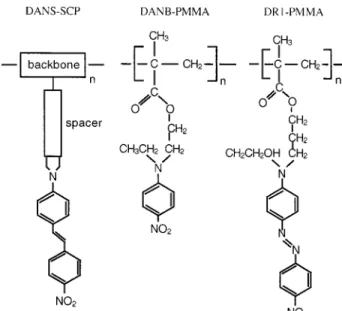
The structures of the three side-chain polymers are dis-played in Fig. 1. The backbone used for the DANS side-chain polymer (DANS-SCP) was polycarbonate, whereas DANB and DR1 were attached to poly(methyl methacry-late) (PMMA). The material and molecular parameters of the chromophores used throughout this study are listed in Tables 1 and 2, respectively. Because the molecular data for DANB were not available we utilized the corre-sponding parameters for 4-dimethylamino-1-nitrobenzyl.
We calculated the Lorentz correction factors at optical frequencies given by Eq. (3) by using the indices of refrac-tion listed in Table 1. Static local field correcrefrac-tion factors
fz0at the poling temperature [Eq. (4)] were calculated on
the basis of dielectric constant data for polycarbonates and PMMA from the literature,30,31listed in Table 1. For the DANS-SCP we used fz0⫽ 1.6 ⫾ 0.1; for
DANB-PMMA and DR1-DANB-PMMA, fz0⫽ 1.8 ⫾ 0.1.
4. EXPERIMENTS
A. Measurement of Linear Absorption Spectra
Sample preparation started with spin coating the polymer solution onto the substrate and subsequent curing of the polymer layer close to the glass-transition temperature for⬃12 h to remove residual solvent.
Absorption spectra of the polymers were obtained from absorbance measurements with a transmission spectro-photometer of thin unpoled films (⬃0.1 to ⬃3m thick) cast upon fused-silica substrates. However, only the strong ultraviolet–visible electronic absorption can be measured by this method, because for its infrared tail (ab-sorption coefficient below⬃1000 cm⫺1) transmission spec-troscopy does not provide the required resolution. Be-cause of the limited availability of polymer material it was impossible to prepare bulk samples that would pro-Fig. 1. Chemical structures of DANS, DANB, and DR1 side
chain polymers.
Table 1. Properties of Polymers Used in This Paper
Property DANS-SCP DANB-PMMA DR1-PMMA
Chromophore (wt. %) 43 65 24
Number density of chromophores (m⫺3) 1.3⫻ 1027 2.6⫻ 1027 0.5⫻ 1027
Chromophore-to-backbone monomer ratio Not applicable 1:1 1:10
Glass-transition temperature Tg(°C) 142 98 131
Index of Refraction nat 1.55m 1.61 1.56 1.54
Index of Refraction2at 0.775m 1.65 1.58 1.56
Dielectric constant⑀at poling temperature (Ref.) 3.0 at 135 °C (30) 5.6 at 100 °C (31) 5.7 at 120 °C (31)
Table 2. Molecular Parameters of Chromophores Used in This Papera
Parameter DANS DANBb DR1
Ground-state dipole moment0,Zin solution (Cm) (value in D)
2.4⫻ 10⫺29(7.2) 2.4⫻ 10⫺29(7.1) 2.9⫻ 10⫺29(8.7)
Linear polarizability␣ZZin solution (Fm2) 5.0⫻ 10⫺39 2.6⫻ 10⫺39 5.8⫻ 10⫺39
aAccording to Ref. 26. Solvent, dimethyl sulfoxide (DMSO). bValues quoted for 4-dimethylamino-1-nitrobenzyl.
vide the necessary absorption length. Moreover, bulk polymers can exhibit different absorption properties from thin polymer films. Therefore, to estimate the absorp-tion coefficient in the infrared, we spin coated thin (ap-proximately 1.5–3-m-thick) layers of polymer onto ther-mally oxidized silicon wafers (SiO2 layer thickness, ⬃3
m; index of refraction, 1.45). After cleaving the faces to facilitate end fire coupling we used the polymer films as planar waveguides for which the propagation loss was measured by the cutback method. The waveguide propa-gation loss in such a thin-film guide originates from three phenomena: absorption, volume scattering, and inter-face scattering. Knowledge of the guide parameters (in-dices of refraction, thickness, root-mean-square surface roughness of⬃3 nm as measured by atomic-force micros-copy) allows us to separate interface scattering losses by using the expression given by Tien.25 The remaining loss, caused by absorption and volume scattering, yields a good estimate for the intrinsic material loss. The accu-racy of this measurement is⬃10%, with a minimum reso-lution of 0.1 cm⫺1.
We used the following laser sources to obtain propaga-tion loss data in planar waveguides: an Ar⫹ ion laser (0.515m), a He–Ne laser (0.543, 0.594, and 0.633 m), an AlGaAs diode laser (0.78 m), a Nd:YAG laser (1.06 and 1.32m), and a NaCl:OH⫺color-center laser (tunable from 1.50 to 1.65m).
Although our model, given by Eqs. (9)–(11), describes the spectrum as a function of photon energy (frequency), we prefer to plot the data as a function of wavelength, which is more appropriate for our application-oriented ap-proach. Absorption coefficients are given in units of in-verse centimeters (cm⫺1; 1 cm⫺1⫽ 4.34 dB cm⫺1). B. Poling Techniques
Two configurations were used for poling: parallel-plate and in-plane poling. For parallel-plate poling 1.5–3- m-thick polymer films were spin coated onto indium tin oxide–coated fused-silica or borosilicate glass substrates. Approximately 150-nm-thick Al electrodes with an ap-proximate size of 1 cm⫻ 1 cm were deposited on top of the films by thermal evaporation. The voltage was then applied between the bottom indium tin oxide and the top Al electrodes. The procedure for in-plane poling was re-ported previously in Ref. 32. We prepared samples by patterning two Al electrodes of 250-nm thickness with a gap of 20m onto fused-silica substrates and spin coating the nonlinear polymer onto the substrates. To prevent arcing along the air–film interface we spun an additional cladding layer of polycarbonate polymer of 15-m thick-ness on top of the sample.
The parallel-plate geometry offers the advantages of ease of fabrication and availability of a large area for measurement. However, poling at fields above 150 Vm⫺1is critical as the samples become more susceptible to electrical breakdown. We observed that, as a general rule, higher fields can be applied to thicker samples. With the available DANB-PMMA solution we were able to prepare samples of a maximum 1.5-m thickness and to reach an external poling field of 95 Vm⫺1. The largest layer thickness prepared with the DR1-PMMA polymer was 2.5 m, and the maximum poling field reached was
150 V m⫺1. Higher poling fields, up to 370 V m⫺1, can be obtained with the in-plane poling geometry, as was previously shown with DANS-SCP.32 However, the small electrode spacing limits the poled area available for the measurements and requires more-complicated experi-mental procedures.
Poling was performed in a furnace in ambient atmo-sphere. Once the sample reached the poling temperature close to the glass-transition temperature, the voltage was carefully ramped at a rate of⬃10 V min⫺1. The samples were kept at the poling temperature for⬃2 h (135 °C for DANS-SCP, 100 °C for DANB-PMMA, and 120 °C for DR1-PMMA). Then they were slowly cooled to room tem-perature at a rate of⬃0.5 °C min⫺1with the voltage ap-plied. Thereafter, for the parallel-plate poled samples the top electrode was etched off by use of a mixture of phosphoric, acetic, and nitric acids.
C. Measurement of Nonlinear-Optical Coefficients We used a standard Maker fringe setup to measure the nonlinear coefficients of the poled polymer films. A y-cut quartz plate was used as a reference with a value of d11
⫽ 0.29 pm V⫺1 at a wavelength of 1.58 m to calibrate
the measurement (equivalent to d11⫽ 0.30 pm V⫺1 at
1.064 m).33 The 1.58-m fundamental radiation was generated by Raman shifting of the output of a frequency-doubled (0.532-m) Q-switched Nd:YAG laser in a hydro-gen cell (pulse duration, 10 ns; pulse energy at 1.58m, 10J). The transmitted fundamental beam was blocked by a set of filters, whereas the second-harmonic signal was detected with a photomultiplier tube. Using in-plane poled samples, we were able to measure directly the nonlinear coefficient d33, whereas the parallel-plate
ge-ometry yielded more-accurate values for d31. In the
lat-ter case we used expression (8) to obtain the value of d33.
The experimental uncertainty of the measured nonlinear coefficient was ⫾15%, with a minimum resolution of 0.1 pm V⫺1.
5. RESULTS AND DISCUSSION
A. Linear Absorption Spectra and Nonlinear-Optical Coefficients
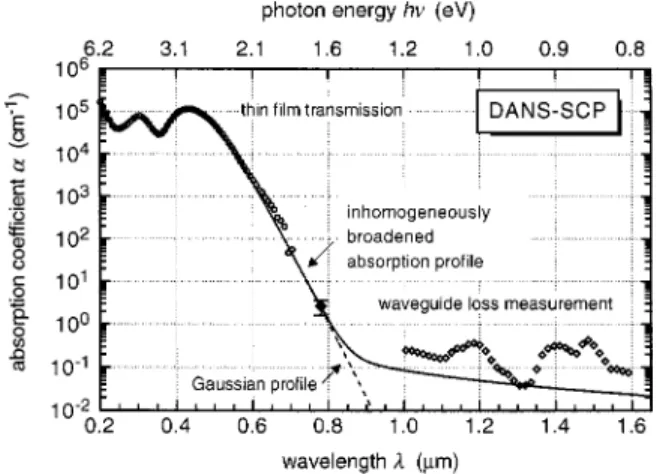
The absorption spectrum of DANS-SCP, previously pub-lished in Ref. 16, is shown here in Fig. 2 on a semiloga-rithmic scale. The fit to the inhomogeneously broadened absorption profile, described by Eq. (9), is indicated by the solid curve; its Gaussian part is represented by the dashed curve. Four transitions were used to fit the spec-trum. We also measured the absorption coefficient at the second-harmonic wavelength of 0.78m in a 2.5-m-thick planar waveguide, indicated by the filled diamond in Fig. 2. The measured absorption spectra of DANB-PMMA and DR1-PMMA are plotted in Figs. 3 and 4, respectively. For these two polymers we used two transitions to fit the spectra.
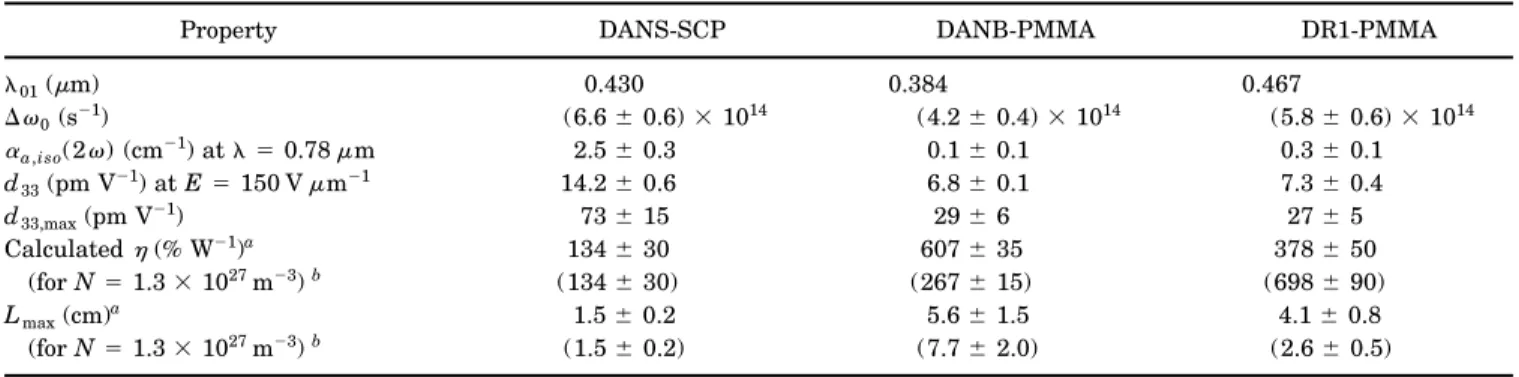
In Table 3 we have listed the measured absorption data, where01is the peak absorption wavelength,⌬0is
the fitted Gaussian linewidth of the 0–1 state transition, and ␣a,iso(2) is the absorption coefficient at the
second-harmonic wavelength of 0.78m for the unpoled polymer. The absorption spectrum of DANS-SCP (Fig. 2) is
charac-terized by a broad Gaussian linewidth, which is respon-sible for the relatively strong absorption of (2.5 ⫾ 0.3) cm⫺1 at the second-harmonic wavelength of 0.78
m. The fitted Gaussian linewidth in the absorption spectrum of DANB-PMMA (Fig. 3) is significantly nar-rower than the one for DANS-SCP. At 0.78m, DANB-PMMA is essentially transparent, most of the measured loss being due to scattering. However, this high trans-parency in the visible and infrared is associated with a pronounced blueshift of the electronic transitions, which, in general, results in smaller hyperpolarizabilities.13 DR1-PMMA (Fig. 4), finally, peaks at the longest wave-length among the three polymers considered here, with a relatively narrow Gaussian bandwidth. The measured absorption coefficient at 0.78 m is (0.3 ⫾ 0.1) cm⫺1. Our measurement of the absorption of DR1-PMMA is in very good agreement with the results obtained by photo-thermal deflection spectroscopy and reported in Ref. 24 for a similar DR1-PMMA polymer.
Comparison of the three absorption spectra shows that the chromophores experience different amounts of inho-mogeneous broadening. Whereas for DANS-SCP the wavelength of 0.78m falls onto the Gaussian part of the absorption line, the same wavelength is on the Lorentzian branch of the spectrum for DANB-PMMA and for DR1-PMMA. DR1-PMMA exhibits a nearly ideal absorption characteristic for second-harmonic generation at 1.55m: a significantly redshifted absorption maximum combined with a narrow bandwidth, so the second-harmonic wave-length falls right onto the short-wavewave-length end of the transparency region.
In the fundamental wavelength window, near 1.55m, the absorption spectrum is dominated by the vibrational overtone bands of the C—H bonds that occur in any or-ganic polymer in which C—H bonds are present. It is in-dependent of the chromophores incorporated in the poly-mer matrix and of their number density.24 To illustrate the effect of overtone absorption, we have plotted in Fig. 5 the measured propagation loss in a 1.5-m-thick DANB-PMMA waveguide for wavelengths of 1.55–1.65m. It is evident that a pronounced increase in attenuation occurs for wavelengths above 1.6m, limiting the useful wave-length window in the telecommunication band.
The effect of poling on the absorption coefficient is shown in Fig. 6. This measurement was performed on in-plane poled DANS-SCP samples at the wavelength of 0.458m, close to the absorption maximum. The curves were fitted according to Eqs. (12) and (13) with the isotro-pic absorption coefficient ␣a,iso [Eq. (14)] as the only
adjustable parameter (fitted value, ␣a,iso⫽ 1.1
⫻ 105cm⫺1). The poling-induced dichroism is clearly
evident from this measurement. For practical external poling fields smaller than 300 Vm⫺1, the increase of the absorption parallel to the polarization direction is smaller than 30%.
The measured nonlinear coefficients d33of DANS-SCP,
DANB-PMMA, and DR1-PMMA are shown in Figs. 7(a), 7(b), and 7(c), respectively. The data are plotted as a function of the poling field with the respective Onsager correction factors. The curves in Figs. 7(a) and 7(c) rep-resent fits to Eq. (2) and expression (7), respectively. Fig. 2. Ultraviolet–visible–near-infrared absorption spectrum
of DANS-SCP. Open circles, data measured by transmission spectroscopy of an unpoled thin film (thickness, 0.2 m); open diamonds, data measured in a planar waveguide (from Ref. 16). Filled diamond, loss measured in a planar DANS waveguide of 2.5-m thickness at a wavelength of 0.78m. Solid curve, fitted inhomogeneously broadened absorption profile according to Eq. (9); dashed curve, Gaussian part of the inhomogeneously broad-ened line.
Fig. 3. Ultraviolet–visible–near-infrared absorption spectrum of DANB-PMMA. Open circles, data measured by transmission spectroscopy of an unpoled thin film (thickness 0.6m); filled diamonds, data measured in a planar waveguide (thickness, 1.6
m). Curves, same meaning as for Fig. 2.
Fig. 4. Ultraviolet–visible–near-infrared absorption spectrum of DR1-PMMA. Open circles, data measured by transmission spectroscopy of an unpoled thin film (thickness, 1.1 m); filled diamonds, data measured in a planar waveguide (thickness, 1.5
Both curves were fitted with one free parameter only. In Table 3 we list the d33coefficients for an external poling
field of 150 Vm⫺1, which are good estimates for the non-dition, we list the fitted values for d33,maxthat represent
the theoretical limit for the nonlinearity when the isotro-pic model is used for fitting. The highest nonlinearity
was measured for DANS-SCP and is a result of the com-bination of large hyperpolarizability with a relatively
high chromophore loading. DANB-PMMA and
DR1-PMMA exhibit similar nonlinear coefficients despite the large difference in their hyperpolarizabilities (discussed in Appendix A), an effect that can be attributed to the dif-ferent chromophore number densities (see Table 1).
The dependence of the nonlinearity on poling tempera-ture was measured for DANS-SCP and DR1-PMMA in the ranges 125–145 and 110–135 °C, respectively, and is shown in Fig. 8. It is apparent that the poling tempera-ture is a noncritical parameter; the tolerance is of the or-der of degrees celsius.
B. Calculation of Second-Harmonic Conversion Efficiencies in Waveguides
In what follows, we calculate the second-harmonic conver-sion efficiency at 1.55m, given by Eq. (15), on the basis of the measured material parameters listed in Table 3. We assume a channel waveguide with an effective cross section of ⌫⫺1⫽ 10m2, a value that is typical of
an-nealed proton exchanged LiNbO3 waveguides. The
ma-terial absorption at the fundamental is assumed to van-ish, and we assume a scattering loss␣sof 0.2 cm⫺1(1 dB
cm⫺1) at both wavelengths. The absorption loss ␣a(2)
is given by the values of␣a,iso(2) listed in Table 3, and
its poling field dependence is described by Eq. (12). The poling field dependence of nonlinear-optical coefficient d33
is given by Eq. (2), and the values of d33,maxare listed in
Table 3.
In Fig. 9(a) we have plotted the calculated second-harmonic conversion efficiency as a function of guide length for the three polymers for an external poling field of 150 Vm⫺1. The maximum attainable conversion ef-ficiency and the corresponding guide length at this field are indicated in Table 3. Their accuracy was calculated on the basis of the experimental incertainties of d33and
␣2 as given above in Table 3. Because of its
transpar-ency, DANB-PMMA shows the highest maximum conver-sion efficiency, despite its small nonlinearity. This fact illustrates the importance of taking the absorption into account when one is evaluating second-harmonic figures of merit for polymers. Whereas the curves in Fig. 9(a) were calculated for the actual chromophore loading of the Fig. 5. Attenuation coefficient␣of a 1.5-m thick unpoled
pla-nar DANB-PMMA waveguide measured at 1.55–1.65-m wave-lengths. Solid line, calculated surface scattering loss.
Fig. 6. Poling field dependence of the absorption coefficient for polarization parallel (␣储, filled diamonds) and perpendicular (␣⬜, open diamonds) to the poling field, measured on in-plane poled DANS-SCP samples at a wavelength of 0.458m; curves, fits to Eqs. (12) and (13), respectively.
Table 3. Measured Absorption Characteristics and Nonlinear-Optical Properties and Calculated Second-Harmonic Conversion Efficiencies of the Polymers Used in This Paper
Property DANS-SCP DANB-PMMA DR1-PMMA
01(m) 0.430 0.384 0.467 ⌬0(s⫺1) (6.6⫾ 0.6) ⫻ 1014 (4.2⫾ 0.4) ⫻ 1014 (5.8⫾ 0.6) ⫻ 1014 ␣a,iso(2) (cm⫺1) at ⫽ 0.78m 2.5⫾ 0.3 0.1⫾ 0.1 0.3⫾ 0.1 d33(pm V⫺1) at E⫽ 150 Vm⫺1 14.2⫾ 0.6 6.8⫾ 0.1 7.3⫾ 0.4 d33,max(pm V⫺1) 73⫾ 15 29⫾ 6 27⫾ 5 Calculated(% W⫺1)a 134⫾ 30 607⫾ 35 378⫾ 50 (for N⫽ 1.3 ⫻ 1027m⫺3)b (134⫾ 30) (267⫾ 15) (698⫾ 90) Lmax(cm)a 1.5⫾ 0.2 5.6⫾ 1.5 4.1⫾ 0.8 (for N⫽ 1.3 ⫻ 1027m⫺3)b (1.5⫾ 0.2) (7.7⫾ 2.0) (2.6⫾ 0.5)
aCalculated for a waveguide with an effective cross section of⌫⫺1⫽ 10m2, an interface scattering loss of 0.2 cm⫺1(1 dB cm⫺1) at both fundamental and
second-harmonic wavelengths, and a poling field of E⫽ 150 Vm⫺1.
three polymers used for the measurements (listed in Tables 1 and 2), Fig. 9(b) displays the respective curves
when a chromophore number density of N ⫽ 1.3
⫻ 1027m⫺3is assumed for all three polymers, the actual
loading of DANS-SCP. Under this normalization DR1-PMMA is clearly the best polymer because of its combina-tion of large nonlinearity and low absorpcombina-tion. Despite its much smaller nonlinearity, the conversion efficiency at-tainable with DANB-PMMA is approximately a factor of 2
larger than that of DANS-SCP; however, the maximum is reached only at an impractically long guide length.
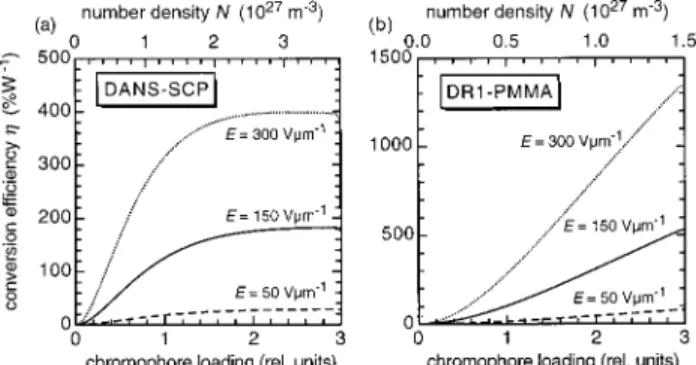
The effect on conversion efficiency of varying chro-mophore concentration is shown for DANS-SCP and DR1-PMMA in Figs. 10(a) and 10(b), respectively. The load-ing is indicated in units of multiples of the actual chromophore concentration in the polymers used for the measurements, where loading⫽ 1 corresponds to the val-ues given in Table 1. The calculation was done for a waveguide of 1-cm length and three different poling fields. The conversion efficiency saturates as a function of loading as the increase of the absorption becomes domi-nant over the growth of the nonlinearity. This effect is apparent for DANS-SCP, in which the chromophore con-centration is nearly at the optimum level, as opposed to DR1-PMMA, for which saturation occurs at much higher chromophore loading.
The effects of varying poling field strength are illus-trated in Fig. 11. In Fig. 11(a) we have calculated the normalized conversion efficiency as a function of external poling field for a guide length of 1 cm and the actual chro-mophore loading. The saturation of the conversion effi-ciency is due to saturation of the nonlinearity and in-crease of the absorption loss as a function of poling field. Figure 11(b) shows the same dependence as Fig. 11(a), as-suming a chromophore loading of N ⫽ 1.3 ⫻ 1027m⫺3for
Fig. 7. Poling field dependence of the nonlinear-optical coeffi-cient d33for DANS-SCP, DANB-PMMA, and DR1-PMMA. The respective poling temperatures were 135, 100, and 120 °C. Dot-ted curves, fits according to Eq. (2); solid curves fits according to expression (7). (a) Solid and open diamonds, data from parallel-plate and in-plane poled samples, respectively. (b), (c) All data measured on parallel-plate poled samples.
Fig. 8. Dependence of nonlinear-optical coefficient d33on poling temperature for DANS-SCP and DR1-PMMA.
Fig. 9. Normalized second-harmonic conversion efficiencyas a function of waveguide length L calculated on the basis of the measured absorption and nonlinear-optical coefficients as listed in Table 3 for DANS-SCP, DANB-PMMA, and DR1-PMMA. (a) Dependence assuming the actual chromophore loading as listed in Table 1; (b) assuming a chromophore number density N ⫽ 1.3 ⫻ 1027m⫺3 for all three polymers. The calculation was performed for an external poling field of 150 Vm⫺1, a wave-guide with an effective cross section of⌫⫺1⫽ 10m2, an inter-face scattering loss of 0.2 cm⫺1(1 dB cm⫺1) at both wavelengths, and a fundamental wavelength of 1.55m.
Fig. 10. Calculated normalized second-harmonic conversion ef-ficiency as a function of chromophore density for DANS-SCP and DR1-PMMA for three (external) poling fields E. The rela-tive units are defined such that unity corresponds to the actual loading of the chromophores in the polymers used for the mea-surements. The corresponding chromophore number densities N are indicated on the top axes. The waveguide was assumed to be 1 cm long; the other parameters are identical to those in Fig. 9.
Fig. 11. Calculated normalized second-harmonic conversion ef-ficiencyas a function of external poling field E. (a) Calculated for the actual chromophore loading; (b) chromophore number density assumed to be N⫽ 1.3 ⫻ 1027m⫺3 for all three poly-mers. The guide parameters are identical to those in Fig. 9.
all three polymers. This calculation again emphasizes the conclusion that DR1-PMMA is the most promising of the three polymers.
6. CONCLUSIONS
A detailed investigation of the absorption spectra and nonlinear-optical properties is essential for assessing the potential of nonlinear polymers for guided-wave paramet-ric processes at telecommunication wavelengths. The absorption–nonlinearity trade-off for the three polymers investigated can be described as follows: high nonlinearity–high absorption for DANS-SCP, low nonlinearity–low absorption for DANB-PMMA, and high nonlinearity–low absorption for DR1-PMMA. Obviously, DR1-PMMA exhibits the most promising properties, and DANS-SCP and DANB-PMMA are comparable despite their considerably different nonlinearities.
The conversion efficiencies for guided-wave second-harmonic generation, calculated on the basis of our ex-perimental data, of several hundred percent per watt compare favorably with those of the best quasi-phase-matched LiNbO3 waveguides.4,5 Our calculations,
how-ever, were performed for optimized waveguides, and it is yet to be proved that full advantage can be taken of the promising material properties of nonlinear polymers. So far, experimentally achieved conversion efficiencies in polymer waveguides are of the order of 0.1–1% W⫺1.12,28,34 To improve these values, we need to address a number of technological issues, among which are the fabrication of waveguides with good optical confinement and scattering losses smaller than 1 dB cm⫺1 at both wavelengths, increase of the effective poling field above
150 Vm⫺1, increase of the phase-matched guide length over 1 cm, and design of waveguides with optimized modal overlap. Although these requirements have been shown to be attainable independently,18,32,35,36 their si-multaneous fulfillment in one device still remains a chal-lenging task.
APPENDIX A: EVALUATION OF
MOLECULAR PARAMETERS
Molecular properties are usually derived from measure-ments in solution, whereas only few attempts to obtain data from polymer films have been made. Analysis of our absorption spectra and Maker fringe measurements can provide data for some molecular parameters in the polymer matrix that can be compared with previously published values in the literature. Their accuracy is lim-ited by (i) experimental errors, (ii) reliability and accu-racy of the models used for fitting, (iii) uncertainty of mo-lecular parameters used for fitting purposes (given in Table 2), and (iv) uncertainty of the local electric fields. Given these restrictions, our results represent at least useful estimates.
The transition dipole moments01from the ground to
the first excited state are obtained from fitting the linear absorption spectra to the inhomogeneously broadened line profile [Eqs. (9)–(11)]. The fitted values for the three chromophores are listed in Table 4. The fitted transition dipole moments are of the same magnitude as the ground-state dipole moments0,Z in solution (Table 2).
Utilizing the simple two-level model we can derive the molecular hyperpolarizability for frequency doubling ZZZ(⫺2, , ) from quantum mechanics as
Table 4. Molecular Parameters of the Chromophores Derived from the Measurements of This Study and Comparison with Previously Published Data
Parameter DANS DANB DR1 Reference (Method)
Dipole moment01(Cm) (value in D) (2.1⫾ 0.2) ⫻ 10⫺29 (6.3) (1.5⫾ 0.2) ⫻ 10⫺29 (4.5) (2.4⫾ 0.2) ⫻ 10⫺29 (7.3) This work
(linear absorption of thin film) Hyperpolarizability
ZZZ(m4V⫺1)a
276⫻ 10⫺40 68⫻ 10⫺40 289⫻ 10⫺40 This work
(Maker fringe on thin film)
244⫻ 10⫺40 49⫻ 10⫺40 b 290⫻ 10⫺40 26 (EFISH at 1.356m)c
(solvent, DMSO) (solvent, DMSO) (solvent, DMSO)
380⫻ 10⫺40 (solvent, CHCl3) 62⫻ 10⫺40 b (solvent, acetone) 260⫻ 10⫺40 (solvent, dioxane) 13 (EFISH at 1.907m)c Product (m5C V⫺1)d 6.7⫻ 10⫺67 1.7⫻ 10⫺67 8.4⫻ 10⫺67 This work Mesomeric moment⌬(Cm) (value in D) 5.7⫻ 10⫺29 (17.1) 3.6⫻ 10⫺29 (10.8) 3.1⫻ 10⫺29 (9.1) This work 5.3⫻ 10⫺29 (16) e e 37 (third-harmonic generation) 6.0⫻ 10⫺29 (18) 37 (Solvatochromic) 4.0⫻ 10⫺29 (12) e e 38 (two-photon absorption) 3.8⫻ 10⫺29 (11.4) e e 39 (Calculation) Dipole moment 1,Z(Cm) (value in D) 8.1⫻ 10⫺29 (24.3) 5.9⫻ 10⫺29 (17.7) 5.9⫻ 10⫺29 (17.8) This work aUncertainty, 30–50%.
bValues quoted for 4-dimethylamino-1-nitrobenzyl. cMeasured by EFISH. Values referenced to d
11⫽ 0.30 pm V⫺1at 1.064m for quartz. dValues for the dipole moment
0,Ztaken from Table 2. eNot applicable.
ZZZ共⫺2, , 兲 ⫽ 3 2⑀0ប2 ⌬01 2 01 2 共01 2⫺ 42兲共 01 2⫺2兲, (A1)
where⌬ ⫽ 1,Z⫺ 0,Zis the difference between the
di-pole moment of the chromophore in the excited and the ground states (mesomeric moment), 01is the transition
dipole moment, and01is the transition frequency.
Us-ing expression (7), we can calculate the molecular hyper-polarizability ZZZ(⫺2, , ) from the fitted curves
shown in Fig. 7. The  values obtained are listed in Table 4. Apart from experimental errors, the accuracy of these values is directly correlated to the uncertainty of local field correction factors in expression (7). The accu-racy is estimated to be of the order of 30–50%. For com-parison, we have also listed the hyperpolarizabilities quoted in Refs. 26 and 13, which were obtained from electric-field-induced second-harmonic (EFISH) measure-ments in solution. We emphasize here that one should use great caution in comparing hyperpolarizabilities ob-tained in solution and in solid matrices because the envi-ronment can have a pronounced effect on the value of , which also accounts for differences in reported EFISH values in the literature if, for example, different solvents were used. Given these limitations, our values for ZZZ(⫺2, , ) are within the range of the literature
values.
Another molecular parameter, namely, the mesomeric moment⌬, can be derived from the two-level model with Eq. (A1) from the values fitted for 01, 01, andZZZ.
The corresponding values are listed again in Table 4. The mesomeric moment of the same DANS-SCP had pre-viously been derived from third-harmonic generation and solvatochromic measurements,37 two-photon absorption
spectroscopy,38and theoretical calculations.39 Again, our measurement is within the range of these values that are listed in Table 4 for comparison. Finally, we have also indicated the excited-state dipole moments1,Z.
ACKNOWLEDGMENTS
This research was supported by the U.S. Air Force Office of Scientific Research through a grant from the Jet Pro-pulsion Laboratory. We are grateful to Akzo Nobel for providing us with the DANS-SCP material. T. Plisˇka and M. Canva acknowledge partial financial support pro-vided by the Swiss National Science Foundation and by a NATO science fellowship, respectively. This research is also supported by National Science Foundation–Centre National de la Recherche Scientifique U.S.–French bilat-eral collaboration funds.
T. Plisˇka can be reached by e-mail at: tomas.pliska @ch.jdsunph.com.
*Present address, JDS Uniphase AG, Binzstrasse 17, 8045 Zu¨ rich, Switzerland; e-mail: tomas.pliska @ch.jdsunph.com.
†Permanent address, Laboratoire Charles Fabry,
Insti-tut d’Optique The´orique et Applique´e, Universite´ d’Orsay/ Paris-Sud, 91403 Orsay Cedex, France.
‡Present address, Nano Technology Section, Kansai
Advanced Research Center, Communications Research Laboratory, Ministry of Posts and Telecommunications, 588-2 Iwaoka, Nishi-ku, Kobe 651-2401, Japan.
REFERENCES
1. G. I. Stegeman, ‘‘Introduction to nonlinear guided wave op-tics,’’ in Guided Wave Nonlinear Optics, D. B. Ostrowsky and R. Reinisch, eds. (Kluwer Academic, Dordrecht, The Netherlands, 1992), pp. 11–27.
2. K. Gallo, G. Assanto, and G. I. Stegeman, ‘‘Efficient wave-length shifting over the erbium amplifier bandwidth via cascaded second order processes in lithium niobate waveguides,’’ Appl. Phys. Lett. 71, 1020–1022 (1997). 3. G. I. Stegeman, D. J. Hagan, and L. Torner, ‘‘(2) cascading
phenomena and their applications to all-optical signal pro-cessing, mode-locking, pulse compression and solitons,’’ Opt. Quantum Electron. 28, 1691–1740 (1996).
4. M. H. Chou, I. Brener, M. M. Fejer, E. E. Chaban, and S. B. Christman, ‘‘1.5-m-band wavelength conversion based on cascaded second-order nonlinearity in LiNbO3waveguides,’’ IEEE Photon. Technol. Lett. 11, 653–655 (1999).
5. D. Hofmann, G. Schreiber, C. Haase, H. Herrmann, W. Grundkoetter, R. Ricken, and W. Sohler, ‘‘Quasi-phase-matched difference-frequency generation in periodically poled Ti:LiNbO3channel waveguides,’’ Opt. Lett. 24, 896–
898 (1999).
6. D. S. Chemla and J. Zyss, eds., Nonlinear Optical
Proper-ties of Organic Molecules and Crystals (Academic, Orlando,
Fla., 1987).
7. H. S. Nalwa and S. Miyata, eds., Nonlinear Optics of
Or-ganic Molecules and Polymers (CRC Press, Boca Raton,
Fla., 1997).
8. C. Bosshard, K. Sutter, Ph. Preˆtre, J. Hulliger, M. Flo¨rsheimer, P. Kaatz, and P. Gu¨nter, Organic Nonlinear
Optical Materials (Gordon & Breach, London, 1995).
9. D. Chen, H. R. Fetterman, A. Chen, W. H. Steier, L. R. Dalton, W. Wang, and Y. Shi, ‘‘Demonstration of 110 GHz electro-optic polymer modulators,’’ Appl. Phys. Lett. 70, 3335–3337 (1997).
10. K. Clays, J. S. Schildkraut, and D. J. Williams, ‘‘Phase-matched second-harmonic generation in a four-layered polymeric waveguide,’’ J. Opt. Soc. Am. B 11, 655–664 (1994).
11. T. C. Kowalczyk, K. D. Singer, and P. A. Cahill, ‘‘Anomalous-dispersion phase-matched second-harmonic generation in a polymer waveguide,’’ Opt. Lett. 20, 2273– 227 (1995).
12. M. Ja¨ger, G. I. Stegeman, S. Yilmaz, W. Wirges, W. Brinker, S. Bauer-Gogonea, S. Bauer, M. Ahlheim, M. Sta¨hlin, B. Zysset, F. Lehr, M. Diemeer, and M. C. Flipse, ‘‘Poling and characterization of polymer waveguides for modal dispersion phase-matching,’’ J. Opt. Soc. Am. B 15, 781–788 (1998).
13. L.-T. Cheng, W. Tam, S. H. Stevenson, G. R. Meredith, G. Rikken, and S. R. Marder, ‘‘Experimental investigations of organic molecular nonlinear optical polarizabilities. 1. Methods and results on benzene and stilbene derivatives,’’ J. Phys. Chem. 95, 10631–10643 (1991).
14. D. M. Burland, R. D. Miller, O. Reiser, R. J. Twieg, and C. A. Walsh, ‘‘The design, synthesis, and evaluation of chro-mophores for second-harmonic generation in a polymer waveguide,’’ J. Appl. Phys. 71, 410–417 (1992).
15. M. Ja¨ger, V. Ricci, W. R. Cho, M. Canva, and G. I. Stegeman, ‘‘Advantages of modal-dispersion phase-matching and material requirements for polymeric device-susing efficient second harmonic generation at telecommu-nication wavelengths,’’ Mater. Res. Soc. Symp. Proc. 488, 179–191 (1998).
16. A. Otomo, M. Ja¨ger, G. I. Stegeman, M. Flipse, and M. Diemeer, ‘‘Key trade-offs for second harmonic generation in poled polymers,’’ Appl. Phys. Lett. 69, 1991–1993 (1996). 17. A.-C. Le Duff, V. Ricci, T. Plisˇka, M. Canva, G. I. Stegeman,
K. P. Chan, and R. J. Twieg, ‘‘Importance of chromophore environment on the near infrared absorption of polymeric waveguides,’’ Appl. Opt. 39, 947–953 (2000).
18. M. Ja¨ger, G. I. Stegeman, M. C. Flipse, M. Diemeer, and G. Mo¨hlmann, ‘‘Modal dispersion phase matching over 7 mm length in overdamped polymeric channel waveguides,’’ Appl. Phys. Lett. 69, 4139–4141 (1996).
19. Q. Zhang, M. Canva, and G. I. Stegeman, ‘‘Wavelength de-pendence of 4-dimethylamino-4⬘-nitrostilbene polymer thin film photodegradation,’’ Appl. Phys. Lett. 73, 912–914 (1998).
20. K. D. Singer, M. G. Kuzyk, and J. E. Sohn, ‘‘Second-order nonlinear-optical processes in orientationally ordered mate-rials: relationship between molecular and macroscopic properties,’’ J. Opt. Soc. Am. B 4, 968–976 (1987). 21. C. P. J. M. van der Vorst and S. J. Picken, ‘‘Electric field
poling of acceptor-donor molecules,’’ J. Opt. Soc. Am. B 7, 320–325 (1990).
22. C. J. F. Bottcher, Theory of Electric Polarization (Elsevier, Amsterdam, 1973).
23. K. D. Singer and A. F. Garito, ‘‘Measurements of molecular second order optical susceptibilities using dc induced sec-ond harmonic generation,’’ J. Chem. Phys. 75, 3572–3580 (1981).
24. A. Skumanich, M. Jurich, and J. D. Swalen, ‘‘Absorption and scattering in nonlinear optical polymeric systems,’’ Appl. Phys. Lett. 62, 446–448 (1993).
25. P. K. Tien, ‘‘Light waves in thin films and integrated op-tics,’’ Appl. Opt. 10, 2395–2413 (1971).
26. K. D. Singer, J. E. Sohn, L. A. King, H. M. Gordon, H. E. Katz, and C. W. Dirk, ‘‘Second-order nonlinear-optical prop-erties of donor- and acceptor-substituted aromatic com-pounds,’’ J. Opt. Soc. Am. B 6, 1339–1350 (1989).
27. M. Ja¨ger, G. I. Stegeman, G. R. Mo¨hlmann, M. C. Flipse, and M. J. B. Diemeer, ‘‘Second harmonic generation in poly-meric channel waveguides using modal dispersion,’’ Elec-tron. Lett. 32, 2009–2010 (1996).
28. W.-R. Cho, V. Ricci, T. Plisˇka, M. Canva, and G. I. Stegeman, ‘‘Second-harmonic generation in reactively-ion etched, Disperse Red 1 polymer waveguides at telecommu-nication wavelengths,’’ J. Appl. Phys. 86, 2941–2944 (1999). 29. T. Plisˇka, V. Ricci, L. Friedrich, A.-C. Le Duff, M. Canva, G. I. Stegeman, P. Raimond, and F. Kajzar, ‘‘Polymer waveguides for 2:2-cascading at telecommunication
wavelengths,’’ (presented at the 9th European Conference on Integrated Optics, Turin, Italy, April 14–16, 1999). 30. P. A. M. Steeman, F. J. J. Maurer, and J. van Turnhout,
‘‘Dielectric properties of blends of polycarbonate and
acrylonitrile-butadiene-styrene copolymer,’’ Polym. Eng. Sci. 34, 697–706 (1994).
31. K. Mazur, ‘‘More data about dielectric and electret proper-ties of poly(methyl methacrylate),’’ J. Phys. D 30, 1383– 1398 (1997).
32. A. Otomo, G. I. Stegeman, W. H. G. Horsthuis, and G. R. Mo¨hlmann, ‘‘Strong field, in-plane poling for nonlinear op-tical devices in highly nonlinear side chain polymers,’’ Appl. Phys. Lett. 65, 2389–2391 (1994).
33. D. A. Roberts, ‘‘Simplified characterization of uniaxial and biaxial nonlinear optical crystals: a plea for standardiza-tion of nomenclature and convenstandardiza-tions,’’ IEEE J. Quantum Electron. 28, 2057–2074 (1992).
34. Y. Shuto, T. Watanabe, S. Tomaru, I. Yokohama, M. Hikita, and M. Amano, ‘‘Quasi-phase-matched second-harmonic generation in diazo-dye-substituted polymer channel waveguides,’’ IEEE J. Quantum Electron. 33, 349–357 (1997).
35. T. Plisˇka, V. Ricci, A.-C. Le Duff, M. Canva, P. Raimond, F. Kajzar, and G. I. Stegeman, ‘‘Low loss polymer waveguides fabricated by plasma etching for nonlinear-optical devices at telecommunication wavelengths,’’ in Conference on
La-sers Electro-Optics (CLEO/US), 1999 OSA Technical Digest
Series (Optical Society of America, Washington, D.C., 1999), pp. 313–314.
36. W. Wirges, S. Yilmaz, W. Brinker, S. Bauer-Gogonea, S. Bauer, M. Ja¨ger, G. I. Stegeman, M. Ahlheim, M. Sta¨hlin, B. Zysset, F. Lehr, M. Diemeer, and M. C. Flipse, ‘‘Polymer waveguides with optimized overlap integral for modal dis-persion phase-matching,’’ Appl. Phys. Lett. 70, 3347–3349 (1997).
37. W. E. Torruellas, R. Zanoni, G. I. Stegeman, G. R. Mo¨hl-mann, E. W. P. Erdhuisen, and W. H. G. Horsthuis, ‘‘The cubic susceptibility dispersion of alkoxy-nitro-stilbene (MONS) and di-alkyl-amino-nitro-stilbene (DANS) side chain susbtituted polymers: comparison with the two-level model,’’ J. Chem. Phys. 94, 6851–6856 (1991); Erra-tum, J. Chem. Phys. 96, 1662 (1992).
38. M. Cha, W. E. Torruellas, G. I. Stegeman, W. H. G. Horst-huis, G. R. Mo¨hlmann, and J. Meth, ‘‘Two photon absorp-tion of di-alkyl-amino-nitro-stilbene side chain polymer,’’ Appl. Phys. Lett. 65, 2648–2650 (1994).
39. D. Beljonne, J. L. Bre´das, M. Cha, W. E. Torruellas, G. I. Stegeman, J. W. Hofstraat, W. H. G. Horsthuis, and G. R. Mo¨hlmann, ‘‘Two-photon absorption and third-harmonic generation of di-alkyl-amino-nitro-stilbene (DANS): a joint experimental and theoretical study,’’ J. Chem. Phys. 103, 7834–7843 (1995).