i
,oeuhnt Rj.UQBl 2;1z' HiZI6
f4/
rssearzh Laboratory of Elctroic8
i .Nsacuhatetts Institute of TecL:ology
AN ANALOG CORRELATOR SYSTEM FOR BRAIN POTENTIALS
JOHN S. BARLOW, M. D.MASSACHUSETTS GENERAL HOSPITAL AND
RESEARCH LABORATORY OF ELECTRONICS AND
ROBERT M. BROWN
RESEARCH LABORATORY OF ELECTRONICS
TECHNICAL REPORT 300
JULY 14, 1955
RESEARCH LABORATORY OF ELECTRONICS
MASSACHUSETTS INSTITUTE OF TECHNOLOGY CAMBRIDGE, MASSACHUSETTS
I. INTRODUCTION
The electrophysiological approach to the nervous system is based on the study of electric potentials that are recordable from the nervous systems of functioning organisms. From the study of these potentials, under various experimental conditions, information is obtained about pathways of neuronal activity, and about interaction of activity arriving from distant sources with that of local origin. Corresponding studies under the altered conditions of diseases of the nervous system help to elucidate the nature of the changes of function that occur under these conditions.
The electrical activity of the brain, recorded from electrodes placed on the scalp, appears as a series of continuously fluctuating potentials, mostly of low frequencies (below 35 cps). Recorded as an inked trace, such voltage-time graphs are known as electroencephalograms (EEG's) (Fig. 1). The term electrocorticogram is used if the recording is made directly from the exposed surface of the brain. The instruments that have been developed for amplifying and recording these weak potentials (about 5-100 ~Iv in amplitude) are called electroencephalographs.
These fluctuating potentials, which appear to play an important role in controlling the degree of excitability of brain cells but whose exact origin is still a matter for research, are a reflection of the continuous, or ongoing, activity of the brain, subjected
- ., . ,
~~~~~~i..'
".,<-'..'.,:...^ .-- : ,:.<' ".: :-' : :. " i:;.C* f 'j ; j oh- t39S tigt *
~l'.k.h
R m iii~
'S' dd~';gr tr . > t i ... i g S .z , ,. , , .
Fig. 1. Example of an inked trace of the EEG of a human subject, with electrode placements. The trace is a small section from the
recording of one of several sets of bipolar combinations of the ten electrodes. The standard electroencephalographic proce-dure includes recordings from several different bipolar com-binations of at least 24 scalp electrodes, together with unipolar recordings between each scalp electrode and a reference elec-trode on an indifferent point.
1
to the continuous influence of other parts of the nervous system, e. g., sensory organs (1-4).
In some instances, the EEG trace exhibits a definitely periodic, or recurrent, and, at times, almost sinusoidal appearance; in others, no periodicity is apparent from the visually inspected trace of the EEG. Since electrodes on the scalp are not directly in
contact with the brain, the activity of a relatively large area at the surface of the brain will be recorded, and hence, multiple sources of activity tapped by the electrode may be masking any single periodic component.
Similarly, such multiple sources of continuously fluctuating potentials may com-pletely swamp the effect at the scalp electrodes of the specific signals arriving in the brain over the nerves leading from the sensory organs. Thus the specific response
evoked by an experimental stimulus (a click or a flash of light, for example) may some-times be apparent (Fig. 33b) but it is more frequently obscured by the fluctuating back-ground activity at the recording electrode. (In man, the response to auditory stimuli in the form of clicks is almost always obscured in the waking record.) As also occurs with the ongoing activity of the brain, the responses to sensory stimuli can be altered by changing the experimental conditions (by anaesthesia, for example).
In clinical neurology, EEG traces, visually inspected, have proved to be of great diagnostic help in many diseases. Further refinements in the study of brain potentials, including the search for periodic potentials of low amplitudes, have included the use of toposcopic methods (5) and the use of filters for frequency analysis. Instruments have been designed (automatic frequency analyzers) which assess, over a limited time (usually 10 sec) the relative amounts of activity present at each of a number of frequen-cies between 1.5 cps and 30 cps (6).
Analysis of electrophysiological phenomena in the time domain by what might be termed "time filtering," (in contrast to analysis in the frequency domain by means of frequency filters) also appears to be a method of considerable promise and one that has received less experimental exploration. The principles of analysis in the time domain will be described below.
This general type of analysis in the time domain, which has a longer history than others, has been used to study hidden periodicities in scientific data of frequent occur-rence in meteorology and astronomy. Thus, as Dawson (7) pointed out, Sabine (8) was able to demonstrate, in 1847, a very small tide in the atmospheric pressure resulting from the gravitational effect of the moon, even though it was completely obscured by much larger random variations and regular variations of solar origin, by retabulating data on atmospheric pressure with reference to the azimuth of the moon. This method of retabulation of data was suggested originally by Laplace (9) in 1798.
As early as the turn of this century, Schuster (10) pointed out the close relationship between analysis in the frequency domain (harmonic analysis) and analysis in the time domain by statistical methods, in his development of the theory of the periodogram (graph of the frequency components of a phenomenon, or more strictly, of the sums
of the squares of the two Fourier coefficients belonging to each period of the phenom-enon).
Following the work of Schuster on periodograms, and the work of Taylor (11), who considered the correlation between the movements over any one short interval and the next in a turbulent fluid, analysis in the time domain (as well as in the frequency domain) was considerably extended by Wiener (12) in his work on generalized harmonic analysis. Wiener pointed out the similarity between correlation as a tool long used by the statis-tician in the study of phenomena which do not have time as a variable and correlation in the study of time series, that is, those phenomena for which the relations of the data in time are essential, as they are, for example, in meteorology. He also indicated the theoretical interchangeability of analysis in the time domain and analysis in the
fre-quency domain (12, 13).
1. CORRELATION ANALYSIS OF TIME SERIES
The theory of correlation analysis in the study of time series has appeared (13-16) and will be considered only briefly. Goff (17) described a simple example of correlation analysis in a hypothetical case of the relationship of the price of wheat to the amount of rainfall. The example is quoted below. Dawson (7) discussed the applicability of cor-relation analysis to the study of brain potentials.
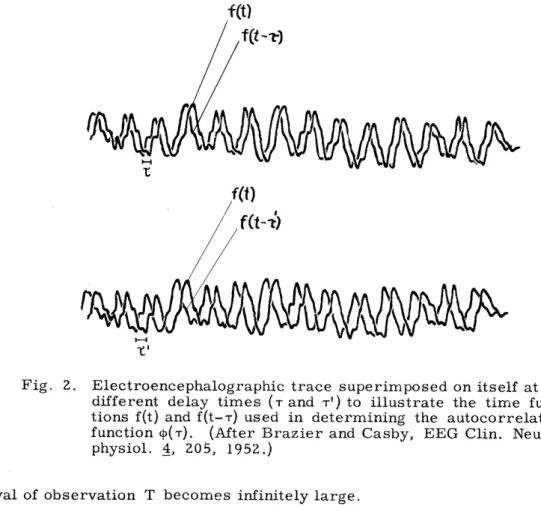
The method used in correlation analysis of time series is that of comparison of a given time series with itself, or with another time series, displaced in time (Fig. 2 indicates a sample of an EEG tracing displaced with respect to itself). In the first instance, the autocorrelation function of the time series is obtained; in the second, the crosscorrelation function of the two time series is obtained. In the comparison the instantaneous values (voltages) of the displaced and undisplaced time series are multi-plied, and the products are integrated for the particular interval of observation of the time series. The correlation function then consists of the resulting plot of averages against the corresponding relative delays.
Mathematically, the correlation function for time series is defined as
f(t
g(t-+(T) = Lim T f(t) g(t-T) dt (1)
T-oo T
in which
1. f(t) and g(t) are two stationary time series (phenomena whose statistical proper-ties are independent of the particular period of observation T);
2. T is the duration of the interval of observation in time;
3. T is the delay, or shift in time, of g(t) with respect to f(t) during the computation
process;
4. Lim T oo indicates that the equation becomes increasingly accurate as the
f(t)
f(t)
Fig. 2. Electroencephalographic trace superimposed on itself at two different delay times (T and T') to illustrate the time
func-tions f(t) and f(t-T) used in determining the autocorrelation function ((T). (After Brazier and Casby, EEG Clin. Neuro-physiol. 4, 205, 1952.)
interval of observation T becomes infinitely large.
For time series of a periodic or recurrent nature, Eq. 1 takes the form T
1 1
-( T f(t) g(t-T) dt (Z)
T1 J T1
in which T1 is the period, or the time of one complete cycle, of the time series. For
values of T greater than T1, the correlation function simply repeats itself, as does the
original function.
The following example, given by Goff (17) illustrates the principle of crosscorre-lation of two time series. (It is quoted below with the author's permission. Figure numbers refer to those in this report.)
Let us suppose that curve (a) of Fig. 3 represents the fluctuation of the price of wheat about its average value, while curve (b) represents the fluctuation from average of the rainfall over the area in which the wheat was grown. If we were asked to determine the amount of interdependence between the rain-fall and wheat prices, we would probably mentally superpose the two curves as in Fig. 3c and look for evidence of cause and effect. We see that there is little or no similarity between today's rainfall and today's wheat price. However, if we shift one curve in time with respect to the other, we can look for evidence of cause and delayed effect. Figure 3d for example, shows the price of wheat superposed on the rainfall three months earlier. These curves indicate that the periods of less than average rainfall were consistently followed
o o
39V3AV WOblI NOIIVA30
O h E d cr 4- ' C) '.-- U EO ti cd>< 0 Co 4 4 o3 i- O Oc :E l L: t 3 > ed c > -0 C-o . c, O oo cd --4 ' C ,.-.0 -' C ) 4Lf^ j :: O 4 0-4 . -c- d 0 2-4
0
oe 0 5 2nalOud o I 4by higher than average wheat prices three months later when the drought crops arrived on the market. We could then state qualitatively that there is an inter-dependence between these two quantities, and that the lag between a change in the rainfall and the corresponding change in the price of wheat is approximately three months.
The correlation function offers a means of determining the degree of inter-dependence between two time functions in a quantitative manner. To do this test it is necessary to perform the operations of delay, multiplication, and averaging as indicated by the definition of the crosscorrelation function (Eq. 1).
If we consider g(t) to be the fluctuation in rainfall and f(t) to be the
fluc-tuation in the price of wheat we can obtain +(T) for two values of time delay T by multiplying the respective pairs of curves in Fig. 3 and taking the time
average of these products. These products are shown in Fig. 4 and while curve
(a) for T = 0 is positive approximately as much of the time as it is negative, and
averages to zero, curve (b) for T = 3 months averages to a comparatively large negative value. By repeating the operations of multiplication and averaging for other values of delay time, we obtain the crosscorrelation function shown in Fig. 4c. This crosscorrelation function has a large negative value for
T = 3 months indicating a decrease in rainfall has a strong effect in increasing
the price of wheat three months later. For other values of T the
crosscor-relation function is approximately zero indicating little or no crosscor-relation between rainfall and wheat price for other values of time delay.
The price of wheat would be expected to depend on many other factors such as freight costs, international trade conditions and so forth. The interdepen-dence between the price of wheat and each of these other factors could be determined in a similar fashion.
This example indicates the use of crosscorrelation in the comparison of two different time series one of which is displaced in time in relation to the other. In the same manner, by autocorrelation, a single time series is compared with itself displaced in time.
Correlation analysis thus offers a method of investigating the time structure of phenomena. Autocorrelation of a time series indicates what it has in common with itself, that is, whether the time series is of a regular (repetitive) nature or of a random nature or has characteristics of both regularity and randomness. Thus, in the autocor-relation of a signal consisting of a mixture of noise and a sine wave, the effect of noise
will tend to average out for relatively large values of the delay T, with the
autocorre-lation of the sine wave persisting for such large values of delay. In this way, hidden periodicities may be detected. Similarly, in crosscorrelation, those components that are common to both series will be emphasized, and unrelated components will be
aver-aged out.
If the waveform of the time series is a sinusoid, the correlation function will be sinusoidal (Fig. 16a). Waveforms of more complex nature are, however, altered in the correlation process; thus the autocorrelation of a square wave is a triangular wave (Fig. 16b), and the crosscorrelation of a square and a triangular wave results in a cor-relation function of a yet more complex nature.
Waveform is not altered, however, in the special case in which one of the two time series being crosscorrelated consists of a repetitive brief pulse which is
synchro-nous with, or time-locked to, the hidden periodicity in the other of the series (14). The hidden periodicity, however, must be added linearly to the background noise.
Mathematically, the process may be described as one of crosscorrelation of a continu-ously varying phenomenon with a recurrent "unit impulse" function; physically, it is one of taking samples of the phenomenon at regular intervals and averaging the results.
Correlation analysis can thus be used to investigate the time structure of brain potentials, their periodic (or aperiodic) nature, and to compare brain potentials
recorded from different points on the scalp for similarities and dissimilarities. The method has already been applied to some problems in the study of brain potentials by
Brazier and Casby (18, 19).
Crosscorrelation of a time series with a recurrent unit impulse function has its counterpart in electrophysiology in the detection of evoked responses by crosscorrelation
of stimuli with brain potentials. The crosscorrelation function gives, in effect, the average result of many responses. This method is similar to that used in the
electro-mechanical averager developed by Dawson (20) to detect evoked responses in brain potentials resulting from stimulation of peripheral nerves.
The present system has been specifically designed for the automatic computation of autocorrelation and crosscorrelation functions of brain potentials and for cross-correlation of brain potentials with stimuli in the detection of evoked responses. The electrophysiological phenomena are recorded on magnetic tape, and correlational analysis is being performed during repeated playbacks of the tapes. The several steps in this process are indicated in Fig. 5. Provision is also made for computation of cor-relation functions for signal sources other than magnetic tape (oscillators, noise generators, and so on).
ANIMAL MAGNETIC TAPE
OR E L E CTROENGE PHALOGRAPH AND CORRELATOR CORRELOGRAM
SUBJECT BRAIN TAPE RECORDER
Fig. 5POTENTIALS
Fig. 5. Over-all block diagram of correlator system.
II. SPECIFICATIONS
1. CHARACTERISTICS OF THE ELECTROPHYSIOLOGICAL PHENOMENA
The frequency range of the ongoing activity of the brain, as recorded from electrodes on the scalp, lies largely in the range below 35 cps, as stated before. (The slowly varying dc component of the ongoing activity is not of primary interest here, and is not ordinarily recorded in the inked trace.) The maximum delay T, necessary in computing
correlation functions of the ongoing activity, is of the order of seconds.
In the early portion of evoked responses, under some conditions of recording, there may be frequency components of as high as 1 kc/sec or higher, and there may be an observable effect on the brain potentials for as long as 250 msec or longer after the
stimulus.
Although the correlation function (T) is strictly defined only for an infinite
obser-vation period of a stationary time series, the indication has been that samples of the electrophysiological events of the order of a few minutes may be considered represent-ative and hence stationary for the particular conditions of the recording.
2.. OVER-ALL SYSTEM CHARACTERISTICS
The present correlator system is of the analog type, with continuous multiplication of f(t) and g(t) (Eq. 1), but with T varied in discrete units, AT.
The over-all characteristics of the system are dependent on the components used in the recording of data, and on the ratio of the playback speed (during analysis) to the recording speed of the magnetic tape.
The characteristics for the case in which there is no speed-up of tape during analysis, that is, when playback for analysis is at the same speed as that of the original recording, are as follows: maximum over-all bandwidth, 1 cps to 5 kc/sec; maximum delay T, 185 msec; number of possible values of AT (the units by which T is changed
for computation of successive points of the correlation function), 30, ranging from 1/16 msec to 10 msec; maximum length of record which can be analysed (T), 50 seconds.
Corresponding figures for a speed-up of 5 are: bandwidth, 1-1000 cps; maximum
T, 925 msec; AT, 30 values, ranging from 5/16 msec to 50 msec; maximum length of
record, 4. 2 minutes; and for a speed-up of 25: bandwidth, 1-200 cps; maximum T, 4. 6
sec; AT, 25/16 msec to 250 msec; maximum length of record, 21 minutes. In order to handle the low frequencies encountered, an FM carrier is used in the recording and analysis systems.
III. RECORDING OF DATA
The arrangement for making recordings is indicated in Fig. 6. The electroenceph-alograph at the Massachusetts General Hospital is an 8-channel Grass instrument (model III D) the amplifiers of which cover the frequency range from below 0. 5 cps to about 1500 cps. Alternatively, four physiological amplifiers (Grass model P4-A) with frequency response from below 0. 5 cps to 20, 000 cps are available. At M. I. T., recordings are made with an 8-channel Offner electroencephalograph, six channels of which have a frequency response of approximately 0. 2-5000 cps, and two channels have a response of 0-5000 cps. Also available is a two-channel Grason-Stadler physiological amplifier (model 221-A), with frequency response from 0. 2-5000 cps. The inkwriters of the electroencephalographs, which provide inked records to accompany the tape recordings, cover the frequency range up to approximately 70 cps. The bandwidth of all of these instruments may be decreased by means of low- and high-pass filters.
The magnetic tape recorder at the Massachusetts General Hospital is a 5-channel FM Ampex (model S3244), with frequency response of 0-1 kc/sec, recording speeds of 6 or 12 inches/sec, and an FM carrier frequency of 5. 4 kc/sec. The tape recorder at M. I. T. is a similar instrument (Ampex model 306-5) but it employs a tape speed of 30 inches/sec, an FM carrier frequency of 27 kc/sec, and it has a bandwidth of 0-5 kc/sec. The M. I. T. instrument is used to play back, for purposes of analysis, the data recorded on either instrument.
The electrophysiological signals are taken from the amplifiers at a level of ampli-fication sufficient to yield the desired input level to the tape recorders, for which 1 volt rms of a sine wave produces 100 per cent modulation of the FM carrier.
Fig. 6. Block diagram of recording system.
IV. ANALYSIS SYSTEM
1. COMPONENTS OF THE SYSTEM
From Eq. 1 it is seen that the following units are required for autocorrelation and crosscorrelation of brain potentials:
1. a delay system for a displacement in time of g(t) with respect to f(t), i.e., to
obtain f(t) and g(t-T);
2. a multiplier to form the product f(t) X g(t-T);
3. an integrator or averager for this product;
4. a timer to specify the value of T (the sample length);
5. a plotter to indicate the value of the correlation function for the particular value
of T.
Figure 7 shows these components in a block diagram. The modification of this diagram for the present analysis system is indicated in Fig. 8. Figure 9 is a photograph of the actual system.
From Fig. 8 it is seen that f(t) (Channel A) and g(t) (Channel B) in FM carrier form are chosen from the tape playback channels by means of the switching unit. The electro-physiological signals are recovered from the FM carrier after the delay T has been
introduced, are fed to the multiplier, the output of which is integrated, and the value of the integral for the particular value of T is indicated on the plotter. The rewinding
of the magnetic tape between points on the correlogram is controlled by the automatic recycler. The various components are described in detail in the sections that follow.
In the detection of evoked responses by crosscorrelation of brain potentials with
stimuli, the multiplication f(t) X g(t-T) is simplified, since the stimulus may be
con-sidered to be a constant multiplier. For this purpose, a gating-storage circuit is used instead of the multiplier (Fig. 8). This unit is still under development; it is described, in its present form, in Appendix III.
2. SWITCHING UNIT
A photograph of this unit appears in Fig. 10a; the schematic, in Fig. 18. The inputs to the five record channels of the Ampex are fed through the front panel of the switching unit. The record channels can be turned off individually.
The playback selector switches permit, for each of the playback Channels A and B, selection of any of the five playback heads. A sixth position of the switches permits use of the modulated carrier from Record Channels 1 and Z (available at a test jack in the record amplifiers). This position of the selector switches is used for obtaining
cor-relograms from signal sources other than the magnetic tape playback (see Appendix II). The outputs from the playback selector switches are fed to the "Delay-No Delay" switch, from which the signals are fed either directly, or indirectly (by way of the mag-netic drum delay system), to the Ampex FM demodulators.
f(
MULTiPLIER _ NER~O - LTE DRLGA
9(t) g(t-) - '
DELAY a_
T g o
~
t | f()g(t-r)dtFig. 7. Block diagram of a correlator.
Fig. 7. Block diagram of a correlator.
… --- --- r--…--
… 1
Fig. 8. Block diagram of analysis system. Solid lines, signal channels; broken lines, control channels.
Fig. 9. Photograph of analysis system.
-C o0 . C) -4-4, H 5 4. 0 t 0 > 0,--. O -d 0
panel of the switching unit ("Output, than A, Chan B,' Fig. 10a).
A level meter of the peak-reading type (21), calibrated in rms volts for a sine wave and with a full-scale reading of 1 volt, permits monitoring the level of signals fed to the five record amplifiers, and of the playback signals appearing at the "Output" terminals.
3. MAGNETIC DRUM DELAY SYSTEM
The delay T is introduced by a magnetic drum, a modified form of the one designed by Goff (22, 23). A block diagram of the drum appears in Fig. 11; photographs, in Fig. 12. From the diagram it is seen that the drum actually introduces a relative delay between the two channels.
The modifications in the present drum were introduced, in part, because of its operation as part of an FM system. In Goff's drum, which is used to delay AM signals, the bandwidth is 100-10, 000 cps, and a high-frequency (60 kc/sec) bias-erase is used. The magnetic heads are spaced 0. 001 inch from the drum.
The present drum, in contrast, is used to delay the 27-kc/sec carrier of the Ampex during playback and its frequency excursions (for 100 per cent modulation of the original tapes) of 16-38 kc/sec. The magnetic heads that are used are: (a) record: special Brush type S1360 with head-gap of 0. 001 inch and inductance of approximately 160 milli-henries; (b) playback: standard Brush type BK 1090 (gap, 0. 00025 inch and inductance,
550 millihenries); (c) erase: standard Brush type BK 1110 (resistance, 58 ohms). The record and playback heads are spaced 0. 00025-0. 0005 inch from the drum surface; the erase heads, at about 0. 001 inch. Such close spacing of magnetic heads to the drum surface is necessary in order to recover from the drum the highest frequency com-ponents of the FM carrier (38 kc/sec or even higher).
A recording current of 3 ma is used. Since an FM system is being used, high-frequency bias-erase is not used. The erase is of the direct-current type (20 ma through the erase heads).
The relative delay between channels, which is indicated directly on a counter to tenths of a millisecond, may be altered either by a hand crank or automatically, by a pair of rotary solenoids described in the section on the automatic recycler, Appendix I. The manner in which the computation of correlation functions ceases automatically when the maximum delay is reached will also be described in Appendix I.
The interchannel delay may be varied from -15 msec to +185 msec (corresponding to delays up to 925 msec if tapes recorded at 6 inches/sec are played back at 30 inches/sec during analysis).
From Fig. 8 it is seen that the input to the magnetic drum delay system is taken from the tape recorder playback heads through the switching unit. A three-stage amplifier-clipper (Fig. 20), similar in design to those used in Ampex playback channels, eliminates amplitude fluctuations that appear in the output from the tape recorder play-back heads. The FM signals are recorded on the drum by the drum record amplifier (Figs. 10b, 21, and 26). Signals recovered from the drum playback heads are fed to a
CHANNEL A (FIXED DELAY)
INEL A
CHANNEL B
REPRODUCE B
CHANNEL B (VARIABLE DELAY)
Fig. 11. Block diagram of magnetic drum delay system.
Fig. 12. Photographs of magnetic drum: (a) front view; (b) rear view, showing cam-actuated limit microswitch, rotary solenoids, zero-sensitive microswitch, drum playback preamplifier, and drum terminal box.
FROM PLAYBACK HEADS
(VIA SWITCHING UNIT) TO FM DEMODULATORS(VIA SWITCHING UNIT)
preamplifier and cathode follower (Figs. 12b, 22, and 26), located close to the drum in order to minimize cable losses at the high frequencies employed.
4. FM DEMODULATORS
The delayed FM signals from the drum playback preamplifiers are fed (Fig. 8) through the switching unit to the Ampex playback amplifiers (FM demodulators); the output from these is then the original electrophysiological data (except at higher fre-quencies, if tape speed-up has been used). The original data, in the delayed form, are then fed to the multiplier-integrator.
5. MULTIPLIER, INTEGRATOR, AND PLOTTER
The multiplier and integrator (Figs. 10c, 13, and 23) are very similar to the multi-plier and integrator of the correlator for speech waveforms of the Imperial College of Science and Technology in London (24).
a. Multiplier
The multiplier, of the "quarter-square" type (23, 24), utilizes the relation
f Xg = 1/4 [(f+g)2 (f-g)2]
thus reducing the operation of multiplication to those of addition, subtraction, and squaring. For squaring, use is made of the near parabolic grid voltage-plate current characteristics of two 6B8 vacuum tubes operating near cut-off in push-pull. A simpli-fied schematic of the multiplier circuit, indicating these operations, is shown in Fig. 14. b. Integrator
The time constant (RC product) of the simple RC integrator is increased by a factor equal to the gain of the amplifier (Miller integrator, Fig. 15), thereby permitting longer periods of integration at the same accuracy (linearity) of integration.
The design of the integrator circuits allows integration of 1 per cent accuracy for periods as long as 50 sec. A shorter time constant (10 sec) is also available ("Integrator Time Constant" switch, Fig. 10c).
Two units (V8a-V9 and V8b-V1O, Fig. 23) with cathode follower inputs (V7a, b) are operated in push-pull in order to simplify the problem of rapid discharge of the inte-grating condensers (24).
Additional details and a discussion of the theory of the multiplier-integrator com-ponents, with performance data, are given by Dukes and Holmes (24), and further information will also be found in a technical note on the present instrument (26).
ER
Fig. 13. Block diagram of multiplier-integrator (proportionality constants omitted).
_f(t) x g(t- t) ITEGRATOR)
Fig. 14. Simplified schematic of multiplier (proportionality constants omitted) indicating the use of pentodes (6B8) in push-pull for squaring. R El CT E 2 (a) RC INTEGRATOR (b) MILLER INTEGRATOR
Fig. 15. Simplified schematic of integrator: (a) RC integrator; (b) Miller integrator.
c. Plotter
The plotter, a standard Esterline Angus recording milliammeter with a full-scale reading of 1 ma, is connected to the push-pull output of the integrator. A dc bias is applied to the integrators ("Integrator Bias," Fig. 10c) so that the pen excursions of the plotter during the integration time T (Eq. 1) are to midscale with zero input to the multiplier. The correlogram is thus the envelope of successive pen excursions.
For very small values of a correlation function, an expansion of scale of the plotter of 10 to 1 is provided ("Plotter Sensitivity" switch, Fig. 23). A scale expansion greater or less than ten can be obtained by adjustment of the resistor in series with the plotter leads ("Plotter Sensitivity" potentiometer, Fig. 23). The "Integrator Input" switch (Fig. 23) allows protection of the plotter from excessive build-up of currents while the unit is being adjusted or at other times when integration is not desired.
6. AUTOMATIC RECYCLER
The automatic recycling unit (Fig. 10d), which is described in Appendix I, controls the rewinding of the magnetic tape between computations of successive points on the correlogram.
During the recycling period, the unit sets the delay of the magnetic drum at the next value; for autocorrelation, T is successively increased from zero to maximum; for crosscorrelation, T is first decreased from maximum to zero, then increased to maximum.
Other functions of the recycler include turning off the tape transport mechanism when the maximum T has been reached and control of the analysis system for nontape-recorded signals.
V. PERFORMANCE OF THE SYSTEM
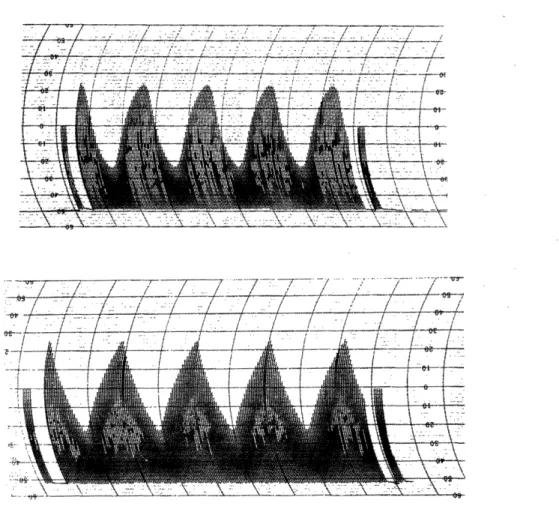
Figures 16a, b are representative correlograms obtained with the system from known signal sources. These data were recorded on tape from the Grass
electro-encephalograph with 100-tv peak-to-peak input. Figure 16a is the autocorrelation of a 20-cps sine wave; Fig. 16b is the autocorrelation of a 20-cps square wave.
The autocorrelation of a human electroencephalogram recorded as the difference in potential between two electrodes on the posterior part of the head (bipolar recording,
left parietal to left occipital) appears in Fig. 17a. Figure 17b is the corresponding autocorrelation for a recording from the right side of the head of the same subject.
Figure 17c is the crosscorrelation of these simultaneous recordings from opposite sides of the head. A portion of the EEG trace is reproduced in Fig. 17d.
Fig. 16. Autocorrelation of known signals: (a) 20-cps sine wave; (b) 20-cps square wave. AT, 1. 25 msec; sample length, T, 50 sec.
DELAY IN MILLISECONDS 0 200 400 600 800 0 DELAY IN MILLISECONDS 200 400 600 800 DELAY IN MILLISECONDS - 800 t -600 ! -400 -200 , 0 200 400 600 800
Fig. 17. Correlations of human EEG: (a) autocorrelation of left parietal to left occipital; (b) autocorrelation of right parietal to right occipital; (c) crosscorrelation of left and right parietal-occipital recordings; (d) inked trace of EEG, showing electrode placement on the scalp. AT,
5 msec; sample length, T, 1 min.
19
VI. LIMITATIONS OF THE SYSTEM
The limitations of the present system are principally set by the magnetic drum delay system. As discussed previously, the maximum value of delay T, the units of AT, the sample length T, and the bandwidth are all dependent on the playback/record speed-up ratio that is used for analysis of data. Thus for a speed-up of 25 times, the bandwidth (referred to the original data recording) is 1-200 cps, maximum T is about 4. 5 sec, and
the minimum AT is 1. 5 msec. With the recording speed now available a speed-up of 25,
however, requires that a rerecording be made; that is, recordings made at 6 inches/sec are played back at 30 inches/sec, and a rerecording is made at 6 inches/sec. A
5-minute (actual time) recording is thus shortened to 12 sec for analysis.
If delays longer than 4. 5 sec are required, as may be desirable in some recordings, special methods of introducing interchannel delays must be used. One method is that of rerecording a third time, but without additional speed-up, from one channel onto two adjacent channels. The recording on the first of these channels is made through the fixed delay channel of the magnetic drum; the recording on the second is made through the variable delay channel, set at maximum delay. Crosscorrelation of these two channels then gives the correlogram of the original data for values of 4. 5-9 sec.
These procedures for obtaining long values of delay suggest the desirability of making the original recording at a lower speed; a recording speed 1. 2 inches/sec with playback during analysis at 30 inches/sec would provide a speed-up of 25. Plans are underway for making recordings at these low speeds, if desired. However, the cor-responding recording with a bandwidth of 1-200 cps would permit studies on evoked responses with resolution of only about 5 msec.
The practice has been to obtain correlograms with a speed-up of 5, with an additional speed-up if necessary. Though time-consuming, this procedure permits, from the same recording, the detection of evoked responses with a resolution of approximately 1 msec (speed-up of 5) and correlograms of ongoing brain potentials with longer values of delay (speed-up of 25).
An entirely different approach to the construction of the magnetic drum consists of eliminating the small air gap between the magnetic heads and the drum by operating the magnetic heads in contact with the rotating drum. The problems of the rather critical dimensions associated with the maintenance of the small air gaps (essential in the present drum to obtain the necessary frequency response) would be eliminated. It was necessary in the present drum to introduce a preset, or permanent bend, of 0. 001 inch in the supporting shaft to compensate for the effect of bending of the shaft under the weight of the drum. This effect could be eliminated by a vertical, instead of a horizon-tal, mounting of the drum axis or by use of a much larger shaft. With the operation of heads in contact with the drum, however, there would be the new problems of head wear and of the design of a mechanical drive for a drum subject to much greater frictional drag than occurs with the present drum.
V 42 I X. -, L I--IJ L x ( IL ui-(I x 5 0 < 0 1 0 z I z NQA0 ai J U) 21 2 I U _Jo a S 0w 0oz z I 0 -4 C) .c U2 -4 *,{
i U a) Cd a >J j > o z id Id o o Cd a) 0r N < 0 ) -a.) -4a) a.) -4 0 C.) ."-Cd a) a-.,.j -4 --m 38 t C ¢
I
1 tJo A; < 3. a) Cd To 0o C.) ., , C c-Prl 23Id .4 O
'(
uj 0>)
I jilm I un ov
iD! LI~~~m dI~~ I~ z )
Z, O g m o 6 0 0 c o Lg I cL Z c xI) 05 V O O r a) a Cd Cd Cl o,z: ;-4-4 0r
r
F I I Z I I 1 ,-I L'.eL I I _ h, Z ; , J 8 -I -. ff1 25 ba -4 .0 U) U)
0) 0) 01 0. z ZQo .w o LILd
~.'
w Y)W 3 I-j 0 +o Cd -4 Q) -4 --4 0 o --4 c0 c) -4 o 4-4 r4 I 1) m~n~
i -tAPPENDIX I
AUTOMATIC RECYCLER
An automatic recycling device (Figs. 10d, 25, and 26) was designed to rewind the magnetic tape between computations of successive points of the correlation curve, cor-responding to successively larger values of delay T. The rewind method was chosen instead of the use of a continuous loop of tape because of the length of loop required (for example, 50 feet for a 20-second sample with a tape speed of 30 inches/sec) to provide flexibility in the choice of the section of tape to be analyzed (without cutting the original tape), and to avoid the difficulties with tape flutter that are encountered in loop systems, particularly with large loops.
At both ends of the section of tape which is to be analyzed, short pieces of a reflecting tape (aluminum-based 1/4 inch magnetic tape) are affixed to the reverse side of the 1/2 inch magnetic tape. The automatic recycler controls the motion of the tape, utilizing as control signals the pulses that are generated when these strips reflect light from an electric light into an adjacent photoelectric tube (V1, Fig. 25; and Fig. 9), a principle adapted from the M. I. T. digital correlator.
1. Sequence of Operation
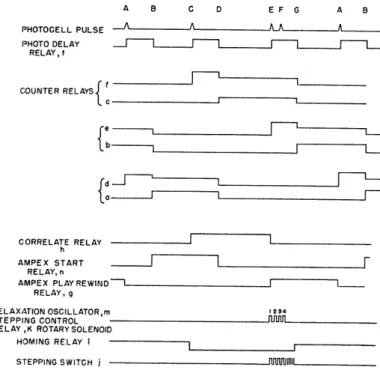
The various events in the recycling process are better understood by reference to Fig. 27. Four photopulses are generated during a complete cycle, that is, for each computation of a point on the correlogram, two pulses corresponding to forward and reverse motions past the phototube of each of the two reflecting strips are generated. These four pulses are fed, after amplification in a preamplifier unit adjacent to the phototube (Fig. 9), to a univibrator (V3 and V4, Fig. 25) which increases the width of the pulse to a few seconds. From Fig. 27 it is seen that the photopulse occurring at point F is not counted, as the photopulse delay univibrator is still in an activated state from the previous pulse. The relays a, b, c, d, e, and f (Fig. 25 and Fig. 27), in pairs of two, act as prime pair counters, so that after three counts, the cycle is repeated.
The operating sequence may be described as follows. Assume that the tape has just come to rest after completing rewind (point A, Fig. 27). After a delay of a few seconds (introduced by the photopulse delay univibrator) the tape is started in the forward direc-tion (point B). The passage of the first reflector signals the beginning of correlation (point C), at which time the discharge relay for the integrating capacitors in the multiplier-integrator unit is operated, thus removing the shunts across the integrating capacitors. Computation of the next point on the correlogram is begun. Passage of the other reflector in the forward direction past the photocell signals the end of correlate (point E), at which time the correlator discharge relay is de-energized, rewinding of the tape is begun, and the mechanism (described below) for changing the interchannel delay of the drum is activated. The photopulse corresponding to the passage of the
reflector in the opposite direction (point F) is ineffective, as previously described. At the next reflected signal appearing at the end of rewind of the sample (point A), the tape motion is stopped, thus completing the cycle.
At the beginning of the sequence of operations, the tape is positioned by manual con-trol of the Ampex ("Local-Remote" switch, Fig. 29) so that both reflecting strips are on the rewind reel. Pressing the "Stop Release" and "Set Up Correlate" buttons sets up the system to correspond to point B, and the tape motion is started.
2. Delay Changing System
During the time that the tape is rewinding, the delay T of the variable delay channel
of the drum is changed as follows (see Fig. 27). At point E, a relaxation oscillator consisting of two resistors, a capacitor, and a relay ("Step Interval," "Step Duration" potentiometers, 120-pf capacitor, and relay "m," Fig. 25), acts as a switch the con-tacts of which close about once a second. Each closing operates one of the pair of rotary solenoids which changes the delay on the drum, and also operates a stepping switch (relay "j"). This process continues until 1, 2, 4, 8, or 10 steps have occurred (depending on the position of the front panel switch "AT multiplier"); then the homing relay "1" is actuated, turning off the relaxation oscillator and allowing the stepping switch to step rapidly to its resting or home position. The homing relay remains ener-gized until the end of the recycle process (its holding contacts are supplied through the correlator relay "h"). The drum interchannel delay is thus set for computation of the next point on the correlogram.
Three sets of gears are provided to change the movable arm of the drum by the rotary solenoids, giving five gear ratios, which, combined with the six positions of the
"AT multiplier" switch, provide a total of 30 possible values of AT, ranging from
1/16 msec to 10 msec (referred to the drum speed of rotation).
The use of two rotary solenoids makes possible either automatic increase or decrease in the interchannel delay of the drum. In obtaining crosscorrelation functions, for which both positive and negative values of delay are required (since crosscorrelation functions are not necessarily symmetrical about zero T, as is the case with
autocorre-lation functions) f(t) is delayed with respect to g(t) for negative delays, and g(t) is delayed with respect to f(t) for positive delays. Hence, for computation of crosscorrelograms, the movable arm of the drum is set (manually) near the extreme limit of delay, but an integral number of units of AT from zero position, and the recycler is set so that T is
automatically decreased by the reverse rotary solenoid ("Alternate" position of the "T" Selector switch, and "Set Up Decrease T" push button, Fig. 25). The computation of
points on the correlogram proceeds for successively smaller values of T until the movable arm of the drum has reached the zero T position. At this point, a zero-sensitive
switch (consisting of a Veeder-Root counter, modified to actuate a microswitch when turning from 0000 to 9999) interrupts the principal supply to the " T decreasing relay"
a} C) 0 C.) Cr o N r-4
8 CONDUCTOR JONES PLUG (LARGE)
REGULATED POWER SUPPLY TRIAD TYPE
REGULATED
POWER SUPPLY GROUND I' + 300VC 2 6.3VAC{ 40t
7 CONDUCTOR AMPHENOL SOCKET
6 CONDUCTOR JONES CONNECTOR SOCKET
o2 3 GROUND - . ATM ATATIC'
5 RECYCLER
6 )6.3V AC
Fig. 26. Schematic of power cables for recycler.
A B C D EF G A B PHOTOCELL PULSE _A A - A PHOTO DELAY _ F ' . RELAY,t COUNTER RELAYS f I c -{e- L |bL i L_ CORRLAT --- -CORRELATE RELAY h AMPEX START I RELAY, n AMPEX PLAYREWIND--- RELAY, g RELAXATION OSCILLATOR,m STEPPING CONTROL RELAY ,K ROTARY SOLENOID
HOMING RELAY IL STEPPING SWITCH j
flflllfl
Fig. 27. Sequence of operation of relays of automatic recycler. (Lines at half-height indicate that the coils of the respective relay pairs are in series and that both relays are operated.)
31 to Io , · I F ---imifill T ~f f] f ... j L -i-- I 2 3. nnnn
diode and a contact on relay "k," until relay "k" is released. This provision prevents a double operation of the rotary solenoids at the zero point on a single step; for example, on the 0t h step, the reverse rotary solenoid moves the arm from 0. 25 msec to zero, followed immediately by the forward solenoid moving the arm from zero back to 0. 25 msec. The operation of the forward solenoid does not then occur until the next step, which directs subsequent energy for changing the position of the movable arm to the forward rotary solenoid and interchanges the inputs to Channels A and B (and hence f(t) and g(t)) in the drum record amplifier ("Signal Reversing" relay, Fig. 21). Compu-tation of points on the correlogram for positive values of T then proceeds. The over-all
effect, then, is to shift f(t) with respect to g(t) from -185 msec to +185 msec.
3. Zero Warning System
If the movable arm has not been set initially an integral number of AT steps away from the zero position, the values of T will not be symmetrical about zero, and there
will be no point on the curve corresponding to zero T. A front-panel glow lamp ("Zero Error Warning," controlled by relays "p," "q," and "r") indicates that the point T = 0
has been omitted, and hence that the values of T are not symmetrical about zero. The
glow lamp is energized by relay "r" as follows. Relay "p" is operated during the recycling process by the stepping of the rotary stepping switch "j" from position zero to position one (by current supplied through the 1N39 diode). This relay remains ener-gized for the remainder of the recycling period by its holding contacts and contacts of the correlate relay "h." The 1N39 diode prevents feedback of direct current to the
stepping-switch contacts while the stepping switch is inactive. Relay "q" is activated only if relay "p" is already energized at the time that the microswitch is operated to the zero position. Once operated, relays "p" and "q" remain energized until the end of the recycling process because of supply to their holding contacts from the correlate relay
" h."
If T = 0 is included as a point, then the zero-position microswitch on the drum is actuated by the last of the 1, 2, 4, 5, 8, or 10 steps of the (reverse) rotary solenoid of the drum advance mechanism, and it is released by the first of the series of steps occurring during the next recycling process. In this event, since relay "p" has not yet been operated, relay "q," and hence relay "r," are not activated.
Contrariwise, if T = 0 is not included, then the zero-position microswitch will be actuated during the stepping process (for instance, after the fourth step of a step-of-10 if the "AT multiplier" switch is set at 10). In this case, relay "q" is activated through the already closed contacts of relay "p," and, in turn, relay "r" and the "Zero Error Warning" light, when the zero-position microswitch returns to the nonzero position. The warning light remains on until the "Stop Release" button is pushed (holding contacts
4. Drum Limit System
When the movable arm of the drum has reached the position of maximum delay, a cam-operated microswitch (Fig. 12b and "Limit Switch," Fig. 25) effects the following: (a) stops the rotation of the drum (drum idler arm release relay "w"); (b) interrupts the supply to the drum rotary solenoids; and (c) energizes the limit relay "i." Relay "i" in turn: (a) interrupts the -300 volt dc supply to the relaxation oscillator; (b) interrupts the supply to the Ampex start relay "n" so that the tape motion will not begin again after the completion of the recycling process; and (c) interrupts the operation of the autotimer (described below) when it is being used.
The complete system operation may, in addition, be inactivated at any point in the cycle by pressing the "Stop Release" button.
5. Autotimer
In the computation of correlation functions for signal sources other than magnetic-tape playback, a multivibrator timer with variable "correlate" and "recycle" phases is provided ("Operation Selector" switch in "Autotimer" position, and "Autotimer," Fig. 25). Two univibrators are used, one triggering the other in a closed-loop fashion, permitting the system to be started in a specified phase (correlate) and stopped at will ("Start Auto" and "Stop Release" buttons).
The operation of changing the value of T for the drum is the same as for operation
with the tape recorder.
APPENDIX II
MODIFICATIONS OF THE AMPEX FM TAPE RECORDER 1. Mechanical
A mechanical gate (Fig. 28), for the design and construction of which we are indebted to Mr. E. C. Ingraham of this Laboratory, has been added in order to prevent contact of the tape with the magnetic heads during the rewinding process, thereby avoiding excessive wear of the heads. The gate is spring-loaded, and is retracted by the cap-stan idler wheel solenoid, which is energized only during the "play" mode, or forward motion of the tape.
2. Electrical
a. Tape Motion Control System
The control system has been modified (Fig. 29) to permit complete control of tape motion by the automatic recycler. Thus the function of the "Mode Selector Switch" is replaced by the Ampex play-rewind relay "g" in the recycler (Fig. 25), and the "Start" button is replaced by the Ampex start relay "n." The alternative position of the added "Local Remote" switch permits control of tape motion from the Ampex top plate in the usual way.
Since the Ampex control circuit is so designed that the tape motion is interrupted when the mode is changed from "rewind" to "play" (point A, Fig. 27), the only provision in the recycler for stopping the tape motion is a set of contacts on the "Stop Release" button.
b. Record Amplifier Control
The added switch "Normal Record Amplifier Only" (Fig. 29) permits operation of the record amplifiers independent of the tape motion, in the computation of correlation
Fig. 28. Mechanical gate for moving tape away from magnetic heads during rewinding of the tape. The fingers are kept retracted during cor-relation.
I 0 coaSo a To 0 0 1 1 4 Is A IIO It O ( , , ^' N ° . N D 0 °^ . k , IX ,Y 1 0 1 35 m AS E z I 4 w wzO tO-CF .,-Cd SH -4 o .-.1 0 04 Us -q 0 0 C) N -4 Flq
TERMINAL STRIP TERMINAL STRIP +250V 8 _ +250V 7 +150V 6 AMPEX POWER +75V 5 -SUPPLY -150 V 4 #2 12.6V AC 3 12.6V AC 2 --GROUND I
PLUG TERMINAL STRIP
80 7 7 + 250V 6 6 +150V 5 5 75V 40 4 12.6VAC 3 03 2 2 12.6VAC I o- o I GROUND TERMINAL STRIP 80 o8 7 7 +250V 6-- 6 + 150V 5 --- 5 + 75V 4 4 12.6V AC 2 2 12.6V AC - - I GROUND
Fig. 30. Ampex power cable modifications.
functions for signal sources other than magnetic tape. Operation of this switch to the "Record Amplifiers Only" position totally disables the tape-motion system, with
the mechanical gate moving any tape away from the magnetic heads at the same time.
c. Power Supplies
The connections for the two power supplies which originally supplied two record-playback channels independently, have been altered (Fig. 30) so that one supply is now used to power the five record amplifiers; its negative supply, together with the second supply, is used to power the two playback amplifiers (demodulators), the drum record preamplifier-clipper (Fig. 20), and the level meter circuit of the switching unit (Fig. 19).
AMPEX POWER SUPPLY #1 AMPEX PLAYBACK AMPLIFIER #1 AMPEX PLAYBACK AMPLIFIER "*2 AMPEX RECORD AMPLIFIER #1a2 AMPEX RECORD AMPLIFIER #3 -5 1i1 TERMINAL STRIP
APPENDIX III
GATING-STORAGE UNIT
The gating-storage unit is used instead of the multiplier unit (Fig. 23) for the detection of evoked responses. The magnetic drum is used to introduce a relative delay
T between the recording of the stimulus pulse and the brain potentials. Successive points of the correlogram then correspond to successively larger values of delay, the tape recording being played through again for each new value of the delay.
A block diagram of the gating-storage unit, in its present form, appears in Fig. 31. The stimulus pulse recorded on one channel of the tape recorder is delayed by the mag-netic drum and after being amplified and sharpened (V1), triggers a univibrator (V2), from which both positive and negative gating pulses of brief duration are available (phase inverter, V3, and cathode follower, V6). The playback of the brain potentials is similarly amplified (V4, and cathode follower, V5). The gating tubes V7 and V8 isolate the electrophysiological signal at V5 from the storage circuit (V9A and V9B) except when stimulus pulses appear at V1 and corresponding gating pulses appear at V7 and V8. When gating pulses occur, the storage circuit assumes the instantaneous value of the signal at the cathode of V5 and retains this value, after the gating pulse ends, until the next stimulus pulse arrives; then the new instantaneous value is assumed, retained, and so on. These successive stored samples, all for a given value of the delay T, are in turn fed to the Miller Integrator (Fig. 23) by means of the pin jack "V1-V3 Test Square" and the result is indicated on the plotter for that particular value of the delay. At the end of the computation for that value of delay, the tape is rewound, the magnetic drum is set for the new value of delay, and the computation for the new value of delay is begun. The process continues until the entire evoked response, with any afterevents, is defined in the correlogram.
Sample results from the present unit are indicated in Figs. 32 and 33. A more complete description of the gating-storage unit, with a schematic diagram, will be published later.
TO
-GRATOR
Fig. 31. Block diagram of gating-storage unit.
(a ) (b)
(d)
(c )
Fig. 32. Detection of a sine wave in noise: (a) crosscorrelation of a repetitive pulse with a single cycle of a 200-cps sine wave in noise of the same rms amplitude. AT = 0. 25 msec; sample time, 8 sec; number of samples, 160; (b) photograph of the signal correlated in "a"; (c) cor-relogram of single cycle of same sine wave as in "a" but not mixed with noise; (d) photograph of the signal correlated in "c."
DELAY IN MILLISECONDS
0 100 200 300
ISEC,
.. . ... .. .. .... .. . . ...
Fig. 33. Detection of an evoked response: (a) crosscorrelation of flash with cortical responses from a subject for whom the response was unusu-ally clear in the inked trace. Flash rate, 1 per second; number of responses averaged, 45; A = 2. 5 msec; (b) portion of inked trace of the EEG which was correlated above, with electrode placements.
I
I
Acknowledgment
The authors are particularly indebted to Dr. Mary A. B. Brazier of the Massachu-setts General Hospital, and to Professor W. A. Rosenblith of M. I. T., under whose general direction the system was designed and constructed. We wish to thank Professor Norbert Wiener for continuing interest and encouragement. The schematics of the cor-relator for speech waveforms at the Imperial College of Science and Technology, London, were made available to us by Professor E. Colin Cherry, Mr. J. M. C. Dukes, and Mr. J. N. Holmes. Dr. K. W. Goff, formerly of the Acoustics Laboratory, M. I. T., has been particularly helpful in the design of the magnetic drum. Numerous other problems in design have been discussed with members of the Acoustics Laboratory and the Research Laboratory of Electronics. Finally, we wish to acknowledge the unusually large part in the completion of the analysis system contributed by the ancillary services of the Research Laboratory of Electronics: the drafting room, the machine shop, and the wiring shop.
References
1. M. A. B. Brazier, The Electrical Activity of the Nervous System (Sir Isaac Pitman and Sons, London, 1951).
2. E. D. Adrian, The Physical Background of Perception (Clarendon Press, London, 1947).
3. J. D. N. Hill and G. Parr, Ed., Electroencephalography (Macdonald and Co., London, 1950).
4. M. H. Clare, and G. H. Bishop, Properties of dendrites; apical dendrites of the cat cortex, EEG Clin. Neurophysiol. 7, 85-98 (1955).
5. W. G. Walter, Toposcopy, EEG Clin. Neurophysiol. Suppl. No. 4, 7-16 (1953). 6. J. R. Knott, Automatic frequency analysis, EEG Clin. Neurophysiol. Suppl. No. 4,
17-25 (1953).
7. G. D. Dawson, Autocorrelation and automatic integration, EEG Clin. Neurophysiol. Suppl. No. 4, 26-37 (1953).
8. E. Sabine, On the lunar atmospheric tide at St. Helena, Trans. Roy. Soc. (London) 137, 45-50 (1847).
9. P. S. [Marquis de] Laplace, Mecanique C6leste, Trans. by Nathaniel Bowditch, Vol. 2, Book IV, Chap. V (Hilliard, Gray, Little, and Wilkins, Boston, 1832), pp. 797-798.
10. A. Schuster, The periodogram and its optical analogy, Proc. Roy. Soc. (London) 77, 136-140 (1906).
11. G. I. Taylor, Diffusion by continuous movements, Proc. London Math. Soc., Ser. 2, 20, 196-211 (1921-22).
12. N. Wiener, Generalized harmonic analysis, Acta Math. 55, 117-258 (1930). 13. N. Wiener, The Extrapolation, Interpolation, and Smoothing of Stationary Time
Series (John Wiley and Sons, Inc., New York, 1949).
14. Y. W. Lee, Application of statistical methods to communication problems, Tech-nical Report 181, Research Laboratory of Electronics, M. I. T., Sept. 1950. 15. Y. W. Lee, T. P. Cheatham, Jr., and J. B. Wiesner, Application of correlation
analysis to the detection of periodic signals in noise, Proc. IRE 38, 1165-1171 (Oct. 1950).
16. Y. W. Lee and J. B. Wiesner, Correlation functions and communication applica-tions, Electronics 23, 86-92 (June 1950).
17. K. W. Goff, The application of correlation techniques to some acoustic measure-ments, J. Acoust. Soc. Am. 27, 236-246 (1955).
18. M. A. B. Brazier,and J. U. Casby, Crosscorrelation and autocorrelation studies of electroencephalographic potential, EEG Clin. Neurophysiol. 4, 201-211 (1952). 19. M. A. B. Brazier and J. U. Casby, An application of the MIT digital electronic
correlator to a problem in EEG: the EEG during mental calculation, Proc. East. Assoc. EEG, EEG Clin. Neurophysiol. 3, 375 (1951).
20. G. D. Dawson, A summation technique for the detection of small evoked potentials, EEG Clin. Neurophysiol. 6, 65-85 (1954).
21. P. E. Green, Magnetic tape recorder for very low frequency phenomena, Rev. Sci. Instr. 21, 893-895 (1950).
22. K. W. Goff, The development of a variable time delay, Proc. IRE 41, 1578-1584 (Nov. 1953).
23. K. W Goff, An analogue electronic correlator for acoustic measurements, J. Acoust. Soc. Am. 27, 223-236 (1955).
24. J. N. Holmes and J. M. C. Dukes, A speech-waveform correlator with magnetic-tape delay and electronic multiplication, Proc. IEE 101, Part III, 225-237 (1954). 25. B. Chance, Ed., Waveforms, Vol. 19, M. I. T. Radiation Laboratory Series
(McGraw-Hill Book Co., Inc., New York, 1949).
26. J. S. Barlow and M. A. B. Brazier, A note on a correlator for electroencephalo-graphic work, EEG Clin. Neurophysiol. 6, 321-325 (1954).