HAL Id: hal-00842216
https://hal.archives-ouvertes.fr/hal-00842216
Preprint submitted on 8 Jul 2013
HAL is a multi-disciplinary open access
archive for the deposit and dissemination of
sci-entific research documents, whether they are
pub-lished or not. The documents may come from
teaching and research institutions in France or
abroad, or from public or private research centers.
L’archive ouverte pluridisciplinaire HAL, est
destinée au dépôt et à la diffusion de documents
scientifiques de niveau recherche, publiés ou non,
émanant des établissements d’enseignement et de
recherche français ou étrangers, des laboratoires
publics ou privés.
Topological surface states of strained Mercury-Telluride
probed by ARPES
Olivier Crauste, Yoshiyuki Ohtsubo, Philippe Ballet, Pierre Delplace, David
Carpentier, Clément Bouvier, Tristan Meunier, Amina Taleb-Ibrahimi,
Laurent Lévy
To cite this version:
Olivier Crauste, Yoshiyuki Ohtsubo, Philippe Ballet, Pierre Delplace, David Carpentier, et al..
Topo-logical surface states of strained Mercury-Telluride probed by ARPES. 2013. �hal-00842216�
Topological surface states of strained Mercury-Telluride probed by ARPES
Olivier Crauste,1 Yoshiyuki Ohtsubo,2 Philippe Ballet,3 Pierre Delplace,4 David Carpentier,5
Cl´ement Bouvier,1 Tristan Meunier,1 Amina Taleb-Ibrahimi,2 and Laurent P. L´evy1
1Institut N´eel, C.N.R.S. and Universit´e Joseph Fourier, BP 166, 38042 Grenoble Cedex 9, France 2Synchrotron SOLEIL, Saint-Aubin BP 48, F-91192 Gif-sur-Yvette, France
3CEA, LETI, MINATEC Campus, DOPT, 17 rue des martyrs 38054 Grenoble Cedex 9, France 4D´epartement de Physique Th´eorique, Universit´e de Gen`eve, CH-1211 Gen`eve 4, Switzerland
5Laboratoire de Physique, Ecole Normale Sup´erieure de Lyon and CNRS UMR5672, France
(Dated: July 8, 2013)
The topological surface states of strained HgTe have been measured using high-resolution ARPES measurements. The dispersion of surface states form a Dirac cone, which origin is close to the top of the Γ8,HHband: the top half of the Dirac cone is inside the stress-gap while the bottom half lies
within the heavy hole bands and keeps a linear dispersion all the way to the X-point. The circular dichroism of the photo-emitted electron intensity has also been measured for all the bands. PACS numbers: 73.20.At, 79.60.-i, 03.65.Vf
Topological Insulators are new states of matter pos-sessing a topological order induced by a strong spin-orbit. One of the hallmark of this topological order is the appearance of robust surface states, whose pre-cise nature is a unique signature of the unconventional bulk order. In the case of the three dimensional topo-logical insulators, these surface states consist in an odd number of species of Dirac particles, as opposed to 2D systems where Dirac states can only appear in pairs. Moreover, these surface Dirac states display remark-able magnetic textures, reflecting their spin-orbit ori-gin where momentum and spin are bound together. While transport experiments proved to be poor probes of surface states, Angle Resolved PhotoEmission Spec-troscopy (ARPES) appeared as a tool of choice. Land-mark ARPES experiments on Bismuth-Antimony[1– 3], Bismuth-Telluride[4, 5], Bismuth-Selenide[6–10] have firmly established topological insulators as real materi-als. A number of other experimental tools, such as sur-face STM-AFM studies[11], magnetotransport[6], orbital magnetometry[12], far-infrared spectroscopy[13], have re-vealed a number of the physical properties of the surface states of these materials. However, the cleanest evidences for topological surface states seem always to come from low energy ARPES. In this letter, we analyze the nature of surface states of strained Bulk Mercury Telluride in the ARPES spectra, and prove its topological structure. Bulk Mercury Telluride is a semi-metal with an in-verted band structure: the Γ8 band is lying 0.3 eV
above the Γ6 band. As pointed out in several seminal
papers[16, 17], this semi-metal can be turned into a two-dimensional spin-Hall insulator by confining the carriers inside a quantum well[18], or into a three-dimensional topological insulator by applying a bi-axial strain to the material[19, 20]. This can be achieved in the epitax-ial growth of Mercury Telluride from a Cadmium Tel-luride substrate, which lattice constant is 0.3% larger than Mercury Telluride. This strains opens a small gap
(26 meV) between the Γ8 light hole (Γ8,LH) and the Γ8
heavy hole (Γ8,HH) band. Within this gap, the only
con-ducting states left are topological surface states which give a metallic character to this three-dimensional topo-logical insulator which bulk is truly insulating within the strain gap.
In this letter, the experimental ARPES spectra of ho-mogenously strained 100 nm thick HgTe slabs epitaxially grown on [100] CdTe substrates reveal very strong sur-face states whose Dirac point sits close to the top of the Γ8,HHband, leaving one half of the Dirac cone inside the
strain gap and the other half inside the bulk Γ8,HH band.
This near degeneracy between the Dirac point and the extremum of a bulk band is a unique feature found in no other topological insulating material. These observa-tions are confirmed by a discrete analysis of the 8-bands Kane model close to the Γ point. Surprisingly enough, the surface states dispersion is linear all the way from the Γ to the X point. We have also measured the cir-cular dichroism of the surface and bulk bands. We find a strong circular dichroism of the bulk Γ8,HH band but
no dichroism coming from the surface states. These new experimental findings are critical to the interpretation of transport experiments and to spintronic applications using strained Mercury Telluride.
The ARPES-data were obtained on the CASSIOPEE line at the SOLEIL synchrotron[14], which low energy photons and high resolution (few meV) spectrometer are well suited to topological insulator studies. The strained HgTe slabs were grown by low temperature Molecular Beam Epitaxy in a Ultra-High Vacuum chamber from a [100] CdTe substrate which lattice constant (aCdTe =
6.48˚A) is 0.3% larger than bulk HgTe (aHgTe = 6.46˚A).
As long as the HgTe thickness does not exceed ≈ 150 nm, the HgTe is expanded homogenously, as was checked by θ− 2θ X-ray scans and reciprocal space maps. Only oc-cupied electronic states are observed in ARPES: indium-doped samples at 1018cm−3were prepared in addition to
2
Γ
8hhΓ
6a)
b)
−0.1 0.0 0.1 ky(Å−1) −0.1 0.0 0.1 kx (Å − 1) −0.1 0.0 0.1 ky(Å−1) −0.1 0.0 0.1 − 0 .0 8 e V −0.1 0.0 0.1 kx (Å − 1) −0.1 0.0 0.1 − 0 .1 6 e V −0.1 0.0 0.1 kx (Å − 1) −0.1 0.0 0.1 − 0 .2 4 e V −0.1 0.0 0.1 ky(Å−1) −0.1 0.0 0.1 kx (Å − 1) −0.1 0.0 0.1 ky(Å−1) −0.1 0.0 0.1 − 0 .3 2 e Vc)
FIG. 1: High resolution ARPES spectra for a maximally strained [100] HgTe/vacuum interface in the vicinity of the Γ-point measured at room temperature. a) Energy-momentum intensity spectrum after background substraction. b) The second derivative of the intensity data which band positions are less faithful enhances the contrast. c) Intensity spectrum at different energies. Raw data on the left and its second derivative on the right. The cone structure has a circular section up to ≈ 0.4 eV.
un-doped reference samples, in order to raise the bulk chemical potential.
The samples surfaces were cleaned in a dedicated Ul-tra High Vacuum preparation chamber by a low-energy Ar-ion sputtering at grazing angles to remove the sur-face oxide. The sharp dots observed in the in-situ LEED spectra showed that the surface was clean enough for the ARPES experiments[15]. The samples were subsequently transferred to the ARPES chamber in Ultra-High Vac-uum. The position of the Fermi level was determined with a reference gold sample placed on the same sample holder.
We first present the high-resolution spectra in the vicinity of the Γ-point for an un-doped sample. On the panel a) of Fig. 1, the intensity of the ARPES spec-trum is shown for a incident photon energy hν = 20 eV. We retrieve the surface projection of the two volume va-lence bands Γ8,HH and Γ6 (deep blue) and, with more
intensity, a linear cone structure, which broadens as one moves away from its apex. The second derivative spec-trum shown on panel b) enhances the contrast in the ARPES intensity. Within the experimental accuracy the cone apex coincide with the top of the Γ8,HH band and
lies 0.1 eV below the Fermi level. On the raw ARPES spectrum shown in panel a) the cone structure extends in the gap with a decreasing intensity, as those states are populated mostly through the room-temperature thermal activation. The cone section for different binding
ener-gies shown on the panel c) are circular up to enerener-gies 0.4 eV below the Dirac point. From the experimental slope of the cone structure, the surface state band velocity is found to be vF ≈ 5 × 10⁵m.s−1. This value agrees with
the lowest order expansion for the energy close to the Dirac point in the Kane model (~vF ≈ α√P6), where the
parameter α ≈ 0.9 for HgTe (the Kane parameters are defined in the supplementary material). The same sam-ple was also probed at different incident photon energies hν. Varying the incident photon energy, shifts the bind-ing energy of bulk bands accordbind-ing to their kzdispersion.
Here, the cone position is unaffected, emphasizing that this cone structure comes from a surface state with no kz
dispersion (see supplementary material, Fig. 1S). This is a powerful check which discriminates between 2D and 3D states. Surface state spectra were also collected over the entire Brillouin zone. In the Γ-K direction, the surface state spectrum becomes diffuse at energies of 0.8 eV be-low the Fermi level. On the other hand, in the Γ-X direc-tion, the surface state spectra remain linear all the way the the X point (Supplementary material Fig. 2S), where its energy is 3.4 eV below the Dirac point, i.e. well below the Γ6 band: in this direction, the surface state
robust-ness goes well beyond the usual topological protection ar-guments. The ARPES spectra of doped samples are quite similar to the one presented in Fig. 1, i.e. the electro-chemical potential at the top surface appears to be little
affected at the doping level used (1018cm−3-measured by
an ex-situ SIMS analysis- which is equivalent to a surface density of 1013cm−2 for a 100 nm thick slab).
Previous theoretical studies[21, 22] of HgTe surface states do not account quantitatively with our experimen-tal findings in some of their salient features: weak hybri-dation between surface states and the Γ8,HHvalence band
at small k and a Dirac point which lies very close to the top of the Γ8,HH valence band. Considering the successes
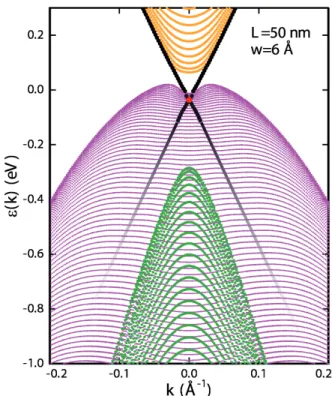
of the Kane model[23], for which all the parameters[24] are known for HgTe, we computed the surface and bulk states of 2D interfaces between a maximally strained HgTe slab and vacuum (resp. CdTe) within the 8 bands (Γ6,±1/2, Γ8,±3/2,±1/2and Γ7,±1/2) Kane model. The
in-terfaces were described by interpolating smoothly over a finite width w the Kane parameters between their val-ues in HgTe for 0 < z < L and vacuum (resp. CdTe) for z < 0 and z > L. The corresponding Schr¨odinger equation is discretized only in the z direction and nu-merically solved, determining surfaces and bulk states at once. The results are carefully shown to be independent of the discretization constant a over the range of energy and momenta considered. The results are shown in Fig. 2 : the surface states, originating from the inversion be-tween the two S = 1
2 bands Γ6 and Γ8,LH, are the only
states present in the gap. For the Kane parameters used, the energy of the Dirac point is ǫD = −30 meV below
the Γ8,LH and is similar for a CdTe/HgTe interface. At
k= 0 (ǫD), the surface states do not couple to the Γ8,HH
band, and are weakly affected by the Γ8,HHband at small
kbelow ǫD. They disappear gradually for larger k,
con-sistent with the observed broadening in the experiment. Their dispersion is linear with the same band velocity as in the experiment. As observed experimentally, half of the Dirac cone lies inside the Γ8,HH valence band while
the other half continues in the stress gap.
A hallmark of topological insulators is the helical spin structure of surface states induced by the strong spin-orbit coupling. Such textures have been observed directly using spin-resolved ARPES.[2, 3, 25] A less direct way to probe this helical spin-texture is through the induced cir-cular dichroism in ARPES.[9, 10]. Circir-cular dichroism is defined as the asymmetry between the ARPES intensity for left (L) and right (R) circular polarization
C(ǫ, k) = IR(ǫ, k) − IL(ǫ, k) IR(ǫ, k) + IL(ǫ, k)
. (1)
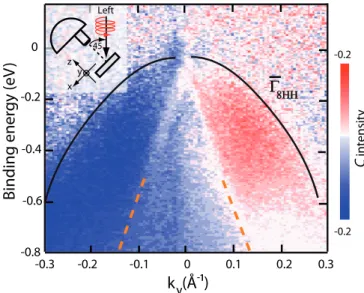
It is plotted in Fig. 3 (the geometry is specified in the inset) as a function of ky for kx= 0 and an incident light
beam at ≈ 45◦with respect to the normal to the sample.
By symmetry, the circular dichroism must cancel in the ky = 0 plane as observed for incident photon energies
Ekin>15.9 eV.
The most salient features of the experimental data of Fig. 3 are (i) the absence of dichroism from the surface states, signaled by the white lines (no dichroism) along
FIG. 2: Surface (black) and bulk bands (Γ8,LHorange, Γ8,HH
magenta, Γ6 red) dispersions in the vicinity of the Γ point
computed with a discretized Kane model along the z axis for a HgTe – vacuum interface interface one lattice constant wide (w). The black dots are the computed surface states energies.
the surface states dispersion and (ii) a significant dichro-ism (up to 20%) is observed in the bulk Γ8,HH band.
These results on strained HgTe differ from the circu-lar dichroism ARPES data on Bi2Se3 compound [9, 10]
where a dominant signature of surface states was ob-served. The relationship between the circular dichroism and the spectral spin densities of low energy bands is complex and depends on the incident photon energies[26]. Hence, a quantitative description of circular dichroism may involve processes with higher energy bands which require ab-initio calculations for a proper treatment. On the other hand if we assume that such a relationship ex-ists, Wang et al. [9] have shown that the dependence of the ARPES polarization asymmetry on the band polar-izations, hSxi and hSzi is
C(ǫ, k, φ) = −a2cos φhS
z(ǫ, k)i + 4ab sin φhSx(ǫ, k)i, (2)
for a circularly polarized light beam incident in the x-z plane at an angle φ with respect to the normal to the sample. The matrix elements a and b depends on surface symmetries of the material [9]. This formula is consis-tent with the experimental data of Fig.3 if the coefficient
4
Binding ener
gy (eV
)
k (Å-1)
y 0 0 -0.2 -0.4 -0.6 -0.8 -0.2 -0.1 -0.3 0.1 0.2 0.3Γ
8ΗΗ -0.2 -0.2 C in tensit y Left z x y 45FIG. 3: Circular dichroism measured at kx = 0˚A
−1. The
largest contribution to the dichroism comes from the Γ8,HH
valence volume band. The surface states appear here as white lines (no dichroism). The inset shows an incident left polar-ized light beam at 45◦with respect to the sample surface.
b vanishes for the [100] HgTe surface. This explains the weak circular dichroism contribution of the surface states, whose spin polarization normal to the surface hSz(ǫ, k)i
vanishes at low energy. An interpretation along these lines also relates the observed dichroism of the valence band Γ8,HH to its pseudo-spin polarization whose
possi-ble origins are well known[23]. The first common source is the Rashba effect [23, 27] : the Ar+ beam used in the
surface cleaning leaves a partially charged HgTe surface [28], inducing a surface electric field F . In addition, the Dresselhaus coupling present in centro-asymmetric crys-tals is here further enhanced by the strain deformation at the surface[29]. With these asymmetric couplings, the two Γ8,HH spin-bands can acquire a sizable pseudospin
polarization near the valence band maximum. This spin structure has implications for the design of spintronic de-vices. In the stress gap, the only charge carriers are the helical surface states. On the other hand, for negative en-ergies the coexistence between a partially spin-polarized heavy-holes and helical surface states is less favorable for applications.
In summary, we have observed the surface states of stressed Mercury Telluride, confirming its topological in-sulating nature. It has some quite unique features: the Dirac point sits at the top of the heavy hole band, some-thing which was also noticed in transport experiment for samples oriented in the [100][19] and the [211][20] direc-tion. Combined with the very low residual bulk conduc-tion in the stress gap, this topological insulator is one of the most interesting system for fundamental and applica-tive studies.
The authors would like to thank H. Cercelier for his
useful comments on the ARPES analysis. This work was funded by the EU contract GEOMDISS and the ANR grant SemiTopo.
[1] D. Hsieh, D. Qian, L. Wray, Y. Xia, Y. S. Hor, R. J. Cava, and M. Z. Hasan, Nature 452, 970 (2008). [2] D. Hsieh, Y. Xia, L. Wray, D. Qian, A. Pal, J. H. Dil,
J. Osterwalder, F. Meier, G. Bihlmayer, C. L. Kane, et al., Science 323, 919 (2009).
[3] D. Hsieh, L. Wray, D. Qian, Y. Xia, J. H. Dil, F. Meier, L. Patthey, J. Osterwalder, G. Bihlmayer, Y. S. Hor, et al., New Journal of Physics 12, 125001 (2010). [4] Y. L. Chen, J. G. Analytis, J. H. Chu, Z. K. Liu, S. K.
Mo, X. L. Qi, H. J. Zhang, D. H. Lu, X. Dai, Z. Fang, et al., Science 325, 178 (2009).
[5] M. Hajlaoui, E. Papalazarou, J. Mauchain, G. Lantz, N. Moisan, D. Boschetto, Z. Jiang, I. Miotkowski, Y. P. Chen, A. Taleb-Ibrahimi, et al., Nano Letters 12, 3532 (2012).
[6] J. G. Analytis, R. D. McDonald, S. C. Riggs, J.-H. Chu, G. S. Boebinger, and I. R. Fisher, Nature Physics 6, 960 (2010).
[7] K. Kuroda, M. Arita, K. Miyamoto, M. Ye, J. Jiang, A. Kimura, E. E. Krasovskii, E. V. Chulkov, H. Iwasawa, T. Okuda, et al., Physical Review Letters 105, 076802 (2010).
[8] P. D. C. King, R. C. Hatch, M. Bianchi, R. Ovsyannikov, C. Lupulescu, G. Landolt, B. Slomski, J. H. Dil, D. Guan, J. L. Mi, et al., Physical Review Letters 107, 096802 (2011).
[9] Y. H. Wang, D. Hsieh, D. Pilon, L. Fu, D. R. Gardner, Y. S. Lee, and N. Gedik, Physical Review Letters 107, 207602 (2011).
[10] S. Park, J. Han, C. Kim, Y. Koh, C. Kim, H. Lee, H. Choi, J. Han, K. Lee, N. Hur, et al., Physical Review Letters 108, 046805 (2012).
[11] T. Hanaguri, K. Igarashi, M. Kawamura, H. Takagi, and T. Sasagawa, Physical Review B 82, 081305 (2010). [12] A. Taskin and Y. Ando, Physical Review B 80, 085303
(2009).
[13] M. Orlita, K. Masztalerz, C. Faugeras, M. Potem-ski, E. G. Novik, C. Brune, H. Buhmann, and L. W. Molenkamp, Physical Review B 83, 115307 (2011). [14] http://www.sychrotron-soleil.fr/Cassiopee.
[15] The surface roughness was measured with an AFM on the oxydized sample surface after this experiment and found to be of the order of ≈ 2 nm, i.e. ≈ three monolayers. [16] B. A. Bernevig, T. L. Hughes, and S. C. Zhang, Science
314, 1757 (2006).
[17] L. Fu and C. Kane, Physical Review B 76, 045302 (2007). [18] M. Konig, S. Wiedmann, C. Brune, A. Roth, H. Buh-mann, L. W. Molenkamp, X. L. Qi, and S. C. Zhang, Science 318, 766 (2007).
[19] C. Brune, C. Liu, E. G. Novik, E. M. Hankiewicz, H. Buhmann, Y. L. Chen, X. L. Qi, Z. X. Shen, S. C. Zhang, and L. W. Molenkamp, Physical Review Letters, 106, 126803 (2011).
[20] C. Bouvier, X. Baudry, P. Ballet, T. Meunier, R. Kramer, and L. P. L´evy, ArXiv p. 12.... (2012).
Physical Review B 77, 125319 (2008).
[22] R.-L. Chu, W.-Y. Shan, J. Lu, and S.-Q. Shen, Physical Review B 83, 075110 (2011).
[23] R. Winkler, SpinOrbit Coupling Effects in Two-Dimensional Electron and Hole Systems, vol. Number 191 (Springer, 2003).
[24] E. Novik, A. Pfeuffer-Jeschke, T. Jungwirth, V. La-tussek, C. Becker, G. Landwehr, H. Buhmann, and L. Molenkamp, Physical Review B 72, 035321 (2005). [25] A. Kimura, E. E. Krasovskii, R. Nishimura,
K. Miyamoto, T. Kadono, K. Kanomaru, E. V.
Chulkov, G. Bihlmayer, K. Shimada, H. Namatame,
et al., Phys. Rev. Lett. 105, 076804 (2010).
[26] M. R. Scholz, J. Snchez-Barriga, J. Braun, D. Marchenko, A. Varykhalov, M. Lindroos, Y. J. Wang, H. Lin, A. Ban-sil, J. Minr, et al., Physical Review Letters 110, 216801 (2013).
[27] Y. A. Bychkov, and E.I. Rhashba, J.E.T.P. Lett. 39, 78 (1984).
[28] U. Solzbach and H. J. Richter, Surface Science 97, 191 (1980).
[29] X.-L. Ye, Y. Chen, J. Wang, Z. Wang, and Z. Yang, Physical Review B 63, 115317 (2001).
![FIG. 1: High resolution ARPES spectra for a maximally strained [100] HgTe/vacuum interface in the vicinity of the Γ-point measured at room temperature](https://thumb-eu.123doks.com/thumbv2/123doknet/12735893.357564/3.892.95.846.74.470/resolution-spectra-maximally-strained-interface-vicinity-measured-temperature.webp)