HAL Id: hal-00000370
https://hal.archives-ouvertes.fr/hal-00000370v2
Preprint submitted on 21 May 2003
HAL is a multi-disciplinary open access archive for the deposit and dissemination of sci-entific research documents, whether they are pub-lished or not. The documents may come from teaching and research institutions in France or abroad, or from public or private research centers.
L’archive ouverte pluridisciplinaire HAL, est destinée au dépôt et à la diffusion de documents scientifiques de niveau recherche, publiés ou non, émanant des établissements d’enseignement et de recherche français ou étrangers, des laboratoires publics ou privés.
CP Violation: Recent Results from BABAR
Gautier Hamel de Monchenault
To cite this version:
ccsd-00000370 (version 2) : 21 May 2003
CP VIOLATION: RECENT RESULTS FROM BABAR
G. Hamel de Monchenaulta,
on behalf of the BABARCollaboration DSM/Dapnia, CEA/Saclay, F-91191 Gif-sur-Yvette, France
We review recent time-dependent measurements in theB meson sector based on data collected
between 1999 and 2002 by the BABARdetector, which correspond to approximately 88 millions
BB pairs.
1 Introduction
The striking agreement with the Standard Model predicted value3 of direct measurements of sin 2β at B Factories, by BABAR1
sin 2β = 0.741± 0.067 (stat) ± 0.034 (syst) (1) and Belle2 experiments, leaves little room for sizable New Physics contribution to the B0B0 flavor mixing4. Because sin 2β is turning to a precision measurement, BABAR has started to
test experimentally some of the basic assumptions in the interpretation of the time-dependent CP asymmetry in ”Golden” charmonium modes in terms of sin 2β5: constraints on direct CP
violation in B → J/ψ K decays; limit on wrong-flavor transitions in B → J/ψ K decays; test of CP T conservation and limits on CP and T non-conservation in B0B0 mixing; and limit on the lifetime difference between neutral B mesons. In addition are performed measurements of sin 2β using various neutral B decay modes involving different short-distance physics: φKS0, η
0K0
S, D?±D∓, D?+D?− and J/ψ π0; and time-dependent CP asymmetry measurements in charmless B decay modes, π+π− and ρ±π∓, which are related to angle α of the Unitarity Triangle.
a
1.1 The data set
Unless specified otherwise, the measurements presented in this paper are based on a data sample of about 88 million BB pairs collected between 1999 and 2002 with the BABAR detector at the
PEP-II asymmetric-energy B Factory at SLAC. This corresponds to an integrated luminosity of approximately 92 fb−1 at the Υ (4S) resonance. We also exploit a sample of 9 fb−1 of data taken 40 MeV below the resonance (off-resonance data) for continuum background studies. 1.2 The BABAR detector
The BABAR detector is described in detail elsewhere6. The tracking system is composed of a
cylindrical drift chamber (DCH) and a silicon vertex tracker (SVT), both operating in a 1.5-T solenoidal magnetic field. Charged particle identification is performed using a ring-imaging Cherenkov detector (DIRC) and dE/dx information from tracking detectors. Electrons and photons are identified and their energy measured with a CsI electromagnetic calorimeter (EMC). Muons and neutral hadrons are identified in the instrumented flux return (IFR).
1.3 The B0B0 system
There are three relevant bases to describe the neutral B meson system. The first basis is that of the two flavor eigenstates B0 and B0, which are related through CP transformation. The
second basis is that of the CP eigenstates of the system, B+ and B−. The third basis is that
of the physical states that propagate with definite mass and lifetime. The mass difference and width difference between the ”heavy” BH and ”light” BL mesons are defined as
∆m≡ mBH − mBL > 0 , ∆Γ≡ ΓBH − ΓBL .
∆m, which is 2π times the B0B0 flavor oscillation frequency, is measured with great accuracy. The present world average, ∆m = 0.502± 0.006 ps−1, is dominated by measurements at B
Factories7. A peculiarity of the B0B0 system is that the oscillation frequency and the width are of the same order, xd = ∆m/Γ = 0.755± 0.015. Only very loose constraints of the width
difference, ∆Γ, are available up to now8. In the Standard Model, ∆Γ/Γ is proportional to m2 b/m2t
and thus is expected to be very small. A recent leading order calculation yields ∆Γ/Γ =−0.3%9,
but next-to-leading order corrections are expected to be large and may lead to an even smaller absolute value10.
1.4 CP , T and CP T conservation in B0B0 mixing alone
The discrete symmetries CP and T are expected to be violated in B0B0 mixing alone, but at a
very low level. CP and T violation can be characterized by the parameter q/p, where q and p are (assuming CP T invariance) the reduced complex coefficients that link the mass and flavor eigenstates of the system according to
|BLi = p |B0i + q |B0i, |BHi = p |B0i − q |B0i .
The argument of q/p depends on phase conventions; therefore q/p is not an observable, but its modulus |q/p| is. A departure of |q/p| from 1 is a manifestation of both CP and T violation in B0B0 mixing alone. In the Standard Model this effect is tiny: |q/p| − 1 ' 4π m2
c/m2t sin β ≈
5× 10⁻⁴. For most applications one can write q/p = e2iφM, where φ
M = −β in the usual
Wolfenstein phase convention11.
CP T conservation, based on very general principles of relativistic quantum mechanics, relies on the locality of quantum field theories. However some theories in modern physics, such as string theories, are not local at very short distances. Therefore the CP T symmetry could
be violated. We introduce the phase convention-independent complex parameter z ≡ (δM − (i/2)δΓ)/(∆m−(i/2)∆Γ ), where δM and δΓ are differences between the diagonal elements of the mass (dispersive) and lifetime (absorptive) components of the effective Hamiltonian describing the evolution of the neutral B meson system. z 6= 0 is a manifestation of both CP and CP T violation in B0B0 mixing alone.
1.5 Time evolution at the Υ (4S)
B Factories are energy-asymmetric e+e− colliders operating at an energy of√s = 10.58 GeV on
the Υ (4S) resonance. The Υ (4S) is the 43S1 state (JP C = 1−−) of the bottonium (b¯b) system; it
decays exclusively into a BB pair, B+B−or B0B0 in nearly equal amounts. The B0B0 system from a Υ (4S) decay evolves coherently: the two mesons flavor-oscillate in phase in such a way that at any moment in time, the system is the superposition of exactly one B0 and one B0 meson. The decay of one meson serves as an analyzer of the state of the accompanying meson at that instant.
Experimentally, we reconstruct fully the decay on one of the two B mesons, that we label Brec, into a final state frec. The other particles, which form the rest of the event (ROE), come
from the decay of the second B meson, Btag, into the final state ftag. The odds of reconstructing
fully the final state ftag are small. Instead, we apply a flavor tagging algorithm to the ROE
based on the presence of charged lepton, kaons, soft pions, and other kinematical properties. This algorithm determines the flavor of the Btag with an effective efficiency (i. e. taking into
account the probability of wrong flavor assignment) of 28.1± 0.7%. The sample of selected events is divided according to the result of the flavor tagging algorithm, either B0 or B0 tag. The proper time difference ∆t between the two decays is deduced from the measurement of the distance ∆z between the Brec and Btag decay vertices along the boost axis, which is measured
with a resolution (RMS) of about 150 µm. (At PEP-II, the distance between the two B vertices is 260 µm in average.)
We consider cases where frec is a CP eigenstate fCP, i.e. such that CP|fCPi = ηfCP|fCPi with ηfCP =±1. We introduce a convention-independent complex parameter
λfCP ≡ q p AfCP AfCP , where we use the notation (A)f ≡ A(
( )
B → f ) for the complex decay amplitudes. The imaginary part of λfCP characterizes CP violation in the interference between B
0B0 mixing and B0 or B0
decay while a value of |λfCP| different from 1 is an indication of direct CP violation in the decay (assuming that the effects of CP violation in B0B0 mixing alone are negligible). The time-dependent CP asymmetry
afCP(∆t)≡
N (∆t; B0tag)− N (∆t; B0tag)
N (∆t; B0tag) +N (∆t; B0tag)
can be expressed (omitting effects of imperfect flavor tagging and time difference reconstruction) as afCP(∆t) =−CfCP cos (∆m ∆t) + SfCP sin (∆m ∆t) with CfCP ≡ 1− |λfCP| 2 1 +|λfCP|2 and SfCP ≡ 2 Im λfCP 1 +|λfCP|2 .
We also consider cases where frec is a flavor eigenstate, or very nearly so, i.e. such that
|Af| ¿ |Af|. This larger sample is used to determine from the data the probabilities of wrong
2 Limit on direct CP violation in J/ψ K decays
In the Standard Model CP violation is expected to be small in B→ J/ψ K decays. The reason is that the sub-dominant contribution to the decay, a gluonic penguin amplitude, has the same weak phase as the dominant color-suppressed tree amplitude. The first contribution to the decay with a different phase is highly suppressed. One expects|AJ/ψ K0
S/AJ/ψ KS0| − 1 ≤ 10
−2.
The test of the absence of direct CP violation in these decays is two-fold. On the CP =−1 sample used for the measurement of sin 2β we obtain1:
|λJ/ψ K0
S| = 0.948 ± 0.051 ± 0.030 . (2)
We also measure the charge asymmetry for the isospin-related charged mode. Based on a sample of about 1300 J/ψ K± candidates selected in 20.7 fb−1 of data, we find12:
AJ/ψ K± = ( 0.3 ± 3.0 ± 0.4 )% . (3) Both results are consistent with no direct CP violation in B → J/ψ K decays.
3 Could sin 2βJ/ψ K0
S and sin 2βJ/ψ KL0 differ?
The main final states for the measurement of sin 2β are J/ψ KS0 and J/ψ K
0
L. Since the two measurements are combined, one may ask the question: How good is the relation
sin 2βJ/ψ K0
S = sin 2βJ/ψ KL0 ? (4)
The interference between B0 → J/ψ K0 and B0 → B0 → J/ψ K0 is possible thanks to K0K0 mixing. Obviously relation (4) cannot be rigourously exact since the K0
S and KL0 physical states are not exactly CP eigenstates of the neutral kaon system. However the effect of indirect CP violation in K0K0 mixing has negligible impact on (4). It has been shown13 that the only effect that could spoil this relation would be a sizable wrong-flavor B → J/ψ K transition, which is not possible at lowest orders in the Standard Model. To investigate the possibility of wrong-flavor decays, we study time-dependent rates on samples of 860 (resp. 856) self-tagged J/ψ K∗0 (resp. J/ψ K∗0) candidates (selected with a purity greater than 96%). We obtain the preliminary
measurements
Γ(B0 → J/ψ K∗0)/Γ(B0 → J/ψ K∗0) = −0.022 ± 0.028 ± 0.016 ,
Γ(B0 → J/ψ K∗0)/Γ(B0 → J/ψ K∗0) = +0.017± 0.026 ± 0.016 , (5) which are consistent with the absence of wrong-flavor ¯b→ c¯cs transitions, as expected.
4 Search for CP and T violation and test of CP T symmetry in B0B0 mixing; limit on the lifetime difference.
The differential rates of Υ (4S)→ BB → frecftag events as a function of ∆t has an exponential
dependance e−Γ|∆t| modulated by a cosine and a sine term at the mixing frequency ∆m. The
exponential envelop is slightly modified by terms that depend on the lifetime difference ∆Γ, while the coefficients of the cosine and sine terms receive small corrections that depend on the CP -and CP T -violating parameter z. From a simultaneous time-dependent fit to the CP -and flavor eigenstate samples including tagged and untagged events, we obtain the following preliminary measurements14: sign(Re λCP)× ∆Γ/Γ = −0.008 ± 0.037 ± 0.018 [−0.084, +0.068 ] | q/p | = 1.029 ± 0.013 ± 0.011 [ +1.001, +1.057 ] ( Re λCP/| λCP| ) × Re z = 0.014 ± 0.035 ± 0.034 [−0.072, +0.101 ] Im z = 0.038 ± 0.029 ± 0.025 [−0.028, +0.104 ] (6)
where the first errors are statistical, the second errors systematical, and 90% confidence level intervals are given under brackets. The first parameter, ∆Γ/Γ with a sign ambiguity, is consistent with zero within 4%. The second parameter, which measures CP and T violation in mixing, is consistent with unity within two standard deviations. The last two parameters, which are CP T -violating, are consistent with zero.
Systematics include possible biases due to charge asymmetries in the detector, which are estimated from the data, and a component that covers any effect due to quantum interference between the two decays when the Btag undergoes a doubly-Cabibbo suppressed transition.
Ex-tensive systematic cross-checks include alternative measurements of sin 2β and ∆m, which are fully consistent with BABARpublished values and world averages. We also confirm that the ratio
|ACP/ACP| is consistent with unity (no direct CP violation in J/ψ K) within 4.5%.
5 Measurements of sin 2β using non-¯b→ ¯cc¯s modes
One of the most promising ways to look for New Physics at B factories is to measure the CP parameter sin 2β in several B decay modes sensitive to different short-distance physics.
The B → φK decay is dominated by a pure ¯b → ¯ss¯s penguin transition. Our updated preliminary branching fraction and charge asymmetries measurements in these modes are
B(B0→ φK0) = ( 7.6+1.3−1.2 ± 0.5 ) × 10−6
B(B+ → φK+) = ( 10.0+0.9−0.8 ± 0.5 ) × 10−6 (7) ACP(B± → φK±) = ( 3.9 ± 8.6 ± 1.1 )%
and we place a limit on the B+→ φπ+ decay
B(B+→ φπ+) < 0.38× 10⁻⁶ @ 90% CL (8) which indicates that the magnitude of rescattering in the φK final states is small15. The B
decay final state φKS0 is a CP -odd eigenstate. Any deviation from SφKS0 = sin 2β would be a strong indication of New Physics. We update our preliminary result16with a larger data set (84
million BB pairs) and augment it with the KS0 → π
0π0 channel. Based on a sample of 51.5± 7.5
candidates in the KS0 → π
+π− channel and 13.3± 5.3 candidates in the K0
S → π
0π0 channel we
obtain:
SφK0
S =−0.18 ± 0.51 ± 0.07 , CφKS0 =−0.80 ± 0.38 ± 0.12 . (9) The large value of CφK0
S reflects the mismatch between 27 B
0-tagged and 13 B0-tagged events
in our signal sample. Fixing CφK0
S to zero, we obtain SφKS0 =−0.26 ± 0.51(stat).
The B→ η0K decay is also a dominantly ¯b→ ¯ss¯s transition. However, because the η0 meson
has non-negligible ¯uu component, the decay may also receive an additional ¯b→ ¯uu¯s contribution with a different weak phase. The predictions are that the size of this non-penguin contribution is relatively small. We measure the branching fractions and charge asymmetry17
B(B0 → η0K0) = ( 55.4 ± 5.2, ±4.0 ) × 10−6
B(B+→ η0K+) = ( 76.9 ± 3.5 ± 4.4 ) × 10−6 (10) ACP(B±→ η0K±) = ( 3.7 ± 4.5 ± 1.1 )%
and time-dependent CP parameters Sη0K0
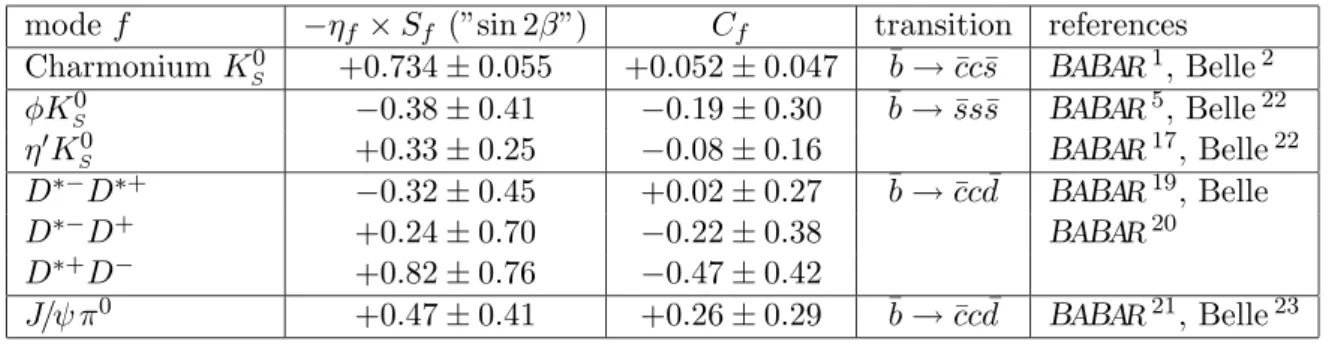
Table 1: Summary of time-dependent measurements in various modes measuring sin 2β, from the Heavy Flavor
Averaging Group. The sign of the S coefficients for the J/ψ π0 and D∗∓D± modes are reversed to be directly
comparable to the reference value of sin 2β.
mode f −ηf × Sf (”sin 2β”) Cf transition references
Charmonium KS0 +0.734± 0.055 +0.052± 0.047 ¯b → ¯cc¯s BABAR 1, Belle2 φKS0 −0.38 ± 0.41 −0.19 ± 0.30 ¯b → ¯ss¯s BABAR 5, Belle22 η0K0 S +0.33± 0.25 −0.08 ± 0.16 BABAR17, Belle22 D∗−D∗+ −0.32 ± 0.45 +0.02± 0.27 ¯b → ¯cc ¯d BABAR19, Belle D∗−D+ +0.24± 0.70 −0.22 ± 0.38 BABAR20 D∗+D− +0.82± 0.76 −0.47 ± 0.42 J/ψ π0 +0.47± 0.41 +0.26± 0.29 ¯b → ¯cc ¯d BABAR21, Belle23
Provided that the tree contribution is small, Sη0K0
S is equal to sin 2β.
The B → D(∗)−D(∗)+ modes receive contribution from Cabibbo-suppressed ¯b → ¯cc ¯d tree
and ¯b→ ¯d penguin amplitudes. The latter is believed to be much smaller than the former. At present only the B0→ D∗−D∗+ and the B0 → D∗∓D± have been observed. Using a sample of 126±13 events selected in the pseudoscalar to vector-vector B0 → D∗+D∗−mode, we performed
a transversity analysis to disentangle the CP = +1 and CP = −1 components of this decay. As anticipated18 we find that the decay proceeds mostly through the CP -even component: R⊥ = 0.07± 0.06 ± 0.03. If the penguin contribution can be neglected, the imaginary part of
the CP parameter (λD∗D∗)CP =+1 is equal to − sin 2β. We obtain19:
|(λD∗D∗)CP =+1| = 0.98 ± 0.25 ± 0.13 and Im (λD∗D∗)CP =+1= 0.31± 0.43 ± 0.13 . (12) From a sample of 113± 13 events reconstructed in the modes D∗−D+ and D∗+D−, we
measure20:
B(B0 → D∗±D∓) = ( 8.8 ± 1.0, ±1.3 ) × 10−4 and AD∗D = (−3 ± 11 ± 5 )% , (13) whereAD∗D ≡ (ND∗+D−− ND∗−D+)/(ND∗+D−+ND∗−D+) is the time-integrated charge asym-metry. Our preliminary time-dependent results in these modes are:
SD∗−D+ =−0.24 ± 0.69 ± 0.12 , CD∗−D+ =−0.22 ± 0.37 ± 0.10 ,
SD∗+D− =−0.82 ± 0.75 ± 0.14 , CD∗+D−=−0.47 ± 0.40 ± 0.12 , (14) where SD∗−D+ and SD∗+D− are equal to − sin 2β if penguin contributions are negligible.
The B0→ J/ψ π0 decay is a ¯b→ ¯cc ¯d transition. The dominant color-suppressed tree
ampli-tude is also Cabibbo-suppressed. The sub-dominant penguin ampliampli-tude is CKM-suppressed but has a different weak phase, which might spoil the relation SJ/ψ π0 =− sin 2β. With a sample of 40± 7 signal events, we obtain21:
SJ/ψ π0 = +0.05± 0.49 ± 0.16 , CJ/ψ π0 = +0.38± 0.41 ± 0.09 . (15) The time-dependent results presented here are combined in Table 1 with corresponding results from Belle when available. More statistics is needed to draw conclusions on the slight discrepancy between the values of sin 2β measured in (¯cc)K and (¯ss)K modes.
6 Time-dependent analyses in charmless modes
The B → π+π− decay receives contributions from CKM-suppressed ¯b → ¯u tree and ¯b → ¯d penguin amplitudes. In the absence of penguin contribution the phase of λππ is−2(β +γ), which
is equivalent to 2α using the triangle relation α + β + γ = π (here, γ is the phase of Vub∗). In
presence of penguin contribution the modulus and phase of λππare modified: λππ ≡ |λππ| e2iαeff.
The observables are Cππ = (1−|λππ|2)/(1+|λππ|2) and Sππ =
p
1− C2
ππ sin 2αeff. One condition
for direct CP violation (Cππ 6= 0) is that the relative strong phase δππ between the tree and
penguin amplitudes be non-zero, while α− αeff depends on the absolute ratio |P/T | of the
penguin to tree amplitude.
We perform a simultaneous π+π−/K+π−analysis. The Cherenkov angles as measured in the
DIRC enter directly the likelihood function as discriminating variables to distinguish between the π+π− and K+π− modes. The separation that results from this discrimination is excellent. The maximum likelihood fit identifiesNKπ = 589± 30 and Nππ = 157± 7 signal candidates out
of a large continuum-dominated sample of events. From the self-tagged Kπ sample we measure ∆m as a cross-check and find a value in full agreement with the actual value. From the ππ sample we measure24:
Sππ= +0.02± 0.34 ± 0.05 , Cππ =−0.30 ± 0.25 ± 0.04 . (16)
The statistical errors are quoted from the likelihood fit and are in good agreement with expec-tation from Monte-Carlo studies. Our result is well into the physical region (C2
ππ + Sππ2 ≤ 1)
and does not bring evidence for either direct or mixing-induced CP violation in the B→ π+π−
mode: BABAR does not confirm the observation by Belle of large CP violation effects in this
mode25.
The time-dependent study of the B → π+π−π0 decay is in principle a promising way for
a model-independent determination of angle α26. In practice the description of the interfering resonant structure in the 3π Dalitz plot will introduce some level of model dependence in the extraction of α, which has to be evaluated. With the present statistics we perform a quasi two-body analysis where we select bands around the ρ+and ρ−in the π+π−π0Dalitz plot, excluding the interfering region at the intersection between the two bands, where the charge assignment (ρ+π− or ρ−π+) is ambiguous. The analysis is similar to that in the π+π− mode, with the additional complications of a π0 in the final state and of a larger background from poorly-known rare B decays. We perform a simultaneous ρπ/ρK analysis that yields Nρπ = 428± 42
and NρK = 120± 28 signal events. The small ratio ρK/ρπ is an indication that the penguin
contribution is smaller in the ρπ mode than it is in the ππ mode, as anticipated. We obtain the preliminary branching fractions and charge asymmetry:
B(B0→ ρ±π∓) = ( 22.6 ± 1.8 ± 2.2 ) × 10−6
B(B0 → ρ±K∓) = ( 7.3+1.3−1.2 ± 1.3 ) × 10−6 (17) AρK = ( +28 ± 17 ± 8 )% .
From the ρπ sample we update our time-dependent CP measurements27 in this mode. In addition to a global charge asymmetryAρπ= ( +18 ± 8 ± 3 )%, we obtain:
Sρπ = +0.19± 0.24 ± 0.03 , Cρπ = +0.36± 0.18 ± 0.04 ,
∆Sρπ = +0.15± 0.25 ± 0.03 , ∆Cρπ= +0.28± 0.19 ± 0.04 . (18)
Sρπ and Cρπ are parameters that measure mixing-induced and direct CP violation, respectively.
∆Cρπ and ∆Sρπ are dilution parameters: ∆Cρπ is linked to the ratio of B0 → ρ−π+ and
B0 → ρ+π− amplitudes, and its value is consistent with predictions; ∆S
ρπ is a non-trivial
combination of strong and weak phase differences. The values ofAρπ and Cρπcan be interpreted
as a ∼ 2.5σ deviation from the hypothesis of no-direct CP violation in this mode, from which no claim can be made.
7 Conclusions
A broad experimental program of time-dependent measurements in a variety of modes related to angles β and α of the Unitarity Triangle is underway at BABAR. With the exception of the main
sin 2β measurement in golden channels, these measurements have poor statistical significance, but promise exciting results with an order-of-magnitude larger statistics at B factories. Even-tually this array of measurements will put strong constraints on the fundamental parameters of the CKM model in the Standard Model and, perhaps, reveal the presence of New Physics in processes involving B meson mixing and decay.
8 Acknowledgements
I am grateful to my BABARcolleagues for their help and support in preparing this talk. I would
like to congratulate the organizers for the outstanding scientific quality of the conference. References
1. B. Aubert et al., BABARCollaboration, Phys. Rev. Lett. 89 (2002) 201802.
2. K. Abe et al., Belle Collaboration, Phys. Rev. D 66 (2002) 071102(R).
3. A. H¨ocker et al., Eur. Phys. Jour. C 21 (2001) 225-259, and references therein. 4. See for instance: Y. Nir, ICHEP2002 proceedings; hep-ph/0208080.
5. G. Hamel de Monchenault, on behalf of the BABAR Collaboration, Rencontres de
Moriond EW 2003, BABAR-TALK-03/010 (2003).
6. B. Aubert et al., BABARCollaboration, Nucl. Instr. and Methods A 479 (2002) 1.
7. Heavy Flavor Average Group; http://www.slac.stanford.edu/xorg/hfag/index.html. 8. B. H. Berhens et al., CLEO Collaboration, Phys. Lett. B 490 (2000) 36;
T. Allmendinger et al., DELPHI Collaboration, DELPHI 2001-054 CONF (2001) 482. 9. A. Dighe et al., Nucl. Phys. B 624 (2002) 377-404; note that the opposite sign convention
is used in the definition of ∆Γ in this paper. 10. D. Becirevic, private communication.
11. Particle Data Group, K. Hagiwara et al.. Phys. Rev. D 53 (2002) 010001. 12. B. Aubert et al., BABARCollaboration, Phys. Rev. D 65 (2002) 091101.
13. Y. Grossman, A. L. Kagan and Z. Ligeti, Phys. Lett. B 538 (2002) 327-334.
14. B. Aubert et al., BABARCollaboration, BABAR-CONF-03/008, SLAC-PUB-9696 (2003).
15. B. Aubert et al., BABARCollaboration, BABAR-CONF-03/011, SLAC-PUB-9684 (2003).
16. B. Aubert et al., BABARCollaboration, BABAR-CONF-02/016, SLAC-PUB-9297 (2002).
17. B. Aubert et al., BABAR Collaboration, BABAR-PUB-03/006, SLAC-PUB-9698 (2003),
submitted to Phys. Rev. Lett.
18. See for instance: J. L. Rosner, Phys. Rev. D 42 (1990) 3732.
19. B. Aubert et al., BABARCollaboration, BABAR-CONF-02/014, SLAC-PUB-9299 (2002).
20. B. Aubert et al., BABAR Collaboration, BABAR-PUB-03/004, SLAC-PUB-9661 (2003),
submitted to Phys. Rev. Lett.
21. B. Aubert et al., BABAR Collaboration, BABAR-PUB-03/003, SLAC-PUB-9668 (2003),
submitted to Phys. Rev. Lett.
22. K. Abe. et al., Belle Collaboration, Phys. Rev. D 67 (2003) 031102. 23. K. Abe. et al., Belle Collaboration, BELLE-CONF-0201 (2002).
24. B. Aubert et al., BABARCollaboration, Phys. Rev. Lett. 89 (2002) 281802.
25. K. Abe et al., Belle Collaboration, submitted to Phys. Rev. D. 26. A. E. Snyder and H. R. Quinn, Phys. Rev. D 48 (1993) 2139.