Publisher’s version / Version de l'éditeur:
Canadian Paint and Finishing, 43, 8, pp. 43-47, 1969-10-01
READ THESE TERMS AND CONDITIONS CAREFULLY BEFORE USING THIS WEBSITE.
https://nrc-publications.canada.ca/eng/copyright
Vous avez des questions? Nous pouvons vous aider. Pour communiquer directement avec un auteur, consultez la première page de la revue dans laquelle son article a été publié afin de trouver ses coordonnées. Si vous n’arrivez pas à les repérer, communiquez avec nous à [email protected].
Questions? Contact the NRC Publications Archive team at
[email protected]. If you wish to email the authors directly, please see the first page of the publication for their contact information.
NRC Publications Archive
Archives des publications du CNRC
This publication could be one of several versions: author’s original, accepted manuscript or the publisher’s version. / La version de cette publication peut être l’une des suivantes : la version prépublication de l’auteur, la version acceptée du manuscrit ou la version de l’éditeur.
Access and use of this website and the material on it are subject to the Terms and Conditions set forth at
Paint tests
Ashton, H. E.
https://publications-cnrc.canada.ca/fra/droits
L’accès à ce site Web et l’utilisation de son contenu sont assujettis aux conditions présentées dans le site
LISEZ CES CONDITIONS ATTENTIVEMENT AVANT D’UTILISER CE SITE WEB.
NRC Publications Record / Notice d'Archives des publications de CNRC:
https://nrc-publications.canada.ca/eng/view/object/?id=15873f37-3db1-4f84-8461-97dfbd4617b7
https://publications-cnrc.canada.ca/fra/voir/objet/?id=15873f37-3db1-4f84-8461-97dfbd4617b7
Ser
THl
N21r2
no.
413
c. 2
BLDG
NATIONAL RESEARCH COUNCIL OF CANADA
CONSEIL NATIONAL DE RECHERCHES DU CANADA
PAINT
TESTS
by
H.
E. Ashton
CANADIAN PAINT AND FINISHING
Vol. 43, No. 8,
August
1969,
p.43
f
BUILD! 2,-NOV
12
1965
f
Research Paper No. 413 of the Division of Building Research
Price 10 cents
OTTAWA
October 1969
PAINT
TESTS
National Research Council's extensive weather testing of paint
on wood substrates has shown some significant results, if few
surprises, concerning proper coating protection for such material
in various Canadian climates. Here is a technical reDort on the
Ltesting prepared for Canadian Paint and Finishing by
H. E.
ASHTON
Building Materials Section, National Research Council of Canada.
Because of the importance of wood in the Canadian economy, research on exterior coatings for this substrate has always been a n important part of the work of the Materials Section of the Division of Building Research, Na- tional Research Council of Canada. Laboratory studies carried out under the direction of J. Harris were report- ed in this journal in 1963.' Numer- ous tests o n the properties of different types of coatings were discussed and a n attempt was made to relate test re- sults to durability. Prediction of dura- bility was based in part o n the reten- tion of properties when the coatings were subjected to accelerated weath-
ering.
Because the reliability of this accel- erated test is not universally accepted, it was necessary to confirm the results by natural exposure, and Mr. Harris had exterior exposure tests started while the laboratory tests were being conducted. T h e final results are now reported:
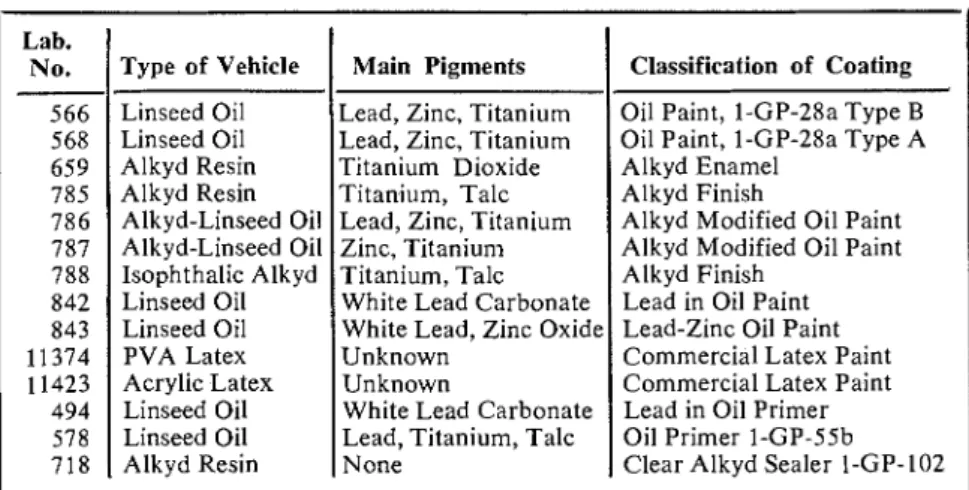
Most of the coatings classed as ex- perimental paints in the previous re- port were exposed at one time o r an- other early in the program. Their gen- eral composition is given in table one and complete formulations of all but the commercial latex paints are avail- able. T h e tests included a wide range of materials, from the original white lead in oil to acrylic latex paint and alkyd enamel. T h e acrylic paint was purchased over a period of 2% years and it is not known whether the com- position was changed between batch- es.
White pine and red cedar siding, birch exterior grade plywood, tem- pered hardboard siding and red cedar shingles were used a s substrates. In most tests o n wood siding the long di- mension was in the horizontal direc-
tion and the siding was in the drop or cove shape. One year, siding was ex- posed with the grain arranged verti- cally and for this test, tongue and groove siding was used. All panels were mounted vertically facing south. F o r the first three years the white pine and red cedar sidings were coat- ed before being fastened to the expo- sure frame. Aluminum paint was ap- plied to the backs and ends of the boards after application of the test material to the face. T h e boards were then screwed to H-frames so that the backs were open to the weather.
F o r the last three years in which exposure commenced, the siding was mounted before being painted and only the ends were sealed. T h e boards were nailed to three-quarter-in. sheath- ing covered with sheathing paper. There was also wood sheathing o n the back of the assembly and, for vertical siding, a water table at the bottom, as shown in figure one. Shingles, ply- wood and hardboard were similarly applied over sheathing paper. T h e sides of the frames and the sheathing o n the back were coated with alumi-
num paint.
Because the exposures were begun in different years and the program was modified with time as a result of laboratory and exposure tests, all coatings were not exposed on all sub- strates. This procedure reduced the number of individual samples but made analysis of the results much more complex. There were also dif- ferences in the application procedures with time: in most of the early tests the wood was sealed with two coats of clear alkyd sealer, but in the later tests three coats of the finishes, re- gardless of type, were applied to bare wood. Although the latter procedure may be regarded as placing all coat- ings on the same footing, it may have been unfair to those that were specifi- cally designed for use over a primer. Except for the last exposure series in 1963, the first coat of the three-coat system was generally reduced with 10 to 15 per cent thinner, aside from latex paints. Thinning would only reduce the already low dry-film thickness of latex paints and could not aid pene- tration of the binder, which is dis- persed, not dissolved, in water.
All exposure tests were conducted at the Division's Ottawa site, with the
TABLE
ONE
M A T E R I A L S U S E D I N E X P O S U R E S T U D I E S Lab. No.-
566 568 659 785 786 787 788 842 843 11 374 11423 494 578 718 Main PigmentsLead, Zinc, Titanium Lead, Zinc, Titanium Titanium Dioxide Titanium, Talc Lead, Zinc, Titanium Zinc, Titanium Titanium, Talc White Lead Carbonate White Lead, Zinc Oxide Unknown
Unknown
White Lead Carbonate Lead, Titanium, Talc None Type of Vehicle Linseed Oil Linseed Oil Alkyd Resin Alkyd Resin Alkyd-Linseed Oil Alkyd-Linseed Oil Isophthalic Alkyd Linseed Oil Linseed Oil PVA Latex Acrylic Latex Linseed Oil Linseed Oil Alkyd Resin Classification of Coating
Oil Paint, 1-GP-28a Type B Oil Paint, 1-GP-28a Type A Alkyd Enamel
Alkyd Finish
Alkyd Modified Oil Paint Alkyd Modified Oil Paint Alkyd Finish
Lead in Oil Paint Lead-Zinc Oil Paint Commercial Latex Paint Commercial Latex Paint Lead in Oil Primer Oil Primer I-GP-55b Clear Alkyd Sealer 1-GP-102
T A B L E
TWO
E F F E C T O F SUBSTRATE O N C O A T I N G DURABILITY
Tlrree Coals, N o Secrler {Years lo reuch ruling of 5 )
;E\rimated value: absence of decimal indicates p r e c i s ~ o n of t h c approximalic~n.
exception of one year when three du- plicates were exposed near Halifax at York Redoubt. Over the years, expo- sures at Ottawa have been representa- tive of results obtained at all D B R stations across the country, except for the marine industrial site in Halifax.
T h e combinations of coating and substrate are shown by year of-expo- sure in tables o n pages 48 and 49, to- gether with ratings made at various periods by individual observers using the conventional scale of 10 to 0,
where 10 is perfect condition and 0 is complete failure. For the final exami- nation in the fall of 1967, two ob- servers rated the panels independently and then reviewed the results together to resolve disagreements. 842 Lead in Oil 3.0 2.0 2.4 3.5
. .
. Wood Substrate Horizontal Siding Tempered Hardboard Birch Plywood Vertical Siding Cedar ShinglesI t is difficult to present exposure results in a manner that readily en- ables comparisons to be made or meaningful conclusions to be reached. At any single observation tinle ratings may show reversals from the general trend. There are also differences in rapidity of coating failure. Some qirickly drop to a fairly low rating, but subsequently fail rnuch niore
659 Alkyd Enamel 10; 8
?
6.0 4.2 7t
566 Oil Paint 6.3 3.8 2.4 7 f 3.9gradually; other coatings ~naintuin a high rating for several years and then fail rapidly; in a third group the rat- ing decreases fairly uniformly with time.
In the analysis of the exposure studies, the ratings were first plotted against time, as illustrated. From the general trend the times a t which each system woi~ld reach ratings of 8, 5 and 2 were determined. T h e first moderate drop in appearance o r the first isolated failures i n protection are reflected in a rating of 8. Five repre- sents the condition at which recoating would be required, but without exten- sive preparation of the substrate. Two indicates severe failure of either the coating o r the underlying surface. With coatings that were very durable or had been exposed for a relatively short time, i t was necessary to cxtrap- olate to the time required to reach the lower ratings. In some cases, therefore, the estimate was not very precise, es- pccially for the rating of 2. In order to accommodate the different types of failure, the estimated time to reach a
rating of 5 was selected as most rcp-
11423 Acrylic Latex 3.0 2.9 2.4 4.2 4.2t 788 Isophthalic Finish 4.1 6.0 5.3 4.3
.
. .
W h i t e lead i n oil o n tempered hard- board after six years. Paint retnains zlndrr laps and few other spots.
Alkyd enalnel o n telnpererl l7arrlboarrl r~fter six yerirs' exposlire. A t right. typical exposure m c k . 785 Alkyd Finish 4.5 5.3 3.4 .
. .
. . .
rcsentative of the periormance of a
coating. Substrate Mean 5.2 4.7 3.6 4.6 5.0
K e s u l t s
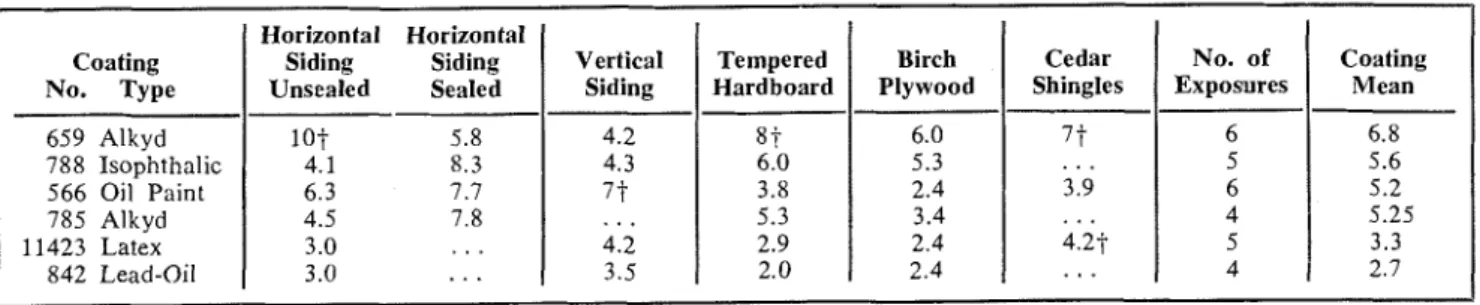
T h e years req~rired for several fin- ishes applied in three coats to bare substrates to reach the repaint condi- tion are xhown in table two, which in- dicates that horizontal siding is one of the better wood substrates for painting. Cedar shingles also have a high rat- ing, but this conclusion is more tenta- tive because only three coatings were tested o n them. F o r comparison, the mean for the same three materials o n horizontal siding was 6.4 years, but this is influenced by the high rating of the alkyd enamel. More definite con- clusions can only be reached when there are several exposures to com- pensate for an occasional erratic re- sult.
As expected from enquiries re- ceived from the field, plywood had the lowest mean rating of the differ- ent wood substrates. The alkyd enam- cl, however, lasted six years on it and the isophthalic finish performed bet- ter than on ~rnsealed siding.
- - 5 7 0 0 , CAP
Ktr
3 4 SHEATHING/
11
&2"~
4 " F R A M ETABLE THREE
D U R A B I L I T Y RESULTS BY C O A T I N G
( Y e a r s ro reach raring of 5)
->Estimated value.
Plywood might be expected to be a first coat reduced 1 0 to 15 per cent kyd enamel, 659. In the first exposure good substrate for painting because with solvent; they were unreduced series the oil paints were applied to the perpendicular arrangement o f the when applied to vertical siding in the siding over 1-GP-55b. T h e resultant plies increases its resistance to dimen- laboratory. These differences plus the durabilities were unexpectedly higher sional changes caused by variations in different years o f initial exposure than in any subsequent exposure of moisture content. When care is not weakened the comparison. formula 566, whether used over white taken in cutting the veneers, however, Comparison of coatings applied to lead primer or self-primed. Although o r when the face veneer is not orient- four or more substrates is made in ta- a single result is not concl~lsive evi- ed so that the side originally towards ble three. Where there were a reason- dence) it strongly indicates superior the outside of the tree is o n the out- able number o f exposures the alkyd performance is obtained if oil paint is side of the sheet (called in the lumber enamel gave the best over-all results. applied over a properly formulated trade "bark-side out"), plywood on Its rating was higher on horizontal primer rather than s e l f - ~ r i m e d . This exterior exposure is very prone to de- and lower on vertical siding than first pointed O u t BrOwne i n velop cracks known as checks. T h e might logically be expected. 1941 .6
means for preventing this defect have The isophthalic alkyd finish ranked White lead in oil paint was quite been k n o w n for s o m e years.2-4 second i n over-all performance on six inferior to most of the other coatings. Nevertheless, because most plywood different wood surfaces, Because of Even o n hardboard. which is not a is used where appearance is not a fac- m i l d e w growth it sometimes received demanding surface, it had an unsatis- tor, it is evidently considered not eco- a lower rating than i t might have factory appearance in a few nlonths nomically feasible to take the neces- the point of view of protection and deteriorated to a rating of 5 in sary steps to prevent checking. alone. T h e mildewcide recommended only t w o Years. I n areas where erosion When the face ply has the bark- i n the original fornlula was not incor- "Ot c o m ~ l e ~ e , checking occurred. side out, the outer layer of wood is in porated in the laboratory batch so Inclusion zinc i n
compression. When the "loose" side is that the material may be capable of 843 did not noticeably improve its out, the small cracks produced in ro- better performance in appearance. performance. It is thus evident that tary cutting of the veneer are exposed the industry has produced coatings under tension and can crack even Formula 785, a n alkyd finish, and superior to those in common use at more when stressed from shrinking formula 566, the standard oil paint, the beginning of this century. The and swelling. Since the laying up of were similar in durability. T h e hiding reputation f o r good durability that plywood occurs randomly, about half pigment in the alkyd was anatase tita- these old-time paints still possess is should have the preferred orientation, nium dioxide, which chalks much apparently due more to fond recollec- and this may account for variations in more than the rutile used in the oil tion than to actual performance. performance of coatings o n plywood. paint. T h e severe chalking leading to Latex paint, which is the other In addition, because veneers are edge marked film erosion probably contrib- coating comnlonly applied to wood jointed to provide the necessary panel uted to the lower durability of formu-
width, variation in durability com- la 785 compared with that of the al-
48
b
monly occurs o n the same panel, as il-lustrated o n pages 48 a n d 49.
TABLE FOUR
Coating Mean 6.8 5.6 5.2 5.25 3.3 2.7
Tempered hardboard showed poor-
er results than expected, chiefly be- E F F E C T O F 2 COATS O F SEALER cause the lower edge of the siding A P P L I E D T O H O R I Z O N T A L S I D I N G swelled and disrupted most coatings. ( Y e a r s ro reach ratirzg of 5 )
"Edge flare" can be overconle in par- ticle-boards by increasing resin con- tent,5 and this may also be true for fibreboards. T h e more water resistant alkyd enamel gave very good service on this surface.
It was not possible t o reach definite conclusion o n the effect of mounting the siding in the horizontal or vertical direction. Finishes were applied to
horizontal siding in the field. with the *plus one o a t W h i t e Lead primer. fEstimaled value.
No. of Exposures 6 5 6 4 5 4 Birch Plywood 6.0 5.3 2.4 3.4 2.4 2.4 Tempered Hardboard 8t 6.0 3.8 5.3 2.9 2.0 Coating No. Type 659 Alkyd 788 Isophthalic 566 Oil Paint 785 Alkyd 11423 Latex 842 Lead-Oil Cedar Shingles 7
t
. . .
3.9. . .
4.2t. . .
Sealed 7.7* 5.8 7.8 5.6 9.2t 8.3 7.4 Coating Applied 566 Oil Paint 659 Alkyd 785 Alkyd 786 Alkyd-Oil 787 Alkyd-Oil 788 Isophthalic Treatment Mean Horizontal Horizontal Siding Siding Unsealed Sealedlot
5.8 4.1 8.3 6.3 7.7 4.5 7.8 3.0 . . . 3.0. . .
Not Sealed 6.3lot
4.5 4.6 4.6 4.1 5.7 Vertical Siding 4.2 4.3 7t
. . .
4.2 3.5L ~ J U~ L U M I Y U M ~ r I I Y L J I U I I Y U
P r i m e r
-
5 7 8 1 - G P - 5 5 b
2 C o a t s 1 - G P - 2 8 a
2 C o a t s 1 - G P - 2 8 a
C3T y p e B
T y p e A
f
8
I-5 6 6 O i l P a i n t
5 6 8
O i l P a i n t
a
-
2
mY e a r s
7
n9
10
11
7
9
10
11
~ o i t h s
8
1
1
1
8
1
1
1
1 9 5 8 C E D A R A N D P l N E S I D I N G 2 C o a t s - 7 1 8 A l k y d S e a l e r P r i m e r 4 9 4 W H . L e a d 3 C o a t s 3 C o a t s 1 1 3 7 4 2 C o a t s 5 6 6 1 - G P - 2 8 a - B 6 5 9 A l k y d E n a m e l P V A L a t e x r Y e a r s 1 2 3 5 7 8 9 1 2 3 5 7 8 9 1 2 3 5 M o + n t h s - - 1 9 3 3 3 - - 1 9 3 3 3 - - 1 9 1 9 6 0 C E D A R A N D P l N E S I D I N G - 3 C O A T S M A T E R I A L F i r s t C o a t T h i n n e d 1 0 - 1 5 7 0 ( E x c e p t L a t e x ) 5 6 6 6 5 9 785 7 8 6 O i l P a i n t A l k y d E n a m e l A l k y d F i n i s h O i l - A l k y d P a i n t r 8 + 3 0 2 n 7 8 7 7 8 8 8 4 2 8 4 3 O i l - A l k y d l s o p h t h a l i c L e a d i n O i l L e a d - Z i n c P a i n t A l k y d P a i n t O i l P a i n t r + 8 - 0d z
6 m - 3 0 2 0 Y e a r s 3 5 6 7 3 5 6 7 3 5 6 7 3 5 6 7 M o ' n t h s 8 1 2 2 8 1 2 2 8 1 2 2 8 1 2 2 1 1 4 2 3 5 6 6 6 5 9l o r
A c r y l i c L a t e x O i l P a i n t A l k y d E n a m e l r O t t a w a H a l i f a x H a l i f a x H a l i f a x 3 0 2 nsiding in North America, was inferior to oil paint in the tests. This result is contrary to most field experience and is probably due to application of the latex paint to unprimed wood. At the time these exposures began acrylic latices were not designed for use on bare wood. I n recent years such emul- sions have been introduced and better performance might be expected. In general, a latex paint should be used precisely as directed by the paint manufacturer, since the type of resin it contains is unknown to the user. T h e P V A latex was not exposed long enough or under enough conditions to provide a valid comparison. It is un- derstood, however, that most coatings manufacturers in Canada prefer acrylics for use on exterior wood.
N o conclusions were obtained from the study of pigment and vehicle changes in alkyd modified house paints. Several factors were varied at a time and the number of exposures was limited.
T h e effect of sealing the wood be- fore coating is shown in table four. Most coatings had improved durability over sealed wood, as might be expected from a somewhat higher total film thickness, but the alkyd enamel exhib- ited a reversal of this general trend. Further tests to verify this result are being conducted, with half of each board sealed to eliminate differences in wood and time of exposure.
I n a very limited test, three coat- ings failed more rapidly a t York Re- doubt than a t Ottawa. Most of the more extensive DBR exposure studies have not shown this difference be- tween these two sites. P a r t of the dis- crepancy may result from the use of different observers, except f o r the fi- nal examination.
Summary
These exposure studies confirm that plywood is a difficult substrate to paint satisfactorily, but alkyd enamel and an isophthalic alkyd finish gave reasonable performance. Cedar shin- gles were somewhat less demanding o n the three coatings applied to them than was hardboard siding. T h e latter swelled a t the lower edges, cracking most systems except alkyd enamel.
Alkyd enamel was best o n most surfaces, although it had poor dura- bility o n vertical siding. A n isophthal- ic alkyd was next in over-all perform- ance. Latex paint was generally poor, probably because it was applied t o bare wood. T h e usual type of oil paint was intermediate, between en- amel and latex, except on vertical sid- ing where it was best owing t o the unexplained low rating of t h e alkyd. A n oil primer markedly improved the performance of the oil paint on hori-
Y e a r s . 3 1 2 5 1 2 5 1 2 5
zontal siding. Straight white lead and white lead plus zinc oxide paints were very poor on most surfaces. Applica- tion of two coats of sealer to siding appeared to improve the durability of most finishes, but the exposures with and without sealer were started in dif- ferent years.
The paint industry in Canada may use this report as an independent con- firmation of their tests where the re- sults are in agreement. In cases of dis- agreement, the report may be of value in instigating a review of previous tests. On the basis of these exposures and the reported laboratory tests1 the use of alkyds on wood siding should receive more consideration than it has in the past. It is recog- nized that test fence exposure results cannot blindly be accepted because there is no temperature or moisture gradient across the panels. There have also been rumours of extensive fail- ures when one company introduced alkyd house finishes to the American market. Nevertheless, alkyds have demonstrated good wet adhesion in laboratory tests conducted in Ottawa and Stockholm,7 and are reportedly in use on houses in Norway where the climate is wet and in Australia where it is dry. It is thought, therefore, that their use for this purpose should at least be re-examined in Canada.
Acknowledgement
These exposure studies were com- menced by Mr. J. Harris, formerly Research Officer in charge of the Paint Laboratory. Thanks are due to several technicians of the Building Materials Section and especially to Mr. R. C. Seeley, who prepared the panels for the last three series and looked after all the exposures for the last four years of the tests.
This paper is a contribution from the Division of Building Research, National Research Council of Cana- da, and is published with the approval of the director of the division.
I/
-- .- -- - - - .
REFERENCES
I . Harris, J. A Study of House Paint Proper- ties. Canadian Paint and Varnish, Vol. 37.
No. 2, p. 22; No. 3, p. 42, 1963. 2. Bat&, T . E. Minimizing Face Checking of
Plywood. Forest Products J., Vol. V, No.
5, p. 277, 1955.
3. Yan, M. M. and W. G. Lang. Veneer Checking and Warping. Canadian Wood- worker, November 1958, p. 20.
4. Keith, C. T . Surface Checking in Veneered Panels. Forest Products J., Vol. XIV, No.
10, p. 481, 1964.
5. Heebink, B. G. A Look at Degradation in Particleboards for Exterior Use. Forest Products J., Vol 17, No. 1, p. 59, 1967.
6 . Browne, F . L. The Two-Coat System of House' Painting. Ind. and Eng. Chem., Vol. 33, p. 900, 1941.
7. Gardnenas, G . and E. Wahlii. Effect of Water on Paint Films 11. Adhesion. Farg och Lack, Vol. 10, No. 2, p. 20, 1964.
2 C o a t s - 7 1 8 A l k y d S e a l e r 3 C o a t s 785 A l k y d F i n i s h 3 C o a t s 7 8 6 A l k y d