HAL Id: hal-00423715
https://hal.archives-ouvertes.fr/hal-00423715
Submitted on 21 Jan 2019
HAL is a multi-disciplinary open access
archive for the deposit and dissemination of
sci-entific research documents, whether they are
pub-lished or not. The documents may come from
teaching and research institutions in France or
abroad, or from public or private research centers.
L’archive ouverte pluridisciplinaire HAL, est
destinée au dépôt et à la diffusion de documents
scientifiques de niveau recherche, publiés ou non,
émanant des établissements d’enseignement et de
recherche français ou étrangers, des laboratoires
publics ou privés.
Matthias Robine, Pierre Hanna, Mathieu Lagrange
To cite this version:
Matthias Robine, Pierre Hanna, Mathieu Lagrange. Meter Class Profiles for Music Similarity and
Retrieval. International Society for Music Information Retrieval Conference (ISMIR), Oct 2009, Kobe,
Japan. �hal-00423715�
METER CLASS PROFILES FOR MUSIC SIMILARITY AND RETRIEVAL
Matthias Robine and Pierre Hanna
LaBRI - University of Bordeaux
351, cours de la Lib´eration
33405 TALENCE Cedex - FRANCE
[email protected]
Mathieu Lagrange
Telecom ParisTech
46, rue Barrault
75634 PARIS Cedex 13 - FRANCE
[email protected]
ABSTRACT
Rhythm is one of the main properties of Western tonal music. Existing content-based retrieval systems generally deal with melody or style. A few existing ones based on meter or rhythm characteristics have been recently pro-posed but they require a precise analysis, or they rely on a low-level descriptor. In this paper, we propose a mid-level descriptor: the Meter Class Profile (MCP). The MCP is centered on the tempo and represents the strength of beat multiples, including the measure rate, and the beat subdivi-sions. The MCP coefficients are estimated by means of the autocorrelation and the Fourier transform of the onset de-tection curve. Experiments on synthetic and real databases are presented, and the results demonstrate the efficacy of the MCP descriptor in clustering and retrieval of songs ac-cording to their metric properties.
1. INTRODUCTION
The amount of digital music is rapidly increasing, and is mostly comprised of Western pop music. New interfaces for browsing, classifying or searching have to be proposed. Content-based retrieval systems generally consider musi-cal properties related to melody or style. But taking into account other characteristics such as rhythm may lead to the development of useful tools for helping users to browse into large databases.
Research regarding rhythmic or metric properties typ-ically involves tempo or meter analysis. Several systems have been developed for improving tempo induction [1, 2], meter analysis [3, 4], or estimation of the time signature of audio songs [5]. Other works focus on the automatic classi-fication of songs according to their rhythmic properties [6]. In contrast, only a few methods have been presented for re-trieving songs by rhythmic similarity. A few existing ones consider a low-level descriptor such as beat spectrum [7], acoustic features [8], or spectral descriptors [9]. Others precisely analyze tempo, meter and/or time signature [5] and are consequently limited by the error analysis.
In this paper, we present a new mid-level descriptor for retrieving music according to the metric properties. The estimation of this descriptor requires neither a complete analysis of the time signature nor the meter of a song, but
Permission to make digital or hard copies of all or part of this work for personal or classroom use is granted without fee provided that copies are not made or distributed for profit or commercial advantage and that copies bear this notice and the full citation on the first page.
c
� 2009 International Society for Music Information Retrieval.
only the prior knowledge of its tempo. In comparison to a low-level feature, the essential metric information is re-duced to a few values which characterize the metric prop-erties of any song. In Section 2, we discuss the notion of metrical structure. The new mid-level descriptor and the associated analysis method are detailed in Section 3. Then, clustering and retrieval experiments are presented in Sec-tion 4. Finally, discussion of these results and perspectives are proposed in Section 5.
2. MUSICAL METER 2.1 Metrical Structure
In Western tonal music, the periodic alternation of strong and weak beats leads to a metrical hierarchy known as met-rical structure. The symbolic representation of this struc-ture is present in score notation using markings such as a time signature, bar lines, and dynamic accents.
The Generative Theory of Tonal Music (GTTM) [10] proposes a model of the metrical structure, where the meter of a musical piece may be represented by multiple levels of beats. The periodicity of beats is reinforced from level to level, and it is the interaction of the different levels that produces the sensation of meter. This representation is also used by Temperley [11] in his proposal of a preference rule system for meter.
According to [10], while there are five or six metri-cal levels in a piece, one is particularly central: the
tac-tus level. The tactac-tus identifies a perceptually prominent
level, with the levels immediately smaller and immedi-ately larger. It refers to the perceived tempo, the internal clock [12]. It corresponds highly with the notated unit time of a musical piece, but it can differs. Lee [13] indicates thus that listeners may revise meter to always get a tactus between 300ms and 600ms.
In the following, we assume that the tactus level corre-sponds to the tempo and the basic unit time of the music, when it is known or notated. We choose also to use with-out distinction the terms tactus and beat. As the metrical structure is hierarchical, levels lower than that of the tac-tus can be called subtactac-tus levels and represent divisions of the beat. The smallest division is generally called tatum or tick. Alternatively, higher levels are termed supertactus levels, and contain multiples of the beat duration, including the measure level.
2.2 Time Signature
We can restrict the notion of meter to two levels, the faster of which provides the element, and the slower of which
group them. According to Gouyon [14], this is close to the usual description of meter that can be found in a score, given by the time signature and the bar lines.
The time signature consists of 2 integers arranged ver-tically, e.g. 4
4 or68. The upper number of the signature
in-dicates the number of units in a bar, with the value of unit given by the lower number of the signature (e.g. 4 for a quarter note). If the upper number is divisible by 3 and the lower by 2, the time is compound and the number of beats per measure is given by the upper number divided by 3. In this case, the unit of time, i.e. the beat, is divided triply at the smaller level. Otherwise, in simple time, the upper number indicates the number of beats per measure and the beat is divided duply. Table 1 presents the time signatures mainly used in Western tonal music.
3. METER CLASS PROFILE
We introduce in this section a new descriptor to represent the metrical structure of the music called Meter Class Pro-file (MCP). We describe the method used for estimating the MCP, and provide examples for illustration of its use.
3.1 Properties
MCP is a real-valued vector providing information of the strength of the different metrical levels within the music. It is centered on the tactus level: the beat multiples, including the measure level, are represented on the left, and the beat subdivisions, including the tatum level, on the right. The choice was made to represent the relative strength of ac-cents at multiple rates of the tempo: 2, 3, 4, 5, 7, 9, and 11, and also at subdivisions of the tempo: 1/2, 1/3, 1/4, 1/6, 1/8, 1/12. MCP is thus a vector of thirteen dimensions.
A MCP corresponding to a 4/4 time signature would contain high amplitudes for the bin corresponding to 4 times the tempo, i.e. beat multiple 4 representing the measure periodicity, for beat multiple 2 (in 4/4, there are accents every two beats), for beat subdivision 1/2 (because 4/4 is in simple time), and perhaps beat subdivisions 1/4 and 1/8 (if 16thor 32thnotes occur). A few examples are
pre-sented in Figure 2.
As the MCP is independent from tempo, its represen-tation does not change with tempo variations. It may be considered as a mid-level descriptor, since the metric in-formation is summarized to a 13-dimension vector with-out identifying a particular time signature. Additionally, the amplitude ratios from the different metrical levels pro-vide a meaningful way to handle the meter of a musical piece. The MCP could, for example, also indicate a degree of swing, by considering the balance between duple and triple beat subdivisions.
3.2 Estimation
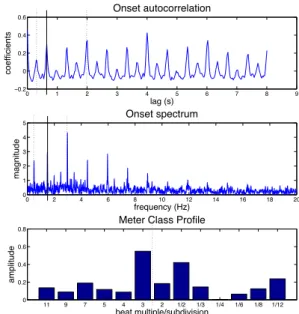
The method proposed here for computing MCP relies on existing analysis methods recently described for estimat-ing tempo [15]. It has been implemented usestimat-ing the MIR toolbox [16]. The main steps are illustrated on Figure 1, with the example of the country song Wanted (A. Jackson), annotated with a 3/4 time signature.
In this paper, we consider only one global MCP per audio musical signal. We thus choose to analyze a large frame of music (length 60 seconds). The meter is assumed
to be stationary during this frame. An onset-energy func-tion is first extracted from the audio signal by taking into account spectral energy flux [17]. Then, dominant period-icities (or frequencies) are estimated.
Two types of observations, respectively termed Onset Discrete Fourier Transform (ODFT) or Onset Autocorre-lation Function (OAF), are considered. Their complemen-tary properties are discussed for tempo estimation in [2]. In the experiment presented in this paper, the OAF and ODFT are both computed and normalized and the tempo frequency is known.
The analysis method of MCP locates both periodicities corresponding to beat multiples (related to measure) and beat subdivisions. Estimation of multiples and subdivi-sions is carried out using the complementary properties of the two observations. On one hand, the ODFT of a periodic signal is a set of harmonically related frequencies, and it is difficult to determine predominant frequencies above the tempo frequency. Therefore, we only estimate frequencies lower than the tempo frequency. These frequencies corre-spond to beat multiples (first part of MCP), in particular that of the measure.
On the other hand, the OAF of a periodic signal is a set of periodically related lags. It is thus difficult to mea-sure predominant periodicities higher than the tempo pe-riod. The OAF is only considered for estimating periods lower than the tempo periods. These periods are related to beat subdivisions (second part of the MCP).
0 1 2 3 4 5 6 7 8 9 −0.2 0 0.2 0.4 0.6 Onset autocorrelation lag (s) coefficients 0 2 4 6 8 10 12 14 16 18 20 0 1 2 3 4 5 Onset spectrum frequency (Hz) magnitude 11 9 7 5 4 3 2 1/2 1/3 1/4 1/6 1/8 1/12 0 0.2 0.4 0.6 0.8 beat multiple/subdivision amplitude
Meter Class Profile
Figure 1. Different stages of the analysis method of Meter
Class Profile for the song Wanted of A. Jackson (time sig-nature 3/4): from top to bottom, the autocorrelation func-tion, the spectrum of the onset function and the MCP esti-mated, showing peaks at beat multiple 3 and beat subdivi-sion 1/2.
With prior knowledge of the tempo, the first part of the MCP is estimated from the ODFT and the second part is estimated from the OAF. Consequently, period bands cor-responding to harmonics of the frequency tempo are ana-lyzed when considering the OAF. Only the six harmonics (2, 3, 4, 6, 8, and 12) are taken into account. The amount of energy of OAF within a thin frequency band around the related periodicities directly determines the amplitude
re-Duple Triple Quadruple 5-uple 7-uple 9-uple 11-uple Simple 21 22 24 28 31 32 34 38 41 42 44 48 51 25 54 58 71 72 74 78 19 92 94 98 111 112 114 118
Compound 6
2 46 68166 92 94 98169 122 124 128 1216 152 154 158 1516 212 214 218 2116 272 274 278 2716 332 334 338 3316
Table 1. Time signatures. Most common signatures are duple, triple and quadruple time in Western tonal music. Notations
9/2, 9/4 and 9/8 may be used either for a simple measure of 9 pulses, or for a compound measure of 3 pulses.
lated to the beat subdivisions of the MCP. In our imple-mentation, the width of the frequency bands for cumulat-ing the energy in the ODFT and OAF has been set to 5%. In Figure 1, the tempo has been annotated to 1.5Hz and is showed on the OAF with a solid line. When considering periods lower than 1.51 = 0.66s, energy is located around period of 0.33s, corresponding to the beat subdivision 1/2. The contribution to the beat subdivision of the correspond-ing MCP is thus significant and clearly indicates a simple meter.
The ODFT is considered in a similar way. Only the seven sub-harmonics (2, 3, 4, 5, 7, 9, and 11) of the tempo frequency are considered. Energy within a thin band around these sub-harmonics determines the amplitude related to the beat multiples. In Figure 1, only the energy around fre-quencies 1.5
2 , 1.5
3 , . . . , 1.5
11, contributes to the first part of
the MCP. In this example, the sub-harmonic1.5
3 is
signif-icantly predominant and results in a substantial amplitude in the MCP. This high amplitude thus indicates that the song is characterized by 3 beats per measure.
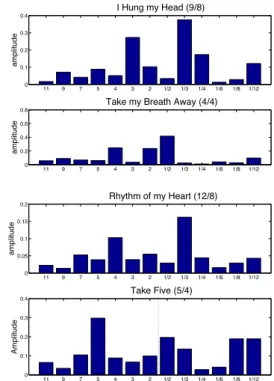
Other examples of MCP computation for real audio songs are shown in Figure 2. In each example, the MCP looks very different, according to their metric properties. In par-ticular, the highest value in the first part of the MCP gen-erally indicates the number of beats per measure, whereas the highest value of the second part is related to the beat subdivision.
3.3 Distance between MCP
The MCP is proposed for music retrieval purposes. There-fore, a method for computing a matching score between two MCP has to be defined. Several distances are possible, however this is a difficult selection due to the difference in the analysis processes of the two parts of the MCP. We thus propose to consider a global score s as the combination of the two scores s1and s2obtained with the two parts of the
MCP:
s = αs1+ (1 − α)s2 (1)
where α is a fixed weighting value in the interval [0; 1], s1
the comparison score related to the meter multiple part of the MCP, and s2 the comparison score related to the
me-ter subdivision. These two scores s1and s2are calculated
according to correlation: si(MCP1,MCP2) = c(MCP1,MCP2) � c(MCP1,MCP1)�c(MCP2,MCP2) c(MCP1,MCP2) = N � i=1 MCP1(i)MCP2(i) (2)
whereMCP1andMCP2are MCP vectors of size N .
11 9 7 5 4 3 2 1/2 1/3 1/4 1/6 1/8 1/12 0 0.1 0.2 0.3 0.4 amplitude I Hung my Head (9/8) 11 9 7 5 4 3 2 1/2 1/3 1/4 1/6 1/8 1/12 0 0.2 0.4 0.6 0.8
Take my Breath Away (4/4)
amplitude 11 9 7 5 4 3 2 1/2 1/3 1/4 1/6 1/8 1/12 0 0.05 0.1 0.15 0.2 Rhythm of my Heart (12/8) amplitude 11 9 7 5 4 3 2 1/2 1/3 1/4 1/6 1/8 1/12 0 0.1 0.2 0.3 0.4 Amplitude Take Five (5/4)
Figure 2. Examples of MCP computed from real audio
songs with different time signatures, respectively 9/8, 4/4, 12/8 and 5/4.
4. EXPERIMENTS
In this section, experiments are presented that demonstrate the ability of MCP to discriminate songs that have different metric characteristics. The first experiments deal with clus-tering abilities, and other second concerns song retrieval.
4.1 Databases
Two databases are considered in this paper. The first one is composed of short artificial audio musical pieces (60 sec-onds long at 16 kHz) that have been synthesized according to different metric properties. The tempo was set to 1 Hz and classes have been constituted considering the time sig-nature. Classes with 2, 3, 4, 5, 7, 9 and 11 beats per mea-sure have been built, in simple time and in compound time. For each class, 2 different distributions of the strong beats in the measure have been chosen, to synthesize 200 pieces. A process has been achieved to randomly add 16thnotes
in the pieces. The database contains 2800 different files. The second database is a collection of real pop audio songs indexed using the time signature. The noise col-lection contains 476 simple-meter songs with 2 or 4 beats per measure (sampling rate 44.1 kHz).We constitute an-other collection of 54 songs with different metric proper-ties. Some of them are in compound time, while others are
characterized by a different number of beats per measure. Therefore, 7 different classes are assumed according to 7 different time signatures. The composition of each class is presented in Table 2. Different classes are also deduced from time signatures: one class is composed of 13 songs with 3 beats per measure, another class comprises 24 com-pound time songs. For all these 54 songs, tempo has been manually annotated.
It is important to notice that all ground truth annotation of the songs from the noise database have not been pre-cisely verified; ambiguous meter, large tempo variations, and short-duration time signature changes may result in evaluation errors that may underestimate the quality of the clustering and retrieval systems presented here.
Simple Compound
3/4 5/4 7/4 11/4 6/8 9/8 12/8
11 10 7 2 6 2 16
Table 2. Number of songs within each meter class
consid-ered for the experiments.
4.2 Clustering
We present here the clustering abilities of the proposed me-ter feature on the two different databases.
4.2.1 Evaluation Metrics
The task can be here reworded as follows: “Do the ele-ments classified together actually belong to the same time signature?”. The similarity of the elements of the given database is first computed. As the databases considered in those experiments are of relatively small sizes, we con-sider an unsupervised clustering scheme (the k-means) to perform the clustering task, i.e. each element ekis given a
clustering tag tk. The correct number of classes is given to
the clustering algorithm.
The clustering matrix M is next computed, where each entry is defined as:
M (Cx, Cy) =#{(ek
, el)|tk= tl∧ ek∈ Cx∧ el∈ Cy}
#{(ek, el)|ek∈ Cx∧ el∈ Cy}
(3) where Cxand Cyare the classes given as ground truth, and
(ek, el) is a couple of elements. In order to attenuate the
impact of the random initialization of the k-means algo-rithm, the classification is done 10 times and the mean re-sult over the 10 iterations is considered. The better the clas-sification, the higher the ratio between the diagonal values of M and the remaining of the matrix.
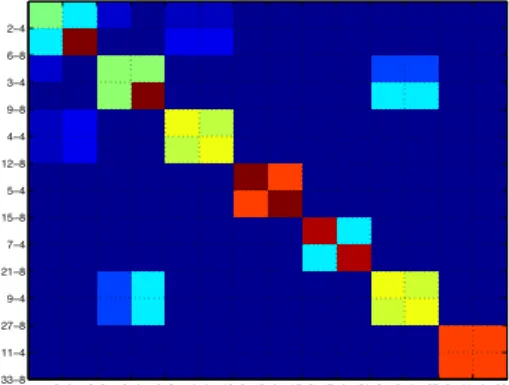
Evaluation over the synthetic database allows us to val-idate the proposed approach in a controlled environment. Figure 3 depicts the clustering matrix M for the synthetic database. The results are very satisfying in general as most of the values are concentrated on the diagonal, meaning that most of the cluster generated by the k-means algorithm from the features correspond to the actual metrical struc-tureclasses. Typical errors are due to a confusion between simple and compound time, e.g. between 3/4 and 9/8 time signatures, or sometimes between classes for which the numbers of beats per measure have common factors (e.g., 4/4 and 2/4, or 9/4 and 3/4). 2−4 6−8 3−4 9−8 4−4 12−8 5−4 15−8 7−4 21−8 9−4 27−8 11−4 33−8 2−4 6−8 3−4 9−8 4−4 12−8 5−4 15−8 7−4 21−8 9−4 27−8 11−4 33−8
Figure 3. Clustering matrix over the synthetic database.
6_8 3_4 9_8 12_8 5_4 7_4 11_4 6_8 3_4 9_8 12_8 5_4 7_4 11_4
Figure 4. Clustering matrix over the real database.
Real data is now considered to evaluate the robustness of the MCP. Evaluations based on clustering allows us to finely analyze the properties of the MCP with respect to the different time signature classes, as shown in Figure 4. We can note that a clear distinction is made between simple and compound time.
4.3 Retrieval
In this section, we propose the evaluation of a music re-trieval system based on the MCP. The 54 songs from the real song collection are successively considered as query. The retrieval system computes a similarity score between the query and all the songs of the database. The database is comprised of 530 different songs, including all the queries and all the noise collection. These songs are then ranked from most to least similar. For each query, we expect to retrieve all the songs belonging to the class of the query at the top rank. In the following evaluation, results are pre-sented with Precision at Top 1, N and 2N , in which N denotes the size of the class of the query.
4.3.1 Synthetic Query
The first experiments concern retrieval based on a synthetic query. This query is a flat input, i.e. a MCP defined by a binary string. For example, if the songs searched have a 3/4 time signature, the synthetic query is the MCP
[0, 0, 0, 0, 0, 1, 0, 1, 0, 1, 0, 1, 0]
where the only non-null values correspond to the beat mul-tiple 3 and the beat subdivisions 1
2, 1
4and
1
simple time subdivisions. Other experiments only concern the left or right half of the MCP, since retrieval may fo-cus on beat multiples or beat subdivisions. For example, retrieving compound time songs is tested by considering only the second part of the MCP with a synthetic query such as:
[0, 0, 0, 0, 0, 0, 0, 0, 1, 0, 1, 0, 1] which exhibits beat subdivisions1
3, 1 6, and
1 12.
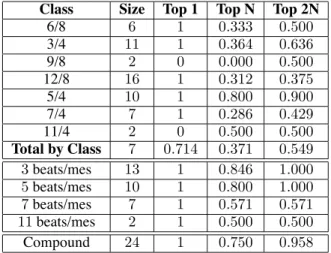
Table 3 shows the results of the retrieval experiments from those synthetic queries. At the exception of time sig-natures 11/4 and 9/8, one song of the correct class is al-ways correctly retrieved at the first rank. These two excep-tions may be explained by the small size the two classes concerned (each comprised of only two songs). Concern-ing the 11/4 class, related songs are retrieved at ranks 2 and 11. Concerning the 9/8 class, related songs are re-trieved at ranks 3 and 5. Even if the precision at top 1 is null, the retrieval results are thus quite good.
Average precision at top 2N indicates that more than half the songs are generally retrieved within the first 2N ranks. Considering one part of the MCP for retrieving songs seems to be effective. For example, a synthetic query allows the retrieval of 75% of the songs of the compound time class at the first N ranks. Almost all the compound time songs are ranked within the first 2N best matches. The results of these experiments confirm the quality of the MCP as a metric descriptor for retrieval, since the MCP computed from a real audio file is similar to its time signa-ture properties.
Class Size Top 1 Top N Top 2N
6/8 6 1 0.333 0.500 3/4 11 1 0.364 0.636 9/8 2 0 0.000 0.500 12/8 16 1 0.312 0.375 5/4 10 1 0.800 0.900 7/4 7 1 0.286 0.429 11/4 2 0 0.500 0.500 Total by Class 7 0.714 0.371 0.549 3 beats/mes 13 1 0.846 1.000 5 beats/mes 10 1 0.800 1.000 7 beats/mes 7 1 0.571 0.571 11 beats/mes 2 1 0.500 0.500 Compound 24 1 0.750 0.958
Table 3. Results of the retrieval system based on MCP,
considering a synthetic query.
4.3.2 Audio Query
We present a second experiment to test the ability of re-trieving real songs using a real song as a query. The appli-cations related to these experiments are Query-by-Example systems, which allows users to perform a database search for songs that are similar to a given query song. The simi-larity here relies on the metric properties, but does not have to be explicitly determined by the user.
Since the query is always retrieved at the first rank, we propose to remove the query from the database. Precision at top N is the number of correct songs retrieved in the first N− 1 ranks divided by N − 1, N being the size of
the class considered. Precision at top 2N is the number of correct songs retrieved in the first 2N − 1 ranks divided by 2N − 1. By using all the songs of each class as a query, N precisions are computed and averaged for each class. Then, the total average is computed by query, or by class. It is respectively denoted Total by Query, and Total
by Class. Such evaluations are respectively named First Tier and Second Tier in [18].
Table 4 shows the results of the retrieval experiments. The value α determines the weighting between the two parts of the MCP, and has been set to 0.6. The average results by query indicate that 44% of the queries allow the retrieval of one song of the same class at the first rank, 53% of the class is retrieved at the first 2N ranks. The accuracy is lower than the results obtained with synthetic queries. This can be explained by the presence of songs in the noise database that may be similar to the query. For example, a query with time signature 3/4 often leads to the retrieval of songs with time signature 9/8, since the num-ber of beats per measure are the same for each of these two classes and since the beat subdivisions may be varying dur-ing the analyzed song (for example in the case of swdur-ing). At the opposite, the class 5/4 leads to the best results: 80% of the correct songs are retrieved.
Moreover, difficulties with annotations of time signa-tures may lead to errors in evaluation. For example, it is sometimes difficult to discriminate 6/8 songs from 12/8 songs. This difficulty is illustrated by the poor results for class 6/8, whereas the compound time class leads to good results.
Classes Size Top 1 Top N Top 2N
6/8 6 0.000 0.033 0.242 3/4 11 0.727 0.500 0.649 9/8 2 0.000 0.000 0.333 12/8 16 0.562 0.579 0.714 5/4 10 0.700 0.567 0.695 7/4 7 0.000 0.095 0.132 11/4 2 0.000 0.000 0.000 Total by Class 7 0.284 0.253 0.395 Total by Query 54 0.444 0.394 0.529 3 beats/mes 13 1.000 0.686 0.825 Compound 24 0.875 0.784 0.863
Table 4. Results of the retrieval system based on MCP,
considering an audio song as query.
5. CONCLUSION AND PERSPECTIVES
In this paper, we have proposed a new mid-level descrip-tor, related to the beat multiples and subdivisions. Exper-iments with synthetic and real songs show that consider-ing the MCP allows the retrieval of songs belongconsider-ing to the same metric class.
When focusing on the time signature, we reduce the search information from the descriptor. Other considera-tions are also of interest, such as the amplitudes of all the beat subdivisions, which may denote a certain rhythmic complexity of the music. The MCP of one minute of Fever by Ray Charles is shown in Figure 5. If the time signature of this piece is generally notated 4/4, beat subdivisions at
1/3 are more prevalent than at 1/2. As studied in [19], this is a consequence of the swing. We see here that MCP con-tains information more complex than the time signature only, and it could thus be used for very specific retrieval purpose. 11 9 7 5 4 3 2 1/2 1/3 1/4 1/6 1/8 1/12 0 0.1 0.2 0.3 0.4 beat multiple/subdivision amplitude MCP − Fever
The estimation of the MCP assumes the prior knowl-edge of the correct tempo. Its robustness against tempo es-timation has to be improved in the future. If the tempo may be automatically estimated, errors are unavoidable and will significantly limit the accuracy of the MCP, and thus the accuracy of the retrieval system.
Furthermore, since metric properties may change dur-ing a song, a song may be represented by a sequence of MCP (computed during short frames), in the same way that tonal properties of a song can be represented by a sequence of chromas [20]. Such representation may allow the dis-crimination of songs with the same metric properties, but with different evolutions with respect to time.
6. ACKNOWLEDGEMENT
The authors would like to thank Jason Hockman for his useful comments during the writing of the paper. This work has been partly funded by the Quaero project within the task 6.4: “Music Search by Similarity” and the French GIP ANR under contracts ANR-06-JCJC-0027-01, DESAM and ANR-JC07-188930, SIMBALS.
7. REFERENCES
[1] F. Gouyon, A. Klapuri, S. Dixon, M. Alonso, G. Tzane-takis, C. Uhle, and P. Cano. An experimental compari-son of audio tempo induction algorithms. IEEE
Trans-actions on Speech and Audio Processing, 14(5):1832–
1844, 2006.
[2] G. Peeters. Template-based estimation of time-varying tempo. EURASIP Journal on Advances in Signal
Pro-cessing, 2007(1), 2007. 14 pages.
[3] J. Brown. Determination of the meter of musical scores by autocorrelation. Journal of the Acoustical Society of
America, 94(4):1953–1957, 1993.
[4] A. Klapuri, A. Eronen, and J. Astola. Analysis of the meter of acoustic musical signals. IEEE
Transac-tions on Speech and Audio Processing, 14(1):342–355,
2006.
[5] C. Uhle and J. Herre. Estimation of tempo, micro time and time signature from percussive music. In Proc. of
the International Conference on Digital Audio Effects (DAFx, London, UK, 2003.
[6] S. Dixon, E. Pampalk, and G. Widmer. Classification of dance music by periodicity patterns. In Proc. of
the International Conference on Music Information Re-trieval (ISMIR), pages 159–165, Baltimore, 2003.
[7] J. Foote, M.D. Cooper, and U. Nam. Audio retrieval by rhythmic similarity. In Proc. of the International
Con-ference on Music Information Retrieval (ISMIR), pages
265–266, Paris, France, 2002.
[8] J. Paulus and A. Klapuri. Measuring the similarity of rhythmic patterns. In Proc. of the International
Confer-ence on Musical Information Retrieval (ISMIR), pages
150–156, Paris, France, 2002.
[9] A. Holzapfel and Y. Stylianou. A scale transform based method for rhythmic similarity of music. In Proc.
of the IEEE International Conference on Acoustics, Speech, and Signal Processing (ICASSP), Taipei,
Tai-wan, 2009.
[10] F. Lerdahl and R. Jackendoff. A Generative Theory of
Tonal Music. MIT Press, Cambridge, Massachussetts,
1985.
[11] D. Temperley. The Cognition of Basic Musical
Struc-tures. The MIT Press, 2001.
[12] D.J. Povel and P. Essens. Perception of temporal pat-terns. Music Perception, 2:411–440, 1985.
[13] C. S. Lee. Representing Musical Structure, chapter The perception of metrical structure: Experimental ev-idence and a model, pages 59–127. P. Howell, R. West, and I. Cross, London, UK, 1991.
[14] F. Gouyon. Towards Automatic Description of Musical
Audio Signals - Representations, Computional Mod-els and Applications. PhD thesis, Universitat Pompeu
Fabra, Barcelona, Spain, 2003.
[15] G. Peeters. Rhythm Classification Using Spectral Rhythm Patterns. In Proceedings of the 6th
Interna-tional Conference on Music Information Retrieval (IS-MIR), pages 644–647, London, UK, 2005.
[16] O. Lartillot and P. Toiviainen. A Matlab Toolbox for Musical Feature Extraction From Audio. In Proc. of
the International Conference on Digital Audio Effects (DAFx), Bordeaux, France, 2007.
[17] M. Alonso, G. Richard, and B. David. Tempo And Beat Estimation Of Musical Signals. In Proc. of the
Interna-tional Conference on Music Information Retrieval (IS-MIR), Barcelona, Spain, 2004.
[18] B. De Haas, R. Veltkamp, and F. Wiering. Tonal Pitch Step Distance: A Similarity Measure for Chord Pro-gressions. In Proc. of the International Conference on
Music Information Retrieval (ISMIR), pages 51–56,
September 14-18 2008.
[19] K.A. Lindsay and P.R. Nordquist. A technical look at swing rhythm in music. The Journal of the Acoustical
Society of America, 120(5):3005–3005, 2006.
[20] E. G´omez. Tonal Description of Music Audio
Sig-nals. PhD thesis, University Pompeu Fabra, Barcelona,