Publisher’s version / Version de l'éditeur:
Vous avez des questions? Nous pouvons vous aider. Pour communiquer directement avec un auteur, consultez la première page de la revue dans laquelle son article a été publié afin de trouver ses coordonnées. Si vous n’arrivez pas à les repérer, communiquez avec nous à [email protected].
Questions? Contact the NRC Publications Archive team at
[email protected]. If you wish to email the authors directly, please see the first page of the publication for their contact information.
https://publications-cnrc.canada.ca/fra/droits
L’accès à ce site Web et l’utilisation de son contenu sont assujettis aux conditions présentées dans le site LISEZ CES CONDITIONS ATTENTIVEMENT AVANT D’UTILISER CE SITE WEB.
Paper (National Research Council of Canada. Institute for Research in
Construction); no. IRC-P-1486, 1987
READ THESE TERMS AND CONDITIONS CAREFULLY BEFORE USING THIS WEBSITE. https://nrc-publications.canada.ca/eng/copyright
NRC Publications Archive Record / Notice des Archives des publications du CNRC :
https://nrc-publications.canada.ca/eng/view/object/?id=ee0c7b0a-7183-4ef8-80d4-631945959b6d https://publications-cnrc.canada.ca/fra/voir/objet/?id=ee0c7b0a-7183-4ef8-80d4-631945959b6d
NRC Publications Archive
Archives des publications du CNRC
This publication could be one of several versions: author’s original, accepted manuscript or the publisher’s version. / La version de cette publication peut être l’une des suivantes : la version prépublication de l’auteur, la version acceptée du manuscrit ou la version de l’éditeur.
For the publisher’s version, please access the DOI link below./ Pour consulter la version de l’éditeur, utilisez le lien DOI ci-dessous.
https://doi.org/10.4224/40001378
Access and use of this website and the material on it are subject to the Terms and Conditions set forth at
Effects of insulation on postflashover room fire
Choi, K. K.
Ses
TH1 National Research Conseil national N21d
1
Council Canada de recherches Canada no. 1486'
c. 2 Institute for lnstitut de
BLDC Research in recherche en
- - - -> Construction construction
Effects of Insulation on
Postflashover Room Fire
by K.K. ChoiReprinted from Fire Technology
Vol. 23, No. 1, February 1987 p. 19-25
(IRC Paper No. 1486)
Price $3.00 NRCC 28450 NRC
-
CISTI I R CL I B R A R Y
O E C
9
1967
B I B L I O T H ~ Q U EI R C
C N R C-
ICISTOn a Btudie le rale de l'isolant dans les f e w de local en realisant une sgrie d1exp8riences d'incendit e n vraie grandeur. Les resultats montrent que la presence d'isolant dans les murs n'influe pas sur la violence de l'incendie.
Effects of Insulation on Postflashover
Room Fire
By K. K.
Choi
Reprinted from FIRE TECHNOLOGY Vol. 23, No. 1 February 1987Copyright O National Fire Protection Association All Rights Reserved
Effects of Insulation on Postflashover
Room Fire
K. K. CHOI*
National Research Council of Canada
(Manuscript received February 1986, accepted September 1986) ABSTRACT
The effects of insulation on postflashover room fires were studied in a series of full scale room bum tests. Results show that the severity of the fire is not influenced by the presence of insulation in the walls.
NE OF THE MECHANISMS by which fire can spread in buildings is
0
successive destruction of the separations between rooms. I t has beenshown that the potential for such destructive spread (severity) can be quan- tified by the normalized heat load' and that this is dependent on the nature of the room lining materials when other factors such as amount, shape and type of combustible, and ventilation are kept constant.
There is concern that insulation installed behind lining materials might influence the characteristics of a fire in a room, especially during the postflashover stage. Two series of full scale room burn tests have therefore been conducted to study the effect of insulation on the severity of a room fire. The results of the first series of tests, which were reported in an earlier publication,' indicated that the severity of a room fire is not increased by the incorporation of foamed plastic insulation in the walls. The second series was designed to broaden the scope of investigation by involving foamed plastic as well as glass fiber insulation in the tests. The results are presented in this paper.
EXPERIMENTAL DETAIL
Tests were carried out in a test room (2.47 m wide by 3.66 m long, as for the small ASTM room) in the first story of a two-story lightweight concrete block structure. A plywood ceiling was installed at a height of 2.6 m, pro- tected during the tests by 38 mm Fiberfrax board (for finished height of 2.56 m).
The insulation materials to be investigated were installed between metal Reference: K. K. Choi, "Effects of Insulation on Postflashover Room Fire," Fire Technology, Vol. 23, No. 1, February 1987, p. 19.
Key Worde: Insulation, postflashover room fire, full scale room burn, room fire severity. *K. K. Choi is a fellow of the Society of the Plastics Industry of Canada.
Fire Technology studs on the south and west walls (Figure 1) and covered by a layer of 16 I mm Type X gypsum board. Relevant properties of the insulation materials i are listed in Table 1. Thermocouples were stapled to the unexposed face of ; the gypsum board to monitor temperatures a t the gypsum boardlinsulation
I
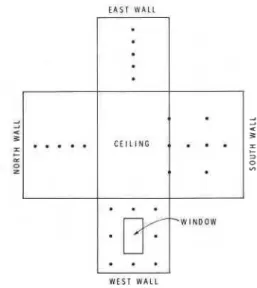
interface. Panels of insulating firebrick were attached to the north and east j walls and then covered by a layer of 16 mm Type X gypsum board. To deter-mine the normalized heat load, 0.3 m wide vertical strips of the gypsum were removed to expose the insulating firebrick, in which thermocouples were embedded a t a depth of 22 mm (Figure 1). The temperature rise in the room was measured by thermocouples located 0.3 m, 0.6 m, 1.2 m and 1.8 m from the ceiling and attached to thermocouple trees that were installed at the center points of the room quadrants (Figure 2).
Four large and four small wooden cribs of pine sticks were used in each test to provide a fire load of 190 kg. They were similar to those used in the first series and were supported on bricks. They were ignited simultaneously by pools of methanol. Ventilation was provided from an open window measuring 0.665 m wide by 1.1 m high in the west wall, selected to produce a fire duration of approximately 45 min. Figure 2 is a cross-sectional view of the test room, showing the construction of the walls and the distribution of the cribs.
RESULTS AND DISCUSSION
Six tests were conducted in this series, including two runs on a control setup and two on a setup with glass fiber insulation. No insulation was used in the control setup, but a 50 mm air gap was left between the concrete
E A S T W b L l
rq
W I N D O W
W E S T W A L L
Figure 1. Locations of thermocouples in walls.
Insulation
wflm
SOUTH
LIGHIWEIGHT CONCRETE BLOCK INSULATION I N S U l a T l N G FIREBRICX CAST REFRACTORY PANE1
-
16-rnm FIRE-RESISTAN1 GYPSUM @ THERMOCOUPLE TREE BOARD WOOD CRIBFigure 2. Cross-sectional view of test room.
C O N T R O L -- G L A S S F I B R E 9 0 0 S P R A Y E D P U - - - E X T R U D E D P S 8 0 0 C O N T R O L 1 0 0 0 G L A S S F I B R E S P R A Y E D P U 9 0 0 - - - - - - - E X T R U D E D P S T I M E m i n T I M E , m i n
Figure 3. Thennal response of insulating Figure 4. Thennal response of insulating
22
F i e Technology block walls and gypsum boards. A preliminary control experiment iden- tified air leakage through the ceiling that produced much quicker flashover time and shorter fire duration, shortcomings that were corrected. Only results from the second control experiment are presented. The two with glass fiber insulation were essentially duplicate runs and similar results were obtained; the results of only one will therefore be presented.According to theory: the severity of a room fire can be characterized by the normalized heat load on one of the lining materials. (Harmathy has shown that the normalized heat load is approximately the same on all lining materials.) This normalized heat load is the total heat absorbed per unit room surface area divided by the thermal inertia of the lining material. The thermal inertia is defined as the square root of the product of thermal con- ductivity, density, and specific heat.
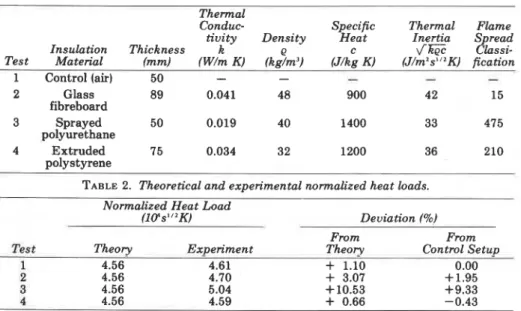
The average temperature rise in the exposed insulating firebrick in the north and east walls, as measured by the five embedded thermocouples, is shown in Figures 3 and 4. The normalized heat loads4 are determined from the noted maximum temperature rises in these curves and are presented with the theoretical predictions5 shown in Table 2. Because of the small area of insulating firebrick exposed, the fire in the room essentially "saw" only gypsum board as the lining material for the walls. The theory, therefore, predicted the same normalized heat load for all tests. A comparison of the normalized heat loads indicates good agreement between theoretical and ex- perimental values. Reproducibility of the normalized heat load measure- ments is usually f 10 p e r ~ e n t . ~ Deviations between the experimental values for test runs and control runs are within 10 percent. Since the insulation materials also have similar thermal inertia values (Table 1). these deviations are small enough to permit the claim that fire severity is to all intents the same for all runs.
TABLE 1. Properties of insulation materials.
Insulation Test Material 1 Control (air) 2 Glass fibreboard 3 Sprayed polyurethane 4 Extruded polystyrene Thermal
Conduc- Specific Thermal tivity Density Heat Inertia
Thickness k e c (62 (mm) (W/m K) (kg/m3) (J/kg K) (J/m2s"'K) 50 - - -
-
Flameyz::
fication - 15 475 210 TABLE 2. Theoretical and experimental normalized heat loads.Normalized Heat Load
( ~ @ s ' / ~ K ) Deviation (%I
From From
Test Theory Experiment Theory Control Setup
1 4.56 4.61
+
1.10 0.002 4.56 4.70
+
3.07 +1.953 4.56 5.04
+
10.53 +9.331 2 0 0 I I I I i 1 2 0 0 - I 1 0 0 - - 1 1 0 0 LOO0 - 1 0 0 0 9 0 0 9 0 0 - 8 0 0 - 8 0 0 V " . 7 0 0 -
-
. 7 0 0 u LI 3 D. - 2 6 0 0 - 3 E 2 6 0 0 u a DL - u 5 5 0 0 - 5 0 0 b 5 - 4 0 0 - 4 0 0 - 3 0 0 - 3 0 0 C L A S S F I B R E 2 0 0 i-' S P R A Y E D P U - 2 0 0 - - 2 0 0 1 -- - - - E X T R U D E D P S 1 0 0 - - 1 0 0 0 t I I I 1 0 0 1 0 2 0 3 0 4 0 5 0 6 0 0 1 0 2 0 3 0 4 0 5 0 6 0 0 1 0 2 0 3 0 4 0 5 0 6 0 T I M E , rnin T I M E , m i n T I M E , m i nFigure 5. Average temperatures in test room. Figure 6. Average temperatures at interface Figure 7. Average temperatures at interface of insulation and gypsum board in south of insulation and gypsum board in west
wall. waU. I I I I I - C O N T R O L - C L A S S F I B R E - - S P R A Y E D P U -- - - - E X T R U D E D P S - 1 2 0 0 1 1 0 0 C L A S S F I B R E 1 0 0 0 S P R A Y E D P U +--- 9 0 0 E X T R U D E D PS
24 Fire Technology The average room temperature for each test, determined from measure- ments made a t the four thermocouple trees, is shown in Figure 5. Flashover is indicated by the sudden rise in temperature to over 600°C.
These room fire experiments were designed to study the postflashover stage. Factors such as ambient temperature, relative humidity, and percent moisture of the wall lining, all of which could affect the preflashover development of the fire, were not strictly controlled. This is reflected in the scatter of times to flashover throughout the test series.
Following flashover, the room temperatures for the four tests are very similar, indicating that the effect of insulation is minimal. Fire duration, taken roughly as the time to reach maximum room temperature, also ap- pears relatively unaffected by the presence or absence of insulation. I t should be noted, however, that in situations where material with high ther- mal inertia such as sheet metal is used as room lining, the fire growth could be influenced by the insulation. The results of these tests nevertheless sug- gest that fuel contributed by insulation is insufficient to affect the total room heat load significantly.
Average temperatures a t the insulatiodgypsum board interface of the south and west walls are plotted in Figures 6 and 7. Although the tempera- tures exceed the defined failure criterion of 139°C a t approximately 28 min (CAN4-S101-M82),' the absence of rapid rises afterward indicates that the single layer of Type X gypsum board can prevent ignition of the insulation for a t least that length of time. Indeed, the irrelevance of that temperature has been discussed by Schwartz and Lie? The interface temperatures are similar for all insulations up t o the 35 min mark after which significant dif- ferences in temperature are observed. This can be attributed to the loss of integrity of the gypsum board which would undoubtedly expose some of the thermocouples to fire gases, hence producing the variations of temperature. The lower temperatures in the test with extruded polystyrene reflect fusing and possibly pyrolysis of the insulation in which the endothermic reactions actually cool the interface. Even when combustion of the pyrolysis products of the insulation occurred, however, the heat generated did not result in a significant rise of temperature a t the insulatiodgypsum interface.
CONCLUSION
A series of postflashover room burn tests shows that the destructive potential (severity) of fire is not influenced by the presence of insulation in the walls behind a 16 mm gypsum board. The effect of insulation on the tem- perature in the room after flashover and on fire duration also appears to be insignificant. The temperature a t the insulatiodgypsum interface is essen- tially independent of type of insulation, and this raises the question of the significance of the 139°C criterion in CAN4-S101-M82.'
ACKNOWLEDGEMENTS: This work was carried out under the NRClSPI Fellowship arrangement. The author is greatly indebted to the many coworkers who have assisted him in the prepara-
Insulation 25
tion of this paper, which is a contribution from the Institute for Research in Construction. Na- tional Research Council of Canada.
REFERENCES
' Harmathy, T. Z., "Fire Severity: Basis for Fire Safety Design," International Sym- posium on Fire Safety of Concrete Structures, American Concrete Institute, San Juan, Puerto Rico, September 1980.
Choi, K. K., "Effects of Foamed Plastic Insulation on Severity of Room Fires," Fire Tech- nology, Vol. 22, No. 1, Feb. 1986, pp. 5-13.
' Harmathy, T. Z., "The Fire Resistance Test and its Relation t o Real-World Fires," Fire and Materials, Vol. 5 , No. 3, 1981, pp. 112-122.
' Mehaffey. J. R.. and Harmathv. T. Z., "Fully Develo ed Fires: Experimental Findings,"
Pmceedings, Third Symposium 06 Combustibility and phstics, Society of the Plastics In- dugtry of Canada, Toronto. 24-28 Oct. 1983.
Mehaffey, J. R., and Harmathy, T. Z., "Assessment of Fire Resistance Requirements,"
Fire Technology, Vol. 17, No. 4, Nov. 1981,
.
221-237.Mehaffey. J. R., and Harmathy, T. Z.. 'vherrnal Response of Compartment Boundaries t o Fire," Pirst International Symposium on Fire Safety Science, National Bureau of Stan- dards, Washington, DC, Oct. 1985.
CAN4-S101-M82. "Standard Methods of Fire Endurance Tests of Building Construction
an: Materials," Underwriters' Laboratories of Canada, 1982.
Schwartz, K. J., and Lie, T. T., "Investigating the Unexposed Surface Temperature Criteria of Standard ASTM E119," Fire Technology, Vol. 21, No. 3, Aug. 1985, pp. 169-180.
T h i s paper i s being d i s t r i b u t e d i n r e p r i n t form by t h e I n s t i t u t e f o r Research i n C o n s t r u c t i o n . A l i s t of b u i l d i n g p r a c t i c e and r e s e a r c h p u b l i c a t i o n s a v a i l a b l e from t h e I n s t i t u t e may be o b t a i n e d by w r i t i n g t o t h e P u b l i c a t i o n s S e c t i o n , I n s t i t u t e f o r R e s e a r c h i n C o n s t r u c t i o n , N a t i o n a l Research C o u n c i l of C a n a d a , O t t a w a , O n t a r i o , KIA 0R6. Ce document e s t d i s t r i b u 6 s o u s forme d e t i r e - & p a r t p a r 1 ' I n s t i t u t de r e c h e r c h e e n c o n s t r u c t i o n . On peut o b t e n i r une l i s t e d e s p u b l i c a t i o n s de 1 ' I n s t i t u t p o r t a n t s u r l e s t e c h n i q u e s ou l e s r e c h e r c h e s e n m a t i s r e d e bdtiment en G c r i v a n t Zi l a S e c t i o n d e s p u b l i c a t i o n s , I n s t i t u t d e r e c h e r c h e en c o n s t r u c t i o n , C o n s e i l n a t i o n a l d e r e c h e r c h e s du Canada, Ottawa ( O n t a r i o ) , K1A 0R6.