HAL Id: hal-00297580
https://hal.archives-ouvertes.fr/hal-00297580
Submitted on 7 Nov 2006
HAL is a multi-disciplinary open access
archive for the deposit and dissemination of
sci-entific research documents, whether they are
pub-lished or not. The documents may come from
teaching and research institutions in France or
abroad, or from public or private research centers.
L’archive ouverte pluridisciplinaire HAL, est
destinée au dépôt et à la diffusion de documents
scientifiques de niveau recherche, publiés ou non,
émanant des établissements d’enseignement et de
recherche français ou étrangers, des laboratoires
publics ou privés.
Warming mineralises young and old soil carbon equally
F. Conen, J. Leifeld, B. Seth, C. Alewell
To cite this version:
F. Conen, J. Leifeld, B. Seth, C. Alewell. Warming mineralises young and old soil carbon equally.
Biogeosciences, European Geosciences Union, 2006, 3 (4), pp.515-519. �hal-00297580�
www.biogeosciences.net/3/515/2006/ © Author(s) 2006. This work is licensed under a Creative Commons License.
Biogeosciences
Warming mineralises young and old soil carbon equally
F. Conen1, J. Leifeld2, B. Seth1, and C. Alewell1
1Institute of Environmental Geosciences, University of Basel, Bernoullistrasse 30, 4056 Basel, Switzerland 2Agroscope Reckenholz-T¨anikon Research Station ART, Reckenholzstrasse 191, 8046 Z¨urich, Switzerland
Received: 3 August 2006 – Published in Biogeosciences Discuss.: 29 August 2006 Revised: 25 October 2006 – Accepted: 7 November 2006 – Published: 7 November 2006
Abstract. The temperature sensitivity of soil organic carbon
decomposition is critical for predicting future climate change because soils store 2-3 times the amount of atmospheric car-bon. Of particular controversy is the question, whether tem-perature sensitivity differs between young or labile and old or more stable carbon pools. Ambiguities in experimental methodology have so far limited corroboration of any partic-ular hypothesis. Here, we show in a clear-cut approach that differences in temperature sensitivity between young and old carbon are negligible. Using the change in stable isotope composition in transitional systems from C3 to C4 vegeta-tion, we were able to directly distinguish the temperature sensitivity of carbon differing several decades in age. This method had several advantages over previously followed ap-proaches. It allowed to identify release of much older carbon, avoided un-natural conditions of long-term incubations and did not require arguable curve-fitting. Our results demon-strate that feedbacks of the carbon cycle on climate change are driven equally by young and old soil organic carbon.
1 Introduction
Climate change is a process happening over decades. It is mainly driven by increasing concentrations of atmospheric CO2 (Houghton, 2005). Predictions of future CO2
concen-trations significantly depend on the effect of warming on the release of CO2from decomposing soil organic matter (Jones
et al., 2003, 2005) and on the possible duration of this ef-fect. If only young and more labile soil organic matter are sensitive to warming (Melillo et al., 2002), any feedback be-tween climate change and soil carbon would be minor and short-lived because the greatest fraction of soil organic mat-ter is of greamat-ter age and more stable. A larger effect would
Correspondence to: F. Conen
be expected, if all soil carbon would have the same temper-ature sensitivity (Townsend et al., 1997; Diomaeva et al., 2002; Fang et al., 2005, 2006), or if old carbon would re-act more strongly to warming than young carbon (Bol et al., 2003; Knorr et al., 2005; Fierer et al., 2005; Leifeld and Fuhrer, 2005). The latter, currently most discussed propo-sition, would imply that global warming leads to an even stronger increase in the mobilisation of carbon pools than suggested by any previous hypothesis. Investigating the tem-perature sensitivity of different fractions of soil organic mat-ter has proven difficult (Reichstein et al., 2005; Davidson and Janssens, 2006). Three approaches have been followed so far. One has been to expose soils to different temperatures over several months or years while measuring CO2 release
(Townsend et al., 1997; Giardina and Ryan, 2000; Melillo et al., 2002; Knorr et al., 2005, Fang et al., 2005). Usu-ally, CO2 effluxes were observed to decrease with time as
the fraction of young compounds gets smaller (Townsend et al., 1997; Waldrop et al., 2004). Response to temperature changes towards the end of the observation period were as-sumed representative for older fractions of soil organic mat-ter. Yet, only a small proportion of the young carbon is lost in the process and most of the CO2at the end of the observation
periods might still originate from the young fraction. Thus, information about older carbon is very limited. Interpreta-tion of results from this type of experiment strongly depend on the applied model. The same set of data can be used to support contrasting hypotheses (Knorr et al., 2005; Reich-stein et al., 2005; Fang et al., 2006). The second approach to study temperature sensitivity is to compare soil carbon of dif-ferent qualities by means of physical-chemical fractionation and to investigate them separately (Leifeld and Fuhrer, 2005) or to incubate soil from different soil horizons (Fierer et al., 2003; Fang et al., 2005) under the premise that they represent different stabilities. Yet, the destructive nature of the first approach hampers the transferability of its results to natu-ral conditions, and an unequivocal assignment of the evolved
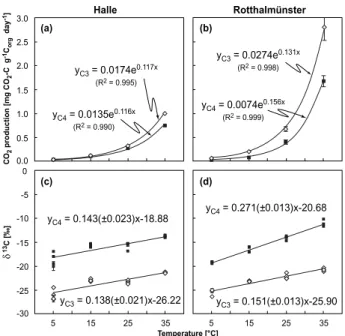
516 F. Conen et al.: Warming mineralises young and old soil carbon equally 0.5 0.0 1.5 1.0 2.5 2.0 3.0 yC4 = 0.0135e0.116x (R2 = 0.990) yC3 = 0.0174e0.117x (R2 = 0.995) yC4 = 0.0074e0.156x (R2 = 0.999) yC3 = 0.0274e0.131x (R2 = 0.998) Temperature [°C] CO 2 production [mg CO 2 -C g -1C org day -1] Halle Rotthalmünster -25 -30 -15 -20 -5 -10 0 15 25 35 5 yC4 = 0.143(±0.023)x-18.88 yC3 = 0.138(±0.021)x-26.22 15 25 35 5 13 C [‰] yC4 = 0.271(±0.013)x-20.68 yC3 = 0.151(±0.013)x-25.90 (a) (b) (c) (d) δ
Fig. 1. Mean temperature-dependent respiration rates at (a), Halle;
(b), Rotthalm¨unster under continuous C3 vegetation (open dia-monds) and where vegetation had changed to C4 (closed squares)
(error bars indicate ±1 s.d.; n=4). Effect of temperature on δ13C
values of CO2released at (c), Halle; (d), Rotthalm¨unster for soils
under continuous C3 vegetation (open diamonds) and soils, where vegetation had changed to C4 (closed squares) (error bars indicate the internal analytical error, where larger than the symbol). Values in brackets in the regression equations in (c) and (d) indicate the error of the slope.
CO2 to young vs. old organic matter is hampered for both.
The third approach makes use of different isotopic signatures in CO2derived from young and old soil carbon, either after a
transition from C3 to C4 vegetation or after spiking with14C that ocurred after 1950, and has been applied in long-term incubation studies (Dioumaeva et al., 2002; Bol et al., 2003; Waldrop and Firestone, 2004). Here, we follow the third ap-proach in a short-term incubation study to avoid alteration of the soil through exhaustion of labile carbon or changes in microbial community structure as common in long-term incubation studies.
2 Material and methods
Change of vegetation from C3 to C4 type allows to distin-guish between soil carbon pools originating from the time be-fore and after the changes (Balesdent et al., 1987) as well as their respective contribution to CO2production (Townsend
et al., 1997; Waldrop et al., 2004). The fraction of new carbon equals the difference in δ13C between C3 soil (or CO2)and C4 soil (or CO2)divided by the difference in δ13C
between previous C3 and new C4 carbon input. To make use of such natural isotope enrichement, we collected soil
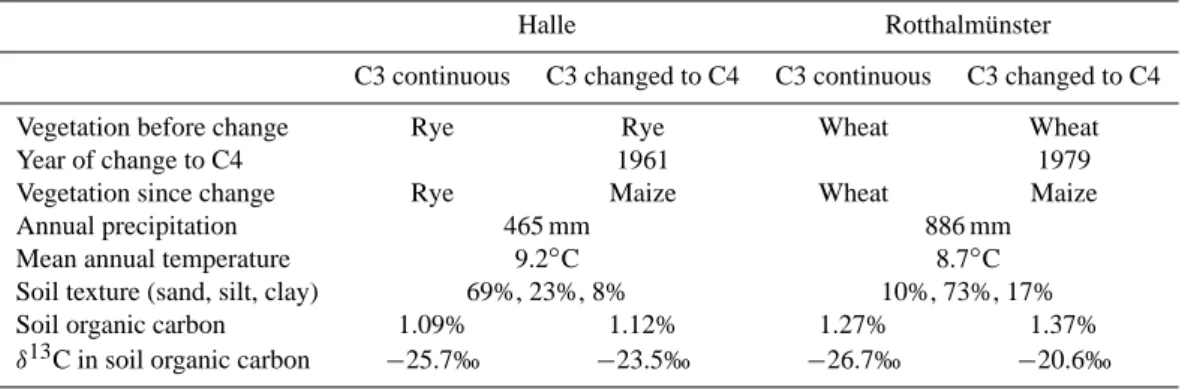
samples during the winter of 2005/2006 from the plough-layer (0–30 cm) of two sets of split cereal fields in Germany where the vegetation on one part had changed from contin-uous C3 to a monoculture of C4 vegetation, while the other part remained as C3 (Tab. 1). Litter inputs on the C4 plots were smaller in Halle (HL), where whole plants were har-vested, than in Rotthalm¨unster (RM), where only grain was removed from the field. Fresh samples were sieved (2 mm), homogenised and incubated at 15◦C for several days be-fore being split into 32 units of 5.0 g per site and vegetation type. The 5.0 g samples were placed into 12 ml Exetainer vials (Labco, High Wycombe, UK), three times evacuated and flushed with CO2-free air, equilibrated to atmospheric
pressure and immediately placed in one of four tempera-ture controlled water baths (5, 15, 25 and 35◦C, 8 replicates per temperature treatment). The evolution of CO2
concen-trations within the vials was monitored on four of the eight replicates through repeated extraction of 1 ml headspace gas and its immediate analysis on a gas chromatograph with methaniser and flame ionisation detector (model 8610C, SRI Instruments, Torrance, CA, USA). When concentrations of around 1000 ppm CO2were reached, headspace CO2in the
remaining four replicates of each treatment were measured for carbon isotope ratios using a continuous flow isotope ra-tio mass spectrometer (CF-IRMS, DELTAplus XP, Thermo Finnigan, Bremen, Germany) equipped with a GasBench II following standard processing techniques and a backflushing system (Seth et al., 2006). This allowed for the compari-son of essentially the same substrate quality independent of temperature. The duration of the incubations ranged from a few hours at 35◦C to up to 6 days at 5◦C. Isotope ratios are
reported as δ13C values relative to VPDB [‰]. Isotope ra-tios of soil carbon were obtained using an elemental analyzer (Flash-EA 1112, Thermo Electron, Milano, Italy) connected to our CF-IRMS.
3 Results and discussion
Isotopic signatures of C4 vegetation are enriched in13C rel-ative to C3 vegetation by 16.8‰ in Halle (John et al., 2003) (HL) and by 14.1‰ in Rotthalm¨unster (Ludwig et al., 2005) (RM). Isotopic values of C3 and C4 litter compared to the
δ13C of soils allows the calculation of old carbon (e.g. orig-inating from before the change to C4) and young carbon. At HL, 13% of soil carbon were younger than 45 years and contributed 44% of CO2between 5 and 35◦C on
aver-age. In RM, 43% of soil carbon were less than 26 years old and contributed 55% of the total CO2 emission. The
smaller proportion of C4 soil carbon at HL despite the ear-lier change to this vegetation type results from smaller lit-ter inputs. At both sites, respiration rates were somewhat smaller at C4 sites. Values of Q10 were identical (3.2) on
both plots at HL (Fig. 1a). At RM, the Q10 value of the
soil with C4 vegetation was greater (4.8) than under
Table 1. Summary information on sites from where the studied soil samples were taken at a depth of 0–30 cm in winter 2005–2006.
Halle Rotthalm¨unster
C3 continuous C3 changed to C4 C3 continuous C3 changed to C4
Vegetation before change Rye Rye Wheat Wheat
Year of change to C4 1961 1979
Vegetation since change Rye Maize Wheat Maize
Annual precipitation 465 mm 886 mm
Mean annual temperature 9.2◦C 8.7◦C
Soil texture (sand, silt, clay) 69%, 23%, 8% 10%, 73%, 17%
Soil organic carbon 1.09% 1.12% 1.27% 1.37%
δ13C in soil organic carbon −25.7‰ −23.5‰ −26.7‰ −20.6‰
uous C3 vegetation (3.7) (Fig. 1b). Interestingly, the δ13C value in CO2 was temperature-dependent under continuous
C3 vegetation. At both sites, increasing temperatures led to increasingly enriched δ13C values of about 1.38 (±0.21)‰ and 1.51 (±0.13)‰ per 10◦C at HL and RM, respectively. These values were calculated from the slope of regression lines through plots of δ13C in CO2 against incubation
tem-perature (Figs. 1c, d). Trends were reproducible when sam-ples first incubated at 5 and 35◦C were incubated a second time at the opposite end of the temperature range. These trends stress the importance of control treatments in stud-ies based on C3 to C4 vegetation change. Since we have not further investigated the cause of the temperature depen-dence of δ13C in our control treatments, we can only spec-ulate about possible mechanisms involved. They could in-dicate increasing decomposition at higher temperatures of compounds generally enriched in 13C against background, such as sugars, amino-acids, hemicellulose or pectin (Glaser, 2005, and references therein). They could also be caused by a growing importance of fungal respiration relative to mi-crobial respiration at higher temperatures (Kelliher et al., 2005, and references therein). However, it is more likely that they are caused by the Raleigh fractionation in combina-tion with metabolic branching (Schmidt, 2003). At moderate temperatures soil microbial organisms exhibit low metabolic quotients suggesting that only between 70 to 50% of car-bon is respired. In this case, isotope fractionation during the pyruvate-dehydrogenase reaction (Melzer and Schmidt, 1987) liberates depleted carbon for respiration. However, at higher temperatures the metabolic quotient is decreasing and most carbon is used for respiration, so that the pyruvate-dehydrogenase reaction is almost complete and no fraction-ation occurs. Consequently, respired carbon will be isotopi-cally enriched with increasing temperature. A further pos-sibility to explain the temperature dependent fractionation in the C3 soil could be a decrease in the activity of Gram-negative bacteria relative the activity of Gram-positive bac-teria with increasing temperature. Gram-negative bacbac-teria preferentially degrade isotopically more depleted plant
car-bon whereas Gram-positive bacteria degrade relatively more enriched soil organic matter. This was recently confirmed for both study sites using compound specific 13C and 14C contents of microbial phospholipid fatty acids (Kramer and Gleixner, 2006). Trends in δ13C of respired CO2with
tem-perature were also found in other studies. Biasi et al. (2005) and Andrews et al. (2000) found increasing temperature to result in increasingly depleted δ13C of respired CO2, which is
in contrast to our findings and probably the result of changes in microbial community structure as a reaction to a long-term temperature change.
To test differences in temperature sensitivity of young and old carbon, we compared changes in the isotopic signature of CO2 across the studied temperature range between the
C3 soils and the soils where vegetation changed from C3 to C4 type. At HL, the mean increase in δ13C values of re-leased CO2was the same for both soils (Fig. 1c). The
dif-ference (0.05‰) per 10◦C increase in temperature was much smaller than the combined errors of the slopes (±0.31‰). This indicates that at this site, carbon older or younger than 45 years respectively has the same temperature sensitivity. At RM, δ13C values of soil 26 years under C4 vegetation were slightly more enriched with increasing temperatures (Fig. 1d). A temperature increase of 10◦C resulted on av-erage in an enrichment 1.20 (±0.18)‰ larger than in soil under continuous C3 vegetation. In other words, a conceiv-able temperature increase of 5◦C above the current mean an-nual temperature of 8.7◦C by the end of this century, would cause a 9.6% increase in stimulation of the decomposition of soil carbon younger than 26 years, compared with older soil carbon. The statistical significance of this result underlines the precision of our approach. However, unlike at HL, the Q10 values differed considerably at RM between the plots.
This might result from differences in substrate availability (Davidson and Janssens, 2006). Almost twice the amount of litter is incorporated annually by C4 compared to C3 vege-tation at RM (Ludwig et al., 2005) because maize produces larger litter quantities than wheat. Thus, sugars, amino-acids, hemicellulose or pectin enriched in δ13C against the rest of
518 F. Conen et al.: Warming mineralises young and old soil carbon equally the younger carbon background as well as the ratio of
Gram-negative to Gram-positive bacteria might not be exactly the same under C4 and C3 vegetation at the RM site. Thus, the greater enrichment of CO2in13C with increased temperature
at the C4 site might not necessarily indicate a greater tem-perature sensitivity of younger soil organic carbon. It could equally result from a greater influence of the same factors that have possibly caused the13C enrichment of CO2at the
C3 control sites. At HL, grain and straw were removed from both parts of the field (John et al., 2003) and therefore an-nual carbon inputs to soil and Q10values were more similar.
Taking this into consideration, we conclude that albeit de-tectable, the small effect observed at RM is likely to be the result of different amounts of annual carbon input rather than being a real difference in temperature sensitivities between young and old carbon.
This result and the robustness of our findings may help to reduce the uncertainty in predicting changes in atmospheric CO2 concentrations associated with the long-term response
of soil carbon decomposition to increasing temperatures. Our study was limited to agricultural soils but natural soils may behave similarly. Unlike previous studies based on a shift from C3 to C4 vegetation, our results were neither influenced by changes in microbial community composition (Waldrop and Firestone, 2004) nor by different substrate qualities in our temperature treatments (Bol et al., 2003). Our results suggest that the carbon cycle feedback on climate change will neither be small and short lived until young carbon pools have reached a new dynamic equilibrium, nor accelerating with a growing share of CO2 from old carbon, but steady
and persistent in agreement with Townsend et al. (1997) and Fang et al. (2005, 2006). Similarly, for northern peatlands, Dioumaeva et al. (2002) found increasing rates of respira-tion with temperature but an unchanged relative proporrespira-tion of
14C in respired CO
2, which may suggest an equal sensitivity
of old and young carbon to warming also for this important source of CO2.
Acknowledgements. We would like to thank J. Sirch and R.
Ober-meier from the Agricultural College Rotthalm¨unster and L. Schmidt from the University Halle-Wittenberg for providing soil samples. Edited by: T. J. Battin
References
Andrews, J. A., Matamala, R., Westover, K. M., and Schlesinger, W. H.: Temperature effects on the diversity of soil heterotrophs
and the delta C-13 of soil-respired CO2, Soil Biol. & Biochem.,
32, 699–706, 2000.
Balesdent, J., Mariotti, A., and Guillet, B.: Natural C-13 abundance as a tracer for studies of soil organic-matter dynamics, Soil Biol. & Biochem., 19, 25–30, 1987.
Biasi, C., Rusalimova, O., Meyer, H., Kaiser, C., Wanek, W., Bar-sukov, P., Junger, H., and Richter, A.: Temperature-dependent
shift from labile to recalcitrant carbon sources of arctic het-erotrophs, Rapid Commun. Mass Spectrom., 19, 1401–1408, 2005.
Bol, R., Bolger, T., Cully, R., and Little, D.: Recalcitrant soil or-ganic materials mineralize more efficiently at higher tempera-tures, J. Plant Nutr. Soil Sci., 166, 300–307, 2003.
Davidson, E. A. and Janssens, I. A.: Temperature sensitivity of soil carbon decomposition and feedbacks to climate change, Nature, 440, 165–173, 2006.
Dioumaeva, I., Trumbore, S., Schuur, E. A. G., Goulden, M. L., Litvak, M., and Hirsch, A. I.:. Decomposition of peat from upland boreal forest: Temperature dependence and sources of respired carbon, J. Geophys. Res. 108(D3), 8222, doi:10.1029/2001JD000848, 2002.
Fang, C., Smith, P., Moncrieff, J. B., and Smith, J. U.: Similar re-sponse of labile and resistant soil organic matter pools to changes in temperature, Nature, 433, 57–59, 2005.
Fang, C., Smith, P., and Smith, J. U.: Is resistant soil organic mat-ter more sensitive to temperature then the labile organic matmat-ter?, Biogeosciences, 3, 65–68, 2006,
http://www.biogeosciences.net/3/65/2006/.
Fierer, N., Craine, J. M., McLaughlan, K., and Schimel, J. P.: Litter quality and the temperature sensitivity of decomposition, Ecol-ogy, 86, 320–326, 2005.
Fierer, N., Allen, A. S., Schimel, J. P., and Holden, P. A.: Controls
on microbial CO2production: A comparison of surface and
sub-surface soil horizons, Glob. Change Biol., 9, 1322–1332, 2003. Giardina, C. P. and Ryan, M. G.: Evidence that decomposition rates
of organic matter in mineral soil do not vary with temperature, Nature, 404, 858–861, 2000.
Glaser, B.: Compound-specific stable-isotope (δ13C) analysis in
soil science, J. Plant Nutr. Soil Sci., 168, 633–648, 2005. Houghton, J.: Global warming, Rep. Prog. Phys., 68, 1343–1403,
2005.
John, B., Ludwig, B., and Flessa, H.: Carbon dynamics deter-mined by natural C-13 abundance in microcosm experiments with soils from long-term maize and rye monocultures, Soil Biol. & Biochem., 35, 1193–1202, 2003.
Jones, C. D., Cox, P., and Huntingford, C.: Uncertainty in climate-carbon-cycle projections associated with the sensitivity of soil respiration to temperature, Tellus B, 55, 642–648, 2003. Jones, C., McConnell, C., Coleman, K., Cox, P., Falloon, P.,
Jankin-son, D., and PowlJankin-son, D.: Global climate change and soil carbon stocks; predictions from two contrasting models for the turnover of organic carbon in soil, Glob. Change Biol., 11, 154–166, 2005. Kelliher, F. M., Barbour, M. M., and Hunt, J. E.: Sucrose applica-tion, soil microbial respiration and evolved carbon dioxide iso-tope enrichment under contrasting land uses, Plant and Soil, 268, 233–242, 2005.
Knorr, W., Prentice, I. C., House, J. I., and Holland, E. A.: Long-term sensitivity of soil carbon turnover to warming, Nature, 433, 298–301, 2005.
Kramer, C. and Gleixner, G.: Variable use of plant- and soil-derived carbon by microorganisms in agricultural soils, Soil Biol. Biochem., 38, 3267–3278, 2006.
Leifeld, J. and Fuhrer, J.: The temperature response of CO2
produc-tion from bulk soils and soil fracproduc-tions is related to soil organic matter quality, Biogeochemistry, 75, 433–453, 2005.
Ludwig, B., Helfrich, M., and Flessa, H.: Modelling the long-term
stabilization of carbon from maize in a silty soil, Plant and Soil, 278, 315–325, 2005.
Melillo, J. M., Steudler, P. A., Aber, J. D., Newkirk, K., Lux, H., Bowles, F. P., Catricala, C., Magill, A., Ahrens, T., and Moris-seau, S.: Soil warming and carbon-cycle feedbacks to the climate system, Science, 298, 2173–2175, 2002.
Melzer, E. and Schmidt, H. L.: Carbon isotope effects on the pyruvate-dehydrogenase reaction and their importance for rela-tive C-13 depletion in lipids, J. Biol. Chem., 262, 8159–8164, 1987.
Reichstein, M., K¨atterer, T., Andr´en, O., Ciais, P., Schulze, E.-D., Cramer, W., Papale, D., and Valentini, R.: Temperature sensi-tivity of decomposition in relation to soil organic matter pools: critique and outlook, Biogeosciences, 2, 317–321, 2005, http://www.biogeosciences.net/2/317/2005/.
Schmidt, H. L.: Fundamentals and systematics of the
non-statistical distributions of isotopes in natural compounds, Natur-wissenschaften, 90, 537–552, 2003.
Seth, B., Schneider, C., and Storck, F.: Improved reliability of oxy-gen isotopic analysis of water using the Finnigan GasBench II periphery of a continuous flow isotope ratio mass spectrome-ter by backflushing of the sampling line, Rapid Commun. Mass Spec. 20, 1049–1051, 2006.
Townsend, A. R., Vitousek, P. M., Desmarais, D. J., and Tharpe, A.: Soil carbon pool structure and temperature sensitivity
in-ferred using CO2and13CO2incubation fluxes from five
Hawai-ian soils, Biogeochemistry, 38, 1–17, 1997.
Waldrop, M. P. and Firestone, M. K.: Altered utilization patterns of young and old soil C by microorganisms caused by temperature shifts and N additions, Biogeochemistry, 67, 235–248, 2004.