HAL Id: hal-01432484
https://hal.archives-ouvertes.fr/hal-01432484
Submitted on 23 Nov 2018
HAL is a multi-disciplinary open access
archive for the deposit and dissemination of
sci-entific research documents, whether they are
pub-lished or not. The documents may come from
teaching and research institutions in France or
abroad, or from public or private research centers.
L’archive ouverte pluridisciplinaire HAL, est
destinée au dépôt et à la diffusion de documents
scientifiques de niveau recherche, publiés ou non,
émanant des établissements d’enseignement et de
recherche français ou étrangers, des laboratoires
publics ou privés.
Distributed under a Creative Commons Attribution| 4.0 International License
Phonologically Driven Variability: The Case of
Determiners
Audrey Buerki, Marina Laganaro, F. -Xavier Alario
To cite this version:
Audrey Buerki, Marina Laganaro, F. -Xavier Alario. Phonologically Driven Variability: The Case
of Determiners. Journal of Experimental Psychology: Learning, Memory, and Cognition, American
Psychological Association, 2014, 40 (5), pp.1348-1362. �10.1037/a0036351�. �hal-01432484�
Phonologically Driven Variability: The Case of Determiners
Audrey Bürki
FAPSE, Université de Genève, and CNRS, Laboratoire de Psychologie Cognitive, Aix-Marseille Université
Marina Laganaro
FAPSE, Université de Genève
F.-Xavier Alario
CNRS, Laboratoire de Psychologie Cognitive, Aix-Marseille Université
Speakers usually produce words in connected speech. In such contexts, the form in which many words are uttered is influenced by the phonological properties of neighboring words. The current article examines the representations and processes underlying the production of phonologically constrained word form variations. For this purpose, we consider determiners whose form is sensitive to phonological context (e.g., in English: a car vs. an animal; in French: le chien ‘the dog’ vs. l’âne ‘the donkey’). Two hypotheses have been proposed regarding how these words are processed. Determiners either are thought to have different representations for each of their surface forms, or they are thought to have only 1 representation while other forms are generated online after selection through a rule-based process. We tested the predictions derived from these 2 views in 3 picture naming experiments. Participants named pictures using determiner–adjective–noun phrases (e.g., la nouvelle table ‘the new table’). Phonologi-cally consistent or inconsistent conditions were contrasted, based on the phonological onsets of the adjective and the noun. Results revealed shorter naming latencies for consistent than for inconsistent sequences (i.e., a phonological consistency effect) for all the determiner types tested. Our interpretation of these findings converges on the assumption that determiners with varying surface forms are repre-sented in memory with multiple phonological-lexical representations. This conclusion is discussed in relation to models of determiner processing and models of lexical variability.
Keywords: language production, variation, lexical representations, speech
Words are not always uttered in the way they are described in a standard dictionary. For instance, in English, the word camera is often realized without its second vowel ([kæmrə]), the word plain
is likely to be realized with [m] rather than [n] in some contexts (e.g., “a plain bun”), and the words a and the are often produced as [ə] and [ði:] when preceding a vowel. Similarly, in French, the
adjectives beau [b] ‘nice’, vieux [vjø] ‘old’, and grand ‘big’ are realized [bεl], [vjεj], and , respectively, before vowel-initial nouns. The form of those words surrounding the varying word (i.e., the phonological context) plays a major role in deter-mining the occurrence of many of these variations (e.g.,Gaskell, Cox, Foley, Grieve, & O’Brien, 2003;Gaskell, Hare, & Marslen-Wilson, 1995).
In this research, we examine the representations and pro-cesses underlying the production of phonologically constrained variations. Dependencies (i.e., fact that the form or the pronun-ciation of a word depends on another word in the sentence) have been studied extensively at the syntactic level (e.g.,Eberhard, Cutting, & Bock, 2005; Franck, Vigliocco, Antón-Méndez, Collina, & Frauenfelder, 2008;Haskell, Thornton, & MacDon-ald, 2010; Mirkovi´c & MacDonald, 2013). By contrast, much less is known of phonological dependencies because signifi-cantly less psycholinguistic research has been devoted to this issue, be it in auditory and visual language perception (e.g.,
DeLong, Urbach, & Kutas, 2005; Gaskell & Marslen-Wilson, 1996, 2001) or in speech production (Alario & Caramazza, 2002;Miozzo & Caramazza, 1999;Spalek, Bock, & Schriefers, 2010).
Determiners provide an interesting test ground for understand-ing phonologically driven variability. In many languages, deter-miner form depends on diverse properties of the surrounding words, which frequently include the phonological context (see
Table 1). Whereas this fact has been acknowledged in previous This article was published Online First May 5, 2014.
Audrey Bürki, Laboratoire de Psycholinguistique Expérimentale, FAPSE, Université de Genève, and CNRS, Laboratoire de Psychologie Cognitive, UMR 7290, Aix Marseille Université; Marina Laganaro, Laboratoire de Psycholinguistique Expérimentale, FAPSE, Université de Genève; F.-Xavier Alario, CNRS, Laboratoire de Psychologie Cognitive, UMR 7290, Aix Marseille Université.
We acknowledge funding from the Swiss National Science Foundation (Grants IZK0Z1-146008 and PP001-118969), the Université de Genève (Subside tremplin), the European Research Council under the European Community’s Seventh Framework Program (FP7/2007-2013 Grant agree-ment 263575), and the Brain and Language Research Institute (Aix-Marseille Université: AⴱMIDEX grant ANR-11-IDEX-0001-02 and LABEX grant ANR-11-LABX-0036). We thank Deirdre Bolger for proofreading an earlier version of the article and the Fédération de Recherche 3C (Aix-Marseille Université) for institutional support.
Correspondence concerning this article should be addressed to Audrey Bürki, Laboratoire de Psycholinguistique Expérimentale, FAPSE, Univer-sité de Genève, Boulevard du Pont d’Arve 40, 1205 Geneva, Switzerland. E-mail:[email protected]
research (Caramazza, Miozzo, Costa, Schiller, & Alario, 2001;
Foucart, Branigan, & Bard, 2010; Garrett, 1975; Spalek et al., 2010), the conclusions reached in these studies are not consensual. Here we will reconsider this research and provide new evidence to clarify the representations and processes involved in determiner form variation. In our interpretation of the findings, we will focus specifically on connecting linguistic and psycholinguistic frame-works.
Nonlexical Determiner Representations
In early psycholinguistic accounts of determiner processing (Garrett, 1975,1984,1988), determiners have no corresponding phonological representation in the mental lexicon. Unlike con-tent words, they are not lexical entities. This nonlexical
hypoth-esis was proposed to account for error patterns in natural speech
corpora. Especially relevant were the observations that phono-logical errors rarely involve function words and that word exchange errors involve stems but not their inflections (e.g., ⴱ“she’s already trunked two packs”;Berndt, 2001). In Garrett’s model, function words and inflections share a number of prop-erties. The generation of a sentence starts with the assembly of a planning frame that specifies the location of the content words (see alsoBock, 1987). These content words are activated and selected, and their phonological forms are inserted into this frame. In contrast, function words, as well as inflections, are part of the planning frame. Their production is automatic and results from the processing of the sentence frame. Their pho-nological makeup is determined once that of the content words has been defined (see Dell, 1990, for an alternative view). According to Garrett (1980), local accommodation processes adjust the determiner form to the phonological context (e.g., a
money’s aunt for an aunt’s money in Garrett, 1984). Conse-quently, the phonological shapes of these morphemes are not “tied to particular lexical entries” (Garrett, 1980, p. 187).
A Lexicalist View of Determiner Representation
In a seminal studySchriefers (1993)initiated the investigation of determiner production with chronometric paradigms. He intro-duced the manipulation of grammatical gender as the distractor inthe picture-word interference paradigm (Lupker, 1979). Dutch native participants were asked to name pictures with determiner⫹ noun phrases. When the distractor and the name of the picture had different genders, naming latencies were longer than when they had the same gender. This so-called gender congruency effect was replicated several times, in Dutch and other Germanic languages (i.e., La Heij, Mak, Sander, & Willeboordse, 1998; Schiller & Caramazza, 2003;van Berkum, 1997) and has been interpreted as reflecting a conflict between determiner form representations (e.g.,
Schiller & Caramazza, 2003;Schriefers, Jescheniak, & Hantsch, 2002,2005; see alsoSchriefers, 1993, for an interpretation of the effect in terms of competition at the level of the words’ syntactic features). After Schriefers’ report, Garrett’s conception of deter-miners was more or less abandoned in favor of a lexicalist view of determiner processing and representation (as discussed inAlario, Ayora, Costa, & Melinger, 2008). According to this view, deter-miners are represented in the mental lexicon, and their production, like that of content words, results from an active, presumably attention demanding, selection mechanism (Ayora, Janssen, Dell’Acqua, & Alario, 2009). One of the reasons for this novel perspective may be the variety of constraints that govern deter-miner production across languages, particularly those described in the next section.
Constraints From the Phonological Context
In addition to grammatical gender, phonological context can be a major constraint on determiner forms, notably in Romance languages (e.g., Italian, French, Spanish, Catalan; see Table 1). The presence of this phonological constraint is associated with a systematic empirical pattern. When the gender congruency effect described in the previous paragraph was tested in these languages, it was never observed (for an overview, see Figure 1 in Costa, Alario, & Sebastián-Gallés, 2007).1 The requirement to consider phonological context to select the appropriate determiner form is thought to delay determiner selection. For this reason, at the time of selection, the representations activated by the distractor word (e.g., its gender and associated determiner form) do not constitute1With one notable exception described below (Foucart et al., 2010).
Table 1
Examples of Constraints on Singular Determiner Form Production in Different Languages
Language and determiner type
Grammatical constraint (noun gender)
Phonological constraint
(next word onset) Determiner form English indefinite determiner Consonant a
Vowel an
French definite determiner Masculine Consonant le
Vowel l’
Feminine Consonant la
Vowel l’
French possessive determiner Masculine Consonant mon
Vowel mon with liaison
Feminine Consonant ma
Vowel mon with liaison German definite determiner Feminine Any die
Masculine Any der
significant alternatives. This has been termed the late selection
hypothesis and is thought to apply to all determiners within a given
language (Caramazza et al., 2001;Miozzo & Caramazza, 1999). Although the timing aspects of this hypothesis are quite detailed, the representations over which selection processes operate were merely assumed to be lexical units. Determiner forms are produced via an activation/selection mechanism constrained, among others, by those properties of the local noun with which the determiner agrees.
Of interest, determiner retrieval performance is not influenced solely by the adjacent (local) phonological context (i.e., the context that is considered relevant for language usage); the context uttered beyond the local word can also affect performance. This was shown early on byMiozzo and Caramazza (1999). In Italian, the masculine definite singular determiner is realized as l’ before vowels; lo before /S/; and “s” followed by a consonant, gn, and some affricates (/ts/ and /dz/). It is realized as il in all other cases.
Miozzo and Caramazza (1999, Experiment 5) measured naming latencies for the production of il⫹ adjective ⫹ noun sequences (e.g., il grande treno ‘the big train’) in a picture naming task. Naming latencies were longer for the adjective noun phrases (relative to the il⫹ noun baseline; e.g., il treno, lo sgabello) when the adjective and the noun called for different determiner forms (i.e., inconsistent noun phrases; e.g., il vs. lo in il grande sgabello ‘big stool’) than when they called for the same form (i.e., consis-tent noun phrases; e.g., il grande treno).Alario and Caramazza (2002)reported a similar finding for the French determiners ma (mon) ‘my’ and ce (cet) ‘this’, with shorter naming latencies for consistent than for inconsistent noun phrases. These results were interpreted as reflecting the phonological activation of the (nonlo-cal) noun prior to response onset. This is consistent with a variety of findings suggesting that, in noun phrases such as those used in these studies, the phonological properties of the three words are activated prior to vocal response (at least, the onsets of all three words; e.g., Alario, Costa, & Caramazza, 2002;Costa & Cara-mazza, 2002;Damian & Dumay, 2009). The phonological activa-tion of the third word to be uttered is thought to constrain the selection of determiner forms, although the mechanism involved is not specified beyond the hypothesis of late selection discussed in the previous paragraph. As was the case for Germanic languages, in this account determiners are thought to have several lexical representations from among which the appropriate one must be selected: “The proposal is that the noun’s gender and number activate an allomorphic set of determiners (e.g., il/lo for singular masculine), but the selection of a specific determiner has to wait for the ordering and insertion of the phonological forms of the noun and adjectives into a phonological phrase” (Miozzo & Cara-mazza, 1999, p. 920).
Interpreting Phonological Constraints With
Adjustment Processes
Two recent studies (Foucart et al., 2010;Spalek et al., 2010) have investigated in more detail how the phonological context constrains determiner form selection. The interpretation of their findings leads these authors to discuss explicitly the nature of determiner representations. Notably, in both studies, the discus-sions account for local context dependency by means of a concep-tualization that borrows some aspects of the concepconcep-tualization
originally proposed in Garrett’s model (see references above); namely, a process of adjustment of determiner form.
In the first study,Foucart et al. (2010)focused on the alternation properties of the definite determiner (‘the’) in French (lemascand
lafem, realized as [l] irrespective of gender before vowels; see
Table 1). They observed the gender congruency effect that had only been observed in Germanic languages before (see above). A first aspect of their result is that they only observed the gender congruency effect when the distractor appeared after the picture onset (with a stimulus onset asynchrony, or SOA, of⫹200 ms), not when the picture and distractor were synchronous (SOA 0; note thatMiozzo, Costa, & Caramazza, 2002, failed to observe the effect when they used a similar SOA manipulation in Spanish and Italian). The timing constraint on the occurrence of the effect is compatible with the core claim of the late selection hypothesis, if one assumes that the activation induced by a later distractor stands a greater chance of being influential when determiner selection occurs.
A second, more important, aspect on whichFoucart et al. (2010)
focused their interpretation concerns the specific properties of the determiner forms they tested. In their view, the form [l] produced before vowel-onset words results from a “late phonetic” adjust-ment.2
The presence of a gender congruency effect at⫹200 SOA occurs because the adjustment process delays the selection of the determiner. In their own words, “le/la would always be selected by ‘default’ but could only be ‘fully’ selected once the post-selection rule had been checked with reference to the local [emphasis added] context” (Foucart et al. (2010), p. 1416). They do not discuss the production of larger sequences and the possible influence of non-adjacent words on determiner production. However, because the late phonetic process is triggered by the local context, determiner production should be blind to the phonological composition of words occurring later in the sequence.
In the second study,Spalek et al. (2010)investigated determiner phonological variation in English by using definite and indefinite determiners, both of which are constrained by the phonological context (i.e., [ə]/[ðə] before consonants and [ən]/[ði:] before
vow-els; the alternation being less systematic for the and only found in some dialects of English; see, e.g., Raymond, Fisher, & Healy 2002). They measured naming latencies and errors for the produc-tion of noun phrases with determiners and adjectives (e.g., a purple
elephant). Naming latencies were longer when the adjective and
the noun called for different determiner forms (e.g., a versus an in
a purple elephant, because the adjective and the noun start,
re-spectively, with a consonant and a vowel) than when they called for the same form (e.g., an, as in an orange elephant, or a, as in a
purple giraffe; 24 ms and 19 ms for a–an and the–thee
respec-tively). As was the case in Italian and French (Alario & Cara-mazza, 2002;Miozzo & Caramazza, 1999), this effect of phono-logical consistency indicated that the production of a given determiner form is not the result of a local adjustment process. Spalek et al. took these findings to suggest that the two determiner
2The term phonetic is borrowed from Foucart et al. (2010). Note
however that the adjustment rule described by these authors cannot take place after the phonological encoding process has been completed, given its impact on the selection of the determiner’s phonological representation. If such a rule does apply, it must be phonological (rather than phonetic) in nature.
forms (e.g., a vs. an) compete at the phonological level. In their proposal, these determiner forms are both derived from a single underlying representation, or one form is directly retrieved from the lexicon while the other one is derived from the former.
To summarize, according to Foucart et al. (2010), definite determiner form selection on the basis of gender is followed by an optional adaptation of determiner form constrained by the local phonological context. InSpalek et al. (2010), in contrast, definite and indefinite determiner forms are first derived from an underly-ing form and then compete with one another for selection. Irre-spective of the order in which form derivation and selection operate, these two accounts contrast with the assumption made in previous research that determiners have stable (i.e., nonadjustable) lexical representations and that all determiners are processed by the same mechanisms within a given language (Caramazza et al., 2001).
The crucial differences noted between accounts regarding de-terminer form representation may be due to one or a combination of the following reasons. First, the studies investigated different languages, and hence differences in the conclusions may reflect cross-linguistic disparities in determiner representation. Second, determiner processing could differ depending on specific proper-ties of the determiners examined, a point that is emphasized by
Foucart et al. (2010). Third, differences in these accounts could be due to the fact that different experimental paradigms were used. Finally, because of some difficulties in each of the theoretical accounts (to be considered in more detail in the General Discus-sion), it is still possible that the determiner representations and production are in fact homogeneous within and across these (and possibly other) languages and that the findings are not as divergent as they seem.
Working Model and Hypothesis Tested
We now summarize the available theoretical proposals regard-ing the representation of phonologically constrained determiners. According to one view, varying surface forms enjoy alternative lexical representations, each of which is appropriate for a different type of phonological context (typically, in front of vowel vs. consonant onsets). We will refer to this view as the alternating
forms hypothesis. A selection process isolates the form to be
retrieved and selected. In principle, the selection processes could be restricted or unrestricted. A restricted selection process in-volves exclusively the information that is logically required to perform the selection (i.e., the information specified in language usage rules: the local phonological context). Alternatively, an unrestricted selection process would be more open and would involve any information that is active, even if it is not required according to language usage rules (e.g., the nonlocal phonological context).
According to the other view, a given determiner form is stored and then retrieved irrespective of the phonological context. When certain phonological constraints are met (e.g., if the following word starts with a vowel), an alternative form is derived. Such derivation is typically realized through local accommodation pro-cesses involving the adjacent word (usually at the phonological level). By “typically” we refer to the fact that the definition of such constraints in Garrett’s classic model or in linguistic accounts involves only adjacent words. For example,Selkirk and Vergnaud
(1973) reviewed several simple phonological rules of this kind. The following rule accounts for the alternation between le/la and
l in French: V¡A/___#V (“the vowel of the definite determiner
deletes before a vowel-initial word but not before a consonant-initial one”;Selkirk & Vergnaud, 1973, p. 250). For these reasons, we shall consider that deriving alternative forms is a process that can only be governed by the local context (although seeSpalek et al., 2010; we come back to this point in the General Discussion). We will refer to this view as the accommodation hypothesis.
Within this working model, testing for the presence of nonlocal phonological constraints on determiner retrieval performance pro-vides a discriminative test between the alternating forms and the accommodation hypothesis. Observing an effect of nonlocal con-straints would provide evidence against the accommodation pothesis but would be consistent with the alternating forms hy-pothesis, inasmuch as it involves an unrestricted selection process. Alternatively, if the effect of nonlocal constraints is absent (in a reliable and interpretable manner), this would be most consistent with the accommodation hypothesis, or with the alternating forms hypothesis, but only with a restricted selection process.
Although the research described in the previous section has involved many languages (e.g., English, Italian, French), the ex-periments we report here were all conducted in French. This language allows the conditions needed for testing the alternative hypotheses to be constructed. Moreover, whereas previous studies resorted to different paradigms (picture word interference vs. noun phrase production), we used the same paradigm for all the deter-miners we examine (i.e., the experimental paradigm used inSpalek et al., 2010; see alsoAlario and Caramazza, 2002). Native speak-ers were asked to name pictures using determiner⫹ adjective ⫹ noun sequences, while phonologically consistent and inconsistent conditions were contrasted (i.e., where the prenominal adjective and noun require the same vs. different determiner forms).
The alternative forms and accommodation hypotheses were tested with different types of determiners. First, we performed a conceptual (i.e., not literal) replication ofAlario and Caramazza’s (2002) Experiment 3. We tested determiners whose alternation is typically described as allomorphic (mon/ma). This alternation is not expected to rely on accommodation processes. Thus it is expected to be sensitive to nonlocal constraints (as reported in
Alario & Caramazza, 2002). Then we tested the definite determin-ers le (l’) and la (l’), whose alternation is thought to involve accommodation processes (e.g.,Foucart et al., 2010). These should not be sensitive to nonadjacent words. In light of the findings, we will reconsider the evidence available in French and other lan-guages.
Experiment 1
In French, the singular possessive determiner takes the gender of the object possessed (and not that of the possessor, as is for instance the case in English). Moreover, the feminine determiner is realized as [ma] before consonants (e.g., ma chaisefem‘my chair’)
and as [mɔ˜n] before vowel-initial words (mon armoirefem ‘my
cupboard’).Alario and Caramazza (2002) reported that the pro-duction of noun phrases starting with the French singular feminine possessive determiner is delayed (⫹34 ms) when followed by an adjective and noun that require different determiner forms (pho-nological inconsistent condition; e.g., mon ancienne table ‘my old
table’). This suggests that the production of this determiner does not involve the application of a local rule to a single underlying representation. Our first step was to perform a replication of Alario and Caramazza’s Experiment 3, albeit with different materials and different participants. This was intended to ensure that, with our set of stimuli, it is possible to observe an effect of phonological consistency.
Method
Participants. Eighteen native French speakers, all university students, took part in this experiment. They were given course credit for their participation.
Material. Following Alario and Caramazza (2002), we se-lected two adjectives that are frequently found in prenominal position in French. One adjective started with a vowel (ancienne ‘old’), and the other started with a consonant (nouvelle ‘new’). The vowel-initial adjective requires gender agreement (anciennefemvs.
ancienmasc). The consonant-initial adjective also requires gender
agreement (nouvellefemvs. nouveaumasc); in addition, the
mascu-line form of the adjective varies with the phonology of the next word (nouveaumasc before consonant and nouvelmasc before
vowel). To simplify the interpretation of the contrasts devised below, involving manipulations of noun phonology in relation to determiner selection, the experimental targets were all feminine nouns. We selected 40 pictures representing feminine nouns (see
Appendix Afor the complete list of stimuli). Half of these corre-sponded to vowel-initial nouns (e.g., armoire ‘cupboard’), and the other half corresponded to consonant-initial nouns (e.g., table ‘table’). In addition, 10 filler items were added, all of which were masculine.
In order to elicit the production of these two adjectives with each noun, we used two versions of each picture. For the adjective
nouvelle, we used the original solid line black drawings. For the
adjective ancienne, these original pictures were slightly blurred with the software Adobe Photoshop 5.5 (see Figure 4 inAlario & Caramazza, 2002, for an example). Although this blurring may have an effect on visual performance, the theoretical argument hinges on the interaction between adjective and noun properties.
Procedure. The experimental software DMDX (Forster & Forster, 2003) was used to control stimulus presentation, timing, and data collection for all experiments. The experiment started with a familiarization phase. During this phase, participants were presented with all the pictures and their corresponding nouns. They were then asked to name each picture preceded by the singular possessive determiner and the relevant adjective. For experimental (feminine) items, these were ma nouvelle ‘my new’ and mon
ancienne ‘my old’, depending on the picture format (e.g., ma nouvelle table ‘my new table’). For the masculine fillers, these
could be /mɔ˜nuvo/, /mɔ˜nuvεl/, /mɔ˜nɑ˜sjε˜/ or /mɔ˜nɑ˜sjεn/. The 100
different adjective–noun combinations were presented twice, in two consecutive blocks. Each block started with two warm-up trials. The items were randomized such that no more than three consecutive trials requiring the same determiner–adjective pairs were presented. Each trial had the following structure: an empty screen for 300 ms, followed by a fixation cross shown at the center of the screen for 500 ms, followed by the presentation of the picture. The picture remained on the screen until the participant responded or a maximum duration of 2,000 ms had elapsed. After
a 1,000-ms blank screen interval, the participant pressed a key to start the next trial.
Data analyses. In all experiments, we analyzed participants’ responses and latencies by means of (generalized) mixed-effects regression models (e.g.,Baayen, Davidson, & Bates, 2008; Gold-stein, 1987) using the statistical software R (R Development Core Team, 2007–2013). The random part of the model included ran-dom intercepts for participant and item, and ranran-dom slopes allow-ing for the effects of the predictors to differ across participants or items for all between-unit predictors (see, e.g.,Baayen & Milin, 2010;Barr, Levy, Scheepers, & Tily, 2013). All the results we report stem from models with the maximal random effects struc-ture. Moreover, a sequential analysis of variance (Baayen, 2008) was conducted to ensure that, for the fixed part of the model, each predictor or interaction contributed significantly to explaining the variance in the dependent variable.
In the presentation of the results, we report the estimates and t values of the model with the maximal random effect structure. Estimations of p values made use of the posterior probabilities of a Markov chain Monte Carlo simulation with 10,000 runs. As the function to obtain p values from posterior probabilities of Markov chain Monte Carlo simulations is not yet implemented in R for models with random slopes, the p values were estimated from the corresponding models with random intercept for participant and item only. In all the statistical models, we took the inverse of the production latencies as our dependent variable, as indicated by the Box–Cox test (Box & Cox, 1964). These values are provided for information only. Significance was assessed using two criteria: a t value above 1.96 for the estimate and the p value from the sequential F tests (seeBaayen, 2008).
The fixed part of the model initially included phonological consistency, adjective onset (whether a vowel or a consonant), and several variables capturing diverse properties of the nouns and pictures (age of acquisition, number of syllables, name agreement, lexical frequency, visual complexity, image variability). In Exper-iment 3, the predictor “grammatical gender” was also included. Notably, in the literature, phonological consistency effects are reported with two different analyses: in terms of an interaction between the onset of the adjective and that of the noun (Spalek et al., 2010) or by grouping and comparing trials as a function of the consistency of their onsets (Alario & Caramazza, 2002). The main advantage of the latter analysis is the possible inclusion in the model of the effect of adjective (or noun) onset and its interaction with phonological consistency. For this reason, we opted for an analysis in terms of consistency effects.
The models we present contain only those fixed effects that reached significance or that were involved in a significant inter-action (alpha level⫽ 0.05). FollowingBaayen (2008), residuals larger than 2.5 times the standard deviation were considered out-liers and were removed from all models. This procedure ensured that the results were not driven by a small number of atypical data points.
Results and Discussion
All responses were checked for accuracy, and errors were re-moved prior to any statistical analysis. There were 212 errors (7%), most of them due to dysfluencies (53% of errors). Of the remaining errors, 14% involved the noun, 20% the adjective, and
12% the determiner; 1% were no responses. Nine additional data points were removed due to voice key malfunctioning. The prob-ability of producing an error was not influenced by the phonolog-ical consistency between onsets (p⬎ .1).
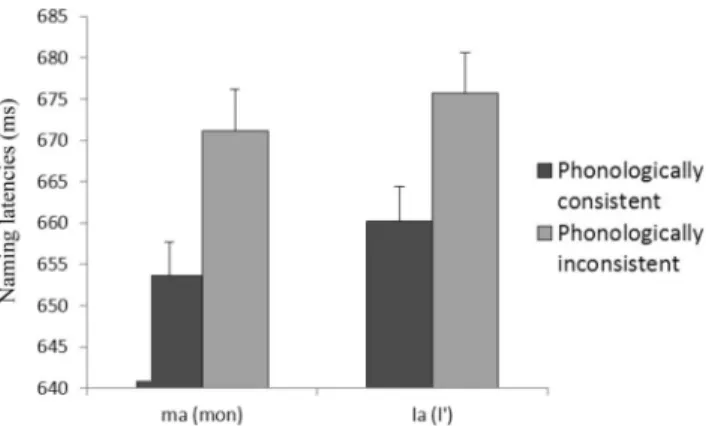
Visual examination of the distribution by means of a quantile-quantile plot led us to disregard the 8 data points above 1,500 ms (0.4% of data). Whenever a response for a given noun was miss-ing, the corresponding trial with the other adjective was excluded from the data set (183 data points, 7% of correct responses). The mean latency of the 2,468 remaining correct responses was 662 ms (confidence interval⫽ ⫾6 ms). Mean latencies broken down by adjective and noun onset (consonant initial vs. vowel initial) are summarized inAppendix B.Figure 1(left panel) shows the mean production latencies as a function of the phonological consistency between onsets.
Results revealed a main effect of phonological consistency with longer latencies for inconsistent adjective–noun combinations (i.e., different onset for adjective and noun) than for consistent se-quences (i.e., same onset for adjective and noun, ⫽ 4.10 10-5
,
t⫽ 3.13, p ⬍ .0001).3
In addition, they revealed a main effect of adjective onset, with longer response latencies for sequences whose adjective starts with a vowel ( ⫽ 3.99 10-5
, t⫽ 2.09, p ⬍ .0001). Response latencies were also longer for late than for early acquired words ( ⫽ 7.47 10-5
, t ⫽ 4.24, p ⬍ .0001) and for sequences with more syllables ( ⫽ 7.66 10-5
, t⫽ 2.90, p ⬍ .01). The apparent difference in the phonological consistency effect across adjective (or noun) onsets was not significant (i.e., the interaction between the onset of the adjective and the consistency between onsets is not significant, t⫽ 0.91).
These results provide a conceptual replication of the observa-tions made byAlario and Caramazza (2002)with a different set of stimuli and a different statistical analysis. The consistency effect confirms that the alternation between ma and mon in feminine noun phrases is not the result of a strictly local process.
Experiment 2
We are now in a position to use the paradigm to test the production of the French definite singular feminine determiner, realized [la] before consonant-initial words and [l] before
vowel-initial words. In Experiment 2, we examine whether this deter-miner also shows a phonological consistency effect; that is, shorter response latencies for sequences in which the adjective and noun call for the same determiner form (e.g., la nouvelle table ‘the new table’, l’ancienne armoire ‘the old cupboard’) than for sequences in which the adjective and the noun call for different determiner forms (e.g., l’ancienne table ‘the old table’, la nouvelle armoire ‘the new cupboard’). Within the accommodation hypothesis of our working model, the only information that is relevant for the pro-duction of the reduced form [l] is the onset of the word that immediately follows the determiner. This view predicts no differ-ence between consistent and inconsistent sequdiffer-ences. By contrast the alternative forms hypothesis with unrestricted selection pre-dicts an advantage for consistent sequences.
Method
Participants. A total of 18 native French speakers from the same pool as in Experiment 1 participated in the study. They had not participated in Experiment 1. They were given course credit for their participation.
Material, design, and procedure. The materials, design, and procedure were identical to those of Experiment 2, except that participants were instructed to use the definite singular determiner
la (l’) or le (l’).
Results and Discussion
All responses were checked for accuracy, and errors were re-moved prior to any statistical analysis. There were 198 errors (7%), most which were due to dysfluencies (51% of errors). Of the remaining errors, 14% involved the noun, 27% the adjective, and 4% the determiner; 4% were no responses. Twenty-one additional data points were removed due to voice key malfunctioning. The probability of producing an error was not influenced by the pho-nological consistency between onsets (p⬎ .1).
Visual examination of the distribution by means of a quantile-quantile plot led us to disregard the 20 data point above 1,500 ms (0.8% of data). In addition, whenever a response for a given noun was missing, the corresponding trial with the other adjective was excluded from the dataset (184 data points, 7% of the correct responses). The mean latency of the remaining 2,461 correct responses was 662 ms (confidence interval⫽ ⫾10). Mean laten-cies broken down by adjective and noun onset (consonant initial vs. vowel initial) are summarized in Appendix B. The mean production latencies as a function of the phonological consistency between onsets are shown inFigure 1(right panel).
Results revealed an effect of phonological consistency, with inconsistent sequences being produced with longer latencies than consistent sequences ( ⫽ 3.56 10-5
, t⫽ 3.4, p ⬍ .001). Produc-tion latencies were also influenced by the age of acquisiProduc-tion of the noun ( ⫽ 6.74 10-5
, t⫽ 4.91, p ⬍ .0001) and its number of syllables ( ⫽ 5.42 10-5, t⫽ 2.57, p ⬍ .01). There was no effect
3In this and subsequent experiments, we also carried out an analysis in
which we removed the predictor “phonological consistency” and intro-duced instead the interaction between adjective and noun onset (as was done in previous studies; i.e.,Spalek et al., 2010). In all experiments, this interaction is significant.
Figure 1. Mean production latencies (raw data) as a function of the phonological consistency between the adjective and the noun in Experi-ments 1 (determiner ma, left panel) and Experiment 2 (determiner la, right panel). The bars represent the standard errors of the means.
of adjective onset (t⫽ 0.47) and no interaction between adjective onset and phonological consistency (t ⫽ ⫺0.43). The fact that production latencies are influenced by the phonological properties of the two content words of the noun phrase is consistent with the alternative forms hypothesis with unrestricted selection.
Experiment 3
In Experiment 3, we test the generalizability of the results of Experiments 1 and 2 to other contexts (i.e., other adjectives and nouns) and to the definite masculine French determiner le.Foucart et al. (2010)proposed that the use of the reduced variants in front of vowels for the French definite singular determiner le and la results from the application of a phonetic adaptation rule.
Foucart et al. (2010)did not provide results for each grammat-ical gender separately; thus, in theory, it is possible that the gender congruency effect they reported is mostly driven by the masculine determiner. Le differs from la (and from ma) in an important way. The phonological constraints governing the realization of le are not systematic. Whereas the same variant (l’) is invariably used in front of vowels, both determiner forms are used in front of con-sonants (see, e.g.,Côté and Morrison, 2007). In fact, the use of the reduced from l’ before consonant-initial words might be even more frequent than the nonreduced form le in some contexts. For in-stance, in a sentence like Prends le paquet de mouchoirs [Take the pack of tissues], the masculine definite determiner is more likely to be realized [l] than [lə]. Because both variants of the determiner
can be used in the same context, it is possible that the onset of the nonlocal noun has a reduced impact on the naming latencies for the whole sequence.
In Experiment 3, we use the same paradigm as in Experiments 1 and 2 to examine whether a phonological consistency is also found when the masculine and feminine forms le and la are considered within the same experiment and whether this effect differs across genders.
Method
Participants. Eighteen native French speakers, all university students between 18 and 35 years of age, took part in the experi-ment. They had not participated in the previous study. They were paid for their participation.
Materials. We selected 60 pictures representing masculine nouns and 60 pictures representing feminine nouns. In each group, there were 30 vowel-initial and 30 consonant-initial nouns (see
Appendix C). Four adjectives were also selected. As in Experi-ments 1 and 2, we used the adjectives ancien/ancienne and
nou-veau/nouvelle. As mentioned above, the masculine forms of these
two adjectives alternate with the phonology of the next word (e.g., nouveaumasc before consonant and nouvelmasc before vowel),
which introduces a potential additional difficulty for the speaker. Thus, in our statistical analyses, we considered only the feminine noun phrases for these two adjectives (N⫽ 30). We selected an additional adjective pair that we could use for both the feminine and masculine nouns. One adjective started with a vowel (immense ‘huge’) and the other started with a consonant (demi ‘half’). Each noun was associated with one adjective pair (either demi/immense or nouveau/ancien). Given that the adjectives nouveau–nouvelle and ancien–ancienne were to be elicited in the context of demi and
immense, we modified the representation of these adjectives so as
to maximize the contrast between the four adjectives. For the adjective ancien–ancienne, the original pictures were blurred and colored to resemble the sepia style of old pictures. For the adjec-tive nouveau–nouvelle, we added alternating black and white lines around the original black outline pictures to mimic the shining aspect of a new object. In order to elicit the adjective demi, we applied a semi-opaque white mask to the right-hand half of the original black outline pictures. This way, the whole picture was still visible but the right-hand part was much less clear. In order to elicit the adjective immense, the pictures were enlarged so as to touch the black square. Examples of the pictures used in Experi-ment 3 are presented inFigure 2.
In order to maximize the distance between trials involving the same target noun, we constructed two lists. Each noun appeared once with a different adjective in each list. Lists were balanced in terms of adjective type, grammatical gender, and consistent versus inconsistent sequences. The lists were presented one after the other, and their order was counterbalanced across participants. Given the higher number of sequences (240) involved in this experiment, each adjective–noun combination was presented once only.
Procedure. In this experiment, in addition to being familiar-ized with the pictures and their corresponding nouns (as in all other experiments), participants were familiarized and trained with the adjectives. Training with the adjectives was progressive and in-volved four steps. Participants were first presented with four versions of the same object, each representing one of the four adjectives to be used in the experiment. The name of the adjective appeared next to the picture, and the participants were told to memorize the association between the visual display and the adjective. The four pictures and their corresponding adjective were presented twice. During the second step, participants were pre-sented with the same pictures and had to produce the adjective in
Figure 2. Examples of pictures used in Experiment 3 to elicit the production of the adjectives nouvelle ‘new’, ancienne ‘old’, demi ‘half’, and immense ‘huge’ (from left to right).
isolation. A novel object, with, again, four different versions, was then introduced, and participants had to name the adjective in isolation. Feedback was provided by the experimenter. During the third step, participants had to name the object using the determiner, the adjective, and the noun, in blocks of four trials. In each block, the object remained the same but the visual display was varied. During the last step, they performed the same task as in the experiment, and the object varied from trial to trial. This progres-sive training was introduced to compensate for the increased difficulty of the task. Whereas in Experiments 1 and 2, participants had to select one among two antagonist adjectives, in Experiment 3, they had to select among four adjectives, and three of them were not antagonist to one another.
During the experiment, a fixation cross first appeared on the screen and stayed there for 800 ms, followed by a 200-ms blank screen interval. The picture then appeared on the screen and remained there for 4,000 ms or until a response was given. A 1,000-ms blank screen interval separated trials.
Results and Discussion
All responses were checked for accuracy, and errors were re-moved prior to any statistical analysis. There were 659 errors (20%), most being due to dysfluencies (71% of errors). Of the remaining errors, 15% involved the noun, 3% the adjective, and 5% the determiner; 5% were no responses. A further 1% of the data was removed due to difficulty in setting the response onset. The probability of producing an error was not influenced by the phonological consistency between onsets (p ⫽ .5) or by gender (p⫽ .9), and there was no interaction between gender and pho-nological consistency (p⫽ .5).
Automatically generated response latencies were adjusted whenever necessary with the CheckVocal software (Protopapas, 2007). Visual examination of the distribution by means of a quantile-quantile plot led us to disregard the 38 data points above 2,200 ms and the one data point below 500 ms (2% of data). Whenever a response for a given noun was missing, the corre-sponding trial with the other adjective was excluded from the data set (228 data points, 9% of correct responses). The mean latency for the 2,312 remaining data points was 966 ms (confidence interval⫽ ⫾12 ms). Mean latencies for target and filler sequences, broken down by adjective and noun onset (consonant initial vs. vowel initial) and gender, are summarized inAppendix D.
Mean production latencies for phonologically consistent and inconsistent sequences as a function of grammatical gender are shown inFigure 3. Mean response times for fillers were 1,030 ms for consistent sequences and 1,060 ms for inconsistent sequences. The analysis (target words) revealed a main effect of phonological consistency ( ⫽ 4.10 10-05
, t⫽ 3.68, p ⬍ .0001), with shorter naming latencies for consistent than for inconsistent sequences. In addition, naming latencies were shorter for sequences whose ad-jectives started with a consonant ( ⫽ 5.26 10-05
, t⫽ 3.73, p ⬍ .0001) for early than for late acquired words ( ⫽ 6.80 10-05
, t⫽ 5.32, p⬍ .0001) and for masculine than feminine sequences ( ⫽ 5.27 10-05
, t⫽ 2.98, p ⬍ .001). Crucially, there was no interaction between gender and phonological consistency (t⫽ 1.4). Moreover, the apparent difference in the phonological consistency effect across adjective (or noun) onsets was not significant (i.e., the interaction between the onset of the adjective and the consistency
between onsets was not significant, t⫽ 1.7). There was no three-way interaction among gender, adjective onset, and phonological consistency (t⫽ 0.13).
These results extend the findings of Experiment 2. They show that the phonological consistency effect for the French singular definite determiner is not restricted to the feminine nouns or feminine determiner forms and that it can be elicited with a variety of adjectives and stimulus displays. This conclusion, in turn, strengthens the view that the production of [l] before vowel-initial masculine and feminine words is not the result of a late local accommodation process. Results of Experiments 1 to 3 rather favor a view in which alternating forms enjoy alternative lexical repre-sentations, whose selection is influenced by both adjacent and nonadjacent words.
Note that in the present research we discuss mostly the possi-bility that determiners whose pronunciation varies with phonolog-ical context have two phonologphonolog-ical representations, typphonolog-ically, one for the form used before consonants and one for the form used before vowels (see, however, the discussion of /le/ in the motiva-tions of Experiment 3). Some determiners have more than two pronunciation variants. For instance, the English indefinite deter-miner form an can be realized /ən/ or /æn/ before vowels, and the
form a can be realized /ə/ or /æ/. An interesting goal for future
research will be to examine the representation of determiners with more than one pronunciation in a given phonological context.
General Discussion
Our goal in the present work was to examine the mechanisms and representations underlying the production of words whose form varies with the phonological context. To this end, we focused on French determiners, because many of them are constrained by the phonological context.
Summary of the Evidence
In three experiments, participants named pictures with deter-miner⫹ adjective ⫹ noun phrases. Phonologically consistent or inconsistent conditions were contrasted, based on the phonological onsets of the adjective and noun. The accommodation hypothesis predicted no difference between conditions, whereas the alterna-Figure 3. Mean production latencies (raw data) as a function of phono-logical consistency, broken down by gender, in Experiment 3. The bars represent the standard errors of the means.
tive forms hypothesis with unrestricted selection predicted shorter latencies for consistent than for inconsistent sequences (i.e., a phonological consistency effect). Experiments 1 to 3 showed a reliable phonological consistency effect for the possessive deter-miners ma [ma] (realized [mɔ˜n] before vowel-initial words (e.g.,
mon armoire ‘my cupboard’) and for the feminine (la) and
mas-culine (le) definite determiners (realized [l] before vowels; e.g.,
l’armoire ‘the cupboard’). Within the working model developed in
the introduction, these data stand in contrast to the accommodation hypothesis but are consistent with the alternative forms view with an unrestricted selection process. In the remainder of the General Discussion, we reconsider the definitions used in our working model and attempt to provide an integrative view of determiner representation and retrieval.
On the Phonological Representation of Determiners
Our working model stands at the crossroads of linguistic and psycholinguistic research, directly inspired from previous propos-als made in those contexts. In linguistic and psycholinguistic studies two views can be found, which correspond roughly to the distinction we made between the alternative forms and the accom-modation hypotheses.According to the first linguistic view, phonologically con-strained determiners have an underlying representation (“allo-morph” in linguistic terms) for each pronunciation variant. Ac-counts of this kind have, for instance, been proposed to describe the alternation between the forms a and an of the English indefi-nite determiner (see Zwicky, 1986 or Nevins, 2011). Similarly,
Raymond et al. (2002)discussed their corpus data on the English definite and indefinite determiners in terms of multiple represen-tations (see alsoNeu, 1980, for a similar discussion for the English function word and).
According to a second view, phonologically constrained deter-miners have a single underlying representation, the other surface form being derived via a phonological rule. InSelkirk and Verg-naud (1973), several simple phonological rules of this kind are reviewed. For instance, the following rule accounts for the alter-nation between le/la and l in French: V¡A/___#V (“the vowel of the definite determiner is deleted before a consonant-initial word but not before a vowel-initial one”;Selkirk & Vergnaud, 1973, p. 250). Crucially, the latter view involves the local context (i.e., the word that is directly adjacent to the phonologically constrained word). In these linguistic accounts, rules indeed operate locally.
In psycholinguistic research, determiners, like content words, are most often thought to have phonological representations, roughly equivalent to the lexeme representations that have been posited for nouns.4
In this context, the production of context-dependent determiners has been suggested to rely on an active selection mechanism operating on multiple phonological represen-tations (Miozzo & Caramazza, 1999). This fits with the alternative forms hypothesis of the working model. Alternatively, the stored form that is retrieved is thought to be adjustable to its context, for example, through phonological rule based processes (Foucart et al., 2010;Spalek et al., 2010). This is in line with the accommo-dation hypothesis of the working model (although Spalek et al. suggested that accommodation may occur nonlocally; see below). In particular,Foucart et al. (2010)suggested that le and la would be good candidates for a local (“phonetic”) adjustment process
applied to an underlying representation, given the close phonolog-ical relationship between the variants (i.e., the presence/absence of one phoneme) and given that the reduced form of both genders corresponds to the same pronunciation. To these arguments, we could add that vowel elision is not specific to these two words but occurs in a variety of contexts (e.g., pronouns, j’aime ‘I like’, ils
m’ont appelé ‘they called me’; nouns, ch’val ‘horse’; adverbs, il n’a pas ‘he doesn’t have’) and could, therefore, be easily
ac-counted for in terms of a general phonological rule. In contrast to what we would normally expect, our results show that the alter-nation between le (or la) and the reduced form l’ is subject to nonlocal constraints. A strictly local process applied to an under-lying phonological representation cannot account for these results. To account for our results, one option is to abandon the idea that an accommodation process is responsible for the alternation be-tween forms and to adopt the alternative forms hypothesis in which determiner forms are retrieved but not adjusted. In this view, the three forms le/la/l’ are stored as such and are discriminated one from another through a selection process that is sensitive to the broad phonological context. This option has the advantage of parsimony. It allows dispensing with what was essentially, in Foucart et al.’s proposal, a double selection process: “le/la would always be selected ‘by default’ but could only be ‘fully’ selected once the post-selection rule had been checked with reference to the local context” (Foucart et al., 2010, p. 1416). This option also allows preserving the hypothesis that all determiners within a language are retrieved through a similar process (Caramazza et al., 2001) and accounts for phenomena occurring in other Romance languages. For example,Miozzo and Caramazza’s (1999) Exper-iment 5 shows a phonological consistency effect in Italian for the masculine definite determiner il/lo.
An alternative option, which would be along the lines ofSpalek et al.’s (2010)account, is to abandon the idea that accommodation should only be local. Spalek et al. reported phonological consis-tency effects in English, thus showing that this phenomenon can be observed in the absence of the grammatical gender constraint. According to one of their accounts, the alternative forms of a given determiner (e.g., the and thee, or a and an) are generated by assimilation processes. In Spalek et al.’s account, the representa-tion on which assimilarepresenta-tion operates is not specified. One oprepresenta-tion is that determiners are represented in the phonological lexicon with a single phonological representation, which is to be used with every noun. This stored phonological representation is likely to corre-spond to either one of the surface forms. This predicts that the consistency effect should be asymmetrical (i.e., not present for the stored form, which is readily retrieved as needed for production). Our data allow us to reject this possibility, at least for French, as the consistency effect did not interact with the adjective phonology factor (i.e., the consistency effect was not weaker for the citation form).
Finally, along the lines of another of Spalek et al.’s (2010)
proposals, nouns may be linked to their “default” determiner form (e.g., a or the for consonant-initial nouns, an or thee for vowel-initial nouns). The phonological consistency effect would arise
4In addition, they may also have lemma representations that do not
comprise phonological information, but this issue is beyond our discussion of phonological representations.
because, in inconsistent sequences, the default determiner form retrieved by the noun competes with an alternative form prompted by the adjective. In this view, there are representations for all of the forms (e.g., a and an) of phonologically constrained determin-ers (e.g., indefinite). Therefore, this account is essentially similar to the alternative forms hypothesis with unrestricted selection. The main difference lies in the process prompted by the adjective: nonlocal assimilation, in Spalek et al.’s account, and activation, in our account (see also Alario & Caramazza, 2002). Determining whether this secondary distinction between the accounts leads to discriminating predictions is not straightforward, and the issue is left for future research. Such research should primarily address how adjectives prompt determiner forms and identify boundary conditions for the activation of determiners by nonadjacent words; for example, by manipulating adjective–noun order (pre- vs. post-nominal), the number of adjectives, or their relative availability (e.g., lexical frequency as inAlario et al., 2002). The issue should be addressed in the light of previous studies of the dynamics of lexical activation and the scope of phonological planning that precedes vocal onset. Across various languages and noun phrase structures, there is evidence of phonological activation of both noun and adjective before vocal onset (Costa & Caramazza, 2002), with the noun being possibly more activated than the adjective (Damian & Dumay, 2009).
In summary, the account that seems to be the most compatible with the data, and the most parsimonious, is one in which the phonological variants of a determiner are represented. These forms are retrieved at the moment of production, and a selection process chooses from among the alternatives those forms that are (at least partially) compatible with the context of occurrence.
Toward a General Model of Determiner Processing
The proposal that varying determiners are stored in memory with multiple phonological representations is not novel. Most studies in the psycholinguistic literature have implicitly assumed multiple representations for determiners with multiple pronuncia-tions. To our knowledge, however, this specific assumption has never been explicitly tested. Our interpretation leads us to argue that, pending further evidence, this assumption applies to many determiners. This conclusion is not at all trivial, as it allows for apprehending determiner selection in general terms.In this context, we can propose the following mechanism of determiner processing, which integrates the present research’s findings as well as previous findings in the literature, in Romance or Germanic languages. In this model all determiner forms are represented similarly, irrespective of the language. Determiners whose pronunciation depends on the phonological context have a representation for each pronunciation (or surface form).5
During the production of a noun phrase involving a determiner, the lemma of the determiner is selected based on the noun’s gender and conceptual information (e.g., whether the referent is indefinite or definite). This lemma, in turn, activates its corresponding lex-eme(s). In a model without lemmas, the same may occur with lexemes being tied to grammatical gender.
In line with the late selection hypothesis, our model of deter-miner processing assumes different dynamic parameters of lexeme selection in Germanic versus Romance languages. In Germanic languages, the determiner lexeme is activated and can be selected
as soon as the corresponding lemma has been selected. In lan-guages in which the determiner form is dictated by the onset of the following word(s), the phonological form of the noun is selected first. The noun’s lexeme then activates the corresponding deter-miner lexeme. In the presence of a prenominal adjective (e.g.,
l’immense chien ‘the huge dog’), the adjective form also receives
activation from the noun’s lemma (and possibly from its lexeme, at least when the adjective form depends on the noun’s phonolog-ical properties). Once selected, the noun and adjective forms send activation to the determiner form(s). This proposal, then, does not include nonlocal adaptation processes. Therefore, when both the adjective and noun call for the same determiner form, only this form will receive some activation. In contrast, when the two words each call for a different form, the two forms will receive some activation. The production of the latter sequences will be delayed in time, either because the activation level required for production is reached later or because of a competition mechanism in which both determiner forms receive activation and, thus, compete (for discussions related to the competitive versus noncompetitive na-ture of determiner selection, seeJanssen, Schiller, & Alario, 2012;
Jescheniak, Schriefers, & Lemhöfer, 2012). Alternatively, a graded value of activation could be computed on the basis of the phono-logical content of the noun phrase, and this value would then be sent to the determiner form (see Eberhard et al., 2005 for a mechanism of this kind in the context of the influence of local noun on noun–verb agreement).
In the same vein, the presentation of two nouns with different genders (as in, for instance, the picture word naming paradigm) will activate the determiner forms that correspond to both genders. This again results in a delay. This delay is the source of gender congruency effects in Germanic or Romance languages. The fact that the gender congruency effect occurs at a later SOA in French (Foucart et al., 2010; but seeMiozzo et al., 2002) than in German or Dutch can be interpreted within the same framework and in accordance with the late selection hypothesis (Caramazza et al., 2001;Miozzo & Caramazza, 1999). In order for a distractor word to generate a gender congruency effect, it has to be presented at the time window within which the target word’s determiner form(s) becomes activated. In languages with phonologically constrained determiners, the production of noun phrases with determiners requires that the noun’s phonological properties be accessed before the activation of the relevant determiner forms. Determiner form selection is thus delayed in these languages, in contrast to lan-guages in which determiner form does not depend on phonological constraints.
5We adopt the view of traditional abstractionist models of word
pro-duction on lexical representations and phonological encoding processes. In these models, the words’ acoustic forms are represented in the mental lexicon under the form of sets of abstract units (or lexemes). During the production process, these lexemes are activated by the corresponding lemmas. Once selected, a lexeme is phonological encoded; that is, its phonemes are ordered and inserted in the metrical structure. We do not consider the possibility that acoustic forms of words are stored in acous-tically detailed exemplars (seePierrehumbert, 2001, for convincing argu-ments against purely exemplarist accounts of speech production).
Phonological Representations of Alternating Words
Across Word Classes
The present research adds to the more general debate on the representation and processes underlying words with pronunciation variants. The realization of many content words, like that of determiners, depends on the surrounding context. For instance, in British English, words ending with an /r/ are pronounced without their last phoneme when followed by a consonant or produced in isolation (e.g., car [kɑ:]; Levelt, 1989) and with the /r/ when preceding a vowel (e.g., in the car is running). Similarly, in French, the adjective beau ‘nice’ is realized [bo] with a masculine noun when followed by a consonant-initial word (e.g., beau
bu-reau ‘nice desk’) and [bε1] with the same gender but a
vowel-initial word (bel arbre ‘nice tree’). In this same language, it is also often the case that, as the result of the well-known liaison process, adjectives are realized with an additional final consonant when followed by a vowel-initial noun (e.g., grand chien ‘big dog’ vs.
grand [t]ami ‘great friend’).
Other alternations are less systematic. For instance, words with a schwa in their initial syllable (e.g., semaine ‘week’) are more likely to be produced without the schwa if preceded by a vowel than if preceded by one or two consonants, but the two pronunci-ations can nevertheless be found in all contexts. In English, coronal-final phonemes tend to be realized as labial or velar if followed respectively by a labial (e.g., plain bun [ ]) or a velar phoneme (e.g., plain game [ ]).
Current psycholinguistic word production models assume that content words have a single underlying representation each. Until recently, this assumption had not been examined with chronomet-ric evidence. Several studies have examined this assumption for content words with two pronunciation variants, a schwa and a non-schwa variant. Results converged to suggest that, as long as the pronunciation variants differ categorically, the two forms are lexically represented (Bürki, Alario, & Frauenfelder, 2011;Bürki & Gaskell, 2012). Notably, several studies in corpus linguistics also point to multiple representations for words with several pro-nunciation variants (e.g.,Hanique, Ernestus, & Schuppler, 2013). For instance, the influence of the words’ properties (e.g., lexical frequency) on the distribution and acoustic realization of the variants is often taken to suggest that these variants are lexically represented (Bybee, 2001;Hooper, 1976, see alsoPierrehumbert, 2001). Taken together, the available evidence thus suggests that the way pronunciation variants are represented and processed could be relatively similar for content and function words.
Conclusion
The present study provides evidence in favor of the view that determiners with more than one pronunciation variant have several corresponding phonological forms in the mental lexicon, presum-ably lexemes. Moreover, whereas previous studies pointed to important differences among determiners and languages, our ac-count highlights the similarities in processing and representation present across languages and determiner types.
In our view, then, phonological dependencies affecting deter-miner forms are likely handled through multiple representations, as has been previously posited for nouns. Language production
mod-els should be enriched in their representational structure and their dynamics to account for these phenomena.
References
Alario, F.-X., Ayora, P., Costa, A., & Melinger, A. (2008). Grammatical and non-grammatical contributions to closed-class word selection. Jour-nal of Experimental Psychology: Learning, Memory, and Cognition, 34, 960 –981.doi:10.1037/0278-7393.34.4.960
Alario, F.-X., & Caramazza, A. (2002). The production of determiners: Evidence from French. Cognition, 82, 179 –223. doi:10.1016/S0010-0277(01)00158-5
Alario, F.-X., Costa, A., & Caramazza, A. (2002). Frequency effects in noun phrase production: Implications for models of lexical access. Language and Cognitive Processes, 17, 299 –319. doi:10.1080/ 01690960143000236
Ayora, P., Janssen, N., Dell’Acqua, R., & Alario, F.-X. (2009). Attentional requirements for the selection of words from different grammatical categories. Journal of Experimental Psychology: Learning, Memory, and Cognition, 35, 1344 –1351.doi:10.1037/a0016373
Baayen, R. H. (2008). Analyzing linguistic data: A practical introduction to statistics using R. New York, NY: Cambridge University Press. Baayen, R. H., Davidson, D. J., & Bates, D. M. (2008). Mixed-effects
modeling with crossed random effects for subjects and items. Journal of Memory and Language, 59, 390 – 412.doi:10.1016/j.jml.2007.12.005
Baayen, R. H., & Milin, P. (2010). Analyzing reaction times. International Journal of Psychological Research, 3, 12–28.
Barr, D. J., Levy, R., Scheepers, C., & Tily, H. J. (2013). Random effects structure for confirmatory hypothesis testing: Keep it maximal. Journal of Memory and Language, 68, 255–278.doi:10.1016/j.jml.2012.11.001
Berndt, R. S. (2001). Sentence production. In B. Rapp (Ed.), The handbook of cognitive neuropsychology: What deficits reveal about the human mind (pp. 375–398). Hove, United Kingdom: Psychology Press. Bock, K. (1987). Exploring levels of processing in sentence production. In
G. Kempen (Ed.), Natural language generation (pp. 351–363). Dor-drecht, the Netherlands: Springer.
Box, G. E. P., & Cox, D. R. (1964). An analysis of transformations. Journal of the Royal Statistical Society B (Methodological), 26, 211– 252.doi:10.2307/2984418
Bürki, A., Alario, F.-X., & Frauenfelder, U. H. (2011). Lexical represen-tation of phonological variants: Evidence from pseudohomophone ef-fects in different regiolects. Journal of Memory and Language, 64, 424 – 442.doi:10.1016/j.jml.2011.01.002
Bürki, A., & Gaskell, G. (2012). Lexical representation of schwa words: Two mackerels, but only one salami. Journal of Experimental Psychol-ogy: Learning, Memory, and Cognition, 38, 617– 631. doi:10.1037/ a0026167
Bybee, J. (2001). Phonology and language use. Cambridge, United King-dom: Cambridge University Press.
Caramazza, A., Miozzo, A., Costa, A., Schiller, N. O., & Alario, F.-X. (2001). A crosslinguistic investigation of determiner production. In E. Dupoux (Ed.), Language, brain and cognitive development: Essays in honor of Jacques Mehler (pp. 209 –226). Cambridge, MA: MIT Press. Costa, A., Alario, F.-X., & Sebastián-Gallés, N. (2007). Cross-linguistic research on language production. In M. G. Gaskell (Ed.), The Oxford handbook of psycholinguistics (pp. 531–546). Oxford, United Kingdom: Oxford University Press.
Costa, A., & Caramazza, A. (2002). The production of noun phrases in English and Spanish: Implications for the scope of phonological encod-ing in speech production. Journal of Memory and Language, 46, 178 – 198.doi:10.1006/jmla.2001.2804
Côté, M.-H., & Morrison, G. S. (2007). The nature of the schwa/zero alternation in French clitics: Experimental and non-experimental evi-dence. Journal of French Language Studies, 17, 159 –186.doi:10.1017/ S0959269507002827