Corporate investment and changes in GAAP
The MIT Faculty has made this article openly available. Please share how this access benefits you. Your story matters.Citation Shroff, Nemit. “Corporate Investment and Changes in GAAP.” Review
of Accounting Studies 22, no. 1 (November 15, 2016): 1–63.
As Published http://dx.doi.org/10.1007/s11142-016-9375-x
Publisher Springer-Verlag
Version Author's final manuscript
Citable link http://hdl.handle.net/1721.1/107959
Terms of Use Creative Commons Attribution-Noncommercial-Share Alike
Corporate investment and changes in GAAP
Nemit Shroff
Massachusetts Institute of Technology
July 2016
Abstract
This paper investigates whether changes in Generally Accepted Accounting Principles (GAAP) affect corporate investment decisions. Using a sample containing forty nine changes in GAAP, I find that changes in accounting rules affect investment decisions. I then examine two mechanisms through which changes in GAAP affect investment. First, I find that changes in GAAP affect investment, particularly R&D expenditures, when firms have financial covenants that are affected by changes in GAAP. Second, I find evidence suggesting that the process of complying with some changes in GAAP alters managers’ information sets and consequently changes their investment decisions, particularly their capital and R&D expenditures and, to a weaker extent, their acquistion expenditures. This paper contributes to the literature on the real effects of accounting by providing evidence that accounting rules affect investment decisions even when the rule change does not concern the measurement and reporting of investment, and by documenting specific mechanisms through which the relation manifests.
Key Words: Investment; Capital expenditure; R&D; Acquisitions; GAAP; Managerial learning; Financial reporting; Earnings quality; Covenants; Financing constraints
JEL Classification: D9; G30; G31; M40; M41
This paper is the winner of the 2014 Competitive Manuscript Award, the 2012 Ross School of Business Emeriti Award, and the 2011 FARS Best Dissertation Award, and is a finalist for the 2011 ProQuest Distinguished Dissertation Award. This paper is a chapter from my doctoral dissertation completed at the University of Michigan. I am very grateful to my dissertation committee members Michelle Hanlon (co-chair), Russ Lundholm (co-chair), Amy Dittmar, Raffi Indjijekian, Yusufcan Masatlioglu, and Greg Miller for their support and guidance. Special thanks to Shiva Shivakumar (the editor) and an anonymous reviewer for a number of constructive comments, and to Jerry Searfoss for thoughtful discussions about the standard-setting process and how changes in accounting standards affect firm behavior. I also thank Mary Barth, Beth Blankespoor, Willie Choi, John Core, Anna Costello, S.P. Kothari, Bill Lanen, Roby Lehavy, Feng Li, Michal Matejka, Mike Minnis, Venky Nagar, Shiva Rajgopal, Scott Richardson, Cathy Shakespeare, Terry Shevlin, Andrew Sutherland, Rodrigo Verdi, Greg Waymire, Joe Weber, Hal White, Chris Williams, Gwen Yu, and workshop participants at Columbia Business School, Emory University, Harvard Business School, London Business School, MIT, Northwestern University, Stanford University, University of Michigan, and the Wharton School for comments. I thank Ryan Hill, Arkisha Howard, Peter Lundholm, Paul Michaud, and Niketa Shroff for help with data collection. I thank Peter Demerjian for providing me data to link Dealscan with Compustat. All errors are my own.
1. Introduction
In this paper, I investigate whether changes in Generally Accepted Accounting Principles (GAAP) affect an important managerial decision: corporate investment. A large body of prior research finds that changes in the way in which a transaction or economic activity is measured and recorded in financial statements lead to changes in that specific transaction or economic activity (e.g., Horowitz and Kolodny (1980) find that the change in the accounting for research and development (R&D) leads to changes in R&D investment; Mittelstaed et al. (1995) find that the change in accounting for postretirement benefits leads to changes in the postretirement benefits offered to employees). However, there is limited research that examines whether changes in accounting rules affect investment decisions when the accounting change does not affect the financial reporting of investment activities. I hypothesize that changes in GAAP (unrelated to the accounting for investment) can affect investment decisions for at least two reasons.
First, I hypothesize that changes in GAAP affect investment decisions because the numbers reported in financial statements often have a direct bearing on contractual outcomes (Watts and Zimmerman 1986; henceforth, the “contracting hypothesis”). For example, debt contracts typically contain covenants based on numbers reported in financial statements (Leftwich 1983). Thus, if a change in GAAP has an unfavorable (favorable) impact on current and future financial statements, and if debt covenants are not adjusted to incorporate the changes, the change in GAAP will likely tighten (loosen) covenant slack. As a result, managers may alter their actions to avoid covenant violation, especially if the covenants are binding. Specifically, since most investments have an uncertain future outcome and some positive probability that the outcome is a loss, they increase the probability of violating covenants in the future by adversely impacting future financial ratios. Consequently, managers might respond to changes in GAAP that adversely affect financial statements by cutting investment in risky assets, with the goal of preserving net worth and preventing deterioration of financial ratios.
Second, I propose that some changes in GAAP require managers to collect and process additional information to comply with the new rule, which changes their information set and subsequent decisions (henceforth, the “information hypothesis”). One of the primary objectives of
GAAP is to provide investors with information about firms’ future cash flows to facilitate their investment decisions (Statement of Financial Accounting Concepts No. 1). Managers, like investors, evaluate investment opportunities by forecasting and discounting the expected future cash flows from investments (Graham and Harvey 2001). Therefore, preparing financial accounting statements for external investors can have a spillover effect on managers’ information sets by requiring managers to assimilate information to comply with GAAP. Although managers have access to more detailed and timely information than what is reported in financial statements, they have limited attention and are unlikely to process all the information available within the firm (Simon 1973).1 Further, prior research finds that the management accounting systems that are used for internal decision making are closely linked to the financial accounting systems that are used for external reporting (Kaplan 1984; Zimmerman 2009; Dichev et al. 2013). Consequently, the implementation of a new accounting rule can lead firms to collect and process additional information, which can incrementally inform managers about the future cash flow consequences of their decisions. For example, Singh (2001) quoted Ben Neuhausen, a partner in Arthur Andersen’s professional standards group, as saying,
I think some companies were genuinely clueless about how much these benefits were going to cost them over the long haul…once Statement 106 [postretirement benefits] forced them to measure these obligations, a lot of companies realized that they had offered benefits they could not afford.
More recently, Shumsky (2016) suggests that complying with the new accounting rule for leases will lead companies to collect new data that can improve decision making. Specifically, she states that
most large companies are party to thousands of leases. Yet, few of these are tracked by top decision makers like chief financial officers and financial controllers. This is changing. Starting in 2019, public companies will have to report obligations and assets tied to lease agreements…“visibility into companies’ lease portfolios will enable companies and CFOs to start making potentially different decisions and cut costs potentially across the organization,” said Sheri Wyatt, managing director at PwC’s capital markets and accounting advisory practice. I hypothesize that changes in GAAP that inform managers that they overestimated (underestimated) the future cash flows and net present values (NPV) of their investment decisions, cause managers to decrease (increase) investment. For example, if the adoption of SFAS 106 (postretirement benefits) informed managers that they underestimated the cost of employees, this information is likely to cause
1
Simon (1973, p. 270) argues that “the scarce resource is not information; it is processing capacity to attend to information. Attention is the chief bottleneck…and the bottleneck becomes narrower…as we move to the tops of organizations.”
a downward revision in NPV estimates of projects, turning some previously positive NPV projects into negative NPV projects. Any such revision in NPV estimates is likely to decrease investment.
I test whether changes in GAAP affect investment using a sample containing 49 mandatory accounting rule changes implemented between 1991 and 2007. An innovation of my setting is that I use multiple accounting changes spread over 17 years, which has two advantages: (i) the inferences have greater external validity because they span multiple accounting changes and thus are unlikely to be explained by idiosyncratic attributes of any individual standard, and (ii) I can exploit the heterogeneity in the characteristics of different accounting changes to develop unique tests of my hypotheses. I measure investment as capital expenditure (Capex), R&D, acquisition expenditures, and the sum of these (total investment). I use the cumulative effect of an accounting change to measure the impact an accounting rule change has on firms’ earnings and book equity. The cumulative effect of an accounting change is a one-time, noncash, below-the-line charge reflecting the “catch-up” effect from adopting the new accounting rule. The cumulative effect captures (i) the difference between the old and new accounting practice, and (ii) the degree to which a firm uses the economic transaction for which the accounting changed. Thus, the cumulative effect captures both the magnitude and sign of the impact an accounting change has on firms’ financial statements. Importantly, the cumulative effect serves as a proxy for the impact of an accounting change on firms’ financial statements that can be compared across multiple different standards.
I predict that the cumulative effect is positively related to investment under both the contracting and information hypotheses. For example, negative cumulative effects reduce net income and net assets, which increases the probability of violating covenants (e.g., the net worth covenant). In addition, negative cumulative effects may inform managers that they previously overestimated profits and cause them to revise NPV estimates downward. In either case, negative cumulative effects are likely to decrease investment. Consistent with the above prediction, I find that the cumulative effect of an accounting change is positively related to Capex, R&D, acquisition expenditures, and total investment. The coefficient estimates suggest that a one standard deviation increase in the cumulative effect (=6.4% of assets) leads to a 2.4% (4.3%; 7.6%; 1.6%) increase in Capex (R&D; acquisitions; total investment) from its mean. This result is robust to controlling for
accounting standard fixed effects, potential measurement error in Tobin’s Q (Erickson and Whited 2000), and a number of control variables. Further, my inferences are robust to measuring investment in “changes” rather than “levels” and dropping accounting changes that allow firms discretion with respect to the adoption method. These results provide initial support for my primary hypothesis that changes in GAAP affect corporate investment decisions.
Next, I conduct several tests to examine the specific mechanisms through which changes in GAAP affect investment. I begin by examining whether the use of GAAP numbers in debt contracts induces a relation between changes in GAAP and investment. The contracting hypothesis suggests that accounting changes affect covenant slack, which in turn affects investment decisions. To test this hypothesis, I exploit the fact that debt contracts differ in terms of whether they allow changes in GAAP to affect contract provisions. Specifically, some debt contracts “fix GAAP” at inception and contain explicit provisions to prevent changes in GAAP from affecting contract terms, while other debt contracts use a “floating GAAP” approach and allow changes in GAAP to affect contract terms. Thus, changes in GAAP affect covenant slack only when the contract is based on floating GAAP. I use variation in this contract characteristic (i.e., fixed or floating GAAP) as well as variation in the presence of financial covenants in the contract to examine whether the use of GAAP in debt contracts induces a relation between changes in GAAP and investment.
I find that changes in GAAP have a larger effect on investment when debt contracts have covenants that are affected by changes in GAAP (i.e., when contracts are based on floating GAAP), relative to when debt contracts explicitly disallow accounting changes from influencing the computation of covenants (i.e., contracts based on fixed GAAP). This result suggests that changes in GAAP affect investment via contracts. Further, I find that this result is statistically stronger for investments in R&D relative to Capex and acquisitions. Given that investments in R&D are immediately expensed and thus have an immediate and direct impact on financial statements and debt covenants (unlike Capex and acquisitions), it is not surprising that managers are more likely to cut R&D than other investments in response to a change in GAAP that reduces covenant slack. To further examine the contracting hypothesis, I also test and find that changes in GAAP have a stronger
effect on investment when a company is financially constrained and thus has fewer outside opportunities to refinance/renegotiate its debt.
In the above tests, I find that changes in GAAP are associated with investment even in the absence of financial covenants, suggesting that debt contracts are not the only reason why changes in GAAP affect investment. To explore further, I devise a test of the information hypothesis. Specifically, I exploit the variation in the nature of the changes in GAAP and classify them into two groups based on their likelihood of requiring managers to collect and process additional information. For example, SFAS 123R (expensing stock options) required firms to recognize the cost of employee stock options in earnings. Since such information was already disclosed in financial statements (due to SFAS 123), compliance with SFAS 123R is less likely to affect managers’ information sets. In contrast, compliance with standards such as SFAS 106 (postretirement benefits) and SFAS 143 (asset retirement obligation) is more likely to affect managers’ information sets because they required managers to collect and process significant amounts of additional information, which was not required previously.2 The information hypothesis suggests that changes in GAAP that are likely to inform managers have a larger effect on investment than changes in GAAP that are less likely to inform managers. Consistent with this prediction, I find that the coefficient on the cumulative effect is significantly larger when the change in GAAP is likely to inform managers for investments in Capex and R&D but not acquisitions. The weaker evidence that changes in GAAP inform firms’ acquisition decisions is perhaps because acquisition decisions are relatively more dependent on the value of the target and less likely to be affected information about the acquirer’s costs and revenues.
To further investigate the contracting and information hypotheses, I examine whether the effect of changes in GAAP on investment persists into the future. Since debt contracts are frequently renegotiated (e.g., Roberts and Sufi 2009), the effect of changes in GAAP on investment via the contracting channel is unlikely to persist into the future. In contrast, any new information learned from complying with an accounting rule change is likely to have a persistent effect on investment. Consistent with the above intuition, I find that changes in GAAP affect investment in the
2
The classification of a change in GAAP as more or less likely to inform managers is based on a manual coding procedure discussed in section 4. I discuss the rationale for each of my classification choices in Appendix A and a validation test for the classification in Appendix B.
adoption years via the information channel but not via the contracting channel, thereby providing further evidence consistent with my with hypotheses.
Thus far my tests rely on the cumulative effect of an accounting change being a valid measure to capture the impact of accounting changes on firms’ financial statements. To mitigate concerns about potential measurement error in this proxy, I conduct an additional test that does not utilize the cumulative effect. Specifically, I examine whether the adoption of SFAS 106 (postretirement benefits) led firms to reduce investment. The benefit of focusing on SFAS 106 is that (i) it affected a broad cross-section of firms, (ii) there is fairly robust anecdotal evidence that firms underestimated postretirement benefit costs prior to SFAS 106 adoption, such that compliance with this standard is expected to reduce investment per my hypothesis, and (iii) I can measure cross-sectional differences in the impact of this accounting change using the magnitude of the postretirement benefit obligation.
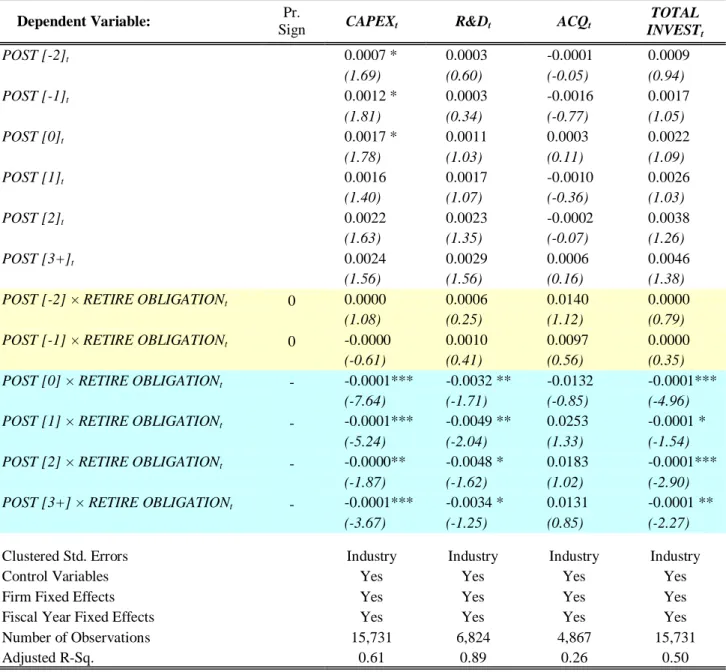
To test whether SFAS 106 affects investment decisions while controlling for the concurrent changes in economic conditions and investment opportunities, I use a differences-in-differences design that exploits the staggered nature of SFAS 106 adoption resulting from differences in firms’ fiscal year ends as well as some early adoption of the standard. Consistent with my prediction, I find that firms reduce their capital and R&D investment post-SFAS 106 adoption and that the reduction in investment is larger for firms that had larger postretirement benefit obligations. Further, the data show that the effect of SFAS 106 on investment persists for many years post adoption, which is consistent with the information hypothesis but not necessarily with alternative hypotheses related to changes in investment opportunities. Finally, I find that SFAS 106 adoption does not affect acquisition expenditures. I interpret this result as suggesting that the new information learned from complying with SFAS 106 does not affect acquisition decisions because they are more dependent on the valuation of the target firm (rather than the acquirer). This result is consistent with the evidence discussed earlier that the information hypothesis is less applicable for acquisition decisions.
This paper makes the following contributions. First, this paper contributes to the literature examining the relation between accounting changes and economic behavior. Specifically, many prior studies show that changes in the accounting rules for a transaction (e.g., R&D) have real effects on that particular transaction (i.e., R&D) for which the accounting changed. This paper extends this line
of inquiry by providing evidence that accounting rules have an impact on investment decisions even when the rule change is unrelated to the measurement and financial reporting of investment.
Second, this paper contributes to the emerging and growing literature on the relation between financial accounting and investment. One line of inquiry shows that financial reporting considerations and earnings management incentives affect investment decisions—i.e., firms’ investment decisions are affected by their incentives to report higher earnings (e.g., Bushee 1998; Bens et al. 2002; Graham et al. 2005; Graham et al. 2011). Another strand of research examines whether disclosure quality facilitates more efficient investment by (i) reducing agency problems (Biddle et al. 2009; Balakrishnan et al. 2014, 2016; Shroff 2015), (ii) informing managers of the disclosing firms and peer firms (McNichols and Stubben 2008; Badertscher et al. 2013; Shroff et al. 2014), and (iii) serving as a signal of managers’ forecasting ability (Goodman et al. 2014). I add to this line of research by studying the link between accounting and investment around the adoption of multiple new standards and by providing evidence of two mechanisms through which this relation manifests.
Finally, I use insights from the psychology literature to develop a new hypothesis suggesting that the process of complying with certain mandatory changes in financial reporting can alter managers’ information sets and consequently their investment decisions. The psychology literature argues that managers have limited attention and thus might not fully incorporate all information available within the firm in their decisions (see Camerer and Malmendier (2007) and DellaVigna (2009) for reviews of the literature). An implication of having limited attention is that managers use a single set of rules to measure performance for external reporting (i.e., financial accounting) and for internal decision making (i.e., managerial accounting) (Kaplan 1984; Zimmerman 2009; Dichev et al. 2013). As a result, changes in external reporting rules can lead to changes in managers’ information sets and thus affect their corporate decisions. I provide initial empirical evidence consistent with this hypothesis but caution that this hypothesis is in its infancy and requires further testing to establish its descriptive validity. Cheng et al. (2014) take a step in this direction.
2.1. Prior research on the relation between accounting changes and corporate decisions
A number of prior studies examine whether firms change their behavior in response to changes in GAAP. The vast majority of the studies examining the economic consequences of changes in GAAP focus on a single accounting change and show that the change in accounting for an economic activity affects that specific economic activity in the future. For example, Amir et al. (2010) show that firms shift pension assets from equities to bonds after SFAS 158 required firms to recognize the pension-funding status in the balance sheet. Zhang (2009) finds that firms cut their speculative use of derivative instruments after SFAS 133 required recognition of all derivatives as either assets or liabilities at fair value. Choudhary et al. (2008) find that firms accelerate the vesting of employee stock options to avoid recognizing unvested option grants at fair value under SFAS 123R. Hodderet al. (2002) show that the implementation of SFAS 115, which requires certain debt and equity investment securities to be fair-valued, led banks to change the size and composition of their investment securities portfolios. Mittelstaedt et al. (1995) document a reduction in retiree healthcare benefits after SFAS 106 changed the accounting for postretirement benefits. As for studies more focused on accounting changes and investment, Bens and Monahan (2008) provide evidence that firms cut investments in variable interest entities once FIN 46 required then to consolidate variable interest entities in their financial statements, and Horowitz and Kolodny (1980) find that firms reduce R&D activity in response to SFAS 2, which required firms to expense R&D costs.3
A common theme among prior studies that examine the real effects of changes in GAAP is whether accounting for a specific economic transaction (e.g., retirement benefits) affects the future use of that economic transaction (e.g., providing employees retirement benefits). This paper differs from prior studies by examining whether changes in GAAP have a more general effect on Capex, R&D, and acquisition decisions even when the accounting rules for these investments remain constant. This examination broadens the economic implications of changes in accounting rules beyond the direct effect of the accounting change.
3
2.2. Background for contracting hypothesis
Accounting numbers prepared under GAAP serve as a foundation for contracting on accounting information (Leftwich 1983). As a result, changes in GAAP can affect real decisions through their effect on contractual outcomes as long as there are transaction costs to altering contract terms (Holthausen and Leftwich 1983; Watts and Zimmerman 1986). In other words, if it is costless to undo the effect of accounting change on contracts, then changes in GAAP should not affect managers’ real decisions via their effect on contracts. For example, it is conceivable that some firms write contracts on the basis of pro-forma financial statements or specifically state in the contract that accounting changes will not affect the contractual outcomes (i.e., use “fixed” GAAP). However, writing contacts to accommodate changes in GAAP is quite challenging in practice, as Ball et al. (2015) discuss. Specifically, if a firm chooses to use fixed GAAP, it incurs the cost of keeping parallel books and might even have to have both sets of books audited. If borrowers have outstanding debt issued at different dates—each under a different set of accounting standards—then the costs of maintaining multiple sets of books can escalate quickly. Consistent with the arguments that writing and adjusting contracts to accommodate changes in GAAP are costly, Ball et al. (2015) find that mandatory IFRS adoption led to a significant drop in the use of accounting covenants in debt contracts because IFRS entails frequent rule changes as well as significant uncertainty about future rule changes. Their evidence speaks to the potential difficulty in altering contract terms to accommodate (frequent) accounting rule changes.4 In a scenario where adjusting contract terms in response to changes in GAAP is costly, a change in GAAP can affect managers’ real decisions, including their investment decisions.
2.3. Background for the information hypothesis
One of the primary purposes of financial reporting is to provide investors with information about firms’ future cash flows. Since managers make capital allocation decisions by forecasting and
4
In contrast to Ball et al. (2015), Demerjian et al. (2016) find that lenders modify contractual definitions after the adoption of SFAS 159 (Fair Value Option) but continue to use GAAP-based accounting covenants. However, Demerjian et al. (2016) do not examine how existing debt contracts, written based on pre-SFAS 159 GAAP, were affected by the implementation of the new accounting rule.
discounting future cash flows from corporate investments (Graham and Harvey 2001), a potential byproduct of producing financial accounting statements and assimilating information to comply with GAAP is that the compliance process can affect managers’ information sets. While managers have virtually unconstrained access to information within the firm on a more timely basis than that reported in financial statements, theories of costly information acquisition and processing suggest that managers have limited information processing capacities and are unlikely to be cognizant of all the information relevant for decision making (Simon 1973, 1979; Sims 2003; DellaVigna 2009). Consequently, compliance with a new accounting rule that was proposed to enhance the ability of investors to forecast a firm’s future cash flows may incrementally inform managers of that firm about the future cash flow consequences of their actions by forcing them to collect and process previously unprocessed data.
Consider the following examples: SFAS 106 required firms to switch from a cash basis of accounting for postretirement benefits to an accrual basis. The change required firms to compute the expected future cash outflows towards retirement benefits, which require estimates of future health care costs, expected lifespan of employees post retirement, expected retirement age, discount rates, and expected return on retirement plan assets, among other things. To the extent firms simply used current cash outflows as a proxy for expected future cash outflows towards retirement benefits (as anecdotal evidence suggests), they would have underestimated the true cost of postretirement benefits, and compliance with SFAS 106 would have provided firms with information about this cost. The same argument applies for SFAS 112, which required firms to accrue the expected cost of postemployment benefits.
Also consider SFAS 143 and FIN 47, which required firms to accrue the expected cost associated with the legal obligation to remove tangible long-lived assets such as property and equipment. Inherent in the calculation of the obligation are numerous assumptions and judgments, including the estimated life of the property to be retired, settlement amounts, inflation factors, discount rates, timing of settlement, and changes in the legal, regulatory, and environmental landscapes. Therefore, the cost of obtaining an accurate estimate of the retirement obligation is likely to be nontrivial. To the extent firms failed to fully factor these costs into their investment decisions,
complying with SFAS 143 and FIN 47 is likely to have provided managers with incremental information relevant for their investment decisions.
Although I do not observe whether firms accurately calculate the cost of postretirement benefits, postemployment benefits, and asset retirement, etc., and incorporate them into their investment decisions before adopting the respective accounting standard, anecdotal evidence suggests that at least some firms were not collecting the information necessary to estimate these costs before the accounting rule change.5 In addition, compliance with these standards often requires firms to hire outside experts (e.g., actuaries, appraisers, etc.) to help managers estimate accruals and evaluate the value of assets/liabilities (Reason 2003). Such an action suggests that firms may not have had the expertise to comply with the accounting change, and that the changes in GAAP, by requiring firms to hire outside experts, improved the quality of information available to managers to make their decisions.
Anecdotal and survey evidence also show that financial accounting rules affect management information systems—the premier source of information for managerial decision making.6 Conventional wisdom claims that managerial and financial accounting are fundamentally different entities since they cater to different audiences. However, Zimmerman (2009, p. 7) argues that using different systems for managerial decision making and external reporting can be costly because managers have limited information-processing capacities and the different systems can create disorder by reporting different numbers for the same concept. Dichev et al. (2013) survey managers and find that over 80% of their sample firms indicate that there is “a tight link between internal and external reporting” (p. 10). In such a scenario, changes in financial reporting rules are likely to affect internal information systems and thus provide managers with new information, which affects their investment decisions.7
5
For example, a Business Week article entitled “First Thing We Do Is Kill the Accountants” quotes FASB project manager Diana J. Scott as saying, “We are absolutely appalled. They [employers] honestly weren’t measuring this [healthcare benefits]. In some cases they didn’t even know whom they were covering as dependents. Employers are finding they promised much more than they can give” (September 12, 1988, p. 4). See Appendix A for additional examples.
6
See e.g., Kaplan (1984), Johnson and Kaplan (1987), Hopper et al. (1992), Drury and Tayles (1997), and Ball (2004). Hemmer and Labro (2008) provide analytical evidence that changes in GAAP affect management accounting systems.
7
Note that the information hypothesis does not assume that managers are acting sub-optimally. It is conceivable that managers rationally choose not to process certain data because the expected benefits of doing so are lower than the
2.4. Hypothesis development
I conjecture that changes in GAAP that have a negative (positive) impact on current and future financial statements are likely to have at least two effects. First, they increase the probability of having a negative (positive) contracting outcome, and managers respond to such changes in GAAP by cutting investment in risky assets with the goal of preventing further deterioration of financial ratios in the future. Second, complying with a new GAAP promulgation might incrementally inform managers that they overestimated (underestimated) the NPV of their investments.8 Such changes are likely to be followed by a decrease (increase) in investment.
I use the cumulative effect of an accounting change to measure the impact of an accounting change on firms’ earnings and book equity. The cumulative effect captures not only the difference between the old and new accounting practice, but also the degree to which a firm uses the economic transaction for which the accounting changed. As a result, cumulative effect captures both the magnitude and sign of the impact an accounting change has on firms’ financial statements, and I expect it to be positively related to investment. The above discussion leads to my first hypothesis.
H1: The cumulative effects of accounting changes are positively associated with firms’ investment.
Next, I hypothesize that changes in GAAP affect corporate investment decisions by altering the probability of violating financial covenants in debt contracts. Financial covenants in private debt agreements provide a good setting in which to examine the effects of changes in GAAP on investment because of their ubiquity and because covenants are generally defined in terms of modified versions of GAAP (Smith and Warner 1979; Leftwich 1983). Further, since the covenants in private credit agreements are tightly set, even small changes in financial ratios are likely to affect firm behavior (Kahan and Tuckman 1993; Verde 1999; Dichev and Skinner 2002). Finally, prior research finds that covenant violation is costly for the borrowing firm (e.g., Chava and Roberts 2008). Therefore, when a change in GAAP pushes firms closer to (away from) covenant violation,
expected costs. However, when a change in GAAP forces managers to process additional information, we might observe a change in their behavior because of the spillover effects from complying with the new accounting rule.
8
Computing NPV requires estimates of the project’s future cash flows and cost of capital. I remain agnostic as to whether the information learned by managers is about future cash flows or the project’s cost of capital.
firms are likely to respond by cutting (increasing) investment spending, provided covenants are not fully adjusted to undo the effect of the change in GAAP. Anecdotal evidence supports the arguments above. For example, a recent article in CFO.com discusses the impact of a proposed change in lease accounting on debt contracts.
The boards [FASB and IASB] are now mulling new ways to proceed on lessee accounting. Whatever changes the boards do make, however, one thing is nearly certain: the assets and liabilities of what are now operating leases will henceforth be recorded on corporate balance sheets. No matter how the boards decide to make that happen, the current apple cart of the relations between companies and their lenders is bound to be upset, experts say. That’s because the calculations of many of the key ratios governing bank covenants, such as earnings before interest, taxes, depreciation, and amortization (EBITDA), debt-to-equity (D/E) and return on assets (ROA), are bound to come out a whole lot differently for many companies.9
However, ex ante it is uncertain whether changes in the probability of covenant violation due to
mandatory accounting changes will cause managers to alter investment. Financial covenants are
generally put in place to monitor managers and prevent them from taking actions that transfer wealth from debt holders to equity holders (Tirole 2006). Since firms have no choice but to adopt mandatory changes in GAAP, debt holders could be more willing to renegotiate debt contracts to accommodate changes in GAAP. In fact, recent research suggests that contract renegotiation occurs frequently and should be thought of as the norm, not the exception (Roberts and Sufi 2009). Therefore, the costs of violating covenants due to mandatory accounting changes may not be large enough to warrant a change in investment if contracts can be renegotiated. That said, prior research also finds that the borrowing firm can face switching and hold-up costs once the contract is signed, which can increase renegotiation costs for the borrower (Hart and Moore 1988; Aghion and Bolton 1992; Rajan 1992). The above discussion leads to my next hypothesis.10
H2: The cumulative effects of accounting changes have a stronger association with firms’ investment when the change in GAAP alters firms’ financial covenants.
Finally, I hypothesize that some changes in GAAP affect investment by providing managers new information that is relevant for investment decision making. Changes in GAAP that increase the
9
The full article can be viewed at: http://ww2.cfo.com/gaap-ifrs/2014/02/lease-accounting-changes-jar-bank-covenants/.
10
Another reason why changes in GAAP might not affect investment via the contracting channel is because managers have other mechanisms through which they can alter contracting outcomes in the short run. For example, prior research suggests that managers manipulate accruals (Healy and Wahlen 1999), cash flows (Lee 2012), and day-to-day operations (Roychowdhury 2006; Cohen et al. 2010) to achieve the desired financial reporting outcomes. Given these alternatives, whether managers change long-term investment to lower the probability of an adverse accounting outcome and the resultant contracting outcome is an empirical question.
amount of accrual accounting estimates are more likely to inform managers because they may impose additional information-processing requirements on managers to arrive at reasonable accrual estimates. For example, compliance with standards such as SFAS 106 (postretirement benefits) and SFAS 142 (goodwill impairment) requires firms to make considerable judgments about future events and perhaps even seek expert help outside the firm to arrive at reasonable estimates of the expense/benefit and the value of the asset/liability (Reason 2003). Making informed estimates requires information which may not be readily available to managers. Therefore, such standards are more likely to inform managers. On the other hand, compliance with rules such as SFAS 123R (expensing stock options), SOP 98–5 (mandatory expensing of business startup costs), and SAB 101 (revenue recognition) is less likely to provide managers with decision-facilitating information. SAB 101, for example, increased verifiability requirements to recognize revenue, which primarily results in postponing revenue recognition until the higher verifiability threshold is met (Altamuro et al. 2005). Since managers are less likely to gain any information about the underlying cash flow stream from a higher verifiability threshold, this standard is less likely to inform managers. This discussion leads to my final hypothesis.
H3: The cumulative effects of accounting changes have a stronger association with firms’ investment when the accounting change is more likely to inform managers about the profitability of current and/or future projects.
Although the above hypotheses suggest that changes in GAAP affect investment due to a mixture of debt contracting and managerial learning, there may be other reasons why changes in GAAP can have real effects. For example, a potential third reason why changes in GAAP can affect investment is because other stakeholders (e.g., employees, customers, and suppliers) rely on certain key financial items/ratios, which either implicitly or explicitly (via contracts) requires managers to keep these financial items/ratios above a “threshold” similar to an explicit debt contract. My empirical tests try to parse out the debt-contracting and managerial-learning channels as potential reasons why changes in GAAP have real effects (as discussed below), but they do not preclude the idea that changes in GAAP affect investment via additional mechanisms.11
3. Investment model and sample selection
11
However, I concede that my tests cannot definitively separate out the information and debt contracting hypotheses from the hypothesis that the use of financial statement numbers by customers/suppliers affects manager behavior.
3.1. Investment model
A large body of investment literature (e.g., Fazzari et al. 1988; Kaplan and Zingales 1997; Rauh 2006; Chava and Roberts 2008) estimates linear equations of the form
t i, t i, 2 1 t i, 1 0 t i TOBIN S Q CFO INVESTMENT, ' _ (1)
where the dependent variable is the ratio of capital expenditures to assets, TOBIN’S_Qi,t−1 is represented by a market-to-book ratio of assets at the beginning-of-year t, and CFOi,t is a measure of
cash flow. A linear relationship between investment and TOBIN’S_Q is derived from the Q theory of investment pioneered by Tobin (1969) and further developed by Hayashi (1982). The key result from this literature is that investment is solely a function of Q in a frictionless world. Fazzari et al. (1988) motivate the inclusion of cash flow in this specification by arguing that firms are financially constrained and thus the availability of funds affects investment. A positive coefficient on CFO rejects a frictionless model of investment and suggests the presence of financing constraints (see Hubbard 1998). However, prior studies raise a number of objections about the validity of the above investment model and the inferences drawn from differences in investment-cash flow sensitivity across firms/time. Most prominently, prior studies argue that measurement error in Q significantly hinders the reliability of any inferences drawn using the above model, and suggest measurement error remedies to address the concern (Roberts and Whited 2012).
I examine the effect of changes in GAAP on corporate investment decisions by building on the neoclassical investment model (i.e., Q-theory model) described above. My primary prediction is that accounting changes incrementally affect investment decisions when other determinants of investment, such as investment opportunities and cash flows, are controlled for. This is because (i) accounting changes lead to changes in both income and book equity that affect contract terms such as net worth covenants, and (ii) compliance with accounting changes can lead managers to collect/process additional information that affects their subsequent decisions. The neoclassical investment model assumes that (i) contracts are complete with respect to accounting rules (i.e., accounting changes do not create any contracting frictions), and (ii) managers have complete
information sets and do not have limited attention.12 Therefore, accounting changes do not affect investment in the neoclassical investment model. My tests are based on the null hypothesis that the neoclassical model is correctly specified and go on to test the alternative hypothesis that accounting changes affect investment.
I use the cumulative effect of an accounting change as a proxy for the magnitude and sign of the impact an accounting change has on a firm’s financial statements. The cumulative effect is a one-time, noncash, below-the-line item reflecting the prior-period or “‘catch-up” effect of changing an accounting practice, which is recognized in the current period’s income statement. This amount captures the difference between the old and new accounting rules and the extent to which each firm used the transaction (or economic activity) for which the accounting changed (e.g., firms that do not compensate their employees with stock options are unaffected by the adoption of SFAS 123R and thus have zero cumulative effects associated with this standard). Computationally, the cumulative effect of an accounting change is the difference between the owner’s equity under the old accounting rules and the owner’s equity after the change in GAAP.
There are a number of advantages of using the cumulative effect as the proxy for the impact of a change in GAAP on firms’ financial statements for the purpose of my research question. First, the cumulative effect serves as a measure of the impact of an accounting change that can be compared across many different standards in a quantitative manner. Second, the cumulative effect captures the degree to which a firm uses the economic transaction for which the accounting changed and thus does not assume that all firms are equally affected by an accounting change, thereby creating within standard variation in the impact. Finally, the cumulative effect is especially meaningful for testing the contracting hypothesis because it has a one-to-one effect on some of the commonly used debt covenants (e.g., the net worth covenant, the tangible net worth covenant) that results from changes in GAAP rather than changes in firm performance. Thus, if an accounting change leads to a firm booking a ten million dollar charge as a cumulative effect, their net worth is that much closer to the
12
covenant threshold and this decrease in covenant slack can be attributed to the accounting change rather than changes in economic factors.13
I add the cumulative effect to equation 1 as another explanatory variable and estimate regressions of the following form to test my predictions.
t i, t i, 3 t i, 2 1 t i, 1 0 t
i TOBINS Q CFO CUMU EFF
INVESTMENT, ' _ _ (2)
I measure INVESTMENT as either CAPEX, R&D, ACQ (acquisition expenditures) or the sum of the three investment proxies (TOTAL INVEST). CFO is cash flows from operations, and CUMU_EFF is the cumulative effect of an accounting change (see Appendix C for variable definitions).
3.2. Sample selection
I begin my sample construction by identifying firm-years in the intersection of CRSP and Compustat with non-missing and nonzero values for the cumulative effect.14 Both voluntary and mandatory accounting changes cause firms to book a cumulative effect, and including voluntary changes in my sample raises endogeneity concerns. To eliminate voluntary accounting changes, I hand-collect information from more than 5,500 10-K filings corresponding to observations in Compustat that have a non-missing and nonzero cumulative effect.15 The information in 10-K filings helps me determine not only whether the accounting change is mandatory or voluntary but also which mandatory accounting change caused firms to book the cumulative effect. Requiring electronic 10-K filings from Edgar constrains my sample to begin in 1991.
The above criteria yield 5,530 firm-year observations between 1991 and 2007. Removing observations that are missing data for assets and the independent variables in my analyses, as well as firms in any regulated or financial industry, reduces my sample to 3,473 observations. Missing 10-K
13
The argument for using the cumulative effect to capture whether changes in GAAP affect investment via the information hypothesis is more nuanced because the underlying construct of interest is the amount of information managers learn from complying with a new accounting rule. If managers rely on financial accounting numbers based on GAAP to measure certain costs (which I assume), then they are more likely to learn new information from complying with a change in GAAP that (i) concerns an economic transaction commonly used by them and (ii) is more different than the previous one in place, both of which are captured by the cumulative effect.
14
I do not include firms with zero cumulative effects because I cannot tell whether such firms are truly unaffected by the change in GAAP or report a zero cumulative effect due to the method in which they adopt the standard. Specifically, firms can have a zero cumulative effect because (i) they are unaffected by the accounting change or (ii) they choose a method of adoption that does not require them to recognize a cumulative effect. Nevertheless, my inferences are unchanged if I use firm-years with zero cumulative effects as control firm-years in my main tests (untabulated).
15
filings and 10-K filings with insufficient information about the cumulative effect reduce my sample, to 3,012 observations. Of these, 2,795 (217) observations have mandatory (voluntary) accounting changes. My final sample for the Capex analyses comprises 2,795 firm-years. R&D and acquisition expenditure data are missing for a number of observations in my sample, and prior research typically assumes that these firms have zero R&D and acquisitions, respectively. However, Koh and Reeb (2015) find that many firms that fail to report R&D in their financial statements have a significant number of patents, thereby invalidating the assumption that missing R&D implies a firm has zero R&D investment. They also go on to show that treating missing R&D as zero R&D engenders substantive bias into the analyses. In order to mitigate any biases from coding missing R&D and acquisitions as zero, I restrict my analyses to firm-years with non-missing R&D and non-missing acquisition, which reduces my final sample for the R&D (acquisition) analyses to 1,390 (1,047).16, 17
I also require data on the presence of financial covenants to test the contracting hypothesis, which I obtain from the Dealscan database. Dealscan contains data on loan contracts for 59% of my sample. I assume that observations not in Dealscan do not have private debt contracts.18 For the subset of observations with financial covenants on Dealscan, I obtain their actual debt contracts from either Amir Sufi’s website or Edgar, and hand-collect data from these contracts on the contracting practices—i.e., fixed or floating GAAP—used in them. I drop the 281 observations for which I am unable to find the actual contract on Edgar even though these observations have debt agreements and covenants on Dealscan. As a result, the final sample for the analyses of the contracting hypothesis is further reduced to 2,514 (1,281; 900) observations when investment is measured as Capex (R&D; Acquisitions). Table 1 provides a detailed breakdown of the sample construction.
4. Research design and results 4.1. Descriptive statistics
16
Koh and Reeb (2015) suggest an alternative remedy for dealing with missing R&D observations that involves using industry averages. However, since my research question concerns how individual firms adjust their R&D activities in response to changes in GAAP, using an industry average would be inappropriate.
17
My inferences are unchanged if I include observations with missing R&D and acquisitions in my sample and treat such observations as having zero R&D and acquisition expenditures, respectively.
18
The Dealscan database contains between 50% and 75% of the value of all commercial loans in the United States during the early 1990s (Carey and Hrycray 1999). From 1995 onward, Dealscan coverage increases to include an even greater fraction of commercial loans (Chava and Roberts 2008). Therefore, assuming that only the firms covered by Dealscan have private debt agreements is unlikely to cause much measurement error.
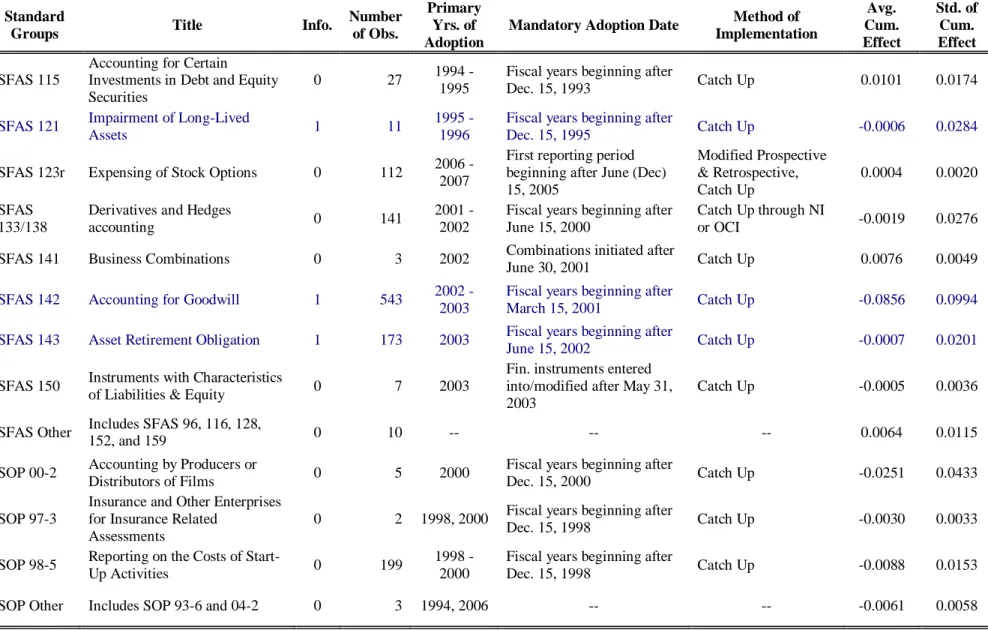
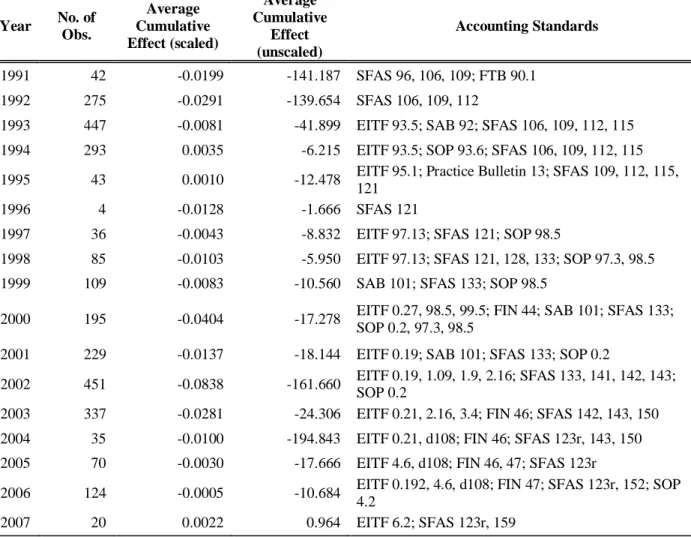
Table 2, Panel A shows the major accounting changes in my sample along with the years of adoption, methods of implementing the standard, mean CUMU_EFF for the rule change and its standard deviation, number of observations for each standard, and whether the standard is classified as informative to managers. The table shows that there is considerable variation in the average
CUMU_EFF across the standards. Table 2, Panel B shows the number of observations and the
accounting standards adopted each year, along with the scaled and unscaled mean cumulative effect. Table 3 reports the summary statistics for variables used in the regression analysis. The mean (median) CUMU_EFF is –2.6% (–0.3%) of assets, suggesting that accounting rule changes can have economically significant impacts on bottom line earnings and book equity. The mean CAPEX (R&D;
ACQ; TOTAL INVEST) is 6.1% (6.6%; 5.4%; 11.4%). The average firm in my sample is 21 years old,
has a market value of equity of $3.3 billion, and has cash flows from operations equal to 6.7% of assets. These statistics indicate that the average firm in my sample is large and profitable. However, the other statistics in the table show that there is considerable variation in these firm characteristics.
4.2. Do changes in GAAP affect investment?
To examine the relation between changes in GAAP and investment, I begin by testing whether
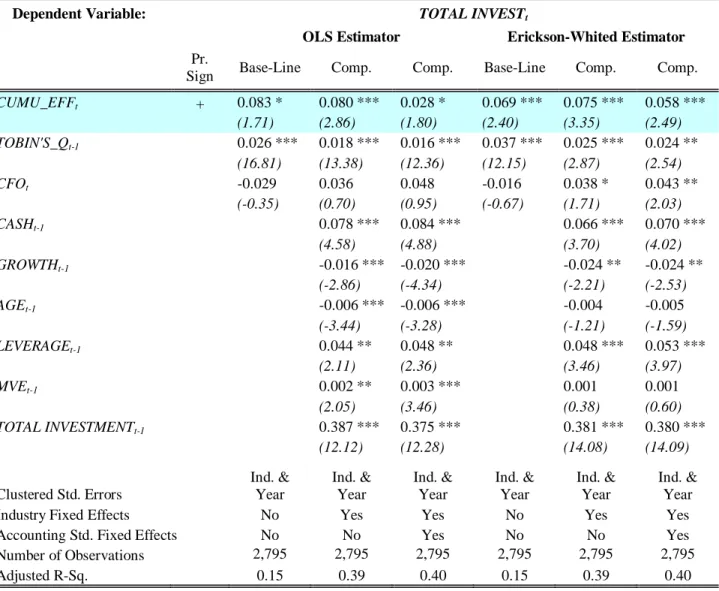
CUMU_EFF is associated with CAPEX, R&D, ACQ, and TOTAL INVEST. I estimate equation 2
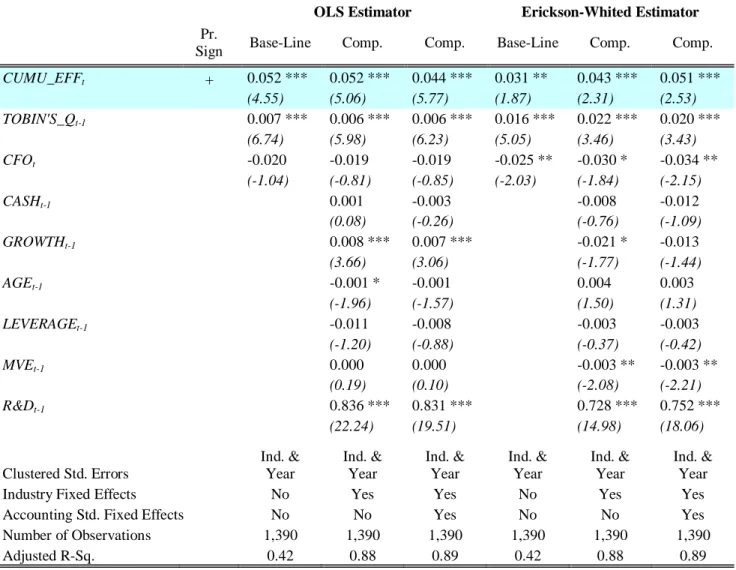
using ordinary least squares (OLS), and I compute standard errors by clustering them at the industry and year level (Petersen 2009; Gow et al. 2010). Column 1 in Table 4, Panel A reports the results from estimating equation 2 when CAPEX is the dependent variable. I find that the coefficient on
CUMU_EFF is positive and statistically significant at the 1% level (coef.=0.116, t-stat.=4.18). This
coefficient suggests that changes in accounting standards affect corporate investment decisions, consistent with my main hypothesis. The coefficients on TOBIN’S_Q and CFO are also positive and significant at the 1% level, consistent with prior research (e.g., Fazzari et al. 1988; Rauh 2006).
In Column 2, I examine whether my results are robust to including additional control variables used in prior accounting research on investment. Specifically, I control for CASH, GROWTH (change in total assets), AGE, LEVERAGE, and MVE (the market value of equity) following McNichols and Stubben (2008), Biddle et al. (2009), and Kausar et al. (2016). I control for lagged investment, which
gives the regression coefficients a changes interpretation and captures a firm-specific component to investment decisions not captured by the other variables (McNichols and Stubben 2008). Finally, I include indicator variables for each two-digit SIC industry in my regressions (Biddle et al. 2009; Badertscher et al. 2013). Column 2 in Table 4, Panel A shows that the coefficient on CUMU_EFF remains positive and significant (coef.=0.049, t-stat.=4.22) when I control for the additional variables. Further, the coefficients on the control variables are also consistent with that documented in prior research. For example, I find that the coefficients on TOBIN’S_Q, CFO, GROWTH, and lag
CAPEX are all positive and significant, consistent with those documented by Fazzari et al. (1988),
McNichols and Stubben (2008), Biddle et al. (2009) and Kausar et al. (2016).
Column 3 in Table 4, Panel A reports regression results when I include 23 indicator variables, one for each accounting standard group reported in Table 2. The benefit of including fixed effects for accounting standards is that the idiosyncratic attributes of individual accounting rules are filtered out in the estimation, thereby increasing the external validity of my inferences. However, the drawback is that some information that is relevant for documenting a relation between accounting changes and investment will also get filtered out in the process. I find that the coefficient on CUMU_EFF continues to be positive and significant at the 1% level, but it drops in magnitude from 0.049 to 0.023. This is expected given that only a subset of the variation in CUMU_EFF is used to estimate the relation between the accounting changes and investment.
Next, to mitigate concerns that the association between the cumulative effect and investment is due to measurement error in TOBIN’S_Q, I examine the robustness of the above result to using the measurement error remedy proposed by Erickson and Whited (2000; EW henceforth). EW use a generalized method of moments (GMM) estimator to exploit the information contained in the higher-order moments of the observed regression variables to increase the precision of the estimates and mitigate any effects of measurement error. Columns 4–6 in Table 4, Panel A present the results when I use the EW estimator to test my hypothesis. Consistent with the previous results, I find that the coefficient on CUMU_EFF is positive and significant at the 5% level or better in the three regression models discussed above. Further, I find that the coefficient on TOBIN’S_Q increases in the EW specification compared to the OLS estimate of the coefficient, which is consistent with a reduction in
measurement error in TOBIN’S_Q. In terms of economic magnitude, a one standard deviation increase in CUMU_EFF is associated with a 2.4% increase in CAPEX from its mean (in regression with the comprehensive set of control variables presented in column 3).
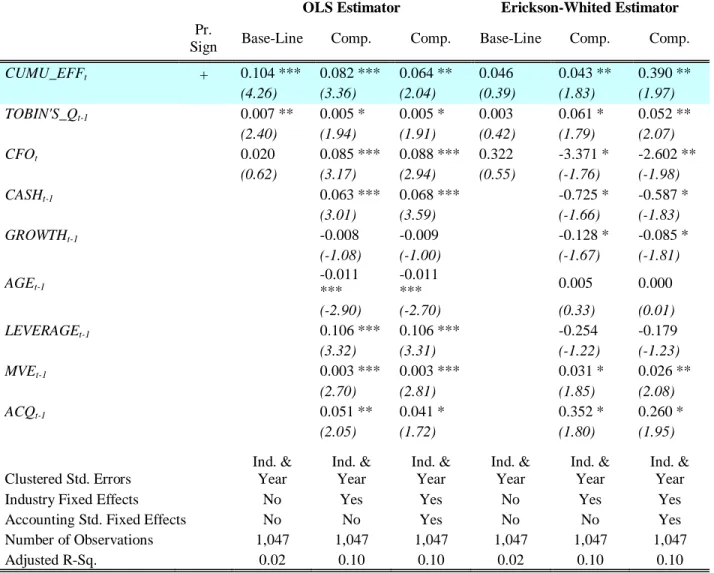
Table 4, Panels B, C, and D repeat all the above analyses with R&D, ACQ, and TOTAL INVEST as the dependent variables, respectively. Consistent with the results reported in Table 4, Panel A, I find that the coefficient on CUMU_EFF remains positive and significant across all regression specifications for all three dependent variables R&D, ACQ, and TOTAL INVEST, with one exception; the coefficient on CUMU_EFF is positive but insignificant in the base-line Erickson-Whited model when the dependent variable is ACQ. In terms of economic magnitude, a one standard deviation increase in CUMU_EFF is associated with a 4.3% (7.6%; 1.6%) increase in R&D (ACQ; TOTAL
INVEST) based on the regression in column 3 in the panels. Overall, the results in Table 4 suggest
that changes in GAAP affect Capex, R&D expenditures, and acquisition expenditures.19
For the remainder of the analyses, I tabulate results where I include the entire set of control variables in my regressions with industry and accounting standard fixed effects (as described in Table 4, column 3). The expanded model helps mitigate potential correlated omitted variable bias in my regression estimates.20
4.3. Why do changes in GAAP affect investment? Tests of the contracting hypothesis
Next, I examine whether changes in GAAP affect investment decisions by altering the probability of violating debt covenants (contracting hypothesis). To test this hypothesis, I exploit variation in (i) the definition of GAAP used in debt contracts (i.e., floating GAAP vs. others) and (ii) the presence of accounting covenants in debt contracts. Prior research identifies three common debt contracting practices: the “fixed GAAP” practice, which excludes all accounting changes once the contract is signed; the “floating GAAP” practice, which uses the most up-to-date GAAP; and a hybrid that gives lenders and borrowers a “mutual option to fix” GAAP at any point in time (see
19
In untabulated analyses, I verify that my results are robust to measuring investment in changes rather than levels; retaining only one observation per firm; and dropping one standard at a time and re-estimating my results.
20
The Erickson-Whited (EW) methodology is fairly onerous on the data because it requires estimates of higher order moments of the covariates. As a result, the EW approach has limited power in small samples. In fact, Erickson and Whited (2000, p. 1043) indicate that their estimator has “limited power for the smaller sample sizes.” Thus, I tabulate the results using this methodology for the main tests in the paper (given my relatively small sample size compared to other studies that use the entire Compustat population) and continue to use OLS as the main specification in the paper.
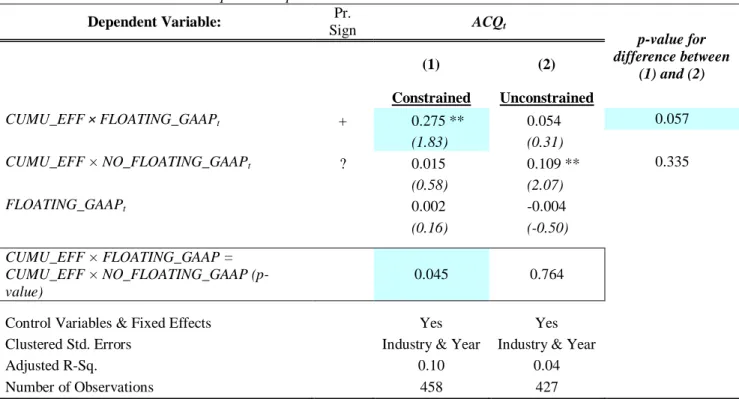
Beatty et al. 2002; Christensen and Nikolev 2012). The covenants in debt contracts that use fixed or hybrid GAAP are unaffected by changes in GAAP because they explicitly disallow (or provide contracting parties the option to disallow) such changes to covenants. Thus, changes in GAAP are likely to affect investment via the contracting channel only when debt contracts are based on floating GAAP. To incorporate this institutional feature of debt contracts in my tests, I hand-collect data on the contract type by reading all debt contracts for my sample firms and constructing an indicator variable—FLOATING_GAAP—that equals one if (i) the debt contract uses the floating GAAP, and (ii) there is at least one covenant that is affected by the cumulative effect of an accounting change.21 Specifically, I estimate the following regression to test the contracting hypothesis:
t i, t i, 5 t i 4 t i 3 t 2 t i 1 0 t i CONTROLS GAAP FLOATING GAAP FLOATING NO EFF CUMU GAAP FLOATING EFF CUMU CFO Q S TOBIN INVESTMENT
' _ _ _ _ _ _ _ ' , , 1 , , (3) where NO_FLOATING_GAAP is an indicator variable that takes the value of one ifFLOATING_GAAP equals zero, and CONTROLS is a vector of the control variables described
earlier.22 All other variables are as described before. The coefficients of interest in equation 3 are β3 and β4, which capture the relation between changes in GAAP and investment for firms with and without debt covenants that can be affected by an accounting change, respectively.
Table 5 presents the results from estimating equation 3. Columns 1, 2, 3, and 4 in Table 5 present the results when Capex, R&D, acquisitions, and total investment are the dependent variables, respectively. The first column shows that the coefficients on both CUMU_EFF × FLOATING_GAAP and CUMU_EFF × NO_FLOATING_GAAP are positive and significant (coef.=0.062 and 0.032, t-stat.=1.74 and 4.03, respectively). Although the coefficient on CUMU_EFF × FLOATING_GAAP is larger than that on CUMU_EFF × NO_FLOATING_GAAP, the difference between these coefficients is insignificant (p-value=0.19). These results suggest that changes in GAAP have a similar effect on
21
Debt contracts include several covenants, not all of which are affected by the cumulative effect. For example, a covenant limiting the maximum debt to cash flows ratio is unaffected by the cumulative effect since the cumulative effect does not have any direct cash flow implication.
22
Note that many of the observations in my sample have NO_FLOATING_GAAP equal to one because they do not have a debt contract in the Dealscan database, and I assume that such firm-years do not have private debt contract (and thus no contract that uses floating GAAP).
CAPEX when firms have contracts affected by accounting changes and when contracts are unaffected
by accounting changes. Thus, these results provide limited support for the contracting hypothesis, at least with respect to Capex decisions. One potential reason for the weak evidence linking changes in GAAP to Capex via debt contracts is because debt covenants often rely on earnings metrics excluding depreciation such as EBITDA rather than income after depreciation. As a result, the depreciation of Capex is likely to be irrelevant for income statement based covenants.
Column 2 shows that the coefficient on CUMU_EFF × FLOATING_GAAP is positive and significant at the 10% level but the coefficient on CUMU_EFF × NO_FLOATING_GAAP is insignificant (coef.=0.227 and 0.030, t-stat.=1.53 and 0.95, respectively). Further, the coefficient on
CUMU_EFF × FLOATING_GAAP is significantly larger than that on CUMU_EFF × NO_FLOATING_GAAP (p-value=0.099). These results are consistent with the contracting hypothesis
and suggest that changes in GAAP affect R&D investment when debt contracts contain covenants that are affected by changes in GAAP (but not otherwise).
Column 3 shows that the coefficient on CUMU_EFF × FLOATING_GAAP is positive and significant at the 10% level but the coefficient on CUMU_EFF × NO_FLOATING_GAAP is insignificant (coef.=0.276 and 0.056, t-stat.=1.50 and 1.46, respectively). In addition, the coefficient on CUMU_EFF × FLOATING_GAAP is significantly larger than that on CUMU_EFF ×
NO_FLOATING_GAAP (p-value=0.101). These results are again consistent with the contracting
hypothesis and suggest that changes in GAAP affect acquisition expenditures when debt contracts contain covenants that are affected by changes in GAAP. Column 4 presents the results with total investment as the dependent variable and provides similar inferences—i.e., that changes in GAAP have a larger effect on total investment when debt contracts are based on floating GAAP compared to when they are based on fixed GAAP.
Overall, the results in Table 5 suggest that changes in GAAP affect R&D and acquisition expenditures via the contracting channel, and there is at best weak evidence suggesting that changes in GAAP affect Capex via the contracting channel. Given the differences in the accounting treatment of R&D relative to Capex (i.e., immediate expensing of R&D versus capitalize and depreciate
Capex), it is perhaps not surprising that managers are more likely to alter R&D investment in response to changes in GAAP that affect covenant slack.
4.4. Why do changes in GAAP affect investment? Tests of the information hypothesis
To test the information hypothesis, I exploit differences in the characteristics of the changes in GAAP and classify them into two groups, INFO and NO_INFO, based on their likelihood of providing managers with decision-facilitating information. I hand-collect data on which GAAP promulgation was adopted by each firm-year in my sample from 10-K filings. Next, to classify standards, I evaluate the likelihood that they provide managers with information along the following dimensions: (i) Whether the change in GAAP increased the amount and complexity of accrual accounting estimates that managers are required to make. Managers require information to estimate the numbers reported in public financial statements, some of which may not be readily available. Therefore, standards that increase estimation requirements are more likely to provide managers with information. (ii) Whether the change in GAAP requires firms to hire outside experts such as actuaries and appraisers to aid with compliance. Those changes that require the help of outside experts are classified as more likely to inform managers (e.g., Goodwill—SFAS 142, Asset Retirement Obligation—SFAS 143). And (iii) whether the stated objective of the new standard is to make financial statements more relevant for valuation. Although FASB strives to make financial statements both relevant and reliable, there is generally a tradeoff between the two objectives. Therefore, some standards (e.g., SAB 101—Revenue Recognition) are designed to make financial statements more reliable, whereas other standards (e.g., SFAS 142—Goodwill) are designed to make financial statements relevant. Standards designed to improve relevance are more likely to inform managers, since relevant information by definition should help predict future cash flows. Table 2 and Appendix A contain my classification scheme and a detailed discussion of my classification choices.
To validate my classification, I examine whether CUMU_EFF, which arises from standards classified as more likely to inform managers, is more closely associated with concurrent stock returns than CUMU_EFF, which arises from standards classified as less likely to inform managers, controlling for contemporaneous changes in earnings. This test is predicated on the assumption that stock prices impound managers’ information sets. Under this assumption, we would observe an