Do Job-Seekers Benefit from Contacts? A Direct Test
by
George Jun Lan
A.B., Woodrow Wilson School of Public and International Affairs Princeton University, 2009
Submitted to the Alfred P. Sloan School of Management in Partial Fulfillment of the Requirements for the Degree of
Master of Science at the
Massachusetts Institute of Technology
May 2012
© 2012 George Jun Lan. All rights reserved.
The author hereby grants to MIT permission to reproduce and to distribute publicly paper and electronic copies of this thesis document in whole or in part in any medium now known
or hereafter created. Author:
Department of the Sloan School of Management
May 4, 2012
Certified by:
Elena Obukhova Assistant Professor of Global Economics and Management Thesis Supervisor Accepted by:
Ezra Zuckerman Professor of Technological Innovation, Entrepreneurship, and Strategic Management Chair, MIT Sloan School of Management PhD Program
Do Job-Seekers Benefit from Contacts? A Direct Test by
George Jun Lan
Submitted to the Department of Alfred P. Sloan School of Management on May 4, 2012 in Partial Fulfillment of the
Requirements for the Degree of Master of Science
ABSTRACT
While it is intuitively plausible that using contacts in job search benefits a job-seeker, there is still both theoretical disagreement and inconclusive empirical evidence on why a job-seeker's social capital is associated with her labor-market outcomes (for reviews, see Mouw 2003, 2006). We take an important step toward identifying the source of this association by proposing a direct
test for whether or not a job-seeker benefits from using her social networks. This direct test holds
an important advantage over an indirect test proposed by Mouw (2003). By using a within-individual fixed-effects methodology, the direct test rules out most sources of between-within-individual heterogeneity (Yakubovich 2005). Therefore, its results are not influenced by the quality of the measures used to assess a job-seeker's social capital. Using unique data on university graduates' successful and unsuccessful job-searches, we show that, for job-seekers who use contacts to search for jobs, that method leads to better labor-market outcomes than formal methods do. We conclude by discussing the implications of our findings for the literature on job search and social networks.
Thesis Supervisor: Elena Obukhova
Do Job-Seekers Benefit from Contacts? A Direct Test
INTRODUCTION
"It is not what you know, but who you know." This is not only a nugget of popular wisdom and practical experience, but a concise summary of much of the sociological theorizing on labor markets (for reviews, see Granovetter 1995; Lin 2000; Marsden and Gorman 2001). It is intuitively plausible that a job-seeker can improve her labor-market outcomes by using her contacts. On the one hand, contacts can influence the hiring decisions made by employers or other hiring intermediaries (Corcoran, Datcher, and Duncan 1980; Bian 1997; Bian and Ang 1997). Alternatively, contacts can provide a job-seeker with information and insight on (a) new job opportunities, (b) job opportunities that provide a better match for her skills, or (c) firm-specific hiring process (Rees 1966; Granovetter 1973; Fernandez and Weinberg 1997). Consistent with this intuition, several studies have found that job-seekers with more social capital achieve better labor-market outcomes (de Graaf and
Flap 1988; Lai, Lin, and Leung 1998; V61ker and Flap 2001; Lin 2002).
Yet, despite the literature's long history, there is still both theoretical disagreement and inconclusive empirical evidence on why a job-seeker's social capital is associated with her labor-market outcomes. In particular, recent research suggests the association might be spurious-an omitted variable may influence both the quality of a job-seeker's social capital and her labor-market outcomes (Mouw 2003; for a more general statement of this problem,
see Manski 1993). One candidate for this omitted variable is homophily in friendship networks-the propensity to make friends similar to oneself (McPherson, Smith-Lovin, and
Cook 2001; Mouw 2003, 2006). For example, highly talented people are more likely to be friends with other highly talented people. They are also more likely to achieve better labor-market outcomes, independent of their friends' help.
To examine whether the association between social capital and labor-market outcomes is spurious, Mouw (2003) proposes an indirect test for determining network causality. Specifically, seekers who expect higher returns from using a particular job-search method should be more likely to use that method than job-seekers who expect lower returns (Holzer 1987). Thus, we expect that if people benefit from using contacts, job-seekers with more social capital should be more likely to use contacts than otherwise identical job-seekers with less social capital. But drawing on data from the Multi-City Study of Urban Inequality and the Urban Poverty and Family Life Study, Mouw finds that job-seekers who have more social capital are no more likely to find jobs' through their social networks than those with less social capital. Thus, we cannot rule out the possibility that the association between a job-seeker's social capital and her labor-market outcomes is spurious.
Yet these results are particularly puzzling when we consider the strong evidence in favor of a non-spurious explanation from single-firm studies (Fernandez and Weinberg 1997; Petersen, Saporta, and Seidel 2000; Fernandez, Castilla, and Moore 2000; Fernandez and Sosa 2005; Yakubovich and Lup 2006). Those studies, which compare the outcomes of job-seekers applying through referrals to those of job-job-seekers applying without referrals,
consistently find that the former group achieves better labor-market outcomes. Single-firm studies have been replicated in a variety of organizations, increasing our confidence in the
When Mouw uses the phrase "use contacts", he actually refers to "finds a job through contacts" (2003:873, footnote 3). In his case this switch is justified because he shows that if job-seekers are more likely to search using contacts, they will be more likely to find a job through contacts. However, as we argue in the theory section, it is important to maintain this conceptual distinction. To avoid confusion, "use networks" refers to a seeker searching forjobs through her network contacts and "finding a job through contacts" refers to a
generalizability of their results. Thus, these two streams of literature yield seemingly contradictory conclusions about causal relationship between the contacts used to search for jobs and the labor-market outcomes-an important gap in our understanding of the role of
social networks in labor markets.
In this paper, we take an important step toward filling this gap by proposing a direct
test of whether or not a job-seeker benefits from using her social networks. We argue that to
evaluate the relative effectiveness of different search methods, we need to compare both successful and unsuccessful search attemptsfor each job-seeker (e.g., Mouw 2002; Yakubovich 2005; Obukhova 2011). This direct test holds an important advantage over an indirect test. By using a within-individual methodology, our direct test eliminates the possibility that unobserved differences between individuals will affect our results. This means that the direct test's results are not influenced by the quality of the measures used to
assess a job-seeker's social capital.
In the following sections, we discuss the contradiction in the results of previous studies on whether job-seekers benefit from contacts. We then explain how our empirical strategy and our research setting-school-to-work transition-provide a unique opportunity to begin to resolve this contradiction by overcoming the difficulties plaguing previous studies. We proceed to describe our data and method. In the results section, we present the results of the direct test and compare them with the results of an indirect test. In the
discussion section, we provide some preliminary observations on why an indirect test could lead to misleading results. We conclude by outlining the implications of our study for the literature on job search and social networks.
THEORY
While it seems intuitively plausible that job-seekers benefit from contacts, scholars have found it extremely difficult to prove it analytically (for reviews, see Mouw 2003, 2006). The first generation of studies typically examined the relationship between a job-seeker's search method and her labor-market outcomes (for reviews, see Lin 2000; Marsden and Gorman 2001; Mouw 2003). These studies suffered from the common methodological problem of selection on the dependent variable (Montgomery 1992; Granovetter 1995; Fernandez and Weinberg 1997). If we look at only the successful outcomes, we ignore how many alternative offers a person receives, the means by which they were acquired, and how they compare to the chosen job. This may lead to misleading conclusions because we may be undercounting the bad offers that poor job-search channels yield.
While the second generation of studies has attempted to address this pitfall, Mouw's recent critique suggests their results fail to establish causal nature of this association. To avoid the selection on the dependent variable problem, the second generation of studies focused on the job-seeker's social capital rather than on the tie used to find a job. These studies found solid evidence that job-seekers with more social capital have better labor-market outcomes than those with less social capital (de Graaf and Flap 1988; Lai et al. 1998; V61ker and Flap 2001; Lin 2002). However, these studies suffer from another methodological problem-omitted-variable bias. The relationship between social networks and labor-market outcomes may be spurious; an omitted variable could influence both the quality of a job-seeker's social capital and her labor-market outcomes.
To examine this possibility, Mouw (2003) proposes an indirect test: Ifjob-seekers do benefit from using contacts, then those with more social capital should be more likely to find
a job through contacts than otherwise identical job-seekers with less social capital. Drawing
on data from the Multi-City Study of Urban Inequality and the Urban Poverty and Family
Life Study, Mouw finds that job-seekers with more social capital are no more likely to use
their social networks to find a job than those with less social capital. Thus, we cannot rule out
the possibility that the association between a job-seeker's social capital and her labor-market
outcomes is spurious.
However, the indirect test could lead to misleading conclusions if it does not
accurately capture the heterogeneity of different job-seekers' social capital. Capturing
relevant social networks is inherently difficult (Bernard et al. 1984; Freeman and Romney
1987; Brewer 2000; Quintane and Kleinbaum 2011) and even more so for networks relevant
to job search, because weak ties matter more than strong ties for job-seekers (Granovetter
1973; Yakubovich 2005). Consider a newly minted Ph.D. seeking a job in a sociology
department. Presumably, her academic contacts-such as her dissertation advisor, former
classmates, coauthors, and people she has met at conferences-may be in the best position to
provide helpful information or influence. Were we to collect information only on her family,
childhood friends, or neighbors, we might fail to capture the networks that have the most
influence on labor outcomes.
To address the possible heterogeneity among job-seekers, we need to switch to a
within-individual test. Our version of the direct test draws on data from the full set of
applications that a job-seeker sends out during her job search, not just those that lead to
successful outcomes. Following Yakubovich (2005) and Obukhova's (2011) approach to
analyzing multiple-method job-search data,2 our models use within-individual fixed-effects
2 This approach differs from the fixed-effects direct test in Mouw's work (e.g. 2002, 2003) in two important ways. Using data from the National Longitudinal Survey of Youth (NLSY), Mouw compares how a given
comparisons. This means that, instead of comparing the outcomes of two people's job searches, we compare the outcomes from applications submitted by the same person through different job-search methods. This approach rules out any potential individual-level omitted-variable problems by controlling for all sources of between-individual heterogeneity, both observed and unobserved, other than the differences in search method used in the analyses (Mouw 2006). Thus, even if the available measures of social capital do not accurately capture the ties most relevant to job search, the validity of the direct test's results is not affected.
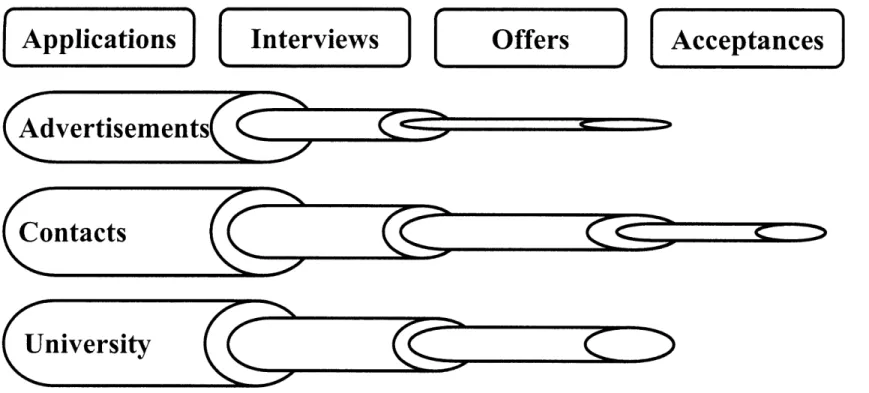
Figure 1 presents a conceptual diagram of how we model an individual's job search.3
Each funnel represents a different method by which a job-seeker could learn about job opportunities. The width of the leftmost cylinder in each funnel represents the number of applications that a job-seeker initially submits. Each subsequent cylinder represents the number of those original applications that lead to interviews, then to offers, and finally to a job acceptance. To determine whether or not using contacts benefits a job-seeker, we
compare the effectiveness of using contacts with the effectiveness of using formal methods when used by the same person. Through comparing the relative rates by which different job applications move through this narrowing funnel, we can evaluate whether contacts are indeed an effective method of job search.
<Jgurel HERE>
seeker found his most recent job at three different points in time (1994, 1996, and 1998). But for each point in time, the NLSY does not provide information on both successful and unsuccessful job-search attempts. Therefore, the results in Tables 2-4 (2003:878-881) suffer from the same selection-on-the-dependent-variable problem that characterizes past job-search studies. Moreover, even with individual fixed effects, there could still be intertemporal heterogeneity in job applications: Two job applications submitted by the same person but several years apart will not be evaluated in the same light. The more recent application could demonstrate that the candidate has several more years of additional working experience than indicated in the older application. Our study design minimizes this concern by analyzing job-search histories at only one point in time: the school-to-work transition.
3 Although not all employers recruit and screen potential employees in this standard manner, most large firms use a variant of this model (Cohen and Pfeffer 1986) and it is a reasonable simplification of the general process.
Contacts in school-to-work transition
The school-to-work transition offers a strategic research setting in which to conduct
our analyses. First, graduating university students search for jobs through a wide variety of
methods, making it possible to analyze the within-individual effectiveness of each method. In
our dataset, the majority of students submit applications through at least two search methods.
Second, the short time-span during which students search forjobs reduces concerns about the
accuracy with which they recall their job-search histories (Pierret 2001). This is especially
important since we collect information on all the job applications that a student submits, not
just the successful one.
Furthermore, our empirical context provides a conservative test for the usefulness of
social networks in job search because, for graduating students, social networks may not be
the most effective method. First, their networks are less likely to have useful resources. In
contrast to older job-seekers whose same-age peers have accumulated considerable job
experience and wide-ranging networks, these graduating students' peers are themselves
either graduating students or recent entrants to the job market and are less likely to be in a
position to pass on important information about job opportunities or to influence hiring
managers' decisions. As a result, we know that first-time job-seekers are less likely to rely on
and benefit from their social networks (McDonald and Elder 2006; McDonald 2011).
More importantly, graduating students have a much more viable alternative to
searching through contacts-university intermediaries (Rosenbaum and Kariya 1989;
Rosenbaum 2001). University career offices often accumulate both extensive information
about employment opportunities and intensive information about specific employers' hiring
practices and tendencies.4 The information that career offices transact may be particularly valuable due to its limited distribution. For example, Ho's (2009) ethnography of the recruiting process of New York City financial firms describes how some job openings are made available only through the career offices of select universities. Career offices also often maintain lists of alumni who work for particular employers and whom students can contact. In sum, for job-seeking graduating students, university intermediaries are a highly attractive alternative to personal contacts.
DATA AND METHOD
Sample
Our data was collected as part of the Future Paths project, a longitudinal study of students at four major universities with engineering programs (hereafter referred to as Research University, Private College, Engineering-Only College, and Public University). The Future Paths project selected these universities for their geographic proximity to one another and to reflect the diversity in engineering programs. Research University is a top-tier engineering university with both undergraduate and graduate programs. Private College is a small women-only liberal arts college with a relatively new engineering program.
Engineering-Only College offers only engineering undergraduate degrees. Public University is a large state school with both undergraduate and graduate programs. The study selected its original set of students using a stratified random sample of the undergraduates at each school.5
4 See Small (2009) for a general discussion of the role of intermediaries as storage spaces for networks and resources.
5 Non-engineering majors were included as a control group at each school except Engineering-Only College. The control group was selected prior to the students' freshmen years so that the number of engineers and
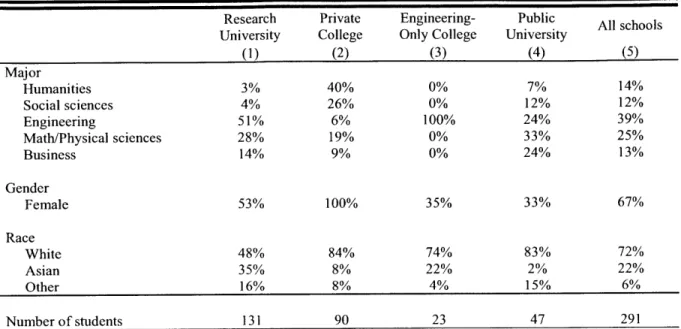
non-Beginning in their first year of college, participating students received online surveys every year. The fifth year of surveys specifically contained the job-search questions that we use for our analyses. Of the 487 students that took part in the fifth year of this survey, 291 provided information about their job-search histories. Table 1 presents basic means and standard deviations for the descriptive characteristics of these students, both as a whole and disaggregated across the four schools.6 Of all the student job-seekers, 67% were female,7 72% were White, and 22% were Asian. Although 45% of the students who responded to the
fifth-year survey came from Research University and only 11% from Engineering-Only College, these percentages match the baselines of the initial sample: 41% Research
University, 33% Private College, 8% Engineering-Only College, and 19% Public University. <Table I HERE>
Variables
The questionnaire asked each student how many applications she sent to job opportunities found through each of 13 job-search methods: advertisements, career office, college alumni network, school friends, non-school friends, family members, internship, campus recruiter, direct contact with company, employment agency, head-hunter, faculty and other. We constructed independent variables by grouping the 13 job-search methods into five
categories: advertisements (reference category for our analysis), university intermediaries
engineers were proportional at the beginning of the longitudinal study. However, over the course of the study, many students switched majors, which partly explain why only 39% of the final sample was engineers (see Table 1).
6 We also analyzed the descriptive statistics of the entire set of students in the original sample, including those
who did not search for jobs, and did not find any statistically significant differences in the demographic composition of these two sets of students.
7 Our dataset's unusually high percentage of female students is not surprising given that one of the universities was a women-only college.
(career office and college alumni network8
), contacts (school friends, non-school friends, family members), internships, and all other methods (campus recruiter, direct contact with company, employment agency, head-hunter, and faculty and other).
The questionnaire also asked how many interview opportunities and job offers each student received via each method and which of these opportunities the student accepted. Using this information, we construct three dependent variables: receiving an interview,
receiving an offer, and getting ajob. Receiving an interview is coded 1 if an application led
to an interview opportunity. Receiving an offer is coded 1 if an application led to a job offer.
Getting ajob is coded 1 if an application led to a job offer that the job-seeker accepted.9 The
first two outcomes allow us to examine the effects of using social networks at different stages of the job-search and hiring process, while the last outcome is most similar to the dependent variable of previous job-search studies.
Model
To test the relative effectiveness of different job-search methods, we run individual fixed-effects linear probability models to analyze the likelihood that a job application
achieves one of the three aforementioned outcomes. To address the theoretical concern about
8 We chose to code the college alumni networks as a university intermediary method rather than as contacts because we believe the underlying mechanisms that influence how college alumni networks help job-seekers are more similar to those of the career office than to those of contacts (cf. Lee and Brinton (1996), who consider alumni networks as a semi-institutional job-search method). A key difference between college alumni networks and job-seekers' personal contacts is that the former method is, in principle, available to any student from the same university. As further robustness checks, we have also rerun all our models with (a) alumni networks as a separate covariate, (b) alumni networks included in the "all other methods" category, and (c) alumni networks included in the "contacts" category; the results remained substantively identical to those reported here. 9 According to both our model and the structure of the questions on the survey, any application that leads to an offer must also have led to an interview. Likewise, any application that leads to a job acceptance must also have led to an interview and an offer.
predicted values falling outside the [0, 1] range,'0 we estimate a fixed-effects logit model.
Then, to address the possibility of correlations in the error terms of each individual's
application outcomes, we estimate fixed-effect linear probability models with clustered
standard errors and a fixed-effects logit models with clustered standard errors. Across these
different model specifications, there was no change in the direction of the results and little
change in the significance of the marginal effects. Thus, for ease of interpretation, we present
only the results from the linear probability models.
RESULTS
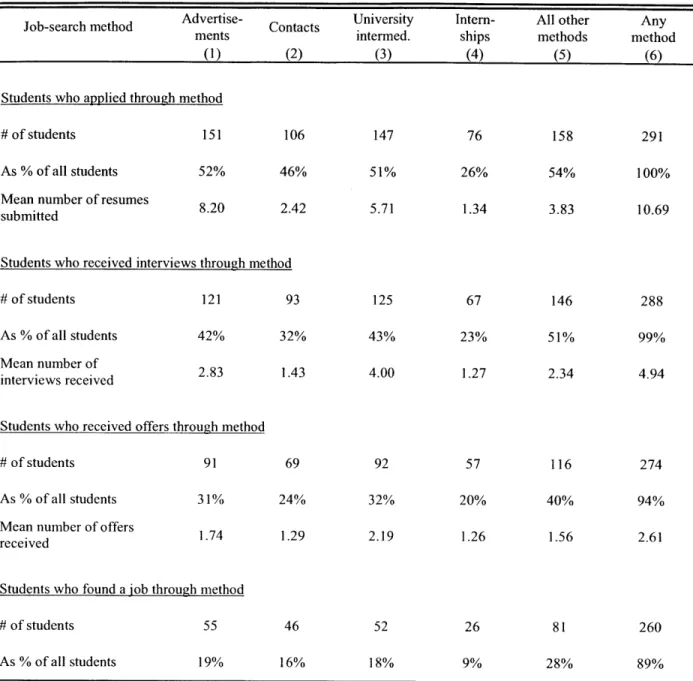
Table 2 reports descriptive statistics on job-search patterns using the student as the
unit of analysis. We find that, during their job search, students submitted, on average, 10.69
applications though all search methods combined (Column 6). Of all job-seeking students,
52% applied for jobs through advertisements, 46% through contacts, and 51% through
university intermediaries. About a quarter applied to employers with whom the student had
had an internship, and more than half applied through other methods. "
Though roughly the same percentage of students (but obviously not necessarily the
same students) used each of the job-search methods, the number of applications students sent
through those methods differed greatly. For example, students who applied through
advertisements on average submitted of 8.2 applications, while students who applied through
contacts and university intermediaries submitted an average of only 2.4 and 5.7 applications,
respectively. Students who applied with employers where they had had an internship
'm Some scholars (e.g., Aldrich and Nelson 1992) advise against using the linear probability model because it can theoretically yield predicted probabilities greater than I or less than 0. This does not occur in our models.
Specifically, 19% applied through a campus recruiter, 13% through direct contact with an employer, 9% through a job placement agency, 6% through a headhunter, and 9% through other miscellaneous means.
submitted an average of only 1.3 applications. Among students who applied through all other methods, the average was 3.8 applications.
<Table 2 HERE>
Disaggregating the statistics across different stages of the hiring process suggests that the students who search through advertisements, contacts, and university intermediaries appear to have roughly similar probabilities of having a positive labor-market outcome; that is, 4 out of 10 received an interview, 3 out of 10 received an offer, and 2 out of 10 accepted a job. Students searching through other methods appear to have the highest probability of
positive labor-market outcomes; almost everyone received an interview, three-quarters
received an offer, and 3 out of 10 got a job. This is not surprising; students are unlikely to use these less-orthodox methods unless they expect them to be particularly effective for them. Having had an internship with an employer appears to be the second-most effective job-search method. This is also not surprising, since the job-seeker and the employer face considerably less uncertainty in entering a work relationship.
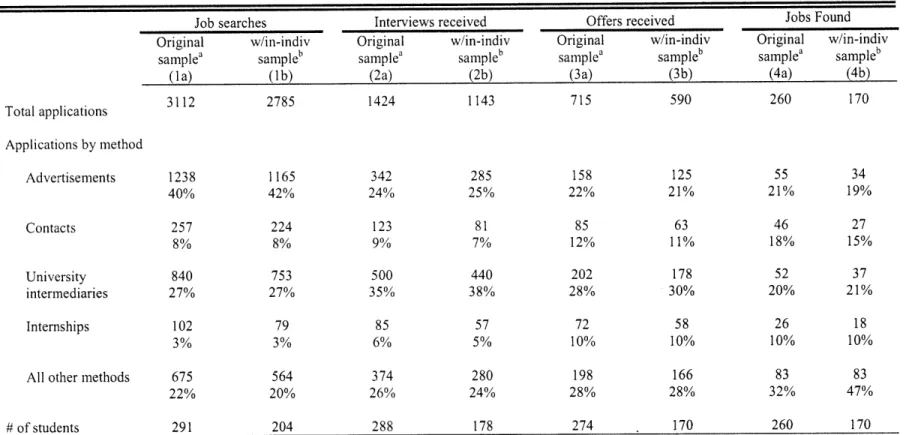
Table 3 provides descriptive statistics with the application as the unit of analysis. The 291 students in our dataset sent out 3,112 job applications (Column la), of which 1,424
resulted in interviews (Column 2a) and 715 led to job offers (Column 3a). In addition, the results presented in Table 3 indicate that the relative percentages of applications originating from different search methods do not vary much between the full and within-individual samples, mitigating concerns that the within-individual sample we use for our robustness checks is selectively biased. Specifically, for each outcome, 80% to 90% of applications in the full sample are included in the within-individual samples. For example, while the original
sample consists of 291 job-seekers who submitted 3,112 applications, the within-individual
sample consists of 204 job-seekers who submitted 2,785 applications.
<Table 3 HERE>
Direct test results
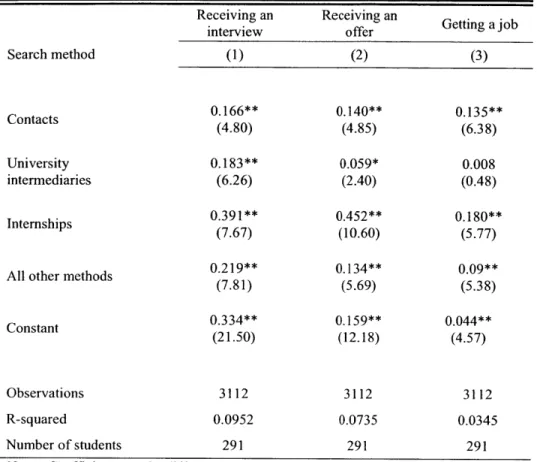
Table 4 presents the estimates from the linear probability models. We find that using
contacts leads to better labor-market outcomes than using advertisements. Specifically,
applications submitted through contacts were 16.6% more likely than applications submitted
through advertisements to lead to an interview, 14% more likely to lead to an offer, and
13.5% more likely to lead to a job. Moreover, we find that contacts outperform university
intermediaries, especially in later stages of job search. Specifically, univariate F-tests show
that applications submitted through contacts are more likely than applications submitted
through university intermediaries to lead to both an offer and a job, and these differences are
statistically reliable at the 0.05 and 0.0001 levels respectively [F-test = 5.60 and 29.50, df=
2817].
<Table 4 HERE>
Consistent with our expectation that university intermediaries are a viable job-search
method for student job-seekers, we find that applications submitted through a university
intermediary were 18% more likely than applications submitted through advertisements to
result in an interview (Model 1) and 5.9% more likely to result in an offer (Model 2). Yet,
they were no more likely to lead to a job. These results suggest that university intermediaries
are better at getting the student job-seeker in the door with the employer than at influencing
the employer's hiring decision.
We also find that applications to jobs with employers for which a student job-seeker had interned were 39.1% more likely than applications submitted through advertisements to lead to an interview, 45% more likely to lead to an offer, and 18% more likely to lead to a job-much higher rates of success. However, some of the advantages of other methods disappear in the later stages of the job-search process. Specifically, applications submitted through other methods are 21.9% more likely than applications submitted through
advertisements to lead to an interview and 13.4% more likely to lead to an offer, but only 9% more likely to lead to a job.
Comparing direct and indirect tests
To compare the results of a direct and an indirect test, we turn to one subset of
job-seekers' contacts for which we have social network data-their school friends. In the third wave of the longitudinal study, the survey asked, "How many students did you interact with socially over the past two weeks?" and "How many students did you interact with in
completing school assignments during the past two weeks?" We use this information to construct two logged count variables for school-related social capital, # socialfriends (In) and # academicfriends (In), respectively.'2 For these analyses, we also disaggregate
applications submitted through contacts into those submitted through school friends and those submitted through all other contacts.
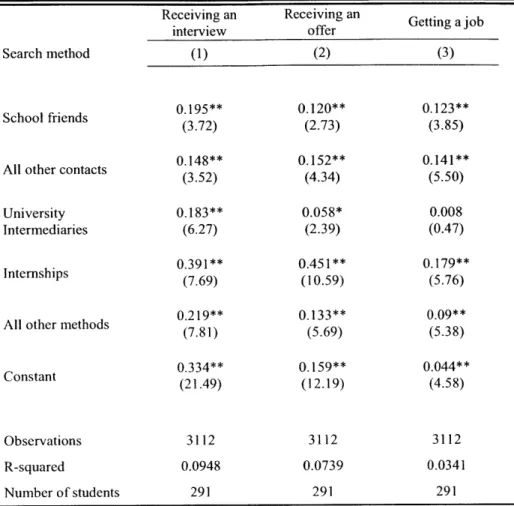
Our results suggest that an indirect test can produce null results even when a direct test indicates that job-seekers benefit from contacts. We find that applications through school
12 We also run these models using only logged social ties or only logged academic ties as the covariate. We find that these measures by themselves are not significantly associated with an individual's decision to search for a job through all contacts or through school friends. This is not surprising, considering that the correlation between logged social ties and logged academic ties-our two measures of social capital--is only 0.2894.
friends are 19.5%, 12%, and 12.3% more likely than applications through advertisements to
lead to an interview, an offer, and a job, respectively; these results are significant at the 0.01
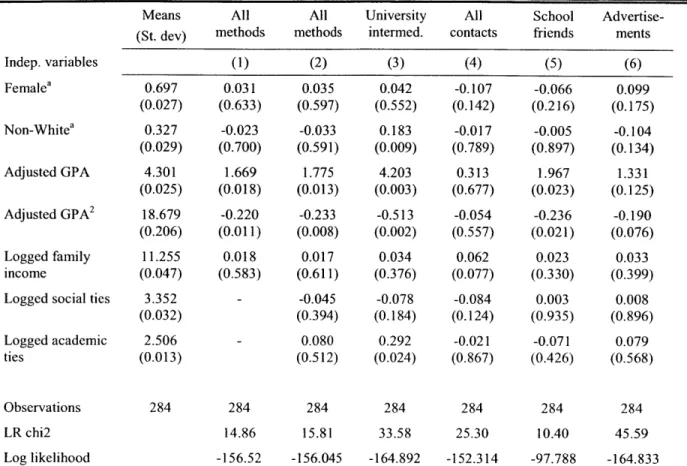
level (see Table 5). But the results of the indirect test lead to opposite conclusions. We find
that students with more school-related social capital are no more likely to use those ties than
students with less school-related social capital. The results presented in Table 6 show that
neither of these measures of school social capital is significantly associated with a person's
decision to search for a job either using all contacts or using schools friends. Thus, in contrast
to the results of the indirect test, the results from an indirect test suggest that job-seekers do
not benefit from using school friends.
<Table 5 HERE>
DISCUSSION
Consistent with results of single-firm studies, our results show that applications
submitted through contacts are more likely to lead to successful outcomes than applications
submitted through formal methods. These results hold not only for the final outcome of
getting a job but also for two intermediate outcomes within the hiring process-getting an
interview and getting a job offer. We also find evidence that applications submitted through
contacts are more likely than applications submitted through formal intermediaries to be
successful in getting a job offer and getting a job. Moreover, our results show that an indirect
test can produce null results even when a direct test indicates that job-seekers do benefit from
using contacts. In this section, we argue that these results suggest that, when possible,
researchers should use a direct test rather than an indirect test. We begin by presenting
evidence against the possibility that the direct test results simply reflect self-selection into method choice. Then we explain why an indirect test might yield misleading conclusions.
One possible explanation for the strength of our direct test's results is that job-seekers self-select into the methods they use to search for jobs. Ifjob-seekers have a priori beliefs about how effective certain search methods are for them personally, then a job-seeker with poor social networks may well choose not to search through his contacts at all (Mouw 2003). If this were true and taken to the logical extreme, then the observations of job-seekers who
use contacts to search for a job are, in fact, only observations of job-seekers who believe they have good contacts. We test for potential selection effects using individual-level variables from our study, including gender, non-White race, adjusted GPA, a square of adjusted GPA, logged family income, and school social capital. For all job-search methods, we find that none of the observed variables included in our study predicted the job-search methods an individual job-seeker adopted.
<Table 6 HERE>
If the results of the direct test are not simply due to the self-selection of job seekers
into methods, then why does the indirect test produce null results when the direct test results show that job-seekers do benefit from using contacts? One potential explanation is that the effectiveness of the indirect test depends on the quality of the social-network measures. For our specific survey, the measures of social capital may better capture some aspect of a student's personality, such as gregariousness, than the usefulness of her contacts. Because our social-network measures may not accurately assess job-seekers' social capital, it is not surprising that an indirect test leads to null results. Yet, while our example might appear particularly flawed, it points to a larger problem with the indirect test: The test's accuracy
depends on the researcher's ability to capture between-individual heterogeneity in contacts
that might be in a position to influence the outcome of the job-seeker's job search.
Because capturing individual's social networks is inherently difficult (Bernard et al.
1984; Freeman and Romney 1987; Brewer 2000; Quintane and Kleinbaum 2011), this is an
important limitation of the indirect test. Due to the practical constraints of surveying a large
sample, respondents in network surveys are most likely to be asked about a limited number
of contacts and are therefore more likely to name their strong ties (Brewer and Webster 2000;
Quintane and Kleinbaum 2011). But if weak ties matter more for job search and are not well
captured by measures of social capital in surveys of job-seekers, then using an indirect test to
make inferences about network causality may lead to misleading results. Specifically,
job-seekers whose weak ties did help them in their job search would be undercounted in the
sample and the coefficient associated with the effectiveness of social capital would be
downwardly biased.
Another important piece of evidence for the influence of the quality of social-capital
measures comes from our finding that the likelihood that applications submitted through
school contacts lead to better outcomes than applications submitted through other search
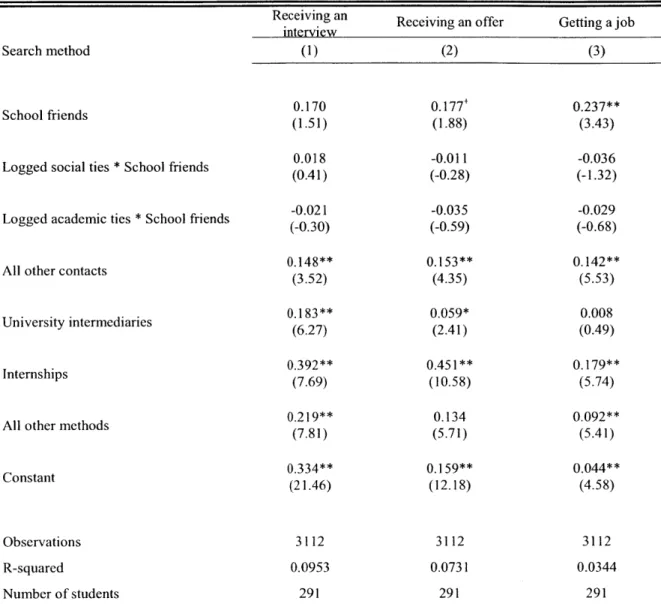
methods is not significantly related to students' school-related social capital. Specifically, we
estimated models that include an interaction terms for the schoolfriends search-method
dummy and (a) # socialfriends (in) and (b) # academicfriends (In). By including this term,
we test whether students with more social or academic friends get more benefit from using
school friends in their job search than students with fewer social or academic friends do. We
find that students with more social or academic friends did not get more benefit from using
school friends in their job search than students with fewer social or academic friends did.
These results would be puzzling unless we assume that these two measures of social capital do not adequately capture the social capital that is relevant for using school friends to seek a
job.
<Table 7 HERE>
SUMMARY AND IMPLICATIONS
While it is intuitively plausible that using contacts in job search improves labor-market outcomes, there is still both theoretical disagreement and inconclusive empirical evidence concerning why a job-seeker's social capital is associated with her labor-market outcomes. In particular, recent research suggests that the association might be spurious--due to an omitted variable that influences both the quality of a job-seeker's social capital and her labor-market outcomes (Mouw 2003; for a more general statement of this problem, see Manski 1993). Mouw's results are particularly puzzling when we consider the strong evidence from single-firm studies in favor of a non-spurious explanation (Fernandez and Weinberg 1997; Petersen et al. 2000; Fernandez et al. 2000; Fernandez and Sosa 2005; Yakubovich and Lup 2006). We argue that solving this puzzle requires a direct within-individual test of each method's effectiveness. Using data on school-to-work transition among university students, we show that job-seekers do benefit from searching for jobs through contacts. We also argue that a direct test is superior to an indirect test because its effectiveness does not depend on the quality of the social-network measures.
Our study makes an important contribution to the social-network causality debate. As sociologists, we find the idea that job-seekers benefit from contacts intuitively appealing. However, despite its intuitive appeal, the empirical foundations for these claims are shaky
(Mouw 2003, see also Manski 1993). Our study joins a growing number of studies that
attempt to put the literature on a firmer methodological ground (for a review, see Mouw
2006). Some of this literature exploits unique contexts in which individuals are assigned
social networks (Marmaros and Sacerdote 2006; Reagans and McEvily 2003), thus avoiding
the possibility that an omitted variable accounts for an association between a job-seeker's
social capital and her labor-market outcomes. Our study takes an alternative path by directly
revealing how those job-seekers who use social networks benefit from using them.
By highlighting the theoretical importance of investigating different job-search
methods with more accurate measures of social capital than were available for this study, our
results suggest a fruitful direction for future investigation. Because of the constraints of our
data on job-seekers' social capital, our study's conclusions are limited in two ways. We were
able to provide only preliminary evidence for the lack of self-selection into job-search
methods, and we found no evidence that job-seekers with social capital get more benefit from
using contacts than they get from other methods. Future studies with more accurate measures
of social capital can extend our research by exploring how and why the quality of social
capital relates to the benefits it delivers to a seeker. Thus, while we can see now that
job-seekers do benefit from contacts, only with more accurate measures of social capital can see
why.
Figure 1: Illustrative Funnel-Diagram of a Single Job-seeker's Applications and Their Progress through Stages of the Hiring Process
Applications
(
Interviews
Offers
JLI
Acceptances
AdvertisementsCzC
17
(
J
Table 1. Descriptive statistics of students who searched for a job
Research Private Engineering- Public All schools University College Only College University
(1) (2) (3) (4) (5) Major Humanities 3% 40% 0% 7% 14% Social sciences 4% 26% 0% 12% 12% Engineering 51% 6% 100% 24% 39% Math/Physical sciences 28% 19% 0% 33% 25% Business 14% 9% 0% 24% 13% Gender Female 53% 100% 35% 33% 67% Race White 48% 84% 74% 83% 72% Asian 35% 8% 22% 2% 22% Other 16% 8% 4% 15% 6% Number of students 131 90 23 47 291
Note: The percentages of majors for a school might add up to more than 100% because 18 students had double majors and one student had a triple major
Table 2. Distribution of students and their labor-market outcomes by job-search method
Job-search method Advertise- Contacts University Intern- All other Any
ments intermed. ships methods method
(1) (2) (3) (4) (5) (6)
Students who applied through method
# of students 151 106 147 76 158 291
As % of all students 52% 46% 51% 26% 54% 100%
Mean number of resumes 8.20 2.42 5.71 1.34 3.83 10.69
submitted
Students who received interviews through method
# of students 121 93 125 67 146 288
As % of all students 42% 32% 43% 23% 51% 99%
iteriews receved 2.83 1.43 4.00 1.27 2.34 4.94
Students who received offers through method
# of students 91 69 92 57 116 274
As % of all students 31% 24% 32% 20% 40% 94%
Mean number of offers 1.74 1.29 2.19 1.26 1.56 2.61
received
Students who found a job through method
# of students 55 46 52 26 81 260
Table 3. Distribution of job-search attempts, interviews, and offers by search method Job searches Original w/in-indiv samplea sampleb (1a) (Ib) Interviews Original samplea (2a) received w/in-indiv sampleb (2b) Offers received Original w/in-indiv samplea sampleb (3a) (3b) Jobs Found Original w/in-indiv samplea sampleb (4a) (4b) Total applications 3112 2785 1424 1143 715 590 260 170 Applications by method Advertisements Contacts University intermediaries Internships
All other methods
1238 40% 257 8% 840 27% 102 3% 675 22% 1165 42% 224 8% 753 27% 79 3% 564 20% 342 24% 123 9% 500 35% 85 6% 374 26% 285 25% 81 7% 440 38% 57 5% 280 24% 158 22% 85 12% 202 28% 72 10% 198 28% 125 21% 63 11% 178 30% 58 10% 166 28% 55 21% 46 18% 52 20% 26 10% 83 32% 34 19% 27 15% 37 21% 18 10% 83 47% # of students 291 204 288 178 274 170 260 170
Notes: Percentages are of number of applications from that method relative to total applications at that stage; i.e., in Column 2a, university intermediaries
make up 35% (i.e., 500/1424) of the total job applications that received an interview.
aThe number of observation in Column la includes all search attempts for all students. The samples in Columns 2a, 3a, and 4a include all interviews that all students received, all offers that all students received, and jobs found, respectively. These are the total numbers of applications that we use for our various linear probability models.
b The number of observation in Column lb includes all search attempts for students that (a) received more than one interview (from any search method)
and (b) received fewer interviews than the total number of applications sent out. Likewise, the number of observations in Columns 2b, 3b, and 4b is the number of search attempts at the interview, offer, and jobs found levels, respectively. These are the total numbers of applications that are used in conditional logit models.
Table 4. Linear probability models of the likelihood of progressing to the next stage of the hiring process
Receiving an interview
Receiving an
offer Getting a job Search method
Contacts
University intermediaries
Internships
All other methods
Constant Observations R-squared (1) (2) (3) 0.166** (4.80) 0.183** (6.26) 0.391 ** (7.67) 0.219** (7.81) 0.334** (21.50) 3112 0.0952 0.140** (4.85) 0.059* (2.40) 0.452** (10.60) 0.134** (5.69) 0.159** (12.18) 3112 0.0735 0.135** (6.38) 0.008 (0.48) 0.180** (5.77) 0.09** (5.38) 0.044** (4.57) 3112 0.0345 Number of students 291 291 291
Notes: Coefficients are the difference in the probability of an outcome for each method; dropped search method is advertisements; t-values in parentheses; two-tailed tests: ** p<0.01, * p<0.05, + p<O.I
Table 5. Linear probability models of the likelihood of progressing to the next stage of the hiring process, separated by types of contacts
Search method
School friends
All other contacts
University Intermediaries
Internships
All other methods
Constant Observations R-squared Receiving an interview (1) 0.195** (3.72) 0.148** (3.52) 0.183** (6.27) 0.391 ** (7.69) 0.219** (7.81) 0.334** (21.49) 3112 0.0948 Receiving an offer (2) 0.120** (2.73) 0.152** (4.34) 0.058* (2.39) 0.451 ** (10.59) 0.133** (5.69) 0.159** (12.19) 3112 0.0739 Getting a job (3) 0.123** (3.85) 0.141** (5.50) 0.008 (0.47) 0.179** (5.76) 0.09** (5.38) 0.044** (4.58) 3112 0.0341 Number of students 291 291 291
Notes: Coefficients are the difference in the probability of an outcome for each method; dropped search method is advertisements; t-values in parentheses; two-tailed tests: ** p<0.01, * p<0.05, + p<O.l
Table 6: Marginal effects of probit regressions on decisions to search for a job Means
(St. dev)
All All University All School
methods methods intermed. contacts friends Indep. variables Female" Non-White a Adjusted GPA Adjusted GPA2 Logged family income
Logged social ties Logged academic ties Observations LR chi2 Log likelihood (1) (2) (3) (4) (5) (6) 0.697 0.031 0.035 0.042 -0.107 -0.066 0.099 (0.027) (0.633) (0.597) (0.552) (0.142) (0.216) (0.175) 0.327 -0.023 -0.033 0.183 -0.017 -0.005 -0.104 (0.029) (0.700) (0.591) (0.009) (0.789) (0.897) (0.134) 4.301 1.669 (0.025) (0.018) 1.775 4.203 0.313 1.967 1.331 (0.013) (0.003) (0.677) (0.023) (0.125) 18.679 -0.220 -0.233 -0.513 -0.054 -0.236 -0.190 (0.206) (0.011) (0.008) (0.002) (0.557) (0.021) (0.076) 11.255 0.018 0.017 0.034 0.062 0.023 0.033 (0.047) (0.583) (0.611) (0.376) (0.077) (0.330) (0.399) 3.352 (0.032) 2.506 (0.013) -0.045 -0.078 -0.084 0.003 0.008 (0.394) (0.184) (0.124) (0.935) (0.896) 0.080 0.292 -0.021 -0.071 (0.512) (0.024) (0.867) (0.426) 284 284 14.86 284 284 15.81 33.58 284 25.30 284 10.40 0.079 (0.568) 284 45.59 -156.52 -156.045 -164.892 -152.314 -97.788 -164.833 Notes: All models include university fixed effects; z-values in parentheses unless noted; all marginal effects are
calculated for white males with average values of adjusted GPA, adjusted GPA2
, logged family income, logged social ties, and logged academic ties
" dy/dx is for discrete change of dummy variable from 0 to 1
Advertise-ments
Table 7. Linear probability models of the likelihood of progressing to the next stage of the hiring process, including social-capital interaction effects with school friends
Receiving an interview
Search method (1)
School friends
Logged social ties * School friends
Logged academic ties * School friends
All other contacts
University intermediaries
Internships
All other methods
Constant Observations R-squared 0.170 (1.51) 0.018 (0.41) -0.021 (-0.30) 0.148** (3.52) 0.183** (6.27) 0.392** (7.69) 0.219** (7.81) 0.334** (21.46) 3112 0.0953 Receiving an offer (2) 0.177k (1.88) -0.011 (-0.28) -0.035 (-0.59) 0.153** (4.35) 0.059* (2.41) 0.451** (10.58) 0.134 (5.71) 0.159** (12.18) 3112 0.0731 Number of students 291 291 291
Notes: Coefficients are the difference in the probability of an outcome for each method; dropped search method is advertisements; t-values in parentheses; two-tailed tests: ** p<0.01, * p<0.05, + p<O.1
Pg. 29 of 32 Getting a job (3) 0.237** (3.43) -0.036 (-1.32) -0.029 (-0.68) 0.142** (5.53) 0.008 (0.49) 0.179** (5.74) 0.092** (5.41) 0.044** (4.58) 3112 0.0344
REFERENCES
Aldrich, John H., and Forrest D. Nelson. 1992. Linear Probability, Logit, and Probit Models.
SAGE: Newbury Park, CA.
Bernard, H. Russell, Peter Killworth, David Kronenfeld, and Lee Sailer. 1984. "The Problem of Informant Accuracy: The Validity of Retrospective Data." Annual Review of
Anthropology 13:495-517.
Bian, Yanjie. 1997. "Bringing Strong Ties Back in: Indirect Ties, Network Bridges, and Job Searches in China." American Sociological Review 62(3):366-385.
Bian, Yanjie, and Soon Ang. 1997. "Guanxi Networks and Job Mobility in China and Singapore." Social Forces 75(3):981-1005.
Brewer, Devon D. 2000. "Forgetting in the Recall-based Elicitation of Personal and Social Networks." Social Networks 22(1):29-44.
Brewer, Devon D., and Cynthia M. Webster. 2000. "Forgetting of Friends and Its Effects on Measuring Friendship Networks." Social Networks 21(4):361-373.
Cohen, Yinon, and Jeffrey Pfeffer. 1986. "Organizational Hiring Standards." Administrative
Science Quarterly 31(1):1-24.
Corcoran, Mary, Linda Datcher, and Greg Duncan. 1980. "Information and Influence Networks in Labor Markets." Five Thousand American Families: Patterns of Economic Progress:
Analyses of the First Eleven Years of the Panel.
Fernandez, Roberto M., and M. Lourdes Sosa. 2005. "Gendering the Job: Networks and Recruitment at a Call Center." American Journal of Sociology 111(3):859-904.
Fernandez, Roberto M., and Nancy Weinberg. 1997. "Sifting and Sorting: Personal Contacts and Hiring in a Retail Bank." American Sociological Review 62(6):883-902.
Fernandez, Roberto M., Emilio J. Castilla, and Paul Moore. 2000. "Social Capital at Work: Networks and Employment at a Phone Center." The American Journal of Sociology
105(5):1288-1356.
Freeman, Linton C., and A. Kimball Romney. 1987. "Words, Deeds and Social Structure: A Preliminary Study of the Reliability of Informants." Human Organization 46(4):330-334.
de Graaf, Nan Dirk, and Hendrik Flap. 1988. "'With a Little Help from My Friends': Social Resources as an Explanation of Occupational Status and Income in West Germany, The Netherlands, and the United States." Social Forces 67(2):452-472.
Granovetter, Mark. 1995. Getting a Job: A Study of Contacts and Careers. 1st ed. University Of Chicago Press: Chicago, IL.
Granovetter, Mark. 1973. "The Strength of Weak Ties." The American Journal of Sociology
78(6):1360-1380.
Ho, Karen. 2009. Liquidated. An Ethnography of Wall Street. Duke University Press: Durham. Holzer, Harry J. 1987. "Informal Job Search and Black Youth Unemployment." The American
Economic Review 77(3):446-452.
Lai, Gina, Nan Lin, and Shu-Yin Leung. 1998. "Network Resources, Contact Resources, and Status Attainment." Social Networks 20(2):159-178.
Lee, Sunhwa, and Mary C. Brinton. 1996. "Elite Education and Social Capital: The Case of
South Korea." Sociology ofEducation 69:177-192.
Lin, Nan. 2000. "Inequality in Social Capital." Contemporary Sociology 785-795.
Lin, Nan. 2002. Social Capital: A Theory of Social Structure and Action. 1st ed. Cambridge University Press: New York, NY.
Manski, Charles F. 1993. Identification Problems in the Social Sciences. Harvard University Press, Cambridge, MA.
Marmaros, David, and Bruce Sacerdote. 2006. "How do Friendships Form?" Quarterly Journal ofEconomics 121(1):79-119.
Marsden, Peter, and Elizabeth H. Gorman. 2001. "Social Networks, Job Changes, and
Recruitment." Sourcebook of labor markets: Evolving structures and processes 467-502. McDonald, Steve. 2011. "What You Know or Who You Know? Occupation-Specific Work
Experience and Job Matching Through Social Networks." Social Science Research
40(6):1664-1675.
McDonald, Steve, and Glen H. Elder. 2006. "When Does Social Capital Matter? Non-Searching for Jobs Across the Life Course." Social Forces 85(l):521-549.
McPherson, Miller, Lynn Smith-Lovin, and James M. Cook. 2001. "Birds of a Feather: Homophily in Social Networks." Annual Review of Sociology 27:415-444. Montgomery, James D. 1992. "Job Search and Network Composition: Implications of the
Strength-Of-Weak-Ties Hypothesis." American Sociological Review 57(5):586-596. Mouw, Ted. 2006. "Estimating the Causal Effect of Social Capital: A Review of Recent
Research." Annual Review ofSociology 32(1):79-102.
Mouw, Ted. 2002. "Racial Differences in the Effects of Job Contacts: Conflicting Evidence from Cross-Sectional and Longitudinal Data." Social Science Research 31(4):511-538.
Mouw, Ted. 2003. "Social Capital and Finding a Job: Do Contacts Matter?" American Sociological Review 68(6):868-898.
Obukhova, Elena. 2011. "Motivation vs. Relevance: Using Strong Ties to Find a Job in Chiina."
Social Science Research Forthcoming.
Petersen, Trond, Ishak Saporta, and Marc-David L. Seidel. 2000. "Offering a Job: Meritocracy and Social Networks." The American Journal ofSociology 106(3):763-816.
Pierret, Charles R. 2001. "Event History Data and Survey Recall: An Analysis of the National Longitudinal Survey of Youth 1979 Recall Experiment." The Journal ofHuman
Resources 36(3):439-466.
Quintane, Eric, and Adam M. Kleinbaum. 2011. "Matter Over Mind? E-mail Data and the Measurement of Social Networks." Connections 31(1).
Reagans, Ray, and Bill McEvily. 2003. "Network Structure and Knowledge Transfer: The Effects of Cohesion and Range." Administrative Science Quarterly 48(2):240-267. Rees, Albert. 1966. "Information Networks in Labor Markets." The American Economic Review
56(1/2):559-566.
Rosenbaum, James E. 2001. Beyond College for All: Career Paths for the Forgotten Half Russell Sage Foundation Publications: New York: NY.
Rosenbaum, James E., and Takehiko Kariya. 1989. "From High School to Work: Market and Institutional Mechanisms in Japan." American Journal ofSociology 94(6):1334-1365. Small, Mario Luis. 2009. Unanticipated Gains: Origins of Network Inequality in Everyday Life.
Oxford University Press: New York, NY.
V61ker, Beate, and Hendrik Flap. 2001. "Weak Ties as a Liabiliaty." Rationality and Society 13(4):397 -428.
Yakubovich, Valery. 2005. "Weak Ties, Information, and Influence: How Workers Find Jobs in a Local Russian Labor Market." American Sociological Review 70(3):408-42 1.
Yakubovich, Valery, and Daniela Lup. 2006. "Stages of the Recruitment Process and the Referrer's Performance Effect." Organization Science 17(6):7 10.