Decoding Algorithms for Complex Natural
Language Tasks
by
Pawan Deshpande
Submitted to the Department of Electrical Engineering and Computer
Science
in partial fulfillment of the requirements for the degree of
Masters of Engineering in Computer Science and Engineering
at the
MASSACHUSETTS INSTITUTE OF TECHNOLOGY
January
2007
@ Massachusetts Institute of Technology 2007. A]
Author ...
Department of Electrical Engineering and
l1 rights reserved.
Computer Science
January 30, 2007
Certified by...
...
....
Assetgina Barzilay
Assistant Professor
Accepted by
.(
/Thesis Supervisor
*y;o77Arthur C. Smith
Chairman, Department Committee on Graduate Students
ARCHIVES
MASSACHUSETTS INSTITUTE OF TECHNOLOGYOCT 0 3 2007
LIBRARIES
... . ... ... ..-Decoding Algorithms for Complex Natural Language Tasks
by
Pawan Deshpande
Submitted to the Department of Electrical Engineering and Computer Science on January 30, 2007, in partial fulfillment of the
requirements for the degree of
Masters of Engineering in Computer Science and Engineering
Abstract
This thesis focuses on developing decoding techniques for complex Natural Language Processing (NLP) tasks. The goal of decoding is to find an optimal or near optimal solution given a model that defines the goodness of a candidate. The task is chal-lenging because in a typical problem the search space is large, and the dependencies between elements of the solution are complex.
The goal of this work is two-fold. First, we are interested in developing decoding techniques with strong theoretical guarantees. We develop a decoding model based on the Integer Linear Programming paradigm which is guaranteed to compute the opti-mal solution and is capable of accounting for a wide range of global constraints. As an alternative, we also present a novel randomized algorithm which can guarantee an ar-bitrarily high probability of finding the optimal solution. We apply these methods to the task of constructing temporal graphs and to the task of title generation. Second, we are interested in carefully investigating the relations between learning and decod-ing. We build on the Perceptron framework to integrate the learning and decoding procedures into a single unified process. We use the resulting model to automati-cally generate tables-of-contents, structures with deep hierarchies and rich contextual dependencies. In all three natural language tasks, our experimental results demon-strate that theoretically grounded and stronger decoding demon-strategies perform better than existing methods. As a final contribution, we have made the source code for these algorithms publicly available for the NLP research community.
Thesis Supervisor: Regina Barzilay Title: Assistant Professor
Acknowledgments
First and foremost, I would like to thank my advisor Regina Barzilay. In one short year, I was able to accomplish much more than I ever had imagined. It was only through her ever-ready willingness to help and indispensable guidance that this was possible.
Aside from my advisor, I must also thank my collaborators who worked with me on various papers along the way that led to this thesis: S.R.K. Branavan, Philip Bramsen, Yoong Keok Lee and David Karger. I will not forget the many long nights spent in the lab with Branavan, Philip and Yoong Keok.
I also would like to express my gratitude to others who helped in many other ways from proof-reading to providing much-needed feedback. In this regard, I would like to thank Eli Barzilay, Erdong Chen, Harr Chen, Michael Collins, Marcia Davidson, my brother Ashwin Deshpande, Zoran Dzunic, Jacob Eisenstein, Bo-June (Paul) Hsu, Terry Koo, Igor Malioutov, Christina Sauper, Yuan Shen, Ben Snyder, Peter Szolovits and Luke Zettlemoyer.
Finally, I would like to thank my parents and my roommate, Yang Zhang, for the copious sustenance.
Bibliographic Notes
Portions of this thesis are based on the following papers:
"Finding Temporal Order in Discharge Summaries" by Philip Bramsen, Pawan Desh-pande, Yoong Keok Lee and Regina Barzilay. The paper appeared in the Proceedings
of the 2006 American Medical Informatics Association (AMIA) Annual Symposium.
"Inducing Temporal Graphs" by Philip Bramsen, Pawan Deshpande, Yoong Keok Lee and Regina Barzilay. The paper appeared in the Proceedings of Empirical
Meth-ods in Natural Language Processing (EMNLP) 2006.
"Randomized Decoding for Selection-and-Ordering Problems" by Pawan Deshpande, Regina Barzilay and David R. Karger. The paper will appear in the Proceedings of
the 2007 Annual Conference of the North American Chapter of the Association for Computational Linguistics (NAACL).
"Generating a Table-of-Contents: A Hierarchical Discriminative Approach" by S.R.K. Branavan, Pawan Deshpande and Regina Barzilay. The paper was submitted to the
Contents
1 Introduction
1.1 Decoding in NLP ...
1.2 Common Decoding Strategies ...
1.3 Scope of the Thesis and Contributions . . . . 2 Inducing Temporal Graphs
2.1 Introduction ... 2.2 Related W ork ...
2.3 TDAG: A representation of temporal flow . . 2.4 Method for Temporal Segmentation . . . . 2.5 Learning to Order Segments ...
2.5.1 Learning Pairwise Ordering . . . . 2.5.2 Global Inference Strategies for Segment 2.6 Evaluation Setup ...
2.6.1 Corpus Characteristics . . . . 2.6.2 Annotating Temporal Segmentation . . 2.6.3 Annotating Temporal Ordering . . . . 2.6.4 Evaluation Measures ... 2.7 Results ... . .... 2.8 Conclusions ... .. 21 . . . . 2 1 . . . . 23 . . . . . 24 . . . . . 25 . . . . 27 . . . . . 27 Ordering . ... 28 . . . . 3 1 . . . . . 3 1 . . . . . 32 . . . . . 33 . . . . 33 . . . . 34 . . . . 35
3 Randomized Decoding for Selection-and-Ordering Problems 3.1 Introduction . . . . . .. . . ...
37 37
3.2 Problem Formulation . . . ... 3.2.1 Graph Representation . . . ... 3.2.2 Example: Decoding for Multidocument 3.2.3 Relation to Classical Problems ... 3.3 Related W ork ...
3.4 Randomized Decoding with Color-Coding 3.5 Decoding with Integer Linear Programming 3.6 Experimental Set-Up . . . .... 3.7 3.8 summarization Results ... Conclusions . . . . 4 Generating a Table-of-Contents: proach 4.1 Introduction . . . . 4.2 Related Work . . . . 4.3 Problem Formulation . . . . 4.4 Algorithm . . . . 4.4.1 Model Structure . . . . . 4.4.2 Training the Model . . . 4.5 Features ...
4.6 Evaluation Setup . . . . 4.7 Results ...
4.8 Conclusions . . . . 5 Conclusions and Future Work
A Examples of Automatically Constructed TDAGs B Generated Tables of Contents
A Hierarchical Discriminative Ap-53 53 55 56 56 58 59 61 63 64 68 69 71
List of Figures
2-1 An example of the transitive reduction of a TDAG for a case summary. A sample of segments corresponding to the nodes marked in bold is
shown in the table. ... 24
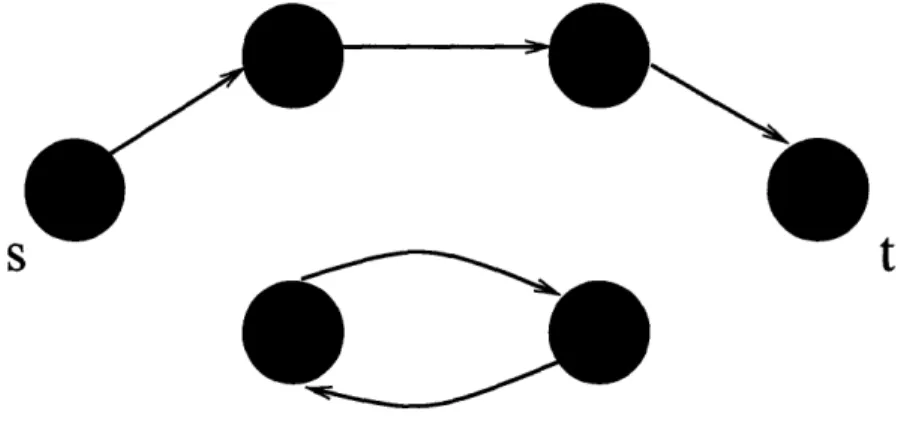
3-1 A subgraph that contains a cycle, while satisfying constraints 3.2
through 3.5 ... 47
3-2 The proportion of exact solutions found for each iteration of the color
coding algorithm... 52
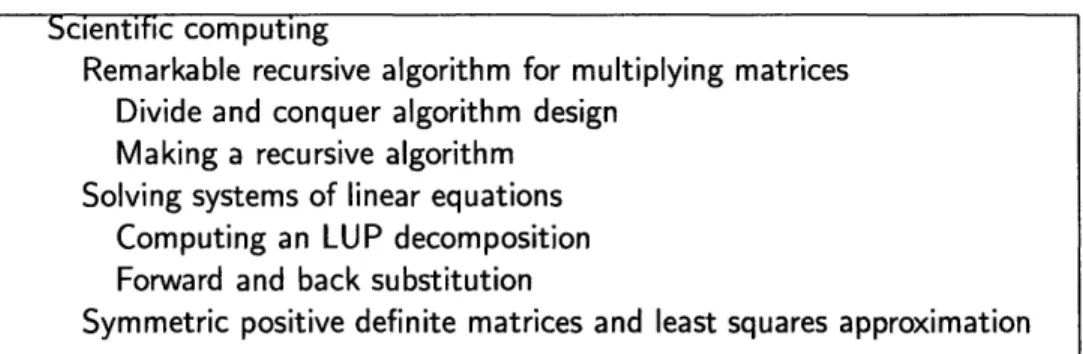
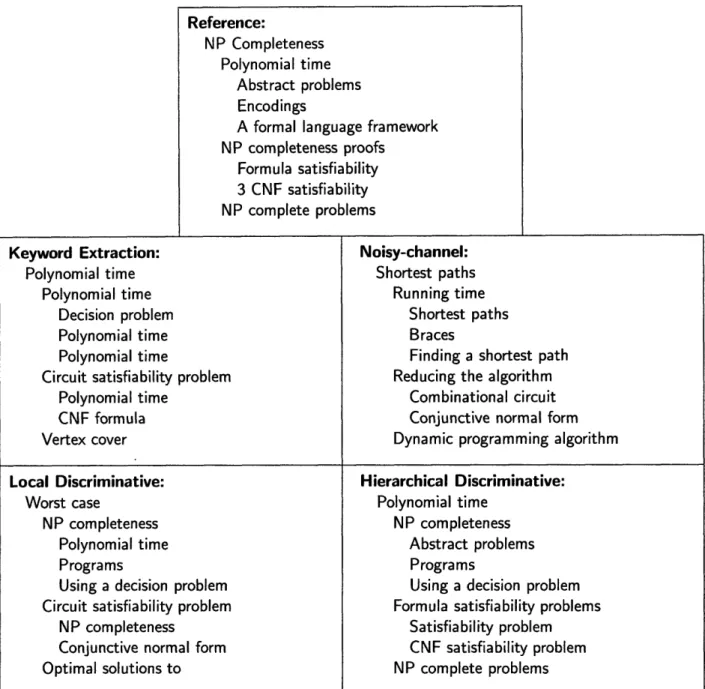
4-1 A fragment of a table-of-contents generated by our method. ... 54 4-2 The training algorithm for the local model. . ... 60 4-3 Fragments of tables-of-contents generated by our method and the three
baselines along with the corresponding reference. . ... 65
A-1 The reference TDAG ... 71
A-2 ILP generated TDAG with an accuracy of 84.6% ... 71 A-3 BF generated TDAG with an accuracy of 71.4%; NRO produces the
same graph for this example ... 72
List of Tables
2.1 Accuracy for 3-way ordering classification over manually-constructed
segments. ... 35
2.2 Results for 4-way ordering classification over clauses, computed over manually and automatically generated segments. . ... . 36 2.3 Per class accuracy for clause classification over manually computed
segments. ... 36
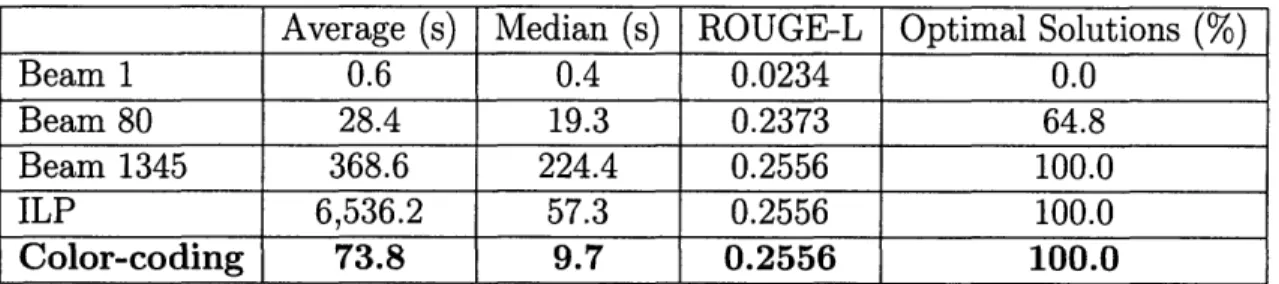
3.1 Running times in seconds, ROUGE scores, and percentage of optimal solutions found for each of the decoding algorithms. . ... 51
4.1 Examples of global features. ... 62
4.2 Statistics on the corpus used in the experiments. . ... 62 4.3 The ratio of titles that fully overlap with words in the corresponding
segment. The overlap is measured by unigram, bigram and full matches. 65 4.4 Comparison with reference titles. . ... . . . 66 4.5 Average ratings assigned to each system by each of the four judges. . 66
Chapter 1
Introduction
1.1
Decoding in NLP
In Natural Language Processing (NLP), researchers study systems that take natu-ral language as input and/or produce natunatu-ral language as an output. In order for these systems to perform effectively, we need to exploit both syntactic and semantic knowledge. In the past, NLP systems relied on human experts to manually encode this information. In recent years, increased computing power, advances in machine learning, and the availability of large corpora have allowed the research community to adopt a statistical approach for many language processing tasks. Since then, the success of statistical methods have made them the predominant technique in nearly
all areas of NLP from syntactic parsing to natural language generation.
A typical model consists of a function f : X -- y that maps a set of possible inputs
X to a set of possible outputs y. With supervised models, we seek to learn f from a
set of annotated pairs (xi, y))... (x, y,) where xi e X and yi E Y. We then use the learned model to predict an output for a previously unseen input. For example, in a document classification system, we are provided with a set of document-class pairs to learn a model. The model then predicts the class y of an input document x.
In many NLP tasks, the set of outputs y consists of a large, possibly infinite, number of highly structured objects such as parse trees or document summaries. In these cases, the mapping function f is not learned directly. Instead, we learn a
function g : X x y -- [0, 1] that returns a score or probability of an input-output hypothesis pair. We then use g to find the best output Y in Y for an input x:
y = arg max g(x, y)
yEY
To date, a major focus of research has been on learning the function g in an effective and robust manner. However, little progress has been made on improving decoding, the process of finding the best output ý given the learned scoring function.
The complexity of decoding depends on the size of the output space. If the output space is small, then decoding is simple. An important class of problems with this property are classification problems. For instance, in the task of word sense disambiguation, a word and its context are provided and we need to determine the sense in which the word is used. For example, if we are given the word "bass" in the sentence "I caught a bass in the river. ", we must determine if the word refers to a type of fish or a low frequency tone. In this case, because the size of the output space is two, we only need to compare the probabilities of each word sense and return the
one with the higher probability.
Unfortunately, many NLP tasks cannot be cast as classification problems. When the output structure is a sequence, as in part-of-speech tagging, or a syntax tree, as in parsing, a simplistic decoding technique may not suffice. In these cases, we may want to account for complex inter-dependencies between elements of the output solution. For instance, in part-of-speech tagging, we may want to select the part-of-speech tag of a word, based on the parts-of-speech of the words surrounding it. In the sentence
"He can see. ", a model that captures these dependencies would correctly determine
"can" to be a modal verb rather than a noun because it is preceded by the pronoun, "He", and followed by the verb, "see". However, capturing these dependencies can
greatly increase the size of the output space. If we consider the parts-of-speech of all other words when selecting the part-of-speech for each word, we would need to consider nm possible tag sequences for a sentence of n words with m possible parts-of-speech.
Of course, we could simplify the decoding process by assuming that each element of the output solution is selected in isolation. Under this assumption, the part-of-speech tagger would ignore the dependencies between words altogether. Though such a decomposition would make decoding constant in the size of the input, it could have potentially drastic effects on the performance of the system. For example, the tagging model would no longer leverage the presence of the parts-of-speech of adjacent words and may now incorrectly determine "can" to be a noun.
In summary, the art of decoding lies in balancing the accuracy and the complexity of the dependencies considered. In the next section, we give examples of common decoding strategies to problems where the the output space may be exponential in the size of the input.
1.2
Common Decoding Strategies
How is decoding performed when the output space is exponential in the size of the input space? For many tasks, where we can assume local dependencies between ele-ments of the output, we can use efficient solutions, such as dynamic programming, to find the exact solution. For example, in probabilistic context-free grammar (PCFG) parsing, we can model the local dependency between a child node and its parent, while disregarding global dependencies across the rest of the parse tree. Under this independence assumption, we can use the Cocke-Younger-Kasami (CYK) dynamic programming algorithm to efficiently find the best parse tree for a given input sen-tence [14].
For other tasks, where global dependencies cannot be decomposed into a set of local dependencies, it is not possible to find the exact solution in an efficient manner. In such cases, a common decoding strategy is to return an approximate solution, sacrificing accuracy for efficiency. A typical solution in this case is to employ a heuristic search method, such as a beam or greedy search, that considers only a subset of the total output space [45]. These methods incrementally build the output solution while maintaining a list of the top partial solutions during the process. For
instance, beam search is the primary means of decoding in machine translation [34). Because these methods prune out large portions of the output space, it is possible that the optimal solution may never be considered.
Another approximate decoding approach is to use sampling-based techniques such as simulated annealing or the Metropolis-Hastings algorithm. Rather than building a solution incrementally, these sampling techniques are initialized with a complete solution and iteratively refine the solution until there can be no further improvement or the desired number of iterations has been exceeded. These techniques are guaran-teed to return a locally optimal solution, but not the globally optimal one. In many applications, returning a locally optimal solution is sufficient. In recent years, these methods have been successfully applied to a handful of tasks such as named entity recognition [27] and machine translation [24]. While these approximation methods may perform well in practice, there are no theoretical guarantees on their likelihood of finding the exact solution.
Furthermore, when an inexact inference method is employed, most learning algo-rithms make no assumptions about the nature of the decoder - the model is learned independent of the decoder. However, during the search for a solution, the actual decoder is in fact approximate and inexact. This failure to account for the actual decoder during training results in suboptimal performance of the entire system.
1.3
Scope of the Thesis and Contributions
In this thesis we explore decoding methods in the context of two NLP areas: natural language generation and discourse processing. Natural language generation deals with translating a semantic representation to a natural language text. For example, we may want to automatically convert a database of financial records into a financial report. Discourse processing involves modelling relations between sentences in a text, covering aspects such as topical, temporal and rhetorical progression. For example, a discourse processing system could be developed to understand the chronology of events described in a text. Both areas need to capture complex dependencies and are
still challenging for statistical techniques.
This thesis is a first attempt at developing decoding techniques for these two ar-eas of NLP. The goal of this work is two-fold. First, we are interested in developing decoding techniques with strong theoretical guarantees. In some cases, we can em-ploy Integer Linear Programming (ILP) which is guaranteed to compute the optimal solution and is capable of accounting for a wide range of global constraints [28, 44]. Al-though ILP is NP-hard, some ILP formulations can be solved in a reasonable amount of time since many powerful heuristics have been developed for this optimization tech-nique. In other cases, where a problem can not be solved quickly with ILP, we can use randomized algorithms that guarantee an arbitrarily high probability of finding the optimal solution. The second objective of this thesis is to carefully investigate the re-lations between learning and decoding. Ideally, the learning algorithm is aware of the shortcuts used by decoder. However, in traditional approaches, the learning model does not have knowledge of the decoding procedure, divorcing the actual decoder from the learning process. We might therefore improve performance by integrating
the learning and decoding processes into a single unified process.
In chapter 2, we investigate decoding in the ILP framework. We consider the problem of constructing a directed acyclic graph that encodes temporal relations found in a text. The unit of our analysis is a temporal segment, a fragment of text that maintains temporal coherence. The strength of our approach lies in its ability to simultaneously optimize pairwise ordering preferences between temporal segments as well as global constraints on the graph topology. We show that the ILP model outperforms two greedy baseline methods.
Chapter 2 is organized as follows. First, we introduce the problem and highlight the importance of the application. Next, we discuss previous approaches for temporal ordering. We formalize our representation of temporal flow and discuss our method for temporal segmentation. We then describe two greedy decoding methods and one ILP method for graph induction. After that, we discuss our corpus and evaluation methods. To conclude the chapter, we present our results and discuss the performance of our system.
In chapter 3, we propose the use of a randomized decoding algorithm for selection-and-ordering problems. The task of selecting and ordering information appears in multiple contexts in text generation and summarization. For instance, methods for title generation construct a headline by selecting and ordering words from the input text. In this chapter, we investigate decoding methods that simultaneously optimize selection and ordering preferences. We formalize decoding as a task of finding an acyclic path in a directed weighted graph. Since the problem is NP-hard, finding an exact solution is challenging. We describe a novel decoding method based on a randomized coding algorithm [2]. We prove bounds on the number of color-coding iterations necessary to guarantee any desired likelihood of finding the correct solution. Our experiments show that the randomized decoder is an appealing alterna-tive to a range of decoding algorithms for selection-and-ordering problems, including beam search and ILP.
The organization of chapter 3 is as follows. We first discuss the importance of decoding in selection-and-ordering problems. Then, we provide an overview of ex-isting work on decoding in text generation and other relevant tasks. Following that, we formalize decoding in a graph-theoretic framework and introduce our representa-tion. Next, we discuss the connections between our decoding problem and classical graph-traversal algorithms. The randomized algorithm and an ILP formulation are presented next. Finally, we describe our evaluation setup and data. We conclude the chapter by presenting and discussing our results.
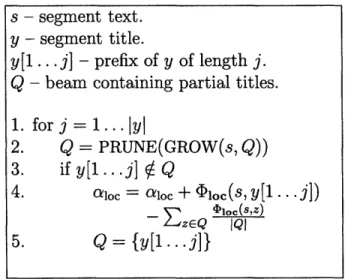
In chapter 4, we explore how incorporating a heuristic decoder into the learning process can affect system performance for the task of table-of-contents generation. We implement a model that accounts for decoding during the learning process and apply it to automatically generate a of-contents. To generate a coherent table-of-contents, we need to capture both global dependencies across different titles in the table and local constraints within sections. Our algorithm effectively handles these complex dependencies by factoring the model into local and global components, and incrementally constructing the model's output. The results of automatic evaluation and manual assessment confirm the benefits of this design: our system is consistently
ranked higher than non-hierarchical baselines.
At the start of chapter 4, we explain the benefits of an automated means of generating a table-of-contents and provide an overview of the challenges involved. We then provide an overview of relevant work on text summarization. Then, we formalize the problem of table-of-contents generation and introduce our approach for incremental learning and decoding. Next, we describe our experimental framework and data. At the end the chapter, we present our results and provide directions for
future work.
In chapter 5, we conclude the thesis by discussing the key points and discuss avenues for future research.
As a final contribution, we have made the source code for the decoding algorithms discussed in the thesis publicly available for the NLP research community.1
1The source code for the methods described in chapter 3 is available at
http://people.csail.mit.edu/pawand/randomized/. The code for the model described in chapter 4 is accessible at http: //people. csail .mit. edu/pawand/toc/.
Chapter 2
Inducing Temporal Graphs
2.1
Introduction
Understanding the temporal flow of discourse is a significant aspect of text compre-hension. Consequently, temporal analysis has been a focus of linguistic research for quite some time. Temporal interpretation encompasses levels ranging from the syn-tactic to the lexico-semantic [43, 39] and includes the characterization of temporal discourse in terms of rhetorical structure and pragmatic relations [23, 51, 41, 36].
Besides its linguistic significance, temporal analysis has important practical im-plications. In multidocument summarization, knowledge about the temporal order of events can enhance both the content selection and the summary generation pro-cesses [7]. In question answering, temporal analysis is needed to determine when a particular event occurs and how events relate to each other. Some of these needs can be addressed by emerging technologies for temporal analysis [53, 38, 35, 9].
We characterize the temporal flow of discourse in terms of temporal segments and their ordering. We define a temporal segment to be a fragment of text that does not exhibit abrupt changes in temporal focus [52]. A segment may contain more than one event or state, but the key requirement is that its elements maintain temporal coherence. For instance, a medical case summary may contain segments describing a patient's admission, his previous hospital visit, and the onset of his original symptoms. Each of these segments corresponds to a different time frame, and is clearly delineated
as such in a text.
Our ultimate goal is to automatically construct a graph that encodes ordering be-tween temporal segments. The key premise is that in a coherent document, temporal progression is reflected in a wide range of linguistic features and contextual depen-dencies. In some cases, clues to segment ordering are embedded in the segments themselves. For instance, given a pair of adjacent segments, the temporal adverb
next day in the second segment is a strong predictor of a precedence relation. In
other cases, we can predict the right order between a pair of segments by analyzing their relation to other segments in the text. The interaction between pairwise order-ing decisions can easily be formalized in terms of constraints on the graph topology. An obvious example of such a constraint is prohibiting cycles in the ordering graph. We show how these complementary sources of information can be incorporated in a model using global inference.
We evaluate our temporal ordering algorithm on a corpus of medical case sum-maries. Temporal analysis in this domain is challenging in several respects: a typical summary exhibits no significant tense or aspect variations and contains few absolute time markers. We demonstrate that humans can reliably mark temporal segments and determine segment ordering in this domain. Our learning method achieves 83% F-measure in temporal segmentation and 84% accuracy in inferring temporal relations between two segments.
Our contributions are twofold:
Temporal Segmentation We propose a fully automatic, linguistically rich model for temporal segmentation. Most work on temporal analysis is done on a finer gran-ularity than proposed here. Our results show that the coarse grangran-ularity of our rep-resentation facilitates temporal analysis and is especially suitable for domains with sparse temporal anchors.
Segment Ordering We introduce a new method for learning temporal ordering. In contrast to existing methods that focus on pairwise ordering, we explore strategies for global temporal inference. The strength of the proposed model lies in its ability to simultaneously optimize pairwise ordering preferences and global constraints on
graph topology. While the algorithm has been applied at the segment level, it can be used with other temporal annotation schemes.
2.2
Related Work
Temporal ordering has been extensively studied in computational linguistics [41, 52, 31, 36, 37]. Prior research has investigated a variety of language mechanisms and knowledge sources that guide interpretation of temporal ordering, including tense, aspect, temporal adverbials, rhetorical relations and pragmatic constraints. In recent years, the availability of annotated corpora, such as TimeBank [42], has triggered the use of machine-learning methods for temporal analysis [38, 35, 9]. Typical tasks include identification of temporal anchors, linking events to times, and temporal ordering of events.
Since this chapter addresses temporal ordering, we focus our discussion on this task. Existing ordering approaches vary both in terms of the ordering unit - it can be a clause, a sentence or an event - and in terms of the set of ordering relations considered by the algorithm. Despite these differences, most existing methods have the same basic design: each pair of ordering units (i.e., clauses) is abstracted into a feature vector and a supervised classifier is employed to learn the mapping be-tween feature vectors and their labels. Features used in classification include aspect, modality, event class, and lexical representation. It is important to note that the classification for each pair is performed independently and is not guaranteed to yield a globally consistent order.
In contrast, our focus is on globally optimal temporal inference. While the im-portance of global constraints has been previously validated in symbolic systems for temporal analysis [26, 55], existing corpus-based approaches operate at the local level. These improvements achieved by a global model motivate its use as an alternative to existing pairwise methods.
S1 A 32-year-old woman was admitted to the hospital because of left subcostal pain...
S2 The patient had been well until four years earlier,
S5 Three months before admission an evaluation elsewhere included an ultrasono-graphic examination, a computed tomoultrasono-graphic (CT) scan of the abdomen... S7 She had a history of eczema and of asthma...
S8 She had lost 18 kg in weight during the preceding 18 months.
S13 On examination the patient was slim and appeared well. An abdominal ex-amination revealed a soft systolic bruit... and a neurologic exex-amination was normal...
Figure 2-1: An example of the transitive reduction of a TDAG for a case summary. A sample of segments corresponding to the nodes marked in bold is shown in the table.
2.3
TDAG: A representation of temporal flow
We view text as a linear sequence of temporal segments. Temporal focus is retained within a segment, but radically changes between segments. The length of a segment can range from a single clause to a sequence of adjacent sentences. Figure 2-1 shows a sample of temporal segments from a medical case summary. Consider as an example the segment S13 of this text. This segment describes an examination of a patient, encompassing several events and states (i.e., an abdominal and neurological examina-tion). All of them belong to the same time frame, and temporal order between these
events is not explicitly outlined in the text.
We represent the ordering of events as a temporal directed acyclic graph (TDAG). An example of the transitive reduction' of a TDAG is shown in Figure 2-1. Edges in a TDAG capture temporal precedence relations between segments. Because the graph encodes an order, cycles are prohibited. We do not require the graph to be fully connected - if the precedence relation between two nodes is not specified in the text, the corresponding nodes will not be connected. For instance, consider the segments
S5 and S7 from Figure 2-1, which describe the patient's previous tests and the history of eczema. Any order between the two events is consistent with our interpretation of the text, therefore we cannot determine the precedence relation between the segments S5 and S7.
In contrast to many existing temporal representations [1, 42], TDAG is a coarse annotation scheme: it does not capture interval overlap and distinguishes only a sub-set of commonly used ordering relations. Our choice of this representation, however, is not arbitrary. The selected relations are shown to be useful in text processing ap-plications [55] and can be reliably recognized by humans. Moreover, the distribution of event ordering links under a more refined annotation scheme, such as TimeML, shows that our subset of relations covers a majority of annotated links [42].
2.4
Method for Temporal Segmentation
Our first goal is to automatically predict shifts in temporal focus that are indicative of segment boundaries. Linguistic studies show that speakers and writers employ a wide range of language devices to signal change in temporal discourse [8]. For instance, the presence of the temporal anchor last year indicates the lack of temporal continuity between the current and the previous sentence. However, many of these predictors are heavily context-dependent and, thus, cannot be considered independently. Instead of manually crafting complex rules controlling feature interaction, we opt to learn them from data.
We model temporal segmentation as a binary classification task. Given a set of candidate boundaries (e.g., sentence boundaries), our task is to select a subset of the boundaries that delineate temporal segment transitions. To implement this approach, we first identify a set of potential boundaries. Our analysis of the manually-annotated corpus reveals that boundaries can occur not only between sentences, but also within a sentence, at the boundary of syntactic clauses. We automatically segment sentences into clauses using a robust statistical parser [12]. Next, we encode each boundary as a
vector of features. Given a set of annotated examples, we train a classifier2 to predict boundaries based on the following feature set:
Lexical Features Temporal expressions, such as tomorrow and earlier, are among the strongest markers of temporal discontinuity [41, 8]. In addition to a well-studied set of domain-independent temporal markers, there are a variety of domain-specific temporal markers. For instance, the phrase initial hospital visit functions as a time
anchor in the medical domain.
To automatically extract these expressions, we provide a classifier with n-grams from each of the candidate sentences preceding and following the candidate segment boundary.
Topical Continuity Temporal segmentation is closely related to topical segmen-tation [11]. Transitions from one topic to another may indicate changes in temporal flow and, therefore, identifying such transitions is relevant for temporal segmentation. We quantify the strength of a topic change by computing a cosine similarity be-tween sentences bordering the proposed segmentation. This measure is commonly used in topic segmentation [29] under the assumption that change in lexical distribu-tion corresponds to topical change.
Positional Features Some parts of the document are more likely to exhibit temporal change than others. This property is related to patterns in discourse or-ganization of a document as a whole. For instance, a medical case summary first discusses various developments in the medical history of a patient and then focuses on his current conditions. As a result, the first part of the summary contains many short temporal segments. We encode positional features by recording the relative position of a sentence in a document.
Syntactic Features Because our segment boundaries are considered at the clausal level, rather than at the sentence level, the syntax surrounding a hypothesized bound-ary may be indicative of temporal shifts. This feature takes into account the position of a word with respect to the boundary. For each word within three words of the hy-pothesized boundary, we record its part-of-speech tag along with its distance from the
boundary. For example, NNP+I encodes the presence of a proper noun immediately following the proposed boundary.
2.5
Learning to Order Segments
Our next goal is to automatically construct a graph that encodes ordering relations between temporal segments. One possible approach is to cast graph construction as a standard binary classification task: predict an ordering for each pair of distinct segments based on their attributes alone. If a pair contains a temporal marker, like
later, then accurate prediction is feasible. In fact, this method is commonly used
in event ordering [38, 35, 9]. However, many segment pairs lack temporal markers and other explicit cues for ordering. Determining their relation out of context can be difficult, even for humans. Moreover, by treating each segment pair in isolation, we cannot guarantee that all the pairwise assignments are consistent with each other and yield a valid TDAG.
Rather than ordering each pair separately, our ordering model relies on global inference. Given the pairwise ordering predictions of a local classifier3, our model
finds a globally optimal assignment. In essence, the algorithm constructs a graph that is maximally consistent with the individual ordering preferences of each segment pair and at the same time satisfies graph-level constraints on the TDAG topology.
In Section 2.5.2, we present three global inference strategies that vary in their computational and linguistic complexity. But first we present our underlying local ordering model.
2.5.1
Learning Pairwise Ordering
Given a pair of segments (i, j), our goal is to assign it to one of three classes: forward, backward, and null (not connected). We generate the training data by using all pairs of segments (i, j) that belong to the same document, such that i appears before j in the text.
3
The features we consider for the pairwise ordering task are similar to ones used in previous research on event ordering [38, 35, 9]. Below we briefly summarize these features.
Lexical Features This class of features captures temporal markers and other phrases indicative of the order between two segments. Representative examples in this category include domain-independent cues like years earlier and domain-specific markers like during next visit. To automatically identify these phrases, we provide a
classifier with two sets of n-grams extracted from the first and the second segments. The classifier then learns phrases with high predictive power.
Temporal Anchor Comparison Temporal anchors are one of the strongest cues for the ordering of events in text. For instance, medical case summaries use phrases like two days before admission and one day before admission to express relative order between events. If the two segments contain temporal anchors, we can determine their ordering by comparing the relation between the two anchors. We identified a set of temporal anchors commonly used in the medical domain and devised a small set of regular expressions for their comparison.4 The corresponding feature has three values that encode preceding, following and incompatible relations.
Segment Adjacency Feature Multiple studies have shown that two subsequent sentences are likely to follow a chronological progression [8]. To encode this informa-tion, we include a binary feature that captures the adjacency relation between two segments.
2.5.2
Global Inference Strategies for Segment Ordering
Given the scores (or probabilities) of all pairwise edges produced by a local classifier, our task is to construct a TDAG. In this section, we describe three inference strategies that aim to find a consistent ordering between all segment pairs. These strategies vary significantly in terms of linguistic motivation and computational complexity. Exam-ples of automatically constructed TDAGs derived from different inference strategies
4We could not use standard tools for extraction and analysis of temporal anchors as they were developed on the newspaper corpora, and are not suitable for analysis of medical text [531.
are shown in Figures A-1-A-4 of the appendix.
Greedy Inference in Natural Reading Order (NRO)
The simplest way to construct a consistent TDAG is by adding segments in the order of their appearance in a text. Intuitively speaking, this technique processes segments in the same order as a reader of the text. The motivation underlying this approach is that the reader incrementally builds temporal interpretation of a text; when a new piece of information is introduced, the reader knows how to relate it to already processed text.
This technique starts with an empty graph and incrementally adds nodes in order of their appearance in the text. When a new node is added, we greedily select the edge with the highest score that connects the new node to the existing graph, without violating the consistency of the TDAG. Next, we expand the graph with its transitive closure. We continue greedily adding edges and applying transitive closure until the new node is connected to all other nodes already in the TDAG. The process continues until all the nodes have been added to the graph.
Greedy Best-first Inference (BF)
Our second inference strategy is also greedy. It aims to optimize the score of the graph. The score of the graph is computed by summing the scores of its edges. While this greedy strategy is not guaranteed to find the optimal solution, it finds a reasonable approximation [131.
This method begins by sorting the edges by their score. Starting with an empty graph, we add one edge at a time, without violating the consistency constraints. As in the previous strategy, at each step we expand the graph with its transitive closure. We continue this process until all the edges have been considered.
Exact Inference with Integer Linear Programming (ILP)
We can cast the task of constructing a globally optimal TDAG as an optimization problem. In contrast to the previous approaches, the method is not greedy. It
com-putes the optimal solution within the Integer Linear Programming (ILP) framework. For a document with N segments, each pair of segments (i, j) can be related in the graph in one of three ways: forward, backward, and null (not connected). Let
si--j, si.-j, and sij be the scores assigned by a local classifier to each of the three relations respectively. Let Iij, Ii-j, and Ii,j be indicator variables that are set to
1 if the corresponding relation is active, or 0 otherwise.
The objective is then to optimize the score of a TDAG by maximizing the sum of the scores of all edges in the graph:
N N
maxZ
Si- i* + sieji+-j + si+j j
(2.1)
i=1 j=i+l
subject to:
I-j, ij, Iij e {0, 1} V i, j = 1, ... N, i < j (2.2)
Iij + Ii.-j + Ii+,j = 1 V ij = 1 ,...N,)i < j (2.3)
We augment this basic formulation with two more sets of constraints to enforce validity of the constructed TDAG.
Transitivity Constraints The key requirement on the edge assignment is the transitivity of the resulting graph. Transitivity also guarantees that the graph does not have cycles. We enforce transitivity by introducing the following constraint for
every triple (i, j, k):
li-,j + Ij-k - 1 < li-~-k (2.4)
If both indicator variables on the left side of the inequality are set to 1, then the indicator variable on the right side must be equal to 1. Otherwise, the indicator variable on the right can take any value.
Connectivity Constraints The connectivity constraint states that each node i is connected to at least one other node and thereby enforces connectivity of the
gener-ated TDAG. We introduce these constraints because manually-constructed TDAGs do not have any disconnected nodes. This observation is consistent with the intuition that the reader is capable to order a segment with respect to other segments in the TDAG.
i-1 N
(Z Iij + 1 Iji) < N- 1 (2.5)
j=1 j=i+1
The above constraint rules out edge assignments in which node i has null edges to the rest of the nodes.
Solving ILP Solving an integer linear program is NP-hard [17]. Fortunately, there exist several strategies for solving ILPs. We employ an efficient Mixed Integer Pro-gramming solver lp_solve5 which implements the Branch-and-Bound algorithm. It takes less than five seconds to decode each document on a 2.8 GHz Intel Xeon ma-chine.
2.6
Evaluation Setup
We first describe the corpora used in our experiments and the results of human agreement on the segmentation and the ordering tasks. Then, we introduce the evaluation measures that we use to assess the performance of our model.
2.6.1
Corpus Characteristics
We applied our method for temporal ordering to a corpus of medical case summaries. The medical domain has been a popular testbed for methods for automatic temporal analyzers [16, 55]. The appeal is partly due to rich temporal structure of these documents and the practical need to parse this structure for meaningful processing
of medical data.
We compiled a corpus of medical case summaries from the online edition of The New England Journal of Medicine.6 The summaries are written by physicians of
5
http://groups.yahoo.com/group/lpsolve
6
Massachusetts General Hospital. A typical summary describes an admission status, previous diseases related to the current conditions and their treatments, family his-tory, and the current course of treatment. For privacy protection, names and dates are removed from the summaries before publication.
The average length of a summary is 47 sentences. The summaries are written in the past tense, and a typical summary does not include instances of the past perfect. The summaries do not follow a chronological order. The ordering of information in this domain is guided by stylistic conventions (i.e., symptoms are presented before treatment) and the relevance of information to the current conditions (i.e., previous onset of the same disease is summarized before the description of other diseases).
2.6.2
Annotating Temporal Segmentation
Our approach for temporal segmentation requires annotated data for supervised train-ing. We first conducted a pilot study to assess the human agreement on the task. We employed two annotators to manually segment a portion of our corpus. The annota-tors were provided with two-page instructions that defined the notion of a temporal segment and included examples of segmented texts. Each annotator segmented eight summaries which on average contained 49 sentences. Because annotators were in-structed to consider segmentation boundaries at the level of a clause, there were 877 potential boundaries. The first annotator created 168 boundaries, while the second
- 224 boundaries. We computed a Kappa coefficient of 0.71 indicating a high inter-annotator agreement and thereby confirming our hypothesis about the reliability of temporal segmentation.
Once we established high inter-annotator agreement on the pilot study, one an-notator segmented the remaining 52 documents in the corpus.7 Among 3,297 poten-tial boundaries, 1,178 (35.7%) were identified by the annotator as segment bound-aries. The average segment length is three sentences, and a typical document contains around 20 segments.
2.6.3
Annotating Temporal Ordering
To assess the inter-annotator agreement, we asked two human annotators to construct TDAGs from five manually segmented summaries. These summaries consist of 97 segments, and their transitive closure contain a total of 1,331 edges. We computed the agreement between human judges by comparing the transitive closure of the TDAGs. The annotators achieved a surprisingly high agreement with a Kappa value of 0.98.
After verifying human agreement on this task, one of the annotators constructed TDAGs for another 25 summaries.s The transitive reduction of a graph contains on average 20.9 nodes and 20.5 edges. The corpus consists of 72% forward, 12% backward and 16% null segment edges inclusive of edges induced by transitive closure. At the clause level, the distribution is even more skewed - forward edges account for 74% edges, equal for 18%, backward for 3% and null for 5%.
2.6.4
Evaluation Measures
We evaluate temporal segmentation by considering the ratio of correctly predicted boundaries. We quantify the performance using F-measure, a commonly used binary classification metric. We opt not to use the Pk measure, a standard topical segmen-tation measure, because the temporal segments are short and we are only interested in the identification of the exact boundaries.
Our second evaluation task is concerned with ordering manually annotated seg-ments. In these experiments, we compare an automatically generated TDAG against the annotated reference graph. In essence, we compare edge assignment in the tran-sitive closure of two TDAGs, where each edge can be classified into one of the three types: forward, backward, or null.
Our final evaluation is performed at the clausal level. In this case, each edge can be classified into one of the four classes: forward, backward, equal, or null. Note that the clause-level analysis allows us to compare TDAGs based on the automatically
8
derived segmentation.
2.7
Results
We evaluate temporal segmentation using leave-one-out cross-validation on our corpus of 60 summaries. The segmentation algorithm achieves a performance of 83% F-measure, with a recall of 78% and a precision of 89%.
To evaluate segment ordering, we employ leave-one-out cross-validation on 30 annotated TDAGs that overall contain 13,088 edges in their transitive closure. In addition to the three global inference algorithms, we include a majority baseline that classifies all edges as forward, yielding a chronological order.
Our results for ordering the manually annotated temporal segments are shown in Table 2.1. All inference methods outperform the baseline, and their performance is consistent with the complexity of the inference mechanism. As expected, the ILP strategy, which supports exact global inference, achieves the best performance
-84.3%.
An additional point of comparison is the accuracy of the pairwise classification, prior to the application of global inference. The accuracy of the local ordering is
81.6%, which is lower than that of ILP. The superior performance of ILP demon-strates that accurate global inference can further refine local predictions. Surprisingly, the local classifier yields a higher accuracy than the two other inference strategies. Note, however, the local ordering procedure is not guaranteed to produce a consis-tent TDAG, and thus the local classifier cannot be used on its own to produce a valid TDAG.
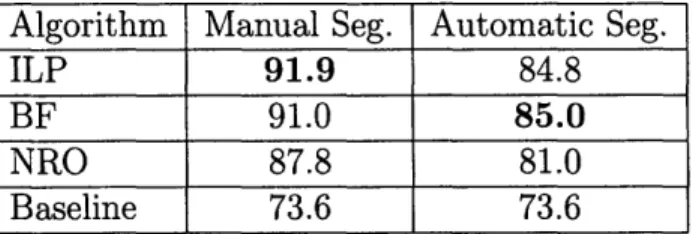
Table 2.2 shows the ordering results at the clausal level. The four-way classification is computed using both manually and automatically generated segments. Pairs of clauses that belong to the same segment stand in the equal relation, otherwise they have the same ordering relation as the segments to which they belong.
On the clausal level, the difference between the performance of ILP and BF is blurred. When evaluated on manually-constructed segments, ILP outperforms BF by
Algorithm Accuracy Integer Linear Programming (ILP) 84.3
Best First (BF) 78.3
Natural Reading Order (NRO) 74.3
Baseline 72.2
Table 2.1: Accuracy for 3-way ordering classification over manually-constructed seg-ments.
less than 1%. This unexpected result can be explained by the skewed distribution of edge types - the two hardest edge types to classify (see Table 2.3), backward and null, account only for 7.4% of all edges at the clause level.
When evaluated on automatically segmented text, ILP performs slightly worse than BF. We hypothesize that this result can be explained by the difference between training and testing conditions for the pairwise classifier: the classifier is trained on manually-computed segments and is tested on automatically-computed ones, which negatively affects the accuracy on the test set. While all the strategies are negatively influenced by this discrepancy, ILP is particularly vulnerable as it relies on the score values for inference. In contrast, BF only considers the rank between the scores, which may be less affected by noise.
We advocate a two-stage approach for temporal analysis: we first identify seg-ments and then order them. A simpler alternative is to directly perform a four-way classification at the clausal level using the union of features employed in our two-stage process. The accuracy of this approach, however, is low - it achieves only 74%, most likely due to the sparsity of clause-level representation for four-way classification. This result demonstrates the benefits of a coarse representation and a two-stage approach for temporal analysis.
2.8
Conclusions
We introduce a new method for temporal ordering. The unit of our analysis is a temporal segment, a fragment of text that maintains temporal coherence. After
in-Algorithm Manual Seg. Automatic Seg.
ILP 91.9 84.8
BF 91.0 85.0
NRO 87.8 81.0
Baseline 73.6 73.6
Table 2.2: Results for 4-way ordering classification over ually and automatically generated segments.
Algorithm Forward Backward Null
ILP 92.5 45.6 76.0
BF 91.4 42.2 74.7
NRO 87.7 43.6 66.4
clauses, computed over
man-Table 2.3: Per class accuracy for clause classification over manually computed seg-ments.
vestigating several inference strategies, we concluded that integer linear programming and best first greedy approach are valuable alternatives for TDAG construction.
In the future, we will explore a richer set of constraints on the topology on the ordering graph. We will build on the existing formal framework [26] for the verifica-tion of ordering consistency. We are also interested in expanding our framework for global inference to other temporal annotation schemes. Given a richer set of temporal relations, the benefits from global inference can be even more significant.
Chapter 3
Randomized Decoding for
Selection-and-Ordering Problems
3.1
Introduction
The task of selecting and ordering information appears in multiple contexts in text generation and summarization. For instance, a typical multidocument summarization system creates a summary by selecting a subset of input sentences and ordering them into a coherent text. Selection and ordering at the word level is commonly employed in lexical realization. For instance, in the task of title generation, the headline is constructed by selecting and ordering words from the input text.
Decoding is an essential component of the selection-and-ordering process. Given selection and ordering preferences, the task is to find a sequence of elements that maximally satisfies these preferences. One possible approach for finding such a solu-tion is to decompose it into two tasks: first, select a set of words based on individual selection preferences, and then order the selected units into a well-formed sequence. Although the modularity of this approach is appealing, the decisions made in the se-lection step cannot be retracted. Therefore, we cannot guarantee that selected units can be ordered in a meaningful way, and we may end up with a suboptimal output.
In this chapter, we investigate decoding methods that simultaneously optimize selection and ordering preferences. We formalize decoding as finding a path in a
directed weighted graph.' The vertices in the graph represent units with associated selection scores, and the edges represent pairwise ordering preferences. The desired solution is the highest-weighted acyclic path of a prespecified length. The requirement for acyclicity is essential because in a typical selection-and-ordering problem, a well-formed output does not include any repeated units. For instance, a summary of multiple documents should not contain any repeated sentences.
Since the problem is NP-hard, finding an exact solution is challenging. We intro-duce a novel randomized decoding algorithm based on the idea of color-coding [2]. Although the algorithm is not guaranteed to find the optimal solution on any single run, by increasing the number of runs the algorithm can guarantee an arbitrarily high probability of success. We provide a theoretical analysis that establishes the connec-tion between the required number of runs and the likelihood of finding the correct solution.
Next, we show how to find an exact solution using an integer linear program-ming (ILP) formulation. Although ILP is NP-hard, this method is guaranteed to compute the optimal solution. This allows us to experimentally investigate the trade-off between the accuracy and the efficiency of decoding algorithms considered in the chapter.
We evaluate the accuracy of the decoding algorithms on the task of title genera-tion. The decoding algorithms introduced in the chapter are compared against beam search, a heuristic search algorithm commonly used for selection-and-ordering and other natural language processing tasks. Our experiments show that the randomized decoder is an appealing alternative to both beam search and ILP when applied to selection-and-ordering problems.
1We assume that the scoring function is local; that is, it is computed by combining pairwise
scores. In fact, the majority of models that are used to guide ordering (i.e., bigrams) are local scoring functions.
3.2
Problem Formulation
In this section, we formally define the decoding task for selection-and-ordering prob-lems. First, we introduce our graph representation and show an example of its struction for multidocument summarization. (An additional example of graph con-struction for title generation is given in Section 3.6.) Then, we discuss the complexity of this task and its connection to classical NP-hard problems.
3.2.1
Graph Representation
We represent the set of selection units as the set of vertices V in a weighted directed graph G. The set of edges E represents pairwise ordering scores between all pairs of vertices in V. We also add a special source vertex s and sink vertex t. For each vertex v in V, we add an edge from s to v and an edge from v to t. We then define the set of all vertices as V* = V U {s, t}, and the set of all edges as
E* = EU {(s, v) Vv E V} U {(v, t) Vv E V}.
To simplify the representation, we remove all vertex weights in our graph structure and instead shift the weight for each vertex onto its incoming edges. For each pair of distinct vertices (v, u) E V, we set the weight of edge e,,u to be the sum of the logarithms of the selection score for u and the pairwise ordering score of (v, u).
We also enhance our graph representation by grouping sets of vertices into
equiv-alence classes. We introduce these classes to control for redundancy as required in
many selection-and-ordering problems.2 For instance, in title generation, an
equiva-lence class may consist of morphological variants of the same stem (i.e., examine and
examination). Because a typical title is unlikely to contain more than one word with
the same stem, we can only select a single representative from each class.
Our task is now to find the highest weighted acyclic path starting at s and end-ing at t with k vertices in between, such that no two vertices belong to the same
2
An alternative approach for redundancy control would be to represent all the members of an equivalence class as a single vertex in the graph. However, such an approach does not allow us to select the best representative from the class. For instance, one element in the equivalence class may have a highly weighted incoming edge, while another may have a highly weighted outgoing edge.
equivalence class.
3.2.2
Example: Decoding for Multidocument summarization
In multidocument summarization, the vertices in the decoding graph represent sen-tences from input documents. The vertices may be organized into equivalence classes that correspond to clusters of sentences conveying similar information.3 The edges in the graph represent the combination of the selection and the ordering scores. The selection scores encode the likelihood of a sentence to be extracted, while pairwise or-dering scores capture coherence-based precedence likelihood. The goal of the decoder is to find the sequence of k non-redundant sentences that optimize both the selection and the ordering scores. Finding an acyclic path with the highest weight will achieve this goal.
3.2.3
Relation to Classical Problems
Our path-finding problem may seem to be similar to the tractable shortest paths problem. However, the requirement that the path be long makes it more similar to the the Traveling Salesman Problem (TSP). More precisely, our problem is an instance of the prize collecting traveling salesman problem, in which the salesman is required to visit k vertices at best cost [5, 4].
Since our problem is NP-hard, we might be pessimistic about finding an exact solution. But our problem has an important feature: the length k of the path we want to find is small relative to the number of vertices n. This feature distinguishes our task from other decoding problems, such as decoding in machine translation [28], that are modeled using a standard TSP formulation. In general, the connection between n and k opens up a new range of solutions. For example, if we wanted to find the best length-2 path, we could simply try all subsets of 2 vertices in the graph, in all 2 possible orders. This is a set of only O(n2) possibilities, so we can check all
to identify the best in polynomial time. 3
Such clusters are computed automatically by analyzing lexical similarity of sentences from dif-ferent documents.
This approach is very limited, however: in general, its runtime of O(nk) for paths of length k makes it prohibitive for all but the smallest values of k. We cannot really hope to avoid the exponential dependence on k, because doing so would give us a fast solution to an NP-hard problem, but there is hope of making the dependence "less exponential." This is captured by the definition of fixed parameter tractability [22]. A problem is fixed parameter tractable if we can make the exponential dependence on the parameter k independent of the polynomial dependence on the problem size
n. This is the case for our problem: as we will describe below, an algorithm of Alon
et al. can be used to achieve a running time of roughly o(2kn2). In other words, the path length k only exponentiates a small constant, instead of the problem size n, while the dependence on n is in fact quadratic.
3.3
Related Work
Decoding for selection-and-ordering problems is commonly implemented using beam search [6, 18, 33]. Being heuristic in nature, this algorithm is not guaranteed to find an optimal solution. However, its simplicity and time efficiency make it a decoding algorithm of choice for a wide range of NLP applications. In applications where beam decoding does not yield sufficient accuracy, researchers employ an alternative heuristic search, A* [32, 28]. While in some cases A* is quite effective, in other cases its running time and memory requirements may equal that of an exhaustive search. Time- and memory-bounded modifications of A* (i.e., IDA-A*) do not suffer from this limitation, but they are not guaranteed to find the exact solution. Nor do they provide bounds on the likelihood of finding the exact solution. Newly introduced methods based on local search can effectively examine large areas of a search space [24], but they still suffer from the same limitations.
As an alternative to heuristic search algorithms, researchers also employ ex-act methods from combinatorial optimization, in particular integer linear program-ming [28, 44]. While existing ILP solvers find the exact solution eventually, the running time may be too slow for practical applications.