Design of an Autonomous Underwater Vehicle to
Evaluate the Blazed Array Sonar and Simultaneous
Localization and Mapping Algorithms
byMatthew William Uhle
SUBMITTED TO THE DEPARTMENT OF MECHANICAL ENGINEERING IN PARTIAL FULFILLMENT OF THE REQUIREMENTS FOR THE DEGREE OF
BACHELOR OF SCIENCE IN MECHANICAL ENGINEERING AT THE
MASSACHUSETTS INSTITUTE OF TECHNOLOGY FEBRUARY 2007
C 2007 Matthew W. Uhle. All rights reserved.
The author hereby grants to the MIT permission to reproduce and to distribute publicly paper and electronic copies of this thesis document in whole or in part in any medium
now known or hereafter created.
- / '-~7
Signature of Author:
Department of Mechanical Engineering
77
1
A
January 19, 2007
Certified by: Accepted by: MASSACHUSETTS INSTITU OF TECHNOLOGYJUN 2 1 2007
LUI
A
R I
P
SJohn
J. Leonard
Professor of Mechanical and cean Engineering Thesis Supervisor
FE
John H. Lienhard V Professor of Mechanical Engineering Chairman, Undergraduate Thesis Committee
Matthew W Uhle
Design of an Autonomous Underwater Vehicle to evaluate the Blazed
Array Sonar and Simultaneous Localization and Mapping Algorithms
by
Matthew William Uhle
Submitted to the Department of Mechanical Engineering on January 19, 2007 in Partial Fulfillment of the Requirements for the Bachelors of Science in Mechanical Engineering
Abstract:
This thesis has investigated aspects of the design of a new highly maneuverable
Autonomous Underwater Vehicle - the XAUV. The overall goal for the design of this vehicle is to create a small, highly maneuverable AUV that can perform autonomous ship hull inspection. Our work towards this goal was targeted to three different aspects: (1) contributions to the conceptual design of the overall vehicle, (2) specification and acquisition of the electronic components of the vehicle, including its main CPU, and (3) mechanical design of selected components, including the ship's hull, servo-controlled fin system, and blazed array sonar nose cone. These contributions have helped to improve and realize the design of the first prototype XAUV, which is expected to be completed in May, 2007, through the work of other members of the design team.
Thesis Supervisor: John J. Leonard
Title: Professor of Mechanical and Ocean Engineering
Matthew W Uhle
Table of Contents
Introduction ... 4
Background ... 5-7
1 Mechanical Design Requirements 2 Electrical Design Requirements
Design Results ... 8-13
1 Initial Concept
2 Refined Design: the Hull
3 Refined Design: Additional Components
Project Schedule ... 13
References ... 14
Page 3 of 14 AUV Project
Matthew W Uhle
Introduction:
Traditional sonar sends a series of single beam signals and interprets the reflecting signals to determine a picture. The blazed array sonar is similar, but uses a multi-beam signal. Each individual signal of the multi-beam has slightly varied information encoded in its frequency. These changes allow the blazed array signal to contain more
information, be more versatile in its directional orientation, and be more cost effective. For these reasons, the Navy is looking to move more exclusively to the blazed array sonar.
The Navy is also looking for innovations to increase the effectiveness of ship hull inspections. Hull inspections are important for the maintenance of ships, for the
protection of the surrounding environment from internal leaks of hazardous chemicals, and for protection from sabotage to the vessel. A deficiency of hull inspections would decrease life expectancy of the ship and increase the probability for costly consequences for other people, animals, and vessels in its vicinity. Currently, the Navy employs divers
to search each ship regularly underwater - armed mainly with their own eyes, hands, and
a flashlight - to find hull irregularities and dangers. However, this method is inefficient
and not particularly fast or cost effective. Instead, the Navy hopes to build something more autonomous which could check ships at port far more regularly and precisely.
Another autonomous goal for the Navy, and particularly for this lab, is the creation and testing of simultaneous localization and mapping (SLAM) algorithms. Though SLAM algorithms are needed in a variety of mobile robotic applications, they are particularly useful underwater. Simply stated, the goal of these algorithms is to allow the robot to autonomously navigate unknown terrain and return safely with a geographical layout to be used on further missions. Thus, SLAM algorithms are useful for any mobile autonomous function through an unknown terrain. Though eventually the intent is to test these algorithms in the ocean, testing will first be done in artificial and shallow fresh water tanks and pools. However, in order to test SLAM algorithms, the lab requires an autonomous underwater vehicle (AUV) suited for SLAM testing. Currently most SLAM testing has been done on AUVs that were designed for other purposes and often are not available to the lab as often as necessary.
An AUV for hull inspections would be an ideal solution to inspecting ships at greater frequency. The blazed array sonar's maneuverability and greater sight range make an ideal combination as a sensor for the inspections. Moreover, a blazed array would be a useful sensor for testing SLAM algorithms, though likely testing these programs would later require additional sensory inputs. The conclusion is to build an autonomous submersible with the blazed array and the potential to interface to other underwater sensors. This AUV would be able to effectively solve all three problems by performing ship hull inspections and providing the lab with a platform for using the blazed array sonar and testing SLAM algorithms. MIT Professor of Mechanical and Ocean Engineering, John Leonard, has given the task of creating this AUV to Mechanical Engineering undergraduates Joseph Brown (MIT), Kenton Williams (Ohio State), and myself under the direction of MIT Mechanical Engineering graduate student Daniel Walker.
Matthew W Uhle Background:
T- . 1.1L.-'A •I.• -- •-+. .. T X7 +._.1•/ i .
n uurder to prope;rly build UUS -AUYU , Ulu U;•signI
requirements and restraints should be explored. This section will discuss the mechanical and electrical aspects of the vehicle and highlight principle design considerations. Possible solutions are explored, mostly from observations of other autonomous water vehicles built under Professor Leonard's direction.
Figure 1. Joe, Alex, and one of the lab's automated surface
1 Mechanical Design Requirements vehicles.[3]
1.1 Degrees ofFreedom
Ideally, the AUV will have a large degree of mobility and control of its motion underwater. The ability to move in any of the three principle axes would be useful both for localization algorithms and to focus on particular areas of ship hulls. However, the only directions required to be directly motor driven are forward, up, and down. The submersible must be able to control its depth and have one principle direction for motion. Turning could be controlled either as a difference in output of multiple forward thrusters, a change in position of fins on the craft, or directly by additional motors.
Roll and pitch control is important to the AUV in that these variables need not be controlled, but must remain stable during operation. Control of roll and pitch would be useful in controlling sensor direction. For simple stability, the craft could be weighted to allow the buoyant forces of the water to keep the vehicle in a particular orientation. This can be achieved by keeping the center of buoyancy of the vehicle above its center of gravity[ 4], perhaps by seating most of the vehicle's internal weight lower than its center. However, in this configuration the craft would only remain perfectly positioned in a static fluid and water currents could cause the craft to roll. Fins or other structures to resist movements in particular directions or additional motor control could be added to increase stability.
1.2 Fluid Dynamics
A particular design concern will be to minimize the drag experienced underwater during motion in moveable directions. A torpedo shape is ideal for reducing drag. However, this shape is not necessarily ideal for the AUV's sensors nor does it provide much control in non-forward directions. Additionally the maximum speed of the vehicle is not a primary objective. Thus, trade-offs between drag and additional features can be made with the design.
Buoyancy is also a concern. Though the AUV could use motor control for depth stability, the design will be simpler to keep the weight of the vehicle equivalent to the weight of the water it displaces underwater.[ 41 Since then the vehicle's buoyancy will be
equivalent to its weight, it will be able to remain at a particular depth without constant motorized control.
Page 5 of 14 AUV Project
Matthew W Uhle
1.3 Blazed Array Sonar Housing
Figure 2. Blazed Array Sonarl
The blazed array sonar will cost over $20,000[11 and will be the most expensive piece of equipment on the AUV. For this reason, safeguarding the sonar from harm will be a significant design consideration. Likely a housing will be constructed around the device, leaving only the necessary rectangular end directly exposed to the water. A structured body surrounding the blazed array sonar will reduce potential collision damage.
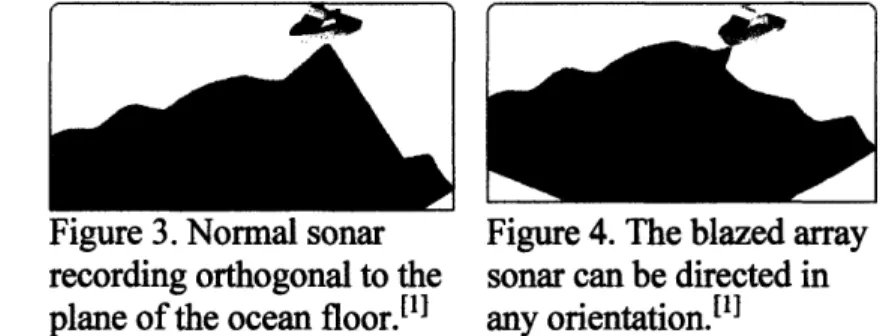
e rugiF 4 The blazed
ar y
recording orthogonal to the sonar can be directed in plane of the ocean floor.111 any orientation.[11
Ideally, the blazed array housing will also take advantage of the sonar's ability to take readings in any direction. This ability would be useful in testing and evaluating the sonar itself as well as giving greater freedom to picture the surrounding area. One option is a fixed housing for the sonar could be used in combination with greater degree of freedom control for the craft. This design would require the AUV as a whole to change its orientation and face in the direction of what it wants to sense. Another option is to have the housing's direction controlled independent of the craft, allowing it to rotate or move to the desired direction. In either case, considerations must be made to insure that the direction of motion of the craft always corresponds to a direction determined to be collision free.
In either case, consideration must be given to the ability to remove the blazed array and add another sensor, or set of sensors, in its place. A possible solution that will allow for a customized blazed array housing without detracting from potential
customability is to allow the housing to be separable from the rest of the AUV. Then AUV Project
Matthew W Uhle
separate housings could be fashioned for any given large sensor to replace the blazed array sonar.
2 Electrical Design Requirements 2.1 Electronics Housing
Depending on ballast issues, the AUV may not need to be airtight in all locations. However, the electronics must be kept waterproof. Due to the expensive nature of the computer and sensors involved, special effort will be taken to minimize the potential for damage. A sturdy, airtight housing can protect against water and AUV collision issues. Likely the
design of this housing would use at least two layers of airtight containers to prevent the accidental fracture of one seal from
snorting ime entire system. Overneating problems may prove Figure 5. Watertight
minimal as significant problems of this nature have not electronics housing in a
characterized other autonomous watercraft, though will be a surface vehicle.[31
design consideration.
The cables connecting the main electronics to the motors and sensors should also be doubly insulated against water. Depending on the number of motors and sensors contained in the AUV, the cables may occupy a significant amount of space within the craft. Additionally, as not all underwater sensors use a universal serial connection, consideration for inputs for sensors other than the blazed array will be considered.
Also to increase future customability of the AUV, the electronics housing may need to be removable. This feature would increase the ability to upgrade the existing
electronics to suit future sensor requirements. At the very least, the computer needs to be accessible to download new programs.
2.2 Power
Since the craft will be autonomous, the AUV should house its own source of power, most easily accomplished by electric batteries. Since onboard batteries will often require recharging, design of an accessible outlet location or an easily replaceable battery housing will be used. The latter option may be more ideal because it keeps an electrical outlet from being accessible in waterproof areas and would allow a separate battery pack to be charging during craft operation. A housing of batteries could also be useful as ballast to stabilize the craft.
Instead of housing batteries, the AUV could be designed to be tethered to a separate power source. A tether would cause mobility issues related to area of operation and forces on the craft transferred from the water to the tether. However, a tether would increase maximum mission length, give the craft greater retrievability, and would prevent a several thousand dollar robot from becoming lost.
Page 7 of 14
AUV Project
Matthew W Uhle Design Results:
1 Initial Concepts
After considering the constraints and requirements for the AUV outlined above, several general designs were proposed and examined. Here the two concepts determined to be most suited for the project are discussed.
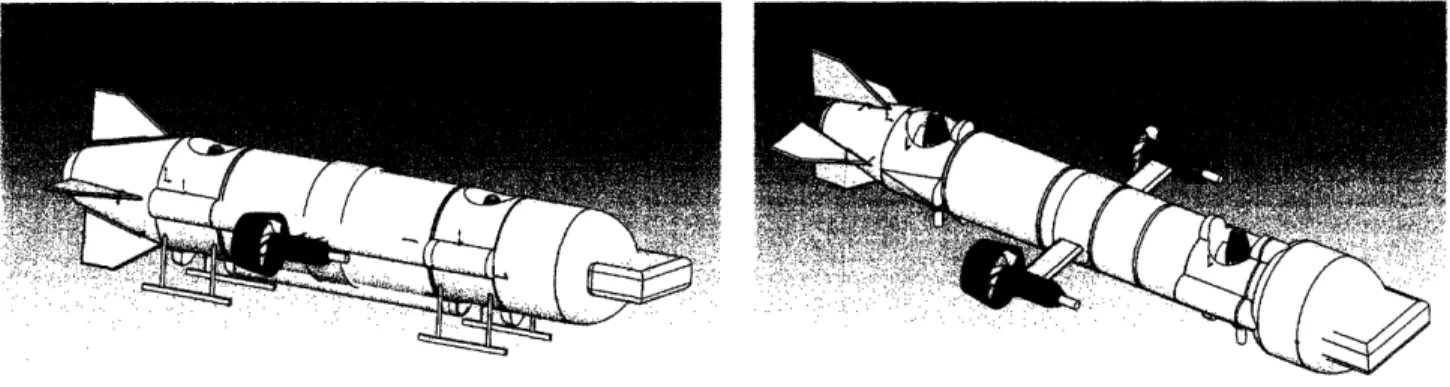
Figure 6. Solidworks model of AUV Concept 1. Figure 7. Solidworks model of AUV Concept 2 These concepts meet the three design goals of using the blazed array sonar,
performing ship hull inspections, and being a suitable platform for SLAM algorithm testing. The blazed array sonar in these concepts is built into the nose module and is the primary sensor for the AUV. Hull inspections will be performed by either facing the
AUV toward the hull or turning the blazed array sonar independently towards the desired location. The computer can then use the resulting picture to determine whether specific areas of the hull should be sent to a supervisor for further inspection. In this manner, only a few Navy personnel are required to inspect flagged areas of the hulls rather than several teams to inspect every hull. Finally, the ability to remove each section of the AUV's hull will allow the vehicle to be easily reprogrammed or customized with
additional programs and sensors, which will make the AUV a great test bed for SLAM algorithms.
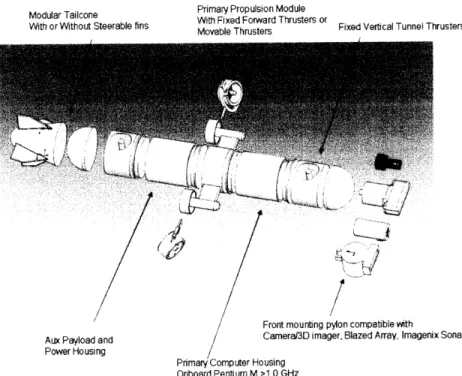
The basic hull is modeled after a torpedo to reduce drag in the forward motion of the vehicle. The main hull is composed of the tail cone, a depth motor, the battery housing, the electronics housing, a second depth motor, and the nose cone. The tail has external fins which provide roll stability and can be actuated to steer the vehicle. The two depth motors will work in unison to keep the vehicle aligned with the plane of the water's surface while controlling depth. The battery housing will be the heaviest part of the vehicle and is placed slightly behind the geometric center to counteract the weight of the blazed array sonar. The sonar is placed in front of the AUV as this will allow greater use of the sonar's multi-directional capabilities. The AUV can either tilt itself through a difference in the two depth motors' outputs or the nose can be modified to move the sonar independently of the main body.
Matthew W Uhle
Modular Tailcone
With or Without Steerable fins
Aux Payload and
Power Ho using
Primary Propulsion Module
With Fixed Forward Thrusters or Movable Thrusters
/ Front mounting pyli
/ Camera/3D imager
/
mary Computer Housing board Pentium M >1.0 GHz
Fixed Vertical Tunnel Thrusters
on compatible with
, Blazed Array, Imagenix Sonars
Figure 8. Solidworks model of basic AUV design.
Additionally these designs feature two forward biased motors. A difference in outputs between the two forward motors allow for a greater turning maneuverability than the usual single motor design on torpedoes. Concept 1 also features aluminum "feet" on the underside of the AUV and two connection bars. The "feet" reduce the risk of damage to the vehicle in diving to the seafloor and give the AUV stability when stored on land. The connection bars force the separate compartments of the AUV hull to remain together and give operators a hand hold to manually move the vehicle in and out of the water. Concept 2's design lacks the aluminum "feet" and connection bars to reduce the drag felt by the AUV in the water.
2 Refined Design: the Hull
In an effort to have a working AUV continually from the earliest possible stages of development, the complexity of the AUV will be increased in a number of steps. The fins on the tail cone, for example, though they will provide greater maneuverability and stability to the AUV, are not essential for the ability of the vehicle to turn. The modular design of the hull allows a tail cone without the fins to be fashioned first and for a tail cone with the fin mechanisms to be added later. Similarly separate nose cones can be fashioned lacking sensors or with sensors other than the blazed array sonar. The ability to switch the blazed array sonar for other underwater sensors gives the AUV greater customability for SLAM algorithm testing in addition to minimizing the risk placed on the expensive sonar. The AUV can be tested first with less expensive sensors so initial programming changes do not cause accidentally damage to important equipment.
Page 9 of 14 AUV Project ·-- ·~ r:
----
~P
e4
i 2A ThesisMatthew W Uhle
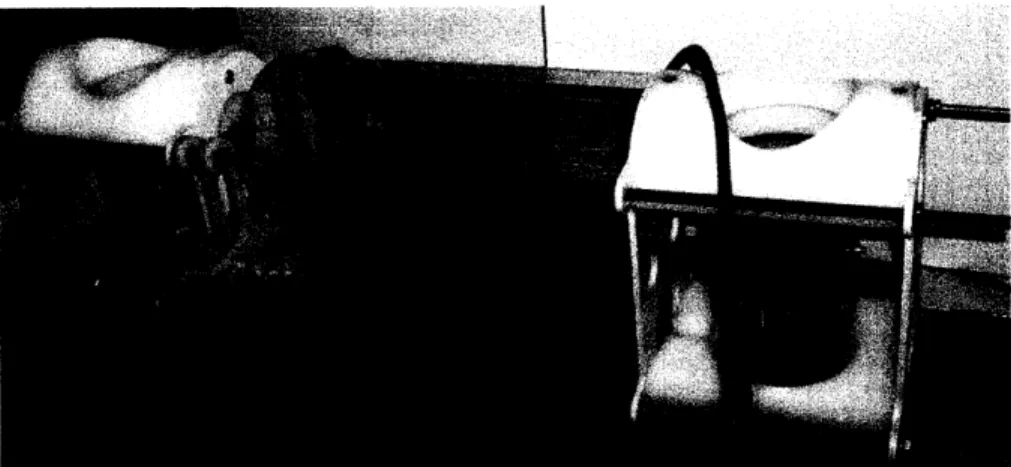
Figure 9. AUV hull design as built on January 11, 2007.
Three notable improvements that were made to the design before building the AUV relate to primary sensor protection, motor position, and a retrieval mechanism. The conceptual design for an independently movable primary sensor does not protect the sensor in the event of a forward collision. Though the AUV can be tested with
inexpensive sensors while perfecting the obstacle avoidance program, primary sensors, like the blazed array sonar, are still important enough to warrant additional protection rather than risk sensor damage. Thus a cone-like outer covering with an opening that moves with the sensor should be included.
Since the AUV is designed to allow for servo-controlled fins, the position of the forward motors is better placed towards the rear of the vehicle. The higher velocity water exiting the motors will give the fins greater influence over the vehicle's direction. This placement change also allows the possibility of a single hull cavity for both the batteries and electronics. However, currently two separate hull cavities for each have been kept to allow a separate compartment for batteries. A separate battery compartment gives the AUV a greater lifespan by allowing one battery compartment to be used on the vehicle while another is being charged. If the batteries and electronics were in the same compartment, then the batteries could only be charged while the vehicle is not in operation.
Finally, the eventual use of the AUV in open water carries the eventual risk of the vehicle being carried out to sea or being lost on the seafloor. To minimize the risk of losing this vehicle, a method will be added for locating either the vehicle as a whole or
simply the expensive electronics and sensors. The current design will have a few LEDs that will allow a diver searching for a lost AUV to find the flashing light in the depths. However, the final method to increase retrievability will be determined after the vehicle has been tested in clear pools and shallow water and is ready for open salt water testing.
3 Refined Design: Additional Components
All four of us on this project were heavily involved in the design process for the AUV as a whole and of the AUV's hull, detailed above. Additional aspects of the AUV
continued to be supervised by Daniel Walker, but were otherwise divided amongst the AUV Project
Matthew W Uhle
3.1 Tail Cone (Kenton Williams and Matthew Uhle)
The primary functions of the tail cone are to enhance the AUV's ability to
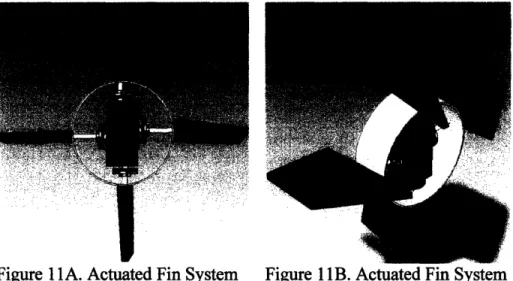
stabilize itself while floating and to provide control while in motion. We determined that computer controlled tail fins would serve to provide increased mobility and moderate roll stability. To preserve the ability to gradually add complexity to the AUV, this module was designed not to be essential to the operation of the AUV and will be added after the hull is complete and submersible.
Figure 11A. Actuated Fin System Figure 11 B. Actuated Fin System Figure 11 shows the design for the fin system. Each of four fins are independently servo controlled and are doubled orthogonally to minimize space
requirements and maximize the resulting forces on the vehicle. Originally, the four fins were designed to be controlled by two servos. A two servo design would allow opposite
fins to always work in unison and provide the AUV with a coordinated effort to direct the vehicle either up, down, left, or right. The four servo design will additionally allow the
craft to control roll by twisting opposite fins in different directions, increasing stability while in motion.
3.2 Computer / Electronics (Matthew Uhle)
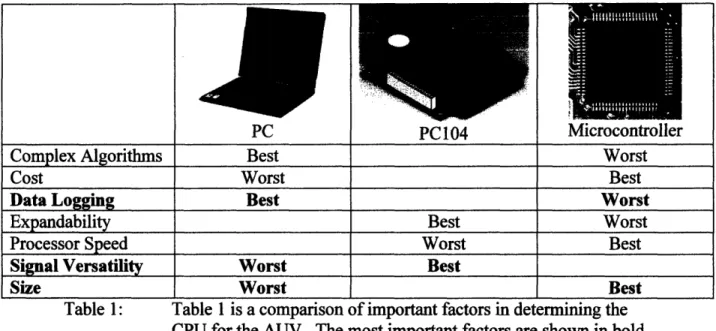
The project's goal centers on having an autonomous vehicle and an appropriate computer is necessary to appropriately control the craft's motion and sensors. The options available to us included buying and installing a laptop computer, a PC104 board, or a microcontroller.
The most important constraints for the AUV's CPU are size, ability to communicate a variety of sensor inputs/outputs, and the ability to store detailed
information about the status and process of the vehicle. Smaller CPUs are preferred to decrease the size of the electronics housing. Greater signal communication versatility increases the number of sensors that can be incorporated into the AUV for future SLAM testing and insures that the vehicle does not become hardwired solely to the blazed array sonar or another primary sensor. Data logging is particularly important for this AUV due
Page 11 of 14
AUV Project
Matthew W Uhle
to its function as a testbed, since a multitude of data will be required to evaluate the blazed array sonar or improve SLAM algorithms. The SLAM algorithms might also become very complex, which would require the CPU to have the ability to do higher level math and procedures. Moreover, future algorithms may wish to add additional software or CPUs, making future expandability a concern. However, the basic program for the AUV does not need to be complex and instead will rely on a constant data loop to allow the vehicle to react and correct for any problems. Cost effectiveness is also a concern.
Complex Algorithms Cost Data Logging Expandability Processor Speed Signal Versatility Size PC Best Worst Best Worst Worst PC104 Best Worst Best Microcontroller Worst Best Worst Worst Best Best
Table 1: Table 1 is a comparison of important factors in determining the CPU for the AUV. The most important factors are shown in bold. Table 1 above shows a comparison of these factors and rates them based on how effective they are for this AUV. Overall, a stackable PC104 board was determined to be the best choice.
3.3 Nose Cone (Joseph Brown)
Though the AUV's sensors could be used from a fixed position relative to the vehicle's hull, the sensors would be more useful if they could be positioned independently from the movement of the AUV. The blazed array sonar, for example, would gain the benefit of allowing the AUV to move between
ships while focusing the sonar on a sideways sweep during
ship hull inspections. Moreover, independently moving the Figure 10. Mechanism to blazed array sonar would allow the sonar to be tested for move sensor independently of accuracy based on the angular position of the sonar and the AUV.
distance of the sonar from the objective.
However, the ability to redirection the primary sensor implies that this sensor will not always be forward looking. For this reason, a simple forward looking sonar will be placed on the AUV for obstacle avoidance when the primary sensor is facing other directions. The AUV will also contain a three axis magnetometer which will serve as an accelerometer, tilt sensor, and electronic compass. This sensor will accurately allow the
Matthew W Uhle
both for the vehicle to control its motion during hull inspections and for the AUV to create a map of its terrain while testing SLAM algorithms.
Project Schedule:
My role in this project is ending; however, Mechanical Engineering graduate student Daniel Walker and undergraduate Joseph Brown will be continuing the project with the goal of a finished and tested AUV by Summer 2007. Over IAP, the AUV's main body modules and motors will be assembled. By the beginning of spring term, the minimum mechanical elements to allow the vehicle to move underwater will be
constructed. This plan allows testing of the AUV to start at the beginning of Spring 2007 and continue through the term as the tail cone and additional nose cone sensor modules are constructed. By the end of Summer 2007, the AUV will be well equipped to test SLAM algorithms at the lab's whim and ready to perform hull inspections in salt water.
Page 13 of 14 AUV Project
Matthew W Uhle References:
[1] BlueView Technologies. Products and Applications. <http://www.blueviewtech.com/>
[2] Custer, Dave. "2.THA Haven." September 2006. <http://web.mit.edu/2.THA/www/> [3] Leonard, John. "John Leonard's Research." September 2006.
<http://cml.mit.edu/-jleonard/>
[4] White, Frank M. Fluid Mechanics. 5thEd, New York: McGraw Hill, 2003
![Figure 1. Joe, Alex, and one of the lab's automated surface 1 Mechanical Design Requirements vehicles.[3]](https://thumb-eu.123doks.com/thumbv2/123doknet/14685876.560243/5.918.561.786.129.356/figure-alex-automated-surface-mechanical-design-requirements-vehicles.webp)