HAL Id: inria-00537964
https://hal.inria.fr/inria-00537964v3
Submitted on 5 Jul 2012
HAL is a multi-disciplinary open access
archive for the deposit and dissemination of
sci-entific research documents, whether they are
pub-lished or not. The documents may come from
teaching and research institutions in France or
abroad, or from public or private research centers.
L’archive ouverte pluridisciplinaire HAL, est
destinée au dépôt et à la diffusion de documents
scientifiques de niveau recherche, publiés ou non,
émanant des établissements d’enseignement et de
recherche français ou étrangers, des laboratoires
publics ou privés.
Continuation-Passing C: compiling threads to events
through continuations
Gabriel Kerneis, Juliusz Chroboczek
To cite this version:
Gabriel Kerneis, Juliusz Chroboczek. Continuation-Passing C: compiling threads to events through
continuations. Higher-Order and Symbolic Computation, Springer Verlag, 2011, 24 (3), pp.239-279.
�10.1007/s10990-012-9084-5�. �inria-00537964v3�
(will be inserted by the editor)
Continuation-Passing C
Compiling threads to events through continuations
Gabriel Kerneis · Juliusz Chroboczek
Received: date / Accepted: date
Abstract In this paper, we introduce Continuation Passing C (CPC), a programming lan-guage for concurrent systems in which native and cooperative threads are unified and pre-sented to the programmer as a single abstraction. The CPC compiler uses a compilation technique, based on the CPS transform, that yields efficient code and an extremely light-weight representation for contexts. We provide a proof of the correctness of our compilation scheme. We show in particular that lambda-lifting, a common compilation technique for functional languages, is also correct in an imperative language like C, under some condi-tions enforced by the CPC compiler. The current CPC compiler is mature enough to write substantial programs such as Hekate, a highly concurrent BitTorrent seeder. Our benchmark results show that CPC is as efficient, while using significantly less space, as the most effi-cient thread libraries available.
Keywords Concurrent programming· Lambda-lifting · Continuation-Passing Style
Contents
1 Introduction . . . 1
2 Related work . . . 3
3 The CPC language . . . 5
4 Experimental results . . . 9
5 The CPC compilation technique . . . 13
6 Lambda-lifting in an imperative language . . . 26
7 Conclusions and further work . . . 39
1 Introduction
Most computer programs are concurrent programs, which need to perform multiple tasks at a given time. For example, a network server needs to serve multiple clients at a time;
G. Kerneis
Laboratoire PPS, Universit´e Paris Diderot, Case 7014, 75205 Paris Cedex 13, France E-mail: [email protected]
J. Chroboczek
a program with a graphical user interface needs to expect keystrokes and mouse clicks at multiple places; and a network program with a graphical interface (e.g. a web browser) needs to do both.
The dominant abstraction for concurrency is provided by threads, or lightweight
pro-cesses. When programming with threads, a process is structured as a dynamically changing number of independently executing threads that share a single heap (and possibly other data, such as global variables). The alternative to threads is event-loop or event-driven program-ming. An event-driven program interacts with its environment by reacting to a set of stimuli called events. At any given point in time, to every event is associated a piece of code known as the handler for this event. A global scheduler, known as the event loop, repeatedly waits for an event to occur and invokes the associated handler.
Unlike threads, event handlers do not have an associated stack; event-driven programs are therefore more lightweight and often faster than their threaded counterparts. However, because it splits the flow of control into multiple tiny event-handlers, event-driven program-ming is difficult and error-prone. Additionally, event-driven programprogram-ming alone is often not powerful enough, in particular when accessing blocking APIs or using multiple processor cores; it is then necessary to write hybrid code, that uses both threads and event handlers, which is even more difficult.
Since event-driven programming is more difficult but more efficient than threaded pro-gramming, it is natural to want to at least partially automate it.
Continuation Passing C Continuation Passing C (CPC) is an extension of the C program-ming language with concurrency primitives which is implemented by a series of source-to-source transformations, including a phase of lambda-lifting (Section 5.5) and a transforma-tion into Continuatransforma-tion-Passing Style (Sectransforma-tion 5.2). After this series of transformatransforma-tions, the CPC translator yields a program in hybrid style, most of it event-driven, but using the native threads of the underlying operating system wherever this has been specified by the CPC programmer, for example in order to call blocking APIs or distribute CPU-bound code over multiple cores or processors.
Although it is implemented as a series of well-understood source-to-source translations, CPC yields code that is just as fast as the fastest thread libraries available to us; we fur-ther believe that the code it generates is similar to carefully tuned code written by a human programmer with a lot of experience with event-driven code. And although it is an exten-sion of the C programming language, a language notoriously hostile to formal proofs, the correctness of the transformations used by CPC have been proved; while we perform these proofs in a simplified dialect, there is nothing in principle that prevents a complete proof of the correctness of CPC. We believe that this property makes CPC unique among the sys-tems for efficient implementation of concurrency in a widely used imperative programming language.
In this paper, we give an introduction to CPC programming, we describe informally the transformations performed by CPC, and give an outline of the proof of correctness; the complete proof can be found in a companion technical report [28].
1.1 Outline
The rest of this paper is organised as follows. In Section 2, we present previous work related to threads and event-driven programming, and to the compilation techniques used by the CPC translator. In Section 3, we give an overview of the CPC language through excerpts
of code from Hekate, the most significant program written in CPC so far. In Section 4, we show that CPC threads are as fast as the most efficient thread libraries available to us. In Section 5, we detail the several passes of the CPC compilation technique to translate threads into events, and in Section 6 we prove the correctness of one of these passes, lambda-lifting, in the context of an imperative, call-by-value language restricted to functions called in tail position. We conclude in Section 7.
2 Related work
2.1 Continuations and concurrency
Continuations offer a natural framework to implement concurrency systems in functional languages: they capture “the rest of the computation” much like the state of an imperative program is captured by the call stack. Thread-like primitives may be built with either first-class continuations, or encapsulated within a continuation monad.
The former approach is best illustrated by Concurrent ML constructs [38], implemented on top of SML/NJ’s first-class continuations, or by the way coroutines and engines are typ-ically implemented in Scheme using thecall/ccoperator [22, 15] (previously known as
catch[52]). Stackless Python [49] uses first-class continuations to implement generators, which are in turn used to implement concurrency primitives. Scala also uses first-class con-tinuations, through theshift and resetoperators, to implement concurrency primitives and asynchronous IO [40].
Explicit translation into continuation-passing style, often encapsulated within a monad, is used in languages lacking first-class continuations. In Haskell, the original idea of a con-currency monad is due to Scholz [41], and extended by Claessen [9] to a monad transformer yielding a concurrent version of existing monads. Li et. al [33] use a continuation monad to lazily translate the thread abstraction exposed to the programmer into events scheduled by an event loop. In Objective Caml, Vouillon’s lwt [50] provides a lightweight alternative to native threads, with the ability to execute blocking tasks in a separate thread pool.
2.2 Transformation techniques
The three main techniques used by CPC — CPS conversion, lambda-lifting and splitting — are fairly standard techniques for compiling functional languages, or at least languages providing inner functions.
The conversion into continuation-passing style, or CPS conversion, has been discovered and studied many times in different contexts [37, 46, 39]. It is used for instance to compile Scheme (Rabbit [44]) and ML (SML/NJ [2]), both of them exposing continuations to the programmer.
Lambda-lifting, also called closure-conversion, is a standard technique to remove free variables. It is introduced by Johnsson [25] and made more efficient by Danvy and Schultz [11]. Fischbach and Hannan prove its correctness for the Scheme language[17]. Although environments are a more common way to handle free variables, some implementations use lambda-lifting; for instance, the Twobit Scheme-to-C compiler [10].
We call splitting the conversion of a complex flow of control into mutually recursive function calls. Van Wijngaarden is the first to describe such a transformation, in a source-to-source translation for Algol 60 [54]. The idea is then used by Landin to formalise a
translation between Algol and the lambda-calculus [31], and by Steele and Sussman to ex-press gotos in applicative languages such as LISP or Scheme [44]. Thielecke adapts van Wijngaarden’s transformation to the C language, albeit in a restrictive way [48].
We are aware of two implementations of splitting: Weave and TameJS. Weave is an unpublished tool used at IBM around year 2000 to write firmware and drivers for SSA-SCSI RAID storage adapters [29]. It translates annotated Woven-C code, written in threaded style, into C code hooked into the underlying event-driven kernel. TameJS1, by the authors of the C++ Tame library [30], is a similar tool for Javascript where event-driven programming is made mandatory by the lack of concurrency primitives.2
2.3 Threads and events
There has been a lot of research to provide efficient threads, as well as to make event-driven programming easier [4, 53, 36]. We focus here on results involving a transformation between threads and events, or building bridges between them.
Adya et al. [1] present adaptors between event-driven and threaded code to write pro-grams mixing both styles. They first introduce the notion of stack ripping to describe the manual stack management required by event-driven style.
Duff introduces a technique, known as Duff’s device [13], to express general loop un-rolling directly in C, using theswitchstatement. Since then, this technique has been em-ployed multiple times to express state machines and event-driven programs in a threaded style.3 For instance, it is used by Tatham to implement coroutines in C [47]. Other C li-braries later expanded this idea, such as protothreads [14] and FairThreads’ automata [6]. These libraries help keep a clearer flow of control but they provide no automatic handling of local variables: the programmer is expected to save them manually in his own data struc-tures, just like in event-driven style.
Tame[30] is a C++ language extension and library which exposes events to the program-mer while introducing state machines to avoid the stack ripping issue and retain a thread-like feeling. The programmer needs to annotate local variables that must be saved across context switches.
TaskJava[18] implements the same idea than Tame, in Java, but preserves local variables automatically, storing them in a state record. Kilim [43] is a message-passing framework for Java providing actor-based, lightweight threads. It is also implemented by a partial CPS conversion performed on annotated functions, but contrary to TaskJava, it works at the JVM bytecode level.
ACis a set of language constructs for composable asynchronous IO in C and C++ [21]. Harris et al. introducedo..finishandasyncoperators to write asynchronous requests in a synchronous style, and give an operational semantics. The language constructs are some-what similar to those of Tame but the implementation is widely different, using LLVM code blocks or macros based on GCC nested functions rather than source-source transformations. Haller and Odersky [20] advocate unification of thread-based and event-based models through actors, with thereactandreceiveoperators provided by the Scala Actors library; suspended actors are represented by continuations.
1 http://tamejs.org/
2 Note that, contrary to TameJS, the original Tame implementation in C++ does not use splitting but a state
machine using switches.
3 This abuse was already envisioned by Duff in 1983: “I have another revolting way to use switches to
3 The CPC language
Together with two undergraduate students, we taught ourselves how to program in CPC by writing Hekate, a BitTorrent seeder, a massively concurrent network server designed to efficiently handle tens of thousands of simultaneously connected peers [27, 3]. In this section, we give an overview of the CPC language through several programming idioms that we discovered while writing Hekate.
3.1 Cooperative CPC threads
The extremely lightweight, cooperative threads of CPC lead to a “threads are everywhere” feeling that encourages a somewhat unusual programming style.
Lightweight threads Contrary to the common model of using one thread per client, Hekate spawns at least three threads for every connecting peer: a reader, a writer, and a timeout thread. Spawning several CPC threads per client is not an issue, especially when only a few of them are active at any time, because idle CPC threads carry virtually no overhead.
The first thread reads incoming requests and manages the state of the client. The Bit-Torrent protocol defines two states for interested peers: “unchoked,” i.e. currently served, and “choked.” Hekate maintains 90 % of its peers in choked state, and unchokes them in a round-robin fashion.
The second thread is in charge of actually sending the chunks of data requested by the peer. It usually sleeps on a condition variable, and is woken up by the first thread when needed. Because these threads are scheduled cooperatively, the list of pending chunks is manipulated by the two threads without need for a lock.
Every read on a network interface is guarded by a timeout, and a peer that has not been involved in any activity for a period of time is disconnected. Earlier versions of Hekate which did not include this protection would end up clogged by idle peers, which prevented new peers from connecting.
In order to simplify the protocol-related code, timeouts are implemented in the buffered read function, which spawns a new timeout thread on each invocation. This temporary third thread sleeps for the duration of the timeout, and aborts the I/O if it is still pending. Because most timeouts do not expire, this solution relies on the efficiency of spawning and context-switching short-lived CPC threads (see Section 4).
Native and cps functions CPC threads might execute two kinds of code: native functions and
cpsfunctions (annotated with thecpskeyword). Intuitively, cps functions are interruptible and native functions are not: it is possible to interrupt the flow of a block of cps code in order to pass control to another piece of code, to wait for an event to happen or to switch to another scheduler (Section 3.3). Note that thecpskeyword does not mean that the function is written in continuation-passing style, but rather that it is to be CPS-converted by the CPC translator. Native code, on the other hand, is “atomic”: if a sequence of native code is executed in cooperative mode, it must be completed before anything else is allowed to run in the same scheduler. From a more technical point of view, cps functions are compiled by performing a transformation to Continuation Passing Style (CPS), while native functions execute on the native stack.
There is a global constraint on the call graph of a CPC program: a cps function may only be called by a cps function; equivalently, a native function can only call native functions —
cps void listening(hashtable * table) { /* ... */ while(1) { cpc_io_wait(socket_fd, CPC_IO_IN); client_fd = accept(socket_fd, ...); cpc_spawn client(table, client_fd); }
}
Fig. 1 Accepting connections and spawning threads
but a cps function may call a native function. This means that at any point in time, the dynamic chain consists of a “cps stack” of cooperating functions followed by a “native stack” of regular C functions. Since context switches are forbidden in native functions, only the cps stack needs to be saved and restored when a thread cooperates.
CPC primitives CPC provides a set of primitive cps functions, which allow the programmer to schedule threads and wait for some events. These primitive functions could not have been defined in user code: they must have access to the internals of the scheduler to operate. Since they are cps functions, they can only be called by another cps function.
Figure 1 shows an example of a cps function:listeningcalls the primitivecpc io wait
to wait for the file descriptorsocket fdto be ready, before accepting incoming connections with the native functionacceptand spawning a new thread for each of them. Note the use of thecpc spawnkeyword to create a new thread executing the cps functionclient.
The CPC language provides five cps primitives to suspend and synchronise threads on some events. The simplest one is cpc yield, which yields control to the next thread to be executed. The primitivescpc io waitand cpc sleepsuspend the current thread until a given file descriptor has data available or some time has elapsed, respectively. A thread can wait on some condition variable [23] withcpc wait; threads suspended on a condition variable are woken with the (non-cps) functionscpc signalandcpc signal all. To allow early interruptions,cpc io waitandcpc sleepalso accept an optional condition variable which, if signaled, will wake up the waiting thread.
The fifth cps primitive,cpc link, is used to control how threads are scheduled. We give more details about it in Section 3.3.
We found that these five primitives are enough to build more complex synchronisation constructs and cps functions, such as barriers or retriggerable timeouts. Some of these gen-erally useful functions, written in CPC and built above the CPC primitives, are distributed with CPC and form the CPC standard library.
3.2 Comparison with event-driven programming
Code readability Hekate’s code is much more readable than its event-driven equivalents. Consider for instance the BitTorrent handshake, a message exchange occurring just after a connection is established. In Transmission4, a popular and efficient BitTorrent client written
in (mostly) event-driven style, the handshake is a complex piece of code, spanning over a thousand lines in a dedicated file. By contrast, Hekate’s handshake is a single function of less than fifty lines including error handling.
While some of Transmission’s complexity is explained by its support for encrypted con-nexions, Transmission’s code is intrinsically much more messy due to the use of callbacks and a state machine to keep track of the progress of the handshake. This results in an obfus-cated flow of control, scattered through a dozen of functions (excluding encryption-related functions), typical of event-driven code.
Expressivity Surprisingly enough, CPC threads turn out to naturally express some idioms that are more commonly associated with event-driven style.
A case in point: buffer allocation for reading data from the network. When a native thread performs a blocking read, it needs to allocate the buffer before thereadsystem call; when many threads are blocked waiting for a read, these buffers add up to a significant amount of storage. In an event-driven program, it is possible to delay allocating the buffer until after an event indicating that data is available has been received.
The same technique is not only possible, but actually natural in CPC: buffers in Hekate are only allocated aftercpc io waithas successfully returned. This provides the reduced storage requirements of an event-driven program while retaining the linear flow of control of threads.
3.3 Detached threads
While cooperative, deterministically scheduled threads are less error-prone and easier to reason about than preemptive threads, there are circumstances in which native operating system threads are necessary. In traditional systems, this implies either converting the whole program to use native threads, or manually managing both kinds of threads.
A CPC thread can switch from cooperative to preemptive mode at any time by using the
cpc linkprimitive (inspired by FairThreads’ft thread link[6]). A cooperative thread is said to be attached to the default scheduler, while a preemptive one is detached.
Thecpc link primitive takes a single argument, a scheduler, either the default event loop (for cooperative scheduling) or a thread pool (for preemptive scheduling). It returns the previous scheduler, which makes it possible to eventually restore the thread to its original state. Syntactic sugar is provided to execute a block of code in attached or detached mode (cpc attached,cpc detached).
Hekate is written in mostly non-blocking cooperative style; hence, Hekate’s threads re-main attached most of the time. There are a few situations, however, where the ability to detach a thread is needed.
Blocking OS interfaces Some operating system interfaces, like thegetaddrinfoDNS re-solver interface, may block for a long time (up to several seconds). Although there exist several libraries which implement equivalent functionality in a non-blocking manner, in CPC we simply enclose the call to the blocking interface in acpc detached block (see Figure 2a).
Figure 2b shows how cpc detached is expanded by the translator into two calls to
cpc link. Note that CPC takes care to attach the thread before returning to the caller func-tion, even though thereturnstatement is inside thecpc detachedblock.
cpc_scheduler *s = cpc_detached { cpc_link(cpc_default_threadpool); rc = getaddrinfo(name, ...) rc = getaddrinfo(name, ...) return rc; cpc_link(s); } return rc; (a) (b)
Fig. 2 Expansion of cpc detached in terms of cpc link
prefetch(source, length); /* (1) */ cpc_yield(); /* (2) */ if(!incore(source, length)) { /* (3) */ cpc_yield(); /* (4) */ if(!incore(source, length)) { /* (5) */ cpc_detached { /* (6) */
rc = cpc_write(fd, source, length); }
goto done; }
}
rc = cpc_write(fd, source, length); /* (7) */
done: ...
The functionsprefetch and incore are thin wrappers around the posix madvise and mincore system
calls.
Fig. 3 An example of hybrid programming (non-blocking read)
Blocking library interfaces Hekate uses the curl library5to contact BitTorrent trackers over
HTTP. Curl offers both a simple, blocking interface and a complex, asynchronous one. We decided to use the one interface that we actually understand, and therefore call the blocking interface from a detached thread.
Parallelism Detached threads make it possible to run on multiple processors or processor cores. Hekate does not use this feature, but a CPU-bound program would detach computa-tionally intensive tasks and let the kernel schedule them on several processing units.
3.4 Hybrid programming
Most realistic event-driven programs are actually hybrid programs [36, 53]: they consist of a large event loop, and a number of threads (this is the case, by the way, of the Transmission BitTorrent client mentioned above). Such blending of native threads with event-driven code is made very easy by CPC, where switching from one style to the other is a simple matter of using thecpc_linkprimitive.
This ability is used in Hekate for dealing with disk reads. Reading from disk might block if the data is not in cache; however, if the data is already in cache, it would be wasteful to pay the cost of a detached thread. This is a significant concern for a BitTorrent seeder because the protocol allows requesting chunks in random order, making kernel readahead heuristics inefficient.
The actual code is shown in Figure 3: it sends a chunk of data from a memory-mapped disk file over a network socket. In this code, we first trigger an asynchronous read of the
on-disk data (1), and immediately yield to threads servicing other clients (2) in order to give the kernel a chance to perform the read. When we are scheduled again, we check whether the read has completed (3); if it has, we perform a non-blocking write (7); if it hasn’t, we yield one more time (4) and, if that fails again (5), delegate the work to a native thread which can block (6).
Note that this code contains a race condition: the prefetched block of data could have been swapped out before the call tocpc write, which would stall Hekate until the write completes. Moreover, this race condition is even more likely to appear as load increases and on devices with constrained resources. To avoid this race condition and ensure non-blocking disk reads, one could use asynchronous I/O. However, while the Linux kernel does provide a small set of asynchronous I/O system calls, we found them scarcely documented and difficult to use: they work only on some file systems, impose alignment restrictions on the length and address of buffers, and disable the caching performed by the kernel. We have therefore not experimented with them.
Note further that the call tocpc writein thecpc detachedblock (6) could be replaced by a call towrite: we are in a native thread here, so the non-blocking wrapper is not needed. However, the CPC primitives such as cpc io waitare designed to act sensibly in both attached and detached mode; this translates to more complex functions built upon them, and
cpc writesimply behaves as writewhen invoked in detached mode. For simplicity, we choose to use the CPC wrappers throughout our code.
4 Experimental results
The CPC language provides no more than half a dozen very low-level primitives. The stan-dard library and CPC programs are implemented in terms of this small set of operations, and are therefore directly dependent on their performance. In Section 4.1, we show the results of benchmarking individual CPC primitives against other thread libraries. In these benchmarks, CPC turns out to be comparable to the fastest thread libraries available to us.
In the absence of reliable information on the relative dynamic frequency of cps function calls and thread synchronisation primitives in CPC programs, it is not clear what the per-formance of individual primitives implies about the perper-formance of a complete program. In Section 4.2, we present the results of benchmarking a set of naive web servers written in CPC and in a number of thread libraries.
Finally, in Section 4.3, we present a number of insights that we gained by working with
Hekate, our BitTorrent seeder written in CPC.
We compare CPC with the following thread libraries: nptl, the native thread library in GNU libc 2.13 (orµClibc 0.9.32 for our tests on embedded hardware) [12]; GNU Pth version 2.0.7 [16]; State Threads (ST) version 1.9 [42]. Nptl is a kernel thread library, while
GNU Pthand ST are cooperative user-space thread libraries.
4.1 Speed of CPC primitives
4.1.1 Space utilisation
On a 64-bit machine with 4 GB of physical memory and no swap space, CPC can handle up to 50.1 million simultaneous threads, which implies an average memory usage of roughly 82 bytes per continuation. This figure compares very favourably to both kernel and user-space
thread libraries (see Figure 4), which our tests have shown to be limited on the same system to anywhere from 32 000 to 934 600 threads in their default configuration, and to 961 400 threads at most after some tuning.
4.1.2 Speed
Figure 5 presents timings on three different processors: the Core 2 Duo, a superscalar out-of-order 64-bit processor, the Pentium-M, a slightly less advanced out-out-of-order 32-bit pro-cessor, and the MIPS 4Kc, a simple in-order 32-bit RISC chip with a short pipeline.
Library Number of threads
nptl 32 330
Pth 700 000 (est.)a
ST 934 600
ST (4 kB stacks) 961 400
CPC 50 190 000
Fig. 4 Number of threads possible with 4 GB of memory
Function calls Modern processors include specialised hardware for optimising function calls; obviously, this hardware is not able to optimise CPS-converted function calls, which are therefore dramatically slower than direct-style (non-cps) calls. In our very simple bench-mark (two embedded loops containing a function call), the Core 2 Duo was able to com-pletely hide the cost of a trivial function call6, while the function call costs three processor cycles on the Pentium-M and just one on the MIPS processor; we do not claim to understand the hardware-level magic that makes such results possible.
With CPS-converted calls, on the other hand, our benchmarking loop takes on the order of 100 processor cycles per iteration (400 on MIPS). This apparently poor result is mitigated by the fact that after goto elimination and lambda-lifting, the loop consists of four CPS function calls; hence, on the Pentium-M, a CPS function call is just 6 times slower than a direct-style call, a surprisingly good result considering that our continuations are allocated on the heap [34]. On the MIPS chip the slowdown is closer to a factor of 100, more in line with what we expected.
Context switches and thread creation The “real” primitives are pleasantly fast in CPC. Con-text switches have similar cost to function calls, which is not surprising since they compile to essentially the same code. While the benchmarks make them appear to be much faster than in any other implementation, including ST, this result is skewed by a flaw in the ST li-brary, which goes through the event loop on everyst_yieldoperation. Context switches on
a Pthnever completed, the given value is an educated guess.
b On x86-64, performing a direct-style function call adds no measurable delay.
c The behaviour of the system call sched yield has changed in Linux 2.6.23, where it has the
side-effect of reducing the priority of the calling thread. Until Linux 2.6.38, setting the kernel variable sched compat yield restored the previous behaviour, which we have done in our x86-32 and MIPS-32 benchmarks. This knob having been removed in Linux 2.6.39, the nptl results on x86-64 are highly suspect.
Library loop callb cps-call switch cond spawn nptl (1 core) 2 2 439 1 318 4 000 000c nptl (2 cores) 2 2 135 1 791 11 037 Pth 2 2 2 130 2 602 6 940 ST 2 2 170 25 411 CPC 2 2 20 16 36 74
x86-64: Intel Core 2 Duo at 3.17 GHz, Linux 2.6.39
Library loop call cps-call switch cond spawn
nptl 2 4 691 2 426 24 575
ST 2 4 1 003 96 2 293
CPC 2 4 54 46 91 205
x86-32: Intel Pentium M at 1.7 GHz, Linux 2.6.38
Library loop call cps-call switch cond spawn
nptl 58 63 6 310 63 305 933 689
CPC 58 63 2 018 1 482 3 268 8 519
MIPS-32: MIPS 4KEc at 184 MHz, Linux 2.6.37
All times are in nanoseconds per loop iteration, averaged over millions of runs (smaller is better). The columns are as follows:
loop:time per loop iteration (reference);
call:time per loop iteration calling a direct-style function;
cps-call:time per loop iteration calling a CPS-converted function;
switch:context switch;
cond:context switch on a condition variable;
spawn:thread creation.
Fig. 5 Speed of thread primitives on various architectures
a condition variable are roughly two times slower than pure context switches, which yields timings comparable to those of ST.
Thread creation is similarly fast, since it consists in simply allocating a new continuation and registering it with the event loop. This yields results that are ten times faster than ST, which must allocate a new stack, and a hundred times faster than the kernel implementation.
4.2 Macro-benchmarks
As we have seen above, the speed of CPC primitives ranges from similar to dramatically faster than that of their equivalents in traditional implementations. However, a CPC program incurs the overhead of the CPS translation, which introduces CPS function calls which are much slower than their direct-style equivalents. As it is difficult to predict the number of CPS-converted calls in a CPC program, it is not clear whether this performance increase will be reflected in realistic programs.
We have written a set of naive web servers (less than 200 lines each) that share the ex-act same structure: a single thread or process waits for incoming connections, and spawns a new thread or process as soon as a client is accepted (there is no support for HTTP/1.1 persistent connections). The servers were benchmarked by repeatedly downloading a tiny
file over a dedicated Ethernet with different numbers of simultaneous clients and measur-ing the average response time. Because of the simple structure of the servers, this simple, repeatable benchmark measures the underlying implementation of concurrency rather than the performance tweaks of a production web server.
0 200 400 600 800 1000 0 100 200 300 400 500 600 700 Concurrency level Mean r esponse time (ms) Fork NPTL Pth CPC ST
Fig. 6 Web servers comparison
Figure 6 presents the results of our experiment. It shows the average serving time per request against the number of concurrent requests; a smaller slope indicates a faster server. It shows that on this particular benchmark all of our web servers show the expected linear behaviour, and that CPC’s performance is comparable to that of ST, and much better than that of the other implementations. A more in-depth analysis of this benchmark is available in a technical report [26].
4.3 Hekate
Benchmarking a BitTorrent seeder is a difficult task because it relies either on a real-world load, which is hard to control and only provides seeder-side information, or on an artificial testbed, which might fail to accurately reproduce real-world behaviour. We have however been able to collect enough empirical evidence to show that Hekate (Section 3) is an efficient implementation of BitTorrent, lightweight enough to be run on embedded hardware.
Real-world workload To benchmark the ability of Hekate to sustain a real-world load, we need popular torrents with many requesting peers over a long period of time. Updates for Blizzard’s game World of Warcraft (WoW), distributed over BitTorrent, meet these condi-tions: each of the millions of WoW players around the world runs a hidden BitTorrent client, and at any time many of them are looking for the latest update.
We have run an instance of Hekate seeding WoW updates without interruption for weeks. We saw up to 1,000 connected peers (800 on average) and a throughput of up to 10 MB/s (around 5 MB/s on average). Hekate never used more than 10 % of the 3.16 GHz dual core CPU of our benchmarking machine, and was bottlenecked either by the available bandwidth during peaks of requests (10 MB/s), or by the mere fact that we did not gather enough peers to saturate the link.
Stress-test on embedded hardware We have ported Hekate to OpenWrt7, a Linux
distribu-tion for embedded devices. Hekate runs flawlessly on a cheap home router with a 266 MHz
MIPS 4KcCPU, 32 MB of RAM and a 100 Mbps network card. The torrent files were kept on a USB flash drive.
Our stress-test consists in 1,000 simultaneous clients (implemented as a single CPC pro-gram running on a fast computer directly connected to the device over 100 Mbps Ethernet) requesting random chunks of a 1.2 GB torrent. In these conditions, Hekate was able to serve data at a rate of 2.9 MB/s. The CPU load was pegged at 100%, with most of the CPU time spent servicing software interrupt requests, notably from the USB subsystem (60 % sirq, the usb-storage kernel module using up to 25 % of CPU). These data indicate that even on a slow MIPS processor, Hekate’s performance is fairly good, and that the performance could be much improved by using a device on which mass storage traffic doesn’t go over the USB bus.
5 The CPC compilation technique
The current implementation of CPC is structured into three parts: the CPC to C transla-tor, implemented in Objective Caml [32] on top of the CIL framework [35], the runtime, implemented in C, and the standard library, implemented in CPC. The three parts are as in-dependent as possible, and interact only through a small set of well-defined interfaces. This makes it easier to experiment with different approaches.
In this section, we present how the CPC translator turns a CPC program in threaded style into an equivalent C program written in continuation-passing style. Therefore, we only need to focus on the transformations applied to cps functions, ignoring completely the notions of CPC thread or CPC primitive which are handled in the runtime part of CPC. We detail each step of the CPC compilation technique and the difficulties specifically related to the C language.
5.1 Translation passes
The CPC translator is structured in a series of source-to-source transformations which turn a threaded-style CPC program into an equivalent event-driven C program. This sequence of transformations consists of the following passes:
Boxing a small number of variables needs to be encapsulated in environments to ensure the correctness of the later passes;
Splitting the flow of control of each cps function is split into a set of mutually recursive, tail-called, inner functions;
Lambda-lifting free local variables are copied from one inner function to the next, yielding closed inner functions;
CPS conversion at this point, the program is in CPS-convertible form, a form simple enough to perform a one-pass partial conversion into continuation-passing style; the resulting continuations are used at runtime by the CPC scheduler.
The converted program is then compiled by a standard C compiler and linked to the CPC scheduler to produce the final executable.
All of these passes are well-known compilation techniques for functional programming languages, but lambda-lifting and CPS conversion are not correct in general for an impera-tive call-by-value language such as C. The problem is that these transformations copy free variables: if the original variable is modified, the copy becomes out-of-date and the program yields a different result.
Copying is not the only way to handle free variables. When applying lambda-lifting to a call-by-value language with mutable variables, the common solution is to box variables that are actually mutated, storing them in environments. However, this is less efficient: adding a layer of indirection hinders cache efficiency and breaks a number of compiler optimisations. Therefore, CPC strives to avoid boxing as much as possible.
One key point of the efficiency of CPC is that we need not box every mutated variable for lambda-lifting and CPS conversion to be correct. As we show in Section 6, even though C is an imperative language, lambda-lifting is correct without boxing for most variables, provided that the lifted functions are called in tail position. As it turns out, functions issued from the splitting pass are always called in tail position, and it is therefore correct to perform lambda-lifting in CPC while keeping most variables unboxed.
Only a small number of variables, whose addresses have been retained with the “address of” operator (&), need to be boxed: we call them extruded variables. Our experiments with Hekate show that 50 % of local variables in cps functions need to be lifted. Of that number, only 10 % are extruded. In other words, in the largest program written in CPC so far, our translator manages to box only 5 % of the local variables in cps functions.
Sections 5.2 to 5.5 present each pass, explain how they interact and why they are cor-rect. Although CPS conversion is the last pass performed by the CPC translator, we present it first (Section 5.2) because it helps understanding the purpose of the other passes, which aim at translating the program into CPS-convertible form; the other passes are then pre-sented chronologically. Also note that the correctness of the lambda-lifting pass depends on a theorem that will be shown in Section 6.
5.2 CPS conversion
Conversion into Continuation Passing Style[46, 37], or CPS conversion for short, is a pro-gram transformation technique that makes the flow of control of a propro-gram explicit and provides first-class abstractions for it.
Intuitively, the continuation of a fragment of code is an abstraction of the action to perform after its execution. For example, consider the following computation:
f(g(5) + 4);
The continuation ofg(5)isf(· + 4)because the return value ofgwill be added to 4 and then passed tof.
CPS conversion consists in replacing every function f in a program with a function f∗ taking an extra argument, its continuation. Where f would return with value v, f∗invokes its continuation with the argument v. A CPS-converted function therefore never returns, but makes a call to its continuation. Since all of these calls are in tail position, a converted program doesn’t use the native call stack: the information that would normally be in the call stack (the dynamic chain) is encoded within the continuation.
This translation has three well-known interesting properties, on which we rely in the implementation of CPC:
CPS conversion need not be global The CPS conversion is not an “all or nothing” deal, in which the complete program must be converted: there is nothing preventing a converted function from calling a function that has not been converted. On the other hand, a func-tion that has not been converted cannot call a funcfunc-tion that has, as it does not have a handle to its own continuation.
It is therefore possible to perform CPS conversion on just a subset of the functions constituting a program (in the case of CPC, such functions are annotated with thecps
keyword). This allows cps code to call code in direct style, for example system calls or standard library functions. Additionally, at least in the case of CPC, a cps function call is much slower than a direct function call; being able to only convert the functions that need the full flexibility of continuations avoids this overhead as much as possible.
Continuations are abstract data structures The classical definition of CPS conversion im-plements continuations as functions. However, continuations are abstract data structures and functions are only one particular concrete representation of them.
The CPS conversion process performs only two operations on continuations: calling a continuation, which we call invoke, and prepending a function application to the body of a continuation, which we call push. This property is not really surprising: as contin-uations are merely a representation for the dynamic chain, it is natural that there should be a correspondence between the operations available on a continuation and a stack. Since C doesn’t have full first-class functions (closures), CPC uses this property to im-plement continuations as arrays of function pointers and parameters.
Continuation transformers are linear CPS conversion introduces linear (“one-shot”) con-tinuations [5, 7]: when a CPS-converted function receives a continuation, it will use it exactly once, and never duplicate or discard it.
This property is essential for memory management in CPC: as CPC uses the C allocator (mallocandfree) rather than a garbage collector for managing continuations, it allows reliably reclaiming continuations without the need for costly devices such as reference counting.
CPS conversion is not defined for every C function; instead, we restrict ourselves to a subset of functions, which we call the CPS-convertible subset. As we shall see in Section 5.4, every C function can be converted to an equivalent function in CPS-convertible form.
The CPS-convertible form restricts the calls to cps functions to make it straightforward to capture their continuation. In CPS-convertible form, a call to a cps functionfis either in tail position, or followed by a tail call to another cps function whose parameters are
non-shared variables, that cannot be modified byf. This restriction about shared variables is ensured by the boxing pass detailed in Section 5.3.
Definition 1 (Extruded and shared variables) Extruded variables are local variables (or function parameters) the address of which has been retained using the “address of” operator (&).
Shared variablesare either extruded or global variables. ⊓⊔
Thus, the set of shared variables includes every variable that might be modified by several functions called in the same dynamic chain.
Definition 2 (CPS-convertible form) A functionhis in CPS-convertible form if every call to a cps function that it contains matches one of the following patterns, where bothfandg
variables: return f(e1, ..., en); (1) x = f(e1, ..., en); return g(x, y1, ..., yn); (2) f(e1, ..., en); return g(x, y1, ..., yn); (3) f(e1, ..., en); return; (4) f(e1, ..., en); g(x, y1, ..., yn); return; (5) x = f(e1, ..., en); g(x, y1, ..., yn); return; (6) ⊓ ⊔ We usereturnto explicitly mark calls in tail position. The forms (3) to (6) are only neces-sary to handle the cases wherefandgreturnvoid; in the rest of this paper, we ignore these cases and focus on the essential cases (1) and (2).
Early evaluation of non-shared variables To understand why the definition of CPS-convert-ible form requires non-shared variables for the parameters ofg, consider what happens when converting a CPS-convertible function. We use a partial CPS conversion, as explained above, focused on tail positions. In a functional language, we would define the CPS conversion as follows, wheref⋆is the CPS-converted form offandkthe current continuation:
return a; → return k(a);
return f(a1, ..., an); → return f⋆(a1, ..., an, k);
x = f(a1, ..., an);
→ k’ = λx. g⋆(x, y1, ..., yn, k);
return g(x, y1, ..., yn); return f⋆(a1, ..., an, k’);
Note the use of the lambda-abstractionλx. g⋆(x, y1, ..., yn, k)to represent the con-tinuation of the call tof⋆in the last case. In a call-by-value language, this continuation can be described as: “get the return value off⋆, bind it tox, evaluate the variablesy1toynand
callg⋆with these parameters.”
Representing this continuation in C raises the problem of evaluating the values ofy1to
ynafter the call tof⋆has completed: these variables are local to the enclosing CPS-converted
function and, as such, allocated in a stack frame which will be discarded when it returns. To keep them available until the evaluation of the continuation, we would need to store them in an environment and garbage-collect them at some point. We want to avoid this approach as much as possible for performance reasons since it implies an extra layer of indirection and extra bookkeeping.
We use instead a technique that we call early evaluation of variables. It is based on the following property: if we can ensure that the variablesyicannot be modified by the function
f, then it is correct to commute their evaluation with the call tof. Because the CPC translator produces code where these variables are not shared, thanks to the boxing pass (Section 5.3), it is indeed guaranteed that they cannot be modified by a call to another function in the same dynamic chain. In CPC, the CPS conversion therefore evaluates these variables when the continuation is built, before callingf, and stores their values directly in the continuation.
We finally define the CPS conversion pass, using early evaluation and the fact mentioned above that continuations are abstract data structures manipulated by two operators:push, which adds a function to the continuation, andinvokewhich executes a continuation.
Definition 3 (CPS conversion) The CPS conversion translates the tail positions of every CPS-convertible term as follows, wheref⋆ is the CPS-converted form off and kis the current continuation:
return a; → return invoke(k, a);
return f(a1, ..., an); → push (k, f⋆, a1, ..., an); return invoke(k); x = f(a1, ..., an); return g(x, y1, ..., yn); push (k, g⋆, y1, ..., yn); → push (k, f⋆, a1, ..., an); return invoke(k); ⊓ ⊔ A proof of correctness of this conversion, including a proof that early evaluation is correct in the absence of shared variables, is available in the technical report [28].
Implementation From an implementation standpoint, the continuationkis a stack of func-tion pointers and parameters, andpushadds elements to this stack. The functioninvoke
calls the first function of the stack, with the rest of the stack as its parameters. The form
invoke(k, a)also takes care of passing the valueato the continuationk; it simply pushes
aat the top of the continuation before calling its first function.
The current implementation ofpushgrows continuations by a multiplicative factor when the array is too small to contain the pushed parameters, and never shrinks them. While this might in principle waste memory in the case of many long-lived continuations with an occasional deep call stack, we believe that this case is rare enough not to justify complicating the implementation with this optimisation.
The functionpushdoes not align parameters on word boundaries, which leads to smaller continuations and easier store and load operations. Although word-aligned reads and writes are more efficient in general, our tests showed little or no impact in the CPC programs we experimented with, on x86 and x86-64 architectures: the worst case has been a 10 % slow-down in a micro-benchmark with deliberately misaligned parameters. We have reconsidered this trade-off when porting CPC to MIPS, an architecture with no hardware support for un-aligned accesses, and added a compilation option to align continuation frames. However we keep this option disabled by default, until we have more experimental data to assess its efficiency.
There is one difference between Definition 3 and the implementation. In a language with proper tail calls, each function would simply invoke the continuation directly; in C, which is not properly tail-recursive, doing that leads to unbounded growth of the native call stack. Therefore, the tail callreturn invoke(k)cannot be used; we work around this issue by using a “trampolining” technique [19]. Instead of callinginvoke, each cps function returns its continuation:return k. The main event loop iteratively receives these continuations and invokes them until a CPC primitive returnsNULL, which yields to the next CPC thread.
In the following sections, we show how the boxing, splitting and lambda-lifting passes translate any CPC program into CPS-convertible form.
5.3 Boxing
Boxing is a common, straightforward technique to encapsulate mutable variables. It is neces-sary to ensure the correctness of the CPS conversion and lambda-lifting passes (Sections 5.2
and 5.5). However, boxing induces an expensive indirection to access boxed variables. In order to keep this cost at an acceptably low level, we box only a subset of all variables — namely extruded variables, whose address is retained with the “address of” operator&(see Definition 1, p. 15).
Example Consider the following function:
cps void f(int x) { int y = 0;
int *p1 = &x, *p2 = &y; /* ... */
return; }
The local variablesxandyare extruded, because their address is stored in the pointersp1
andp2. The boxing pass allocates them on the heap at the beginning of the functionfand frees them beforefreturns. For instance, in the next program every occurrence ofxhas been replaced by a pointer indirection*px, and&xby the pointerpx.
cps void f(int x) {
int *px = malloc(sizeof(int)); int *py = malloc(sizeof(int));
*px = x; /* Initialise px */
*py = 0;
int *p1 = px, *p2 = py;
/* ... with x and y replaced accordingly */ free(px); free(py);
return; }
The extruded variablesxandyare not used anymore (except to initialisepx). Instead,px
andpyare used; note that these variables, contrary toxandy, are not extruded: they hold the address of other variables, but their own address is not retained. After the boxing pass, there are no more extruded variables used in cps functions.
Cost analysis The efficiency of CPC relies in great part on avoiding boxing as much as pos-sible. Performance-wise, we expect boxing only extruded variables to be far less expensive than boxing every lifted variable. Indeed, in a typical C program, few local variables have their address retained compared to the total number of variables.
Experimental data confirm this intuition: in Hekate, the CPC translator boxes 13 vari-ables out of 125 lifted parameters. This result is obtained when compiling Hekate with the current CPC implementation. They take into account the fact that the CPC translator tries to be smart about which variables should be boxed or lifted: for instance, if the address of a variable is retained with the “address of” operator&but never used, this variable is not considered as extruded. Using a naive implementation, however, does not change the pro-portion of boxed variables: with optimisations disabled, 29 variables are boxed out of 323 lifted parameters. In both cases, CPC boxes about 10 % of the lifted variables, which is an acceptable overhead.
Interaction with other passes The boxing pass yields a program without the “address of” operator (&); extruded variables are allocated on the heap, and only pointers to them are copied by the lambda-lifting and CPS-conversion passes rather than extruded variables themselves. One may wonder, however, whether it is correct to perform boxing before ev-ery other transformation. It turns out that boxing does not interfere with the other passes, because they do not introduce any additional “address of” operators. The program therefore remains free of extruded variables. Moreover, it is preferable to box early, before introducing inner functions, since it makes it easier to identify the entry and exit points of the original function, where variables are allocated and freed.
Extruded variables and tail calls Although we keep the cost of boxing low, with about 10 % of boxed variables, boxing has another, hidden cost: it breaks tail recursive cps calls. Since the boxed variables might, in principle, be used during the recursive calls, one cannot free them beforehand. Therefore, functions featuring extruded variables do not benefit from the automatic elimination of tail recursive calls induced by the CPS conversion. While this prevents CPC from optimising tail recursive calls “for free”, it is not a real limitation: the C language does not ensure the elimination of tail recursive calls anyway, as the stack frame should similarly be preserved in case of extruded variables, and C programmers are used not to rely on it.
5.4 Splitting
To transform a CPC program into CPS-convertible form, the CPC translator needs to ensure that every call to a cps function is either in tail position or followed by a tail call to another cps function. In the original CPC code, calls to cps functions might, by chance, respect this property but, more often than not, they are followed by some direct-style (non-cps) code. The role of the CPC translator is therefore to replace this direct-style chunk of code following a cps call by a tail call to a cps function which encapsulates this chunk. We call this pass splitting because it splits each original cps function into many, mutually recursive, cps functions in CPS-convertible form.
To reach CPS-convertible form, the splitting pass must introduce tail calls after every existing cps call. This is done in two steps: we first introduce agotoafter every existing cps call (Section 5.4.1), then we translate thesegotointo tail calls (Section 5.4.2).
The first step consists in introducing agotoafter every cps call. Of course, to keep the semantics of the program unchanged, this insertedgotomust jump to the statement follow-ing the tail call in the control-flow graph: it makes the control flow explicit, and prepares the second step which translates thesegotointo tail calls. In most cases, the control flow falls through linearly and insertinggotostatements is trivial; as we shall see in Section 5.4.1, more care is required when the control flow crosses loops and labelled blocks. This step produces code which resembles CPS-convertible form, except that it usesgotoinstead of tail calls.
The second step is based on the observation that tail calls are equivalent to jumps. We convert each labelled block into an inner function, and eachgotostatement into a tail call to the associated function, yielding a program in CPS-convertible form.
5.4.1 Explicit flow of control
When a cps call is not in tail position, or followed by a tail cps call, the CPC translator adds agotostatement after it, to jump explicitly to the next statement in the control-flow graph. These insertedgotoare to be converted into tail cps calls in the next step.
In most cases, the control flow falls through linearly, and making it explicit is trivial. For instance,
cpc_yield(); rc = 0;
becomes
cpc_yield(); goto l; l: rc = 0;
However, loops and conditional jumps require more care:
while(!timeout) { int rc = cpc_read(); if(rc <= 0) break; cpc_write(); } reset_timeout(); is converted to: while_label: if(!timeout) {
int rc = cpc_read(); goto l; l:
if(rc <= 0) goto break_label; cpc_write(); goto while_label; }
break_label: reset_timeout();
More generally, when the flow of control after a cps call goes outside of a loop (for,while
ordo ... while) or aswitchstatement, the CPC translator simplifies these constructs into
ifandgotostatements, adding the necessary labels on the fly.
Although adding trivialgoto, and making loops explicit, brings the code in a shape close to CPS-convertible form, we need to add some moregotostatements for the second step to correctly encapsulate chunks of code into cps functions. Consider for instance the following piece of code: if(rc < 0) { cpc_yield(); rc = 0; } printf("rc = %d\n", rc); return rc;
With the rules described above, it would be translated to:
if(rc < 0) {
cpc_yield(); goto l; l: { rc = 0; }
}
printf("rc = %d\n", rc); return rc;
This is not enough because the block labelled bylwill be converted to a cps function in the second step. But if we encapsulate only the{rc = 0;}part, we will miss the call toprintf
whenrc < 0. Therefore, to ensure a correct encapsulation in the second step, we also need to make the flow of control explicit when exiting a labelled block. The example becomes:
if(rc < 0) { cpc_yield(); goto l; l: { rc = 0; goto done; } } done: printf("rc = %d\n", rc); return rc;
After this step, every cps call is either in tail position or followed by agoto statement, and every labelled block exits with either areturnor agotostatement.
5.4.2 Eliminating gotos
It is a well-known fact in the compiler folklore that a tail call is equivalent to a goto. It is perhaps less known that a goto is equivalent to a tail call [45, 54]: the block of any destination labellis encapsulated in an inner functionl(), and eachgoto l;is replaced by a tail call tol.
Coming back to the first example of Section 5.4.1, the labellyields a functionl():
f(); return l();
cps void l() { rc = 0; }
We see that the first line is now in CPS-convertible form. Note again that we usereturnto mark tail calls explicitly in the C code.
Applying the same conversion to loops yields mutually recursive functions. For in-stance, thewhile loop in the second example is converted intowhile label(),l()and
break label():
while_label();
cps void while_label() { if(!timeout) {
int rc = cpc_read(); return l(); cps void l() {
if(rc <= 0) return break_label(); cpc_write(); return while_label(); } } } cps void break_label() { reset_timeout(); }
When a label, likewhile labelabove, is reachable not only through agoto, but also di-rectly through the linear flow of the program, it is necessary to call its associated function at the point of definition; this is what we do on the first line of this example.
Note that splitting may introduce free variables; for instance, in the previous example,rc
is free in the functionl. In this intermediate C-like code, inner functions are considered just like any other C block when it comes to the scope and lifespan of variables: each variable lives as long as the block or function which defines it, and it can be read and modified by any instruction inside this block, including inner functions. There is in particular no copy of free variables in inner functions; variables are shared inside their block. In the previous example, the lifespan of the variablercis theifblock, including the call to the functionl
which reads the free variable allocated in its enclosing functionwhile label.
The third example shows the importance of having explicit flow of control at the end of labelled blocks. Aftergotoelimination, it becomes:
if(rc < 0) {
cpc_yield(); return l();
cps int l() { rc = 0; return done(); } } cps int done() { printf("rc = %d\n", rc); return rc; } return done();
Note the tail call todoneat the end oflto ensure that theprintfis executed whenrc < 0, and again the call on the last line to execute it otherwise.
5.4.3 Implementation
The actual implementation of the CPC translator implements splitting on an as-needed basis: a given subtree of the abstract syntax tree (AST) is only transformed if it contains CPC primitives that cannot be implemented in direct style. Our main concern here is to transform the code as little as possible, on the assumption that the gcc compiler is optimised for human-written code.
To perform splitting, the CPC translator iterates over the AST, checking whether the cps functions are in CPS-convertible form and interleaving the two steps described above to reach CPS-convertible form incrementally. On each pass, when the translator finds a cps call it dispatches on the statement following it:
– in the case of areturn, the fragment is already CPS-convertible and the translator con-tinues;
– in the case of agoto, it is converted into a tail call, with the corresponding label turned into an inner function (Section 5.4.2), and the translator starts another pass;
– for any other statement, agotois added to make the flow of control explicit, converting enclosing loops too if necessary (Section 5.4.1). The translator then starts another pass and will eventually convert the introducedgotointo a tail call.
At the end of the splitting pass, the translated program is in CPS-convertible form. How-ever, it is not quite ready for CPS conversion because we introduced inner functions, which makes it invalid C. In particular, these functions may contain free variables. The next pass, lambda-lifting, takes care of these free variables to get a valid C program in CPS-convertible form, suitable for the CPS conversion pass described in Section 5.2.
5.5 Lambda-lifting
Lambda-lifting [25] is a standard technique to eliminate free variables in functional lan-guages. It proceeds in two phases [11]. In the first pass (“parameter lifting”), free variables are replaced by local, bound variables. In the second pass (“block floating”), the resulting closed functions are floated to top-level.
Example Coming back to the latest example, we add an enclosing functionfto definerc
and make the fragment self-contained:
cps int f(int rc) { if(rc < 0) {
cpc_yield(); return l();
cps int l() { rc = 0; return done(); } } cps int done() { printf("rc = %d\n", rc); return rc; } return done(); }
The functionfcontains two inner functions,landdone. The local variablercis used as a free variable in both of these functions.
Parameter lifting consists in adding the free variable as a parameter of every inner func-tion:
cps int f(int rc) { if(rc < 0) {
cpc_yield(); return l(rc);
cps int l(int rc) { rc = 0; return done(rc); } } cps int done(int rc) { printf("rc = %d\n", rc); return rc; } return done(rc); }
Note thatrcis now a parameter oflanddone, and has been added accordingly whenever these functions where called. There are, now, three copies ofrc; alpha-conversion makes this more obvious:
cps int f(int rc1) { if(rc1 < 0) {
cpc_yield(); return l(rc1);
cps int l(int rc2) { rc2 = 0; return done(rc2); } }
cps int done(int rc3) { printf("rc = %d\n", rc3); return rc3;
}
return done(rc1); }
Once the parameter lifting step has been performed, there is no free variable anymore and the block floating step consists in extracting these inner, closed functions at top-level:
cps int f(int rc1) { if(rc1 < 0) { cpc_yield(); return l(rc1); } return done(rc1); } cps int l(int rc2) { rc2 = 0; return done(rc2); } cps int done(int rc3) { printf("rc = %d\n", rc3); return rc3; }
Applying boxing, splitting and lambda-lifting always yields CPS-convertible programs: – every call to a cps function is either a tail call (not affected by the transformations) or
followed by a tail cps call (introduced in the splitting pass),
– the parameters of this second cps call are local variables, since they are introduced by the lambda-lifting pass,
– these parameters are not shared because they are neither global (local variables) nor extruded (the boxing pass ensures that there are no more extruded variables in the pro-gram).
Lambda-lifting in imperative languages There is one major issue with applying lambda-lifting to C extended with inner functions: this transformation is in general not correct in a call-by-value languages with mutable variables.
Consider what would happen if splitting were to yield the following code:
cps int f(int rc) {
cps void set() { rc = 0; return; } cps void done() {
printf("rc = %d\n", rc); return;
}
set(); return done(); }
This code, which is in CPS-convertible form, prints outrc = 0whatever the original value ofrcwas: the call tosetsetsrcto 0 and the call todonedisplays it.
Once lambda-lifted, this code becomes:
cps int f(int rc1) {
} cps void set(int rc2) { rc2 = 0; return; } cps void done(int rc3) { printf("rc = %d\n", rc3); return; }
The result has changed: the code now displays the original value ofrcpassed tofrather than 0. The reason why lambda-lifting is incorrect in that case is becauseset anddone
work on two separate copiesrc,rc2andrc3, whereas in the original code there was only one instance ofrcshared by all inner functions.
This issue is triggered by the fact that the functionsetis not called in tail position. This non-tail call allows us to observe the incorrect value ofrc3aftersethas modified the copy
rc2and returned. Ifsetwere called in tail position instead, the fact that it operates on a copy ofrc1would remain unnoticed.
Lambda-lifting and tail calls In fact, although lambda-lifting is not correct in general in a call-by-value language with mutable variables, it becomes correct once restricted to func-tions called in tail position and non-extruded parameters. More precisely, in the absence of extruded variables, it is safe to lift a parameter provided every inner function where this pa-rameter is lifted is only called in tail position. We show this result in Section 6 (Theorem 1, p. 30).
Inner functions in CPC are the result ofgotoelimination during the splitting step. As a result, they are always called in tail position. Moreover, as explained in Section 5.3, the boxing pass ensures that extruded variables have been eliminated at this point of the trans-formation. Hence, lambda-lifting is correct in the case of CPC.
Implementation To lift as few variables as possible, lambda-lifting is implemented incre-mentally. Rather than lifting every parameter, the translators looks for free variables to be lifted in a cps function and adds them as parameters at call points; this creates new free variables, and the translator iterates until it reaches a fixed point.
This implementation might be further optimised with a liveness analysis, which would in particular avoid lifting uninitialised parameters. The current translator performs a very limited analysis: only variables which are used (hence alive) in a single function are not lifted.
Experimental results The common technique to use lambda-lifting in an imperative lan-guage is to box every mutated variable, in order to duplicate pointers to these variables instead of the variables themselves. To quantify the amount of boxing avoided by our tech-nique of lambda-lifting tail-called functions, we used a modified version of CPC which blindly boxes every lifted parameter and measure the amount of boxing that it induced in Hekate, the most substantial program written with CPC so far.
Hekate contains 260 local variables and function parameters, spread across 28 cps func-tions8. Among them, 125 variables are lifted. A naive lambda-lifting pass would therefore need to box almost 50 % of the variables.
8 These numbers leave out direct-style functions, which do not need to be converted, and around 200
On the other hand, boxing extruded variables only carries a much smaller overhead: in Hekate, the current CPC translator boxes only 5 % of the variables in cps functions. In other words, 90 % of the lifted variables in Hekate are safely left unboxed, keeping the overhead associated with boxing to a reasonable level.
6 Lambda-lifting in an imperative language
To prove the correctness of lambda-lifting in an imperative, call-by-value language when functions are called in tail position, we do not reason directly on CPC programs, because the semantics of C is too broad and complex for our purposes. The CPC translator leaves most parts of converted programs intact, transforming only control structures and function calls. Therefore, we define a simple language with restricted values, expressions and terms, that captures the features we are most interested in (Section 6.1).
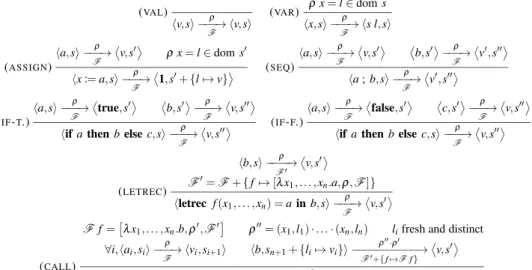
The reduction rules for this language (Section 6.1.1) use a simplified memory model without pointers and enforce that local variables are not accessed outside of their scope, as ensured by our boxing pass. This is necessary since we have seen that lambda-lifting is not correct in general in the presence of extruded variables.
It turns out that the “naive” reduction rules defined in Section 6.1.1 do not provide strong enough invariants to prove this correctness theorem by induction, mostly because we represent memory with a store that is deeply modified by lambda-lifting. Therefore, in Section 6.2, we define an equivalent, “optimised” set of reduction rules which enforces more regular stores and closures.
The proof of correctness is then carried in Section 6.3 using these optimised rules. We first define the invariants needed for the proof and formulate a strengthened version of the correctness theorem (Theorem 3, Section 6.3.1). A comprehensive overview of the proof is then given in Section 6.3.2. The proof is fully detailed in Section 6.3.5, with the help of a few lemmas to keep the main proof shorter (Sections 6.3.3 and 6.3.4).
The main limitation of this proof is that Theorems 1 and 3 are implications, not equiv-alences: we do not prove that if a term does not reduce, it will not reduce once lifted. For instance, this proof does not ensure that lambda-lifting does not break infinite loops.
6.1 Definitions
In this section, we define the terms (Definition 4), the reduction rules (Section 6.1.1) and the lambda-lifting transformation itself (Section 6.1.2) for our small imperative language. With these preliminary definitions, we are then able to characterise liftable parameters (Defini-tion 11) and state the main correctness theorem (Theorem 1, Sec(Defini-tion 6.1.3).
Definition 4 (Values, expression and terms)
Values are either boolean and integer constants or 1, a special value for functions return-ingvoid.
v ::= 1| true | false | n ∈ N
Expressions are either values or variables. We deliberately omit arithmetic and boolean operators, with the sole concern of avoiding boring cases in the proofs.