HAL Id: hal-00728663
https://hal.archives-ouvertes.fr/hal-00728663
Submitted on 30 Aug 2012
HAL is a multi-disciplinary open access
archive for the deposit and dissemination of
sci-entific research documents, whether they are
pub-lished or not. The documents may come from
teaching and research institutions in France or
abroad, or from public or private research centers.
L’archive ouverte pluridisciplinaire HAL, est
destinée au dépôt et à la diffusion de documents
scientifiques de niveau recherche, publiés ou non,
émanant des établissements d’enseignement et de
recherche français ou étrangers, des laboratoires
publics ou privés.
TRANSPORT REGULATION
Arij Masmoudi, Sabeur Elkosantini, Sabeur Darmoul, Habib Chabchoub
To cite this version:
Arij Masmoudi, Sabeur Elkosantini, Sabeur Darmoul, Habib Chabchoub. AN ARTIFICIAL IMMUNE
SYSTEM FOR PUBLIC TRANSPORT REGULATION. 9th International Conference on Modeling,
Optimization & SIMulation, Jun 2012, Bordeaux, France. �hal-00728663�
9th International Conference of Modeling, Optimization and Simulation - MOSIM’12 June 06-08, 2012 – Bordeaux - France
“Performance, interoperability and safety for sustainable development”
AN ARTIFICIAL IMMUNE SYSTEM FOR PUBLIC TRANSPORT
REGULATION
Arij Masmoudi, Sabeur Elkosantini
LOGIQ Research Unit, ISGIS University of Sfax, Tunisia
[email protected] [email protected]
Saber Darmoul
Industrial Engineering Department College of Engineering King SAUD University Kingdom of Saudi Arabia
Habib Chabchoub
Institut des Hautes Etudes Commerciales, IHEC, de Sfax,
University of Sfax, Tunisia [email protected]
ABSTRACT: In public transportation networks, complex and unpredictable disturbances (e.g. accidents, delays,
traffic jams, etc.) may affect public transportation schedules so dramatically that these schedules could become useless. Consequently, it becomes a necessity to develop regulation support systems that are able to help biological operators in managing public transportation networks efficiently, and to provide users with high quality services, in terms of punctuality, frequency and productivity. In this paper, a real time regulation support system for public transport regulation is developed based on the biological immune theory. This regulation support system is an artificial immune system, which presents many interesting capabilities, including identification, learning, memory and distributed parallel processing. Through experimental validation, we show that this exploratory approach performs well in terms of quality of solutions and time of response.
KEYWORDS: Public transport regulation, biological immune system, artificial immune system, clonal selection
1 INTRODUCTION
Due to the continuous increase in population and urban growth, public transportation of passengers has become a major preoccupation for governments and local authorities. Managers of public transportation networks struggle to establish schedules that satisfy passengers, who expect high levels of service quality in terms of timely and regular shuttles. However, many disturbances occur that affect public transportation services, such as bad weather, absence of personnel, traffic congestion, accidents, etc. These disturbances cause pre established schedules to be delayed or to become obsolete, which affects service quality and reliability.
The regulation of public transportation networks is a complex engineering task (Ould Sidi, 2005). In fact, regulators must analyze big quantities of information concerning the state of the transportation network in order to detect any disturbances and assess their severity. Also, very often, regulators have to rely on their own experience to select critical information and make regulatory decisions taking into account requirements of service quality and operational constraints. These different tasks show the management complexity of transportation networks, especially if multiple disturbances appear and need to be managed simultaneously.
Therefore, it has become necessary to implement public transportation regulation systems that are able to help regulators to monitor the good execution of early
prepared transportation time tables, and to propose corrective decisions as early as possible to prevent passenger dissatisfaction and performance degradation.
This work is not interested in the elaboration of bus time tables from scratch. However, it suggests a regulation system, which is more focused on the adaptation of bus schedules based on corrective decisions applied to pre established time tables. When a disturbance perturbs the expected schedules, the regulation system tries to adapt the expected schedules as quickly as possible in order to accommodate the disturbance and update pre established time tables.
The suggested regulation system is designed based on the biological immune theory. In fact, this paper establishes and shows the effectiveness of using an analogy between the biological immune system and the transport regulation system. It has been demonstrated (Hunt et al., 1998; Dasgupta et al., 2003) that the immune system has the capability to recognize new patterns, learn, classify, memorize and process information. In addition, the immunity, which is the feature of recovering and maintaining a status of good health, can be preserved even in the face of a dynamically changing environment. The biological immune system can recognize different patterns and generate selective immune responses. For all these reasons – which were already experimented in several fields, such as planning and scheduling (Darmoul et al., 2007), anomaly detection (Dasgupta and Forrest, 1999), optimization (De Castro and Timmis, 2002), etc. – the primary focus of this paper is to explore the potential of
the biological immune system to solve the problem of public transportation regulation.
Therefore, this paper is organized as follows: Section 2 introduces the public transport regulation problem. Section 3 describes the main concepts of the biological immune system and the artificial immune system. In Section 4, the proposed regulation algorithm is detailed. The simulation results of this approach are presented in Section 5. Finally, a conclusion and perspectives are presented.
2 OVERVIEW ON TRANSPORT REGULATION 2.1 The transport regulation problem
Scheduling a transportation network refers to several activities, including crew time tabling, assignment of buses to routings (design of shuttles), and assignment of visiting hours to stations (Hayat, 2003). Schedules are initially established taking into account information about forecasts of traffic conditions, rush hours, demand for transportation, etc. However, the appearance of disturbances in the network (such as bad weather, absence of personnel, traffic congestion, accidents, etc.) makes the pre established schedules to be delayed or to become obsolete. Consequently, regulators have to make decisions in real time to correct the gap between pre established schedules and really executed ones.
Ould Sidi (2005) defines the transport regulation problem as the real time adjustment of pre established transport schedules to the real exploitation conditions of the transportation network. It is important to emphasize that this paper does not deal with the initial elaboration of transport schedules, i.e. elaboration from scratch. Instead, the focus is to provide regulators with decision support tools to help them manage deviations from expected schedules. Several approaches, including exploitation aid systems and regulation support systems, exist in the literature to help decision-makers deal with transport regulation problems. These approaches are briefly described in the following sections.
2.1.1 Exploitation Aid Systems
With the development of applications in electronics and digital communications, it became possible to locate buses using intelligent transportation systems, ITS (Figueiredo, 2001). An Exploitation Aid System (EAS) provides real time information regarding the exploitation of the transportation network Ezzedine (2006). Such information includes updated states of schedule execution, delays, vehicles in advance, messages, alerts, etc. The implementation of EASs has greatly facilitated the task of regulators. Thus, an EAS can monitor real-time operation of a public transportation network and process a very large amount of network information. The developed system in this paper must be connected to
such systems to gather information concerning the real state of the transportation network.
2.1.2 Regulation Support Systems
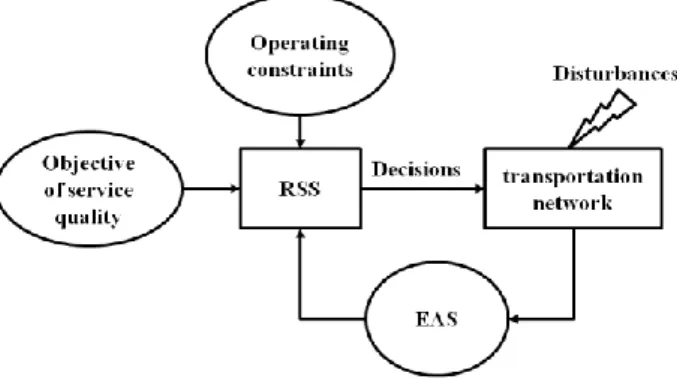
A Regulation Support System (RSS) is a software application that is designed to help biological operators to control and manage the performance of a public transportation network (Ezzedine, 2008). This software tool helps decision makers solve problems that arise in the transportation network due to disturbances (such as bad weather, absence of personnel, traffic congestion, accidents, etc.), and that have direct impact on schedule validity and expected performance. Figure 1 illustrates the operation of a regulation support system:
Figure 1: Operation of a regulation support system
Based on information provided by an EAS (position of each vehicle, number of passengers, etc.), the RSS is able to analyze the state of the transportation network and to determine the gaps between the objectives of quality of service (such as maximum waiting time, maximum number of passengers waiting at a station, etc.) and reality. An RSS must be able to identify occurrences of disturbances, propose and evaluate reliable corrective decisions taking into account the exploitation constraints. It is worth noting that an RSS is not intended to replace the biological regulator who will always be the master in the selection of the final regulation decision.
2.2 Existing transport regulation support systems
Several studies exist in the literature, which are concerned with the development of algorithms for traffic regulation and management of urban transportation.
Deb (1998) proposes time scheduling of transit systems with transfer considerations using genetic algorithms. Rahal (2010) designs a Multi-agent system approach to model a transportation system.
Li et al. (1991) propose a stochastic linear programming model for the regulation of a bus schedule taking into account the flow of passengers.
Ezzedine (2006) uses a modeling of an interactive system with an agent-based architecture using Petri nets
MOSIM’12 - 06 au 08 Juin 2012 - Bordeaux - France
and he applies the model to the supervision of a transport system.
Yan et al. (1997) adopt a multifleet routing and multistop flight scheduling for schedule perturbation. Finally, Azzini (2008) proposes an artificial immune system to detect traffic volume anomalies by evolution of negative classifiers.
In these works, there is no interaction between the systems and the decision maker. This paper illustrates this interaction using an approach based on the immune system.
3 BIOLOGICAL AND ARTIFICIAL IMMUNE SYSTEMS
From a computer engineering viewpoint, the study of the biological immune system shows that it has several interesting information processing capabilities, including pattern recognition, classification, learning, optimization, and memorization (De Castro and Timmis, 2003). The biological immune system has inspired the development of several artificial immune systems, applied in several fields of engineering, including mobile robotics, computer security, planning, scheduling, etc. However, to the best of the authors’ knowledge, the biological immune system has not yet been applied to solve public transportation regulation problems.
The primary focus of this paper is to explore the potential of the biological immune system to inspire the development of a regulation support system to help decision makers react in a timely manner to disturbances affecting transportation schedules. A regulation support system should protect public transportation networks from disturbances affecting pre established schedules, just as the biological immune system protects the body from disease causing elements. In order to further explore this analogy between a regulation support system and a biological immune system, the following sections first introduce the main concepts of the biological immune system, and discuss existing artificial immune system applications.
3.1 Biological immune system
The biological immune system defends organisms from disease causing elements, called “antigens”, such as viruses, bacteria, parasites and pollen (Lydyard, 2000). When an antigen enters into the body, it stimulates a subset of immune cells, called “lymphocytes”, to produce special molecules, called “antibodies”. Antibodies bind to antigens, block them and thereby lead to their elimination (Hightower, 1996). Figure 2 shows how an antibody blocks an antigen in order to eliminate it. Antibodies have “paratopes” that bind to “epitopes” of antigens. When the paratope and the epitope bind, in a complementary fashion, the antigen is recognized by the immune system. the concept of “affinity” allows to
measure the intensity of this binding. The higher the affinity, the better the immune system recognizes and eliminates the antigen.
Figure 2: An antigen and an antibody interaction
A regulation support system should protect a public transportation network from disturbances affecting pre established bus schedules, just as the biological immune system protects the body from invasion by antigens. In this paper, an antigen represents a disturbance that affects the transportation network, such as a bus delay or a technical problem. An antibody represents a corrective decision that could be recommended to regulate the system, such as “override a station” or “go directly to terminal station”.
Clonal selection theory, The clonal selection principle
assumes that only the immune cells that recognize antigens proliferate and produce specific antibodies (Timmis, 2004). In fact, after an antigen penetrates the body, only lymphocytes that bind to the antigen are activated, proliferate and mutate. Proliferation is insured by cloning those lymphocytes that have the highest affinity with antigens. Mutation allows diversification of lymphocytes, so that they produce antibodies with higher ability to bind to antigens. Cloned and mutated lymphocytes produce a large number of specific antibodies to eliminate the antigen.
During the clonal expansion, lymphocytes divide into two main types of cells: effector cells and memory cells (Perelson et al. 1978). Effector cells have a short life time and are created for the immediate defense of the organism. Memory cells are long lived cells that circulate through the host organism. When confronted with the presence of an antigen that was previously recognized, memory cells are able to launch a rapid and effective response. Usually, AISs often use the idea of memory cells to retain good solutions to the problem under consideration.
3.2 Artificial immune systems
Artificial Immune Systems (AIS) are a novel computational intelligence technique inspired by immunology (De Castro and Timmis, 2003). The powerful information processing capabilities of the biological immune system, such as feature extraction,
pattern recognition, learning, memory and its distributive nature provide rich metaphors for artificial intelligence applications (Dasgupta, 2003). Several principles and aspects from the biological immune system have been extracted and applied in order to create effective computational solutions to complex problems in a wide range of domain areas (kim, 1999), including anomaly detection (Dasgupta, l999), pattern recognition and clustering (McCoy, 1997; Cao, 2003), adaptive control (Kumar, 1999), optimization (De Castro, 2000, 2002), robotics (Mitsumoto, 1996), machine learning (Hunt, 1996, 1998; Potter, 1998; Nicolaev, 1999), planning and scheduling (Darmoul et al., 2007), data mining (Knight, 2002) and many other engineering problems (Dasgupta, 2003). However, to the best knowledge of the authors, AIS have not yet been applied in the transportation field, especially in the regulation of public transportation networks.
The clonal selection algorithm is one of the most used algorithms in AIS. It relies on the clonal selection theory. De Castro and Von Zuben proposed a version of the clonal selection algorithm, named CLONALG (De Castro and Von Zuben, 2000). This algorithm contains 3 main phases:
(i) Initialization: corresponds to generating an initial population N of antibodies. This population N is divided into two sets; a memory antibody set m representative of the best solutions found by the algorithm and a remaining antibody set r used for introducing additional diversity into the system.
(ii) Creation of the specific antibody for the
antigen: this step first consists of determining
the affinity of each antibody of N with an antigen a. Second, the selection of the n best antibodies with the highest affinity with the antigen. Third, cloning the n best antibodies, then, mutating these clones to better match the antigen in question with an inversely proportional degree to their parents’ affinity. Next, exposing clones back to the antigen and recalculating their affinities.
(iii) Memory: Antibodies with the highest affinity in the clone are then selected as candidate memory and placed into m. Replace individuals having the lowest affinity from r with new random antibodies. The best antibody in the memory set m is considered as the output solution of the algorithm.
In the remaining of this paper, we will adapt the clonal selection algorithm to tackle the transportation regulation problem.
4 PROPOSED SOLUTION
Based on presented disturbance information, the regula-tion support system finds the best soluregula-tion to solve the problem.
To develop a regulation support system for public trans-portation based on immune theory, we should look carefully at the definition of antibodies and antigens. In this study, antigens represent disturbances influencing the public transportation schedules and antibodies are the decisions taken by regulators.
4.1 Antigen
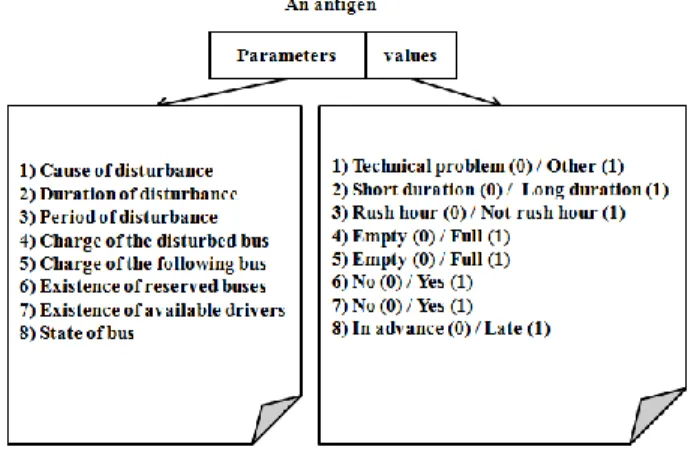
A disturbance is any unpredictable incident that affects a public transportation network and causes a gap between theoretical time table and real time table. An antigen is characterized by 8 most important parameters of a dis-turbance {cause of disdis-turbance, duration of disdis-turbance, period of disturbance, charge of the disturbed bus, charge of the following bus, existence of reserve buses, existence of available drivers and state of disturbed bus}. Figure 3 shows the structure of an antigen:
Figure 3: Structure of an antigen
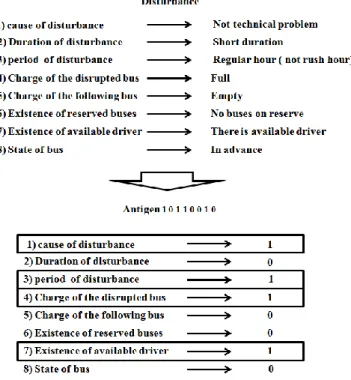
Each parameter has a binary value. The antigen parameter values are filled based on disturbances information. Figure 4 shows an example of an antigen:
MOSIM’12 - 06 au 08 Juin 2012 - Bordeaux - France
Figure 4: Example of an antigen
As it is illustrated in this example, an antigen is generated according to the disturbances characteristics. In the case where many buses are disturbed simultaneously, an antigen is created for each disturbed bus.
4.2 Antibody
After the generation of the antigen, the system creates the specific antibody (solution/decision) to this antigen. Figure 5 illustrates the structure of an antibody:
Figure 5: Definition of an antibody
As illustrated in figure 5, each antibody (decision) is described by 7 actions {turn around, override stations, only step off, go directly to the terminal station without stopping at intermediate stations, rescheduling, addition
of bus driver, addition of bus, intervention of technical service}.
An action can take 0 or 1 as a value. If an action is used in an antibody, it is assigned the value 1; otherwise it is assigned the value 0. Therefore, if the value of an action is equal to 1, this action is selected in the antibody (decision), otherwise it isn’t. Figure 6 represents an example of an antibody proposed by the regulation system:
Figure 6: Example of an antibody
The antibody in figure 6 contains 2 actions:
(i) Turn around
(ii) Go directly to the terminal station
These 2 actions will appear in the decision taken by the regulator and are sent to the driver of the disrupted bus. This decision is: turn around and go directly to the terminal station.
4.3 Proposed algorithm
The proposed system tries to find the best solution (antibody) to solve an encountered problem (antigen) in public transport regulation. The solution is generated based on the learning process and interaction with the regulator. For this purpose, an artificial immune system is developed based on clonal selection theory. Figure 7 shows the general architecture of the system:
Figure 7: The system architecture
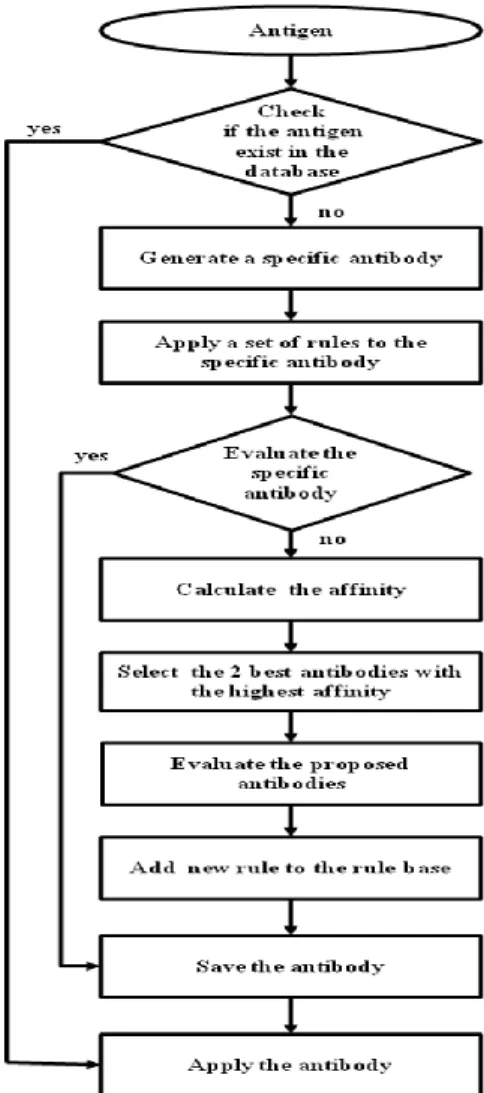
The proposed system has two main phases. In the first phase the system creates the specific antibody (solution) to the antigen (disturbance). The second phase is the evaluation of this antibody. Evaluation relies on the experience of the regulator. This phase is based on the interaction between the regulator and the system. Figure 8 describes the proposed algorithm.
Figure 8: Diagram of the proposed algorithm
When an antigen is introduced into the system, the system performs the following steps:
(i) The system checks the existence of the antigen in the database (see figure 9):
Figure 9: Checking the existence of the presented antigen
If the antigen is already stored in the database, then the system applies the specific antibody of that antigen, and the work of the system ends.
MOSIM’12 - 06 au 08 Juin 2012 - Bordeaux - France
Otherwise, if the antigen is met for the first time, the system should find the specific antibody for it.
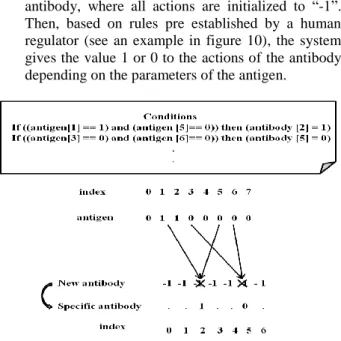
(ii) To produce the specific antibody to a newly introduced antigen, the system creates a new antibody, where all actions are initialized to “-1”. Then, based on rules pre established by a human regulator (see an example in figure 10), the system gives the value 1 or 0 to the actions of the antibody depending on the parameters of the antigen.
Figure 10: Generating of the specific antibody
(iii) The specific antibody founded by the system may not be feasible. Thus, the system checks whether this antibody requires some adjustments by passing it through a rule base. The rule base stores all previously made adjustments by the regulator on antibodies. Adjustments are stored in the system as rules:
If the specific antibody is already stored in the rules base, it means that this antibody has already been evaluated and adjusted by the regulator in previous time. Then, it will be changed by its adjusted version (see figure 11). The system will consider the adjusted version as the specific antibody for the antigen.
Otherwise, the newly created antibody will not be changed.
Figure 11: Adjustment of the produced antibody through the rule base
(iv) The system presents the newly created antibody to the regulator and asks him to evaluate it. The regulator relies on his expertise to evaluate the efficiency and feasibility of the proposed antibody.
If the regulator judges that the feasibility and efficiency of the antibody are good, this antibody will be used as a corrective decision for disruptions caused by the presented antigen and will be saved in the database.
Otherwise, the regulator requests to make some adjustments on the antibody. In this case, the system will calculate the affinity of the specific antibody with antibodies saved on the database and select the two best antibodies with the highest affinity (see figure 12). The degree of affinity between the antibodies is calculated using the Hamming distance :
1
;
l i iD
i
1;0;ifAbelse1iAb2i(v) Two choices are presented to the regulator :
Choose one of the proposed antibodies and make some adjustment (if necessary). The adjustment will be saved on the rule base.
Refuse the proposed antibodies and create another solution based on the expertise of the regulator.
(vi) The final antibody accepted by the regulator will be applied to correct the disturbances.
(vii) The system saves the final solution in the database.
5 EXPERIMENTAL RESULTS
The algorithm described in previous sections is tested under two scenarios. For 10 units of time, the course of 5 buses is followed on one pathway.
5.1 Scenario 1
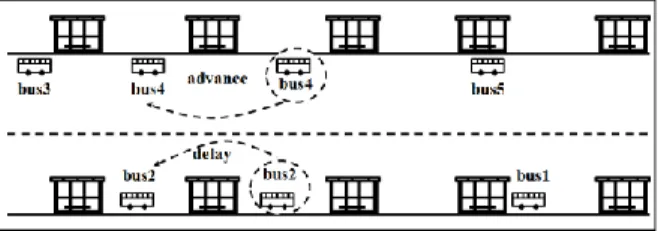
In the first scenario, bus number 2 will be delayed and bus number 4 will be advanced from the theoretical schedules of the time table. Figure 13 shows an illustration of scenario 1:
Figure 13: Illustration of scenario 1
Figure 14 and figure 15 illustrate schedules of bus number 2 and bus number 4 with and without using the system.
Figure 14: Schedules of bus 2
When a delay affects bus 2, it produces a growing gap between theoretical and real schedules. The system will be involved in real time to reduce the possible time lag as much as possible. For example, at t=4, bus 2 must be at station number 25, without using the regulation
system bus 2 is in reality at station number 21, (4 station delay), however, by using the regulation system bus 2 is back to its normal scheduling.
Figure 15: Schedules of bus 4
Without using the regulation system, the real schedules of bus number 4 precede the theoretical schedules. For example, at t = 5, the time table schedule is equal to 20, but, the real schedule of bus number 4 is equal to 23 (two stations before). Schedules provided by regulation system are very close or equal to theoretical schedules, which helps the public transport network to quickly recover the normal status.
5.2 Scenario 2
In this scenario, the 5 buses of the network will have disturbances, which will affect the regular running of the network. Buses number 1, 3 and 5 will be late, bus number 2 will be advanced and bus number 4 will have a technical problem as is shown in figure 16:
Figure 16: Illustration of scenario 2
During their course, the functioning of the 5 buses was interrupted for an arbitrarily chosen amount of time “t” and 3 positions of each bus are extracted: the real position, the theoretical position and the position using the regulation system. Results are presented in figure 17.
MOSIM’12 - 06 au 08 Juin 2012 - Bordeaux - France
By analyzing figure 17, we can observe that whatever the cause and the state of the disturbance (advance, delay, technical problem) that affects bus schedules, the regulation system can help regulators, in real time, to maintain proper functioning of the public transport network. For example: without using the regulation system, bus1 (which is delayed) is in station 24 when it must be in station 29 according to the theoretical schedule. However, the position of bus 1 by using the regulation system is station number 25 (very close to the theoretical schedule).
To summarize, results given by the system are in adequacy with theoretical schedules, which helps the network to maintain good working conditions of the transportation network.
6 CONCLUSION
Unpredictable disturbances affecting the public transportation network influence bus schedules and make regulating the transportation system a complex task. In this paper, a real time regulation support system for public transport networks is proposed. This regulation support system is an artificial immune system, which relies on the clonal selection algorithm to find optimized solutions to the transportation regulation problem.
Clonal selection offers to the system the ability to learn and memorize decisions taken by the regulator to correct the malfunction of transportation networks when a disturbance occurs. This methodology improves the system by making it faster and more efficient with each new exposure to a disturbance in the public transportation network. For the evaluation, two scenarios have been realized. The obtained results allow to recover the pre established theoretical schedules realized at early time, and to reduce the impacts of the disturbances.
In order to enhance the work described in this paper, other concepts inspired by the biological immune system such as negative selection and the immune network theory can be used to compare the obtained results. Furthermore, the fuzzy logic approach can be used to consider imprecise and uncertain information given by the aid exploitation system. Finally, the developed system can be tested with the real public transportation system.
REFERENCES
Azzini .A, Damiani .E, Gianini .G, Marrara .S, 2008.
Detection of traffic volume anomalies by evolution of negative classifiers in Artificial Immune Systems. 2008
Second IEEE International Conference on Digital Ecosystems and Technologies (IEEE DEST 2008) © 2008 IEEE.
Cao. Y and Dasgupta. D. An Immunogenetic Approach
in Chemical Spectrum Recognition. In Advances in
Evolutionary Computing, Springer-Vrrlag, 2003.
Darmoul. S, Pierreval. H., Gabouj. S.H, 2007.
Scheduling Using Artificial Immune System Metaphors: A Review. International Conference on Service Systems
and Service Management.
Dasgupta. D and Forrest. S, 1999. An anomaly detection
algorithm inspired by the immune system, Artificial
Immune System and Their Applications.
Dasgupta D., Ji Z. and Gonzalez F., 2003. Artificial
Immune System (AIS) Research in the Last Five Years.
The 2003 Congress on Evolutionary Computation (CEC '03), 8-12 Dec., vol. 1, pp. 123-130.
Deb. K., Chakroborty.P, 1998. Time scheduling of
transit systems with transfer considerations using genetic algorithms . Evolutionary Computation 6(1),
pp.1-24.
De Castro. L. N., Von Zuben. F. J, 2000. The clonal
selection algorithm with engineering application. Proc
of GECCO00, Workshop Proceeding, 36-37.
De Castro L. N., Timmis J., 2002. An Artificial Immune
Network for Multimodal Function Optimization. EC’02,
Proceeding of IEEE Congress on Evolutionary Computation, IEEE Press.
De Castro. L.N., Timmis. .J.I, 2003. Artificial immune
systems as a novel soft computing paradigm. Soft
Computing Journal, Springer-Verlag.
Ezzedine. H., Trabelsi. A., Kolski. C., 2006. Modelling
of an interactive system with an agent-based architechture using Petri nets, application of the method to the supervision of a transport system. Mathematics
and Computers in Simulation 70, 358-376.
Ezzedine. H., Bonte. T. , Kolski. C., Tahon. C., 2008.
Integration of traffic management and traveller information systems: basic principles and case study in intermodal transport system management. International
Journal of Computers, Communications & Control (IJCCC), ISSN 1841-9836, E-ISSN 1841-9844
Vol. III (2008), No. 3, pp. 281-294.
Figueiredo, L.; Jesus, I.; Machado, J.A.T.; Ferreira, J.R.; Martins de Carvalho, J.L., 2001. Towards the
development of intelligent transportation systems.
Intelligent Transportation Systems. Proceedings. 2001 IEEE.
Hayat, S.; Ould Sidi, M.M., 2003. Towards fuzzy aid decision-making system of the Valenciennes transport network connections. Information Reuse and Integration, 2003. IRI 2003. IEEE International Conference on.
Hightower. R, Forrest. S, Perelson. A., 1996. The
Baldwin effect in the immune system: learning by somatic hypermutation, In M. Mithchell, R. Belew (eds)
Adaptive Individuals in Evolving Populations: Models and Algorithms, Addison-Wesley.
Hunt. J and Cooke. D., 1996. Learning using an
Artificial Immune System. Journal of Network and
Computer Applications: Special Issue on Intelligent Systems Design and Application, Vol. 19, pp.189-212.
Hunt. J, Timmis. J, Cooke. D, Neal. M and King. C, 1998. Jisys: Development of Artificial Immune Systems
for Real World Applications. Artificial Immune Systems
and Their Applications, (Ed) Dasgupta, D., Springer-Verlag, Berlin, pp.157-186.
Kim. J and Bentley. P, 1999. The Human Immune
System and Network Intrusion Detection. 7fh European
Conference on Intelligent Techniques and Soft Computing , Aachen.
Knight. T and Timmis. J, 2002. A multi Layered Immune
Inspired Approach to Data Mining. Proceedings of the
4th International Conference on Recent Advances in Soft Computing.
KrishnaKumar. K and Neidhoefer. J, 1998. Immunized
Adaptive Critic for an Autonomous Aircraft Control Application. Artificial immune systems and their
applications. Springer-Verlag, Inc., 1998.
Li .Y, Rousseau .J.M, Gendreau .M, 1991. Real-time
Scheduling on transit Bus Route: A 1-1 1Stochastic Programming Model. Rapport de recherché PUB-722,
Centre de recherche sur le Transport, CRT, Université de Montréal.
Lydyard, Peter M., A. Whelan, and Michael W. Fanger, 2000. Instant notes in immunology. Oxford, UK: Bios/Springer.
McCoy. D. F and Devarajan. V, 1997. Artificial Immune
Systems and Aerial Image Segmentation. Proceeding of
IEEE Systems, Man and Cybernetics, pp.867- 873.
Mitsumoto. N, Fukuda.T and Idogaki. T, 1996.
Self-Organising Multiple Robotic System. Proceedings of
IEEE International Conference on Robotics and Automation. Pp. 1614-1619. Minneapolis, USA. IEEE.
Ould Sidi. MM, Hayat. S, Hammadi. S, 2005. AEMC
pour l’aide à la régulation du trafic d’un réseau de transport collectif. Méthodes et heuristiques pour
l’optimisation des systèmes industriels (MHOSI’05), 24-26 Avril 2005, Hammamet, Tunisie.
Nikolaev. N, Iba. H and Slavov. V, 1999. Inductive
Genetic Programming with Immune Network Dynamics.
Advances in Genetic Programming 3, MIT Press, Chapter 15, pp. 335-376.
Potter. M. A. and De Jong, K.A., 1998. The Coevolution
of Antibodies for Concept Learning. Proceeding of the
fifth Intl. Conference on Parallel Problem Solving From Nature, pp.530-539.
Rahal .D.D, Rahal .F, Chekroun .M.R, 2010.
Multi-Agent System for Modeling Transport Systems.
European Journal of Scientific Research, ISSN 1450-216X Vol.46 No.1 (2010), pp.080-089 © EuroJournals Publishing, Inc.
Timmis. J, Knight. T and De Castro. L.N & E.Hart. E, 2004. An overview of Artificial immune Systems. Natural computation series, pages 51-86, Springer.
Yan.S, Tu.Y.P, 1997. Multifleet routing and multistop
flight scheduling for schedule perturbation. European
Journal of Operational Research, Vol.103, Issue1, PP.155-169.