Complete Integrability
and Geometrically
Induced Representations
by
Michael David Grossberg
B.A. Math., University of Pennsylvania(1986)
Submitted to the Department of Mathematics
in partial fulfillment of the requirements for the degree of
Doctor of Philosophy at the
Massachusetts Instit ute of Technology May, 1991
<9
Michael David Grossberg, 1991. All rights reserved.1
Signature of Author , <,ct! .CO "Kjh«
R.
Bott Professor of klathematics, Harvard University ""' ...., Thesis Supervisor..
Certified by---II ...'~<...
-=.
..".~'-"L---.«.y....t<'----"->_--;;-t-~---/'
Certified by__ --"v'"-="'VO<;"!Y'OC":;"- ,,--=-_....::=-=~.,,_.£'--;:;...-"--- -=-'----''---~-'--_--''-~-'-.,_\..../=- _
v.
VV.Guillemin Professor~-M~~ematics, Massachusetts Institute of TechnologyA •
• _
_
"J
I _...M.LT. AdvisorAccepted bY---~'--OI-. ---S-i-g-ur-d ••u'-r-H-el-g-a-so-n-,-~C-h-a-i-rm-a-n Departmental Graduate Committee
Complete Integrability and Geometrically
Induced representations
Michael David Grossberg
Submitted to the Department of Mathematics May, 1991, in partial fulfillment of the
requirements for the degree of Doctor of Philosophy
Abstract
In the completely integrable case one can ask, when do geometrically induced rep-resentations split into one dimensional weight spaces. In this thesis this problem has been solved in an interesting case, that of the Bott tower. This is then applied to yield a geometric interpretation of the multiplicities of finite dimensional representations of compact Lie groups.
Thesis Supervisor: Raoul Bott
Dedication.
To my father and mother,
Jack Grossberg and Anita Zang Grossberg, whose love and support made this possible.
[Total Revolution is our slogan; Future history belongs to us]
from Prison Diary
by Jayaprakash Narayan
" 'You are still young,' said Athos, 'and there is still time for your bitter memories to turn to sweet ones.' "
the last line of The Three Muskateers
by Alexander Dumas
" Next year in Jerusalem"
Acknowledgments.
I should start by thanking my advisor Raoul Bott for having given me, a gem of a problem, so many of his insights, so much of his time, and for being so patient with me. I should next like to thank Miljenko Zabcic, who showed me how beautiful Lie theory really is, who got me started, was there whenever I got stuck and needed saving and was not when I got stuck and needed to save myself. I want to thank Victor Guillemin for his suggestions, ideas, enthusiastic encouragement and for giving me the opportunity to speak on my thesis at his seminar. I want to thank David Vogan, Haynes Miller, and Robert MacPherson for their time and for giving me some very good ideas. I would like to thank Yael Karshon for having listened to my talks and practice talks so many times she must be able to recite them in her sleep, and for being interested and helpful. I want to thank Renganathan Iyer for proof reading this tome.! want to thank Mark Engel, "Tal tel' lVlascarenhas, Bill Richter and Calvin Clark for their TeX help. I want to thank Paul Bressler, Matthew Ando, Rayer Sjamaar, Bill Graham, Paolo Piazza and for their help and suggestions. I would like to thank Eric Weinstein for playing his damn accordion so loudly, so poorly, and so incessantly, in Maine, that I had to eat cucumbers and solve my thesis problem to blot out the sound. I want to thank Eugene Lerman for helping me get through my qualifying exams and showing me some very pretty geometry. I want to thank Gordana Matic for being my "big sister" and helping me get through my first year. I want to thank all the other grad students in my department who were always helpful and listened to my dumb questions. I want to thank Adolfo Quirez for taking me to Angel Falls. I want to thank Eric vVeinstein, Adil Abdulali, and Janaki Abraham, for teaching me more about life and myself in the past five years than I learned in the previous twenty two. Lastly I want to thank Eric and Adil for being the best brothers an only kid could have.
Contents
Introduction
1 Simple multiplicity in projectivized towers 1.1 Geometrically induced representations
1.1.1 Elliptic Complexes .
1.1.2 Lifting actions .
1.1.3 Almost Complex Structures and The Dolbeault Operator 1.2 Complete Itegrability and the Twisted Dolbeault Operator
1.2.1 The G -Index of the Twisted Dolbeault Operator
1.2.2 Complex Projective Space .
1.2.3 Complete Integrability and the Complex Case 1.3 Bott Towers and the Simple Multiplicity Theorem
1.3.1 The Simple Multiplicity Theorem . 1.3.2 The Index and the symbol map . . 1.3.3 Multiplicitivityand Compatibility.
1.4 Towers and actions .
2 Applications to the Bott-Samelson manifold
2.1 Bott-Samelson Manifolds .
2.1.1 Reduced Expressions and Orderings . 2.1.2 Defining the Bott-Samelson Manifolds
2.1.3 Principal Bundles .
2.1.4 Reductive Spaces .
2.1.5 The almost complex structure of the flag manifold. 2.1.6 The tangent bundle of Bott-Samelson manifolds
8 14 15 15 16 17 19 19
20
22 25 25 3639
41 4547
47
51 54 5657
60
2.1.7 Choosing a Connection . . . . . 2.1.8 The Bott Tower Perspective .. 2.1.9 An Almost Complex Structure. 2.1.10 Coefficient Line bundles ....
2.2 Bott-Samelson varieties and Demazure's Theorem
2.2.1 The complex picture .
2.2.2 Schubert Varieties and Cell Decompositions 2.2.3 A Theorem of Demazure ....
2.3 Comparing almost complex structures.
2.3.1 A family of almost complex structures
2.4 Definition and Computation of the Extended Character . 2.4.1 Definition of the Extended Character
2.4.2 The Atiyah-Bott Lefschetz formula . 2.4.3 Computation of the Extended Character 2.4.4 Expanding the terms . . . .
62
63
64
65
66
66
68
70
74 74 79 79 81 83 85Introduction
In the late 1950's R. Bott and H. Samelson intoduced certain manifolds which they used to study the cohomology of the 1(
IT,
the flag variety of a compact Lie group [(, and the cohomology ofn(In
the loop space of 1(.These manifolds, which throughout this paper are referred to as the Bott-Samelson manifolds, have periodically come up in various guises. Recently, in the summer of '89, Bott noticed that these manifolds supported an action of a real torus of half the dimension of the space [Bl]. This is a special case of the phenomenon of complete integrability. One expects that complete integrability should be reflected in the simplification of some geometric structure. In his letter to M. Atiyah he conjectured that the Bott-Samelson manifolds should be realizable as some kind of tower of projecivized vector bundles. He conjectured that there should be some form of induced representation and that under the action of this large torus this representation should decompose into irreducible distict complex lines. Lastly he conjectured that given that the flag manifold is so closely linked with associated Bott-Samelson manifolds, such a complete splitting into lines could lead to some kind of canonical basis of irreducible finite dimensional representations of the compact Lie groups. In fact this very problem was solved my G. Lusztig at approximately the same time using the machinery of quantum groups. It seems likely that there may be a strong connection between quantum groups and this approach although this has not, as yet, revealed itself.As to Bott's idea that the Bott-Samelson manifolds are projectivized towers, this is clarified in the the section on Bott towers. Bott towers are introduced, they are natural generalizations of Hirzebruch surfaces and they promise to provide interesting examples of various phonomena. In the first chapter geometrically induced represen-tations are reviewed; the notation closely follows [A-Bl.] The model for complete integrability and geometrically induced representations, is complex projective space. This example is discussed. A general fact about complete integrability and complex manifolds is spelled out as was communicated in [Bl.] Some general conjectures are made about the almost complex case. Bott towers have nice almost complex struc-tures which are preserved by the action of the large torus. This permits the construc-tion of a equivariant elliptic differential operators
DL.
The kernel and cokernel provide the desired representations and complete integrability does yield a virtual splittingof the index. We call this the simple multiplicity result for Bott towers. There is a section on functoriality of the index which appears necessary for this proof although it is hoped that a proof can be found which avoids the excursion into topology. The second chapter explores the connections with representation theory.
If G is a group one way to seek representations of this group is via geometric induction. Let G act on a manifold 1\1. For the rest of the paper we will assume M is compact without boundry. Let (A., d) be a G-equivariant elliptic complex. This then induces a representation of on each of the cohomology spaces, Hi(Ae, d). While it is often difficult to undersand the cohomology itself it is often possible to study the index. If we let the index of the elliptic complex to be
2:(
_l)i Hi
(Ae,d), then Ginduces a virtual representation on the index of the complex. Denote the representa-tion ring of G by
R( G).
IfG
is the set of inequivalent irreducible representations of G then R(G) is the free abelian group generated byG.
Hence we may writeI)-l)iHi(Ae,d) =
2:
l\1V' VveG
n times " e'\ : Tn --+ U(l) (0.1) (0.2) (0.3) where ,,\ = (db d2, ••• ,dn) Ezn
and e'\( ei2/r1l1,
ei2/r1l2, ...
,ei2/rlln) = ei21l'2:::'1
d,II,. Soin this case
2:(
_l)i
Hi(A., d) =2: m" .
e".
"
Here m" is called the multiplicity of the weight ,,\ and if m"
=
1 whenever m"=f:.
0 the representation is called multiplicity free. A weaker condition which will be of more interest here is requiring m" = :1:1when m.\ =P 0 which will be called simplemultiplic-ity. Note that the presence of multiplicities -1 indicate a virtual representation. The case of the torus is of course important because when G is complex semi-simple or compact its finite dimensional complex representations are completely determined by
the character of a maximal torus. The case of multiplicity free is important (respec-tively simple multiplicity) because the decomposition into one dimensional subspaces gives us a canonical basis of the representation (respectively virtual representation.)
R. Bott points out in a letter to 1\1. F. Atiyah [B1] that complete integrability of a manifold can imply the existence of a canonical basis for geometrically induced rep-resentations. Complete integrability is taken to mean the existence of a torus Tn (as above) acting smoothly on a real2n-dimensional manifold with isolated fixed points. Bott shows in the case of Tn acting holomorphicly on a complex n-dimensional man-ifold M with equivariant holomorphic line bundle L the induced representation on
f(M,
L)
splits into complex lines. This is accomplished by choosing a fixed point and filtering the sections by degrees of vanishing at that point. It was hoped that there was such an action on a manifold closely related to the the flag manifoldG
jB
of a complex semi-simple Lie group G with Borel subgroup B. This in turn would leadto a canonical basis for finite dimensional representations of G via Borel- Weil-Bott theory. This turns out not to be successful in the original context however it will be useful to review this theory briefly [B2]. As an aside, the problem of finding a canonical basis was subsequently solved by G. Lusztig using quantum group methods
[L].
Let
~+
be a positive root system for the Lie group G. We recall that there is a 1-1 correspondence between irreducible representations and the set of dominant weights with respect to ~+. Let ,\ be an integral weight andB
be the Borel subgroup with Lie algebra b = ~EElEOE.:l+ g-O, the negative root spaces. If r is the rank ofG then e" is an irreducible representation C,\ of Tr on C which extends naturally to
B :::> Tr. Thus the line bundle L,\ := G XB C,\ --+ Gj B has an action of G by left
multiplication. This induces a representation of G on HO(Gj B,
L,,)
=
qGj B,L,,)
(Dolbeaut cohomology with coefficients in L,\). The Borel- Weil theorem tells us that if,\ is dominant, this is simply the unique irreducible representation,
V",
with highest weight ,\ and further (Bott,) that Hq(GjB,L,,) = 0 for q>
O. So in fact the index of the rolled up Dolbeaut operator twisted by the line bundle,0+ 0* ~
V'L, which isE(-l)iHi(GjB,L,,) is simply
V\.
We can restrict to the action ofTT
on GIB which then acts on the index of0+ fJ* ~
L". Hence the character index is just the characterVA ~
'l)-l)iHi(G/B,L,\) =Lm~. e~
~
(0.4) with m~ is the multiplicity of the weight It. When JL
=
>.,
m~=
1but in general m~>
1
when m~ =I-O.
In order to try to further split these weight spaces into one dimensional pieces one first passes to a Bott-Samelson manifold Af defined in [B-S]. If Wo is the longest element of the Weyl group of
G
then 1\1 is built out ofAl
and a reduced expression for Wo in terms of simple reflections. M is a sequence of blows up ofG/
B whichmaintain the action of
TT.
Demazure showed that a mapW : Al -+ G /
B
induces an isomorphism Hq(G/ B,LA) ~
Hq(Af,w-L,\)
asTT
modules [D]. Composing this isomorphism with that of 0.4 we obtain 'L.(-l)iHi(AI,W-LA)
~ VA.The
surprising fact is that M admits an action of an-torus,t
with n the number of positive roots [Bl]. Hence we are in the completely integrable ca"e. This action lifts to an action onw-L
A and so by Bott's observation above, this should splitVA
into one dimensionalpieces. The character can be computed via the Atiyah-Bott fixed point formula. Some of the multiplicities were discovered to be negative integers implying, that
t
does not act holomorphicly.The author's solution is to relax the category to that of an almost complex struc-ture J and to study the G-equivariant index of a a twisted Dolbeault or equivalently Spine twisted Dirac operator asscociated to the almost complex structure DF with F
a line bundle
[L-M].
This is in done in the more general setting of a manifold that is the successive projectivization of rank-2 complex plane bundles. \Ve assume that at each stage of the projectivization, there is a section. Again one can find a torust
of half the dimension of the manifold acting on it. One can also find an equivariant almost complex structure and lift the action to an auxiliary line bundle.Theorem 0.1 Let M be a successive p1'Ojectivization of complex two-plane bundles, with complex dimension n. Suppose further that at each step in the tower of two-sphere fiber bundles, there is a section. Let
L-+
1\1 be a line bundle. For any effective action of an n-torus on the tower preserving the sections and an equivariant operator(a
+
a-)
0 L, the virtual character index has simple multiplicity.When applied to a Bott-Samelson manifold
AI,
which is a successive projectiviza-tion, one obtains a virtual representation of a torust
that naturally contains the maximal torus T of the group as mentioned above. Restricting the character to the maximal torusT
Ct,
gives the ordinary character of the representationV.\.
This is proven by finding an almost complex structure, j which is invariant undert.
Demazure showed that the manifolds Bott and Samelson discovered were algebraic varieties and hence carry an honest complex structure J. The maximal torus T C I<acts on M preserving both J and j.
Theorem 0.2 There is a family of T -equivariant almost complex structures J(, 0 ~
€ ~
1,
with Jo=
J and J1=
j.
The homotopy invariance of the index shows that the
t
character extends the ordinary T character. Studying the form of our extended character reveals that the weights in the dual Lie algebra of the larger torus, Lie(T) =i*,
live in a non-convex shape the author calls a twisted cube. Counting the signed lattice points in the twisted cube yields the dimension of the representation while first intersecting with subspaces (inverse images of points under the projectioni*
--+t*)
yields multiplicitiesChapter 1
Simple multiplicity in
projectivized towers
1.1
Geometrically induced representations
In this section we will briefly review the machinery of geometric induction. This is not meant to be an exposition of the material but rather an opportunity to set notation. The general idea is to start with a Coo-manifold Al with some kind of geometric structure, and an action of a group G on Al that preserves that geometric structure. Out of this data one constructs a representation of the group G. Probably the most familiar example is the case of a complex semisimple Lie group G acting on M
=
Gj
Bwith B a Borel subgroup. This induces a representation on the Dolbeault cohomology with coefficients in a line bundle
Hi(G/ B,
L). In the case that L comes from a dominant weight of G, the geometrically induced representation onHO(Gj B, L),
coincides with the ordinary notion of an induced representation.
1.1.1
Elliptic Complexes
Let M be a COO-manifold. Suppose we have vector bundles {Ej} over M. Denote by
f(Ej), COO-sections of Ei. A sequence of kth order differential operators
(1.1) is called a differential complex ifdjdj_1 =0 (sometimes abbreviated
J2
= 0.) Letr(E)
denote this complex. The vector spaces
(1.2)
(1.3) are the cohomology groups (thought of as additive groups) of the complex f(E).
Locally we can write a kth order differential operator
alai
d
i =L
Ao(x)-lol~k
ax
ohere Q here is a multi-index. Locally then the principal symbol of this operator is
defined to be
a(d
j)=
L
Aa(x)~o.
lol=k
The variables ~ are coordinates in the fibers of the cotangent bundle,
T* M.
It turns out that the principal symbol is a globally well defined object. Let1r* : T*M-+M.
The symbols of the operators of the complex
r(E)
induce a sequence of bundles calledthe
symbol sequence
*E O'(di_d *E O'(d;) *E
... -+1r
;-1 -+ 1r ; -+1r
;+1-+ ..• (1.5)over
T* M
A differential complex is said to beelliptic
if its symbol sequence is exact off of the zero section. An important property of a differential complex that is elliptic is that if the manifoldAI
is also compact, then the cohomology of the complex is finite dimensional.1.1.2
Lifting actions
Suppose
1:
M-+M is a smooth map. Suppose as above we have an elliptic differentialcomplex
r(E).
Consider mapsfor each i, which covers
I.
Composing <pi withr
we get a mapi
r
* <PT :
r(E;)
-+ r(fE
i) -+r(E
i).(1.6)
(1.7)
If Ti
commute with the differential operators, i.e ..diTi
=Ti+Idi,
then we call the collection of maps{<pi}
alifting
off
to the complexr(E).
A lifting off,
{<pi},
tor(E)
induces maps(1.8) which by abuse of notation we also denote Ti• In particular suppose we have a left action of a group G on a manifold
AI.
Letfg-I
be the map19-1 :
AI
-+AI
m 1-+ 9-1• m
(1.9)
and assume there is a natural lifting of
fg-I.
Call the map induced from the lifting ofif g,h E G then T;T~
=
T;h'
Then we call the resulting representation on Hi(f(E)) a geometrically induced representation.1.1.3
Almost Complex Structures and The Dolbeault
Op-erator
Suppose M is an even dimensional manifold with an almost complex structure J. If
m E M then
J
m : TmM-+Tmj}f is a linear map such that(J
m)2
=
-Identity. Thus the complexification splits as followsTA10 C ~ (TA1)I.0 EEl (TAl)o,1
(1.10)
with (T M)I,O the +i eigenspace and (TA1)°,1 the -i eigenspace of J acting on T M0C. There is a similar splitting for T*
A-I
0C.
With this splitting one obtains a bigrading on /\ *(T* M 0 C) (here /\ taken to be over C) such that/\T(T* A10
C)
=
ED
/\p,qT* M.T=p+q
be the projection. The ordinary exterior derivative is an operator
Define the operator
where
8
=
7r'p,q+Id. If8
2=
0, then we can form a complex(1.11)
(1.12)
(1.13)
(1.14)
(1.15)
The symbol of
8
is 0'(8)(TJ,e.p)=
TJO,II\e.p, with TJ E T*Af, TJ=
TJ1,o+
TJO,I, and e.p E /\o,q.is equivalent to the almost complex structure being integrable, which by [N-N] is equivalent to the almost complex structure coming from an honest complex structure. Suppose, in this case, that L-+ 1\1 is a holomorphic line bundle. If we choose a hermitian metric h on L, this determines a unique connection \7L on L as follows. If s is a local holomorphic trivializing section, and \7Ls =
0
QS)s is determined by the connection 1 form0,
which is defined by the equation0= h-
18h.
The connectiondecomposes as \7L = \71.
+
\7'L, where \71. = 8+
0
and \7'L =tJ.
Suppose r.p QS)s Ef(l\o,q(T*M) QS)L). Then define the operator
tJ
L~(r.p
QS)s)
=
(tJ
QS)\7l,)(r.p QS)s)
=
(tJr.p)
0s
+
(-I)qr.p
QS)\7'Ls.
(1.16)If s is a holomorphic section then this operator simplifies to 8QS)1. From this we build the twisted complex
... a~l
f(
1\O,q-l (T* M) QS)L) 8~1 r(1\O,q(T* Jll) QS)L) &5!} r( 1\O,q+!(T* M) QS)L) a~l ....(1.17) which is again elliptic. We write the cohomology of this complex as Hi(M, L). If we suppose that we have a hermitian metric on T* 1\1 then we can form the adjoint
tJ*
to the operatortJ.
Putting this together with. the connection we can "roll up" the complex ( 1.17) into one operator(1.18) This is an elliptic operator. The even cohomology of ( 1.17) is captured in the kernel, ker DL = Heven(M, L) while the odd cohomology is captured in the cokernel, coker DL
=
Hodd(M, L). vVe call this operator the (twisted) Dolbeault operator. The operator DL is well defined and elliptic even iftJ2
=f;
O. In that case Hi(M, L) no longer makes sense, and we do not have a canonical choice of \7L. Nevertheless we may choose a \7L, and thus \7'1. and define DL. Though we do not have cohomology we still have the kernel and cokernel of DL. It is precisely in the case in which the almost complex structure is not integrable that the operator DL is necessary to provide "cohomology." In fact such an operator may be defined more generally. Breifly, if our even dimentional manifold,1'1,
has a Spine structure, we can define a Spineoperator analogous to the Dirac operator. If the Spine comes from an almost complex structure, then is operator is simply
a
+
a*.
As before we can twist the operator by choosing a connection on a line bundle over Af.1.2
Complete Itegrability
and the Twisted
Dol-beault Operator
In this section we define the G -index of the iwisted Dolbeault operator. We study the case of the torus action on complex projective space. We define what we mean by complete integrablity and using complex projective space as a model generalize to complex manifolds. From this we form a conjecture about almost complex manifolds.
1.2.1
The
G
-Index of the Twisted Dolbeault Operator
Suppose G is a compact Lie group acting on an almost complex manifold M (on the left )with almost complex structure J. vVe assume that the group action preserves this
structure J. Let 9 E G, and let Ig : Af ~ Af be the diffeomorphism obtained by left
translation by g. As mentioned before it will actually make more sense to work with
Ig-l. The linearization of left translation at a point is
(2.19) If we complexify the tangent bundle and the map and take the transpose, we have a map
(2.20) Since the action preserves the almost complex structure J, this map preserves the
-i
eigenspace of J,
(2.21) Now the g-1 convention becomes clear. Since
T(lg-I)*T(h-1)*
=T(/(gh)-I)*,
a left action is induced onf(Ap,qT*
Af). In particularif
a
2=
0 and L ~ M is a holomorphicif
fP
i=
0, if we suppose L -+ 1\1 is au equivariant line bundle, with equivariantconnection VL, and an equivariant metric, then we can define DL as in ( 1.18). This will be an equivariant operator and so we will induce representations of
G
on ker DL and coker DL.Recall that in Section 1.1.2, if g E
G,
we letT;
denoted the associated endo-morphism the cohomologyHi(f(E))
of the elliptic complexf(E).
The G-index or character index off(E)
is a character of the group G, inda
(f(E)) defined by(2.22) with 9 E
G
and the trace taken by consideringT;
as an endomorphism of the finite dimensional vector spaceHi (f(E)).
Applying this definition to the above 2n dimen-sional almost complex manifold Af, with equivariant line bundle Land equivariant connection VL, we haven
inda
(f(l\o'*T*
Af0
L),parlial)=
'2)
-1)i
ch(Hi
(A1,L))
i=l
(2.23)
with ch the character of the representation of G on Hi(A1, L), in the case where
lP
= 0and L is holomorphic. Even in the non-integrable case, where [j2
i=
0 we haveinda(DL)
=
ch(kerDd - ch(cokerDd (2.24)While it is often very difficult to study the geometrically induced representations specifically, it is often possible to obtain information about the index.
1.2.2
Complex Projective Space
Perhaps the most beautiful example of geometrically induced representations is on
cpn. This example is very much a model situation in that we can induce interesting representations on sections of holomorphic line bundles, and we hace an action of an n torus which is what we call complete integrability. More specifically have the principal bundle
H :=
C
X-+ Cn+1 \
{OJ
=:E1
where CX
:= C \ {O}, and the right bundle action is given by
(Zll'"
zn) .
t-(ZIt, ... znt)
Now let k E Z we can form the associated line bundlewith Ck is the CX module obtained by left multiplication by tk, t E
C.
Holomor-phic sections of this bundle come from maps! : E-+Ck such that
!(zot, ... , znt)
=t-k !(zo, ... , zn)'
In other words, ! is homogeneous of degree-k.
Ifk
:5
0 then L hassections which are given by the homogeneous polynomials of degree -k.
We can now induce interesting representaions geometricall. The group SU(n+l) acts linearly on cn+! \ {O} by the restriction of its defining representation. This action commutes with the right bundle action on E. Thus this induces an action on cpn, on L and on the space of holomorphic sections f(CPn,L). This is in fact an irreducible representation of SU(n+1) and the module, as we have seen above, is the space of homogeneous polynomials on Cn+l of degree -I.:. A canonical basis for this space is
the set of monomials
ZPO •••o -n."Pn ,
L:?=l
Pi = -k, and Pi ~ O.We would like to see this basis geometrically. Suppose we restrict to a maximal torus
Tin
SU(n+1) which could be represented as the diagonal determinant one matrices. The torus T has dimension n which is the complex dimension of cpn. This case of a torus acting on a manifold of half the dimension (real) of the manifold we will callcomplete integrability. The T thus acts on
r( cpn,
L) and splits it into weight spaces. In particular the basis above is preserved by this action and these monomials span the weight spaces. We can take generators Wi=
e2irr8j. Then an element ofT
looksIn this notation the weight associated to the monomial z~o ... Z~" is
wf
O-P1 ••• W~"-l-PnIt is important to note that each basis element has a different weight. We call this situation multiplicity free. Suppose 17 = 2 and k = 3 then the weights are
1 101102
10; 101102 1O~
3 2 2 3
WI 101101 WI1L'2W2
which can be graphically represented as the weight diagram:
•
• •
•
• •
• •
••
1.2.3
Complete Integrability and the Complex Case
(2.25)
(2.26)
One would hope that, just as in the case of complex projective space, complete intega-bility would split geometrically induced representaions into distinct one dimentional weight spaces. Bott explains that this is the case for sections of a holomorphic line bundle over complex manifold [B]. Suppose we have an 17 dimensional complex
man-ifold M with a holomorphic effective action of an n torus T(n) with isolated fixed points.
Theorem 1.1 Suppose the1'e is also a holomorphic equivariant line bundle Lover M. Then iffhol(M,
L),
the space of holomorphic sections, doesn't vanish it is multiplicity free.Proof. Let m E M, be a fixed point. \Ve can filter fhol(.M, L) by the degree of a section vanishing at the point m.
(2.27) Since we are taking holomorphic sections this descending filtration terminates. The graded pieces
Fd F
i-b by the Taylor expansion in n variables is justSi(TmM)
0L
m,(2.28) Since the fixed points are isolated an we have an effective torus action, the weights (or normal exponents) are linearly independent at
Tm1\l.
HenceS*(TmM)
splits into one dimensional pieces which are multiplicity free and so doesS*(TmM)
@ Lm• This then induces a multiplicity free splitting of rhol (1\1,L) .•The proof above would seem to indicate that the representation is more or less determined by the isotropy representations at the fixed points. For sufficiently positive line bundles this is certainly true. This might tempt one to generalize this for almost complex structures which are the pointwise analog of complex structures. Here things become more complicated but potentially workable. Let
AI
be an almost complex manifold with almost complex structure J. Suppose T is an n torus acting on the 2n dimensional manifold 1\1. Further suppose that T acts by isometries preserving the almost complex structure J, and that there is a line bundleL,
and a connection VL which are equivariant. Then there are induced representations on kerDL and cokerDL' We define the T index of DL as the difference of the characters of these representations(2.29) If the almost complex structure is integrable, i.e.
rJ2
=
0, then we can express the index in terms of the representations on the cohomology(2.30) More particularly if the higher cohomology vanishes then
(2.31) As shown above
T
splits rhol(1\f,L)
into multiplicity one dimensional pieces and soind
TDL is a Laurent polynomial wi th all+
I coefficients. A less stringent condition would be that the coefficients would be :f:l, which we will call simple multiplicity. In general there is the following wild conjecture:Conjecture 1.1 Let M be a 211 (limwsional almost complex manifold with all the structure above including a torus T of dimension n acting effectively with isolated fixed points, then indTDL has simple multiplicity.
Or even a bit wilder:
Conjecture 1.2 This is still true when DL is manufactured from a Spine structure.
On possible approach is to first look at the symplectic version of this problem (which there will unfortunately not be time for here) which is presumably easier to under-stand.
(3.32)
(3.33)
1.3
Bott Towers and the Simple Multiplicity
The-orem
In this section Bott-towers are defined. We show first that for Bott-towers with an almost complex structure, an action of an n-torus T(n), an equivariant complex line bundle and an equivariant connection, we can construct an operator DL whose T(nL index is a character of T(n) with simple multiplicity. This will be done by induction on the stages of the tower (dimension). The result is established on Cpl first. Then an argument is given exactly analogous to a spectral sequence argument. By computing the index "along the fibers" and assuming the index on the base has a particular form on the base, the result can be established on the bundle. A crucial piece of the proof uses the index theorem and the multiplicitivity axiom to prove functioriality. This will be explained in the third and fourth subsections. The this part is not entirely satisfactory since there should be a direct proof that does not involve the brief sidetrack into topology. Throughout this section it will be assumed that an almost complex structure comes with a compatible riemannian metric which is guaranteed since T(n) is compact.In the following section we establish that the extra structure that was assumed on the Bott-tower always exist.
1.3.1
The Simple Multiplicity Theorem
Suppose we start with a line bundle L1 over,
Cpl :
t
CPl
~fAI}
Now take the direct sum of LI and a trivial bundle and projectivize the fibers:
P(l EEl L})
~f A/2t
1r2A/I
If we assume that the line bundle L} is holomorphic then Afl is a Hirzebruch
over M2• We can repeat the process n-times.
P(l EB L
n) - Aln!
7rn Aln_t (3.34)P(l EB L
2)!
7r2 cpt = MtSuch a collection of spaces and maps,
{Al
i, 7rd will be called a Bolt tower. An almostcomplex structure on a Bolt tower is then a collection of almost complex structures
{J
i} such that Ji is an almost complex structure on Ali andb) The almost complex structure restricted to fiber
Jil
cpt is the ordinary complex structure on cpt.A complete almost complex action on an n step Bolt tower is an action of an n torus, T(n) on each Mi, which is effective on Afn and preserves the maps 7ri.
Theorem 1.2 Let {Mil 7ri,
Ji}
be an almost complex Bolt tower with a completetorus action of T(n). Suppose thel'e is an efJltivariant line bundle
L,
andfix
an equivariant connection \7 L and hermitian metric h on Aln, then this datadeter-mines an equivariant operator
(3.35)
and the character indr<nl( DL ) has simple multiplicity.
We first need to prove some propositions. Eventually we will establish Theorem 1.2
by induction. Rather than start at n
=
0, a point, it will be necessary to handle the case n=
1 which will be used in the induction step. After proving this elementarystep the induction step will be handled as a separate theorem and Theorem 1.2 will follow as a corollary. Let ~[t
=
cpt. The group is a circle T( 1)=
8t acting on cpt preserving its natural complex structure. Suppose we have an equivariant (smooth) line bundle L over cpt and an equivariant connection Y' L . We will need the following:Proposition 1.1 (Atiyah and Bott) Y' Land J on cpt induce a holomorphic
structure on L.
Proof As mentioned in the last section J breaks the complexified cotangent bun-dle into
T*(M)t,O
andT*(Af)°.t
which are +iand -i eigenspaces respectively. Suppose we have a local non-vanishing section s E f( L). Now there is a () such that(3.36) using the splitting of the complexified cotangent space. Moreover the connection splits into
Y' L
=Y' L'
+
Y' L".
\Vhat we really need to do is find a locally trivializing section which is "holomorphic." Our notion of a holomorphic section of L will mean one that is killed by Y' L" .(3.37) So we should solve the equation,
(3.38) for f. In the case of a Riemann surface, in particular cpt, this equation has a solution as explained in [A-B2]. Suppose we had two such solutions sand
s
locally. It would then be the case that there was a smooth function 9 such that gs=
s.
In this case0=
Y' L"s =
og
0 s+
9Y' L"s =
og
0 s (3.39) so we conclude thatog
=
0, in other words 9is holomorphic. Thus we have established a holomorphic structure on L .•It should be clear that, since 51 preserves J, it preserves the splitting and since V L is an equivariant operator, so is V L" . More generally we have an operator on forms
(3.40) So fj0 V L" = fj01 for holomorphic frames. Restricting our attention to an almost complex structure on
Cpl,
fj2 = 0, since all almost complex structures onCpl
are integrable. Hence
(3.41)
is a complex. In fact this is just the ordinary Dolbeault complex with coefficients in a holomorphic line bundle. Denote the cohomology of this complex by
Hj(M
ll L),which agrees with sheaf cohomology with coefficients in holomorphic local sections of L by the Dolbeault theorem. In the sequence 3.41,
Ao,qT*
Afl0
L=
0, forq ~ 2 since dim
CPl
= 1, so [r =o.
If the complex is rolled up as explained inSection 1.1.3,
DL
=
(fj+
8*)
0
V L"=
8
0
1. Thus kerDL
=HO(M
ll L) andcoker
DL
=H
l(M
ll L) Suppose l..~ is the Chern number of L on
CPl.
In otherwords
k
is the number obtained by evaluating the first Chern class of L on the orientation class of the manifold. The circle acts onCPl
fixing two points. Pick any other point x and the stabilizer of that point in the circle will be the cyclic groupZIZZ.
Using the orientation we can pick out one of the fixed points as a "north pole,"N.
We chooseN
so that atN,
51 acts on the tangent space as multiplication by e121ri6, withZ
>
O. The circle also acts on the fiber of LaboveN,
L
N, by the character en21ri6. With these numbers fixed the corresponding character at the south pole 5, es21ri6, is determined by the eq nation s =n -ll..~,
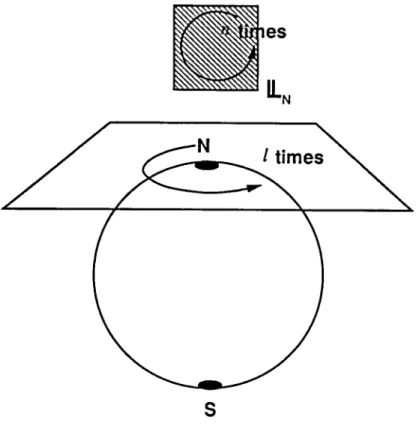
(See Figure 1.1)s
Figure 1.1: The circle action
Proposition
1.2If k ~ -1 then Hi(AI1,
L)
=0 for
i>
0 and
HO(MI,
L) =C
n-Ik $Cn-Ilk-l) $ ... $Cn.while if k ~
-1then Hi(A1I,
L) = 0for
i=/;
1and
where
Cjdenotes
81acting on
Cby e2j1riO.
(3.42)
(3.43)
As pointed out above, Hj(A11,
L)
=
0 for
j ~2 a priori. If k
<
0 then
L is
a negative bundle and HO(MI,
L)
=0 by I~odaira vanishing. Using Serre duality
H1(MI,
L)
=
0 if k
+
2
>
0, in other words if k ~
-1.Also as noted above
inds
l(
DL )=
ch(ker
DL ) -ch(coker
DL )=
ch(HO(A11, L)) - ch(H1(M1,
L).
(3.45)
(3.46) So since either kerDL= 0 or cokerDL= 0 we need only compute the index. The Atiyah-Bott Lefschetz formula (see Section 2.4.2)computes the index from the information at the fixed points.
..,.n ...." ....n n-lk .... - "" .... 1 - z-I
+
1 - zl = 1 - z-I+
1 - zl .1 - zl(k+l) . zn-Ik=
(1+
zl+
Z21+ ... +
zkl)zn-Ik 1 - zlThe last equality depends on k ~ O. \Vhen k = -1, indsl ( DL ) = O. The case where
k
<
0 is handled similarly yielding:(3.47) if k ~ 0 and
(3.48) if k ~
-2.
Since the character determines the representation we are done .•The next step that will be necessary is to understand how to "restrict" the operator we are studying DL on kIn to the fibers of 7rn :!I1n-+l\1n_l' More generally suppose
we have a rank 2 complex bundle E over an almost complex manifold
{M,
Jd.
LetJ2 be an almost complex structure on P(E) such that
a)
J
1T(1r)
=T(1r)J
2 where1r:
P(E)-+!II is the projection.b) J2 restricted to a fiber
P(E
m) ~CPl
coincides with the holomorphic structureof CPl there.
Assume there is an action of
51
on P(E) that is a bundle automorphism that is, the action is a "lift" of the trivial action on1H.
c) the action preserves the almost complex structure.
d) the action is a bundle automorphism, that is, the action is a "lift" of the trivial action on M.
Suppose now there is an equivariant line bundle L over Al and an equivariant connection
V L .
Then we can form the operator DL = (0+
0*) @V L"
asdefined in section 1.1.3.
DL : r(t\0,even T*
P(E) 0 L)--+
r(t\0,odd T*P(E)
@L)
(3.49)Let
i: P(E
m)<-+ P(E)
be the inclusion of the fiber over m E M. Pulling back the linebundle i*
L,
restricting the connection i*V L,
and restricting the almost complex structure J2 (and the metric,) determines an operator(3.50) on the fiber over m. As we vary 111 E
AI,
since restriction and pullbacks are natural,one obtains a family of operators FL ~ {( DL
)m}mEM.
Recall that earlier the index of an operator D was defined asind(D) = dim (kerD) - dim (cokerD) (3.51)
To generalize this it is more useful to think of this as a virtual difference of vector space rather than a difference of integers, in the language of I<-theory we think of ind(D) E I«point). Hence if there is a family of operators
F
parameterized by a manifoldX
then for each x EX,
the two vector spaces kerDx and cokerDx can be associated with the point. One might hope that each could be used to form a vector bundle. In fact, independently, there is no reason why the dimensions of these vector spaces would be locally constant. The index is locally constant and so one forms the difference "bundle." This is a well defined element of I«X) and will be denotedInd(F). If it happens that either ker
D
x or cokerD
x vanish then the local constancy of the index guarantees that the other forms a well defined vector bundle as x varies overX.
Returning to the problem at hand, if we let FL be the family of operators above in 3.50, then
Proposition 1.3 The index of the family FL is a direct sum of line bundles over M
(connected),
2:i=l
Li.
If one considers the 51 index, thenI
ndsl(F)
= :f:2:i=l
Ai Li
whereAi
are certain characters of the circle.Proof Restricting to i* L--. P(Em) define "'m, nm, and 1mas in Proposition 1.2. Note that all of these integers are in fact continuous in m. Hence, since M is connected they are globally constant. Suppose k ~ -1. Again as in Proposition 1.2, cokerDm =
o
for all m EM.
ThusInds1{FL)
is an honest vector bundle.Two representations of a group can be added via direct sum and multiplied via the tensor product. Denote the Grothendieck group arising from this by
R( G),
this then is the representation ring ofG.
This can also be thought of as a subring of the Laurent polynomials in rank( G) variables, generated by characters of the group if G is abelian. For the case G=
51, then R(51)
=
C[z, Z-I]. Equivariant K-theory isthe Grothendieck group of equivariant virtual bundles. In particular since 51 acts trivially on M, Ks! (AI) ~ R(51) (9 [{(i\l). Thus again using Proposition 1.2 the
8
1action splits the fibers naturally and hence the bundle
Inds
! (FL) into lines withcharacters given by the decomposition (3.47). Hence
Inds
! (Ft} =Li=1
Ai Li'where the Ai are characters of the circle determined by 3.47.
To handle the case where k ~ -lone considers -
Inds
! (FL), which is an honestvector bundle, and uses 3.48 to obtain
Inds
! (FL) = -Li=1
Ai Li.•
We can now attack the induction step. In the next theorem is an exact analogy of a Leray-Serre spectral sequence argument. It is necessary to use the machinery of the index since cohomology is not well defined for non-integrable almost complex structures. In the theorem, two facts will be needed which
will
be explained in the next two sections.Theorem 1.3 5uppose M, JM is an almost complex manifold with a rank 2 complex
vector bundle
E.
Suppose there is an almost complex structureJP
on P=
P( E)
such that if 1r:
P( E) --.Al
is the induced projection, thenb) The restriction of the almost comple:r structure to a fiber
JP
I
Cp
l is theordi-nary almost complex structure on
CPl.
Further assume that there is an action of the group
G
x51
on the bundle P and M such that the actionc) preserves '1r,
JP,
andJM
d)
st
fixes M.Then if we choose an equivariant line bundle
L,
and equivariant connection on the line bundle and a hermitian structure on P then this determines an operator(3.52)
and there are line bundles Li, over ill, and operators
such that
a
ind axS! ( DL ) =
::I::
L
Aiind
a( DL
i )i=l
with
Ai
weights of the circle Sl.(3.53)
(3.54)
Proof The proof depends on essentially two facts. One is Proposition
1.3.
Thesecond is the functoriality of the index. This second fact is essentially equivalent to the multiplicitivity axiom. Argument will be given by appealing to the topological index.
Suppose we let
;:i
= {(
DL)x}.
Let k be the Chern number when L is restricted to a single fiber ofP-+B.
Assume I.: ~-1.
ThenInds
!(FL)
is an honest vectorbundle over M. In fact it is a G-equivariant vector bundle over M , since all of the structures used to define
Inds
!(Ft)
are G-equivariant. Set V =Inds
!(FL)'
As a bundle V splits into
G
x Sl-equivariant line bundles V=
EBi=lLi over M byProposition
1.3.
Here thest
acts on Liby simple multiplication in the fiber, globallyby the character
Ai.
Choose G-equivariant connections V Li on the line bundles L; and form the operators
(3.55) where
(a
+
a*)M
is the Dolbeault operator on1'1.
From these connections onL;
form the direct sum connection on V,Vv.
Now the functoriality claim which we will need and which we will argue in the next section is thatind GxSI ( DL) = ind GxSI ( Dv ) a
- L
'\i indG(
D L; ) i=1 (3.56) (3.57)The second equality is just an encapsulazation of the simple nature of the 31 action
on L which was computed in Proposition 1.3. If we consider the case
k
<
-1 then- Indsl (Ji)
is, in this case an honest vector bundle. Letting V = -Inds
l(FL)
ourformula becomes
a
ind GxSI ( DL )= -
L
'\i indG(
D L; )i=1
(3.58)
•
Before moving on to the functoria.lity of the index we can now prove Theorem 1.2.
Proof of Theorem 1.2. The proof is by induction. It is true for n = 1 by Propo-sition 1.2. Suppose it is true for any complete almost complex action of an n - 1 torus on an n - 1 step Bott tower. Suppose then we have a complete almost complex action on an n step Bott tower and apply Theorem 1.3. More precisely let M in The-orem 1.3 be Mn-1 and P
=
lv/n• As we will see, Proposition 1.4, in a later section, if we suppose that T(n) acts on Aln with isolated fixed points, then there is an 31 C T(n) that fixes Mn-1• Let G=
T(n-l). Suppose that the variables {ZI' ••• ' zn} represent the fundamental characters onTn.
In other words if{(}I, ... ,(}n}
are coordinates on Tn, then Zi=
e21riB;. Applying the theorem we havea
ind T( DL ) =
::I::
L
'\i ind T(n-1l( D L; )i=1
(3.59)
where '\
=
z~ for some q. By the inductive assumption, ind T(n-1l( D L; ) is a Laurent polynomial in the variables{zt, ... ,
Zn-d
with coefficients +1 or -1. Since the charactersAi
are all independent it follows thata
::I::
L
Ai
ind Tn-I ( DL; )
i=1
also has simple multiplicity .•
As mentioned above this argument is, in some sense, a Leray-Serre spectral se-quence argument for indexes of operators. It would be tempting to try to generalize Theorem 1.3, for example, by starting with a rank j complex vector bundle E and projectivizing. One problem is that Proposition 1.1 would not apply since the holo-morphic structure mentioned here is only guaranteed for complex curves.
1.3.2
The Index and the symbol map
In the next two sections it is argued that the index can be thought of a topological pushforward and is thus functorial. There is a map from elliptic operators (complexes)
£f£(M) on M to K-theory. Suppose D : f{E)~r(F) is elliptic, then its symbol
a(D) : r.*E~Jr* F (3.61)
defines a class in the K-theory of T* AI. In fact if the operator and the bundles are G equivariant then we have a map £CCc(A1) to f{c(T* AI) which we denote as
[a(D)] = [r.*E, Jr-F, a(D)] E I<c(T* AI).
One can formulate a notion of a G-index which is a map
(3.62)
(3.63) While there is a purely topological definition of this map the Atiyah-Singer index theorem states that this index coincides with the analytical notion of an index[A-S1]. In other words
ind ~P[a(D)] = ind~nll D. (3.64)
Moreover suppose
F
=
{DX}XEM
is a family of operators on a bundlet/J:
P~M,
with fiber F. So
Dx :f{E)~f{F) (3.65)
where E and F are bundles over Fx• If we denote the vertical bundle of
t/J :
P~M,
by
T
p/B, then[a(
F)]
E I<c(Tp/
B) (3.66)and again, in their paper on the index of families of elliptic operators [A-S4], Atiyah and Singer have shown that the topological notion of a family of elliptic operators coincides precisely with the analytical version:
Let M be an almost complex manifold with almost complex structure Jl, and let
E-+M be a rank two complex vector bundle over
1'1.
Suppose that there is an action of G on P(E) that comes from an action of G on E and is a lift of an action of G onM. Assume J2 is an almost complex structure on P(E) such that if
Em
is the fiberover m E M, then J2
I
P(Em) is the standard almost complex structure on Cpl. Now suppose there is an equivariant line bundle L-+P(E) and an equivariant connection on the line bundle VL. Then as in section 1.1we can form the operatorDL :
r(l\o.evenT*p(E) @ L)DL
-+ f(l\o.oddT*p(E) @ L)(8
+
8*)
@ VL (3.68) (3.69) If we fix a point m E M and we let Llm be the pull back of L along the inclusion of the fiber. We can then form the operator(DL)m :
f(l\o.evenT*p(Em) @LlnJ
(Ddm
-+ r(l\o,oddT*p(Em) @ Llm)(8
+
8*)lm
@ VLlm (3.70) (3.71) with(fJ
+
fJ*)lm
the Dolbeault operator with respect to the almost complex structure J21cPl'
Define the family of operatorsF
= {(Ddm}
mEAt.Let k be the Chern number of L restricted to a fiber. Recall if
k ~
0 then V =IndslF is an honest vector bundle over Af. If
k
<
0 then we can set V=
-IndslF,which is an honest vector bundle, and we can keep track of the sign. Hence we will assume
k ~
O. We choose a G-equivariant connection Vv on the G-equivariant vector bundle V. Suppose we consider the almost complex structure JI on M. We can thenform the operator
Cv : r(l\o.evenT* Af@V)-+f(l\o.oddT* Af @ V) Cv
=
(8
+
8*)
@ Vv(3.72) (3.73) where here
fJ
+
fJ*
is with respect to JI on Af. The functoriality statement want tojustify is that
Here we mean analytical index but as mentioned in ( 3.64) the G-index theorem [A-S 1] tells us that we need only prove this for the topological index:
(3.75) Our first step will be to compute the symbols of DL and Cy. If N is some manifold with vector bundles E and F, then suppose that A : r(E)-+r(F) is a first order differential operator. If 1r : T* N -+N is the projection map then the symbol is a map
a(A) : 1r*E-+1r*F. This can be computed as follows. Let e E (1r*E)17with TJE T*N.
Take a local section s of E such that s( 1r(1]))
=
e, and takef
a function on N such thatf
vanishes at 1r(TJ) and d.fTr(17)=1]. Then we havea(A)(TJ,
e)
=
(AU' s)) (1r(TJ)).So the symbol for A
=
fJ Q9V'L
is(3.76)
with a( fJQ9
V'L)(
TJ,<pQ9s)=
(1]°.1 (up) ({)s, where 1]=1]1.0+
TJo.t, (recall sign conventionm 1.16.) The symbol for DL is
a(DL) : 1r*/\ o.evenT*p(E) (9L-+1r*/\ o.oddT*p(E) Q9 L (3.78)
with
a(
DL)( TJ,c.p Q9s)
=
(1]0.1 1\ <p+
(1]°,1)*--'<p)
(9s,
with --, being the interior productand the dual, here, is taken with respect to a hermitian metric. Let the operator
D
def -
-= 8
+
8,*. Thus, when thought of as a classes in K-theory we have[a(DL)] - [1r*/\ o.evenT*p(E) Q9 L, 1r*/\ o,oddT*p(E) Q9 L, a(DL)]
[1r*/\ o,evenT*p(E), 1r*/\ o.oddT*p(E), a(D)][1r*L]
(3.79) (3.80)
the multiplication being in K-theory. Note that [1r*L] is not a compactly supported class but when multiplied by [a(D)] the product does have compact support. In a similar manner we can establish that
[a(
Cy)]=
[a(
C)][1r*V].1.3.3
Multiplicitivity and Compatibility
Suppose that there is an action of G on P(E) that comes from an action of G on
E
and is a lift of an action ofG
onA1.
Choose an equivariant hermitian metric onE.
Suppose we denote the bundle of complex orthonormal frames F(E). Thus F(E) is a U(2) principal bundle over 1\1. There is an induced action of G on F(E) as follows: if1
E F(E) is a map1 :
C2-+Em
for 111, EA1,
9 EG,
and v EEm,
then(g . 1)(v)
:= 9 .I(v).
Essentially by constructionF(E) XU(2)
C
2=
E,
(3.81)with the identification (f, v) t--+ I(v). Thus the left action defined by g.(f, v)
=
(g.l, v) is the same as the left action on E via the identification. The standard U(2) action onC
2 induces an action on Cpl and soP(E)
=
P(F(E) XU(2) C2) ~ F(E) XU(2) CplAgain suppose we restrict L to a fiber CPl. \Ve can form an operator
(3.82)
<
DL>:
r(/\o,evenT*Cpl 0 L)<
DL>
-+ r(/\ o,oddT*Cpl 0 L)(8
+
8*) 0
\7L (3.83) (3.84)This operator is equivariant with respect to the U(2) action so let V
=
indu(2)XS1«
DL
».
Suppose W is a G x H module, and suppose P is a right H principal bundle then we can form the vector bundle P xH ~V overA1.
This extends to a morphism J1.p : R(G x H) -+ Ka(!vl). Thus we can form a vector bundle F(E) XU(2) V which isin fact equal to
V.
Following the notation of [A-S 1] we set a=
[O'(C)]
while we think ofb
= [0'(.1")]
"=" [0'«
DL> )].
The multiplicitivity axiom, (B3) of [A-S 1] says(3.85) The product, ab, needs some clarification. If we denote the projection p : P(E)-+M,
then, using a metric, T*P(E) = Tp(E)/M ffi p*T*
A1
where Tp(E)/M is the cotangent. bundle "along the fibers." If a EKa(T*1H)
while b E J(a(Tp(E)/M) then the product comes from the mapJ(G(Tp(El/M) 0 [{G(p*T* AI)-+J(G(T*P(E))
So rewriting ( 3.85) we obtain
(3.86)
(3.87) If we can show that
[O'(C)][O'(F)]
=
[O'(Dd],
we will have demonstrated ( 3.74.) The key condition here is that if p : P(E) -+ Al, then(3.88) We assumed that the restriction of J2 to a fiber defined an almost complex structure
on the fiber, although ( 3.88) insures that. l\loreover if we use a hermitian metric on
T*(P(E)), it can be split in to complex subbundles
T*P(E) = Tp(El/M 6:l p*T* ill. (3.89)
We can lift the complex structure J1 up from the Al to p*T* AI via the map p. Because
we assume ( 3.88), we know that the lifted almost complex structure will agree with the restriction of J2 to the complex subbundle p*T* AI. The hermitian metric gives us
the following splitting
(T*P(E)
)0,1
=
(Tp(El/M)0.1
6:l (p*T*Al)o,1 .
(3.90)The compatibility condition further guarantees that (p*T*
Af)°.1
=
p* (T*Al)o,l .
Suppose Wand U are complex vector spaces then taking wedge products over the
complex numbers we have that
l\(lV 6:l U) =
l\(lV)
01\(U)So applying this to the present situation we find that
even even even
1\0,
odd T*P(E) =1\0,
odd Tp(El/M 01\0,odd r* Al(3.91)
(3.92) The above identification being compatible with the symbol maps we conclude
[O'(C)][O'(F)]
1.4
Towers and actions
Upon studying the definition of the Bott- Tower one may wonder, why we specialize to starting with a complex line bundle to build our complex plane bundle, and under what conditions do Bott- Towers have complete torus actions and equivariant almost complex structures. In this section these questions are addressed. First we define a pre-Bott tower and then we show that a pre-Bott tower supports a complete Torus action if and only if it is a Bott tower. For this section we shall assume that M is simply connected as it will be in pre-Bott and Bott towers.
Definition 1.1 An n-step pre-Bott tower will be a sequence of fiber bundles
Mn ~
Mn-l
1l'~1 ••• ..::.; AP ~CP
1 such that at each stage, Afi =P(E),
whereE
is acomplex plane bundle over Afi-1
• A pre-Bott tower is called sectioned if each of the
bundles Mi ~ Mi-l has a section.
The main result is the following:
Theorem 1.4 If
{AI
i, 1rd
is a pre-Bott tower then the following are equivalent:!
{Mi,1rd
supports an effective action of an n-torus T(n)2
{Mi, 1rd
is sectioned.3
{Mi,1riJ
is a Bott towerThe proof will be given after a number or propositions are proven.
Proposition 1.4 Let M be a 2(n-1)-dimensional compact connected manifold with a rank
2
complex plane bundle over itE ~
ill. Suppose there is an effective action of an n-torus of on the bundleP(E)
with isolated fixed points, then there is an SIC
T(n)which fixes M.
Proof. Let p E be a fixed point. Then 7r(p)
=
x E At is a fixed point of M. Itfollows that this gives us a representation of
T(n)
onTxAI.
SinceAl
is 2(n -1)
real dimensional T(n) cannot be acting effectively on TxAI.
In other words there must be an51
C T(n) such that51
fixes Txi\!. \Ve introduce a riemannian metric 9 onM. Since T(n) is compact we can average the metric making it T(n) invariant. Let
y E
NI
be any point. We can find a path / going from x to y which is a geodesic curve. The action of SI preserves geodesics since the metric is invariant. Now extend / maximally (M is compact and hence geodesically complete) to a geodesici
which must either be isometric to R or SI. In either case since x and TxAI is fixed by SI, Y is also fixed. This is because there are no orientation preserving isometries of either R or SI that fix a point other than the identity isometry. Hence SI C T(n) fixes M .•Next we want to show that the action of T(n) implies the existence of a section: Proposition 1.5 Let E --+ AI be a rank 2 complex plane bundle over an oriented
manifold M. Suppose that
P(E)
supports a non-trivial action of SI which fixes the base space M. Then E--+ Al has an eqlLilmriant section.Proof. Since M is simply connected
P(E)
is oriented. Now let 1I"(x)-1 =P(E)x
withx E M. Then SI acts on
P(E)x
since 1\1 is fixed. SI cannot fixP(E)x
since thenif p E
P(E)x
SI would fix TpP(E)x and hence by the above argument act trivially. Again we can fix a metric onP(E)
and assume that SI acts by isometries. Now we know this action must have a isolated fixed point on TpP(E)x. If the fixed point were not isolated SI would act trivially. Now we can surround this fixed point with a disk of radius to The compliment is also a closed equivariant disk. Hence we know thatthere is exactly one fixed point in this disk. \Ve can compare the actions of SI on the tangents spaces to the fixed point. If one rotates positively with respect to the orientation the other must rotate negatively. Call the positive one the north pole at
x and denote it nx• Since
P(E)
is an oriented manifold nx is well defined for all x and continuous in x. The map:P(E)
is an equivariant section .•
These two propositions will essentially take care of 1
=>
2 of Theorem 1.4. The next one is addressed at showing 2=>
3.Proposition 1.6 Let Al be a manifold and 11" : E --+ AI be a rank 2 complex plane
bundle. IfP(E) --+ M has a section s : 1\1 --+