HAL Id: hal-01568703
https://hal.archives-ouvertes.fr/hal-01568703
Submitted on 18 Jan 2018
HAL is a multi-disciplinary open access
archive for the deposit and dissemination of
sci-entific research documents, whether they are
pub-lished or not. The documents may come from
teaching and research institutions in France or
abroad, or from public or private research centers.
L’archive ouverte pluridisciplinaire HAL, est
destinée au dépôt et à la diffusion de documents
scientifiques de niveau recherche, publiés ou non,
émanant des établissements d’enseignement et de
recherche français ou étrangers, des laboratoires
publics ou privés.
Sketching Sonata Form Structure in Selected Classical
String Quartets
Louis Bigo, Mathieu Giraud, Richard Groult, Nicolas Guiomard-Kagan,
Florence Levé
To cite this version:
Louis Bigo, Mathieu Giraud, Richard Groult, Nicolas Guiomard-Kagan, Florence Levé. Sketching
Sonata Form Structure in Selected Classical String Quartets. ISMIR 2017 - International Society for
Music Information Retrieval Conference, 2017, Suzhou, China. �hal-01568703�
SKETCHING SONATA FORM STRUCTURE
IN SELECTED CLASSICAL STRING QUARTETS
Louis Bigo
1Mathieu Giraud
1Richard Groult
2Nicolas Guiomard-Kagan
2Florence Lev´e
2,11
CRIStAL, UMR 9189, CNRS, Universit´e de Lille, France
2MIS, Universit´e de Picardie Jules Verne, Amiens, France
{louis,mathieu,richard,nicolas,florence}@algomus.fr
ABSTRACT
Many classical works from 18th and 19th centuries are sonata forms, exhibiting a piece-level tonal path through an exposition, a development and a recapitulation and in-volving two thematic zones as well as other elements. The computational music analysis of scores with such a large-scale structure is a challenge for the MIR community and should gather different analysis techniques. We propose first steps in that direction, combining analysis features on symbolic scores on patterns, harmony, and other elements into a structure estimated by a Viterbi algorithm on a Hid-den Markov Model. We test this strategy on a set of first movements of Haydn and Mozart string quartets. The pro-posed computational analysis strategy finds some pertinent features and sketches the sonata form structure in some pieces that have a simple sonata form.
1. INTRODUCTION 1.1 Sonata Forms
Sonata form is a large-scale structure that can be found in many works from early Classical (18th century) to late Romantic period (end of 19th century). Sonata forms can be found in almost all first movements (and, often, in other movements) on Haydn, Mozart and Beethoven works.
Figure 1 shows an example of a very reduced sonata form in a piano sonatina by Kuhlau. Basically, a sonata form is built on a piece-level tonal path involving a pri-mary thematic zone (P) and a contrasting secondary the-matic zone (S). It contains the following parts [15]:
• an exposition, often repeated, containing the the-matic zone P in the main tonality (denoted by I), and the thematic zone S in an auxiliary tonality (usually, but not always, the tonality of the dominant of I, de-noted by V);
• a development (D) characterized by tonal instabil-ity, in which the existing themes are transformed and
c
Louis Bigo, Mathieu Giraud, Richard Groult, Nicolas Guiomard-Kagan, Florence Lev´e. Licensed under a Creative Commons Attribution 4.0 International License (CC BY 4.0). Attribution: Louis Bigo, Mathieu Giraud, Richard Groult, Nicolas Guiomard-Kagan, Flo-rence Lev´e. “Sketching Sonata Form Structure in Selected Classical String Quartets”, 18th International Society for Music Information Re-trieval Conference, Suzhou, China, 2017.
possibly new themes are introduced, finished by a re-transition(R), that focus back to the main tonality; • a recapitulation of the themes P and S, both in the
tonality of the tonic, possibly including elements that were added throughout the development. Several striking events are found between these sec-tions, in particular cadences. The transition (TR) between the P and S zones often ends on a Medial Caesura (MC), that is often a Half Cadence (HC) with additional break features [14]. The S zone generally concludes with a Per-fect Authentic Cadence (PAC), and is followed by conclud-ing patterns (C) without thematic content.
There are many possible variations on this basic struc-ture. Somehow, the “regular” sonata form does not exist, and is merely a reconstruction. Some forms even do not have two contrasting themes but rather a “continuous ex-position”, such as in several Haydn string quartets or in the first movement of Mozart’s “The Hunt” K 458 [15].
More than a rigid framework between sections, what constitutes the essence of a sonata form is a high-level bal-ance in the whole piece: the tonal tension (the auxiliary tonality) and the rhetorical tension (textures, themes) cre-ated by the exposition and the development are resolved during the recapitulation. The development of sonata form was consubtantial to the emergence of instrumental mu-sic, this high-level balance enabling the design of musical works at a larger scale than before.
1.2 Sonata Forms, Musicology and Pedagogy
The term “Sonata form” was first coined in mid-1820s, in the A. B. Marx’s Berliner allgemeine musikalische Zeitung, and later formalized in [22] and [6], even if some underlying principles were already known before [19, 29]. Somes authors conducted in-depth analyses of corpora with sonata forms, such as [12, 27] for Beethoven’s String quartets or [32] for Beethoven’s Piano sonatas.
In the last decades, authors proposed systematic theo-ries on those forms [3, 4, 11, 21, 23, 28, 30]. The work of Hepokoski and colleagues [13, 14], culminating in the book [15], will be used here as a reference. These works formalized the notion of rotations organizing musical tech-niques throughout the piece.
Music research on sonata forms is thus still active today, two centuries after the climax of compositions in sonata
Figure 1. Allegretto of the piano sonatina Op. 55, no. 2 by Kuhlau. HC/PAC/EEC/ESC describe cadences and structure endings using the notations from [15]. This movement has very short sections, a tiny development (Dev) that is almost only a retransition, and almost no transition between themes P and S. It nevertheless features the characteristic tonal path: S (and C) is in the dominant tonality (V, D major) during the exposition and comes back to the main tonality (I, G major) during the recapitulation. Theme S and conclusion C are exactly transposed between the exposition and the recapitulation. The theme P is both times in the main tonality, but lasts 8 measures in the exposition and 11 in the recapitulation.
form. Such studies help to understand some principles of compositions and to have a new look on the history of mu-sic. Finally, sonata forms are one of the focus of lectures in music history, analysis or in composition.
1.3 Sonata Forms and MIR
Several works in the MIR community target in sonata forms, for example to test pattern extraction [25], tonal-ity estimation [34], classification on n-grams, interval and metrical analyses [18]. However, there are very few works focusing on the sonata form structure. There will never be a “definitive analysis” of some piece in sonata form – even between musicians, one may choose to focus on some aspects. Anyway, some analytical viewpoints on the sonata forms make consensus and can be the focus of MIR research. On audio signals, Jiang and M¨uller com-puted correlations to detect exposition/recapitulation on the first movements of 28 Beethoven piano sonatas with self-similarity matrices [17]. They also trace transpositions and harmonic changes during the different parts. Weiß and M¨uller propose a model of the “tonal complexity” and map it on sections of sonata forms [35].
On symbolic data, we proposed in [7] a first approach to detect the exposition/recapitulation based on pattern matching. Barat`e and al. proposed a model of the sonata form strucure trough Petri Nets, but without any algo-rithm [2].
We argue that sonata forms are very stimulating exam-ples for MIR research, going from simple cases (repeated pattern with a tonal path in a sonatina, as in Figure 1) to very elaborated constructions (such as Beethoven piano sonatas) with many deviations from the norm [36]. The key point of an analysis of sonata forms – a large-scale tonal path – combines local-level features (themes, har-mony) with a piece-level analysis.
An example of the complexity is the detection of Medial Caesura (MC) that marks the break between the two
the-matic zones. The MC is often marked by a half-cadence, but also by a long preparation, a “triple hammer blow” and then a silence on all voices [14]. However these events are not always found – and such events can also appear outside of a MC. To our knowledge, not any study in MIR tried to detect MC in sonata forms.
More generally, sketching an analysis of large-scale structures such as sonata forms is challenging for any an-alyst. A student in music analysis or a music theorist con-siders different elements and, through diligent analytical choices, summarize them into a coherent analysis. Our computational strategy to analyze sonata forms in sym-bolic scores takes inspiration from this approach. We pro-pose to detect several analysis “features” using or extend-ing MIR techniques (Section 2) and then to combine them to sketch the large-scale structure (Section 3). We test this strategy on a corpus of ten Haydn and Mozart string quar-tets and discuss the results (Sections 4 and 5).
2. ANALYSIS FEATURES
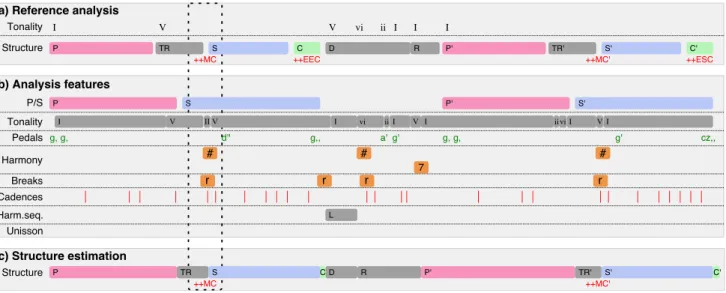
The following paragraphs list analysis features on which we will build to sketch the structure of the sonata form. Figures 2b and Figure 3 show these features on a first movement of a string quartet by Mozart. Such musical features are common in textbook or lecture descriptions of the sonata form. Their selection was done according to whether their presence or absence could be characteristic of one (or several) section(s) in a sonata form.
The following paragraphs lists these features, noted with boxes such as P. The detection of some of these
fea-tures is taken from previous works [8]. Note that these features are already relatively mid-level or high-level MIR features, and their detection is often a challenge by it-self that will not be detailed and evaluated here. Al-though not perfect, these methods detect features that can be combined as observable symbols produced by a Hidden Markov Model (Section 3).
P S P' S' P/S I V II V I vi ii I V I ii vi I V I Tonality g, g, d'' g,, a' g' g, g, g' cz,, Pedals # # # 7 Harmony r r r r Breaks Cadences L Harm.seq. Unisson b) Analysis features ++EEC ++MC' ++ESC I V V vi ii I I I P TR S C D R P' TR' S' C' ++MC Tonality Structure a) Reference analysis c) Structure estimation Structure S ++MC' ++MC P TR S CD R P' TR' S' C'
Figure 2. First movement of the String Quartet no. 4 in C major by W. A. Mozart (K157). (a.) Reference analysis indicating the main sections, following notations of [15], with the cadential structure endings, in particular the MC (Medial Caesura) between the P/TR and S zones. (b.) Analysis features as described in Section 2. (c.) Structure estimation by the HMM described in Section 3.2. The section with a dotted frame, around the first MC, is detailed on Figure 3.
2.1 Thematic Features
In a “regular” sonata form, the two thematic zones are strong markers of the form. We detect here repeated themes by computing a similarity score [8], which is based on equations similar to the Mongeau-Sankoff algorithm that uses dynamic programming [24]. The score function favors diatonic similarities, and only allows here alignment of two notes having the same duration.
• P theme. P The P theme is searched using the score
function, forbidding any transposition, and by com-paring the start of the piece with other parts. The pattern is extracted only from the highest voice (first violin), but successive occurrences may be found in other voices. The first searched pattern begins at the start of the piece and ends at most at 1/3 of the length of the piece. If no repeated pattern is found, the search is done again, starting from 2 measures after. The P theme must start in the first 10 measures and its length has to be more than 1 measure. • S theme. S The S theme is searched after the first P
theme, again for at least one more occurrence. The S theme must start before 1/3 of the length of the piece, end before 1/2 of the length of the piece, and its length has to be between at least 4 measures. This time, the cost forces to find some pattern with a dom-inant transposition between the first occurrence and the following one. Once again, if no repeated pat-tern is found, the search is done by starting from a further position.
These features were introduced in [7] and may be re-lated to the approach taken by [17] on audio signals. The selected ratios (1/3, 1/2) reflect a generic balance of the structure of the sonata form. The score function could be
improved by further research, in particular to allow more variations between the statements of the themes.
2.2 Harmonic Features
As tonal path is the most striking element of a sonata form, some features specifically focus on the harmony. Indeed, even without detection of full P/S themes, the harmony alone should give hints on analyzing sonata forms.
• Tonality. I A O We detect local tonalities on
2-measures windows with a Krumhansl-Schmukler al-gorithm [20] used with the pitch profiles improved by Temperley [31]. Tonalities are then output rela-tively against the main (most present) tonality of the piece: main I, auxiliary A and other O tonalities.
As our goal is not to infer precisely the tonality but to give a hint of the tonal context that will be used next in a probabilistic model, we do not use any gorithm improving this detection such as the full al-gorithm of [31].
• Authentic cadences. AC Cadences are markers
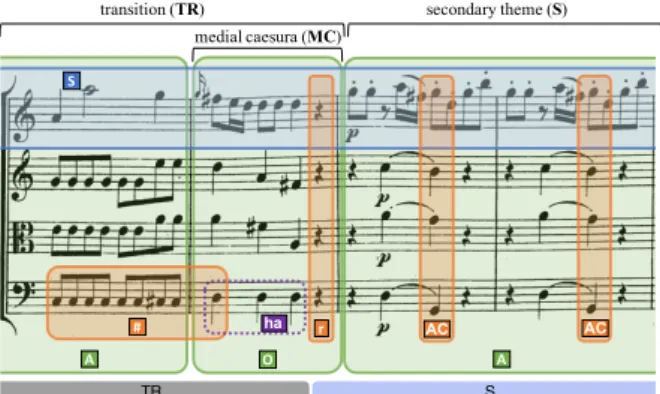
be-tween sections. Moreover, cadences appear more likely in conclusive sections (C). We detect candi-dates of simple Perfect Authentic Cadences (PAC) and rooted Imperfect Authentic Cadences (rIAC) by checking harmonies over any V-I bass movement on strong beats using the algorithm of [8]. To take for-eign notes into account, the V chord, characterized by the leading tone and possibly the seventh, has to be found somewhere while the bass holds the dom-inant. As this detection is here solely based on the harmony, it may induce some false positives. This is the case on Figure 3, where two successive V-I bass movements are interpreted as PACs even if they do not correspond to any phrase ending.
r # S A O A transition (TR) medial caesura (MC) secondary theme (S) TR @ S AC AC ha
Figure 3. First medial caesura (MC) in the first movement of the String Quartet no. 4 in C major by W. A. Mozart (K157), measures 29 to 32. See Figure 2 for an overview of this movement. The MC ends the transition (TR) and is before the beginning of the secondary theme (S). The com-puted analysis retrieves several features within this region: the thematic pattern S S – falsely detected even before
the MC, see discussion in the text – tonality regions corre-sponding to auxiliary A and – falsely detected – other O
tonalities, a chromatic upward bass movement # and a full
rest r. Two spurious cadences AC are also detected at the
beginning of the secondary theme. Although not taken into account in the present work, the extract includes a triple hammer blow ha characteristic of the medial caesura.
• Preparation of half-cadences. We detect both chro-matic upward bass movements # (one chromatic
semitone followed by one diatonic semitone, con-tiguous notes with the same pitch being taken as one note, see Figure 3) and putative diminished seven chords 7 (any diminished seventh or augmented
second interval between two notes sounding at the same time). These feature are often found in the preparation of half-cadences, and especially for the preparation of the Medial Caesura.
• Pedals. ped We detect pedals during more than 1
measure in one voice. Pedals are often found during development and conclusion sections. On the con-trary, they are often not found in thematic P/S zones, except at the very beginning of the piece.
2.3 Other Features
These features combine melody and harmony and/or other music elements.
• Full rests. r We look for rests that occur in all
voices simultaneously. Such rests are often found at key places: after the MC, after the exposition, and just before the recapitulation.
• Unisons. uni We detect unisons between all
the voices using the algorithm presented in [10]. Unisons are strong markers that often also break the musical flow: They are also likely to be found in structural breaks.
• Long harmonic sequences. L We detect harmonic
sequences by at least three successive occurrences of melodic patterns in all four voices, using the algo-rithm presented in [9] and reporting sequences dur-ing at least 5 measures. Such long harmonic se-quences, often modulating, can be found in the de-velopment.
3. STRUCTURE ESTIMATION THROUGH FEATURE COMBINING
Analysis features are sampled at regular intervals to give sequences of symbols (Figure 2b). We propose to gather these features into a sonata form structure (Figure 2c). The following paragraphs present the Hidden Markov Models (HMM) framework we use and then the particular HMM designed for sonata forms.
3.1 Hidden Markov Models with Multiple Outputs Markov model. We consider a finite alphabet of sym-bols A = {α1, α2...} that will be here the analysis
fea-tures. The Markov model M = (Q, π, τ, T, E) on A is defined by a set of n states Q = {q1, ...qn} corresponding
here to sections of the sonata form, the initial state prob-abilities π = (π1, ...πn), and the final state probabilities
τ = (τ1, ...τn). T (i → j) is the transition probability –
state qi goes to state qj – and E(i α) is the emission
probability– state qiemits feature α. All probabilities are
between 0 and 1, and the probabilities arrays sum to 1. Given an integer t, we call a t-tuple P = (p1, ...pt) ∈
[1, n]ta path in M. This path goes through the t states qp1...qpt. We also consider a sequence of symbols w =
α1...αt−1∈ At−1. The probability that the model M
fol-lows a path P while outputting the sequence w, one state outputting one character at each step, is given by:
p(P, w) = πp1 · Π
t−1
i=1(E(pi αi) · T (pi→ pi+1)) · τpt
Outputting mutiple symbols. Several features can be predicted at the same step. We thus now consider that a state may output simultaneously a set of symbols A = {α1...αa} ⊂ A. If these emissions are independent events,
the probability that the state qioutputs the set A is
E(i A) = Πα∈AE(i α) · Πα∈A\A(1 − E(i α))
We now consider a path P as before and a sequence of sets of symbols W = A1...At−1. The probability
p(P, W ) that the model M follows a path P while out-putting the sequence W is given by the same equation, re-placing E(pi αi) by E(pi Ai).
HMM. Now we consider M as a Hidden Markov Model (HMM). The path P is unknown but we observe a se-quence of sets of symbols W .
Finding the most probable path P that maximizes p(P, W ) is done by the classical Viterbi algorithm [26, 33] that first uses a forward stage to compute the probability of being in a state while outputting A1...Aj, and then that
P TR MC S C d D R p P’ TR’ MC’ S’ C’
Exposition Development Recapitulation
tonalities themes other I P I A P S ped I A S # 7 AC r uni A S A S ped AC A 7 r uni I A O L A ped I # 7 AC r uni
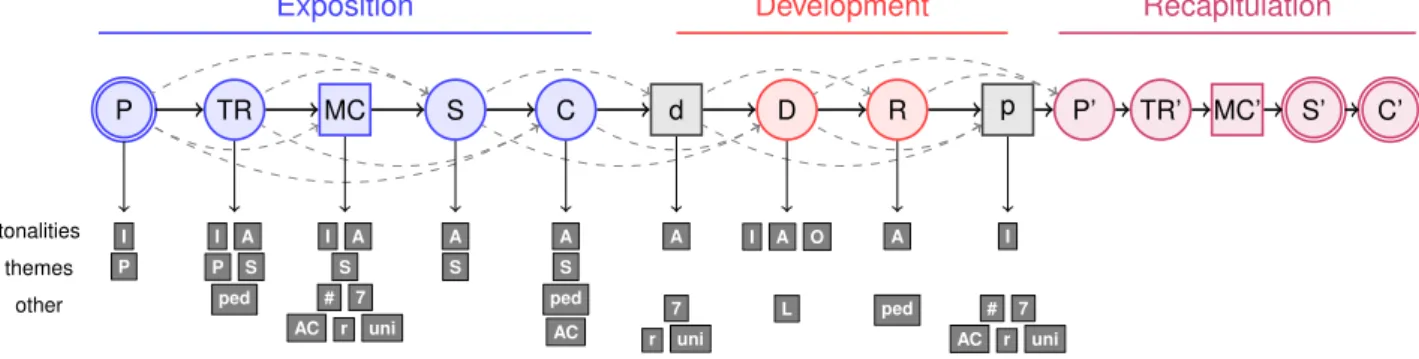
Figure 4. Hidden Markov Model sketching a regular sonata form structure from analysis features. The initial state is P, the final states are S’ and C’. The square states (MC/MC’ “medial caesura”, d “transition to development”, p “retransition to primary theme”) are transient states intended to last one or a few quarters, and are characterized by break features (#, 7, AC, r, uni). Each state has a (not shown) loop transistion over itself. The horizontal straight transitions have the
second highest probabilities, and the curved dashed transitions enable to skip some states with a low probability. Only the main emissions are shown here: the states may also emit other symbols with a low probability. For clarity, auxiliary transitions and emissions are not shown in the recapitulation. They are the same than in the exposition, except that the tonality emissions focus on the main tonality I.
3.2 A HMM to Sketch Sonata Form Structure
Figure 4 depicts the HMM created to sketch the sonata form structure. The HMM uses the alphabet {P, S, I, A, O, #, 7, ped, r, uni, L, AC} containing
the analysis features presented in the previous section. The features are sampled at every quarter note. The 14 states Q = {P, TR, MC, S, C, d, D, R, p, P0, TR0, MC0, S0, C0} were selected to match the various sections of the “regular” sonata form as well as some transitions {MC, d, p, MC0} between these sections.
As discussed in the introduction, even if such a “reg-ular” sonata form is a fiction, some pieces do follow this structure: The proposed states intend to match these pieces. As the model is very simple – and as the detec-tion of the features is far from perfect – the goal is not to perfectly match these 14 stages to actual sections of sonata forms, but rather to sketch the structure. We defined so many states to try to follow actual structures – for example, TR and MC states definitely imply different music events: in TR, focalization on the auxiliary tonality A, possibly
with some ped, and, in MC, conclusion with a cadence,
possibly AC, possibly with additional events: #, 7, r.
Transitions and emission probabilities of the selected symbols were choosen manually by a trial-and-error pro-cess (see discussion in Section 5). Each state has a loop transistion over itself with a very high probability (0.8). The emission probabilities were drafted according to what was described in the previous section. Some adjustments were made to take into account limits of some feature de-tection. For example, the feature S is often detected
out-side of S, as on Figure 3. Indeed, sometimes some few measures before the MC in the recapitulation are exactly a transposition of the same passage in the exposition. Thus, in the HMM, S can also be emitted by the states TR and
MC. The model with all probabilities can be downloaded at algomus.fr/sonata.
4. CORPUS AND RESULTS 4.1 Corpus and Reference Analysis
Experiments were done in python3, within the music21 framework [5] extended with analytic labels [1]. Pieces were given as .krn Humdrum files [16] downloaded from kern.humdrum.org. The corpus C10contains 10 first
movements of classical string quartets composed by Haydn and Mozart (see Table 1). All these are in major mode. The selected Mozart quartets are mostly early works (K80 and the three Milanese quartets K155, K156, K157) that have a simple sonata form, even if the first movement of K80 is adagio. Although they have the typical tonal path, the two Haydn quartets 54-3 and 64-4 do not exhibit a clear S (or S’) theme. We denote by C8the set of the 8 remaining
pieces. These pieces were analyzed following principles of [15] to determine P/TR/S/C sections as well as MCs. At least two curators checked every reference analysis. These analyses are available under an open-source license from algomus.fr/datasets.
4.2 Results of the Proposed Strategy
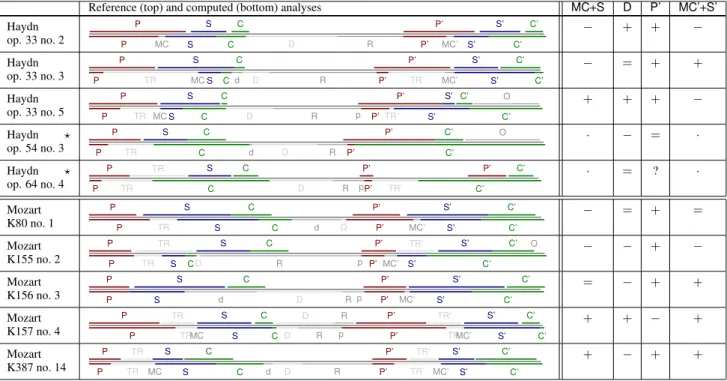
Table 1 shows the structure estimation of the HMM on all pieces in C10. As written above, the 14-state HMM was
not intended to fit perfectly with the structure, but rather to give hints on the sonata form structure. Moreover, some sections are difficult to predict, or even to define: for ex-ample, the start of the transition (TR) is often “blurred” in the end of P. Note also that the features and model we proposed do not separate well the S themes from the con-clusions C. We thus propose here to focus the evaluation on four key events of the sonata form (start of S, D, P’, S’): • MC+S. In the exposition, the MC followed by the start of S is perfectly or approximately found in 4 pieces in C8. In non-regular structures (?), a S may
be falsely detected, because the feature S may
Reference (top) and computed (bottom) analyses MC+S D P’ MC’+S’ Haydn op. 33 no. 2 P S C P’ S’ C’ P MC S C D R P’ MC’ S’ C’ − + + − Haydn op. 33 no. 3 P S C P’ S’ C’ P TR MCS C d D R P’ TR’ MC’ S’ C’ − = + + Haydn op. 33 no. 5 P S C P’ S’ C’ O P TR MCS C D R p P’ TR’ S’ C’ + + + − Haydn ? op. 54 no. 3 P S C P’ C’ O P TR C d D R P’ C’ · − = · Haydn ? op. 64 no. 4 P TR S C P’ P’ C’ P TR C D R pP’ TR’ C’ · = ? · Mozart K80 no. 1 P S C P’ S’ C’ P TR S C d D P’ MC’ S’ C’ − = + = Mozart K155 no. 2 P TR S C P’ TR’ S’ C’ O P TR S CD R p P’ MC’ S’ C’ − − + − Mozart K156 no. 3 P S C P’ S’ C’ P S d D R p P’ MC’ S’ C’ = − + + Mozart K157 no. 4 P TR S C D R P’ TR’ S’ C’ P TRMC S C D R p P’ TR’MC’ S’ C’ + + − + Mozart K387 no. 14 P TR S C P’ TR’ S’ C’ P TR MC S C d D R P’ TR’ MC’ S’ C’ + − + +
Table 1. Structure detection on ten first movements of Haydn and Mozart string quartets. The top lines are the reference analyses and the bottom line the structure found by the HMM. The four columns MC+S, D, P’ and MC’+S’ evaluate the prediction of the start of these events or sections: + (perfect or almost, that is at most 1 measure shifted from the reference), = (approximate match, between 2 and 3 measures), − (not found, or too far from the reference, at least 4 measures). We do not evaluate S positions (·) for pieces marked with ?, as they do not follow a “regular” bithematic sonata form structure with a clear secondary theme.
• D. The start of the development is perfectly or ap-proximately found in 6 pieces in C10. This detection
is usually grounded by the feature r.
• P’. The start of the recapitulation is perfectly or ap-proximately found in 8 pieces in C10, mainly driven
by the feature P. Haydn op. 64 no. 4 has partial
repeats of the P theme during the recapitulation, and Mozart K157 has a long retransition that is falsely detected as a P theme due to the feature I.
• MC’+S’. In the recapitulation, the start of S’ is ap-proximately found in 5 pieces in C8. It is again often
grounded on the break features.
Sonata structure sketch. Back on the motivation of this study, the predicted sonata form structure seems quite good for Mozart K157 and K387: starts and durations of sec-tions are quite precisely detected. For Mozart K80, K156 and Haydn 33-3 and 33-5, the structure is coarsely de-tected, but bad lengths or shifts in some predicted sections are not satisfying. Note that, on K80, even if the thematic features are not detected (data not shown), the path esti-mated by the HMM is still sensible, mainly due to tonali-ties as well as break events.
The bad results on the other pieces mostly come from a wrong detection of the start of S/S’. This suggest that features helping the prediction of the MC as well as the HMM should be improved.
5. DISCUSSION
The music analysis of large-scale structures, such as the sonata forms, requires to gather different analytical ele-ments into some coherent analysis. Taking inspiration from what the analysts do, we proposed a strategy to sketch such sonata structures, designing a HMM modeling music knowledge over analysis features. The proposed strategy manages to sketch the structure of some “regular” sonata forms in string quartets, finding the most important sec-tions (P/S, D, P’/S’) and sometimes detecting the location of the Medial Caesura (MC).
This strategy should now be evaluated on a larger cor-pus. More general perspectives include both the improve-ment of individual feature detection – conceiving or using MIR techniques that may be used to analyze any tonal mu-sic, in classical music but also in jazz or pop repertoires – and also improvement of the HMM. Other HMM topolo-gies could analyze more elaborated variations of sonata forms – especially continuous exposition. Analyzing late Mozart quartets or some romantic quartets will also be very challenging.
In the present work, we manually designed transition and emission probabilities. These probabilities could also be learned on larger corpora, but the number of parame-ters to learn makes such a learning difficult. A solution to benefit both from human expertise and machine learn-ing could be also to learn the weights of only manually selected emissions and transitions.
Acknowledgements. We thank Elise Janvresse, Marc Rigaudi`ere, and the anonymous reviewers for their insight-ful comments. This work was supported by a grant from the French Research Agency (ANR-11-EQPX-0023 IR-DIVE).
6. REFERENCES
[1] Guillaume Bagan, Mathieu Giraud, Richard Groult, and Emmanuel Leguy. Mod´elisation et visualisation de sch´emas d’analyse musicale avec music21. In Journ´ees d’Informatique Musicale (JIM 2015), 2015.
[2] Adriano Barat`e, Goffredo Haus, and Luca A Ludovico. Music analysis and modeling through Petri nets. In In-ternational Symposium on Computer Music Modeling and Retrieval (CMMR 2005), pages 201–218, 2005. [3] William E. Caplin. Classical Form: A Theory of
For-mal Functions for the Instrumental Music of Haydn, Mozart, and Beethoven. Oxford University Press, 2000.
[4] William E. Caplin. The classical sonata exposition: Cadential goals and form-functional plans. Tijdschrift voor Muziektheorie, 6(3):195–209, 2001.
[5] Michael Scott Cuthbert and Christopher Ariza. mu-sic21: A toolkit for computer-aided musicology and symbolic music data. In International Society for Mu-sic Information Retrieval Conference (ISMIR 2010), pages 637–642, 2010.
[6] Carl Czerny. School of Practical Composition. R. Cocks, London, 1848.
[7] Laurent David, Mathieu Giraud, Richard Groult, Corentin Louboutin, and Florence Lev´e. Vers une analyse automatique des formes sonates. In Journ´ees d’Informatique Musicale (JIM 2014), 2014.
[8] Mathieu Giraud, Richard Groult, Emmanuel Leguy, and Florence Lev´e. Computational fugue analysis. Computer Music Journal, 39(2), 2015.
[9] Mathieu Giraud, Richard Groult, and Florence Lev´e. Detecting episodes with harmonic sequences for fugue analysis. In International Society for Music Informa-tion Retrieval Conference (ISMIR 2012), 2012. [10] Mathieu Giraud, Florence Lev´e, Florent Mercier, Marc
Rigaudi`ere, and Donatien Thorez. Modeling texture in symbolic data. In International Society for Music In-formation Retrieval Conference (ISMIR 2014), 2014. [11] Robert O. Gjerdingen. Music in the Galant Style.
Ox-ford University Press, 2007.
[12] Theodor Helm. Beethovens Streichquartette: Versuch einer technischen Analyse dieser Werke im Zusammen-hange mit ihren geistigen Gehalt. Leipzig, 1885. [13] James Hepokoski. Beyond the sonata principle. J. of
the American Musicological Society, 55(2):91, 2002.
[14] James Hepokoski and Warren Darcy. The medial caesura and its role in the eighteenth-century sonata exposition. Music Theory Spectrum, 19(2):115–154, 1997.
[15] James Hepokoski and Warren Darcy. Elements of Sonata Theory: Norms, Types, and Deformations in the Late-Eighteenth-Century Sonata. Oxford Univer-sity Press, 2006.
[16] David Huron. Music information processing using the Humdrum toolkit: Concepts, examples, and lessons. Computer Music Journal, 26(2):11–26, 2002.
[17] Nanzhu Jiang and Meinard M¨uller. Automated meth-ods for analyzing music recordings in sonata form. In International Society for Music Information Retrieval Conference (ISMIR 2013), pages 595–600, 2013. [18] Stephanie Klauk and Frank Zalkow. Das
italienis-che Streichquartett im 18. Jahrhundert. M¨oglichkeiten der semiautomatisierten Stilanalyse. urn:nbn:de:101:1-201609071562, 2016.
[19] Heinrich Christoph Koch. Versuch einer Einleitung zur Composition (volume 3). Leipzig, 1793.
[20] Carol L. Krumhansl and Edward J. Kessler. Tracing the dynamic changes in perceived tonal organisation in a spatial representation of musical keys. Psychological Review, 89(2):334–368, 1982.
[21] Steve Larson. Recapitulation recomposition in the sonata-form first movements of Haydn’s string quar-tets: Style change and compositional technique. Music Analysis, 22(1-2):139–177, 2003.
[22] Adolph Bernhard Marx. Die Lehre von der musikalis-chen Komposition (volumes 2 et 3). Breitkopf & H¨artel, Leipzig, 1838, 1845.
[23] Jan Miyake. The Role of Multiple New-key Themes in Selected Sonata-form Exposition. PhD thesis, Univ. of New York, 2004.
[24] Marcel Mongeau and David Sankoff. Comparison of musical sequences. Computers and the Humanities, 24(3):161–175, 1990.
[25] Oriol Nieto and Morwaread Mary Farbood. Perceptual evaluation of automatically extracted musical motives. In International Conference on Music Perception and Cognition (ICMPC 2012), pages 723–727, 2012. [26] Lawrence R Rabiner. A tutorial on hidden Markov
models and selected applications in speech recognition. Proceedings of the IEEE, 77(2):257–286, 1989. [27] Phillip Radcliffe. Beethoven’s String Quartets. E. P.
Dutton, 1965.
[28] Leonard Ratner. Classical Music: Expression, Form, and Style. Schirmer, 1980.
[29] Anton Reicha. Trait´e de haute composition musicale (volume 2). Paris, 1826.
[30] Charles Rosen. Sonata Forms. W. W. Norton, 1980. [31] David Temperley. What’s key for key ? the
Krumhansl-Schmuckler key-finding algorithm reconsidered. Music Perception, 17(1):65–100, 1999.
[32] Donald Francis Tovey. A Companion to Beethoven’s Pianoforte Sonatas: Complete Analyses. AMS Press (reedited in 1998), 1931.
[33] Andrew Viterbi. Error bounds for convolutional codes and an asymptotically optimum decoding algorithm. IEEE Transactions on Information Theory, 13(2):260– 269, 1967.
[34] Christof Weiß and Julian Habryka. Chroma-based scale matching for audio tonality analysis. In Con-ference on Interdisciplinary Musicology (CIM 2014), 2014.
[35] Christof Weiß and Meinard M¨uller. Quantifying and vi-sualizing tonal complexity. In Conference on Interdis-ciplinary Musicology (CIM 2014), 2014.
[36] Frans Wiering and Emmanouil Benetos. Digital musi-cology and MIR: Papers, projects and challenges. In International Society for Music Information Retrieval Conference (ISMIR 2013), 2013. Late-breaking ses-sion.
![Figure 1. Allegretto of the piano sonatina Op. 55, no. 2 by Kuhlau. HC/PAC/EEC/ESC describe cadences and structure endings using the notations from [15]](https://thumb-eu.123doks.com/thumbv2/123doknet/14456249.519678/3.892.91.808.72.301/figure-allegretto-sonatina-kuhlau-cadences-structure-endings-notations.webp)