XIV. COMMUNICATIONS BIOPHYSICS
Prof. W. A. Rosenblith Dr. N. Y. S. Kiang Mrs. Margaret Z. Freeman Prof. M. H. Goldstein, Jr. Dr. T. T. Sandel C. D. Geisler
Dr. J. S. Barlow* O. Gutierrez'* H. C. Ingrao Dr. M. A. B. Brazier Aurice V. Albert C. E. Molnar
Dr. Eda Bergert R. M. Brown W. T. Peake
Dr. E. de Boer E. O. Dunlavey C. A. Steinberg Dr. B. G. Farleyl G. E. Forsen T. F. Weiss
A. MATHEMATICAL DESCRIPTION OF AVERAGE EVOKED RESPONSES IN TERMS OF ACTIVITY OF NEURAL UNITS
In many electrophysiological experiments evoked responses to sensory stimuli are recorded by means of gross electrodes. Interpretation of the mechanisms that underlie these evoked responses has been aided by the use of a mathematical model that relates the integrated activity that is recorded by a gross electrode to the temporal pattern of unit activity (1).
The model is statistical and deals with statistics of the evoked response as a function of time. Since the model treats the evoked response as a time-varying random process, the response must be viewed as a member of an ensemble; statistical measures are obtained from averages taken over the ensemble. Realization of the ensemble in an experimental situation may pose some practical problems. For example, it may be made up of the responses recorded from a set of cats to which an identical stimulus is delivered at the same time; or, more practically, it may be formed by repeatedly recording responses from a cat that is maintained in a steady physiological state for all stimulus presentations - a situation that is experimentally achievable under certain conditions. Recently, in fact, such average responses have been useful in many of our studies of bioelectric activity.
The following assumptions permit us to state the model in its simplest form: 1. There are N neural units that contribute to the response recorded by a gross electrode. (A neural unit is not necessarily a neuron; it may even represent the activ-ity of groups of neurons.)
2. The units behave in all-or-none fashion. They either discharge or do not discharge.
3. When a unit is activated for a time t = 0 it contributes a potential U(t) to the response seen by the gross electrode. U(t) is not necessarily the action spike, but
From the Neurophysiological Laboratory of the Neurology Service of the Massachusetts General Hospital.
tPostdoctoral Fellow of the National Institute of Mental Health. $Staff Member, Lincoln Laboratory, M. I. T.
(XIV. COMMUNICATIONS BIOPHYSICS)
may have components that correspond to the "slow" potentials that may follow a neural
discharge.
(It should be emphasized that U(t) is the potential at the gross electrode
that results from a unit discharge, and not the potential that would be seen by a
micro-electrode at the unit.)
4.
The N units form a statistically homogeneous population.
5.
The potentials that contribute at the location of the gross electrode sum linearly.
The expression for the average evoked electrode response will now be derived; higher
moments can be obtained by a similar procedure.
An average discharge rate P(t) is defined in such a way that the average number of
unit discharges between times t
aand t
bis given by
a
b
N
fb
P(t) dt
aIf tt -b
is larger than the average refractory period of the neural units,
b P(t) dt
a
may be greater than 1.
a
We are often interested in the stimulus-generated time pattern of the activity of
neural units. Since our datum is, however, the average response, we must infer from
it the average discharge rate, P(t).
Consider time to be divided into small intervals A, of uniform duration A seconds.
The interval A is assumed sufficiently small so that P(t) and U(t) will not change
appreciably during the interval.
The contribution of units that fire in the k
t hinterval
to the response measured during the nth interval is U(nA
-
kA) for n
>
k.
The number
of units firing in the k
t hinterval is NP(kA)A.
The average response is then obtained
by summing contributions from all discharges prior to time nA, and is expressed as
n
A(nA) = X
NP(kA) U(nA-kA)A
k=- oo
Allowing A to approach zero, nA = t, and kA = T, we obtain
A(t) = N P(T) U(t-T) dT
Hence the average response A(t) is the convolution of P(t) and U(t).
This result is a
generalization of Campbell's theorem (2, 3, 4) employed in the description of shot-effect
noise.
The assumptions given above that lead to this simple mathematical statement are
known to be far removed from actual experimental conditions.
However, the expression
does not change significantly when we deal with inhomogeneous populations whose units
(XIV. COMMUNICATIONS BIOPHYSICS)
give rise to nonidentical unit potentials or when we make use of weighting functions to account for the distance of different units from the electrode.
It should be clear that this model does nothing more than relate average responses that are recorded by gross electrodes to the time pattern of the activity of single units. There is a similarity between the mathematical procedure employed here and that used by Frishkopf in studying the neural elements at the periphery of the auditory nervous system in terms of the statistical properties of gross electrode activity (5).
M. H. Goldstein, Jr.
References
1. M. H. Goldstein, Jr. and N. Y. S. Kiang, Synchrony of neural activity in electric responses evoked by transient acoustic stimuli, J. Acoust. Soc. Am. 30, 107 (1958). 2. N. Campbell, The study of discontinuous phenomena, Proc. Camb. Phil. Soc. 15,
117-136 (1909).
3. J. M. Whittaker, The shot effect for showers, Proc. Camb. Phil. Soc. 33, 451-458 (1937).
4. S. O. Rice, Mathematical analysis of random noise, Bell System Tech. J. 23, 282 (July 1944); 24, 46 (Jan. 1945).
5. L. S. Frishkopf, A probability approach to certain neuro-electric phenomena,
Technical Report 307, Research Laboratory of Electronics, M. I. T., March 1, 1956.
B. AVERAGE RESPONSE COMPUTER (ARC-1)
In neurophysiological experiments we often want to measure the evoked electrical response to a given stimulus. This response is frequently obscured by the spontaneous activity of the system. One method of eliminating the effect of this activity is to repeat the stimulus many times and average the resulting responses. An adaptation of the autocorrelator that enables it to carry out this averaging process has been described by Barlow (1).
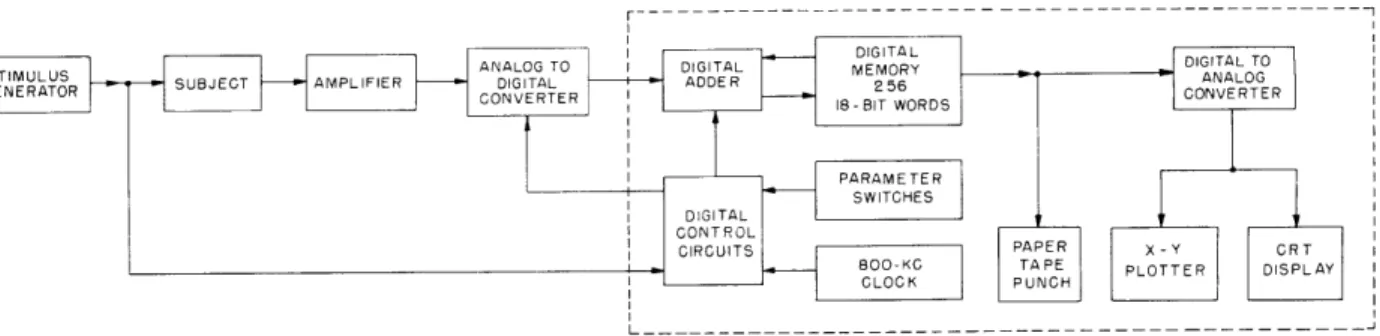
An electronic instrument specifically designed to compute evoked response averages over many stimuli, which was built at Lincoln Laboratory, uses digital transistor circuits for processing experimental data and is fast enough to compute and display results while the experiment is in progress. Figure XIV-1 shows the principal parts of the system in block diagram form. The ARC is triggered into action by a signal derived from the stimulus. After a specified initial delay period, the ARC causes the analog-to-digital converter to sample and quantize the response waveform at a large number of points separated by uniform time intervals. The set of 8-bit binary numbers thus produced is added into a corresponding set of 18-bit accumulating sums held in a ferrite-core memory. As this process is repeated for many stimuli, the average response emerges from any background activity or noise which is not "time-locked" to
Fig. XIV-1. Block diagram of average response computer. (ARC-1).
X88
V.
V XI XI X I N ' STIMULUS 0 10 20 TIME (MSEC)Fig. XIV-2.
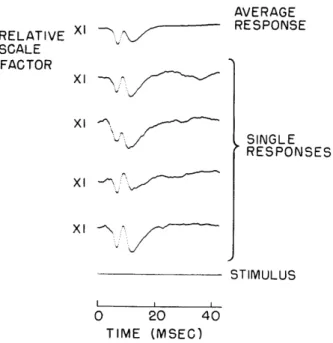
Single responses and the average of 64 cortical responses to acoustic clicks (35 db above the threshold of the electrical response). Clicks were presented at a rate of 1 every 2 seconds. Recordings were taken with a gross electrode from the surface of the auditory cortex of an unanesthetized cat. Peak-to-peak amplitude of top trace, approxi-mately 500 1v. RELATIVE SCALE FACTOR AVERAGE RESPONSE SINGLE RESPONSES - - _1 II
DIGITALA
I0GD,
DIGITAL
MEMORY
DIGITAL
TO
ADDE R 256 A ALOG
ANALOG
IS-IT WORDS ,CONVERTER I I 18 -BIT WORDS PARAMETER I SWITCHES DIGITAL CONTROL CGIRCUITS PAPER X - Y CRT 80 -KC TP PLOTTER DISPLAY CLOCK
L__---RELATIVE SCALE FACTOR AVERAGE RESPONSE SINGLE RESPONSES X I XI XI I\ STIMULUS 0 20 40 TIME (MSEC)
Fig. XIV-3. Single responses and the average of 1024 responses to click stimuli at a second repetition rate of Z00/sec. Same physiological preparation as given in Fig. XIV-Z. Peak-to-peak amplitude of top trace, approximately 2. 5
pv.
X32 X 16 X8 X4 1024 256 NUMBER OF RESPONSES 65 AVERAGED 65 X2 4 XI I I I i STIMULUS 0 10 20 TIME (MSEC)
Fig. XIV-4. Emergence of an average response from background
activity as the number of averaged responses is
increased.
The data used here are from the same
run as those in Fig. XIV-3.
RELATIVE SCALE FACTOR
(XIV. COMMUNICATIONS BIOPHYSICS)
the stimulus. The results can then be converted to equivalent voltages and displayed as a set of points on a cathode-ray tube or xy plotter, or can be punched out as 18-bit binary numbers on paper tape.
The initial delay, the interval between successive samples, the number of samples, and the number of responses to be treated can be specified by means of switches over the following ranges:
initial delay: 0 to 2. 62 sec in steps of 10 jsec sample interval: 80 4sec to 2. 62 sec in steps of 10 sec no. of samples: 1 to 254
no. of responses: 1 to 262,144
In a second mode of operation, the ARC compiles a frequency distribution of amplitudes at a specified time following the stimulus and displays this distribution in histogram form. Figures XIV-Z and XIV-3 show the results of trial computations, photographed directly from the face of the display cathode-ray tube. Figure XIV-4 illustrates the emergence of a well-defined average response as the number of added individual responses increases.
W. A. Clark, Jr. (Lincoln Laboratory) References
1. J. S. Barlow, An electronic method for detecting evoked responses of the brain and for reproducing their average waveforms, EEG and Clin. Neurophysiol., Vol 9, No. 2, 340-343 (1957).