HAL Id: hal-01486527
https://hal.archives-ouvertes.fr/hal-01486527
Submitted on 10 Mar 2017
HAL is a multi-disciplinary open access
archive for the deposit and dissemination of
sci-entific research documents, whether they are
pub-lished or not. The documents may come from
teaching and research institutions in France or
abroad, or from public or private research centers.
L’archive ouverte pluridisciplinaire HAL, est
destinée au dépôt et à la diffusion de documents
scientifiques de niveau recherche, publiés ou non,
émanant des établissements d’enseignement et de
recherche français ou étrangers, des laboratoires
publics ou privés.
Multicore Locks: The Case Is Not Closed Yet
Hugo Guiroux, Renaud Lachaize, Vivien Quéma
To cite this version:
Hugo Guiroux, Renaud Lachaize, Vivien Quéma. Multicore Locks: The Case Is Not Closed Yet.
2016 USENIX Annual Technical Conference (USENIX ATC 16), Jun 2016, Denver, United States.
pp.649-662. �hal-01486527�
This paper is included in the Proceedings of the
2016 USENIX Annual Technical Conference (USENIX ATC ’16).
June 22–24, 2016 • Denver, CO, USA
978-1-931971-30-0
Open access to the Proceedings of the
2016 USENIX Annual Technical Conference
(USENIX ATC ’16) is sponsored by USENIX.
Multicore Locks: The Case Is Not Closed Yet
Hugo Guiroux and Renaud Lachaize, Université Grenoble Alpes and Laboratoire
d’Informatique de Grenoble; Vivien Quéma, Université Grenoble Alpes, Grenoble Institute
of Technology, and Laboratoire d’Informatique de Grenoble
Multicore Locks: The Case is not Closed Yet
Hugo Guiroux
†Renaud Lachaize
†Vivien Qu´ema
†‡ †Universit´e Grenoble Alpes
‡Grenoble INP
LIG (CNRS UMR 5217)
Abstract
NUMA multicore machines are pervasive and many multithreaded applications are suffering from lock con-tention. To mitigate this issue, application and library de-velopers can choose from the plethora of optimized mu-tex lock algorithms that have been designed over the past 25 years. Unfortunately, there is currently no broad study of the behavior of these optimized lock algorithms on re-alistic applications. In this paper, we attempt to fill this gap. We perform a performance study of 27 state-of-the-art mutex lock algorithms on 35 applications. Our study shows that the case is not yet closed regarding locking on multicore machines. Indeed, our conclusions include the following findings: (i) at its optimized contention level, no single lock is the best for more than 52% of the stud-ied workloads; (ii) every lock is harmful for several ap-plications, even if the application parallelism is properly tuned; (iii) for several applications, the best lock changes when varying the number of threads. These findings call for further research on optimized lock algorithms and dy-namic adaptation of contention management.
1 Introduction
Today, multicore machines are pervasive and many mul-tithreaded applications are suffering from bottlenecks re-lated to critical sections and their corresponding locks. To mitigate these issues, application and library develop-ers can choose from the plethora of optimized mutex lock algorithms that have been designed over the past 25 years but there is currently no clear study to guide this puzzling choice for realistic applications. In particular, the most recent and comprehensive empirical performance evalu-ation on multicore synchronizevalu-ation [9], due to its breadth (from hardware protocols to high-level data structures), only provides a partial coverage of locking algorithms. Indeed, the aforementioned study only considers 9 al-gorithms, does not consider hybrid spinning/blocking
waiting policies, omits emerging approaches (e.g., load-control algorithms described in §2) and provides a mod-est coverage of hierarchical locks [14, 5, 6], a recent and efficient approach. Furthermore, most of the observa-tions are based on microbenchmarks. Besides, in the case of papers that present a new lock algorithm, the empirical observations are often focused on the specific workload characteristics for which the lock was designed [21, 26], or mostly based on microbenchmarks [14, 12].
The present paper provides a broad performance study on Linux/x86 of 27 state-of-the-art mutex lock algo-rithms on a set of 35 realistic and diverse applications (the PARSEC, Phoenix, SPLASH2 suites, MySQL and an SSL proxy). We make a number of observations, sev-eral of which have not been previously mentioned: (i) about 60% of the studied applications are significantly impacted by lock performance; (ii) no single lock is sys-tematically the best, even for a fixed number of contend-ing cores; (iii) worse, at their optimized contention level (individually tuned for each application), the best locks never dominate for more than 52% of the lock-sensitive applications; (iv) any of the locks is harmful (i.e., signif-icantly inefficient compared to the best one) for at least several workloads; (v) across all the lock-sensitive appli-cations, there is no clear performance hierarchy among the locks, even at a fixed number of contending cores; (vi) for a given application, the best lock varies according to both the number of contending cores and the machine; (vii) unlike previous recommendations [9] advocating that standard Pthread mutex locks should be avoided for workloads using no more than one thread per core, we find that, with our studied workloads, the current Linux implementation of these locks actually yields good per-formance for many applications with this pattern. More-over, we show that all these results hold even when each configuration, i.e., each (application, lock) pair, is tuned to its optimal degree of parallelism. From our perfor-mance study, we draw two main conclusions. First, spe-cific lock algorithms should not be hardwired into the
code of applications. Second, the observed trends call for further research both regarding lock algorithms and runtime support for parallel performance and contention management.
To conduct our study, manually modifying all the ap-plications in order to retrofit the studied lock algorithms would have been a daunting task. Moreover, using a meta-library that allows plugging different lock algo-rithms under a common API (such as liblock [26] or libslock [9]) would not have solved the problem, as this would still have required a substantial re-engineering ef-fort for each application. In addition, such meta-libraries provide no or limited support for important features like Pthread condition variables, used within many ap-plications. Therefore, we implemented LiTL1, a
low-overhead library that allows transparent interposition of Pthread mutex lock operations and support for main-stream features like condition variables, without any re-striction on the application-level locking discipline.
The remainder of the paper is organized as follows:
§2 presents a taxonomy of existing lock designs and the
list of algorithms covered by our study. §3 describes our experimental setup and the studied applications. §4 de-scribes the LiTL library. §5 exposes the main results from our empirical observations. §6 discusses related works and §7 concludes the paper.
2 Lock algorithms
2.1 Background
The body of existing works on optimized lock algo-rithms for multicore architectures is rich and diverse and can be split into the following five categories:
1) Flat approaches correspond to simple algorithms (typically based on one or a few shared variables ac-cessed by atomic instructions) such as: simple spin-lock [33], backoff spinspin-lock [2, 30], test and test-and-set (TTAS) lock [2], ticket lock [30], partitioned ticket lock [11], and standard Pthread mutex lock.
2) Queue-based approaches correspond to locks based on a waiting queue in order to improve fairness as well as the memory traffic, such as: MCS [30, 33] and CLH [7, 29, 33].
3) Hierarchical approaches are specifically aimed at providing scalable performance on large-scale NUMA machines, by attempting to reduce the rate of lock migra-tions among NUMA nodes. This category includes HBO [32], HCLH [28], FC-MCS [13], HMCS [5], AHMCS [6] and the algorithms that stem from the lock cohorting framework [14]. A cohort lock is based on a combination
1LiTL: Library for Transparent Lock interposition.
of two lock algorithms (similar or different): one used for the global lock and one used for the local locks (there is one local lock per NUMA node); in the usual C-LA-LB
notation, LAand LBrespectively correspond to the global
and the node-level lock algorithms. The list includes C-BO-MCS, C-PTL-TKT and C-TKT-TKT (also known as Hticket [9]). The BO, PTL and TKT acronyms respec-tively correspond to backoff lock, partitioned ticket lock, and standard ticket lock.
4) Load-control approaches correspond to algorithms that aim at limiting the number of threads that con-currently attempt to acquire a lock, in order to prevent a performance collapse. These algorithms are derived from queue-based locks. This category includes MCS-TimePub2[19] and so-called Malthusian algorithms like
Malth Spin and Malth STP3[12].
5) Delegation-based approaches correspond to algo-rithms in which it is (sometimes or always) necessary for a thread to delegate the execution of a critical section to another thread. The typical benefits expected from such approaches are improved cache locality and better resilience under high lock contention. This category in-cludes Oyama [31], Hendler [20], RCL [26], CC-Synch [15] and DSM-Synch [15].
Another important design dimension is the waiting
pol-icy used when a thread cannot immediately obtain a
re-quested lock [12]. There are three main approaches: (i) spinning on a memory address, (ii) immediate parking (i.e., blocking the thread) either for a fixed amount of time or until the thread gets a chance to obtain the lock, and (iii) spinning-then-parking (STP), a hybrid strategy using a fixed or adaptive threshold [22]. The choice of the waiting policy is mostly orthogonal to the lock design but, in practice, policies other than pure spin-ning are only considered for certain types of locks: the queue-based (from categories 2–4 above) and the stan-dard Pthread mutex locks. Besides, note that the GNU C library for Linux provides two versions of Pthread mu-tex locks: the default one uses parking (via the futex
syscall) and the second one uses an adaptive spin-then-park strategy. The latter version can be enabled with the
PTHREAD MUTEX ADAPTIVE NPoption [23].
2.2 Studied algorithms
Our choice of studied locks is guided by the decision to focus on portable lock algorithms. We therefore exclude the following locks that require strong assumptions on
2MCS-TimePub is mostly known as MCS-TP but we use
MC-TimePub to avoid confusion with MCS STP.
3Malth Spin and Malth STP correspond to MCSCR-S and
MCSCR-STP, respectively, but we do not use the latter names to avoid confusion with other MCS locks.
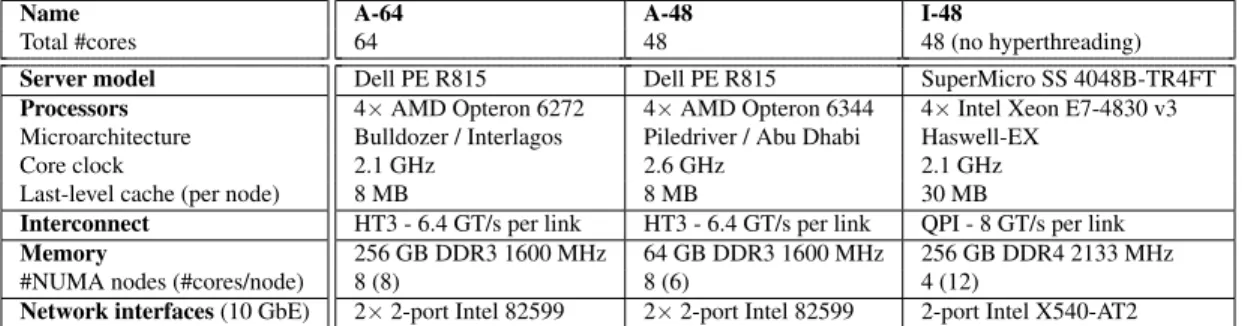
Name A-64 A-48 I-48
Total #cores 64 48 48 (no hyperthreading) Server model Dell PE R815 Dell PE R815 SuperMicro SS 4048B-TR4FT Processors 4× AMD Opteron 6272 4× AMD Opteron 6344 4× Intel Xeon E7-4830 v3 Microarchitecture Bulldozer / Interlagos Piledriver / Abu Dhabi Haswell-EX
Core clock 2.1 GHz 2.6 GHz 2.1 GHz Last-level cache (per node) 8 MB 8 MB 30 MB
Interconnect HT3 - 6.4 GT/s per link HT3 - 6.4 GT/s per link QPI - 8 GT/s per link Memory 256 GB DDR3 1600 MHz 64 GB DDR3 1600 MHz 256 GB DDR4 2133 MHz #NUMA nodes (#cores/node) 8 (8) 8 (6) 4 (12)
Network interfaces (10 GbE) 2× 2-port Intel 82599 2× 2-port Intel 82599 2-port Intel X540-AT2
Table 1: Hardware characteristics of the testbed platforms.
the application/OS behavior, code modifications, or frag-ile performance tuning: HCLH, HBO, FC-MCS, and all the delegation-based locks (see Dice et al. [14] for de-tailed arguments).
Our study considers 27 mutex lock algorithms that are representative of both well-established and state-of-the-art approaches. We use the Spin and STP suf-fixes to differentiate variants of the same algorithm that only differ in their waiting policy. The -LS tag corre-sponds to optimized algorithms borrowed from libslock [9]. Our set includes ten flat locks (Backoff, Partitioned ticket, Phtread, Pthread adaptive, Spinlock, Spinlock-LS, Ticket, Ticket-LS, TTAS, TTAS-LS), seven queue-based locks (Alock-LS, CLH-LS, CLH Spin, CLH STP, MCS-LS, MCS Spin, MCS STP), seven hierarchical locks (C-BO-MCS Spin, C-(C-BO-MCS STP, C-PTL-TKT, C-TKT-TKT, Hticket-LS, HMCS, AHMCS), and three load-control locks (Malth Spin, Malth STP, MCS-TimePub).
3 Experimental setup and methodology
3.1 Testbed and studied applications
Our experimental testbed consists of three Linux-based servers whose main characteristics are summarized in Table 1. All the machines run the Ubuntu 12.04 OS with a 3.17.6 Linux kernel (CFS scheduler), glibc 2.15 and gcc 4.6.3. For our comparative study of lock per-formance, we consider (i) the applications from the PARSEC benchmark suite (emerging workloads), (ii) the applications from the Phoenix 2 MapReduce bench-mark suite, (iii) the applications from the SPLASH2 high-performance computing benchmark suite4, (iv) the
MySQL database running the Cloudstone workload, and (v) SSL proxy, an event-driven SSL endpoint that pro-cesses small messages. In order to evaluate the impact of workload changes on locking performance, we also con-sider so called “long-lived” variants of four of the above workloads denoted with a “ ll” suffix. Note that six of
4We excluded the Cholesky application because of extremely short
completion times.
the applications cannot be evaluated on the two 48-core machines because, by design, they only accept a number of threads that correspond to a power of two: facesim, fluidanimate (from PARSEC), fft, ocean cp, ocean ncp, radix (from SPLASH2).
Most of these applications use a number of threads equal to the number of cores, except the three follow-ing ones: dedup (3× threads), ferret (4× threads) and MySQL (hundreds of threads). Two thirds of the appli-cations use Pthread condition variables.
3.2 Tuning and experimental methodology
For the lock algorithms that rely on static thresholds, we use the recommended values from the original papers and implementations. The algorithms based on a spin-then-park waiting policy (e.g., Malth STP [12]) rely on a fixed threshold for the spinning time that corresponds to the duration of a round-trip context switch [22] — in this case, we calibrate the duration using a microbenchmark on the testbed platform.
All the applications are run with memory interleav-ing (via the numactl utility) in order to avoid NUMA memory bottlenecks. Generally, in the experiments pre-sented in this paper, we study the performance impact of a lock for a given contention level, i.e., the number of threads of the application. We vary the contention level at the granularity of a NUMA node (i.e., 8 cores for the A-64 machine, 6 cores for the A-48 machine, and 12 cores for the I-48 machine). For most of the experiments de-tailed in the paper, the application threads are not pinned to specific cores. The impact of pinning is nonetheless discussed in §5.3.
Finally, each experiment is run at least five times and we compute the average value. Overall, we observe little variability for most configurations. For all experiments, the considered application-level performance metric is the throughput (operations per time unit).
4 The LiTL lock interposition library
In order to carry out the lock comparison study, we have developed LiTL, an interposition library for Linux/x86 allowing transparently replacing the lock algorithm used for Pthread mutexes. We describe its design, implemen-tation, and assess its performance.
4.1 Design
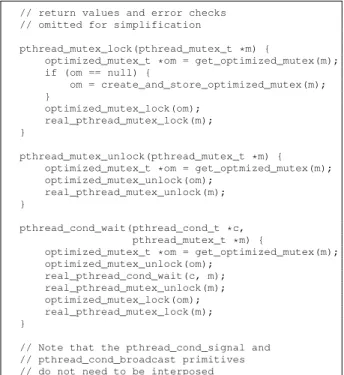
The design of LiTL does not impose any restriction on the level of nested locking and is compatible with ar-bitrary locking disciplines (e.g., hand-over-hand locking [33]). The pseudo-code of the main wrapper functions of the LiTL library is depicted in Figure 1.
// return values and error checks // omitted for simplification
pthread_mutex_lock(pthread_mutex_t *m) {
optimized_mutex_t *om = get_optimized_mutex(m); if (om == null) { om = create_and_store_optimized_mutex(m); } optimized_mutex_lock(om); real_pthread_mutex_lock(m); } pthread_mutex_unlock(pthread_mutex_t *m) { optimized_mutex_t *om = get_optmized_mutex(m); optimized_mutex_unlock(om);
real_pthread_mutex_unlock(m); }
pthread_cond_wait(pthread_cond_t *c, pthread_mutex_t *m) {
optimized_mutex_t *om = get_optimized_mutex(m); optimized_mutex_unlock(om); real_pthread_cond_wait(c, m); real_pthread_mutex_unlock(m); optimized_mutex_lock(om); real_pthread_mutex_lock(m); }
// Note that the pthread_cond_signal and // pthread_cond_broadcast primitives // do not need to be interposed
Figure 1: Overview of the pseudocode for the main wrapper functions of LiTL.
General principles The primary role of LiTL is to maintain a mapping structure between an instance of the standard Pthread lock (pthread mutex t) and
an instance of the chosen optimized lock type (e.g., MCS Spin). This implies that LiTL must keep track of the lifecycle of all the application’s locks through interposition of the calls to pthread mutex init()
andpthread mutex destroy(), and that each
inter-posed call to pthread mutex lock() must trigger a
lookup for the instance of the optimized lock. In addi-tion, lock instances that are statically initialized can only
be discovered and tracked upon the first invocation of
pthread mutex lock()on them (i.e., a failed lookup
leads to the creation of a new mapping).
Thelock/unlockAPI of several lock algorithms
re-quires an additional parameter (called “struct” hereafter) in addition to the lock pointer. For example, in the case of an MCS lock, this parameter corresponds to the record to be inserted in (or removed from) the lock’s waiting queue. In the general case, a struct cannot be reused nor freed before the corresponding lock has been released. For instance, an application may rely on nested critical sections (i.e., a thread T must acquire a lock L2 while
holding another lock L1). In this case, T must use a
dis-tinct struct for L2in order to preserve the integrity of L1’s
struct. In order to gracefully support the most general cases, LiTL systematically allocates exactly one struct per lock instance and per thread.
Supporting condition variables Dealing with con-dition variables inside each optimized lock algorithm would be complex and tedious as most locks have not been designed with condition variables in mind. We therefore use the following strategy: our wrap-per forpthread cond wait()internally calls the true
pthread cond wait() function. To issue this call,
we need to hold a real Pthread mutex lock (of type
pthread mutex t). This strategy (depicted in the
pseu-docode of Figure 1) does not introduce high contention on the internal Pthread lock. Indeed, for workloads that do not use condition variables, the Pthread lock is only requested by the holder of the optimized lock associated with the critical section. Furthermore, workloads that use condition variables are unlikely to have more than two threads competing for the Pthread lock: the holder of the optimized lock and a notified thread. Note that the latter claim also holds for workloads that rely on
pthread cond broadcast() because the Linux
im-plementation of this call only wakes up a single thread from the wait queue of the condition variable and directly transfers the remaining threads to the wait queue of the Pthread lock.
Support for specific lock semantics The design of LiTL is compatible with specific lock semantics when the underlying lock algorithms offer the corresponding properties. For example, LiTL supports non-blocking lock requests (pthread mutex trylock()) for all the currently implemented locks except CLH-based locks and Hticket-LS, which are not compatible with such se-mantics. Although not yet implemented, LiTL could eas-ily support blocking requests with timeouts for the so-called “abortable” locks (e.g., Try [34] and MCS-TimePub [19]). Moreover, support for optional Pthread
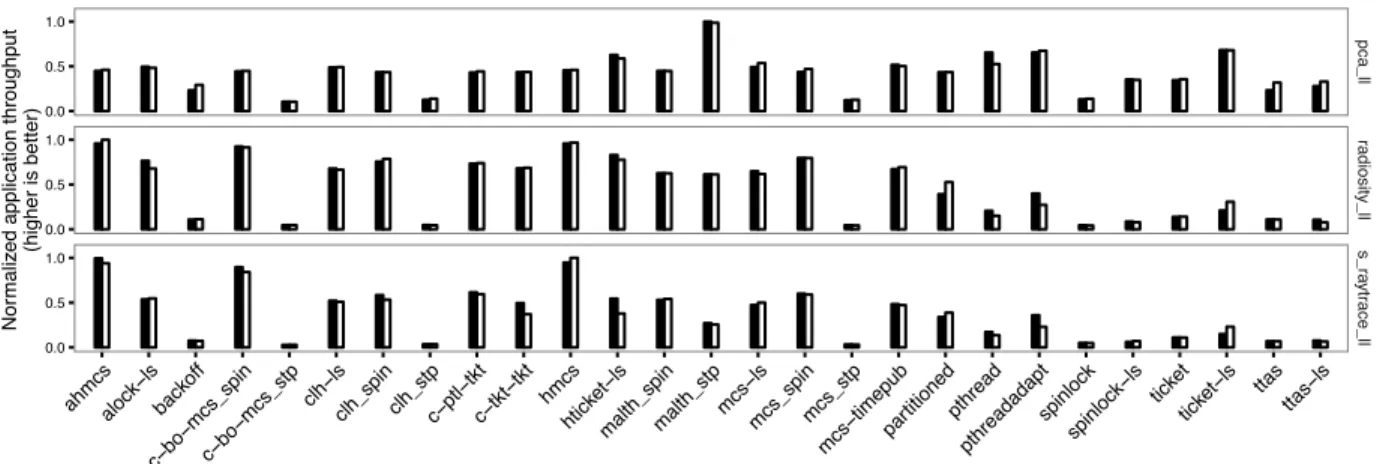
0.0 0.5 1.0 0.0 0.5 1.0 0.0 0.5 1.0 pca_ll radiosity_ll s_r aytr ace_ll ahmcsalock−lsbackoff c−bo−mcs_spinc−bo−mcs_stp clh−lsclh_spinclh_stpc−ptl−tktc−tkt−tkt hmcs
hticket−lsmalth_spinmalth_stpmcs−lsmcs_spinmcs_stp
mcs−timepubpar titionedpthread pthreadadapt spinlock spinlock−ls ticket
ticket−ls ttas ttas−ls
Nor
maliz
ed application throughput (higher is better)
Figure 2: Performance comparison (throughput) of manually implemented locks (black bars) vs. transparently inter-posed locks using LiTL (white bars). The throughput is normalized with respect to the best performing configuration for a given application (A-64 machine).
mutex behavior like reentrance and error checks5could
be easily integrated in the generic wrapper code by man-aging fields for the current owner and the lock acquisition counter.
4.2 Implementation
The library relies on a scalable concurrent hash table (CLHT [10]) in order to store, for each Pthread mu-tex instance used in the application, the correspond-ing optimized lock instance, and the associated per-thread structs. For well-established locking algorithms like MCS, the code of LiTL borrows from other li-braries [9, 1, 26]. Other algorithms are implemented from scratch based on the description of the original pa-pers. For algorithms that are based on a parking or on a spinning-then-parking waiting policy, our implementa-tion directly relies on thefutexLinux system call.
Finally, the source code of LiTL relies on preprocessor macros rather than function pointers. Indeed, we have observed that the use of function pointers in the critical path introduced a surprisingly high overhead. Moreover, all data structures are cache-aligned in order to mitigate the impact of false sharing.
4.3 Experimental validation
In this section, we assess the performance of LiTL using the A-64 machine. To that end, we compare the perfor-mance (throughput) of each lock on a set of applications running in two distinct configurations: manually modi-fied applications and unmodimodi-fied applications using in-terposition with LiTL. Clearly, one cannot expect to
ob-5Using respectively the PTHREAD MUTEX RECURSIVE and
PTHREAD MUTEX ERRORCHECKattributes.
tain exactly the same results in both configurations, as the setups differ in several ways, e.g., with respect to the ex-ercised code paths, the process memory layout and the al-location of the locks (e.g., stack- vs. heap-based). How-ever, we show that between both configurations: (i) the achieved performance is close and (ii) the general trends for the different locks remain stable.
We selected three applications: pca ll, radiosity ll and s raytrace ll. These three applications are particularly lock-intensive and the last two use Pthread condition variables. Therefore, all three represent an unfavorable case for LiTL. Moreover, we focus the discussion on the results under the highest contention level (i.e., when the application uses all the cores of the target machine), as this again represents an unfavorable case for LiTL.
Figure 2 shows the normalized performance (through-put) of both configurations (manual/interposed) for each
(application, lock) pair: black bars correspond to
manu-ally implemented locks, whereas white bars correspond to transparently interposed locks using LiTL. In addition, Table 2 summarizes the performance differences for each application: number of locks for which each version per-forms better and, in each case, the average gain and the relative standard deviation.
We observe that, for all of the three applications, the results achieved by the two versions of the same lock are very close: the average performance difference is below 5%. Besides, Figure 2 highlights that the general trends observed with the manual versions are preserved with the interposed versions. We thus conclude that using LiTL to study the behavior of lock algorithms in an application yields only very modest differences with respect to the performance behavior of a manually modified version.
pca ll radiosity ll s raytrace ll Manual Winners 10 17 19 Average Gain 2% 3% 4% Rel. Dev. 4% 4% 5% LiTL Winners 17 10 8 Average Gain 2% 3% 3% Rel. Dev. 2% 5% 3%
Table 2: Detailed statistics for the performance compar-ison of manually implemented locks vs. transparently interposed locks using LiTL (A-64 machine).
5 Performance study of lock algorithms
In this section, we use LiTL to compare the behavior of the different lock algorithms on different workloads and at different levels of contention. In the interest of space, we do not systematically report the observed stan-dard deviations. However, in order to mitigate the impact of variability, when comparing the performance of two locks, we consider a margin of 5%: lock A is considered better than lock B if B’s achieved performance is below 95% of A’s. Besides, in order to make fair comparisons, the results presented for the Pthread locks are obtained using the same library interposition mechanism as with the other locks.
Note that some configurations are not tested because of specific restrictions. First, streamcluster, streamclus-ter ll, and vips cannot use CLH-based locks or Hticket-LS as they do not support trylocks semantics. Second, we omit the results for most locks with MySQL: given the extremely large ratio of threads to cores, most locks yield performance close to zero. Third, some applica-tions, e.g., dedup and fluidanimate, run out of memory for some configurations.
Finally, for the sake of space, we do not report all the results for the three studied machines. We rather focus on the A-64 machine and provide summaries of the results for the A-48 and I-48 machines. Nevertheless, the en-tire set of results can be found in a companion technical report [18].
The section is structured as follows. §5.1 provides pre-liminary observations that drive the study. §5.2 answers the main questions of the study regarding the observed lock behavior. §5.3 discusses additional observations.
5.1 Preliminary observations
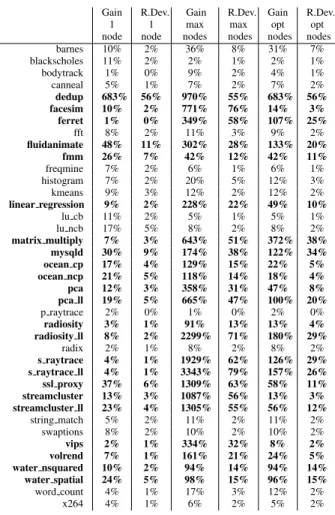
Before proceeding with the detailed study, we highlight some important characteristics of the applications. 5.1.1 Selection of lock-sensitive applications Table 3 shows two metrics for each application and for different numbers of nodes on the A-64 machine: the per-formance gain of the best lock over the worst one, as well
as the relative standard deviation for the performance of the different locks. For the moment, we only focus on the relative standard deviations at the maximum number of nodes (max nodes—highest contention) given in the 5th column (the detailed results from this table are discussed in §5.2.1).
We consider that an application is lock-sensitive if the relative standard deviation for the performance of the different locks at max nodes is higher than 10% (high-lighted in bold font). We observe that about 60% of the applications are impacted by locks. We observe similar trends on the three studied machines (see Table 4).
In the remainder of this study, we focus on lock-sensitive applications. Gain 1 node R.Dev. 1 node Gain max nodes R.Dev. max nodes Gain opt nodes R.Dev. opt nodes barnes 10% 2% 36% 8% 31% 7% blackscholes 11% 2% 2% 1% 2% 1% bodytrack 1% 0% 9% 2% 4% 1% canneal 5% 1% 7% 2% 7% 2% dedup 683% 56% 970% 55% 683% 56% facesim 10% 2% 771% 76% 14% 3% ferret 1% 0% 349% 58% 107% 25% fft 8% 2% 11% 3% 9% 2% fluidanimate 48% 11% 302% 28% 133% 20% fmm 26% 7% 42% 12% 42% 11% freqmine 7% 2% 6% 1% 6% 1% histogram 7% 2% 20% 5% 12% 3% kmeans 9% 3% 12% 2% 12% 2% linear regression 9% 2% 228% 22% 49% 10% lu cb 11% 2% 5% 1% 5% 1% lu ncb 17% 5% 8% 2% 8% 2% matrix multiply 7% 3% 643% 51% 372% 38% mysqld 30% 9% 174% 38% 122% 34% ocean cp 17% 4% 129% 15% 22% 5% ocean ncp 21% 5% 118% 14% 18% 4% pca 12% 3% 358% 31% 47% 8% pca ll 19% 5% 665% 47% 100% 20% p raytrace 2% 0% 1% 0% 2% 0% radiosity 3% 1% 91% 13% 13% 4% radiosity ll 8% 2% 2299% 71% 180% 29% radix 2% 1% 8% 2% 8% 2% s raytrace 4% 1% 1929% 62% 126% 29% s raytrace ll 4% 1% 3343% 79% 157% 26% ssl proxy 37% 6% 1309% 63% 58% 11% streamcluster 13% 3% 1087% 56% 13% 3% streamcluster ll 23% 4% 1305% 55% 56% 12% string match 5% 2% 11% 2% 11% 2% swaptions 8% 2% 10% 2% 10% 2% vips 2% 1% 334% 32% 8% 2% volrend 7% 1% 161% 21% 24% 5% water nsquared 10% 2% 94% 14% 94% 14% water spatial 24% 5% 98% 15% 96% 15% word count 4% 1% 17% 3% 12% 2% x264 4% 1% 6% 2% 5% 2%
Table 3: For each application, performance gain of the best vs. worst lock and relative standard deviation (A-64 machine).
A-64 A-48 I-48 # tested applications 39 33 33 # lock-sensitive applications 23 19 17
Table 4: Number of tested applications and number of lock-sensitive applications (all machines).
Applications ahmcs alock-ls back of f c-bo-mcs spin c-bo-mcs stp clh-ls clh spin clh stp c-ptl-tkt c-tkt-tkt hmcs htick et-ls malth spin malth stp mcs-ls mcs spin mcs stp
mcs-timepub partitioned pthread pthreadadapt spinlock spinlock-ls tick
et tick et-ls ttas ttas-ls dedup - 252 129 89 95 229 200 204 125 117 75 96 119 119 106 110 113 80 136 120 126 147 118 141 121 145 197 facesim 412 908 425 172 55 888 895 78 460 328 324 379 711 71 1k 948 87 26 895 91 67 726 35 919 462 489 530 ferret 134 176 46 170 174 109 63 100 108 57 194 192 173 182 34 7 fluidanimate - 72 9 - - - - 7 53 8 12 54 7 16 13 11 6 65 fmm 15 12 histogram 95 88 90 95 95 87 92 92 84 79 94 90 90 88 89 85 109 84 89 125 88 107 87 105 102 97 104 linear regression 44 227 12 21 132 67 45 34 7 49 44 15 25 8 51 47 24 50 10 8 38 8 21 27 matrix multiply 259 92 287 66 62 7 64 65 55 mysqld - - - 25 - - - -ocean cp 107 97 114 81 70 103 124 121 89 92 96 73 87 75 111 114 82 45 103 72 73 234 49 136 60 106 173 ocean ncp 93 99 90 73 69 90 93 79 76 90 81 73 84 85 73 92 95 61 98 97 85 206 56 89 57 93 186 pca 77 79 163 42 370 69 44 148 40 34 68 49 37 49 55 134 19 50 97 36 229 80 116 35 160 130 pca ll 91 81 219 14 582 74 41 321 23 16 88 31 7 21 58 41 403 21 195 114 513 168 108 51 206 476 radiosity 69 21 10 53 radiosity ll 12 413 1k 13 10 699 33 19 7 13 11 792 18 48 157 71 987 164 296 97 411 615 s raytrace 18 185 1k 66 460 14 13 16 7 436 100 88 14 269 50 134 149 195 154 s raytrace ll 19 96 781 17 2k 110 107 1k 83 180 15 170 68 161 108 88 1k 118 178 371 185 1k 308 495 301 857 881 ssl proxy 44 69 695 33 1k 107 61 1k 61 103 608 78 36 52 95 99 1k 73 87 268 195 2k 268 360 139 718 957 streamcluster 2k 2k 4k 2k 2k - - - 1k 2k 1k - 4k 16k 4k 3k 16k 1k 1k 2k 3k 9k 2k 5k 4k 4k 7k streamcluster ll 421 246 829 410 497 - - - 266 275 250 - 816 4k 774 590 4k 301 275 446 450 2k 585 1k 615 718 1k vips 64 56 22 400 32 - - - 331 189 131 - 229 18 46 51 18 21 60 20 21 20 23 37 28 22 26 volrend 52 88 97 62 99 72 82 123 50 62 52 59 69 128 79 86 109 82 83 131 162 222 114 74 70 108 154 water nsquared water spatial
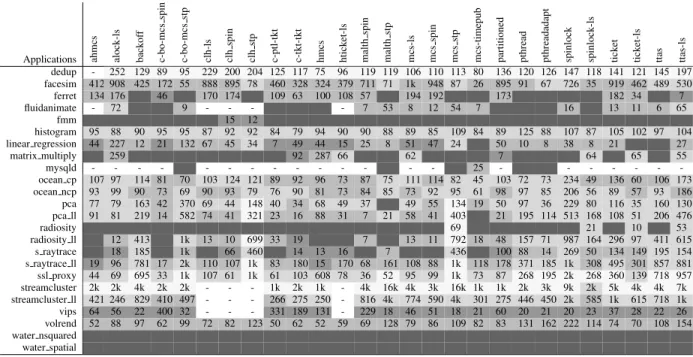
Table 5: For each (application, lock) pair, performance gain (in %) of the optimized configuration over the max-node configuration. The background color of a cell indicates the number of nodes (1, 2, 4, 6, or 8 nodes) for the optimized configuration: 1 2 4 6 8 . Dashes correspond to untested cases. (A-64 machine).
5.1.2 Selection of the number of nodes
In multicore applications, optimal performance is not always achieved at the maximum number of available nodes (abbreviated as max nodes) due to various kinds of scalability bottlenecks. Therefore, for each
(applica-tion, lock) pair, we empirically determine the optimized configuration (abbreviated as opt nodes), i.e., the
num-ber of nodes that yields the best performance. For the A-64 and A-48 machines, we consider 1, 2, 4, 6, and 8 nodes. For the I-48 machines, we consider 1, 2, 3, and 4 nodes. Note that 6 nodes on A-64 and A-48 correspond to 3 nodes on I-48, i.e., 75% of the available cores.
The results for the A-64 machine are displayed in Ta-ble 5. For each (application, lock) pair, the correspond-ing cell indicates the performance gain of the optimized configuration with respect to the max-node configura-tion. The background color of a cell indicates the num-ber of nodes for the optimized configuration. In addition, Table 6 provides a breakdown of the (application, lock) pairs according to their optimized number of nodes for all machines.
We observe that, for many applications, the optimized number of nodes is lower than the max number of nodes. Moreover, we observe (Table 5) that the performance gain of the optimized configuration is often extremely large. This confirms that tuning the degree of parallelism has frequently a very strong impact on performance. We also notice that, for some applications, the optimized
number of nodes varies according to the chosen lock.
A-64 A-48 I-48 1 Node 11% 9% 1 Node 33% 2 Nodes 28% 24% 2 Nodes 14% 4 Nodes 27% 21% 3 Nodes 8% 6 Nodes 7% 9% 4 Nodes 45% 8 Nodes 27% 37%
Table 6: Breakdown of the (application, lock) pairs ac-cording to their optimized number of nodes (all ma-chines).
In light of the above observations, the main questions investigated in the study (§5.2) will be considered from two complementary angles: (i) comparing locks at a fixed number of nodes, and (ii) comparing locks at their optimized configurations (i.e., with possibly a different number of nodes for each). The first angle offers insight for situations in which the degree of parallelism cannot be adjusted, while the second is useful for scenarios in which more advanced application tuning is possible.
5.2 Main questions
5.2.1 How much do locks impact applications? Table 3 shows, for each application, the performance gain of the best lock over the worst one at 1 node, max nodes, and opt nodes for the A-64 machine. The table also shows the relative standard deviation for the perfor-mance of the different locks.
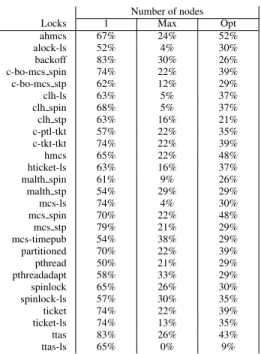
We observe that the impact of locks on the perfor-mance of applications depends on the number of nodes. At 1 node, the impact of locks on lock-sensitive appli-cations is moderate. More precisely, most appliappli-cations exhibit a gain of the best lock over the worst one that is lower than 30%. In contrast,at max nodes, the impact of locks is very high for all lock-sensitive applications. More precisely, the gain brought by the best lock over the worst lock ranges from 42% to 3343%. Finally,at the optimized number of nodes, the impact of locks is high, but noticeably lower than at max nodes. We ex-plain this difference by the fact that, at max nodes, some of the locks trigger a performance collapse for certain applications (as shown in Table 5), which considerably increases the observed performance gaps between locks. We observe the same trends on the A-48 and I-48 ma-chines (see the companion technical report [18]). 5.2.2 Are some locks always among the best? Table 7 shows the coverage of each lock, i.e., how often it stands as the best one (or is within 5% of the best) over all the studied applications for the A-64 machine. The results are shown for three configurations: 1 node, max nodes, and opt nodes. Besides, Table 8 displays, for each machine (at 1 node, max nodes and opt nodes) the following metrics aggregated over the different locks: the min and max coverage, the average coverage, and the relative standard deviation of the coverage.
Number of nodes Locks 1 Max Opt ahmcs 67% 24% 52% alock-ls 52% 4% 30% backoff 83% 30% 26% c-bo-mcs spin 74% 22% 39% c-bo-mcs stp 62% 12% 29% clh-ls 63% 5% 37% clh spin 68% 5% 37% clh stp 63% 16% 21% c-ptl-tkt 57% 22% 35% c-tkt-tkt 74% 22% 39% hmcs 65% 22% 48% hticket-ls 63% 16% 37% malth spin 61% 9% 26% malth stp 54% 29% 29% mcs-ls 74% 4% 30% mcs spin 70% 22% 48% mcs stp 79% 21% 29% mcs-timepub 54% 38% 29% partitioned 70% 22% 39% pthread 50% 21% 29% pthreadadapt 58% 33% 29% spinlock 65% 26% 30% spinlock-ls 57% 30% 35% ticket 74% 22% 39% ticket-ls 74% 13% 35% ttas 83% 26% 43% ttas-ls 65% 0% 9%
Table 7: For each lock, fraction of the lock-sensitive ap-plications for which the lock yields the best performance for three configurations: 1 node, max nodes, and opt nodes (A-64 machine).
# nodes Coverage A-64 A-48 I-48 1 [min; max]Avg. [50%; 83%]66% [27%; 83%]66% [44%; 89%]62%
Rel. Dev. 9% 15% 12% Max [min; max]Avg. [0%; 38%]19% [0%; 42%]17% [5%; 50%]24%
Rel. Dev. 10% 12% 11% Opt [min; max]Avg. [9%; 52%]34% [0%; 47%]21% [5%; 50%]28%
Rel. Dev. 9% 13% 12%
Table 8: Statistics on the coverage of locks for three con-figurations: 1 node, max nodes, and opt nodes (all ma-chines).
We make the following observations (Table 8). No lock is among the best for more than 89% of the ap-plications at 1 node and for more than 52% of the applications both at max nodes and at the optimal number of nodes. We also observe that the average cov-erage is much higher at 1 node than at max nodes, and slightly higher at the optimized number of nodes than at max nodes. This is directly explained by the observa-tions made in §5.2.1. First, at 1 node, locks have a much lower impact on applications than in other configurations and thus yield closer results, which increases their likeli-hood to be among the best ones. Second, at max nodes, all of the different locks cause, in turn, a performance collapse, which reduces their likelihood to be among the best locks. This latter phenomenon is not observed at the optimized number of nodes. We observe the same trends on the A-48 and I-48 machines (see the companion tech-nical report [18]).
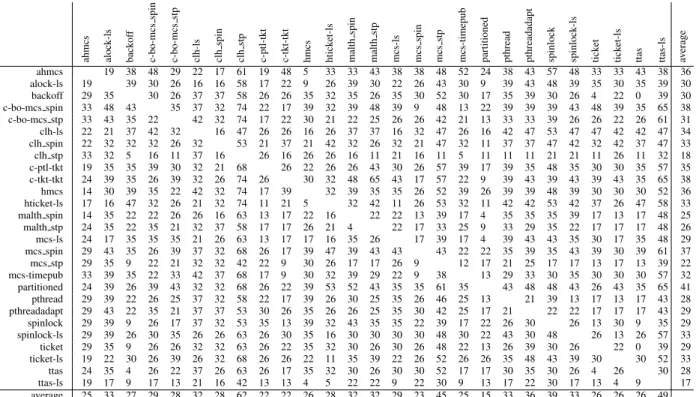
5.2.3 Is there a clear hierarchy between locks? Table 9 shows pairwise comparisons for all locks, at max nodes on the A-64 machine. In each table, cell (rowA,colB) contains the score of lock A vs. lock B, i.e., the percentage of applications for which lock A is at least 5% better than lock B. For example, Table 9 shows that for 38% of the applications, AHMCS performs at least 5% better than Backoff at the optimized number of nodes. Similarly, the table shows that Backoff is at least 5% better than AHMCS for 29% of the applica-tions. From these two values, we can conclude that the two above mentioned locks perform very closely for 33% of the applications. At the end of each line (resp. col-umn), the table also shows the mean of the fraction of applications for which a lock is better (resp. worse) than others. Besides, the latter two metrics are summarized for the three machines in Table 10.
We observe thatthere is no clear global performance hierarchy between locks. More precisely, for most pairs of locks (A, B), there are some applications for which A is better than B, and vice-versa (Table 9). The only marginal exceptions are the cells having 0% for value. This corresponds to pairs of locks (A,B) for which A
ahmcs alock-ls back of f c-bo-mcs spin c-bo-mcs stp clh-ls clh spin clh stp c-ptl-tkt c-tkt-tkt hmcs htick et-ls malth spin malth stp mcs-ls mcs spin mcs stp
mcs-timepub partitioned pthread pthreadadapt spinlock spinlock-ls tick
et
tick
et-ls
ttas ttas-ls average
ahmcs 19 38 48 29 22 17 61 19 48 5 33 33 43 38 38 48 52 24 38 43 57 48 33 33 43 38 36 alock-ls 19 39 30 26 16 16 58 17 22 9 26 39 30 22 26 43 30 9 39 43 48 39 35 30 35 39 30 backoff 29 35 30 26 37 37 58 26 26 35 32 35 26 35 30 52 30 17 35 39 30 26 4 22 0 39 30 c-bo-mcs spin 33 48 43 35 37 32 74 22 17 39 32 39 48 39 9 48 13 22 39 39 39 43 48 39 35 65 38 c-bo-mcs stp 33 43 35 22 42 32 74 17 22 30 21 22 25 26 26 42 21 13 33 33 39 26 26 22 26 61 31 clh-ls 22 21 37 42 32 16 47 26 26 16 26 37 37 16 32 47 26 16 42 47 53 47 47 42 42 47 34 clh spin 22 32 32 32 26 32 53 21 37 21 42 32 26 32 21 47 32 11 37 37 47 42 32 42 37 47 33 clh stp 33 32 5 16 11 37 16 26 16 26 26 16 11 21 16 11 5 11 11 11 21 21 11 26 11 32 18 c-ptl-tkt 19 35 35 39 30 32 21 68 26 22 26 26 43 30 26 57 39 17 39 35 48 35 30 30 35 57 35 c-tkt-tkt 24 39 35 26 39 32 26 74 26 30 32 48 65 43 17 57 22 9 39 43 39 43 39 43 35 65 38 hmcs 14 30 39 35 22 42 32 74 17 39 32 39 35 35 26 52 39 26 39 39 48 39 30 30 30 52 36 hticket-ls 17 16 47 32 26 21 32 74 11 21 5 32 42 11 26 53 32 11 42 42 53 42 37 26 47 58 33 malth spin 14 35 22 22 26 26 16 63 13 17 22 16 22 22 13 39 17 4 35 35 35 39 17 13 17 48 25 malth stp 24 35 22 35 21 32 37 58 17 17 26 21 4 22 17 33 25 9 33 29 35 22 17 17 17 48 26 mcs-ls 24 17 35 35 35 21 26 63 13 17 17 16 35 26 17 39 17 4 39 43 43 35 30 17 35 48 29 mcs spin 29 43 35 26 39 37 32 68 26 17 39 47 39 43 43 43 22 22 35 39 35 43 39 30 39 61 37 mcs stp 29 35 9 22 21 32 32 42 22 9 30 26 17 17 26 9 12 17 21 25 17 17 13 17 13 39 22 mcs-timepub 33 39 35 22 33 42 37 68 17 9 30 32 39 29 22 9 38 13 29 33 30 35 30 30 30 57 32 partitioned 24 39 26 39 43 32 32 68 26 22 39 53 52 43 35 35 61 35 43 48 48 43 26 43 35 65 41 pthread 29 39 22 26 25 37 32 58 22 17 39 26 30 25 35 26 46 25 13 21 39 13 17 13 17 43 28 pthreadadapt 29 43 22 35 21 37 37 53 30 26 35 26 26 25 35 30 42 25 17 21 22 22 17 17 17 43 29 spinlock 29 39 9 26 17 37 32 53 35 13 39 32 43 35 35 22 39 17 22 26 30 26 13 30 9 35 29 spinlock-ls 29 39 26 30 35 26 26 63 26 30 35 16 30 30 30 30 48 30 22 43 30 48 26 13 26 57 33 ticket 29 35 9 26 26 32 32 63 26 22 35 32 30 26 30 26 48 22 13 26 39 30 26 22 0 39 29 ticket-ls 19 22 30 26 39 26 32 68 26 26 22 11 35 39 22 26 52 26 26 35 48 43 39 30 30 52 33 ttas 24 35 4 26 22 37 26 63 26 17 35 32 30 26 30 30 52 17 17 30 35 30 26 4 26 30 28 ttas-ls 19 17 9 17 13 21 16 42 13 13 4 5 22 22 9 22 30 9 13 17 22 30 17 13 4 9 17 average 25 33 27 29 28 32 28 62 22 22 26 28 32 32 29 23 45 25 15 33 36 39 33 26 26 26 49
Table 9: For each pair of locks (rowA, colB) at the optimized number of nodes, score of lock A vs lock B: percentage of applications for which lock A performs at least 5% better than B (A-64 machine).
Better Worse Lock A-64 A-48 I-48 A-64 A-48 I-48 ahmcs 36% 40% 52% 25% 28% 25% alock-ls 30% 42% 37% 33% 25% 32% backoff 30% 29% 23% 27% 33% 45% c-bo-mcs spin 38% 47% 46% 29% 25% 15% c-bo-mcs stp 31% 25% 38% 28% 44% 25% clh-ls 34% 46% 32% 32% 32% 38% clh spin 33% 38% 33% 28% 34% 37% clh stp 18% 11% 8% 62% 72% 71% c-ptl-tkt 35% 44% 54% 22% 26% 13% c-tkt-tkt 38% 42% 51% 22% 27% 15% hmcs 36% 50% 52% 26% 21% 17% hticket-ls 33% 45% 42% 28% 25% 17% malth spin 25% 36% 31% 32% 37% 35% malth stp 26% 20% 28% 32% 53% 36% mcs-ls 29% 43% 35% 29% 22% 26% mcs spin 37% 38% 36% 23% 33% 23% mcs stp 22% 23% 20% 45% 59% 52% mcs-timepub 32% 38% 34% 25% 34% 29% partitioned 41% 42% 38% 15% 32% 23% pthread 28% 33% 34% 33% 43% 35% pthreadadapt 29% 34% 34% 36% 38% 36% spinlock 29% 35% 20% 39% 44% 49% spinlock-ls 33% 41% 38% 33% 30% 31% ticket 29% 23% 17% 26% 44% 53% ticket-ls 33% 40% 28% 26% 24% 35% ttas 28% 28% 24% 26% 34% 44% ttas-ls 17% 27% 20% 49% 42% 52%
Table 10: For each lock, at the optimized number of nodes, mean of the fraction of applications for which the lock is better (resp. worse) than other locks (all ma-chines).
never yields better performance than B. The results at max nodes (not shown due to lack of space) exhibit simi-lar trends as the ones at opt nodes. Besides, we make the same observations (both at opt nodes and max nodes) on the A-48 and I-48 machines (see the companion techni-cal report [18]).
5.2.4 Are all locks potentially harmful?
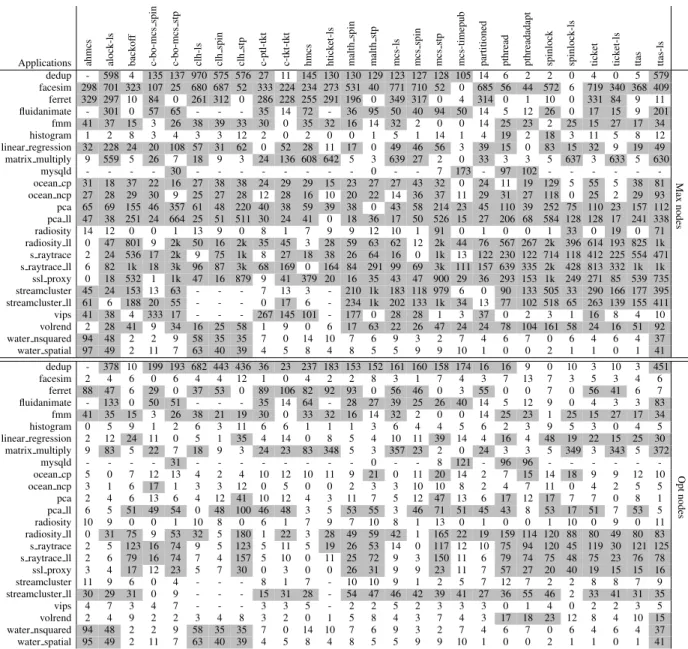
Our goal is to determine, for each lock, if there are ap-plications for which it yields substantially lower perfor-mance than other locks and to quantify the magnitude of such performance gaps. Table 11 displays, for the A-64 machine, the performance gain brought by the best lock with respect to each of the other locks for each applica-tion at max nodes (top part) and at the optimized num-ber of nodes for each lock (bottom part). For example, the top part of the table shows that for the dedup applica-tion, the best lock (0%, here Spinlock-LS) is 598% better than the Alock-LS lock. The gray cells highlight values greater than 15%. Thus, for each lock in a column, the number of grey cells corresponds to the number of ap-plications for which the lock is beaten by a gap of 15% or more by the best lock(s) for this application. In addi-tion, Table 12 displays, for each machine, the fraction of applications that are significantly hurt by a given lock.
On the three machines, we observe that,both at max
Applications ahmcs alock-ls back of f c-bo-mcs spin c-bo-mcs stp clh-ls clh spin clh stp c-ptl-tkt c-tkt-tkt hmcs htick et-ls malth spin malth stp mcs-ls mcs spin mcs stp
mcs-timepub partitioned pthread pthreadadapt spinlock spinlock-ls tick
et tick et-ls ttas ttas-ls dedup - 598 4 135 137 970 575 576 27 11 145 130 130 129 123 127 128 105 14 6 2 2 0 4 0 5 579 Max nodes facesim 298 701 323 107 25 680 687 52 333 224 234 273 531 40 771 710 52 0 685 56 44 572 6 719 340 368 409 ferret 329 297 10 84 0 261 312 0 286 228 255 291 196 0 349 317 0 4 314 0 1 10 0 331 84 9 11 fluidanimate - 301 0 57 65 - - - 35 14 72 - 36 95 50 40 94 50 14 5 12 26 0 17 15 9 201 fmm 41 37 15 3 26 38 39 33 30 0 35 32 16 14 32 2 0 0 14 25 23 2 25 15 27 17 34 histogram 1 2 8 3 4 3 3 12 2 0 2 0 0 1 5 1 14 1 4 19 2 18 3 11 5 8 12 linear regression 32 228 24 20 108 57 31 62 0 52 28 11 17 0 49 46 56 3 39 15 0 83 15 32 9 19 49 matrix multiply 9 559 5 26 7 18 9 3 24 136 608 642 5 3 639 27 2 0 33 3 3 5 637 3 633 5 630 mysqld - - - - 30 - - - 0 - - 7 173 - 97 102 - - - -ocean cp 31 18 37 22 16 27 38 38 24 29 29 15 23 27 27 43 32 0 24 11 19 129 5 55 5 38 81 ocean ncp 27 28 29 30 9 25 27 28 12 28 16 10 20 22 14 36 37 11 29 31 27 118 0 25 2 29 93 pca 65 69 155 46 357 61 48 220 40 38 59 39 38 0 43 58 214 23 45 110 39 252 75 110 23 157 112 pca ll 47 38 251 24 664 25 51 511 30 24 41 0 18 36 17 50 526 15 27 206 68 584 128 128 17 241 338 radiosity 14 12 0 0 1 13 9 0 8 1 7 9 9 12 10 1 91 0 1 0 0 1 33 0 19 0 71 radiosity ll 0 47 801 9 2k 50 16 2k 35 45 3 28 59 63 62 12 2k 44 76 567 267 2k 396 614 193 825 1k s raytrace 2 24 536 17 2k 9 75 1k 8 27 18 38 26 64 16 0 1k 13 122 230 122 714 118 412 225 554 471 s raytrace ll 6 82 1k 18 3k 96 87 3k 68 169 0 164 84 291 99 69 3k 111 157 639 335 2k 428 813 332 1k 1k ssl proxy 0 18 532 1 1k 47 16 879 9 41 379 20 16 35 43 47 900 29 36 293 153 1k 249 271 85 539 735 streamcluster 45 24 153 13 63 - - - 7 13 3 - 210 1k 183 118 979 6 0 90 133 505 33 290 166 177 395 streamcluster ll 61 6 188 20 55 - - - 0 17 6 - 234 1k 202 133 1k 34 13 77 102 518 65 263 139 155 411 vips 41 38 4 333 17 - - - 267 145 101 - 177 0 28 28 1 3 37 0 2 3 1 16 8 4 10 volrend 2 28 41 9 34 16 25 58 1 9 0 6 17 63 22 26 47 24 24 78 104 161 58 24 16 51 92 water nsquared 94 48 2 2 9 58 35 35 7 0 14 10 7 6 9 3 2 7 4 6 7 0 6 4 6 4 37 water spatial 97 49 2 11 7 63 40 39 4 5 8 4 8 5 5 9 9 10 1 0 0 2 1 1 0 1 41 dedup - 378 10 199 193 682 443 436 36 23 237 183 153 152 161 160 158 174 16 16 9 0 10 3 10 3 451 Opt nodes facesim 2 4 6 0 6 4 4 12 1 0 4 2 2 8 3 1 7 4 3 7 13 7 3 5 3 4 6 ferret 88 47 6 29 0 37 53 0 89 106 82 92 93 0 56 46 0 3 55 0 0 7 0 56 41 6 7 fluidanimate - 133 0 50 51 - - - 35 14 64 - 28 27 39 25 26 40 14 5 12 9 0 4 3 3 83 fmm 41 35 15 3 26 38 21 19 30 0 33 32 16 14 32 2 0 0 14 25 23 1 25 15 27 17 34 histogram 0 5 9 1 2 6 3 11 6 6 1 1 1 3 6 4 4 5 6 2 3 9 5 3 0 4 5 linear regression 2 12 24 11 0 5 1 35 4 14 0 8 5 4 10 11 39 14 4 16 4 48 19 22 15 25 30 matrix multiply 9 83 5 22 7 18 9 3 24 23 83 348 5 3 357 23 2 0 24 3 3 5 349 3 343 5 372 mysqld - - - - 31 - - - 0 - - 8 121 - 96 96 - - - -ocean cp 5 0 7 12 13 4 2 4 10 12 10 11 9 21 0 11 20 14 2 7 15 14 18 9 9 12 10 ocean ncp 3 1 6 17 1 3 3 12 0 5 0 0 2 3 3 10 10 8 2 4 7 11 0 4 2 5 5 pca 2 4 6 13 6 4 12 41 10 12 4 3 11 7 5 12 47 13 6 17 12 17 7 7 0 8 1 pca ll 6 5 51 49 54 0 48 100 46 48 3 5 53 55 3 46 71 51 45 43 8 53 17 51 7 53 5 radiosity 10 9 0 0 1 10 8 0 6 1 7 9 7 10 8 1 13 0 1 0 0 1 10 0 9 0 11 radiosity ll 0 31 75 9 53 32 5 180 1 22 3 28 49 59 42 1 165 22 19 159 114 120 88 80 49 80 83 s raytrace 2 5 123 16 74 9 5 123 5 11 5 19 26 53 14 0 117 12 10 75 94 120 45 119 30 121 125 s raytrace ll 2 6 79 16 74 7 4 157 5 10 0 11 25 72 9 3 150 11 6 79 74 75 48 75 23 76 78 ssl proxy 3 4 17 12 23 5 7 30 0 3 0 0 26 31 9 9 23 11 7 57 27 20 40 19 15 15 16 streamcluster 11 9 6 0 4 - - - 8 1 7 - 10 10 9 1 2 5 7 12 7 2 2 8 8 7 9 streamcluster ll 30 29 31 0 9 - - - 15 31 28 - 54 47 46 42 39 41 27 36 55 46 2 33 41 31 35 vips 4 7 3 4 7 - - - 3 3 5 - 2 2 5 2 3 3 3 0 1 4 0 2 2 3 5 volrend 2 4 9 2 2 3 4 8 3 2 0 1 5 8 4 3 7 4 3 17 18 23 12 8 4 10 15 water nsquared 94 48 2 2 9 58 35 35 7 0 14 10 7 6 9 3 2 7 4 6 7 0 6 4 6 4 37 water spatial 95 49 2 11 7 63 40 39 4 5 8 4 8 5 5 9 9 10 1 0 0 2 1 1 0 1 41
Table 11: For each application, at max nodes (top part) and at the optimized number of nodes (bottom part), perfor-mance gain (in %) obtained by the best lock(s) with respect to each of the other locks. The grey background highlights cells for which the performance gains are greater than 15%. A line with many gray cells corresponds to an application whose performance is hurt by many locks. A column with many gray cells corresponds to a lock that is outperformed by many other locks. Dashes correspond to untested cases. (A-64 machine).
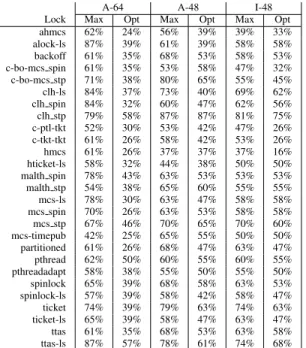
nodes and at the optimal number of nodes, all locks are potentially harmful, yielding sub-optimal perfor-mance for a significant number of applications (Ta-ble 12). We also notice that locks are significantly less harmful at the optimized number of nodes than at max nodes. This is explained by the fact that several of the locks create performance collapses at max nodes, which does not occur at the optimized number of nodes. More-over, we observe that, for each lock, the performance gap to the best lock can be significant (Table 11).
5.3 Additional observations
Impact of the number of nodes. Table 13 shows, for each application on the A-64 machine, the number of pairwise changes in the lock performance hierarchy when the number of nodes is modified. For example, in the case of the facesim application, there are 18% of the pairwise performance comparisons between locks that change when moving from a 1-node configuration to a 2-node configuration. Similarly, there are 95% of pairwise comparisons that change at least once when considering
A-64 A-48 I-48 Lock Max Opt Max Opt Max Opt ahmcs 62% 24% 56% 39% 39% 33% alock-ls 87% 39% 61% 39% 58% 58% backoff 61% 35% 68% 53% 58% 53% c-bo-mcs spin 61% 35% 53% 58% 47% 32% c-bo-mcs stp 71% 38% 80% 65% 55% 45% clh-ls 84% 37% 73% 40% 69% 62% clh spin 84% 32% 60% 47% 62% 56% clh stp 79% 58% 87% 87% 81% 75% c-ptl-tkt 52% 30% 53% 42% 47% 26% c-tkt-tkt 61% 26% 58% 42% 53% 26% hmcs 61% 26% 37% 37% 37% 16% hticket-ls 58% 32% 44% 38% 50% 50% malth spin 78% 43% 63% 53% 53% 53% malth stp 54% 38% 65% 60% 55% 55% mcs-ls 78% 30% 63% 47% 58% 58% mcs spin 70% 26% 63% 53% 58% 58% mcs stp 67% 46% 70% 65% 70% 60% mcs-timepub 42% 25% 65% 55% 50% 50% partitioned 61% 26% 68% 47% 63% 47% pthread 62% 50% 60% 55% 60% 55% pthreadadapt 58% 38% 55% 50% 55% 50% spinlock 65% 39% 68% 58% 63% 53% spinlock-ls 57% 39% 58% 42% 58% 47% ticket 74% 39% 79% 63% 74% 63% ticket-ls 65% 39% 58% 47% 63% 47% ttas 61% 35% 68% 53% 63% 58% ttas-ls 87% 57% 78% 61% 74% 68%
Table 12: For each lock, at max nodes and at the opti-mized number of nodes, fraction of the applications for which the lock is harmful (all machines).
the 1-node, 2-node, 4-node and 8-node configurations. We observe that, for all applications, the lock per-formance hierarchy changes significantly according to the chosen number of nodes. Moreover, we observe the same trends on the A-48 and I-48 machines (see the companion technical report [18]).
% of pairwise changes between configurations Applications 1/2 2/4 4/8 1/2/4/8 dedup 16% 6% 12% 19% facesim 18% 38% 81% 95% ferret 0% 74% 26% 87% fluidanimate 5% 6% 24% 32% fmm 33% 10% 19% 45% histogram 19% 32% 24% 55% linear regression 58% 40% 57% 95% matrix multiply 16% 27% 45% 54% mysqld 33% 20% 7% 40% ocean cp 54% 53% 72% 94% ocean ncp 52% 54% 56% 86% pca 44% 60% 29% 89% pca ll 31% 38% 23% 73% radiosity 11% 49% 65% 83% radiosity ll 66% 28% 14% 92% s raytrace 1% 70% 32% 96% s raytrace ll 21% 69% 24% 99% ssl proxy 62% 12% 21% 78% streamcluster 68% 21% 32% 88% streamcluster ll 60% 28% 31% 90% vips 2% 3% 82% 82% volrend 16% 27% 44% 85% water nsquared 23% 24% 13% 52% water spatial 12% 10% 10% 29%
Table 13: For each application, percentage of pairwise changes in the lock performance hierarchy when chang-ing the number of nodes (A-64 machine).
Impact of the machine. Table 14 shows the number of pairwise lock inversions observed between the ma-chines (both at max nodes and at the optimized number of nodes). More precisely, for a given application at a given node configuration, we check whether two locks are in the same order or not on the target machines.
We observe that the lock performance hierarchy changes significantly according to the chosen ma-chine. Interestingly, we observe that there is approxi-mately the same number of inversions between each pair of machines.
A-64 A-48 A-64 vs. vs. vs. # nodes A-48 I-48 I-48
Max 38% 36% 38% Opt 30% 29% 31%
Table 14: For each pair of machines, at max nodes and at opt nodes, percentage of pairwise changes in the lock performance hierarchy (all machines).
A note on Phtread locks. The various results pre-sented in this paper show that the current LinuxPthread locks perform well (i.e., are among the best locks) for a significant share of the studied applications, thus providing a different insight than recent results, which were mostly based on synthetic workloads [9]. Beyond the changes of workloads, these differences may also be explained by the continuous refinement of the Linux Pthread implementation. It is nevertheless important to note that on each machine, some locks stand out as the best ones for a higher fraction of the applications than Pthread locks. Finally, we note that Pthread adaptive locks perform slightly better than standard Pthread locks.
Impact of thread pinning. As explained in §3.2, all the above-described experiments were run without any restriction on the placement of threads, leaving the corre-sponding decisions to the Linux scheduler. However, in order to better control CPU allocation and improve local-ity, some developers and system administrators use pin-ning to explicitly restrict the placement of each thread to one or several core(s). The impact of thread pinning may vary greatly according to workloads and can yield both positive and negative effects [9, 27]. In order to assess the generality of our observations, we also performed the complete set of experiments with an alternative configu-ration in which each thread is pinned to a given node, leaving the scheduler free to place the thread among the cores of the node. Note that for an experiment with a
N-node configuration, the complete application runs on
exactly first N nodes of the machine. We chose thread-to-node pinning rather than thread-to-core pinning because we observed that the former generally provided better
performance for our studied applications, especially the ones using more threads than cores. The detailed results of our experiments with thread-to-node pinning are avail-able in the companion technical report [18]. Overall, we observe thatall the conclusions presented in the paper still hold with per-node thread pinning.
6 Related work
The design and implementation of the LiTL lock li-brary borrows code and ideas from previous open-source toolkits that provide application developers with a set of optimized implementations for some of the most-established lock algorithms: Concurrency Kit [1], li-block [25, 24, 26], and libslock [9]. All of these toolk-its require potentially tedious source code modifications in the target applications, even in the case of algorithms that have been specifically designed to lower this bur-den [3, 33, 36]. Moreover, among the above works, none of them provides a simple and generic solution for supporting Pthread condition variables. The au-thors of liblock [26] have proposed an approach but we discovered that it suffers from liveness hazards due to a race condition. Indeed, when a thread T calls
pthread cond wait(), it is not guaranteed that the two
steps (releasing the lock and blocking the thread) are al-ways executed atomically. Thus, a wake-up notification issued by another thread may get interleaved between the two steps and T may remain indefinitely blocked.
Several research works have leveraged library interpo-sition to compare different locking algorithms on legacy applications (e.g., Johnson et al. [21] and Dice et al. [14]) but, to the best of our knowledge, they have not publicly documented the design challenges to support arbitrary application patterns, nor disclosed the corre-sponding source code and the overhead of their interpo-sition library has not been discussed.
Several studies have compared the performance of dif-ferent multicore lock algorithms, either from a theoreti-cal angle or based on experimental results [4, 33, 9, 24, 14]. In comparison, our study encompasses significantly more lock algorithms and waiting policies. Moreover, the bulk of these studies is mainly focused on charac-terization microbenchmarks while we focus instead on workloads designed to mimic real applications. Two no-ticeable exceptions are the work from Boyd-Wickizer et al. [4] and Lozi et al. [26] but they do not con-sider the same context as our study. The former is fo-cused on kernel-level locking bottlenecks, and the lat-ter is focused on applications in which only one or a few heavily contended critical sections have been op-timized (after a profiling phase). For all these rea-sons, we make observations that are significantly differ-ent from the ones based on all the above-mdiffer-entioned
stud-ies. Other synchronization-related studies like the one from Gramoli [16] have a different scope and focus on concurrent data structures, possibly based on other facil-ities than locks.
Finally, some tools have been proposed to facilitate the identification of locking bottlenecks in applications [35, 8, 26]. These publications are orthogonal to our work. We note that, among them, the profilers based on library interposition can be stacked on top of LiTL.
7 Conclusion and future work
Optimized lock algorithms for multicore machines are abundant. However, there are currently no clear guide-lines and methodologies helping developers to select the right lock for their workloads. In this paper, we have presented a broad study of 27 locks algorithms with 35 applications on Linux/x86. To perform that study, we have implemented LiTL, an interposition library allow-ing the transparent replacement of lock algorithms used for Pthread mutex locks. From our study, we draw sev-eral conclusions, including the following ones: at its op-timized contention level, no single lock dominates for more than 52% of the lock-sensitive applications; any of the locks is harmful for at least several applications; for a given application, the best lock varies according to both the number of contending cores and the machine that executes the application. These observations call for further research on optimized lock algorithms, as well as tools and dynamic approaches to better understand and control their behavior.
The source code of LiTL and the data sets of our ex-perimental results are available online [17].
Acknowledgments
We thank the anonymous reviewers and our shepherd, Tim Harris, for their insightful comments on ealier drafts of this paper. Dave Dice provided detailed answers for our questions on Malthusian locks. Baptiste Lepers pro-vided valuable insights for some of the case studies. Pierre Neyron provided his help to set up experiments on the I-48 machine. Finally, this work has been par-tially supported by: LabEx PERSYVAL-Lab (ANR-11-LABX-0025-01), EmSoc Replicanos and AGIR CAEC projects of Universit´e Grenoble-Alpes and GrenobleINP, and the INRIA/LIG Digitalis project.
References
[1] AL BAHRA, S. Concurrency Kit, 2015. http:// concurrencykit.org.
[2] ANDERSON, T. E. The Performance of Spin Lock Alternatives for Shared-Memory Multiprocessors. IEEE Transaction on
Par-allel and Distributed Systems (Jan. 1990), 6–16.
[3] AUSLANDER, M., EDELSOHN, D., KRIEGER, O., ROSEN
-BURG, B.,ANDWISNIEWSKI, R. Enhancement to the MCS Lock for Increased Functionality and Improved Programmabil-ity. U.S. Patent Application Number 20030200457 (abandoned), October 2003.
[4] BOYD-WICKIZER, S., KAASHOEK, M. F., MORRIS, R.,AND
ZELDOVICH, N. Non-scalable Locks are Dangerous. In
Pro-ceedings of the Linux Symposium (Ottawa, Canada, July 2012).
[5] CHABBI, M., FAGAN, M.,ANDMELLOR-CRUMMEY, J. High Performance Locks for Multi-level NUMA Systems. In
Proceed-ings of the 20th ACM SIGPLAN Symposium on Principles and Practice of Parallel Programming (PPoPP’15) (2015), ACM.
[6] CHABBI, M., AND MELLOR-CRUMMEY, J. Contention-conscious, Locality-preserving Locks. In Proceedings of the 21st
ACM SIGPLAN Symposium on Principles and Practice of Paral-lel Programming (PPoPP’16) (2016), ACM.
[7] CRAIG, T. S. Building FIFO and Priority-Queuing Spin Locks from Atomic Swap. Tech. Rep. TR 93-02-02, University of Washington, 1993.
[8] DAVID, F., THOMAS, G., LAWALL, J., AND MULLER, G.
Continuously Measuring Critical Section Pressure with the Free-lunch Profiler. In Proceedings of the 2014 ACM
Interna-tional Conference on Object Oriented Programming Systems Languages & Applications (2014), OOPSLA ’14, ACM.
[9] DAVID, T., GUERRAOUI, R.,ANDTRIGONAKIS, V. Everything
You Always Wanted to Know About Synchronization but Were Afraid to Ask. In Proceedings of the Twenty-Fourth ACM
Sympo-sium on Operating Systems Principles (SOSP’13) (2013), ACM.
[10] DAVID, T., GUERRAOUI, R.,ANDTRIGONAKIS, V. Asynchro-nized Concurrency: The Secret to Scaling Concurrent Search Data Structures. In Proceedings of the Twentieth International
Conference on Architectural Support for Programming Lan-guages and Operating Systems (ASPLOS’15) (2015), ACM.
[11] DICE, D. Brief Announcement: A Partitioned Ticket Lock. In Proceedings of the Twenty-third Annual ACM Symposium on
Parallelism in Algorithms and Architectures (SPAA’11) (2011),
ACM.
[12] DICE, D. Malthusian Locks, november 2015. http:// arxiv.org/abs/1511.06035.
[13] DICE, D., MARATHE, V. J.,ANDSHAVIT, N. Flat-Combining
NUMA Locks. In Proceedings of the Twenty-third Annual
ACM Symposium on Parallelism in Algorithms and Architectures (SPAA’11) (2011), ACM.
[14] DICE, D., MARATHE, V. J.,ANDSHAVIT, N. Lock Cohorting: A General Technique for Designing NUMA Locks. ACM
Trans-actions on Parallel Computing 1, 2 (Feb. 2015), 13:1–13:42.
[15] FATOUROU, P.,ANDKALLIMANIS, N. D. Revisiting the Com-bining Synchronization Technique. In Proceedings of the 17th
ACM SIGPLAN Symposium on Principles and Practice of Paral-lel Programming (PPoPP’12) (2012), ACM.
[16] GRAMOLI, V. More Than You Ever Wanted to Know About chronization: Synchrobench, Measuring the Impact of the Syn-chronization on Concurrent Algorithms. In Proceedings of the
20th ACM SIGPLAN Symposium on Principles and Practice of Parallel Programming (PPoPP’15) (2015), ACM.
[17] GUIROUX, H., LACHAIZE, R., AND QUEMA´ , V. LiTL source code and data sets, 2016. https://github.com/ multicore-locks.
[18] GUIROUX, H., LACHAIZE, R., ANDQUEMA´ , V. Multicore Locks: the Case is not Closed Yet. Technical report, 2016. Avail-able from https://github.com/multicore-locks. [19] HE, B., SCHERER, W. N., ANDSCOTT, M. L. Preemption
Adaptivity in Time-published Queue-based Spin Locks. In
Pro-ceedings of the 12th International Conference on High Perfor-mance Computing (HiPC’05) (2005), Springer-Verlag.
[20] HENDLER, D., INCZE, I., SHAVIT, N.,ANDTZAFRIR, M. Flat Combining and the Synchronization-Parallelism Tradeoff. In
Proceedings of the Twenty-second Annual ACM Symposium on Parallelism in Algorithms and Architectures (SPAA’10) (2010),
ACM.
[21] JOHNSON, F. R., STOICA, R., AILAMAKI, A.,ANDMOWRY, T. C. Decoupling Contention Management from Scheduling. In
Proceedings of the 15th International Conference on Architec-tural Support for Programming Languages and Operating Sys-tems (ASPLOS’10) (2010), ACM.
[22] KARLIN, A. R., LI, K., MANASSE, M. S.,ANDOWICKI, S. Empirical Studies of Competitve Spinning for a Shared-memory Multiprocessor. In Proceedings of the Thirteenth ACM
Sympo-sium on Operating Systems Principles (SOSP’91) (1991), ACM.
[23] KYLHEKU, K. What is PTHREAD MUTEX ADAPTIVE NP?, 2014. http://stackoverflow.com/a/25168942. [24] LOZI, J.-P. Towards More Scalable Mutual Exclusion
for Multicore Architectures. PhD thesis, UPMC, Paris,
July 2014. http://www.i3s.unice.fr/˜jplozi/ documents/lozi-phd-thesis.pdf.
[25] LOZI, J.-P., DAVID, F., THOMAS, G., LAWALL, J., AND
MULLER, G. Remote Core Locking: Migrating Critical-Section Execution to Improve the Performance of Multithreaded Appli-cations. In Proceedings of the 2012 USENIX Annual Technical
Conference (2012), USENIX Association.
[26] LOZI, J.-P., DAVID, F., THOMAS, G., LAWALL, J., AND
MULLER, G. Fast and Portable Locking for Multicore
Archi-tectures. ACM Transactions on Computer Systems 33, 4 (Jan. 2016), 13:1–13:62.
[27] LOZI, J.-P., LEPERS, B., FUNSTON, J., GAUD, F., QUEMA´ , V., ANDFEDOROVA, A. The Linux Scheduler: A Decade of Wasted Cores. In Proceedings of the 11th European Conference
on Computer Systems (EuroSys’16) (2016), ACM.
[28] LUCHANGCO, V., NUSSBAUM, D.,ANDSHAVIT, N. A Hier-archical CLH Queue Lock. In Proceedings of the 12th
Interna-tional Conference on Parallel Processing (Euro-Par’06) (2006),
Springer-Verlag.
[29] MAGNUSSON, P. S., LANDIN, A.,ANDHAGERSTEN, E. Queue Locks on Cache Coherent Multiprocessors. In Proceedings of
the 8th International Symposium on Parallel Processing (1994),
IEEE Computer Society.
[30] MELLOR-CRUMMEY, J. M., ANDSCOTT, M. L. Algorithms
for Scalable Synchronization on Shared-memory Multiproces-sors. ACM Transactions on Computer Systems 9, 1 (Feb. 1991), 21–65.
[31] OYAMA, Y., TAURA, K., AND YONEZAWA, A. Executing Parallel Programs with Synchronization Bottlenecks Efficiently. In Proceedings of the International Workshop on Parallel and
Distributed Computing For Symbolic And Irregular Applications (PDSIA’99) (1999), World Scientific.
[32] RADOVIC, Z., AND HAGERSTEN, E. Hierarchical Back-off Locks for Nonuniform Communication Architectures. In
Proceedings of the 9th International Symposium on High-Performance Computer Architecture (HPCA’03) (2003), IEEE
Computer Society.
[33] SCOTT, M. L. Shared-Memory Synchronization. Morgan & Claypool Publishers, 2013.
[34] SCOTT, M. L.,ANDSCHERER, W. N. Scalable Queue-based Spin Locks with Timeout. In Proceedings of the Eighth ACM
SIGPLAN Symposium on Principles and Practices of Parallel Programming (PPoPP’01) (2001), ACM.
[35] TALLENT, N. R., MELLOR-CRUMMEY, J. M.,ANDPORTER
-FIELD, A. Analyzing Lock Contention in Multithreaded
Appli-cations. In Proceedings of the 15th ACM SIGPLAN Symposium
on Principles and Practice of Parallel Programming (PPoPP’10)
(2010), ACM.
[36] WANG, T., CHABBI, M.,ANDKIMURA, H. Be My Guest — MCS Lock Now Welcomes Guests. In Proceedings of the 21st
ACM SIGPLAN Symposium on Principles and Practice of Paral-lel Programming (PPoPP’16) (2016), ACM.