HAL Id: cea-02506825
https://hal-cea.archives-ouvertes.fr/cea-02506825
Submitted on 12 Mar 2020
HAL is a multi-disciplinary open access
archive for the deposit and dissemination of
sci-entific research documents, whether they are
pub-lished or not. The documents may come from
teaching and research institutions in France or
abroad, or from public or private research centers.
L’archive ouverte pluridisciplinaire HAL, est
destinée au dépôt et à la diffusion de documents
scientifiques de niveau recherche, publiés ou non,
émanant des établissements d’enseignement et de
recherche français ou étrangers, des laboratoires
publics ou privés.
Pertraction of neodymium by a dedicated solvent
M. Toure, G. Borda, J. Duhamet, S Pellet-Rostaing
To cite this version:
M. Toure, G. Borda, J. Duhamet, S Pellet-Rostaing. Pertraction of neodymium by a dedicated
solvent. ALTA 2015 Nickel-Cobalt-Copper, Uranium-REE and Gold-Precious Metals, May 2015,
Perth, Australia. �cea-02506825�
PERTRACTION OF NEODYMIUM BY A DEDICATED SOLVENT
By
Moussa TOURE 1, 2, Gilles BORDA 1, Jean DUHAMET 1, Stephane PELLET-ROSTAING 2
1
CEA, DEN, DTEC, SGCS, F-30207 Bagnols-sur-Cèze, France
2
ICSM, UMR5257, LTSM, F-30207 Bagnols-sur-Cèze Presenter and Corresponding Author
Moussa TOURE
ABSTRACT
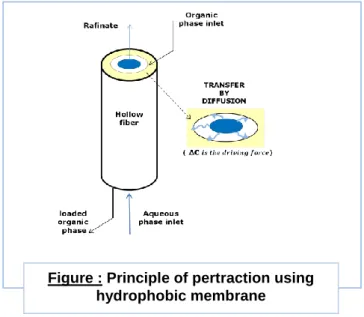
The process called pertraction or non-dispersive solvent extraction (NDSX) is a technique which allows the metals recovery from leach solutions. It is a liquid-liquid extractor in which the interfacial area is delimited by a porous membrane separating two immiscible phases, the aqueous phase containing the species to be extracted and the organic phase forming the extractant. In the case of the figure bellow, organic phase passing through the shell side of the module wets the hydrophobic membrane. A non-wetting aqueous phase is passed through the lumen side of the membrane.
It is worth noticing that the aqueous-organic (aqueous-membrane) interface is essentially immobilized at the pore mouth of the hydrophobic membrane support through which the solute mass transfer takes place. It has several advantages over conventional solvent extraction method such as dispersion-free operation, very high contact surface area per unit extractor volume (provided by hollow fiber geometry), emulsion formation is avoided and nonrequirement of density difference of the phases.
In the present contribution, the macroporous and hydrophobic hollow fiber made of polypropylene is used for the extraction of Nd3+ in HNO3 solution in the presence of sodium nitrate NaNO3. The
studied extractant is used as pure (e.g without diluent) and has been chosen for his relative low solubility in water, his high selectivity for rare earths elements (REE), and his low viscosity. In view of possible application to actual feeds, Nd3+recovery from varying feed conditions was investigated such as HNO3,and Nd
3+
concentrations. In order to predict scale up of the process, the extraction on a fiber with a cylindrical geometry is modeled taking account transfer kinetics at the interphase. For a model need, Taylor Dispersion Analysis (TDA) coupled to UV-Vis detection is used for determine the diffusion coefficient of Nd3+ in aqueous phase and in organic phase.
Figure : Principle of pertraction using hydrophobic membrane