
UNIVERSITY OF ABDLHAMID IBN BADIS MOSTAGANEM FACULTY OF FOREIGN LANGUAGES
DEPARTMENT OF ENGLISH LANGUAGE
MASTER
Didactics and Applied Linguistics
Presented by: Tahar Asma
Board of Examiners
Chairperson: Dr. El Ouchdi Ilhem University of Mostaganem Supervisor: Dr. Ziani Melouka University of Mostaganem Examiner: Mrs. Adnani Rajaa University of Mostaganem
Academic Year: 2016-2017
The Effectiveness of In-Class Debates in Enhancing EFL
Learners’ Speaking Skill.
Case study: Second year LMD Students of English at Mostaganem University.
I dedicate this work:
To the “Queen of hearts”, dear mother, for her endless love, sacrifice, support. She is
my source of inspiration and encouragement.
To the greatest father on earth, I will be always grateful for his support and
confidence in me.
“Mom and dad, Thank you for everything.”
To my lovely sisters, Amel, Aya, Halima
To my best friend “Hind”, for her help and support whenever I was in need.
To all those who have been supportive, caring, and patient, sometimes beyond their
strength, I dedicate this simple work.
ACKNOWELEGMENTS
My utmost sincere gratitude goes to Dr. Ziani Melouka, who honoured me with
her supervision of this work. I wish I knew more words that can articulate my
heartfelt thanks for her encouragement, patience, constructive comments and
insightful advice through the completion of this work.
I would like to express my deep appreciation and sincere gratitude to Dr. El Ouchdi
Ilhem and Mrs. Adnani Rajaa for their acceptance to be members of the jury.
I am also profoundly indebted to Ms. Djoub Zineb for her understanding and help.
I am deeply grateful to all the students of second year LMD at Mostaganem
University, who completed the questionnaire.
I should also like to express my sincere acknowledgement to all the teachers who
allowed me to attend their oral expression sessions.
ABSTRACT
Being competent in speaking the foreign language, is of focal concern for many learners. In particular, the English language learners, who endeavour to communicate effectively with other users of the target language. However, teaching to communicate in real situations is somehow neglected in EFL context, and students have little exposure to practise the language in the classroom. Therefore, teachers should apply various techniques and activities to enhance their learners' speaking ability and foster their communicative skill. Debating is such an activity through which students filter their English spoken production. The current paper aims to investigate the effectiveness of in-class debates in enhancing learners’ speaking skill. The study is mainly concerned with making use of debates in oral English courses to improve learners’ speaking skill. The research will also put the light on the importance of creating a friendly atmosphere in language class as an attempt to get learners involved to practise the language. To investigate this issue, a questionnaire was administered to second year LMD students at the Department of English (Abdelhamid IBN Badis University of Mostaganem), we relied as well as on classroom observation. We have adopted a descriptive method in order to gather data. The analysis has partially answered our research questions and led into a relative embracing of our hypotheses. We interestingly found that classroom debate is a useful technique for increasing students’ language practice and affect their speaking skill. As well as, the results revealed that students need to be provided with thrilling activity to develop their speaking ability and to create a fruitful environment where they can use the language appropriately. Thus, it was believed that the role of the teacher is needed in this case.
List of Abbreviations
CC………. Communicative Competence CLL…………Cooperative Language Learning CLT…………. Communicative Language Teaching EFL…………. English as Foreign Language
ELT……… English Language Teaching ESL…………. English as Second Language FL……… Foreign Language
L1………. First Language
LMD…………License Master Doctorate O.E……… Oral expression
TBLT………… Task-based Language Teaching TL………Target Language
List of Tables
II. Table.1: The students’ choice of study English………...24
II.Table.2: Students’ level………...25
II.Table.3: Emphasis on Learning the Four Skills……….26
II.Table.4: Students’ opinions about Speaking English and its relation with the
learning process………..27
II.Table.5: Students’ Difficulties when Speaking in Classroom………....28
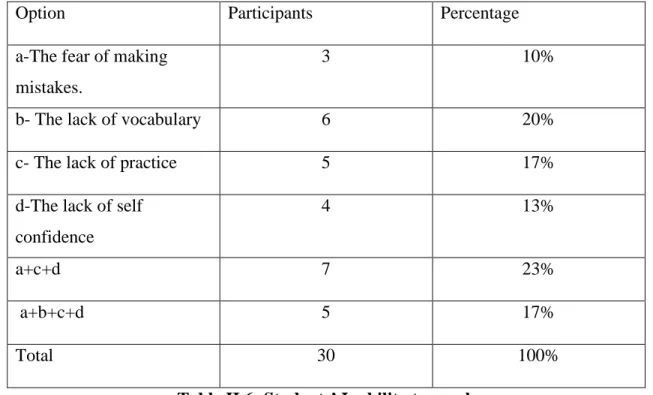
II.Table.6: Students’ inability to speak………...30
II.Table.7: The opportunity that teachers give to their students to speak………...30
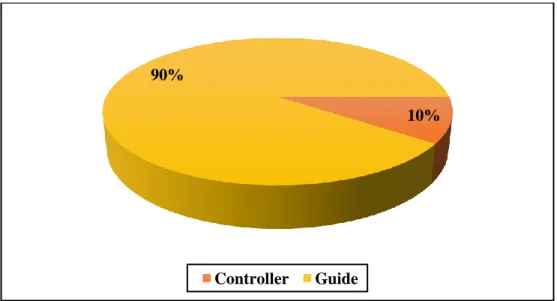
II.Table.8: Teacher’ role………...31
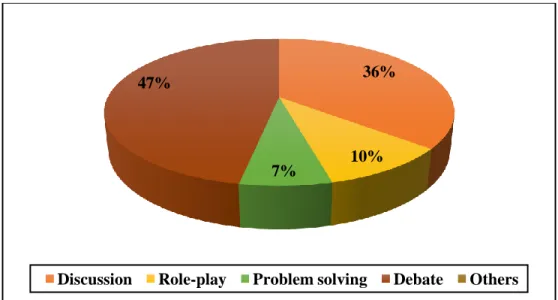
II.Table.9: Kinds of techniques used for teaching………...32
II.Table.10: The use of debates in classroom………...33
II.Table.11: The frequency of using debates in classroom………..34
II.Table.12: Students’ reactions while debating………...35
II.Table.13: Students’ evaluation of debate in improving their speaking skill……36
II.Table.14: The use of debate in classroom………37
II.Table.15: Raising students’ awareness toward the skills of debate…………...38
II.Table.16: Students’ attitudes on applying debate in classroom………39
List of Figures
II. Figure1: The students’ choice of study English………...25
II.Figure2: Students’ level……….….….26
II.Figure3: Emphasis on Learning the Four Skills………...27
II.Figure4: Students’ opinions about Speaking English and its relation with the
learning process………....29
II.Figure.5: Students’ Difficulties when Speaking in Classroom…………...30
II.Figure6: The opportunity that teachers give to their students to speak……...31
II.Figure7: Teacher’ role………..32
II.Figure8: Kinds of techniques used for teaching………...33
II.Figure9: The use of debates in classroom………34
II.Figure10: The frequency of using debates in classroom………..35
II.Figure11: Students’ reactions while debating………..36
II.Figure12: Students’ evaluation of debate in improving their speaking skill……37
II.Figure13: The use of debate in classroom………38
II.Figure14: Raising students’ awareness toward the skills of debate……….39
II.Figure15: Students’ attitudes on applying debate in classroom………...40
III.Figure16: Physical Layout of Think- pair- Share Debates……….54
III.Figure17: Fishbowl Debate Format ………...55
III.Figure18: Layout in Role-play Debates………..56
III.Figure19: Format of Four Corners Debates in the Classroom………56
DEDICATION………. I ACKNOWLEDGEMENT……… II ABSTRACT……….. II List of Abbreviations……… IV List of Tables……… V List of Figures……….. VI General Introduction……… 1
Chapter One: Theoretical Background of the Speaking Skill in the Teaching/Learning Process I.1.Introduction………... 4
I.2. The Nature of Speaking Skill……….. 4
I.3.Elements of Speaking Skill………... 5
I.3.1. Language Features ……… 5
I.3.2. Mental/Social Processing……… 6
I.4.Communicative Competence………... 7
I.4.1. Grammatical /linguistic Competence………... 7
I.4.2. Sociolinguistic/pragmatic Competence……… 8
I.4.3. Strategic Competence………... 8
I.4.4. Discourse competence……….. 8
I.5.Teaching Speaking……… 9
I.5.1. Communicative Approach………... 9
I.5.2. Cooperative Language Learning ………. 10
I.5.3. Task-Based Approach……….……… . 11
I.6.Learneres’ Speaking Difficulties……….. 12
I.7.The Roles of the Teacher in Speaking Class……… 14
I.8.Classroom Speaking Activities………. 16
I.8.1. Communication Games……….. 16
I.10. Conclusion……… 21
II. Chapter Two: Methodology of the Study and Data Analysis II.1. Introduction……… 22
II.2. Methodological Design ………. 22
II.2.1 Description of sample population………... 22
II.2.2. Data Collection Methods………... 22
II.2.2.1. Description of the questionnaire………. 23
II.2.2.2. Description of Classroom Observation………... 23
II.3. Data Analysis………. 24
II.3.1. Analysis of the Questionnaire……… 24
II.3.2. Analysis of Classroom Observation……….. 41
II.4. Conclusion……….. 43
III. Chapter Three: Discussion and Recommendations III.1. Introduction………. 44
III.2. Data Discussion and Interpretation of the results………... 44
III.2.1. The Questionnaire………... 44
III.2.2. The Classroom Observation………... 49
III.2.3. Discussion of the Main Results………. 50
III.3. Recommendations……… 51 III.4. Limitations………... 57 III.5. Conclusion………... 58 General Conclusion………. 59 Bibliography………. 61 Appendix
English has recently become a dominant language all over the world. It is remained as “lingua franca”; that is the common foreign language used for communication among people who do not share the same first language. Obviously, the growing prominence of English in every field of human activities demand the need to study this popular language and “to handle it fairly in everyday communication.” (Ramesh, 2009, p.2). The learning of English requires mastering the four language skills, those are reading, listening, writing and speaking. However, speaking is considered as the most important and a challenging skill to be mastered by the learners. In this line of words, Ur (1996, p120) states that, “Many if not most foreign language learners are primarily interested in learning to speak.” Therefore, the main objective of learning the foreign language is to be competent- fluent speakers of that language in order to communicate.; though it is not an easy task in EFL context, where students have poor English background and few opportunities to practise the language outside the learning environment. The only platform enabling students to voice their opinions and communicate in the target language; is the classroom.
As a matter of fact, it is necessary for teachers to help their students improve their level of oral production by using effective techniques and activities which propel students to practise the language properly and successfully.
In EFL settings, the overwhelming majority of students possess inability in communicating appropriately and they are found scared, unsatisfied with their achievements in speaking. However, they hesitate, stammer and feel embarrassed in their attempt to speak the target language in front of/ with others.
So, through the experience we had as EFL learners, we noticed that oral English course is the only key that enables students to practise the language as well to speak freely and confidently. But, in fact, oral expression courses with its unforeseen environment, it is a source of anxiety for many learners. Our attention was captured by the defective methods of teaching oral expression session; teachers rely heavily on the traditional approaches. Considering the fact above, there would be a need to incorporate creative teaching methods in EFL courses and implementing new techniques and challenging activities that make students fluent-confident speakers of the target language. One of the techniques that help students to found their voice, practise the language, share their opinions express themselves confidently and thus, improving the speaking skill; is
“the debate”. As stated by Almasri& Ahmed (2013, p. 148), “debating can be brilliantly to boost up students‟ speaking skill. Furthermore, we can say the emphasis on the skill of debating in mass media and the great portion of studies that have been conducted to integrate debates in ESL/EFL curriculum is what motivate us to tackle this study. As well debate nowadays is intertwined with our life because it helps us to defend our belief, express our opinions and present arguments in a formal way and in a disciplined manner. Alfred Snider (2011) believes that, “we can improve our societies by raising up a generation of debaters to become news generation of citizen.”
Our pivotal aim of this research work is to investigate the effect of in-class debates on the improvement of learners speaking skill. Moreover, the foreseen objectives of this study is to encourage teachers to use debates in EFL classes in order to maximise learners‟ oral production and provide them with more opportunities to practise the target language. Thus, to get the learners involved actively in the learning process. This study attempts as well at shedding the light on the influence of the social and affective factors (self-confidence, anxiety) in creating a friendly, relaxed learning atmosphere.
Our study is put forward to answering three main questions being: what are the reasons behind students‟ weakness in oral expression? Secondly, Does the application of classroom debate improve students‟ level in speaking the English language? And whether the teacher „s role is needed in the class in this case or not. The above main questions inspire us to assume that the reasons behind students‟ weakness in oral expression are the lack of practice and the activities that prompt them to use the language in the classroom. Moreover, the main assumption is that in-class debates is an effective technique that help students to use English extemporary, confidently to express their intended meaning and thus; improve their level in speaking the language. Another by-product assumption is the role of the teacher in the class is needed in this case.
To investigate the effectiveness of in-class debates in enhancing the learners‟ speaking skill, a descriptive method will be used. This method aims to describe two variables; debates as an independent variable and its role in enhancing learners‟ speaking skill as the dependent variable. The research will collect quantitative and qualitative data relying on questionnaire and classroom observation. The questionnaire will be handed to second year LMD students chosen at random from the department of English, University of Mostaganem since they already studied
oral expression courses and they are aware of the difficulties that hamper them to master the speaking skill. The classroom observation will be covered as well in two classes of second year students in the same settings.
The paper is structured as follows: Chapter one, deals with review of literature related to speaking skill in the teaching -learners process. It will as well discuss the teaching of speaking. Then, it will shed the light on EFL learners‟ speaking difficulties with and attempt to provide some effective classroom speaking activities. This chapter is mainly concerned to give a better understanding of the debate technique and its importance in EFL classes.
The second chapter will cover the methodology and the data analysis. It will provide a briefly description of the sampling presenting, the questionnaire and classroom observation. Furthermore, it will discuss the sampling, data collection and the research instruments. This chapter will focus mainly on the investigation of the hypothesis of the data collected. In this practical part, we will adopt mixed-method of both quantitative and qualitative data to provide reliability of the results.
In the last chapter, we will describe and interpret the results and the findings provided by the data gathered in order to see whether our hypothesis can be confirmed or infirmed on the basic of our findings. Moreover, it will include some limitations encounter the process of our research and provide suggestion and pedagogical implication.
I.1.Introduction:
In EFL settings, the acquisition of the language entails mastering the four language skills (speaking- writing-reading and writing). Speaking has been considered as prominent productive skill. Therefore, the main concern of EFL teachers is to reinforce and develop their learners‟ speaking proficiency and make them able to communicate with the language effectively and readily. However, it is not an easy task to address the teaching of speaking. This need leads the teachers to use different approaches and vary activities to fit the learners‟ needs, interests. Thus, gauge the mood of the class by having a productive atmosphere.
This chapter is devoted to a theoretical background about the key concepts related to speaking skill; its various definitions, elements and we will discuss the teaching of speaking. Moreover, it sheds the light on the learners‟ difficulties in speaking then, we will set up some of the roles of the teacher. It attempts to bring out some of the activities that may tackle the problem of EFL learners in speaking with focusing on the use of debates in EFL classes.
I.2.Nature of Speaking Skill:
Speaking is a crucial part in foreign language learning, therefore the main aim of EFL learners is to be able to speak and communicate in the language. It is one of the main language skills besides listening, reading and writing. Nunan (2003, p.48) states, “speaking is the productive aural/oral skill, it consists of producing systematic verbal utterances to convey meaning.” In Chaney words, “Speaking is the process of building and sharing meaning through the use of verbal and non-verbal symbols in a variety of context.” (1998, p.13) This denotes that speaking is an activity in which speakers making a speech by using language to convey a message whether by expressing their ideas and thoughts, sharing their feelings as well delivering their opinions. Ur. P (1996, p120) considers speaking as the most important skill among the four skills (listening, speaking, reading and writing) because “people who know a language are referred to as „speakers‟ of that language”, paradoxically Thornbury (2005, p.1) states, “knowing a language and being able to speak it is not synonymous.” What has been said indicates that speaking a language is different from being knowledgeable about that language, this remains a very complex issue in the teaching of speaking. In addition, Bygate (2003, p.3) believes that studying a knowledge of grammar, pronunciation, vocabulary…etc, is not sufficient to a learner to be
skillful in speaking but studying the skill to apply this knowledge to communicate successfully is fundamental.
As we mentioned at the beginning of this work, the main aim of learning a language is to be able to speak and communicate in that language. Thornbury (2005, p. 1) states that speaking is an ability that we take it for granted; nevertheless, it is not an easy task to be mastered especially in foreign language context. Bailey (2003, p. 54) says, “Learning speaking is very challenging for students in foreign language context. Similarly, Luoma (2004, p.1) argues “Speaking in a foreign language is very difficult and competence in speaking takes a long time to develop.” Thereby, in ELT speaking is a skill that needs to be practised.
In short, depending on the definitions given above speaking is considered as the basis of all human relationship within learning a language and as a major skill. It is an interactive process of communication and an art of sharing and carrying out ideas and feeling orally.
I.3.Elements of Speaking Skill:
Since speaking skill is not an easy task, many students face difficulties in spoken production. In order to enhance speaking in EFL classes and to be able to help learners to master the language, they should know the elements of speaking skill, which are of great significance. Harmer (2001, pp. 269-271) states and explains some elements that are characterised through language feature and process of language and information.
I.3.1. Language Features:
The most essential elements in speaking are presented as follows (Harmer op.cit):
Connected Speech: According to Harmer a good speaker is the one who is able to produce and use fluent connected sounds not only individual phonemes. These sounds may be modified, omitted, added or weakened. Therefore, the teacher should engage students in oral activities that endeavour in improving their connected speech.
Expressive Device: Native speakers of English language use a variety of strategies in speaking such as pitch and stress of a particular part of utterance as well physical and non-verbal (paralinguistic). These devices help them to convey their intended meaning.
Students, then need to be aware and use these devices that help them to be fully effective communicators.
Lexic and Grammar: This element refers when students use the same lexical structure
during the performance of certain language function. Teachers‟ role then is to provide their learners with different phrases that load different functions, so that they can use them in certain stages of communication and interaction.
Negotiation of Language: Learners benefits from the use of negotiation language; they
often ask for clarification when they are listening to others „talk. Thus, teachers should provide their students with proper expression they need when they ask for clarification from other speakers. In addition, learners should know how to make their utterance well structured, organised if they seek to be clear, and understood especially when they can see the interlocutor did not understand them.
I.3.2. Mental/Social Processing:
Speaker‟s productive ability bases not only on the above elements but also depends on the rapid processing skill that oral communication necessitates (2001, p.271).
Language Processing: This means the ability of the learner or the speaker to process the language in their minds by putting it in a coherent order so as to be understood and clear in conveying the meaning that are intended. In addition, speakers should be able to retrieve phrases and words from their memories to use them to interact with others.
Interacting with Others: This element depends on the learners „ability to get involved and interact with one or more participants. That is to say, an effective speaker needs to be sensitive and be able to listen and understand others „speech; thereafter, reacts through
taking-turn or letting the others to do so
Information Possessing on the Spot: It depends on the ability of the learners in processing information rapidly when they get it. Therefore, they should be ready to respond to others „talk.
I.4.Communicative Competence:
In the field of language teaching, the main concern sometimes is filling students up with the requisite grammar, vocabulary and polishing their pronunciation. Nevertheless, this actually does not help them to achieve their attainable goal of being able to communicate effectively inside or outside the classroom (real world). Many of foreign language learners, however, consider linguistic competence as a fundamental issue that effects extremely their development in the language because they believe that the acquisition of a foreign language entails forming correct grammatical sentences.
For a start, according to Hedge (2000, p. 45), the term communicative competence was coined by the sociolinguist Dell. Hymes (1972) in contradiction to Chomsky‟s narrow concept of linguistic competence. This latter was regarded as the ideal model for any speaker. Moreover, the concept of CC expands to involve knowledge of „rules of use without which the rules of grammar could be useless. (Hymes1972, p.278.cited in Hedge). This indicates our ability to use grammar appropriately in communication for conveying meaning. Savigon (1972, pp.8-9. cited by Yasmina Nouar) describes foreign communicative competence as “the ability to function dynamically in a truly communicative setting adapting to all of the informal elements in the context by the linguistic or non-verbal.” In addition, many scholars are concerned in the development of the notion of CC, Canale and Swain (1980, cited in Hedge op. cit) identify four dimensions of communicative competence: grammatical competence, sociolinguistic competence, strategic competence, discourse competence.
I.4.1. Grammatical/linguistic Competence:
Canale and Swain (1980, p.29) state that grammatical competence” includes the knowledge of lexical items and rules of morphology, syntax, sentence-grammar, semantics and phonology.” (Brown 2007, p.219). In other words, learners need to be knowledgeable about language rules for instance, the grammatical features, morphology, syntax and phonetics of the target language in order to be able to produce and form meaningful utterances.
I.4.2. Sociolinguistic/pragmatic Competence:
According to Canale and Swain (p.30), sociolinguistic competence is made up of two different kinds: illocutionary competence (knowing how to use language to achieve specific communicative goals) and sociolinguistic competence (has to do with politeness, formality and their accordance with context situation and cultural milieu). (Brown op cit)
I.4.3. Strategic Competence:
For Canal and Swain (p.28 in Hedge 2000), strategic competence is “how to cope in an authentic communicative situation and how to keep the communication channel open.” In other terms, strategic competence is the ability to manage obstacles that may occur in communication. Therefore, learners need to structure what they say otherwise they might use communication strategies (gestures, repulsing or asking for clarification) in order to maintain a conversation.
I.4.4. Discourse Competence:
The ability to structure discourses coherently and cohesively i.e. is to be able to blend utterances of the language to construct and interpret intended message. Tricia Hedge is one of the researchers who are interested in developing the framework of communicative competence. She suggests the term „fluency‟ as the fifth dimension in addition to the four areas that are presented previously. Fluency is the ability to produce language appropriately, efficiently and creatively without paying attention to accuracy. Hedge (1993.cited in D. Bohlke, 2014p.121) describes fluency as “the ability to link units of speech together with facility and without strain or inappropriate slowness or endure hesitation.”
In brief, to communicate competently does not involve only knowing the grammar rules but also the communicative rules. Hymes pointed out that the acquisition of a language is not only knowing the rules of a language but also to know what to say, to whom, and how to say it in specific context. (Canale and Swaine 1980 in Y. Nouar)
I.5.Teaching Speaking:
In ESL/EFL classes, teaching speaking is considered as a key that helps students in the acquisition of the language as well as to communicate with effectively, fluently and confidently. According to Nunan (in Kay; 2003, in http://itselj.org/techniques) states that teaching speaking is to teach learners to:
Produce the English speech sounds and sound patterns.
Use word and sentences stress, intonation patterns and the rhythm of the second language. Select appropriate words and sentences according to the proper social settings, audience,
situation and subject matter.
Organise their thoughts in a meaningful and logical sequence. Use language as a means of expressing values and judgments.
Use the language quickly and confidently with few unnatural pauses, which is called as fluency. (Nunan 2003)
Furthermore, C. Richards (2008, p.2) demonstrates that speaking “in traditional methodologies usually meant repeating after the teacher, memorising a dialogue or responding to drill.” However, these approaches do not help students to enhance their communicative skill or lead them to produce the language fluently. Thus, approaches to the teaching of speaking in ELT have been updated to cater for a wide variety of learner „interest, needs and to maximise opportunities to use the language i.e apply “learner-centered” inside the classroom to achieve a great amount of their goals.
I.5.1. Communicative Approach:
According to Richards and Rodgers (1986, p. 153), the field of Communicative approach was widely known and practised from the late 1970s. Speaking proficiency is the core of this approach in language teaching because it emphasises learning a language for the purpose of communication. According to Harmer (2001, p.86) “The Communicative approach or communicative language teaching (CLT) have now become generalised „umbrella‟ terms to describe learning sequences which aim to improve the students „ability to communicate.”
In similar words, D. L -Freeman and M. Anderson (2011, p.150) claim that “Communicative language teaching aims broadly to make communicative competence the goal of language
Teaching.” This approach is divided into two major versions; a weak version and strong version. The former depends on the acquisition of the foreign language through communication and its direct use, the latter is devoted to the importance of using the English language for learners in order to communicate and interact as well creating some practices for the same purpose. Howatt (1984, p. 27) as cited in Richard and Rodgers (2001, p.155) points out “If the former could be described as learning to use English, the latter entails using English to learn it.
Some of the characteristics of CLT are summarised as follow:
Language is a mean of interacting and communicating.
The structure of language reflects its functional and communicative uses.
The main units of language are not grammatical and structural characteristics solely, but kinds of functional and communicative meaning as exemplified in discourse.
In brief, CLT is considered as a medium for fostering communication. In language teaching, this approach focuses on helping language learners foremost to communicate effectively in the target language by enabling them to interpret, deliver a meaningful and appropriate message. Besides, it increases interaction between teacher-learner as well as among the students thereby creating a supportive atmosphere for language learning. (Cited in Belkheir‟s lecture, 2016)
I.5.2. Cooperative Language Learning:
Cooperative language learning (CLL), often called Collaborative learning (CL). It is one of the most prominent instructional practices. This approach entails using cooperative activities in which students are involved in a small group in the classroom; in meantime, they are required to contribute and learn from each other in pair or groups by sharing their ideas and opinions. Moreover, In EFL learning, CLL offer the opportunity for students to use the language in meaningful context.
Oslen and Kagan (1992, 8) as cited in Richard and Rodgers describe
Cooperative learning is group learning activity organised so that learning is dependent on the socially structured exchange of informal between learners in groups and in which each learner is held accountable for his/her own learning and is motivated to increase the learning of the others. (2001, p.192)
In addition, Richard and Rodgers (2001, p.194) point out an important premise of CLL is that “learners develop communicative competence by conversing in socially and pedagogically structured situation.” Due to the fact that in second language teaching cooperative language learning is considered as an extension of communicative language teaching (CLT), they share the same principles and both approaches tend to promote communicative competence and communicative interaction in the classroom. As well, CLL aims to foster cooperation rather than competition.
Furthermore, Richard and Rodgers (2001, 193) believe that CLL goals are:
1. To provide opportunities for naturalistic second language acquisition through the use of interactive pairs and group activities.
2. To provide teachers with a methodology to enable them to achieve this goal and one that can be applied in a variety of curriculum settings (e.g., content-based, foreign language classrooms, mainstreaming).
3. To provide opportunities for learners to develop successful learning and communicative strategies.
4. To enhance learner motivation, reduce stress and to create a positive and effective classroom climate.
5. To enable focused attention to particular lexical items, language structures, and communicative functions through the use of interactive tasks.
I.5.3. Task-Based Approach:
Task-based approach /task-based language teaching (TBLT) relies on the use of task as the main instrument of planning and instruction in language teaching. In this latter, the term task as J. Edge, S. Gartoon (2009, p.108) define it “is a communicative activity in which students are given an outcome to achieve beyond just using language.” According to Nunan (2004, p.4) “pedagogical task is a piece of classroom work that involves learners in comprehending, manipulating, producing or interacting in the target language.” Tasks are also said to evolve and sustain learner motivation thus foster learning. Nunan (2014, p.467) states that TBLT “is a methodological realisation of communicative language teaching”. Similarly, L. Freeman and M. Anderson (2011, p. 193) state that this approach “is a strong version of the communicative
approach.” TBLT refers to teaching a second language or foreign language that requires involving students to use the language interactively as well authentically; also, to negotiate meaning and engaging them in meaningful communication. Willis (1996, p. 123) states, “TBLT is a learner-centered teaching approach”. This approach intends to train learners to utilise language forms in different context purposefully. In addition, it has been said that TBLT is a type of teaching that addresses language primarily as means of communicating rather than an object of study. The aim of the teacher is to simplify students „language learning by engaging them in a variety of tasks that have a clear outcome. His role is monitoring and feedback provider whereas the learner is required to act as interactor and negotiator. The major characteristics of TBLT as presented by Ellis (2003, p.64) are the following:
Learner-centered rather than the teacher controlled learning. Task serves as the means of achieving natural use of the language.
Jack C. Richards and T. Rodgers (2001, p. 223) claim that TBLT draws on various principles that shaped a part of the communicative language teaching for instance:
Activities that involve real communication are fundamental for language learning. Activities in which language is used for carrying out meaningful tasks promote learning. Language that is meaningful to the learner supports the learning process.
Overall, Task- based Language Teaching is an approach tending to provide the ESL/EFL‟ learners with opportunities to use the target language meaningfully, actively as well for authentic communication in order to accomplish the outcome. C.Richards and T. Rodgers (2001, p. 235) believe that TBLT “provides for a more effective basis of teaching than other language teaching approaches.
I.6. Learners’ Speaking Difficulties:
Speaking is considered as the basic of all human relationships within language learning. It is what foreign language learners need to master. Florez (1999) states that speaking is apparently a priority for most learners of English. Accordingly, in ESL/EFL programs, enhancing speaking skill is of vital significance. It has been assumed that speaking proficiency is still a far-fetched goal to be hard to attain by learners like other skills (S. Torky, 2006, p.21). Notably, EFL learners face many problems and difficulties in their attempt to speak the language; they suffer from
weaknesses in their performance and often, they stammer and hesitate while speaking. Rivers (1968, pp.192-8) states that these difficulties are due to the lack of interest in the subject and deficient vocabulary.
Lack of Interest in the Subject:
In language teaching, selecting a suitable topic is the key to solicit and maintain the learners‟ interest. In EFL classroom, when the teacher may have chosen a subject, which is unfamiliar to the learners, or they m ay have little knowledge about it. Thus, they stay silent; they are unable to express their thoughts. So, the teacher should adopt a subject that interests them and ensures to keep them involved in the learning process.
Deficient Vocabulary:
In foreign language learning, the lack of vocabulary was viewed as the main impediment to spoken communication. When it comes to speaking, students find themselves struggling to find correct words or phrases. They are unable to use the language to convey intended meaning due to the incorrect vocabulary repertoire or limited vocabulary, which is not suitable.
Zhang (2009) argued, “Speaking remains the most difficult skill to master for the majority of English learners they still incompetent in communicating orally.” Moreover, there are numerous factors that supply difficulties in speaking according to P.Ur (1996, p.21):
Inhibition: students might be worried of making mistakes, afraid of their classmates‟ criticism, teacher‟s negative feedback or simply timid.
Nothing to say: expressing feelings or ideas do not motivate students.
Low participation: the opportunities to participate are not provided because of a large number of students in the class apart from the tendency of some learners to dominate.
Mother tongue use: students have little exposure to the English language so learners who have same first language use it because they feel less stressed while speaking their native language.
I.7. The Roles of the Teacher in Speaking Class:
The teacher is considered as a source of knowledge for many students. Therefore, he has to be sensitive to his learners „needs to stimulate and conduct the learning process in effective and adequate conditions. In ELT, several roles need to be performed by the teacher inside the classroom. These functions depend on the nature of activities during the lesson and might change from one stage to another. In the point of view of Harmer (2001, p.57) it relies on their fluency in changing their disposal to the different stage of the lesson. Hedge (2000, p26) come up with the most important roles that the teacher can play in the classroom
…as controller in eliciting nationality words;(….); as organiser in giving instruction for the pair work, initiating it, monitoring it, and organising feedback; as prompter while students are working together; and as resource if students need help.
Controller:
The teacher is acting as a controller when s/he in charge of the class; impose orders to the learners like what they are expected to do, how to do and when to speak…etc. Harmer (op.cit, p58.) states that “controllers take the roll, tell students things, organise drills, read aloud and in a various way to exemplify the qualities of a teacher-fronted classroom”. Moreover, being a controller in the classroom is the most comfortable role for teachers who consider themselves as “knowledge supplier” and “the authority of the class”. This act should be performed periodically; in just a few stages of the lesson to supply learners with opportunities to learn, speak and share their ideas as well; otherwise, it can affect adversely the learning process.
Organiser:
Organising students in the classroom to do different activities is the most crucial role that to be performed by the teacher. It entails the teacher to provide his students with a certain amount of information and clear instruction, for instance, inform them about the activity; the importance of the activity, the procedures to follow when doing the activity as well as to tell them if they need to work in pairs or groups. Meantime, he has to check their understanding about the instruction of the given task to involve them in the activity they are practising and make sure that everyone is on task. J. Screvener (2003) states that “Often students are judged to have failed when it is actually the teacher who failed to clarify what was required”. Then he should prepare feedback.
Thus, good organisation ensures the success of the learning process. Harmer (op.cit, p.59) summarised the role of organizer as follow:
Engage Instruct (demonstrate) Initiate Organize feedback
Prompter:
Students sometimes struggle to find correct words, coherent phrases due to the lack of vocabulary, they are unable to produce a meaningful spoken communication with their teacher or their classmates. For instance, when they are confounded in performing a play, they might be lost and cannot think creatively to handle the situation. Hence, the role of the teacher here is „hold back‟ and encourages his students to be creative in performing and producing the language. Embracing the role of prompter entails being sensitive, cautious and encouraging. As indicated by Harmer (2001, p. 60) “When we prompt we need to do it sensitively and encouragingly but,
above all, with discretion. If, on the other hand, we are too retiring, we may not the supply the
right amount of encouragement.”
Participant:
The usual perspective of teachers when their students are engaged in speaking activities (discussion, performing a play or group decision-making activities) was bounded between providing feedback and correcting mistakes. However, teachers may often join and intervene in the activity but on condition that they (teachers as participants) do not try to dominate but to introduce new information, help them with some ideas and suggestions in order to create a friendly learning atmosphere. (Harmer p.60&p. 276).
Tutor:
According to Harmer (p.62), this role combines both prompter, resource role. When students are engaged in individual work, project work (pair, small group) or debate, the teachers act as a tutor. Due to the fact that this role beholds an intimate relationship (more personal) between teachers and learners in term of guidance, support, care…etc, its difficulty occurs and lifts especially in a large group. Nevertheless, this role can be highly enhancing.
I.8.Classroom Speaking Activities:
In EFL classes, the main aim of teachers is to develop their learners‟ communication skill.
However, this can be reached through designing suitable activities that invite learners to communicate as naturally as possible, express themselves in speeches that are relevant, exchange information and opinions, etc. For a start, classroom speaking activities are one the opportunities that enable students to practise their spoken language proficiency. As well as it increases interaction, motivate learners and establish a good relationship between the teacher and his learners and learners with each other. According to Scrivener (2005, p.152), the purpose of communicative activities in class is “to get learners to use the language they are learning to interact in realistic and meaningful ways. Usually involving the exchange of information or opinions.” Apart from focusing on learners‟ linguistic output (accuracy), speaking activities encourage students to produce utterances without restriction to make the classroom a conversational place. In order to break the silence of students and prevent the monotony of the classroom, the teacher should vary speaking activities. This latter should be adopted purposefully by the teacher, to create and maintain learners‟ motivation as well as to increase their enthusiasm and make them eager to communicate. A. Lazarton et al (2014, p.116) state, “EFL teachers need to be particularly adept at organising class activities that are authentic, motivated and varied.” Overall, in ELT, there are numerous speaking activities that help to create relaxed, supportive and humanistic classroom atmosphere besides they enhance learners‟ speaking proficiency by providing them with the opportunity to use the language appropriately and meaningfully. Thus, they further the learning process itself.
I.8.1. Communicative Games:
Games which are designed to create an enjoyable and relaxed atmosphere as well as to
promote speaking proficiency. In EFL classes, these games are intended to incite the utterance (verbal interaction) and communication between learners as cited in Harmer (2001, p.272). Moreover, these games encourage both co-operative and competitive elements.
I.8.2. Information Gap Activity:
This kind of activities is aimed to stimulate communication between learners, in which they are involved to work in pair or groups to possess information, which is missing and unknown for
other learners. However, the information should be discovered and shared. (T. Hedge,2000, p.281) For a start, Information gap activity relies on the learner‟s ability who is required to talk to his/her partner; to solve puzzles. Here are some examples of communication games: “Describe and Draw” where a given picture has to be described from one student whereas the other participant draws it. Then, “Describe and Arrange” in which student has to put things that are described by his partner in the right order without viewing the original one. In addition, “Find differences and similarities”, in which students are given the same picture twice with some differences so they have to wrinkle out both the differences between the two picture and find the similarities.
I.8.3. Role-play:
In EFL classes, pushing students to express themselves and making them involved in the process of performing a role-play is not an easy task. However, role-play is a very useful technique for developing their oral proficiency. It is considered as a real/authentic activity in which students are able to use the language freely and appropriately. Revell (1979) defines role-play “is an individual‟s spontaneous behaviour reacting to other in a hypothetical situation.” Learners are supposed to perform in pair or group, therefore it is regarded as one of the most important interactive fluency activities (T. Hedge, 2000, p.279). In addition to that, Harmer (2001, p.275) states that role-play is the act in which students are required to hold a role different from themselves (in real life) and assume other personae.
Furthermore, in this activity, participants are given information about the situation or the task and they are required to use their imagination and behave in a social context (play different social roles within fictional status). This means, that learners are given chance to be creative as well as it provides them with the opportunity to practice a series of real-life spoken language (Ur, 1996, p.132). Moreover, there are two types of role-playing, which are “Role cards” and “Cue cards”. According to Ur (p133) role cards, when the teacher allots participant in individual roles and they can act freely without providing them with any speech. Whereas, in cue card, students need to follow what the teacher has given them such as, what to say, when to speak, etc. In another way, T. Hedge (op. cit, p.280) identifies different two types of role-play: “Fictional and Professional role “that are based on the ability of the learners about the role imposed and their reaction.”
I.8.4. Discussion:
In language teaching and learning, discussion is considered as a fundamental activity that should be practised in the classroom. This activity/technique is used for evolving learners‟ spoken language proficiency through the exchange of ideas, opinions, and talk about experiences or comment about a related topic…etc. According to T. Hedge (2000, p.277), “discussion can provide important opportunities for developing certain aspects of fluency.” Therefore, discussion ensures the use of language meaningfully, interactively and fluently. Especially when students are introduced to a topic and they are asked to discuss it; in meanwhile they are motivated and encouraged to speak freely. As a result, they will be able to deal and talk several of topics. Moreover, Hedge states that discussion helps student to be involved in interpersonal communication for instance, how to take and hold turns, assert a topic or mutate to another one, and pushing students to reply and other participation. However, students are reluctant to give an opinion in front of the whole class because they are afraid of making errors in front of their classmates as cited in harmer (2001, p.272). Consequently, this leads to the failure of discussion activity. In order to prevent this failure, the teacher should first set his objectives and aims behind the discussion activity as well as make his students aware of these aims and encourage them to speak freely and spontaneously. Thornbury (2005, p.102) points out that “the best discussions in class are these that arise spontaneously either because of something personal that learner report or because of a topic.” Furthermore, (A. Lazarton,2014, p.112) states that “learners need to know what they are going to discuss, why they are discussing it, how long they have for the activity, and what outcome is expected.” Harmer (2001, p.272) come up with two kinds of discussion activities that are important to avoid difficulties and complexity which are: “Buzz group” and “instant comment”. First, Buzz group when students are asked to talk in public, they have a chance for a quick discussion before in small group, and then they have a chance to think of ideas and language to express. In this case, the stress level of that situation for whole-class performance is decreased. It can also be used for whole range discussion. Such as, we might want the learners to anticipate the content of a reading text, or we might ask them to speak about their reactions to the reading passage. The other activity is named “instant comment” in which we can make the learners well trained to respond fluently in the classroom, this means showing photographs or presenting a topic at any stage or level and opting learners to say the first thing that comes to their
minds. (Harmer op cit) Furthermore, discussion classroom has many advantages presented by Revell (1979):
Participants are engaged in producing and analysing utterances.
There is cooperation of information (send and receive) which foster the language development.
The learners use the knowledge of language and put into communicative use. I.8.5. Debate:
J. Paulette & J.C. Wolf (2000, p.176) state that “debate as a speaking situation in which opposite point of views are presented and argued.” In language learning classroom, the debate is one of the communicative interaction activities in which students exchange ideas, express their opinions as well as give genuine arguments to rebut and persuade the other participants. For R. Carter & Mc. Carthy (1997, p.10) debate is “data in which people take up position, per sue arguments and expound their opinion on a range or matters; with or with some sort of lead figure or chairperson.”
Furthermore, classroom debate has been scrutinised to be an effective, authentic activity that paves students to be accustomed to listening, accept others „points of view and to be a decision makers. This technique can be conducted in different ways; with individuals or groups, therefore it has been demonstrated that debates empower students to cooperate in order to compete and to enhance interactive learning. (P, Zare, & Othma,2013, p.1507)
For a start, to engage students in debate, the teacher has foremost to provide his students with
a debatable topic about current issues. Then, he divides them into pairs or groups: affirmative (for) and negative (against). The students should be knowledgeable about the position they are defending besides they are required to work together and collect strong evidence that outweighs their assigned points of view to convince rebuttal group (opponents) and present it in front of the class. In addition, there are some procedures of debate as stated by Rybiati (2010, p.19), “the form of debate is varied in used; based on the number and the level of students.” And several activities such as; The four-corner debate, Role-play debates, Fishbowl debates, Think-pair-share debates, Problem-solving debates and so on. Moreover, the use of classroom debate can be held for various reasons, share knowledge, provide learners with extra practice in hearing and using
the language. Thus, it develops their speaking skill and involves them in the learning process. According to Combs & Bourne (1994 quoted in Kennedy 2007, p184), “debates demand the development of oral communication skill, which are vital for success in most careers.”
The classroom debate is not only a means for developing speaking proficiency but it also enables students to express themselves confidently and make them learn how to stand and defend their beliefs respectfully despite their disagree with others. Throughout the time, by practising debates learners will be able to speak fluently and be spontaneous since it encourages thinking and creativity through negotiating the meaning.
I.9.Debates in EFL Classes:
A debate as communicative and an interactive technique is an enjoyable activity that needs to be practised in the language classroom. According to many studies that have been conducted to show the benefits of classroom debate, this technique is increasingly required in ESL classes. As stated by (P, Zare & O. Moomala 2013, p.1511) “Classroom debate build up academic language skill, second language fluency and public speaking which assist ESL learners to be prepared for successful academic study.” However, it is undervalued and neglected in EFL settings because many teachers believe that engaging students in the debate is a challenging task and can be frightening for the speaker to produce foreign language fluently and confidently.
Many researchers as Md, Didar (2016, pp660-3), R. Kennedy (2007, pp183-8), P, Zare& Moomala.O (2013, pp1506-11) and A. Masri& S. Sayed (2013, pp.146-152) enunciate the benefits of using debate in EFL classes:
a. Debating can be used in EFL classes as a tool to make students practice language skill in real life situation. (4)
b. When debating is held in EFL classes, all four skill of English language are practised. (4) c. Debate can be very helpful for learning a foreign language since it encourages students in
a variety of cognitive and linguistic way. (Krieger,2005, p.1)
d. Debating in EFL settings open up opportunities for learners to use the language in a form of expressing their opinions with logic. (1)
e. Regular Practice of debate speaking will improve their fluency and vocabulary as well as it will enrich their spoken English and ultimately make them confident speakers. (2)
f. Classroom debate is a major feature of CLT since it engages students to use the language meaningfully and to promote their communication skill. (2)
g. People learn how to be open-minded to questions and issues (Goodnight, 1993)
h. Debate helps develop team work skills. Debate is competitive activity but it relies on cooperation. (Williams 2001)
i. Debate offers opportunity for students to move beyond the acquisition of basic knowledge in a subject matter and progresses into the types of higher order critical thinking skills that good debate requires. (Elliot, L.1993)
I.10.Conclusion:
To conclude this chapter, we have attempted to provide a clear insight concerning some key concepts related to the speaking skill, which is considered as a crucial part of EFL learning process. It has dealt with various definitions, elements, and approaches for the teaching of speaking skill. Moreover, we try to figure out some of the difficulties behind students‟ inability to speak English. Then, this chapter has introduced some of the communicative activities that help students to communicate freely and confidently, among these activities; we try to shed some of the light on the importance of using debate activity in EFL classes. Thus, the next chapter will be devoted to analysing the data collected.
II.1. Introduction:
The present research is designed to elicit from students‟ views the effect of classroom debate in developing the speaking skill since they are the main variables of this study. As well as, it aims to investigate whether teachers apply classroom debate as a significant technique to improve learners‟ speaking ability.
This current chapter is mainly devoted for the practical part of this research. It discusses the sampling and the data collection, the tools of the research, and the data analysis. It also provides both description and analysis of the instruments used to gather data; the questionnaire for the learners besides the classroom observation.
II.2. Methodological Design:
Based on the nature of this study, a descriptive research methodology is used to clarify the effect of classroom debate on participants‟ speaking ability. Furthermore, this present work will collect quantitative and qualitative data relying on a set of instruments in order to obtain valuable information and to provide reliability and generalizability of the results.
II.2.1. Description of sample population:
The targeted population in this study is composed of 339 students (8 groups) of second year LMD at the department of English, at Mostaganem University. We have limited our selected population by working with 30 participants who represent the total population. In fact, these participants were picked up randomly for the sake of making the data more valid and generalizing the findings. Furthermore, the selection of such sample is based on the consideration that second year LMD students already had an idea about oral expression in their first year and they are aware of the difficulties that hamper them to develop their speaking skill.
II.2.2. Data Collection Methods
For the purpose and sake to collect data, two different methods are used being the classroom observation and the questionnaire. We have used the questionnaire as primary tool which is considered as more useful method for eliciting data from some target informants relative to their needs, goals and attitudes; it is an instrument of data collection which is thought to provide the researcher with the benefit to gather a large amount of diverse data within a short period and with less energy. Thus, the questionnaire is proved to be the least time and effort
consuming method. Besides that, to achieve more reliable data, the researcher has used the classroom observation as second method allowing to perceive what is happening in the classroom practice as well as to identify how the procedures are going on in the field itself.
II.2.2.1. Description of the Questionnaire
The questionnaire is designed for the purpose to gather data about learners‟ attitude towards the effectiveness of classroom debate as a particular technique in the oral expression module. The questionnaire is composed of fifteen questions handed-down randomly to the sample chosen.
30 participants are chosen from the Department of English; University of Mostaganem in order to prevent large sampling which is time consuming and save time collecting more valid data. It consists of fifteen questions which are arranged in a logical order; consisting of close-ended questions requiring from the students to choose “yes” or “no”, or to pick up the appropriate answer from a number of choices, and open-ended questions in which students are required to give their own answers and justify them. The questionnaire is divided into three main parts; Personal Information, Students „perception of the speaking skill and the third part is about participants „perception of teachers‟ implementation of debate in the classroom.
II.2.2.2. Description of Classroom Observation
In order to carry out this research, classroom observation is used as a second method and to back up the questionnaire administered to second year LMD students. This method is considered as more useful to investigate classroom phenomena since it permits the researcher to record and explore what goes inside the classroom related to the behavior of the students, interaction of both teacher-learners and so on.
Hence, a structured observation has been covered during the second semester of the academic year 2016-2017 with second year EFL classroom at Mostaganem University over 2 sessions. This observation includes group (2, 6) which are selected randomly from the total number of groups (out of 8 groups). To collect the necessary data, the investigator has observed those groups in Oral Expression session with different teachers at different times, by sitting at the end of the class and taking notes about the following criteria: learners‟ interaction, the extent to which teachers of O.E give opportunity to students to practice the speaking skill inside the
classroom, whether students share their willingness to speak English in classroom or hesitate as well as explore the role of the teacher in speaking class besides activities used in O.E session.
In a similar way, such research tool would enable the investigator to have a clear idea about teachers‟ teaching methods in addition to pinpoint the reaction of students toward the use of debate as significant technique to develop the speaking skill.
II.3. Data Analysis
This section is concerned with the analysis of data results that have been gathered from various research methods. The researcher will analyze these data quantitatively by using statistical techniques (tabulation, graphic presentation and percentage) to describe the information. However, the qualitative data analysis relies on textual technique.
II.3.1. The Analysis of the questionnaire
Section 01:
General Information. Question 01: Was English your first choice?
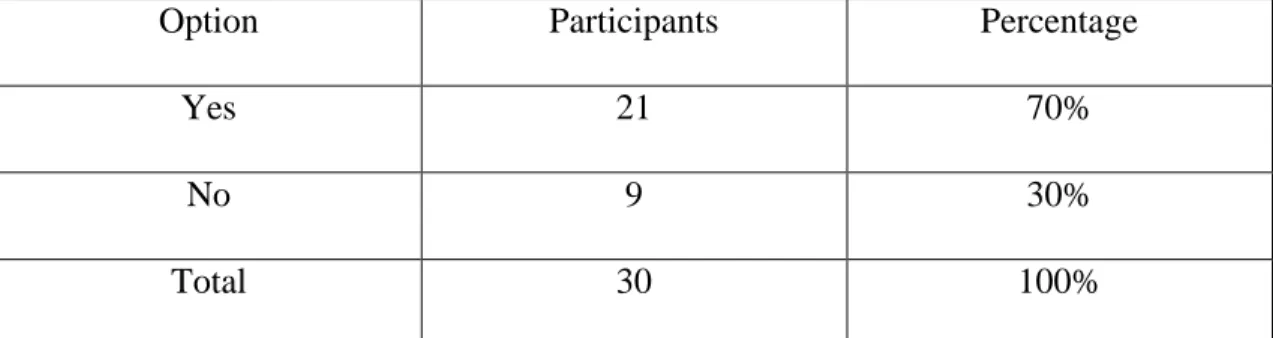
We asked this question for the purpose to perceive participants‟ willingness to study English language. They are asked to say whether they have chosen to study English or not.
Option Participants Percentage
Yes 21 70%
No 9 30%
Total 30 100%
Figure II.1: The Students’ Choice of study English
According to the results recorded in the table, we notice that the majority of students (70%) have chosen to study the English language indicating that they are motivated to learn and improve their level. Whereas, only (30%) of the students were not allowed to follow the study they wanted or studying English was imposed on them.
Question 02: How do you consider your level in English?
Participants are asked to describe their level in English. They are supposed to rank themselves from very good to weak.
Level Participants Percentage
Very good 8 27%
Good 12 40%
Average 06 20%
Weak 04 13%
total 30% 100%
Table II.2: Students’ Level 70%
30%
Figure II.2: Students’ Level
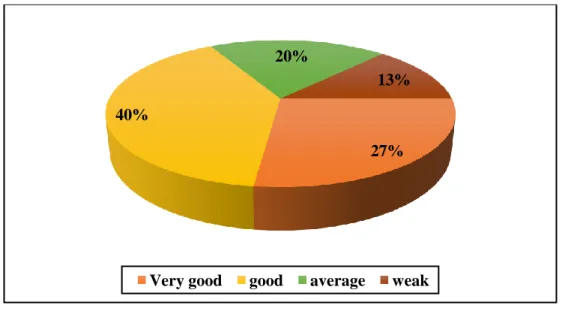
According to the results demonstrated above, it can be seen that (27%) of the participants have admitted that their level in English is very good. (40%) of participants have perceived that their level is good, however (20%) believed that their level is average and only (13%) classified themselves as weak in English.
Section 02: Students‟ perceptions of the speaking skill.
Question 03: Pick the most skill that you need to improve the most:
This question was asked for the purpose to determine the learners‟ need to different language skill. The informants are asked to pick the most needed skill (speaking- listening- reading and writing) and then, they justify their choices.
Options Participants Percentage
Speaking 16 54%
Listening 4 13%
Reading 3 10%
Writing 7 23%
Total 30 100%
Table II.3: Emphasis on Learning the Four Skills. 27%
40%
20%
13%
Figure II.3: Emphasis on Learning the Four Skills.
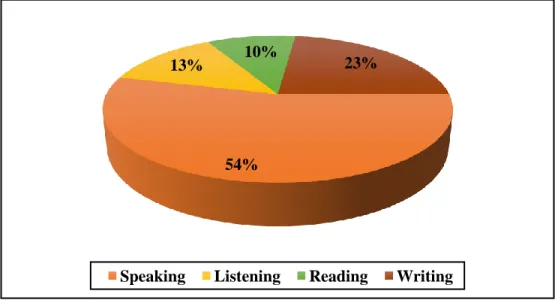
It can be seen from the graph that (54%) of the participants considered speaking to be the most important skill to be improved, because to communicate effectively they need to speak first. Some of the participants claimed that speaking is an important skill; we use it to express our ideas and opinions as well to interact with each other. (23%) have opted the Writing skill as an important since it is more required in most academic activities and their level usually assessed by the writing process. Unlike the other skills, just (13%) have admitted that listening should be improved, since we need to listen before we speak or write. Insofar, reading is concerned, just (10%) believe that reading skill needs to be improved before any other skill because it provides us with a great amount of vocabulary.
Question 04: Do you agree that in order to learn the language you have to speak it?
This question was intended on behalf of unveiling the importance of speaking skill in EFL learning process. Participants are asked to pick the suitable statement that demonstrates their opinion toward the relation between the speaking skill and the learning of the language.
Option Participants Percentage
Strongly agree 25 83%
Agree 03 10%
Disagree 02 70.5%
Strongly disagree 00 0%
Total 30 100%
Table II.4: Students‟ opinions about Speaking English and its relation with the learning
process
54%
13% 10% 23%
Figure II.4: Students’ opinion about Speaking English and its relation with the learning process.
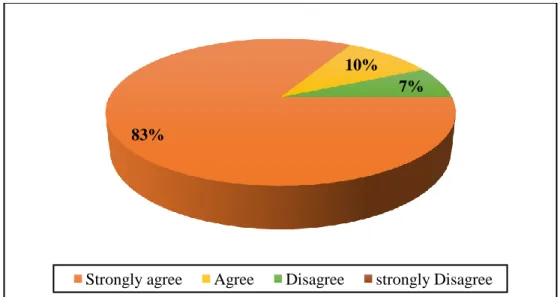
As the table shows, the majority of students (83%) do strongly agree that speaking is very important to learn a foreign language. One can notice that students are aware of the importance of speaking in learning the language. Others they also agreed (10%). However, 2 participants making up (7%) state that they disagree with this saying since speaking the language is not necessary to learn it. (0%) affirmed that they strongly disagree with the opinion that to learn the language you have to speak it.
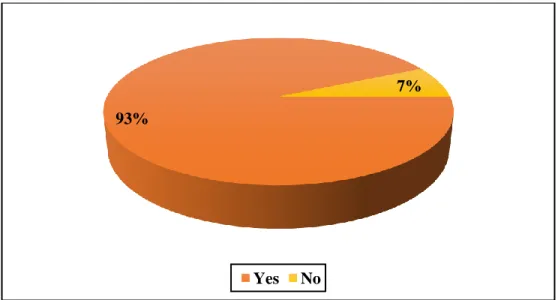
Question 05: Do you encounter difficulties while speaking?
This question was asked mainly to determine whether participants face obstacles while speaking in English in classroom or not.
Option Participants Percentage
Yes 18 60%
No 12 40%
Total 30 100%
Table II.5: Students’ Difficulties when Speaking in Classroom.
83%
10% 7%


![[PDF] Cours pour apprendre à programmer avec Visual Basic pas à pas | Formation informatique](data:image/gif;base64,R0lGODlhAQABAIAAAP///wAAACH5BAEAAAAALAAAAAABAAEAAAICRAEAOw==)