HAL Id: hal-00482031
https://hal.archives-ouvertes.fr/hal-00482031
Submitted on 11 May 2010
HAL is a multi-disciplinary open access
archive for the deposit and dissemination of
sci-entific research documents, whether they are
pub-lished or not. The documents may come from
teaching and research institutions in France or
abroad, or from public or private research centers.
L’archive ouverte pluridisciplinaire HAL, est
destinée au dépôt et à la diffusion de documents
scientifiques de niveau recherche, publiés ou non,
émanant des établissements d’enseignement et de
recherche français ou étrangers, des laboratoires
publics ou privés.
Distributed under a Creative Commons Attribution - NonCommercial - NoDerivatives| 4.0
International License
Selection using non symmetric context areas
Diane Lingrand, Stéphane Lavirotte, Jean-Yves Tigli
To cite this version:
Diane Lingrand, Stéphane Lavirotte, Jean-Yves Tigli. Selection using non symmetric context areas.
Workshop on Context-Aware Mobile Systems, OnTheMove Federated Conferences; Springer, Oct 2005,
Agia Napa, Cyprus. �hal-00482031�
Diane Lingrand, St´ephane Lavirotte, and Jean-Yves Tigli
I3S, UNSA/CNRS UMR 6070 – B.P. 121 - F06903 Sophia Antipolis - FRANCE [email protected]
http://www.i3s.unice.fr/~ lingrand/
Abstract. This paper targets with applications running on mobile de-vices and using context informations. Following previous studies from other authors, we extend the notion of context area replacing distance function by cost function. Using this extension, we exhibit three differ-ent modes of selection and demonstrate their differences on a mobile applications: the museum visit.
1
Motivations
With the expansion of mobile devices in our life (PDA, cellular phones, ...), we have observed for some years the development of applications taking context into account. For example, it is natural to take into account the localization of a user in an application which aims at giving a list of nearby restaurants. Moreover, the application should also consider the opening days and hours in order to select relevant items in this list using the current date and time. Context-aware applications are intended to simplify the interface between the user and the machine.
The concept of context and its evaluation are often redefined depending on application needs [1–4]. However, some authors propose a general context defini-tion such as Dey [5]: “Context is any informadefini-tion that can be used to characterize the situation of an entity”. In order to use context informations, Pauty, Couderc and Banˆatre [6] propose a definition and an evaluation of context using distance functions.
In this paper, we come back on previous definitions of context, context area and selection modes using distances. We exhibit an example where these defi-nitions of context and context area are not satisfying. We then propose a new formalism to define context and context area. Using this formalism, we introduce again the selection modes definitions that are, in this case, not symmetric. We illustrate this on a mobile applications: the museum visit.
2
Context Model
2.1 Context and context area definitions
The context space E is defined as a state space composed by several contextual components ei. Each component is bound to a distance function di:
2 D. Lingrand, S. Lavirotte, and J.-Y. Tigli
Several authors [7, 8] have made a classification of the different types of com-ponents in several families: environmental context, user context, computer con-text and time concon-text.
In the context space are context instances for which the components ei
are taking values in a determined set.Assuming that the distance function in the context space is well defined, we need to define the notion of proximity that is the context area or neighborhood of a context instance E:
Z(E) = {F | d(F, E) ≤ D} , where D is a constant. (1)
2.2 Discussion on distances
Do we really need to extend the constantD to a function? In [6], D is replaced by a function of E and F . Replacing the constant D by a function has the advantage of permitting the expression of a large variety of constraints. However, it is a too broad definition that needs to be restricted to make sense.
Is it necessary to be a distance? Let us take the example of a hiker in the mountain: going from A (in the valley) to B (the summit) may be more costly (in term of effort or gasoline) than going from B to A. The cost, in this example, is not symmetric: this is not a distance!
However, we need to be able to compare costs between several contexts and to determine neighborhoods. We now show how to replace a cost function instead of distance function in our formalism.
2.3 Introducing a cost function
We define the cost function by the following properties:
c(x, y) ≥ 0 , c(x, y) 6= 0 ⇒ x 6= y and c(x, y) ≤ c(x, z) + c(z, y) (2) These properties are similar to the properties of a distance function except the symmetry. The context space is redefined as follow: E = {{e1, ..., en}, {c1, ..., cn}}
where the ciare cost functions, and the context area by:
Z(E) = {F | c(F, E) ≤ C} (3) where c is a cost function defined by equation 2 and C is a constant cost.
With this definition, loosing the symmetry of the distance function, we also loose the symmetry of the context area as we will study in the next paragraph.
2.4 Selection mode
Knowing a context instance, one may want to select all context instances near E. There are two ways of doing that: (i) select the context instances in the context area of E (endo selection) or (ii) select the context instances which context
area contains E (exo selection). If we are interested in both types of selection, we can use the bilateral selection:
Sbilateral(E) = Sendo(E) ∩ Sexo(E)
Considering definition (1), there is no difference between endo and exo se-lection, as said in [6]. But considering definition (3), the endo and exo selection modes are different because of the lack of symmetry. This leads to interesting properties in the selection. We will now illustrate this.
3
Experimentation: the museum visit.
In this well-known application, each visitor has a PDA for commenting the pic-tures displayed. When the visitors PDA detects a picture nearby, it displays informations on this picture. However, since the hall may be large and the pic-tures high, we also consider the fact that the visitor may have a picture in his back nearer than the picture he is looking at. Of course, in this case, he would like to have the information on the picture he is looking at rather than the one behind him. This is an example showing that we need to select pictures regarding the distance between picture and visitor and the orientation of the visitor.
α 1,2 x2 x1 y2 y1 M2 M1 τ θ1 x y
Fig. 1. Notations for the context space in the case of the museum visit. The point M1 represents the visitor and M2 the
pic-ture. M1is defined by its 2D position
(co-ordinates x1 and x2) and its orientation
given by the angle θ1. The direction of the
user with respect to the picture τ1,2is
cen-tered on θ1 with amplitude α.
The context space is composed by a 2D position (x; y) and an orientation θ. We define the context area limiting the Euclidean distance to D and the angle variation to α
2 (see figure above). The cost between points M1(the visitor) and
M2(the picture) is then given by:
c([x1, y1, θ1]T, [x 2, y2, θ2]T) = max ( p (x1− x2)2+ (y1− y2)2 D , |τ1,2− θ1| α/2 ) where τ1,2=(Ox,d −−−−→
M1M2) measures the orientation of the vector
−−−−→ M1M2.
The context area is defined by: c([x1, y1, θ1]T, [x2, y2, θ2]T) ≤ 1.
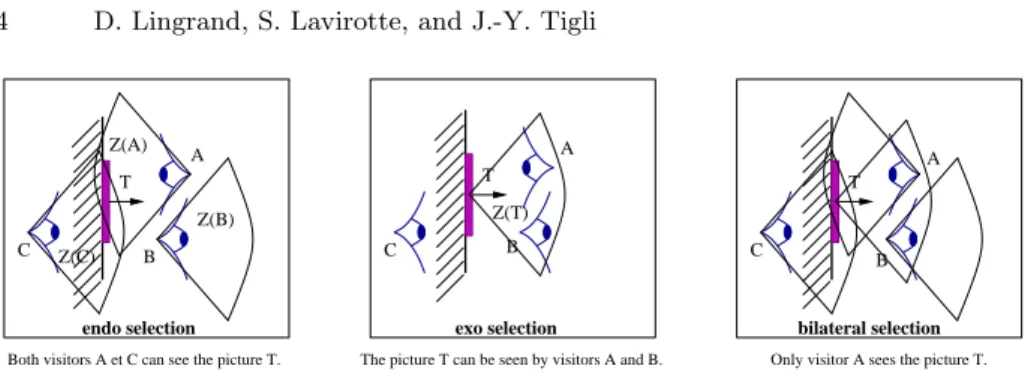
As seen in figure 2, the visitor must see the picture: this is the endo selection. But if the visitor is behind the picture, he cannot see this picture. Using the exo selection, we select users in front of the picture but not necessary looking at the picture. The correct selection is the bilateral selection: the visitor must see the picture and the picture must have the visitor in his field of view.
4 D. Lingrand, S. Lavirotte, and J.-Y. Tigli bilateral selection exo selection endo selection A B T C Z(T) A B T C B A T Z(B) Z(A) C Z(C)
Only visitor A sees the picture T. The picture T can be seen by visitors A and B.
Both visitors A et C can see the picture T.
Fig. 2.The three different modes of selection. The selection we need in this application is the bilateral selection.
4
Conclusion
In this paper, we have extended the context area definition using cost functions instead of distance functions. This allows to express a larger family of applica-tions and leads to different selection modes: endo, exo and bilateral.
We have applied this context formalism to the well-known example of the museum visit considering both location and sight view of the visitor.
Future work will focus on dynamic cost composition in order to adapt our system to the availability of different context components.
References
1. Want, R., Hopper, A., Falc˜ao, V., Gibbons, J.: The active badge location system. ACM Transactions on Information Systems (1992)
2. Schilit, B.N., Hilbert, D.M., Trevor, J.: Context-aware communication. IEEE Wire-less Communications 9 (2002) 46–54
3. Long, S., Kooper, R., Abowd, G.D., Atkeson, C.G.: Rapid prototyping of mobile context-aware applications: the cyberguide case study. In: Proceedings of the Sec-ond Annual International Conference on Mobile Computing and Networking, White Plains, NY, . ACM Press. (1996) 97–107
4. Abowd, G.D., Atkeson, C.G., Hong, J., Long, S., Kooper, R., Pinkerton, M.: Cy-berguide: A mobile context-aware tour guide. Wireless Networks 3 (1997) 421–433 5. Dey, A.K.: Understanding and using context. Personal and Ubiquitous Computing
5(2001) 4–7
6. Pauty, J., Couderc, P., Banˆatre, M.: Synth`ese des m´ethodes de programmation en informatique contextuelle. Technical Report 1595, IRISA (2004)
7. Chen, G., Kotz, D.: A survey of context-aware mobile computing research. Technical Report TR2000-381, Dept. of Computer Science, Dartmouth College (2000) 8. Coutaz, J., Rey, G.: Foundations for a theory of contextors. In Kolski, C.,
Vander-donckt, J., eds.: 4th International Conference on Computer-Aided Design of User Interfaces, Valenciennes, France (2002) 283–302