Acoustic and Linguistic Interdependencies
Of Irregular Phonation
by
Kimberly F. Dietz B.S., Electrical Engineering
Massachusetts Institute of Technology, 2009
SUBMITTED TO THE DEPARTMENT OF ELECTRICAL ENGINEERING AND COMPUTER SCIENCE IN PARTIAL FULFILLMENT OF THE REQUIREMENTS FOR THE
DEGREE OF
MASTER OF ENGINEERING
IN ELECTRICAL ENGINEERING AND COMPUTER SCIENCE AT THE
MASSACHUSETTS INSTITUTE OF TECHNOLOGY MAY 2010
© 2010 Massachusetts Institute of Technology. All rights reserved.
Signature of Author ... Kimberly F. Dietz Department of Electrical Engineering and Computer Science May 21, 2010
Certified by ... Thomas F. Quatieri Senior Member of Technical Staff; MIT Lincoln Laboratory VI-A Company Supervisor Certified by ... Stefanie Shattuck-Hufnagel Principal Research Assistant; MIT Research Laboratory of Electronics M.I.T. Thesis Supervisor
Acoustic and Linguistic Interdependencies
Of Irregular Phonation
by
Kimberly F. Dietz B.S., Electrical Engineering
Massachusetts Institute of Technology, 2009
Submitted to the Department of Electrical Engineering and Computer Science On May 21, 2010
In partial fulfillment of the Requirements for the Degree of Master of Engineering in Electrical Engineering and Computer Science
Abstract
Irregular phonation is a commonly occurring but only partially understood phenomenon of human speech production. We know properties of irregular phonation can be clues to a speaker‟s dialect and even identity. We also have evidence that irregular phonation is used as a signal of linguistic and acoustic intent. Nonetheless, there remain fundamental questions about the nature of irregular phonation and the interdependencies of irregular phonation with acoustic and linguistic speech characteristics, as well as the implications of this relationship for speech processing applications.
In this thesis, we hypothesize that irregular phonation occurs naturally in situations with large amounts of change in pitch or power. We therefore focus on investigating parameters such as pitch variance and power variance as well as other measurable properties involving speech dynamics.
In this work, we have investigated the frequency and structure of irregular phonation, the acoustic characteristics of the TIMIT Acoustic-Phonetic Speech Corpus, and relationships between these two groups. We show that characteristics of irregular phonation are positively correlated with several of our potential predictors including pitch and power variance. Finally, we demonstrate that these correlations lead to a model with the potential to predict the occurrence and properties of irregular phonation.
VI-A Company Thesis Supervisor: Thomas F. Quatieri
Title: Senior Member of Technical Staff; MIT Lincoln Laboratory M.I.T. Thesis Supervisor: Stefanie Shattuck-Hufnagel
Acknowledgements
I am deeply grateful to my advisors, to the Human Language Technology Group at the MIT Lincoln Laboratory, and to my friends and family. This thesis would not have been possible without their support and encouragement.
Above all, I am indebted to my official and unofficial thesis supervisors. I could not have asked for a more passionate or supportive group to work with. Tom Quatieri, Stefanie Shattuck-Hufnagel, and Nick Malyska have consistently impressed me with their dedication, insight, and knowledge; meeting with them always led to new ideas and inspirations. I would also like to thank Bob Dunn for sharing his insights about pitch-modification with us.
It has been my pleasure to be a part of the community at the MIT Lincoln Laboratory and in the Human Language Technology Group. From seminars and presentations on Laboratory research to salsa lessons and lunchtime concerts, I have enjoyed the many opportunities to explore. Within my office, I would like to thank full- and part-time labmates Tian Wang, Nancy Chen, Zahi Karam, Tom Baran, Dan Rudoy, and Daryush Mehta for an always interesting environment. Daryush, having just completed his PhD thesis, was several times the reassuring voice of experience. I would also like to thank Doug Jones, Joel Acevedo-Aviles, Linda Kukolich, Yi-Hsin Lin, and Amy Englehart for the great lunchtime conversations and camaraderie.
To my Undergraduate Advisor who continued to offer his support even in my M.Eng. year, George Verghese …
To Anne Hunter, Niki Huhn, and Brandon Moore, who provided a sounding board when I was stressed …
To Jo-Ann Graziano, for last minute editing ...
To my family – Mom, Steph, Abby, and Matt – who have always supported me … To my Dad ...
To Kevin, who keeps me focused …
Thank you! I would not have made it without you.
Contents
Acknowledgements 5 Contents 7 List of Figures 9 List of Tables 11 Chapter 1 13 Introduction 131.1 Problem Statement and Motivation 13
1.2 Hypothesis 13
1.3 Methodology 14
1.4 Summary of Contributions 14
1.5 Thesis Outline 14
Chapter 2 17
Background – Speech Production and Irregular Phonation 17
2.1 Speech Production 17
2.1.1 True Speech Production 17
2.1.2 Modeled Speech Production 18
2.2 Descriptions of Irregular Phonation – Physical, Perceptual, and Acoustical 19
2.2.1 Physical Descriptions 19
2.2.2 Perceptual Descriptions 20
2.2.3 Acoustical 21
2.2.4 For this Thesis 22
2.3 Known Correlated Properties of Speech 23
2.3.1 Speaker, Dialect, and Gender Dependence 23
2.3.2 Linguistic Dependence – Structure and Intent 23
2.4 Summary 24
Chapter 3 25
The Speech Corpus: Choice and Characterization 25
3.1 Choice of Corpus - TIMIT 25
3.2 Characterization of Corpus – Pitch, Variance, Irregular Phonation 26
3.2.1 Distribution of Pitch 28
3.2.2 Distribution of Variance 29
3.2.3 Overall Frequency of Irregular Phonation 32
3.3 Summary 33
Chapter 4 35
The Frequency of Irregular Phonation: Dependence on Prosody 35
8
Chapter 5 45
The Nature of Irregular Phonation 45
5.1 The Characteristic Spacing 45
5.2 Prosodic Dynamics and Spacing 47
5.3 Location as a Correlate to Characteristics of Irregular Phonation 48
5.4 Summary 50
Chapter 6 51
Multivariate Correlations 51
6.1 Model fitting 51
6.2 Discussion of Model Fits 52
6.3 Discussion of Prominent Features 53
6.4 Summary 54
Chapter 7 55
Conclusions and Future Work 55
7.1 Conclusions 55
7.2 Future Work 55
List of Figures
Figure 1. Composite diagram of speech system components. Speech system schematic by Stevens (Fig. 1.2) [5]. Cross-sectional view of the vocal tract by Coker, Denes, and Pinson
(Fig.4.7) [6]. 18
Figure 2. Key components of the source-filter model of speech production (adapted from Fig.
1-1, Malyska [8]). 19
Figure 3. The source-filter model of speech generation [9]. 19 Figure 4. Example of irregular phonation. Taken from the end of sentence SA1 by speaker fjsp0 in TIMIT. Arrows indicate approximate locations of glottal pulses. Note that, between the large pulses of the region of irregular phonation, there are what appear to be smaller pulses. These may or may not register as pulses through the use of various automatic methods of pulse detection. Even if they register as pulses, this sample will be classed as irregular due to the
uneven pulse amplitude. 22
Figure 5. Distribution of average pitch for males (upper) and females (lower) in TIMIT. For each of the 438 male speakers and 192 female speakers in the database, 10 sentences were
available. We used our pitch and voicing extraction tool to calculate an estimate of the pitch and whether the speech was voiced for each sample (16k sampling rate). We use a voiced cutoff of 0.75 (out of a maximum score of 1) to determine whether a frame is voiced. We take the mean of the pitch measurements for all voiced points during the 10 sentences. This leads to one average pitch data point per speaker. In these histograms, binning – for which there is no agreed-upon optimal algorithm – is done according to the square-root method, whereby the number of bins in the histogram is equal to the square root of the number of samples. 27 Figure 6. Normal distribution fitted to male and female mean pitch data. 29 Figure 7. Variance in Pitch Over a Single Sentence - Comparison Between Two Speakers. (The second speaker is the same speaker used to generate the example or irregular phonation
shown in Figure 4). 30
Figure 8. Distribution of variance for males (upper) and females (lower) in TIMIT. For each of the 438 male speakers and 192 female speakers in the database, estimates of the pitch during only voiced regions of speech are obtained as described in Figure 5. For each speaker, we take the variance of the pitch measurements for all samples determined to be voiced in the 10 sentences. This leads to one pitch variance data point per speaker. In this histogram, binning – for which there is no agreed-upon optimal algorithm – is done according to the square-root method, whereby the number of bins in the histogram is equal to the square root of the number
10
Figure 12. Pitch variance and percentage time spent on irregular phonation. r=0.3757 (p not calculated). The variance measure for each speaker is divided by the mean pitch of the speaker‟s gender (119.1 Hz for males and 201.4 Hz for females) in order to make the values
easier to compare across gender. 36
Figure 13. Mean power vs. percentage time spent on irregular phonation. 38 Figure 14. Power variance vs. percentage time spent on irregular phonation. 38 Figure 15. Final creak in the TIMIT population, regions 1 and 2. 39 Figure 16. The cumulative distribution function for the approximated slope of the final word of the sentence for cases in which final creak is and is not present. The blue curve indicates the cases in which final creak is not present; the red curve indicates the cases in which final
creak is present. 40
Figure 17. The average power curves are shown for sentences with final creak (red) and without (blue). These power curves span the final word a sentence, which is „year.‟ They are aligned in time such the final phone of the word begins at the same point, at adjusted time 1. 41 Figure 18. The length of each phone of the word „year.‟ The first and second subplot,
reading left to right, show the first two phones of the word (roughly, „y‟ and „ea‟). The third subplot shows the length of the third phone including regular phonated parts only. The fourth subplot shows the length of the third phone including all phonation, regular or irregular. 42 Figure 19. Illustration of pitch, smooth power, and phone duration in the word „year‟ for
specific TIMIT. case. 43
Figure 20. Illustration of pitch, smooth power, and phone duration in the word „year‟ for a specific TIMIT case. „axr‟ refers to the phonated portion of the „r‟ in „year‟ and „q‟ refers to
the irregularly phonated portion. 44
Figure 21. Average pitch versus average spacing in irregular spacing obtained using the MED method (top) and fusion method (bottom). Data shown here is for males from dialect regions 1 and 2. The data over two sentences was combined to produce one data point per speaker.
Each speaker spoke the same two sentences. 46
Figure 22. Distribution of maximum spacing during irregular phonation. (Colors
differentiate gender and region of speaker.) 47
Figure 23. Mean pitch versus median spacing. Subsets not shown did not occur in data. 49 Figure 24. Mean power versus maximum spacing. Subsets not shown did not occur in data. 49 Figure 25. Mean power versus median spacing. Subsets not shown did not occur in data. 50
List of Tables
Table 1. Result of a study on fundamental frequency of distinct registers. ... 20 Table 2. Comparison of corpora. A single asterisk indicates that the data needs a small amount of hand-correction to be usable. A pair of asterisks means that labeled data does not need corrections, but not all data is labeled. In the TIMIT database, 151 of the 530 speakers are fully labeled for irregular phonation. ... 26 Table 3. Average pitch distribution in TIMIT. ... 28 Table 4. Pitch variance distribution in TIMIT. ... 32 Table 5. Relationship between acoustics and attributes of irregular phonation. The three most prominent correlations are highlighted. ... 48 Table 6. Coefficients resulting from autoregressive prediction of number of instances of
irregular phonation. β is the coefficient of each term and p indicates the significance of the result. Lower values of p are preferable. α is the constant term of the linear equation. ... 52 Table 7. Coefficients resulting from autoregressive prediction of median inter-pulse spacing of irregular phonation. β is the coefficient of each term and p indicates the significance of the result. Lower values of p are preferable. α is the constant term of the linear equation. ... 52
Chapter 1
Introduction
When people speak, their vocal folds vibrate, sending pulses of air through the vocal tract and shaping them into the sounds we recognize. The vocal folds generally vibrate at a regular rate, generating something we hear and call pitch (or measure and call average fundamental frequency). However, the vocal folds can, and often do, vibrate irregularly. This may mean an irregular spacing of pulses, irregular pulse heights, or vibrating at a frequency so low that individual pulses are distinguishable to the human ear. When the vocal folds vibrate irregularly in any of these ways, the result is termed irregular speech. „Irregular‟ here does not refer to the spacing between the pulses or their heights, but to the fact that the pattern produced is substantially different from the one produced under most circumstances.
1.1 Problem Statement and Motivation
The ability to predict (1) the occurrence of irregular phonation and (2) its properties would lead to important advances in the analysis, modification, and synthesis of speech. Current methods of analyzing speech have difficulty when they encounter sections of speech that are irregularly phonated; they are unable to cope using standard models. Without knowing the characteristics of irregular phonation, realistic modification (in terms of pitch, speed or identity) of speech is hindered. Synthesizing realistic speech also depends on an inclusion of this phenomenon – without including episodes of irregular phonation, synthetic speech feels unnatural.
1.2 Hypothesis
We posit that the relationship to the variation of pitch and power is due largely to the physical constraints on the speech apparatus. Slifka has found that „the physical reality of managing vocal fold vibration‟ leads to an association between irregular phonation and silence within speech [1-2]. In this thesis, we hypothesize that these same „physical realit[ies]‟ are responsible for the
14
The relationship to dialect and gender (in at least English) can be attributed to the allophonic nature of words pronounced with and without irregular phonation. Because of this, a manner of speaking which includes more or less irregular phonation can be adopted by a group. In the case of gender, physical differences in average length and mass of the vocal folds can play a role in the extent and nature of irregular phonation as well.
Linguistic dependencies of irregular phonation have also been found previously. We propose that something similar to Slifka‟s “preferred location” for irregular phonation near silence can aid us in understanding the connection between linguistic uses of irregular phonation and measurable properties of speech such as pitch and power variance. Linguistic use of irregular phonation as a signal has two sources: irregular phonation is „available‟ to hold extra information (since words with and without irregular phonation are allophonic in English) and irregular phonation has tacitly understood correlates in terms of variance as well as in terms of silence.
1.3 Methodology
We address the challenge of irregular phonation description and classification on a large scale, using a database of 530 speakers, 151 of whom are fully phonetically pre-labeled with information about irregular phonation. We draw on pre-existing tools for analysis. These include a sinewave-based pitch and voicing extraction tool [3], an implementation of the Maximum Entropy Deconvolution (MED) for pulse location [4], and a fusion method which combines several pulse location methods for increased accuracy. We use these tools to gain information about the frequency and nature of irregular phonation and its co-incidence with other defining characteristics of speech: measurable acoustic properties, timing and location, and speaker demographics. Overall we note a relationship between irregular phonation, the variation of pitch and power, dialect, and gender.
1.4 Summary of Contributions
This thesis provides results in two distinct areas: description and prediction. We begin by describing the TIMIT Acoustic-Phonetic Continuous Speech Corpus in terms of average pitch, pitch variance, and occurrence of irregular phonation. We form a hypothesis that places of pitch and power variation form a “preferred location” for irregular phonation, akin to Slifka‟s descriptions of regions of silence as “preferred locations for irregular phonation. In the realm of prediction, we show that short- and long-term acoustic properties of speech are predictive of irregular phonation, as is demographic information. We report correlations for individual relationship as well as a model for prediction of the occurrence of irregular phonation at the sentence level, based on acoustic and demographic properties.
1.5 Thesis Outline
This thesis is organized as follows. In Chapter 2 we provide background on the description, and detection of irregular phonation. In Chapter 3 we discuss our choice of corpus and characterize its pitch and the frequency of occurrence of irregular phonation within it. In Chapter 4 we present work related to the frequency of occurrence of irregular phonation. In Chapter 5 we discuss the small-scale properties of irregular phonation. In Chapter 6 we use relationships described in
previous chapters to build a model which predicts the occurrence of irregular phonation and its average inter-pulse spacing. We discuss the implications of relative coefficient magnitudes and measures of significance in this model. Finally, in Chapter 7 we conclude and offer suggestions for future work.
Chapter 2
Background: Speech Production and
Irregular Phonation
In Chapter 2, we provide a brief overview of the complexity of the speech production system and the source-filter system often used to describe it more simply. We then describe and define irregular phonation. We discuss known correlates to irregular phonation: acoustic, demographic, and linguistic. These findings give us insight into whether, at its root, its production is physically or linguistically motivated. We discuss the notion of a „preferred location‟ in linguistics and put forth the notion that pitch and power variance, in addition to silence, may be such a location.
2.1 Speech Production
2.1.1 True Speech Production
Speech production is a complex process, involving physical systems located from the midsection upwards. Moving from the bottom up, the system can be divided into subglottal, laryngeal, and farther forward subsystems.
The subglottal subsystem, including the abdominal muscles, intercostals, diaphragm, lungs, branching airways, and trachea provide a variable supply of pressurized air to the glottis. The larynx, further subdivided into the vocal folds, supporting structures for the vocal folds, extrinsic laryngeal muscles, and laryngeal structures above the vocal folds, produces vibration in response to the air flowing through from below. The properties of the vocal folds (such as tension, position, and mass per unit length) can effectively be modified by adjustments of the surrounding muscles and cartilages. The vocal tract above the larynx is characterized by the pharynx, soft palate, nasal cavity, oral cavity, tongue, mandible, lips, the mechanical properties of the wall of the vocal tract, and the overall length and volume of the vocal tract [5].
18
Figure 1. Composite diagram of speech system components. Speech system schematic by Stevens (Fig.
1.2) [5]. Cross-sectional view of the vocal tract by Coker, Denes, and Pinson (Fig.4.7) [6].
2.1.2 Modeled Speech Production
Characterizing all of the properties of the speech production system and emulating them would be a difficult task. The interactions are many and nonlinear in real life. For practical purposes, we lump many components together and use a linear source-filter model to understand speech. We essentially divide this complex system into two key components and focus on their interaction. Gunnar Fant developed the canonical source-filter model of speech production. [7]. His model states that speech is made up of two key components. The first is the generation of sound sources. Air is pushed from the lungs to the vocal folds, which vibrate and form it into pulses – the source. The second component of speech generation is shaping by the vocal tract. The sound source is encounters the pharynx, tongue, teeth, lips, and nasal passages. The specific path available to it depends both on both permanent and temporary physical parameters (such as the size of their vocal tract and the instantaneous position of the tongue). Its movement through the vocal tract shapes the sound source into its final form. The system formed by the physical space the source moves through modifies the source. We describe both system and source mathematically, and are therefore able to describe source-system interactions with precision. A diagram representing key components of this model appears in Figure 2.
Figure 2. Key components of the source-filter model of speech production (adapted from Fig. 1-1,
Malyska [8]).
Specifically, the source-filter model describes the signal as the sum of two pieces, a voicing source (air driven by the vocal folds) and a noise source (air which moves through the vocal tract without causing the vocal folds to vibrate). The system is modeled as a time-varying filter with terms modeling vocal tract resonances and the effect of lip radiation (as described by acoustic phonetic theory). A diagram of the source-filter model is shown in Figure 3. This model is useful as a conceptual framework for the understanding of speech production. It also leads to effective mathematical manipulation of the system. One advantage of this model is that it partitions our task. Rather than constantly accounting for dozens of factors, we model only two components.
Figure 3. The source-filter model of speech generation [9].
2.2 Descriptions of Irregular Phonation – Physical, Perceptual,
and Acoustical
20
system can lead not only to modal voiced speech and unvoiced speech (the “regular” modes), but also to irregularly voiced speech or speech which otherwise does not sound “regular”. It is the speech we hear when the vocal folds are vibrating with a quasi-regular pitch period.
Irregular phonation is caused by the interplay of various physiological factors. Important factors include the amount of tension in the vocal folds, their position (pressed tightly together, held far apart, or somewhere in between), and transglottal pressure. Janet Slifka has given evidence that these factors tend to naturally align in favor of irregular phonation at word and syllable boundaries in spoken speech. She identifies two methods of producing irregular phonation, whether intentionally or incidentally: a speaker can either tightly adduct their vocal folds or abduct them. As Slifka uses our definition of irregular phonation, her findings are directly applicable to our research [1].
The fundamental frequency of irregular phonation has been described and measured in previous papers. Hollien and Wendahl [10] describe a phenomenon very similar to our „irregular phonation‟ which they term vocal fry. They say that “[v]ocal fry (1) is a normal mode of laryngeal production; (2) it consists of a register of very low fundamental frequencies, and (3) it consists of a train of relatively discrete laryngeal pulses with nearly complete damping between successive glottal excitations.” Hollien and Michel [11] further study whether or not vocal fry constitutes a phonational register, defined as “a series or range of consecutive (vocal) fundamental frequencies of similar quality; in addition, there should be little or no overlap in fundamental frequency between adjacent registers.” They use a corpus which includes 12 males and 11 females. Their relevant findings are summarized in Table 1. Their “group range” indicates smallest and largest quantities measured across the group; their “mean range” averages the smallest and largest quantities of each speaker. We see that males and females have an extremely similar fundamental frequency range while producing irregular phonation, despite the fact that they have much more divergent ranges during modal phonation.
Males Females
Group Range of Irregular Region Mean Range of Irregular Region
7 – 78 Hz 24 – 52 Hz
2 – 78 Hz 18 – 46 Hz
Group Range of Modal Region Mean Range of Modal Region
71 – 561 Hz 94 – 287 Hz
122 – 798 Hz 144 – 538 Hz
Table 1. Result of a study on fundamental frequency of distinct registers.
2.2.2 Perceptual Descriptions
A litany of buzzwords have sprung up around irregular phonation and related phenomena, many of them perceptual. While these are useful for building intuition about the phenomenon, the pure number of words used can be confusing. Episodes of irregular phonation are often described as sounding „rough‟ [12], „creaky‟ [8], or similar to a “… rapid series of taps, like a stick being run
along a railing” [13]. Perhaps the most telling of these terms is “creaky.” Irregular phonation, at a basic perceptual level, can be thought of as a brief, creaky sound that happens in speech. Basic elements of perceptual voice analysis used in the setting of voice-disorder clinics include roughness, breathiness, hoarseness, and strain. These perceptual labels are used to aid physicians in the work of voice study and therapy [14-15]. To understand why a voice might sound rough, breathy, hoarse, or strained, we need to look further into how speech is produced. A perception of roughness translates acoustically to irregular pitch periods, and therefore irregular phonation. Breathiness constitutes an extra amount of air moving through the vocal tract without vibration. Breathiness alone does not make speech irregular by our definition. Hoarseness is a combination of roughness and breathiness, and is therefore irregular phonation. Finally, a perception of strain occurs when the vocal folds are pressed tightly together.
2.2.3 Acoustical
There is some tolerance in the perceptual definitions of “regular” speech, thus it is sometimes termed “quasi-regular”. Titze categorized acceptable variation during regular speech as follows [16]:
jitter: “a short-term (cycle-to-cycle) variation in the fundamental frequency of a signal” shimmer: “a short-term (cycle-to-cycle) variation in the amplitude of a signal”
perturbation: “a disturbance, or small change, in a cyclic variable (period, amplitude, open quotient, etc.) that is constant in regular periodic oscillation”
tremor: “a 1-15 Hz modulation of a cyclic parameter (e.g. amplitude or fundamental frequency), either of a neurologic origin or an interaction between neurological and biomechanical properties of the vocal folds”
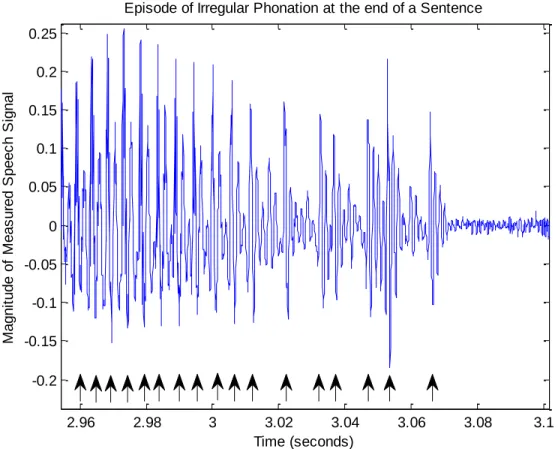
Irregular voiced speech occurs when the vocal folds are vibrating, but with more extreme irregularity than described as „acceptable variation‟ above. Unvoiced speech occurs without vibration of the vocal folds, as in pronunciation of many consonants and during whispering. An example of irregular phonation at the end of an utterance is shown in Figure 4. The irregular phonation was labeled (by Surana [17]) as beginning at 3.011 seconds and lasting until 3.072 seconds. We see from the figure “quasi-regular” spacing for the first 10 pulses, followed by irregular phonation for the remainder of the utterance.
22
2.96 2.98 3 3.02 3.04 3.06 3.08 3.1 -0.2 -0.15 -0.1 -0.05 0 0.05 0.1 0.15 0.2 0.25 Time (seconds) M a g n it u d e o f M e a s u re d S p e e c h S ig n a lEpisode of Irregular Phonation at the end of a Sentence
Figure 4. Example of irregular phonation. Taken from the end of sentence SA1 by speaker fjsp0 in
TIMIT. Arrows indicate approximate locations of glottal pulses. Note that, between the large pulses of the region of irregular phonation, there are what appear to be smaller pulses. These may or may not register as pulses through the use of various automatic methods of pulse detection. Even if they register as pulses, this sample will be classed as irregular due to the uneven pulse amplitude.
2.2.4 For this Thesis
For the purposes of this thesis, we deal with irregular phonation as described by Surana in his thesis [17]. Irregular phonation includes phonation with a noticeably different quality than the speaker normally uses. This includes not only irregularly voiced phonation, but also phonation with an unusually low fundamental frequency, such that it sounds “like a series of taps. [13]” The definition presented in Surana‟s 2006 Master‟s thesis and which we also adopt for use in this thesis is:
“A region of speech is an example of irregular phonation if the speech waveform displays either an unusual difference in time or amplitude over adjacent pitch periods that exceeds the small-scale jitter and shimmer differences or an unusually wide-spacing of the glottal pulses compared to their spacing in the local environment, indicating an anomaly from the usual, quasi-periodic behavior of the vocal folds.”
2.3 Known Correlated Properties of Speech
2.3.1 Speaker, Dialect, and Gender Dependence
Speaker Dependence of Irregular Phonation
The amount of irregular phonation detected in an individual has been shown to be highly variable. Some speakers speak “with almost continuous creak,” [18], some have been unable to produce it at all [11], and most fall along a spectrum between these extremes.
Furthermore, acquaintances of subjects have been shown to perceive these differences in production of irregular phonation and to use them in speaker identification tasks. In one study, researchers recorded speech samples from subjects. They then manipulated the short segments of the recorded utterances, creating and removing episodes of irregular phonation. Acquaintances of the subjects listened to the original and altered versions, attempting to determine which sounds most like a sample of the subject‟s voice. These acquaintances consistently chose the original sentence [19]. In another series of experiments, timing and amplitude features derived from glottal events were shown to carry speaker-dependent information which was successfully used to improve the accuracy of results obtained with a leading speaker identification algorithms [20]. Dialect Dependence of Irregular Phonation
Some dialects of similar languages have in the past been shown to be distinguishable in part on the basis of how “creaky” they are. This is, for instance, the case in British English [21]. Due to the fact that irregularly phonated words are allomorphic in most languages, irregular phonation is „freer‟ to vary across populations than it otherwise would be.
Gender Dependence of Irregular Phonation
Gender has often been posited as an indicator of the propensity of a speaker for irregular phonation. In general, it has been assumed that males would be more prone to irregular phonation [21], due to the fact that their regular phonation is characterized by a lower fundamental frequency than that of females. However, in actuality which gender produces more irregular phonation in studies is definition dependent. According to one study which defines four voice types – „creaky voice,‟ „creak,‟ „glottalization,‟ and „diplophonia,‟ where we would distinguish only „irregular phonation,‟ there are differences in phonation patterns based upon gender. Males produce more „creaky voice‟ than females, whereas females produce more „creak‟ than males. Levels of „glottalization‟ and „diplophonia‟ are similar across genders [22]. While we are not concerned here with the precise definitions used in this work to characterize irregular phonation, we note that the nature of irregular phonation has been shown to differ across groups of subjects (e.g. subjects grouped by gender).
24
Dilley, et. al. [23] and Pierrehumbert [24] have found that, “glottalization [roughly, irregular phonation] of word-initial vowels is influenced by full vs. intermediate intonational phrase boundaries and pitch accent on the target syllable or word.” Intonational phrase boundaries are perceptually defined boundaries between segments of speech with a single pitch and rhythm contour. This research demonstrates that the speaker‟s choice of intonational phrase boundaries significantly affects whether or not irregular phonation occurs during word-initial vowels. Specifically, they found that at the beginning of a full intonational phrase irregular phonation occurs on both full and reduced vowels, while on an intermediate intonational phrase irregular phonation occurs on only full vowels. This research suggests that irregular phonation appears differentially in grammatically significant locations.
A 2004 study by Grivičić and Nilep [25] similarly suggests that irregular phonation is a cue to pragmatic understanding of dialog. This study examines the relationship between using the word „yeah,‟ irregular phonation, and speakers‟ „turns‟ in a conversation. The study found that people who said „yeah‟ with regular phonation continued to speak afterward 60 percent of the time. However, people who said „yeah‟ with irregular phonation only continued to speak afterward 20 percent of the time. This implies that speakers who want to give someone else a turn can proactively initiate a change in their speech quality. The fact that the other speakers began to speak after hearing their partners produce these episodes of irregular phonation implies that they subconsciously understood the signal.
Slifka [1] has noted that irregular phonation in speech can be both prompted by physical realities and used as a linguistic cue. Furthermore, she has shown links between the two. Specifically, she has posited that irregular phonation has a preferred function for cueing silence, a role related to the cueing of boundaries and hence a linguistic cue. She has shown that this cue is not randomly chosen but rather a natural outcome of the positioning of unplanned irregular phonation. According to her work, as silence is approached or passed, the configuration of physiological factors around the glottis is such that the unplanned occurrence of irregular phonation becomes more likely. This, coupled with the fact that speakers are able to artificially increase the probability of the production of irregular phonation by tightening (or loosening) the vocal folds, leads to the use of irregular phonation as a signal of silence in many languages. We believe that the fact that irregular phonation may be used to cue not only silence, but also other naturally co-occurring circumstances. Specifically, we believe that Slifka‟s theory may apply to variance in pitch and power as well as silence.
2.4 Summary
The speech system is an extraordinarily complex system, much more so than the models with which we usually describe it. Irregular phonation in particular is not well-suited to description and manipulation under current methods. We described irregular phonation both as “a series of taps” and as variations from the normal speech pattern above an acceptable “small-scale” level. We discussed the way in which this physical phenomenon has been adopted for linguistic use and assert that pitch and power variance are potentially “preferred location[s]” for irregular phonation.
Chapter 3
The Speech Corpus: Choice and
Characterization
The choice of a speech corpus is an important one which shapes the scope and nature of the work. Here, we discuss our choice of the TIMIT Acoustic-Phonetic Continuous Speech Corpus and characterize the speech found in the database in terms of pitch and frequency of irregular phonation.
3.1 Choice of Corpus - TIMIT
In choosing our corpus, we considered the amount of recorded material, the number of unique speakers, whether the speech was spontaneous or read, and what labeling had been performed (prosodic, IP (irregular phonation), and phonetic labels were desired). Our process is shown in Table 2 to aid others in choosing between these corpora in the future. The corpora are listed in ascending size. With ascending size tends to come descending labeling, due to the amount of time required to label speech. We chose TIMIT because of its substantial size advantage. Unfortunately, it is not labeled prosodically, which limits us to acoustic and phonetic deductions about irregular phonation.
TIMIT was developed as a joint effort between the Massachusetts Institute of Technology (MIT), Stanford Research Institute (SRI), and Texas Instruments (TI). The work was sponsored by the Defense Advanced Research Projects Agency – Information Science and Technology Office (DARPA-ISTO), in order to provide a large corpus of speech for use in developing acoustic-phonetic knowledge and developing and evaluating automatic speech recognition systems [26]. The database consists of 530 speakers who speak 10 sentences each. The sentences are chosen such that two are common to all speakers in the database, 450 are spoken by 7 speakers in the database, and 1890 appear are spoken only once. The two commonly spoken sentences are designed as dialect shibboleths, meant to reveal differences between the speakers based on their geographic location. The 450 multi-speaker sentences are phonetically-compact, designed to
26
Corpus Size (Time) Num. Speakers Spontaneous? Prosodic Labels? IP Labels? Phonetic Labels? Maptask 12 minutes4 Yes Yes* Yes* Yes*
BU FM 6 hours 6 Read Yes (?) No Yes (?)
TIMIT 50+
hours
630 Read in lab No Yes** Yes
Switchboard, Callhome
Huge Lots Yes No (very
few)
No Yes (2
hours)
Table 2. Comparison of corpora. A single asterisk indicates that the data needs a small amount of
hand-correction to be usable. A pair of asterisks means that labeled data does not need hand-corrections, but not all data is labeled. In the TIMIT database, 151 of the 530 speakers are fully labeled for irregular phonation.
A deciding factor in our use of TIMIT was that much of it has been labeled for irregular phonation. Further, the labeling was performed by Surana according to the definition of irregular phonation that we use here [17]. Therefore, one source of error (inconsistent definitions of IP) is removed from contention. Surana‟s labeling was automatically performed by a method developed by Surana, then reviewed and hand-corrected to ascertain the efficacy of the method and to ensure accurate results. The TIMIT database is divided into dialect regions of the United States. Two of these dialect regions, „New England‟ and „Northern‟ were fully labeled by Surana and are used throughout the thesis. They are also referred to in this thesis as dialect region 1 and dialect region 2, respectively. The remaining regions, „North Midland,‟ „South Midland,‟ „Southern,‟ „New York City,‟ „Western,‟ and „Army Brat‟ are used for large-scale database characterizations but not analyses of irregular phonation.
3.2 Characterization of Corpus – Pitch, Variance, Irregular
Phonation
Before seeking to predict regular or irregular phonation, we seek a basic understanding of the underlying distribution. What is the average pitch of a male or female speaker? Are male and female pitch roughly normally distributed? If so, with what variance? What percentage of sentences in the general population include irregular phonation?
80 90 100 110 120 130 140 150 160 170 180 0 10 20 30 40 50 60
Male Average Pitch Distribution as Binned by Square-Root Method
Mean Pitch, Hz N u m b e r o f S p e a k e rs i n R a n g e 140 160 180 200 220 240 260 0 5 10 15 20 25 30 35 40
Female Average Pitch Distribution as Binned by Square-Root Method
Mean Pitch, Hz N u m b e r o f S p e a k e rs i n R a n g e
28
3.2.1 Distribution of Pitch
It has been widely noted in the literature [20] that the mean pitch of speech is related to the voice quality – a term describing perceptual characteristics such as „rough‟ or „creaky‟ – of the speech. Therefore, our investigation of pitch characteristics has a twofold benefit, both describing regular speech and providing a clue to the occurrence of irregular speech.
We use an in-house sinewave-based pitch and voicing extraction tool [3] to determine these parameters. In this way, we have calculated an average pitch for each of the 530 speakers in the corpus. Figure 5 displays histograms of the results for males and females.
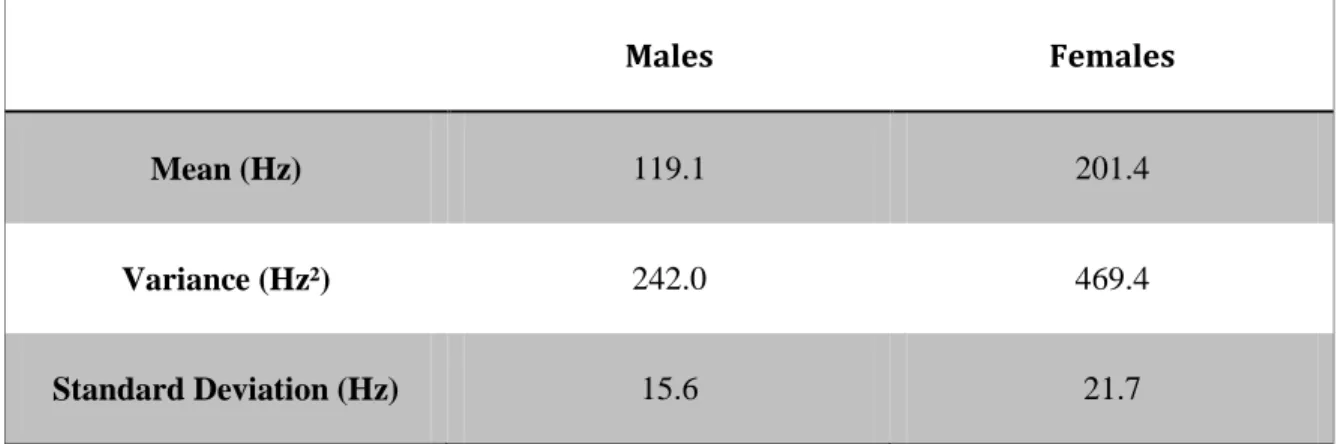
We fit normal distributions to the data, and the mean and variance calculated are shown in Table 3. Standard deviation is also determined from variance and shown in this table. Standard deviation lends itself to more intuition, as its units of Hz are easier to grasp and manipulate internally. The fit of the data is shown graphically in Figure 6 and appears to be well approximated by the normal distribution.
Males Females
Mean (Hz) 119.1 201.4
Variance (Hz²) 242.0 469.4
Standard Deviation (Hz) 15.6 21.7
80 100 120 140 160 180 200 220 240 260 0 0.005 0.01 0.015 0.02 0.025 0.03
Mean Pitch of Speaker
D e n s it y
Normal Fit to Speaker Pitch Distributions Male Data Female Data
Normal Fit for Male Data Normal Fit for Female Data
Figure 6. Normal distribution fitted to male and female mean pitch data.
3.2.2 Distribution of Variance
Next, we seek to characterize the variation in pitch found in our database. Irregular phonation has been found to have a „preferred role‟ as an indicator of silence, due to „the physical reality of managing vocal fold vibration. [1]‟ We believe that similar physical realities lead logically to the association of highly variable pitch with irregular phonation. The more quickly adjustments are made to the vocal folds and their surrounding supports and muscles, the greater the chance that the vocal folds will be, however briefly, in a position which makes it difficult to sustain regular phonation. Therefore, we quantify the variation in pitch found in our corpus.
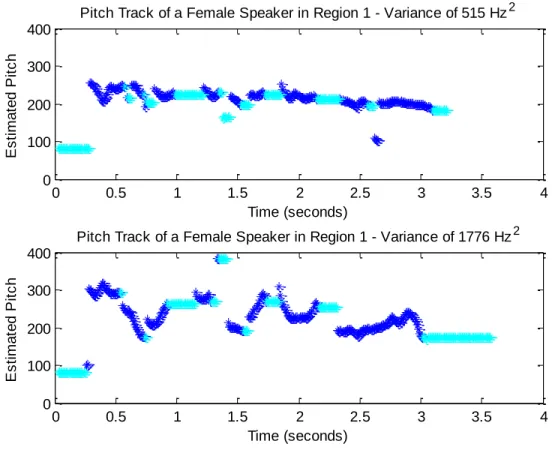
Variance, as a unit, can be difficult to grasp. To give a sense of the range of variance in our data, we present two example sentences in Figure 7. Both are versions of the sentence with the text “She had your dark suit in greasy wash water all year.” Each is produced by a different female speaker from the New England dialect region. The sentence which has a smoother pitch contour is measured to have a variance of only 515 Hz², whereas the distribution which shows more pitch
30
0 0.5 1 1.5 2 2.5 3 3.5 4 0 100 200 300 400 Time (seconds) E s ti m a te d P it c hPitch Track of a Female Speaker in Region 1 - Variance of 515 Hz2
0 0.5 1 1.5 2 2.5 3 3.5 4 0 100 200 300 400 Time (seconds) E s ti m a te d P it c h
Pitch Track of a Female Speaker in Region 1 - Variance of 1776 Hz2
Figure 7. Variance in Pitch Over a Single Sentence - Comparison Between Two Speakers. (The second
speaker is the same speaker used to generate the example or irregular phonation shown in Figure 4).
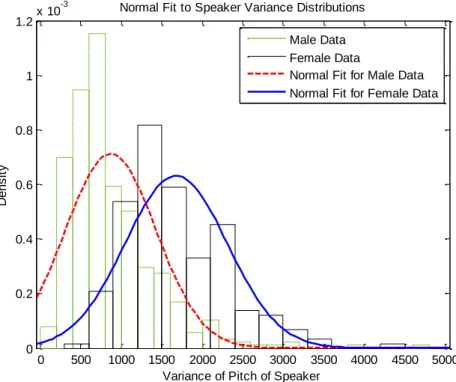
In Figure 8 we see the distribution of variance measured in the TIMIT population. We fit normal distributions to these male and female variance distributions. We report our results in Table 4 and display them graphically in Figure 9. The normal distribution fits less well in this case.
0 500 1000 1500 2000 2500 3000 3500 4000 4500 5000 0 20 40 60 80 100 120
Male Pitch Variance Distribution as Binned by Square-Root Method
Pitch Variance, Hz Squared
N u m b e r o f S p e a k e rs i n R a n g e 0 500 1000 1500 2000 2500 3000 3500 4000 4500 0 5 10 15 20 25 30 35 40 45
Female Pitch Variance Distribution as Binned by Square-Root Method
N u m b e r o f S p e a k e rs i n R a n g e
32
Table 4. Pitch variance distribution in TIMIT.
0 500 1000 1500 2000 2500 3000 3500 4000 4500 5000 0 0.2 0.4 0.6 0.8 1 1.2x 10 -3
Variance of Pitch of Speaker
D e n s it y
Normal Fit to Speaker Variance Distributions Male Data Female Data
Normal Fit for Male Data Normal Fit for Female Data
Figure 9. Normal distribution fitted to male and female variance data.
3.2.3 Overall Frequency of Irregular Phonation
Statistics have been reported on the frequency of irregular phonation in various populations. Generally these statistics do not cover a large group of individuals. Therefore, it is of interest to characterize our database in terms of overall propensity to irregular phonation.
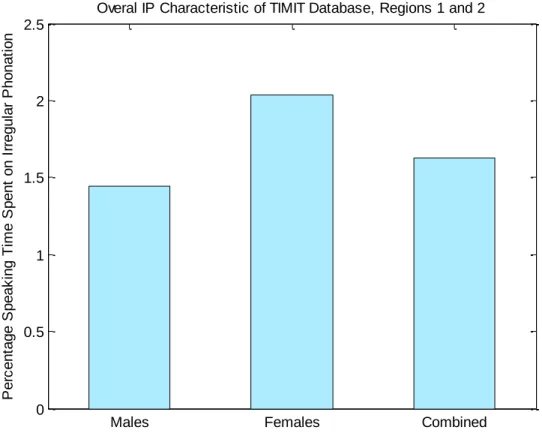
Based on the phonetic labeling of the TIMIT database and the extension of labeling of irregular phonation in regions 1 and 2 by Surana, [17] we were able to calculate the amount of time spent on production of irregular phonation, as a percentage of total time spent speaking. Results for regions 1 and 2 of the TIMIT database are shown in Figure 15. As seen there, females were observed to spend more time on production of irregular phonation than were males.
Males Females
Mean (Hz) 119.1 201.4
Variance (Hz²) 242.0 469.4
Males Females Combined 0 0.5 1 1.5 2 2.5 P e rc e n ta g e S p e a k in g Ti m e S p e n t o n I rr e g u la r P h o n a ti o n
Overal IP Characteristic of TIMIT Database, Regions 1 and 2
Figure 10. Percentage time spent on irregular phonation. This calculation uses dialect regions 1 and 2 of
the TIMIT database, due to the fact that they are fully labeled for occurrences of irregular phonation.
3.3 Summary
We chose to use the TIMIT Acoustic-Phonetic Continuous Speech Corpus in this work. We did so to maximize amount of data we had to work with while still maintaining the advantage of labeling. We found that the mean pitch for males and for females was roughly normally distributed, while the pitch variance for the genders was not. We found that irregular phonation occurred more frequently in female subjects‟ speech than in that of males.
Chapter 4
The Frequency of Irregular Phonation:
Dependence on Prosody
In Chapter 4 we probe the correlation between irregular phonation and readily measured aspects of prosody. We know that physical acts and circumstances (such as pulling the vocal folds apart for lax irregular phonation or pushing them together for tense irregular phonation) underlie the phenomenon. The physical requirements for irregular phonation may be met more frequently as people speak with different pitch and power patterns. Absolute pitch and power may be important because speaking in certain ranges of either may cause tensioning and placement of the vocal folds to require more or less precision. Variance in pitch and power is likely important because it requires adjustments. Whenever the configuration in the larynx is changing, its many components must simultaneously adjust, and on sum may pass through a state in which the vocal folds are not able to vibrate regularly. With these possibilities in mind, we investigate the relationship between irregular phonation and prosody. We begin by examining the effect of pitch (both mean and variance). We then conduct parallel experiments with power. Finally, we present a case study of irregular phonation which occurs at the end of an utterance (known as final creak.)
4.1 Average Pitch and Pitch Variance
It has been widely noted in the literature that the mean pitch of speech is related to the voice quality of the speech [20]. We probe this relationship with studies of how mean pitch and variance of pitch are related to the amount of speaker time spent on irregular phonation.
For each subject in district regions 1 and 2 of TIMIT, we calculated their average pitch during voiced segments (determined using a cutoff value of 0.75, as described in Chapter 2.) Using the same pitch points, we also calculated the variance of pitch among these speakers. We used all 10 sentences for each subject to determine their mean pitch and pitch variance, giving us approximately 30 seconds worth of data per subject. Using the prosodic labeling of irregular phonation provided by Surana, we computed the amount of time spent on irregular phonation and
36
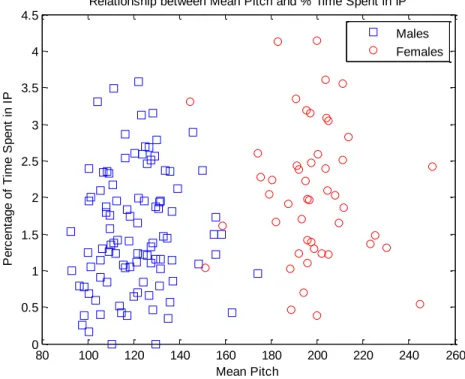
80 100 120 140 160 180 200 220 240 260 0 0.5 1 1.5 2 2.5 3 3.5 4 4.5 Mean Pitch P e rc e n ta g e o f Ti m e S p e n t in I PRelationship between Mean Pitch and % Time Spent in IP Males Females
Figure 11. Mean pitch and percentage time spent on irregular phonation. r=0.2598, p=0.0013.
0 5 10 15 20 25 0 0.5 1 1.5 2 2.5 3 3.5 4 4.5
Variance Normalized by Mean Pitch of Gender
P e rc e n ta g e o f Ti m e S p e n t in I P
Relationship between Variance and % Time Spent in IP Males Females
Figure 12. Pitch variance and percentage time spent on irregular phonation. r=0.3757 (p not calculated).
The variance measure for each speaker is divided by the mean pitch of the speaker‟s gender (119.1 Hz for males and 201.4 Hz for females) in order to make the values easier to compare across gender.
Figure 11 shows the average pitch of a speaker and the percentage of their speaking time they spend on irregular phonation. There are two main groupings in this graph, corresponding to male and female speakers. The correlation between mean pitch and percentage of time spent on irregular phonation is much stronger for the group as a whole than the equivalent for either gender group. The individual gender results have low r-values and the associated p-values are not low enough to make them statistically significant at the 95% significance level. The results for mean pitch versus amount of time spent on irregular phonation as a whole, on the other hand, boast a correlation coefficient of 0.2598. They are significant at the 95% level and beyond, with a p value of 0.0013. This seems to indicate that while mean pitch can be used to predict irregular phonation, it is more a proxy for gender than anything else.
The results of our comparison of variance with irregular phonation, displayed in Figure 12, show a strong relationship between the two. This is especially true for the population as a whole and for the combined population. The overall population has an r value of 0.3757 and is statistically significant at the 95% level. The male population has an r value of 0.4885 at the 95% significance level. The female population has an r value of .0805 but is not statistically significant.
4.2 Average Power and Power Variance
We next perform parallel experiment relating to power. We expect to find that the mean and variance of the amount of power measured in a speaker will be positively correlated with the percentage of time spent on irregular phonation. We expect the variance of power to be more strongly correlated than its mean, for two reasons. The first reason is related to our overall thesis: as mentioned previously, we speculate that a possible factor in generating irregular phonation is that the speaker moves to or through a configuration which naturally causes irregular phonation to have a greater likelihood of appearing. We expect this effect to be more substantial than the effect of the differential difficulty of controlling the vocal folds at different mean levels of pitch and power. The second reason has to do with experimental setup. We note that factors such as the distance to the microphone of each speaker were not rigidly controlled for in the recording of the TIMIT database. This means that the amount of power recorded cannot be directly measured and used as such. To control for such factors, we normalized each speaker‟s file by the maximum strength of the original signal recorded.
Our results are shown below. The male correlation measures were significant, but the female and combined measures were not. The mean power for males and the percentage of time the same males spent on irregular phonation were found to have a Pearson correlation coefficient of -0.1653, which was significant at the 90% level. The power variance for males and the percentage time the same males spent on irregular phonation were found to have a Pearson correlation coefficient of -0.2023, which was found to be significant at the 95% level.
38
0.4 0.6 0.8 1 1.2 1.4 1.6 1.8 2 2.2 x 10⁷ 0 1 2 3 4 5 6 7 8Relationship between Mean Power and % Time Spent in IP
Mean Power P e rc e n ta g e o f Ti m e S p e n t in I P Males Females
Figure 13. Mean power vs. percentage time spent on irregular phonation.
0.2 0.4 0.6 0.8 1 1.2 1.4 1.6 1.8 x 10¹⁵ 0 1 2 3 4 5 6 7 8
Relationship between Power Variance and % Time Spent in IP
Power Variance P e rc e n ta g e o f Ti m e S p e n t in I P Males Females
4.3 Pitch and Power Case Study: Utterance Final Irregular
Phonation
We next take a more in-depth look at prosodic effects on irregular phonation localized to a small part of a sentence. We limited this case study to a single location in order to decrease the number of potentially obfuscating variables. We chose to study final creak, a subset of irregular phonation which occurs specifically at the end of an utterance. We took baseline measurements, measures of pitch, power, and duration.
4.3.1 Baseline Measurements
We first took baseline measurements on the New England and Northern dialect regions of the TIMIT database. This grouping includes 102 males and 49 females, each of whom speak ten sentences, for a total of 1510 sentences. Of these, two sentences -- labeled in Figure 15 as sentences 1 and 2 -- are said in common among the speakers. Sentence 1 reads, “She had your dark suit in greasy wash water all year.” Sentence 2 reads, “Don‟t ask me to carry an oily rag like that.” We calculated that final creak occurred in 33% of the entire set of 1510 sentences. Females exhibited final creak more frequently than did males, with a significance level of 95%. See Figure 15. 10 20 30 40 50 60 70 80 90 100 rc e n ta g e o f S e n te n c e s E n d in g i n I rr e g u la r P h o n a ti o n
Frequency of Final Creak in TIMIT DR1 and DR2 Sent. 1 Sent. 2 Sents. 8-10 Sents. 1-10
40
We next studied pitch effects on sentence 1. We limited ourselves to a single sentence so that the majority of the pitch trajectories across the set of speakers would follow the same pattern. At the end of the word „year‟ in this sentence, most of their pitch slopes move downward approximately linearly. Therefore, instead of measuring pitch variance, we measured the pitch slope. We fit a first-order line to each subject‟s pitches. After determining the best line in a least squares sense, we examined the distribution of slopes for the group with final creak and for the group without final creak, irregular phonation which specifically occurs at the end of an utterance. We found that the subjects who exhibited final creak tended to have more highly sloped pitch trajectories as they approached the end of the sentence than did those who did not exhibit final creak. Figure 16 shows a cumulative distribution of the slopes for each group. Roughly 50% of the sentences with final creak, but only 20% of the sentences without final creak, showed a slope of -1 or less.
4.3.2 Pitch Slope
-4 -3 -2 -1 0 1 2 3 4 5 0 10 20 30 40 50 60 70 80 90 100 Slope P e rc e n t s e n te n c e s w it h s lo p e o f le s s t h a n o r e q u a l v a lu eComparison: CDFs of Pitch Slope
Final Creak NOT Present Final Creak Present
Figure 16. The cumulative distribution function for the approximated slope of the final word of the
sentence for cases in which final creak is and is not present. The blue curve indicates the cases in which final creak is not present; the red curve indicates the cases in which final creak is present.
We next examine the change in power and how it can be predictive of irregular phonation. Our work focused on one sentence recorded by 151 subjects: „She had your dark suit in greasy wash water all year‟. Approximately 20% of the subjects in our sample exhibited final creak at the end of the word „year‟.
4.3.3 Power Change
We next examined the movement of power for subjects who did and did not exhibit final creak. We expected the power trajectories to be more variable for speakers with final creak. We calculated the amount of power as a function of time for the last word („year‟) of each speaker. Then, we normalized the amounts of power (due to the fact that some speakers may have been positioned closer to their microphones) so that each speaker had the same amount of average power. We used the pre-existing phone labels provided with the TIMIT database to time-align the words as pronounced by different speakers. Each speaker began speaking at time 0, finished the vowel sound and moved on the „r‟ at time 1. We then average the results of all speakers who did and who did not produce irregular phonation, to form composite results, shown in Figure 17. These results support our intuition: The sentences ending in irregular phonation do have a greater „swing‟ in power over the last word of the sentence. The „typical‟ speaker‟s power dipped, peaked, and trailed off, regardless of whether they produced irregular phonation. But the typical producer of irregular phonation swings lower initially and peaks higher as they approach the end of the word. This shows that they would have a higher amount of calculated variance. We conclude that variance in power is associated with the production of final creak.
0 0.5 1 1.5 2 0 0.5 1 1.5 2 2.5 3 3.5 4
'Year' Time Adjusted such that 'r' begins at 1
N o rm a liz e d P o w e r
sentence with IPPs sentence without IPPs
Figure 17. The average power curves are shown for sentences with final creak (red) and without (blue).
These power curves span the final word a sentence, which is „year.‟ They are aligned in time such the final phone of the word begins at the same point, at adjusted time 1.
42
the phone „-y‟ for the „y‟ of the word, „ea‟ was alternately realized as „-ih‟, „-iy‟, or „-ix‟ and „r‟ was alternately pronounced as „-ax‟, „-ah‟, „-axr‟, -„er‟, „-ar‟, or „-r‟ as the phones were transcribed. Additionally, some speakers exhibited irregular phonation during the word and others did not. We calculated the amount of time each speaker spent on the three parts of the word. We plotted composite distribution functions for each piece of the word, showing the distribution of amounts of time spent by subjects who did and did not exhibit final creak. We calculated the amount of time spent on the „r‟ of the word in two ways. The first was time spent only on the phone associated with „r‟. The second included time spent on that phone and time spent on irregular phonation at the end of the word.
Figure 18 shows the composite results of the phone duration study. The distribution of time spent on the first and second phones of the word is similar for speakers who did and did not exhibit final creak. We see that if we choose to exclude irregular phonation from the phone associated with „r‟ the duration of the final phone tends to be much shorter for sentences with final creak. However, if we include it as an irregular component of the phone, there is little difference in phone length between the two types of utterances.
0 200 400 0 10 20 30 40 50 60 70 80 90 100 Time (ms) C D F o f Ti m e ( % o f s u b je c ts b ri e fe r th a n t im e ) CDF of 1st phone of year 0 200 400 0 10 20 30 40 50 60 70 80 90 100 Time (ms) C D F o f Ti m e ( % o f s u b je c ts b ri e fe r th a n t im e ) CDF of 2nd phone of year 0 200 400 0 10 20 30 40 50 60 70 80 90 100 Time (ms) C D F o f Ti m e ( % o f s u b je c ts b ri e fe r th a n t im e ) CDF of 3rd phone of year
Figure 18. The length of each phone of the word „year.‟ The first and second subplot, reading left to right,
show the first two phones of the word (roughly, „y‟ and „ea‟). The third subplot shows the length of the third phone including regular phonated parts only. The fourth subplot shows the length of the third phone including all phonation, regular or irregular.
4.3.5 Composite
Finally, we present a pair of examples in Figure 19 and Figure 20 which demonstrate the three experiments performed above: pitch slope, power trajectory, and phone length. We examine the word „year‟ as produced by two speakers, and overlay measures of pitch, power, and phone duration. 0 200 400 0 10 20 30 40 50 60 70 80 90 100 Time (ms) C D Fo f Ti m e ( % o f s u b je c ts b ri e fe r th a n t im e ) CDF of 1st phone of year 0 200 400 0 10 20 30 40 50 60 70 80 90 100 Time (ms) C D F o f Ti m e ( % o f s u b je c ts b ri e fe r th a n t im e ) CDF of 2nd phone of year 0 500 0 10 20 30 40 50 60 70 80 90 100 Time (ms) C D F o f Ti m e ( % o f s u b je c ts b ri e fe r th a n t im e ) CDF of 3rd phone of year
Comparing the two, we see that the best fit line for the pitches is more sloped for the sentence with final creak. We also see that there is a more dramatic drop in power at the end of the word in the sentence with final creak. Examining the phone lengths, we see that the result is heavily dependent on where we decide that the phone associated with „r‟ ends. If we say that the phone is finished when irregular phonation begins to occur, our measured duration for that phone is much shorter than if we say that it includes the irregular phonation which is occurring at the end of the sentence. 50 100 150 200 250 300 350 400 450 500 550 600 50 100 150 200 250 Time (ms) s m o o th e d m a g n it u d e 2 (b lu e ) m s (r e d ) H z (g re e n )
The final word ('year') of an utterance without Final Creak
pitches best fit line phone lengths power
Figure 19. Illustration of pitch, smooth power, and phone duration in the word „year‟ for specific TIMIT.
44
50 100 150 200 250 300 350 400 450 500 550 600 50 100 150 200 250 Time (ms) s m o o th e d m a g n it u d e 2 (b lu e ) m s (r e d ,p u rp le ) H z (g re e n )The final word ('year') of an utterance with Final Creak
pitches best fit line 'axr' 'q' phone lengths power
Figure 20. Illustration of pitch, smooth power, and phone duration in the word „year‟ for a specific TIMIT
case. „axr‟ refers to the phonated portion of the „r‟ in „year‟ and „q‟ refers to the irregularly phonated portion.
4.4 Summary
In this chapter, we have shown several relationships between irregular phonation and prosody. We have shown positive correlations between irregular phonation and mean pitch, pitch variance, mean power, and power variance. We have examined final creak specifically, looking in detail at the pitch tracks, power tracks, and phone durations within the last word of utterances which do and do not exhibit final creak. We conclude that greater variance in both pitch and power is related to the exhibition of irregular phonation.
Chapter 5
The Nature of Irregular Phonation
In Chapter 5, we examine the properties of individual instances of irregular phonation. We focus on the amount of spacing between individual pulses and the heights of those pulses. We investigate the relationships between these measures and the average and variance of pitch and power for our entire database, finding four several significant correlations. Finally, we conclude Chapter 5 with a look at how location within a word is related to the nature of the irregular phonation produced.
5.1 The Characteristic Spacing
We first examined the „usual‟ spacing found in irregular phonation. We determined the average pitch, variance of pitch, average power, and variance of power as described previously. We detected the location of pulses (e.g., glottal closings) using two methods. One was an implementation of the Minimum Entropy Deconvolution (MED) method. Another was a fusion method. The fusion technique is currently being developed at MIT Lincoln Laboratory. The method combines a variety of different state-of-the-art pulse-time detectors, such as those based on inverse-filtering (e.g., MED [4]) and linear-phase-estimation [27]. We concluded that use of the fusion method provided more accurate pulse locations and therefore more reliable correlation results. Figure 21 shows through scatter plots the relationship between speakers‟ average pitch and average spacing of pulses in irregularly phonated regions of speech, as calculated with the MED and fusion methods, respectively. Regions 1 and 2 of the TIMIT database were used. By switching to the more accurate fusion method, we were able to improve our onset detection and correspondingly our Pearson correlation coefficient (from 0.049 to -0.230).Using this method, we found the spacing between individual glottal pulses and calculated the maximum inter-pulse spacing for each episode of irregular phonation.
Figure 22 shows the distribution of maximum spacing over all episodes of irregular phonation labeled in our database. They are color-coded by gender and region, and displayed along a pitch scale. Maximum spacing is a useful characteristic because it is has been posited that a pitch of