Effect of Titania and Zinc Oxide Particles on Acrylic Polyurethane Coating Performance Sudeshna Saha, Duygu Kocaefe
*, Cornelia Krause, Tommy Larouche
Université du Québec a Chicoutimi, Canada
555, boul de l’Université, Chicoutimi Québec Canada G7H 2B1
* [email protected] Ph No: 1-418-5455011 (5215)
Fax No: 1-418-5455012
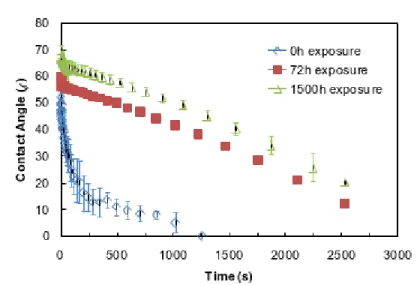
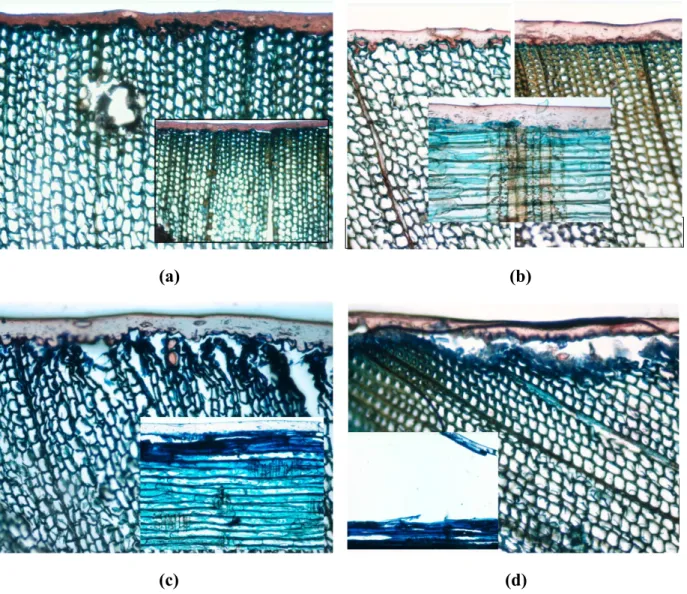
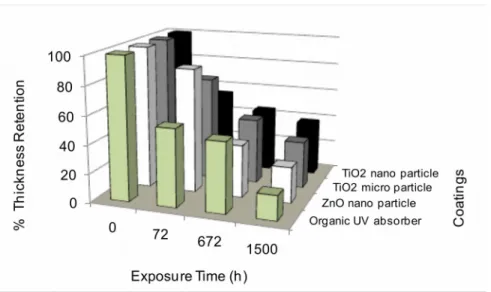
The outer environment, especially UV portion of solar radiation and water (in the form of moisture or rain) has an adverse effect on the surface appearance of heat-treated wood. Exposure to UV triggers the chain scission reactions which change the intrinsic properties of heat-treated wood and discoloration of wood surface. Repeated temperature and humidity variations cause swelling and shrinking of wood surface, which consequently creates cracks and fissures exposing wood’s sub superficial layers to atmospheric agents. Therefore, wood industries move towards the development of coatings in order to protect the heat-treated wood while retaining wood’s natural look. Water based acrylic polyurethane coatings are highly efficient, non toxic and durable coatings with upgraded film properties. In this study, an attempt is made to improve the performance of these coatings by incorporating natural antioxidant (bark extract) and inorganic UV absorbers (nano and micro titania and nano zinc oxide) into the coatings. The main objectives of this study are to investigate the wetting and penetration characteristic of these new coatings on the wood surface and to study coating thickness variation with weathering time. The Sessile-drop method and fluorescence microscope are used for this investigation. The wettability of different coatings applied to heat-treated jack pine early wood and late wood is compared. The results show that there is a significant difference between the contact angle of early wood and late wood for acrylic polyurethane coating containing titania micro particles. The contact angle between water and coated wood surface reveals that the degree of orientation of the coating materials increases as the weathering time increases. The penetration characteristics of all the three coatings are found to be very poor. In addition, the relationship between the coating thickness and the UV exposure time are studied for three different water based acrylic polyurethane coatings. It is found that the coating thickness decreases with increasing weathering time and a tissue deformation beneath the coating surface takes place during weathering.
Key Words: Weathering, Heat-treated jack pine, Acrylic polyurethane coating, Wetting,
Fluorescence microscopy, Titania and zinc oxide particles.
1. Introduction
Heat-treated wood is a new value added product with improved biological resistance, dimensional stability, and an attractive darker color [1-4]. Changes in the intrinsic properties of heat-treated wood as a result of exposure to outer environment especially to UV portion of solar radiation and water (in the form of moisture or rain) often cause serious problems in appearance of the surface due to the occurrence of chain scission reactions. Moreover, the repeated temperature and humidity variations of the ambient environment subject the wood to wet and dry cycles which result in swelling and shrinking, consequently, creates cracks and fissures [5-12].
These in turn lead to the exposure of the wood’s sub superficial layers to atmospheric agents and the progressive degradation of the wood surfaces and sub surfaces. These facts forced wood industries to move towards the development of a non toxic transparent coating for UV protection of heat-treated wood [7, 13]. Coating selection for exterior use often requires a balance between aesthetic (clear coatings) and protection (colored coatings) for a particular application. Water based acrylic polyurethane coatings are highly efficient, non toxic and durable with upgraded film properties [14-16] and applied widely in the recent years due to growing environmental concerns. Though the polymer itself is non toxic and durable in outer environment, incorporation of UV absorbers and HALS is necessary for the development of transparent coatings which most of the time are toxic in nature. Increasing pressure of the environmental legislation to reduce the VOC content of the coatings has compelled the development of non toxic organic and inorganic UV absorbers. Among the inorganic UV absorbers titanium dioxide and zinc oxide have a long history of color protection [17-19]. The natural antioxidant (bark extract) on the other hand is a new additive and no information was found in the literature citing their application as coating additive and their effectiveness in prevention of wood discoloration. The effect of natural antioxidant in prevention of wood coloration is the subject of another paper [20]. In this study, an attempt was made to improve the performance characteristic of acrylic polyurethane by incorporating them with a natural antioxidant (bark extract) and inorganic UV absorbers (nano and micro titania and nano zinc oxide). In order to assess the performance of these modified coatings, it is necessary to study their wetting and penetration characteristics into wood and changes occurring at the wood and coating interface due to weathering induced by UV.
The service life (durability) of coated-wood surface depends on the chemical composition of coating material, properties of the wood surface (type of species, early wood and late wood region, sap wood or heart wood etc) and the interaction between the coating materials with the wood at their interface [21-23]. This interaction is primarily reflected in the wetting and spreading of the coating material over the wood surface during its application and it determines the contact area and smoothness of the coating layer.
The fluorescence microscope is a very important tool to determine the penetration characteristic of different coatings into wood cells. The penetration behavior is well correlated with the adhesion performance of coatings to the wood surface. Also, the changes in the wood-coating interface taking place due to weathering can be characterized using fluorescence microscopy.
This analysis gives valuable information on the interaction between wood and coating [23]. In
this paper, the effects of additives on the wetting and penetration characteristics of polyurethane
coating and on the wood degradation due to weathering are presented. The coating thickness
change with the increasing weathering time is also discussed.
2. Materials and Methods
2.1. Wood Surface Preparation
In this study, commercially available heat-treated (210°C) jack pine wood has been used for all the tests. The wooden boards with tangential surfaces were randomly chosen from the lot obtained from ISA industry. The wooden panels were then planed followed by sawing.
2.2. Preparation of Coatings
The acrylic-polyurethane coating was used as a base during the present study. This coating was modified using different additives such as organic antioxidant (bark extract), inorganic UV absorbers (micro titania particles obtained from Sigma Aldrich, nano titania and nano zinc oxide obtained from MK Nano). Alone or different combinations of these additives were utilized. The formulations of different coatings are presented in Table1.
Table1 Summary of the composition of the four coating formulations
Composition Coatings
A B C D
Other components √ √ √ √
Inorganic UV absorbers none Titania micro particles<5µm
Titania nano particles~50nm
Zinc oxide nano particles~30nm Organic UV absorber
and HALS
√ √ √ √
Natural Antioxidant none √ √ √
2.3. Accelerated Weathering Test
28 jack pine samples were coated with two layers of the coatings tabulated in Table1. Seven samples were prepared for each coating. 6 of these samples were exposed to accelerated weathering test and one sample for each coating was kept as a reference. The reference samples were protected from the light exposure.
Accelerated weathering test was conducted in Atlas Xenon Weather-Ometer (with a daylight filter,
irradiation 0.35W/m2 at 340nm, BPT 63±3
◦C and continuous light cycle with 102min light and 18 min
specimen spray with light). All the above mentioned samples were exposed to UV light for different time
span with maximum exposure time of 1500h. A sample for each coating was taken out after 72h, 168h,
336h, 672h, 1008h and 1500 h exposure.
2.4. Contact Angle Tests
The contact angle tests were performed using FTA200 sessile-drop system. FTA200 consists of a measurement platform and a frame grabber (video capture) card and a computer. With the help of a computerized syringe pump, 15µL drop of a desired liquid was placed on the wood sample and the images were captured using high resolution camera for a predetermined time. The contact angle measurement of liquid/wood system and data analysis was carried out using the image analysis software FTA32. All the contact angle experiments were carried out at room temperatures. In this study, only tangential surface of wood was examined and the contact angle experiments were executed along the veneer grain direction in order to study the affinity of the coatings towards tangential surface of heat-treated jack pine. The contact angles of water and coated jack pine surface were also measured before and after weathering. The surface tension of the liquid coatings was measured by pendant drop method using the FTA32 software. At least 6 measurements were carried out for each coating.
2.5. Fluorescence Microscopy Test
For fluorescence microscopy tests, 2cm×2cm×1cm blocks were sawn from the wood specimens before and after they are subjected to accelerated weathering test. Then, they were immersed in water for at least an hour in order to soften the surface prior to microtoming. After, 15µm thick sections were cut perpendicular to the surface by using sliding microtome in the region of wood- coating interface in both axial and radial directions. The staining of sections was performed in the following manner. All sections were stained with a 0.5% aqueous solution of Toluidine Blue to enhance the contrast of the wood tissue. To examine the depth of penetration and the pattern of distribution of the coating, sections were also stained with 1% Sudan IV solution prepared in 95% ethanol [24]. The resulting turquoise color of the wood cell walls contrasts well against the red color of the coating. Stained sections were mounted in glycerol on a glass slide and examined with a polaroid digital microscope consisting of a Nikon eclipse 600 camera with various zoom lenses. The coating thickness was measured from the light micrographs of radial sections using Wincell software and at least 30 measurements were carried out to find the average thickness of the coating.
3. Results and Discussions
3.1. Wetting of Wood Surfaces by Coatings Materials
The contact angle measurements of coating materials on the wood substrate are essential for understanding the adhesion, spreading and penetration characteristics of coatings [25]. As reviewed by Rijckaert et al. [21] the bulking effect of the coating polymers in the cell voids and cell wall structure may improve the dimensional stability, check resistant of the wood surface and penetration of the paint into the wood rays and cell lumens provides some mechanical strength to the wood.
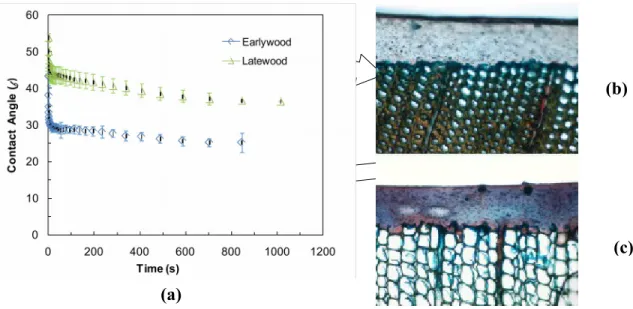
Figure 1 compares the early wood and late wood dynamic contact angles for the acrylic polyurethane coating containing bark extract and titania micro particles. Late wood has a higher contact angle at all the times compared to that of the early wood. The porosity (big cell lumen and thin cell wall) of the early wood region is higher than that of the late wood region (thicker cell wall and smaller cell lumen). Higher porosity results in larger contact area between coating material and early wood which leads to better wettability, consequently, lower contact angle (Figure 1(a)). The wettability manifests itself not only through penetration of the liquid into the substrate and the spreading of the liquid on the substrate. The spreading on the early wood region is faster than the spreading on the late wood region. In order to comprehend the penetration characteristic of this coating, the images were taken using a fluorescence microscope in early and late wood regions along the wood-coating interface. Figures 1 (b) and (c) show that the penetration into both early wood and late wood regions is poor but there is good adhesion between cell wall and the coating for both. While there is one or two cell layer penetration in early wood region almost no penetration is observed in late wood region.
(a)
Figure 1 Acrylic polyurethane coating containing bark extract and titania micro particle (a) comparison of contact angle change with time on early wood and late wood regions; penetration characteristic of (b) late wood (c) early wood jack pine studied with fluorescence microscope
(b)
(c) coating
coating
(a)
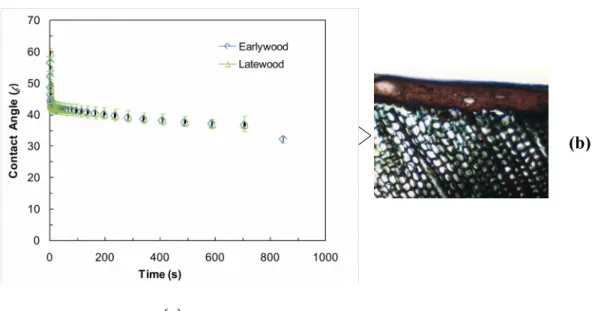
Figure 2 Acrylic polyurethane coating containing bark extract and titania nano particles (a) comparison of contact angle change with time on early wood and late wood regions; penetration characteristic of (b) early wood jack pine studied using fluorescence microscope
No considerable difference in dynamic contact angles was observed between early wood and late wood regions coated with the acrylic polyurethane coating containing bark extract and titania nano particles (Figure 2 (a)). Spreading was also similar on both early wood and late wood jack pine for this coating. This is probably due to the presence of nano particles. Fluorescence test results show low penetration in the early and late wood region for both coatings. This is in agreement with the results of wetting test (Figure 2(b)).
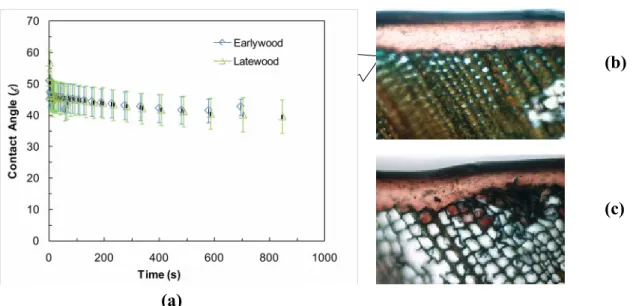
Also, there wasn’t any significant difference in the dynamic contact angles of early wood and late wood jack pine and the acrylic polyurethane coating containing bark extract and zinc oxide nano particles (Figure 3(a)). However, the initial contact angle was higher in late wood region compared to that of the early wood region. The difference in the penetration characteristic of this coating in late wood and early wood regions is clearly shown in Figure 3 (b) and (c). The coating penetrates up to 4-5 cells in the early wood region but there is almost no penetration in the late wood region. Penetration results seem to be in conflict with the contact angle test results.
As already mentioned above, the contact angle depends not only on the penetration but also on spreading. There is almost no spreading on early wood whereas spreading is very high for late wood for this coating. This might explain the observed contrast between the contact angle and penetration data.
(b)
coating
(a)
Figure 3 Acrylic polyurethane coating containing bark extract and zinc oxide nano particles (a) comparison of contact angle change with time for early wood and late wood region; penetration characteristic of (b) late wood (c) early wood jack pine studied using fluorescence microscope The only difference between the three coatings is the size and type of the incorporated nano particles. The overall comparison of the contact angle, penetration and spreading characteristics of these three coatings revealed that the coating containing titania micro particles wetted the surface most and coating containing zinc oxide nano particle containing wetted the surface least.
This can be directly related to the surface tension results (Figure 4) obtained for these coatings.
The lowest surface tension was measured for coating containing titania micro particles whereas highest surface tension was measured for coating containing zinc oxide nano particles. Although the highest penetration in the early wood region was observed for the coating containing zinc oxide nano particles compared to those of the coatings containing titania particles (micro and nano), the spreading of the former coating was found to be less comparatively less due to higher surface tension resulting in the highest contact angle at all times compared to the contact angles measured using other coatings.
(b)
(c) coating
coating
0 10 20 30 40
IFT (dyne/cm)
Different Coatings
28.80 29.50 29.78
Titania<5micron Titania-50nm ZnO-30nm