
Publisher’s version / Version de l'éditeur:
Journal of the Acoustical Society of America, 100, 2, pp. 889-898, 1996-07-01
READ THESE TERMS AND CONDITIONS CAREFULLY BEFORE USING THIS WEBSITE. https://nrc-publications.canada.ca/eng/copyright
Vous avez des questions? Nous pouvons vous aider. Pour communiquer directement avec un auteur, consultez la première page de la revue dans laquelle son article a été publié afin de trouver ses coordonnées. Si vous n’arrivez pas à les repérer, communiquez avec nous à [email protected].
Questions? Contact the NRC Publications Archive team at
[email protected]. If you wish to email the authors directly, please see the first page of the publication for their contact information.
NRC Publications Archive
Archives des publications du CNRC
This publication could be one of several versions: author’s original, accepted manuscript or the publisher’s version. / La version de cette publication peut être l’une des suivantes : la version prépublication de l’auteur, la version acceptée du manuscrit ou la version de l’éditeur.
Access and use of this website and the material on it are subject to the Terms and Conditions set forth at
Some effects of orchestra shells
Bradley, J. S.
https://publications-cnrc.canada.ca/fra/droits
L’accès à ce site Web et l’utilisation de son contenu sont assujettis aux conditions présentées dans le site LISEZ CES CONDITIONS ATTENTIVEMENT AVANT D’UTILISER CE SITE WEB.
NRC Publications Record / Notice d'Archives des publications de CNRC:
https://nrc-publications.canada.ca/eng/view/object/?id=d866ed14-705d-45d1-ac47-322bc52420b6 https://publications-cnrc.canada.ca/fra/voir/objet/?id=d866ed14-705d-45d1-ac47-322bc52420b6http://www.nrc-cnrc.gc.ca/irc
Som e e ffe c t s of orc he st ra she lls
N R C C - 3 9 0 3 6
B r a d l e y , J . S .
J u l y 1 9 9 6
A version of this document is published in / Une version de ce document se trouve dans:
Journal of the Acoustical Society of America,
100, (2), pp. 889-898, July 01,
1996
The material in this document is covered by the provisions of the Copyright Act, by Canadian laws, policies, regulations and international agreements. Such provisions serve to identify the information source and, in specific instances, to prohibit reproduction of materials without written permission. For more information visit http://laws.justice.gc.ca/en/showtdm/cs/C-42
Les renseignements dans ce document sont protégés par la Loi sur le droit d'auteur, par les lois, les politiques et les règlements du Canada et des accords internationaux. Ces dispositions permettent d'identifier la source de l'information et, dans certains cas, d'interdire la copie de documents sans permission écrite. Pour obtenir de plus amples renseignements : http://lois.justice.gc.ca/fr/showtdm/cs/C-42
Sdme effects of orchestra shells
J.
S. BradleyInstitute for Research in Construction, National Research Council, Montreal Road, Ottawa KIAOR6,
Canada
(Received 26 May 1995; revised 22 March 1996; accepted 26 March 1996)
This paper presents room acoustic measurements of the effects of adding or modifying an orchestra shell in several halls. The average effects, at audience seats, of adding an orchestra shell in three large multipurpose halls were small but within predicted ranges. At mid- and high frequencies, partial shells produced intermediate results. However, at lower frequencies more complex effects were observed, because the addition of an orchestra shell modified the grazing incidence seat dip attenuation. 'These effects depended on the geometry of the shell and on the reCeiver position in the hall. On-stage measurements of support were increased by approximately 5 dB with the addition of an orchestra shell. Although orchestra shells had much larger effects on-stage, they were also found to produce significant audible effects at audience seats.
PACS numbers: 43.55.Gx, 43.55.Fw, 43.55.Hy [JDQ]
INTRODUCTION
Modem performing arts facilities in all but the largest cities are usually required to accommodate a variety of types of performances. Typically this requires a large conventional proscenium arch stage for performances of opera, ballet and theatre. An orchestra shell is then often added to adapt the hall to the needs of orchestral music. These shells can take various forms from little more than a reflecting wall at the proscenium, to almost complete enclosures around the or-chestra. An orchestra shell is most necessary to provide ac-ceptable acoustical conditions on-stage for the musicians. However, orchestra shells also modify the acoustical condi-tions experienced by the audience in the hall.
Despite the widespread use of orchestra shells, there is little published information on their acoustical properties. One early paperl discussed some practical aspects ofッイ」ィ・ウセ tra shell design. Rinder s2 work on reflector arrays could help to explain some aspects of the reflecting properties of shell ceiling components.
This paper reports acoustical measurements of the ef-fects of adding an orchestra shell in a number of halls. Al-though most of the results describe conditions at audience seats, measures of the effects of orchestra shells on support values, measured on-stage, are also included. The first sec-tion of this paper compares the average effects of adding orchestra shells in three large multipurpose halls. The fol-lowing. section examines how some of the effects of adding an orchestra shell vary throughout the audience seating area. Following this the measured effects of modifications to or-chestra shells are examined. Finally, the on-stage changes of acoustical conditions due to the addition of an orchestra shell are considered in terms of measured support values.
It is intended that this paper will provide useful quanti-tative data for estimating the effects of other orchestra shells. It is hoped to encourage others to perform further measure-ments of the acoustical properties of orchestra shells that . could be usefully compared with the present results. This process will hopefully lead to the refining ofdesignsto pro-duce more effective orchestra shells.
I. AVERAGE MEASURED EFFECTS AT AUDIENCE SEATS IN THREE LARGE MULTIPURPOSE HALLS
Detailed room acoustic measurements were made in three large mUltipurpose halls both with and without an or-chestra shell in place. Measurements were made using the combinations of three source positions and between ten and 14 receiver positions. That is, a total of between 30 and 42 measurements were made in each hall for conditions with and without the orchestra shell present.
The three halls were the Alberta Jubilee Auditorium in Edmonton (JUB), the Opera of the National Arts Centre in Ottawa (NACO), and Salle Wilfrid Pelletier in Montreal (SWP). Some details of these halls are given in Table I. The orchestra shells in the three halls were quite different in con-struction and are illustrated in the sketches of Fig. 1. They are intended to represent the full range of possible shell con-figurations from little more than a proscenium wall (NACO) to an almost complete enclosure (SWP).
The Alberta Jubilee Auditorium shell was a relatively lightweight general purpose shell. It included both wall and ceiling panels, but there were considerable gaps between the panels. The shell enclosed approximately the rear 2/3 of the orchestra. The shell in the Opera of the National Arts Centre consisted of seven massive towers and a light weight ceiling piece designed specifically for this hall. There were also three side pieces on either side of the stage that could be rotated but were not moved in these studies. The shell was quite effective at separating the hall from the back stage area. It can be described as more of a wall at the proscenium opening than an enclosure around the orchestra. The shell in the Salle Wilfrid Pelletier was an even more substantial con-struction and formed a quite distinct enclosure in which the orchestra was located. The wall sections were hydraulically raised from below the stage floor and the large ceiling sur-face was hinged down from the rear wall of the stage. There were no significant gaps in the shell.
Although the structural components of the three shells were quite different, the weight of the surface materials were
YABLE I: Details 'of the halls. (*RT measured with shell in place, aRT measured for' the large reflective condition, LR.)
Volume,ュセ
Number Mid-frequency Hall Symbol Hall Stage of seats RT(5oo.1000 Hz),S
Salle Wilfrid
Pelletier SWP 32100 17300 2982 1.95* Alberta Jubilee
Auditorium JUB 21500 12150 2730 1.63* National Arts
Centre Opera NACO 20000 28500 2300 1.71* Aicd Recital
Hall AIRD 3000 352 l.80a
Centre Pointe Theatre C.Pointe 5100 3600 986 1.19*
3r---,
0 ...- - - ' - - - - ' - - - " - -...- -... 125 250 500 1000 2000 4000Frequency, Hz
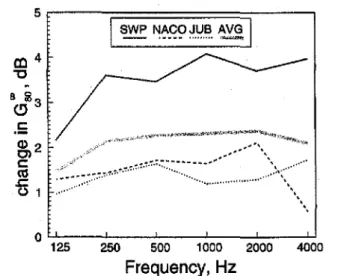
(1) FIG. 2. Hall-average changes in total relative level (G) values with the addition of an orchestra shell for the three large multipurpose halls and the overall average change (AVG).hall, and greatly changes the effective volume of the room. One can simply explain the expected changes in sound levels in the hall, with the addition of an orchestra shell, in tenns of the portion of the sound radiated by the source that directly strikes the orchestra shell. When the shell is present, the sound striking the shell is reflected back into the hall with an amplitude reduced byRs , the effective reflection coefficient of the shell (i.e., Rs includes the effects of gaps in the shell pieces as well as the reflective properties of the shellュ。エ・セ rial). When the shell is removed, one can assume that almost all of the sound energy that would have struck the shell will pass back stage and be absorbed. Thus the expected change in relative sound levels is given by
where Fh and Fs are the fractions of the sound energy radi-ated by the source that initially strike the hall and shell, respectively,
If the source is close to the proscenium then Fh"'"Fs . For this case, and if the shell is perfectly reflective(Rs= 1), then Eq. (1) above would indicate a 3·dB increase in sound levels. As the source moves out in front of the proscenium, Fhbecomes larger thanFs•Real orchestra shells will not be perfect reflectorsandRs will be less than 1. Where there are
large gaps between the pieces of the shell, such as in the Alberta Jubilee Auditorium, thenRs will be much less than
1. These simple arguments suggest that an upper bound to the expected effect of adding an orchestra shell would be a 3-dB increase in sound levels in the hall. Estimates, using Eq. (1), of the effects in the three large multipurpose halls suggest increases of approximately 1 to 2 dB.
Figure 2 plots the average change in overall G values in the three halls due to the addition of an orchestra shell. (G values are measured sound levels relative to the level of the same source at a distance of 10 m in a free field.) Also shown is the average change for all three halls. On average, mid-frequency G values changed by 1.4 to 2.2 dB. Thus the av-erage changes in these halls are less than the suggested 3-dB upper bound for level changes and similar to the expected
=E:::::::=:::::::::========::F
JUS
SWP
NACO
quite similar. Neglecting the supporting frame material all three shells had surface materials with surface densities of approximately 8 kgm1m2•
A. Relative sound levels
The effect, at audience seats, of adding an orchestra shell can most simply be examined in tenns of relative sound levels. Typically the volume of the stage house is similar to or a little smaller than the volume of the hall. Adding the orchestra shell usually separates. the stage house from the
FIG. 1.Sketches of removable orchestra shells in three large multipurpose halls: Salle Wilfrid Pelletier (SWP), the Opera of the NationalArtsCentre (NACO), and the Alberta Jubilee Auditorium (JUB). The shaded areas are the removable parts of the shells.
OU--_l-....-_....J.-_ _..L-_--I._ _....L.J
125 250 500 1000 2000 4000
Frequency
IHz
FIG. 5. Hall-average changes in late arriving relative level HgセッI values with the addition of an orchestra shell for the three large multipurpose halls and the overall average change (AVO).
5r--;::=====::::;----,
I
セ
AGAセᆪYセNセNセN
セL
I
J. S. Bradley: Some effects of orchestra shells 891
HgセoI values are increased by an average of about 1 dB in these halls. The rank ordering of these increases among the
three halls is different than for the total G values in Fig. 2. In fact the hall that provided the largest increase in G values (Salle Wilfrid Pelletier) produced the smallest increase in early sound levelgセッ values. This is because the increases in
HgセッI values are related to the construction of the shell (as
are G values), and also to the geometry of the shell and the audience seating locations. That is, the shell must have sur-faces that are positioned to provide useful strong reflections at the measured audience seat locations to significantly in-crease early sound levels.
The increases in late arriving relative sound level(G;o)
values shown in Fig. 5 are seen to vary more among the three halls. Two of the halls show similar increases of 1 to 1.5 dB while the third hall indicates a mid-frequency increase of about 4 dB. Late sound levels will be influenced by the rela-tive amounts of sound absorption associated with the stage and the hall. We can expect shells that direct strong reflec-FIG. 4. Hall-average changes in early arriving relative levelHgセッI values with the addition of an orchestra shell for the three large multipurpose halls and the overall average change (AVO).
125 250 500 1000 2000 4000
Frequency
IHz
In "'02 15 ..C!:l
.S
(1)1g>
as
..c CJo
Image o Source•
Hall891 J.Acousl. Soc. Am., Vol. 100, No.2, Pt. 1, August 1996 Stage
FIG. 3. Simplified section of a hall and orchestra shell to illustrate the effect of a reflection represented by an image source.
changes. The least substantial shell with the most gaps, in the Jubilee Auditorium, produced the smallest increases in G values and particularly so at low frequencies. The most sub-stantial shell, in Salle Wilfrid Pelletier, produced the largest changes in sound levels. On average these results suggest that the addition of an orchestra shell in a large multipurpose hall will increase mid-frequency sound levels by 1.5 to 2 dB. A 3-dB increase in sound levels is sometimes described as being equivalent to doubling the size of the orchestra. To parallel this analogy, the 1.5- to 2-dB increases are approxi-mately equivalent to a 50% increase in the size of the orches-tra. Although the increases of G values vary with frequency, the magnitude of the variations with frequency are quite small and hence the addition of these shells would not be expected to greatly change the timbre of the sound in the hall.
The early and late arriving components of sound in a hall have quite different subjective effects and it is of interest to examine them separately. Here the division between early and late is taken to be 80 ms after the arrival of the direct sound. Orie can approximately estimate the effect of the shell on the early sound by considering the effect of each surface of the shell to be represented by an image source. As illus-trated for the rear wall of a shell in Figure 3, the sound from this image source arrives after the direct sound and is smaller in amplitude than the direct sound. In total we can expect the reflected early sound added by the shell to be lower in level than the sound propagating directly out into the hall. The magnitude of the reflected sound at a particular location will depend on the geometry of the shell and whether the shell directs reflections to that location. Of course the shell will not be perfectly reflecting and the reflected sound will be weaker because of the extra distance travelled by the re-flected sound. Thus early sound level increases are expected to be substantially less than 3 dB.
Figure 4 shows the average measured changes in the three large halls. Mid-frequency early relative sound level
...
セセ
o
LLセLQヲイ'..
..,.... ,...".".,....
\ィLL[LL\NLZGセLセZセ7
,.,.'..
"-セ 0.3.5
Q) C)fa
.c:
(,,) -0.3 '-'-_---J_ _--L._---JI.-_--L._ _.L.J 125 250 500 1000 2000 4000Frequency, Hz
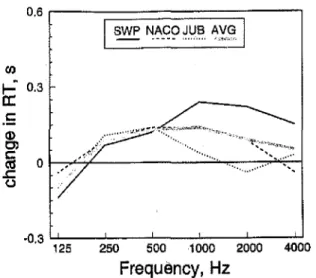
FIG, 6, Hall-average changes in reverberation time (RT) values with the addition of an orchestra shell for the three large multipurpose halls and the overall average change (AVG).
tions to .the audience to provide increases in early sound levels. However, shells that form separate enclosures will lead to multiple reflections within the shell before the sound energy is reflected out to the audience. Such shells will tend to produce greater increases in late arriving sound levels and lesser increases in early sound levels. The shell in SWP is clearly an example of this type of shell, and in this hall late sound levels increased more than in the other two halls.
Itis also interesting to note that Barron's revised theory of sound propagation in halls3indicates that late sound levels are more sensitive to changes in reverberation time and room volume than early or total relative sound levels. Barron's revised theory suggests that late sound levels vary approxi-mately as 20 times the logarithm of the ratio ()f reverberation time to room volume. This again indicates that adding an orchestra shell may most effect the late arriving sound levels at audience seat locations.
B. Decay times and energy ratios
One can most simply predict the effect of adding an orchestra shell on reverberation times as due to changing the proscenium opening from perfectly absorptive to perfectly reflective. That is, without an orchestra shell one can con-sider, that to the acousticalーイッー・イエゥセウ of the hall, the prosce-nium opening acts like an absorbing surface and essentially all of the sound energy passing through from the hall to the stage does not return. (This assumes some absorption mate-rial such as curtains is present on stage.) Conversely, when the orchestra shell is in place, essentially all of the sound energy in the hall is reflected back from the orchestra shell and cannot travel to the backstage area.
Using this simple explanation one can estimate an ex-pected change in RT values on adding an orchestra shell in these three large multipurpose halls. The average total sound absorption in these halls at mid frequencies is approximately 2200 m2and the proscenium opening is about 200 m2in area (see data in Table I). Thus one would expect that adding an orchestra shell would decrease the total absorption and hence increase the reverberation time (RT) by about 9%. This cor-responds to an approximately 0.15-s change in mid-frequency RT values for these halls. The average measured changes in RT values shown in Fig. 6 confirm that this is a reasonable estimate of what actually occurs. Mid-frequency RT values tended to change by slightly less than: 0.15 s when an orchestra shell was added.
At low frequencies the addition of an orchestra shell tended to decrease RT values rather than to increase them. tィゥウセウ assumed to be due to the orchestra shell being an ・セ・」エNャv・ sound absorber at low frequencies. At high frequen-CIes the results are more varied because of the different amounts of sound absorption contributed 'by curtains and other backstage materials. in the. three halls, as well as the differences in shell constructions. High-frequency RT values were changed least in JUB probably because the large gaps . between the shell pieces made it a less effective reflector at thes.e frequencies. High-frequency RT increases were great-est10 SWP where the shell formed a more complete enclo- .
sure with no gaps. The relative amount of backstage
absorp-892 J.Acoust, Soc. Am., Vol. 100, No.2, Pt. 1, August 1996
tion would also influence these changes but unfortunately was not measured.
Figure 7 shows the average changes in early decay time (EDT) values in the three halls when an orchestra shell was added. These results show a similar pattern to the RT values except that the changes are more varied at higher frequen-cies. These results indicate that the presence of absorbing material on-stage can have a significant effect on higher-frequency EDT values and adding an orchestra shell can in-crease hall-average EDT times by up to 0.4 s. It is important to determine. the effects in terms of the subjectively more important EDT values. They suggest quite large and quite audible changes can occur with the addition of an orchestra shell, while the average changes to RT values are quite small and only just over 0.1 s.
C80 is a measure of perceived clarity and is the ratio of the early-to-late arriving sound energy. One might simplis-ticly expect that adding an orchestra shell would add early reflected energy and hence increase C80' values. This does
...
, |ZNNセ-0.3 Ll-._ _'--_--l-_ _l - _ - - L_ _J..J
125 250 500 1000 2000 4000
Frequency. Hz
FIO. 7. Hall·average changes in early decay time (EDT) values with the addition of an orchestra shell for the three large multipurpose halls and the overall average change (AVO).
REAR
MID
Position
-0.5
==-
...J.. -JL..lFRONT
FIG. 9. Average 500Hzrelative early sound levels HgセッI versus position from the stage for main floor seats in the three large multipurpose halls.
o
2 2.5 0.53r---...,
en
"'C セ[[ 1.5 C!:l Q) Cl c ctl .s::. osystematically with position in a hall, there is little evidence from the present measurements that the changes produced by the addition of an orchestra shell vary systematically with position in the halls.
The simple analysis of Fig. 3 and Sec. I A above would suggest that changes in early sound levels HgセッI due to the addition of an orchestra shell would tend to increase with increasing distance from the stage. It was reasoned that early sound levels are increased because of the addition of reflec-tions from various surfaces of the orchestra shell. For re-ceiver positions close to the stage, the reflected paths tend to be much longer relative to the direct path. As One moves to the rear of the hall, the relative difference between the direct path and the reflected path lengths become less. This leads to direct and reflected sounds being more similar in amplitude and the addition of the reflection from the shell comes closer to increasing the early sound level by 3 dB. Thus one expects the effect of the shell on the early sound to be greatest at the rear of the hall and to approach a +3-dB change.
Figure 9 demonstrates that this effect was very evident in two of the halls. In NACO and JUB the increase ingセッ values was 1.5 to 2 dB greater at the rear of the main floor than at seats closer to the stage. At the rear seats the increase . G80 I .
m 0 va ues was approximately 2.5 dB, approaching the
estimated upper limit for increases of 3 dB. In the third hall, SWP, there is a small trend for the increases ingセッ values to decrease with increasing distance from the shell. This shell was quite different in that it formed an enclosure around the orchestra which would have acoustical properties almost like a separate room. In this shell, sound could reflect around within the orchestra shell several times before being directed out into the hall. Thus this shell tended to increase late sound levels G
so
more than early sound levels gセッL and it did not simply reflect sounds immediately out to the audience seat-ing areas.The increase in late arriving sound levels due to the
FIG. 8. Hall-average changes in early/late ratio(e80)values with the addi-tion of an orchestra shell for the three large multipurpose halls and the overall average change (AVG).
-4
セ⦅セ]]ZイNZZZZ]ZZZZZi]]セ⦅MMMNj
125 250 500 1000 2000 4000
Frequency, Hz
not occur. The effect of adding an orchestra shell on C80 values will depend on how the shell modifies both early and late arriving sound. The results of Fig. 4 showed that adding anッセ」ィ・ウエイ。 shell increased early sound levels HgセッIG by ap-proximately 1.0±O.5 dB. However, late arriving sound levels
HgセッI were increased by up to 4 dB. In halls where the early and late sound levels are increased by about the same amount, then C80 values will change very little. In halls where the Gso values are increased much more than gセッ values, then C80 values will decrease when a shell is added.
The average measured changes to C80 values are plotted in Fig. 8: In two of the halls (NACO and JUB) the average changesIIIC80 values are quite small because both early and late sound levels were increased by similar amounts when the shell was added. In the third hall (SWP) mid-frequency C80 values decreased by approximately 3 dB. This is a result of gセッ values being increased about I dB and G so values being increased approximately 4 dB. Again this suggests that the audible effects of adding an orchestra shell can be quite negligible in some halls but very significant in others.
The lateral energy fraction (LF) is the fraction of the early sound energy that arrives from lateral directions. It is known to be related to subjective jUdgments of spatial im-pression and in particular to the apparent width of the sound source.4 Measurements of the average change of LF values showed only very small changes due to the addition of an orchestra shell. Almost all octave band changes in LF values were less than ±O.05. Thus on average the orchestra shells did not change this aspect of spatial impression in these halls.
11. SPATIAL VARIATION OF THE EFFECTS OF AN ORCHESTRA SHELL AT AUDIENCE SEATS
Various acoustical measures vary systematically with position in an auditorium. Early, late, and total sound levels usually decrease with increasing distance from the source.3,5
Although RT values are usually relatively constant through-out a hall, EDT values can vary systematically with source-to-receiver distance.5 While the various measures may vary
0,---
---.
Or---.
-2 -4 to "C o ' -6 III 0 CJ -8 -10 セB , -,,: r-o---....
=---.-.--_.-,, ,
"
Withshell"-"
, , First balcony -2 -4 ."A.", " '...
Lセ-_
. , I , , , J , With shell': Second balcony 4000 .12 L..J.._ _...J._ _...J L...._ _...l-_ _....L.l .12 LLBLZLZZMMセM⦅NNjM _ _..L.-._ _L-_ _l.J 125 250 500 1000 2000 Frequency, Hz 125 250 500 1000 2000 Frequency,Hz 4000..
セgN 10. Average spect.J:a of the relative early arriving sound(GgQ ) at seats
10the first balcony of the Opera of the National Arts Centre both with and
キゥエィッセエ an orchestra shell present.
addition of an orchestra shell also increased with increasing distance from the stage in the Alberta Jubilee Auditorium. The change in Gso values was 2 dB greater at the rear seats than at seats closer to the stage. However, this trend was not observed in the other two halls.
Much more complex variations at some receiver loca-tions can be found when measured results are examined in more detail. Figure 4 showed that, on average, at 125 Hz
early sound .levels HgセッI changed only very small amounts when an orchestra shell was added. When examined on a seat by seat basis much larger changes in the 125 and 250Hz
80 .
Go values were observed. Figure 10 shows average mea-sured
06°
values for seats in the first balcony of NACO both with and without an orchestra shell. While there is little change in the mid- and high-frequencyG6° values, the low frequency G6° values change more significantly. Similar re-sults were found for an average of measurements in the sec-ond balcony shown in Fig. 11. Both plots are the average of the six measurements from three source positions to two re-ceiver positions. In both cases early sound levels increased considerably at 250 Hz and decreased at 125 Hz.These results are thought to be due to a shift in the frequency of the maximum attenuation of the grazing inci-dence seat dip attenuation. This attenuation is known to be dependent on the angle of incidence of the sound,6 and the frequency of the maximum attenuation shifts lower in fre-quency as the angle of incidence departs from grazing inci-dence. As an example. the results of Fig. 2 of Ref. 4 show the frequency of this maximum attenuation to shift from 180 to 125 Hz when the grazing angle increased from 1 to 10 deg above the surface formed by the chairs. The added reflected
894 J. Acoust. Soc. Am., Vol. 100. No.2, PI. 1, August 1996
FIG. II, Average spect.J:a of the relative early arriving soundHgセッI at seats
inthe second balcony of the Opera of the National Arts Centre both with and without an orchestra shell present.
sound from the orchestra shell arrives at more elevated angles relative to the audienceウオセ。」・ than the direct sound as illustrated in Fig. 12. Thus one might expect the seat dip attenuation maximum to shift to a lower frequency with the addition of an orchestra shelL This is exactly what is ob-served in the results of Figs. 10 and 11. Ggo values (rather than gセッ values) were shown in these plots to better illus-trate the changes in the seat dip attenuations. Of course, to fully explain these low-frequency effects one would have to include the complex interference of the direct sound and the sound reflected from the shell.
These results also help to further explain the average changes ingセッ values in Fig. 4. The larger increases ingセッ
values at 250 Hz for NACO are due to the same changes in
Balconies
FIG_12.. Simplified section of the Opera of the National Arts Centre, show-ing the difference in angles of incidence of the direct and reflected sound.
J.S. Bradley: Some effects
or
orchestra shells 894 23 ..$.9.Q.&250 500 1000 2000 4000
Frequency, Hz
125
·6
J.S. Bradley: Some effects of orchestra shells 895 RNNNMMMMMMMMMMMMMMMMセ
co
-2"C
a
levels. Measurements of the total sound levels showed an 。ャセッウエ identical pattern to the
Gg
o values in Fig. 13, because in this hall the early sound is a significant portion of the overall sound energy.These results show that even for this relatively light weight shell with significant gaps between the various pan-els, the ceiling pieces are important for increasing the low-frequency sound levels in the hall. Both the G and gセッ val-ues at 125 Hz were increased by approximately 1.5 dB by the addition of the ceiling pieces of this shell. This corre-sponds to a 41%increase in the sound energy. It would be very difficult to achieve this magnitude of increase by trying
tomake the shell more reflective at 125 Hz.
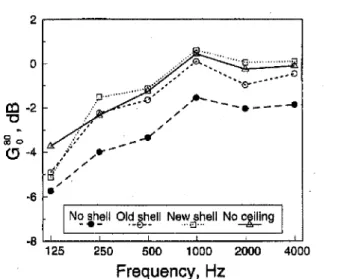
Measurements in the Opera of the National Arts Centre also showed the ceiling component of the shell to have a special effect in the 125-Hz octave band. Measurements were made for two configurations of the shell towers and a third configuration with the ceiling piece raised up. These were compared with measurements for the no shell condition at main floor audience seats. Figure 14 compares average measured gセッ values for these four conditions. In the "old shell" configuration the towers that formed the rear wall of the shell were in a slightly bow-shaped plan. For the "new shell" configuration the rear wall was closer to a straight line. The one ceiling piece formed a relatively minor com-ponent of the complete shell. When it was raised up, reflec-tions fromitwere eliminated.
The results in Fig. 14 show that adding either the old or the new shell configuration increasedgセッ values by close to 2 dB except in the 125-Hz octave band. The differences be-tween the effects' of the old and new configurations were very small with a trend for slightly larger increases in
Ggo
values for the new shell configuration. When the ceiling . piece for the new shell configuration was removed the in· creases in
Gg
o values were very slightly reduced at mid- and high frequencies. However, at 125 Hz removing the ceiling piece led to increasedGgo values. This is the opposite of the effect of removing the more significant ceiling pieces of the shell in the Jubilee Auditorium.FIG. 14. Average relative early arriving sound levels (Ggo) at main floor seats in the Opera of the Nationa! Arts Centre for: no shell, old and new shell configurations, as well as a partial shell without ceiling pieces. Full shell No ceiling No shell
. - . - - "'0'" 3 ,
"
..
BLセNB...
|Nセ , " \ , , 2 ' .!1J
LゥZ[セZ\O
\.•...
goo iMKエGセ ..MtMMMMMMセセセGNNZ •...,..-_l
CJ
.3l..l....----l==::::::C==:i::::=:::::i:::==L---..J
125 250 500 1000 2000 4000 BODOFrequency, Hz
Inthe Jubilee Auditorium acoustical measurements were made at main floor audience seats for three conditions: no shell, complete shell, and the shell without any ceiling pan-els. Figure 13 plots hall-average early sound levels versus octave frequency for each configuration. The average
Gg
o values for the full shell and the no shell cases suggest that the shell is most effective at mid- and high frequencies. At these same frequencies the partial shell case, without the ceiling pieces present, gives results that are intermediate to the other two cases. However, in the lowest two octaves the partial shell case seems to be less effective than the no shell case. The effect of the shell at lower frequencies is more complicated than one might expect.The more complex effects at lower frequencies are again thought to be related to changes in the grazing incidence seat dip attenuation. Adding only the walls of the shell decreases the early low-frequency sound levels
(Ggo).
That is, the early reflections from the walls of the shell are significantly attenuated at low frequencies by the grazing ゥョ」ゥ、・ョセ・ seat dip attenuation. However, the reflections from the ceiling pieces of the shell do not arrive at grazing incidence and considerably increase the early arriving low-frequency soundIII. EFFECTS OF MODIFICATIONS TO ORCHESTRA SHELLS
FIG. 13. Average relative early arriving sound levelsHgセッI at main floor seats in the Alberta Jubilee Auditorium for: a full shell, no shell, and a partial shell without ceiling pieces.
frequency of the maximum seat dip attenuation at some lo-cations.
Measurements were also made of various modifications to orchestra shells. These results give an indication of the performance of partial orchestra shells and also help to fur-ther increase our understanding of the effects of orchestra shells. Measurements were made for variations of the orches-tra shell configuration in two of the large multipurpose halls mentioned above. Tests were also performed to evaluate the effects of variable absorption panels around the stage of a smaller recital hall.
A. Modified orchestra shells in large multipurpose halls
895 J.ACQusl. Soc. Am., Vol. 100, No.2, PI. 1, August 1996
4r---..,
t
Variable ---.. absorptionセ
surfaces Audience seatingq,,,,!?
scale, mFIG. 15. Simplified sketch plan of the Aird recital hall showing the location of variable absorption panels.
Again the effect of the shell on early amvlng low-frequency sound levels is more complex than might be ex-pected. The grazing incidence seat dip attenuation phenom-enon is the result of the destructive interference of various sound waves. The addition of the orchestra shell adds new sound waves that arrive from different directions and may either increase or decrease this destructive interference de-pending on the details of arrival times, phase, and directions. The effect of the different shell configurations on G
so
values were very similar. The addition of a either shell con-figuration increased Gso
values by 1.5 to 2 dB in all but the 4-kHz octave band where increases of about I dB were mea-sured. The difference in the effects of the old and new shells on G80 values was no more than about 0.2 dB. Removing the ceiling piece produced Gso
values intermediate to the old and new shell results.The effects of orchestra shells on early and late sound levels can be quite different, and the effect of adding a shell on the total sound levels will depend on the relative impor-tance of the early and late sound levels.
B. Modifications to the stage surfaces In a small recital hall
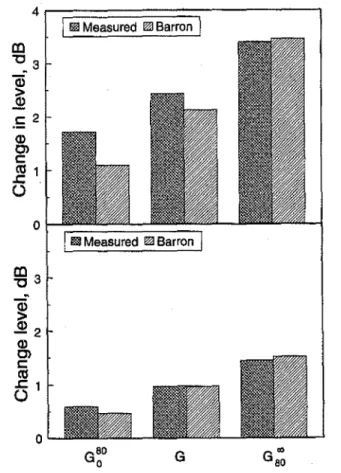
The Aird Recital Hall in Waterloo, Ontario, Canada has a volume of3000 m3and seats352 people. It has a relatively large stage with variable absorption panels on the side and rear walls. Figure 15 is a sketch of the plan of this hall. As illustrated in this figure parts of the side walls of the stage can be rotated to reveal either reflective or absorbing sur-faces. A rear wall can also be added that reduces the depth of the stage and this surface can be either reflective or absorp-tive. Measurements were made at audience seats in this hall for a range of different configurations of the stage surfaces. Figure 16 summarizes the measured changes in
mid-896 J.Acoust. Soc. Am., Vol. 100, No.2, Pt. 1, August 1996
Tイ[ZZZ]]]]]]]]]]]セMMMML
I
fl!!I Measured
rn
BarronI
o
I
III Measuredm
BarronI
a
FIG. 16. Comparison of measured average changes in early, late, and total mid-frequency relative levelHgセッL G, and G
so)
values due to changing the absorbtivity of stage surfaces with predictions using Barron's revised theory,Jfrequency early, late, and total sound levels HgセッL G
so•
and G values) for two different changes of the stage surfaces. The lower half of this graph shows the measured average differences between the small reflective (SR) and small ab-sorptive (SA) conditions. The upper half of the graph shows the differences between small reflective (SR) and all absorp-tive (AA) conditions. The small reflecabsorp-tive (SR) case is for all surfaces reflective. The small absorptive (SA) case is with the side walls absorptive, and the all absorptive case (AA) is for both the side and rear walls absorptive. For all cases shown in Fig. 16 the moveable rear wall was installed to create the small stage configuration.These changes did not involve any change to the shape or volume of the hall, they only changed the absorption of the surfaces of the orchestra enclosure formed by the stage area of this recital hall. The expected changes were calcu-lated using Barron's revised theory3 for each condition. The differences between the theoretical calculations for each pair of conditions are generally in very good agreement with the measured changes. The exception is the change in gセッ val-ues between the small reflective (SR) and the all absorptive (AA) conditions. The measured gセッ values show a larger change than predicted, presumably because the theory does not correctly account for the addition of significant amounts of absorbing material close to the source. With this small exception, it is seen that Barron's revised theory can be quite useful in predicting the effects of such changes to the
SUf-face§ of an orchestra shell.
. J.S. Bradley: Some effects of orchestra shells 896
-8 . - - - ,
IV. ON-STAGE EFFECTS OF ORCHESTRA SHELLS
AA
..
".
••
"', ", セ ", ',...",., \\.\\.•..
acceptable support LA SA SA Stage configuration LR -8 -12co
"Cof
セ
·10The results presented in this paper give an overview of typical effects of orchestra shells both at audience seats and on-stage, The average changes in measured acoustical quan-tities when an orchestra shell was added were usually similar t<:? simple predictions. In general, the average effects at audi-ence seats were small but are expected to be audible. Larger effects were measured on-stage.
The addition of an orchestra shell increased overall sound levels, but by less than 3 dB. Early arriving sound
-6 . . . - - - ,
V.CONCLUSIONS
J.S, Bradley: Some effects of orchestra shells 897
FIG. 18. Average measured changes in early support [STeel] values for varied configurations of absorbing stage wall panels.
ST( e) values are below - 12dB in several halls well known
for their good acoustics and a 5-dB increase is certainly a substantial improvement.
Support values were also measured for a range of con-figurations of the stage surfaces in the Aird Recital Hall (see Fig. 15 and Table I). The configurations included the small reflective (SR), small absorptive (SA), and the all absorptive (AA) described in the previous section. Measurements were also made for the large reflective (LR) and large absorptive (LA) conditions. For these large conditions the removable rear wall shown in Fig. 15 was not present, and only the absorptive side panels were in place for the large absorptive case. The resulting averageST(e) values are shown in Fig. 18. The largest measured change was about 3.5 dB. This was smaller than completely removing the orchestra shells in the other two halls.
These measurements show that even small changes to the absorbing properties of the orchestra shell surfaces can significantly modify acoustical conditions on-stage. As would be expected, the addition of a complete orchestra shell has a larger effect on-stage than at audience seat locations. dB, (2) With Shall
...
..
' ... ... .... C.Pointe ......
With Shell No Shell Hall and Condition
NACO acceptable support
o
, , ,' , , , , , ,"
, , , , , , , ;' ,"
No Shell -20 -10 -12 -18co
"C -14<if
セ
-16FIG. 17. Average measured changes in early support[STeel] values with the addition of an orchestra shell in two different halls.
Although this paper has concentrated on the effects of orchestra shells at audience seats, orchestra shells were also evaluated at on-stage locations. Measurements of Gade's support measure were made to evaluate the effects of orches-tra shells for performers. Gade has defined early support as follows:?
897 J. Acousl. Soc. Am., Vol. 100, No.2, Pt. 1, August 1996 whereST(e) is related to the support or response of the hall to the performers efforts. It is measured in octave bands and an average of the four octave values from 250 to 2000 Hz is calculated. In these measurements, results were an average of the data obtained at four positions on stage that were repre-sentative of where orchestral musicians would sit.
Meas'urements were made in two halls both with and without an orchestra shell present. One hall was the Opera of the National Arts Centre and the other, the Centre Pointe Theatre, is a medium sized hall described further in Table 1.
The shell in the Centre Pointe Theatre was a general purpose light weight shell with both wall and ceiling pieces. It was quite similar to the shell in the Alberta Jubilee Auditorium. The effects of adding an orchestra shell in these two halls are illustrated in Fig. 17. In both halls adding an orchestra shell increased ST(e) values by approximately 5 dB. Gade sug-gests thatanST(e) value of about -12:t 1dB is a desirable optimum.? Adding the shell in the Centre Pointe Theatre in-creased averageST(e) values above this level. In the larger Opera of the National Arts Centre, adding the shell did not increase ST(e) values to this desired value. Of course,
{
(0.10 /
(om
}
revels were increased less but later arriving sound levels were increased by as much as 4 dB.
Low and mid frequency (125 to 500 Hz) RT and EDT values were increased by as much as 0.1 to 0.15 s when an orchestra shell was added. Mid- and high-frequency (1000 to 4000 Hz) RT and EDT values could be more varied and high-frequency EDT values increased by up to 0.4 s. Aver-age e80 measures of clarity showed little change or 、・セ
creased by up to 3 dB. Thus orchestra shells do not usually increase clarity as is often assumed. LF values were on av-erage not changed significantly by the addition of an orches-tra shell.
Where the shell is shaped to reflect sound directly out to the audience, there was a trend for mid-frequencygセッ values to be more increased toward the rear of the hall.
Low-frequency RT values were decreased by the addi· tion of a shell but on average low-frequency EDT values showed small increases when a shell was added. The effect of an orchestra shell on early low-frequency sound levels was more complex, and sometimes resulted in octave band changes of ±2 dB ingセッ values. Adding an orchestra shell could increase or decrease low-frequency early-arriving sound levels. These effects are due to the complex interfer-ence of direct and reflected sounds from the orchestra shell modifying the grazing incidence seat dip attenuation.
It is seen that designing an orchestra shell to provide adequate increases in low-frequency sound levels is not just a question of having an adequately massive construction that will better reflect low-frequency sound. The geometry of the shell is also important. It must provide reflections with
sig-898 J.Acoust. Soc. Am., Vol. 100, No.2, Pt. 1, August 1996
nificant low-frequency sound energy. Thus it is important that these reflections arrive at audience locations from non-grazing angles of incidence.
Tests of partial shells also confirmed the importance of low-frequency reflections arriving from suitable directions and with appropriate time delays. In a recital hall with vari-able absorption surfaces on the orchestra shell, the effect of the varied absorption could be accurately predicted using Barron's revised theory of sound propagation in halls.
As is usually assumed to be true, the effects of the or-chestra shells were much greater at on-stage measurement locations. Although the addition of an orchestra shell can have significant audible effects at audience seats, orchestra shells are most important to provide adequate acoustical con-ditions on-stage for musicians.
セ 1C. Jaffe, "Design Considerations for a Demountable Concert Enclosure - (Symphonic Shell)," J. Aud. Eng. Soc. 22 (22),163-170 (1974).
2J. H. Rindel, "Design of New Ceiling Reflectors for Improved Ensemble
ina Concert Hall," App!. Acoust. 34, 7-17 (1991).
3M. Barron and L-J.Lee, "Energy Relations in Concert Auditoria.I,"J. Acoust. Soc.Am.84, 618-628 (1988).
4J. S. Bradley and G.A.Soulodre. "The Influence of Late Arriving Energy on Spatial Impression," J. Acoust. Soc.Am.97.2263-2271 (1995).
SJ. S. Bradley, "Hall Average Characteristics of 10 Halls," Proceedings of
the 13th Int. Congress on Acoustics, Belgrade (Sava Centar, Belgrade, 1989),Vol. 2, pp. 201-202.
6J. S. Bradley, "Some Further Investigations of the Seat Dip Effect," J.
Acoust. Soc.Am.90, 324-333 (1991).
7A. C, Gade, "Investigations of Musicians' Room Acoustic Conditions in
Concert Halls. 11: Field Experiments and Synthesis of Results," Acustica 69. 249-262 (1989).


![FIG. 17. Average measured changes in early support [STeel] values with the addition of an orchestra shell in two different halls.](https://thumb-eu.123doks.com/thumbv2/123doknet/14222672.484000/12.944.447.807.25.411/average-measured-changes-support-steel-addition-orchestra-different.webp)
