
HAL Id: hal-01783575
https://hal.archives-ouvertes.fr/hal-01783575
Submitted on 2 May 2018
HAL is a multi-disciplinary open access
archive for the deposit and dissemination of
sci-entific research documents, whether they are
pub-lished or not. The documents may come from
teaching and research institutions in France or
abroad, or from public or private research centers.
L’archive ouverte pluridisciplinaire HAL, est
destinée au dépôt et à la diffusion de documents
scientifiques de niveau recherche, publiés ou non,
émanant des établissements d’enseignement et de
recherche français ou étrangers, des laboratoires
publics ou privés.
Stochastic programming approach for TEP optimization
considering RES integration in electricity market
Catalina Alexandra Sima, Cristian Lazaroiu, Virgil Dumbrava, Mariacristina
Roscia, Dario Zaninelli, Philippe Duquenne
To cite this version:
Catalina Alexandra Sima, Cristian Lazaroiu, Virgil Dumbrava, Mariacristina Roscia, Dario Zaninelli,
et al.. Stochastic programming approach for TEP optimization considering RES integration in
elec-tricity market. 2017 International Conference on ENERGY and ENVIRONMENT (CIEM), Oct 2017,
Bucharest, Romania. pp. 485-489. �hal-01783575�
To cite this version :
Sima, Catalina alexandra and Lazaroiu, Cristian and
Dumbrava, Virgil and Roscia, Mariacristina and Zaninelli, Dario and
Duquenne, Philippe
Stochastic programming approach for TEP
optimization considering RES integration in electricity market. (2017) In:
2017 International Conference on ENERGY and ENVIRONMENT (CIEM),
19 October 2017 - 20 October 2017 (Bucharest, Romania
O
pen
A
rchive
T
OULOUSE
A
rchive
O
uverte (
OATAO
)
OATAO is an open access repository that collects the work of Toulouse researchers and
makes it freely available over the web where possible.
This is an author-deposited version published in :
http://oatao.univ-toulouse.fr/
Eprints ID : 19883
To link to this article: DOI: 10.1109/CIEM.2017.8120869
URL :
http://dx.doi.org/10.1109/CIEM.2017.8120869
Any correspondence concerning this service should be sent to the repository
administrator:
[email protected]
Stochastic Programming Approach for TEP
Optimization Considering RES Integration in
Electricity Market
Catalina
Alexandra
SIMA, George Cristian
LAZAROIU, Virgil
DUMBRAVA
University POLITEHNICA of Bucharest Department of Power Systems Bucharest, Romania Mariacristina ROSCIA Universita di Bergamo Department of Design andTechnology Bergamo, Italy Dario ZANINELLI Politecnico di Milano Department of Energy Milano, Italy Philippe DUQUENNE Institut National Polytechnique Toulouse Toulouse, France
Abstract — Transmission expansion planning (TEP) is helping
the system operator to decide the optimal solution for building new lines and in the same time to increase the reliability and safety of the existing power system. The proposed problem is a mixed-integer nonlinear programming problem (MINLP) and it is solved using stochastic programming. Stochastic programming is applied when uncertain environment occurs, in this case the uncertain environment refers to the production of renewable energy sources (RES) and its dependence on the short-term weather conditions. Stochastic Optimization weights all scenarios considered in this paper in order to obtain an expected total cost. The expected total cost includes the cost associated with the construction of new transmission lines, generation cost and load shedding cost.
Index Terms -- decision support optimization, electricity market,
renewable energy sources, stochastic programming, transmission expansion planning.
I. NOMENCLATURE
Indices:
d – demands
h – hydro energy generation units
t – thermal energy production units
w – wind energy production units
l – transmission lines
b – buses
Sets:
db – demand supplied from bus b
hb – hydro energy production unit located at bus b
tb – thermal energy production unit located at bus b
wb – wind energy production unit located at bus b
lp – transmission lines possible to be build
r(l) – receiving node
s(l) – sending node
s – complete set of scenarios
IJ – analysis horizon
Parameters:
ʌs – probability of scenarios
Cl – maximum capacity for transmission line l [MW]
Bl – susceptance of transmission line l [p.u.]
Gh – generation capacity of hydro unit h [MW]
Gt – generation capacity of thermal unit t [MW]
Gw – generation capacity of wind farm w [MW]
ܮఛǡ௦ௗ – consumption of demand d [MW]
ܿௌௗ – load shedding cost of demand d [€/MWh]
ch – cost of production of hydro unit h [€/MWh]
ct – cost of production of thermal unit t [€/MWh]
cw – cost of production of wind unit w [€/MWh]
ܤܫ – annualized budget for investing in construction of
new transmission lines [Euro]
ܥܫ – annualized cost for investing in new transmission
lines l [Euro]
Binary variables:
ݑఛ – Binary variable that is 1 if a new transmission line l
is built, and 0 if no new transmission line l is built, for each time period.
Variables:
ܮܵௗఛǡ௦ – load shedding at demand d [MW]
ܲ௧ఛǡ௦ – power produced by thermo unit t [MW]
ܲ௪ఛǡ௦ – power produced by wind unit w [MW]
ܲఛǡ௦ – power produced by hydro unit h [MW]
Ʌୠதǡୱ – voltage angle at bus b [rad]
Ȗ – time period [hours].
II. INTRODUCTION
In Romania, there is a pronounced trend of installing renewable energy sources (determined by the green certificates incentives), especially wind and photovoltaic, therefore the need of knowing weather forecast is necessary in exploitation time of wind power systems (WPP) and photovoltaic installations (PV) and obviously when the placement of the new RESs is determined. Although it is hard to estimate the forward amount of energy in time that can be extracted from these sources and errors may appear [1], [2]. In order to integrate the renewable energy sources in the power grid and avoid overloads it is necessary to take into consideration infrastructure reinforcements [3]. The transmission expansion planning (TEP) has the purpose to ensure economic trade and engineering reliability and should provide reliability and safety of the power grid. The engineering reliability objective and economical trade is very important in TEP problem. The decision of which new lines should be built must satisfy forthcoming loads while power quality is maintained. The engineering reliability objective is referring to reliability in supply the demands which should be provide when constructing new lines while economical trade is referring to the minimization of generating costs and load shed costs [4].
In this paper, the expansion transmission planning is applied on a large-scale transmission network for integrating RESs in the existing grid [5], [6]. The final solution of this problem establishes the number of lines, and where new electrical lines should be built so that the power supply and quality are preserved considering four scenarios. The construction of new electrical lines is based on a given investment budget, and analysis of its variation on the optimal solution are considered in this paper [7], [8]. TEP can provide safety in the power grid and should lower the load shed costs. The load shed is increasing if the consumers are not supplied, with the construction of the new lines load shed cost is decreasing with the decrease of the number of the consumers that are not supplied. It is also important to note that the inherent computational difficulty of optimal TEP makes it necessary to limit the size of the candidate list in order to keep the problem tractable. In very large systems, even a reduced list of interesting candidates (as opposed to all feasible candidates) can be excessive for optimization [9].
III. MATHEMATICAL FORMULATION OF THE PROBLEM
In this paper, it is proposed a mixed-integer nonlinear programming problem that is solved using stochastic programming. Stochastic programming is applied for large-scales models and when uncertain environment occurs, in this case the uncertain environment refers to the production of RESs and its dependence on the short-term weather conditions [1]. The mathematical model for the considered problem is a nonlinear one considering the products between binary variables and continuous variables. The problem is reformulated as a mixed-integer linear programming problem [10].
The problem is formulated under the assumption in which the losses are neglected. It is considered that voltage magnitudes are approximately constant in the system and that voltage angle differences are small enough between two connected nodes. This hypothesis allows the power flow equations to be linearized. In order to linearize the mathematical model, it is possible to replace the nonlinear constraints by introducing exact equivalent mixed-integer linear sets and a large enough constant M [7]. The TEP problem presented in this article was solved using GAMS (General Algebraic Modeling System) optimization software.
For solving the proposed problem, four scenarios with different probabilities are considered (s1=0,26; s2=0,11;
s3=0,34 and s4=0,29) which refers to the RESs and their
dependence on short-term weather conditions [1]. Also, there are considered two different time periods (t1 and t2) but the
investment decision is considered to be made at the beginning of each time period considered. The planning horizon is divided into two different time periods that are considered to be equivalent to two different years and due to this fact the optimal solution of the mathematical model described is a dynamic one. According to the threshold budget, the optimal solution provides the number of new transmission lines that are possible to be built in order to minimize the costs for constructing the new lines, the cost for operating the generating units and the load shed cost [1]. The budget is varying between 10 million euros and 55 million euros, and obviously, the optimal solution is different for each threshold budget considered.
A. Linearized Mathematical Model
The objective function of the mathematical model presented in this paper is minimizing the total cost of building new electrical transmission lines, which contains the operating cost of production units, investment cost and the load shedding cost.
¦¦
∈ τ τ p l l l im pu
CI
MIN]
[
°
°
°
°
¿
°°
°
°
¾
½
°
°
°
°
¯
°°
°
°
®
»
»
»
»
»
»
»
»
¼
º
«
«
«
«
«
«
«
«
¬
ª
»
¼
º
«
¬
ª
+
+
+
»
¼
º
«
¬
ª
+
+
+
»
¼
º
«
¬
ª
+
+
¦
¦
¦
¦
¦
¦
¦
s h d s d d LS s h h w d s d d LS s w w t d s d d LS s t t sLS
c
P
c
LS
c
P
c
LS
c
P
c
, , , , , , τ τ τ τ τ τπ
γ
(1) Subjected to constrains:¦
∈∀
∈
∀
≤
p l l ib p l im pu
BI
s
S
CI
τ,
,
τ
{ }
s
S
u
lτ=
0
,
1
,
∀
∈
(2)In equation (2) the cost associated with the construction of the new lines in each scenario must be smaller than the threshold budget.
¦
¦
¦
¦
∈ ∈ ∈ =+
−
+
+
b b b t t h h w w lsl n s l s w s h s tP
P
PF
P
) ( \ , , , , τ τ τ τ(
)
¦
¦
= ∈∀
∈
∀
−
=
+
n l r l d d s d s d s l nS
s
LS
L
PF
) ( \ , , ,,
,
τ
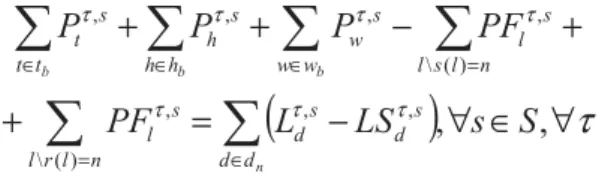
τ τ τ (3)In equation (3) is presented the balance between consumption and production and the power flow.
DC power flow is defined by the susceptance of the transmission line and is multiplied by the subtraction between voltage angles at the receiving points and sending points for each scenario.
(
θ
τθ
τ)
τ
τ∀
∈
∀
∈
∀
−
=
(,) (,),
,
,
,S
s
l
l
B
PF
l s l sls rls p (4) DC power flow is limited by the capacity of the transmission lines in any scenario as the following:τ
τ∀
∈
∀
∈
∀
≤
≤
−
C
PF
,C
l,
l
l
p,
s
S
,
s l l (5)τ
τ τ τ∀
∈
∀
∈
∀
≤
≤
−
u
C
PF
,u
lC
l,
l
l
p,
s
S
,
s l l l (6)(
−
)
≤
−
(
−
)
≤
−
s l r s l s l s l lM
PF
B
u
(,) , ) ( ,1
τ τθ
τθ
τ(
−
τ)
∀
∈
∀
∈
∀
τ
≤
1
u
lM
,
l
l
p,
s
S
,
(7)The production of each generator cannot be higher the capacity of the generators:
τ
τ∀
∈
∀
∀
≤
≤
,
,
,
0
P
,G
t
s
S
t s t (8)τ
τ∀
∈
∀
∀
≤
≤
,
,
,
0
P
h,sG
ht
s
S
(9)τ
τ∀
∈
∀
∀
≤
≤
,
,
,
0
P
w,sG
wt
s
S
(10)Load shedding of demand d cannot be higher than the consumption of demand d.
τ
τ τ∀
∈
∀
∀
≤
≤
,
,
,
0
LS
d,sL
d,st
s
S
(11)Voltage angle must be between -π and π.
τ
π
θ
π
≤
τ≤
∀
∀
∈
∀
−
,s,
t
,
s
S
,
b (12)Voltage angle for reference node (node 5):
0
,=
s b τθ
, reference node (13)B. Real Test Network
The stochastic programming method is applied on a real test network form south-east of Romania, in Dobrogea area, where are connected many RESs. The topology of the considered power system it is shown in Fig.1. This grid contains 18 generating units (10 thermal generating units, 7 wind generating units and 1 hydro generating unit), 29 existing lines and 16 demands. The new transmission lines that are possible to be built are l6, l11, l13, l19 and l26 and their
number depends on the threshold budget, the growth of the demand and energy production which is increasing in every year.
The energy production is steadily increasing from the first to the second time period, and continues to grow with each scenario considered. The demands are constant in each scenario but they are increasing from the first year to the second. The number of the new transmission lines that are possible to be build is varying in each year. The considered threshold budget in this paper is varying between 10 million euros and 55 million euros. In the first time period the threshold budget is 30 million euros and in the second time period it is 25 million euros.
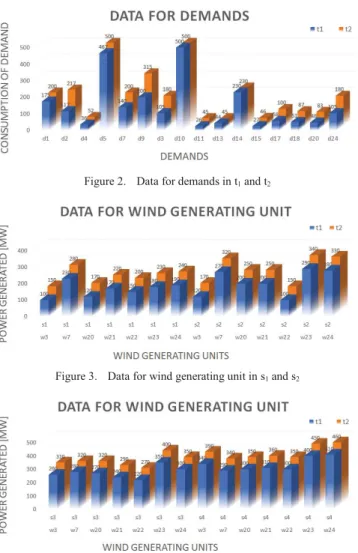
The data for thermal generating unit and hydro generating unit is not varying and it is taken from [8]. The data for demands which is considered in the two choose time periods it is shown in Fig. 2. The consumption is increasing in each year. The data for wind generating unit which is considered in first and the second scenario is presented in Fig. 3. The data for wind generating unit which is considered in third and the forth scenario is presented in Fig. 4. It can be seen that the production is increases from the first scenario to the last one.
Figure 2. Data for demands in t1 and t2
Figure 3. Data for wind generating unit in s1 and s2
Figure 4. Data for wind generating unit in s3 and s4
IV. CASE STUDY RESULTS
The case study refers to TEP problem applied to Dobrogea system where are installed a lot of RESs. It is necessary to take into consideration the interconnection of RESs into the existing power system in order to avoid the overloads [11]. After solving the proposed mathematical model, the system operator should be able to decide which is the best reinforcement of the existing power system in order to maintain safety and reliability of the power system.
In Fig. 5 and Fig. 6 it can be seen that different number of transmission lines are built depending on the threshold budget and on the time periods. The threshold budget is varying between 10 million euros and 55 million euros taking into account both time periods. It is considered that the investment budget is varying between 10 million euros and 30 million euros in the first time period and between 10 million euros and 25 million euros on the second time period.
In Fig. 5 it can be seen that for the first time period, with the investment budget of 10 million euros only line l19 is
possible to be built and with the investment budget of 30 million euros three lines are possible to be built l13, l19 and l26.
In the second time period it is considered that all three lines
l13, l19 and l26 are built in the order to obtain fewer consumers
shed that leads to a lower value of the objective function. Therefore, the decisions that are made in the second time period are made following the construction of the three required lines from the first time period (l13, l19 and l26) thus
only l6 and l11 can be built in this time period. For the second
time period, the maximum investment budget is 35 million euros and only two new transmission lines are possible to be built (l6 and l11). In Fig. 6, it can be seen that for an investment
budget of 10 million euros, only line l6 it is possible to be built
and with the investment budget of 25 million euros l6 and l11
are possible to be built.
Different new transmission lines and different number of new transmission line will be built according to the threshold budget.
Figure 5. The construction of the new transmission lines in the first time period
Figure 6. The construction of the new transmission lines in the first time period
TABLE I. CASE STUDY RESULTS FOR THE FIRST TIME PERIOD I [mill. €] Lines to be build [0/1] Z [mill. €] L6 L11 L13 L19 L26 10 0 0 1 0 0 58 20 0 0 1 1 0 52 30 0 0 1 1 1 51
In both tables, Table I and Table II, the value of the objective function is decreasing while the investment budget is increasing.
The number of the new lines that are required to be built is increasing also due to the increase of the investment budget that allows the construction of new transmission lines in each time period considered.
TABLE II. CASE STUDY RESULTS FOR THE SECOND TIME PERIOD I [mill. €] Lines to be built [0/1] Z [mill. €]
L6 L11
0 0 0 97
10 1 0 88
25 1 1 85
As showed in table II, with no investment budget in the second time period, the value of the objective function is bigger than in the first time period due to the increase of the demand and power generated. It is considered that in this situation the network has undergone no modification regarding the constructions of new lines over the first period of time. This fact is due to the increase of the demand and power generated and it requires another investment budget allocated for the expansion of the existing grid. Fig. 7 and Fig. 8 shows the power generated in both time periods, in the case that the objective function has the minimum value presented in this paper (51 million euros and 85 million euros, respectively). It can be seen that the power produced is increasing in the second time period due to the increase of the demand and the power installed.
Figure 7. Power generated [MW] in the first time period in each considered scenario (s1, s2, s3, s4).
Figure 8. Power generated [MW] in the first time period in each considered scenario (s1, s2, s3, s4).
V. CONCLUSIONS
In this paper, the mathematical model is a mixed-integer nonlinear programming problem that is reformulated as a mixed-integer linear programming problem and it is solved using stochastic programming. The objective function is minimizing the cost of building new electrical transmission lines, the operating cost of production units, and the load shedding cost. The optimal solution of the resolved mathematical model is different in each year, reinforcements of the existing grid are necessary to be made due to the growth of the consumption and for providing safety and reliability of the grid. In order to avoid overloads, the aging of the infrastructure and the growth of demand. The pronounced
trend of installing RESs is contributing to the necessity of infrastructure reinforcements. The solution of the problem should allow the transmission system operator to make the optimal decision for the reinforcement of the power system in order to maintain the system reliability and satisfy the forthcoming loads along with maintaining the power quality.
The number of new transmission lines that are required to be built is different in the first time period than in the second due to the steady growth of the consumption and the variation of the threshold budget that is between 10 million euros and 55 million euros. Along with the increase of the investment budget, the number of the new transmission lines that are possible to be built is increasing too and the load shed is decreasing for there are less consumers that are not fed.
ACKNOWLEDGMENT
This work was supported by a grant of the Romanian National Authority for Scientific Research and Innovation, CCCDI – UEFISCDI, project number 37BMPNIII-P3-199/02.09.2016 and and 16.80013.5807.12/RO.
REFERENCES
[1] N. Golovanov, H. Albert, St. Gheorghe, N. Mogoreanun, G.C. Lazaroiu, Renewable sources in power systems, AGIR: Bucharest, 2015, pp. 1-5, 2009.
[2] Z. Wu, “Transmission expansion planning and unit commitment with large-scale integration of wind power,” Ph.D. dissertation, Dept. of Electronic, Electrical and Systems Engineering, University of Birmingham, Birmingham, 2016.
[3] J. L. Higle, “Stochastic programming: optimization when uncertainty matters,” informs in Emerging Theory, Methods, and Appplications, pp. 30-53, 2005.
[4] J. M. Morales, A. J. Conejo, H. Madsen, P. Pinson and, M. Zungo,
Integrating Renewables in Electricity Markets, vol. 205. Springer
Science & Business Media, 2013.
[5] S. F. Santos, D. Z. Fitiwi, M. Shafie-Khah, A. W. Bizuayehu, C. M. P. Cabrita and J. P. S. Catalão, "New Multistage and Stochastic Mathematical Model for Maximizing RES Hosting Capacity—Part I: Problem Formulation," IEEE Trans. on Sustain. Energy, vol. 8, no. 1, pp. 304-319, Jan. 2017.
[6] S. F. Santos, D. Z. Fitiwi, M. Shafie-khah, A. W. Bizuayehu, C. M. P. Cabrita, and J. P. S. Catalão, “New Multi-Stage and Stochastic Mathematical Model for Maximizing RES Hosting Capacity—Part II: Numerical Results,” IEEE Transactions on Sustain. Energy, vol. 8, no. 1, pp. 320-330, Jan. 2017.
[7] J. L. Ho, “Stochastic Co-optimization for National Transmission Planning Under Environmental Regulation,” MSc dissertation, John Hopkins University, Baltimore, 2014.
[8] C. A. Sima, G. C. Lazaroiu and V. Dumbrava, “Transmission expansion planning optimization for improving RES integration on electricity market,” in Proc. 2017 10th International Symposium on
Advanced Topics in Electrical Engineering (ATEE), Bucharest,
Romania, 2017, pp. 855-859.
[9] S. Lumbreras, A. Ramos, and P. Sánchez, “Automatic selection of candidate investments for Transmission Expansion Planning,”
International Journal of Electrical Power & Energy Systems, vol. 59,
pp. 130-140, July 2014.
[10] Y. H. Wu, "A stochastic mathematical program with complementary constraints for market-wide power generation and transmission expansion planning", master of science, Iowa State University, Iowa, (2014).
[11] M. Carrion, J. M. Arroyo, and N. Alguacil, “Vulnerability-Constrained Transmission Expansion Planning: A Stochastic Programming Approach,” IEEE Trans. Power Syst., vol. 22, no. 4, pp. 1436-1445, Nov. 2007.
![TABLE II. C ASE S TUDY R ESULTS FOR THE S ECOND T IME P ERIOD I [mill. €] Lines to be built [0/1]](https://thumb-eu.123doks.com/thumbv2/123doknet/14271479.490437/7.892.92.414.147.275/table-ase-tudy-esults-econd-eriod-lines-built.webp)
