HAL Id: hal-01309202
https://hal.archives-ouvertes.fr/hal-01309202
Submitted on 29 Apr 2016
HAL is a multi-disciplinary open access
archive for the deposit and dissemination of
sci-entific research documents, whether they are
pub-lished or not. The documents may come from
teaching and research institutions in France or
abroad, or from public or private research centers.
L’archive ouverte pluridisciplinaire HAL, est
destinée au dépôt et à la diffusion de documents
scientifiques de niveau recherche, publiés ou non,
émanant des établissements d’enseignement et de
recherche français ou étrangers, des laboratoires
publics ou privés.
Purely Corpus-based Automatic Conversation Authoring
Guillaume Dubuisson Duplessis, Vincent Letard, Anne-Laure Ligozat, Sophie
Rosset
To cite this version:
Guillaume Dubuisson Duplessis, Vincent Letard, Anne-Laure Ligozat, Sophie Rosset. Purely
Corpus-based Automatic Conversation Authoring. 10th edition of the Language Resources and Evaluation
Conference (LREC), May 2016, Portorož, Slovenia. pp.ISBN: 978-2-9517408-9-1. �hal-01309202�
Purely Corpus-based Automatic Conversation Authoring
Guillaume Dubuisson Duplessis
1, Vincent Letard
2, Anne-Laure Ligozat
3, Sophie Rosset
11LIMSI, CNRS, Universit´e Paris-Saclay, F-91405 Orsay 2LIMSI, CNRS, Univ. Paris-Sud, Universit´e Paris-Saclay, F-91405 Orsay
3LIMSI, CNRS, ENSIIE, Universit´e Paris-Saclay, F-91405 Orsay
{gdubuisson, letard, annlor, rosset}@limsi.fr Abstract
This paper presents an automatic corpus-based process to author an open-domain conversational strategy usable both in chatterbot systems and as a fallback strategy for out-of-domain human utterances. Our approach is implemented on a corpus of television drama subtitles. This system is used as a chatterbot system to collect a corpus of 41 open-domain textual dialogues with 27 human participants. The general capabilities of the system are studied through objective measures and subjective self-reports in terms of understandability, repetition and coherence of the system responses selected in reaction to human utterances. Subjective evaluations of the collected dialogues are presented with respect to amusement, engagement and enjoyability. The main factors influencing those dimensions in our chatterbot experiment are discussed.
Keywords: Example-based dialogue modelling; Open-domain dialogue system; Human-Machine dialogue corpus; Evaluation
1.
Introduction
The main objective of our work is to design a conversa-tional strategy aiming at the maintenance or increase of the human participation in dialogue, usable both in chatterbot systems (such as Eliza (Weizenbaum, 1966)), or as a fall-back strategy for out-of-domain human utterances in spe-cific dialogue systems. An important property for such a system is to enable a wide variety of possible responses, while keeping a level of control of what is said (with regard to, e.g., the desired language level, the relationship between the human and the system, the situation of interaction). Our approach belongs to the category of example-based di-alogue modelling which aims at using a database of seman-tically indexed dialogue examples to manage dialogue (Lee et al., 2009). However, our purpose is a complete automa-tion of this process from the creaautoma-tion of the database to the conversational management process to avoid the need of a costly and time-consuming human intervention. To this end, we present a data-driven process aiming at the auto-matic authoring of a conversational strategy for a dialogue system interacting with a human participant. The main pur-pose of the conversational strategy is to select an appropri-ate response from a corpus given a human utterance, and adapt it by taking into account the history of dialogue (in-cluding the last utterance from the human). This process relies both on the exploitation of a large and varied cor-pus of Human-Human interactions and on natural language processing tools such as a named entity (NE) recogniser. Our approach is implemented in the context of the Joker project which aims to build a generic intelligent user inter-face providing a multimodal dialogue system with social communication skills including humour and other social behaviours (Devillers et al., 2015). This system is primar-ily involved in entertaining interactions occurring in a so-cial environment (e.g., a cafeteria). A conversational strat-egy could be fruitfully used to provide the system with ju-dicious and entertaining contributions when faced with an unexpected human utterance.
Section 2. draws some links with related work. Section 3. presents an overview of our approach from the automatic
creation of the database of dialogue examples to the se-lection process behind the conversational management pro-cess. Section 4. describes an implementation of our ap-proach on a subtitle corpus, exploited for the creation of the database of dialogue examples. Section 5. details the conversational management process involving three main steps: the selection of candidate system-responses, the se-lection of the most appropriate response and its transfor-mation according to the dialogue context. It shows exam-ples of Human-Machine dialogues obtained in text-based interactions between a human and our system. Section 6. describes an experiment dedicated to the collection of a Human-Machine corpus of dialogues between a human and our system in a chatterbot usage. Section 7. presents the collected corpus, and discusses the capabilities of our sys-tem with regard to the self-reports filled by the human par-ticipants, as well as the chatterbot usage of the automati-cally authored open-domain conversational strategy. Lastly, section 8. concludes this paper.
2.
Related Work
Several approaches have been previously undertaken to automatically author a conversational strategy based on movie scripts (Banchs and Li, 2012; Nio et al., 2014) and on movie subtitles (Ameixa et al., 2014). (Banchs and Li, 2012) present the IRIS chat-oriented dialogue system. It implements a dual-strategy to select a system-response from a corpus of movie scripts that takes into account the history of dialogue and the current user input. (Nio et al., 2014) describe a chat-oriented dialogue system based on a corpus of drama television dialogues. This system retrieves the shortest system-response from the corpus based on se-mantic and syntactic similarity with the human-utterance. They outline the benefit of taking into account NEs to gen-eralise the system-response. (Ameixa et al., 2014) design a conversational strategy to deal with out-of-domain human utterances in Human-Agent interaction based on a corpus of movie subtitles. This approach distinguishes the retrieval of candidate system-responses and the selection of the most appropriate response. (Gandhe and Traum, 2007; Gandhe and Traum, 2013) present several surface text-based models
for virtual agents to select an appropriate system response from an in-domain Human-Human dialogue corpus. These models are evaluated in the domain of simulation training involving an army captain and a doctor.
In our work, we intend to go further than these previous approaches on several aspects. First, we aim at the au-tomatic design of an open-domain conversational strategy based on a corpus of Human-Human interactions for both chatterbot systems and fallback strategies. Then, our goal is to design a conversational strategy that makes it possi-ble to maintain some control over the selected response of the system. To this end, our approach explicitly takes into account three main steps in the conversational manage-ment process by discerning: (i) the selection of candidate system-responses, (ii) the selection of the most appropriate response, and, last but not least, (iii) the transformation of the system-response by taking into account the local con-text of the corpus, the human-utterance, and the history of dialogue.
3.
Overview of the Approach
Our approach involves three main steps. First, it consists in the selection of a corpus of Human-Human interactions which is going to be exploited on the overall process. Next, an automatic pre-processing is applied on the selected corpus. It aims at building a database of initiative/response pairs enriched with additional information including, e.g., NEs. Notably, extracted pairs are more than just surface text pairs. Indeed, a pair represents an initiative/response context from which additional information can be used to fruitfully adapt the response to a given initiative. This prop-erty is used during the conversational management process. Several operations can be applied to the corpus including lexical normalisation, segmentation of the corpus in order to extract initiative/response pairs, filtering of inappropriate pairs and enrichment of utterances forming pairs via their automatic annotation.
Then, the conversational management process takes advan-tage of the built database of initiative/response pairs. It con-sists in selecting and adapting a system-utterance from the database of pairs, given the last human-utterance and the history of dialogue, in order to produce a system-response. This process can be broken down into three main parts:
1. Selection of initiative/response pairs relevant to the human-utterance.
2. Selection of the most adequate response from the pre-viously picked pairs that forms the system-utterance. 3. Transformation of the system-utterance by taking into
account the pair, the human-utterance and the history of dialogue to produce the system-response.
4.
Creation of the Database from a Subtitle
Corpus
4.1.
Description of the Corpus
Our corpus is made from subtitles of television dramas1. Given the context of the Joker project, we selected a
vari-1
Downloaded from tvsubtitles.net
Files 432
Total utterances 274,659 Utterances per subtitle file 635.8 Ratio of unique utterances 81.1% Tokens per utterance (mean / std) 6.23 / 3.56
Unique tokens 33,995
Table 1: Statistics about the subtitle corpus
ety of genres including comedy and sci-fi series2.
Alter-native recent approaches use movie scripts instead (Banchs and Li, 2012; Hu et al., 2013). The goal is to make the robot provoking laughter, notably with the incongruity of its answers, while maintaining a coherence with the ongo-ing dialogue.
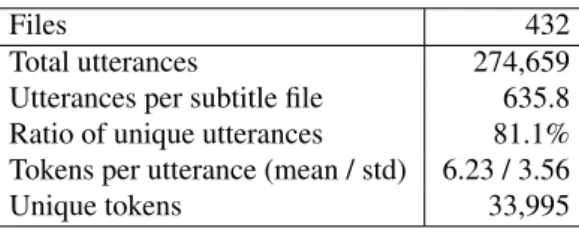
The corpus contains 432 subtitle files, for a total of 274,659 utterances (635.8 utterances per file). Statistics about the utterances in the corpus are given in Table 1. Due to the spoken source for subtitles, most of the utterances are rather short. The ratio of unique utterances over the total number is 0.81, meaning that one sentence out of 5 from the total corpus is repeated several times – short usual expressions, mainly.
4.2.
Limitations
Using a subtitle corpus for the example base of a chatter-bot comes with some difficulties. First, interactions in the TV series are not exclusively between two characters, and someone may interrupt the character speaking. Used as is, the risk is to introduce incoherent sequences of utter-ances when read as a dialogue between two persons. Pre-venting this problem would require the costly annotation of the speaker in every episode of the corpus. To the best of our knowledge, there is no automatic approach for this task which does not need multimodality. However, we chose not to go further into this problematic for the following reasons: the system is intended to be fully unsupervised, which rules out annotation; also, it is a first version and an advanced combination of development choices would make it com-plex to evaluate.
Another limitation that follows from this corpus is that scenes are not encoded in the subtitles. This prevents the direct detection of incoherent utterance pairing at the edge of scenes. We tried to use the time gap between utterances to automatically determine scene limits, but it turned out not to be a relevant factor.
4.3.
Pre-Processing of the Corpus
The following operations are applied to the corpus in order to automatically generate a usable database.
First, a cleaning process is necessary in order to remove any text that is not part of the actual dialogue such as sub-ber annotations, font shaping or speaker naming. Fancy or misread characters are also corrected or removed at this stage.
2
The exhaustive list is: “Real Humans”, “Awkward”, “Game Of Thrones”, “Malcolm In The Middle”, “The Americans”, “The Big Bang Theory” and “The Good Wife”.
Then, the NEs are identified with the help of the Stanford NER (Finkel et al., 2005). After being tagged by the parser, the NEs are memorised and replaced by their type so that they stay neutral for the further similarity calculations of the lookup phase.
Finally, the utterances are lemmatised using the English version of the lemma dictionary from (Courtois, 1990). The resulting base contains 274,227 pairs of which 25% contain at least one tagged NE3. 11% of the latter contain
NEs both in the initiative and the response, and a quarter of those cases (that is 1626 pairs in total) have a followed entity. An entity is followed when it is present both in the initiative and the response.
5.
Conversational Management
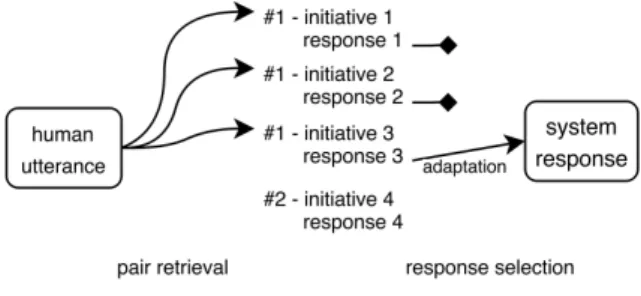
This section details the three steps of the response produc-tion process (cf. figure 1).
Figure 1: Conversational Management Flow
5.1.
Pair Retrieval
Currently, the last human-utterance is used to retrieve ap-propriate pairs from the base. After being applied the same NER tagging and lemmatisation as described in previous section, the utterance is used to rank all initiative utterances from the base by their similarity. Our similarity measure is based on tf-idf: the similarity between the human-utterance and any initiative utterance from the base is the mean of the tf-idf for each token.
σ(uuser, ubase) =
1 |(uuser)|
X
w∈uuser
tf idf (w, ubase, base)
In this particular use of tf-idf, utterances are considered as the documents. base is the set of all the documents. This choice of similarity measure permits to retrieve pairs in which the initiative is lexically close to the human-utterance. In future work, we intend to more generally take into account the dialogue history in this process.
5.2.
Response Selection
An eligible response is the response in the base to an initia-tive that is similar to the human-utterance. Those responses can be multiple for many reasons:
• several initiatives can have the same best similarity with the human-utterance
3
We observe a difference of 432 with the total utterances in Table 1. This is because the last utterance of each file is not paired with the first of the following one.
• the exact same initiative can appear more than once in the base
• a threshold can be set in order to choose more than one pair
The default strategy can be to randomly select among those, however we observed that often, several of these possible responses were close if not identical. The random strategy will select more likely (more often) the responses that are more represented, but the final selection is still out of pre-cise control. Another strategy that can be derived from this observation is to choose the most representative of the re-sponses. This can be done by computing the mean word vector of all the possible responses and using it as the ideal mean of the responses. We then rank the responses by the cosine similarity of their word vectors with the mean word vector. After this last step, still having responses that are have the same rank can mean either that they are very sim-ilar, or that they are so different that the mean word vector is equidistant to each of them. In both cases, the random selection among the best ranked is harmless.
However, the choice of a selection strategy between pure random or a more elaborate one like our proposal is not easy. Indeed, the elaborate strategy is (nearly) deterministic and will provide the same output each time whereas the ran-dom one is not, by definition. If a similar utterance is told twice by the human, the order in which possible responses should be given is certainly not random and strongly de-pends on the dialogue history. In that perspective, the mean word vector strategy at least guarantees a certain coherence in track of the system’s responses.
Finally, we can remark that the case of repetition of utter-ances by the speaker is rather unlikely. It is mainly an issue for short utterances which are theoretically less numerous.
5.3.
Response Transformation
The final step is to adapt the single selected response to the human-utterance. In this work, the adaptation consists in replacing or deleting the original NEs. For this purpose, we distinguish several situations regarding the selected pair (i, r) from the base:
1. every NE found in r is also present in i:
(a) every NE from i has an equivalent of the same type in the human-utterance
(b) some NEs from i cannot be linked to any in the human-utterance
2. some NEs from r are not present in i
When NEs from r can be linked to i and to the human-utterance, the default strategy is to replace it accordingly. For every other unlinked entity, it can be deleted if it is not inside a sentence, or left identical. We plan to imple-ment a generalisation process to replace unlinked entities by more neutral expressions such as “someone” or “that place”. Also, a POS tagging will allow to accurately mod-ify sentences to allow entity deletion without meaning loss.
5.4.
Dialogue Examples
Our system targets the selection of an appropriate response to an open-domain human utterance. We present some suc-cess and failure cases of our system collected in text-based interactions with a human in a chatterbot usage (described in section 6.).
Our system is able to select coherent and sometimes rele-vant responses allowing fluid interactions spanning several exchanges, e.g. (“H” is the human, “S” is the system):
H: hey S: hey H: what’s up S: nothing H: seriously? S: yeah
H: what do you do all day? S: mostly read comics
Some surprising and sometimes amusing interactions have emerged between the human and the system, e.g.:
H: are you a machine? S: i am who i was yesterday H: who were you yesterday?
S: anybody
H: anybody is not an answer S: it was
or such as:
H: would you like some wine? S: no
H: beer may be?
S: it’s hard to get drunk on beer
However, these results should be mitigated (see section 7. for a discussion of the capabilities of the system). Indeed, we have observed some failure cases. It includes the selec-tion of incomprehensible responses, e.g. incomplete ones:
H: i am tired S: well that’s
or incomprehensible ones:
H: ok. i don’t know what can i say to you. S: hejsan ooh
Sometimes, the system selects responses that are clearly in-valid given the previous utterance:
H: what are you? S: hello
H: could you describe yourself? S: thanks
The system also selects responses that are pragmatically valid but nonetheless inappropriate, e.g.:
H: 2 times 2 equals ? S: 1
6.
Preliminary Study: Chatterbot Usage
6.1.
Description of the Experiment
We conducted an experiment dedicated to the collection of a Human-Machine corpus of dialogues between a human and our system in a chatterbot usage. Dialogues consist in free open-domain conversations with the system through a text-based web interface. Dialogues are carried out in En-glish. Our chatterbot system is a reactive-only dialogue sys-tem. Hence, dialogues follow a common structure which
is a sequence of human participant-system utterance pairs. Dialogues are initiated by the human participant.
6.2.
Description of the Questionnaires
Participants were encouraged to immediately assess each conversation they had with the system via two question-naires.
The first questionnaire is dedicated to the evaluation of in-dividual system utterances produced in response to human ones. For each system utterance, the participant was asked to answer by one of the three possibilities “yes”, “no”, “N/A” to the following questions: (i) “Is the utterance un-derstandable?”, (ii) “Is the utterance polite?”, (iii) “Is the utterance coherent?”, and (iv) “Is the utterance relevant?”. Understandability of an utterance is defined as whether or not the response of the system is understandable taken alone. For instance, the utterance “Hello !” can be said to be understandable whereas the utterance “I...” cannot. Co-herence of an utterance assesses whether a system response is acceptable given the directly previous human utterance. In other words, an exchange of two utterances is said to be coherent if the presence of the second utterance is easily explained by taking into account the first one. For example, the answer “Hi!” can be said to be coherent in response to the utterance “Hello!”, whereas “The sky is blue.” cannot. Relevance of an utterance is defined as a coherent utterance that also provides interesting information.
The second questionnaire is a global self-report regarding the conversation participants just had on a Likert scale of 5 points. It consists of several items aiming at (i) evaluating the interaction in terms of amusement, engagement, enjoy-ability, (ii) evaluating the system in terms of its capabilities (global politeness, understandability, coherence, relevance and repetition) as well as its attitude (e.g., friendliness), and (iii) evaluating the attitude and mental states of the par-ticipants (such as bored, embarrassed, upset, friendly, en-thusiastic, embarrassed, surprised, feeling a desire to talk to the system). A representative example of a Likert item of this second questionnaire is: “The interaction with the system has been: 1-‘not amusing at all’, 2-‘somewhat not amusing’, 3-‘neither amusing nor not amusing’, 4-‘some-what amusing’, 5-‘very amusing’”. Additionally, partici-pants had the possibility to let anonymous free form com-ments about the experiment.
6.3.
Participants
27 volunteers participated in this experiment (37% female, 63% male). They are mainly non-native English speakers. Ages of the participants are comprised between 20 and 59. 81% of the participants have ages ranging from 20 to 39; 19% have ages ranging from 40 to 59.
7.
Results and Analyses
7.1.
Description of the Collected Corpus
Participants were allowed to interact several times with the system. A session consists of a dialogue with the sys-tem along with the two evaluation questionnaires. Table 2 presents some figures about the collected corpus. We col-lected 41 sessions carried out by 27 participants. 48% of the participants only interacted once with the system. On
Dialogues 41
Turns 1384
Unique utterances 917 (system: 358, human: 573) Tokens 5493 (unique: 989)
Table 2: Figures about the collected corpus
Type average (std/min/max) Turns 33.76 (19.32 / 10 / 82) Tokens 133.98 (73.2 / 29 / 331) Tokens/human 85.02 (45.5 / 20 / 208) Tokens/system 48.95 (29.1 / 8 / 130) Tokens/human utt. 5.04 (2.9 / 1 / 23) Tokens/system utt. 2.90 (2.9 / 0 / 20) Duration 7min19s (9m41s / 1m38s / 56m49s) Response time . . . human 25.7s (108.8 / 0.002 / 2429.5) . . . system 1.8s (0.19 / 0.002 / 13.7)
Table 3: Figures about the collected dialogues. utt. = utter-ance
average, participants carried out 1.8 sessions (median=1.0, std=1.1). The maximum number of sessions by a unique participant is 5.
Table 3 presents some figures characterising the collected dialogues. On average, a dialogue with the system lasts around 7 minutes and contains approx. 34 turns. Unsurpris-ingly, the human participant takes approx. 10 times much time than the system to produce a response, right after a system utterance (on average 25.7s for the human, 1.8s for the system).
The corpus is available at the URL: https://ucar. limsi.fr/.
7.2.
Variety of System Responses
We investigated some objective indicators to evaluate sys-tem responses. First, it is worth noticing than the syssys-tem contributions are shorter than the human ones in terms of token size. From table 3 and given the fact that every di-alogue contains the same number of system turns and hu-man participant turns, we can see than the system produces less tokens than the human on the whole dialogue (on av-erage, 48.95 VS 85.02). The same can be said at the utter-ance level (on average, 2.90 VS 5.04): system utterutter-ances are shorter than human utterances.
Next, we looked into the repetition of the system in-side a same dialogue. To that purpose, we com-puted a unique utterance4 ratio which corresponds to the proportion of unique system utterances in a given dialogue. Alternatively, it is given by the formula: #unique system utterance /#system utterances. For the entire corpus, the ratio is on average 0.92 (median=0.93; std=0.08; min=0.73; max=1.0). In other words, 92% of the utterances of the system are unique in a dialogue on aver-age. Then, we examined the variety of system responses
4
Here, utterance equality is the same as string equality.
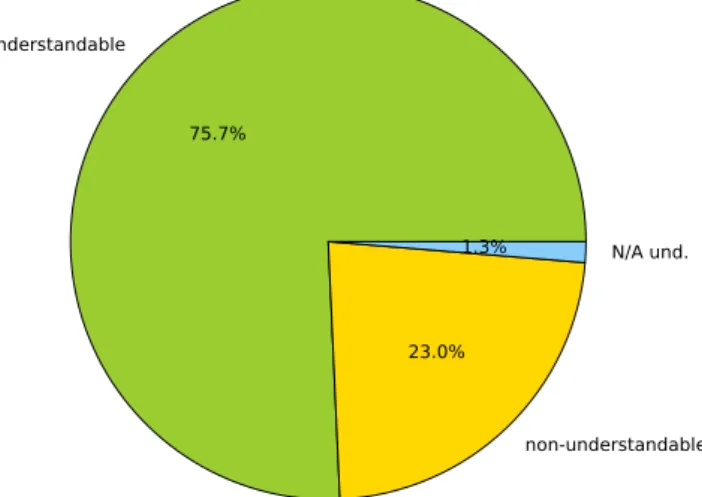
understandable 75.7% non-understandable 23.0% N/A und. 1.3%
Distribution of understandability per utterance (n=692)
Figure 2: System utterance-level evaluation of understand-ability
in the entire corpus, i.e. across dialogues. To that aim, we computed the ratio given by the number of unique system utterances in the corpus against the number of unique hu-man utterances in the corpus. It turns out that the ratio for this corpus is 0.62. This is an objective evidence supporting the fact that system utterances are less varied than human ones. These results about the repetition of the system are completed by the subjective evaluation of human partici-pants in section 7.3.
7.3.
Subjective Study
7.3.1. Capabilities of the System
Participants were asked to assess the global capabilities of the system in producing a response via 5-point Likert items. When asked about the politeness of the system, participants reported that the answers of the system were “3: neither po-lite nor impopo-lite” (mode=median=3), where 1 is “very im-polite” and 5 is “very im-polite”. Concerning the understand-ability of the responses of the system, participants reported that the answers of the system were “4: somewhat under-standable” (mode=4; median=3), where 1 is “very incom-prehensible” and 5 is “very understandable”. Regarding the coherence of the responses of the system, participants re-ported that the answers of the system were “2: somewhat incoherent” (mode=median=2), where 1 is “very incoher-ent” and 5 is “very coherincoher-ent”. Similar results have been observed for the relevance of the responses of the system. These results are corroborated by the utterance-level eval-uation. It shows that 75.7% of the responses of the system have been rated as understandable, while 23% have been considered as incomprehensible (see figure 2). On the other hand, only 41.2% of the responses have been rated as coher-ent, and 55.5% as incoherent. This comes down to 32.2% for relevant responses.
As of the repetition of the system (see figure 3), partici-pants reported that the system has been “2: repeating it-self” (mode=2; median=3), where 1 is “repeating itself a lot” and 5 is “not repeating itself at all”. However, these results should be mitigated. Indeed, results presented in
repeating itself
a lot repeatingitself neither repeatingnor not repeatingnot repeatingitself not repeatingitself at all
Answers (mode=2, median=3.0) 0 2 4 6 8 10 12 14 16 Count
The system has been... (n=41)
Figure 3: Perceived system repetition by human partici-pants
section 7.2. indicate that the system seems to be repeating itself mainly across dialogues rather than inside the same dialogue. As a matter of fact, it turns out that participants that only interacted once with the system have the median answer “4: not repeating itself”.
Lastly, the participants mainly reported the system as being “3: neither friendly nor unfriendly” and “3: neither rude nor nice”.
7.3.2. Self-report from Human Participants
Participants mainly rejected negative mental states by an-swering that they were (i) “3: neither bored nor not bored” (mode = median = 3), (ii) “3: neither embarrassed nor not embarrassed” (mode = median = 3), and (iii) “1: not up-set at all” (mode = 1; median = 2). Similarly, participants mainly selected positive attitudes in answering that they were “4: somewhat friendly” (mode=median=4) and “3: neither rude nor nice” (mode = 3; median = “2: somewhat nice”). However, participants answered being “3: neither enthusiastic nor unenthusiastic” (mode = median = 3). Concerning the chatterbot system, participants were “4: somewhat surprised” (mode = 4; median = 3) by the re-sponses of the system. Besides, participants mainly agreed to feeling a desire to talk to the system (mode = 4; median = “3: neutral”), where 1 corresponds to “strongly disagree” and 5 to “strongly agree”. A clear distinction on the desire to talk to the system appears between participants that only interacted once with the system, and those who interacted several times. By considering results on the first session carried out by each participants, we realise that participants that interacted once strongly disagreed on feeling a desire to talk to the system (mode = 1; median = 2) while par-ticipants that interacted more than once agreed (mode = 4; median = 3).
not amusing
at all not amusingsomewhat neither amusingnor not amusing somewhatamusing amusingvery
Answers (mode=4, median=3.0) 0 2 4 6 8 10 12 14 16 18 Count
The interaction with the system has been... (n=41)
Figure 4: Amusement reported by human participants
7.3.3. Subjective Evaluation of the Interactions with the System
Participants were asked to report their opinions on three no-tions related to the interaction they just had with the system: amusement, engagement and enjoyability.
Figure 4 presents the results concerning the amusement of the interaction with the system. Participants mainly reported that the interactions were “4: somewhat amus-ing” (mode = 4; median = 3). We looked into features of dialogues (length in turns or tokens, duration, response time, vocabulary overlap, and ratios about understandabil-ity/coherence/relevance/politeness) that could explain the amusement reported by human participants. The most sig-nificative feature that we found is the coherence ratio, i.e. the proportion of system utterances in a dialogue that have been rated as coherent by the human participant. Alter-natively, it is given for a specific dialogue by the for-mula: #coherent system utterances/#system utterances. The coherence of the system responses seems to play a role in the amusement of the human participant. Indeed, it exists a significative linear correlation between the coher-ence ratio and the reported amusement (r = 0.52, t-test p-value= 0.0004), computed with Pearson’s product-moment correlation. In addition, we examined potential links be-tween mental states reported by the participants and the amusement. Surprising the human participant with system responses seems to favour the reported amusement of the participant. This is supported by the existence of a signi-ficative linear correlation between the reported amusement and the reported “surprised” mental state (r = 0.58, t-test p-value= 6.35 × 10⁻⁵).
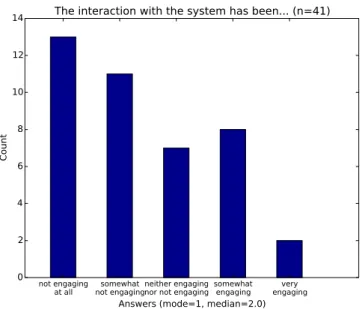
Figure 5 presents the results concerning the engagement of the interaction reported by the human participants. They mainly reported that the interactions were “1: not engaging at all” (mode = 1; median = “2: somewhat not engaging”). In the same way as amusement, engagement is connected to the coherence of the system utterances. This is confirmed by the existence of a significative linear correlation between
not engaging
at all not engagingsomewhatneither engagingnor not engagingsomewhatengaging engagingvery
Answers (mode=1, median=2.0) 0 2 4 6 8 10 12 14 Count
The interaction with the system has been... (n=41)
Figure 5: Interaction engagement reported by human par-ticipants
the coherence ratio and the reported engagement (r = 0.60, t-test p-value= 2.87 × 10⁻⁵). Besides, we looked into the links between self-reports and engagement. It turns out that the main link we found is between the engagement and the “desire to talk” felt by the human. It is supported by a sig-nificative linear correlation between those two (r = 0.65, t-test p-value= 4.84 × 10⁻⁶).
Lastly, participants reported that the interactions were “2: somewhat unenjoyable” (mode = median = 2). This may seem surprising compared to the results about amusement. We did not find significative link between features of di-alogues and the reported enjoyability. In particular, we did not observe significative links between enjoyability and the capabilities of the system in terms of politeness, un-derstandability, coherence and relevance (unlike what was found for amusement and engagement). In addition, re-ported enjoyability does not seem to play a role between participants that only interacted once with the system, and those that interacted several times (contrary to the “talk de-sire”, cf. section 7.3.2.). One explanation may be that en-joyability is more connected to the feeling of the partici-pant toward the chatterbot nature of the experiment rather than on the experiment itself. This seems supported by the fact that the only significative link we found between enjoyability and mental states is with the reported enthu-siasm of the participant. We found a significative linear correlation between those two aspects (r = 0.58, t-test p-value= 6.75 × 10⁻⁵).
7.4.
Discussion: Lessons from a Data Collection
with a Chatterbot
This study has permitted to evaluate the general capabil-ities of our system. It has pointed out some limitations of the automatically authored open-domain conversational strategy in a chatterbot usage. First, we have observed that the system mainly generates understandable responses to a human utterance, with room for improvement. Next, our system has unsurprisingly shown clear limitations on the
coherence and relevance aspects that should be improved in the near future. In particular, our results show a direct link between the reported system response coherence, and the amusement and engagement of the human in the inter-action. Last, the system objectively repeats itself across dialogues, and it is perceived by the human participants. However, the repetition inside a unique dialogue seems ac-ceptable.
This study has brought some useful insights regarding the chatterbot usage of the authored open-domain conversa-tional strategy. First, it has confirmed that the engagement of interaction reported by the human participants in chat-terbot usage is dependent on other factors than the system response selection process. In particular, participants have been complaining in the free form comments about the lack of initiative of the system (which is only reactive). This is corroborated by the fact that we found a significant cor-relation between the talk desire felt by human participants and the reported interaction engagement. Next, participants have been complaining about the shortness of system re-sponses, explaining that there was “not enough matter to bounce on to continue the interaction”. This idea seems supported by correlations between the surprise felt by hu-man participants and the reported amusement. This may indicate that the ability of the system to produce surpris-ing and intrigusurpris-ing responses may increase amusement and probably interaction engagement. Lastly, our study indi-cates that enjoyment of a chatterbot interaction by a human participant may reside in external factors independent from the system. We have not found significative links between reported enjoyment of the interaction and dialogue features or system capabilities (such as dialogue length and coher-ence). However, we have found a significant correlation with the reported mental state “enthusiasm”.
8.
Conclusion and Future Work
In this paper, we have presented an unsupervised corpus-based process to author an open-domain conversation strat-egy usable both in chatterbot systems and as a fallback strategy. This process has been implemented on a corpus of television dramas subtitles.
This system has been used as a chatterbot to collect a cor-pus of 41 open-domain textual dialogues with 27 human participants. It is available at the following URL: https: //ucar.limsi.fr/. We have carried out a study that has made it possible to discuss the general capabilities of the system in terms of understandability, repetition and co-herence of the selected system response in reaction to a hu-man utterance. In addition, we have collected the subjective evaluation of human participants in terms of amusement, engagement and enjoyability. We have discussed the main factors influencing those dimensions in our chatterbot ex-periment, namely: the coherence of the responses of the system with regard to the human utterance, their sizes and their ability to surprise the participant, and the lack of ini-tiative of the system.
This study has brought some useful insights to improve our unsupervised approach to open-domain conversation strat-egy authoring. In future work, we intend to study the im-pact of the subtitle corpus on the understandability of the
system response. In particular, we envision a more robust automatic filtering process to limit the number of incom-prehensible system utterances. Next, we aim at improving coherence of the response by taking into account history of dialogue and not just the last human utterance. Then, we plan to favour response variability in the response selection algorithm to avoid repetition.
Acknowledgements
This work was partly funded by the JOKER project and supported by ERA-Net CHIST-ERA, and the “Agence Na-tionale pour la Recherche” (ANR, France).
9.
Bibliographical References
Ameixa, D., Coheur, L., Fialho, P., and Quaresma, P. (2014). Luke, I am your father: dealing with out-of-domain requests by using movies subtitles. In Intelligent Virtual Agents, pages 13–21. Springer.
Banchs, R. E. and Li, H. (2012). IRIS: a chat-oriented di-alogue system based on the vector space model. In Pro-ceedings of the ACL 2012 System Demonstrations, pages 37–42. Association for Computational Linguistics. Courtois, B. (1990). Un syst`eme de dictionnaires
´electroniques pour les mots simples du franc¸ais in dic-tionnaires ´electroniques du franc¸ais. Langue franc¸aise, 87:11–22.
Devillers, L., Rosset, S., Dubuisson Duplessis, G., Sehili, M., B´echade, L., Delaborde, A., Gossart, C., Letard, V., Yang, F., Yemez, Y., T¨urker, B., Sezgin, M., El Haddad, K., Dupont, S., Luzzati, D., Est`eve, Y., Gilmartin, E., and Campbell, N. (2015). Multimodal data collection of human-robot humorous interactions in the joker project. In 6th International Conference on Affective Computing and Intelligent Interaction (ACII).
Finkel, J. R., Grenager, T., and Manning, C. (2005). Incor-porating non-local information into information extrac-tion systems by Gibbs sampling. In Proceedings of the 43rd Annual Meeting on Association for Computational Linguistics, pages 363–370. Association for Computa-tional Linguistics.
Gandhe, S. and Traum, D. R. (2007). Creating spoken di-alogue characters from corpora without annotations. In INTERSPEECH, pages 2201–2204.
Gandhe, S. and Traum, D. R. (2013). Surface text based dialogue models for virtual humans. In Proceedings of the SIGDIAL.
Hu, Z., Rahimtoroghi, E., Munishkina, L., Swanson, R., and Walker, M. A. (2013). Unsupervised induction of contingent event pairs from film scenes. In EMNLP, pages 369–379.
Lee, C., Jung, S., Kim, S., and Lee, G. G. (2009). Example-based dialog modeling for practical multi-domain dialog system. Speech Communication, 51(5):466–484.
Nio, L., Sakti, S., Neubig, G., Toda, T., Adriani, M., and Nakamura, S. (2014). Developing non-goal dialog sys-tem based on examples of drama television. In Natu-ral Interaction with Robots, Knowbots and Smartphones, pages 355–361. Springer.
Weizenbaum, J. (1966). ELIZA - a computer program for the study of natural language communication be-tween man and machine. Communications of the ACM, 9(1):36–45, January.