READ THESE TERMS AND CONDITIONS CAREFULLY BEFORE USING THIS WEBSITE. https://nrc-publications.canada.ca/eng/copyright
Vous avez des questions? Nous pouvons vous aider. Pour communiquer directement avec un auteur, consultez la première page de la revue dans laquelle son article a été publié afin de trouver ses coordonnées. Si vous n’arrivez pas à les repérer, communiquez avec nous à [email protected].
Questions? Contact the NRC Publications Archive team at
[email protected]. If you wish to email the authors directly, please see the first page of the publication for their contact information.
NRC Publications Archive
Archives des publications du CNRC
This publication could be one of several versions: author’s original, accepted manuscript or the publisher’s version. / La version de cette publication peut être l’une des suivantes : la version prépublication de l’auteur, la version acceptée du manuscrit ou la version de l’éditeur.
Access and use of this website and the material on it are subject to the Terms and Conditions set forth at
Municipal infrastructure investment planning: managing the data Vanier, D. J.; Danylo, N.
https://publications-cnrc.canada.ca/fra/droits
L’accès à ce site Web et l’utilisation de son contenu sont assujettis aux conditions présentées dans le site LISEZ CES CONDITIONS ATTENTIVEMENT AVANT D’UTILISER CE SITE WEB.
NRC Publications Record / Notice d'Archives des publications de CNRC: https://nrc-publications.canada.ca/eng/view/object/?id=a94000fe-b8b7-403d-857c-6cbf4078eb73 https://publications-cnrc.canada.ca/fra/voir/objet/?id=a94000fe-b8b7-403d-857c-6cbf4078eb73
MUNICIPAL INFRASTRUCTURE INVESTMENT PLANNING: MANAGING THE DATA
Dana Vanier, National Research Council Canada Norman Danylo, Ville de Montréal, Canada
Submitted to First International Conference on New Information Technologies for Decision Making in Civil Engineering. Montreal, 1998. (NRCC 42664)
Abstract
This paper describes innovative, decision-making tools for assisting city engineers and managers make choices between long-term alternatives related to the maintenance, repair and capital renewal of mixed urban infrastructure assets. The paper provides the background information uncovered in the first phase of the investigation; identifies needs for decision-making tools for municipal-type organizations; outlines a proposed consortium in the area of investment planning for municipal infrastructure, and describes the conceptual design of a decision-making tool to be used in this consortium. The investigation found a limited number of applications for decision-making in the domain of municipal infrastructure, and did not find any comprehensive solution that addresses the current and future needs for investment planning for municipal engineers and managers. Integration with corporate legacy systems such as computerized maintenance management systems and geographic information systems is seen as the most debilitating problem for using decision-making tools in the area of municipal infrastructure planning.
Résumé
Le présent document décrit des outils novateurs de prise de décision qui aideront les gestionnaires et les ingénieurs municipaux à faire des choix entre différentes solutions à long terme se rapportant à l’entretien, à la réparation et au remplacement d'immobilisations
d’infrastructures urbaines mixtes. Ce document résume l’information de base établie au cours de la première phase de l’étude; il démontre la nécessité d’outils de prise de décision pour les organismes municipaux ou du même type; décrit un consortium proposé dans le secteur de la planification pour les infrastructures municipales et définit les concepts d’un outil de prise de décision qui serait utilisé par ce consortium. L’étude n’a révélé qu’un nombre limité
d’applications de prise de décision dans le domaine des infrastructures municipales et n’a pas permis d’établir une solution parfaite répondant aux besoins actuels et futurs de planification des investissements pour les ingénieurs et gestionnaires municipaux. L’intégration aux systèmes corporatifs comme les systèmes informatisés de gestion de l’entretien et les systèmes
d’information géographique est considérée être le principal obstacle à l’emploi d’outils de prise de décision dans le secteur de la planification des infrastructures municipales.
Keywords: Investment Planning, Municipal Infrastructure, Decision-Making, Product Modeling
1. Introduction
This paper describes innovative, decision-making tools for assisting city engineers and managers make choices between long-term alternatives related to the maintenance, repair and capital renewal of mixed urban infrastructure assets. This investigation into the availability of decision-making tools was initiated by the National Research Council Canada (NRCC) after considerable contact, discussion, and negotiation with the City of Montreal’s Finance Department. Sections 1 and 2 of this paper provide the background information uncovered in the first phase of the investigation. Section 3 identifies needs for decision-making tools for municipal-type organizations. Section 4 outlines the proposed consortium between NRCC and the City of Montreal in the area of investment planning for municipal infrastructure. Section 5 outlines the conceptual framework of a decision-making tool to be used in this consortium. 1.1 Background
Owners of mixed urban infrastructure assets such as federal departments, state or provincial governments, municipalities, universities or the armed forces have responsibility over a diversified set of constructed facilities; these range from complex underground networks to sophisticated buildings, as well as roadway systems, parks and any other equipment necessary to maintain all this infrastructure (to be called municipal infrastructure in this paper). This municipal infrastructure, however, is not protected from deterioration due to usage, aging, climate, geological conditions, or changes in use. Furthermore, because of inadequate funding or inappropriate support technologies, certain components of this infrastructure have been neglected and received only remedial treatments (OAG, 1994). Consequently, these municipal infrastructure assets will have a foreshortened service life.
1.2 Current State of Infrastructure Assets
Maintenance expenditures in Canada represent a significant portion of the total value of construction in any given year. A recent review of Statistics Canada construction expenditures by municipalities has shown that close to $80 billion is spent on construction every year. In the United States of America the numbers can be conservatively estimated at ten times higher.
Indeed, even if Canadian cities, for example, spent between $12 and $15 billion every year on maintaining and rehabilitating their infrastructure (bridges, streets, water systems, sewers, tunnels, and sidewalks), there is currently an accumulated shortfall estimated at $44 billion to return these assets to an acceptable condition (FCM, 1996).
To make matters worse, in the authors’ view, too much emphasis has been placed on new construction for the past three decades, all to the detriment of maintaining the existing facilities. As a result, organizations may have more facilities than they can afford to maintain; and in many instances, they may be unaware of this situation and their serious predicament. Added to these escalating problems, some municipalities are experiencing reductions in revenues caused by urban sprawl and relocation of industries to suburbs, and many Canadian organizations are increasingly sharing the burden of new responsibilities from higher-levels of government.
1.3 Conflicting Infrastructure Management Goals: Financial versus Technical
Managers of municipal infrastructure assets must also make difficult technical decisions regarding when and how to maintain, repair, or renew their assets, while working with continuously-shrinking budgets. These managers do not have an easy task; they must allocate funds among competing yet deserving needs, often having to make decisions based on incomplete data. In addition, the asset managers’ resources are being challenged from all sides: managers are also being asked to cut costs, privatize operations, outsource responsibilities and reduce expenditures (FCM, 1996). This makes it extremely difficult for long-term decision-making in the area of municipal infrastructure management.
2. Municipal Infrastructure Planning: State-of-the-Art in Decision-Making
Many organizations have recognized the scope of the problems facing today’s asset managers (NACUBO, 1990; NRC, 1990, 1994; Melvin, 1992; CERF, 1996). Many simple, practical questions related to day-to-day infrastructure maintenance, repair and renewal remain unanswered: (1) how much annual maintenance is required; (2) is it more cost-effective to maintain, repair or renew a component or system; (3) how can the remaining service life of a component or system be calculated; (4) will the maintained, repaired or renewed component or system meet the desired performance requirements; (5) what are the probabilities of failure for individual components or systems and what are the consequences of failure, and (6) how can an asset manager make a logical, cost-effective and objective decision with so many unknowns?
To address these questions, many agencies (NACUBO, 1990) support the concept of strongly differentiating maintenance and repair from capital renewal; in fact, this distinction is an essential premise to bring deferred maintenance, on-going maintenance and repair, as well as the rehabitation and capital renewal expenditures under control (NACUBO, 1990). It is also an efficient way for identifying the long-term costs for maintenance, repair and renewal. The significant research and development activities reviewed to date relating to decision-making have been classified into the three categories identified above, those relating to: (1) deferred maintenance, (2) inspection, maintenance and repair, and (3) rehabilitation and capital renewal. 2.1 Deferred Maintenance Decision-Making
Many decision-making tools already exist in this domain: the main activities reviewed to date deal with practices employed in the education sector or with condition assessment and data collection methods currently in use in North America.
NACUBO Model: The National Association of College and University Business Officers (NACUBO, 1990; Kaiser, 1996) proposes a detailed process consisting of separating costs attributed to capital renewal from that which is deferred maintenance. In this process, the asset manager first identifies maintenance that has been postponed, phased or deferred, and then attempts to provide an estimate for the cost of that deferred maintenance. NACUBO uses the term “facility condition index” or FCI to provide a comparison metric between different facilities or systems. The FCI is the amount of deferred maintenance divided by the capital replacement value or CRV. NACUBO (1990) indicates that facilities with FCI’s higher than 0.15 are problematic. The NACUBO Model can be easily implemented on a spreadsheet.
Computerized Maintenance Management: There now exists a large selection of “fully commercialized” computerized maintenance management systems (CMMS). Many of these are relational database applications that have been developed to meet the data handling needs of
asset managers. The CMMS domain, at this time, is quite mature, and many stable, comprehensive, useful tools exist. For example, any number of database applications can manage work orders, trouble calls, equipment cribs, stores inventory and preventive maintenance schedules, and many programs include features such as time recording, inventory control and invoicing. The CMMS’s capability to store inventory data is formidable; however, their capacity with respect to life cycle economics, service life prediction and risk analysis is considerably less sophisticated. These systems are currently not able to assist the manager in analysing data or offering scenarios for long-term system readiness, capability, or performance; but the CMMS is becoming an essential tool for the asset manager of the 1990’s. A quick search on the Internet (e.g. www.altivista.dignital.com, www.excite.com) using “computerized maintenance management system” or “cmms” will produce thousands of sites dedicated to this topic.
Condition Assessment Survey System: A condition assessment survey (CAS) is a decision-assistance tool that establishes the existing condition of the asset (IRC, 1994); and hence produces a benchmark for comparison, not only between different assets, but also for the same asset at different times (NRC, 1994; www.fm.doe.gov/fm-20/cais.htm). “Using CAS, a maintenance manager can formalize the assembly of basic planning elements such as deficiency-based repair, replacement costs, projected remaining life and planned future use.” (Coullahan and Siegfried, 1996). CAS records the deficiencies in a system or component, the extent of the defect, as well as the urgency of the repair work; in some cases the estimated cost of repair is provided at the time of inspection. “Management, as a result of the data generated by CAS, is better able to develop optimal plans for maintenance and repair of their buildings” (Coullahan and Siegfried, 1996). The US Department of Energy has a significant program (Earl, 1997) dealing with life cycle asset management/condition assessment surveys (LCAM/CAS) and has started to publish newsletters on the topic in both hardcopy (Inside Infrastructure, 1998) and electronic format (www.fm.doe.gov/fm-20/read.htm).
Engineered Management Systems: The US Army Construction Engineering Research Laboratory (CERL) has pioneered the use of engineered management systems in many construction sectors including paving, roofing and rail maintenance (www.cecer.army.mil/ facts/sheets/fl08.html). Engineered management systems (EMS) assign a condition index (CI) to an asset based on a number of factors including the number of defects, physical condition and quality of materials or workmanship. The software embodies the results of research studies which estimate the potential degradation of the CI based on loads on the system or external agents acting on materials. With all these data in hand, it is therefore possible to predict the CI well into the future, given the current state and a likely degradation curve. A number of systems exist for municipal infrastructure including PAVER (Shahin, Bailey and al., 1987), ROOFER (Bailey, Brotherson and al., 1989), BUILDER (www.cecer.army.mil/facts/sheets/FL25.html), and RAILER (www.cecer.army.mil/ facts/sheets/FL44.html).
2.2 Inspection, Maintenance and Repair - Level of Investment Decision-Making
Facility maintenance literature recommends that asset managers should spend between 2 and 4 percent of the capital replacement value (CRV) of their portfolio on maintenance and repairs (NRC, 1996). Unfortunately for practitioners, these numbers are speculative and based on experiential information only; in addition, they provide too wide range of variance (100% increase). There is little supporting research for the 2 to 4 percent maintenance figures, outside of empirical data (CERF, 1996). In addition, these figures are assumed to be averages over the
entire construction domain and cannot be used for one specific discipline; for example, 2% might be excellent for roads, whereas 4% is the bare minimum for sewage treatment plants
In addition, the calculation of the CRV is not well-defined; -- in some instances it is calculated as the historical price, the historical price after depreciation and inflation, the current replacement cost, or the productivity-realized value “in use” (Lemer, 1998). Of course, the CRV only takes into account the replacement value; in fact, full life-cycle costs including maintenance, repair, replacement and disposal should be considered when calculating CRV (Lemer, 1998).
As can be seen, there is definite need for research in the area of Level of Investment decision-making, specifically as it relates to how much money is required to optimally maintain the different categories of assets.
2.3 Rehabilitation and Capital Renewal Decision-Making
In this subsection the authors have included a number of project or activities related to long-term facilities planning. These examples can be loosely classified into the categories of methodology, research venture, prototype, commercial product, or game.
NACUBO Model: NACUBO (1996) provides practical methods to plan capital renewal. The methodology is related to the FCI discussed earlier and is called capital renewal (CR) analysis. It involves the discrete identification of the projected replacements costs that will be incurred at the end of the service life of a part, component, system or asset. The CR analysis involves estimating the renewal costs in five-year lumps, and spreading these costs equally over each year. In this way, costs for the CR for each system or facility can be calculated well into the future, and can be brought forward as a present value or calculated as an annuity expense. Spreadsheets are the implementation of choice for the NACUBO Model.
IMPACT (Installation Maintenance Prioritization, Analysis, and Coordination Tools): The goal of this CERL research project is to provide the capability to identify effective installation-wide strategies for managing the maintenance and repair of facilities and infrastructure through multi-year plans. The approach follows “operations research” models: the facilities are modeled as a systems network, initial states are established by EMS and CAS, “what if” scenarios are simulated based on predicted deterioration curves, user requirements and budget allotments, and maps, graphs and point-and-click provide the user interface. Although still in the prototype stage, IMPACT is providing a view of the potential of information technology as it relates to planning long-term investments (Subick, 1997).
Project CITY (Civil Infostructure TechnologY): “The objective of this project is to support the sustainable management of civil infrastructure via (1) a principled methodology for the study of work practices, problem solving, coordination, and use of technology in an organization, (2) the integration and further development of existing information technology to support team decision-making and information sharing, and (3) the application of the methodology and information technology to the civil infrastructure system (specifically, gas pipeline and road systems) of Fort Gordon, Georgia” (www.tec.spcomm.uiuc.edu/projcity/ cityprop.html). The project has adopted a hybrid world wide web (WWW)/client-server interface to manage the infrastructure data (O’Keefe, 1998). The project is currently in its final year and the proposed “CityScape” suite will be implemented at Fort Gordon at the end of 1998. The CityScape users will be able to use their Internet browsers to submit work orders, to view maps and drawings of the existing infrastructure, and to store corporate knowledge about the civil
infrastructure. Although the original research plan involved the use of Engineered Management Systems to collect data related to condition assessment, it was found that assessment data in some fields were difficult to obtain and impossible to maintain. As a result, the EMS were not integrated into the final solution.
Geographical Information Systems: GIS are becoming extremely popular with municipalities to manage cadastral information such as lot plans, buried systems and road networks (cgdi.gc.ca/iacg/gis/gov/mun_p.htm; GIAC, 1998). In a geographical information system, the data about a particular asset are directly related to their physical location on a map of the city or region. For example, the location of a specific lot can be viewed in the context of other lots in a neighbourhood; lot surface areas can be calculated, and distances to specific services can be accurately calculated. Satellite imagery data can also be included in GIS systems.
In addition to the widely-available client-server GIS applications, the world wide web can also be used as an interface to GIS data (Municipal GIS, 1998). The State of Kansas’ GIS uses the web (http://gisdasc.kgs.ukans.edu/kanview/contour/ks_contour.html) extensively to publish information regarding geomatic information. The Kansas interface serves quick and comprehensive data to citizens and municipal decision-makers, alike. The data include physical descriptions (http://gisdasc.kgs.ukans.edu/kanview/demograph/county/demograph.html) in form of maps or charts, as well as demographic information related to these regions, such as number of households, number of rental units, vacancy rates, property values, and population.
System implementation costs for a comprehensive GIS can be extremely expensive for municipal or regional governments. A large Michigan county has expended over $10M US to date for their county-wide GIS; however, the savings to the taxpayers are estimated at $1 M US (Oppman, 1998).
Although GIS may appear as a solution to many in the municipal engineering field, the integration of the diverse set of applications related to municipal infrastructure may be problematic. However, based on the significant commitments to GIS in the field of municipal infrastructure by a large number of organizations (GIAC), it is highly recommended that any software developed in the domain of investment planning should interface to an organization’s Geographic Information System. Browsing the Internet (www.altavista.digital.com) provides considerable data about GIS in the field of municipal engineering.
Integrated Infrastructure Assets Management System: The IIMS system, proposed by Lemer (1997; 1998), identifies the potential problems of integrating asset management data for decision-making. These problems include the lack of complete data regarding facilities, the difficulty in establishing replacement values for facilities, the establishment of the “non-financial” value of assets, and the integration with GIS. Lemer stresses the need for proper data collection, performance modeling, decision analysis, as well as, management reporting. In a properly-crafted, integrated, infrastructure assets management system, Lemer envisions the tool as serving decision-makers at all levels, including policy and operations, by drawing on detailed project-level information and by producing information on demand. Lemer views the proposed IIMS as a tool to enable policy makers and operations managers to collect data to be used by them and by the citizens of the community.
Real Estate Capital Asset Priority Planning System: RECAPP™ (www.recapp.com) is a strategic database management systems running on Windows™ that can calculate the funding requirements for capital repair/renovations over a 25 year time horizon. It is a relational database
and management methodology that develops prioritized capital funding and renewal projections using life cycle costing strategies. It is also a tactical planning tool that allows tracking of capital budgets, project status, and the risks associated with deferring maintenance. RECAPP allows the user to input data at an organization, regional, district, building or department level; permits the user to enter information about assets such as building location, gross area, tenancy, and property type; stores additional data such as digital images of the facility, system and components or CAD drawings of the floor plan, and saves archival information such as construction cost, age of facility, and maintenance expenditures. The output of RECAPP includes sophisticated plotting routines with histograms, pie charts or line plots depicting portfolio age profiles or 25 year expenditure projections. This program has not been evaluated by the authors at this time, but technical brochures have been reviewed.
Applied Management Engineering: AME (www.idirect.net/ame_ot.htm) retails three Windows™ packages dealing with asset management; Facility Condition Information Systems (FCIS), Facility Equipment Maintenance System (FEMS) and Backlog and Funding Projection Model. FCIS saves facility inventory data including photos and electronic plans; permits the user to prioritize and rank the facility condition and deficiencies; generates facility condition inspection reports, and develops long range maintenance reports. FEMS deals more with facility equipment, including work history inventory, preventive maintenance scheduling, and work order generation. The Backlog and Funding Projection Model is similar to the NACUBO (1994) model described earlier, it projects the deferred maintenance backlog, along with the required funding levels, taking into consideration inflation, deterioration, and potential growth. These programs have not been evaluated by the authors at this time, but technical brochures have been reviewed.
Maintenance and Repair System: MARS 2.0 (www.whitestoneresearch.com) is a CD-ROM-based product available from Whitestone (1998). The name of the program is “Facility Maintenance Cost Forecast System, and is available for Windows™. The technical literature states that the software was created for large facilities that require detailed budget justification and accountability. The literature claims that the software will “forecast your M&R funding requirements out to 50 years and drill down to component-level detail, year by year.” It also claims that it “calculates your current M&R backlog and tracks the net asset value of your building portfolio.” The software comes preloaded with the Whitestone maintenance and repair (M&R) database and the literature claims that MARS allows the user to model or create their asset portfolio using a Whitestone inventory of components. This program has not been evaluated by the authors at this time, but technical brochures have been reviewed.
SimCity: SimCity is a popular computer game (www.maxis.com/games/simcity2000) that allows the user to build and manage a growing municipal infrastructure. The user is given a barren plot of land to zone into residential, recreational, industrial or commercial and also to lay out roads, subways, highways, railroads, and subdivisions. In addition, the user has control over tax, education and health issues. As the city grows, the user is faced with more controversial issues including reelections, riots, earthquakes, fires and strikes. Although SimCity is a computer game, it gives a realistic vision of tools that municipal officials and professionals could use in the not-too-distant future.
2.4 Summary of State-of-the-Art in Municipal Infrastructure Decision-Making
An application such as SimCity may be visualized as the perfect decision-making tool for municipal infrastructure planning; however, this game is designed for a single user, and the type
of application required for municipal infrastructure planning must receive input from a diversity of users including technical, administrative and financial staff; must communicate intelligently with a wide variety of other applications, and must supply data to everyone in the organization from the work scheduler right up to the mayor or base commander, in addition to other computer applications or databases.
General applications such as spreadsheets can calculate long-term costs of a component-based infrastructure, as with the NACUBO Model, but are limited in usage when numbers of regions, districts and organizations need to be analysed. This is true of most spreadsheet applications, as they are normally maintained by one individual. Applications, such as RECAPP and AME, are “ready-to-use” to track costs and expenditures, but also will require complex and possibly expensive integration with the legacy systems in existence in a corporate structure.
In summary, there are limited applications available for decision-making in the domain of municipal infrastructure, and there exists no comprehensive solution that addresses the current and future needs for investment planning for municipal engineers and managers. Partial solutions such as condition assessment surveys or geographic information systems address specific niche markets adequately; however, the authors believe there will be integration difficulties to other applications such as CMMS, personal administration databases, or financial information management systems.
In conclusion, integration with corporate legacy systems is seen as the most debilitating problem for using decision-making tools in the area of municipal infrastructure planning. Because this type of decision-making tool must inter-communicate with a plethora of existing and potential software applications, it is paramount that the development of any tool in this area must be founded on the premise that integration is the primary concern.
3. Need for Decision-Making Tools for Municipal Infrastructure
Many major property owners in North America are beginning to recognize the importance of knowing the current and future states of their infrastructure. For example, the City of Edmonton (1998) recently completed a long range financial plan for infrastructure assets, in which it recognizes the need to increase capital spending and to establish priorities for rehabilitation or new infrastructure works.
Meanwhile, the City of Winnipeg (1998) recommends that it: (1) invest more into infrastructure, (2) make strategic investments with the dollars they have, and (3) find ways to reduce the magnitude of the infrastructure deficit problem. More specifically relating to decision-making tools, the City of Winnipeg recommends that: life cycle costing analysis is used for all decisions related to infrastructure alternatives; maintenance is deferred only if impact on life expectancy and life cycle costs is minimized; maintenance is factored into initial infrastructure costs; the city’s infrastructure asset data are coordinated and managed by the Chief Administrative Officer Secretariat, and computerized maintenance management systems are adopted for preventive maintenance. On the topic of research, the Strategic Infrastructure Reinvestment Policy recommends that “the City partner with academia to strategically fund research aimed at identifying new or improved materials, technologies and techniques having broad infrastructure applications” (Winnipeg, 1998).
In general, the current situation in municipal infrastructure planning has some large Canadian organizations recognizing the need for decision-making tools, with some already
experimenting with commercial software applications such as RECAPP™, described earlier. Many organizations have corrective measures for isolated applications within the infrastructure planning domain, such as CMMS or GIS; but none has an integrated, comprehensive solution to address the needs for maintaining assets efficiently and effectively over their entire service life. 3.1 Challenges for Municipal Infrastructure Planning
Based on the investigation completed to date and experience from directly-related projects (Vanier and Lacasse, 1996; Lounis, Vanier and al., 1998), the authors recognize that there are a number of administrative, financial and technical challenges in the area of municipal infrastructure planning:
• Seamless data integration is difficult to achieve, but an essential feature of the software environment for a domain such as asset management.
• Currently available tools require enhancement and standardization to meet investment planning needs.
• Any software development should be done in partnership with software companies. • There is no central repository or source for information for the domain of municipal
infrastructure planning.
• There is a need to share experience and “best practices” regarding municipal infrastructure planning.
• Life cycle analysis and long-term service life prediction form an integral part of the asset management of municipal infrastructure.
• There is little or no intercommunication between municipal infrastructure research and the field of service life research.
4. Municipal Infrastructure Investment Planning Project (MIIP)
The National Research Council Canada and the City of Montreal have both recognized the need for decision-making tools in the area of municipal infrastructure planning; and so, are cooperating on a “Municipal Infrastructure Investment Planning” (MIIP) Project. This project will address the need for decision-making tools and will address some of the challenges identified earlier. The MIIP project will build on the existing service life and asset management information developed in the Building Envelope and Life Cycle Asset Management Project (Lacasse and Vanier, 1996; Vanier and Lacasse, 1996); it will provide a clearinghouse for service life and asset management research for municipal infrastructure; it will identify tools and techniques to assist municipal infrastructure investment planning, and it will develop prototype tools and techniques to better manage municipal infrastructure. Hopefully in the long-term, software vendors will follow the lead of the MIIP project and will develop commercial software to meet the needs of MIIP consortium members, and similar organizations.
The objectives of the MIIP Project are as follows:
• Serve as a clearinghouse for asset management for municipal infrastructure. • Locate tools and techniques to assist municipal infrastructure investment planning.
• Develop prototype tools and techniques for asset managers to better manage their municipal infrastructure.
• Cooperate with software vendors to develop useful, usable and reliable software. 4.1 MIIP Consortium
To achieve these objectives, NRCC researchers, the City of Montreal’s technical services and representatives of other organizations will work together on developing and validating a framework for the management of municipal infrastructure assets. The second phase of the work will involve assessing the existing condition of the individual consortium member’s inventory, prioritizing maintenance and repairs, analysing the associated maintenance and repair risks, and assisting decision-makers to optimize investment strategies. The following two phases will attempt to validate and test the proposed framework.
4.2 Project Work Plan
Phase I - Development of the method: This phase analyses and integrates the existing
knowledge in condition assessment surveys and decision-making models for municipal infrastructure planning. The first phase will include: investigating the state-of-art in current practice and research, visiting organizations demonstrating “best practices”, and reporting on finding. At the end of Phase I, the general framework to assist investment planning of municipal infrastructure will be ready for validation on representative data.
Phase II - Validation on a prototype: In this phase, statistically representative sectors (e.g.,
pavement, water distribution, roofing) forming part of the consortium members’ built assets will be selected and serve to prototype the previously developed framework. Once the sectors have been identified, the team will collect and analyse the data to produce a report on the condition and needs (physical and financial) of the sectors and systems evaluated. Phase II will result in a framework validated on target sectors, and in a proposal for evaluation and analysing strategies for assessing the condition of municipal infrastructure assets.
Phase III - Generalized data: Depending on the strategies selected in the preceding phase,
and depending on the cost of the condition assessment survey, a large portion of the City of Montreal’s buildings, networks and other assets will be evaluated. The same type of evaluation can place for other consortium members. All the costs for data collection will be borne by the individual consortium members.
Phase IV - Analysis and recommendations: This phase will integrate the data collected in
Phase III and analyze this data in order to estimate the maintenance needs, the potential impact of investment, and the associated financial and technical risks for different levels of investment in maintenance and repair. Analyzing the data collected in Phase III will determine whether or not there is need to expand the extent of condition assessment surveys with respect to the number of sectors, facilities or assessment level. These costs will be borne by the individual organizations. 5. Product Modeling
Recognizing the requirement for seamless data integration in the development and enhancement of investment planning tools, one decision-making tool that could assist the MIIP project is product modeling (STEP, 1998; Vanier, 1998). Product modeling addresses many of
the challenges regarding the integration of the ever-growing suite of potential software applications in use; hopefully, will assist the integration activities of the MIIP project.
Product models are best described as the life cycle, computer representation of product data. Product data models “should serve information handling throughout the design, manufacturing and usage phases of the life-cycle of the product with the purpose of computer-integrated design of the product and/or computer-computer-integrated manufacturing and/or computer integrated information handling within the usage phase” (Svensson, 1998). The product data model should permit the exchange of geometric data, as well as, the intercommunication of product data throughout a product’s life-cycle.
5.1 Background
In the absence of readily-available integration solutions in the current IT community, initiatives such as the Standard for the Exchange of Product Model Data (STEP, 1998) and the International Alliance for Interoperability (IAI, 1998) hold the only hope for comprehensive data integration for life cycle asset management data. A number of other standards, protocols, techniques and technologies have been evaluated in the context of a related project (Vanier, 1998); unfortunately none are suitable for the MIIP project.
“ISO 10303 is an International Standard for the computer-interpretable representation and exchange of product data. The objective is to provide a neutral mechanism capable of describing product data throughout the life cycle of a product, independent from any particular system. The nature of this description makes it suitable not only for file exchange but also as a basis for implementing and sharing for product databases and archiving” (ISO 10303, 1998). To date, most STEP efforts in the building field focus on structural engineering (CIMSteel, 1998) or the development of a Building Construction Core Model (BCCM, 1998). STEP has a long history and solid reputation in a number of engineering domains, and is slowly making inroads in the building and construction industry.
The International Alliance for Interoperability (IAI, 1998) has started work on their Industry Foundation Classes (IFCs) in a number of building design disciplines, including facilities management. Unfortunately, IAI appears to be concentrating only on buildings.
5.2 Proposed Conceptual Design
Based on the information gathered to date, it was decided that the STEP initiative should be followed regarding the data integration requirements of the MIIP project. After a careful evaluation of the potential requirements of the project, as well as study of the capabilities of existing software systems, the initial MIIP framework was developed.
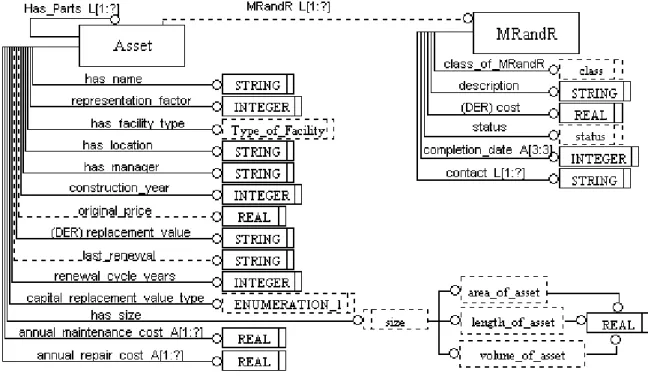
The EXPRESS-G framework shown in Fig. 1 identifies many of the attributes required for the asset entity and the MRandR (maintenance, repair and renewal) entity. The asset entity has the expected attributes such as name, facility type, location, manager, construction year, and original price. The asset entity also “has parts L[1:?]; implying that any asset can be subdivided into a list (e.g. L[1:?]) of assets requiring the same attributes as the parent instance. The asset entity also requires attributes such as replacement value, which is a derived value (DER) based on CRV calculation type described earlier. There are also attributes for the renewal cycle (years) and two array of attributes for the annual maintenance and repair costs. Because the framework is generic in concept, the size of the asset can be represented in area, length or volume.
Any asset entity can have any number of maintenance, repair and renewal (MRandR) instances. The MRandR entity represents past, present or future MRandR projects. The MRandR entity has attributes such as class (e.g. maintenance, repair, renewal), description, cost, status (e.g. completed, in-progress, completed, canceled), completion date, and contact persons.
Fig. 1. Proposed Conceptual Framework (EXPRESS-G) 6. Conclusions
The investigation found a limited number of applications for decision-making in the domain of municipal infrastructure, and did not find any comprehensive solution that addresses the current and future needs for investment planning for municipal engineers and managers. Integration with corporate legacy systems such as computerized maintenance management systems and geographic information systems is seen as the most debilitating problem for using decision-making tools in the area of municipal infrastructure planning.
The proposed conceptual framework provides the first pass at developing a product model to be used in the data storage requirements for the Municipal Infrastructure Investment Planning Project. Future work in the MIIP project will expand and validate the proposed framework, and will test it with real data received from consortium members.
7. References
AME, (1998), Applied Management Engineering, Inc., Lynnhaven Station Building, 101 N. Lynnhaven Road, Virginia Beach VA 23452, Tel: (757) 498-4400.
Bailey, D.M., Brotherson, D.E., Tobiasson, W. and Knehans, A., (1989), ROOFER: An
Engineered Management System for Bituminous Built-Up Roofs, Technical Report M-90/04/
BCCM (1998) Building Construction Core Model Home Page, http://www.tno.nl/instit/bouw/ project/Bccm/bccmhome.html, April.
CERF, (1996), Level Of Investment Study: Facilities and Infrastructure Maintenance and
Repair, Civil Engineering Research Foundation, Washington, DC, n.p.
CIMSteel (1998) CIMSteel Home Page, http://www.leeds.ac.uk/civil/research/cae/cimsteel/ cimsteel.htm, April.
Coullahan, R. and Siegfried, C., (1996), “Facilities Maintenance Using Life Cycle Asset Management”, Facilities Engineering Journal, Mar/Apr, Association for Facilities Engineering (http://www.facilitiesnet.com/).
Earl, R., (1997), “The Condition Assessment Survey: A Case Study for Application to Public Sector Organizations”, Proc. Infrastructure Condition Assessment: Art, Science and Practice, American Society of Civil Engineers, Boston, Aug., 277-286.
Edmonton, (1998), Securing our Future: Edmonton’s Long Range Financial Plan, KPMG presentation to Council, The City of Edmonton, Alberta, Canada.
FCM, (1996), Report on the State of Municipal Infrastructure in Canada, Available from: Federation of Canadian Municipalities and McGill University.
GIAC, (1998), Canadian GIS Source Book, (1995 edition http://cgdi.gc.ca/iacg/gis/index.htm), Available from: Geomatics Industry Association of Canada, 170 Laurier Avenue West, Suite 1204, Ottawa, Canada K1P 5V5, Tel: (613) 232-8770.
IAI (1998) IAI Home Page, http://www.interoperability.com, April.
Inside Infrastructure, (1998), Inside Infrastructure Newsletter, Available from: Marsha Penhaker, FM-20, Department of Energy, Washington, DC, 20585, Tel: (202) 586-0426. IRC (1994), Protocols for Building Condition Assessment, Institute for Research in Construction, National Research Council Canada, Ottawa, Canada, 110p.
ISO 10303, (1998), http://www.nist.gov/sc4/step/parts/part106/wd1/part106.txt, April.
Kaiser, H.H., (1996), A Foundation to Uphold: A Study of Facilities Conditions at U.S. Colleges
and Universities, Association of Physical Plant Administrators, Alexandria, Virginia, 195 pp.
Lacasse, M.A. and Vanier, D.J., (1996), “A Review of Service Life and Durability Issues”,
Proc. 7th International Conference of the Durability of Building Materials and Components,
Stockholm, Sweden, Vol. 2, 857-866.
Lemer, A.C., (1998), “Progress Toward Integrated Infrastructure-Assets-Management Systems: GIS and Beyond”, APWA International Public Works Congress: NRCC/CPWA Seminar Series
Innovations in Urban Infrastructure, Los Vegas, Nevada, USA, Available from: Institute for
Research in Construction, National Research Council Canada, 1500 Montreal Road, Ottawa, Ontario, Canada K1A 0R6, (613) 993-9699.
Lemer, A.C. and Wright, J.R., (1997), “Developing a Comprehensive Infrastructure Management System”, APWA International Public Works Congress: NRCC/CPWA Seminar
Series Innovations in Urban Infrastructure, Minneapolis, Minnesota, USA, Available from:
Institute for Research in Construction, National Research Council Canada, 1500 Montreal Road, Ottawa, Ontario, Canada K1A 0R6, (613) 993-9699.
Lounis, Z., Vanier, D., Lacasse, M. and Kyle, B., (1998), “Effective Decision-Making Tools for Roofing Maintenance Management”, Proc. First International Conference on New Innovative
Techniques for Decision Making in Civil Engineering, Montreal, Canada, 10-13 October, 1998.
Melvin, E., (1992), Plan, Predict, Prevent: How to Reinvest in Public Buildings, Special Report #62, American Public Works Assocation Research Foundation, Chicago, 83 pp.
Municipal GIS (1998), Anon., “Kansas GIS Information through the Internet”, Municipal GIS, Sep-Oct, (www.sanbornmap.com/municipa.htm), The Sanborn Map Company, Inc., 629 Fifth Avenue, Pelham, New York, 10803.
NACUBO, (1990), Managing the Facilities Portfolio, National Association of College and University Business Officers, Washington, DC, 100p.
NRC, (1990), Committing to the Cost of Ownership, Building Research Board, National Research Council, Special Report # 60, Washington, DC, 30p.
NRC, (1994), Toward Infrastrucure Improvement: An Agenda for Research, Building Research Board, National Research Council, National Academy Press, Washington, DC, 129p.
NRC, (1996), Budgeting for Facilities Maintenance and Repair Activities, Federal Facilities Council, National Research Council, Report 131, National Academy Press,Washington, DC, 49p. OAG, (1994), Office of the Auditor General of Canada Annual Report,
(http://www.oag-bvg.gc.ca/domino/reports.nsf/html/9412ce.html). O’Keefe, B., (1998) Personal Communication, August.
Oppman, R.S., (1998), “A True Enterprise GIS: Oakland County, Michigan”, Municipal GIS, Sep-Oct, (www.sanbornmap.com/municipa.htm), The Sanborn Map Company, Inc., 629 Fifth Avenue, Pelham, New York, 10803.
Shahin, M.Y., Bailey, D.M. and Brotherson, D.E., (1987), Roofer: Membrane and Flashing
Condition Indexes for Built-Up Roofs, Technical Report M-87/ADA190368, US Army
Construction Engineering Research Laboratory, Champaign, IL, 97p. STEP (1998) STEP SC4 Home Page, http://www.nist.gov/sc4/step, April.
Subick, C., (1997), For information contact [email protected] (217) 352-6511, ext 6393. Svensson, K., (1998), Integrating Facilities Management Information: A Process and Product
Model Approach, Ph.D. Thesis, Royal Institute of Technology, Stockholm, Sweden.
Vanier, D.J., (1998), “Product Modeling: Helping Life Cycle Analysis of Roofing Systems”, The
Life Cycle of Construction IT Innovations: Technology Transfer from Research to Practice, Jun 3-5, Stockholm Sweden, pp. 423-435.
Vanier, D.J. and Lacasse, M.A., (1996), “BELCAM Project: Service Life, Durability, and Asset Management Research”, Proc. 7th International Conference on the Durability of Building Materials and Components, Stockholm, Sweden, Vol. 2, pp. 848-856.
Vanier, D.J., Lacasse, M.A. and Parsons, A., (1996), “Using Product Models to Represent User Requirements”, W78 Annual Workshop on Information Technology in Construction, Bled Slovenia (http://www.fagg.uni-lj.si/bled96/papers/all-long.htm), Jun, pp. 511-524.
Whitestone, (1998), The Whitestone Building Maintenance and Repair Cost Reference 1998
Technical Brochure, Available from: Whitestone Research Publications, 610 Anacapa Street,
Santa Barbara, California, USA 93101, Tel: (800) 210-0137.
Winnipeg, (1998), Strategic Infrastructure Reinvestment Policy: Report and Recommendations, Available from: Strategic Infrastructure Reinvestment Policy, City of Winnipeg, 100 Main Street, Winnipeg, Manitoba, Canada R3C 1A4, Tel: (204) 986-7997.
Dana J. Vanier, Ph.D. Norman H Danylo, ing
Senior Research Officer Division Chief
Institute for Research in Construction Finance Department
National Research Council Canada Ville de Montréal
Building M-20 Suite 310
1500 Montreal Road 155 Notre Dame East
Ottawa, Ontario CANADA K1A 0R6 Montreal, QC CANADA H2Y 1B5
[email protected] [email protected]
(613) 993-9699 (514) 872-4404