Publisher’s version / Version de l'éditeur:
Vous avez des questions? Nous pouvons vous aider. Pour communiquer directement avec un auteur, consultez la première page de la revue dans laquelle son article a été publié afin de trouver ses coordonnées. Si vous n’arrivez pas à les repérer, communiquez avec nous à [email protected].
Questions? Contact the NRC Publications Archive team at
[email protected]. If you wish to email the authors directly, please see the first page of the publication for their contact information.
https://publications-cnrc.canada.ca/fra/droits
L’accès à ce site Web et l’utilisation de son contenu sont assujettis aux conditions présentées dans le site
LISEZ CES CONDITIONS ATTENTIVEMENT AVANT D’UTILISER CE SITE WEB.
Paper (National Research Council of Canada. Institute for Research in
Construction); no. IRC-P-1766, 1992
READ THESE TERMS AND CONDITIONS CAREFULLY BEFORE USING THIS WEBSITE. https://nrc-publications.canada.ca/eng/copyright
NRC Publications Archive Record / Notice des Archives des publications du CNRC :
https://nrc-publications.canada.ca/eng/view/object/?id=4c573830-e192-410f-b7eb-2b1689d9142c https://publications-cnrc.canada.ca/fra/voir/objet/?id=4c573830-e192-410f-b7eb-2b1689d9142c
NRC Publications Archive
Archives des publications du CNRC
This publication could be one of several versions: author’s original, accepted manuscript or the publisher’s version. / La version de cette publication peut être l’une des suivantes : la version prépublication de l’auteur, la version acceptée du manuscrit ou la version de l’éditeur.
Access and use of this website and the material on it are subject to the Terms and Conditions set forth at
Photometric errors with compact fluorescent sources
S e r
TH1
National Research
Conseil national
N21
d
I* I
Council Canada
de recherches Canada
Institute for
Research in
lnstitut de
recherche en
D L U U
Construction
construction
Photometric Errors with
Compact Fluorescent Sources
by M.J. Ouellette
Reprinted from the Conference Record of the
IEEE
Industry Applications Society Annual Meeting
Houston TX, October 4-9,1992
Vol. II, pp. 1865-1867
(IRC Paper No. 1766)
r
l
L I B R A R Y
NRCC 33982
1
NOV
:,*.1992
J
I
e l e ~ ~ o r n t a u ~
I R C
PHOTOMETRIC ERRORS WITH COMPACT FLUORESCENT SOURCES
MICHAEL OUELLETTE
Member, IEEE
National Research Council Canada Institute for Research in Construction
Ottawa. Ontario KIA OR6
Abstmct- Candidate retrofit light sources are typically however, due to the tendency of overestimates at some evaluated partly in terms of their luminous efficacies relative to wavelengths to cancel underestimates elsewhere in the
-
the sources they are to rep]- This may involve comparingspectrum. ~hotometric measurements collected under sources with
afferent spectral composition. Errors in such measurements could o mif the photometer relative spectral responsivity does not exactly match the spectral luminous emdency of the human eye. This note reports the extent of photometric errors observed when comparing different compact fluorescent sources against incandescent ones.
1. INTRODUCTION
Broadband photometry is the most widely used method of photopic light measurement [I]. Central to the method is a luminance or illuminance photometer consisting mainly of a photodetector with relative spectral responsivity modified or corrected to approximate that of the CIE Standard Photometric Observer [2]. This spectral modification is typically achieved by coloured glass placed anterior to the detector surface [1.3]. The spectral response of the CIE Standard Photometric Observer is represented by the V(h) function. also called the relative photopic luminosity function.
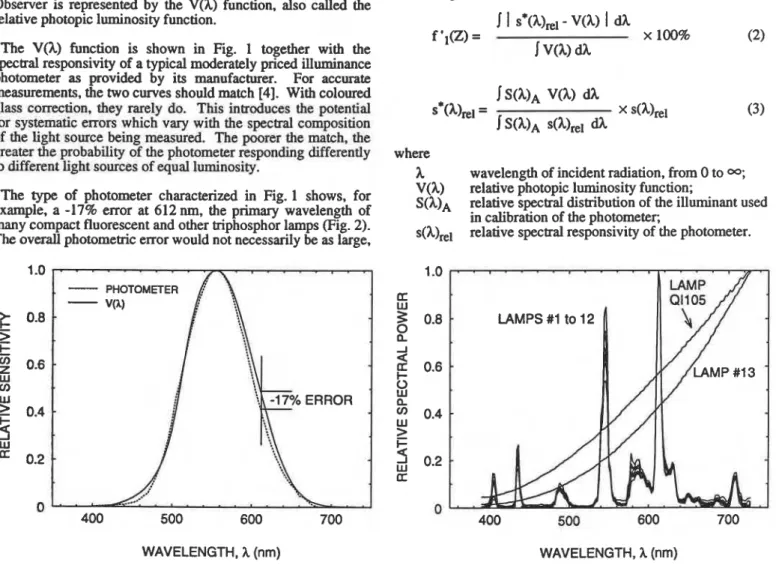
The V(1) function is shown in Fig. 1 together with the spectral responsivity of a typical moderately priced illuminance photometer as provided by its manufacturer. For accurate measurements, the two curves should match [4]. With coloured glass corntion, they rarely do. This intToduces the potential for systematic errors which vary with the spectral composition of the light source being measured. The poorer the match, the greater the probability of the photometer responding differently to different light sources of equal luminosity.
The type of photometer characterized in Fig. 1 shows, for example, a -17% error at 612 nm, the primary wavelength of many compact fluorescent and other triphosphor lamps (Fig. 2). The overall photometric error would not necessarily be as large,
WAVELENGTH, h (nm)
Fig. I. Speelrdmatch characteristic of the four photometers tested
M m f e e r ' s dafa
The CIE proposes two methods of error designation for photometers [5,6]. The first, fl(Z). is a direct measure of the error that would occur if a lamp Z of relative spectral distribution S(h).), were measured. It can serve as a correction factor for subsequent measurements of distributions S(h),.
where
s(Z) sensitivity (responsivity) of photometer when illuminated with lamp Z;
s(A) sensitivity (responsivity) of photometer when illuminated with lamp type A used in calibration. The second error designation, f '1: is independent of target illuminant and does not allow posiave departures from V(h) to cancel negative ones. It cannot be used as a correction factor.
where
h wavelength of incident radiation, from 0 to 00;
V(h) relative photopic luminosity function;
S(h)A relative spectral distribution of the illuminant used in calibration of the photometer,
~ ( h ) , ~ relative spectral responsivity of the photometer.
LAMPS #1 to 12
WAVELENGTH, h (nm)
Fig. 2. ReIative specb-d power &nilrutions of compactjlawrescent
Unfortllnattly, these agrted error designations are not commonly used More common is a statement like that given by the manufacturer of the photometer c h c t m k d in
Figme 1: "speckal response falls within
f
2%
of theC
E
photopic luminosity curve." This describes only the accuracy of response to the source used in calibration; typically
C E
Illuminant A [1,7]. It says nothing of the instrument's spectral responsivity and accuracy to other illuminants [4]. Consequently, additional calibration would be required before the photometer could be used in evaluating the performance of different compact fluorescent systems relative to other illuminants [8].
This technical note describes the calibration procedures developed for this purpose and reports the photometric errors observed for four different units of the same model illuminance photometer while measuring different compact fluorescent and incandescent sources.
IL MATERIALS AND PROCEDURES
A wide range of compact fluorescent sources were used [8,9]. Their rated colour temperatures ranged from 2700K to 2800K. Three of the illuminants were enclosed within frosted glass or plastic diffusers which modified lamp spectral power distribution to some degree. These illuminants, except lamp 12, were powered at 120 Vac. Lamp 12. with dc ballast, was powered at 12 Vdc. The 13th illuminant was a tube shaped incandescent lamp introduced for comparison. These lamps were aged, base up, for at least 100 h and were stabilized for at least 45 min at room temperature before being measured. Figure 2 shows the spectral power distributions of these 13 illuminants.
A 14th illuminant, Lamp QI105, was a 200 W incandescent luminous intensity standard obtained directly from the Institute for National Measurement Standards, National Research Council Canada. It approximated a CIE Illuminant A.
All measurements were taken in a black windowless room to remove the effects of stray light. Ambient temperature remained constant to within f 1 OC. Air flow in the room was negligible.
The calibration procedure began with a portable spectroradiometer, a device capable of measuring absolute spectral distributions of sources. From these distributions, the instrument calculates the appropriate photometric quantity (e.g., luminance). Since the calculation procedure [l] involves the V(h) function, the instrument's response need not be physically matched to V(3L). Spectroradiometers used in this manner are therefore not subject to errors caused by changes in lamp spectral power distribution.
The spectroradiometer was modified by replacing its objective lens with a cosine diffuser. This effectively transformed the instrument from a spectroradiometric luminance meter to a spectroradiometric illuminance meter. The instrument was mounted on a photometric bench and calibrated against Lamp QI105 using conventional calibration procedures [e.n., 101 for The standard lamp QI105 was then replaced by one of the 13 lamps. Z, in question. Illuminance E(Z,R) reported by the spectroradiometer was noted. The spectroradiometer was replaced by one of the four illuminance photometers. P. (Fig. 1). Illuminance. E(Z,Pi) was noted. Relative error, f(~,$: for the measurement of lamp Z by photometer Pi was d e t e m e d in a manner analogous to (1):
This procedure was carried out at least once for each combination of 13 lamps x 4 illuminance photometers.
Variability was assessed by repeating the procedure on the following day for four of the lamps.
111. RESULTS
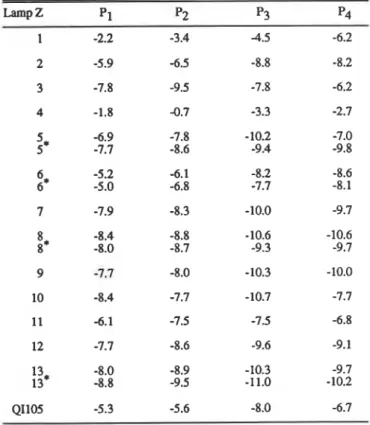
From Table I, measurement errors across the different combinations of lamps and photometers ranged from approximately -1% to -1 1%. The results were reproducible to within approximately 1 or 2 percentage points as given by the consistency in repeated measurements for Lamps 5.6.8 and 13. Therefore, differences of less than 2 percentage points between any two entries in Table I cannot be considered significant.
Most notably, there was considerable variation across the 12 different compact fluorescent sources. Although these lamps radiated at approximately h e same wavelengths @gure 21, the proportion of energy in each of the wavelengths differed
slightly. The differences were sufficient to cause photometric errors varying by up to 9 percentage points across the different lamps for any of the given photometers.
Errors across the 4 photometers for any given lamp varied by approximately 3 percentage points. Greater variability could be expected across different model units from different manufacturers.
Interestingly, errors for the two incandescent sources (Lamps 13 and QI105) varied by 3 or 4 percentage points from each other. Lamp 13 was a 130 W long life source operating at a much lower colour temperature than Lamp QI105 (Figure 2). As with the compact fluorescent lamps, the incandescent lamps differed sufficiently in their spectral power distributions to cause small but noticeable differences in photometric error.
TABLE I
PERCENT ERROR f(ZP.) OF PHOTOMETERS P. IN MEASURING
DIFFERENT C O M P A ~ FLUORESCENT AND
CANDESCENT
LAMPS
IV. DISCUSSION AND CONCLUSIONS
Photometric errors of -1 to -11% were observed in the measurement of different compact fluorescent sources using mid-priced broadband photometers. The errors were most likely due to inexact matches in spectral responsivity of the photometers to the V(h) function. In some cases, errors greatly exceeded that which one might infer from manufacturer specifications (i.e., "within f 2% of CIE Photopic luminosity curve".) Photometer manufacturers should adopt the CIE designations to more completely represent the errors applicable to their instruments.
Where accurate photometric measurements are required, a number of procedures are proposed: 1) calibrate each photometer separately, as described above, for each illuminant to be measured; or 2) use spectroradiometric photometry instead of broadband photometry; or 3) use a broadband photometer having superior spectral responsivity correction. The latter might be achieved through the integration of such technologies as diffraction gratings, photodiode arrays and microprocessors [l 11. Alternatively, the error can be eliminated by a calculation procedure [6] involving the relative spectral responsivity of the photometer, the spectral power distribution of the illuminant to be measured, and the spectral power distribution of the source used to calibrate the photometer.
Such higher accuracy prOOBdures are undoubtedly practiced in
well equipped laboratories. The procedures are not always
feasible, however. to practitioners contending with more
economical photornem and a diversity of changing sources.
Under such conditions. a conventional photometer of the type studied here cannot necessarily be used to accurately compare the luminous output of different lamp types nor sometimes even different models of the same lamp type. Where such measurements are attempted, the implicit inaccuracies in the methodology should be reported.
ACKNOWLEDGEMENTS
Ms. Jana Svec is warmly thanked for carrying out the majority of photometric measurements. Useful comments from Mr. Pierre Landry and Drs. Dale Tiller, Jennifer Veitch and Sherif Barakat are gratefully acknowledged. The work reported here was undertaken in preparation for a research project [8] supported by the Canadian Electrical Association (CEA), Energy Mines and Resources Canada Centre for Mineral and
Energy Technology (EMR/CANMET), National Research Council Canada (NRC) and the U.S. National Institute for Standards and Technology (NIST). The CEA project is entitled "The Evaluation of Compact Fluorescent Lamps for Energy Conservation (CEA 9038 U 828)." Mr. Mike Henville, Mr. An& LapemBre, and Mr. Paul Wasney are thanked for their roles in monitoring the CEA project, as are Mr. Peter Gelineau and Mr. Harvey Douglas for their contributions as CEA Project Engineers.
REFERENCES
[I] G. Wyszecki and W.S. Stiles. Color Science: Concepts and Methods,
Quantitative Data and Formulae: Tomnto. Ont.: John Wiley & Sons.
1982.
121 CJE Technical Committee TC-1.2. "The basis of ~hvsical
-
*photometry," Commission intemationie de l'Cclairage. ~ari's. kech.
Rep. CIE 18.2. 1983.
[3] H. Wright C.L. Sanders, and D. Gignac. "Design of glass filter c o m b ' i o n s for photometers," Applied Optics, vo1.8, no.12,
pp.2449-2455, Dec. 1969.
[4] 0. Nielsen. "The importance of spectral match," Lighting Design and Application, vol. 17, no.1, pp.3841&53,1987.
(51 CIE Technical Committee TC-2.2, "Methods of characterizing the
performance of radiometers and photometers," Commission internationale de l'tclairage, Paris, Tech. Rep. CIE 53, 1982.
[6] CIE Technical Committee TC-2.2. "Methods of characterizing
illuminance meters and luminance meters: Performance, characteristics and specifications," Commission intemationale de
I'klairage. Vienna. Tech. Rep. CIE 69, 1987.
[7] CIE Technical Committee TC-1.3. "Colorimetry." Commission
inkmationale de l'klairage. Vienna. Tech. Rep. CIE 15.2.1986.
[8] M.J. Ouellette. R. Arseneau, M.J. Siminovitch, and S.J. Treado. "New program for investigating the performance of compact fluorescent lighting systems." in Conference Record of the 1991
IEEE Industry Applic. Soc. Annu. Meeting, pp. 1895-1897. [9] M.J. Ouellette and R. Arseneau, "Effects of supply voltage on the
performance of compact fluorescent systems," prepared for publication in Conference Record of the 1992 IEEE Industry Applic. Soc. Annu. Meeting. 1992.
[lo] H. Hewitt and A.S. Vause, Lamps and Lighting: London: Edward Arnold Ltd.. 1966.
[I 11 A. Roberston, in discussion with 0. Nielsen [4]. Lighting Design &