Modification of sperm fatty acid composition during
epididymal maturation in bats
Nicolas J Fasel
1,2, Kevin McMillian
2, Ulrike Jakop
1, Laurent Méné-Saffrané
3, Kathrin M Engel
4,
Michel Genoud
2,5, Karin Müller
1and Philippe Christe
21Leibniz Institute for Zoo and Wildlife Research, Berlin, Germany, 2Department of Ecology and Evolution, University of Lausanne, Lausanne, Switzerland, 3Department of Biology, Metabolomics and Proteomics Platform, University of Fribourg, Fribourg, Switzerland, 4Institute for Medical Physics and Biophysics, Medical Faculty, University of Leipzig, Leipzig, Germany and 5Division of Conservation Biology, Department of Biology, Institute of Ecology and Evolution, University of Bern, Bern, Switzerland
Correspondence should be addressed to N J Fasel; Email: [email protected]
Biochemical properties of polyunsaturated fatty acids (PUFAs) are fundamental to sperm movements. Amongst all adjustments operated during epididymal maturation, sperm membrane lipid composition is remodelled. Specifically, the proportion of PUFAs usually increases from the caput towards the cauda epididymidis. In mammals, PUFAs are predominantly acquired through the diet, which can consequently impact male fertility. We aimed at analysing to what extent n-6 and n-3 PUFAs are incorporated into sperm in the Seba’s short-tailed bat (Carollia perspicillata), and at demonstrating the effect of the sperm fatty acid composition on sperm mobility. We therefore provided food varying in fatty acid composition to males of C. perspicillata and measured the fatty acid composition and mobility traits in spermatozoa collected from the caput and cauda epididymides. We found that n-6 and n-3 PUFAs and saturated fatty acids were significantly related to sperm velocity but not to the proportion of progressive sperm (i.e. motility). Concomitant to an increase in sperm velocity, the level of fatty acid saturation increased from the caput to the cauda epididymidis, while the proportion of PUFAs remained similar along the epididymis. A reduction in n-6 PUFAs counterbalanced an increase in n-3 PUFAs. The food treatments did not affect the sperm fatty acid composition. Our results suggest that a precise endogenous control rather than dietary effects determines sperm fatty acid composition in C. perspicillata.
Introduction
In mammals, gametes have evolved anisogamously, with large oocytes and small motile sperm cells (Cummins
& Woodall 1985). However, when they are released
from the testes, spermatozoa are mostly immotile and require biochemical alterations provided during epididymal maturation in order to gain motility and the capacity to fuse with eggs (Aitken et al. 2007). Along the epididymis, these modifications are triggered by varying microenvironments generated by the epithelium in precise locations of the organ (Aitken et al. 2007,
Gervasi & Visconti 2017).
In most species studied so far, mature sperm cells from the cauda epididymidis comprise a higher proportion of polyunsaturated fatty acids (PUFAs), and especially of n-3 PUFAs (also referred to as omega-3 fatty acids) in comparison to those from the caput (Parks
& Hammerstedt 1985, Hall et al. 1991, Aveldaño et al.
1992, Haidl & Opper 1997, Pyttel et al. 2014, Angrimani
et al. 2017). PUFAs possess molecular properties
which increase membrane fluidity and influence trans-membrane protein activities (Giroud et al. 2013, Pinot
et al. 2014, Arnold et al. 2015).
The vigorous movements of mature sperm cells may require a flexible membrane and an elevated metabolic rate (Stubbs & Smith 1984, Lenzi et al. 1996, Kho et al.
2001, Ren et al. 2001, Storey 2008). Sperm velocity and
motility have consistently been positively correlated to the PUFA content of sperm cells (Nissen & Kreysel 1983,
Mourvaki et al. 2010). It has been repeatedly shown that
n-3 PUFAs improve sperm quality significantly more than n-6 PUFAs (reviewed in Esmaeili et al. 2015). Nevertheless, it remains unclear why both types of PUFAs may differently impact sperm biology. PUFAs are essential to most mammal species in the sense that they are not produced de novo (Burr & Burr 1930) and should be acquired through the diet. After their incorporation, PUFAs can be elongated and desaturated to generate the long-chain PUFAs potentially missing in the diet. Human and livestock diets have been designed in order to improve sperm quality by modifying their lipid
http://doc.rero.ch
composition (Strzeżk et al. 2004, Brinsko et al. 2005,
Estienne et al. 2008, Gliozzi et al. 2009, Mourvaki et al.
2010, Gulliver et al. 2012, Fair et al. 2014, Esmaeili
et al. 2015, Maranesi et al. 2018).
Sperm competition, the post-copulatory competition of sperm from several males for the fertilisation of a given set of eggs (Parker 1970), can drive the evolution of faster sperm with higher rate of metabolism (Burness
et al. 2004, Malo et al. 2005, Tourmente et al. 2013,
Fitzpatrick & Lüpold 2014, Klemme et al. 2014). An
efficient incorporation of PUFAs within the sperm membrane should thus have evolved in species facing post-copulatory competition to promote sperm competitiveness.
The mating system of Seba’s short-tailed bat (Carollia
perspicillata) is classified as a resource defence
polygyny (Fleming 1988, McCracken & Wilkinson 2000). Harem males share reproduction with bachelor and peripheral males (Fasel et al. 2016) and males have relatively large testes (Orr & Zuk 2013). Both arguments suggest that sperm competition occurs in this species. C. perspicillata mostly feeds on the fruits of piper plant’s (Piperaceae), but can also complete its diet with Arthropoda (Mello et al. 2004) or leaves
(Pereira et al. 2018). Dietary fatty acid composition
could thus vary. Changes in nutritional sources can potentially affect sperm membrane composition and post-copulatory competitiveness.
In this study, male C. perspicillata were given two dietary treatments differing in n-3 and n-6 PUFA content but similar in their overall PUFA proportion. The first aim was to measure the effects of the dietary treatments on the fatty acid composition of sperm cells collected from the caput and cauda epididymides. This will assess the incorporation of PUFAs within sperm cells along the epididymis. If dietary fatty acids were readily assimilated and unselectively incorporated in the sperm lipids, differences in the sperm fatty acid composition should reflect those of the food. A second aim was to measure the effects of the different fatty acid classes and of the location along the epididymis on in vitro sperm mobility traits. As PUFAs render membranes more flexible and increase cell metabolism, the proportion of PUFAs in sperm of C. perspicillata should be positively correlated with sperm mobility traits. Ultimately, epididymal maturation should lead to better sperm mobility in the cauda than in the caput epididymidis.
Materials and methods Ethical statement
The veterinary office of the Canton Fribourg, after supervision of the Cantonal Ethical Committee, authorised the experimental setup and the detention conditions (2016_27_ FR). Laboratory analyses were performed blind with respect to sample identity.
Animal housing
Bats were collected from a captive population, having free access to a tropical dome mimicking a Belizean dry forest (Papiliorama, Kerzers, Switzerland). Thirty C. perspicillata males were individually marked (PIT tags) and housed in five cages (dimensions: 1 × 2 × 2 m), with six individuals per cage. Temperature ranged between 25 and 30°C and humidity reached more than 80%. The light-cycle was reversed and based on a 12L:12D cycle. Food consisted of mashed fruits and vegetables (apples, grapes, boiled carrots and bananas), complemented with vitamins, yeast, honey and grape sugar. Every night, 160 g of food was provided per cage during 6 h of the dark phase. This feeding regime simulated the conditions occurring during the dry season, when fruiting plants are sparse and rare. Most copulations in this species occur during the dry season (Fleming 1988). Water was provided ad libitum. All individuals were given a minimum of 1 week of acclimation to these conditions before the food treatments were started. Experimental design
The experiment lasted 4 weeks. Males were equally and randomly assigned to one of the two treatments, hereafter named n-3 and n-6 PUFA treatments. One cage contained six males, three from each treatment. Twice a week, males of each cage were captured and separated in two different cages to feed on their respective food treatment. On the days of treatments, 1.1 mL of flaxseed oil (n-3 PUFA treatment) or 0.9 mL of sunflower oil mixed with 0.2 mL flaxseed oil (n-6 PUFA treatment) were added and thoroughly mixed to 80 g of the daily food ration. On some occasions (N = 8), we collected faeces after treatment and analysed the fatty acid composition. Compared to the n-3 PUFA treatment, faeces collected from bats feeding on the n-6 PUFA treatment contained a significantly larger proportion of n-6 PUFAs (linear mixed model with logit transformation of the response variable: estimate: 1.19 ± 0.26, F1,6 = 21.29, P = 0.004, R2 = 0.78) and
a significantly lower proportion of n-3 PUFAs (linear mixed model with logit transformation of the response variable: estimate: −1.50 ± 0.41, F1,6 = 13.27, P = 0.011, R2 = 0.69).
Sperm collection
After 4 weeks of treatment, males were killed via an intraperitoneal overdose of sodium pentobarbital and an orchiectomy was performed. Epididymides were separated from the testes and blood vessels were removed. Caput and cauda epididymidis were separately minced in 100 μL of HEPES buffer solution (HBS: 150 mM NaCl, 5 mM HEPES, pH 7.4). Sperm were filtered using a 30 μm filter (Partec, Münster, Germany) and rinsed with 100 μL of HBS. From the mix, 3 μL was used for the mobility analysis. The mix was then centrifuged (600 g, 5 min) to remove the supernatant and washed twice with 200 μL of HBS. In samples with a visible pellet, the pellet was finally suspended in 50 μL of HBS and split in two tubes. Only 25 μL of HBS were added to samples with a lower amount of sperm and those were not split. Finally, 25 μL of butylated hydroxytoluene (BHT, antioxidant, 2 mg/mL) diluted in 100%
MeOH were added to the washed sperm samples. Samples were then placed on dry ice until reaching the lab where they were frozen at −70°C until analysis.
Sperm mobility analysis
Sperm motion was video-recorded using a Kappa CF 8/5 camera mounted on an Olympus XK41 microscope set with 200× magnification under dark-field conditions. Three microlitres of filtered sperm (i.e. before the centrifugation) were injected in a 20-μm-deep chamber slide (SC 20-01-04-B, Leja, Netherlands) within 10 min after dissection. Three 2-s videos at a frame rate of 50 Hz were then analysed for each sample using a CASA plug-in in ImageJ 1.47v (Rasband, National Institute for Health, USA; Wilson-Leedy & Ingermann 2007) to measure sperm velocity (i.e. curvilinear velocity (VCL), μm/s) of progressive sperm cells. As previously reported (Fasel et al. 2015), measures of VCL significantly correlated to the other swimming parameters (Table 1) calculated by CASA, with the single exception of the linearity (NJ Fasel 2018, unpublished data). Sperm motility (i.e. the proportion of progressive sperm) was estimated subjectively by a unique observer (KMc) and significantly correlates to the CASA estimation (linear model with CASA estimation as explanation of subjective measures, the intercept forced to zero and both variables arcsine square root transformed: estimate: 0.87 ± 0.04, F1,131 = 451.43,
P < 0.001, R2 = 0.79). Finally, the mean of the mobility measures
per sample (three videos) was calculated. Fatty acid analysis
Fatty acid methyl esters (FAMEs) were prepared by incubating samples (20 μL) with 1 mL of 5% (v/v) H2SO4 in MeOH in the
presence of 0.1% (w/v) BHT. The transesterification reaction was performed in a dry block heater (VWR, Dietikon, Switzerland) at 85°C for 30 min. At the end of the reaction, tubes were cooled down to room temperature, briefly spun down, and 1.5 mL of 0.9% (w/v) NaCl and 2 mL of n-hexane were added to the solution. The mixture was strongly shaken for 5 min and both organic and hydroalcoholic phases were separated by centrifugation at 1500 g for 5 min. The upper organic (n-hexane) phase was transferred into a new glass tube. The n-hexane phases were evaporated under a nitrogen flux and FAMEs were re-suspended in 30 μL of n-hexane. FAME samples were transferred into 0.2 mL crimp vials (BGB Analytik, Genève, Switzerland) prior to injection into the gas separator to perform gas chromatography (GC).
FAMEs were analysed using a gas chromatograph coupled to a flame ionisation detector (Agilent 7890A). FAME samples dissolved in n-hexane were introduced to the injection port heated to 250°C with an automated liquid sampler (Agilent 7993). The samples were injected without splitting. FAMEs were separated on a 30-m long × 0.25-mm ID × 0.25 μm DB-23 capillary column (Agilent) using He as vector gas (2.6 mL/min). The oven temperature, initially set to 100°C for 2 min, was first increased to 160°C at 25°C/min, then to 250°C at 8°C/min and maintained at this temperature for an additional 4 min. The detector temperature was set to 270°C while detector gases were set to 30 mL/min for H2, 400 mL/min for air, and
30 mL/min for makeup gas (He). Data were recorded at a frequency of 50 Hz. FAME quantifications were performed with calibration curves built with the Supelco 37 component FAME mix (Sigma-Aldrich) using 17:0 methyl ester as the internal standard (250 ng). FAME determination was based on the retention times of each component and compared with those of FAMEs contained in Supelco 37 FAME mix (Sigma-Aldrich) and of 22:5 n-3 and 22:5 n-6.
Statistical analysis
The different types of FAMEs were classified as PUFAs, monounsaturated (MUFA) or saturated fatty acids (SFAs). Within the PUFA class, the n-6 and n-3 PUFAs were distinguished. The proportions of each fatty acid class over the total amount of FAMEs measured were calculated. Analyses were conducted with R (version 3.3.2).
First the effects of the treatments and of the location in the epididymis (caput vs cauda) on the sperm fatty acid composition were estimated. The response variables (i.e. fatty acid class proportions) were logit transformed. Then, to account for the small sample size and the large variance in some fatty acid classes, robust linear mixed models were run (function: rlmer, package: robustlmm; Koller 2016). The null hypothesis was rejected when the 95% CI of an effect estimation did not include 0. As explanatory variables, the treatments, the parts of the epididymis and the interaction between them were considered. The cage number and the identity of the male, nested within the cage number, were considered as random factors.
Secondly, the effects of the sperm fatty acid classes and of the location in the epididymis on sperm velocity and motility were evaluated. VCL and the subjectively estimated motility were used as response variables. Motility was transformed with arcsine square root, which is more appropriate than the logit Table 1 Mobility traits in C. perspicillata sperm from caput (CAP) and cauda (CAU): CASA motility (MOT, proportion), subjective motility
(MOTs, proportion), curvilinear velocity (VCL, μm/s), straight line velocity (VSL, μm/s), average path velocity (VAP, μm/s), progression (PROG, μm), beat cross frequency (BCF), wobble (WOB) and linearity (LIN, VSL/VAP).
MOT MOTs VCL VSL VAP PROG BCF WOB LIN
CAP Mean 0.056 0.056 26.667 7.270 11.202 15.397 23.388 0.376 0.661 S.E. 0.084 0.082 13.264 5.856 7.810 10.596 8.122 0.115 0.146 CAU Mean 0.089 0.083 32.832 12.388 15.494 16.863 22.839 0.413 0.754 S.E. 0.080 0.111 13.753 8.389 9.715 8.396 6.486 0.121 0.108
Means and standard errors (S.E.) are reported.
transformation when data contain 0-values. As explanatory variables, the proportions of the classes of fatty acids (n-6 and n-3 PUFAs, MUFAs and SFAs) were analysed individually in four different models. Combining all classes of fatty acids in one single model would not have been possible because of collinearity. The part of the epididymis and its interaction with the fatty acid classes were also included as explanatory variables. Logit-transformed proportions were centred around the mean values per epididymis in order to interpret the effect of the epididymis part as a main effect but also in interaction with the classes of fatty acids. Male identity and cage number, with male identity nested within cage number, were considered as random factors. Robust linear mixed models (function: rlmer, package: robustlmm) were run. The null hypotheses were rejected when the 95% CI of an effect estimation did not include 0. For all above analyses, non-significant interactions were discarded (Engqvist 2005).
Results
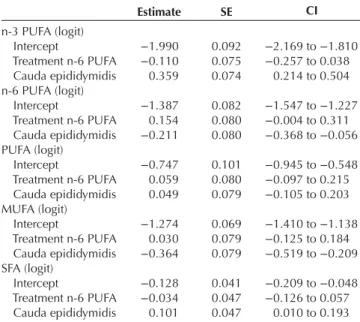
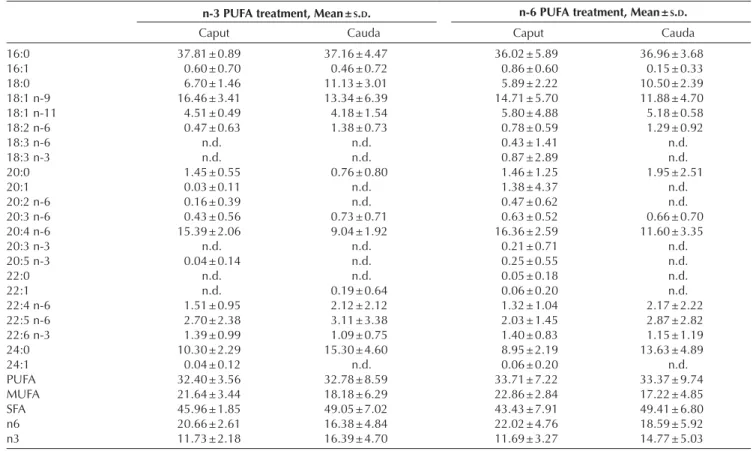
The interaction between the treatment and the epididymis parts had never a significant effect on the proportions of n-3 (CI: −0.359 to 0.228) and n-6 PUFA (CI: −0.229 to 0.409), MUFA (CI: −0.398 to 0.163) and SFA (CI: −0.036 to 0.281) in the sperm cells and was consequently discarded from the models. The food treatments did not trigger significant changes in any of the fatty acid classes (Table 2). Sperm from the cauda epididymidis had higher proportion of n-3 PUFAs and SFAs, and a lower proportion of n-6 PUFAs and MUFAs in comparison to those from the caput part (Fig. 1). However, the proportion of total PUFAs did not vary along the epididymis (Table 2). The mean percentage and standard deviation for each fatty acid type and class are listed in Table 3.
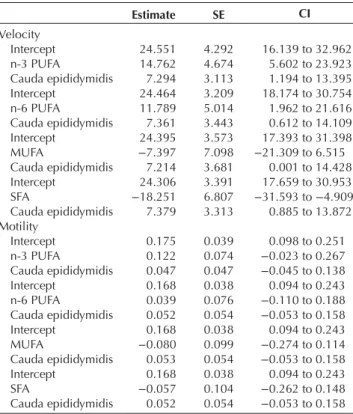
Sperm VCL was not affected by the different classes of fatty acids in interaction with the part of the epididymis: n-3 (CI: −33.482 to 2.314) and n-6 PUFAs (CI: −31.870 to 13.115), MUFAs (CI: −27.806 to 39.775) and SFA (CI: −21.867 to 30.229). Those interactions were consequently removed from the final models. The proportions of n-3 and n-6 PUFAs were positively correlated with sperm VCL (Fig. 2), while the proportion of MUFAs did not significantly affect sperm VCL. Finally, the proportion of SFAs affected negatively this variable
(Fig. 2 and Table 4). Sperm VCL was consistently
significantly higher in the cauda epididymidis (Table 4). Analysed individually, the different classes of fatty acids did not affect sperm motility in interaction with the part of the epididymis: n-3 (CI: −0.417 to 0.214) and n-6 PUFAs (CI: −0.638 to 0.039), MUFAs (CI: −0.233 to 0.722) and SFA (CI: −0.295 to 0.533). Those interactions were consequently removed from the final models. The different proportions of fatty acid classes were not correlated with sperm motility (Table 4). Finally, the sperm collected from the cauda epididymidis were not more motile than those from the caput (Table 4).
Discussion
In this study, we investigated to what extent sperm fatty acid composition can be affected by varying dietary n-6 and n-3 PUFA proportions in C. perspicillata. Furthermore, we described the changes in the fatty acid composition of the sperm lipids along epididymal maturation. Finally, we estimated the effects of fatty acid composition on sperm velocity and motility and its development along the epididymis.
Our results revealed that the transit through epididymis resulted in a higher swimming speed of the motile sperm recovered from cauda compared to caput epididymidis (Fig. 1), indicating sperm maturation. A higher velocity may reduce the time in the vagina and the uterus, where conditions are deleterious to sperm
(Rasweiler et al. 2010). Despite the increase in velocity,
Table 2 Effects of the dietary treatment and epididymis part on the
proportion of the various fatty acid classes in sperm.
Estimate SE CI n-3 PUFA (logit) Intercept −1.990 0.092 −2.169 to −1.810 Treatment n-6 PUFA −0.110 0.075 −0.257 to 0.038 Cauda epididymidis 0.359 0.074 0.214 to 0.504 n-6 PUFA (logit) Intercept −1.387 0.082 −1.547 to −1.227 Treatment n-6 PUFA 0.154 0.080 −0.004 to 0.311 Cauda epididymidis −0.211 0.080 −0.368 to −0.056 PUFA (logit) Intercept −0.747 0.101 −0.945 to −0.548 Treatment n-6 PUFA 0.059 0.080 −0.097 to 0.215 Cauda epididymidis 0.049 0.079 −0.105 to 0.203 MUFA (logit) Intercept −1.274 0.069 −1.410 to −1.138 Treatment n-6 PUFA 0.030 0.079 −0.125 to 0.184 Cauda epididymidis −0.364 0.079 −0.519 to −0.209 SFA (logit) Intercept −0.128 0.041 −0.209 to −0.048 Treatment n-6 PUFA −0.034 0.047 −0.126 to 0.057 Cauda epididymidis 0.101 0.047 0.010 to 0.193
Estimates, standard errors (S.E.) and 95% confidence intervals (CI)
obtained with robust linear mixed models are given. The interaction terms were always not significant and were therefore removed from the final model.
0.0 0.2 0.4 0.0 0.2 0.4 Treatments n-3 PUFA proportion n-3 n-6 Cauda Caput Treatments n-6 PUFA proportion n-3 n-6 Cauda Caput
Figure 1 Proportion of PUFA in the sperm membrane from
C. perspicillata. Median values per dietary groups (n-3 vs n-6 PUFAs) and per epididymis parts (caput and cauda) are indicated with a segment.
the proportion of motile sperm in samples collected from the cauda epididymidis was surprisingly not higher than in samples from the caput. This result contrasts with those from other species (Dacheux & Dacheux 2014), bats included (Rodríguez-Tobón et al. 2015). Mobility measures were recorded with sperm not swimming in seminal fluids but in HEPES buffer. The latter was not designed for sperm mobility analyses but allowed trait comparisons without influencing further lipid analyses. This sub-optimal buffer solution may explain the measures of motility and velocity lower than expected
(Fasel et al. 2015).
The modification of the sperm membrane is one factor believed to allow sperm to gain in velocity. Accordingly, we showed that the proportions of both n-3 and n-6 PUFAs were positively correlated to sperm velocity in C.
perspicillata (Fig. 2), corroborating results found in other species (Mourvaki et al. 2010, Maranesi et al. 2018). PUFAs may increase the activity of trans-membrane proteins (Giroud et al. 2013, Arnold et al. 2015), which would then favour sperm movements (Stubbs & Smith
1984, Kho et al. 2001, Ren et al. 2001, Storey 2008).
In addition, PUFAs’ lower melting temperatures may provide sperm with a more flexible membrane, allowing more effective propulsion (Mortimer 1997, Pinot et al. 2014). The negative correlation between SFA and VCL
further supports that sperm with a membrane containing less saturated fatty acids are faster (Fig. 2). However, the concomitant increases in VCL and in SFA proportion measured along the epididymis recalls that other factors than the membrane fatty acid composition are also involved in sperm maturation and control sperm velocity (e.g. enhanced metabolism, morphological and osmolarity changes, protein incorporation, environmental molecular composition, etc.).
Changes in sperm fatty acids composition was shown to occur during epididymal maturation through the incorporation of lipids from the organ microenvironment (Parks & Hammerstedt 1985, Hall
et al. 1991, Aveldaño et al. 1992, Haidl & Opper
1997, Pyttel et al. 2014, Angrimani et al. 2017). Our
measures in C. perspicillata confirmed that a change in the PUFA composition occurred during the passage from the caput to the cauda epididymidis, with a partial replacement of the n-6 PUFAs by the n-3 PUFAs, without any significant change in the overall PUFA proportion. The importance of n-3 PUFAs in the performance of mammalian sperm has been repeatedly supported (reviewed in Esmaeili et al. 2015). An increase in the proportion of n-3 PUFAs during the last stages of epididymal maturation is consequently not surprising.
Table 3 Percentage of the different fatty acids types and classes over the total amount of fatty acid methyl esters (FAMEs) measured in two parts
of the epididymis of C. perspicillata, following 4 weeks of n-3 or n-6 PUFAs supplementation.
n-3 PUFA treatment, Mean ± S.D. n-6 PUFA treatment, Mean ± S.D.
Caput Cauda Caput Cauda
16:0 37.81 ± 0.89 37.16 ± 4.47 36.02 ± 5.89 36.96 ± 3.68 16:1 0.60 ± 0.70 0.46 ± 0.72 0.86 ± 0.60 0.15 ± 0.33 18:0 6.70 ± 1.46 11.13 ± 3.01 5.89 ± 2.22 10.50 ± 2.39 18:1 n-9 16.46 ± 3.41 13.34 ± 6.39 14.71 ± 5.70 11.88 ± 4.70 18:1 n-11 4.51 ± 0.49 4.18 ± 1.54 5.80 ± 4.88 5.18 ± 0.58 18:2 n-6 0.47 ± 0.63 1.38 ± 0.73 0.78 ± 0.59 1.29 ± 0.92 18:3 n-6 n.d. n.d. 0.43 ± 1.41 n.d. 18:3 n-3 n.d. n.d. 0.87 ± 2.89 n.d. 20:0 1.45 ± 0.55 0.76 ± 0.80 1.46 ± 1.25 1.95 ± 2.51 20:1 0.03 ± 0.11 n.d. 1.38 ± 4.37 n.d. 20:2 n-6 0.16 ± 0.39 n.d. 0.47 ± 0.62 n.d. 20:3 n-6 0.43 ± 0.56 0.73 ± 0.71 0.63 ± 0.52 0.66 ± 0.70 20:4 n-6 15.39 ± 2.06 9.04 ± 1.92 16.36 ± 2.59 11.60 ± 3.35 20:3 n-3 n.d. n.d. 0.21 ± 0.71 n.d. 20:5 n-3 0.04 ± 0.14 n.d. 0.25 ± 0.55 n.d. 22:0 n.d. n.d. 0.05 ± 0.18 n.d. 22:1 n.d. 0.19 ± 0.64 0.06 ± 0.20 n.d. 22:4 n-6 1.51 ± 0.95 2.12 ± 2.12 1.32 ± 1.04 2.17 ± 2.22 22:5 n-6 2.70 ± 2.38 3.11 ± 3.38 2.03 ± 1.45 2.87 ± 2.82 22:6 n-3 1.39 ± 0.99 1.09 ± 0.75 1.40 ± 0.83 1.15 ± 1.19 24:0 10.30 ± 2.29 15.30 ± 4.60 8.95 ± 2.19 13.63 ± 4.89 24:1 0.04 ± 0.12 n.d. 0.06 ± 0.20 n.d. PUFA 32.40 ± 3.56 32.78 ± 8.59 33.71 ± 7.22 33.37 ± 9.74 MUFA 21.64 ± 3.44 18.18 ± 6.29 22.86 ± 2.84 17.22 ± 4.85 SFA 45.96 ± 1.85 49.05 ± 7.02 43.43 ± 7.91 49.41 ± 6.80 n6 20.66 ± 2.61 16.38 ± 4.84 22.02 ± 4.76 18.59 ± 5.92 n3 11.73 ± 2.18 16.39 ± 4.70 11.69 ± 3.27 14.77 ± 5.03
Means and standard deviations (S.D.) are reported.
The observed maintenance in overall PUFA proportion can indicate a need to keep sperm membrane resistant to oxidative stress. Indeed, besides adjustments of antioxidant defences in response to external stressors (Losdat et al. 2014, Rojas Mora
et al. 2017), the fatty acid composition of the sperm membrane could be adjusted to its environment: species whose ejaculate will face elevated ROS levels might reduce the PUFA content of sperm membrane
(delBarco-Trillo & Roldan 2014, delBarco-Trillo
et al. 2015). Ejaculates from C. perspicillata display low lipid peroxidation markers (Fasel et al. 2017). This further supports that the proportion of PUFAs within sperm cells is under control during epididymal maturation to deal with an elevated metabolism and high ROS levels. Additionally, the measured reduction in MUFAs and the increase in SFA in the cauda epididymidis could further strengthen oxidative stress resistance. In sperm cells collected from the caput and cauda epididymidis of C. perspicillata, low but increasing amounts of plasmalogens were detected (U Jakop, NJ Fasel, L Méné-Saffrané, J Schiller, K Müller & KM Engel 2018, unpublished data). In these phospholipids, a SFA is generally fixed to the sn-1 position through an ether bond (Lenzi
et al. 1996, Pyttel et al. 2014). Consequently, from sn-1 position no FAME was generated. This would even lead to a slight underestimation of SFAs along the epididymides.
In their comparative analysis, delBarco-Trillo
and Roldan (2014) did not include any bat species
and the proportion of PUFAs in sperm measured in
C. perspicillata would be the second lowest of the 21
species considered in that analysis. The sperm of some flying foxes have been shown to contain extremely low proportions of PUFAs (Melville et al. 2012). The low proportions of PUFAs in the sperm of the few bats investigated so far could be related to an intense sperm competition (Orr & Zuk 2013), favouring increased sperm velocity but at the same time leading to a rise in ROS generation due to the boosted energy production
(Burness et al. 2004, Tourmente et al. 2013, Fitzpatrick
& Lüpold 2014, Klemme et al. 2014). Alternatively, high
SFA proportions in bat sperm could be related to the capacity of many bat species to store sperm (Orr & Zuk 2013). Indeed, a similar pattern was already shown in the sperm of bees which can be stored up to several years (Wegener et al. 2013). It remains nevertheless unclear whether the capacity to store sperm has been lost in species like C. perspicillata or if its evolution is polyphyletic.
Ultimately, the variation in the dietary PUFAs did not affect the composition of the sperm neither in the caput
0.05 0.10 0.15 0.20 0.25 n-3 PUFA proportion 0.05 0.10 0.15 0.20 0.25 0.30 n-6 PUFA proportion VCL ( μm/sec) Cauda Caput 0.3 0.4 0.5 0.6 0.7 0 20 40 60 0 20 40 60 0 20 40 60 SFA proportion
Figure 2 Curvilinear velocity (VCL) of caput and cauda sperm of
C. perspicillata related to the n-3 PUFA, n-6 PUFA and SFA proportions over the total amount of FAMEs in the sperm cells.
Table 4 Effects of the proportion of the various fatty acid classes in
sperm and of the epididymis part on sperm velocity and motility in C. perspicillata. Estimate SE CI Velocity Intercept 24.551 4.292 16.139 to 32.962 n-3 PUFA 14.762 4.674 5.602 to 23.923 Cauda epididymidis 7.294 3.113 1.194 to 13.395 Intercept 24.464 3.209 18.174 to 30.754 n-6 PUFA 11.789 5.014 1.962 to 21.616 Cauda epididymidis 7.361 3.443 0.612 to 14.109 Intercept 24.395 3.573 17.393 to 31.398 MUFA −7.397 7.098 −21.309 to 6.515 Cauda epididymidis 7.214 3.681 0.001 to 14.428 Intercept 24.306 3.391 17.659 to 30.953 SFA −18.251 6.807 −31.593 to −4.909 Cauda epididymidis 7.379 3.313 0.885 to 13.872 Motility Intercept 0.175 0.039 0.098 to 0.251 n-3 PUFA 0.122 0.074 −0.023 to 0.267 Cauda epididymidis 0.047 0.047 −0.045 to 0.138 Intercept 0.168 0.038 0.094 to 0.243 n-6 PUFA 0.039 0.076 −0.110 to 0.188 Cauda epididymidis 0.052 0.054 −0.053 to 0.158 Intercept 0.168 0.038 0.094 to 0.243 MUFA −0.080 0.099 −0.274 to 0.114 Cauda epididymidis 0.053 0.054 −0.053 to 0.158 Intercept 0.168 0.038 0.094 to 0.243 SFA −0.057 0.104 −0.262 to 0.148 Cauda epididymidis 0.052 0.054 −0.053 to 0.158
Motility values were arcsin-square root transformed. Estimates, standard errors (S.E.) and 95% confidence intervals (CI) obtained with
robust linear mixed models are given. The interaction terms were always not significant and were therefore removed from the final models.
nor in the cauda epididymidis (Fig. 2). The food delivered during the treatment days were expected to comprise approximately 70% of the weekly fat intake. The gut transit time in C. perspicillata is short (Bonaccorso &
Gush 1987, Laska 1990), and the efficiency to extract
lipids might be low. If the bats only incorporated a limited amount of fat during the treatment days, the effect of the dietary treatment on the sperm fatty acid composition might have been reduced. However, as already mentioned above, the proportion of PUFAs in mature sperm (i.e. in the cauda epididymidis) was low in comparison to other mammalian species investigated so far (delBarco-Trillo & Roldan 2014). Therefore, the absence of any significant effects of our dietary treatments may alternatively be explained by the need to maintain the sperm resistant to oxidative stress. Furthermore, feeding habits of C. perspicillata have been shown to vary seasonally (Mello et al. 2004, Pereira et al. 2018). As sperm production is maintained throughout the year (Fleming 1988), epididymal lipid metabolism has probably evolved to resist to the likely seasonal variation in dietary fatty acid composition.
In conclusion, our study describes for the first time the changes in the fatty acid composition of the sperm during epididymal maturation in a bat species. Furthermore, we highlight the relation between the fatty acid composition of the sperm and sperm velocity. This link is often mentioned but has rarely been established.
Declaration of interest
The authors declare that there is no conflict of interest that could be perceived as prejudicing the impartiality of the research reported.
Funding
This study was funded by the Department of Ecology and Evolution of the university of Lausanne, by the Leibniz Institute for Zoo and Wildlife Research, by the German Research Foundation (grant Mu1520/4-2 to K Mu, U J and Schi476/12-2 to K M E) and by Swiss National Science Foundation (grant no. P2BEP3_168709 to N J F).
Acknowledgements
The authors are thankful to the team of the Papiliorama for allowing us to work with their bat colony under excellent research conditions. They warmly thank Magali Meniri and Christiane Franz for her assistance in experiment and Sébastien Pellaud for his help in conducting the FAME analyses. They thank Viktoriia Radchuk for her advices concerning the statistical analyses and Colin Vullioud for his constructive comments. They are also grateful to the world bat
library (Geneva) for providing free literature on bat research. Finally, they thank the associate editor and two anonymous reviewers for their comments enabling us to improve this current manuscript.
References
Aitken RJ, Nixon B, Lin M, Koppers AJ, Lee YH & Baker MA 2007 Proteomic
changes in mammalian spermatozoa during epididymal maturation. Asian Journal of Andrology 9 554–564. (https://doi.org/10.1111/j.1745-7262.2007.00280.x)
Angrimani DSR, Nichi M, Losano JDA, Lucio CF, Veiga GAL, Franco MVMJ & Vannucchi CI 2017 Fatty acid content in epididymal
fluid and spermatozoa during sperm maturation in dogs. Journal of Animal Science and Biotechnology 8 1–8. (https://doi.org/10.1186/ s40104-016-0130-8)
Arnold W, Giroud S, Valencak TG & Ruf T 2015 Ecophysiology of omega
fatty acids: a lid for every jar. Physiology 30 232–240. (https://doi. org/10.1152/physiol.00047.2014)
Aveldaño MI, Rotstein NP & Vermouth NT 1992 Lipid remodelling
during epididymal maturation of rat spermatozoa. Enrichment in plasmenylcholines containing long-chain polyenoic fatty acids of the n-9 series. Biochemical Journal 283 235–241.
Bonaccorso FJ & Gush TJ 1987 Feeding behaviour and foraging strategies
of captive phyllostomid fruit bats: an experimental study. Journal of Animal Ecology 56 907–920.
Brinsko SP, Varner DD, Love CC, Blanchard TL, Day BC & Wilson ME
2005 Effect of feeding a DHA-enriched nutriceutical on the quality of fresh, cooled and frozen stallion semen. Theriogenology 63 1519–1527. (https://doi.org/10.1016/j.theriogenology.2004.07.010)
Burness G, Casselman SJ, Schulte-Hostedde AI, Moyes CD & Montgomerie R 2004 Sperm swimming speed and energetics vary with
sperm competition risk in bluegill (Lepomis macrochirus). Behavioral Ecology and Sociobiology 56 65–70. (https://doi.org/10.1007/s00265-003-0752-7)
Burr GO & Burr MM 1930 On the nature and role of the fatty acids
essential in nutrition. Journal of Biological Chemistry 86 587–621.
Cummins JM & Woodall PF 1985 On mammalian sperm dimensions.
Journal of Reproduction and Fertility 75 153–175. (https://doi. org/10.1530/jrf.0.0750153)
Dacheux J-L & Dacheux F 2014 New insights into epididymal function in
relation to sperm maturation. Reproduction 147 R27–R42. (https://doi. org/10.1530/REP-13-0420)
delBarco-Trillo J & Roldan ERS 2014 Effects of metabolic rate and sperm
competition on the fatty-acid composition of mammalian sperm. Journal of Evolutionary Biology 27 55–62. (https://doi.org/10.1111/jeb.12275)
delBarco-Trillo J, Mateo R & Roldan ERS 2015 Differences in the
fatty-acid composition of rodent spermatozoa are associated to levels of sperm competition. Biology Open 4 466–473. (https://doi.org/10.1242/ bio.201411288)
Engqvist L 2005 The mistreatment of covariate interaction terms in linear
model analyses of behavioural and evolutionary ecology studies. Animal Behaviour 70 967–971. (https://doi.org/10.1016/j.anbehav.2005.01.016)
Esmaeili V, Shahverdi AH, Moghadasian MH & Alizadeh AR 2015 Dietary
fatty acids affect semen quality: a review. Andrology 3 450–461. (https:// doi.org/10.1111/andr.12024)
Estienne MJ, Harper AF & Crawford RJ 2008 Dietary supplementation
with a source of omega-3 fatty acids increases sperm number and the duration of ejaculation in boars. Theriogenology 70 70–76. (https://doi. org/10.1016/j.theriogenology.2008.02.007)
Fair S, Doyle DN, Diskin MG, Hennessy AA & Kenny DA 2014 The effect of
dietary n-3 polyunsaturated fatty acids supplementation of rams on semen quality and subsequent quality of liquid stored semen. Theriogenology
81 210–219. (https://doi.org/10.1016/j.theriogenology.2013.09.002)
Fasel NJ, Helfenstein F, Buff S & Richner H 2015 Electroejaculation
and semen buffer evaluation in the microbat Carollia perspicillata. Theriogenology 83 904–910. (https://doi.org/10.1016/j. theriogenology.2014.11.030)
Fasel NJ, Saladin V & Richner H 2016 Alternative reproductive tactics
and reproductive success in male Carollia perspicillata (Seba’s short-tailed bat). Journal of Evolutionary Biology 29 2242–2255. (https://doi. org/10.1111/jeb.12949)
Fasel NJ, Wesseling C, Fernandez AA, Vallat A, Glauser G, Helfenstein F & Richner H 2017 Alternative reproductive tactics, sperm mobility
and oxidative stress in Carollia perspicillata (Seba’s short-tailed bat). Behavioral Ecology and Sociobiology 71 1–12. (https://doi.org/10.1007/ s00265-016-2246-4)
Fitzpatrick JL & Lüpold S 2014 Sexual selection and the evolution of sperm
quality. Molecular Human Reproduction 20 1180–1189. (https://doi. org/10.1093/molehr/gau067)
Fleming TH 1988 The Short-Tailed Fruit Bat. University of Chicago Press:
Chicago, IL, USA
Gervasi MG & Visconti PE 2017 Molecular changes and signaling events
occurring in spermatozoa during epididymal maturation. Andrology 5 204–218. (https://doi.org/10.1111/andr.12320)
Giroud S, Frare C, Strijkstra A, Boerema A, Arnold W & Ruf T 2013
Membrane phospholipid fatty acid composition regulates cardiac SERCA activity in a hibernator, the syrian hamster (Mesocricetus auratus). PLoS ONE 8 e63111. (https://doi.org/10.1371/journal. pone.0063111)
Gliozzi TM, Zaniboni L, Maldjian A, Luzi F, Maertens L & Cerolini S
2009 Quality and lipid composition of spermatozoa in rabbits fed DHA and vitamin E rich diets. Theriogenology 71 910–919. (https://doi. org/10.1016/j.theriogenology.2008.10.022)
Gulliver CE, Friend MA, King BJ & Clayton EH 2012 The role of omega-3
polyunsaturated fatty acids in reproduction of sheep and cattle. Animal Reproduction Science 131 9–22. (https://doi.org/10.1016/j. anireprosci.2012.02.002)
Haidl G & Opper C 1997 Changes in lipids and membrane anisotropy in
human spermatozoa during epididymal maturation. Human Reproduction
12 2720–2723. (https://doi.org/10.1093/humrep/12.12.2720)
Hall JC, Hadley J & Doman T 1991 Correlation between changes in rat
sperm membrane lipids, protein, and the membrane physical state during epididymal maturation. Journal of Andrology 12 76–87.
Kho KH, Tanimoto S, Inaba K, Oka Y & Morisawa M 2001 Transmembrane
cell signaling for the initiation of trout sperm motility: roles of ion channels and membrane hyperpolarization for cyclic AMP synthesis. Zoological Science 18 919–928. (https://doi.org/10.2108/ zsj.18.919)
Klemme I, Soulsbury CD & Henttonen H 2014 Contrasting effects of
large density changes on relative testes size in fluctuating populations of sympatric vole species. Proceedings of the Royal Society of London, Series B: Biological Sciences 281 20141291. (https://doi.org/10.1098/ rspb.2014.1291)
Koller M 2016 robustlmm: an R package for robust estimation of linear
mixed-effects models. Journal of Statistical Software 75 1–24. (https:// doi.org/10.18637/jss.v075.i06)
Laska M 1990 Food transit times and carbohydrate use in three phyllostomid
bat species. Zeitschrift für Säugetierkunde 55 49–54.
Lenzi A, Picardo M, Gandini L & Dondero F 1996 Lipids of the sperm plasma
membrane: from polyunsaturated fatty acids considered as markers of sperm function to possible scavenger therapy. Human Reproduction Update 2 246–256. (https://doi.org/10.1093/humupd/2.3.246)
Losdat S, Helfenstein F, Blount JD & Richner H 2014 Resistance to
oxidative stress shows low heritability and high common environmental variance in a wild bird. Journal of Evolutionary Biology 27 1990–2000. (https://doi.org/10.1111/jeb.12454)
Malo AF, Garde JJ, Soler AJ, García AJ, Gomendio M & Roldan ERS
2005 Male fertility in natural populations of red deer is determined by sperm velocity and the proportion of normal spermatozoa. Biology of Reproduction 72 822–829. (https://doi.org/10.1095/ biolreprod.104.036368)
Maranesi M, Castellini C, Dall’Aglio C, Petrucci L, Mattioli S, Boiti C & Zerani M 2018 Effects of PUFAs on animal reproduction: male and
female performances and endocrine mechanisms. Phytochemistry Reviews 17 801–814.
McCracken GF & Wilkinson GS 2000 Bat mating systems. In Reproductive
Biology of Bats. Eds EG Crichton & PH Krutzsch. Academic Press: London, UK
Mello M, Schittini GM, Selig P & Bergallo HG 2004 Seasonal variation
in the diet of the bat Carollia perspicillata (Chiroptera: Phyllostomidae) in an Atlantic Forest area in southeastern Brazil. Mammalia 68 49–55. (https://doi.org/10.1515/mamm.2004.006)
Melville DF, Johnston SD & Miller RR Jr 2012 Flying-fox (Pteropus spp.)
sperm membrane fatty acid composition, its relationship to cold shock injury and implications for cryopreservation success. Cryobiology 65 224–229. (https://doi.org/10.1016/j.cryobiol.2012.06.007)
Mortimer ST 1997 A critical review of the physiological importance and
analysis of sperm movement in mammals. Human Reproduction Update
3 403–439. (https://doi.org/10.1093/humupd/3.5.403)
Mourvaki E, Cardinali R, Bosco AD, Corazzi L & Castellini C 2010
Effects of flaxseed dietary supplementation on sperm quality and on lipid composition of sperm subfractions and prostatic granules in rabbit. Theriogenology 73 629–637. (https://doi.org/10.1016/j. theriogenology.2009.10.019)
Nissen HP & Kreysel HW 1983 Polyunsaturated fatty acids in
relation to sperm motility. Andrologia 15 264–269. (https://doi. org/10.1111/j.1439-0272.1983.tb00374.x)
Orr TJ & Zuk M 2013 Does delayed fertilization facilitate sperm competition
in bats? Behavioral Ecology and Sociobiology 67 1903–1913. (https:// doi.org/10.1007/s00265-013-1598-2)
Parker GA 1970 Sperm competition and its evolutionary consequences
in the insects. Biological Reviews 45 525–567. (https://doi.org/10.1111/ j.1469-185X.1970.tb01176.x)
Parks JE & Hammerstedt RH 1985 Developmental changes occurring
in the lipids of ram epididymal spermatozoa plasma membrane. Biology of Reproduction 32 653–668. (https://doi.org/10.1095/ biolreprod32.3.653)
Pereira AS, da Rocha PA, Santana JP, Beltrão R, Ruiz-Esparza J & Ferrari SF 2018 Consumption of leaves by Carollia perspicillata
(Chiroptera, Phyllostomidae): a new dimension of the species’ feeding ecology. Mammalia 82 303–307. (https://doi.org/10.1515/ mammalia-2016-0096)
Pinot M, Vanni S, Pagnotta S, Lacas-Gervais S, Payet L-A, Ferreira T, Gautier R, Goud B, Antonny B & Barelli H 2014 Polyunsaturated
phospholipids facilitate membrane deformation and fission by endocytic proteins. Science 345 693–697. (https://doi.org/10.1126/ science.1255288)
Pyttel S, Nimptsch A, Böttger J, Zschörnig K, Jakop U, Wegener J, Müller K, Paasch U & Schiller J 2014 Changes of murine sperm
phospholipid composition during epididymal maturation determined by MALDI-TOF mass spectrometry. Theriogenology 82 396–402. (https:// doi.org/10.1016/j.theriogenology.2014.04.017)
Rasweiler JJ IV, Badwaik NK & Mechineni KV 2010 Selectivity in the
transport of spermatozoa to oviductal reservoirs in the menstruating fruit bat, Carollia perspicillata. Reproduction 140 743–757. (https://doi. org/10.1530/REP-10-0130)
Ren D, Navarro B, Perez G, Jackson AC, Hsu S, Shi Q, Tilly JL & Clapham DE
2001 A sperm ion channel required for sperm motility and male fertility. Nature 431 603–609. (https://doi.org/10.1038/35098027)
Rodríguez-Tobón A, Fierro R, León-Galván MA, Rosado A, Cortés-Barberena E & Arenas-Ríos E 2015 Tyrosine phosphorylation as evidence
of epididymal cauda participation in the sperm maturation process of Corynorhinus mexicanus bat. Acta Zoologica 97 310–318. (https://doi. org/10.1111/azo.12124)
Rojas Mora A, Meniri M, Gning O, Glauser G, Vallat A & Helfenstein F
2017 Antioxidant allocation modulates sperm quality across changing social environments. PLoS ONE 12 e0176385. (https://doi.org/10.1371/ journal.pone.0176385)
Storey BT 2008 Mammalian sperm metabolism: oxygen and sugar, friend
and foe. International Journal of Developmental Biology 52 427–437. (https://doi.org/10.1387/ijdb.072522bs)
Strzeżk J, Fraser L, Kuklińka M, Dziekońska A & Lecewicz M 2004
Effects of dietary supplementation with polyunsaturated fatty acids and antioxidants on biochemical characteristics of boar semen. Reproductive Biology 4 271–287.
Stubbs CD & Smith AD 1984 The modification of mammalian membrane
polyunsaturated fatty acid composition in relation to membrane fluidity and function. Biochimica et Biophysica Acta 779 89–137. (https://doi. org/10.1016/0304-4157(84)90005-4)
Tourmente M, Rowe M, González-Barroso MM, Rial E, Gomendio M & Roldan ERS 2013 Postcopulatory sexual selection increases ATP
content in rodent spermatozoa. Evolution 67 1838–1846. (https://doi. org/10.1111/evo.12079)
Wegener J, Zschörnig K, Onischke K, Fuchs B, Schiller J & Müller K
2013 Conservation of honey bee (Apis mellifera) sperm phospholipids during storage in the bee queen – a TLC/MALDI-TOF MS study. Experimental Gerontology 48 213–222. (https://doi.org/10.1016/j. exger.2012.12.009)
Wilson-Leedy JG & Ingermann RL 2007 Development of a novel CASA
system based on open source software for characterization of zebrafish
sperm motility parameters. Theriogenology 67 661–672. (https://doi. org/10.1016/j.theriogenology.2006.10.003)