
HAL Id: tel-02170022
https://tel.archives-ouvertes.fr/tel-02170022
Submitted on 1 Jul 2019
HAL is a multi-disciplinary open access
archive for the deposit and dissemination of sci-entific research documents, whether they are pub-lished or not. The documents may come from teaching and research institutions in France or abroad, or from public or private research centers.
L’archive ouverte pluridisciplinaire HAL, est destinée au dépôt et à la diffusion de documents scientifiques de niveau recherche, publiés ou non, émanant des établissements d’enseignement et de recherche français ou étrangers, des laboratoires publics ou privés.
Lying, deception and strategic omission : definition and
evaluation
Benjamin Icard
To cite this version:
Benjamin Icard. Lying, deception and strategic omission : definition and evaluation. Psychology. Université Paris sciences et lettres, 2019. English. �NNT : 2019PSLEE001�. �tel-02170022�
THÈSE DE DOCTORAT
de l’Université Paris Sciences et Lettres
PSL University
Préparée à l’École normale supérieure, Paris
Lying, Deception and Strategic Omission
Definition & Evaluation
École doctorale n
o158
CERVEAU, COGNITION, COMPORTEMENT
Spécialité
SCIENCES COGNITIVESSoutenue par
Benjamin ICARD
Le 4 Février 2019
Dirigée par Paul ÉGRÉ
COMPOSITION DU JURY :
M. Didier BAZALGETTE, Ingénieur Direction Générale de l’Armement, Examinateur
M. Denis BONNAY, MCF
Université Paris X / IRePh / IHPST, Examinateur
M. HansVANDITMARSCH, DR Université de Lorraine / LORIA, Rapporteur et Président du Jury M. Paul ÉGRÉ, DR
ENS Ulm / IJN, Directeur de la thèse M. Pascal ENGEL, DE EHESS / CRAL, Rapporteur
Lying, Deception and Strategic Omission
Definition & Evaluation
Lying, Deception and Strategic Omission
Definition & Evaluation
PhD Thesis
Submitted in partial fulfillment of the requirements for the degree
of
Doctor in Cognitive Science
by
Benjamin Icard
Under the supervision
of
Examination Committee
Supervisor: M. Paul Égré École normale supérieure - IJN
Committee: M. Didier Bazalgette Direction Générale de l’Armement
M. Denis Bonnay Université Paris X - IRePh / IHPST
M. Hans van Ditmarsch Université de Lorraine - LORIA
M. Pascal Engel EHESS - CRAL
À mes parents À Alice
This work was supported by a doctoral scholarship from the Mission pour la Recherche et l’Innovation Scientifique of the Direction Générale de l’Armement (DGA-MRIS). The author also received funding from the Project “New Ideas in Mathematical Philosophy”, the PSL Research Grant “Improving Prediction for a Better World”, the ANRs 14-CE30-0010-01, 10-LABX-0087 IEC, 10-IDEX-0001 PSL*. The writing of the dissertation has been helped by the ANR 17-EURE-0017 FrontCog.
Copyright c 2018 by Benjamin Icard.
Acknowledgments
First and foremost, I would like to express my profound gratitude to Paul Égré, my PhD Advisor, for his invaluable input, precious guidance, support, and generosity over the years. I had the great opportunity to meet Paul during my Master’s Degree, and since then on many occasions I could realize how lucky I was to work under his supervision. Without his continuing support and wise advice, things would have been much more arduous.
I am very grateful to Hans van Ditmarsch and Pascal Engel for accepting to be
rapporteursof my dissertation thesis. I also want to express my sincere gratitude
to Marie-Jeanne Lesot, Denis Bonnay and Didier Bazalgette for being examinateurs at my defence.
Special thanks go to Denis Bonnay and Hans van Ditmarsch for their very useful feedback and advice during, and between, my Comités de suivi de thèse. I am also thankful to Brent Strickland for his substantial help since the beginning of my empirical investigations on the topic of lying.
I thank Didier Bazalgette for his constant support before and during my PhD, thanks to him I could undertake this thesis with a DGA scholarship and for as-sociating me to applied projects then. I am also particularly grateful to Philippe Capet for his friendship and constant attention concerning topics related to de-ception in intelligence warfare.
work: Alexandru Baltag, Peter van Emde Boas, Raul Fervari, Mathias Girel, Neri Marsili, Sonja Smets in particular.
I am thankful to the audience and commentators in the conferences, workshops and seminars in Paris, Amsterdam, Leiden and Leuven for their interest, and their sometimes challenging inputs.
I would also like to thank Ghislain Atemezing, Reinaldo Bernal, Samira Bou-jidi, Romain Bourdoncle, Serge Bozon, Bouchra Budel, Géraldine Carranante, Jean-Marie Chevalier, Rose-Hélène Doranges-Daupin, Nathalie Evin-Abitbol, Au-rélien Fermo, Miguel Flament, Martin Fortier, Clémentine Fourrier, Guillaume Gadek, Vincent Gaudefroy, Benoit Gaultier, Félix Geoffroy, Janek Guerrini, Anna Giustina, Helena Hachmann, Guillaume Herzog, Dan Hoek, Rojdi Karli, Eka-terina Kubyshkina, David Landais, Baptiste Lanne, Sandra Lasry, Bénédicte Legastelois, Nathalie Marcinek, Hugo Mell, Raphaël Millière, Pierre-Alexandre Miot, Boian Nikiforoff-Kharisanoff Vega, Mélanie Sarzano, Ian Shilito, Andrès Soria-Ruiz, Claire Sourdin, Chloé Tahar, Tristan Thommen, Louis Vayssette, Juli-ette Vazard, Jacques-Henri Vollet.
Lastly, I would like to thank Alice, my parents and my brother and sister for their continuous support, for their interest and for their care all along these years of intense work.
Contents
Acknowledgments i Contents iii Introduction 1 1. Methodological Approaches . . . 4 2. Theoretical Aspects . . . 7 3. Practical Interests . . . 12 4. General Outline . . . 171 Two Definitions of Lying 23 1.1 Introduction . . . 23
1.2 Defining Lying: standard account and theoretical challenges . . . 27
1.2.1 The Traditional Definition: the Subjective View . . . 27
1.2.2 Main Conceptual Challenges to the Traditional Definition. . 30
1.3 The Subjective vs. Objective View on Lying: previous experi-mental results . . . 33
1.3.1 Turri & Turri’ Plea for Falsity: the Objective View . . . 33
1.3.2 Wiegmann & al.’ Defense of the Subjective View . . . 38
1.4 The Subjective Core Definition of Lying . . . 44
1.4.1 Main Point . . . 44
1.4.2 Pilot Experiment . . . 46
1.4.2.1 Pilot Hypothesis . . . 46
1.4.2.2 Design and Materials . . . 46
1.4.2.3 Results . . . 48
1.4.3 Replication . . . 51
1.4.3.1 Replication Hypothesis . . . 51
1.4.3.2 Design and Materials . . . 51
1.4.3.3 Results . . . 52
1.4.3.4 Post Hoc Analysis . . . 54
1.4.4 Comparing the Results . . . 55
1.5 Discussion . . . 56
1.6 Conclusion. . . 62
2 The Surprise Deception Paradox 65 2.1 Introduction . . . 65
2.2 A Language for Analysis . . . 68
2.2.1 A Dynamic Epistemic Syntax L(B,K,[⇑]) . . . 68
2.2.2 Epistemic Plausibility Models for Language L(B,K,[⇑]) . . . 68
2.2.3 Matching L(B,K,[⇑]) with Smullyan’s Story . . . 73
2.3 The Deceptive Plot . . . 75
2.3.1 Emile’s Misleading Announcement . . . 75
2.3.2 Raymond’s Successive States of Deception . . . 76
2.3.3 The Events Leading to Raymond’s States of Deception . . . 77
2.3.4 Emile’s Whole Deceptive Plot on April Fool’s Day . . . 79
2.4 Unveiling the Deception. . . 79
2.4.1 Emile’s Explanation on Deception . . . 79
2.4.2 Raymond’s Self-Referential Reasoning . . . 84
2.5 A Source of Surprise . . . 88
2.5.1 Emile’s Surprise Announcement of Deception . . . 88
2.5.2 Emile’s Successful Action of Surprise . . . 91
2.5.3 Raymond’s Distinct States of Surprise . . . 92
2.6 Conclusion. . . 94
3 The Definition of Intelligence Messages 97 3.1 Introduction . . . 97
3.2 Information Evaluation in Intelligence . . . 100
3.2.1 The Intelligence Cycle in a Nutschell . . . 100
3.2.3 Some Virtues of the Alphanumeric Scale . . . 105
3.3 Discerning Facts from Interpretations . . . 106
3.3.1 The Fact vs. Interpretation Assumption . . . 106
3.3.2 Identifying Issues in the Assumption . . . 107
3.3.2.1 Semantic Confusion in the Definition of Ratings . . 107
3.3.2.2 Pragmatic Misunderstandings Intra-Officers . . . . 108
3.3.2.3 Pragmatic Inconsistencies Inter-Officers . . . 109
3.3.3 A Descriptive Proposal for Intelligence Messages. . . 113
3.4 The Definition of Intelligence Messages . . . 114
3.4.1 A Matrix for Defining Informational Types . . . 114
3.4.2 The Most Classical Types of Messages . . . 115
3.4.3 Some Types Based on Semantic Vagueness . . . 117
3.4.4 Some Other Types Based on Pragmatic Vagueness . . . 121
3.5 Conclusion. . . 124
4 A Dynamic Procedure for Information Evaluation 127 4.1 Introduction . . . 127
4.2 Some Reminders on Information Evaluation. . . 129
4.2.1 The 6×6 Matrix for Intelligence Evaluation . . . 129
4.2.2 The Credibility vs. Reliability Assumption . . . 131
4.2.3 Identifying Issues with the Assumption . . . 133
4.2.4 A New Proposal for Intelligence Evaluation . . . 138
4.3 The Evaluation of Intelligence Messages . . . 138
4.3.1 A Formal Language L(intel)for Information Evaluation . . . 138
4.3.2 Rating Credibility Through Credibility Degrees . . . 140
4.3.2.1 Expressing Degrees of Credibility . . . 140
4.3.2.2 Matching Credibility Degrees with Credibility Rat-ings . . . 143
4.3.2.3 A General Case Study . . . 146
4.3.3 Rating Reliability Through Degrees Updates . . . 148
4.3.3.1 Expressing Updates of Credibility Degrees . . . 148
4.3.3.2 Matching Updates of Degrees with Reliability Rat-ings . . . 152
4.4 Discussion . . . 158
4.4.1 The Scoring Operation: Before and After . . . 158
4.4.2 The Correspondence between Ratings and Types . . . 159
4.4.3 The Correspondence between Types and Scores . . . 161
4.5 Conclusion. . . 165
Conclusion 169 1. Summary of the Chapters . . . 169
2. Future Perspectives . . . 172
List of Figures 177 List of Tables 179 Appendix: Lying and Vagueness (with Paul Égré) 181 6.1 Varieties of vagueness . . . 184 6.1.1 Generality . . . 185 6.1.2 Approximation . . . 186 6.1.3 Degree-vagueness . . . 187 6.1.4 Open-texture. . . 188 6.1.5 Representing vagueness . . . 189 6.2 Avoiding error. . . 190 6.3 Hiding Information . . . 192 6.4 Making half-truths . . . 195
6.5 Are half-truths lies? . . . 197
6.6 Conclusion. . . 199
Introduction
The Dodo says that the Hatter tells lies. The Hatter says that the March Hare tells lies. The March Hare says that both the Dodo and the Hatter tell lies. Who is telling the truth?
A puzzle from Lewis Carrol’s diary.1
Information integrity is of common concern. In every situation in which commu-nication matters, preserving the quality of information is an imperative need as well as a continuous challenge. Understanding how information flows, identi-fying patterns, assessing sources, cross-checking information becomes more and more demanding as data become more prevalent in society. Unfortunately, infor-mation is more manipulated than ever before. While manipulations of all sorts have always existed, new technologies and social media make lying, deceiving or more subtle forms of disinformation as prevalent in daily life as they were, during the Cold War, in the hidden realm of intelligence warfare. Whether these strategies rely on simple mechanisms or on more convoluted scenarios, they are just as difficult to define as to detect. This thesis proposes to help meet these challenges.
Unsurprisingly, information quality has also been a field of common interest. Information being a multidimensional concept, evaluating and protecting data quality calls for the combination of different methods and tools at the interface
1 This riddle and other Carrollian puzzles have been compiled and edited by Edward Wakeling [seeWakeling 1992].
between computer science, analytic philosophy and psychology. Broadly speak-ing, two schools of thought have contributed to define the field of information quality since the 1990s.
The first one, the MIT school, combines complementary approaches, the one empirical, the other theoretical. The empirical approach consists in using empirical surveys to isolate dimensions that are considered crucial by academics, information
practioners and consumers with respect to information quality [Wang 1998, Lee
et al. 2002]. In addition to accuracy (or truth) of message contents, dimensions of relevance, timeliness and completeness are perceived as being as important as accuracy for evaluating the quality of data sets. But this approach based on empirical
investigation has been later opposed to a more “ontological” approach [Wand &
Wang 1996], also named “theoretical” [Batini & Scannapieco 2006]. Contrary to the first, the ontological approach looks for theoretical and a prioristic definitions of the dimensions involved in information quality. Crucially, they aim at better understanding how information quality can be defective, and even deceptive, when one of those dimensions is breached.
The second school of thought, the Italian school, has taken over in this
theo-retical entreprise by following similar intuitions asWand & Wang[1996]. Batini
& Scannapieco[2006] look at the preservation of information quality as a fusion
operationwith specific issues and constraints. For instance, how can sets of data be
merged when they are based on qualitative discrepancies? How to accommodate data that are potentially defective and conflicting with each other? But the lead-ing role in the Italian Group has been played by Floridi who has defined a new field called “philosophy of information” following Shannon & Weaver’s Information Theory as well as Dretske’s influential work on the epistemology of information [Shannon & Weaver 1949, Dretske 1981]. Initial interests on information have been considerably extended to new areas of investigation such as semantic and
pragmatic issues, philosophy of science, logic, ethics, etc [seeFloridi 2008 2011,
Floridi & Illari 2014, for surveys].
As a matter of fact, the analysis of deceitful information has been left aside by the Italian school until works by Luciano Floridi and, more centrally, Don Fal-lis. Before the new millenium, misinformation and a fortiori disinformation were
not considered as information stricto sensu because semantic data were required
to be true to count as information per se [e.g. Dretske 1981, Grice 1989, Floridi
1996]. From a theoretical perspective, this epistemological debate can be linked
to the debate between subsective and non-subsective adjectives in semantics [Kamp
& Partee 1995]. Subsective adjectives are adjectives like blue or good such that the adjective-noun extension is a subset of the noun extension: a blue bike is a
bike and a good fisherman is a fisherman. By contrast, non-subsective adjectives
are adjectives like decoy or alleged such that the adjective-noun extension is not necessarily compatible with the denotation of the noun: is a decoy duck a duck? Is
an alleged thief a thief? More specifically, we can distinguish between two kinds
of non-subsective adjectives: privative non-subsective adjectives (e.g. fake) such that the denotations of the adjective-noun phrase and the noun extension are mutually exclusive (a fake gun is not a gun), and plain non-subsective adjectives (e.g. alleged) such that their respective denotations are compatible with each others (an alleged
thief can be a thief ). Most authors agree with those various distinctions but some
do not [seePavlick & Callison-Burch 2016, for instance].
Consistent with the dominant view in this semantic debate,Dretske[1983, 57]
considers that “false information, misinformation (...) are not varieties of information — any more than a decoy duck is a duck”. In his Studies in the Way of Words published in 1989, Grice makes a similar statement: “False information is not an inferior kind
of information; it just is not information” Grice [1989, 371]. Since then, however,
times have changed. Following Fetzer [2004] and Scarantino & Piccinini [2010]
for whom any meaningful data is information per se, Fallis [2009a] and Floridi
[2011] agree that misinformation and disinformation count as real information.
Misinformation is information that is accidentally defective while disinformation is information that is purposefully defective.
Over the years, epistemologists have devoted efforts to the analysis of decep-tive attitudes by combining conceptual analysis with experimental protocols and formal logic. They have offered definitional accounts of lying, deception and disinformation. In doing so, however, they have made choices that inevitably went with ignoring other aspects of deceptive information. My thesis project is motivated by the following observations:
➤ Methodological Approaches. When deceptive attitudes have been in-vestigated by epistemologists, theoretical and formal accounts have been favored over empirical protocols. But deceptive strategies are social atti-tudes that are worth investigating from theoretical, formal and empiri-cal perspectives. This thesis aims to combine these different approaches for analyzing cases of deception.
➤ Theoretical Aspects. Whenever investigated, standard cases (such as lies) have received more attention than more non-standard cases (such as
misleading inferencesand strategic omissions). But non-standard cases are
as important as classical cases when studying deceptive strategies. This thesis aims to give a more balanced account of both cases of deception. ➤ Practical Interests. Epistemologists have been mostly interested in
definitional aspectsof deceptive attitudes. They have generally left
eval-uative aspectsto behavioural psychologists working on lie detection or
to computer scientists concerned by information security. But defini-tional and evaluative aspects are two sides of the same coin. Accord-ingly, this thesis proposes to consider these two perspectives through a comprehensive account of deceptive attitudes.
1. Methodological Approaches
From a methodological perspective, epistemologists have focused on aprioristic accounts to understand the dynamics of deceptive attitudes. Based on conceptual analysis, they have tried to isolate (sets of) necessary and sufficient conditions for capturing these complex attitudes adequately. The definitions they have put
forward are called “checklist definitions” [Fillmore 1975] and are assumed to
exhaust the meanings of the deceptive attitudes they intend to capture. Soon afterwards, however, checklist accounts were challenged by prototype theory, motivated by Eleanor Rosch’s criticisms of explicit definitions, and by semantic
and pragmatic results from experiments [seeRosch 1973,Coleman & Kay 1981].
Prototypes do not rely on categorical lists of conditions one should fulfill to be categorised as a liar or as a disinformer (for instance). They rely on typical properties
that are more or less salient when one behaves as a liar or as a disinformer. In that sense, typical properties are not as restrictive as necessary conditions in checklist accounts.
More recently, logic has entered the definitional scene, particularly logics of knowledge and belief, to see more clearly into this complexity. Static doxastic logics have been used to characterize lying, many aspects of deception, as well as
dishonesty [Capet 2006,Sakama et al. 2010, Sakama & Caminada 2010, Sakama
et al. 2014]. Epistemic logicians have introduced specific modal operators in syntax to express the speaker’s intention to deceive (in particular). Semantically, these attitudes have been interpreted in basic Kripke models enriched with fur-ther accessibility relations to express preferences and intentions. More recently, dynamic epistemic frameworks have also been devised for the logics of lying,
truth-telling and bluffing [van Ditmarsch et al. 2012,van Ditmarsch 2014], as well
as for more exotic cases like self-deception [Sakama 2015] or lies that were false
but become true once announced [Agotnes et al. 2016]. These settings have also
helped define types of epistemic agents depending on their degree of rationality or of the kind of information they convey.
Concerning rationality-based types,van Benthem & Liu[2004] andLiu[2009]
have characterized more realistic agents than those usually prescribed by dynamic epistemic settings. They have studied agents with bounded rationality due to limited inferential power, introspection, observation and memory. Concerning information-based types, updates and other revision policies have been proposed to characterize cooperative and non-cooperative agents depending on the infor-mation they convey. Objective truth-tellers and liars, who respectively convey true
and false information purposefully, have been modelled byLiu [2009] as well as
van Ditmarsch [2014], the latter being also interested by bluffers and subjective
versions of truth-tellers and liars. ThenLiu & Wang[2013] gave a syntactic
coun-terpart to those types in a language that authorized self-reference. Their goal was to verify a classic solution to Boolos’s version of Raymond Smullyan’s Knights
and Knaves puzzle.2 In van Ditmarsch proposal, however, the perspectives of
2 This puzzle has been so-labelled by Smullyan in his 1978 book on paradoxes and puzzles [Smullyan 1978]. A fictional island hosts two kinds of inhabitants: some who always tell the truth (Knights) and some who always tell falsities (Knaves). A visitor to the island is asked
the deceiver are considered along with the perspectives of the dupes who can either be credulous, skeptical or belief revising agents. This complementary
ap-proach was touched upon byLiu[2009] but not systematically investigated until
van Ditmarsch[2014].
In this whole theoretical entreprise, experimental epistemology has been generally left aside. In 1981, Coleman & Kay published results supporting prototypical accounts of lying that challenged classical definitions based on necessary and
sufficient conditions [Coleman & Kay 1981]. But since then, experimentalists
have remained on the fringes of theoretical discussions. It was not until 2013 that Adam J. Arico and Don Fallis released empirical data showing that ordinary English speakers count bald-faced lies (viz. believed-false utterances made without any intention to deceive) and proviso lies (viz. utterances in which the speakers adds a
proviso that undermines any warrant of truth) as lies in the proper sense [Arico &
Fallis 2013]. Then John and Angelo Turri argued in 2015 for a revised (checklist) definition of lying called “objective”, in which lying not only implies uttering a content you subjectively believe to be false, but also implies that the content itself
is objectively false [Turri & Turri 2015]. Immediately, though, Wiegmann, Samland
and Waldmann responded with new results showing that the Turris’ protocols were possibly ill-founded and that the subjective definition was sufficient as it
stands [Wiegmann et al. 2016].
Since then, further investigations have followed that argue that the speaker’s
intention to deceiveis not necessary for lying [Turri & Turri 2016,Meibauer 2016b,
Rutschmann & Wiegmann 2017]. These cases referred as “bald-faced lies” are deliberate false utterances that the speaker and the addressee know, or at least
believe, to be false.3 Except for a few philosophers [e.g.Sorensen 2007,Fallis 2009b,
Stokke 2013], most disagree that such false utterances are lies, either because they
suspect that bald-faced assertions are not real assertions [seeLeland 2015,Keiser
2016] or that the speaker has still some intention to deceive in case of bald-faced
lies [seeLackey 2013,Dynel 2015,Meibauer 2016a].
to deduce who are the truth-tellers and who are the liars by asking inhabitants a finite set of questions. Boolos[1996] proposed a personal version of this puzzle called “The Hardest Logic Puzzle Ever”, and based on a variation due to computer scientist John McCarthy.
3 For instance, a politician makes a bald-faced lie when he or she claims that they are “honest” while having been recently convicted of misusing public money.
Other empirical studies concluded that one can lie by falsely implicating [ Wieg-mann & Willemsen 2017] or by omitting relevant facts. In this latter case,Wiegmann & Willemsen[2017] andWiegmann et al. [2017] have tested folk intuitions on two cases of omission. One case is when the dishonest speaker refrains from com-municating some piece of information by changing the topic of the conversation. But another case of omission is when the dishonest speaker hides information from the addressee by witholding some relevant part of the truth. They observed that if lay participants consider that the speaker lied in the first case, they do not consider that the he or she did in the second case. Aside from these recent forays, however, the analysis of unreliable attitudes has remained neglected by empirical epistemologists.
Based on this background, my first goal in this thesis is to combine conceptual, for-mal and experimental resources for defining and evaluating deceptive attitudes. Three deceptive attitudes ranging from standard cases (lying) to more peripheral ones (misleading defaults and strategic omissions), will be studied using a multi-methodological approach. Chapter 1 focuses on the definition of lying through conceptual and experimental lenses. Chapter 2 combines conceptual and formal tools to analyze a paradox that concerns deception by omission through a misleading default rule. Chapters 3 and 4 propose an integrative framework for evaluating information quality and spotting deceptive attitudes based on the strategic use of vagueness (in particular). In that latter case, my approach will be conceptual and formal but strongly motivated by empirical findings researchers have made.
2. Theoretical Aspects
From a theoretical perspective, epistemologists have concentrated their efforts on standard cases of unreliable attitudes. Lying, for instance, is one of these paradigmatic cases. Traditionally, a speaker lies to some specific addressee if and only if the speaker makes a dishonest utterance with the intention to deceive the addressee. Broadly speaking, epistemologists have asked whether making an utterance and intending to deceive were necessary conditions for lying per se. They have also wondered whether the speaker’s utterance must also be false to count
as a lie. In lying, deception concerns the semantic meaning of the content uttered by the speaker. In fact, the speaker’s utterance aims at making the addressee believe the opposite of the semantic meaning the speaker has in mind.
But there are many other attitudes by which the speaker is unreliable. Deception and disinformation are not based only on the literal meaning of the speaker’s utterance. They rely both on semantic and pragmatic features. Deception is classically defined as “causing a false belief that is known or believed to be false” by
the deceiver [Mahon 2015]. Disinformation is defined as the dissemination of
“misleading information that is intended, or at least foreseen to be misleading” [Fallis
2009a]. Unlike for lies and disinformation, deceptions are not necessarily made
through utterances and are not necessarily intentional [e.g.Demos 1960,Chisholm
& Feehan 1977, Adler 1997], even though some philosophers do not agree that
there can be non-deliberate deceptions [e.g.Barnes 2007,Carson 2010,Saul 2012].
More crucially, both deception and disinformation can rely on semantic aspects (as in lies) but also on pragmatic aspects, namely on misinterpretations that are intended by the speaker. Pragmatic strategies of this kind are for instance double bluff, presupposition failures and false implicatures. Though being indirect strategies compared to blatant lies, these deceptive mecanisms are considered classical for being pervasive in society.
In double bluff strategies, the speaker wants the addresse to falsely believe that a content p is false. But instead of simply uttering that not-p, the speaker starts out by arousing the addressees’ suspicion in order for them to believe that the speaker has misleading intentions (first bluff ). As a second step, the speaker simply utters that p to them. Since the addressees believe the deceiver to have misleading intentions, they will come to wrongly believe that p is false and will be deceived
afterwards (second bluff ). Double bluff strategies have been studied byFallis[2014]
based onVincent & Castelfranchi[1981, 764-766] who qualify those strategies as
“pretending to lie” or “lying while saying the truth”. An example of double bluff is
the following one [based onFallis 2014]: imagine that the authorities are looking
for a thief who is used to stealing with a mate. If the policemen go at the mate’s place to ask him or her where the thief is, they will expect the mate to lie for protecting his or her partner. So the mate can tell the policemen the exact truth
since they will probably believe the opposite and be deceived.4
Presupposition fakinghappens when the speakers counterfeit their entitlement
to make an utterance they are not entitled to make because appropriate
pre-conditions are missing [e.g.Harder & Kock 1976, Vincent & Castelfranchi 1981,
Meibauer 2014]. Preconditions can be missing either because the content of the utterance fails to refer to anything real (i.e. there is not state of affair correspond-ing to the facts the content describes), or because the speakers themselves are not justified making the utterance they are making in the context. In that case, the speakers lack evidence for being entitled to make their utterances. Presupposition faking can be seen as intended presupposition accommodation when there is, in fact, presupposition failure. In case of presupposition faking, the deceiver delib-erately makes a misleading utterance that intends the addressee to be mistaken about his or her preconditions. Let us give an example of presupposition faking
inspired byVincent & Castelfranchi[1981, 763]: imagine that you are organizing
a party in Paris and say to a renowned guest: “It is rather a pity that Elizabeth and Philip are at Windsor this week-end”, when in fact you are not on first-name terms with the British royal couple. In such a case, you are faking the preconditions that would allow you to make this utterance appropriately.
Another standard case of deception is false implicatures [Adler 1997,Fallis 2014].
In false implicatures, the literal meaning of the speakers’ utterances are true and may be believed to be true, but the pragmatic interpretations the speakers intend
are false. Most authors like Fallis [2009b] and Sorensen [2012] argue that false
implicatures are not lies because the explicit meaning of the speaker’s utterance is not defective although the implicit meaning of the utterance is. In fact, speakers do not believe their utterances to be false and are not lying for this very reason.
But according to Adler [1997], Meibauer [2005 2014], Dynel [2011] and more
recentlyViebahn[2017], untruthful implicatures that are directly intended by the
speakers are lies stricto sensu. Ones who conversationally implicate believed-false statements are lying even though the literal statements they made turn out
4 A famous instance of double bluff is given by Sigmund Freud in his book Jokes and Their Relation to the Unconscious translated in 1960: “Two Jews met in a railway carriage at a station in Galicia. ’Where are you going?’ asked one. ’To Cracow’, was the answer. ’What a liar you are!’ broke out the other. ’If you say you’re going to Cracow, you want me to believe you’re going to Lemberg. But I know that in fact you’re going to Cracow. So, why are you lying to me?’.” [seeFreud 1960]. This case of double bluff is analyzed byFallis[2014].
to be true. False implicature is illustrated by the Story of the Mate and the Captain
given byPosner[1980] [see alsoMeibauer 2005 2011]:
“A captain and his first mate do not get along well. The mate is a heavy drinker and the captain who never drinks alcohol, wants the situation to stop. So, when the mate is drunk again, the captain writes into the log: ’Today, May6th, the mate is drunk’.
When the mate discovers the entry, he is so angry that he looks for revenge. Then, he writes in the log: ’Today, May20th, the captain is not drunk’.”
The mate’s entry is true since the captain does not drink any alcohol but it falsely suggests that the captain is usually drunk, which cannot be possible since he never drinks alcohol. But aside from these standard cases, some non-standard cases also count as instances of deception and disinformation. Strategic omissions and misleading defaults are such non-standard cases. But whether intentional or not, these attitudes have received less attention in the literature than more classical cases.
The few times when strategies of omission have caught the attention, they have
been classified as instances of withholding information. Bok[1983, 5-6] has
chara-terized omission as keeping secrets: “to keep a secret from someone (...) is to block information about it or evidence of it from reaching that person, and to do so intention-ally”. The speaker keeps a secret s from some addressee if and only if the speaker intentionally and actively withholds the information contained by the secret s from reaching the addressee. In 1988, Scheppele has provided a complementary definition of keeping secrets in which the speaker no longer acts actively to keep
secret s from the addressee [see Scheppele 1988]. Carson [2010, 57] as well as
[Lackey 2013, 240-241] then insisted on the distinction between keeping secrets — that consists in concealing, or hiding, information that is already available, from
withholding information that consists in non-disclosing information one wants to
omit for strategic reasons. As I said, keeping secrets implies that the speaker plays an active role in the deceptive process. On the contrary, withholding information is strict omission: the speaker does not intervene to keep the addressee in the
dark about information he or she has. FollowingChisholm & Feehan[1977]’s
2018] looks at the speaker’s epistemic goals when he or she conceals information or simply withholds it. According to Fallis, the speaker causes the addressee to be deceived in the first case while the speaker simply leaves the addressee in the dark in the second case. As for concealment, withholding information should be blamed for epistemic reasons, though not as much as for information conceal-ment. In cases of omission, the addressee is left in a worse epistemic state than he or she should have been according to the Gricean principles of cooperation.
Misleading default interpretationsare close to false implicatures. Misleading defaults
consist, for the speaker, in making the addressee infer a presumptive or probable conclusion that is false. But despite being false, this conclusion is a perfectly reasonable interpretation to make. The conclusion the hearer infers is the pre-dictable meaning one would normally infer from the speaker’s utterance in natu-ral circumstances. Some have compared defaults to implicatures, more precisely generalized conversational implicatures, — the latter being defined as
context-independent pragmatic inferences that are automatic and unconscious [Levinson
1995 2000,Horn 2004]. But the status of defaults with respect to implicatures is
un-clear and a subject of debates: Levinson[2000] classifies defaults as implicatures
per se,Récanati [2004] considers them as a pragmatic enrichment of the output
of syntactic processing whileBach[1994] andHorn[2006] adopt an intermediate
position in which default meanings are a subpart of what remains implicit in what is explicitly said by the speaker. Debates generally revolve around the can-cellability (or defeasibility) of default interpretations, their availability, whether they arise locally (on the basis of a proposition) or globally (during the process of interpretation), and the time it takes for deriving default conclusions (and which is usually considered as being shorter than for other inferences). Default interpretations, and in particular misleading default interpretations, have also been studied in non-monotonic logics as being cases in which the hearer infers a default conclusion which is incorrect based on incomplete beliefs. According toCaminada[2009] andSakama et al. [2010], the speaker also needs to withhold relevant information to make the default interpretation misleading. If the speaker was more informative, he or she would prevent the hearer from reaching a wrong conclusion based on this false default interpretation.
Based on those observations, my second goal in this thesis is to study two non-standard cases that are instances of strategic omissions and misleading defaults to improve our understanding of non-standard cases of deception. The paradox I offer to analyze in Chapter 2 deals with the interpretation one would normally commit after hearing that one will be deceived in some way or another. In that situation, one would usually infer that he or she will be deceived by some decep-tive action (commission). This is the default conclusion to be reached in common circumstances. But if one is deceived by no action (omission), this conclusion is false and one is in fact deceived on the type of deception itself.
This thesis will also investigate strategic omissions through the interplay be-tween lying and vagueness (see Chapter 3 and Appendix). In Lying and Vagueness published in 2018, Égré and I contrast cases of half-truths with cases of omissions [seeÉgré & Icard 2018]. The term half-truth has received different senses in the
literature but our use coincides with the one ofEngel[2016] and is very close to
Vincent & Castelfranchi’ definition of “deliberate ambiguity”: “Given an utterance with two possible interpretations or readings in a given context, one of which is true for [the speaker] A and one of which is false, A may exploit the ambiguity hoping and
intend-ing that [the hearer] B understands the false readintend-ing” [Vincent & Castelfranchi 1981,
763]. In that sense, half-truths are pragmatic exploitations of semantic vague-ness in which the speaker makes an utterance that is borderline between truth and falsity. By contrast, omissions are instances of (purely) pragmatic vagueness whereby speakers are less informative than they should according to Gricean
communication principles [Grice 1989]. In our paper, half-truths and omissions
are considered as subcases of semantic and pragmatic vagueness, and compared to the standard case of lying.
3. Practical Interests
From a more practical perspective, epistemologists have been mostly interested in
defining deceptive attitudes. They have been less concerned than psychologists
and computer scientists with evaluating informational strategies in order to detect misleading ones. But, in fact, defining and evaluating deceptive attitudes are two sides of the same coin. One attempts to define attitudes in order to detect them
when they materialize. Conversely, detecting deceptive attitudes requires having clear definitions of them to know when they can be ascribed on a fair basis. On the whole, epistemologists have focused mostly on definitions whereas computer scientists have concentrated on evaluation and psychologists, on detection. I briefly review works from psychologists and computer scientists on those issues before presenting my own perspective.
Psychologists have contributed a lot to the developpment of detection devices. The best known technique is the “polygraph” also known as “lie detector”. However, a polygraph does not directly detect lies but the physiological signals, or arousals, that are caused by telling lies. The questioning procedure that was first used is the “control test question” or CQT. In CQT, suspects are asked control questions to measure the arousal they provoke when they actually lie. Based on this measure, examiners will be able to detect whether the suspects lie or not when answering to the test questions. In that respect, control questions are deliberately vague in order to force suspects to blatantly lie to them and generate arousal. Then test
questionsare asked that are relevant to the crime under investigation such as “Did
you kill your wife on July 5th?”. Contrary to guilty suspects, innocents suspects
won’t lie at such questions and, therefore, won’t show arousal compared to the arousal they have shown at the control questions. In contrast, guilty suspects will generate equal arousal in both cases and give themselves away. The accuracy of CQT, however, has been highly criticized for being based on pseudoscience: no strong evidence indicates that CQT detects deception at a rate better than chance [Research Council 2003]. CQT is known to have stress-inducing effects which strongly undermine the accuracy of collected results and may lead to convict innocent suspects.
A more efficient alternative to CQT is known as GKT for “guilty knowledge test” [seeLykken 1959 1998]. In this technique, examiners do not ask single “Yes/No”
questions (such as “Did you kill your wife on July 5th?”) but series of suggestive
questions that address details of the crime only known to the criminal and to the
authorities: “How was your wife killed on July 5th? Was she drowned? Was she hit on the
head? Was she stabbed? Was she strangled? etc”. The idea is that the correct option amongst the series of questions will provoke more arousal in the guilty examinee
than the other options. One of the advantages of GKT is that false positives are controlled by the range of alternatives the examiner provides. Accordingly, polygraphs based on GKT proved to be more accurate than CQT ones but have remained controversial. If GKT have been proved to have a validity above chance
level, guilty knowledge tests still perform far below perfection [e.g. Meijer &
Verschuere 2015,Meijer et al. 2016].
In recent years, other techniques have been developped that rely on verbal and non-verbal cues. Most of these techniques are based on the “Cognitive Ap-proach to Deception” according to which lying and deceiving are more demanding than truthtelling in terms of cognitive load. Deceptive attitudes take more time because unlike truth-tellers, liars need to fabricate a new story instead of simply
rememoring a true one [Vrij et al. 2006, Christ et al. 2008]. In addition to that,
liars should have a clear view of the story they elaborate to avoid contradicting
themselves [Suchotzki et al. 2017]. This cognitive approach is grounded on
em-pirical data showing that truth-telling does not provoke more brain activity than lying but that lying generates more activity in prefrontal and frontal regions of
the brain which are usually activated by complex cognitive tasks [Christ et al.
2008, Abe 2009,Ganis & Keenan 2009, Gamer 2011]. Advocates of the cognitive approach have proposed to improve GKT by measuring and comparing the sus-pects’ reaction times to test questions in case of truth-telling and in case of lying
[e.g. Seymour & Kerlin 2008, Debey et al. 2012, Verschuere et al. 2014]. In this
thesis, information evaluation won’t be studied primarily from the perspective of behavioural psychology but from the one of epistemology. Detection won’t be in-vestigated by analyzing the cognitive mechanism involved in deceptive attitudes but by helping figure out the taxonomy of attitudes they correspond to, and the way these attitudes can be ascribed from a procedural perspective. However, it is worth mentioning works from psychologists since they have contributed a lot to improve the detection of deceptive attitudes.
Aside from behavioural psychologists, information evaluation has also aroused strong interest amongst computer scientists, especially amongst those working on applications to data security and intelligence processing. They have developped methods for helping practionners make more accurate evaluations of intelligence
messages, namely of the credibility of message contents as well as the reliability of their sources. Rightly conceived, informational messages are linguistic contents, thus having qualitative attributes — semantic and/or pragmatic, that informational sources deliver with some specific intent — positive or negative. Since drawing lines can be useful for clarity purposes, a broad distinction can be made between
quantitativeand qualitative approaches to information evaluation.5
Quantitative approaches look at information evaluation as a fusion issue. They are
numericaland usually based on Zadeh’s possibility theory [Zadeh 1978,Dubois &
Prade 1990] or on probabilistic reasoning as in Bayesian analysis [Bayes 1763, Jef-freys 1939 1946,Pearl 2014] or as in Dempster-Shafer’ theory of evidence [ Demp-ster 1967,Shafer 1976].
Fusion operators based on possibility theory capture degrees of uncertainty about epistemic and doxastic attitudes through possibility and necessity measure-ments. Different families of fusion operators have been proposed for aggregating
imperfect and hetereogenous intelligence data in that case [seeLesot et al. 2011
2013]. These operators are defined as conjunctive if the resultant score does not go
beyond the minimum of initial values, disjunctive if the result is greater or equal to the maximum of the arguments, based on a compromise if the result is intermediary and, finally, variable if the score alternates depending on the initial arguments.
Bayesian analysis has been used to help officers better appreciate the cred-ibility of intelligence messages by using probability degrees instead of verbal
quantifiers [e.g.Zlotnick 1972, Fisk 1972, Schweitzer 1978, Schum 1987, Barbieri
2013,Blasch et al. 2013]. This proposal was motivated by empirical data showing inconsistencies in individual and collective interpretations of the existing ratings. Probabilities are used to define prior credibility ratings for message contents. Then, Bayesian rules are defined to update these prior probabilities depending on incoming information one can use to cross-check the message content. But incoming information can also concern the reliability of the message source. In
5 Even though this distinction is artificial to some extent: quantitative approaches deal with qual-itative notions (such as credibility, reliability, truth, likelihood, etc.), and most of the qualqual-itative proposals have a quantitative flavour (through the elicitation of degrees for qualitative dimen-sions). However, this coarse delineation gives a clearer representation of the field of information evaluation [seeRogova & Nimier 2004,Capet & Delavallade 2013,Lesot & Revault d’Allonnes 2017, for surveys].
both cases, however, incoming information helps strike a balance on the prior probability distribution of ratings.
Fusion operators based on the Dempster-Shafer theory aim at helping officers compute the plausibility of some uncertain event, as well as the doxastic attitude to abide by, depending on data obtained from independent sources of various
sensor types [e.g.Nimier & Appriou 1995,Nimier 2005,Cholvy 2004 2010,Pichon
et al. 2012]. Degrees of credibility are expressed by belief functions rather than by Bayesian probability distributions. Probabilities encode evidence the officer has for particular messages. But these probabilities are assigned to sets of pos-sible messages representing pospos-sible outcomes rather than to single and isolated messages.
Qualitative approaches are symbolic and based on non-classical logics. But depend-ing on whether they put emphasis on the message content (for ratdepend-ing credibility) or on the message source (for rating reliability), these approaches split into two strands.
The first strand is many-valued logic and consists in giving assessments of the credibility of message contents in semantic framework built on more values than strict truth or falsity. Contents can receive extra discrete values (as in three-valued logics) or values on a continuum from 0 to 1 (as in fuzzy logics). In both cases, values are interpreted in an epistemic way: they capture agents’ degrees of certainty and uncertainty on information quality. Contrary to existing scales for intelligence evaluation that are based on 6 levels of discrimination, many-valued settings provide message contents with more fine-grained credibility ratings. But the main challenge is to define semantic clauses for the conjunction of message contents that may receive conflicting semantic values. Various combination rules
have been proposed in this endeavour [e.g.Akdag et al. 1992, Seridi & Akdag
2001,Revault d’Allonnes et al. 2007,Revault d’Allonnes & Lesot 2014].
The second strand of qualitative approaches is modal logic. Static epistemic operators have been defined to capture the beliefs, desires and intentions of
in-formational sources [e.g. Demolombe & Lorini 2008, Herzig et al. 2010]. These
operators are then combined to express profiles of sources depending on their in-formational pedigree, that is on their disposition to deliver true messages (validity)
and to be maximally informative when they do so (completeness) [e.g.Demolombe 2004, Cholvy 2013]. On a higher level, two types of unreliable sources have been characterized by Demolombe and Cholvy such as falsifiers (who sometimes report
falseinformation) and misinformers (who report only false information). Based on
these syntactic definitions for sources’ profiles and types, axiomatic principles and inference rules are combined to assess new contents and sources through adequate derivations. In this perspective, information evaluation is conceived as a way of ascribing profiles and types to the sources under investigation.
Quantitative and qualitative approaches have played a prominent role in devising innovative methods for information evaluation. Modal logic proposals are more recent but can be explained by the influence of quantitative approaches that already dealt with qualitative notions in need of higher specification (credibility, reliability, likelihood, confidence, etc.). From those observations, my third goal in
this thesis is to propose a modal approach in numerical belief revision [Aucher
2004, van Ditmarsch 2005, van Ditmarsch & Labuschagne 2007], which aims to bridge the gap between qualitative and quantitative approaches on information evaluation, and to combine definitional and evaluative perspectives on deceptive attitudes. In Chapter 4, I define a plausibility setting in which prior distributions of credibility degrees are defined for intelligence messages based on the evidence officers have for, or against, their contents. That being done, distributions are
updateddepending on the reliability of their sources.
4. General Outline
This thesis is entitled “Lying, Deception and Strategic Omission: Definition & Evaluation” and aims at improving our understanding of some deceptive attitudes by combining the methodological approaches, theoretical aspects, and practical interests I have presented. The dissertation is composed of four chapters and one appendix. Each chapter is self-contained: the notions I intend to analyze in those chapters, as well as the experimental and logical materials I use to do so, are explained in due course and reminded when necessary. But although they are independent from each others, the chapters and appendix are integrated in a
deliberate order.
In Chapter 1 entitled Two Definitions of Lying, I combine conceptual resources with experimental protocols to see more clearly into the definition of lying. People’s understanding of the verb “lie” seems to alternate between a subjective under-standing insisting mostly on the speaker’s intention-to-deceive, and an objective understanding insisting on the falsity of the agent’s utterance as being a necessary condition for lying. A problematic and disputed case is when an agent intends to say something false, but ends up saying something actually true. Did the agent
lie in those cases? Turri & Turri[2015] answered negatively, butWiegmann et al.
[2016] responded positively.
Based on two experiments,6I argue that the subjective account offers a better
explanation of people’s understanding of “lie” than the objective one. I test lay people’s intuitions on various predicates derived from the root verb “lie” (viz. “lied successfully”, “lied”, “liar”, etc.), the aim of which being to frame people’s intuitions on both definitions, and to show that they favor the subjective definition in the critical condition. But although I do support this claim, I also discuss the mechanisms by which the objective definition can be retrieved from the subjective one when the speaker’s utterance turns out to be false.
While the goal of Chapter 1 is to clarify the definition of lying, Chapter 2 looks at a more unusual case of deception in which the speaker deceives the addressee through a misleading default inference. This chapter entitled The Surprise
Decep-tion Paradox combines conceptual resources with formal modelling to analyze a
paradox on deception by omission that was formulated bySmullyan[1978].
In this paradox, a sly speaker makes an announcement that triggers a default inference leading a vulnerable addressee to falsely believe that he will be deceived by some action (deception by commission) when in fact, he won’t be deceived by any action (deception by omission). A paradox arises when the addressee starts reasoning about the deception he has been preyed to: on the one hand, if he wasn’t deceived, then he didn’t get what he expected (because he expected to be deceived after the speaker’s announcement), and hence he was actually deceived. But on
the other hand, if he was deceived, then he exactly did get what he expected, and hence he was not “deceived”. However, the paradox dissipates when the deceiver explains to the addressee the type of deception he has been preyed to. Then comes a state of surprise: the addressee is surprised to realize that he failed to expect the deception by omission that would actually happen.
This chapter uses dynamic belief revision theory [Baltag & Smets 2006,van
Ben-them 2007,Baltag & Smets 2008b] to investigate on those theoretical and paradox-ical issues concerning deception by omission. I argue that the speaker’s intended default can be reinterpreted through a belief update referred as “radical upgrade” in the literature. Modelling this rule helps understand the various stages of the speaker’s deceptive plan as well as the addresse’s resulting surprise. One in-teresting aspect of this paradox is that it raises similar issues to another famous
epistemic puzzle known as the Surprise Examination Paradox [e.g.O’Connor 1948,
Scriven 1951,Shaw 1958]. In both cases, surprise ensues because the protagonist fails to be a perfect reasoner and thus, to reach adequate conclusions about the world. But another interesting aspect in the surprise deception case is that the speaker’s announcement of deception is literally true (the speaker will deceive the addressee), but is pragmatically misleading (the addressee won’t be deceived the way he assumes he will be). For this reason, misleading defaults can be compared with classical instances of deception such as double bluff strategies, presupposition faking or false implicatures, but should be classified as non-standard cases of deception for being less pervasive than the latter.
While Chapters 1 and 2 investigate standard and non-standard cases of deception, Chapter 3 and 4 integrate these definitional aspects with the evaluative perspective on deception. Entitled The Definition of Intelligence Messages, Chapter 3 focuses on the scale that is commonly used for evaluating information in the intelligence
domain [seeSTANAG-2511 2003, DIA-2 2010]. This scale is based on two
eval-uative dimensions for assessing message contents and message sources, namely the credibility of contents and the reliability of sources. But these dimensions have been critized for leading officers to conflate objective facts with subjective inter-pretations when they evaluate messages. In Chapter 3, I argue that this confusion follows from the subjective dimensions of credibility and reliability that leave in
the background objective dimensions of truth and honesty.
Chapter 3 sheds light on these objective dimensions to show that a taxonomy of messages can be derived which integrates standard and non-standard cases of deception. I propose a 3×3 matrix that partitions the scale into nine categories based on the truth of contents and honesty of sources. I distinguish three levels of truth: true, false or indeterminate when the status of the content is borderline between true and false. I also distinguish three levels of honesty: honest, dishonest and imprecise when sources are less cooperative than they should according to Gricean principles. By combining levels of truth and honesty, I then identify nine categories of messages in the descriptive space of the intelligence scale. That way, both standard and non-standard cases of deceptive attitudes can be recovered during information evaluation.
In Chapter 4 entitled A Dynamic Procedure for Information Evaluation, I combine conceptual and formal resources to devise a new procedure for intelligence eval-uation. This procedure aims to comply with empirical findings researchers have made concerning the dimensions of credibility and reliability. In fact, experiments have shown that credibility and reliability are seen as highly correlated, and even
redundant, by officers on the field [e.g.Baker et al. 1968,Samet 1975]. Credibility
is perceived as the dominant dimension when evaluating messages, whereas reli-ability, whose role is secondary, helps mark a score on this dominant dimension. In that respect, the existing scale is ill-founded from a procedural perspective and should be revised to comply with empirical findings.
I propose a procedure in numerical belief revision [e.g.Aucher 2004,van
Dit-marsch 2005,van Ditmarsch & Labuschagne 2007] that abides by the overwhelm-ing importance of the credibility dimension and the ancillary role of the reliability dimension. The distinct credibility ratings are captured through various degrees expressing the conditional plausibility of the message under evaluation based on the evidence the officer has for, or against, its content being true. Reliability ratings are represented through various update rules that modify these degrees depending on the reliability of the source. This proposal is comprehensive in the sense that classical and non-classical cases of deceptive messages can be spotted in the course of evaluation.
In the Conclusion, I draw some perspectives for future work. Beside the main chapters in this thesis, the Appendix contains a paper I have written with my Advisor for the Oxford Handbook of Lying published in 2018 (J. Meibauer ed.). Entitled “Lying and Vagueness”, our contribution is devoted to clarifying the link between standard cases of lies and non-standard cases of vague assertions. We start out by presenting the conceptual issues around linguistic vagueness through the distinction between main categories of vague language, namely pragmatic
imprecision vs. semantic indeterminacy, as well as sub-categories of imprecision
(generality vs. approximation) and of indeterminacy (degree-vagueness vs. open-texture). We then analyze deceptive cases of pragmatic imprecision based on
hiding informationas well as deceptive cases of semantic indeterminacy based on
asserting half-truths (i.e. on making utterances whose truth status is borderline between truth and falsity). If hiding information is not lying (since the speaker does not breach the Gricean Maxim of Quality in that case), we argue that half-truths can be classified as lies if the speaker’s utterance is true only under some very peculiar precisifications. Some of the content of this Appendix infuses the distinctions made in Chapter 3, regarding the evaluation of information.
Chapter
1
Two Definitions of Lying
1.1 Introduction
Since Plato fighting against sophistry (Gorgias) and Augustine’ two essays on lying (De Mendacio) and against lying (Contra Mendacio), the topics of lying and deception have aroused continuous debates. They have spurred a lot of interest
amongst (developmental) psychologists [e.g. Piaget 1932, Peterson et al. 1983,
Bussey 1999], linguists and semanticists [e.g. Dynel 2011 2016, Meibauer 2014],
experimental pragmaticists [e.g. Danziger 2010] and ethnologists. But
philoso-phers, of course, have been on the front stage, especially analytical epistemologists who have tried to offer proper accounts of the (verbal) act of lying — that is ade-quate definitions of what it means for someone to utter a lie to someone else. In this definitional entreprise, most of them have offered iff -accounts of lying, sometimes
called “checklist definitions” [e.g. Carson 2006, Fallis 2009b 2010, Mahon 2015].
The goal of such definitions is to provide a set of necessary and sufficient conditions for lying, the aim of which being to capture people’s theoretical intuitions on the notion.
By doing so, however, analytic epistemologists have usually left aside people’s pre-theoretical intuitions on the notion, — either because they consider that the
concept of lying can be fully determined by pure inquiry,1 or that pre-theoretical
intuitions are strictly reducible to theoretical ones and don’t need to be investigated
on their own. As a result, these epistemologists have generally assumed that lying is not sensitive to context and can be entirely manipulated by thought experiments. Whether intentional or not, this aprioristic bias necessarily sets apart extra dimensions (such as blame and conditions of success for the speaker,
costs for the hearer, etc.) that strongly matter for defining lies since lying is
a social action. Indeed, lying typically involves two social agents, one of them — the speaker — having an intention to deceive the other — the hearer — by uttering a proposition he or she believes to be false. As a consequence, lying is a multidimensional concept which is sensitive to external constraints and cannot be grasped by thought experiments only.
For this reason, some epistemologists have joined the definitional debate through experimental means. Their ambition is to try to assess, complete or even chal-lenge the aprioristic definitions (analytic) epistemologists have put forward for centuries. By asking questions about scenarios that involve a dishonest speaker, the aim is to evaluate people’s commonsensical intuitions about lying to deter-mine whether these intuitions actually match with the aprioristic definition. We can distinguish two different challenging strategies.
The first strategy rejects the iff definitional project as being structurally inad-equate and illusory. Amongst those who consider that iff accounts are too rigid
to capture all the features of lying are prototypical semanticists [since Fillmore
1975]. For instance,Coleman & Kay[1981] hold that a proper definition of lying
should only highlight the definitional traits that are constitutive of lying, namely the features called “typical” which materialize when using the verb “to lie”. These prototypical definitions are more flexible than the previous iff ones. They are less rigid (since definitional constituents are no longer necessary and/or suffi-cient), and they introduce a semantic dimension that makes them more sensitive to contextual variations.
The second strategy proposes to adapt the iff project by adding (or removing) necessary conditions in order to reach adequate sufficiency. In this endeavour, some experiments have been conducted by John and Angelo Turri in empirical epistemology. In 2015, they collected data to show that contrary to the aprioristic credo which they dub the “subjective account of lying”, uttering lies requires to make
objectively falsestatements and not only believed-to-be-false statements. Accordingly, the subjective account should be reinforced by a so-called “falsity condition”. This is the “objective account of lying”. Immediately, though, this claim was challenged byWiegmann et al. [2016] who argued that the falsity condition was superfluous, and that the subjective definition was satisfactory as it stands.
A compromise strategy could be to integrate the iff strategy to the prototypical strategy. The concept of lying would be many-sided and more precisely,
two-sided between the subjective and objective definitions. On that view, lying is
pragmatically ambiguous and may alternate between two acceptable definitions of the same notion. As a matter of fact, the Turris themselves recognized that their results are consistent with lying being many-sided: “An alternative interpretation of our findings is that there are multiple senses of “lie,” some of which require objective falsity and some of which do not” [166]. But they dismiss this many-sense interpretation as being an easy way out from offering a straightforward account of lying based on the one-sense interpretation. So, preferably to any compromise strategy, they first attempted to give evidence for the objective view of lying.
In this chapter, I argue that the subjective account offers a better explanation of people’s understanding of “lie” than the objective account. I present the theoretical features to both definitions, and provide empirical data supporting the subjective view. More specifically, I test people’s intuitions on various predicates derived from the root verb “lie”: “lied successfully”, “lied”, “liar”, etc. My strategy is to elicit people’s intuitions in order to show that they favor the subjective definition in critical condition. Then, I also discuss the mechanisms from which the objective definition can be retrieved from the subjective one in particular circumstances.
My chapter is structured as follows. In section 1.2, I briefly review the
episte-mological literature behind the aprioristic accounts. I first present the subjective
definitionwhich is known as the traditional (or standard) definition on lying
(subsec-tion1.2.1). I then point out how epistemologists have been challenging its limits concerning the necessity and sufficiency of definitional conditions (subsection
1.2.2). I particularly insist on the objective account that requires a falsity condition as mandatory.
Section1.3presents the main results of the experiments I have mentioned above
[viz.Turri & Turri 2015,Wiegmann et al. 2016]. I start out by reviewing the Turri
& Turri’ plea for the objective view (subsection1.3.1), and then present Wiegmann
& al.’ response to support the subjective view (subsection1.3.2). Reviewing those
results will help me sketch the main issues involved in the empirical debate about lying. It will also give some preliminary insight to distinguish Wiegmann & al.’ strategy from my own.
My purpose in section1.4is to defend the subjective hypothesis by testing different
predicates derived from the root verb “to lie” (subsection1.4.1). I first present a
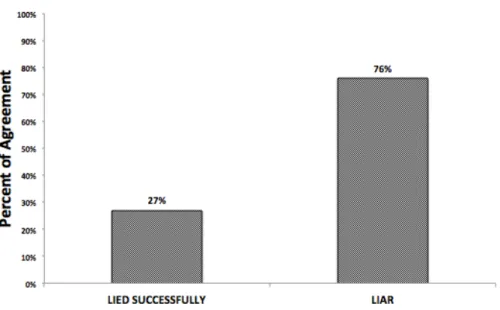
pi-lot experiment supporting this subjective hypothesis. Basically, I test two distinct predicates (viz. “is a liar” and “has lied successfully”) which respectively encode the subjective vs. objective definitions due to their dispositional vs. episodic
forms (subsection1.4.2). As it turns out, these data are not replicated for more
basic predicates, namely “is a liar” and “has lied” (subsection 1.4.3). However,
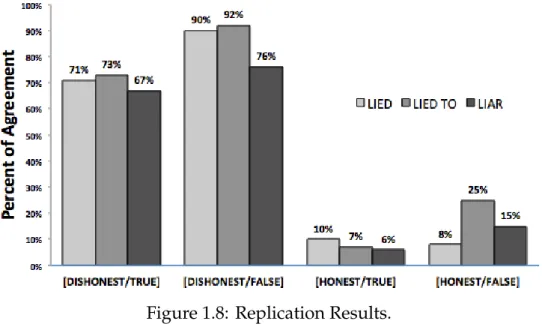
a post hoc analysis of the results shows that “has lied” behaves exactly like “is a
liar” in the critical condition (subsection1.4.4). Both are tracking identical
prop-erties (viz. the speaker’s intention to deceive). This confirms that people endorse the subjective definition as a core definition of lying.
In section1.5, I discuss the subjective definition of lying. Though this definition
accounts for people’s handling of “lie”, some points need clarification to make it fully operative. In particular, one should explain why the falsity of the speaker’s utterance is not mandatory for lying but tends to increase the ascription of the subjective definition. My interpretation is that falsity generates a Knobe effect
[viz. Knobe 2003ab 2006] which naturally increases people’s ascription of the
predicate “has lied”. By clarifying this issue, I hope to secure a stronger basis for the subjective account when falsity enters the scene.



![Figure 1.10: Comparison for [Dishonest / True].](https://thumb-eu.123doks.com/thumbv2/123doknet/14672887.741944/74.892.130.766.132.376/figure-comparison-for-dishonest-true.webp)
