
Contributions to Large-scale Distributed Systems The infrastructure Viewpoint - Toward Fog and Edge Computing as The Next Utility Computing Paradigm?
164
0
0
Texte intégral
(2) Université Bretagne Loire. Habilitation à Diriger des recherches Presentée par. Adrien Lebre École Doctorale Sciences et technologies de l’information, et mathématiques Discipline : Informatique et applications, section CNU 27 Unité de recherche : IMT Atlantique, Inria, LS2N Soutenue le 1er Sept. 2017. Contributions to Large-scale Distributed Systems The infrastructure Viewpoint Toward Fog and Edge Computing as The Next Utility Computing Paradigm?. Contributions aux systèmes distribués à large échelle la vision infrastructure Vers le Fog et l’Edge computing comme nouveau modèle d’informatique utilitaire ?. M. Claude Jard, Président Professor in Computer Science at University of Nantes Head of Nantes Digital Science Laboratory (LS2N). M. Erik Elmroth, Rapporteur Professor in Computing Science at Umea University, Sweden Head of Umea University research on distributed systems. M. Manish Parashar, Rapporteur Distinguished Professor of Computer Science at Rutgers University, USA Director of the Rutgers Discovery Informatics Institute (RDI2). M. Pierre Sens, Rapporteur Professor at the University of Pierre et Marie Curie (Paris 6), France Head of the REGAL Resarch Group. M. Frédéric Desprez, Examinateur Senior Researcher at Inria Deputy Scientific Director at Inria.
(3)
(4) It does not matter how slowly you go as long as you do not stop. — Confucius. Acknowledgments Because I see now how overloaded can be the schedule of senior researchers, I would like to start these acknowledgments by expressing my gratitude to all the members of the committee for accepting to evaluate m work despite their respective obligations. It is a real honor for me to have such a prestigious committee. This document covers most of the activities I made since the defense of my Phd in 2006. During these ten years, I had the opportunities to work with many French as well as Foreign colleagues. While these are acknowledged throughout the document, I would like, here, to warmly thank all of them for the collaborations we had and that have made the researcher I am today. I should highlight that I am much indebted to • Dr. Christine Morin for showing me what a community can accomplish ; • Prof. Mario Südholt for the freedom and trust he has given me in each action I have wanted to achieve since my arrival in his team ; • Dr. Frédéric Desprez for his confidence and guidance he has never stopped to give me during this period. Special thanks go to the Phd candidates, Post-docs and Engineers I had the chance to work with. In addition to performing the real work that makes research progressing, they have been key persons that through their competences and efforts have kept my enthusiasm and my energy to conduct research activities intact. The contributions to the field of distributed computing I am glad to present in this document could not have been achieved without them. Finally, my most affectionate thanks go to: • My Friends who are throught our weekend outings and meals the best way for me to “recharge my batteries” ; • My parents-in-law who indirectly have participated to the work presented in this manuscript, in particular by taking care of my kids each time it has been necessary ; • My parents who after 39 years still continue to impress me for the devotion they have for their five children ; • My brothers, sister(s) (in-law) and their kids with whom I should have spent much more times than what I have done ; • My children, Elie-Lou and Jonas who are, by their daily smiles, an endless source of happiness ; • And, my lovely wife, Dorothée, who is, in good times and bad, the most wonderful person I have met.. iii.
(5)
(6) Table of Contents I Introduction 1 Introduction 1.1 General Context . . . . . . . . . . . . . . . . . 1.2 Scientific Contributions . . . . . . . . . . . . 1.2.1 Dynamic scheduling of VMs . . . . . 1.2.2 Virtualization and Simulation toolkits 1.2.3 Beyond the Clouds . . . . . . . . . . . 1.3 Looking Back to the Future . . . . . . . . . . 1.4 Organization of the Document . . . . . . . .. . . . . . . .. . . . . . . .. . . . . . . .. . . . . . . .. . . . . . . .. . . . . . . .. . . . . . . .. . . . . . . .. II Dynamic Virtual Machine Scheduling 2 VM Cluster-Wide Context Switch 2.1 Challenge Description . . . . . . . . . . . . . . . . . . . . . 2.2 Our Proposal: A Generic VMs Context Switch . . . . . . . . 2.2.1 Fundamentals . . . . . . . . . . . . . . . . . . . . . . 2.2.2 Architecture Overview . . . . . . . . . . . . . . . . . 2.3 Proof-of-Concept & Validations . . . . . . . . . . . . . . . . 2.3.1 Proof-of-Concept . . . . . . . . . . . . . . . . . . . 2.3.2 Experiments . . . . . . . . . . . . . . . . . . . . . . 2.4 Related Work . . . . . . . . . . . . . . . . . . . . . . . . . . 2.5 Summary . . . . . . . . . . . . . . . . . . . . . . . . . . . . . 3 Distributed Virtual Machine Scheduler 3.1 Addressing Scalability, Reactivity and Fault-tolerant Aspects 3.1.1 Challenge Description . . . . . . . . . . . . . . . . . 3.1.2 Our Proposal: DVMS . . . . . . . . . . . . . . . . . 3.1.3 Proof-Of-Concept & Validation . . . . . . . . . . . . 3.1.4 Summary . . . . . . . . . . . . . . . . . . . . . . . . 3.2 Locality Aware-Scheduling Strategy . . . . . . . . . . . . . . 3.2.1 Challenge Description . . . . . . . . . . . . . . . . . 3.2.2 Our Proposal: A Locality-aware Overlay Network . 3.2.3 Proof-of-Concept & Validation . . . . . . . . . . . . 3.2.4 Summary . . . . . . . . . . . . . . . . . . . . . . . . 3.3 Related Work . . . . . . . . . . . . . . . . . . . . . . . . . . 4 Conclusion & Open Research Issues III Virtualization and Simulation toolkits 5 Adding virtualization capabilities to SimGrid 5.1 Challenge Description . . . . . . . . . . . . . . . . . 5.2 SimGrid Overview . . . . . . . . . . . . . . . . . . . 5.3 Our proposal: Simgrid VM . . . . . . . . . . . . . . . 5.3.1 Adding a VM Workstation Model . . . . . . 5.3.2 Adding a Live Migration Model . . . . . . . . 5.3.3 SimGrid VM API (C and Java) . . . . . . . . . 5.4 Validation . . . . . . . . . . . . . . . . . . . . . . . . 5.4.1 Experimental Conditions . . . . . . . . . . . 5.4.2 Evaluation of the VM Workstation Model . . 5.4.3 Live migrations with various CPU levels . . . 5.4.4 Live Migrations under CPU Contention . . . 5.4.5 Live Migrations under Network Contention. . . . . . . . . . . . .. . . . . . . . . . . . .. . . . . . . . . . . . .. . . . . . . . . . . . .. . . . . . . .. . . . . . . .. . . . . . . .. . . . . . . .. . . . . . . .. . . . . . . . . .. . . . . . . . . .. . . . . . . . . .. . . . . . . . . .. . . . . . . . . .. . . . . . . . . . . .. . . . . . . . . . . .. . . . . . . . . . . .. . . . . . . . . . . .. . . . . . . . . . . .. . . . . . . . . . . . .. . . . . . . . . . . . .. . . . . . . . . . . . .. . . . . . . . . . . . .. . . . . . . . . . . . .. 1 3 3 4 5 6 7 7 9 10 13 13 15 15 16 20 20 20 22 23 25 25 25 27 30 33 34 34 35 38 40 41 43 46 49 49 50 51 52 54 58 59 61 62 63 64 65. v.
(7) vi. Table of Contents. 5.5 Related Work . . . . . . . . . . . . . . . . . . . 5.6 Summary . . . . . . . . . . . . . . . . . . . . . . 6 Virtual Machine Placement Simulator 6.1 Challenge Description . . . . . . . . . . . . . . 6.2 Our Proposal: VMPlaceS . . . . . . . . . . . . . 6.3 Dynamic VMPP Algorithms . . . . . . . . . . . 6.4 Experiments . . . . . . . . . . . . . . . . . . . . 6.4.1 Accuracy Evaluation . . . . . . . . . . . 6.4.2 Analysis of Entropy, Snooze and DVMS 6.5 Related Work . . . . . . . . . . . . . . . . . . . 6.6 Summary . . . . . . . . . . . . . . . . . . . . . . 7 Conclusion & Open Research Issues. . . . . . . . . . . . . . . . . . . . . . . . . . . . . . . . .. . . . . . . . .. . . . . . . . .. . . . . . . . .. . . . . . . . .. . . . . . . . .. . . . . . . . .. . . . . . . . .. . . . . . . . .. . . . . . . . .. . . . . . . . .. . . . . . . . .. IV Beyond the Clouds: Recent, Ongoing and Future Work 8 The DISCOVERY Initiative 8.1 Context & Motivations . . . . . . . . . . . . . . . . . . . . . . . . . . 8.2 From Cloud to Fog/Edge Computing Facilities . . . . . . . . . . . . 8.3 Revising OpenStack Through a Bottom/Up Approach . . . . . . . . 8.3.1 Design Considerations . . . . . . . . . . . . . . . . . . . . . . 8.3.2 The Choice of OpenStack . . . . . . . . . . . . . . . . . . . . 8.4 Innovation Opportunities . . . . . . . . . . . . . . . . . . . . . . . . 8.5 Summary . . . . . . . . . . . . . . . . . . . . . . . . . . . . . . . . . . 9 Revising OpenStack to Operate Fog/Edge Computing Infrastructures: a First Proof-Of-Concept 9.1 Challenge Description . . . . . . . . . . . . . . . . . . . . . . . . . . 9.2 Revising OpenStack . . . . . . . . . . . . . . . . . . . . . . . . . . . . 9.2.1 Distributing the AMPQ Bus . . . . . . . . . . . . . . . . . . . 9.2.2 Distributing the Databases . . . . . . . . . . . . . . . . . . . 9.2.3 The Nova POC: From MySQL to Redis . . . . . . . . . . . . 9.3 Experimental Validation . . . . . . . . . . . . . . . . . . . . . . . . . 9.3.1 Impact of Redis w.r.t MySQL . . . . . . . . . . . . . . . . . . 9.3.2 Multi-site Scenarios . . . . . . . . . . . . . . . . . . . . . . . 9.3.3 Compatibility with Advanced Features . . . . . . . . . . . . . 9.4 Summary . . . . . . . . . . . . . . . . . . . . . . . . . . . . . . . . . . 10 Conducting Scientific Evaluations of OpenStack 10.1 Challenge Description . . . . . . . . . . . . . . . . . . . . . . . . . . 10.2 Background . . . . . . . . . . . . . . . . . . . . . . . . . . . . . . . . 10.2.1 Deploying OpenStack and controlling Experiments . . . . . 10.2.2 Enos Default Benchmarks . . . . . . . . . . . . . . . . . . . . 10.2.3 Monitoring and Gathering Metrics . . . . . . . . . . . . . . . 10.3 EnOS . . . . . . . . . . . . . . . . . . . . . . . . . . . . . . . . . . . . 10.3.1 EnOS Description Language for Flexible Topologies . . . . . 10.3.2 EnOS Workflow . . . . . . . . . . . . . . . . . . . . . . . . . 10.4 Experiments . . . . . . . . . . . . . . . . . . . . . . . . . . . . . . . . 10.5 Related Work . . . . . . . . . . . . . . . . . . . . . . . . . . . . . . . 10.6 Summary . . . . . . . . . . . . . . . . . . . . . . . . . . . . . . . . . . 11 Ongoing and Future Work: A Software Stack for Fog/Edge Infrastructures. 66 67 69 69 70 72 74 74 75 77 78 81 85 87 87 89 91 91 92 94 96 99 99 100 101 101 102 103 104 106 107 108 109 109 110 110 110 111 111 111 112 113 115 116 119. Bibliography. 125. V Appendix A Résumé long en francais a.1 Contexte générale . . . . . . . . . . . . . . . . . . . . . . . . . . . . . a.2 Contributions Scientifiques . . . . . . . . . . . . . . . . . . . . . . . a.2.1 Placement dynamique de machines virtuelles . . . . . . . . .. 135 137 137 138 138.
(8) Table of Contents. a.2.2 Virtualisation et bibliothèques de simulation . . . . . . . . . 140 a.2.3 Au delà de l’informatique en nuage . . . . . . . . . . . . . . . 142 a.3 Une recherche dirigée par l’expérimentation . . . . . . . . . . . . . . 143 B Detailled Curriculum Vitae/List of Publications/Invited Talks 145. vii.
(9)
(10) Part I. INTRODUCTION.
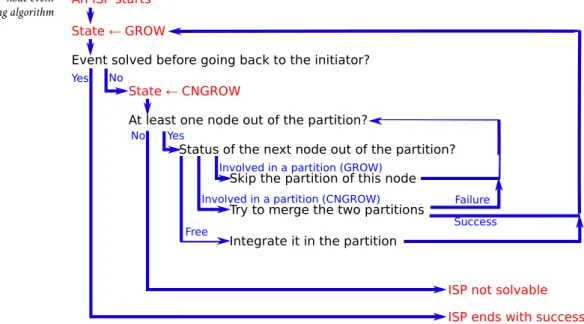
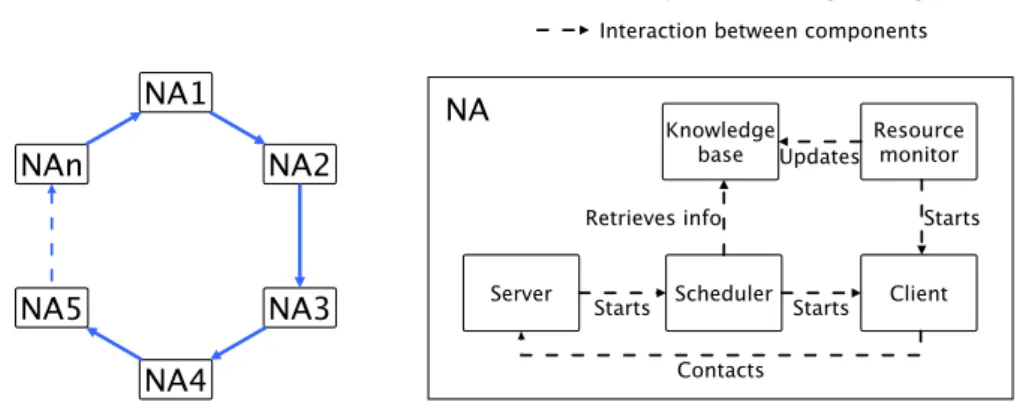
(11) This habilitation thesis presents an overview of the major research activities I conducted as part of the ASCOLA Research Group of the Ecole des Mines de Nantes (now IMT Atlantique), where I have held an Associate Professor position since October 2008. ASCOLA is a joint team of the Automation, Production and Computer Science Department of IMT Atlantique, the Inria research center in Rennes, and the “Laboratoire des Sciences du Numérique de Nantes” (LS2N, UMR CNRS 6004) in France. The team addresses the general problem of the implementation and evolution of large and complex software architectures. In particular, we pursue the objective of new language abstractions and implementation techniques for large-scale applications in cloud- and grid-based systems, both on the level of (service-based) applications and (virtualized) infrastructures. The document summarizes the main contributions I achieved on this topic. I highlight that each part includes, at the beginning, a short preamble such as this one. The goal is to give additional information regarding the work that is presented. In particular, for each contribution, I mention the different persons that took part to the activities and, as appropriate, the sources of funding that have been associated. Last but not the least, all URLs that are given in this manuscript have been validated on March 2017.. 2.
(12) Introduction In this introduction, I first present the scientific context of my research and second highlight three main actions I have done since I have joined the ASCOLA Research Group. To conclude this introduction, I voluntary chose to give a brief overview of the activities I have been doing along the ones presented in this manuscript. Reading of this last section is not mandatory to understand the scientific aspects that will be discussed later on. The goal is to highlight a few details that I consider as key elements in my professional life such as my engagement in the Grid’5000 consortium or more generally my involvement in the scientific community – Being involved in the community has been and will be a key element of my research activities – I have always been convinced of the importance to promote collaborations and exchanges between researchers: collaborations is the answer to tackle scientific challenges that would be almost impossible to address alone.. 1.1. 1. General Context. To accommodate the ever-increasing demand for computation and storage capabilities, computing infrastructures have continuously evolved since the 1960’s. Figure 1 provides a chronology of major advances in communication and computation technologies. It depicts in particular the different computing architectures starting from the historical mainframe computers to the advent of Cloud Computing solutions that host most IT-services nowadays. Figure 1: Evolution of Communication/Computation Facilities As early as the advent of the TCP/IP network, Utility Computing infrastructures have been leveraging network backbones to deliver more efficient solutions.. Although these architectures radically differ in their design and the way of using them, mainframes, commodity clusters, Grids and more recently Cloud Computing facitilies have all been targeting the Utility Computing concept for IT capabilities as defined by John McCarthy in 1961. Because it enables Utility Computing providers to go beyond the capacity of a single machine, distributed computing became the prevalent infrastructure for delivering IT as a service in the middle of the 1990’s. However, due to the complexity to operate and use Distributed Computing Platforms, it has taken almost two decades. 3. If computers of the kind I have advocated become the computers of the future, then computing may someday be organized as a public utility just as the telephone system is a public utility... The computer utility could become the basis of a new and important industry John Mc Carthy, Speaking at the MIT centennial in 1961.
(13) Virtual Machines have finally arrived. Dismissed for a number of years as merely academic curiosities, they are now seen as cost-effective techniques for organizing computer systems resources to provide extraordinary system flexibility and support for certain unique applications. Goldberg, 1974, A Survey of Virtual Machine Research, Computer, 7(6), 34-45.. of research activities and technology transfers (Foster and Kesselman, 2010) to popularize them in all domains of science and industry (Armbrust et al., 2010; Low, Chen, and Wu, 2011). Among the key enablers of this democratization are virtualization technologies. Proposed as early as Mainframes (Popek and Goldberg, 1974) but used for about a decade in distributed computing (Fallenbeck et al., 2006; Sotomayor, Keahey, and Foster, 2008), system virtualization had a huge impact on distributed computing. System Virtualization can be seen an independent abstraction between hardware resources and software applications that enables the division of physical resources into several independent virtual elements. These elements can be assigned “on-thefly” to applications according to their requirements, thus improving the flexibility in terms of resource management. Among virtualization technologies, the concept of virtual machine is probably best known (Barham et al., 2003). A Virtual Machine (VM) provides a substitute of a physical machine with its own operating system, libraries and applications. A hypervisor acts as the independent abstraction that enables the execution of several VMs simultaneously on a physical machine. Using VMs offers strong advantages from the end-users/developers point of view. First, they can customize a VM with the runtime they want, save it in a persistent manner and start it each time it is needed. Second, by splitting a service into multiple VMs, it is possible to adapt the number of running VMs in order to satisfy the expected quality of service on time. Finally, using VMs provides a stronger isolation between the different tenants that use the distributed infrastructure. Indeed, applications running inside a VM cannot access resources that have been assigned to other VMs. While Virtualization technologies paved the way of the Cloud Computing revolution, in particular of the computation dimension of the Infrastructure-as-a-Service model (IaaS, i.e., a distributed infrastructure where developers/end-users can provision VMs on demand) (Sotomayor, Rubén S Montero, et al., 2009), it also led to new scientific and technical challenges in terms of resource management (Foster, Y. Zhao, et al., 2008). These challenges are related to the classical management of all resources consumed and provided by the hosting infrastructure (servers, storage, and network) and on the management of the VM lifecycle (creation, suspend/resume and migration operations). Since 2008, my research activities have been focusing on these challenges with three major contributions (i) on the dynamic scheduling of VMs in cloud computing infrastructures (Hermenier, Lebre, and Menaud, 2010; Quesnel and Lebre, 2011; Balouek, Lebre, and Quesnel, 2013; Quesnel, Lebre, Pastor, et al., 2013; Quesnel, Lebre, and Südholt, 2013; Pastor et al., 2014), (ii) on delivering abstractions and accurate models to study VM related challenges through simulations (Hirofuchi and Lebre, 2013; Hirofuchi, Pouilloux, and Lebre, 2013; Hirofuchi, Pouilloux, and Lebre, 2015; NGuyen and Lebre, 2017) and, finally, (iii) on the design of a new generation of Utility Computing that can cope with new requirements of Internet of Things and Mobile Computing applications (Lebre, Anedda, et al., 2011; Bertier et al., 2014; Lebre, Pastor, Simonet, et al., 2017; Confais, Lebre, and Parrein, 2017). It is noteworthy that although these three parts can be considered as independent activities, they have nurtured each other as explained in the following.. 1.2. Scientific Contributions. At coarse-grained, the red thread of the activities I conducted is the following one: While investigating the challenge related to the dynamic scheduling of VMs, in particular under the scalability perspective (see Section 1.2.1), I remarked that our community lacked of a simulator toolkit to evaluate and compare state-of-the-art’s solutions at large scale (see Section 1.2.2). Addressing these challenges at large scale has been a wise choice with respect to the current trend toward large-scale and widely distributed Cloud Computing Infrastructures (see Section 1.2.3).. 4.
(14) 1.2.1. Dynamic scheduling of VMs 2008 - 2015. Among challenges IaaS providers soon faced was the VMs proliferation dilemma (a.k.a., the VM sprawl (Sarathy, Narayan, and Mikkilineni, 2010)). Due to the fact that the creation of VMs was becoming straightforward and the possibility to provision and free VMs on demand, administrators as well as developers have built new services/applications on a VM-basis. The main issue of this software architecture choice is that it may lead to over-provisioning situations where some VMs are consuming resources that they do not longer need, preventing other VMs to access resources they require. To mitigate resource waste as well as shortages, the distributed computing community has been investigating new mechanisms in charge of maximizing system utilization while ensuring the Quality of Service (QoS) of each VM. Among the different solutions available, the ASCOLA research group worked on the Entropy proposal (Hermenier, Lorca, et al., 2009), a framework built on the concept of a central MAPE loop (Monitor-Analyze-Plan-Execute) (Huebscher and McCann, 2008) and constraint programming concepts (Rossi, Van Beek, and Walsh, 2006) to deal with the VMs placement problem. The first contribution we made at my arrival in ASCOLA has been a generalization of the Entropy proposal to manipulate VMs across a cluster in the same manner as processes on a laptop (Hermenier, Lebre, and Menaud, 2010). We proposed the concept of cluster-wide context switches of virtualized jobs. By encapsulating jobs into VMs and by using VM operations such as migration, suspend and resume it was possible to resolve under-used and over-loaded situations dynamically by means of autonomous mechanisms that reassign resources in case of service degradation. This fine-grained management of VMs enabled the execution of a maximum number of jobs simultaneously and non-intrusively (VMs were considered as black boxes). Leveraging this first result, I proposed to investigate how this cluster-scale solution could be extended to handle larger infrastructures composed of thousands of servers potentially spread over multiple-sites. The key idea I proposed has been to leverage P2P mechanisms while keeping the constraint programming approach to address the optimization problem. First, we introduced DVMS (Distributed VM Scheduler), a manager that schedules and supervises VMs cooperatively and dynamically in distributed systems (Quesnel and Lebre, 2011; Quesnel, Lebre, and Südholt, 2013; Quesnel, Lebre, Pastor, et al., 2013; Balouek, Lebre, and Quesnel, 2013). DVMS relies on a ringbased algorithm that allows nodes to cooperate for solving under and over-loaded situations: when a node cannot guarantee the QoS for the VMs it is hosting or when it is under-utilized, it starts an iterative scheduling procedure by querying its neighbor to find a better placement. If the request cannot be satisfied by the neighbor, it is forwarded to the following free one until the procedure succeeds. This approach allows each scheduling procedure to send requests only to a minimal number of nodes, thus decreasing the scheduling as well as the reconfiguration time (a.k.a., the aforementioned VM context switch operation) without requiring a central point. The second extension we made focused on the locality of nodes hosting the VMs. The objective was to mitigate inter-site VM relocations that are costly in the context of a cloud infrastructure spread over several sites (Pastor et al., 2014). To tackle this problem, we designed a generic building block that enables the reification of the locality aspects at the level of the scheduling algorithm. The locality has been estimated through a cost function of the latency/bandwidth tuple between peers in the network, thus enabling each peer to select its closest neighbors. We rely on Vivaldi (Dabek et al., 2004), a simple decentralized protocol allowing to map a network topology onto a logical space while preserving locality. On top of Vivaldi, a shortest path construction, similar to Dijkstra’s well-known algorithm, is performed each time there is a need for cooperation between two nodes that take part in the schedule. We evaluated the advantage of this new building block by changing the overlay network in the DVMS proposal.. 5.
(15) It is noteworthy that for each proposal, we implemented an open-source framework and evaluated it through in-vivo experiments, as further discussed in the document. All pieces of software are available online: http://beyondtheclouds.github. io/DVMS/.. 1.2.2. SimGrid is a scientific instrument to study the behavior of large-scale distributed systems such as Grids, HPP, P2P and more recently Cloud systems thanks in part to the work I did. It can be used to evaluate heuristics and prototype applications. All this as a free software. Further information available at the Simgrid website.. Virtualization and Simulation toolkits 2013 -. While evaluating our VM placement algorithms, I observed there was no instrument to evaluate and compare the different approaches that have been proposed in the literature. Although the VM placement problem has been a hot topic for almost one decade, most proposals were evaluated either using limited scale in-vivo experiments or ad-hoc simulator techniques. Such validation methodologies are unsatisfactory. First they do not model precisely enough real production platforms (size, workload representativeness, etc.). Second, they do not enable the fair comparison of each approach. The second contribution we made has consisted in extending SimGrid, a toolkit for the simulation of potentially complex algorithms executed on large-scale distributed systems (Casanova, Legrand, and Quinson, 2008). Although it has been intensively used in HPC and P2P areas, it did not provide the VM abstractions that were required to study and compare VM placement strategies and more generally VM-related challenges. We proposed SimGrid VM, a highly-scalable and versatile simulation framework supporting VM environments (Hirofuchi, Pouilloux, and Lebre, 2015). SimGrid VM allows users to launch hundreds of thousands of VMs on their simulation programs and control VMs in the same manner as in the real world (e.g., suspend/resume and migrate). Users can execute computation and communication tasks on physical machines and VMs through the same SimGrid API, which provides a seamless migration path to IaaS simulations for hundreds of users. Moreover, SimGrid VM includes a live migration model that implements the precopy migration algorithm. This model correctly calculates the migration time as well as the migration traffic, taking account of resource contention caused by other computations and data exchange within the whole system. Leveraging these extensions, we developed VMPlaceS (Lebre, Pastor, and Südholt, 2015), a dedicated simulation framework to perform in-depth investigations and fair comparisons of VM placement algorithms. VMPlaceS provides generic programming support for the definition of VM placement algorithms, execution support for their simulation at large scales, as well as new means for their trace-based analysis. The accuracy of VMPlaceS has been validated by comparing simulated and in-vivo executions of a centralized scheduling strategy (Hermenier, Lorca, et al., 2009). We have also illustrated the relevance of VMPlaceS by evaluating and comparing algorithms representative of three different classes of virtualization environments: centralized, hierarchical and fully distributed placement algorithms. The corresponding experiments have provided the first systematic results comparing these algorithms in environments including up to one 1K nodes and 10K VMs. Although the efforts I put in this action are less important now than what I did between 2013 and 2015, I continue to contribute to this area. In addition to being involved in the Simgrid community as much as I can (Lebre, Legrand, et al., 2015), I recently started a study on the boot time of VMs (NGuyen and Lebre, 2017). Most cloud simulators often ignored the VM boot time because they assumed that the duration is negligible. Because the VM booting process consumes resources (CPU, I/O …), it has been rather simple to disprove through experiments this assumption. Booting a VM can last from tens of seconds up to minutes depending on co-located workloads. We expect to validate a first-class VM boot time model soon and integrate it into SimGrid.. 6.
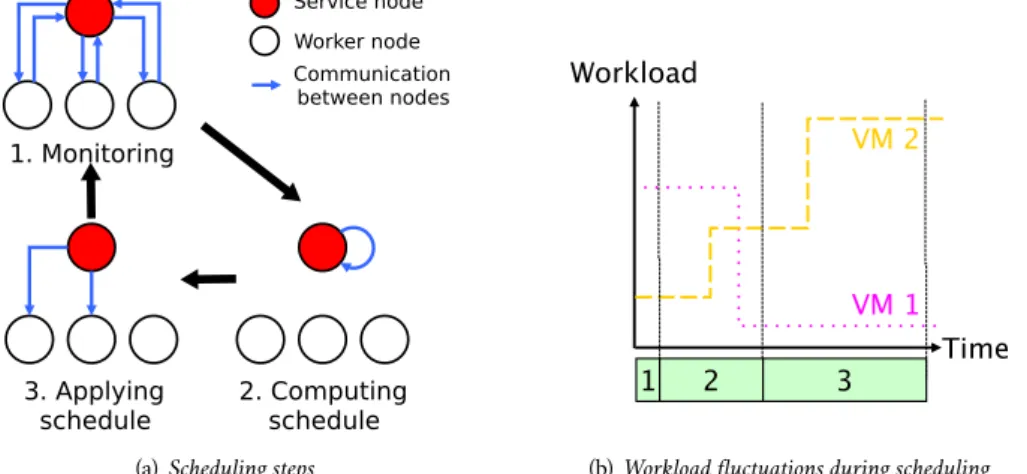
(16) All pieces of software are available online: http://simgrid.gforge.inria.fr and http://beyondtheclouds.github.io/VMPlaceS/.. 1.2.3. Beyond the Clouds 2014 -. To satisfy the demand for Cloud Computing resources while realizing economies of scale, the production of computing resources has been concentrated for the last ten years in mega data centers (DCs) where the number of physical resources that one DC can host is limited by the capacity of its energy supply and its cooling system. To meet these critical needs in terms of energy supply and cooling, the trend has been toward building DCs in regions with abundant and affordable electricity supplies or taking advantage of free cooling techniques available in regions close to the polar circle (Gary Cook, 2013). While this model of mega DCs still prevails, the advent of new usages related to Internet of Things applications (IoT) (Atzori, Iera, and Morabito, 2010), Mobile Edge Computing (MEC) (Fernando, Loke, and Rahayu, 2013) and Network Function Virtualization (NFV) (Mijumbi et al., 2016) is strongly challenging this approach. As an example, the projection regarding the number of connected devices and applications that will consume cloud services and generate massive amounts of data is a severe scalability challenge for the current model (B. Zhang et al., 2015). To cope with these changes in terms of usage, the cloud and network communities are now advocating for going from a few central platforms to massively distributed small sized DCs that are deployed at the edge of the network, thus closer to end-users and their related devices, and applications (Bonomi et al., 2012). The drivers of this (r)evolution lay in the development of appropriate software mechanisms that will enable an operator to aggregate, supervise and expose such massively distributed resources on the first hand, and the implementation of new kinds of services deployed and managed by the operator itself or by third-party users on the other hand. I have been investigating this challenge for the last 4 years through preliminary studies. Built on these initial investigations I proposed the creation of the DISCOVERY Inria Project Lab that I have led since 2015. DISCOVERY gathers academic and industry experts in research areas such as large-scale infrastructure management systems, network and P2P algorithms. From the scientific and technical point of view, the novelty of DISCOVERY lies in a new way of designing a system in charge of operating a massively distributed cloud. The system we envisioned can be viewed as a distributed operating system, manipulating Virtual Machines in a geo-distributed infrastructure. The major difference with respect to the state of the art is related to our bottom-up approach: instead of designing a system in charge of orchestrating independent cloud instances, we target to revise and extend mechanisms of the OpenStack software suite with P2P and self-* techniques. Although this activity is rather young in comparison to the two previous ones, it is important for me to deal with it in this manuscript. First, we obtained a few interesting results in particular around the OpenStack community that deserve to be highlighted (Lebre, Pastor, Simonet, et al., 2017; Cherrueau et al., 2017). Second, this activity paves the way for several activities I plan to do for the next couple of years. In particular, this action should lead to set-up a new research group in Nantes that will focus on the design of a complete software stack to operate and use next generation of Utility Computing infrastructures: The Fog, the Edge and beyond!. 1.3 Looking Back to the Future At the end of my post-doctorate position, I led a preliminary work that investigated how suspend/resume VM operations can benefit the best effort mode of the Grid’5000 infrastructure (Gallard, Lebre, and Morin, 2010). Grid’5000 is a dedicated testbed. 7. the Discovery initiative is an Open-Science Initiative aiming at implementing a fully decentralized IaaS manager. Since 2015, the initiative is mainly supported through the Inria Project Labs program and the I/O labs, a joint lab between Inria and Orange Labs. I am the Principal Investigator of this actions and the current leader. Further information available at the DISCOVERY website..
(17) Created in 2006, Grid’5000 is a large-scale and versatile testbed for experiment-driven research. With more than 500 active users per year since 2006, it is one of the most recognised testbeds worlwide. I have been involved in different strategic committees since 2008. For Further information available at the Grid’5000 website.. for experiment-driven research in all areas of computer science, with a focus on parallel and distributed computing including Cloud, HPC and Big Data (Bolze et al., 2006). In Grid’5000, users book resources leveraging a batch-scheduler approach. Our proposal consisted in encapsulating jobs into VMs so that it became possible to suspend/resume them each time it was needed. Although this study did not have a strong impact on the scientific community because the innovative part with respect to the state-of-the art was not important enough (Sotomayor, Keahey, and Foster, 2008), it completely changed the perception I had regarding how a distributed computing infrastructure should be operated and used (Gallard, Lebre, Morin, et al., 2012; Lebre, 2010). From my point of view, the notion of sandboxes provided by the VM abstraction would radically change the distributed computing perspective and it was urgent to extend several mechanisms of Grid’5000 in order to be able to investigate virtualization challenges. Leveraging the aforementioned study and achievements made by the distributed systems community, I have been underlining the importance of VM technologies in distributed computing infrastructures. As early as 2008, I proposed to create a dedicated working group at the French national level. The efforts of this group have been then consolidated through several actions such as the Hemera Inria Large-Scale initiative1 (2010-2014) whose virtualization activities I led. We added the virtualization capabilities to Grid’5000, enabling researchers and engineers to investigate virtualization related challenges (Balouek, Amarie, et al., 2012). Along with these activities, I organized several events such as the French events ‘’Journée Thèmes Emergents” on Virtualization in Distributed Architectures organized in 2010 and 2014 in Nantes.2 At the international level, I had the opportunity to co-chair the ACM Virtualization Technologies in Distributed Computing workshop (VTDC) between 2011 and 2015.3 Co-located with the ACM HPDC conference, VTDC workshop series has been an important forum for the exchange of ideas and experiences on the use of virtualization technologies in distributed computing. In addition to VTDC, I also took part in several technical program committees such as ACM SuperComputing, IEEE/ACM CCGrid, Europar, IEEE CloudCom and IEEE IC2E to name a few. Being strongly involved in the community has been a decisive point to strengthen my expertise and to consolidate the vision I have regarding how next generations of utility computing infrastructures should be designed. In particular, I have been among the first researchers to promote and work on the concept of massively distributed cloud infrastructures deployed on network point of presences (Bertier et al., 2014). This has been a wise choice as this new paradigm referred to as the Fog/Edge Computing nowadays, is attracting growing interest by the network as well as the distributed computing communities. In addition to taking part in several events that dealt with this topic (program and track chairs of recent events such as ICFEC, CloudCom and Europar to name a few), I have been invited to co-chair the transversal action “Virtualization and Clouds” of the RSD GDR4 since 2015. This action aims at further bridging the gap between the communication networks and distributed systems experts of the RSD GDR (as example, we gathered 80 people in Paris for the 1st edition of the CloudDay events). Although the use of virtualization technologies has been leading to exciting developments for almost ten years now, current solutions for operating virtual infrastructures still need to provide a tighter integration between network, computation and storage resources at a geographically wide area network scope. This integration is mandatory to build the next generation of Internet backbones as well as Utility Computing infrastructures. This is urgent as the new requirements of IoT and mobile computing applications cannot be satisfied by cur1 https://www.grid5000.fr/mediawiki/index.php/Hemera. 2 http://web.emn.fr/x-info/ascola/doku.php?id=internet:jte-virtualization-2010 and http://people.rennes.inria.fr/Adrien.Lebre/PUBLIC/CloudDay/. 3 http://people.rennes.inria.fr/Adrien.Lebre/VTDC/vtdc15.html. 4 https://rsd-cloud.lip6.fr.. 8.
(18) rent cloud computing offers. Finally, I would like to underline that I’m still deeply involved in the Grid’5000 consortium taking part in the architecture and executive committees where we are discussing how Grid’5000 should evolve with respect to recent challenges related to the Industrial Internet and the Internet of Skills. These two internets can be seen as a convergence between data centers, network and IoT devices.. 1.4. Organization of the Document. The major part of this manuscript is devoted to the presentation of the three scientific activities that have been highlighted in this introduction (one part for each of them). I underline that all these works have been published and are here gathered, standardized, and revised to make the manuscript more consistent. The last chapter presents an overview of my ongoing activities and my research program for the coming years. In detail, the documents is structured in 11 chapters. Chapter 2 presents the VM cluster-wide context-switch concept. Chapter 3 discusses the extensions that have been proposed around the DVMS proposal. Chapter 4 concludes the first part. Chapter 5 describes the extension we proposed in the SimGrid toolkit, including the elementary VM abstractions and the live migration model. Chapter 6 gives an overview of the VMPlaceS framework that has been built on top of the SimGrid extensions. Chapter 7 concludes this second part and also discusses preliminary results about an on-going work on the VM boot operation. Chapter 8 presents the DISCOVERY inititive. Chapter 9 and Chapter 10 present the first results we obtained within the framework of DISCOVERY and the OpenStack community. Finally, Chapter 11 concludes this manuscript by summarizing ongoing activities and giving a few perspectives on my future works. Note that the appendix, attached at the end of this manuscript, includes a detailed Curriculum Vitae, the complete list of my publications and and invited talks.. 9.
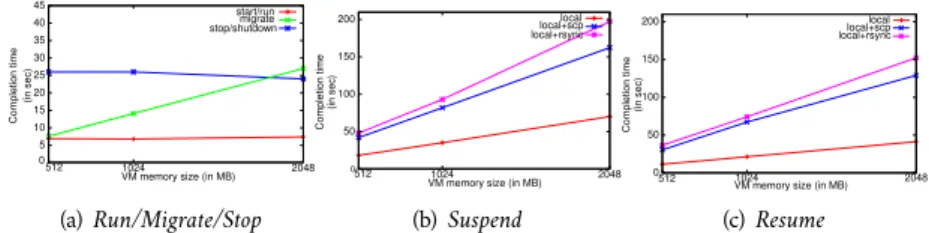
(19) Part II. DYNAMIC VIRTUAL MACHINE SCHEDULING.
(20) This part presents a compilation of the following publications: (Hermenier, Lebre, and Menaud, 2010) and (Quesnel, Lebre, and Südholt, 2013; Quesnel, Lebre, Pastor, et al., 2013) (Pastor et al., 2014). These results have been possible thanks to collaboration with: • Jérome Gallard, Phd in the MYRIADS Resarch Group (2007-2010), Rennes, now Research Engineer à Orange Labs ; • Fabien Hermenier, Phd in the ASCOLA Research Group (2006-2009), Nantes, now Ass. Professor at University of Nice ; • Jean Marc Menaud, Professor in the ASCOLA Research Group, IMT Atlantique Nantes ; • Flavien Quesnel, Phd in the Ascola Research Team (0ct 2010- Feb 2013), Nantes, now Research Engineer at System-X Institute ; • Mario Südholt, Professor and Head of the ASCOLA Research Group, IMT Atlantique, Nantes ; • Daniel Balouek-Thomert, Research Engineer, Hemera Inria Large Scale Initiative, (Dec 2011 - May 2012), Lyon, now PostDoc at Rutgers University ; • Jonathan Pastor, Phd in the Ascola Resarch Team (Oct 2012 - Oct 2016), Nantes, now PostDoc at Chicago University ; • Frédéric Desprez, Senior researcher and Deputy Scientific Director at Inria, Grenoble ; • Cédric Tedeschi, Ass. Profesor in the MYRIADS Research Group, University of Rennes 1, Rennes ; • Marin Bertier, Ass. Professor in the ASAP Research Group, INSA, Rennes. The activities have been mainly supported by the Ecole des Mines de Nantes (now IMT Atlantique), which succesively granted the Phd scholarships of Fabien Hermenier, Flavien Quesnel and Jonathan Pastor. I underline that Dr. Fabien Hermenier has been supervised by my colleague Prof. Jean-Marc Menaud. In the following, I co-supervised, first, the Phd of Dr. Flavien Quesnel with Prof. Mario Südholt and, second, the Phd of Dr. Jonathan Pastor with Dr. Frédéric Desprez. Major Results as well as software code are available at: http://beyondtheclouds.github. io/DVMS/.. 11.
(21)
(22) VM Cluster-Wide Context Switch Distributed infrastructures such as clusters are mostly handled by resources management systems with a static allocation of resources for a bounded amount of time. Those approaches are insufficient for an efficient use of resources. To provide a finer management, job preemption, migration and dynamic allocation of resources are required. However due to the complexity of developing and using such mechanisms, advanced scheduling strategies have rarely been deployed in production. This trend has been evolving since 2008 thanks to the use of migration and preemption capabilities of VMs. However, even though the manipulation of VMs-based jobs enables the reconfiguration of the system according to the scheduling objective, changing the state and the location of numerous VMs at each decision is tedious and degrades the overall performance. In addition to the scheduling policy implementation, developers have to focus on the feasibility of the actions (such as suspend, resume and migrate) while executing them in the most efficient way. In this section, we present the cluster-wide context switch, a building block that leverage virtualization capabilities to facilitate the development of advanced scheduling strategies (Hermenier, Lebre, and Menaud, 2010). Our proposal relies on the manipulation of virtualized-jobs (vjobs), i.e. jobs composed of VMs, through their life cycle. As a proof of concept, we have integrated the cluster-wide context switch module into the Entropy consolidation manager (Hermenier, Lorca, et al., 2009). Developers of scheduling policies can now only focus on the algorithm to select the vjobs to run. Then the cluster-wide context switch infers and plans the actions to perform on the VMs. It ensures the feasibility of the process and selects, among the multiple satisfying solutions, the one implying the fastest change. We evaluated the cluster-wide context switch through a FCFS dynamic scheduler. Transparently for developers, it uses dynamic allocation of resources, preemption and migration technics to maximize the resources usage. The chapter concludes by highlighting three research axes raised by this work.. 2.1 Challenge Description Scheduling jobs has been and still is a major concern in distributed computer systems. According to their size and their objectives, computing infrastructures are exploited in different ways. However, few of them are dedicated to one particular application and the most common way of exploiting large common computing infrastructures has mainly consisted in using Resources Management Systems (RMS) (Krauter, Buyya, and Maheswaran, 2002) where users request resources for a specific duration according to their estimated needs. Such an allocation of resources lead to a coarsegrain exploitation of infrastructures. In the best case, the allocated time slot is larger than the estimate and resources are underused. In the worst case, running applications can be withdrawn from their resources which may lead to the loss of all the performed calculations. Although strategies such as back-filling approaches have been proposed to improve the resources usage, preemption mechanisms such as the ones used for context switching in traditional operating systems are valuable to deliver an efficient management of resources. Thanks to preemption mechanisms, jobs can be processed, even partially, and suspended according to the scheduler objectives (Feitelson et al., 1997): Whenever necessary, the RMS can suspend some jobs and start, or resume from previously saved images, other ones. Such an allocation scheme is presented in Figure 2. Unfortunately due to the problem of residual dependencies (Clark. 13. 2.
(23) et al., 2005), the development of such mechanisms is tedious and only few RMS allow such a level of scheduling (Etsion and Tsafrir, 2005). Processors. Figure 2: Toward a Dynamic Scheduling Strategy Figure 2a depicts a minimalist scheduling process: jobs are enqueued one after the other and are scheduled according to their estimated duration and resource requirements. Figure 2b illustrates the backfilling mechanism improvement, which deals with fragmentation issues while guaranteeing a time reservation for the first job in the queue. Although there exist more advanced backfilling strategies, such as Conservative which provides time guarantee for each waiting job in the queue, these strategies suffer from limitations that prevent an optimal usage of the resources without exploiting advanced mechanisms such as preemption. Figure 2c presents such an approach that enables the execution of a job, even partially, each time it is possible.. 1st 2nd job job in the queue in the Running. queue. 3rd job in the queue. 4th job in the queue. Time. (a) Jobs 1, 2, 3 and 4 arrive in the queue and have to be scheduled Processors 3rd job in 2nd the queue job 1st in the job queue in the Running queue. 4th job in the queue. Time. (b) FCFS + EASY back filling: jobs 2 and 3 have been back filled. Some resources are unused (dark gray areas). Processors 3rd job in 2nd the queue job 4th job in 1st in the the queue job queue in the Running queue. Time. (c) EASY back filling with preemption. The job 4 is started earlier without impacting job 1. A small piece of resources is still unused (dark gray areas). Thanks to the consolidation and preemption mechanisms, it is possible to improve the whole cluster usage.. The increasing popularity of virtualization technologies in 2008 led to several initiatives (Fallenbeck et al., 2006; Sotomayor, Keahey, and Foster, 2008) that investigated the use of VM migration and preemption capabilities to improve the resource usages of distributed infrastructures: live migration (Clark et al., 2005) aims to adapt the assignments of VMs according to their current requirements (Bobroff, Kochut, and Beaty, 2007; Hermenier, Lorca, et al., 2009; Ruth et al., 2006; Verma, Ahuja, and Neogi, 2008), while the suspend and the resume actions provide preemption (Anedda et al., 2010). However manipulating VMs needs to be performed carefully. First, suspending or resuming VMs can impact the correctness of a job, especially if the VMs are interconnected. Second, migrating a VM from one node to another one can be impossible without violating VM expectations in terms of resource or placement constraints (e.g., migrating a “replica” VM to the same host that the master instance should not be allowed) (Grit, D. Irwin, Yumerefendi, et al., 2006; Hermenier, Lorca, et al., 2009; Wood et al., 2009). Finally, each context switch (or permutation) of VMs should be performed in an efficient manner. Migrating a VM can last from a few seconds up to minutes according to the executed workload while suspending/resuming VMs are I/O intensive operations that can negatively impact the performance of the whole infrastructure. Although considering permutation issues is fundamental, most developers of schedulers did not consider it as a primary concern. In most cases, they simply focused on the efficiency of the algorithms to select the jobs to run while ignoring the mechanisms to perform the transition between the current situation and their solution. The remainder of the chapter is organized as follows: Section 2.2 describes the VM context switch proposal overall. It first introduces fundamentals and second gives an overview of the framework and how a VM context switch is performed clusterWide.. 14.
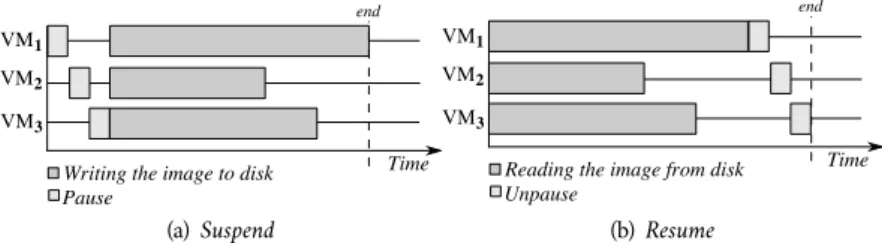
(24) Section 2.3 discusses an evaluation of a sample scheduler that enabled us to validate our concept. Section 2.4 addresses related work. Finally Section 2.5 concludes this chapter and gives some perspectives.. 2.2. Our Proposal: A Generic VMs Context Switch. Back to 2009, the first contribution we did has been to deliver the VM cluster-wide context switch operation as a fundamental building block (Hermenier, Lebre, and Menaud, 2010). We showed that the permuation operation between two allocations of VMs is independent from the policy itself and can be addressed through a generic mechanism. Thanks to it, developers can implement sophisticated algorithms to schedule “virtualized” jobs without handling the issues related to their manipulations.. 2.2.1. Fundamentals. This section deals with the fundaments of our proposal. First, we define the virtualized job abstraction and the different actions that change its state. Second, we present preliminary experiments on the cost of each action.. Virtualized job The first change we did has been to reconsider the batch scheduler granularity from the usual job to the virtualized one. We defined the virtualized job (vjob) abstraction. According to the nature of the application to execute (centralized or distributed), a vjob can be composed of several VMs. Implementing a dynamic scheduling policy consists in manipulating vjobs through their four different states described in Figure 3: waiting, sleeping, running or terminated. The transition between the different states consists in applying the associated action to all the VMs composing the vjob. Actions are supposed to be atomic: all the VMs composing a vjob are in the same state. The action migrate slightly differs from others. It relocates a VM from one node to another with a negligible downtime using the live migration capability (Clark et al., 2005). This action can be performed on subsets of vjobs as it does not change the state of the manipulated VMs. migrate. run. running. Figure 3: The Life Cycle of a Virtualized Job. Each transition but migrate implies to execute the associated action on each VM attached to the vjob. stop. resume waiting ready. suspend. terminated. sleeping. In detail, the action run starts the selected vjob and puts it into the state running. It consists in launching the VMs of the vjob on the cluster. A vjob can be suspended on a persistent device to free resources with the action suspend. This lets the vjob into the state sleeping. Reciprocally, a suspended vjob can be resumed with the action resume: each VM is resumed from its state file previously saved. Finally, the action stop shuts down a vjob and puts it into the state terminated. The pseudo state ready combines the states waiting and sleeping. Both precede the state running and if the actions to perform the transition are different, these states are equivalent regarding to the availability of the vjob and its resources consumption. Relying on this model, implementing a dynamic cluster scheduler consists of the following steps, (i) determine the set of vjobs to run, (ii) associate a sufficient amount. 15.
(25) of resource to each VM attached to the selected vjobs, and (iii) execute the mandatory actions to perform the vjobs transition. The main contribution of our proposal has been to provide a generic system to deal with the two latest steps.. VM Elementary Operation Costs Evaluating the cost of a cluster-wide context switch is mandatory since it significantly reduces the performance on the nodes involved in the action. Indeed migrating, suspending or resuming a VM requires some CPU resources, memory and network bandwidth. When the involved nodes host CPU intensive VMs, performing the action reduces their access to these resources for the whole duration of the action. In order to have an idea of the cost of each operation, in particular the completion time, we conducted a first series of experiments. Evaluations have been done on 11 homogeneous nodes from Grid’5000 including a 2.1 GHz Intel Core 2 Duo, 4 GB of RAM and interconnected through a giga ethernet network. Each node runs a GNU/Linux 2.6.26-amd64 with Xen 3.2 and 512 MB of RAM are allocated to the Domain-0. Three NFS storage servers provide the virtual disks for all the VMs. 45. Figure 4: Completion time of VM Operations according to the amount of memory allocated to the VM. start/run migrate stop/shutdown. 40. 25 20 15 10. 512. 1024 VM memory size (in MB). (a) Run/Migrate/Stop. 2048. 150. 100. 100. 50. 0. 512. local local+scp local+rsync. 200. 150. Completion time (in sec). Completion time (in sec). Completion time (in sec). 30. 5 0. This series of experiments is one of the first link I want to highlight with the second major contribution I present in this manuscript. As discussed later on in Chapter 5, I conducted deeper investigations to understand the parameters that govern first the live migration process and second the VM boot operation. Here, I want to focus the reader’s attention on the cost of manipulating VMs dynamically, especially on the start and migration time because we will see they can be really significant.. local local+scp local+rsync. 200. 35. 1024 VM memory size (in MB). (b) Suspend. 2048. 50. 0 512. 1024 VM memory size (in MB). 2048. (c) Resume. Figure 4 shows the average duration of each action depending on the amount of memory allocated to the manipulated VM. As expected, the duration of a run or a stop action is independent from the amount of memory allocated to the VM: booting a VM takes around 6 seconds in our architecture whereas a clean shutdown takes approximately 25 seconds. This second duration is due to the different service timeouts and can be easily reduced to a second by using a “hard” shutdown of the VM. On the opposite, the duration of a migration on a VM clearly depends on the amount of memory allocated to it. Moreover the duration of a suspend or a resume action depends on the involved nodes. We conducted several benchmarks to evaluate the cost implied by a local or a remote suspend/resume operation (i.e., the suspend is done locally and the command scp or rsync pushes the file on the destination node and reciprocally for the resume). The difference between a local and a remote resume/suspend is quite significant (twice the duration). These results show the interests of preferring local suspend and resume actions instead of the remote ones to reduce the duration of a cluster-wide context switch.. 2.2.2. Architecture Overview. As a generalization of one previous contribution of the ASCOLA Research group, the cluster-wide context switch has been integrated as an independend module of the Entropy consolidation manager (Hermenier, Lorca, et al., 2009). Entropy focused on hosting all the running VMs on the minimum number of nodes using migrations. Since it did not consider the whole life cycle of the VMs, it was not able to solve overloaded situations that require to suspend VMs. In addition, it manipulated each VM individually and was not able to ensure a consistent state for a set of interconnected VMs. After describing the changes we made to Entropy, we present the implementation of the cluster-wide context switch.. 16.
(26) Global Design We consider a cluster as a set of working nodes that can host VMs, a set of storage nodes to serve the virtual disks of the VMs and a set of service nodes that host services such as the head of the distributed monitoring system and the Entropy service. A configuration describes the CPU and the memory capacity of each node and the CPU, the memory requirement and the position of each VM in the cluster. A viable configuration denotes a configuration where each running VM has an access to a sufficient amount of memory and CPU resources to satisfy its requirements. Our modifications on Entropy make it able to implement the cluster-wide context switch. Scheduling policy. sample configuration. Figure 5: The control loop of Entropy. CW Context switch Module. (select the jobs to run). efficient reconfiguration plan current configuration. Execution. Monitoring statistics through an external system (such as ganglia) Dom0 VM1 VM2. run/stop, suspend/resume and migration orders. Dom0 VM3 VM4 Sensor. Sensor. hypervisor. Dom0 VM5 VM6 Sensor. hypervisor. hypervisor. The system acts as a loop (see Figure 5) that (i) extracts the current configuration from a monitoring service, (ii) executes the scheduling strategy defined by administrators that indicates the state of the vjobs for the next iteration, (iii) determines from the current and the new configuration the actions to perform and plans them and (iiii) executes the cluster-wide context switch by performing the actions.. Implementation Performing a cluster-wide context switch requires to execute several actions on VMs in a correct order and an efficient way. In this section, we first address the feasibility of these actions. Second we describe our solution to ensure the correctness of suspending and resuming a set of interconnected VMs. Finally, we present our approach to reduce the duration of its execution.. Plan the actions on VMs Regarding to the life cycle of the vjobs, their current state and their state computed by the scheduling policy for the next round, we determine the actions to apply on VMs. These actions must be planned to ensure their feasibility. Some actions have to be executed before others (Grit, D. Irwin, Yumerefendi, et al., 2006; Wood et al., 2009) and additional migrations have to be considered to solve inter-dependency issues (Hermenier, Lorca, et al., 2009). Solving these dependencies consists in providing a reconfiguration plan that describes an execution protocol ensuring the feasibility of the actions. A reconfiguration plan is modeled as a sequence of steps, i.e., a set of actions that are executed sequentially, while the actions composing them are executed in parallel. To reduce the duration of the cluster-wide context switch and to increase reactivity, it is mandatory to perform in parallel as many actions as possible so that each action takes place with the minimum possible delay. The reconfiguration plan is created iteratively from a reconfiguration graph that describes the actions to perform to pass from one configuration to another. A reconfiguration graph is an oriented multigraph where each node denotes a machine and each edge denotes an action on a VM between two machines. First, all the feasible actions are grouped into a step. If there are no feasible actions, it is due to an interdependent issue. In this situation, the cycle is broken with an additional migration. 17.
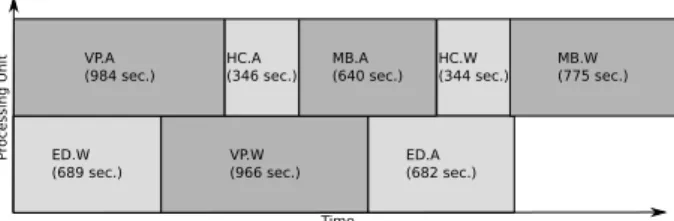
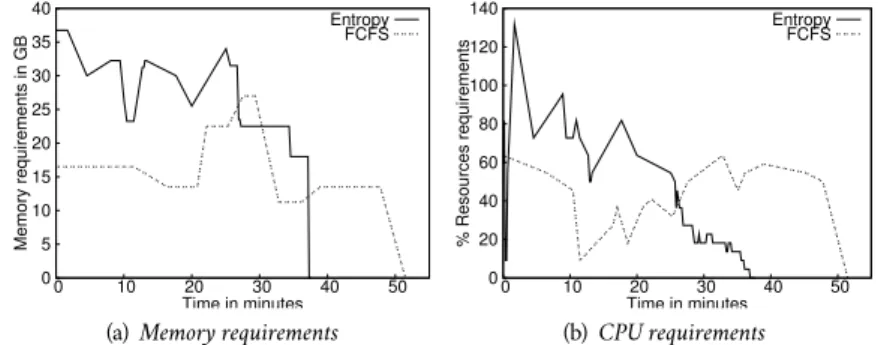
(27) on a temporary node to create at least one feasible action, added to the current step. Then the step is appended to the plan, and a new reconfiguration graph is created using the temporary resulting configuration of the plan and the expected configuration. This process is repeated until the resulting configuration of the plan equals the expected configuration.. Suspending and resuming a vjob When several VMs execute a distributed application, they exchange network packets through a transport protocol, commonly TCP. This protocol maintains a total ordering between IP packets and ensures their delivery. When a host does not receive an acknowledgment for a packet after multiple retransmissions or when the keep-alive timeout is reached, the protocol considers the receiver as unreachable and closes the connection. During the cluster-wide context-switch, the states of VMs belonging to the same vjob may not be consistent for a moment since actions are based on a VM granularity and some VMs may not be reachable during this time. Thus it is necessary to coordinate the suspend and the resume actions when the cluster-wide context switch manipulates the state of several VMs belonging to the same vjob. This coordination ensures that the distributed application will not fail during the reconfiguration. Suspending a VM consists in pausing it then writing the image of its memory to a disk. When the VM is paused, it does not execute any instructions. On the opposite, resuming a VM consists in restoring its memory by reading its image from the disk then unpausing it. While executing a pause (or an unpause) takes only a few milliseconds, reading (or writing) the image from (to) the disk takes a significant amount of times, led by the amount of memory allocated to the VM (see Section 2.2.1). Once one of the VMs is paused while others are running, the state of the vjob is not consistent. To avoid network errors, the VMs will have to be in the same state (sleeping or running) before outreaching the unreachable delay of TCP. A solution to efficiently coordinate several suspend and resume actions without any clock synchronization is to pause each VM sequentially, in a deterministic order using their unique identifier. To coordinate the suspend actions, all the VMs are first paused sequentially then the content of their memory is written in parallel to the disk (Figure 6(a)). To coordinate several resumes, the images are read in parallel then all the VMs are unpaused sequentially in the same order they were suspended earlier (Figure 6 (b)). As the pause and the unpause actions take only a few milliseconds, this solution ensures that the delay between the first and the last pause (or unpause) is inferior to the unreachability delay while non-acknowledged packets will be retransmit. Figure 6: Several suspend and resume actions are coordinated by sequencing pause and unpause actions. (a) Suspend. (b) Resume. Our coordination protocol can be integrated into Entropy by altering the reconfiguration plan. It consists in grouping the resume and the suspend actions into the same step. The suspend actions do not have precondition so they are naturally grouped into the first step as they are always feasible. The conception of a plan ensures that if an action is feasible at a specific step, it is feasible for all the following steps. Thus, to satisfy the dependencies of the resume actions, each action is grouped into the step that initially contains the last resume action. Figure 7 shows an unmodified reconfiguration plan, it suspends a vjob j1 composed of the VMs vm1 and vm2 , resumes a vjob j2 composed of the VMs vm4 and vm5 , the VMs vm3 and vm6 belong to other. 18.
(28) vjobs that stay in the running state. Figure 8 shows the modified version of this plan with the coordination of the actions related to vjobs j1 and j2 . s1 :. suspend(vm1 ) & suspend(vm2 ). s2 :. resume(vm4 ) & migrate(vm3 ). s3 :. resume(vm5 ) & migrate(vm6 ). s1 :. pause(vm1 ). s2 :. pause(vm2 ). s3 :. write(vm1 ) & write(vm2 ). s4 :. migrate(vm3 ). s5 :. migrate(vm6 ) & read(vm4 ) & read(vm5 ). s6 :. unpause(vm4 ). s7 :. unpause(vm5 ). Figure 7: Unmodified reconfiguration plan with three steps s1 , s2 , and s3 . ’ & ’ indicated the parallelism.. Figure 8: Reconfiguration plan to coordinate the suspend and resume actions of the vjob j1 and j2 .. Reducing the duration of the execution To reduce the duration of a cluster-wide context switch, Entropy computes several similar configurations where all the vjobs of each configuration have a state identical to the sample configuration provided by the scheduling algorithm. Indeed, according to the scheduler policy, the location of the VMs is not relevant, only the state of each vjob is significant. However from a cluster-wide context switch point of view, each transition has a duration. As a consequence, we should be able to compare reconfiguration plans with a cost function and select the one with the smallest estimated duration. The cost of a plan is a positive value. Its has no unit but it allows to compare different plans when they reach equivalent configurations. The cost of a reconfiguration plan P composed of a sequence of n steps s and x actions a is defined through an objective function K described in the Equation (1). This model assumes the cost of an action is minimal when it is executed in the first step. Thus, delaying an action increases the cost of a plan.. K (p) =. m X. K (ax ). x=0. ax ∈ si , K (ax ) =. i−1 X. K (sj ) + k (ax ). (1). j=0. K (si ) = max (k (ax )) , ax ∈ si. The local cost k of an action ax relies on the experiments described in Section 2.2.1. The different values for k(ax ) are listed in Table 1. We showed that the duration of both the stop and the run actions is constant and depends on the software running in the involved VM. For this study, their cost has been set to 0. The duration of a suspend and a migrate actions is led by the memory requirement of the involved VM. We set this cost to the amount of memory allocated to it. Finally, the duration of the resume action depends on the memory demand of the VM and its destination location. Indeed, a local resume does not require to move the image file to the destination node. We choose to define the cost of a remote resume as twice the cost of a local one. By such a way, we favor local resume. To compute the different viable configurations, Entropy uses the Choco solver (Jussien, Rochart, and Lorca, 2008) which is based on a Constraint Programming (Rossi, Van Beek, and Walsh, 2006) approach.. 19.
(29) Table 1: Local cost of an action ai . Dm (vmj ) denotes the memory allocated to the VM vmj. Type of ax migrate run stop suspend resume. k(ax ) Dm (vmi ). constant constant Dm (vmj ) Dm (vmj ) if local, 2 × Dm (vmj ) otherwise. 2.3 Proof-of-Concept & Validations As a proof of concept, we implemented a sample scheduler that only indicates at each round the states of the vjobs. According to the changes, the cluster-wide context switch system handles the transition and provides transparent dynamic resources allocation, live migration and vjob preemption. We discuss the execution of this algorithm relying on the cluster-wide context switch on a cluster composed of 11 working nodes running NAS Grid Benchmarks (Frumkin and Van der Wijngaart, 2002).. 2.3.1. Proof-of-Concept. A common objective of schedulers is to execute jobs as soon as possible. The use of preemption, migration and dynamic allocation of resources improves the cluster usage by executing jobs, even temporarily, when there is a sufficient amount of resource to satisfy their requirements. The scheduling algorithm we implemented tends to satisfy those principles. The algorithm computes a list of vjobs, initially empty, that specifies the vjobs that must be running for the next iteration. To avoid starvation, all the vjobs are stored in a queue with a FCFS priority. For each vjob in the queue, we check if it exists a viable configuration composed of the current vjob and the vjobs already in the list. This assumption is made using the First Fit Decrease algorithm that assigns each VM composing the vjob to the first node with a sufficient amount of free resources. If the algorithm succeeds in assigning all the VMs then the vjob is added to the list. After the last iteration over the queue, the list of vjobs that will be in the running state is defined, the other vjobs will be in the ready state.. 2.3.2. Experiments. The experiment consists in scheduling 8 vjobs, each composed of 9 VMs, using our sample scheduling algorithm. Although vjobs are submitted at the same moment, they are enqueued in a deterministic order to ensure the reproducibility of the experiments. Each vjob is running an application composed of NASGrid Tasks. The application embedded in the vjob is launched when all the VMs are in the running state. When the application is terminated, it signals to Entropy to stop its vjob. Each VM requires a fixed amount of memory, from 512 MB to 2048 MB and requires an entire CPU when the NASGrid task is executing a computation on the VM. The monitoring sensor running on each working node takes at most 10 seconds to signal a change to the monitoring frontend (i.e., a Ganglia monitoring system). Obviously, this reactivity has a negative impact on the ability of Entropy to quickly fix a non-viable configuration and a faster monitoring system would have improved this situation. Computing the reconfiguration plan with the minimum cost may be time consuming. Choco has the property that it can be aborted at any time, in which case it returns the best result computed so far. This feature enabled us to impose a time limit on the solver, to ensure the reactivity of the approach. In previous experiments (Hermenier,. 20.
(30) Lorca, et al., 2009), Entropy computes reconfiguration plans with 200 nodes and 400 VMs in one minute. For the current experiment, the total computation time is limited to 30 seconds and Choco computes each plan in less than 20 seconds. Figure 9 shows the cost and the duration of the cluster-wide context switches performed during the experiment. Those with a small cost and duration only perform migrations, run or stop action. As an example, the five with a cost equal to 0 only perform run and stop actions and take at most 13 seconds. The cluster-wide context switch with a cost equal to 1024 performs 3 migrations in 19 seconds. Cluster-wide context switches with a higher cost perform in addition suspend and resume actions. This increases significantly the duration of their execution. As an example, the one with a cost equal to 4608 takes 5 min 15 seconds to execute 9 stop actions, 18 run actions, 9 resume actions and 9 migrations. In addition, the cost of the plan is not related to its duration when it implies different kind of actions. As mentioned in Section 2.2.2, the cost function only enables to determine the best reconfiguration plan when all the VMs in the destination configuration have the same state. At this moment, our cost function cannot be used to estimate the duration of one cluster-wide context switch. However it appears to be a viable solution to avoid to migrate VMs or perform remote resumes if possible: 21 over the 28 resume actions performed during the experiment were made on the nodes that perform the suspend earlier. Figure 9: Cost and duration of the 19 cluster-wide context switches performed during the experiment. 05:30 05:00. Duration in minute. 04:30 04:00 03:30 03:00 02:30 02:00 01:30 01:00 00:30 00:00. 0. 1. 2 3 4 5 6 7 Reconfiguration cost (step 1k). 8. 9. The second part of this evaluation analyses the benefit of the cluster-wide context switch with regards to to a static approach. In theory, the gain provided by dynamic scheduling policies is related to the resources requirements of the vjobs. In the best case, requirements evolve during the execution of the vjob, and the benefits are significant. In the worst case, requirements are constants and a static approach with backfilling is sufficient. As in many cases, the NASGrid benchmarks used in this experiment do not require an entire CPU all the time. In this experiment, the static scheduling policy relies on a simulated First Come, First Serve (FCFS) algorithm. The FCFS scheduler selects the vjobs to execute by iterating over a queue. When there is a sufficient amount of free resources to execute all the VMs composing a vjob, the scheduler allocates a CPU and a sufficient amount of memory to each VM for the whole duration of the vjob. Each vjob is composed of 9 VMs, thus requiring 9 CPUs to run. As each vjob requires the same amount of CPU to run, a backfilling strategy would not improve scheduling. Figure 10 shows the execution diagram of the vjobs. Figure 10: Execution diagram for the vjobs with a FCFS Scheduler. Figure 11a and 11b show the resources usage of the VMs with the two different schedulers. The average resources usage is more important with our module dur-. 21.
(31) Memory requirements in GB. 40. Entropy FCFS. 35 30. Entropy FCFS. 120 100. 25 20 15 10 5 00. 140 % Resources requirements. Figure 11: Resources utilization of the VMs. 10. 20 30 40 Time in minutes. (a) Memory requirements. 50. 80 60 40 20 00. 10. 20 30 40 Time in minutes. 50. (b) CPU requirements. ing the first 30 minutes. Afterwards, resources utilization with Entropy decreases as there are no more vjobs to run. At 2 minutes 10, the cluster is overloaded as the running vjobs demand 29 processing units while only 22 are available. In this situation, the scheduler indicates which of all the vjobs must be running to have a viable configuration and the cluster-wide context switch performs the transition by suspending the vjobs that must be in the ready state. This improvement of the resource usage reduces the cumulated completion time of the vjobs. The cumulated completion time for the 9 vjobs is equals to 250 minutes with the FCFS scheduler. It is reduced to 150 minutes with our sample scheduling policy. To conclude, one can implement finer scheduling strategies by focusing on the scheduling policy and leaving the issues related to the vjob permutation to the clusterwide context switch module.. 2.4. Related Work. Back to 2010, Sotomayor et al. (Sotomayor, Keahey, and Foster, 2008; Sotomayor, Rubén Santiago Montero, et al., 2008) provided with Haizea the concept of lease as an abstraction for resource provisioning. Users negotiate an amount of resource for a specific duration by indicating (i) wether the lease is made in a best-effort mode or uses advanced reservations and (ii) if it is preemptible. Depending on its type, the lease may be migrated, or suspended to free resources for non-preemptible leases or leases with advanced reservations. This approach enables users to renew a period of execution for a new amount of time but does not provide a way to dynamically change the set of resources assigned to a lease with variable needs. Grit et al. (D. E. Irwin et al., 2006; Grit, D. Irwin, Yumerefendi, et al., 2006; Grit, D. Irwin, Marupadi, et al., 2007) described in Shirako the necessity of separating the management policy of the VMs and the mechanisms to perform the changes as we argue in the present work. They considered the sequencing issues when migrating several VMs for resource management policies, However to solve inter-dependencies, they chose to suspend a VM to break the cycle of dependencies instead of using a bypass migration. Regarding to our experimental study, suspending a VM is much more time consuming than the use of a bypass migration. Moreover, they only considered VM migration in their VM manager. By ignoring the possibilities to manipulate the state of the VMs, it is not possible to implement advanced scheduling policies. Fallenbeck et al. (Fallenbeck et al., 2006) provided an environment to dynamically adapt the number of slots available for specific scheduling policies with multiple queues. A VM is available on each working node for each queue. Depending on the size of each queue, the amount of corresponding activated VMs varies. This approach reduces the number of idle nodes in clusters as compared to clusters with a static partition scheme of the slots. The solution we proposed is different as we provide a single scheduling environment that acts on the jobs instead of acting on the number of slots per queue. All of these works addressed the lack of flexibility in resource management systems and used VM mechanisms to improve it. Each solution addressed a particular use case.. 22.
Figure

+7
Documents relatifs
The hierarchy of solutions arising from the above problem is called the “first order hierarchy” (abbreviation for “first order conditional moment hierarchy”), which may possibly
To control a message queue and industrial equipment actions coordination they use communication system elements with data tide processing function in edge, fog and cloud network
If there are users who are focusing on creating code for the frame- work there is high probability that the code will be effi- cient, without bugs and there will be no task
Giddy, Nimrod/G: an architecture for a resource management and scheduling system in a global computational grid, in: International Conference on High Performance Computing
3) Joint Communication and Computing Resources: Pro- viding SBSs with cloud-like computing capabilities can trans- form those SBSs from just radio access nodes into the so-
Then, we fix the makespan objective as con- straint and a random local search algorithm that pro- motes voltage scaling is used to reduce the energy consumption of the
Modular robots are an interesting application area for spatial computing techniques: space and time are critical given the robotic nature of the system, numerous variations of
Rules applied on nodes closer to sensors can yield deductions faster compared to a centralized approach, both because they receive data earlier and because they process a smaller
