HAL Id: tel-01308575
https://tel.archives-ouvertes.fr/tel-01308575
Submitted on 28 Apr 2016HAL is a multi-disciplinary open access
archive for the deposit and dissemination of sci-entific research documents, whether they are pub-lished or not. The documents may come from teaching and research institutions in France or abroad, or from public or private research centers.
L’archive ouverte pluridisciplinaire HAL, est destinée au dépôt et à la diffusion de documents scientifiques de niveau recherche, publiés ou non, émanant des établissements d’enseignement et de recherche français ou étrangers, des laboratoires publics ou privés.
Vera Elistratova
To cite this version:
Vera Elistratova. Optimal design of line-start permanent magnet synchronous motors of high efficiency. Electric power. Ecole Centrale de Lille, 2015. English. �NNT : 2015ECLI0022�. �tel-01308575�
THESE
Présentée en vue
d’obtenir le grade de
DOCTEUR
En
Spécialité : Génie Electrique
Par
Vera Elistratova
DOCTORAT DELIVRE PAR L’ECOLE CENTRALE DE LILLE
Titre de la thèse :
«CONCEPTION OPTIMALE D’UNE GAMME DE
MOTEURS SYNCHRONES A DEMARRAGE DIRECT A
HAUTE PERFORMANCE ENERGETIQUE»
Soutenue le 6 Novembre 2015 devant le jury d'examen :
Président G. BERTHIAU Professeur IREENA-Univ-Nantes Rapporteur N. TAKORABET Professeur GREEN – Univ-Lorraine Rapporteur F. WURTZ Directeur de
recherche
G2ELAB – Univ- Grenoble
Examinateur G.KREBS Maître de Conférences
GeePs-Univ-Paris Sud
Directeur de thèse M. HECQUET Professeur L2EP-EC Lille Co-directeur P. BROCHET Professeur L2EP-EC Lille Co-Encadrant D. VIZIREANU Ingénieur de
Recherches
EDF R&D Clamart
Thèse préparée dans le Laboratoire d'Électrotechnique et d'Électronique de Puissance (L2EP) Ecole Doctorale SPI 072 (Lille I, Lille III, Artois, ULCO, UVHC, EC Lille)
2
Acknowledgments
My deep gratitude goes first to Professor Pascal BROCHET, the associated professor of Ecole Centrale de Lille and the President at University of Technology of Belfort Montbéliard who hearty welcomed me in his team «Optimization» in 2010. I am very grateful to him for his valuable advices, powerful support, very nice personality and especially for his belief in me. My appreciation also extends to Professor Michel HECQUET, the associate professor of Ecole Centrale de Lille who expertly guided me through my graduate education and who shared with me the excitement of three years of discovery. His personal generosity and unwavering enthusiasm for electrical engineering helped sustain a positive and productive atmosphere in which to do science. I want to express my sincere acknowledgments to Darius VIZIREANU, an engineer researcher of department THEMIS at EdF R&D, for his valuable remarks, important suggestions and sharing his experience during my work.
I want to thank Mr. Lucas ORSATTO, the student-interns who made valuable contribution to the development of our software.
I would like to thank the regional institution of Nord-PdC MEDEE IV and EDF for the financial support of this research work.
I would like to express my hearted acknowledgments to Mr. Noureddine TAKORABET, Professor of University of Lorraine, and Mr. Frédéric WURTZ, the Professor of University of Grenoble, who do us the honor of participating in the jury as reporters.
I also thank all the administrative, technical and professor staff of Ecole Centrale de Lille and my colleagues for perfect working conditions and support. Among them I would like to thank personally Juliana and Bruno IAMAMURA, Evgeny TARASOV, Xavier CIMETIERE, Mathias FAKAM, Patricio LA DELFA, Heloïse DUTRIEUX, Kongseng BOUNVILAY, Simon THOMY, Christophe RYMEK, Guido CHIAPPORI and Frédéric GILLON for their help and support. Working among such people helped me a lot in my research.
Finally I would like to acknowledge with gratitude the support and love of my family -my husband Dmitry, -my parents Igor and Margarita and -my grandfather Vasily. They all kept me going, and this dissertation would not have been possible without them.
3
Contents
Acknowledgments 2
Résumé détaillé de la thèse 6
Introduction 16
Context of the thesis 18
1.1. Introduction ... 18
1.2. Environmental constraints and energy development ... 18
1.2.1. Global warming and its consequences ... 18
1.2.2. Part played by greenhouse gases in climate regulation ... 19
1.2.3. Global energy development ... 20
1.3. New efficiency standards for AC motors as measures against climate change ... 22
1.3.1. European Union plan on climate change ... 22
1.3.2. Shares of world electricity consumption by different sectors ... 22
1.3.3. New standard on efficiency classes for low voltage AC motors ... 24
1.4. Choice of an efficient electric motor for constant-speed application ... 25
1.4.1. Run-down on motor market ... 25
1.4.2. Induction motors ... 26
1.4.3. Permanent magnet synchronous motor ... 26
1.4.4. Line-start permanent magnet synchronous motor... 27
1.4.5. Comparative technico-economic study of LSPMSM and IM ... 28
1.5. LSPMSM Design Challenges ... 30
1.5.1. Demagnetization ... 30
1.5.2. Pulsating torques ... 32
1.5.3. Braking torque ... 35
1.5.4. Manufacturing and sizing ... 36
1.6. Choice of an efficient LSPMSM rotor topology... 36
1.6.1. Variants of LSPMSM rotor ... 36
1.6.2. Interior-magnet LSPMSM vs. surface-magnet LSPMSM ... 37
1.6.3. Choice of an efficient ILSPMSM topology ... 38
4
1.7.1. Numerical methods ... 40
1.7.2. Analytical methods ... 42
1.7.3. Semi-analytical/ semi-numerical methods ... 43
1.7.4. Choice of method ... 45
1.8. Conclusion ... 46
1.9. References ... 47
Design of three LSPMSM rotor topologies 50 2.1. Introduction ... 50
2.2. Analytical method of LSPMSM designing ... 50
2.2.1. Park transformation and transient d-q equivalent circuit of LSPMSM... 50
2.2.2. Study of LSPMSM asynchronous operation ... 53
2.2.3. Steady-State Model for the LSPMSM design ... 57
2.2.4. Analytical calculation of electromagnetic parameters ... 61
2.3. Optimization of LSPMSM ... 81
2.3.1. Organization of the design process... 82
2.3.2. Optimization Problem ... 82
2.3.3. Optimization Technique ... 85
2.3.4. Functionality of software DEMO-LSPM ... 85
2.3.5. Results of optimization technique in the form of Pareto frontier for two variants of rotor cage ... 86
2.3.6. Advantage of rotor bar reduction ... 87
2.4. Conclusion ... 91
2.5. References ... 92
Prototyping and experimental results 95 3.1. Introduction ... 95
3.2. LSPMSM prototyping ... 95
3.3.1. Sizing of two LSPMSM rotors ... 96
3.3.2. Search of the optimal rotor configuration for the LSPMSM with V-type magnetic circuit structure ... 98
3.3.3. Dynamic analysis of the designed LSPMSM with V-type magnetic circuit structure ... 100
5
3.3.5. Search of the optimal rotor configuration for the LSPMSM with
series magnetic circuit structure ... 103
3.3.6. Dynamic analysis of the designed LSPMSM with series magnetic circuit structure ... 105
3.3.7. Demagnetization of the permanent magnets ... 106
3.3.8. Realization of the prototypes ... 107
3.3. Experimental results ... 109
3.3.1. Test strategy ... 109
3.3.2. Validation of asynchronous part in LSPMSM design ... 109
3.3.3. Validation of synchronous part in LSPMSM design ... 113
3.4. Thermal study ... 118
3.5. Conclusion ... 119
3.6. References ... 120
Conclusion 121
Appendix A. LS-PMSM Specification requirements and constraints for the considered
industrial problem: 124
Appendix B. An example of the IM design 125
Appendix С. DEMO-LSPM: graphical user interface 166
Appendix D. Characteristics of PM SmCo S30H 169
6
Résumé détaillé de la thèse
Contexte:
Pour réduire les émissions de gaz à effet de serre, les principaux axes de développement sont les économies d’énergie et la production d’énergie « verte » produisant une quantité faible de polluants lorsqu'elle est transformée en énergie finale. Pour cette énergie, en France, l’objectif fixé par le Grenelle de l’Environnement pour 2020 est de réaliser 23% d’augmentation de consommation à partir des sources d’énergie renouvelable.
Concernant l’encouragement des économies d’énergies, dans des pays de l’Union Européenne et au niveau national, un système de certificats d’économie d’énergie a été mis en place. Dans ce cadre, dans un premier temps, les producteurs/distributeurs d’énergies doivent mettre en place des actions qui génèrent une diminution de la consommation énergétique de leur clientèle afin de bénéficier de ces certificats d’économie d’énergie.
Les moteurs électriques représentent la charge électrique la plus importante pour l’industrie car les systèmes dans lesquels ils sont utilisés représentent environ 70% de l’électricité consommé par l’industrie. Leur consommation annuelle d’électricité en 2005, dans l’espace communautaire, s’élève à 1067 TWh. Ceci représente un impact environnemental de 427 millions de tonnes d’émission de CO2. Selon les estimations, si aucune mesure spécifique n’est adoptée pour limiter cette consommation, celle-ci devrait atteindre 1252 TWh en 2020. Il existe un potentiel total d’amélioration de l’efficacité énergétique des systèmes à moteurs électriques de l’ordre de 20 à 30%. Les principaux facteurs d’une telle amélioration sont l’utilisation des variateurs de vitesse et l’utilisation de moteurs à bon rendement énergétique.
En 2009, la norme CEI 60034 pour la mesure du rendement des moteurs électriques a été modifiée et actuellement elle propose une norme unifiée internationalement qui classe les moteurs à induction basse tension dans de nouvelles classes de rendement : IE3 Rendement premium, IE2 Haut rendement, IE1 Rendement standard. Il est prévu d’intégrer prochainement dans la norme la classe de rendement IE4 (Super-Premium) avec l’objectif de réduire les pertes d’environ 15% par rapport à classe IE3. La Commission Européenne envisage déjà l’introduction d’une norme IE5 (Ultra-Premium) qui pourrait réduire les pertes de 20 à 25 % par rapport à l'IE4 (Figure 1). À compter du 1er janvier 2015, en conséquence des directives adoptées, seuls les moteurs IE3 sont autorisés pour un fonctionnement en ligne direct, bien que les moteurs IE2 avec variateur de vitesse soient aussi admis pour la plage de puissance de 7,5 - 375kW. Cette nouvelle norme définit aussi des exigences en matière d'éco-conception pour la commercialisation et la mise en service de moteurs. Ainsi, les nouveaux moteurs achetés doivent respecter cette norme d'efficacité.
7
Pour les moteurs asynchrones (MA) de faibles et de moyennes puissances (<100kW) avec un taux d’utilisation supérieur à 5000h/an, le coût d’un variateur peut s’avérer onéreux et sans gain d’efficacité pour les applications à vitesse constante. En plus, les études récentes montrent que des moteurs synchrones à aimants présentent un meilleur rendement par rapport aux moteurs asynchrones pour un volume donné. En revanche, ces moteurs synchrones présentent le désavantage de ne pas être capable de démarrer directement sur le réseau. Ainsi, l’hybridation apparaît comme une solution pour améliorer le rendement des moteurs pour les applications ne nécessitant pas de la variation de vitesse.
Objectif de la thèse:
L’objectif de l’étude est de dimensionner une gamme de moteurs « hybrides » de type LSPMSM (Line Start Permanent Magnet Synchronous Motors), intégrant les avantages des deux technologies : l’auto-démarrage de la technologie asynchrone et les bonnes performances énergétique en régime permanent de la technologie synchrone à aimants permanents en répondant aux nouveaux enjeux d’efficacité énergétique et en ajoutant à cela les aspects économiques. Ainsi, dans le cadre de cette thèse, on souhaite se doter d’une méthodologie de conception et d’optimisation multi-physique utilisable en avant-projet pour réaliser le dimensionnement de ces machines électriques.
8 Chapitre 1
Le premier chapitre rappelle la situation actuelle sur le réchauffement climatique en raison de la croissance constante de la production d'énergie.
Dans ce contexte, des plans et des mesures internationales sur le changement climatique sont introduites comme moyen de lutte contre le gaspillage énergétique et l’effet de serre. L'un d'entre eux concerne l'augmentation de l'efficacité énergétique afin de réduire de 20% par rapport aux niveaux prévus la consommation d'énergie dans l'Union européenne (UE) d'ici 2020.
Ensuite, une attention particulière est portée à l'examen des principaux types de moteurs électriques utilisés pour des applications à vitesse constante afin de choisir l’un des plus efficaces. Comme résultat, le moteur synchrone à aimant permanent à démarrage direct (LSPMSM) est choisi pour être le plus intéressant en apportant un bon compromis entre efficacité et les aspects technico-économiques.
Ce chapitre présente également des défis et des enjeux de conception et de réalisation appliqués à différentes topologies du rotor d’un LSPMSM, qui sont les suivants: démagnétisation, couple pulsant (couple de détente et les ondulations de couple), couple de freinage et les spécificités de fabrication. Différentes études bibliographiques ont pu montrer qu’afin de répondre à nos besoins, nous devions utiliser un LSPMSM avec un rotor à aimants enterré (Figure 2).
La sélection de quelques structures rotoriques les plus intéressantes seront étudiées dans cette thèse (Figure 3).
9
a) b) c)
Finalement, une brève revue des différentes techniques de conception et de modélisation appliquée aux problèmes électro-magnétiques est donnée. Les avantages et inconvénients de chacune d'entre elles sont illustrés.
À l'issue de ce chapitre, la méthode analytique pour la conception de LSPMSM et la méthode numérique éléments finis pour les taches de modélisation spécifique comme l’étude dynamique et de validation des modèles analytiques sont choisies comme les plus adaptées aux objectifs globaux de la thèse.
Chapitre 2
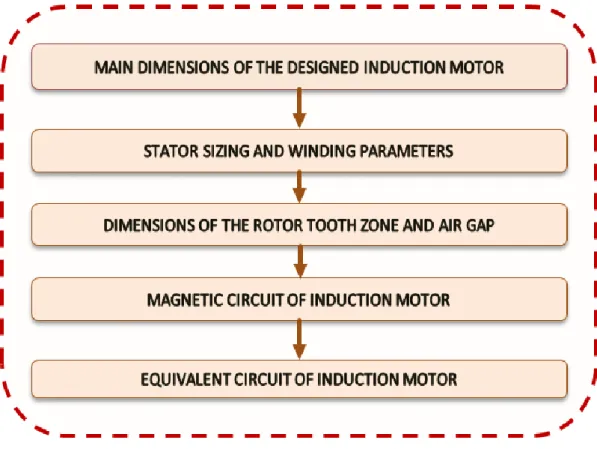
Le deuxième chapitre commence par une discussion sur les méthodes analytiques utilisées pour la conception des machines LSPMSM. Pour des raisons économiques, il a été décidé de conserver le stator et le bobinage du LSPMPM identiques au moteur asynchrone de la même puissance. Cela nous permet de simplifier la conception et de passer d’un moteur asynchrone à un LSPMSM uniquement en changeant le rotor. Ci-dessous la figure présente la démarche de conception des machines LSPMSM choisie. Selon la Figure 4 la première étape de conception est le dimensionnement des paramètres principaux d’une machine asynchrone de la même puissance. Le dimensionnement de ce genre de moteurs est connu. Notre modèle propose un calcul thermique simplifié à une dizaine de nœuds (Annexe B). L’intérêt de ce modèle de dimensionnement est de nous permettre très rapidement de converger vers une solution de bobinage et de choix de la denture stator – rotor en fonction de la puissance souhaitée.
Ensuite, à partir du diagramme vectoriel dans l’axe d et q du référentiel de Park, nous pouvons déduire les équations d’alimentation de LSPMSM en régime établi pour chacune des trois architectures retenues en prenant en compte leurs spécificités géométriques. Ces équations ont été ensuite utilisées dans une étude paramétrique afin de connaitre l’influence des paramètres principaux (entrefer, géométrie d’aimants) sur les inductances Ld et Lq et la force électromotrice E0 et, en conséquence, sur les performances des machines étudiées.
Figure 3 Trois configurations de rotor à l'étude: (a) Rotor à aimants radiaux, (b) Rotor à aimants en série, (c) Rotor à aimants en V
10
Se basant sur ces équations analytiques, un outil de dimensionnement a été réalisé. Les architectures retenues ont été évaluées en établissant des feuilles de calculs analytiques qui intègrent le dimensionnement électrique, magnétique, et thermique. Ces calculs ont été ensuite validés par des calculs éléments finis pour deux puissances (7.5kW et 18.5kW) et les solutions les moins prometteuses ont été retirées en appliquant les critères de qualités imposées par le cahier des charges. Les résultats obtenus sont présentés sous forme d’un front de Pareto pour deux types de cages d’écureuil : classique et avec des sections de barres réduites (Figure 5 et Figure 6).
Au vu des résultats d’optimisation et pour des raisons économiques, nous n’avons réalisé que 2 des 3 machines sélectionnées qui ont présenté une meilleure performance énergétique: LSPMSM avec un rotor à aimants en série et le LSPMSM avec un rotor à aimants en V. Dans les deux cas, la cage d’écureuil est réduite ce qui correspond au cas de la Figure 6.
11
(a) (b)
(a) (b)
Chapitre 3
L'objectif principal du troisième chapitre est la spécification et la fabrication de deux prototypes de LSPMSM permettant la vérification des modèles analytiques et numériques présentés dans le deuxième chapitre mais aussi validant les performances souhaitées des LSPMSM en comparaison avec une machine asynchrone. La première partie du chapitre concerne le dimensionnement détaillé de deux prototypes de LSPMSM et la prédiction de leurs performances pendant le démarrage et en régime établi.
Pour cela, des études en dynamique par éléments finis (Maxwell – Ansys) en prenant en compte la courbe B(h) du matériau (Annexe D) ont permis de comparer les différentes machines au niveau du temps de démarrage avec une inertie totale imposée. De plus,
Figure 5 Résultats d’optimisation : (a)Vue d’une cage classique (sans les aimants) ; (b) Front de Pareto entre l'efficacité par rapport à la surface d’aimants dans le cas de cage classique
Figure 6 Résultats d’optimisation : (a)Vue d’une cage non-classique (limitation de la section des barres) ; (b) Front de Pareto entre l'efficacité par rapport à la surface d’aimants
12
une étude sur la démagnétisation des aimants a permis d’observer leur niveau d’induction lors des phases les plus pénalisantes (Figure 7). Suite à ces études, nous avons pu valider les topologies retenues en ajustant le volume d’aimants.
(a) (b)
La deuxième partie de ce chapitre concerne la réalisation des prototypes. Les 2 machines reprennent un stator de machine asynchrone du marché d’une puissanse de
Figure 7 Valeurs moyennes de l’induction et de la force du champ magnétique des aimants lors du démarrage de LSPMSMs modélisés par éléments finis : (a) LSPMSM avec le rotor à aimants en série de 5x46 mm², (b) LSPMSM avec le rotor à aimants en V de 6x45 mm²
13
7.5KW et les 2 topologies de rotors retenues dans le chapitre précédent sont réalisées : un rotor à aimants en série, un rotor à aimants en ‘V’. Afin de valider la partie asynchrone de la méthodologie de conception, un moteur asynchrone commercial de’une même puissance a été aussi acheté.
De nombreux essais ont été réalisés : électrique et thermique afin de valider les performances en comparaison avec une MAS de référence (stator identique pour les 3 réalisations). Ci-dessous les quelques photos des réalisations des 2 prototypes sélectionnés (Figure 8).
Les Figure 9 et 10 présentent les performances de deux prototypes réalisées et un moteur asynchrone commercial en régime stationnaire leur comparaison avec les normes CEI.
Figure 9 Comparaison de 3 moteurs (ligne bleue – moteurs asynchrone d’origine, ligne rouge – moteurs LSPMSM série, ligne violette – LSPMSM V-type : rendement en fonction de la puissance de sortie.
Figure 8 Réalisations des prototypes à partir de machines asynchrones du marché (à gauche), montage des aimants (au centre) et 2 types de tôles rotoriques (à droite)
14
Les différents résultats obtenus montrent un gain de 3,5% à 4% sur le rendement en comparaison avec des machines asynchrones commercialisés de type IE2 ce qui représente un gain important au niveau énergétique. En reprenant la norme CEI 60034-30, le niveau de rendement obtenu par nos prototypes correspond à un IE4 Super Premium Efficiency Class et par conséquent l’investissement dans un LSPMSM peut être déjà justifié d’un point de vue économique.
L’optimisation de la machine a permis aussi un gain de 1,2% en comparaison avec un moteur commercialisé de type LSPMSM de même puissance. Cependant, le facteur de puissance est légèrement plus faible pour nos prototypes. Par contre, nos machines ont un facteur de puissance nettement supérieur à celui de la machine asynchrone.
De plus, des essais d’échauffement des enroulements du moteur LSPM et du moteur asynchrone commercial en fonction de la charge des moteurs ont été réalisés (Figure 11). Au bout de 2,5 heures, l’échauffement du bobinage de LSPMSM est de 40,8 Kelvin (K) et celui de la machine asynchrone est de 69,3K. Les valeurs d’échauffement de 2 moteurs sont inférieures à la valeur critique donnée par le cahier de charge : 80K. Le fait que l’échauffement de LSPM soit considérablement inférieur (de 41%) à l’échauffement du MAS est expliqué par l’absence de pertes rotoriques pendant le régime stationnaire.
Figure 10 Comparaison de 3 moteurs (ligne bleue – moteur asynchrone d’origine, ligne rouge – moteurs LSPMSM série, ligne violette – LSPMSM V-type : facteur de puissance en fonction de la puissance de sortie
15
Conclusion
Ce travail de thèse répond à un besoin d’actualité dans le domaine des machines électriques industrielles et plus particulièrement d’être capable de choisir un moteur électrique le plus adapté aux applications à vitesse constante à haute performance énergétique, mais aussi de se munir d’une méthodologie de conception et d’optimisation multi-domaine utilisable en avant-projet pour réaliser le dimensionnement.
Des études bibliographiques réalisées ont permis un choix sur le LSPMSM. Parmi toutes les configurations existantes de rotor, seulement 3 types de rotors ont été retenus comme les plus appropriés aux objectifs de la thèse. Ensuite, pour chacune des configurations choisies un modèle de conception analytique a été développé.
Il faut aussi rappeler que pour des raisons économiques, nos modèles de conception se basent sur le stator d’une machine asynchrone commerciale.
A l’issu de cette étude, un outil de dimensionnement a été réalisé en utilisant le couplage entre Matlab et Maxwell 2D. Les architectures retenues ont été évaluées en établissant des feuilles de calculs analytiques qui intègrent le dimensionnement électrique, magnétique, et thermique. Ces calculs ont été ensuite validés par des calculs éléments finis pour deux puissances (7.5kW et 18.5kW).
Grâce aux résultats de notre outil deux prototypes de LSPMSM de 7.5kW ont été réalisés et les résultats de leurs essais ont montré un gain important sur le rendement, le facteur de puissance ainsi que sur comportement thermique en comparaison avec des machines asynchrones commercialisés.
Figure 11 Evolution des températures lors de l’essai d’échauffement sur un moteur asynchrone et un moteur LSPMSM
16
Introduction
The growths in energy price along with stricter environment regulations emphasize the importance of life-cycle costs of innovative technologies. At the same time, there is constantly growing regulating pressure on industry enforcing it to optimize electricity consumption and to implement measures for improving energy efficiency.
As electrical motors consume about 70% of electricity in the industry, the European minimum efficiency regulation has a significant impact on their design and application. For instance, in 2011 the second edition of the International Electrotechnical Commission (IEC) 60034-30 has been presented, where a new Ultra-Premium Efficiency (IE5) Class has been introduced. According to these new requirements, starting from1 January 2015, only the motors with a rated output of 7.5 kW to 375 kW corresponding to IE3 class are allowed to be used providing that they are not equipped with a variable speed drive. Besides, from 1 January 2017, all motors with a rated output of 0.75 kW to 375 kW shall not be less efficient than the IE3 efficiency level or shall meet the IE2 efficiency level and be equipped with a variable-speed drive (VSD). Thus, the tightening regulation implies that the newly purchased electrical motors must meet the new more stringent standards of efficiency.
Previous studies proved that permanent magnet motors can offer higher efficiency than standard induction motors used in the modern industry. Therefore, even the applications that were exclusively limited to induction motors can now benefit from the advantages of permanent magnet motors. In regard to constant-speed applications with direct mains operation, the induction motors still have some cost advantage, although new developments in line-start permanent magnet synchronous motors (LSPMSM) make the last ones a cost-effective alternative during their life-cycle.
The objective of the study is to determine a line-start permanent magnet synchronous motor design general strategy for incorporating the advantages of both technologies: self-start asynchronous technology and good energy performance of synchronous permanent magnet technology. The elaborated strategy will be a bases for the developing a multi-physical generic model (and a software) fast enough to be combined with an optimization procedure. The model must be able to define the most efficient rotor structure for the imposed LSPMSM rotor configuration. The validity of the model has to be verified by virtual modelling and real prototyping.
The work consists of several chapters:
Chapter 1 presents the introduction and motivation of the thesis. It begins with a brief overview presenting actual situation with regard to global warming as a result of energy production growth. After that, some international outlooks and measures on climate change are introduced. The comparison of the new standard and the old one is provided in the dedicated part of the chapter.
Further, particular attention is drawn to the examination of the main types of electric motors used for constant-speed applications. The line-start permanent magnet
17
synchronous motor is selected to be the most promising in terms of technico-economic assessment.
The chapter also presents design challenges and peculiarities in regard to different LSPMSM rotor topologies. A procedure for selection of the three of the most promising LSPMSM rotor structures which will be studied in the thesis.
The last part of the chapter gives general information about modelling techniques used for the calculation of electrical machine characteristics. A brief examination of numerical, analytical and combined methods helps to define the most-corresponding one for the thesis objectives.
The second chapter begins with a discussion about analytical methods used for LSPMSM design presentation of the transient d-q equivalent circuit for LSPMSM. Along with that Chapter 2 is focused on the formalization of a LSPMSM design strategy. It integrates technical features of both motor technologies: self-start asynchronous mode and steady-state performance of synchronous permanent magnet motor and takes into account geometry peculiarities for each of the three selected LSPMSM rotor structures. Based on this strategy the implementation of the dedicated design software is introduced. The developed software will be tested and validated by commercial finite element software Ansoft/Maxwell.
As soon as a general definition of the optimization problem is stated and discussed, the optimization technique may be chosen. With the use of the developed software and integrated in it optimization technique the three selected configurations of LSPMSM rotor topologies are to be analyzed for all variants of design vector. The combinations of design variables belonging to the feasible domain and defined by optimization constraints have to be presented in the form of Pareto frontier in order to choose several the most efficient LSPMSM rotor structures for their farther prototyping.
The main goal of Chapter 3 is sizing and realization of two prototypes based on two of the three selected LSPM rotor configurations defined in the first chapter. The Chapter 3 also presents the experimental validation of the numerical models whose implementation was introduced in Chapter 2. The built prototypes were tested in starting operation, steady state and both no-load and full load operations. The experimental tests have to justify the implementation of the LSPMSM instead of the conventional IM and to show the gap in efficiency and power factor for these two.
In conclusion of Chapter 3 the thermal behavior of the realized prototypes is also discussed and compared with the thermal behavior of commercial IM.
Finally, the general conclusion is presented with perspective future use, development and application of provided models and software. The main contributions of the thesis are also included in the general conclusion.
The present study is carrying out in the Laboratoire d'Electrotechnique et d'Electronique de Puissance de Lille (L2EP) and financed by EDF R&D and MEDEE IV.
18
Context of the thesis
1.1. Introduction
The first chapter begins with a brief overview presenting actual situation with regard to global warming as a result of energy production growth. After that, some international plans and measures on climate change are introduced. One of them, increasing of energy efficiency to save 20% of the European Union (EU) energy consumption by 2020, is, then, discussed in particular. In order to reach this objective, the European Union adopted a new international standard for electric motors efficiency IEC 60034-30. The comparison of the new standard and the old one will be provided in the following part of the chapter.
Then, special attention is paid to the examination of the main types of electric motors used for constant-speed applications in order to choose the most efficient one. In the issue, the line-start permanent magnet synchronous motor is selected to be the most interesting in terms of technico-economic assessment.
The chapter also presents design challenges and specific design issues applied to different LSPMSM rotor topologies. This discussion allows selection of several of the most interesting LSPMSM rotor structures which will be studied along the thesis.
Finally, a brief overview of various design and modeling techniques applied to electro-magnetic problems is made. The advantages and drawbacks of each of them are illustrated. Based on this discussion, the most adapted method meeting the global goal of the thesis consisting in developing of a multi-physical generic model fast enough to be integrated into an optimization procedure will be chosen.
1.2. Environmental constraints and energy development
1.2.1. Global warming and its consequencesGlobal warming also known as climate change is the observed century-scale rise in the average temperature of the oceans and the atmosphere which reflects an increase in the amount of heat at Earth's surface. Since the early 20th century, the global air and sea surface temperature has increased about 0.8 °C [ACC_2011], with about two-thirds of the increase occurring since 1980 (Fig.1. 1).
There are the following indicators of global warming:
Loss of mass of polar ice sheets in the Antarctic and Greenland; Melting of ice floes;
A reduction in the surface area and thickness of glaciers; Increase in average ocean levels;
19
Disruptions to the water cycle, which may lead to very heavy rainfall (flooding) or prolonged droughts;
Changes in ecological systems (flowering dates, harvest times, migrations of animal species).
Climate change has effects on human systems that are difficult to quantify: it has both obvious and not-so-obvious consequences:
Influence of heat waves on particularly vulnerable populations (older people, newborns or persons with respiratory problems, particularly asthma);
Poor air quality affects vulnerable people suffering from cardio-respiratory problems.
Besides, changes in pollen production are one of the reasons why allergies are on the rise in most countries;
Migrations of insects carrying epidemics (malaria, calenture) can lead to the extension of the areas at risk of these epidemics;
Climate changes also affect farm production and fishing resources, which can be cause of undernutrition and shortage of drinking water and bad harvests.
Finally, extreme weather-related events (tsunamis, floods) can give rise to epidemics such as cholera.
1.2.2. Part played by greenhouse gases in climate regulation
There are many factors, both natural and human, that can cause changes in Earth’s energy balance and provoke climate change, including changes in atmospheric
Fig.1. 1 Global mean land-ocean temperature change from 1880–2013 (the green bars show uncertainty estimates) [HANSEN_10]
20
composition (e.g., increased concentrations of greenhouse
gases
), cycles of solaractivity, volcanic eruptions, and variations in Earth's orbit around the Sun.
Emission of greenhouse gases (especially CO2) has a significant role in climate regulation. By trapping a part of the infrared rays, they allow the Earth to have an average temperature of 15 °C instead of -18 °C. However, since the nineteenth century, humankind has greatly increased the amount of greenhouse gases in the atmosphere. While the growth of the global warming has acquired a steady tendency the other factors causing climate change haven’t changed their perennial cyclic nature (Fig.1. 2). Thus the constant increase in concentrations of greenhouse gases is responsible for the broken Earth’s energy balance and as follows in the global temperature rise.
1.2.3. Global energy development
For the past years global energy development and hence the extraction of fossil fuels have a steadily increasing trend. A large amount of this energy has been converted to electricity Fig.1. 3 [KWES_14].
Fig.1. 2 Variation of temperature anomalies, solar activity and CO2 concentration during the last two centuries [WIKI_15]
21
According to Global Energy Statistical Yearbook [GESY_2014] worldwide net electrical energy generation in 2013 was already 23.133 TWh (Fig.1. 4).
Assuming an efficiency of 33.5% for net electricity generation, it was estimated that around 40% of total world energy production is converted to electrical energy. At the same time the share of fossil fuels in electricity generation in 2012 was estimated at 67.9% (Fig.1. 5a).
Fig.1. 3 World electricity generation from 1971 to 2012 by different types of fuel [KWES_14]
22
a) b)
According to estimates presented in Key world energy statistics [KWES_14], the main portion of greenhouse gases is produced by fossil fuels (see Fig.1. 5b). Therefore the electricity generation plays an undeniable role in the worldwide air pollution and global warming.
1.3. New efficiency standards for AC motors as measures against
climate change
1.3.1. European Union plan on climate change
In order to resist climate change, a large number of agreements and treaties have been recently ratified by the international community. One of the last ones is the Copenhagen Accord [FCCC/CP/2009/L.7], which endorses the continuation of the Kyoto Protocol. According to this document, global emissions (mainly CO2) have to be reduced as to hold the increase in global temperature below 2 degrees Celsius. The plan consisted in four proposals:
o To reduce emissions of greenhouse gases by 20% by 2020 taking 1990 emissions as the reference
o To increase energy efficiency to save 20% of EU energy consumption by 2020 o To reach 20% of renewable energy in the total energy consumption in the EU by
2020
o To reach 10% of biofuels in the total consumption of vehicles by 2020.
1.3.2. Shares of world electricity consumption by different sectors
In paragraph 1.2.3 it has been shown that a large amount of primary energy resources is converted to electric energy. According to Key World Energy Statistics [KWES_14] in 2012 electricity is used primarily by industry (42.3%), households and the commercial sector (56.1%), while transport (1.6%) is a rather small share.
Fig.1. 5 Share of different fuels: (a) in worldwide electricity generation in 2012, (b) in worldwide CO2 emission [KWES_14]
23
Electric motors is one of the main sources of electricity consumption at households the same as in industry: it has about 50% in overall global electricity demand (Fig.1. 7) and this expense is up to 70% in the industrial processes in Europe [EEPOEMDS_11], [MESURES803]. As so, they are responsible for a huge share of emission of CO2. Therefore, optimization of electric motor efficiency is crucial for energy saving and emission reduction.
Under different estimates there is a total potential of improving the energy efficiency of electric motors in the range of 20-30%. The main factors in such improvements are the use of variable speed drives and the use of energy efficient motors.
11 Includes agriculture, commercial and public services, residential, and non-specified other
Fig.1. 6 Shares of world electricity consumption in 2012[KWES_14]1
24
1.3.3. New standard on efficiency classes for low voltage AC motors
In order to promote efforts for the use of energy-optimized motors also in Europe, the European Commission and the CEMEP (European Committee of Manufacturers of Electric Machines and Power Electronics) issued a voluntary accord of motor manufacturers on efficiency classification with three efficiency classes [SIEMENS_09]:
EFF1 for motors of high efficiency classes EFF2 for motors of standard efficiency classes EFF3 for motors of low efficiency classes
In 2008 the European Union has adopted a new international standard for electric motors efficiency IEC 60034-30, also called "ECODESIGN" [IEC600034-30_08]. The standard is applied to two- to six-pole motors from 0.75 to 375 kW at voltage up to 1000V. This helps to align energy efficiency standards to the countries of the European Union and to set targets to generate eco-design term energy savings.
The first edition of IEC 60034 defines new efficiency classes for motors and harmonizes the currently different requirements for induction motor efficiency levels around the world. It puts an end to the difficulties encountered by manufacturers producing motors for the global market. Motor users benefit through the availability of transparency and facility to understand information. The new standard defines three IE (International Efficiency) efficiency classes for single-speed, three phase cage induction motors. The standard also introduced IE4 (Super Premium Efficiency), a future level above IE3 which intended to be informative, since no sufficient market and technological information were available to allow IE4 standardization and more experience with such products was required. Comparison made between the new IEC efficiency classification and the old CEMEP efficiency classification (Table.1. 1) shows that the new standards have become stricter and more rigid.
Premium efficiency IE3 Premium
High efficiency IE2 Comparable to EFF1
Standard efficiency IE2 Comparable to EFF2
The second edition of the IEC 60034-30 Standard is now being prepared, and the IE4 classification will be included in it. Moreover, a new Ultra-Premium Efficiency (IE5) Class has been introduced, which, although not yet defined in detail, is envisaged for potential products [IEC600034-30_11]. The levels of the IE5 Efficiency Class are envisaged to be introduced by the next edition of the IEC 60034-30 standard. The goal is to reduce the losses of IE5 by 20% relative to IE4. In Fig.1. 8 the IE5 limits assuming 20% loss reduction in the IE4 limits are also drawn [BRUNNER_11].
25
1.4. Choice of an efficient electric motor for constant-speed
application
1.4.1. Run-down on motor market
Due to new efficiency performance standards being enacted by governments around the world, share of efficiency motors on motor market is changing. If in 2012 high-efficiency motors accounted for only 28 percents of global motor shipments, by 2017 it is expected that the higher-efficiency motor shipments will grow up to 62 percent of motor market [CASSELL_14].
(a) (b)
Fig.1. 8 Nominal efficiency class limits proposed in the second edition of IEC 60034-30, for four-pole motors (0.12–800-kW power range)[ALMEIDA_14]
Fig.1. 9 Share of different types of electric motors; (a) market share in 2012, (b) market share in 2017 [CASSELL_14]
26 1.4.2. Induction motors
Until recently induction motors (IM) thanks to their low manufacturing cost and robust structure have been widely applied for industrial constant-speed applications such as pumps, fans, pumps, air conditioners and etc.
However, as the speed of the IM rotor is below synchronous speed there is always an induced current in the IM rotor cage bars. This current generates large copper losses which are about 30% of total loss (Fig.1. 10) and lowers the motor efficiency [FUCHSLOCH_08].
In addition the IM, because of its inductive behavior, suffers from a low power factor, resulting in a reduction in the capacity of electricity distribution systems by increasing current flow and voltage drops. This may lead to the losses rise in transmission lines and overheating and premature failure of motors and other inductive equipment. A low power factor can also cause extra losses in stator windings of induction motors. Besides, a number of public utilities charge customers by an additional fee if their power factor is less than a minimum.
As public worries about the environment and global warming is ever increasing, the prospect of improving the energy efficiency of running the vast number of IMs currently installed in industry is of particular interest. High efficiency motors are needed in a large variety of industrial products in order to save electrical energy [HASSANPOUR_09]. With legislation tightening the demand for higher efficiency motors is set to increase while IMs start getting technical and economic limits of performance improvement.
1.4.3.
Permanent magnet synchronous motorIn the last quarter-century great progress in the development of new high-energy rare-earth permanent magnets (PMs) such as Samarium-Cobalt (SmCo) and Neodymium-Iron-Boron (NdFeB) has been achieved. Fast advancement in PM materials increased a number of studies about designing of a cost-effective energy-saving permanent magnet synchronous motor (PMSM) [GIERAS_10].
Fig.1. 10 Typical loss distribution in induction motor [FUCHSLOCH_08]
27
For many applications PMSMs can replace IMs as the first ones can be designed smaller in size but more efficient as compared to an asynchronous machine [FENG_12], [DING_11], [KURIHARA_04]. However a PMSM cannot be started up without using a variable frequency drive (VFD). The presence of VFD reduces the overall efficiency and significantly raises the price of the system. A simplified block diagram of open loop voltage-to-frequency control of PMSM is shown in Fig.1. 11.
Therefore, the hybridization (behaving like an IM during the start and a PMSM during the steady state) looks like a good solution to improve motor performance for applications that do not require the speed variation.
1.4.4. Line-start permanent magnet synchronous motor
A permanent magnet synchronous motor that produces asynchronous starting torque is usually called the line-start permanent magnet synchronous motor (LSPMSM). The LSPMSM can be immediately used instead of conventional induction motors for applications where the motor is to be connected directly to the mains, for example, in pumps, air conditioners and fans. Once started, it runs at synchronous speed without “slip” losses reducing by that means the total loss by 30% and consequently improving an efficiency of 85% to 89% for the same output power [HENDERSHOT_10].
In [HASSANPOUR_09] the variations of efficiency, power factor and the product of these two characteristics of a three-phase LSPMSM is compared with those of an induction motor of the same power rating (see Fig.1. 12). It is demonstrated that a well-designed LSPMSM shows the absolute superiority over the standard IM.
28
The LSPMSM has however rotor losses during the start sequence, and thus if the application includes a multitude of large inertia starts in short time intervals, this must be taken into account when determining the required motor size. In such applications the benefits of a LSPMSM are less prominent.
1.4.5. Comparative technico-economic study of LSPMSM and IM
In [ALMEIDA_14] three 7.5-kW four pole commercial motors with different efficiency classes from one of the largest motor manufacturers are now considered, whose main characteristics are presented in Table.1. 2.
The prices with a typical 40% discount for the IE2 IM, IE3 IM and IE4 LSPMSM models are 328€, 378€, and 764€, respectively. The efficiency gain of the IE4 LSPMSM with regard to the IE2 and IE3 IMs is respectively 4.0% and 1.5%.
Assuming 5840 h/year of operation and 0.07 €/kWh even if the LSPMSM has a much longer payback than that for the IE3-Class IM when replacing an IE2-Class IM, its life-cycle cost will be lower. For example, neglecting the possible stator rewinding and bearing replacement costs, during a 15-year period, the estimated energy savings value is 1458€ and 2295 € for the IE3-Class IM and IE4-Class LSPMSM. For a 15-year period it represents the equivalent to approximately 29 and 5 times their extra initial cost (or price difference, with respect to IE2-Class IM), respectively. In that 15-year period these motors will consume an amount of energy with a value equivalent to nearly 137 and 67 times their price (with 40% discount), respectively [ALMEIDA_14].
Fig.1. 12 Efficiency (EFF) and power factor (PF) characteristics of the tree-phase line-start permanent magnet synchronous motor and induction motor [HASSANPOUR_09]
29 IE C Cla ss Motor T ype IE C F ram e We ig ht, kg Pow er d ensi ty , W/kg Mom ent of Inertia , k gm 2 Rated Speed, r/m in Ful l-loa d torq ue , Nm Ful l-loa d eff ic ien cy , % Ful l-Load P ower fac tor, p .u. Pr ic e, % IE 1 IM 132M 64.5 116.3 0.0465 1455 49.3 87.0 0.84 -- IE 2 IM 132M 72.0 104.2 0.0528 1455 49.3 89.0 0.86 100 IE 3 IM 132M 78.0 96.2 0.0642 1465 48.9 91.5 0.85 115 IE 4 LS PMSM 132M 61.5 122.0 0.0500 1500 47.8 93.0 0.93 233
Considering that the IE2 IM needs to be rewound or repaired, the rewinding plus bearing replacement price is 175 € (46% of the price of a new IE3), the original motor efficiency is maintained after repair, and the payback time for the additional cost associated with the decision of replacing the damaged IE2 motor by a new IE3 or IE4 motor, instead of its rewinding, would be 2.1 and 3.8 years, respectively, which is still very attractive, particularly for the IE3 motor. Considering a damaged IE1 IM, if the customer decides to replace it instead of repairing, the payback time for the additional investment in a new IE3 or IE4 motor, would be 1.1 and 2.5 years, respectively, being an attractive option for both cases.
Moreover if a LSPMSM is well-designed it can significantly surpass an IE3 IM of the same power in the range of performances and hence in terms of material consumption. It means that for the same output power and speed and higher power factor, a LSPMSM with smaller frame size compared to IE3 IM can be used. Table.1. 3 presents material consumption, start-up and running performance comparison between a LSPMSM prototype of 19.0kW and a premium efficient induction motor of the same power range [FENG_11].
Table.1. 2 Main characteristics of commercial IE1, IE2-, IE3-, and IE4-class 7.5-kw 4-pole motors [ALMEIDA_14]
30
Performance LSPMSM 19kW 4 Pole Premium IM 19kW 4 Pole (class IE3)
Efficiency 95.8% 93.9%
Power Factor 97.0% 89.8%
Starting Torque (PU) 236.0% 132%
Starting Current (A) 252.5 290.7
Minimum Torque (PU) 115% 132%
Maximum Torque (PU) 265% 253%
Core Laminations (kg) 82.9 124.4
Winding Copper (kg) 11.2 21.9
Cage Aluminum (kg) 1.86 3.61
PM Material (kg) 3.55 N/A
Frame Size F254T F284T (one size bigger)
As the LSPMSM 19kW has smaller frame size, its consumption of core lamination, winding copper and cage aluminum is about 60% of the IE3 IM’s consumption. Therefore in spite of the presence of 3.55kg of rare-earth magnets the total cost of LSPMSM is lower than this of the IE3 IM. This fact opens up new opportunities for saving energy and financial resources.
1.5. LSPMSM Design Challenges
1.5.1. DemagnetizationNowadays the choice of PMs for LSPMSM is mainly making between rare-earth materials (i.e., samarium-cobalt SmCo and neodymium iron-boron NdFeB) and ferrite magnets. Fig.1. 13 presents demagnetization curves for different permanent magnet materials.
31
Despite being considered rather expensive, high temperature range and chemical resistance of rare-earth materials make them more advantageous. In particular, SmCo magnets can be used in situations where operating temperatures will exceed 260°C. As a result, in applications requiring a strong, corrosion resistant magnet that will be exposed to high temperatures, SmCo remains unmatched [EAMAGNETICS_15].
As the PMs are often placed in the d-axis main flux path and the magnet relative permeability is close to one, the choice of magnet greatly affects the d-axis magnetizing inductance. High energy density magnets, i.e. rare-earth, allow a larger d-axis inductance than what is possible with ferrite magnets, resulting in a high power factor and high efficiency over a larger supply voltage range [MODEER_07].
Fig.1. 14 shows dependency of the intrinsic demagnetization curve from the temperature. Increase in temperature results in decrease in the remanent flux density Br. The effect is approximately linear. The coercively of magnets also decreases or increases depending on the temperature range [GIERAS_10].
32
As it follows from Fig.1. 14 there is a risk of demagnetization if the LSPMSM rotor is overheated or if there is too much induced current in the winding and in the rotor bars. Partial or complete demagnetization can occur during the motor startup [DING_11]. Therefore, it’s very important to make correct estimate of the temperature rise in order to ensure that the LSPMSM can normally run without any stator winding insulation damaged and permanent magnet material demagnetization.
There are two principal causes of motor heating: copper losses and iron losses. If in an IM, rotor losses include two components i.e. iron loss and cage loss, in a LSPMSM, thanks to synchronous speed of the rotor, the cage loss vanishes to negligible eddy current loss caused by air gap space harmonics. Therefore, the rotor temperature of a LSPMSM is about 30% less than that of an IM with the same output power [FASQUELLE_07]. However, since the starting time of the LSPMSM may be slower than that of the induction motors, rotor overheating is to be verified during its design.
An adiabatic thermal model for 3 rotor configurations was developed in [DING_11]. According to this research paper, the calculated temperature rise of the surface-inset LSPMSM motor was less than 8°C, while the interior motors are less than 4°C. It seems logical as PMs buried in the rotor are better protected from demagnetization than PMs being arranged on the rotor surface and directly exposed to demagnetizing winding fluxes.
1.5.2. Pulsating torques
LSPMSMs may be used in many high performance applications in which a smoothness of torque is of essential importance. Thus, the pulsating torque which creates vibrations and acoustic noise in the motor and causes inaccuracy should be minimized.
Fig.1. 14 Comparison of B - H and Bi - H demagnetization curves and their variations with the temperature for Sm2Co17XG 26/20 PMs [EAMAGNETICS_15]
33
The pulsating torque consists of two major components: the ripple torque and the cogging torque. The ripple torque is caused by the distortion of sinusoidal distribution of the magnetic flux density in the air gap. Then, in order to get a small ripple torque the rotor magneto-motive force (MMF) should preferably have a sinusoidal waveform. Furthermore, the rotor reluctance variations should be as smooth as possible in order to soften the torque pulsation caused by stator spatial harmonics and rotor reluctance difference. The cogging torque is, however, almost independent of the stator current and back-emf and is caused by the interaction of the stator teeth with the magnets.
Table.1. 4 lists some methods to minimize the cogging torque for PM motors with surface-magnet rotor (SPM) and interior-magnet rotor (IPM) [HEIKKILA_02], [PCT/KR2006/005572], [DING_11].
Methods Rotor
Configuration Influence Drawbacks
Increasing of air
gap length SPM/IPM
-Lower magnetic flux density, lower reluctance variation regarding the rotor
-Increasing of stray inductance;
-Decreasing of flux density and torque
Using a fractional
slot/pole SPM/IPM
-Reduction of the stator MMF harmonics
-Requires often double-layer windings Using a large number of slots/pole SPM/IPM -Frequency of cogging increases; -Permeance variation is reduced: uncovering one half tooth
-Low speed machines normally have many poles as a cause of which a large number of slot/pole may not be possible
Using thick tooth
tips SPM/IPM
-Avoiding of saturation of tooth tips
-Insufficient space for stator windings and as a result heating and lower efficiency
Keeping slot openings to a minimum
SPM/IPM
-Small notches due to stator slotting in flux density waveform
-Complicates installation of the winding wires into the slots
Using magnetic
slot wedges SPM/IPM
-Small notches due to stator slotting in flux density waveform
-Increases stator leakage flux;
-Increases costs Skewing of stator
or/and rotor stack or magnets
SPM/IPM
-Complete harmonic
elimination is possible, if the skewing angle is correct
-Automatic slot filling and mass production becomes difficult;
-Manufacturing problems, expensive;
-Reduction of back-EMF Table.1. 4 Different methods to minimize the cogging torque [HEIKKILA_02]
34 Shaped PM surfaces SPM -Reducing of pulsating components; -Decreasing of the harmonics of the air gap flux density
-Shaping of PMs is expensive
Shaped pole shoes IPM
-Reducing of pulsating components;
-Decreasing of the harmonics of the air-gap flux density
-Increasing of armature reaction
Optimization of
magnet width SPM
-Magnet width should be greater than the integer number of slot pitches
-Exact pole width is not easily achievable: small variation in the arc change can produce either high or small cogging harmonics Asymmetrical
magnet distribution/ shifting of PMs
SPM
-Reducing the cogging harmonics like skewing magnets;
-Increasing of frequency; -Additive effect of symmetry is broken
-Reduction of back- EMF; -Eccentricity: vibration, bearings problems
Different PM pole
arc width SPM
-Additive effect of symmetry is broken
-Different shapes of PM are needed: expensive
-The air-gap flux density is different from each pole; -Parallel paths in windings may not be used
Using of separated into two parts
teeth
SPM/ IPM
-Increased number of interactions between PMs and slots;
-Higher frequency: acoustic noise may fall over audibility -Attenuated peak value of cogging torque
-Effective only if number of notches was correctly selected and if the main harmonic is the highest (in comparison with other harmonics)
Air-gap winding SPM/ IPM -No teeth, no reluctance variations
-Mechanical arrangements; -Difficult winding cooling
Using lower
magnetic flux density
SPM/IPM
-Variation of flux density is smaller and cogging torque decreases
-Affects significantly the torque
35 1.5.3. Braking torque
The LSPMSM starts as an induction motor by the resultant of two torque components [SOULARD_02], [HUANG_08] i.e. the asynchronous torque developed by winding damper (squirrel cage) and magnet opponent torque so-called braking torque (see Fig.1. 15).
(1. 1) Where is braking torque, is asynchronous torque developed by winding damper and is total torque produced by the resultant of these two torques.
Therefore throughout all the starting process the load torque must be less than the total torque developed by motor:
(1. 2) The braking torque is directly proportional to the back-EMF and q-axis reactance and inversely proportional to the product of the d- and q-axis reactances as may be seen below from eq. (1. 3) [SOULARD_02].
(1. 3) where s is the slip, p is the number of poles, r1 is the stator resistance, ω is the synchronous electrical speed, is the no-load EMF, Xd and Xq - d- and q-axis synchronous reactances. As it has been shown in Fig.1. 15, the magnet braking torque reduces the total torque and therefore complicates the motor pull-in process [MILLER_84].
The term in eq. (1. 3) shows that the magnet braking torque is strongly dependent on the electromotive force (EMF) produced by the PMs. At synchronous speed s=0, and if , the torque becomes approximately proportional to and not zero at synchronous speed. At low speed, becomes inversely proportional to . At an intermediate speed there is a maximum magnet braking torque. In low-power
Fig.1. 15 Asynchronous torque/ speed curve of LSPMSM startup Cage torque
Braking torque
36
LSPMSM where r1 is relatively large, this occurs at a higher speed and the is flatter; in larger motors where r1 is relatively small, the curve is more pointed and the peak occurs at a lower speed [HENDERSHOT_10].
1.5.4. Manufacturing and sizing
LSPMSMs use the same frame sizes as conventional IMs for the same motor rating. This makes them attractive replacements for conventional standard efficiency AC induction motors because mounting bolt locations and shaft heights are compatible [SOULARD_02], [TAKAHASHI_10].
However, even though for the same power the stator of a LSPMSM is the same as the stator of IM, its rotor topology is more complicated due to the presence of PMs. This imposes extra manufacturing restrictions on located PMs inside the rotor body. For example, welding of the rotor cage when PMs are already embedded into the rotor may degrade PMs characteristics and deteriorate motor performances. If PMs are too thin, besides from being brittle and so causing manufacturing problems, they become also more sensitive to demagnetization as the magnet reluctance is low and stray fields could more easily cause demagnetization.
Nonetheless, thanks to progressively developing magnetization technology, locating and magnetizing of PMs have become simpler and more cost effective than before [HO_12].
1.6. Choice of an efficient LSPMSM rotor topology
1.6.1. Variants of LSPMSM rotorAs it has been mentioned above, for economic reasons of the thesis, the stator and windings of the LSPMSM are identical to the IM for the same motor rating. This means that between the induction motor and the LSPMSM, only the rotor is changed.
From the point of the magnet arrangement a LSPMSM may be represented by two types: interior-magnet line-start permanent magnet synchronous motor (ILSPMSM) with magnets embedded in the rotor and surface-magnet line-start permanent magnet synchronous motor (SLSPMSM) with magnets mounted on its surface (see Fig.1. 16).
a)
b)
Fig.1. 16 Two rotor structures of line-start permanent magnet synchronous motor: (a) interior-magnet start permanent interior-magnet synchronous motor; (b) surface-interior-magnet line-start permanent magnet synchronous motor
37
1.6.2. Interior-magnet LSPMSM vs. surface-magnet LSPMSM
ILSPMSM type has a conventional design of a LSPMSM with the robust structure and is hard to be demagnetized due to the squirrel cage protection.
The main advantage of the SLSPMSM is that its manufacturing is easier than one of interior-magnet rotor. Moreover, the SLSPMSM can provide larger permanent magnet synchronous torque via the shorter distance between the magnets and the stator winding.
As a result of less flux leakage and reluctance, the SLSPMSM is able to offer higher air gap flux density (Fig.1. 17a) than ILSPMSM and consequently higher output power. On the other hand, the bigger flux density will also create higher reluctance force and increased cogging torque (Fig.1. 17b) that could induce higher vibration as well as noise during rotation [HUANG_08].
a) b)
The higher flux density created by the surface PMs increases the back-EMF that in its turn is proportional to the braking torque eqn. (1. 3). As the flux linkage and the reluctance torque of the SLSPMSM are higher (Fig.1. 17), the ILSPMSM will need less time to reach synchronous rotation.
At steady-state regime the main torques rotating a LSPMSM are the permanent magnet alignment torque and the synchronous reluctance torque :
(1. 4)
(1. 5)
where , refer to the d-axis and q-axis current. During synchronous rotation, the reluctance torque of the ILSPMSM is greater than one of SLSPMSM due to the bigger
Fig.1. 17 Comparison of characteristics of two LSPMs with different rotor structures: (a) Air gap flux density comparison; (b) Cogging torque comparison [HUANG_08]
38
difference of d-axis and q-axis reactance. As loading capability of the LSPMSM is determined by the combination of the permanent magnet alignment torque and the synchronous reluctance torque it means that the SLSPMSM has better synchronous loading capability for the same magnet volume (Fig.1. 18). Anyway it’s not a standing rule and depends on the design geometry [FODOREAN_05], [FODOREAN_09].
Since the ILSPMSM has a larger synchronous reluctance torque at the synchronous speed, the steady-state current in the stator winding is smaller than that of the SLSPMSM at the same loading. The smaller steady-state current indicates that the ILSPMSM uses a lower input power but reaches the same output power as SLSPMSM. In other words, the interior type has a higher efficiency. In [HUANG_08] the influence of magnet arrangements on the transient and steady states operations for a LSPMSM 0.75kW were investigated and compared (Fig.1. 18).
According to given specification (see Appendix A) the designed motor has to start up under unfavorable conditions such as reduced rated voltage and high inertia of the load. According to Fig.1. 18 it is more reasonable to focus on the interior-magnet rotor structure.
1.6.3. Choice of an efficient ILSPMSM topology
In [UGALE_12], [RUAN_11], [HUANG_13] a performance comparison of LSPMSMs with different interior magnet rotor arrangements simulated for the same magnetic material and constant magnet volume (see Fig.1. 19 and Fig.1. 20) has been implemented.
It is has been shown that among all those architectures the spoke-, the interior-, the V-type- and the W-type magnet rotor topologies offer the overall good performance in terms of efficiency, power factor, load angle, starting torque and no-load current [UGALE_12]. Moreover, the spoke rotor presents the principle of concentration of the flux density that allows a significant increase of the magnetic field in the air gap over the residual flux density. This fact let utilization of cheaper magnet materials (SmCo instead of NdFeBr, for example). Despite of having good performances, W-type rotor has a
39
rather complicated geometry and consequently more complex and expensive fabrication process.
a) b) c)
d) e) f)
Thus, due to the presence of a large number of constraints that has to be taken into consideration, such as adequate performances, reluctance torque, costs of manufacture and the pay-back time, it’s not an easy task to find the best compromise solution and the best PM rotor architecture. In this work, it was decided to focus on the analysis on three important rotor configurations that meet the major part of specification requirements (Appendix A): best product of power factor and efficiency (see Fig.1. 20) and being relatively simple to be manufactured. The preselected rotor configurations are the following: (a) rotor with radial magnetic circuit structure, (b) rotor with series-type
Fig.1. 19 Configurations of rotors for LSPM: (a) Spoke rotor (radial magnetic circuit structure), (b) series-type magnetic circuit structure, (c) U-type magnetic circuit structure, (d) V-type magnetic circuit structure, (e) W-V-type magnetic circuit structure, (f) Swastika magnetic circuit structure