HAL Id: tel-00843284
https://tel.archives-ouvertes.fr/tel-00843284
Submitted on 11 Jul 2013
HAL is a multi-disciplinary open access
archive for the deposit and dissemination of
sci-entific research documents, whether they are
pub-lished or not. The documents may come from
teaching and research institutions in France or
L’archive ouverte pluridisciplinaire HAL, est
destinée au dépôt et à la diffusion de documents
scientifiques de niveau recherche, publiés ou non,
émanant des établissements d’enseignement et de
recherche français ou étrangers, des laboratoires
Relations entre bases de données et ontologies dans le
cadre du web des données
Olivier Curé
To cite this version:
Olivier Curé. Relations entre bases de données et ontologies dans le cadre du web des données. Base
de données [cs.DB]. Université Paris-Est, 2010. �tel-00843284�
M´
emoire d’
Habilitation `
a Diriger des Recherches
pr´
esent´
e `
a l’
Universit´
e de Paris-Est
Sp´
ecialit´
e
Informatique
On the Relationships Between Databases and
Ontologies in the Context of the Web of Data
par
Olivier Cur´
e
pr´esent´e le 11 octobre 2010 devant le jury compos´e de:
MM Bernd AMANN Rapporteur
Jorge CARDOSO Rapporteur
Fabien GANDON Examinateur
Jean-Paul GIROUD Invit´e
Stefan JABLONSKI Examinateur
Robert JEANSOULIN Rapporteur
To Philippe Cur´e
We achieve more than we know. We know more than we understand. We understand more than we can explain.
Claude Bernard quoted by Daniel Crevier ”The Tumultuous History of the Search for Artificial Intelligence,” 1993.
Acknowledgments
I would like to thank my parents
my wife and children
the members of the jury of this habilitation
Jean-Paul Giroud for twelve years of a rich collaboration Robert Jeansoulin for opening doors to interesting projects Jean Fruitet, former colleague at the Universit´e Marne la Vall´ee all colleagues at the Universit´e Paris-Est Marne-la-Vall´ee all research project partners
Contents
1 Introduction 8
1.1 Introduction . . . 8
1.2 Motivating example . . . 8
1.3 Organization of this document . . . 11
2 The DBOM framework 13 2.1 Introduction . . . 13
2.2 Mapping framework and the impedance mismatch issue . . . 15
2.2.1 Syntax . . . 15
2.2.2 Semantics . . . 18
2.3 Knowledge base maintenance through a trigger based strategy . . 20
2.4 Dealing with uncertainties with preferences . . . 20
2.4.1 R-preferences . . . 21
2.4.2 A-preferences . . . 22
2.4.3 Full-preferences . . . 22
2.5 Reasoning in DBOM . . . 23
2.5.1 Inference-based instantiation of knowledge bases . . . 24
2.5.2 Incremental generation from previous mapping assertion . 25 2.6 Presentation of papers . . . 30
2.7 Conclusion and perspectives . . . 31
3 Ontology mediation 33 3.1 A Formal Concept Analysis approach to merge ontologies . . . . 34
3.1.1 Source TBoxes . . . 35
3.1.2 Source ABoxes . . . 36
3.1.3 Generation of the Galois connection lattice . . . 37
3.1.4 Dealing with emerging concepts . . . 38
3.1.5 Dealing with uncertainty . . . 43
3.2 Semantic integration in the DaltOn framework . . . 46
3.2.1 DaltOn architecture . . . 46
3.2.2 Architecture of the SeI component . . . 47
3.2.3 Schema to ontology mapping . . . 50
3.2.4 Methodology and heuristics . . . 52
3.3 Presentation of papers . . . 54
3.3.1 FCA papers . . . 54
3.3.2 DaltOn papers . . . 55
4 Ontology-based data quality enhancement of relational databases 57 4.1 Data quality enhancement using ontologies and inductive reasoning 58
4.2 Condition Inclusion dependencies (CINDs) . . . 64
4.3 Conditional dependencies in the context of ontologies . . . 68
4.3.1 Conditional queries as SPARQL queries . . . 69
4.3.2 Conditional queries in an OBDA context . . . 70
4.4 Presentation of papers . . . 70
4.5 Conclusion and perspectives . . . 72
5 Other works involving ontologies 73 5.1 Modeling an application ontology of underwater archaeological surveys of amphorae . . . 73
5.1.1 Application ontology . . . 74
5.1.2 Mapping and extension to CIDOC CRM . . . 76
5.1.3 Reasoning with the application ontology . . . 79
5.1.4 Future works and conclusion . . . 79
5.2 Ontologies to design a Domain Specific Language . . . 80
5.2.1 The Ocelet DSL . . . 81
5.2.2 Ontology-based Ocelet modeling architecture . . . 82
5.2.3 Conclusion and future works . . . 84
5.3 Presentation of papers . . . 85
5.4 Conclusion and perspectives . . . 86
6 Curriculum Vitae 87 6.1 Education . . . 87
6.2 Positions . . . 87
6.3 Languages . . . 88
6.4 Research activities . . . 88
6.4.1 Integration and exchange of data . . . 88
6.4.2 Ontology mediation . . . 88
6.4.3 Knowledge representation . . . 89
6.4.4 RDF triple storage . . . 89
6.5 Teaching activities and student supervision . . . 89
6.5.1 Supervision of MsC Theses . . . 90 6.5.2 Ph.D. supervision . . . 91 6.5.3 Ph.D. committee . . . 91 6.6 Scientific collaborations . . . 92 6.6.1 National collaborations . . . 92 6.6.2 International collaborations . . . 92 6.7 Administrative tasks . . . 92
6.8 Software Developments, Publications and Communications . . . 93
6.8.1 Software Developments . . . 93
6.8.2 International Journals . . . 93
6.8.3 Book Chapters . . . 94
6.8.4 Publications in Conferences (with review) . . . 94
6.8.5 Dissertation . . . 96
6.8.6 Deliverables for EU project . . . 96
6.8.7 Others . . . 97
Chapter 1
Introduction
1.1
Introduction
This dissertation presents my interest in developing methods and algorithms necessary for realizing advanced applications for the Semantic Web [BLHL01]. This extension of the current Web aims to allow the integration and sharing of data across organizations and applications. A direct consequence of the success of this approach would enable to consider the Web as a global database contain-ing the data stored on all connected machines. This aspect is well translated on the W3C Semantic Web Activity web site1 which states that the Semantic
Web is a Web of Data.
Thereby, this Web of Data will permit to submit structured queries on all ac-cessible connected datasets and to retrieve relevant results coming from diverse and heterogeneous sources. A main issue related to this heterogeneity aspect concerns the notion of semantics. In the context of the Semantic Web, this is generally tackled with ontologies and associated mediation operations.
My research is anchored into these topics and this dissertation aims at pre-senting some of my investigations, results as well as to describe some of the applications I have designed and implemented.
1.2
Motivating example
The different contributions presented in this document have been largely moti-vated by the implementation of a medical informatics Web application [Cur02]. This application, named XIMSA (eXtended Interactive Multimedia System for Auto-medication), is the result of more than ten years of collaboration with the CNRS clinical pharmacology department at the CHU Cochin (Paris, France) and its former director, Pr. Jean-Paul Giroud (M.D., Ph.D, D.Sc, WHO ex-pert). In order to fully motivate the next three chapters of this dissertation, we first present the main features proposed in this self-medication application and provide an overview of its architecture.
XIMSA aims at providing several services to the general public for an ac-companied and responsible self-medication. The underlying goal is to improve
1
the general public’s comprehension of mild clinical signs and their relations to drug products. Figure 1.1 presents an overview of XIMSA’s architecture where three main modules are presented: SEHR management, Diagnosis and Drug.
The Drug module proposes a single service, namely search, and as such is the simplest module of the application. The search service provides all the information concerning a peculiar drug product and directly uses the medical database without requiring any form of inferences.
The Diagnosis module chains three services. Among them, the anamnesis service invites an end-user (also referred as a patient) to select a symptom and then initiates interactions in order to characterize the gravity of this symp-tom. If the described symptom lies in the domain of self-medication, the Drug provider service searches for efficient drug products satisfying constraints as-sociated to the information contained in this patient’s Simplified Electronic Health Record (SEHR) document (i.e. mainly known diseases, allergies and current treatments). In case such drugs exist, the Drug description service organizes their presentation given an order based on a efficiency/tolerance ratio. A SEHR is a document that stores information concerning a patient. These information concern personal information (e.g. gender, date of birth, etc.), clinical antecedents, allergies and history of drug treatments. This component enables us to personalize the questions asked by the anamnesis service, as well as improve the accuracy of drug propositions (we do not use the term ’prescription’ to contrast with the task of a healthcare professional) and provide some person-alized health related alerts, e.g. end of treatment with a given product (more details on this component can be found on [Cur04] and [Cur05a]). The SEHR management module proposes a maintenance service for each of these SEHR aspects. These services basically enable to perform CRUD (Create, Retrieve, Update and Delete) operations on the SEHR information.
Obviously, these last two modules contain services making intense use of the different available databases, i.e. medical (containing information about drug products and symptoms) and SEHR. But their functionalities go beyond simply retrieving or updating information from a set of databases. In fact, they require some forms of reasoning which are performed using a knowledge base together with the database instances. These inferences are provided by a Description Logic (DL) [BCM+03] reasoner as well as some specific graph
navigation operations. They are used by both the back and front office of the application.
Concerning the front office, inferences are used by the diagnostic module to personalize the questions asked to the patient within the anamnesis service and to propose a set of adapted and efficient drug products (Drug provider service). The SEHR management module also needs inferences to detect contra-indications at the drug and disease levels when a new drug is introduced in a patient’s record. For the back office, reasoning services are exploited to ensure the data quality of underlying databases (Chapter 4 is dedicated to the presentation of our solutions)
The information and knowledge representation issues play an important role in the architecture of XIMSA. A top priority in this representation concern is to provide a declarative approach in contrast to a procedural one. This is motivated by the genericity, re-usability and interoperability of a declarative approach. Genericity concerns the ability to apply the application architec-ture to other domains, e.g. geography, biology. Re-usability implies that the
Figure 1.1: Architecture of the XIMSA application
knowledge bases defined for the self-medication application can be exploited in other applications. Finally, the interoperability aspect points to the availabil-ity of associated tools to manage and operate on the knowledge (e.g. editors, reasoners, query languages, APIs, etc.). The expressive power of the language used to describe the knowledge is also important and is directly related to the computational complexity of the different reasoning tasks.
Practically, this declarative approach and the need to perform sound and complete inferences implies to consider a logic-based solution to represent infor-mation and knowledge in a Web environment. We have selected the technologies proposed by the W3C’s Semantic Web activity, namely RDF(S) and OWL for ontology technologies and SPARQL as a query language, to design the architec-ture of XIMSA [Cur03]. The ontology component can be considered the corner stone of a Semantic Web application architecture. It consists in a formal descrip-tion of the concepts and their reladescrip-tionships of a given domain, e.g. medicine. When described in an expressive logical formalism, an ontology [Gru93] enables many different forms of inferences to be performed over its knowledge. We have adopted this approach because of its adequacy to our representation needs, the quality of W3C’s recommendations and the availability of robust, scalable and open-source tools, e.g. ontology editors, reasoners, APIs and storage solutions. A main advantage in designing such an architecture in the medical domain is the availability of terminologies, thesaurus and other forms of ontologies.
Some of them are the result of years of development in large and recognized institutes, e.g. World Healthcare Organizations (WHO), National Institute of Health (NIH) or National Health Service (NHS). Hence, a main task for this self-medication application consists in integrating some of these ontologies, to adapt them to the specific context of our application domain and use them to design inference-based functionalities for both the application’s back and front office.
1.3
Organization of this document
The next three chapters of this dissertation present my research activities on some relationships between ontologies and databases. They all have a common structure consisting of an introduction with motivations, presentation of my contributions and obtained results, presentation of the papers published on this research aspect and finally a conclusion with directions for future works. These three chapters are organized as follows:
Chapter 2 presents the DBOM system (DataBase Ontology Mapping) which supports the generation of RDFS/OWL compliant knowledge bases from rela-tional databases. This tool proposes several features which enable to:
• synchronize a knowledge base with a set of databases at the data level, • manage the uncertainty emerging from schema mappings when several
databases are used to construct a knowledge base,
• support several reasoning services that enable to instantiate efficiently knowledge bases and to generate mapping assertions using previously de-fined mappings and databases at both the data and metadata levels. DBOM has been used extensively for the development of XIMSA to generate expressive ontologies from terminologies stored in the databases, e.g. on phar-maceutical molecules, therapeutic classes and diseases.
Chapter 3 deals with two ontology mediation solutions. The first one focuses on merging ontologies using methods borrowed from Formal Concept Analysis (FCA). The second one supports data integration in the context of a process modeling project (named DaltOn) and has been designed conjointly with the Database and Information System laboratory of the University of Bayreuth, Germany. In XIMSA, several ontologies related to the pharmaceutical domains needed to be aligned and merged. These tasks were performed using the FCA merging approach.
Chapter 4 presents several works conducted on the data quality domain. It aims at detecting inconsistent data and missing values in relational databases using associated ontologies. A first contribution consists in an induction-based approach to enrich and refine ontologies from databases. These ontologies are later used to ensure detection of inconsistencies in databases and to support data cleansing solutions. A second contribution proposes methods to discover condi-tional inclusion dependencies in the context of relacondi-tional database management systems (RDBMS). Together with existing methods for discovering conditional functional dependencies, it is possible to design innovative tools for improv-ing the data quality of relational databases. Finally, these methods have been adapted to the Web of Data by representing dependencies in SPARQL and in
an epistemic query language (namely SparSQL) adapted to the Ontology-Based Data Access (OBDA) approach. The data quality of the information stored in XIMSA is paramount to the application since incorrect or incomplete data can put in danger the life of patients. Most of the data quality solutions presented in Chapter 4 are processed regularly on our databases.
Finally, Chapter 5 summarizes different research activities involving ontolo-gies but which are not related to our self-medication application. It mainly con-cerns research conducted within collaborative projects on the European FP6 VENUS project and ANR STAMP. My participation on the first project is twofold: it concerns the definition of an archaeological application ontology via a mapping to the CIDOC CRM standard and the proposition of reasoning tech-niques, based on the use of OWL 2 fragments, to detect inconsistencies of the knowledge base. My contribution to the latter project consists in proposing an ontology-based solution to design and check the consistency of a Domain Specific Language for the domain of dynamic landscape modeling.
The last chapters contain my curriculum vitae which presents my work as a researcher and teacher at the University of Paris Est Marne la Vall´ee. It proposes a complete list of my publications and involvement in administrative and research tasks. Follows a conclusion and future works still in direction of enhancing Web of Data applications.
Chapter 2
The DBOM framework
2.1
Introduction
The role of ontologies is foundational in providing semantics to vocabularies used to access and exchange data within the Semantic Web. The creation and maintenance of large scale, concrete and useful knowledge bases is a major challenge which will condition the success of the Web of Data [BGG+
03]. Since designing ontologies from scratch is considered a complex, error-prone and time-consuming task, any available structured background information can be helpful sources.
Relational databases (in the chapter, whenever we refer to databases, we mean relational ones) are obvious candidates for such background information as they are currently considered the most popular model to store data. Moreover, they possess some interesting properties which encourage the design of ontologies and the instantiation of knowledge bases. One of these properties emerges from the structural similarity between Description Logics (henceforth DL) [BCM+03],
currently the most popular model for knowledge bases of the Semantic Web, and relational databases. In fact, they both propose two forms of components: (i) intensional, i.e. schema for databases and domain terminology (called the TBox) for DL, and (ii) extensional, i.e. database instance and assertions that make use of the DL terminology (called the ABox). On the semantics point of view, the authors of [MHS07] emphasize similarities between databases and DLs, as they are both interpreted according to standard first-order logic semantics. Hence DL knowledge bases can be considered as expressive but decidable database schema languages. In contrast, database schemata often do not provide explicit semantics for their data.
In this Chapter, we are interested in generating both the TBox and ABox components of a DL knowledge base from existing databases. To this end we will use: (i) the intensional part of several databases to design a practical ontology, via the declaration of a schema mapping, i.e. a set of mapping assertions, (ii) the extensional part of databases and mapping assertions to instantiate a knowledge base.
We adopted a materialization approach of the ABox, i.e. tuples remain stored in the target structure, as opposed to a virtual approach where the tu-ples remain in sources and are accessed directly when queries are performed
on the target structure. This is mainly motivated by the fact that some of the databases we are using are not always accessible at run time. In fact, we are periodically supplied by external medical information providers with some database snapshots. Additionally, in order to benefit from DLs expressiveness and associated schema reasoning procedures, it is necessary to enrich the target ontology with DL axioms.
We consider that this enrichment step is at most a semi-automatic process since it usually requires interactions with end-users. For instance, to obtain an expressive ontology, e.g. in OWL2, it is necessary to provide a definition to a concept right after its creation via its mapping assertion processing. That is, consider the creation of mapping assertion defining a Drug concept and its processing within the DBOM system. The Drug concept is now part of the ontology and one can add restrictions to it, e.g. a drug is a chemical thing that treats a symptom and contains chemical molecules, etc.
We consider that the goal of this approach is to create valuable knowledge bases which are being used in data-centric applications requiring inferences, e.g. [CS06a] and [JVR+09]. Hence, our solution may not be adapted to the
defini-tion of upper level ontologies, i.e. describing very general concepts valid across several domains and providing an extension point that propagates coherence constraints and interoperability to its extension, e.g. DOLCE 1 and Suggested
Upper Merged Ontology (SUMO) 2.
The DBOM (DataBase Ontology Mapping) system uses this approach and enables users to create, instantiate and maintain expressive and richly axiom-atized OWL knowledge bases from relational databases. This system provides an incremental solution to map several database sources to a single ontology and to instantiate it by executing a set of SQL queries. A first important issue in this setting consists in considering the impedance mismatch problem. This problem generally refers to the disparity existing between set-oriented relational database access and iterative one-record-at-a-time host language access. In the context of our application, this is due to the fact that databases store data while knowledge bases represent objects. We handle this issue by providing a mapping language that transforms data retrieved from tuples of the database to objects of the knowledge base (Section 2.2).
The rest of this chapter presents the following contributions:
• a trigger-based strategy to synchronize database sources and a knowledge base at the data level (Section 2.3).
• several preference-based solutions to handle uncertainties that can arise when processing a set of mapping assertions (Section 2.4).
• several inference-based functionalities that enable DBOM to (i) efficiently instantiate a knowledge base and (ii) to automatically generate schema mapping assertions based on previously defined mappings using database constants (Section 2.5).
1
http://www.loa-cnr.it/DOLCE.html
2
2.2
Mapping framework and the impedance
mis-match issue
We argue that DBOM is a hybrid approach between Data Exchange (DE) [Kol05] and Data Integration (DI) [Len02] because it possesses some of the key properties of both these systems. This is clearly demonstrated with the following comparison:
• as in both DE and DI, the source schema is given and the schema mapping is a set of formulas constructed by a human expert. In Section 2.5, we extend this approach by proposing a semi-automatic solution to generate a fragment of these formulas.
• as in DI, the target schema, i.e. the intensional knowledge of a DL, is con-structed from the processing of the source schema given a schema mapping. • as in DE, the target instances are materialized, while they are usually
virtualized in the case of DI.
A first important issue considered in the DBOM setting is impedance mis-match which is tackled in the next section through the presentation of a mapping language. Our mapping specification enables us to characterize some values as identifiers which are generally mapped to primary keys of the databases. Moreover, the system supports the representation of compound identifiers, i.e. primary keys composed of several attributes.
2.2.1
Syntax
The mapping approach we have adopted in our system is composed of a set of relational databases, an ontology and a GAV (Global-As-View) schema mapping language with sound sources. This approach requires that the target schema is expressed in terms of queries over the sources [Len02]. Intuitively, an end-user maps a DL concept, respectively a DL role, to a query and in a second step, she maps all distinguished variables of the query to data type properties which have the DL concept as domain, respectively concepts of the ontology, which have previously been defined in the ontology. We now formalize this with a definition of the mapping system.
Definition 1 : The DBOM system is defined as the following triple: DS = hS, K, Mi, where:
• S is a set of sources {S1, .., Sn} corresponding to relational databases that
we assume locally satisfy their set of integrity constraints.
• K is the target and corresponds to DL knowledge base. That is, it contains
a (possibly empty) TBox (an ontology) as well as a (possibly empty) ABox (a set of assertions over the terms of the ontology).
• M is a set of mapping assertions between S and K. This mapping is
represented as a set of logical assertions in which views, i.e. queries, expressed over elements of S are put in correspondence to an element of the TBox of K.
Being a hybrid approach between DE and DI, DBOM allows for several interesting knowledge base design approaches:
• creation of a knowledge base from scratch, i.e. K is empty (i.e. both the TBox and ABox are empty), at the start of the design process. In general, end-users begin with the definition of some primitives concepts and data type properties then they can map novel concepts and roles to elements of the sources, incrementally instantiate the knowledge base and provide axioms to the terminology, e.g. restrictions to the concepts, domain and range to roles.
• start from a non empty TBox and enrich it with new concepts and roles, generate concept/role assertions from tuples stored in the relational database sources via the execution of mapping assertions.
We can now present the form of mapping assertions that have been adopted in our system. The schema mapping language adopted in DBOM corresponds to, respectively in DE and DI terminology, a source to target tuple-generating dependencies (s-t tgd) or GAV in which the right-hand side of the implication consists of a single atomic formula.
Definition 2 : The mapping assertions in M for DS take the following form: ∀x(φ(x) → ∃yψ(x, y))
where φ denotes a conjunctive query over source relations and ψ denotes either a DL Concept expression or a DL Role (in this case y is empty and the existential quantifier is not needed). We denote as φ the premise of a mapping rule and ψ its conclusion. The two forms of ψ, therefore named DS-premises, correspond to:
• Concept where tuples retrieved from the premise serve to create instances
of this concept together with data type properties whose domain is this con-cept. If some of these data type properties are not mapped to distinguished variables of the query, we do not instantiate a property for processed indi-viduals. This approach fits well with the Open World Assumption (OWA) semantics associated to such knowledge bases.
• Role where tuples retrieved from the premise serve to relate existing ABox
instances via this object property.
Finally, we present the attribute mappings that are associated to each form of DS-premises:
• if the query attribute is a primary key in its source relation, then the end-user may select this value to be an object identifier in the knowledge base. This definition is supported by a special property defined in an associated mapping ontology, namely ”dbom:id”. This property creates a linked list of objects where each object has a “dbom:hasIdValue” property whose value is retrieved from the query. This approach enables us to relate source relations with compound primary keys to objects in the knowledge base.
• if the query attribute is not a primary key, the end-user maps it to a data type property.
In DL, roles correspond to binary predicates where a first component relates to the domain and a second to the range. The same approach applies to Role DS-premises. As previously explained, our system supports compound keys and thus a non-empty set of distinguished variables may identify the domain and range. It is obvious in our system that the distinguished variables of an Role mapping assertion must correspond to attributes that have been previously, in a Concept DS-premise mapping, mapped to the dbom:id property. The main idea of the system is to define the set of distinguished variables that correspond to the domain, respectively the range, and based on the values retrieved from the execution of this query, identify the knowledge base individuals and relate them via the object property. In Section 2.5, we highlight that this instantiation requires some forms of reasoning.
Example 2.2.1 Let DS1= (S1
,K1
,M1
) be a DBOM integration system where S1 consists of a single source with three relations (starting with lower case
let-ters). The drug relation is of arity 3 and contains information about drugs with their codes, names and prices. The ephMRA relation, arity 2, contains codes and names of the Anatomical Classification, i.e. a standard that represents a subjective method of grouping certain pharmaceutical products, proposed by the European Pharmaceutical Market Research Association. Finally, relation
ephDrug, of arity 2, proposes relationships between drug codes and codes of the Anatomical Classification.
The ontology schema is made of the following members (properties start with the ’has’ prefix and concept start with capital letters). The data type properties
hasDrugName, hasDrugPrice whose domains will be inferred to be instances of the Drug concept and ranges are respectively a drug name and a drug price. The hasEphName is a data type property with instances of the EphMRA concept as domain and name as range. Finally, we need an object property, namely
hasEphMRA, to relate instances of the Drug concept to instances of the EphMRA concept. Note that this property can only be introduced after the processing of the assertions creating the Drug and EphMRA concepts. That is, in the following
M1 mapping, (3) must be introduced after the processing of (1) and (2).
The mapping M1is defined by:
(1) ∀x, y, z drug(x, y, z) → Drug(x, y, z) (2) ∀x, y ephM RA(x, y) → EphM RA(x, y) (3) ∀x, y ephDrug(x, y) → hasEphM RA(x, y) This mapping is completed by the following:
• in assertion (1) of M1, the x,y and z of Drug(x, y, z) are related
respec-tively to dbom:id, hasDrugName and hasDrugPrice.
• in assertion (2) of M1
, the x and y of EphM RA(x, y) are related respec-tively to dbom:id and hasEphName.
• finally, in assertion (3) of M1, the x and y of hasEphM RA(x, y)
cor-respond respectively to a Drug individual identified by x and a EphMRA individual identified by y.
In the DBOM implementation, the mapping is expressed using SQL queries instead of conjunctive queries and an interactive GUI is proposed to define all elements of the mapping (Figure 2.3). In the previous example the left hand side of mapping assertion (1) would be written with the following SQL query:
SELECT code, name, price FROM drug;
This query would be mapped to the Drug concept and attributes of the select clause would be mapped to data type properties having the Drug concept as domain.
2.2.2
Semantics
First, it is important to note that a standard first-order semantics can inter-pret DL TBoxes and relational schemata because they both distinguish legal structures, i.e. those that satisfy all axioms, named models in DL and database instances in relational databases, from illegal ones, i.e. structures that violate some of them. Thus we can use a first-order semantics with the domain of interpretation being a fixed denumerable set of elements ∆.
In order to specify the semantics of DS, we first have to consider a set of data at the sources, and we need to specify which are the data that satisfy the target schema with respect to such data at the sources. We call C a source model for DS.
Starting from this specification of a source model, we can define the infor-mation content of the target K. From now on, any interpretation over ∆ of the symbols used in K is called a target interpretation for DS.
Definition 3 : Let DS = hS, K, Mi be our data integration system, C be a
source model for DS, a target interpretation A for DS is a model for DS with respect to C if the following holds:
1. the ABox A is consistent with respect to the TBox of K. 2. A satisfies the mapping M with respect to C.
The first condition in Definition 3 can be handled with the DL standard ABox consistency reasoning solution. For the kind of DL we are using in our im-plementation, namely SHIF (D) and SHOIN (D), corresponding respectively to OWL Lite and OWL DL [BvHH+04], this reasoning problem is decidable
(resp. ExpTime-complete and NExpTime-complete). But DL reasoners gener-ally implement heuristics which make standard reasoning services efficient on practical knowledge bases [BCM+
03].
We also need to consider the constraints that need to be satisfied by K. To do so we need to adopt a database-like constraint approach in the DL knowledge base. This approach is satisfied by the adoption of the Unique Name Assump-tion (UNA), i.e. requiring each object instance to be interpreted as a different individual.
The introduction of UNA is supported by the mapping ontology dbom:id property. This property is considered as an object property and needs to satisfy the following axioms:
(1) ∀x, y1, y2(¬dbom : id(x, y1) ∨ ¬dbom : id(x, y2) ∨ y1= y2)
These constraints state that the domain of an object property is identified by a single range (1) and that a range identifies a single domain (2). In the imple-mentation of our system, the dbom:id property is defined in terms of cardinality constraints of OWL properties, that is owl:functionalProperty, i.e. equivalent to (1) and owl:inverseFunctionalProperty, i.e. equivalent to (2). Using this ap-proach, we are still able to design ontologies in the decidable fragment of OWL, namely OWL DL or OWL2 DL.
In this Section, we consider that the mapped databases are not overlapping. This means that at most one mapping assertion is defined per ontology element (concept and roles), i.e. there is at most one mapping assertion per element on the right hand side. Given this constraint, the instantiation of mapped ontology elements from database instances is given by the tuples retrieved with the conjunctive queries (i.e. SQL queries in the DBOM implementation). In the next section, we relax this constraint and introduce preferences to prefer a mapping assertion over other ones for a given ontology element.
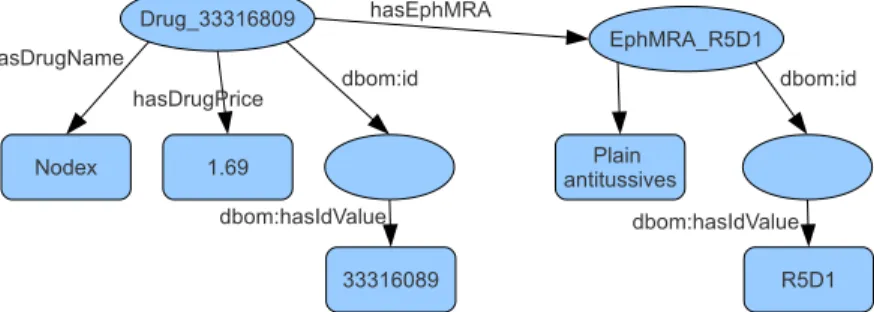
Example 2.2.2 We consider the DS1
system from Example 2.2.1 and the S1
database instance of Figure 2.1
Figure 2.1: Extract of database instance of S1
(a) Drug relation
code name price
33316809 Nodex 1.69 (b) EphMRA relation code name R5D1 Plain antitussives R5D2 Antitussives combinations (c) EphDrug relation drugCode ephMRACode 33316809 R5D1
According to the semantics of DS1
, the ABox displayed in Figure 2.2 is gen-erated.
2.3
Knowledge base maintenance through a
trig-ger based strategy
Since the ABox of the generated knowledge base is materialized, a solution is needed to synchronize objects of the ABox with tuples of the database. This solution is supported by a trigger based strategy. Intuitively, it aims at exploit-ing the dynamic aspect of the relational database sources together with schema mapping to maintain an up-to-date ABox. This approach implies that when-ever a database tuple related to a DL entity (concept, role) is updated (via a SQL query), the ABox is synchronized accordingly to ensure that it remains in a consistent state with respect to its sources. The dynamic aspects considered are triggers and referential actions such as ON UPDATE and ON DELETE. Thus this solution only tackles modifications of instances in relational database ta-bles, meaning that updates of schema through Data Definition Language (DDL) queries are not taken into account.
Generally ABox instance maintenance is usually performed via a complete processing of the mapping. But it is much more efficient to propose a differential approach where only the modified tuples of the sources imply a modification to the knowledge base.
In [CS05], the trigger strategy definition is expressed with the formalization of a translation approach which relates a relational model to DBOM’s mapping model.
Based on this translation approach, a set of standard SQL triggers are auto-matically generated by the DBOM system. They are defined as AFTER triggers, because the system needs to have the data stored in the database before process-ing updates of the ABox, and as ROW LEVEL triggers, meanprocess-ing that the trigger action is executed for every row that is inserted, deleted or updated by the query as opposed to statement level where the trigger is executed only once [EN06]. This AFTER/ROW LEVEL policy allows to consider, when not limited by recur-sive trigger characteristics, referential actions such as ON DELETE | ON UPDATE action.
The triggers are implemented by two generic Java methods (one for ontol-ogy concepts and another one for roles) defined in the DBOM framework and whose main purpose is to find candidate ontology concepts and roles to be up-dated. Once a set of update candidates are identified, the modifications can be performed at the knowledge base level. For this purpose, several heuristics have been defined to solve the problem of efficiently and accurately mapping an update at the database level to the knowledge base level. They are decomposed into rules that solve insert, delete and update trigger events. For each of these three categories, we distinguish between triggers that call the property method and those that call the concept method (more details are provided in [CS05]).
2.4
Dealing with uncertainties with preferences
As said earlier, DBOM aims to integrate several relational database sources on an OWL knowledge base. A situation frequently encountered in integra-tion soluintegra-tions is the execuintegra-tion of uncertain mappings. Such mappings are often generated from overlapping sources where data are possibly not up-to-date and unreliable. In such a situation, one needs to give a special attention to
instan-tiate the most reliable, up-to-date and consistent knowledge base. In order to guarantee the consistency of the processed target knowledge base, end-users can set preferences over the mapping assertions.
Preferences have some of their origins in decision theory where they support complex, multi factorial decision processes [Fis70]. Preferences have also mo-tivated research in the field of databases starting with [LL87]. In [Kie02], the authors distinguish between quantitative and qualitative approaches to prefer-ences. In the quantitative approach, a preference is associated with an atomic scoring function. This approach usually restricts the approach to total orderings of result tuples. The qualitative approach is more general than the quantitative as it proposes partial ordering of results.
We now motivate the reasons for a quantitative approach in the DS system: • it responds effectively to our need to correct inconsistencies when a given individual, identified by a given key, may be generated from several map-ping assertions.
• the task of setting preferences is only required for ontology elements de-fined by different source views. Thus the total order aspect of this quanti-tative approach does not make the preference setting task more restrictive. • in practice, the task of setting preferences to views of a given ontology element may not be complex for a mapping designer. Users responsible for the design of mappings generally know the sources well and are able to tell which source is more reliable than others.
We have described several levels of preferences which we describe in the following sub-sections.
2.4.1
R-preferences
In [CJ07c], we presented a solution that enables us to define preferences over conjunctive queries of mapping assertions, named R-preferences. This approach considers that data retrieved from a source all have the same reliability value. Definition 4 : Let DS be a DBOM system as defined in Definition 1. We
consider the situation where an element of K (i.e. Concept or Role) is defined with several mapping assertions, denoted mai over sources of S. In order to
avoid inconsistencies, the end-user defines a total order relation, denoted >R,
on the mapping assertions of this element. For two mapping assertions ma1
and ma2, if ma1>Rma2 then
• all objects retrieved from a mapping assertion with no counter parts (i.e.
objects identified by the same identifying values) in other mapping asser-tions are created in the ABox.
• all objects that could be retrieved from both mapping assertions, are created
2.4.2
A-preferences
A main limitation with R-preferences, is that it is not possible to compose objects from different sources. That is all values of an object come from a single source. In order to propose a fine-grained composition of objects, we enriched our system with a preference setting over attribute of the views. They are denoted A-preferences and are set on the distinguished variables of mapping assertions. They enable to create fine-grained objects from source tuples. With this approach, one can express that for a given object, the system prefers the value of an attribute stored in one source to another attribute stored in another source. Thus the system is able to compose an object via retrieving preferred values from different sources.
Definition 5 : Let DS = hS, K, Mi be our data integration system with
A-preferences over mapping assertions. We consider the situation where an ele-ment of K (i.e. Concept or Role) is defined with several mapping assertions, denoted mai over sources of S. In order to avoid inconsistencies, the end-user
defines a total order relation, denoted >A, on the distinguished variables of
map-ping assertions of this element. For two mapmap-ping assertions ma1 and ma2 and
respective attributes set (a1, b1, c1) and (a2, b2, c2) where ci corresponds to an
identifier (mapped to dbom:id), if ma1.a1 >A ma2.a2 and ma2.b2 >A ma1.b1
then
• all objects retrieved from a mapping assertion with no counter parts in
other mapping assertions are created in the ABox.
• all objects that could be retrieved from both mapping assertions, are
com-posed by relating a1 from ma1 and b2 from ma2 to respective data type
properties.
2.4.3
Full-preferences
In our extended mappings, both preferences can coexist within a mapping and we call Full-preferences the union of R-preferences and A-preferences. In order to ease the definition of mapping assertions, we have implemented a Graphical User Interface (GUI) that enables users to set the R-preference of a mapping assertions as the default value for all A-preferences of this same mapping asser-tion. The end-user can later overrule all the A-preferences she wants.
In the context of Full-preferences, the complexity of computing all solutions for a set S of sources and A of attributes is related to the number of possible permutations when the order of values matters and a value can be selected several times in a rearrangement. The number of such permutations is: k S kkAk.
Although still proposing an intractable solution, we reduce the complexity of the problem to 2kSkin the worst case and propose heuristics which makes the issue
of computing Full-preferences over practical integration cases relatively efficient. In [Cur08] we proposed an algorithm that searches for attribute permutations with respect to existing overlapping of the sources. In this algorithm, subsets are returned in descending order on their size and the empty set terminates the set of candidate solutions. A heuristic first returns the singleton sets and then it analyzes if A-preferences do not overrule R-preferences such that the empty set can be returned more efficiently, without considering all subsets. Otherwise
other heuristics return sets composed of sources with the highest R-preferences first. In order to improve our system’s performance when instantiating the ABox, we use parameterized queries which are compiled once and then re-used with different parameter values without recompilation.
2.5
Reasoning in DBOM
In order to present the reasoning functionalities included in the DBOM system, it is first important to emphasize on the semantic enrichment of the ontology elements. This enrichment is facilitated by the implementation of DBOM as a Prot´eg´e plug-in. Hence, end-users can benefit from all the standards func-tionalities of this ontology editor, e.g. enjoying interactions with the built in OWLClasses, Properties and Instances tabs, interfacing with reasoners, bene-fiting from visualization tools.
In Figure 2.3, five distinct areas are highlighted in a DBOM window. The left hand side of this window is concerned with sources management and ontology representation while the right hand side deals with mappings.
The upper left zone (1) supports the addition and removal of relational database sources. Just below this area (2), database(s) and ontology schemata are presented. The upper section (3) supports the creation of new ontology members (e.g. concept, properties) and displays information about individuals. In the context of the creation of a concept (resp. role), end-users can specify a super class (resp. super property). Then it is possible to enter as many mapping assertions for this new ontology member (Request tabs of (4)). In the example of Figure 2.3, a RespiratorySystemDrug concept has been created and area (4) defines a mapping assertion (taking the form of an SQL query) defined on source 1.
Note that by default, the confidence value is set to 50% (corresponding to the default of R-preferences). Then each database attribute of the SELECT clause is mapped to an ontology property or the dbom:id identification system in are (5). Note that attributes dbom:id logically have no preference value. A default value of 50% is set to A-preferences for all attributes not mapped to dbom:id. End-users have the ability to refine the A-preference value of each mapped attribute and thus overrule the R-preference.
All ontology members created with a DBOM mapping are integrated in the standard Prot´eg´e tabs (OWLClasses or Property tabs). For instance, the RespiratorySystemDrugconcept of Figure 2.3 is inserted in the tree structure displayed in the OWLClasses tab. Then it is possible to add DL axioms to this concept, e.g. RespiratorySystemDrug ⊑ Drug ⊓ ∃ treat.RespiratorySystem. Or for a property to specify its domain, range as well as characteristics as functional, inverse functional, etc.
At this stage of the presentation of DBOM, reasoning already plays an im-portant role. Via interactions with standard DL reasoners (e.g. Pellet, Racer or HermiT), one can compute concept subsumption, define and check the consis-tency of the defined ontology. But we will present in the next section two other cases requiring inferences.
Figure 2.3: Screenshot of the DBOM Prot´eg´e plug-in
2.5.1
Inference-based instantiation of knowledge bases
In order to generate a consistent knowledge base from a set of mapping assertions and database sources, DBOM performs multiple inferences. They correspond to checking the type of concepts involved in property assertions with respect to the domain and range defined in the ontology. In the background of this approach, standard DL reasoning procedures are used, e.g. concept subsumption, instance checking (i.e. check whether an assertion is entailed by an ABox) and realization (given an individual and a set of concepts, provide the most specific concepts this individual is an instance of). In the following example, we present a concrete situation where inferences are needed.
Example 2.5.1 Consider the following ontology extract:
1. RespiratorySystemDrug ⊑ Drug 2. NervousSystemDrug ⊑ Drug
3. RespiratorySystemDrug ⊑ ¬ NervousSystemDrug 4. ⊤ ⊑ ∀ hasContraIndication.Drug
5. ⊤ ⊑ ∀ hasContraIndication−1.Drug
Where line (1) defines a RespiratorySystemDrug concept being a subcon-cept of the Drug consubcon-cept (resp. on line (2) with NervousSystemDrug). Line (3) states that the RespiratorySystemDrug and NervousSystemDrug concepts are disjoint. Finally lines (4) and (5) define the domain and range of the
hasContraIndicationobject property.
Given a set of mapping assertions, DBOM proceeds as follows: mappings concerned with concepts are treated first then follows mapping concerned with
object properties. This approach enables us to first generate individuals and then to related them with some roles. This means that in the case of Exam-ple 2.5.1, RespiratorySystemDrug and NervousSystemDrug instances are first created, designing a graph of nodes corresponding to individuals, concepts and literals. Finally, the mapping assertion concerning the hasContraIndication property states that the domain and range of this property are the Drug con-cept. But the current graph does not contain any explicit instances of this concept. Hence reasoning other the concept hierarchy of the domain and range concepts are needed to relate existing individuals of the graph, i.e. instances of the RespiratorySystemDrug and NervousSystemDrug concepts.
2.5.2
Incremental generation from previous mapping
as-sertion
An important problem encountered in data integration systems corresponds to the generation of schema mapping. The problem of discovering such schema mappings is known to be a complex one which can be addressed with practical heuristics and approximation algorithms. We have proposed a method to derive new mappings from previously defined ones with constant values. In order to perform these derivations, we also exploit constraints and data associated to the sources. Additionally our solution generates labels for the elements of the mediated (target) schema. This approach is motivated by our experience in designing fined-grained ontologies (e.g. in medicine, biology, archeology, ecol-ogy) which mapping assertions usually involve constant values present in the database sources.
Mapping assertion generation Intuitively, our method takes a limited set of user generated mappings as an input and derives new mappings based on uncovered constants of database instances. The effectiveness of this mapping generation depends on the semantic information associated to the constant val-ues. We consider that in databases containing classifications or terminologies (e.g. scientific domains), this semantic information is valuable and not exploited enough.
Our approach requires to distinguish between two kinds of mappings denoted Md and Mu.
Definition 6 : Let Mu denote the mappings that have been defined by
end-usersor created from a computer system. We denote by Mdthe set of mappings derived by our solution. We state that M = Md∪ Mu and Md∩ Mu= ∅.
For a mapping M , we denote with LHS(M), the left hand-side of a mapping M, i.e. the (SQL) query over the sources, and denote by RHS(M), the right hand-side of M , i.e. the expression over elements of the ontology. In this work, we restrict LHS(M) to SPJ (Select Project Join) queries with equalities. For instance, we do not consider aggregation functions or GROUP BY in LHS(M). Our system exploits meta data of the databases in order to derive new mappings. This information corresponds to the most commonly used constraints over the relational model: primary and foreign key constraints.
Another aspect that needs to be considered is equivalence of conjunctive queries which plays an important role in discovering constant values with high semantic information. In fact, two queries LHS(M1) and LHS(M2) are
Example 2.5.2 Consider two equivalent queries expressed over the database
schema of example 2.2.1:
Q1: SELECT d.code, d.name, d.price FROM drug d, ephDrug ed, ephmra e
WHERE ed.drugCode=d.code AND ed.ephmracode=e.code AND e.name LIKE ’Plain antitussives’;
Q2: SELECT d.code, d.name, d.price FROM drug d, ephDrug ed WHERE
ed.drugCode=d.code AND ed.ephmraCode LIKE ’R5D1’;
Both SQL queries present a constant, i.e. ’Plain antitussives’ in Q1 and
’R5D1’ in Q2, which does not have the same ’direct’ semantic information. But
in the context of the query and database schema, we can associate an equivalent semantic information to ’R5D1’ and ’Plain antitussives’ since both columns are related by a functional dependency. Similar equivalence relationships can be discovered using foreign key constraints.
We now present a structure Ω which stores the information associated to the occurrence of constant values in the conjunctive query of a mapping.
Definition 7 Ω corresponds to an ordered set of triples {ω1, .., ωn} where ωi is
defined as a triple hRj, Ak, ci. In this triple, Rj corresponds to a relation of the
source, Ak is an attribute of Rj with 1 6 k 6 |Rj| (arity of the relation Rj),
and c is the constant value associated to Ak in the conjunctive query and thus
belongs to ∆.
In our approach, we are interested in computing such structures for both Mu and Md and thus denote them respectively with Ωu and Ωd. Once we
have generated the Ωu from a given LHS(Mu), we start a second step aiming
to derive new mappings. The method searches for new constant values for Ωd
which are different from the ones used in Ωu. In order to find these values,
we execute an aggregation query based on LHS(Mu). This query returns the
number of instances retrieved for a rewriting of LHS(Mu) for each constant value
discovered and sorts the results in descending order on the number of instances of these groups. This ordering is justified by the assumption that concepts or roles with the most instance assertions should be the most pertinent in the context of creating an ontology. The aggregation for LHS(Mu) of Q1 and Q2
correspond respectively to the following SQL queries:
(1) SELECT name, count(*) FROM ephmra GROUP BY name HAVING name NOT LIKE ’Plain antitussives’ ORDER BY count(*) DESC;
(2) SELECT ephmracode, count(*) FROM ephmra GROUP BY ephmra-code HAVING ephmraephmra-code NOT LIKE ’R5D1’ ORDER BY count(*) DESC;
Queries with |Ωu| > 2, i.e. the size of the set Ωu, may retrieve very large sets
of candidate values, i.e. based on the cartesian product of all constant values of ∆ for attributes in Ωu. In order to minimize the number of irrelevant mappings
generated, our system interacts with the end-user to select relevant attributes. Basically, for a given mapping, it enables an end-user to select a subset of relations and attributes of Ωu for which new constants should be searched.
The interaction with the end-user is handled by a GUI taking the form of a list of relation, Ωu.Rj, and attribute, Ωu.Ak couples. Each entry of the list is
associated to a check box component. This enables users to select/deselect at-tributes in an effective way. The GUI also interacts with the end-user’s selection to display the number of mappings that will be automatically generated if this
selection is validated. Finally, when |Ωu| = 0, the system does not search for
new mappings as the LHS(Mu) already retrieves all instances of a given relation
Riof S.
The results obtained from the execution of queries (1) and (2) on our database extract, respectively enable to generate the following LHS(Md):
(3) SELECT d.code, d.name, d.price FROM drug d, ephDrug ed, ephmra e WHERE ed.drugCode=d.code AND ed.ephmracode=e.code AND e.name LIKE ’Antitussives combinations’;
(4) SELECT d.code, d.name, d.price FROM drug d, ephDrug ed WHERE ed.drugCode=d.code AND ed.ephmraCode LIKE ’R5D2’;
Both queries are being generated using a rewriting of LHS(Mu) by
substitut-ing constant values of Ωuwith the new constant values of Ωd. We now consider
these Md queries as candidate queries for ontology mappings.
Label generation In cases a Mu mapping introduces new ontology
ele-ments, e.g. ’PlainAntitussive’ concept in M1, then it is necessary to search for
relevant ontology element labels for Md. For instance what RHS(Md) can we
associate to the SQL queries (3) or (4)?
In order to perform this task, the system searches for relationships between the constants in LHS(Mu) and the ontology elements introduced in RHS(Mu).
Then it applies these relationships on the LHS(Md) queries to discover ontology
element labels to complete the RHS(Md) queries.
We distinguish two main relationships between constants: (i) lexicographic equivalence, i.e. a constant and an ontology element correspond to the same string. We also consider some forms of simple lexicographic transformations and concatenation over Ωu constant values. (ii) non lexicographic equivalence,
i.e. a constant value from the SQL query does not correspond to any label of the ontology elements. In this situation, we are searching for other forms of equivalence, e.g. synonymy or hyponymy.
When an equivalence relationship is detected, then the symbol for the on-tology element is obvious and can be computed from the constant value. In our running example, a lexicographic equivalence is detected in mapping M1. Thus
we are able to easily propose a label for the concept of the derived mappings associated to the LHS queries (3) and (4): AntitussiveCombination.
We adopt the same approach if multiple constants appear in Mu(i.e. |Ωu| >
2). That is if one of the constant values in Ωu equals one of LHS(Mu), then
we mark its triple (Rk, An, c) and for all derived LHS(Md), we set the ontology
element symbol with the constant value of the marked Ωd.
When no lexicographic equivalence holds, it is necessary to discover a rela-tionship between some or all of the constant values and the ontology element labels in the end-user mapping. Once these relations have been discovered, we can apply them to the corresponding constants of Mdand find labels for the
as-sociated ontology elements. In order to perform this discovery, we exploit infor-mation coming from some background knowledge, e.g. WordNet (an electronic lexical database). Using WordNet, we consider only nouns as label candidates and we use the Java WordNet Library (http://jwordnet.sourceforge.net) to rec-ognize variants of the same noun obtained by applying the usual inflection rules. Our method considers WordNet as a graph where vertices correspond to nouns or synsets. The edges between these nodes are relations of the kind hyponyms, hypernyms, meronyms, etc.. Using this graph representation, it is possible to navigate through this background knowledge and find relations between nodes.
The labeling solution is decomposed into two algorithms: getRelation and getLabelwhich are detailed below.
In a nutshell, the getRelation algorithm accesses a list of nouns that match the labels of the newly introduced elements of RHS(Mu). For instance 11 synsets
are available for the noun ’Man’. Then the algorithm uses all the information available from Ωu, i.e. relation, attribute names and constants, to find the most
appropriate synset. The selection of the most appropriate one is performed using a score function. Once a synset has been selected, we need to search for the most appropriate relations, i.e. hypernym, hyponym, meronym,etc., available. Again, this is done using a function that scores for each relation the number of matches with the terms of Ωu. Finally the most relevant relation is returned.
Several heuristics are added to our getRelation algorithm. For instance, if no hypernyms, hyponyms or meronyms, etc. are found using WordNet, then we return a ’null’ relation which implies that constant values of Ωu are proposed
as ontology labels. Also, if the scores of all or some the hypernyms, hyponyms, meronyms, etc. relations are equal then we return the hyponym relation.
Once we have characterized the relation between the ontology symbol and the query of Mu, we use this relation with the constant values of Mdto find a set
of symbol candidates for Md. This task is performed by the getLabel algorithm
for each end-user selected Ωu element. The inputs of this algorithm are the Ωd
elements and the WordNet relation returned from getRelation. A first step is to retrieve a set of words corresponding to the constant value of the Ωdelement.
Then the most adequate noun is selected and a set of synsets is retrieved from WordNet based on the selected noun and the previously discovered WordNet relation. Then synsets are rated in a way similar to the getRelation algorithm, i.e. using a score function that searches for matches between synset descriptions, labels and elements of Ωdtriples. Finally a set of synset labels is returned by the
getLabel function. In cases where several constant values have been selected by the end-user, several execution, one for each selected Ωd triple selected, is
performed and the set of candidate labels then corresponds to the union of the returned labels.
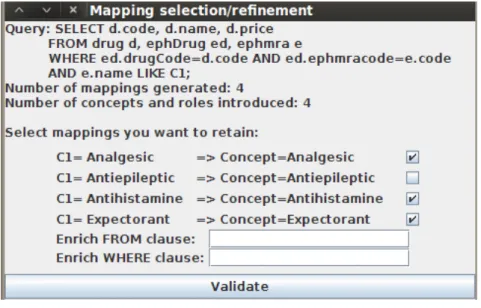
Mapping selection and refinement Once a derived mapping Md is
com-pleted, i.e. both the LHS and RHS queries have been generated, the next logical operation is to make it persistent in the integration system. Basically, this is per-formed by storing the derived mapping in a mapping repository and recording the new ontology elements in the TBox. But before performing these opera-tions, we need to make sure that the derived mappings satisfy the end-user’s intention. The consideration of this aspect prevents the system from generating large TBoxes where only a subset of the concepts and roles are relevant to the ontology designer. This is the case if one wants to design an ontology that only considers a restricted part of the domain of a database, e.g. design an over-the-counter drug ontology from a complete drug database. Hence it is necessary to consider only a relevant subset of the mappings that can be effectively derived. Basically, this is usually a consequence of an under restricting of Mu’s SQL
query. In order to correct this situation, the only reliable source of information is the end-user.
We propose a user-friendly GUI (Figure 2.4) for the acceptance of mappings which permits an effective scan and selection of candidate mappings as well as an easy solution to refine SQL queries associated to these mappings.
1. a pattern of LHS SQL query of the mappings where all constant values are substituted by a symbol (Cx).
2. an evaluation of the number of mapping to process and number of emerging concepts and roles.
3. a simplified view of mappings via pairs consisting of a set of constant values and a set of ontology element labels.
4. a check box for each mapping view which allows to select a mapping. 5. text areas where the end-user can enrich the FROM and WHERE clauses
of the aggregation SQL query responsible for finding constant values. Based on this GUI, it is clear that the system proposes two different ap-proaches to refine, adopt or reject a set of mappings. A first approach consists in selecting, via the check box, a set of satisfying mappings. This approach is useful when the number of proposed mappings is low, in practice we have studied that the upper bound is about thirty mappings. We have seen in the previous sections that our solution can easily derive hundreds or thousands map-pings from certain classifications. In this situation, it is not manageable for the end-user to manually check such an amount of check boxes. Hence, we propose a text area enabling to restrict the set of discovered constant values. This is performed by introducing new tables in the FROM clause and conditions in the WHERE clause of the aggregation SQL query. The main drawback of this approach is to require that end-users are able to write SQL queries and know well the database schema.
2.6
Presentation of papers
[Cur05b] Olivier Cur´e. Semi-automatic data migration in a self-medication knowledge-based system.
In Wissensmanagement (LNCS Volume),pages 373–383, 2005. This article presented at the Knowledge Management in Medicine session at WM 2005 motivates the idea of representing some of the information of our self-medical application, namely XIMSA, with ontologies. The paper details the architecture and functionalities provided in XIMSA (e.g. the Simplified Elec-tronic Healthcare Record (SEHR) and the diagnosis module). Then the overall architecture of DBOM is discussed in the context of this medical application.
[CS05] Olivier Cur´e and Raphael Squelbut. A database trigger strategy to maintain knowledge bases developed via data migration.
In EPIA, pages 206–217, 2005.
This paper motivates the approach of using a trigger based strategy to syn-chronize data states between a set of relational databases and a knowledge base. A survey of the most influential system in the field of mapping databases and on-tologies is provided and enables us to perform several comparisons with DBOM. Finally a formal definition of the trigger strategy is presented with details on applied heuristics and implementation information.
[CS06a] Olivier Cur´e and Raphael Squelbut. Data integration targeting a drug related knowledge base.
In EDBT Workshops, pages 411–422, 2006.
This article was presented at the Information In Healthcare (IIHA) workshop at the EDBT conference. It focuses on methods defined in XIMSA’s Drug Consumption Checker Application (DCCA). This service, aimed at the general public, controls the adequacy of a drug (self) prescription. Thus the architecture of the DCCA service is supported by a drug ontology and a Simplified Electronic Health Record (SEHR). DBOM’s syntax and semantics is introduced in order to design and maintain the different knowledge bases involved in this task.
[CS06b] Olivier Cur´e and Raphael Squelbut. Integrating data into an OWL knowledge base via the DBOM prot´eg´e plug-in.
In 9th International Prot´eg´e conference, 2006.
Prot´eg´e is an open-source ontology and knowledge base framework developed at the Stanford Center for Biomedical Informatics Research and is considered as the leading project in this field. The architecture of this editor encourages the implementation of plug-ins and a conference. This conference is held annually to bring together researchers developing or using Prot´eg´e methodologies and tools. In this context, we demonstrated our DBOM plug-in as well as presented details on its implementation and the way it interacts with the standard component of the editor (e.g. interactions with OWLClasses, Properties, etc.).
[CJ07c] Olivier Cur´e and Florent Jochaud. Preference-based integration of relational databases into a description logic.
In DEXA, pages 854–863, 2007.
This article motivates the need to deal with uncertainties emerging from the mapping assertions of DBOM when several database sources are used to in-stantiate DL concepts or properties. In this paper, only query level preferences (R-preferences) are introduced.
[CB08] Olivier Cur´e and Jean-David Bensaid. Integration of relational databases into OWL knowledge bases: demonstration of the DBOM system.
In ICDE Workshops, pages 230–233, 2008.
This demonstration paper was presented at Information Integration Meth-ods, Architectures, and Systems (IIMAS) at the ICDE conference. It empha-sizes all the functionalities presented in this chapter. That is the ability to map several database sources with Full preferences, reasoning in the context of instantiating a knowledge base, generation of triggers on the sources on the different preference forms available in DBOM and on the associated reasoning mechanisms.
[Cur08] Olivier Cur´e. Data integration for the semantic web with full preferences.
In ONISW, pages 61–68, 2008.
This paper extends the R-preference approach presented in [CJ07c] with
A-preferences and presents the algorithms necessary to process Full A-preferences,
the union of R preferences and A preferences. This paper also evaluates the efficiency of these algorithms and the satisfaction of end-users.
[Cur09c] Olivier Cur´e. Incremental generation of mappings in an ontology-based data access context.
In OTM Conferences (2), pages 1025–1032, 2009.
This paper presents the incremental generation of mappings approach. All steps of this generation are detailed and algorithms are proposed in the context of Ontology-Based Data Access (OBDA). OBDA provides access to a set of (rela-tional) data sources through a mediating ontology, which acts as a semantic layer between the user and the data. Hence OBDA proposes a mapping solution that has some similarities with DBOM. Anyhow, a main difference between these two approaches is that DBOM, via its materialization of the target knowledge base can be considered a hybrid solution between data integration and exchange system while OBDA is a strict data integration system. Nevertheless, the in-cremental generation of mappings is easily translatable to the DBOM context.
2.7
Conclusion and perspectives
The DBOM system proved to be quite useful on many projects we have been working on. Obviously, it has been the case on the XIMSA application which in-tegrates several ontologies from classifications contained in databases. But it has