HAL Id: hal-01871071
https://hal-amu.archives-ouvertes.fr/hal-01871071
Submitted on 10 Sep 2018
HAL is a multi-disciplinary open access
archive for the deposit and dissemination of
sci-entific research documents, whether they are
pub-lished or not. The documents may come from
teaching and research institutions in France or
abroad, or from public or private research centers.
L’archive ouverte pluridisciplinaire HAL, est
destinée au dépôt et à la diffusion de documents
scientifiques de niveau recherche, publiés ou non,
émanant des établissements d’enseignement et de
recherche français ou étrangers, des laboratoires
publics ou privés.
Emoji Recommendation in Private Instant Messages
Gaël Guibon, Magalie Ochs, Patrice Bellot
To cite this version:
Gaël Guibon, Magalie Ochs, Patrice Bellot. Emoji Recommendation in Private Instant Messages.
SAC ’18 Proceedings of the 33rd Annual ACM Symposium on Applied Computing, Apr 2018, Pau,
France. �10.1145/3167132.3167430�. �hal-01871071�
Emoji Recommendation in Private Instant Messages
Gaël Guibon
Caléa Solutions, LIS-CNRSMarseille, France [email protected]
Magalie Ochs
LIS-CNRS Marseille, France [email protected]Patrice Bellot
LIS-CNRS Marseille, France [email protected]ABSTRACT
Emojis are some of the most common ways to convey emotions and sentiments in social messaging applications. In order to help the user choose emojis among a vast range of possibilities, we aim at developing an automatic recommendation system based on user message analysis and real emoji usage, which goes beyond the simple dictionnary lookup that is done in the industry (mainly Android and iOS). For this purpose, we present a novel automatic emoji prediction model trained and tested on real data and based on sentiment-related features. Such a model differ from the ones learnt from tweets and can predict emojis with a 84.48% f1-score and a 95.49% high precision, using MultiLabel-RandomForest algorithm on real private instant message corpus. We want to determine the best discriminative features for this task.
CCS CONCEPTS
• Computing methodologies → Information extraction;
KEYWORDS
emoji, messaging application, multi-label classification, natural language processing, recommendation
ACM Reference Format:
Gaël Guibon, Magalie Ochs, and Patrice Bellot. 2018. Emoji Recommen-dation in Private Instant Messages. In SAC 2018: SAC 2018: Symposium on Applied Computing , April 9–13, 2018, Pau, France.ACM, New York, NY, USA, Article 4, 3 pages. https://doi.org/10.1145/3167132.3167430
1
INTRODUCTION
Messenging applications are one of the most used means of com-munication. Nowadays 55% of teenagers send at least one instant message per day on their mobile phone [11], and 92% of online users send emojis [20]. Emojis are small pictures representing facial cues , objects , or ideas . In our research work, we focus on mobile instant text messaging applications with emojis. In these ap-plications users have to scroll through thousands of different emojis to select one. Among the 2,389 emojis of the Unicode Consortium, 797 were added in 2015 and 233 in 20161.
We aim at developing a novel emoji recommendation system to help users, based on their emoji usage in context. This approach is
1http://unicode.org/emoji/charts/full-emoji-list.html
Permission to make digital or hard copies of part or all of this work for personal or classroom use is granted without fee provided that copies are not made or distributed for profit or commercial advantage and that copies bear this notice and the full citation on the first page. Copyrights for third-party components of this work must be honored. For all other uses, contact the owner/author(s).
SAC 2018, April 9–13, 2018, Pau, France © 2018 Copyright held by the owner/author(s). ACM ISBN 978-1-4503-5191-1/18/04. https://doi.org/10.1145/3167132.3167430
different from emoji recommendation based on emojis metadata [4]. Different strategies are considered. One strategy, called Trust-based recommendation, consists in taking into account users’ indications (ratings for instance) [14]. Another strategy, called content-based recommendation, consists in recommending items based on their description (such as metadata) [16]. In this paper, we use a content-based recommendation approach, the contents being the context in which emojis are used. To do so, we first need to focus on pre-dicting emojis in context. It can be done for a sentence, or a whole conversation. We have decided to focus on sentences in the emoji prediction task, trying to know what features are the most discrim-inative for this task. It is worth noting that several emojis can be associated to one sentence, as users often combine emojis. This is why we use a multi-label classification approach, each emoji being a possible label. Moreover, we focus on a particular type of emojis: sentiment-related emojis. This type of emojis convey emotions, sen-timents, and opinions, mainly through facial cues. For this reason, object-related emojis are excluded. Sentiment-related emojis are indeed the most widely used categories of emojis2- 71.63% of the
emojis used being happy faces, sad faces, and hearts. The same goes on Twitter3. Thus, our classification models mainly exploits
sentiment-based features for each sentence.
Hence, our contribution is twofold. First, we offer a novel model to automatically predict one or several sentiment-related emojis that could be recommended to a user’s written sentences. As far as we know, we are the first to use a large private instant message corpus for this task, as opposed to the few other models made from public tweets [2] or public weibo messages [24]. Moreover, unlike the 20 emojis used for prediction until now, we predict up to 169 emojis. In addition, by creating an emoji prediction system from private text messages, we are able to predict emojis in a new context, different from tweets.
The paper is organized as follows. We summarize the related work (Section 2) before analysing the data (Section 3.1). Then we de-tail our methodology and analyse the results of our emoji prediction system (Section 3.1).
2
RELATED WORK
Emoticons ( :-) , :P ) and emojis ( ) are 2 different ways to represent facial cues. While the former are characters, the latter are pictures and tend to replace emoticons in social conversations [15]. Accord-ing to Kelly et al. [8], emojis are used to improve the understandAccord-ing of the message in 70% of cases.
To do so, several emoji prediction models have been proposed. Eisner [4] used word embeddings based on the Unicode4emoji
descriptions to create an emoji vector space without emoji usage
2According to the SwiftKey Report [17] 3According to http://emojitracker.com/
SAC 2018, April 9–13, 2018, Pau, France Gaël Guibon, Magalie Ochs, and Patrice Bellot
contexts. They evaluate their model through a multi-label classi-fication of emoji descriptions and obtained 85% accuracy while predicting one emoji for several keywords. Also, Xie [24] used neu-ral networks trained on Weibo5and predicted 10 possible emojis
for conversations with 65% accuracy for the 3 mostly used emo-jis. Barbieri [2] predicted the 20 most used emojis in tweets using LSTM [6]. The first two considered keywords and conversation, and the other papers did not directly considered emoji prediction in sentences, which is our main contribution in this paper. We predict up to 169 possible emojis, going beyond the 20 most used emojis.
Text classification by emojis, emotions [3], or moods [13] can be close to each other. For instance, Li [12] did an emotion classification of blog messages using emotion-cause extraction (65% f1-score).
Our work differs by focusing on predicting emojis in sentences and by using several emojis, because users often choose several emojis for one sentence. Thus, we used a multi-label classification approach. Multi-label classification whose first aimed at associating domains to documents [18], or classifying musics by emotions [22], is a generalization of the classification task. Recent state-of-the-art reviews [23, 25] define two main approaches for multi-label classification: one by transformation and one by adaptation, respectively creating a binary classifier per label, each one being independent of the others [10], or adapting existing classification algorithms, resulting into one classifier [7].
In our work, we have a total of 169 possible emojis, so we prefered the adaptation approach for performance and computing time. The Multi-Label RandomForest algorithm was chosen, as it makes it possible to retrieve feature importance scores, and have a strong generalization capacity [19] suited to small datasets.
3
EMOJI PREDICTION
3.1
Data Analysis
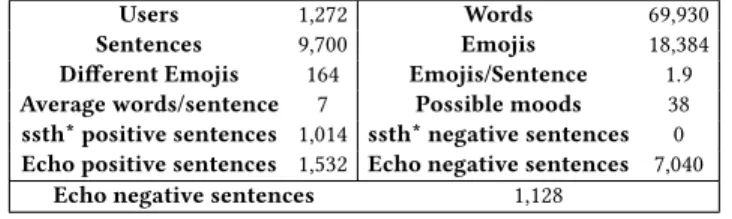
To train and validate the models, we used a new text message corpus retrieved within a messaging application6upon acceptation from the users. The corpus is made of 9,700 sentences from 1,272 users, each sentence containing one or more emojis from 164 different emojis. The corpus is not topic filtered. The main caracteristics are described in Table 1. We automatically split the message into sentences using OpenNLP7[1], and then filter them in order to only keep the sentences with emojis. A sentence is represented by its text along with the list of labels (i.e. emojis). For instance: ("I heard about the news, it is quite depressing.", ).
Users 1,272 Words 69,930 Sentences 9,700 Emojis 18,384 Different Emojis 164 Emojis/Sentence 1.9 Average words/sentence 7 Possible moods 38 ssth* positive sentences 1,014 ssth* negative sentences 0 Echo positive sentences 1,532 Echo negative sentences 7,040
Echo negative sentences 1,128
Table 1: Resource characteristics.*ssth = SentiStrength
A corpus of sentiment-related emojis.A key characteristic of our approach is that we only used a corpus made of messages with
5http://www.weibo.com/
6Mood Messenger. No SMS were retrieved, only instant messages 7We used the following model : http://opennlp.sourceforge.net/models-1.5/
sentiment-related emojis. This means that emojis representing sen-timents such as joy, fear or sadness, will be in our corpus, whereas the ones representing objects will not.
We identified 169 sentiment-related emojis based on their represen-tation in the EmojiSentimentRanking (ESR) [9], a polarity lexicon for emojis. The ESR gives 3 polarity scores for 751 emojis based on manually annotated tweets in context. From these scores we selected emojis that are sentiment-related. For instance, has a triplet negative;neutral;positive of {0.532 ; 0.108 ; 0.360}. This triplet includes this emoji as a sentiment-related one, because the neutral score is not the highest one. On the contrary, the emoji ({0.052 ; 0.545 ; 0.403}) was not selected as a sentiment-related emoji because of its neutral polarity score in the ESR.
Features used.In order to construct the prediction model, we have defined a set of features considering both textual elements and sentiment-related features. All the available features are the following. As textual features, we used bags of words or bags of characters, total word count, exclamation and interrogation marks and n-grams (up to 5-grams). As sentiment-related features, we used positive, negative, and neutral polarity scores from SentiStrength8
[21], using the available model trained on MySpace comments and tweets, and from Echo9[5] trained on 9684 tweets. Another sentiment-related feature is the current mood selected by the user: users can choose between 38 moods and change it whenever they want. Hence, the current mood is attached to each message. Token representation. Tokens can either be count vectors of words or characters gathered, then transformed using TF-IDF weight-ing scheme. Bags of characters can be really useful to deal with spelling variations and slang words without the need of a knowl-edge based or external lexicon.
In short, we used 9,700 sentences vectorized using TF-IDF on a bag of words/characters representation with computed features.
3.2
Methodology
Protocol.To predict emojis we used the ML-RandomForest algo-rithm10. Based on the empirical tests we conducted, we chose to use 20 trees with no depth limitation. Each model has been trained with the following methodology: 1) Preprocessing (tf-idf vectorization without stop words, and feature computation) 2) Cross validation (10 folds) 3) Classifier overall and per label evaluation.
Evaluation method.The evaluation was made from the average scores of each emoji. This means that we did not evaluate our classification as some powersets. Thus, in a sentence tagged with and , each emoji will be considered separately. For instance, in our results, the accuracy, precision, and recall scores are the average score of each emoji with their frequency weight.
3.3
Results Analysis
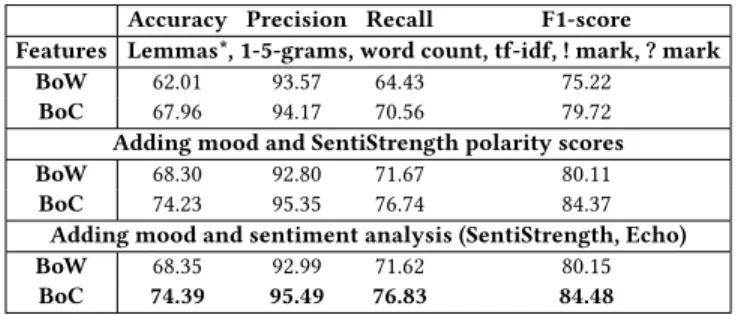
By applying the methodology (Section 3.2) we obtained the results shown in Table 2. Higher scores (bold) are the ones resulting from sentiment-related features: the mood and the polarities from Sen-tiStrength [21]. The average recall is even higher adding Echo [5]
8http://sentistrength.wlv.ac.uk/ 9https://github.com/OpenEdition/echo 10http://scikit-learn.org/
Emoji Recommendation in Private Instant Messages SAC 2018, April 9–13, 2018, Pau, France
Accuracy Precision Recall F1-score Features Lemmas*, 1-5-grams, word count, tf-idf, ! mark, ? mark
BoW 62.01 93.57 64.43 75.22 BoC 67.96 94.17 70.56 79.72 Adding mood and SentiStrength polarity scores BoW 68.30 92.80 71.67 80.11 BoC 74.23 95.35 76.74 84.37
Adding mood and sentiment analysis (SentiStrength, Echo) BoW 68.35 92.99 71.62 80.15 BoC 74.39 95.49 76.83 84.48
Table 2: Emoji prediction cross validation scores in sen-tences. BoW/C = bags of words/characters. *Ignored for BoC polarity labels. These scores show that using sentiment-related features yields better results for sentiment-related emojis.
RandomForest importance scores ranked the most discriminative features: mood came first in every run, followed by Echo Neutral Label. However, these scores do not take into account the combi-nation of multiple features (i.e. sentiment-related features). Given these feature rankings, we wanted to quantify the impact of the mood as it is the first one in every run we made. To do so, we com-pared the scores using a baseline with bags of characters only, and then using bags of characters with an additional mood feature. The mood feature alone added 2.79% to precision, 5.04% to recall, and thus 4.74% to the f1-score measure. This is the main improvement factor in our emoji prediction models: the mood feature improves the recall, which was the weak point of our prediction model.
Nonetheless, by coupling these with the average accuracy and f1-score, our emoji prediction model performs well on private in-stant messages if we compare it to existing results on tweets [2], maximazing precision over recall. In Table 3, we compared the scores of the 3 most used emojis in [2] with our results.
B-LSTM (Barbieri et al.) ML-RF
P R F1 P R F1
0.7 0.84 0.77 0.98 0.80 0.88 0.61 0.78 0.69 0.94 87.50 0.88 0.52 0.30 0.38 0.98 0.71 0.82
Table 3: Sample emoji scores (Precision, Recall, F1-score) Reproductibility.Because of privacy needs, we cannot release our corpus. And, as far as we know, there is no available private instant message corpus with emojis. However, this approach can be reproduced11on other public data such as tweets.
4
PERSPECTIVES
We contribute by proposing an emoji-prediction system using supervised multi-label classification through RandomForest and related features to automatically predict up to 169 sentiment-related emojis, which is higher than the 20 emojis used so far. Our models obtained good prediction scores. For example, a 94.3% pre-cision score was obtained using bags of characters with mood and polarity scores as features. From our results we can draw three conclusions. First, mood feature is important to improve emoji prediction, thus messaging applications should use it. Secondly, using bags of characters for private instant messages, instead of a
11Predicted emojis, scores, features, and example available here : https://gguibon.
github.io/sac2018/index.html
common bag of words, drastically increases emoji recommendation. Finally, results show that using polarity scores does not help to give better sentiment-related-emoji recommendation.
In future work, we will use these results as a baseline to deter-mine whether or not deep learning yields better results, considering our corpus is not excessively large. Finally, we will compare the results from private and public instant messages, taking different contexts into account: sentence, conversation, and user profile.
REFERENCES
[1] Jason Baldridge. 2005. The opennlp project. (2005).
[2] Francesco Barbieri, Miguel Ballesteros, and Horacio Saggion. 2017. Are Emojis Predictable? arXiv preprint arXiv:1702.07285 (2017).
[3] Soumaya Chaffar and Diana Inkpen. 2011. Using a heterogeneous dataset for emotion analysis in text. In Canadian Conference on Artificial Intelligence. Springer, 62–67.
[4] Ben Eisner, Tim Rocktäschel, Isabelle Augenstein, Matko Bo˝snjak, and Sebastian Riedel. 2016. emoji2vec: Learning Emoji Representations from their Description. arXiv preprint arXiv:1609.08359(2016).
[5] Hussam Hamdan, Patrice Bellot, and Frederic Bechet. 2015. Sentiment lexicon-based features for sentiment analysis in short text. In In Proceeding of the 16th International Conference on Intelligent Text Processing and Computational Linguis-tics.
[6] Sepp Hochreiter and Jürgen Schmidhuber. 1997. Long Short-Term Memory. Neural Comput.9, 8 (Nov. 1997), 1735–1780.
[7] Shu Huang, Wei Peng, Jingxuan Li, and Dongwon Lee. 2013. Sentiment and topic analysis on social media: a multi-task multi-label classification approach. In Proceedings of the 5th annual acm web science conference. ACM, 172–181. [8] Caroline Kelly. 2015. Do you know what I mean >:(: A linguistic study of the
understanding of emoticons and emojis in text messages. Master’s thesis. Halmstad University.
[9] Petra Kralj Novak, Jasmina Smailovic, Borut Sluban, and Igor Mozetic. 2015. Sentiment of Emojis. PLOS ONE 10, 12 (2015).
[10] Boris Lauser and Andreas Hotho. 2003. Automatic multi-label subject indexing in a multilingual environment. In International Conference on Theory and Practice of Digital Libraries. Springer, 140–151.
[11] Amanda Lenhart, Aaron Smith, Monica Anderson, Maeve Duggan, and Andrew Perrin. 2015. Teens, technology and friendships. (2015).
[12] Weiyuan Li and Hua Xu. 2014. Text-based emotion classification using emotion cause extraction. Expert Systems with Applications 41, 4 (2014), 1742–1749. [13] Gilad Mishne. 2005. Experiments with mood classification in blog posts. In
Proceedings of ACM SIGIR 2005 workshop on stylistic analysis of text for information access, Vol. 19. Citeseer, 321–327.
[14] John O’Donovan and Barry Smyth. 2005. Trust in recommender systems. In Proceedings of the 10th international conference on Intelligent user interfaces. ACM, 167–174.
[15] Umashanthi Pavalanathan and Jacob Eisenstein. 2015. Emoticons vs. emojis on Twitter: A causal inference approach. arXiv preprint arXiv:1510.08480 (2015). [16] Michael J. Pazzani and Daniel Billsus. 2007. Content-based recommendation
systems. In The adaptive web. Springer, 325–341.
[17] SwiftKey PT. 2015. Most-used emoji revealed: Americans love skulls, Brazilians love cats, the French love hearts. (2015), 18 pages. http://swiftkey.com/en/blog/ americans-love-skulls-brazilians-love-cats-swiftkey-emoji-meanings-report/ [18] Timothy N. Rubin, America Chambers, Padhraic Smyth, and Mark Steyvers. 2012.
Statistical topic models for multi-label document classification. Machine Learning 88, 1 (2012), 157–208.
[19] Carolin Strobl, Anne-Laure Boulesteix, Thomas Kneib, Thomas Augustin, and Achim Zeileis. 2008. Conditional Variable Importance for Random Forests. BMC Bioinformatics9, 1 (2008), 307.
[20] Emoji Research Team. 2015. Emoji Report. (2015), 40 pages. https://emogi.com/ documents/Emoji_Report_2015.pdf
[21] Mike Thelwall, Kevan Buckley, Georgios Paltoglou, Di Cai, and Arvid Kappas. 2010. Sentiment strength detection in short informal text. Journal of the American Society for Information Science and Technology61, 12 (2010), 2544–2558. [22] Konstantinos Trohidis, Grigorios Tsoumakas, George Kalliris, and Ioannis P.
Vlahavas. 2008. Multi-Label Classification of Music into Emotions.. In ISMIR, Vol. 8. 325–330.
[23] Grigorios Tsoumakas and Ioannis Katakis. 2006. Multi-label classification: An overview. International Journal of Data Warehousing and Mining 3, 3 (2006). [24] Ruobing Xie, Zhiyuan Liu, Rui Yan, and Maosong Sun. 2016. Neural Emoji
Recommendation in Dialogue Systems. arXiv preprint arXiv:1612.04609 (2016). [25] Min-Ling Zhang and Zhi-Hua Zhou. 2014. A Review on Multi-Label Learning
Algorithms. IEEE Transactions on Knowledge and Data Engineering 26, 8 (2014), 1819–1837.