
Selection of relevant articles for curation for the comparative toxicogenomic database
195
0
0
Texte intégral
(2) 2012 BioCreative Workshop Proceedings Table of Contents Preface…………………………………………………………………………………….......... iv Committees……………………………………………………………………………………... v Workshop Agenda…………………………………………………………………………….. vi Track 1 Collaborative Biocuration-Text Mining Development Task for Document Prioritization for Curation……………………………………..……………………………………………….. 2 T Wiegers, AP Davis, and CJ Mattingly. System Description for the BioCreative 2012 Triage Task ……………………………….... 20. S Kim, W Kim, CH Wei, Z Lu and WJ Wilbur. Ranking of CTD articles and interactions using the OntoGene pipeline ……………..…... 25. F Rinaldi, S Clematide and S Hafner. Selection of relevant articles for curation for the Comparative Toxicogenomic Database…………………………………………………………………………………………. 31 D Vishnyakova, E Pasche and P Ruch. CoIN: a network exploration for document triage………………………………................... 39 YY Hsu and HY Kao. DrTW: A Biomedical Term Weighting Method for Document Recommendation ………... 45 JH Ju, YD Chen and JH Chiang. C2HI: a Complete CHemical Information decision system……………………………..…... 52. CH Ke, TLM Lee and JH Chiang. Track 2 Overview of BioCreative Curation Workshop Track II: Curation Workflows….…………... 59 Z Lu and L Hirschman. WormBase Literature Curation Workflow …………………………………………………….. 66. KV Auken, T Bieri, A Cabunoc, J Chan, Wj Chen, P Davis, A Duong, R Fang, C Grove, Tw Harris, K Howe, R Kishore, R Lee, Y Li, Hm Muller, C Nakamura, B Nash, P Ozersky, M Paulini, D Raciti, A Rangarajan, G Schindelman, Ma Tuli, D Wang, X Wang, G Williams, K Yook, J Hodgkin, M Berriman, R Durbin, P Kersey, J Spieth, L Stein and Pw Sternberg. Literature curation workflow at The Arabidopsis Information Resource (TAIR)…..………. 72. D Li, R Muller, TZ Berardini and E Huala. Summary of Curation Process for one component of the Mouse Genome Informatics Database Resource …………………………………………………………………………..... 79 H Drabkin, and J Blake and On Behalf Of The Mouse Genome Informatics Team. The Xenbase Literature Curation Process……………………………………………….. 85. J Bowes, K Snyder, C James-Zorn, V Ponferrada, C Jarabek, B Bhattacharyya, K Burns, A Zorn and P Vize. Summary of the FlyBase-Cambridge Literature Curation Workflow……………….………. 92. P McQuilton. Incorporating text-mining into the biocuration workflow at the AgBase database ……….. 98. L Pillai, CO Tudor, P Chouvarine, CJ Schmidt, VK Shanker and F McCarthy. Curation at the Maize Genetics and Genomics Database …………………………….…... M Schaeffer ii ii. 104.
(3) Track 3 An Overview of the BioCreative Workshop 2012 Track III: Interactive Text Mining Task………….………………………………………………………….………... C Arighi, B Carterette, K Bretonnel Cohen, M Krallinger, J Wilbur and C Wu T-HOD: Text-mined Hypertension, Obesity, Diabetes Candidate Gene Database.…....... 110 121. J CY Wu, HJ Dai, R Tzong-Han Tsai, WH Pan and WL Hsu. Textpresso text mining: semi-automated curation of protein subcellular localization using the Gene Ontology’s Cellular Component Ontology………………..………………... 132. K Van Auken, Y Li, J Chan, P Fey, R Dodson, A Rangarajan, R Chisholm, P Sternberg and HM Muller. PCS for Phylogenetic Systematic Literature Curation……………………………………..... 137. H Cui, J Balhoff, W Dahdul, H Lapp, P Mabee, T Vision and Z Chang. PubTator: A PubMed-like interactive curation system for document triage and literature curation……………………………………………………………………………..…. 145. CH Wei, HY Kao and Z Lu. PPInterFinder – A Web Server for Mining Human Protein ‐ Protein Interactions…..……. 151 K Raja, S Subramani and J Natarajan. Mining Protein Interactions of Phosphorylated Proteins from the Literature using eFIP... 165 CO Tudor, C Arighi, Q Wang, CH Wu and VK Shanker. Searching of Information about Protein Acetylation System……………………………….. C Sun, M Zhang, Y Wu, J Ren, Y Bo, L Han and D Ji. iiiii. 171.
(4) Preface Welcome to the BioCreative 2012 workshop being held in Washington DC, USA on April 4-5, 2012. On behalf of the Organizing Committee, we would like to thank you for your participation and hope you enjoy the workshop. The BioCreative (Critical Assessment of Information Extraction systems in Biology) challenge evaluation consists of a community-wide effort for evaluating text mining and information extraction systems applied to the biological domain (http://www.biocreative.org/). Its aim is to promote the development of text mining and text processing tools which are useful to the communities of researchers and database curators in the biological sciences. The main emphasis is on the comparison of methods and the community assessment of scientific progress, rather than on the purely competitive aspects. The first BioCreative was held in 2004, and since then each challenge has consisted on a series of defined tasks, areas of focus in which particular NLP tasks are defined. BioCreative I focused on the extraction of gene or protein names from text , and their mapping into standardized gene identifiers (GN) for three model organism databases, and functional annotation, requiring systems to identify specific text passages that supported Gene Ontology annotations for specific proteins, given full text articles. BioCreative II (2007) focused on GN task but for human genes or gene products mentioned in PubMed/MEDLINE abstracts, and on protein-protein interaction (PPI) extraction, based on the main steps of a manual protein interaction annotation workflow. BioCreative II.5 (2009) focus on the PPI, the tasks were to rank articles for curation based on curatable PPIs; to identify the interacting proteins in the positive articles, and to identify interacting protein pairs. The BioCreative III continued the tradition of a challenge evaluation on several tasks judged basic to effective text mining in biology, including a gene normalization (GN) task and two protein-protein interaction (PPI) tasks (interaction article classification, and interaction method detection). It also introduced a new interactive task (IAT), ran as a demonstration task. The goal of IAT was to develop an interactive system to facilitate a user’s annotation of the unique database identifiers for all the genes appearing in an article. This task included ranking genes by importance based preferably on the amount of described experimental information regarding genes. The BioCreative-2012 Workshop on Interactive Text Mining in the Biocuration Workflow aims to bring together the biocuration and text mining communities towards the development and evaluation of interactive text mining tools and systems to improve utility and usability in the biocuration workflow. To achieve this goal, the workshop consists of three Tracks: I-Triage a collaborative biocuration-text mining development task for document prioritization for curation; II-Workflow a biocuration workflow survey and analysis task; and III-Interactive TM an interactive text mining and user evaluation task. The workshop includes a demo/testing session where curators will be able to test system presented in Track I and III. We would like to thank all participating teams, panelists and all the chairs and committee members. The BioCreative 2012 Workshop was supported by NSF grant DBI-0850319 Organizing Chairs Cecilia Arighi, University of Delaware, USA Cathy Wu, University of Delaware and Georgetown University, USA iv.
(5) BioCreative III Committees Steering Committee Cecilia Arighi, University of Delaware, USA Ben Carterette, University of Delaware, USA Kevin Cohen, University of Colorado, USA Lynette Hirschman, MITRE Corporation, USA Martin Krallinger, Spanish National Cancer Centre, CNIO, Spain Zhiyong Lu, National Center for Biotechnology Information, NCBI, NIH, USA Carolyn Mattingly, Mount Desert Island Biological Laboratory, MDIBL, USA Alfonso Valencia, Spanish National Cancer Centre, CNIO, Spain Thomas Wiegers, Mount Desert Island Biological Laboratory, MDIBL, USA John Wilbur, National Center for Biotechnology Information, NCBI, NIH, USA Cathy Wu, University of Delaware and Georgetown University, USA Local Organizing Committee Cecilia Arighi, University of Delaware, USA Sun Kim, National Center for Biotechnology Information (NCBI), NIH, USA Peter McGarvey, Georgetown University, USA Zhiyong Lu, National Center for Biotechnology Information (NCBI), NIH, USA Susan Phipps, University of Delaware, USA Baris Suzek, Georgetown University, USA John Wilbur, National Center for Biotechnology Information (NCBI), NIH, USA Cathy Wu, University of Delaware and Georgetown University, USA Mehershrutisrin Yerramalla, Georgetown University, USA Proceedings Committee Cecilia Arighi, University of Delaware, USA Katie Lakofsky, University of Delaware, USA. v.
(6) 2012 BioCreative Workshop Agenda April 4-5, 2012 Georgetown University Hotel and Conference Center Washington, DC USA. Wednesday, April 4, 2012 8:30 AM – NOON 7:30 AM – 9:00 AM 10:30 – 12:30 PM. 12:30 PM – 1:30 PM. Registration: West Lobby Breakfast: South Gallery BioCuration 2012 Joint Session: Conference Room 4 • Session 6: Integrating text mining into biocuration workflows Lunch (Salons ABG). 1:30 PM – 1:40 PM. Workshop Opening: Lynette Hirschman, Salon DE. 1:40 PM – 2:15 PM. Overview on Track I (Triage) results: Thomas Wiegers, MDI Biological Laboratory Salon DE. 2:15 PM – 3:40 PM. Participant Track I: Selected Team Participants, Salon DE • 2:15 – 2:30 pm: Team 121 – System Description for BioCreative 2012 Triage Task • 2:30 – 2:45 pm: Team 116 – Ranking of CTD Articles and Interactions Using the OntoGene Pipeline • 2:45 – 3:00 pm: Team 120 – Selection of Relevant Articles for Curation for the Comparative Toxicogenomic Database • 3:00 – 3:15 pm: Team 130 – CoIN: a Network Exploration for Document Triage • 3:15 – 3:40 pm: Discussion (Moderated by Thomas Wiegers). 3:40 PM – 4:00 PM. Break: South Gallery. 4:00 PM – 5:00 PM. BioCuration 2012 Joint Session: Conference Room 4 • Plenary session 3: Rich Roberts. 5:00 PM – 5:30 PM. Break. 5:30 PM – 7:30 PM. BioCreative Workshop Reception and Poster Session: Salon CH. vi.
(7) Thursday, April 5, 2012 7:30 AM – 12:00 PM. Registration. 7:30 AM – 8:30 AM. Breakfast South Gallery. 8:00 AM – 8:20 AM. Overview on Track II (Workflow): Zhiyong Lu, Salon DE. 8:20 AM – 10:00 AM. Participant Track II: Selected team participants, Salon DE • 8:20 – 8:35 am: Team 142 – WormBase Literature Curation Workflow • 8:35 – 8:50 am: Team 50 – Literature curation workflow at The Arabidopsis Information Resource (TAIR) • 8:50 – 9:05 am: Team 151 – Summary of Curation Process for one component of the Mouse Genome Informatics Database Resource • 9:05 – 9:20 am: Team 156 – The Xenbase Literature Curation Process • 9:20 – 9:35 am: Team 159 – Summary of the FlyBase-Cambridge Literature Curation Workflow • 9:35 – 9:50 am: Team 162 – Incorporating text-mining into the biocuration workflow at the AgBase database • 9:50 – 10:00 am: Discussion (Moderated by Lynette Hirschman). 10:00 AM – 10:30 AM. Break. 10:30 AM – 10:50 AM. Overview on Track III (Interactive TM): Cecilia Arighi, Salon DE. 10:50 AM – 12:30 PM. Participant Track III: Selected team participants, Salon DE • • • • • • •. 12:30 PM – 1:30 PM. 10:50 – 11:00 am: Team 132 – T-HOOD: Text-mined Hypertension, Obesity, Diabetes Candidate Gene Database 11:00 – 11:15 am: Team 142 – Textpresso Text mining: Semi-automated Curation of Protein Subcellular Localization Using the Gene Ontology’s Cellular Component Ontology 11:15 – 11:30 am: Team 143 – PCS for Phylogenetic Systematic Literature Curation 11:30 – 11:45 am: Team 153 – PubTator: A PubMed-like interactive curation system for document triage and literature curation 11:45 – 12:00 pm: Team 158: PPInterFinder – A Web Server for Mining Human Protein–Protein Interactions 12:00 – 12:15 pm: Team 160 – Mining Protein Interactions of Phosphorylated Proteins from the Literature using eFIP 12:15 – 12:30 pm: Discussion (Moderated by Ben Carterette, Martin Krallinger, Kevin Cohen and John Wilbur). Lunch: Faculty Club Restaurants. 1:30 PM – 4:00 PM. Participant Tracks I & III: Demos and system testing, Salon BG. 4:00 PM – 4:30 PM. Retrospective & future: BioCreative IV – Organizers, Salon DE. 4:30 PM. Workshop Closing. vii.
(8) Track 1. 1.
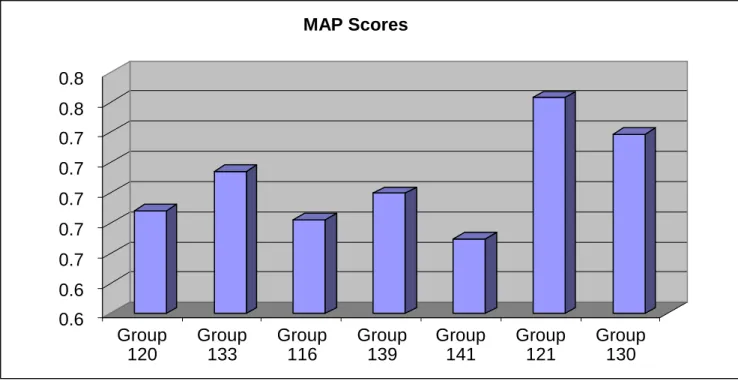
(9) Collaborative Biocuration-Text Mining Development Task for Document Prioritization for Curation Thomas C. Wiegers*, Allan Peter Davis, and Carolyn J. Mattingly Department of Biology, North Carolina State University, Raleigh, NC, USA *Corresponding author: Tel: 207-288-9880, E-mail: [email protected]. Abstract. The BioCreAtIvE (Critical Assessment of Information Extraction systems in Biology) challenge evaluation is a community-wide effort for evaluating text mining and information extraction systems for the biological domain. The BioCreative Workshop 2012 subcommittee identified three areas, or tracks, that comprised independent, but complementary aspects of data curation in which they sought community input: literature triage (Track I); curation workflow (Track II); and text mining/Natural Language Processing (NLP) systems (Track III). Track I participants were invited to develop tools or systems that would effectively triage and prioritize articles for curation and present results in a prototype web interface. Training and test data sets were derived from the Comparative Toxicogenomics Database (CTD; http://ctdbase.org) and consisted of manuscripts from which chemical-gene-disease data were manually curated. In this paper we present a detailed description of the challenge and a summary of the results.. Introduction. The Comparative Toxicogenomics Database (CTD; http://ctdbase.org) is a publicly available resource that aims to promote understanding about the mechanisms by which drugs and environmental chemicals influence the function of biological processes and human health (1). CTD data are manually curated by a team of PhD-level biocurators. Articles are typically prioritized by chemicals of interest and distributed to biocurators who then capture relevant data using our first-generation web-based curation application (2). Curated data include chemical-gene/protein interactions, chemical-disease relationships, and gene-disease relationships. These data are integrated with select external data sets to facilitate development of novel hypotheses about chemical-genedisease networks (3). All manually curated data are captured using freely available controlled vocabularies. Chemicals are represented using terms from the Chemicals and Drugs subset of the National Library of Medicine’s Medical Subject Headings (MeSH) vocabulary (4); genes and proteins are represented using the Entrez Gene vocabulary (5); diseases are represented using CTD’s novel disease vocabulary MEDIC (6) that merges OMIM and the Disease subset of the MeSH vocabulary (4,7); and chemical-gene/protein interactions. 2.
(10) are captured using CTD’s action vocabulary (1). T he implementation of a web-based curation application has had many positive effects on the CTD curation process including, increasing the efficiency of curation, enhancing the flexibility of biocurator location, introducing real-time quality control, and easing data management and storage (2). Research has demonstrated that further enhancement of the curation process for CTD, as well as for many manually curated biomedical resources, would be achieved by improving a) the triage and prioritization of data-rich relevant articles and b) the identification of curatable content within these articles (8). The BioCreative Workshop 2012 subcommittee dedicated a focus area, or track (Track I), to development of systems that would address these important yet unmet needs of the biocuration community. The CTD project was chosen as a source for the project data because it possesses a large and high quality set of manually curated information that contains elements that are of broad interest and relevance to the biomedical research community, specifically chemicals, genes/proteins, and diseases. Track I invited text-mining teams to develop a system to assist biocurators in the selection and prioritization of relevant articles for curation for CTD (http://www.biocreative.org/events/bc-workshop-2012/CFP/#track1). Participants were asked to provide two major deliverables that included a) benchmarking results on t he prioritization of relevant articles and b) a prototype web interface that would present a biocurator with these articles and the relevant information highlighted using integrated text-mining recognition tools.. Methods. Training Phase In order for participants to effectively rank articles and identify relevant data, it was critical for them to gain an understanding of the CTD curation process. To facilitate this understanding, a detailed document entitled, Summary Of Curation Details For The Comparative Toxicogenomics Database, was distributed to participants (http://www.biocreative.org/tasks/bc-workshop-2012/Triage/). In addition, a training data set was made available to participants that consisted of 1,725 articles that had been previously triaged and curated by CTD biocurators. The data were presented in a series of input files that included all associated curated data for eight target chemicals (raloxifene, aniline, amasacrine, doxorubicin, aspartame, quercetin, 2-acetylaminofluorene, and indomethacin). In January 2012, the BioCreative Track I File Upload Facility web site was released (Figure 1). T his web site enabled participants to upload their benchmarking files. The web site in turn produced a report containing detailed information regarding their benchmarking performance and aggregate statistics. Specifically, a report was generated that calculated the aggregate Mean Average Precision (MAP) score, as well as the recognition scores for each data type curated (chemicals, genes, diseases, and action terms). Additional details were provided that enabled participants to understand how these scores where calculated (Figure 1). Recognition scores were provided for each data category (chemicals, genes, diseases, and. 3.
(11) action term) within each article. Three fields were provided for each data category, on a per article basis, and included: • • •. Curated Terms - This field listed the terms, if any, that a CTD biocurator previously curated for each data category. Text Mined Terms - This field listed the text-mined terms, if any, that a participant provided for each data category. Match Explanation - This field provided an explanation of how matches between the curated and text-mined terms were determined. Because providing synonyms to curated terms are counted as matches, the notation of CYP1-->CYP1A1, for example, indicated that the term CYP1 was text mined, which is a valid synonym for the actual underlying curated term CYP1A1; alternatively, FZR1-->FZR1 indicated that the text mined term of FZR1 exactly matched the curated term.. In all, the following information was provided for each article submitted in the form of a post-submission report: • • • • • • • • • • • • • • • • • • • •. PubMed ID Curated (Y or N)? Intermediate MAP Score Curated Gene Hit Rate Curated Chemical Hit Rate Curated Disease Hit Rate Curated Action Hit Rate Text Mined Genes Curated Genes Gene Match Explanation Text Mined Chemicals Curated Chemicals Chemical Match Explanation Text Mined Diseases Curated Diseases Disease Match Explanation Text Mined Action Terms Curated Action Terms Action Term Match Explanation Curated Ixns. The final line of the report provided the aggregate MAP and recognition scores in each category. The reports were provided in both HTML and text formats; summary versions were also provided at the participant’s discretion that contained solely the aggregate statistics.. 4.
(12) Test Phase On February 6, 2012, a Track I Test Dataset was released to participants. The purpose of this data set was to evaluate the performance of the participants’ text-mining pipeline without their prior knowledge of the curated results. The Track I Test Dataset comprised 444 articles that were previously manually curated by CTD biocurators and contained information about three additional target chemicals (urethane, phenacetin, cyclophosphamide). Unlike the comprehensive curated data provided in the Training data set, the Test Dataset contained only the basic identification information for each article (PubMed ID, Title, Abstract, Journal Name, Date). Each participant was asked to process the Test Dataset using their text-mining pipeline, and provide the following information for each article/target chemical combination: • • • • • • • • • • • •. PubMed ID Title Abstract Journal Cited Gene Actors Cited Chemical Actors Cited Disease Actors Marked-up HTML of abstract with tagged links back to CTD for all corresponding terms (see note below) Document Relevancy Score optional: Marked-up HTML of relevant sentences/phrases extracted with tagged links back to CTD for all actors and terms optional: Cited Action Terms optional: Cited Interactions. The benchmarking results and associated documentation were due on February 20, 2012. Upon receipt of the benchmarking data from the participants, CTD staff evaluated the results by calculating the following metrics for each participant: • • • •. MAP score Curated Gene Term Recognition Rate Curated Chemical Term Recognition Rate Curated Disease Term Recognition Rate. Results. A total of seven groups participated: • •. BiTeM Group; Division of Medical Information Sciences, University Hospitals of Geneva and University of Geneva; Information Science Department, University of Applied Science; Geneva, Switzerland Department of Computer Science and Information Engineering, National Cheng Kung University; Department of Information Engineering, Kun Shan University, Tainan, Taiwan. 5.
(13) • • • •. Institute of Computational Linguistics, University of Zurich Two groups from the Department of Computer Science and Information Engineering, National Cheng Kung University, Tainan, Taiwan Dept. Of Computer Science East China Normal University National Center for Biotechnology Information, National Library of Medicine, National Institutes of Health, Bethesda, MD. To maintain anonymity, each group was randomly assigned a coded identification number. Mean Average Precision. For MAP score calculations, an article was counted as relevant if it had one or more associated curated interactions. Across the groups, MAP scores were fairly high and consistent, ranging from 70% to 80% (Figure 2). Curated Term Recognition. The results for recognition scores were significantly more mixed than the MAP scores. The recognition rate for each gene, chemical, and disease term was calculated by comparing the list of text-mined terms to the list of curated terms for each article and in each respective data category. As indicated above, if the curated term, or a synonym for the curated term (as defined by the corresponding CTD controlled vocabulary), was found in the text mined list, it was counted as a match. Gene recognition ranged from 1% to 49% (Figure 3). Chemical recognition ranged from 4% to 82% (Figure 4). Disease recognition ranged from 1% to 64% (Figure 5). The results of MAP scores, and chemical, gene, disease, and action term recognition scores were also aggregated onto a single bar graph for each participating group (Figure 6). Aggregate Benchmarking Results Summary. Two of the groups clearly distinguished themselves with respect to aggregate benchmarking results. Group 121 held the highest MAP score (80%) while also delivering strong recognition scores in the three major recognition categories (chemicals, genes and diseases). Group 116 delivered the highest recognition scores in two of the three major data categories (i.e., gene and disease recognition). Three other groups (120, 139 and 130) had respectable recognition scores in most, if not all, of the major data categories. The groups were also asked to provide a system description, all of which were reasonably clear and well-written. Prototype Web Interface. The participants were asked to deliver a prototype web interface to Track I organizers by March 1, 2012. All seven groups that participated in the benchmarking portion of the challenge also submitted a prototype web interface. Each interface was then evaluated based on functionality and ease-of-use by CTD’s biocuration project manager. Of the seven entries, six provided very sophisticated functionality. (Please note that the web interfaces described below that tag gene, chemical, and disease terms were only as effective at doing so as their benchmarking results suggest; the same is true for those web. 6.
(14) interfaces that provided a ranked list of PubMeds: their ranking effectiveness is reflected in their benchmarking MAP scores). Group 121. The web interface developed by Group 121 was outstanding. The biocurator accesses the system by clicking the Login link. O nce login is complete, the user is presented with a list of chemicals for curation. C licking on one of the chemicals takes the biocurator to a ranked list of articles associated with the chemical with the following information: • • • • • •. Title, Author(s), Journal name, date, and page numbers, PubMed ID, Related citations hyperlink, Abstract hyperlink. The biocurator may remove an article from the list by simply clicking on a single delete hyperlink (e.g., Delete from [BC2012-test-urethane]). Clicking on the Abstract hyperlink causes an expansion of the screen to include the complete abstract text. A ll genes, chemicals, and disease actors contained in the title or abstract and identified by the textmining tool are color-coded and hyperlinked back to the CTD web interface. Clicking on the title causes a detail page to be displayed. The detail page contains most of the same information as the main page, but also includes a list of text-mined chemical, gene and disease actors, each of which is hyperlinked back to CTD. The interface enables the user to save new annotations, as well as confirm and/or reset existing entries. Although this particular feature as currently implemented does not appear to be of direct application to CTD, it certainly has interesting long-term implications. The interface includes several additional and very convenient options. A list of textmined target chemicals is displayed on the main target chemical screen, enabling the biocurator to easily jump from one chemical list to another for curation. The ranked list of articles can be re-sorted based on date or relevancy score. Clicking a chemical, gene or disease checkbox on the main target chemical screen or on the detail page causes these actors to either be highlighted and hyperlinked, or made simply plain text. Because there is sometimes overlap in chemical, gene and disease names, there is a feature that enables the user to correct and save a text-mined actor designation to another category. Finally, there is a Display Management screen that enables biocurators to select their highlighting preferences in the interface. For example, a user can specify whether or not to display chemicals, genes, and diseases by default, as well as to set the colors of the display. Group 116. The web interface developed by Group 116 was also outstanding. The biocurator is presented with a list of target chemicals to curate. After clicking on a target chemical hyperlink, the user is presented with a ranked list of articles by their PubMed ID, relevancy score, and title. Clicking a PubMed ID presents detailed information in a new tab. The new tab displays a split screen; on the left hand side is the Document panel. 7.
(15) that displays the title and abstract text, along with all of the MeSH terms associated with the paper; the right side of the screen is the Annotation panel. The Annotation panel initially consists of two tabs: Concepts and Interactions; a Terms tab may also be displayed if the user selects it from the toolbar. The Concepts tab lists the chemical, disease, and gene terms identified during the text mining process, including the accession, term name, frequency of appearance in the abstract, and type of term (i.e., chemical, disease, or gene); the Concepts tab contains an entry for each concept identified in at least one term in the document. Each of the concepts is also scored using an algorithm developed by the team. If concept rows are expanded by clicking the plus button, a hyperlink to the relevant Web page of the CTD site appears. The Interactions tab displays potential interactions contained within the abstract; these interactions are also derived using a scoring algorithm developed by the team. For each potential interaction, a confidence score is displayed, along with the type and name of each chemical, disease, and gene actor. In the Interactions tab, clicking on the name of a participating concept opens the relevant CTD web page. The Terms tab contains an entry for each stretch of text considered as a technical term. However, no concept disambiguation is made, i.e., a term can contain references to more than one concept, even of different types (e.g., genes, chemicals, etc.). One of the excellent features of the Annotation panel is that check boxes are displayed next to each interaction and concept; clicking these check boxes will cause the associated text mined-data to be highlighted and hyperlinked within the abstract text, or alternatively simply plain text. All of this is cleverly done without a screen refresh, so it is extremely fast. The interface included several additional and very convenient options. The user may remove concepts, interactions or terms from the Annotation tab by simply selecting an associated checkbox and clicking the Remove Selected button. One may also highlight a term and add it to the concepts list by simply double clicking on it and completing the necessary data, including term, term type, concept values, comments, and search databases (i.e., CTD or Entrez), in the Inspectors tab. Mousing over a term/concept causes the term type and associated accession IDs to be displayed. The user may dump all the information associated with an article into XML format by simply selecting the option from the menu. The curation actions taken upon a document are logged into the document itself and/or into a separate database. Group 133 The user is initially presented with a selection of chemicals to curate. The biocurator selects a chemical, clicks the Submit button, and is presented with a split screen. On the left hand side of the screen is an ordered list of ranked articles with associated information including relevancy score, PubMed ID, article title, journal name and abbreviated abstract. The biocurator may begin curating from the list. C licking one of the ranked articles causes a Detail Info frame containing detailed information to be displayed on t he right hand side of the split screen. M ore specifically, each of the data elements described above is provided, along with the complete abstract text. The title and abstract contain highlighted genes and chemicals within the text, as well as lists of each beneath the. 8.
(16) abstract; the lists hyperlink each text-mined actor back to the CTD web interface. A link is also provided to view the PubMed at NCBI on a separate tab. T he interface is very clean and easy to use. Group 120 In order to begin curation, the biocurator enters a chemical as well as a list of associated PubMed IDs separated by tab or new line characters. The list of PubMed IDs is text mined and processed on a real-time basis. Once the text mining is complete, the biocurator is presented with a list of ranked and relevancy score-sorted PubMeds, including the following information: • • • • • • •. PubMed ID Article Title Journal Name Text Mined Genes Text Mined Chemicals Texted Mined Diseases Relevancy Score. To the left of each PubMed ID, a +/- button either expands or contracts display of the PubMed’s abstract. T he abstract contains highlighted genes, chemicals, and diseases within the text, each of which is hyperlinked back to the CTD web interface. T he interface is very clean and easy to use. Group 139 The web interface provided was very similar to Group 133’s prototype; only subtle differences were apparent. Group 130 Clicking on the System Demo link presents the user with the main curation screen. P ortions of the main screen are apparently under construction and are not currently functional. However, selecting a chemical from the Data set field and clicking the Submit button presents the biocurator with a list of ranked PubMeds that are associated with the selected target chemical. F or each PubMed, its numeric sequential rank is provided, along with the article’s title, abstract, and a list of text-mined chemical, gene and disease actors. Each of the text-mined actors is highlighted within the title and the abstract text. Each of the actors provided in the respective lists beneath the abstract are hyperlinked back to CTD, although the hyperlinks may or may not actually link to a CTD actor, i.e., the actors do not appear to have been mapped to actual CTD terms. Group 141 The biocurator is presented with 2 options for curation: • •. Single Mode – Allows a user to enter a single PubMed ID for text mining. Batch Mode – Allows a user to load a file containing one or more PubMed IDs; the file must contain one PubMed ID on each line without a blank line including the last line.. In Single Mode, entering a single PubMed ID and pressing Submit resulted in a report being displayed, providing the PubMed ID entered and a relevancy score. There were. 9.
(17) columns available for text mined gene, chemical, disease, and action terms, but these fields were blank. The report provided no further functionality. In Batch Mode, uploading an input file will cause a new page to be opened, providing information associated with the upload along with a link to a results file. Clicking on the link causes TAB-delimited records to be displayed, one for each PubMed ID in the input file. Each TAB-delimited record contains basic information about the PubMed, as well as a relevancy score. In conclusion, six of the seven submissions for the web interface component of the Track I challenge effectively presented the ranked and highlighted data. Of the six submissions, however, the products provided by groups 121 a nd 116 pr ovided exceptional functionality and were deemed very user-friendly with potential for future expansion and application.. 10.
(18) Conclusions. The Track I project was a very involved assignment. Development of effective ranking and recognition tools, as well as a prototype web interface that conveyed these results in a user-friendly manner required a high degree of systems development and integration. Of the seven groups, five performed very well in virtually every category. Overall, the groups far surpassed expectations and are to be congratulated on t heir efforts and accomplishments in a short period of time. In addition to the successful generation of systems that may have long-term application for either CTD or other curated database groups, the success of the Track I program underscores the enhanced benefits that result from collaborative efforts among otherwise disparate biological and computational groups.. 11.
(19) References 1. 2.. 3. 4. 5. 6. 7. 8.. Davis, A.P., King, B.L., Mockus, S., Murphy, C.G., Saraceni-Richards, C., Rosenstein, M., Wiegers, T., and Mattingly, C.J. (2011) The Comparative Toxicogenomics Database: update 2011. Nucleic Acids Res. 39, D1067-72. Davis, A.P., Wiegers, T.C., Murphy, C.G., and Mattingly, C.J. (2011) The curation paradigm and application tool used for manual curation of the scientific literature at the Comparative Toxicogenomics Database. Database (Oxford). 2011, bar034. Davis, A.P., Murphy, C.G., Saraceni-Richards, C., Rosenstein, M., Wiegers, T., and Mattingly, C.J. (2009) The Comparative Toxicogenomics Database: a knowledgebase and discovery tool for chemical-gene-disease networks. Nucleic Acids Res. 37, D786-92. Coletti, M.H. and Bleich, H.L. (2001) Medical Subject Headings used to search the biomedical literature. J Am Med Inform Assoc., 8, 317-323. Maglott, D., Ostell, J., Pruitt, K.D., and Tatusova, T. (2011) Entrez gene: Genecentered information at ncbi. Nucleic Acids Res. 39, D52-57. Davis, A.P., Wiegers, T.C., Rosenstein, M.C., and Mattingly, C.J. (2012) MEDIC: a p ractical disease vocabulary used at the comparative toxicogenomics database. Database (Oxford). 2012, bar057. Amberger, J., Bocchini, C., and Hamosh, A. (2011) A new face and new challenges for online mendelian inheritance in man (omim(r)). Hum Mutat. 32, 564-567. Wiegers, T.C., Davis, A.P., Cohen, K.B., Hirschman, L., and Mattingly, C.J. (2009) Text mining and manual curation of chemical-gene-disease networks for the comparative toxicogenomics database (CTD). BMC Bioinformatics. 10, 326.. 12.
(20) Figure 1. The BioCreative Track I File Upload Facility. A web interface was developed to allow participants to upload their results (back panel). Following successful uploads, a report was generated and returned to each participant that contained summary or detailed information for each data set. Figure 2. Mean Average Precision (MAP) score results for each participating group. For MAP score calculations, an article was counted as relevant if it had one or more associated curated interactions. Across the groups, MAP scores were fairly high and consistent, ranging from 70% to 80%. Figure 3. Gene recognition results for each participating group. The ability for textmining tools to recognize curated genes was measured; terms and synonyms to terms were counted as matches. Gene recognition ranged from 1% to 49% Figure 4. Chemical recognition results for each participating group. The ability for text-mining tools to recognize curated chemicals was measured; terms and synonyms to terms were counted as matches. Chemical recognition ranged from 4% to 82% Figure 5. Disease recognition results for each participating group. The ability for text-mining tools to recognize curated diseases was measured; terms and synonyms to terms were counted as matches. Disease recognition ranged from 1% to 64% Figure 6. Aggregate metrics for each participating group. The results of Mean Average Precision (MAP) scores, and chemical, gene, disease, and action term recognition scores are aggregated onto a single bar graph for each participating group. Two of the groups clearly distinguished themselves with respect to aggregate benchmarking results. Group 121 he ld the highest MAP score (80%) while also delivering strong recognition scores in the three major recognition categories (chemicals, genes and diseases). G roup 116 de livered the highest recognition scores in two of the three major data categories (i.e., gene and disease recognition). Three other groups (120, 139 and 130) had respectable recognition scores in most, if not all, of the major data categories.. 13.
(21) Figure 1.. 14.
(22) Figure 2. MAP Scores 0.8 0.8 0.7 0.7 0.7 0.7 0.7 0.6 0.6. Group 120. Group 133. Group 116. 15. Group 139. Group 141. Group 121. Group 130.
(23) Figure 3.. Gene Recognition 0.50 0.45 0.40 0.35 0.30 0.25 0.20 0.15 0.10 0.05 0.00 Group 120 Group 133 Group 116 Group 139 Group 141 Group 121 Group 130. 16.
(24) Figure 4.. Chem ical Recognition. 0.90 0.80 0.70 0.60 0.50 0.40 0.30 0.20 0.10 0.00 Group 120. Group 133. Group 116. Group 139. 17. Group 141. Group 121. Group 130.
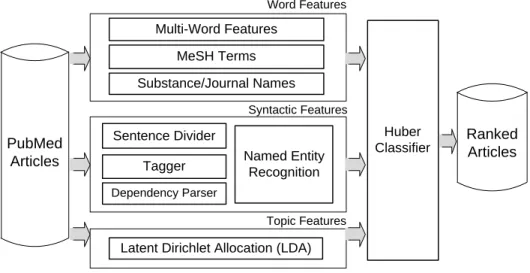
(25) Figure 5.. Disease Recognition. 0.70 0.60 0.50 0.40 0.30 0.20 0.10 0.00 Group 120 Group 133 Group 116 Group 139 Group 141 Group 121 Group 130. 18.
(26) Figure 6.. Aggregate Scoring. 3. 2.5. Curated Action Term Hit Rate Curated Disease Hit Rate. 2. Curated Chemical Hit Rate `. Curated Gene Rate. 1.5. MAP Score 1. 0.5. 0 Group 120. Group 133. Group 116. Group 139. Group 141. Group 121. 19. Group 130.
(27) System Description for the BioCreative 2012 Triage Task Sun Kim1, Won Kim1, Chih-Hsuan Wei1, Zhiyong Lu1 and W. John Wilbur1, * 1. National Center for Biotechnology Information, National Library of Medicine, National Institutes of Health, Bethesda, MD 20894, USA *Corresponding author: Tel: 301 435 5926, E-mail: [email protected]. Abstract. We developed a machine learning framework based on our prior system for the protein-protein interaction article classification task in BioCreative III. To address new challenges in the Triage task, we explored a named entity identification method for genes, chemicals and diseases. In addition, latent topics were analyzed and used as a feature type to overcome the small size of the training set. For entity annotation and a user interface, a web interface for the Interactive TM task, PubTator, was integrated with article prioritization results.. Article Prioritization for the Triage Task The BioCreative Triage task is to develop tools or systems to help the literature-based curation workflow used in the creation of the Comparative Toxicogenomic Database (CTD). In particular, this task is focused on prioritizing articles to be curated by evaluating chemical-gene, chemicaldisease and gene-disease relationships from text. To participate in this task, we assume the Triage task is an extension of the BioCreative III article classification task (ACT), where proteinprotein interaction information was the only concern of prioritizing articles. Since both tasks are data-driven and their goals are to find interaction information among specific entities, we basically follow the same framework (1, 2) developed for ACT. The previous method was successful for the ACT task. However, there are several features we should consider for this new task: 1) Target chemicals are explicitly given for training and test sets. 2) Entities to be identified are now chemical, gene, and disease names, which require new methods for syntactic analysis and named entity recognition (NER). 3) The available training set is very limited. In the Triage task, the numbers of positive and negative examples are only 1,031 and 694, respectively. To tackle these issues, some features are removed from the previous framework and others are introduced for this task.. 20.
(28) Word Features. Multi-Word Features MeSH Terms Substance/Journal Names Syntactic Features. PubMed Articles. Sentence Divider Tagger. Named Entity Recognition. Huber Classifier. Ranked Articles. Dependency Parser Topic Features. Latent Dirichlet Allocation (LDA). Figure 1. Our article prioritization method.. Figure 1 depicts the overview of our article prioritization method. For input articles, features are extracted in three different ways. One is word features including multi-words, MeSH terms and substance/journal names. The second is syntactic features based on dependency relationships between words. The third is topic features obtained from latent Dirichlet allocation (LDA) (3). After feature extraction procedures, a large margin classifier with Huber loss function (4) is utilized for learning and prioritizing articles. The following subsections describe the three feature types briefly. Word features from PubMed○R Multi-words are known as n-grams, where n-consecutive words are considered as features. We here use unigrams and bigrams from titles and abstracts. MeSH is a controlled vocabulary for indexing and searching biomedical literature, and MeSH terms are used to indicate the topics of an article. Hence, these terms are included as features. In the Triage task, target chemicals are designated for a set of articles, and journals are treated differently in the CTD rule-based system (5). Therefore, substances and journal names are also extracted from PubMed and used as features. Syntactic features for identifying entity relationships This feature identifies interactions or relationships among entities by syntactically analyzing sentences. By using a dependency parser (6), a head word and a dependent word are determined as a two-word combination. Since our goal is to find relationships between two entities, any words indicating relations are likely placed in the head position, whereas their corresponding entities will be placed in the dependent position. Thus, we only consider dependent words as candidate entities, and a NER strategy is used to identify these candidates. For the NER method, we use a vector space approach to modeling semantics (7) and compute our vectors as described in (8). We constructed our vector space using PubMed and an updated version of the SEMCAT database (9), and applied support vector machines to learn how to classify into different entity. 21.
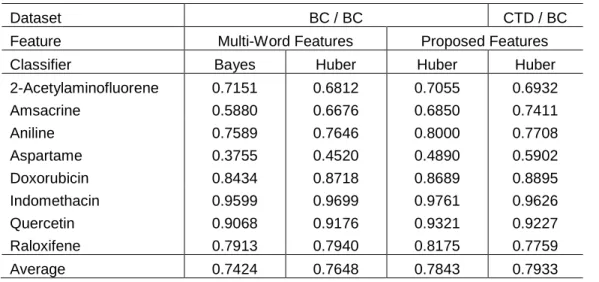
(29) types. If two different entity types are found in a sentence, we assume this sentence includes entity-entity relationship information. Topic features Along with syntactic features, topic features are newly added to address the Triage problem. There is some evidence that LDA topics can provide features with better generalization properties when there is little training data. We pooled the whole CTD (http://ctdbase.org ) and the Triage training set. In our application of LDA, we used the model as put forward in (3) and calculated the model using Markov Chain Monte Carlo (MCMC) simulation as described in (10).. Entity Annotation and User Interface While entity annotation can be combined with an article prioritization method, our approach does not use fully annotated names for genes, chemicals and diseases. As explained above, the proposed method rather makes a quick decision for single words obtained from dependency parsing. As a result, we currently cannot obtain gene/chemical/disease actors directly from our prioritization system. However, our experimental setup makes individual processes independent. Thus, each module can be replaced with other similar approaches as desired. This applies to our feature selection, machine learning classifiers and even entity/actor annotations. Since official results should be submitted with actor information as well as prioritized articles, we use PubTator (11) for annotating entities and for providing a web interface for the Triage task. PubTator is a web-based tool which is developed for creating, saving and exporting annotations. PubTator was customized to have a tailored output for combining the results of article ranking and bioconcept annotation.. Experimental Results Table 1 shows average precisions for different dataset, feature and classifier combinations. The last column is the configuration we used for the Triage task. BC/BC means positive and negative examples from the Triage training set. CTD/BC means positive examples from CTD dataset and negative examples from the Triage training set. Compared to Bayes classifiers (first column), the proposed method improves average precisions up to 5% on average. Note that test examples were always excluded from the training set in either BC/BC or CTD/BC experiments.. 22.
(30) Table 1. Article prioritization performance (average precision) for different dataset, feature and classifier combinations. Dataset. BC / BC. CTD / BC. Feature. Multi-Word Features. Proposed Features. Classifier. Bayes. Huber. Huber. Huber. 2-Acetylaminofluorene. 0.7151. 0.6812. 0.7055. 0.6932. Amsacrine. 0.5880. 0.6676. 0.6850. 0.7411. Aniline. 0.7589. 0.7646. 0.8000. 0.7708. Aspartame. 0.3755. 0.4520. 0.4890. 0.5902. Doxorubicin. 0.8434. 0.8718. 0.8689. 0.8895. Indomethacin. 0.9599. 0.9699. 0.9761. 0.9626. Quercetin. 0.9068. 0.9176. 0.9321. 0.9227. Raloxifene. 0.7913. 0.7940. 0.8175. 0.7759. Average. 0.7424. 0.7648. 0.7843. 0.7933. Funding This work was supported by the Intramural Research Program of the National Institutes of Health, National Library of Medicine.. References 1. Kim, S. and Wilbur, W. J. (2011) Classifying protein-protein interaction articles using word and syntactic features, BMC Bioinformatics, 12(Suppl 8), S9. 2. Kim, S., Kwon, D., Shin, S.-Y., and Wilbur, W. J. (2012) PIE the search: searching PubMed literature for protein interaction information, Bioinformatics, 28(4), pp. 597-598. 3. Blei, D. M., Ng, A. Y., and Jordan, M. I. (2003) Latent Dirichlet allocation, Journal of Machine Learning Research, 3, pp. 993-1022. 4. Zhang, T. (2004) Solving large scale linear prediction problems using stochastic gradient descent algorithms, Proceedings of the 21st International Conference on Machine Learning, pp. 919-926. 5. Summary of curation details for the Comparative Toxicogenomics Database, http://www.biocreative.org/tasks/bc-workshop-2012/Triage 6. Curran, J. R., Clark, S., and Bos, J. (2007) Linguistically motivated large-scale NLP with C&C and Boxer, Proceedings of the ACL 2007 Demonstrations Session (ACL-07 demo), pp. 33-36. 7. Turney, P. D. and Pantel, P. (2010) From frequency to meaning: vector space models of semantics, Journal of Artificial Intelligence Research, 37, pp. 141-188.. 23.
(31) 8. Pantel, P. and Lin, D. (2002) Discovering word senses from text, Proceedings of the eighth ACM SIGKDD International Conference on Knowledge Discovery and Data Mining, pp. 613-619. 9. Tanabe, L. et al. (2006) SemCat: semantically categorized entities for genomics, AMIA Annual Symposium Proceedings, pp. 754-758. 10. Griffiths, T. L. and Steyvers, M. (2004) Finding scientific topics, Proceedings of the National Academy of Sciences, 101, pp. 5228-5235. 11. Wei, C.-H., Kao, H.-Y., and Lu, Z. (2012) PubTator: A PubMed-like interactive curation system for document triage and literature curation, Proceedings of the BioCreative Workshop 2012.. 24.
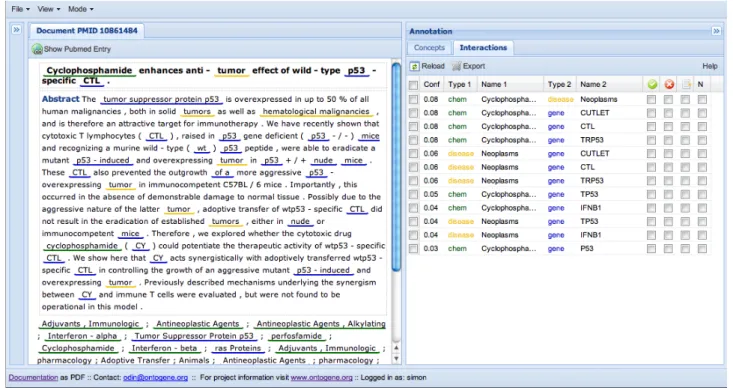
(32) Ranking of CTD articles and interactions using the OntoGene pipeline Fabio Rinaldi, Simon Clematide and Simon Hafner Institute of Computational Linguistics, University of Zurich {rinaldi,siclemat}@cl.uzh.ch,[email protected] Abstract In this paper we briefly describe the architecture of the OntoGene Relation mining pipeline and its application in the task 1 of BioCreative IV. The aim of the task is to deliver information useful for the triage of abstracts relevant to the process of curation of the Comparative Toxicogenomics Database. Although the main focus of our text mining research is the extraction of interactions, we decided to participate in the task with the assumption that articles which contain relevant interactions would be relevant themselves. We use a conventional information retrieval system (Lucene) to provide a baseline ranking, which we then combine with information provided by the relation mining module, in order to achieve an optimized ranking.. 1. Introduction. As a way to cope with the constantly increasing generation of results in molecular biology, some organizations maintain various types of databases that aim at collecting the most significant information in a specific area. For example, UniProt/SwissProt [14] collects information on all known proteins. IntAct [4] is a database collecting protein interactions. The Comparative Toxicogenomics Database collects interactions between chemicals and genes in order to support the study on the effects of environmental chemicals on health [6]. Most of the information in these databases is derived from the primary literature by a process of manual revision known as ”literature curation”. Text mining solutions are increasingly requested to support the process of curation of biomedical databases. The work presented here is part the OntoGene project1 , which aims at improving biomedical text mining through the usage of advanced natural language processing techniques. Our approach relies upon information delivered by a pipeline of NLP tools, including sentence splitting, tokenization, part of speech tagging, term recognition, noun and verb phrase chunking, and a dependency-based syntactic analysis of input sentences [11, 9]. The results of the entity detection feed directly into the process of identification of interactions. The syntactic parser [13] takes into account constituent boundaries defined by previously identified multi-word entities. Therefore the richness of the entity annotation has a direct beneficial impact on the performance of the parser, and thus leads to better recognition of interactions. Recently, in the context of the SASEBio project (Semi-Automated Semantic Enrichment of the Biomedical Literature), the OntoGene group has developed a user-friendly interface (ODIN: OntoGene Document INspector) which presents the results of the text mining pipeline intuitive fashion, and allows a deeper interaction of the curator with the underlying text mining system. In the rest of this paper we first explain how our existing OntoGene relation mining system has been customized for CTD (section 2) and then how it has been integrated with a conventional IR system (Lucene) for the purpose of the Triage task (section 3). We also provide a brief overview of our ODIN curation interface (section 4) and a preliminary evaluation of the results obtained so far (section 5) 1 http://www.ontogene.org/. 25.
(33) 2. Methods. In this section we describe the OntoGene Text Mining pipeline which is used to (a) provide all basic preprocessing (e.g. tokenization) of the target documents, (b) identify all mentions of domain entities and normalize them to database identifiers, and (c) extract candidate interactions. We describe then in some detail a machine learning approach used to obtain an optimized scoring of candidate interactions based upon global information from the whole CTD.. 2.1. Preprocessing and Detection of Domain Entities. In order to solve the triage task, we processed the PubMed abstracts of the referenced articles by the OntoGene Text Mining pipeline. As shown in our previous work [2], the inclusion of PubMed metadata, such as the list of chemical substances, as well as the annotated MeSH descriptors and qualifiers, improves the detection of important relations and enhances term recognition coverage. Therefore, we added these metadata from the PubMed XML files as a textual list at the end of each abstract. In our OntoGene text mining pipeline, the sentence and token boundaries of the enriched abstracts are identified using the LingPipe framework2 Next, we describe our approach to the problem of detecting names of relevant domain entities in biomedical literature (genes, chemicals and diseases for CTD) and grounding them to widely accepted identifiers assigned by the original database. Terms, i.e. preferred names and synonyms, are automatically extracted from the original CTD databases and stored in a common internal format, together with their unique identifiers (as obtained from the original resource). An efficient lookup procedure is used to annotate any mention of a term in the documents with the ID(s) to which it corresponds. A term normalization step is used to take into account a number of possible surface variations of the terms. The same normalization is applied to the list of known terms at the beginning of the annotation process, when it is read into memory, and to the candidate terms in the input text, so that a matching between variants of the same term becomes possible despite the differences in the surface strings. In case the normalized strings match exactly, the input sequence is annotated with the IDs of the reference term – no further disambiguation on concepts is done. For more technical details of our term recognizer, see [8].. 2.2. Detection of Interactions. The information about mentions of relevant domain entities (and their corresponding unique identifiers) can be used to create candidate interactions. In other words, the co-occurrence of two entities in a given text span (typically one or more sentences, or an even larger observation window) is a low-precision, but high-recall indication of a potential relationship among those entities. In order to obtain better precision it is possible to take into account the syntactic structure of the sentence, or the global distribution of interactions in the original database. In this section we describe in detail how candidate interactions are ranked by our system, according to their relevance for CTD curation, by exploiting the vast amount of curated articles in the CTD base. An initial ranking of the candidate relations can be generated on the basis of frequency of occurrence of the respective entities only: relscore(e1 , e2 ) = (f (e1 ) + f (e2 ))/f (E) where f (e1 ) and f (e2 ) are the number of times the entities e1 and e2 are observed in the abstract, while f (E) is the total count of all identifiers in the abstract. We know from our previous experiments [9] that giving a “boost” of 10 to the entities contained in the title produces a measurable improvement of ranking of the results. This simple approach can be further optimized if we apply a supervised machine learning method for scoring the probability of a term to be part of an interesting relation. There are two key motivations for scoring concepts based upon relation candidate ranking: First, we need to adapt to highly-ranked false positive relations which are generated by a simple frequency based approach by frequent but uninteresting concepts. The goal is to model some global properties of the curated CTD relations. Second, we want to penalize false positive concepts that our term recognizer detects. In order to deal with such cases, we need to condition the concepts by their normalized3 textual form t. The combination of a term t and one of its valid entities e is noted as t : e. 2 More 3A. information regarding the framework can be found at http://alias-i.com/lingpipe. normalized textual form of a term consists of the sequence of lower-case alphanumeric characters of all term tokens.. 26.
(34) Next we define a predicate gold(A, e) which is true (i.e. 1) for an article A if there is at least one relation in the gold standard where entity e is part of, and false (i.e. 0) otherwise. We estimate the overall probability P ( gold(A, e) = 1 | t : e ) with the help of the Maximum Entropy Modeling tool megam [3]. For training we use the set of CTD-referenced PubMed articles having not more than 12 manually curated relations4 , additionally removing all articles which are part of the BioCreative training and test set for the respective data set5 . For unseen normalized terms t, i.e. terms not present in the training data, the maximum entropy classifier would assign a low default probability based on the distribution of all training instances. However, we can specify better back-off probabilities if we take into account the admissible entity/entities e of term t. Our current back-off model works as follows: if the entity e of an unseen t is seen in the article, the averaged probability of all seen term-entity pairs is used. Otherwise, the averaged probability of all entities of the same type as e is used. The score of an entity e in an article A is the sum of all zoned term frequencies6 weighted by their gold probability: X score(e) = f (t : e) × P ( gold(A, e) = 1 | t : e ) t:e ∈A. Having determined the individual score for each entity e, we compute the relation score as the harmonic mean of its component scores: score(e1 ) × score(e2 ) relscore(e1 , e2 ) = 2 × score(e1 ) + score(e2 ) In preceding work on relation ranking [2], the relation score was taken as a sum of the concept scores. By performing systematic cross-validation experiments on all CTD articles, we noticed that using the harmonic mean improves the results considerably. In order to make the relation scores comparable between different articles we normalize all relation for a given BioCreative data set.. 3. Integration with a standard IR system. A conventional IR system is used to provide a baseline document classification. Information derived from the OntoGene pipeline, and from the ranking process described in the previous section, is then added as additional features in order to improve the baseline ranking generated by the IR system. The integration of the various components is performed using mainly JRuby (and some small parts in Java).. 3.1. Terminology-aware tokenization. Documents are processed by Lucene in the conventional way, selecting different boost values for title and abstract (10 for title, 3 for abstract, just as in the CTD reference system). The Lucene API is accessed via JRuby. Changes in the boost values did not show any statistically significant change in the MAP scores, because most of the information is in the abstract, not the title. The existence of relevant information in the title typically implies relevant information in the abstract. The only significant technical change to Lucene preprocessing is the replacement of the “StandardAnalyzer” component (which is the default analyzer for English, responsible for tokenization, stemming, etc.) with our own tokenization results, as delivered by the OntoGene pipeline. The advantage of this approach is that we can flexibly treat recognized technical terms as individual tokens, and map together their synonyms [7]. In order words, after this step all known synonyms of a term will be treated as identical by the IR system. The “StandardAnalyzer” component is replaced by a simple transformation of the XML output of the pipeline into a format suitable for internal processing by Lucene. In particular tokens and terms as recognized by the pipeline are transformed into Lucene “token” data objects. Whenever a domain entity (denoted by the Term element in the XML representation) is found, its words are concatenated to one token. At the same position, a new token with the text of the concept identifier is added to the stream. As an example: 4 The threshold of 12 relations is motivated by the observation that the more relations an article has the less probable it is to find them by processing the abstracts only. 5 This results in 22319 articles for the BioCreative 4 training set, containing 69320 curated relations. For the BioCreative 4 test set, we used 22825 articles with 71064 relations. 6 As mentioned earlier, occurrences in the title are counted 10 times.. 27.
(35) <W C="VBN" id="W151" o1="758" o2="767">inhibited</W> <Term allvalues="MESH_D015232:chem" id="TW152W153" matched="prostaglandine2" type="chem"> <W C="NN" id="W152" o1="768" o2="781">prostaglandin</W> <W C="NN" id="W153" o1="782" o2="784">E2</W> </Term> <W C="NN" id="W154" o1="785" o2="794">synthesis</W>. would be converted to the following (square brackets denote token boundaries): [inhibited] [prostaglandin E2] [synthesis] [MESH_D015232]. Synonymous terms (as identified by the pipeline) are mapped to their unique identifiers (for this experiment the term identifier provided by the CTD database, which happens to be a MeSH term in the example above). A basic search is conducted by mapping the target chemical to the corresponding identifier, which is then used as a query term to perform a search in Lucene.. 3.2. Relation-based query expansion. As described in section 2.2 the OntoGene pipeline is not only used in order to deliver an optimized tokenization, it can also be used to generate candidate interactions, which could be directly used for curation purposes by CTD curators. Although the definition of the task did not require the participants to deliver candidate interactions, we worked under the assumption that documents which contain relevant interactions would be relevant themselves. When another term is often seen in relation with the target term, it is probably important for the target. This statistical information is used to adjust the ranking of the documents. The OntoGene pipeline delivers candidate interactions as part of its standard output for each single document. Each interaction is assigned a score in the interval (0,1]. The relations are extracted from all the files in the document set assigned to the target chemical by the organizers. All relations which involve a term equivalent to the target (the target or one of its synonyms) are extracted. The interacting entity (the second term in those interactions) is then added to the search query, for each interaction, giving rise to an expanded query. The additional query terms are weighted according to the normalized score of the original interaction. As an example suppose two documents contain the interactions listed in the first two columns below (document 1 and document 2): document 1: A C 1 B C 0.7 A B 0.5 A D 0.4. document 2: A B 1 B D 0.42. expansion terms: C 1 from doc 1 B 0.75 from doc 1 (score 0.5) and doc 2 (score 1) D 0.4 from doc 1. If the target term is A, the relations marked in boldface are relevant, which gives us new search terms to be added to the query, listed in the 3rd column with their normalized weights (sum of scores divided by the number of relations). The original target term is given a weight which is above the weight of the relations in order to make it clearly more relevant than any of the added terms. We have experimentally verified on the training data that the using this query expansion process improves the average MAP scores from 0.62225 to 0.694625 (i.e. an improvement of nearly 12%).. 4. The ODIN Interface. The results of the OntoGene text mining system are made accessible through a curation system called ODIN (“OntoGene Document INspector”) which allows a user to dynamically inspect the results of their text mining pipeline. A previous version of ODIN was used for participation in the ‘interactive curation’ task (IAT) of the BioCreative III competition [1]. This was an informal task without a quantitative evaluation of the participating systems. However, the curators who used the system commented extremely positively on its usability for a practical curation task. An experiment in interactive curation has been performed in collaboration with curators of the PharmGKB database [5, 12]. The results of this experiment are described in [10], which also provides further details on the architecture of the system.. 28.
(36) Figure 1: Entity annotations and candidate interactions on a sample PubMed abstract. More recently, we partially adapted ODIN to the aims of CTD curation, allowing the inspection of PubMed abstracts annotated with CTD entities and showing the interactions extracted by our system. We would be interested in providing further customizations according to the needs of the CTD curation process.. 5. Evaluation. In order to generally assess the upper limit of our relation recognition system, we evaluated the coverage of the term recognizer on all CTD-referenced articles containing at most 12 curated relations. The table below describes the coverage of term recognition for concepts and relations in experimental data and shows that we find about 3/4 of all entities. However, the upper limits for relation detection are not the same for all relation types. The coverage of relations involving chemicals have substantially lower coverage rates which seems a bit unfortunate for the CTD triage task. Cat disease chemical gene TOTAL. N 12639 38523 39150 90312. abs 9502 30129 29199 68830. rel 75.18 78.21 74.58 76.21. dis-gen che-dis che-gen TOTAL. 6956 12154 52746 71856. 5126 8356 34883 48365. 73.69 68.75 66.13 67.31. The table below shows the final results obtained on the training set using the on-line evaluation tool. Due to lack of space and time, we cannot report here a detailed analysis of all intermediate results, which we intend to present at the workshop.. 29.
(37) Term doxorubicin indomethacin raloxifene amsacrine aniline 2-Acetylaminofluorene aspartame quercetin. 6. MAP 0.800 0.936 0.798 0.655 0.543 0.643 0.365 0.853. genes 0.167 0.331 0.244 0.603 0.625 0.412 0.686 0.463. chemicals 0.843 0.834 0.818 0.689 0.561 0.845 0.756 0.646. diseases 0.793 0.725 0.778 0.500 0.524 0.421 0.720 0.653. Conclusions. In this paper we have described our approach towards ranking biomedical abstracts for the triage task of the CTD curation process. The peculiarity of the approach is that it gives priority to the identification of candidate interactions, which are then used as additional weighting factors in a conventional IR-based system. The OntoGene pipeline is capable of delivering all information relevant to CTD curation: entities with their database references, interactions, and interaction terms. In the shared task however, due to insufficient time for customization, we decided to exclude the computation of interaction terms. The results of the system are accessible through an intuitive interactive interface, which we are willing to customize for CTD curation. Acknowledgments This research is partially funded by the Swiss National Science Foundation (grant 100014-118396/1) and Novartis Pharma AG, NIBR-IT, Text Mining Services, CH-4002, Basel, Switzerland.. References [1] Cecilia Arighi, Phoebe Roberts, Shashank Agarwal, Sanmitra Bhattacharya, Gianni Cesareni, Andrew Chatr-aryamontri, Simon Clematide, Pascale Gaudet, Michelle Giglio, Ian Harrow, Eva Huala, Martin Krallinger, Ulf Leser, Donghui Li, Feifan Liu, Zhiyong Lu, Lois Maltais, Naoaki Okazaki, Livia Perfetto, Fabio Rinaldi, Rune Saetre, David Salgado, Padmini Srinivasan, Philippe Thomas, Luca Toldo, Lynette Hirschman, and Cathy Wu. Biocreative iii interactive task: an overview. BMC Bioinformatics, 12(Suppl 8):S4, 2011. [2] Simon Clematide and Fabio Rinaldi. Ranking interactions for a curation task. Machine Learning and Applications, Fourth International Conference on, 2:100–105, 2011. [3] Hal Daum´e III. Notes on CG and LM-BFGS optimization of logistic regression. Paper available at http://pub.hal3.name# daume04cg-bfgs, implementation available at http://hal3.name/megam/, August 2004. [4] Henning Hermjakob, Luisa Montecchi-Palazzi, Chris Lewington, Sugath Mudali, Samuel Kerrien, Sandra Orchard, Martin Vingron, Bernd Roechert, Peter Roepstorff, Alfonso Valencia, Hanah Margalit, John Armstrong, Amos Bairoch, Gianni Cesareni, David Sherman, and Rolf Apweiler. IntAct: an open source molecular interaction database. Nucl. Acids Res., 32(suppl 1):D452–455, 2004. [5] T.E. Klein, J.T. Chang, M.K. Cho, K.L. Easton, R. Fergerson, M. Hewett, Z. Lin, Y. Liu, S. Liu, D.E. Oliver, D.L. Rubin, F. Shafa, J.M. Stuart, and R.B. Altman. Integrating genotype and phenotype information: An overview of the pharmgkb project. The Pharmacogenomics Journal, 1:167–170, 2001. [6] C.J. Mattingly, M.C. Rosenstein, G.T. Colby, J.N. Forrest Jr, and J.L. Boyer. The Comparative Toxicogenomics Database (CTD): a resource for comparative toxicological studies. Journal of Experimental Zoology Part A: Comparative Experimental Biology, 305A(9):689– 692, 2006. [7] Fabio Rinaldi, James Dowdall, Michael Hess, Kaarel Kaljurand, Mare Koit, Kadri Vider, and Neeme Kahusk. Terminology as Knowledge in Answer Extraction. In Proceedings of the 6th International Conference on Terminology and Knowledge Engineering (TKE02), pages 107–113, Nancy, 28–30 August 2002. [8] Fabio Rinaldi, Kaarel Kaljurand, and Rune Saetre. Terminological resources for text mining over biomedical scientific literature. Journal of Artificial Intelligence in Medicine, 52(2):107–114, June 2011. [9] Fabio Rinaldi, Thomas Kappeler, Kaarel Kaljurand, Gerold Schneider, Manfred Klenner, Simon Clematide, Michael Hess, Jean-Marc von Allmen, Pierre Parisot, Martin Romacker, and Therese Vachon. OntoGene in BioCreative II. Genome Biology, 9(Suppl 2):S13, 2008. [10] Fabio Rinaldi, Gerold Schneider, and Simon Clematide. Relation mining experiments in the pharmacogenomics domain. Journal of Biomedical Informatics, special issue for the Biocuration 2012 conference, 2012. conditionally accepted for publication. [11] Fabio Rinaldi, Gerold Schneider, Kaarel Kaljurand, Michael Hess, and Martin Romacker. An Environment for Relation Mining over Richly Annotated Corpora: the case of GENIA. BMC Bioinformatics, 7(Suppl 3):S3, 2006. [12] Katrin Sangkuhl, Dorit S. Berlin, Russ B. Altman, and Teri E. Klein. Pharmgkb: Understanding the effects of individual genetic variants. Drug Metabolism Reviews, 40(4):539–551, 2008. PMID: 18949600. [13] Gerold Schneider. Hybrid Long-Distance Functional Dependency Parsing. Doctoral Thesis, Institute of Computational Linguistics, University of Zurich, 2008. [14] UniProt Consortium. The universal protein resource (uniprot). Nucleic Acids Research, 35:D193–7, 2007.. 30.
Figure
+7


Documents relatifs
The regional physicians’ chambers addi- tionally negotiate a capacity plan (“location plan”) with the Federation of Social Insurance Institutions for outpatient care
Arzneimittel (Heilmittel) werden seit 2006 vom Geschäftsbereich PharmMed Austria des Bundesamtes für Sicherheit im Gesundheits- wesen zugelassen (wobei seit 2004
District administrations play a major role in managing the local health care budget yet their scope for innovation is constrained by the rigid line-item budget structure of
The Ministry of Health funds university hospitals, specialized health institutions at the national and regional levels, the public health system, national health programmes,
The Health Systems in Transition (HiT) profile on The former Yugoslav Republic of Macedonia was written by Dragan Gjorgjev (Republic Institute for Health Protection),
In der Öffentlichkeit am meisten wahrgenommen wurde die politische Wende hin zu mehr Zuzahlungen (z.B. für Arztbesuche) und Leistungsausschlüssen, was einen Rückgriff auf
The final recommendations (in 2002) endorsed the principle that patients in public hospitals should have choice of physician, supported a slight and gradual increase in
The collapse of health care funding in the beginning of the 1990s, combined with the inefficient use of existing resources and the focus on tertiary care, has threatened
