Publisher’s version / Version de l'éditeur:
The journal of physical chemistry. B, 113, 24, pp. 8369-8374, 2009-05-24
READ THESE TERMS AND CONDITIONS CAREFULLY BEFORE USING THIS WEBSITE.
https://nrc-publications.canada.ca/eng/copyright
Vous avez des questions? Nous pouvons vous aider. Pour communiquer directement avec un auteur, consultez la première page de la revue dans laquelle son article a été publié afin de trouver ses coordonnées. Si vous n’arrivez pas à les repérer, communiquez avec nous à [email protected].
Questions? Contact the NRC Publications Archive team at
[email protected]. If you wish to email the authors directly, please see the first page of the publication for their contact information.
NRC Publications Archive
Archives des publications du CNRC
This publication could be one of several versions: author’s original, accepted manuscript or the publisher’s version. / La version de cette publication peut être l’une des suivantes : la version prépublication de l’auteur, la version acceptée du manuscrit ou la version de l’éditeur.
For the publisher’s version, please access the DOI link below./ Pour consulter la version de l’éditeur, utilisez le lien DOI ci-dessous.
https://doi.org/10.1021/jp900796w
Access and use of this website and the material on it are subject to the Terms and Conditions set forth at
The effect of relative humidity on binary gas diffusion
Astrath, Nelson; Shen, Jun; Song, Datong; Rohling, Jurandir H.; Astrath,
Francine B. G.; Zhou, Jianqin; Navessin, Titichai; Liu, Zhong Sheng (Simon);
Gu, Caikang; Zhao, Xinsheng
https://publications-cnrc.canada.ca/fra/droits
L’accès à ce site Web et l’utilisation de son contenu sont assujettis aux conditions présentées dans le site LISEZ CES CONDITIONS ATTENTIVEMENT AVANT D’UTILISER CE SITE WEB.
NRC Publications Record / Notice d'Archives des publications de CNRC:
https://nrc-publications.canada.ca/eng/view/object/?id=c82cc270-0694-46d0-9815-705a373864f0 https://publications-cnrc.canada.ca/fra/voir/objet/?id=c82cc270-0694-46d0-9815-705a373864f0
The Effect of Relative Humidity on Binary Gas Diffusion
Nelson G. C. Astrath,* Jun Shen,* Datong Song, Jurandir H. Rohling, Francine B. G. Astrath, Jianqin Zhou, Titichai Navessin, Zhong Sheng (Simon) Liu, Caikang E. Gu, and
Xinsheng Zhao
National Research Council of Canada, Institute for Fuel Cell InnoVation, 4250 Wesbrook Mall, VancouVer, British Columbia V6T 1W5 Canada
ReceiVed: January 27, 2009; ReVised Manuscript ReceiVed: February 20, 2009
The dependence of diffusion coefficient of O2-N2mixture in the presence of water vapor was experimentally
determined as a function of relative humidity (RH) with different temperatures using an in-house made Loschmidt diffusion cell. The experimental results showed that O2-N2diffusion coefficient increased more
than 17% when RH increased from 0% to 80% at 79 °C. In the experiments, the RH in both top and bottom chambers of the diffusion cell were the same, and the pressure inside the diffusion cell was kept as ambient pressure (1 atm.). Maxwell-Stefan theory was employed to analyze the mass transport in the diffusion cell, and found that there was no effective water vapor diffusion taking place, indicating that the gas diffusion in this ternary (O2-N2-water vapor) system could be considered binary gas (O2-N2) diffusion. The Fuller,
Schettler, and Giddings (FSG) empirical equation of the kinetic theory of gases was generalized to accommodate the dependence of the binary diffusion coefficient on the RH. The prediction of the generalized equation was found to be consistent with experimental results with the difference of less than 1.5%, showing that the generalized equation could be applied to calculate the diffusion coefficients of the binary gaseous mixture with different temperature and RH values. The effect of water vapor on the increase of O2-N2 diffusion
coefficient was discussed using molecule theory.
Introduction
Thanks to the well-known significance of gaseous diffusion in a wide variety of chemical processes, the temperature and pressure dependence of the diffusion coefficient (namely dif-fusivity) were theoretically and experimentally investigated for numerous binary gas systems.1,2Over a century, considerable
efforts were made to develop a dependable and general equation to predict the binary gas diffusion coefficients for several binary systems. For this purpose, Arnold,3 Gilliland,4Chapman and
Enskog,5 Hirschfelder, Bird and Spotz,6 Chen and Othmer,7
Fuller, Schettler and Giddings (FSG),8 and Huang and
co-workers9developed empirical equations of the kinetic theory
of gases based on Stefan-Maxwell’s hard sphere model. Among them FSG8developed a successful equation in which atomic
and structural volume increments were obtained by a comparison between their theory and more than 500 measurements.1As
indicated by Karaiskakis and Gavril, the FSG equation provides the best practical combination of simplicity and accuracy.1
However, all of these equations cannot predict the influence of humidity on binary gas diffusion. The determination of O2-N2
diffusion in the presence of water vapor is relevant to numerous chemical and electrochemical reactions. For example, in a proton exchange membrane fuel cell, at variable relative humidity (RH) value oxygen is transported from an air-flow channel, through a gas diffusion layer and then into a cathode catalyst layer, where an oxygen reduction reaction takes place. The rate of diffusion of oxygen affects significantly the power output of the proton exchange membrane fuel cell. In this context, the knowledge of the binary gas diffusion coefficient in different gas humidity
is crucial for the development of an accurate theoretical prediction and simulation of fuel cell performance.10
In this work the influence of humidity on binary gas (O2-N2)
diffusion was theoretically and experimentally examined. Maxwell-Stefan theory was employed to study the O2-N2
diffusion in the presence of water vapor as a ternary system, and the numerical simulation showed that under a certain condition the diffusion could be treated as binary gas diffusion. O2-N2 diffusion coefficients were measured under various
experimental conditions of different temperatures and relative humidity using an in-house made gas diffusion cell. The FSG equation was generalized to accommodate the dependence of the diffusion coefficient on relative humidity. The prediction of the generalized equation was found to be well consistent with experimental data, exhibiting that the generalized equation could be used to calculate O2-N2diffusion coefficients with various
temperatures and relative humidity.
Experimental Section
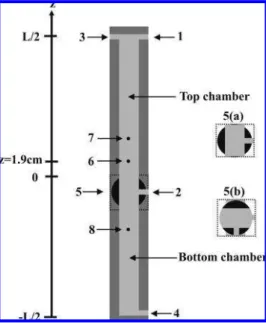
Experimental Setup.Figure 1 shows a Loschmidt diffusion cell used in this work.11 It consisted of the top and bottom
chambers. The interior length and diameter of each chamber were 0.5L ) 17.75 and 2.06 cm, respectively. They could be connected (5a) or separated (5b) by a ball valve (5) (Apollo 86-104-49). The upper side of the ball valve marked the middle of the diffusion cell (z ) 0), and the ball valve was part of the bottom chamber. Two mass flow controllers (Omega, model FMA-5508 0-500 mL/min) were connected to two inlets (1 and 2) to control the gas flow rate when gases were filled into the chambers. An oxygen sensor (Ocean Optics FOXY-AL300) was employed to measure gas diffusion coefficients. Its 300µm (in diameter) aluminum jacketed optical fiber probe was installed in the top chamber at the position very close to z ) 1.9 cm (6). * To whom correspondence should be addressed. E-mail:
[email protected], [email protected].
J. Phys. Chem. B 2009, 113, 8369
10.1021/jp900796w CCC: $40.75 Published 2009 by the American Chemical Society Published on Web 05/26/2009
On the tip of the optical fiber probe was the ruthenium complex in a sol-gel substrate. The probe was connected to an excitation source and a spectrometer (Ocean Optics S2000-FL) by a bifurcated optical fiber. The spectrometer was connected by a computer via a USB A/D converter (Ocean Optics ADC 1000). According to the vender, the response time of the oxygen sensor is around 1 s and the accuracy is 1% of full range for 0-100% (mole percent).
In this work, we measured binary diffusion coefficients of O2-N2with different humidity and temperature. To fill the gases
into the diffusion cell, first, with the inlet 2 and outlet 3 closed and the ball valve opened (5a), both chambers (top and bottom) were filled with gas 1, N2, through the inlet 1 for 15 min at a
flow rate of 500 mL/min. Meanwhile, the outlet 4 was open to expel the originally existing gas. Second, after both inlet 1 and outlet 4 were closed, the ball valve was closed (5b). Third, the bottom chamber was filled with gas 2, O2, through inlet 2 for
12 min at a flow rate of 500 mL/min, at the same time outlet 4 was open to drive out gas N2. Fourth, both inlet 2 and outlet 4
were closed. Finally, both outlet 3 and outlet 4 were opened for around 15 s then were closed. In this way the pressure inside of the diffusion cell kept as the ambient pressure. The chambers, pipes and valves were temperature controlled. A humidifier (TesSol FCTS BH 500) was coupled into both gas suppliers, inlet 1 and 2, to control the relative humidity (RH) values of the gases from 0 to 90%. The RH in both chambers was monitored using two RH sensors (7 and 8) (Sensirion SHT75). After the gases were filled into the diffusion cell, the oxygen sensor was employed to measure the O2concentration evolution
in the top chamber. Before the diffusion started, the oxygen sensor signal was monitored for about 120 s to make sure the system was stable. This signal was also used as a baseline. When the ball valve was opened, the gas diffusion started, and the concentration of O2in the top chamber began to increase. The
time-resolved signal from the O2sensor was recorded, and the
whole measurement system was controlled by the computer.
Signal Processing. In the experiments the top and bottom chambers were initially filled with two gases: gas 1 (N2, species
1) and gas 2 (O2, species 2), respectively, with the same RH.
When theses two chambers were connected at t ) 0, the
diffusion started. The O2-N2diffusion in the presence of water
vapor is a ternary system, and Maxwell-Stefan theory is employed to analyze gas transport in the diffusion cell. Mass fractions for two of the three components are solved, and the third one is given by the first two. The three governing equations are12 F ∂ω 1 ∂t + ∇ ·
(
-Fω1∑
k)1 3[
D˜1k(
∇xk+ (xk-ωk)∇p p)
]
-D†∇T T)
) -Fu · ∇ω1 (1) and F ∂ω2 ∂t + ∇ ·(
-Fω2∑
k)1 3[
D˜2k(
∇xk+ (xk-ωk)∇p p)
]
-D†∇T T)
) -Fu · ∇ω2 (2) for N2and O2mass fractions,ω1andω2, respectively. Watervapor mass fraction isω3) 1 -ω1-ω2.
In eqs 1 and 2 D†is the transpose of the diffusion coefficient
matrix D )(Dik) (cm2s-1), and p the total pressure (Pa). T is
the temperature (K), and u the velocity vector (cm s-1); x and
ω are mole fraction and mass fraction, respectively. The mixture density, F (g cm-3), is a function of the average mixture mole
fraction of the mixture mole mass, M (g mol-1), and the mixture
mole fractions, M )
∑
i xiMi (3) and F ) p RTM (4)Here Miis the mole mass of component i. Note that D˜ikis the
(i,k) component of the multicomponent Fick diffusivity matrix
D˜ . It can be calculated from Maxwell-Stefan diffusivities/binary
diffusivities, Dik, which is given by13
pDvapor,N2) 0.2599
(
T 299.42)
2.334 pDvapor,O 2) 0.3022(
T 323.83)
2.334 pDO 2,N2) 0.0544(
T 143.01)
1.823 (5) Here i, k ) vapor, N2, and O2. Vapor stands for water vapor.The saturated water vapor pressure is given by14
pvaporsat ) exp
(
11.6832 - 3816.44T - 46.13
)
(6)The problem is solved by the Maxwell-Stefan diffusion and convection application mode in the Chemical Engineering Module of COMSOL Multiphysics software.12 There is no
imposed fluid velocity. The boundary conditions at the top and bottom of the cell should be insulated. The initial conditions for each species are
Figure 1. Schematic diagram of a diffusion cell: (1) inlet 1 for gas N2; (2) inlet 2 for gas O2; (3 and 4) outlets; (5) ball valve; (5a) ball
valve (open); (5b) ball valve (closed); (6) oxygen sensor; (7 and 8) humidity sensors.
xvapor(t ) 0) ) RHbottom × pvapor sat p xN 2(t ) 0) ) 0 xO 2(t ) 0) ) 1 - xvapor(t ) 0) - xN2(t ) 0) ωN 2(t ) 0) ) (xN2(t ) 0) × MN2)/(xO2(t ) 0) × MO2+ xN2(t ) 0) × MN2+ xvapor(t ) 0) × Mvapor) ωO2(t ) 0) ) (xO2(t ) 0) × MO2)/(xO2(t ) 0) × MO2+ xN 2(t ) 0) × MN2+ xvapor(t ) 0) × Mvapor) ωvapor(t ) 0) ) 1 -ωO 2(t ) 0) -ωN2(t ) 0) (7)
for the bottom chamber and
xvapor(t ) 0) ) RHtop× pvapor
sat p xO 2(t ) 0) ) 0 xN2(t ) 0) ) 1 - xvapor(t ) 0) - xO2(t ) 0) ωN2(t ) 0) ) (xN2(t ) 0) × MN2)/(xO2(t ) 0) × MO2+ xN 2(t ) 0) × MN2+ xvapor(t ) 0) × Mvapor) ωO 2(t ) 0) ) (xO2(t ) 0) × MO2)/(xO2(t ) 0) × MO2+ xN 2(t ) 0) × MN2+ xvapor(t ) 0) × Mvapor) ωvapor(t ) 0) ) 1 -ωO 2(t ) 0) -ωN2(t ) 0) (8)
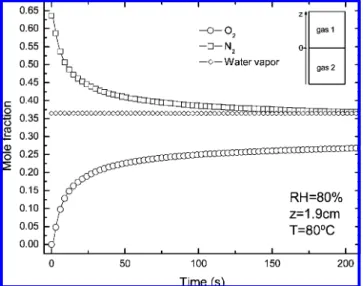
for the top chamber. With the initial conditions that the RH is the same in both chambers (e.g., RH ) 80%), and the top and bottom chamber fills with nitrogen and oxygen, respectively, the simulation results are given in Figures 2-4. Both transient and steady analysis (Figures 2 and 3) show that the mole fraction of water vapor in the diffusion cell is a constant while oxygen diffuses from the bottom chamber to the top chamber, and nitrogen diffuses from the top chamber to the bottom one. For the transient behavior of O2mole fraction under different RH
values at z ) 1.9 cm, Figure 4 shows a significant drop in the case of RH ) 80%, compared to the case of RH ) 0%.
The numerical simulation shown in Figures 2 and 3, in which concentration of water vapor keeps a constant in the ternary system, suggests that with the aforementioned initial conditions there is no effective water vapor diffusion taking place, and
the gas diffusion in this ternary system might be considered binary gas (O2-N2) diffusion. When the diffusion coefficient D21is a constant, Fick’s second law of diffusion describes the
one-dimensional binary diffusion as15
∂η2 ∂t ) D21
∂2η2
∂z2 (9)
Hereη2 stands for the concentration of species (gas) 2. One
can solve eq 9 with the following initial and boundary conditions: η2 )η2b (-L/2 e z < 0, t ) 0) η2)η2t (0 < z e +L/2, t ) 0)
(
∂η 2 ∂z)
z)(L/2) 0 (t > 0) (10)The last equation of the initial and boundary conditions is the impermeable boundary conditions at z ) (L/2, which means zero flow across the boundaries.15 The η
2 b and η
2 t are the
concentrations of gas 2 at t ) 0 in bottom and top chambers,
Figure 2. Concentration (mole fraction) evolution of O2, N2, and water
vapor at z ) 1.9 cm, RH ) 80% and T ) 80 °C, calculated using the ternary model.
Figure 3. Concentration (mole fraction) distribution of O2, N2, and
water vapor at t ) 400 s, RH ) 80% and T ) 80 °C, calculated using the ternary model.
Figure 4. Concentration (mole fraction) evolution of O2at z) 1.9 cm
for RH ) 0% and RH ) 80% at T ) 80 °C, calculated using both the ternary model and binary model.
respectively. In this work the η2t is zero. The solution can be expressed as11 η2(z, t) ) 1 2(η2 b +η2t) -2(η2 b -η2 t ) π m)0
∑
∞ exp(-(2m + 1)2πt/τ) (2m + 1) sin[
(2m + 1)πz L]
(11) τ is the characteristic diffusion time defined asτ ) L
2
πD21
(12)
Lin eqs 11 and 12 is the length of the Loschmidt cell shown in Figure 1. Theτ can be found by fitting the theoretical model to experimental data or be calculated with the knowledge of D21.
At 25 °C D21) 0.202 cm2s- 1for dry O2-N2diffusion;16with
the dimension of this experimental diffusion cell theτ is about 2000 s.
Equation 11 is a general solution and converges most satisfactorily for large values of time.15In practice, sometimes
the measurement for short-time diffusion is convenient and required. For an infinite space and with the initial distribution of gas 2
η2 )η2b z <0, t ) 0
η2) 0 z > 0, t ) 0 (13) the solution of eq 19 can be found in ref 15
η2(z, t) ) 1 2η2 b erfc
(
z 2√
D21t)
(14) in which erfc(x) is the complementary error function. Equation 14 is suitable for numerical evaluation at small time,15duringwhich the diffusion occurs in a finite region.
In the case that the initial conditionη2)η2t (z > 0, t ) 0),
eq 14 can be rewritten as η2(z, t) ) 1 2
[
η2 b +η2t - (η2b-η2t) erf(
z 2√
D21t)
]
(15) erf(x) is the error function. Reference 11 shows that when t < 0.1 τ, 90% of the diffusion gases have not reached to the impermeable boundaries, and the difference between the infinite space approximation and the general solution is less than 1%. Therefore this approximation can be used to describe the binary diffusion when the diffusion duration is less than 0.1τ.11Figure 4 shows the comparison of oxygen concentration evolution in the top chamber simulated by ternary transportation model and binary diffusion model for 0 and 80% RH, respectively. The diffusivities used for the simulations are shown in the figure. The largest difference between the two simulations is less than 1%. This consistency indicates that the O2-N2
diffusion in the presence of water vapor can be considered binary diffusion, probably due to no effective diffusion of water vapor occurring under the foregoing experimental conditions. It can be concluded that the binary diffusion model can be employed for signal processing.
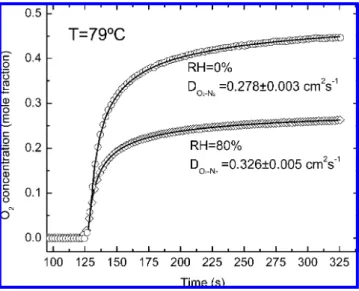
Experimental results have proven the conclusion. Figure 5 shows a typical concentration evolution pattern of the gas diffusion measured using the oxygen sensor for the binary gas mixture O2-N2at 79 °C under the conditions of RH ) 0% and
RH ) 80%, respectively. The continuous lines in Figure 5
represent the least-squares curve fitting of eq 15 to the experimental data. In the experiments, the exact time t0of the
beginning of the gas diffusion was unknown. To find t0, the t
in eq 15 was replaced by t - t0 when curve fittings were
performed. The values of the diffusion coefficient was found to be D21) (0.278 ( 0.003) cm2s-1at 79 °C with RH ) 0%,
which is consistent with the literature value D21) 0.277 cm2
s-1at 80 °C with RH ) 0%,16exhibiting that the binary diffusion
model is suitable for the signal processing. Also, D21) (0.326
( 0.005) cm2s-1at 79 °C in the presence of RH ) 80% was
determined. The fact that standard deviation was less than 1.6% demonstrated that precise experimental results could be achieved with the experimental setup and signal process method described in this “Experimental” section.
Results and Discussion
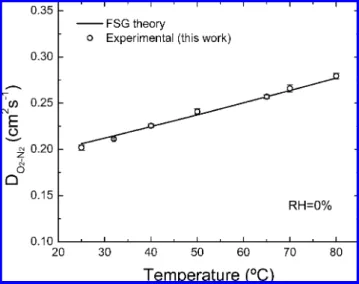
O2-N2 Diffusion under Dry Condition. The measured
temperature dependency of O2-N2diffusion coefficient under
dry condition is shown in Figure 6. The diffusion coefficient at 25 °C is in good agreement with the literature value (0.202 cm2
s-1),16and the measured temperature dependence of the diffusion
coefficient is consistent with that calculated using the FSG equation: D21) 1.00 × 10 -3 T1.75(1/M1+ 1/M2)1/2 p[(
∑
υ)1 1/3 + (∑
υ)2 1/3 ]2 (16) The diffusion coefficient of an ideal binary system 1-2 (D21)is a function of temperature, pressure, and concentration.17The
empirical correlation, eq 16, successfully developed by Fuller, Schettler, and Giddings (FSG) permits the evaluation of the diffusivity for gas pairs of nonpolar and nonreacting molecules based on the special atomic diffusion volumes.8,18This equation
is more accurate in predicting D21compared to other empirical
models.1In the equation, D
21 is the mass diffusivity of gas 2
through gas 1; T is the absolute temperature, K; p is the absolute pressure, atm, with the atomic and structural diffusion volume increment8,18υ to be summed over the atoms, group of atoms,
and structural features of each diffusion species. Theυs values were determined from a nonlinear least-squares analysis of over 500 experimental points and are given for some simple
Figure 5. The concentration evolution of O2in a binary gas mixture
of O2-N2at 79 °C measured by oxygen sensor (RH ) 0%, open circles;
RH ) 80%, open squares). The continuous lines represent the best curve fittings using eq 15 to the experimental data.
molecules elsewhere.18M1and M
2are the molecular masses of
gas 1 and gas 2, respectively, g/mol. Our experimental results, once again, demonstrate the reliability of the FSG equation in the calculation of diffusion coefficients of a dry binary gas mixture.
O2-N2Diffusion in the Presence of Water Vapor.The FSG
theory can predict the temperature and pressure dependence of diffusion coefficients of a dry binary mixture, but it is not suitable for the binary system in the presence of humidity. To study the influence of the humidity, we performed diffusion measurements at two different temperatures, 69 and 79 °C, varying the relative humidity from 0 to 80% for each temper-ature. As mentioned in the experimental section, a humidifier system was used to control the RH of both gases, which were filled into the diffusion chambers with the same RH. The measured results of D21 ) DO2-N2are shown in Figure 7. At
the temperature of 79 °C, the diffusion coefficient varies from (0.278 ( 0.003) under a dry condition to (0.326 ( 0.005) cm2
s-1with 80% RH; the D
O2-N2changes from (0.265 ( 0.003) to
(0.262 ( 0.002) cm2s-1at 69 °C. To our best knowledge, this
is the first time that the diffusion coefficient of binary gas mixtures is measured as a function of relative humidity.
In the experiments, the top and bottom chambers had the same volume V, and the pressure in the diffusion cell was kept as the ambient pressure. At t ) 0 the total pressure in the bottom (PBOT)
and top (PTOP) chambers could be written, respectively, as
PTOP) PN 2+ Pvapor) (nN2 RH + nvaporRH )RT/V )
(
FN 2 RH MN 2 +Fvapor RH MH2O)
RT PBOT) PO 2+ Pvapor) (nO2 RH + nvaporRH )RT/V )(
FO 2 RH MO 2 +Fvapor RH MH 2O)
RT (17)Pi,niRH, and FiRH are the partial pressure, number of moles,
and mass density of the gas i at the relative humidity. T is temperature in K, and R is the universal gas constant. Compared with the experiments with dry gases (i.e., RH ) 0%), the presence of water vapor (RH * 0) reduces the partial pressure
or the mass density (concentration) of the diffusion gases (e.g., N2 and O2). The mole fraction ηiRH of diffusion gas i in the
presence of water vapor (measured by RH) can be expressed as a mole fraction ηiRH ) ni RH niRH+ nvaporRH (18) with niRH )Fi RH V Mi nvapor RH ) Fvapor RH V MH 2O (19) Here FvaporRH ) 100FsatRH (RH is in percentage), and Fsatis the
saturation vapor density that can be calculated using the saturation vapor pressure.19Knowing the RH value, F
i
RHcan be
calculated using eq 17, and thenηiRHcan be obtained with the
equations above. In comparison with the dry binary gas mixture, the presence of water vapor reduces the concentration and therefore the mass MiRHof gas i in one mole of the mixture of
gas i and water vapor in a chamber at t ) 0, that is
MiRH)ηiRHMi (20) During the diffusion processes with water vapor, the self-diffusion of the water vapor between the chambers does not play an important role. On the other hand, the water vapor inside the chambers is working as molecular barriers, contributing to the diffusion volumeυ. Thus, the sum of all diffusion volume portions is (
∑
υ)iRH)ηiRHυi+ηH 2O RH υH 2O (21)Substituting eqs 20 and 21 into FSG eq 16, one can express the diffusion coefficient for different RH values as
D21RH ) 1.00 × 10⁻³T1.75
(
1 η1RHM1 + 1 η2RHM2)
1/2 p[(η1 RH υ1+ηH2O RH υH2O) 1/3 + (η2 RH υ2+ηH2O RH υH2O) 1/3 ]2 (22) The solid lines in Figure 7 represent the theoretical calculation using eq 22. The parameters used to calculate the diffusionFigure 6. Temperature dependence (25-79 °C) of the diffusion
coefficient of binary gas mixture of N2-O2 under dry condition
measured using the oxygen sensor (open circles): Open circles, experimental data; solid line, the theoretical prediction using the FSG equation, eq 7. The following parameters were used in the theoretical calculations:17(∑υ)
N2) 18.5; (∑υ)O2) 16.3; p ) 1 atm; MN2) 28 g/
mol and MO2) 32 g/mol.
Figure 7. Humidity dependence of the diffusion coefficient of a binary gas mixture of O2-N2at 69 °C (open squares) and at 79 °C (open
circles) measured using the oxygen sensor. The continuous lines represent the theoretical prediction using the generalized FSG theory, eq 22. The following parameters were used in the theoretical calcula-tions: (∑υ)H2O) 13.1 and MH2O) 18 g/mol.
coefficient for different RH are listed in the figure captions of Figures 6 and 7. Comparing the measured diffusion coefficients with the calculated ones, the relative error at different humidity and temperature was less than 1.5%, showing a good agreement between the generalized FSG equation and experimental data. When RH ) 0%, that is, dry gases, eq 22 returns to the FSG eq 16, and therefore eq 22 is a generalized version of the FSG equation.
Mass diffusion coefficient can be expressed in terms of the product of the mean thermal speed (V) and the mean free path (λ) as D ∝ Vλ. It is known that the mean thermal speed is proportional to the temperature and inversely proportional to the molar mass17of the gas mixture. Compared to the dry gas
mixture (e.g., N2and O2), the presence of water vapor reduces
the molar mass of the gas mixture and, therefore, increases the mean thermal speed. The mean free path is inversely propor-tional to the product of the number of molecules per unit volume and the effective cross section area for collision in the gas mixture. The presence of water vapor molecules reduces the effective cross section, which is evident considering water vapor has smaller diffusion volume compared with that of the diffuse gases, and then increases the mean free path. The molecular barriers created by the vapor induce less resistance to the mass transport, and the behavior of the diffusion coefficient with the water vapor content measured by RH is governed by the increasing of the mean thermal speed V and mean free pathλ.
Conclusions
The O2-N2diffusion in the presence of water vapor has been
theoretically and experimentally investigated. Under the ex-perimental conditions, the ternary (O2-N2-water vapor) system
has been studied using Maxwell-Stefan equation, showing that there is no effective vapor diffusion in the diffusion cell, and the O2-N2 diffusion in the presence of water vapor can be
considered binary diffusion. A generalized FSG equation has
been developed and found to be consistent with experimental data changing with temperature and RH, exhibiting that the generalized FSG equation can be applied to predict the diffusion coefficient of O2-N2 binary system in the presence of water
vapor. The increase of O2-N2 diffusion coefficient in the
presence of water vapor is due to the increase of the mean thermal speed and mean free path introduced by the water vapor.
References and Notes
(1) Karaiskakis, G.; Gavril, D. J. Chromatogr., A 2004, 1037, 147. (2) Massman, W. J. Atmos. EnViron. 1998, 32, 1111.
(3) Arnold, J. H. J. Am. Chem. Soc. 1930, 22, 1091. (4) Gilliland, E. R. Ind. Eng. Chem. 1934, 26, 681.
(5) Chapman, S.; Cowling, T. G. The Mathematical Theory of
Non-Uniform Gases; Cambridge University Press: London, 1952.
(6) Hirschfelder, J. O.; Curtiss, C. F.; Bird, R. B. Molecular Theory of
Gases and Liquids,2nd ed.; Wiley: New York, 1954.
(7) Chenp, N. H.; Othmer, D. P. J. Chem. Eng. Data 1962, 7, 37. (8) Fuller, E. N.; Schettler, P. D.; Giddings, J. C. Ind. Eng. Chem.
1966, 58, 19.
(9) Huang, T.-C.; Young, F. J. F.; Huang, C.-J.; Kuo, C.-H. J.
Chro-matogr. 1972, 70, 13.
(10) Wang, Q.; Eikerling, M; Song, D; Liu, Z.; Navessin, T.; Xie, Z; Holdcroft, S. J. Electrochem. Soc. 2004, 151, A950.
(11) Rohling, J. R.; Shen, J.; Wang, C.; Zhou, J.; Gu, C. E. Appl. Phys.
B: Laser Opt. 2007, 87, 355.
(12) COMSOL Multiphysics, Chemical Engineering Module, User’s Guide; COMSOL AB, 2005.
(13) Bird, R. B.; Stewart, W. E.; Lightfoot; E. N. Transport Phenomena, 2nd ed.; John Wiley & Sons Inc.: New York, 2002.
(14) Incropera, F. P.; Dewitt, D. P.; Fundamentals of Heat and Mass
Transfer,3rd ed.; John Wiley & Sons, Inc.: New York, 1990.
(15) Crank, J. The Mathematics of Diffusion, 2nd ed.; Oxford University Press: New York, 1975.
(16) Marrero, T. R.; Mason, E. A. J. Phys. Chem. Ref. Data 1972, 1, 3. (17) Poling, B. E.; Prausnitz, J. M.; O’Connell. J. P. The Properties of
Gases and Liquids,5th ed.; MacGraw-Hill: New York, 2000.
(18) Fuller, E. N.; Ensley, K.; Giddings, J. C. J. Phys. Chem. 1969, 73, 3679.
(19) Lide, D. R. CRC Handbook of Chemistry and Physics, 88th ed.; CRC Press:Cleveland, OH, 1977.
JP900796W