The COOP: Shared Space Infrastructure for the Creative City
by
Timothy R. Olson BFA
Alfred University 2003
SUBMITTED TO THE DEPARTMENT OF ARCHITECTURE IN PARTIAL FULFILLMENT OF THE REQUIREMENTS FOR THE DEGREE OF
MASTER OF ARCHITECTURE
AT THE
MASSACHUSETTS INSTITUTE OF TECHNOLOGY
MASSACHUSETTS INSTITUTE OF TECHNOLOGY
FEB 18 2011
LIBRARIES
ARCHIVES
FEBUARY 2011@2011 Timothy R. Olson All rights reserved.
The author hereby grants to MIT permission to reproduce and to distribute publicly paper and electronic
copies of this thesis document in whole or in part
in any medium now known or hereafter created.
~12/
Signature of Aut-.-Certified by: Accepted by: Department of Architecture January 14, 2011 J. Meejin YoonAssociate Professor of Architecture Thesis Supervisor
Takehiko Nagakura Associate Professor of Design and Computation Chair of the Department Committee on Graduate Students
THESIS
COMMITTEE
J. Meejin Yoon
Associate Professor of Architecture Joel Lamere
Lecturer Architectural Design Gediminas Urbonas
Associate Professor of Art Culture and Technology
THE COOP
shared space infrastructure for the creative cityBy Timothy R. Olson
Submitted to the Department of Architecture on January 14th in Partial Fulfillment of the Requirements for the Degree of Master of Architecture
Thesis Supervisor: J. Meejin Yoon Title: Associate Professor of Architecture
ABSTRACT
The urban mainstream suffers from a lack of space. Kitchens are too small to hold a gathering of friends. Spare bedrooms, garages, basements, offices and parlors are foregone in the interest of compaction.
The Rise of the Creative Class, an economic engine with its roots in the city, faces an especially challenging relationship to space. While the vitality of urban density is paramount to the success and growth of creative economies, a lack of available affordable space curtails the potential growth of home brewed culture, entrepreneurship and industry. This project engages this resource gap by imagining a cooperative model as a core infrastructure for the creative city.
The context for this project is within the future Innovation District of Boston on the Fan Pier Boston site. The innovation District is currently being imagined by the City of Boston, the Boston Redevelopment Authority, developers, architects and planners as a mixed-use neighborhood with the economic and cultural energy to attract a global creative class workforce.
Fan Pier Boston is a flagship development within the Innovation District. Due to ongoing global recession, 7 of the 8 buildings proposed for the site have been deferred. The COOP is situated in this interim period, between the existing expanse of parking lots that occupy Fan Pier Boston today, and its future promise as a hub of global innovation.
The COOP condenses the vitality of a creative city onto the site of the Fan Pier. Membership owned kitchens workshops and film studios combined with public event spaces for film screening, art openings and concerts anticipate a future creative class urban fabric for the future Boston Innovation District.
home
urban home
1800 SF
SPARE BEDROOM GARAGE
PORCH
5 10
800 SF shared space
THA NKS
To Meejin, Gediminas and Joel
for their inspiration and insight.
To my wife Amy
for her love, patience and support.
To Kyle, Ali, Ethan, Dennis and Behnam
CHAPTER
1. abstract 5 2. introduction 9 3. site 25 4. project 39 5. structure/envelope 57 6. project perspectives 69INTRODUCTION
TECHNOLOGY
/
FORM
Delirious New York elucidates the influence of technology on urban form. Among the most seminal technologies identified by its analysis is the elevator.
By enabling differentiated programs to
be positioned in vertical adjacency, the elevator has augmented the way in which cities are experienced. The section of The Downtown Athletic Club demonstrates this capacity by revealing contrasting adjacencies compacted into a single form:
A boxing ring abuts an oyster bar. 1
The formal potentials of a virtualized networked world have yet to be integrated
into a city plan or accommodated by architectural form. The potential synergy
between the virtual and physical realms
is manifest by the capacities of smart
phones to link information to geography and the counter culture domestic interlopers riding the wave of websites such as couchsurfer.org. In a hypothetical condition that capitalizes on this potential, programs that are architecturally locked
in associations such as The Downtown
Athletic Club can be spilled back out into and embedded within the fabric of the city.
1 Koolhaas, Rem. Delirious New York (New York Monacelli Press Press, 1994) 123.
downtown athletic club
boxing rimg oyster bar
WEB 2.0
There is a growing need for physical space to augment social transactions initiated by web 2.0. For example, meetup. com enables a range of local interest groups to coalesce in an ad-hoc capacity. Through this service, coffee shops, public parks and personal homes have become the space for the construction of a new type of community. The COOP imagines
a purpose built spatial infrastructure
constructed in the service of this
community. Cooperative space created in this project becomes a mediator between public and private, virtual and physical.
archigrams walking cit walking city
M
BIL/TY
reconfigures the cityemprarilyMobile and plug in infrastructure of Peter Cook and Archigram did not anticipate the advent of mobile real time communication and information technology. Uniform grids, reconfiguring components and stilt legged mobile cities represented the extreme extent of the architectural mobility under the imaginative capacity of the 1960's. the bothy is occupied temprarily
by a mobile population of
workers.
This thesis picks up the torch of
mobility and inverts its devices. Instead of employing heavy equipment to mobilize entire buildings, populations are empowered to temporarily
inhabit static architectural typologies. Reconfiguration is virtualized through real time communication and programmatic redundancies. Mobility under this construct moves from an Archigram imaginary of plug-in to the plausibility of short-term occupancy.
LIQUID MODERNITY
At the same time as the creative class
is transforming the economies of post
industrial cities, "liquid modernity," a recent cultural phenomenon identified
by Zygmunt Bauman, is transforming the
lifestyle, occupation, and ambitions of a generation.
12
"Liquid modernity" describes a condition where identity, occupation and location are in a constant state of flux. The
framework of "liquid modernity" reinvents institutions of permanence with nomadic and indeterminate constructs. This form of modernity moves from commodity to service paradigms and from settlement to
a state of perpetual unrest. 2
The COOP fits within this context by unmooring contemporary life from the anchors of ownership. Networked shared ownership spaces lighten the consumer load of the average citizen. In place of static spatial arrangements, storage
requirements and the financial burden of ownership, the COOP proposes a network of collaboration and service.
2 Bauman, Zygmunt. Liquid Modernity (Malden, MA
KC
occupation timescales COOP CONDOMINIUM interior TIMESHAREplot right to use
envelope right to use interior right to use % plot % envelope % interior ownership modes
K
DETACHED OWN TOWNHOME plot interior plot envelope interiorZIPCAR
By leveraging the capacity of information
technology, Zipcar has recalibrated car
ownership to work within a context of "liquid modernity". Its efficiency enables a radical revision of convenience. Because of Zipcar's increasing ubiquity in American cities, no longer is ownership the most effective mode, but rather by sharing a fleet of vehicles it is possible to gain more
by owning less.
The types of cars, branding and well honed public relations of the company have transformed the image of car sharing from hippie idealism to hip eco consumerism. This is accomplished, in
part, by providing cars that appeal to a young urban demographic. Mini Coopers,
BMWs and Volvos provide aspiration transportation options that are beyond the financial means of many of the program
participants.
The feature that distinguishes Zipcar from previous car sharing models is the use of information technology to economize operations. Cars are reserved online. An RFID enabled card unlocks the car at the time of the reservation. Billing is automatically generated. Maintenance items such as check engine lights and oil change warnings are sent automatically to a team of technicians. This efficiency of has enabled Zipcar to maintain half the car to employee ratio of the rest of the car rental industry.3
networked
0s
0
diverse
3 Clifford, Stephanie. How Fast Can This Thing Go
Anyway? (Inc.com, 2008) 2.
KITCHEN
handvaerkerparken cohousing community, denmarkIl~l"
U
1. wood shop 2. kitchen 3. storage 4. children's room 5. individual unitContemporary shared use arrangements engage two oppositional spheres. The sphere of socialism constructs shared architectural typologies as a physical manifestation of an ideological position, while a parallel capital-driven motivation for sharing generates economic potential through the strategic organization of temporal use.
Contrasting manifestations of the kitchen evidence the ambitions of these two spheres. The socialized kitchens of cohousing are a locus for the construction of community. The shared space of the kitchen provides the forum for members to connect socially. In a typical cohousing layout, individually owned and occupied homes surround shared spaces such as community kitchens, dining rooms and woodshops.
In opposition to the social sharing of
cohousing, capitalism builds temporal use spaces that fill a market need and generate mutual gains for the administrators and users of space. Industrial kitchens evidence a growing market for shared spaces as a place to generate economy. Entrepreneurs who
lack the resources to begin businesses
in the food industry increasingly rely on
YMCA
The 150-year history of the Young Men's Christian Association (YMCA) as an urban-based association demonstrates the capacity of a membership organization to enhance both the physical and social form of cities.
Underlying the success and growth of the early YMCA was the identification of an unmet resource. Young men were flooding American cities around the mid-nineteenth century in search of work in a burgeoning industrial economy. This demographic was faced with limited access to living space
as urban population growth outpaced available resources. Crowded boarding houses were often the only domestic option for upwardly mobile men working in cities hosting the industrial economy. The first YMCAs were conceived as extended living quarters for these urban immigrants. The need for space was so dire that the first Boston YMCA, which featured little more then a modest library and reading room grew to 1,500 members during its first year alone.4
As the YMCA membership grew, so too did an expansive building program.
Purpose built buildings, such as New York's West Side YMCA featured
increasingly elaborate facilities constructed to attract and maintain their membership base. Paula Lupkin
suggests in her PhD dissertation YMCA Y A
Architecture: Building Character in the American City, that the West Side YMCA was hardly distinguishable from upscale hotels of the period.5
mlf n Hn M mm mm
n
ymca national association of shared space
1852 Boston
first YMCA in the United provides memebership reading room and library
1869 New York
assocaition building rivals first class hotels
1859 Baltimore
first purpose built YMCA building
4
Whiteside, William B. The Boston YMCA and Community
Need (New York Association Press, 1951) 27.
5 Lupkin, Paula Rachel. YMCA Architecture: Building
Character in the American City, 1869-1930 (PHd Diss.
3rd ward creative space resource serving Brooklyn and the greater NYC region
3RD WARD
The 3rd Ward artist collaborative in Brooklyn, New York is an association established in an age of creative enterprise.
Founded in 2006 by Jason Goodman,
31, and his partner, Jeremy Lovitt, 30,
the 3rd Ward has grown its membership base to over 750 artists, designers and DIY freelancers.6 Distinguishing the 3rd Ward from other artist spaces is its hybrid program that combines commerce, education, leisure and community. The 3rd Ward collaborative contains facilities such as wood and metal shops, photo studios, and digital editing suites. It hosts classes that range from screen-printing to furniture design. Emerging artists, designers and entrepreneurs can rent space on a month-to-month basis.
Augmenting these aspects is a robust social program of art openings and weekend barbeques. Bicycles and free coffee available to members expand the mission of more typical artist space arrangements to include the creation of a unique brand of community.
6 Ryzikr, Melena. Urban Artists, A Collective Thrives in
Brooklyn (New York. The New York Times, 2008) 1.
MIN %arm
INNAMON9 1111 IM
IN go gaffMIMMIRM
BOSTON ARTIST
SPACE INITIATIVE
In 2002, the Boston Redevelopment 70%
Authority enacted a program called the
Artist Space Initiative. The mission of this EAN B$6
program, to create and support low-cost
spaces dedicated to artistic production,
underscores the primary tenet of this 40%
project: the resource of space is central to creative production.
20%
10%
regional space cost survey rooms per
per square foot household
18
midway studios : 89 units $950-1050 / mo
dartmouth hotel 71 units $765-3329 / mo
the signal building 20 units the distillery
walter baker lofts 13 units
1000sf
allston sculptors workshop charlestown stove factory
dorchester humphreys street studios east boston atlantic works hyde park the arts center hyde park first highland management hyde park stanton and tierny real estate
jamaica plain the brewery jamaica plain stonybrook fine arts
mission hill diablo glass and metals south boston distillery
south end bates art center
work space RANGE:
$6-13 PSF
1
w
19
1OOsf
live/work spaces
L\W
BOSTON ARTIST
SPACE INITIATIVE
GUIDELINES
DDDDE
outdoor displaywaste power ventilation acoustic freight
isolation capacity
x-x-21
natuai iyrn ire r21
CREATIVE CLASS
This project hypothesizes that the
creative class demographic of the Future Innovation District will ascribe creative ambitions to a broader range of activities then the classical tradition supported by the Boston Artist Space Initiative. This speculation aligns the cultural landscape of the Future Innovation District to Michel
De Certeau's Practice of Everyday Life.
Cultural production, a topic described by Certeau as a "residue" of capitalism will
in the future Innovation District become a
central feature. I
A resonance is obtained when the
"practice of everyday life" is overlaid with the emerging lifestyle arrangements of the creative class. Both involve the production of time and space relationships that are increasingly obscure. A relentless integration through the vehicle of creative actions homogenizes the space of work and leisure and produces synergy between economy and lifestyle.
7 De Certeau, Michel. The Practice of Everyday Life
(Berkeley; University of California Press,1984) e reader location 295.
rough weekly cost for band practice space
in seaport today
work
life perruque
Perruque, the term used by Certeau to describe everyday creative production, becomes central to the future innovation district.
prototypical creative class biographies
BRIDGET FELIPE DAN
Bridget is a biomedical researcher for a start up in Cambridge. She is also a freelance photographer who is looking for a production suite, a location to meet with potential clients and a place where she may exhibit her more experimental works.
Although by day Matt works as an attorney, he has always been a tinkerer. He is an avid reader and occasional contributor to MAKE magazine.
Matt is looking for a machine and woodshop near his home so that in between the long hours of his day job he can access facilities where he might hone his craft.
Felipe is a full time student and a professional party organizer. Felipe is currently writing a grant proposal to host
a series of outdoor concerts
that highlight up-and-coming Boston DJ's. He seeks an accessible and affordable location where late night noise from raging dance parties won't wake the neighbors.
Dan is a professional baker. He is developing a new line of confections for an upcoming new bakery. Dan seeks a kitchen he can use a few times
a month to test recipes and a nearby space he can host
tasting parties. He imagines these parties as an ideal way to start a buzz about his future
business venture.
M I
-- -
---'-I
SITE
SITE
The site for the COOP is located within the Seaport District of Boston.
The Seaport is in near proximity to the downtown core of Boston. The site of Fan Pier Boston is a quarter of a mile from the central business district by way of a pedestrian bridge at the terminus of Northern Avenue (1).
The Fort Point neighborhood, within the Seaport District, is already a center for Boston's creative economy. A rare collection of mill buildings built in the late 1800s by the Boston Wharf Company are today home to the Fort Point Artist community, the largest organization of artists in the United States (2).
The Boston Seaport is now home to
a number of new cultural resources
including the Boston Children's Museum
(3), The Institute for Contemporary Art (4),
Civic Center (5) and the Bank of America Concert Pavilion (6).
The Boston Harbor is a regional aesthetic and recreational resource (7).
2
fan pier boston site december 2010
SITE HISTORY
The constructed landmass of the Boston Seaport was originally a tidal marsh abutting deeper waters in the Port of Boston. These shallow waters were both
in direct proximity to the increasingly
viable sea transit and fishing industries of the Boston Harbor and the commercial core of Boston.
This advantageous geography was the basis for the creation of an industrial and maritime zone. In addition, the creation of the Fort Point channel enabled access to
a supply of water for industrial purposes,
easy transport by way of the Fort Point waterway, and an interconnected series of wharfs that supported the growth of
industries such as wool, iron, glass and
shipbuilding in the area.
rail lines
During its first fifty years, the shipping capacity of the Boston Seaport grew enormously in response to the booming industries of the area. The quantity of cargo handled on the site expanded from 23,891 tons in 1826 to 4,145187 tons in 1900. By 1900, the South Boston waterfront employed 50% of the area's industrial workers. 8
Changes in transportation technology after
1900, however, caused a dramatic decline in the shipping and industrial activities
of the Seaport. The introduction of rail service around the turn of the century displaced heavy industry on and around the Fan Pier site.
By bypassing the Seaport, the John F
Fitzgerald elevated expressway disabled the Seaport's successful integration with interstate highway transit systems. The advent of containerized shipping
technology required larger ships and
trucking infrastructure incompatible with the narrow channel and wharfs of the Fort Point Channel.
8 Fischer, Michael Anthony. Real Estate Development
Extractions in Boston (Cambridge Master of Urban
Studies and Planning) 10.
geographic isolation interstate disconnect containerized shipping scale change
2002 BRA
public realm plan
ted williams
190 tunnel
harborwalk
TODAY
Over the past decade, the Boston
Seaport has been the recipient of several infrastructural projects that have updated and connected this former site of industry and prepared it for an alternative future use.
The recently completed Big Dig project constructed a highway interchange in the Seaport that connected the long isolated region to the interstate highway system. The introduction of the Silver Line bus
rapid transit in 2004 connected the Seaport to both Boston and Logan International Airport. Adjacent to the Fan Pier site is the newly constructed Court House station, an elaborate harbinger of the future promise of the site.
The Seaport Public Realm Plan produced
in 2002 by the Boston Redevelopment
Authority outlines a vision for the Boston Seaport that specifies pedestrian
amenities centered around a network of green spaces. The Boston Harbor Walk provides a pedestrian and recreational link between the Seaport waterfront and the waterfront of Boston's central business district.
FAN PIER BOSTON
In 2005, Joseph Fallon, CEO andpresident of the Fallon Company, purchased the site of the Fan Pier and Pier 4 and enlisted Elkus Manfredi Architects to organize the site into a mixed-use development known as Fan Pier Boston. By 2007, optimism for this master plan was so great that the Fallon Company initiated the construction of the first building on the site, One Marina Park
Drive, entirely on speculation. 9
Global financial instability of 2008 and the ongoing recession have since cooled this initial zeal. Plans for the remaining
plots have been deferred until economic rebound again supports investment.
9 Developer Sets Schedule for Fan Pier Construction
SUBLET
This context has sponsored a number of short-term sublets. The vacant parcels of
Fan Pier Boston have over the past two years hosted temporary cultural events such as Puma City, a mobile inhabitable assembly of containers accompanying the Volvo Ocean sailboat race and the Cirque du Soilel.
LOUiS Boston, a high-end clothing retailer, formerly sited in Boston's Back Bay, has recently purchased a ten-year lease on one of the vacant parcels. In the place of a future mid rise residential complex, Louis Boston has assembled
a series of modular components onto a
slab-on-grade.10
10 Louis Boston moving to Fan Pier (www.fortpointboston. com)
puma city cirque du soilel
PROJECT
FAN PIER BOSTON
This thesis activates the dormant plans for Fan Pier Boston. It proposes expediting the site work and foundation construction for buildings delayed due to recession. The COOP occupies and augments these foundations. It appropriates the foundations as its interim building site. The voids created by the foundations
monumentalize the future development of Fan Pier Boston. They are conceived as earthworks that index the latent potential of the site and surrounding region.In addition, they provide the interface that connects the COOP to city services such as power, water, waste and electrical and create a space within which to hold events such as a summer concert series, film screenings, and flea markets.
The volume of the foundation pit is imagined to produce unique subterranean effects. The space within the foundation walls is visually and acoustically isolated
from the surrounding environment. At 40 feet below grade, a geothermal cooling
effect is a possible attribute during
summer months.
40 proposed building
WATER WASTE POWER DATA existing services r --proposed services
|
41 floating foundationSCHEMES
I i
BRIDGE
The modular logic of the bridge scheme enables incremental implementation.
Eventual expansion and adaptation to changing user group and facility needs, is made possible through the aggregation of autonomous units.
The project is imagined as a series of components that arrive at the site and are craned into position. Bridge units are
dimensionally constrained by the
sixteen-foot wide maximum envelope specified by
interstate transportation guidelines.
2i
t
0 7
incremental implementation
modules
PLAN
Permutations of a single loaded corridor organize the sixteen-foot wide bridging structures into circulation and rooms. Partitions are planned as infill components that may be repositioned, as demands require.
By tapering the single loaded
configuration, a hierarchy is established between an open-plan end condition and
a demarcated midsection.
Strategic alignments between adjacent structures produce "double wide" spaces of varying length to accommodate specific programmatic requirements.
The aggregation of chamfered forms produces lateral circulation paths which supplement the axial circulation of the corridors.
The structures are arranged on the site according to desire lines and anticipated site circulation.
Bridges spanning across adjacent foundations produce visual portals that frame the Boston Harbor and the Institute for Contemporary Art (ICA).
The connection between the Courthouse transit station, the Boston. Harbor Walk and the ICA is facilitated by public circulation paths within the COOP plan.
-~- --I -single loaded corridor plan taper double wide
MERNMEMNIF-foundation frames access
public access
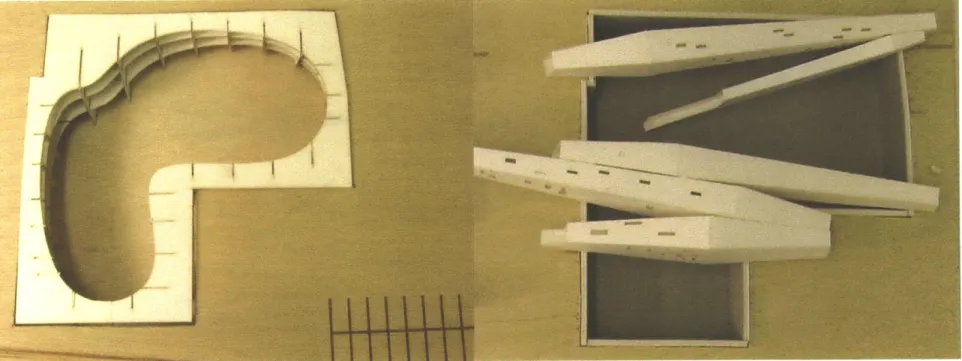
48 physical model
9. foundation stair 10. media 11. cafe + lounge 12. machine shop 13 classroom 14. event hall
5 deb Photo lab 1. kitchen + bbq 2. industrial kitchen 3. foundation stair
50 4. wood shop + gallery
5. wood shop
15. library + print + media
16. foundation stair 51
17. dance + band
18. assembly hall + video screening 19. netflix theater + sound + film library
SITE SECTION 1/16"=1'
DD AA BB HIGH CEILING bblaft.- -moolloompow -44 STANDA13D I SERVICE FLOOR AMPHIIHEArER whom,
) (~J BB wood shop \ '' ,I * ' \ I uLL ] \ .I1I ... ._..._...
cc
machine shop"E 13 8 I a E "L ii
A
MA7LNMVO
AM
DD kitchen bbq deckSTRUCTURE
+
ENVELOPE
STRUCTURAL DIAGRAM
-Q
-cylindrical tube rectilinear tube moment
adjusted
moment adjusted
ENVELOPE
The envelope of the COOP is conceived as a layered system.
1. A simple frame clad in polycarbonate
sheet is allocated to the open ends of the structures.
2. This system is augmented to
accommodate interior programming with the addition of insulation, an interior finish
membrane and operable windows.
3. In zones where even natural light
is desired, aero gel insulation and a translucent interior membrane are
specified. In areas where darkness is desired polystyrene insulation and an opaque interior membrane are specified.
OPAQUE
OPERABLE
TRA
CLEAR OPERABLE
66 physical model
1/8"1=1'
physical model 67
PERSPECTIVES
view from one marina park drive
WORKS CITED
Bauman, Zygmunt, Liquid Modernity. Cambridge: Polity Press, 2000
Clifford, Stephanie. How Fast Can This thing GoAnyways?. INC, 2008
De Certeau, Michel. The Practice of Everyday Life. Berkeley: University of California Press, 1984
Fischer, Michael Anthony. Real Estate Development Exactions in Boston: Implications for Linkage and
Planning in the South Boston Seaport District. Cambridge: MIT, 1999
Koolhaas, Rem. Delirious New York. New York: Monacelli Press Press, 1994
Lupkin, Paula Rachael. YMCA Architecture: Building Character in the American City: 1869-1930.
Pennsylvania: University of Pennsylvania, 1997
Malony, Mark. Fort Point Downtown Municipal Harbor Pan. Boston. Boston: The Boston Redevelopment
Authority, 2002
Ryzikr, Melena. Urban Artists, A Collective Thrives in Brooklyn. New York: The New York Times, 2008 Whiteside, William. The Boston YMCA and Community Need. New York: Association Press, 1951
Web resources:
"Fan Pier" http://www.fanpierboston.com/
"Innovation District" http://www.innovationdistrict.org/ "Lois Boston" www. http://www.fortpointboston.com
WORKS CONSULTED
Boston Redevelopment Authority. South Boston Waterfront-Industrial Study. Boston: BRA, 1970
Boston Redevelopment Authority. The South Boston Seaport: A Master Plan
for the Fort Point and South Boston Waterfront. Boston: BRA, 1997
Cooke, Philip. Creative cities, Cultural Clusters and Local Economic Development. Northampton, MA: Edward Elgar, 2008.
Elfenbein, Jessica. The Making of a Modern City: Philanthropy, Culture and the Baltimore YMCA. Florida:University Press of Florida, 2001
Frankel, E.G. The Boston Seaport 1970-1990. Boston: ABT Associates Inc, 1970
Levine, Mark. Share My Ride. New York: New York Times, 2009
Mjagkij, Nina and Spratt, Margaret. Men and Women Adrift The YMCA and YWCA in
the City. New York: University Press, 1997
Poorvu, William. Fan Pier. Cambridge: Harvard Business School, 2003
SOM. Fan Pier! Pier 4 Development. New York: SOM, 1985
Yigitcanlar,Tan. Creative urban regions : harnessing urban technologies to support knowledge city initiatives. Hershey, PA: Information Science Reference, 2008. Van Nostrand, Reinhold. Collaborative communities : cohousing, central living, and other new forms of housing. New York :Dorit Fromm, 1991.