Construction and Phenotypic Screening of Mid-size Insert Marine Microbial Environmental Genomic Libraries
by
Jennifer C. BraffB.A., New York University, 2001
Submitted in Partial Fulfillment of the Requirements for the Degree of Master of Science
at the
Massachusetts Institute of Technology and the
Woods Hole Oceanographic Institution February 2008
O 2008 Massachusetts Institute of Technology All rights reserved.
Signature of Author
Joint Program in Oceanography/Applied Ocean Science and Engineering Massachusetts Institute of Technology and Woods Hole Oceanographic Institution December 6, 2007 A
Certified by
K
7
Edward DeLong Professor of Biological Engineering and Civil and Environmental Engineering Chair, Joint Committee on Biological Oceanography Thesis Sinervisor Accepted by MA ,SA C M ' I IN 8 7 OFTEOHNOLOGy
APR 15 2008
LIBRARIES
Daniele Veneziano Professor of Civil and Environmental Engineering Chairman, Departmental Committee on Graduate StudentsARCHIVES
Construction and Phenotypic Screening of Mid-size Insert Marine Microbial Environmental Genomic Libraries
by
Jennifer C. Braff
Submitted to the Department of Civil and Environmental Engineering on December 6, 2007 in Partial Fulfillment of the Requirements for the Degree of Master of Science in Biological Oceanography at the Massachusetts Institute of Technology and the Woods
Hole Oceanographic Institution
ABSTRACT
Functional screening of environmental genomic libraries permits the identification of clones expressing activities of interest without requiring prior knowledge of the genes responsible. In this study, protocols were optimized for the construction of mid-size DNA insert, inducible expression environmental genomic plasmid libraries for this purpose. A library with a mean insert size of 5.2 kilobases was constructed with
environmental DNA isolated from surface ocean water collected at Hawaii Ocean Time-series station ALOHA in plasmid cloning vector pMCL200 under the inducible control of the PLAC promoter. To begin to evaluate the utility of such libraries for gene expression-based screens, this library was screened phenotypically for clones expressing genes that confer fluorescence or distinctive coloration on colonies of host Escherichia coli cells, and results were compared to those for a fosmid library constructed from the same marine microbial DNA sample. Ecologically relevant sequences were identified in both
libraries, and each was observed to offer both advantages and disadvantages. Results of this study suggest that mid-size insert plasmid libraries under the control of inducible promoters can provide a useful and complementary approach for both functional screening and shotgun sequencing of environmental genomic libraries.
Thesis Supervisor: Edward DeLong
Title: Professor, Division of Biological Engineering and Department of Civil and Environmental Engineering
Background
Since the development of culture-independent methods in environmental
microbiology (Pace et al. 1985), environmental genomics has emerged as a powerful tool in assessing the taxonomic composition and genetic potential of marine planktonic microbial populations. The first culture-independent environmental genomic studies were aimed primarily at investigating phylogenetic diversity. Phylogeny was assigned by determining 5S rRNA (Stahl et al. 1985) or 16S rRNA (Lane et al. 1985) sequences directly from isolated microbial RNA. These studies offered the first glimpse at the phylogenetic composition of natural microbial populations, as the vast majority of environmental microbes have resisted cultivation (Staley and Konopka 1985), greatly limiting our ability to study them by the use of traditional microbiological methods. 16S small subunit (SSU) rRNA sequence clone libraries were later constructed and used to examine the phylogenetic makeup of marine bacterioplankton (Giovannoni et al. 1990), as well as hot spring microbial communities (Ward et al. 1990). Results of these early culture-independent phylogenetic studies revealed the presence of many previously unknown groups and demonstrated the usefulness of this approach for studying natural microbial populations. However, functional capabilities associated with many groups are largely unexplored, and recent studies have demonstrated that the distribution of
metabolic characteristics do not necessarily track phylogenies based on SSU rRNA sequences (Frigaard et al. 2006), (Nakagawa et al. 2005).
By cloning genomic DNA isolated from marine picoplankton communities directly into bacteriophage lambda vectors and subsequently identifying and sequencing 16S rRNA sequences carried on individual clones (Schmidt et al. 1991), pre-cloning sequence amplification or reverse transcriptase steps could be avoided. More
beyond assessment of phylogenetic diversity and examine the genomic context associated with SSU rRNA sequences. The development of low copy number, F factor based
cloning vectors, including bacterial artificial chromosomes (BACs) which can hold 300 kilobases of DNA or more (Shizuya et al. 1992) and low copy cosmids known asfosmids (Kim et al. 1992), allowed stable, large insert clone libraries to be conveniently
constructed and manipulated. Full sequencing of large-insert clones carrying SSU rRNA genes or other phylogenetic markers made possible analysis of genome fragments derived from abundant, yet poorly understood, marine Chrenarchaeota and yielded insight into their functional and ecological characteristics (Stein et al. 1996), (Hallam et al. 2006a). Analysis of uncultivated microbial genome fragments began to reveal the extent to which microbial diversity was largely unexplored and made apparent the full potential of
environmental genomics. These techniques offered a means to gain insight into the functional and metabolic potential of various groups and to develop testable hypotheses linking phylogeny and function within natural microbial populations.
The discovery of proteorhodopsin, a gene with homology to previously
characterized archaeal rhodopsins, in the sequence of a marine BAC clone derived from an uncultivated SAR86 type Gammaproteobacteria is one such example. Since
Escherichia coli cells harboring this BAC expressed the proteorhodpsin gene, it was
possible to demonstrate that the protein functioned as a light-driven proton pump in the presence of retinal (Beja et al. 2000). Functional characterization of a large-insert environmental genomic clone containing both proteorhodpsin and retinal biosynthetic genes has since demonstrated that the proteorhodopsin photosystem is sufficient to allow photophosphorylation in host Escherichia coli cells (Martinez et al. 2007). Sequence analysis of numerous large-insert environmental genomic clones carrying
proteorhodopsin genes has provided insight into the evolutionary relationships between these uncultivated organisms, as well as their metabolic characteristics and ecological adaptations (Sabehi et al. 2005), (Frigaard et al. 2006), (McCarren and DeLong 2007). The combination of functional characterization and environmental genomic sequence
analysis has greatly advanced our understanding of the role that proteorhodopsin plays in planktonic marine microbes.
In recent years, this approach has been adapted to a variety of applications, and there have been important developments in library construction methodologies,
sequencing technology, and bioinformatic analytic capabilities. The adaptation of shotgun genome sequencing methods to environmental samples has proven to be an effective means of characterizing natural microbial populations. Shotgun sequencing of plasmid libraries constructed from acid mine drainage biofilm samples allowed
reconstruction of composite genomes for dominant organisms found in this specialized and relatively simple microbial community (Tyson et al. 2004). A similar approach making use of overlapping fosmid sequences was used to construct a composite genome of the sponge symbiont Cenarchaeum symbiosum and to examine genomic variability
between two distinct subpopulations (Hallam et al. 2006b). The power of
high-throughput shotgun sequencing to characterize complex planktonic microbial populations was illustrated by the sequencing of more than a billion base pairs of DNA isolated from
Sargasso Sea seawater (Venter et al. 2004) and, more recently, approximately 6 billion base pairs of marine microbial DNA (Rusch et al. 2007). Environmental genomic
surveys of this scale provide researchers with a wealth of data that will provide crucial information relating phylogenetic composition and functional properties of marine microbial populations. Recent studies have used environmental genomic sequence data to compare microbial populations between environments, with an emphasis on functional
characteristics of the community rather than phylogenic composition. Comparison of gene content, as assessed by analysis of environmental shotgun sequence data from disparate environments and similar yet geographically distant sites, revealed numerous habitat-specific characteristics consistent with our understanding of these environments (Tringe et al. 2005). End-sequencing and subsequent analysis of fosmid libraries constructed from microbial DNA sampled from discrete depths at Hawaii Ocean Time-series (HOT) station ALOHA resulted in gene profiles that reflect known distributions of metabolic properties with depth, as well as hinting at intriguing and previously
unobserved community characteristics such as patterns in viral abundance across the water column and overrepresentation of transposase sequences in deep water samples (Delong et al. 2006).
As the number of fully sequenced microbial genomes increases and databases of known genes sequences and proteins become larger and more sophisticated, so does our ability to annotate environmental sequence data and thus draw environmentally
meaningful conclusions from these data sets. However, a large fraction of open reading frames identified in environmental genomic data have no known function assigned, and in many cases genes responsible for key processes have not been identified. In cases where the host cell strain and cloning vector permit the relevant genes to be expressed by host cells, functional screening of environmental genomic libraries is one approach with which to probe this unknown sequence space. By screening libraries for functions rather than sequences of interest, researchers may identify previously unknown genes or
sequences of known genes that are too divergent to be observed by sequence-dependent methods such as hybridization or polymerase chain reaction (PCR).
An early application of this approach involved screening environmental genomic libraries for catabolic genes of interest, such as genes that confer on host Escherichia coli cells the ability to utilize 4-hydroxybutyrate as a carbon source. Growth assays with environmental genomic libraries constructed from soil samples with 4-hydroxybutyrate as a test substrate resulted in the identification of new variants of known
4-hydroxybutyrate dehydrogenases, as well as clones which exhibited 4-4-hydroxybutyrate dehydrogenase activity but whose sequences had no homology to previously
characterized enzymes (Henne et al. 1999). Novel lipolytic enzymes were also detected by visually screening soil libraries plated out on supplemented solid media (Henne et al. 2000), and environmental Na+(Li)/H+ antiporter genes were identified by plating these
libraries on agar plates containing LiCl in antiporter-deficient host cells (Majernik et al. 2001). Variations on this approach involving the substrate induced expression of catabolic genes of interest cloned into green fluorescent protein (GFP) fusion vectors allow higher throughput screens and easy isolation via fluorescence activated cell sorting
(FACS) of GFP expressing clones (Uchiyama et al. 2004). Functional screening of environmental genomic libraries has also proven to be a promising technique in the search for novel antibiotics (Courtois et al. 2003) and molecules involved in quorum sensing (Williamson et al. 2005).
Since functional screening of environmental libraries depends on successful expression of cloned genes in library host cells, in many cases screens may have a better outcome if multiple host cell types can be employed. New methodologies that allow BAC libraries to be shuttled between host species have proven useful in optimizing gene expression-based screens, as some genes that fail to express well in Escherichia coli were
successfully expressed in Streptomyces lividans or Pseudomonas putida host cells
(Martinez et al. 2004). Multiple host-range libraries have also been employed in isolating novel alcohol dehydrogenase genes (Wexler et al. 2005) and tryptophan synthesis (trp) operons from waste-water treatment libraries (Li et al. 2005).
Screens of this type often require that genes encoded by cloned environmental DNA be expressed at relatively high levels in the host cell, as low-level expression may
not result in a sufficiently distinct phenotype. However, high-level expression of foreign DNA places a significant burden on host cells (Guzman et al. 1995) and may constitute
an additional source of cloning bias in library construction, as well as reducing clone stability (Kim et al. 1992). A number of cloning technologies have been developed to address such problems, some of which have already been successfully employed in
environmental genomic research. Dual origin BACs that allow BAC copy number to be elevated by induction of the higher copy oriV origin greatly increase yield on vector DNA extraction so facilitate sequencing and other downstream applications. The host cell strain for these vectors, E. coli strain Epi300, carries a chromosomally integrated trfA replication gene, which is under the control of the arabinose inducible PBAD promoter and
is required for high copy number replication from the oriV origin (Wild et al. 2002). Adaptation of this methodology to fosmid vectors, such as the Epicentre
CopyControl Fosmid Library Production Kit (Epicentre, Madison, WI), offers a number of advantages for environmental genomic library construction. Phage packaging allows
high quality libraries to be produced with limited quantities of environmental insert DNA, as phage packaging size selection virtually eliminates the problem of background non-insert containing clones, and transduction allows 40 kilobase chunks of insert DNA to be transferred to host cells with high efficiency (Ausubel et al. 1992). As with variable copy number BACs, copy number can be elevated prior to DNA preparation. In addition, the copy-up feature of these vectors has facilitated phenotypic screening of surface water libraries for orange-tinted clones carrying proteorhodopsin and retinal biosynthetic genes (Martinez et al. 2007). However, insert instability has been observed under high-copy conditions, so such vectors may be of limited utility in screens that require high-level expression for extended periods of time.
Plasmid vectors with inducible promoters, which have long been used in gene expression studies and for heterologous protein production, offer an alternative to variable copy-number cloning vectors for functional or phenotypic screening of
environmental genomic libraries. A number of plasmid vectors with various origins of replication, antibiotic resistance markers, and transcription promoter combinations have been constructed that allow cloning into low or mid-range copy number plasmids and tight regulation of transcription into the multi-cloning site. Sets of plasmid vectors with compatible origins of replication and promoters engineered for both independent
regulation and enhanced gene expression range are also available (Lutz and Bujard 1997), (Registry of Standard Biological Parts, http://parts.mit.edu). These may provide combinations suitable for functional or phenotypic screens that require multiple genes to be co-expressed at specified levels (Williamson et al. 2005).
In this study, medium copy number plasmids incorporating the PBAD and PLAC inducible expression systems were investigated for the purpose of constructing
environmental genomic libraries to be used in gene expression-based screening. Plasmid vectors that place cloned DNA under the control of the arabinose operon PBAD promoter and its regulatory gene araC offer both positive and negative regulation of insert gene expression. Transcription is tightly repressed in the presence of glucose and can be induced to moderately high levels by the addition of L-arabinose. The PBAD system
offers an additional advantage in that intermediate levels of induction can be reliably produced under the correct conditions (Guzman et al. 1995). This capability may prove valuable in developing functional screens as multiple expression levels can be tested without requiring additional library construction or transfer of the library into alternate host strains. Medium to low copy plasmids carrying the stronger isopropyl-B-D-thiogalactopyranoside (IPTG) inducible PLAC regulatory element have also been
developed with the similar aim of allowing researchers to clone genes that are unstable or difficult to clone at high copy number (Nakano et al. 1995).
Methods
Construction of Mid-Size Insert Plasmid Libraries
pMCL200 Vector Preparation
Plasmid pMCL200 was prepared according to protocols obtained from the Joint Genome Institute (JGI) (Walnut Creek, CA). Briefly, plasmid DNA was isolated from liquid cultures of E. coli cells using the Qiagen HiSpeed Midi Kit (Qiagen, Valencia, CA) according to manufacturer's directions. Plasmid DNA was digested for 4 hours at 370 C with EcoRV restriction endonuclease (New England Biolabs, Beverly, MA) yielding blunt ends, and enzyme was subsequently removed using the Qiagen QIAQuick PCR Purification kit (Qiagen, Valencia, CA). 5' phosphate groups were removed from vector DNA using 100 units shrimp alkaline phosphatase (Roche Applied Science) per 200 aL reaction containing up to 2 pg of linear vector DNA. Reactions were run for 2 hours at 370 C and then heat inactivated for 15 minutes at 650 C before being run out on a 1% low-melting-point (LMP) SeaPlaque agarose (FMC BioProducts, Rockland, ME) gel. Gels were stained with, SYBR Gold nucleic acid stain (Molecular Probes, Eugene OR) and visualized on a non-UV Dark Reader transilluminator (Clare Chemical Research,
Dolores, CO) for band excision. Linear, blunt-end, dephosphoralated vector DNA was then purified using Qiagen QIAQuick Gel Extraction kit (Qiagen, Valencia, CA).
pBAD33 Vector Preparation
pBAD33 plasmid DNA was isolated from liquid cultures of E. coli cells by alkaline lysis and isopropanol precipitation of plasmid DNA according to standard protocols. Plasmid DNA was further purified by two rounds of CsCl equilibrium density gradient centrifugation (Sambrook and Russell 2001), (CHS Protocols; 2006;
doi: 10.1101/pdb.prot3927). Purified plasmid DNA was digested with SmaI restriction endonuclease (New England Biolabs, Beverly, MA) overnight at room temperature. The reaction was heat inactivated by incubation for 20 minutes at 650 C. Vector
dephosphorylation was performed at 370 C for 20 minutes using 5 units of Apex-Heat-Labile Alkaline Phosphatase (Epicentre, Madison, WI) per pg vector DNA, followed by a 5 minute heat inactivation at 700 C. To reduce the potential for vector religation in
downstream applications, phosphatase-treated vector DNA was subjected to a self-ligation step prior to gel purification to religate any incompletely dephosphorylated vector. The sample was EtOH precipitated according to standard protocols and
resuspended in sterile water at a concentration of 100 ng/pL. Self-ligation reactions were run overnight at 160 C with 2000 units of T4 DNA ligase (New England Biolabs,
Beverly, MA) for each gg of plasmid DNA in a volume of 100 JpL. After heat
inactivation, blunt-end linear vector DNA was run out on a 1% LMP SeaPlaque agarose gel (FMC BioProducts, Rockland, ME) to separate linear vector DNA from uncut or religated pBAD33 plasmid. Gels were stained with SYBR Gold stain (Molecular Probes, Eugene, OR) and viewed on a non-UV transilluminator (Dark Reader, Clare Chemical Research, Dolores, CO); vector was isolated using the Qiagen QIAEX II kit (Qiagen,
Valencia, CA) according to manufacturer's directions.
Marine microbial DNA samples were isolated from the 0.2-2 tim size fraction of filtered seawater as described previously (Delong et al. 2006), (Suzuki et al. 2004). Library construction began with extracted and concentrated crude DNA, which had not been further purified by CsCl density gradient centrifugation. Random shearing of insert DNA was performed using a GeneMachines Hydroshear (Genomic Solutions, Ann
Arbor, MI). The Hydroshear was calibrated with sample DNA prior to preparation of insert DNA to determine the syringe speed necessary to produce fragments of the desired size. Crude DNA samples were filtered through a 0.2 gtm filter and diluted to <100 ng/pL in filter sterilized Tris-EDTA (TE) before shearing to avoid clogging the shearing orifice. Sample volume was generally between 50 and 150 tLL. After this filtration step, sample preparation proceeded according to Hydroshear manufacturer's directions
(Genomic Solutions, Ann Arbor, MI). Samples were incubated at 370 C for 30 minutes, with vortexing every 10 minutes, then spun at 13,000 rpm on a bench top
microcentrifuge. No pellet was ever observed at this step, and samples were transferred to clean 1.5 mL tubes and kept on ice. After pre-washing the Hydroshear (Genomic
Solutions, Ann Arbor, MI) with four washes of 0.2 M HC1, four washes of 0.2 M NaOH, and four washes of TE, samples were sheared at speed code 15 for 6-10 kilobase
fragments or 16 for 8-12 kilobase fragments for 25 cycles and immediately placed on ice. To produce blunt-end fragments with 5' phosphate groups for cloning, sheared insert DNA was treated using End-It DNA End-Repair Kit (Epicentre, Madison, WI). Reactions were set up according to the manufacturer's directions and scaled up as
needed. After a 60 minute incubation at room temperature, 125 mM EDTA was added to a concentration of 10 mM in order to prevent exonuclease activity by T4 DNA
polymerase, and reactions were heat inactivated for 10 minutes at 70* C. Samples were extracted once with 25:24:1 (v/v/v) phenol/chloroform/isoamyl alcohol, followed by extraction with 24:1 (v/v) chloroform/isoamyl alcohol to remove residual phenol. Finally, insert DNA was ethanol precipitated with Pellet Paint Co-Precipitant (Novagen)
according to the manufacturer's instructions and resuspended in 30 AiL sterile 10 mM Tris-CI.
Sheared, end-repaired insert DNA was size-selected by running samples on a 1% LMP SeaPlaque agarose (FMC BioProducts, Rockland, ME) gel in tris-acetate-EDTA (TAE) buffer alongside DNA size standards. Gels were cast with sufficient volume, when possible, to allow the entire sample to be run in a single lane. Before use, gels were chilled at 4* C then run at approximately 100 volts for three to four hours. TAE running buffer was changed every two hours to prevent overheating. Gels were stained with freshly prepared SYBR Gold nucleic acid gel stain (Molecular Probes, Eugene, OR) in TAE buffer for 15 minutes shielded from light with gentle shaking. A non-UV safe-light transilluminator (Dark Reader, Clare Chemical Research, Dolores, CO) was used to view the gel, and two size fractions of insert DNA, a longer one containing the majority of the sample and a shorter secondary fraction, were excised from the gel.
Agarose gel purification of DNA fragments shorter than 10 kilobases was
performed using Qiagen QIAQuick Gel Extraction Kit (Qiagen, Valencia, CA) according to manufacturer's directions with slight modifications. Both the isopropanol and
solubilization buffer (QG) column wash steps were included. DNA was eluted with buffer EB (10 mM Tris-Cl pH 8.5) pre-warmed to 500 C, and samples were allowed to sit ten minutes after buffer EB was applied to the columns to increase recovery of larger fragments. The Qiagen QIAEX II kit (Qiagen, Valencia, CA) was used according to manufacturer's directions in cases where the excised gel slice included fragments 10 kilobases or greater in length. No more than 150 mg of agarose gel was processed in a single reaction, and samples were flicked, rather than vortexed, to avoid shearing insert DNA.
Ligation, Transformation, and Plating of Libraries in pMCL200
Prior to ligation, aliquots of both the purified vector and insert DNA were run out on 1% agarose gels stained with ethidium bromide next to DNA size standards of known
concentration (1 kb DNA ladder, New England Biolabs, Beverly, MA) to determine the approximate concentration of each component. Ligations were conducted in 10-15 ItL volumes with approximately 10 ng of vector DNA. An insert to vector molar ratio of
approximately 3:1 was found to be a good target ratio for this protocol. Blunt-end ligation reactions were run overnight (- 16 hours) at 160 C with 200 units of T4 DNA ligase (New England Biolabs, Beverly, MA). After ligation, the reaction was heat inactivated for 10 minutes at 650 C, followed by dialysis against MilliQ water for 30 minutes using a Millipore 0.025 ltm filter to remove salts before electroporation.
After dialysis, approximately 10% of the ligation reaction (1-1.5 [tL) was gently mixed with 50 [tL of Topl0-F' electrocompetent cells (Invitrogen, Carlsbad, CA). The remainder of the ligation was stored at -200 C, in case additional clones were required.
Cells were transferred to a chilled 1 mm cuvette, and electroporation was performed at 25 tF, 2.0 kV, and 200 Ohms on a BTX ECM 630 electroporator (BTX Harvard Apparatus). Cells were immediately mixed with 1 mL room temperature SOC media and incubated at 370 C for one hour with shaking, according to standard protocols (Sambrook and Russell 2001), (CSH Protocols; 2006; doi:10.1101/pdb.prot3933). A 10 ItL sample of
transformation product was set aside to evaluate transformation efficiency and check library quality, and the remainder was mixed with an equal volume of 50% glycerol and stored at -80' C.
The 10 ltL sample was then diluted 1:20 into fresh SOC to give a final volume of 200 uL. 100 pL was plated onto a small Luria-Bertani (LB) plate with 12.5 Rug/mL chloramphenicol, 10 Rg/mL tetracycline, and 40 ptg/mL X-gal, and an equal quantity was plated similarly with the addition of 0.5 mM IPTG. Plates were incubated at 370 C for 16 hours and scored for colony forming units (cfu) per mL transformation product and
percentage of blue, apparently non-insert containing colonies. Between 6 and 12 white clones were grown up in liquid culture, plasmid DNA was prepared, and approximately 200 ng was digested with BamHI and HindIII restriction endonucleases in NEB buffer 2 at 370 C for 4 hours (New England Biolabs, Beverly, MA). Digests were run out on a 1% agarose gel and stained with EtBr to evaluate mean insert size.
The remaining transformation product (stored as a 25% glycerol stock at -800 C), was plated at a cell density of <3000 cfu/plate, onto large rectangular LB plates with 12.5
CIg/mL chloramphenicol, 10 Ctg/mL tetracycline, 40 tg/mL X-gal, and 1 mM IPTG for automated picking. Plates were incubated at 370 C for 16 hours, and colonies were picked using a Genetix QPixII robot (Genetix, Hampshire, UK) into 384-well plates
containing LB-glycerol with 12.5 gg/mL chloramphenicol and 10 ptg/mL tetracycline, to be grown up overnight and stored at -80* C. With the exception of colony-picking
settings adjusted to preferentially pick white colonies, colony picking was conducted as usual for environmental genomic fosmid libraries.
Ligation, Transformation, and Plating of Libraries in pBAD33
Libraries constructed in plasmid pBAD33 were produced as described above for plasmid pMCL200 with minor modifications. Ligations were transformed into
electrocompetent DH1OB Electromax cells (Invitrogen, Carlsbad, CA) and plated onto media supplemented with chloramphenicol only. To spot check insert length, clones
were digested with SacI and Xbal restriction endonucleases in buffer 4 (New England Biolabs, Beverly, MA) at 37* C for four hours.
Arraying and Phenotypic Screening
Libraries were screened phenotypically for colony color and fluorescence by printing cells from 384-well library glycerol stocks onto rectangular LB plates supplemented with 12.5 tg/mL chloramphenicol, 10 gg/mL tetracycline, with and without 0.5 mM IPTG, and overlaid with Genetix Performa II positively-charged nylon
(Genetix, Hampshire, UK) membranes, using a Genetix QPixII robot (Genetix, Hampshire, UK). Twenty-four 384-well plates were arrayed per membrane, and 4
replicates were printed of each membrane (i.e. two for growth with IPTG inducer and two without). One set was incubated for 16 hours at 37* C and one set for 16 hours at 30* C,
after which membranes were moved to room temperature; all incubations were conducted in the dark. Plates were scored for colonies exhibiting a non-wild type color phenotype immediately after the initial 16 hour incubations and then periodically during
approximately two weeks at room temperature, since some color phenotypes were visible only after extended incubations. In order to detect colonies expressing genes that confer a fluorescent phenotype on host cells, membranes were scanned and imaged after a week at room temperature using a Fujifilm FLA-5100 imaging system (Fujifilm, Stamford, CT). Scanning was conducted for all membranes at 473 nm, 532 nm, and 635 nm excitation wavelengths with appropriate filters.
To confirm color phenotype, clones of interest were re-streaked from library glycerol stocks onto LB plates supplemented with 12.5 Rg/mL chloramphenicol, 10 [tg/mL tetracycline, with and without 0.5 mM IPTG, and overlaid with hydrophilic polyethersulfone Supor-200 0.2 um filters (Chisholm Corp., Lincoln, RI). Fosmid library clones were streaked out as above onto plates with 12.5 lig/mL chloramphenicol, with and without 0.02% L-arabinose to raise fosmid copy number. Provided the expected color phenotype was observed upon re-streaking, single colonies were picked and grown up in liquid culture with appropriate selection. Library vector DNA was prepared and retransformed into the library host E. coli strain, and single retransformed colonies were picked and grown up in liquid culture with selection to make 25% glycerol freezer stocks. If the color phenotype of interest was again observed upon streaking out cells as
described above from these retransformed cell stocks, the phenotype was considered confirmed.
Arraying with Retinal
In order to screen mid-size insert plasmid library HMS 186_25m for
proteorhodopsin carrying clones, the library was arrayed as described above for color and fluorescence screening except that exogenous retinal was applied directly to the
overlaying solid media supplemented with 12.5 gig/mL chloramphenicol and 10 gg/mL tetracycline, with and without 1 mM IPTG, were sprayed in situ with a fine mist of 5 mM
all-trans retinal in 95% ethanol using a plastic spray bottle (Fisher Scientific, Springfield,
NJ) and allowed to dry before printing. After the cells were arrayed, plates were incubated overnight at 30* C, then placed at room temperature for several days before being scored for color as described above for color and fluorescence screening.
DNA Sequencing and Sequence Analysis
Selected clones in both mid-size insert plasmid library HMS186_25m and fosmid library HF 186_25m with confirmed non-wild type colony color phenotypes were end-sequenced. Sequencing of fosmid ends was performed using forward primer T7 and reverse primer EpiFos5R to fosmid vector pCC1FOS (Epicentre, Madison, WI). For plasmid library clones, primers pMCL200-seq-FW and pMCL200-seq-REV (Joint Genome Institute, Walnut Creek, CA), which read into the multi-cloning site of plasmid vector pMCL200, were used to obtain forward and reverse end-sequences (Table S 1). In several cases, additional or complete insert sequences for clones in library HMS 186_25m were obtained by subsequent rounds of primer walking.
To identify genes responsible for colony color phenotypes identified in fosmid libraries, transposon mutagenesis of fosmid DNA was performed using the EZ-Tn5 <KAN-2> Insertion kit (Epicentre, Madison, WI). After transformation with
mutagenized fosmid DNA, cells were plated on solid selective media with 0.02% L-arabinose to raise fosmid copy number and an opaque membrane overlay so that colony color could be easily visualized. Colonies in which the color phenotype of interest had been knocked out (i.e. wild type colored colonies) were picked, and fosmid DNA was prepared for sequencing with primers, Kan-2 FP-1 and Kan-2 RP-1 (Table S 1), off the ends of the EZ-Tn5 <KAN-2> transposon (Epicentre, Madison, WI). In cases where additional or full-length insert sequence was desired, additional transposon insertion mutants were picked for sequencing. All DNA sequencing was carried out using the
BigDye v3.1 sequencing system with capillary electrophoresis run on an ABI Prism 3700 DNA analyzer (Applied Biosystems, Forest City, CA). Fosmid sequences were
assembled using Sequencher v.4.5 DNA assembly software (Gene Codes, Ann Arbor, MI), and preliminary automated annotations were done with fgenesb software (Softberry, Mount Kisco, NY). Unless otherwise noted, end-sequences, transposon insertion reads, and other short sequences were analyzed by BLASTX (Altschul et al. 1990) against NCBI non-redundant protein sequences.
HPLC Analysis
To prepare pigments from carotenoid-producing fosmid clones for high pressure liquid chromatography (HPLC), liquid cultures of Epi300 E. coli cells harboring fosmids of interest were grown up overnight at 30* C with shaking in M9 minimal media
supplemented with 0.4% glycerol, 0.1% casamino acids, 0.03% thiamine, and 12.5 gg/mL chloramphenicol. In the morning, cultures were diluted back 1:100 into fresh media and grown at 30* C with shaking for 3-4 hours before induction to high copy with 0.02% L-arabinose. Cultures were allowed to grow for an additional 16 hours before cells were pelletted and stored at -80* C.
To extract pigments, cells from 2 mL worth of culture were resuspended in 300 pL of 7:2 vol/vol acetone:methanol then vortexed briefly, followed by 20, 1 second pulses of sonication. Tubes were then spun for 1 minute at 13,000 rpm on a table-top microcentrifuge, and the supernatants were transferred to clean tubes. Samples were brought to 1 mL total volume with additional 7:2 vol/vol acetone:methanol and filtered through 0.45 pm filters. Filters were washed with another mL of 7:2 vol/vol
acetone:methanol, and samples were dried down to volume under nitrogen. During this process, samples were kept on ice and shielded from light whenever practical. HPLC was performed with a Waters (Milford, MA) separations module controlled by MassLynx 4.0 software, with a Waters 996 photodiode array detector. The column was a 5 pm Zorbax-ODS C18 column (150 X 4.6 mm), (Agilent Technologies, PaloAlto, CA). The
solvent system has been used previously (Maresca et al. 2007), although the gradients were modified somewhat for this work (Fig. S ). Solvent A consisted of 62.5% water, 21% methanol, and 16.5% acetonitrile with 10 mM ammonium acetate, and Solvent B consisted of 50% methanol, 30% ethyl acetate, and 20% acetonitrile. A flow rate of 0.8 ml/min was used for all samples. Purified retinal, astaxanthin, lycopene, and |-carotene standards were run during each experiment.
Results and Discussion
Library Construction and Protocol Optimization in Plasmid pBAD33
This work was undertaken in order to construct randomly sheared mid-size insert environmental genomic libraries in plasmid vectors with inducible promoters for the purpose of functional and phenotypic screening. The target mean insert size of 8-10 kilobases was selected to allow entire operons to be captured in single clones. Although numerous commercially prepared library construction kits are available and protocols
exist for the construction of randomly sheared plasmid genomic libraries, no commercial products were available that met the specific requirements of this project. Available protocols for mid-size insert plasmid or fosmid genomic libraries and small insert
shotgun environmental genomic libraries (Hallam et al. 2006a) required significant optimization in order to yield high-quality libraries of the desired type from our marine microbial DNA samples. Protocols for library construction used for this work were
adapted from JGI protocols for genomic library construction (see
http://www.jgi.doe.gov/sequencing/protocols /index.html) and Epicentre protocols for CopyControl Fosmid library construction. Plasmid vector pBAD33 was selected initially for library construction, although mid-size insert libraries for screening were eventually constructed in the plasmid vector pMCL200 (Fig. S2). The multi-cloning site on pBAD33 is under the control of the L-arabinose inducible PBAD promoter, and it carries the PBAD positive and negative regulator, araC, as well as a chloramphenicol resistance
marker. It has the same mid-low copy pl5A origin of replication as pMCL200 but lacks blue/white screening for the presence of insert. However, it offers tight repression in the presence of glucose and provides lower expression levels that those obtained with the PLAC induction system (Guzman et al. 1995).
Random sheering of marine microbial community DNA was performed as described using a Hydroshear (Genomic Solutions, Ann Arbor, MI), which fragments DNA to a given size range by forcing DNA samples repeatedly through a shearing orifice at a designated speed using an adjustable syringe pump. Since shearing orifices vary slightly, each one must be calibrated prior to use. To conserve environmental DNA
samples, the Hydroshear shearing orifices were calibrated using expendable samples or stock lambda DNA. Fragment size was found to be relatively sample-independent, so calibration with either was adequate. The bulk of sheared sample DNA generally fell within a 3 kilobase size range, although a significant quantity of larger and smaller fragments were also produced. Since smaller genomic fragments generally clone preferentially, for the protocol optimization experiments in vector pBAD33 insert DNA was generally sheared using a pump speed that produced fragments centered around 10 kilobases (usually speed code 16) on the premise that the mean library insert size would be somewhat smaller than the mean fragment size. In later experiments, and for the construction of surface water library HMS 186_25m discussed in more detail below, the pump speed was raised to speed code 15 in order to produce smaller fragments such that the bulk of the insert DNA fell in the 7-10 kilobase size range, which was observed to clone with higher efficiency. 5-10 ug of crude environmental DNA was selected as starting material. However, the designated size fraction of no more than 2.1 gtg worth of this material was incorporated into the ligation reaction for any given library.
To prepare sheared insert DNA, fragments were treated with it DNA End-Repair (Epicentre, Madison, WI), which combines T4 DNA polymerase with T4 polynucleotide kinase to yield blunt, 5'-phosphorylated ends for cloning into
dephosphorylated vector. This was followed by size-fractionation on a LMP agarose gel to remove fragments that were smaller than the desired insert size. Size-fractionation of
insert DNA was deemed necessary, although it results in significant loss of material, in order to minimize the effect of the preferential cloning of smaller fragments on mean library insert size. Since a favorable insert to vector molar ratio was found to be essential in the construction of these libraries, even more so than with smaller (1-3 kilobase) size inserts, maximizing the yield on preparation of limiting environmental
insert DNA was a key area for protocol optimization. Concentration of the End-Repair product by standard ethanol precipitation improved the yield at this step. Due to the tendency of the Hydroshear to clog, environmental sample DNA was diluted to less than
100 ng/gL meaning sample volume after End-Repair was generally too large to fit in a single moderately sized gel well. Concentrating the sample to a volume of approximately 30 I[L allowed the sample to be conveniently loaded in one gel lane for size-fractionation. Several methods were evaluated for the purification of insert DNA from the
size-fractionation gel. However, regardless of the method used, yields improved when the entire sample was concentrated into a single lane, run out only to the extent necessary, and the mass of agarose excised kept to a minimum. Limiting gel slices to between 100 and 200 mg allowed them to be processed in single reactions and gave good results.
Initially, End-Repair reactions were heat-inactivated then loaded directly onto a LMP agarose gel, without extraction and concentration. After the gel was run out, gel bands containing size fractions of interest were excised, and DNA was isolated using the
Gelase gel-extraction kit (Epicentre, Madison, WI). By this method, polysaccharides in the molten agarose sample were enzymatically digested and nucleic acids were
precipitated directly from solution. This method is used to extract 40 kilobase fragments of environmental DNA from LMP agarose gels for the preparation of CopyControl
Fosmid libraries (Epicentre, Madison, WI) and was initially selected because it allows the recovery of DNA fragments larger than 10 kilobases in length, which is the upper limit on the commonly used Qiagen QIAQuick gel extraction kits (Qiagen, Valencia, CA). However, for five to 12 kilobase fragments, the efficiency of sample recovery was lower than with other available methods, and there was some question as to whether the
purified insert DNA would be sufficiently clean to perform well in the downstream blunt-end ligation.
Gel extractions in subsequent work were performed using the QIAEX II kit (Qiagen, Valencia, CA) or the QIAQuick kit (Qiagen, Valencia, CA). For sheared DNA with mean fragments sizes of approximately 10 kilobases, the Qiagen QIAEX II gel purification kit (Qiagen, Valencia, CA) was used. Like the QIAQuick column
purification system, the QIAEX II kit utilizes the reversible binding of DNA to silica. However, the silica beads used in the QIAEX II method allow the recovery of a broader size range of DNA fragments, including those 10 kilobases or larger which do not elute well from the DNA binding columns of the QIAQuick kit (Qiagen, Valencia, CA). During the purification process, beads were resuspended by gently flicking the tubes, rather than vortexing, to avoid shearing of end-repaired insert DNA. Sample recovery was comparable between the two kits, and, for convenience, the QIAQuick kit (Qiagen, Valencia, CA) was used when mean fragment size was less than 10 kb, such as in the construction of the HMS 186_25m Hawaii surface water library. Both of these kits gave improved insert DNA extraction efficiencies relative to the GELase system (Epicentre, Madison, WI) and yielded purified material that was adequate for library production.
Blunt-end ligations are considerably less efficient than those involving fragments with cohesive ends. Frequently, this obstacle is overcome by increasing the
concentration of DNA or simply scaling up the ligation reaction (Ausubel et al. 1992), (section 3.16). In this case, however, the aim was to minimize the amount of DNA required for library production. Limited quantities of marine microbial DNA can be collected during each oceanographic research cruise, and by reducing the amount utilized for any given application, it is possible to characterize samples by a variety of culture-independent methods and therefore maximizes our ability to draw meaningful
conclusions from the resulting data. Shearing followed by end-repair of sample DNA has the advantage over partial digestion methods (Olsen et al. 1986) in that it yields a more random distribution of fragments. However, this method results in blunt rather than cohesive ends, making high efficiency directional cloning impossible without the use of
linkers. To reduce religated vector background, it was necessary to treat the prepared vector with alkaline phosphatase enzyme to remove 5'-phosphates. This step, though generally necessary in blunt-end cloning, further reduces overall ligation efficiency (Ausubel et al. 1992), (section 3.16). An attempt was made to construct a library without first alkaline phosphatase treating the plasmid by ligating an excess of 8-10 kilobase insert DNA into blunt-end digested pBAD33, but the result, as expected, was primarily religated vector.
A number of protocol modifications were made to improve the efficiency of the ligation of sample DNA into the pBAD33 vector. Since the final concentration of ligation components may be too low for accurate spectrophotometric quantitation, an agarose gel with insert and vector side by side was run then stained with SYBR Gold (Molecular Probes, Eugene OR) to allow a more accurate determination of the
concentration ratio, as well as serving as a useful quality check for both vector and insert preparation. Both insert to vector molar ratio and blunt-end ligation conditions, including the amount of enzyme present in the ligation reaction, were found to be critical to library yield, defined for the purposes of protocol optimization experiments by the rough metric of colony-forming units (cfu) per tg of crude DNA starting material. Although rapid ligation protocols are extremely convenient and work well for many cloning applications, Fast-Link DNA Ligase (Epicentre, Madison, WI) ligase was never successfully employed in this protocol. Even blunt-end digested pBAD33 religated to itself with relatively poor efficiency when this enzyme was used for the blunt-end ligation step. For all work discussed here, standard T4 DNA ligase (New England Biolabs, Beverly, MA) was used, and all ligations were performed overnight at 160 C. The use of T4 DNA ligase and long incubation times, rather than the Fast-Link DNA Ligase (Epicentre, Madison, WI) used for fosmid library construction, yielded dramatic improvements in cloning efficiency.
Insert to vector molar ratios between 2:1 and 4:1 were used for all library
construction. Early attempts with higher 6:1 insert to vector molar ratios did not improve library quality. Lower ratios between 1:1 and 1.5:1, although often recommended for blunt-end ligation (Sambrook and Russell 2001), (CSH Protocols; 2006;
doi: 10.1101/pdb.prot3921), yielded libraries of poor quality with a high proportion of religated vector background Since the aim of this work was to produce high quality plasmid libraries with a large mean insert size while using as little valuable
environmental DNA as possible, a 3:1 insert:vector molar ratio was determined to be optimal. The quantity of ligase included in the ligation reaction was also tweaked to improve efficiency, and 200 units of enzyme per 10 jL reaction was selected for library construction. Higher quantities of ligase are sometimes recommended to increase the efficiency of blunt-end ligation (Ausubel et al. 1992), (section 3.16). However,
increasing the amount of ligase used five-fold to 1000 units enzyme per 10 pL ligation reaction decreased the yield on self-ligation of blunt-end digested pBAD33, estimated here in cfu per jig vector DNA, by a factor of at least 20. Significantly lower quantities of ligase also decreased yield. As good results were achieved with the ligation protocol described in "Methods," enzyme removal prior to electroporation, either by phenol extraction or spin-column purification, was not attempted, nor was the addition of polyethylene glycol to the ligation reaction (Pheiffer and Zimmerman 1983).
The presence of non-insert bearing clones in genomic or environmental genomic libraries can be a significant challenge in the construction of high-quality libraries. Although in principal dephosphorylation of the vector DNA should prevent this problem, in many cases this step is not sufficient to eliminate the presence of non-insert bearing clones or "background" in the finished library. A major advantage of fosmid libraries is that blunt-end ligation products that do not contain vector will not be packaged properly
and therefore do not pose a problem in library construction. In addition, selection systems have been developed such that cells that contain empty vector do not survive (Bernard et al. 1994). The pBAD33 plasmid used in the early protocol optimization work has neither a selection against religated vector nor a visual screen to distinguish clones that carry empty vector, and library background was a significant problem.
To evaluate the success of size-fractionation and estimate the fraction of non-insert bearing clones present, a sample of clones selected from partial plating of newly constructed libraries was always checked for quality. Two possible methods for
verifying library quality are colony PCR and restriction enzyme digest. For both pBAD33 and pMCL200, primers are available to amplify the region of the plasmid containing the insertion site (Table Si), so colony PCR could be used to determine mean insert size. However, inserts of length greater than around 5 kilobases can be difficult to amplify using standard colony PCR techniques. In addition, amplification of insert DNA will not diagnose vector rearrangements or deletions. During protocol development, all libraries were checked for quality by restriction analysis of prepared plasmid DNA to look at insert size distribution and verify that clones carried full-length vector. By this method, clones containing insert that is equal in length to linear vector DNA, or clones that yield fragments of that length when digested, could be incorrectly scored.
Nonetheless, it was a useful way to evaluate library construction.
Although transformation of self-ligated, alkaline phosphatase treated, blunt-end digested pBAD33 vector in the absence of insert yielded few or no colonies, as did non-ligated alkaline phosphatase treated prepared pBAD33 vector DNA, the majority of clones in the first library construction experiments contained what appeared to be religated vector. Manufacturer's notes accompanying the End-Repair enzyme mix (Epicentre, Madison, WI) state that T4 polynucleotide kinase is not completely heat-inactivated and recommend phenol-extracting the End-repair reaction if excessive no-insert background is observed to avoid kinase carry-over into the ligation reaction and rephosphorylation of vector DNA. This seemed unlikely, since the sample had been size-fractioned and purified from an agarose gel prior to ligation, but the advice was followed nonetheless. This modified protocol produced a better result, most likely because the subsequent precipitation reduced sample volume, which, as discussed above, improved yield on the agarose gel-purification step. Thus the step remained in the protocol although concentration of the insert DNA before size-fractionation, without phenol extraction, should be sufficient.
Protocol development proceeded under the assumption that empty vector
background observed was due to incomplete dephosphorylation of vector DNA. Since a longer vector dephosphorylation reaction was not helpful, a very clean preparation of
pBAD33 vector DNA was produced by taking approximately 1 pLg of Smal blunt-end digested, alkaline-phosphatase treated pBAD33 plasmid DNA and subjecting it to an overnight self-ligation reaction with T4 DNA ligase at 16 o C in order that any incompletely dephosphorylated vector would religate. Following ligation, the vector preparation was run out on a 1% agarose gel to separate linear (dephosphorylated) vector DNA from any religated or uncut plasmid DNA present. This step was effective in reducing the amount of empty-vector containing clones in the final library.
An additional problem encountered with libraries constructed in the pBAD33 vector was the presence of non-insert bearing clones that upon plasmid DNA extraction and digestion appeared to harbor a linear vector band shorter than 5.3 kilobases, the length of full-length pBAD33, suggesting some sort of vector truncation or
rearrangement. During an experiment designed to test whether increasing the insert to vector molar ratio to 6:1 would lead to a greater fraction of insert-bearing clones, it was observed that a control reaction containing a 1:1 8-10 kilobase insert to vector molar ratio resulted in a library that appeared to be entirely religated vector. However, the ligation with 6:1 ratio produced roughly 1/3 clones that appeared to be religated full-length vector (-5.3 kb) and 2/3 that appeared to harbor non-insert containing vector of approximately 4 kilobases in length, as evaluated by digesting plasmid DNA with SacI and XbaI
restriction enzymes intended to excise any cloned insert. Single digests of these DNA preparations suggested that SacI linearized the short vectors, while the XbaI site may be missing. Apparently truncated vector that were shorter than 4 kilobases or which
appeared to contain some insert were also observed, but, in general, clones with inserts of the desired size tended to also exhibit full-length vector bands when digested with SacI
and Xbal. This result seemed to suggest that the pBAD33 cloning vector may not stably maintain 8-10 kb inserts in the E. coli strain DH10B used for these experiments, but these
clones were never sequenced or further investigated.
Library construction in pBAD33 with samples of stock lambda DNA,
incorporating the protocol optimizations discussed above, did eventually yield greatly improved results. Beginning with 5 plg of lambda stock DNA sheared into 8-12 kilobase
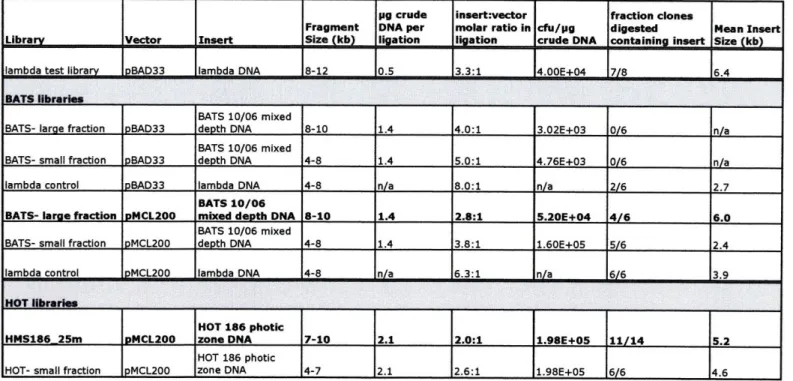
fragments and ligated into prepared pBAD33 vector, approximately 40,000 clones could be produced per gtg of crude insert DNA (Table 1). Eight randomly selected clones were subjected to restriction analysis. Seven of these contained insert with a mean insert size of 6.4 kilobases, while one contained truncated vector and no insert. An environmental genomic library of this quality would be adequate for many functional screening
applications, provided that the larger insert clones could be stably propagated. However, when the protocol was attempted with an environmental sample, quality declined
significantly. It was not clear whether this was due to sample quality or a poor yield on sample preparation that resulted in an insert to vector molar ligation ratio well below the target ratio of 3:1. However, switching to an alternate cloning vector eventually
circumvented many of the difficulties encountered with libraries constructed in plasmid pBAD33.
Library Construction and Protocol Optimization in Plasmid pMCL200
Subsequent library construction, including the surface water library
HMS186_25m arrayed for phenotypic screening, generally made use of the plasmid cloning vector pMCL200. This cloning vector is used by the JGI for the construction of mid-size insert genomic libraries, so it was believed to be suitable for the cloning and maintenance of 8-10 kilobase inserts. The vector was selected because, like pBAD33, it is a mid-low copy plasmid, and the multi-cloning site is under the control of an inducible promoter. pMCL200 has a pACYC derived pl5A origin of replication so is maintained at approximately 20-30 copies per cell (Lutz and Bujard 1997), and it carries a
chloramphenicol resistance gene. The multiple-cloning site is under the control of the IPTG inducible wild type lac operon promoter, and the vector has the lacZa gene to facilitate selection of insert containing clones (Nakano et al. 1995). Moderately low copy number combined with the relatively strong inducible lac promoter was intended to provide sufficient expression for functional screening of the library, while minimizing the
additional cloning biases associated with high plasmid copy number and elevated expression levels.
The E. coli host cell strain ToplO-F' (Invitrogen, Carlsbad, CA) was selected for use with vector pMCL200. This strain is very similar to the commonly used lact cloning strain DHIOB, which was used for all pBAD33 libraries, but harbors an F'
extra-chromosomal element carrying a tetracycline resistance marker and a lacl allele. The presence of the Lacl allele allows this host strain to make sufficient lac repressor such that expression of genes carried on insert DNA from the pMCL200 PLAC promoter are largely repressed in the absence of the inducer molecule, IPTG. Topl0-F' cells, and the closely related MC1061-derived strain DHIOB used for pBAD33 test libraries, poses a number of features that make them suitable as host strains for genomic libraries. Both are DNA repair deficient recAl strains, which reduces the likelihood of recombination events
and enhances library stability, and both lack a suite of genes involved in methylation-dependent restriction of foreign DNA. In addition, both carry chromosomal lacZ genes with partial deletions to permit blue/white screening by alpha-complementation, endA l alleles for cleaner DNA preparations, and deoR to facilitate the uptake of large plasmids (Woodcock et al. 1989), (Grant et al. 1990).
To confirm that the lacl allele in Topl0-F' cells provides sufficient lac repressor to block expression from the PLAC promoter, pMCL200 plasmid DNA was transformed into Topl0-F' E. coli cells. As a control, transformed DH10B cells were similarly transformed and plated onto LB plates supplemented with 12.5 jpg/mL chloramphenicol
and 40 gLg/mL X-gal. After overnight incubation at 370 C, all colonies on these control plates appeared blue, as expected given that DH10OB cells do not express lacI repressor. Transformed ToplO-F' cells were plated onto LB plates supplemented with 10 gg/mL tetracycline, 12.5 gg/mL chloramphenicol and 40 gg/mL X-gal, with and without 0.5 mM IPTG inducer to induce gene expression from the PLAC promoter. In the absence of inducer, all colonies were wild type in color, indicating that expression of 3-galactosidase protein from the PLAC promoter was largely repressed. Cells plated in the presence of 0.5 mM IPTG appeared blue confirming that the addition of this concentration of inducer
was sufficient to allow significant expression of B-galactosidase from the PLAC promoter. Commercially prepared electrocompetent cells were selected to maximize the efficiency of library transformation.
The preparation of cloning vector pMCL200 for library construction differed slightly from that of pBAD33 since it was prepared strictly according to the JGI protocols provided with the plasmid. In the isolation of plasmid DNA, pMCL200 DNA was not subjected to CsCl density gradient centrifugation purification, while pBAD33 did receive this additional purification step. Although the Hispeed Plasmid MidiKit (Qiagen,
Valencia, CA) used here for isolation of pMCL200 plasmid DNA gave a reasonably clean product, some higher molecular weight DNA, believed to be E. coli chromosomal DNA, was visible when the product was run out and stained on an agarose gel. CsCl equilibrium density gradient centrifugation could be used to reduce E. coli chromosomal DNA contamination in the plasmid DNA preparation. For many functional screening applications, depending on the specific screen and host cells employed, low-level
contamination of environmental libraries with E. coli chromosomal fragments may not be problematic. However, since there is no drawback to doing so, aside from some
additional time in the vector preparation step, it would be worthwhile to add the CsCl density gradient purification step to the vector preparation protocol.
The vector dephosphorylation step also differed somewhat, both in the type of phosphatase enzyme and the reaction conditions. For the preparation of pBAD33, Apex Heat Labile Alkaline Phosphatase was selected and used according to the manufacturer's
directions, which call for 5 units of enzyme per pg of plasmid DNA and a 10 minute incubation at 370 C. Blunt-end digested pMCL200 was dephosphorylated with shrimp alkaline phosphatase (SAP), according to the JGI protocol, using almost three times the amount of enzyme called for in the product manual (Roche Applied Science).
Dephosphorylated pMCL200 was not treated with ligase, to ligate incompletely dephosphorylated vector, prior to gel-purification. The fraction of pMCL200 library clones exhibiting a blue color when plated in the presence of IPTG inducer and X-gal, indicating that they express a functional B-galactosidase enzyme and thus do not contain
insert, was generally in an acceptable 10-20% range for this protocol. However, the vector self-ligation step was helpful in reducing religated vector background in the pBAD33 libraries, so adding this step to the pMCL200 vector preparation protocol could potentially further reduce the number of empty vector clones in the finished library.
Preliminary tests of the pMCL200 cloning vector with lambda DNA insert, prepared according to the protocol optimized here for environmental samples, showed promising results, so a mid-size insert environmental genomic plasmid library was constructed in this vector using a mixed-depth sample of water column microbial DNA collected on a sampling expedition at the Bermuda Atlantic Time-series Study (BATS) field site during October of 2006. The purpose of this experiment was to verify that mid-size insert libraries of acceptable quality could be produced by the current protocol before using any of the limited quantity of HOT surface water DNA available, as well as to compare the quality of libraries constructed in pMCL200 to those in pBAD33. A sample containing roughly 9 jig of crude marine microbial DNA was sheared on the Hydroshear (Genomic Solutions, Ann Arbor, MI) at speed code 15 for 25 cycles producing fragments centered around 8 kilobases in length. Since this sample was split between several test libraries, the results for each test library represent the use of less than 1.5 gg of starting material. End-repaired fragments were run out in the usual way on a 1% LMP agarose
gel, and bands containing the 8-10 kilobase fraction, which constituted the majority of the sample, as well as a secondary 4-8 kilobase slice, were excised for gel-purification. All ligation components were quantitated visually on a gel to allow the calculation of approximate quantities and molar ratios (Fig. lA). The two BATS DNA size fractions were ligated to both pBAD33 and pMCL200 vectors, along with a control sample of lambda insert DNA that had been successfully cloned in pBAD33 previously.
Although variations in component DNA length and concentration make it impossible to draw rigorous conclusions about cloning efficiency, the purpose was simply to gain a practical sense of protocol outcomes with different size fractions of environmental DNA in these cloning vectors. All ligation reactions were transformed into electrocompetent DH10B cells, as this experiment was performed prior to the
decision to use Topl0-F' cells for library construction. The most dramatic result was variation in library yield and quality between the two vectors. Sample libraries
constructed in pMCL200 produced dramatically more clones than those constructed in pBAD33 with identical inserts, and the pBAD33 libraries attempted with environmental DNA samples essentially failed. Plates for pBAD33 test libraries had only slightly more colonies than the no-insert pBAD33 vector control. Six clones from each size fraction, as well as for the control lambda library, were checked by restriction analysis. No pBAD33 clones checked for either size fraction BATS libraries contained full-length vector with insert. Plasmid DNA preparations appeared to consist of either religated vector, empty truncated vector, or, in one case, truncated vector with insert. Only 2 of 6 lambda clones in pBAD33 contained insert.
Results for the pMCL200 BATS sample libraries were much better. The library constructed in pMCL200 with the smaller size fraction of insert produced three times as many cfu per jIg crude starting material than that with the larger size fraction and had a lower percentage of blue colonies when plated on X-gal containing plates. 22% of colonies were blue compared to 32% of colonies for the larger size fraction, including very faintly blue colonies that were only visible after more than one week. This was consistent with previous observations of reduced cloning efficiency with larger inserts. As with the pBAD33 test libraries, six clones from each library were selected and grown up to spot check library quality. However, only white colonies were selected from the pMCL200 sample libraries; at the time colonies were picked, between 80% and 90% of colonies appeared white. As observed previously, mean insert sizes were several kilobases smaller than the apparent mean fragment size of the sheared DNA (i.e. 6 kilobases for the "8 kilobase" library and 2.4 kilobases for the "6 kilobase" library). All clones checked in the pMCL200 control lambda library contained insert. For the two environmental genomic test libraries, roughly 75% of clones contained insert (Table 1).
Based on these results, the decision was made to prepare libraries of this type from a Hawaii surface water sample collected in October of 2006 during a research cruise to HOT field station ALOHA (220 45' N, 158' W). This sample is part of a set of
microbial DNA and RNA samples collected on this cruise from specified depths in the water column that are currently being analyzed by a variety of environmental genomic methods. Hawaii Ocean Time-series station ALOHA is an oligotrophic oceanographic field site in the North Pacific Subtropical Gyre that has been studied extensively since
1988 by biological, chemical, and physical oceanographers (Karl and Lukas 1996). The microbial and phytoplanktonic surface water populations have been well-characterized during this time using traditional microbiological and oceanographic methods (Karl et al. 2001), and recent work has taken a culture-independent approach based on sequence analysis of environmental genomic fosmid libraries prepared from microbial DNA isolated at key points in the water column (Delong et al. 2006). Since mid-size insert plasmid libraries require a significant quantity of DNA to produce a good result, libraries of this type were only constructed from the sample with the highest DNA yield, isolated from the 0.2-2 pm microbial size fraction collected in the photic zone at a depth of 25 meters.
An excess of crude surface water DNA was available, so 9 jlg of this was used as starting material for library preparation. A speed code of 15 was selected on the
Hydroshear (Genomic Solutions, Ann Arbor, MI) for the random shearing of insert DNA, although previous experience had shown that this pump speed produced fragments with a length distribution clustered around 8 kilobases, the target mean insert length for this library, so the mean insert length in the final library would therefore be somewhat shorter than desired. Fragments in the optimal 8-10 kilobase range had been successfully cloned in both vectors, but no environmental genomic library of this type had been prepared with a mean insert size in this range. The protocol was repeated exactly as in the BATS environmental sample library. Libraries were prepared from two size fractions. A gel slice containing the bulk of the sheared DNA, the length of which fell between 7 and 10 kilobases, was excised for the primary library, and the smaller fragments, which fell in the 4-7 kilobase rage, were also excised from the gel for the construction of a second backup library. 25% of the size-fractioned and gel-purified insert DNA for each size fraction was incorporated into the ligation reactions, and 12.5% of each ligation product