Impact of diuresis and number of exchanges on Continuous Ambulatory Peritoneal Dialysis
related peritonitis risk in RDPLF registry
Impact du volume de diurèse et du nombre d’échanges sur le risque de péritonite
en dialyse péritonéale continue ambulatoire dans le RDPLF
Clément Vachez1, Caroline Roubiou1, Catherine Bresson-Vautrin1, Cécile Courivaud1
1Service de néphrologie, dialyse et transplantation, Centre Hospitalier Universitaire de Besançon
Résumé Introduction
Les péritonites constituent une complication fréquente en dialyse péritonéale (DP) et sont associées à une morbi-mortalité importante. L’objectif de notre travail était d’étudier l’impact du volume de diurèse et du nombre d’échanges hebdomadaires (EH) sur le risque de péritonite chez des patients français en dialyse péritonéale continue ambulatoire (DPCA).
Méthodes
Ce travail a été effectué à partir des données du Registre de Dialyse Péritonéale de Langue Française (RDPLF). Nous avons inclus tous les patients du registre incidents en DPCA entre janvier 2010 et 30 novembre 2019 ayant eu au moins un bilan d’adéquation. Le risque de péritonite a été évalué d’une part en calculant pour chaque patient un taux de péritonite par année en DP, d’autre part en s’intéressant au délai de survenue de la première péritonite en prenant en compte les risques compétitifs (transplantation, transfert en hémodialyse, arrêt de la DP, quel qu’en soit la cause, et décès). Les patients ayant une diurèse inférieure à 500mL/ jour étaient considérés oliguriques.
Résultats
Nous avons inclus 620 patients dans nos analyses. L’âge moyen était de 72,9 ans (écart type (ET) 15,1). Deux cent quarante-six patients (39,55%) ont eu au moins une péritonite. Aucune modification significative du risque de péritonite n’a été mise en évidence chez les patients oliguriques. En revanche, il a été montré un risque accru de péritonite chez les patients ayant plus de 22 EH (HR=1,55, P=0,0005 et HR=1,47, P=0,02 en prenant en compte les risques compétitifs). Il a également été observé un effet protecteur du diabète (HR=0,74, p=0,02 et HR=0,77, p=0,0497).
Conclusion
Nous n’avons pas montré d’effet du volume de diurèse sur le risque de péritonite. Le nombre d’EH semble constituer un facteur de risque important dès lors que celui-ci est supérieur ou égal à 22.
B
ulletin de la
D
ialyse à
D
omicile
Mots clés : dialyse péritonéale, diurèse résiduelle, exposi-tion au glucose, péritonite
journal officiel du Registr e de D ialyse Péritonéale de Langue Française RDPLF www .rdplf.or g Summary Introduction
Peritonitis is still a frequent complication among patients undergoing peritoneal dialysis (PD) and it’s associated with a significant morbimortality. The aim of our study was to investigate the impact of diuresis volume and number of exchanges (NE) on continuous ambulatory peritoneal dialysis (CAPD) related peritonitis risk.
Methods
This study was performed with data from the French peritoneal dialysis registry (RDPLF). We included every incident patient in the registry from January 2010 to November 2019 who had at least an adequacy evaluation. Peritonitis risk was assessed firstly by estimating a peritonitis rate per year undergoing PD and secondly by focusing on time to first peritonitis, taking into account competing risks (kidney transplantation, switch to hemodialysis, PD withdrawal whatever the cause or death). Patients whose diuresis was <500mL/24 hours were considered oliguric. Results
We included 620 patients in our analysis. The mean age was 72,9 (standard deviation (SD)=15,1). Two hundred and six (39,55%) had at least one peritonitis episode. No difference was observed between oliguric patients and the others. However, we noticed an increased risk in patients with a NE≥22 per week (HR=1,55, P=0,0005 and HR=1,47, P=0,02 considering competing risks). We also observed a lower risk in diabetic patients HR=0,74, p=0,02 and HR=0,77, p=0,0497).
Conclusion
We didn’t find any impact of diuresis volume on peritonitis risk. Whereas, the NE seems to be a considerable risk factor, especially when it’s superior to 22 per week.
Key words : glucose exposure, peritoneal dialysis, perito-nitis, residual diuresis
INTRODUCTION
Despite the considerable progress made in recent decades in the prevention and management of peritonitis, its occurrence remains a frequent complication in patients with end-stage renal disease (ESRD) treated by peritoneal dialysis (PD). It is associated with significant morbidity and mortality with a potential loss of ultrafiltration, an increased risk of hospitalizations, lower survival of the catheter, of the dialysis technique and of the patient (1–4). Many risk factors have been identified, some are modifiable (nutritional status, patient training), others not (age, sex, diabetic status) (5,6). Residual renal function (FRR) seems to play a protective role against the risk of peritonitis (7–9). The mechanism of this relationship has not been formally identified. Better residual kidney function has also been shown to be associated with better nutritional (10) and inflammatory (11) status, as well as better control of anemia (12) and water overload (13). It can be assumed that patients treated in continuous ambulatory PD (CAPD) with a conserved diuresis benefit from treatment with less weekly exchanges (WE) and thus a lower risk of infection due to a reduced number of manipulations. The aim of our work was to study the impact of the volume of diuresis and the number of WE on the risk of peritonitis in French patients on CAPD.
PATIENTS AND METHODS
Patients
We used data from the French Language Peritoneal Dialysis Registry (RDPLF) (14,15). This registry is declared to the National Commission for Computing and Liberties (CNIL) under the number 542668. All data transmitted to the RDPLF by the centers are subjected to an algorithm which identifies suspicious values which are then examined and corrected, where necessary, by contacting the participating center. This database consists of a core module, which is exhaustive, and optional add-ons. Among the optional modules, the one entitled «adequate nutrition and dialysis» is used by 60 centers out of the 169 that participate in the register. We selected all patients over 16 years old included in this module in mainland France and PD incidents between January 1, 2010 and January 1, 2020 (or 1,102 patients (8.8%) out of 12,552), benefiting from ‘’ treatment with CAPD and who have had at least one adequacy assessment. We have chosen not to include patients with automated PD (APD) since in these patients the number of exchanges and manipulations varies little whatever the residual diuresis. The clinical and biological characteristics and treatment of the patients included were those noted during the most recent adequacy assessment.
Judgment criteria
The occurrence of peritonitis has been assessed in two ways. First, we calculated a peritonitis rate for each patient by relating the number of peritonitis episodes reported in the RDPLF to the number of years of treatment with PD. This duration of treatment was calculated from the date of the first treatment with PD until the end of treatment which could be due to: death, a change in dialysis technique, kidney transplantation or discontinuation of the dialysis treatment whatever the cause (recovery of renal function, start of conservative treatment). Patients with no known events were censored on December 31, 2019. We then looked at the delay in the onset of the first episode of peritonitis. The occurrence of this event led us to consider death, kidney transplantation, change of technique and cessation of PD as competitive events.
journal officiel du Registr e de D ialyse Péritonéale de Langue Française RDPLF www .rdplf.or g
Determinants studied
For each patient we noted: age, sex, body mass index (BMI), diabetic status or not, the volume of diuresis. We have defined patients with a diuresis <500mL / 24 hours as oliguric. Regarding the treatment received, we noted: the number and types of daily exchanges, the number of days of CAPD per week, making it possible to estimate the number of weekly exchanges as well as the volume of drained dialysate that we assimilated to dialysis dose received. Glucose exposure was calculated by looking at the amount of glucose that was in contact with the patient and not the glucose absorbed, expressed in g / week. The presence of a registered nurse (IDE) or not to carry out the exchanges was also noted.
Statistical analyses
The quantitative variables were described in terms of average and standard deviation, the qualitative variables were described in terms of numbers and percentages. The quantitative variables were compared with the Student test or the non-parametric Mann-Whitney test. The qualitative variables were compared with the Chi-square test or Fisher’s exact test. The effect on the rate of peritonitis of the following continuous quantitative variables: volume of diuresis, number of WE, volume of dialysate drained and exposure to glucose was evaluated using linear regression and then reconsidering them as categorical variables with 2 modalities. To compare the delays in the onset of the first episode of peritonitis, we used in a first step a model that did not take into account competitive risks. Patients presenting an event considered to be competitive (as defined above) were censored on the date of this one. The risk of peritonitis was thus estimated according to the Kaplan-Meier method, then the risks were compared in univariate analysis by the log-rank test and then by a Cox model in multivariate analysis. In a second step we took into account competitive events. The risk of peritonitis was estimated by the cumulative incidence function (16) and the risks compared by the Fine and Gray test in univariate and multivariate analysis (17). All the tests were bilateral and significant at the alpha threshold = 0.05. The factors having a p <0.15 in univariate analysis were proposed to the multivariate model and selected by a “backward selection” method. All analyzes were performed separately from SAS software, version 9.4 (SAS Institute Inc, Cary, North Carolina, USA).
RESULTS
Characteristics of patients included (Tables I and Ibis)
Of the incident patients on PD, included in the optional module “Nutrition and adequate dialysis” during the period considered, 627 (56.9%) were on CAPD. Among these patients, the number of dialysis days per week was missing for 5 patients, so these were not included in the study. Of the 622 patients included, 394 (63.3%) were male, the average age was 72.9 years (standard deviation (SD) 15.1). Diabetic subjects represented 38.87% of the patients. The average BMI was 26.6 kg / m2 (SD = 5.1). The average diuresis was 1.07L / 24h (SD = 0.7L / 24h) and 122 patients (19.6%) were oliguric. The proportion of diabetics did not differ significantly between these 2 groups: 44.2% in oligurics vs 38.8% in patients with conserved diuresis (p = 0.27)). Regarding treatment: the number of weekly exchanges was on average 21.47 per week (SE = 5.9), the volume of dialysate drained was 45.56L per week (SE = 14.8). Glucose exposure averaged 443.6 g / week (SD = 261.2, median = 421). Oliguric patients had a higher number of weekly exchanges
journal officiel du Registr e de D ialyse Péritonéale de Langue Française RDPLF www .rdplf.or g
(WE) and glucose exposure (p = 0.0002 and p = 0.006). The patients were on PD for an average duration of 2.2 years (SD = 1.7).
Determinants of peritonitis rate (Table II)
Concerning the peritonitis observed: 246 patients (39.55%) had at least one episode of peritonitis. The average number of peritonitis episodes per patient was 0.73 (SD = 1.2), a rate per year of PD of 0.43 (SD = 0.9).
In linear regression, there was no significant correlation between the volume of diuresis, the
journal officiel du Registr e de D ialyse Péritonéale de Langue Française RDPLF www .rdplf.or g
Table I : characteristics of the CAPD population (n = 622)
*2 missing values, CAPD : Continuous Ambulatory Peritoneal Dialysis, PD : Peritoneal Dialysis
moyenne/n écart type/%
Gender (males) 394 63,3
Age (years) 72,9 15,1
Body mass index (kg/m²) 26,6 5,1
Diuresis (L) 1,1 0,7
Diabetics (n) 248 39,9
Number of bag exchanges/week* 21,5 5,9
Weekly total dialysate volume drained (L) 46,6 14,8
Weekly total glucose exposure (g/week) 443.6 261.2
Weekly total number of exchanges with polyglucose 6,0 3,5
Weekly total number of exchanges with amino acids 0,8 2,3
Duration of PD treatment (years) 2,2 1,7
Nurse assisted patients 352 56.6
Table Ibis : caractéristiques de la population selon la diurèse (n(%) ou moyenne(SD))
*oliguric=diuresis<500mL/24h, WE : weekly exchanges
oliguric patients* (n=122) patients with maintained diuresis (n=500) p
Gender (males) 57 (46,7) 337 (67,4) <0,0001
Age (years) 75,1 (15,5) 72,4 (15,0) 0,03
Body mass index (kg/m²) 25,5 (6,1) 26,8 (4,7) 0,003
Diabetics, n (%) 54 (44,3) 194 (38,8) 0,27
Number of bag exchanges/week* 23,4 (5,1) 21,0 (6,0) 0,0002
Weekly total dialysate volume drained
(L) 52,0 (13,6) 45,2 (14,7) <0,0001
Weekly total gucose exposure (g/week) 512,9 (285,4) 426,6 (252,3) 0,006
Number of WE with polyglucose 6,7 (3,6) 5,8 (3,4) 0,001
Number of WE with amino acids 1,7 (3,3) 0,6 (2,0) <0,0001
Duration of PD treatment (years) 2,4 (1,7) 2,1 (1,7) 0,04
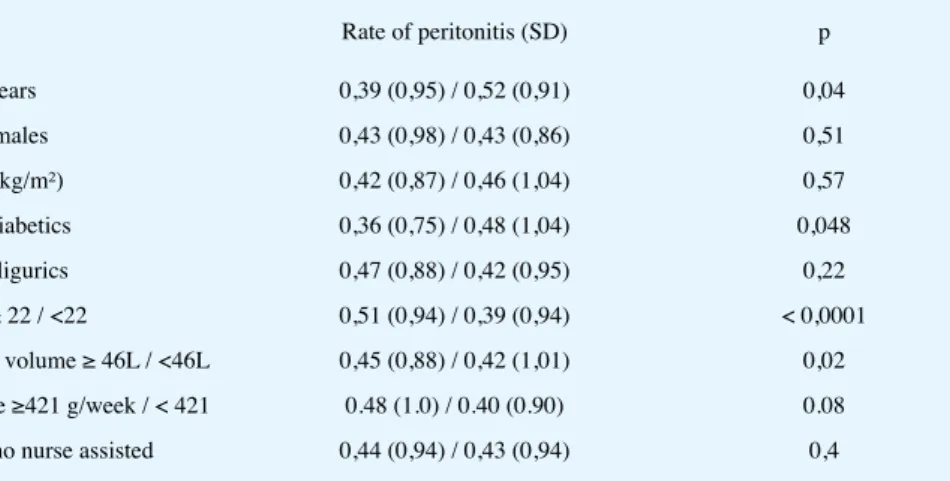
number of WEs, the volume of dialysate drained or the exposure to glucose and the rate of peritonitis per patient (p = 0.33, p = 0.06, p = 0.09 and p = 0.27 respectively). No significant difference was observed in the observed rate of peritonitis between oliguric patients and patients with conserved diuresis (0.47 peritonitis / patient / year in PD in oliguric patients versus 0.42, p = 0, 22). On the other hand, patients with a WE number greater than or equal to 22 had a significant peritonitis excess risk (0.51 vs 0.39, p <0.0001). The same was true in patients with a drained dialysate volume greater than or equal to 46L / week (0.45 vs 0.42, p = 0.02). Gender and BMI had no impact on the risk of peritonitis (p = 0.51 and 0.57 respectively). On the other hand, higher age was associated with a lower rate of peritonitis, especially among the over 70s (n = 411), who had a rate of 0.39 versus 0.52 among the under 70s (p = 0.04 ). Diabetes also appeared to be a protective factor (0.36 in diabetics vs 0.48 in non-diabetics, (p = 0.048). Independent patients did not have more peritonitis than patients helped by a private nurse (p = 0 , 40) and exposure to glucose did not significantly affect the rate of peritonitis (p = 0.08).
With the model not taking into account competitive risks, in univariate analysis: only diabetic status (HR = 0.73, p = 0.02), age ≥70 years (HR = 0.71, p = 0.009), number of WE ≥22 (HR = 1.57, p = 0.0004), the volume of dialysate drained≥46L / week (HR = 1.47, p = 0.004), the exposure to glucose ≥421g / week (HR = 1.30, p = 0.04) and the assistance of an FDI (HR = 0.76, p = 0.03) were significantly associated with the risk of peritonitis. The volume of diuresis did not impact the risk of peritonitis (HR = 1.08, p = 0.6). In multivariate analysis: only the number of WE ≥ 22 and the diabetic status were significantly associated with a modification of the risk of peritonitis (respectively HR = 1.55, p = 0.0005 and HR = 0.74, p = 0, 02).
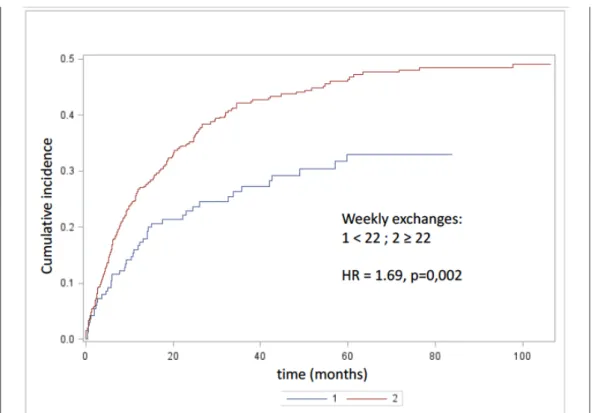
Taking into account competitive risks: 279 patients presented a competitive event before having had an episode of peritonitis, including 144 deaths. In a univariate analysis, only the number of WE ≥ 22 (Figure 1) and the volume of drained dialysate ≥ 46L / week appeared to be associated with a significant risk of peritonitis (HR = 1.69, p = 0.0015 and HR respectively = 1.57, p = 0.0014). Diuresis volume and glucose exposure had no significant impact on the risk of peritonitis (p = 0.46 and p = 0.12 respectively). Diabetic status, age and nurse assistance were associated with a non-significant reduction in the risk of peritonitis (HR = 0.78, p = 0.08; HR = 0.96, p = 0, 74 and HR = 0.8, p = 0.15 respectively). In multivariate analysis, the number of WE was associated with an excess risk (HR = 1.47, p = 0.02), while the volume of dialysate and age were not (p = 0.22 and p = 0.74 respectively). On the other hand, the trend was confirmed in diabetics with a barely significant reduction in risk (HR = 0.77, p = 0.0497).
journal officiel du Registr e de D ialyse Péritonéale de Langue Française RDPLF www .rdplf.or g
Table II : determinants of the peritonitis rate * in CAPD patients, univariate analysis (n = 620)
* number of peritonitis/patient/year, SD : standard deviation, BMI : Body Mass Index, WE : weekly exchanges Time to first onset of peritonitis (Tables III and IV)
Rate of peritonitis (SD) p
Age ≥ 70 / <70 years 0,39 (0,95) / 0,52 (0,91) 0,04
Gender males/females 0,43 (0,98) / 0,43 (0,86) 0,51
BMI ≥ 25 / <25 (kg/m²) 0,42 (0,87) / 0,46 (1,04) 0,57
Diabetics / non diabetics 0,36 (0,75) / 0,48 (1,04) 0,048
Oligurics / non oligurics 0,47 (0,88) / 0,42 (0,95) 0,22
Number of WE ≥ 22 / <22 0,51 (0,94) / 0,39 (0,94) < 0,0001
Weekly dialysate volume ≥ 46L / <46L 0,45 (0,88) / 0,42 (1,01) 0,02
Glucose exposure ≥421 g/week / < 421 0.48 (1.0) / 0.40 (0.90) 0.08
journal officiel du Registr e de D ialyse Péritonéale de Langue Française RDPLF www .rdplf.or g
Figure 1: risk of peritonitis according to the number of weekly exchanges, estimated by the cumulative incidence
Figure 1: risk of peritonitis according to the number of weekly exchanges, estimated by the cumulative incidence func-tion (comparison by the Fine and Gray test): n = 620
tion (comparison by the Fine and Gray test): n = 620
Table III : determinants of the delay before first peritonitis, univariate analysis without and taking competitive risks * into account (n = 620)
*competitive events : death, kidney transplantation and other causes of definitive cessation of PD treatment; HR : hazard ratio, BMI : Body Mass Index, WE: weekly exchanges
model not taking competitve risks
into account model taking competitive risks into account
HR p HR p
age ≥70 (vs <70 years ) 0,71 0,009 0,96 0,74
gender, males (vs females) 0,99 0,94 0,98 0,52
BMI ≥25 (vs <25) 1,10 0,45 1,16 0,26
diabetics (vs non diabetics) 0,73 0,02 0,78 0,08
oligurics (vs non oligurics) 1,08 0,60 1,14 0,46
number of WE ≥22 (vs <22) 1,57 0,0004 1,69 0,002
weekly dialysate volume ≥ 46L (vs <46L) 1,47 0,004 1,57 0,001
glucose exposure ≥ 421g/week (vs <421) 1.30 0.04 1.15 0.12
nurse-assisted 0,76 0,03 0,80 0,15
Table 4: determinants of the delay before first peritonitis, multivariate analysis without and with consideration of com-petitive risks * (n = 620)
model not taking competitive risks into
account** model taking competitive risks into account ***
HR p HR p
diabetics (vs non diabetics) 0,74 0,02 0,77 0,0497
number of WE ≥22 (vs <22) 1,55 0,0005 1,47 0,02
*competitive events : death, kidney transplantation and other causes of definitive cessation of PD treatment; **Cox model, ***Fine and Gray model, HR : hazard ratio, WE : weekly exchanges
DISCUSSION
The aim of this study was to assess the impact of the volume of diuresis and the number of WE on the risk of peritonitis in CAPD patients. We did not find a significant increase of this risk in oliguric patients. However, we have shown an effect of the number of WE on this risk with a significantly increased risk in patients with more than 22 WE (HR = 1.47, p = 0.02). We cannot draw any conclusions as to the origin of this excess. Recent work has shown that increased glucose exposure is associated with an increased risk of peritonitis (18). However, this association remains disputed since the data observed in the literature are not all consistent (19,20). In our study, although there appears to be a tendency for an increased risk of peritonitis in patients with greater exposure to glucose, this parameter is not an independent risk factor. In addition, the increase in the number of WE goes hand in hand with an increase in the handling of the PD catheter, which is probably accompanied by an increased risk of contamination by skin germs or from the ENT sphere. This aspect cannot be verified in the present case since we considered all the episodes in the same way without distinction according to the causative pathogenic agent. On the other hand, we observed a reduced risk in diabetic patients (HR = 0.77, p = 0.0497). Some studies, on the contrary, have identified diabetes as a risk factor for peritonitis (6,21,22). The number of WE does not explain this result since it did not differ between non-diabetic and diabetic patients (21.45 (ET = 5.5) vs 21.50 (ET = 6.5), p = 0.53). One could suppose that this association can be explained by the fact that among the diabetic population more patients benefit from the assistance of a registered nurse at home (63.3% vs 52.1% in non diabetics, p = 0.006) which has already been identified as a protective factor (23). However, in our study, none of the multivariate models carried out retained the assistance of a nurse as a factor significantly linked to the risk of peritonitis. In addition, the forced adjustment to this parameter in the various multivariate models did not modify the association of diabetic status with the risk of peritonitis. No difference in glucose exposure was observed between diabetics and non-diabetics (430.2 g / week respectively (SD = 285.8) vs 452.6 (SD = 243.4), p = 0.24). A study has shown in a Japanese cohort that the excess risk usually associated with diabetes was not observed in the most recent data (24). Presumably, the care of diabetic patients and the prevention of peritonitis in this population has improved.
Our study presents certain strong points: in particular a relatively large number of observations, prolonged monitoring and taking into account of competitive events which occupy an important part in this problem. However, there are several limitations to this work too. First of all, we did not take into account certain potential confounding factors, the impact of which on the risk of peritonitis has already been demonstrated, as is the case for immunosuppressants or certain comorbidities (heart failure, chronic pulmonary disease...). In addition, we considered that the most recent adequacy assessment was the most representative of the entire treatment period, so a bias linked to variability cannot be completely excluded. This work was not intended to describe treatment practices, so we only included a small proportion (8.8%) of PD incident patients during the period of interest. The dialysis practices identified cannot be considered as representative of all the treatment practices of RDPLF centers. Other additional work will be necessary to clarify the results observed. The data available in the RDPLF should make it possible to answer the remaining questions. journal officiel du Registr e de D ialyse Péritonéale de Langue Française RDPLF www .rdplf.or g
CONCLUSION
This study showed an increased risk of peritonitis in patients with more than 22 weekly bag exchanges in CAPD. On the other hand, a reduction in diuresis does not seem to constitute a risk factor in its own right. The pathophysiological mechanism of this risk factor has not yet been clearly identified. We also objectified a lower risk in diabetic patients the origin of which is not explained by the data used in this work.
ACKNOWLEDGMENTS
The authors would like to thank all of the centers participating in the RDPLF as well as Christian Verger for his help and who extracted and anonymized the RDPLF data.
DISCLOSURE The authors have no conflict of interest to declare.
FUNDING no author was paid for this work.
REFERENCES
1. Davenport A. Peritonitis remains the major clinical complication of peritoneal dialy-sis: the London, UK, peritonitis audit 2002-2003. Perit Dial Int J Int Soc Perit Dial. 2009 Jun;29(3):297–302.
2. Boudville N, Kemp A, Clayton P, Lim W, Badve SV, Hawley CM, et al. Recent peritonitis associates with mortality among patients treated with peritoneal dialysis. J Am Soc Nephrol JASN. 2012 Aug;23(8):1398–405.
3. Tian Y, Xie X, Xiang S, Yang X, Zhang X, Shou Z, et al. Risk factors and outcomes of high peritonitis rate in continuous ambulatory peritoneal dialysis patients: A retrospective study. Medicine (Baltimore). 2016 Dec;95(49):e5569.
4. Salzer WL. Peritoneal dialysis-related peritonitis: challenges and solutions. Int J Nephrol Renov Dis. 2018;11:173–86.
5. Gadola L, Poggi C, Dominguez P, Poggio MV, Lungo E, Cardozo C. Risk Factors And Prevention of Peritoneal Dialysis-Related Peritonitis. Perit Dial Int J Int Soc Perit Dial. 2019 Apr;39(2):119–25.
6. Kerschbaum J, König P, Rudnicki M. Risk factors associated with peritoneal-dialysis-related peritonitis. Int J Nephrol. 2012;2012:483250.
7. Han SH, Lee SC, Ahn SV, Lee JE, Kim DK, Lee TH, et al. Reduced residual renal func-tion is a risk of peritonitis in continuous ambulatory peritoneal dialysis patients. Nephrol Dial Transplant Off Publ Eur Dial Transpl Assoc - Eur Ren Assoc. 2007 Sep;22(9):2653–8.
8. John MM, Gupta A, Sharma RK, Kaul A. Impact of residual renal function on clinical outco-me and quality of life in patients on peritoneal dialysis. Saudi J Kidney Dis Transplant Off Publ Saudi Cent Organ Transplant Saudi Arab. 2017 Feb;28(1):30–5.
9. Chen CH, Perl J, Teitelbaum I. Prescribing high-quality peritoneal dialysis: The role of pre-serving residual kidney function. Perit Dial Int J Int Soc Perit Dial. 2020 May;40(3):274–81.
journal officiel du Registr e de D ialyse Péritonéale de Langue Française RDPLF www .rdplf.or g
10. Wang AY-M, Woo J, Wang M, Sea MM-M, Sanderson JE, Lui S-F, et al. Important diffe-rentiation of factors that predict outcome in peritoneal dialysis patients with different degrees of residual renal function. Nephrol Dial Transplant Off Publ Eur Dial Transpl Assoc - Eur Ren Assoc. 2005 Feb;20(2):396–403.
11. Pecoits-Filho R, Heimbürger O, Bárány P, Suliman M, Fehrman-Ekholm I, Lindholm B, et al. Associations between circulating inflammatory markers and residual renal function in CRF patients. Am J Kidney Dis Off J Natl Kidney Found. 2003 Jun;41(6):1212–8.
12. Wang AY-M, Wang M, Woo J, Law M-C, Chow K-M, Li PK-T, et al. A novel association between residual renal function and left ventricular hypertrophy in peritoneal dialysis patients. Kidney Int. 2002 Aug;62(2):639–47.
13. Ateş K, Nergizoğlu G, Keven K, Sen A, Kutlay S, Ertürk S, et al. Effect of fluid and sodium removal on mortality in peritoneal dialysis patients. Kidney Int. 2001 Aug;60(2):767–76. 14. RDPLF (Registre de Dialyse Péritonéale de Langue Française) registry: available on http:// WWW.RDPLF.org/.
15. Verger C, Ryckelynck J-P, Duman M, Veniez G, Lobbedez T, Boulanger E, et al. French peritoneal dialysis registry (RDPLF): outline and main results. Kidney Int Suppl. 2006 Nov;(103):S12–20.
16. Austin PC, Lee DS, Fine JP. Introduction to the Analysis of Survival Data in the Presence of Competing Risks. Circulation. 2016 Feb 9;133(6):601–9.
17. Fine JP, Gray RJ. A Proportional Hazards Model for the Subdistribution of a Competing Risk. J Am Stat Assoc. 1999;94(446):496–509.
18. Uiterwijk H, Franssen CFM, Kuipers J, Westerhuis R, Nauta FL. Glucose Exposure in Peri-toneal Dialysis Is a Significant Factor Predicting Peritonitis. Am J Nephrol. 2020;51(3):237–43. 19. van Diepen ATN, van Esch S, Struijk DG, Krediet RT. The Association Between Glucose Exposure and the Risk of Peritonitis in Peritoneal Dialysis Patients. Perit Dial Int J Int Soc Perit Dial. 2016 10;36(5):533–9.
20. Nataatmadja M, Cho Y, Pascoe EM, Darssan D, Hawley CM, Johnson DW. Association between Peritoneal Glucose Exposure and Peritonitis in Peritoneal Dialysis Patients: The Bal ANZ Trial. Perit Dial Int J Int Soc Perit Dial. 2017 Jul;37(4):407–13.
21. Benabed A, Bechade C, Ficheux M, Verger C, Lobbedez T. Effect of assistance on perito-nitis risk in diabetic patients treated by peritoneal dialysis: report from the French Language Peritoneal Dialysis Registry. Nephrol Dial Transplant. 2016 Apr;31(4):656–62.
22. Oo TN, Roberts TL, Collins AJ. A comparison of peritonitis rates from the United States Renal Data System database: CAPD versus continuous cycling peritoneal dialysis patients. Am J Kidney Dis. 2005 Feb;45(2):372–80.
23. Nessim SJ, Bargman JM, Austin PC, Nisenbaum R, Jassal SV. Predictors of Peritonitis in Patients on Peritoneal Dialysis: Results of a Large, Prospective Canadian Database. Clin J Am Soc Nephrol. 2009 Jul;4(7):1195–200.
24. Ueda R, Nakao M, Maruyama Y, Nakashima A, Yamamoto I, Matsuo N, et al. Ef-fect of diabetes on incidence of peritoneal dialysis-associated peritonitis. PloS One. 2019;14(12):e0225316. journal officiel du Registr e de D ialyse Péritonéale de Langue Française RDPLF www .rdplf.or g
journal officiel du Registr e de D ialyse Péritonéale de Langue Française RDPLF www .rdplf.or g
Open Access This article is licensed under a Creative Commons Attribution 4.0 International
License, which permits use, sharing, adaptation, distribution and reproduction in any medium or format, as long as you give appropriate credit to the original author(s) and the source, provide a link to the Crea-tive Commons license, and indicate if changes were made. The images or other third party material in this article are included in the article’s Creative Commons license, unless indicated otherwise in a credit line to the material. If material is not included in the article’s Creative Commons license and your intended use is not permitted by statutory regulation or exceeds the permitted use, you will need to obtain permission directly from the copyright holder. To view a copy of this license, visit http://creativecommons.org/licenses/ by/4.0/.