Publisher’s version / Version de l'éditeur:
Vous avez des questions? Nous pouvons vous aider. Pour communiquer directement avec un auteur, consultez la première page de la revue dans laquelle son article a été publié afin de trouver ses coordonnées. Si vous n’arrivez pas à les repérer, communiquez avec nous à [email protected].
Questions? Contact the NRC Publications Archive team at
[email protected]. If you wish to email the authors directly, please see the first page of the publication for their contact information.
https://publications-cnrc.canada.ca/fra/droits
L’accès à ce site Web et l’utilisation de son contenu sont assujettis aux conditions présentées dans le site LISEZ CES CONDITIONS ATTENTIVEMENT AVANT D’UTILISER CE SITE WEB.
Internal Report (National Research Council of Canada. Division of Building
Research), 1968-10-01
READ THESE TERMS AND CONDITIONS CAREFULLY BEFORE USING THIS WEBSITE.
https://nrc-publications.canada.ca/eng/copyright
NRC Publications Archive Record / Notice des Archives des publications du CNRC :
https://nrc-publications.canada.ca/eng/view/object/?id=d3b8292e-6510-42de-92c3-a87b6e8cb5bd https://publications-cnrc.canada.ca/fra/voir/objet/?id=d3b8292e-6510-42de-92c3-a87b6e8cb5bd
For the publisher’s version, please access the DOI link below./ Pour consulter la version de l’éditeur, utilisez le lien DOI ci-dessous.
https://doi.org/10.4224/20337957
Access and use of this website and the material on it are subject to the Terms and Conditions set forth at
Physical behaviour of peat derivatives under compression
THE PHYSICAL BEHAVIOUR OF
PEAT DERIVATIVES UNDER COMPRESSION
A re search report on an inve stigation undertaken at McMaster University, Hamilton, during the academic year 1963-64.
by
Ivan C. MacFarlane
Internal Report No. 350 of the
Division of Building Re search
OTTAWA October 1968
relatively small loads can often cause large settlements.
Considerable research, both in the laboratory and in the field, has been carried out in an attempt to determine the
compres-sibility characteristics of peat. Such investigations have
been given additional impetus in Canada by the recent increased pace of development in the north, where organic terrain is much more common than in the south. The various
investi-gations have succeeded in dealing with certain peats in a practical way, such as in road-building techniques, off-road transport, etc. Relatively little re search, however, has been undertaken on the fundamental physical and mechanical propertie s of peats and on the response of peat constituents to load, whether in shear or in compression.
One difficulty constantly encountered in engineering research on peat is the absence of a quantitative classification of peat types, as opposed to purely qualitative designations. The latter have proven to be extremely useful but the time has corne when they should be augmented by something mathe-matically precise.
This work evaluate s two aspects of the muskeg problem: the response of the elements of selected peat to compressional load, and the development of a rational engineering designation of the peat material. The se aspects are closely related
functionally and both entail a microscopic examination of the peat structure.
Ottawa
October 1968
R. F. Legget Director
INTRODUCTION
THE ORIGIN" AND DEVELOPMENT OF PEAT PEAT STRUCTURE
WATER RELATIONSHIPS IN PEAT (1) Free Water
(2) Capillary Water
(3) Physically Bound Water (adsorbed water) (4) Chemically Bound Water
(5) Colloidally Bound Water (6) Osmotically Bound Water
THE COMPRESSION PROCESS IN PEATS MICROCONSOLIDATION TEST PROGRAM
Description of Peat Tested
Development of Microconsolidometer Test Procedures
Test Results
APPRAISAL OF OBSERVATIONS AND TESTS AND RECOMMENDATIONS FOR FURTHER RESEARCH
Structure
Compre s sional Loading ACKNOWLEDGMENTS REFERENCES
APPENDIX A: CALIBRATION OF PROVING RING APPENDIX B: PREPARING SMEAR SLIDES OF PEAT
ELEMENTS FOR MICROSCOPIC STUDY APPENDIX C: PREPARING SLIDES OF PEAT
CROSS-SECTION FOR MICROSCOPIC STUDY
2 7 14 15 15 16 16 16 16 18 21 22 23 24
26
27 2729
31 33by
Ivan C. MacFarlane
Within this report, "peat" is defined as an accumulation of plant remains in various stage s of decomposition and disinte-gration which have been fossilized under conditions of incomplete aeration and high water content. Physicochemical and biochemical proce s se s cause this organic accumulation to remain in a relatively high state of preservation over a long period of time. "Muskeg, II
in this report, de signate s organic terrain, the physical condition of which is governed by the structure of the peat in it and its re-1ated mineral sublayer, considered in relation to topographic feature s and surface vegetation with which the peat coexists (Radforth, 1952).
Investigations into the compression characteristics of peats have been underway internationally for at least 25 years, although most of this work has been carried out in the past decade. Peats exhibit characteristics that re sist a simple settlement analysis based on the classical Ter zaghi (1925) consolidation theory. In general, however, the approach to the compression process in peats has been similar to that for mineral soils exhibiting exceptionally large secondary compression effects because of the need to obtain immediate results for design purposes (Goodman and Lee, 1962; Ander-son and Hemstock, 1959; ThompAnder-son and Palmer, 1951).
Some settlement characteristics of peats strongly resemble clay (and particularly organic clay) compression characteristics. The physical process of compression of a peat, however, is considered substantially different from that of a clay or silt due to the biologically controlled process of aggregation and to the structure of the peat.
Recent investigators are treating peat as a uniquely constituted material and are beginning to recognize its botanical distinctiveness from mineral soils. Adams (1964) of Ontario Hydro, in his hypotheses of the water movement in peat during compression, and Schroeder and Wilson (1962) of McMaster University with
approach. The concept of the compre s sion proce s s as comprised of two separate and distinct phases, one terminating at a clearly defined point and the other continuing for a long period of time, is not applicable to peats. Primary consolidation and secondary compression are considered to be purely empirical divisions of a continuous compre s sion proce s s, both occurring simultaneously during part of the process.
What happens to peat under load is presumably a function of the structure of the material. The question immediately arises: how does one refer to peat structure in rigorous mathe-matical terms? This report describes a study undertaken at McMaster University of the macro- and microstructure of a particular peat type, and the effect of this structure on the application of compressional loads. The investigation was based on the hypothe sis that certain peats that have a single generic plant constituent, and certain other peats that are
consistent admixtures of two or three generic plant constituents, control the quality of physical change in peat when it is subje ct ed to compressional loading. Although only one particular peat is being investigated, it is hoped that workable principles can be established that can be applied equally well to other types.
This report postulates on the compressional process in peats under load, describes the development of apparatus to as sist in the visual observation of physical phenomena and indicate s the direction to be taken in continuing re search. THE ORIGIN AND DEVELOPMENT OF PEAT
A discus sion of peat structure would not be complete without some reference to its origin and development. The mechanical structure of peats, their colloidal properties, and other physical and physicochemical characteristics are determined and con-trolled by the nature of the plants from which they have been formed, by environmental factors, and by other conditions which have contributed to their formation and decomposition (Waksman 1942). A detailed examination of the origin of peat would entail the complex and diverse relations between plant organisms and their environment; this account, however, will refer to the se only in a general way.
Under aerobic conditions, dead plants are quickly decomposed by the action of micro-organisms, thereby
forming carbon dioxide and water. When the supply of oxygen is suppressed by the presence of water the decomposition process proceeds much more slowly and sometimes does not advance with the same speed as the growth and formation of new plant material. In this way, peat accumulates,
influenced by both biotic and extrabiotic factors (Radforth, 1962a). Extrabiotic factors include climate (especially the balance
between precipitation and evaporation at each season of the year), and the topography, soil and rock which together determine
the drainage pattern or hydrology of an area.
The chief requisite for muskeg development is abundant moisture, for water is the fossilizing agent in peat formation. The presence of water may be due to climatic factors, such as a humid atmosphere associated with an excess of precipi-tation over evaporation, or to a high water table resulting from geological or local morphological factors. It may even exist in the form of open water as a lake or a pond. As long as the water persists, peat will continue to accumulate. If the water is removed by evaporation or by drainage, however, the peat begins to deteriorate immediately and will eventually disintegrate if the dehydrating condition persists and is aided by aeration.
A second climatic factor contributing to the formation of peat is temperature. It is a secondary effect, however, and controls the formation of peat only when the water factor is limiting. Low temperatures reduce both evaporation and plant growth. In the sub-arctic, therefore, the decreased evaporation favours peat formation, but in the extreme arctic, the low rate of plant growth limits it. High atmospheric
precipitation and cool, even temperatures are characteristic of the extensive muskeg areas of the temperate zones. In the subt r opi c s , high temperatures discourage peat formation by affecting the water loss, either at frequent intervals or in
seasonal cycle s ,
Wind and snow cover are other secondary factors that modify the peat environment. The direction and intensity of wind influence s atmospheric precipitation, and the amount and extent of snow cover contributes to the over-all water factor.
The ecological function of landform lie s in determining local moisture conditions, as opposed to the general climatic pattern (Gorham, 1957). Where the evaporation-transpiration balance is less favourable to peat growth, peat occurs
where features of topography or impeded drainage cause water to collect. The vegetation, therefore, receives water from two source s - direct rainfall and seepage or runoff water. Suitable topography may include valleys, lakes, basins, lower
slope s , flat plains surrounded by hills, areas around spring s or water seepage, or any area receiving soil water from some large catchment area (Newbould, 1958). Geological factors condition muskeg development through their effect on the permeability and erosion of the soil, and hence upon water
relations. Runoff water differs from rainwater in the chemicals it carries in solution and in the particles (colloidal or larger) it carries in suspension. Its exact nature will depend upon the type of rock or soil it has pas sed through or over. The chemical constitution of the mineral sublayer and the soil water, and their consequent supply of nutrients, will have a controlling effect on the growth and selection of plant species which normally coexist in a consistently wet area and eventually produce peat.
Biotic factors in peat formation have a more direct and fundamental effect upon its structure. The plant asso-ciations existing in a certain bio ....environment contribute
their structural characteristics to the peat mass. The macro-scopic structure is dependent to a large extent on the mode of deposition of the fos silized plant material: for instance,
whether the organic deposit is a filled-in lake or wet depression, or whether it is an extensive area of unconfined organic
terrain. Different environmental conditions will encourage different plant associations whose constituents, by
contri-buting their fos silized remains to the deposit, will produce a characteristic macro- and microstructure in the peat.
Different elements in the floristic community will have
different rates of deterioration so that one fossilized element from the living community will have predominance in the peat mass over another.
Mosses, and particularly sphagnum, are comprised of tissues which absorb many times their own weight in water.
Consequently, when mos se s are a major component of the living cover and of the subsequent peat deposit, the fossilized mass carries the water table with it as it grows, thus pro-viding the necessary moisture for succeeding increments of peat. Some plants contributing to the peat produce a loose open mesh in their growth habit (Radforth, 1962). When these die, no peat will form if free water does not
persist. If there is an adequate supply of free water, however, these plants will fossilize to an open mesh structure.
Other plants endow the peat with a small mesh of immense internal area. When combined with woody fibrous elements, this peat resists natural compression. If the woody constituents are absent in the small mesh, however, substantial
com-paction results.
According to Newbould (1958), there are two extremes
of peat development, as well as consistently recurring intermediate types. Utilizing the European terminology, these are:
(1) Fen peat (also called low moor), formed where impeded drainage occurs with base rich soil water, most commonly found in lake basins and river valleys, that is confined muskeg (Radforth, 1962b). Formation is dependent much more on topography and soil than on climate alone. The production of plant material is probably greater than it is under more acid conditions, although this is partly offset by decomposition. The breakdown of carbohydrate s and proteins and subsequent dissipation of the end products of the breakdown, by decreasing the organic content of the peat, increase its mineral content. Mineral colloids and particles carried in suspension in the soil water may also be deposited in the peat and add to its mineral content, which is usually measured as per cent ash.
(2) Bog peat (also called high moor), formed under acid conditions. This peat is often woody-fibrous and little decomposed and usually has a very low ash content. Acid conditions reduce
both the production of organic m.atter and its decom.-position. Soil water is either so greatly diluted by rain water, or else so acid and base -poor that it favours the growth of so-called "bog plants" rather than "fen plants" (Newbould, 1958). Insofar as rain water exceeds soil water, clim.ate (especially the precipitation/ evaporation ratio) becom.es a m.ore im.portant factor than soil or topography in deter-m.ining the form.ation of peat bog. When the pre-cipitation/ evaporation ratio is particularly favourable, blanket bog (unconfined organic terrain -Radforth, 1962b) occurs. This require s direct rainfall but no soil water and covers all the ground except that with steeper slopes. This type of organic terrain is especially evident on the we st coast of British Colum.bia and in Newfoundland.
Where the precipitation/evaporation ratio is less favourable, "blanket bog" does not occur and the m.uskeg is confined to valleys and basins where the rain water is supplem.ented by soil water. If in the ideal situation, the basin contains a lake,
"fen vegetation" initially prevails under the influence of soil water. Later, accum.ulation of "fen" peat fills the basin to a level just above the perm.anent water table. At this stage, there is a transition to
sphagnum. and other characteristic bog plants, which form. peat above the influence of m.ineral-rich soil water. The underlying "fen" peat acts as a wetness reservoir while the m.argins of the peat-filled basin insulate the raised centre from. the soil water draining into the basin. Som.etim.es the centre of the bog (or confined m.uskeg) grows so rapidly that it assum.es a dom.ed appearance. Such a bog is known as a "raised bog;" the sloping side s are called the "rand, 11 and the
low insulating zone around the periphery is called the "lagg" (Newbould, 1958). This process explains why raised bog peat, unlike blanket peat, usually overlies lake rnud or "fen" peat.
Peat bogs are subject not only to peat form.ation and accum.ulation, but to downgrade, degenerative
processes. The balance between the two types of process at any given time is determined by the factors affecting peat formation, and especially by the age and history of the bog. The accumulation of peat has definite limits (Newbould, 1958). When the climate is unfavourable for peat formation and soil water is essential, peat accumulation ceases as soon as the surface vegetation is brought to a level appreciably above the soil water table. Where peat formation requires a mixture of rain and soil water, the same limit may operate.
In "blanket bog, " the peat is extremely wet and under the surface mat is often quite soft and soggy. Where it occurs on slopes, it cannot build up above a certain thickness without becoming unstable. The critical thickness will depend upon the consistency of the peat and the degree of slope, but is seldom more than six feet. For greater thickne s se s, the peat tends to flow down the slope (Newbould, 1958).
PEAT STRUCTURE
Any soil may be regarded as a system comprised of two or three spatially coexistent phases: a solid phase, a liquid
phase, and usually a gas phase. This three-phase concept applies equally well to peats as to mineral soils except that the "solid" phase in its microscopic aspect is in itself a secondary system of biological entities consisting of cellular structures containing liquid and/or gas. Some knowledge of the relation between these phases, as well as of the structure of the solid phase, is basic to an understanding of the reaction of peat to loads.
"St ru ctur e " refers to the morphology and arrangement of the constituent peat elements, both in the macro- and
microscopic aspects. Since peats are comprised of fos silized remains of plant communitie s, they contain elements of varying morphology, complexity and texture. One form of plant remains may be the most predominant visually, another may be secondary in importance, another tertiary, and so on. On the other hand,
several elements may appear to be equally predominant and to contribute equally to the over-all properties of the peat. The structure of peat implies an arrangement of these primary,
The visible macrostructure of the peat is undoubtedly dependent upon the type and arrangement of the elements that are not so clearly distinguishable to the naked eye. In other words, the arrangement of the smaller units in the
micro-structure markedly influences the macromicro-structure.
It is this structure that affects the retention or expulsion of water in the system, gives it its strength, and differentiates one peat type from another. Peat structure relationships are studied to determine the degree to which peats exhibit a given structure, the stability of this structure, and the physical properties of the peat that are dependent upon the particular structural arrangement.
As defined here, structure involves the arrangement of peat elements into certain patterns; the arrangement varies with the amount and nature of the secondary, tertiary, etc. constituents. Between the various elements is the pore space as well as (for various hollow organics) an additional pore space within the elements. The external pores may be large or small, continuous or discontinuous, depending upon the type and arrangement of the elements. According to Baver (1956), the difference in soil structure may be expressed by: (a) the structural patterns of the various horizons in the profile; (b) the extent of aggregation (or in the case of peats, this might be interpreted as the degree of intermingling of secon-dary and other elements), and (c) the amount and nature of the pore space.
The approach described in (a) is best exemplified by one of the earliest and best known designations for peat types on the North American continent, namely, the stratigraphic system developed by Dachnowski (1924). He classified
peats on the basis of their mode of origin and their composition (fossilized plant material) relating these to particular horizons in peat bogs. He named ten distinct peat types falling into three main categories: sedimentary peats, fibrous peats, and woody peats (Table 1). These categories refer to the proportions of the various plant constituents and to textural, structural and other characteristics. Dachnowski, however, considered structure to be a property of a particular peat layer such as its compactness, density, and whether matted or not, rather than as an arrangement of the various constituents relative to each other or as the inherent characteristics of the constituents.
The section of the Radforth (1956) classification system for muskeg which relates to the peaty material fits approach (b). Radforth based peat type s on size, texture, and arrangement of proximal components. He designated 16 categories of peat, the physical elements of which can be seen from a visual examination of peat samples which he considered to be significant (Table II). The se are the woody fibrous (derived from tissues originally lignified), the non-woody fibrous (originally non-lignified and probably cellulose in origin), and the amorphous -granular constituents, the latter representing the highly variable and consistently
irregular minute organic aggregates that are such an important component of many peats. It is helpful to use these elements to classify peats qualitatively; however, quantitative evidence is necessary to give meaning to the various designations. Radforth and Eydt (1958) carried the question of structure a little further when they inve stigated the proportions of different type s of plant tis sue in sample s of peat examined
under a microscope. They suggested that this sort of examination might permit some extra polation to engineering properties
such as bearing capacity, but did not carry their approach further than this.
The third approach to structure is related to porosity. The arrangement of the peat elements determines the amount and nature of the external pores of the soil. The internal pores are determined by the plant type. Soil porosity may be defined as that percentage of the soil volume not occupied by solid particles (Baver, 1956). Although the amount and nature of the pores depends upon the size and character of the arrangement of elements, pore size alone cannot describe a particular type of structure.
The contribution of porosity to peat structural
relationships is emphasized by the work of Ohira (1962) in his study of Japane se peats. He developed a model structure for peat and described its fundamental physical properties in mathematical terms. His model structure is related to a
statistical analysis of a large number of determinations of basic physical properties of peats in Japan, and his description is briefly paraphrased as follows:
Peat consists of a large number of closely packed hollow organics of the same size. The specific gravity of the organics is represented by Go and their porosity by no. Part of the exterior voids
are filled with finer soils (specific gravity represented by G s), and the rest are filled with moisture and gases. Formulae for the fundamental properties of the
structural model (porosity, wet and dry density,
moisture content, specific gravity and organic content) are presented in terms of Cd, the "coefficient of
deposition,II which varies with the shape of the organic
material and the state of contact.
On the basis of a number of assumptions related to the numerical values of the various physical properties, Ohira postulated a structural model for peat having the following characteristic s:
(1) A large number of closely-packed hollow organics with porosity no of 90 to 98 per cent and a specific gravity Go of 1.5.
(2) A coefficient of deposition Cd of 0.8.
(3) Some of the voids between the organic elements are filled with soils with a specific gravity G s of 2.70 (t ,e. non-organic soils).
(4) The remainder of the voids are saturated with moisture and gas with a porosity of 2 to 10 per cent.
Ohira shows that the theoretical value s of the fundamental properties of the model, based on the above values, are rn
close agreement with actual experimental values.
This quantitative approach is both unique and significant, although the structural model of Ohira is rather limiting because it represents only one peat type (i. e. "fibrous" peats with an
admixture of mineral soils) and may not be valid for the wide range of peats de signated in Table II. The two extreme s of the peat struc-tural spectrum are represented by Radf orth! s Category 16 and
Category 1 (Table II). The former is characterized by an open mesh of highly preserved fossilized elements, including large woody constituents, whereas the latter is composed of pollens, spores, diatoms, etc. as well as highly decomposed botanical
entities; macroscopically, its components are structurally formless. Although many types could exist between these two extremes,
relatively few do occur (Radforth, 1956). The Ohi r a approach can be applied to peats with a predominantly fibrous element and a secondary element of amorphous -granular or even mineral soil. The "pure" fibrous and the "pureII amorphous -granular,
however, present quite another problem.
The amorphous -granular peat mass is normally a coagel of degenerated organic matter and a small quantity of mineral substances of a colloidal degree of dispersity (Naumovich, 1957). The dispersed phase in this condition forms a continuous lattice; in the nuclei of the lattice is a colloidal solution of the peaty substance. Depending upon the size of the particles, this peat is essentially a polydisperse system - the water being the dispersing medium of the peat. The disperse (solid) phase consists of the vegetative remains and the products of their decomposition: the humic acids, bitumens, and other organic and mineral constituents. In
mineral soil concepts, the completely dispersed, individual or primary particles are usually referred to as textural or
mechanical separates (Baver, 1956). The aggregates or secondary particles which are formed by a grouping together of the mechanical separates are generally considered the structural units of a mineral soil. The opposite case may be true for peat in that the structural units are the primary particles - the complex, relatively undecomposed botanical entitie s , The secondary elements are the re sult of chemical and physical degeneration of the primary units, although if
the secondary particles are in the colloidal size range, they will tend to group together in floccules and form the lattice mentioned above.
Conventionally, colloidal size means particles less
than O. 001 mm (1 micron) in diameter. The concept of colloidal properties is based on a comparison of the effect of electrical
charges on its surface on the movement and behaviour of the particle, relative to the effect of gravity. The complex physico chemical forces will therefore result in a structural model for the peats with a high colloidal fraction quite different from a structural model for the peats that are chiefly of a
fibrous nature.
Apart from the references to the submicroscopic colloidal fraction in peats, the foregoing has been referring mainly to the macrostructure of peats, although the importance of the microstructure has been implied. It may be realized that the microstructure is, ultimately, a more complex matter than the macrostructure, and like the latter, varies considerably from the fibrous and woody peats to the sedimentary and
amorphous -granular peats. The arrangement and structure of the cells of the peat constituents depend entirely upon the
plant material composing the peat and upon its physical disintegration and biochemical decomposition. The cells of a well-preserved peat constituent vary a great deal in size and structure. Their structural difference s reflect their different functions performed in the living plant. A group of structurally similar cells performing the same function
is called a tis sue. Fibre s are very elongated cells with tapering ends, occurring singly or variously grouped into strands and contribute to a gross fibre. In fossilized plant material, the cells are devoid of living content and contain water or
gas (including air). The strength of a given element is supplied by the cell wall, which has its own unique structure.
The cell wall is composed fundamentally of a complex mesh-like matrix of cellulose (Eames and McDaniels, 1947) but also contains pactic substances, lignin, etc. In minute structure, this basic matrix is composed of aggregates of delicate fibrils that grade down in size to the limits of
microscopic visibility. These fibrils are believed to be made up of micellae, aggregates of molecules (arranged in chains characteristic of cellulose), probably in crystalline form. These fibrils form complex, three -dimensional systems which adhere firmly and are continuous throughout the wall. Within the meshes of this matrix, channels and pores form another
system in which are deposited various substances. These substances filling the interstices form a secondary structural system. A cell wall may be made up, therefore, of two main substances such as cellulose and lignin or cellulose and a hemicellulose.
The strength of plant fibre s is amazingly high (Frey-Wyssling, 1957), linen fibres having a tensile strength of 110
kg}
sq mm which nearly equals that of steel. Despite this extraordinary tensile strength, however, the plant cell wall is a porous system of submicroscopic capillaries. Frey-Wyssling cites as evidence of this the fact that the density of a cellulose fibre is less than crystallized cellulose. The density of ramie, for instance, is 1. 39 grn/ cc whereas that of crystallized cellulose is1.
59gmJ
cc, which repre sents a mas s deficit of 0.20 gm/ cc or 12.6 per cent. Cellulose fibres also display a pronounced anisotropy in their swelling capacity, swelling being about 20 per cent perpendicular to the fibre axis and virtually negligible parallel to that axis.When considering microstructure in the re sponse of peat to engineering forces, the stress necessary to rupture a cell wall is also of interest. Frey-Wyssling (1952) gives an approximation of this stress in a discussion on the growth of plant cell walls. He postulated that in a spherical membrane whose thickness "d" is small compared with the radius "r" of the sphere, the internal pressure "p" on the cross-section of the ve sicle (i . e. a cell with a membranous integument or covering) equals the stress
"a
II exerted on the wall. Therefore:2
n r p = 2 n r d a .
If p is increased until the wall breaks, then 2d
P - r ab ,
where a
b is the tensile strength of the wall. Crystalline cellulose fibrils have a tensile strength of 100 kg/mm 2
and for a wall of dispersed texture Frey-Wyssling considered that half this value would be reasonable (50 kg/ mm 2). The membrane has a thickness of its fibrils = 250
A
(i , e. 2. 5 x 10- 5 mm) and the radius of the vesicle under consideration was 2. 5 rnrn , It follows from this that-5 2x2.5xlO x 50 P
=
2. 5 -3 / 2=
10 kg mm=
0.1 atmosphere.Therefore, a pressure of 1/10 atmosphere (1.5 psi) inside the vesicle is enough to break the outermost wall.
WATER RELATIONSHIPS IN PEAT
Directly related to the structure of any peat is its as sociated water content. The water factor may be more important for peats than for some mineral soils, since it contribute s so significantly to peat formation. Water is also an integral part of any biological system and even when that system has become fossilized, water still plays an important role. The physics and chemistry of water retention in peats are significant, therefore, in a consideration of permeability characteristics and of expulsion of water from the system under load.
Naumovich (1957) refers in some detail to the water relations in peats. He suggests that all the water occurring in a peat deposit is to some degree connected with the peat material. A study of the form of bound water can therefore be limited by the following types: adsorbed, osmotic and capillary water. He compares this with the system proposed by other Russian investigators where all possible forms of association are divided into three groups: (1) chemical
connection, (2) chemical connection, and (3) physical-mechanical connection. Each connection is characterized by a family of criteria. In peat, therefore, it is possible to associate two types of bound water with the peaty 'material: physical-chemical connection (absorption and osmotic absorption of water) and physical-mechanical connection (capillary water).
A similar classification of the types of water in peat was developed by Ostwald (1921), who carried out one of the earliest recorded examinations of water retention in peats. Modifications to his system have been made by Dumansky and Stobnikosf (Dalton, 1954). It is agreed,
however, that the water held in peat may be divided primarily into six categories: free water ("water of occlusion"),
capillary water, physically bound water, chemically bound water, colloidally bound water, and osmotically bound
water. Ostwald suggests that these various types of held water apply, to a greater or lesser degree, to both high and low bogs, and to both old and young peats.
(1) Free Water
This refers to the water in the peat cavities of 1 mm or more in diameter. Such cavities occur when the (fibrous) elements of peat become stuck together, felting or adhering to form three or more walls enclosing a cavity. These cavities may be in open communication with each other like a sponge, or may consist of a closed honeycomb structure.
This water doe s not interact with the solid material of peat and can be removed from it by free filtration under the force of gravity. In effect, it is a free water surface in a sponge -like structure. In a closed honeycomb structure, it is necessary to break through the walls enclosing the
cavity. This will probably be accomplished not by actual rupture of the organic elements, but by a displacement of their relative positions. Remoulding of peat, therefore, will destroy the original lattice structure and accelerate water expulsion.
(2) Capillary Water
Capillary water filling the capillary pores comprises the large st quantity of water in peat. Capillary water is present in the narrower concave and convex cavities of all types, i , e. in cylindrical plant remains and inside open cells and fibres, but especially between the adjacent discrete
structural components of the peat. Ostwald (1921) suggests that the greater part of the capillary water is not that held within the tissues and fibres, but rather that held between them by their external walls. This water is held in peat by a physical-mechanical bond and is capable of being moved under the action of capillary forces.
The capillary pressure in peat is in a more complex relationship than that of the capillary tube s , but the character of the phenomenon remains the same (Naumovich, 1957). In relation to the dimensions of the pores, the interaction of the capillary water with the peat particles will vary. The water of the micro-capillaries with a radius of r < 10- 5 em, being part of the hygroscopic water, develops large forces of interaction with the peat particles. The water of the macro-capillarie s occupie spore s with a dimension of r > 10 - 5 ern and comprises the chief mass of the capillary water. The latter water is more mobile than the former and can be
water from pores with a dimension of 10- 5 to 10- 7 ern, it is estimated that pressures of 15 to 1500 kg/cm2 (213 to
21,300 psi) are required (Naumovich, 1957). With a dimension of capillaries and pores of 10- 5 to 0.1 ern, a pressure of 1 to 15 kg/cm2 (14.2 to 213 psi) is required to squeeze out the water.
(3) Physically Bound Water (adsorbed water)
This refers to layers of oriented water molecules bordering the solid phase, the denser layer being next to the particle surface. the less dense and less well-oriented layer being outside these. The adsorbed water is held onto the surface of the peat particles by tremendous forces of tension, reaching 10.000 atmosphere s (Naumovich, 1957).
(4) Chemically Bound Water
This water is arranged in a chemical association with the peat material, analogous to water of crystallization of crystalline hydrates. It is held firmly in peats and is not removed by heating even at temperatures up to 150°C. (5) Colloidally Bound Water
Peats, particularly those with SOme amorphous-granular element, contain various substance s in a colloidal state and are held colloidally with water. Ostwald (1921) suggests that they are mostly gels, that is colloidal substances, which in spite of their high water content, retain typical properties of solid bodies. These gels are principally cellulose gels (membranes of plant remains which have not yet become combined or are only partly carbonized), humus gels, humic acid gels, and possibly pectin, albumen and other gels. The humus and humic acid gels permeate the whole substance of the peat. The se gels are pre sent in the form of carbonized membrane s or in an amorphous state as substance s between fibrous elements. Water held in this state is very difficult to expel under pressure and it is this colloidal condition which so drastically affects the permeability of amorphous-granular peats.
(6) Osmotically Bound Water
Naumovich (1957) suggests that the osmotic water is the second largest quantity of water" in peat (capillary water constituting the major quantity). Osmotic forces are generally
considered to be living plant cells, but when there are intact plant cells, when the cell membranes are well preserved, intracellular water fills these undecomposed cells of the fos silized plants and also the osmotic nuclei formed by the
coagel of the peat. The absorption of the peat water by osmosis is a stage in the swelling of the colloidal substances that
proceeds without liberation of heat.
Naumovich (1957) outlines the theory of this process. The lyophyllic colloidal systems consist of fractions of varying degrees of dispersity and solubility. The fractions of low molecular weight are soluble in a liquid and are the inner inclusions of the cells, formed by insoluble fractions of high molecular weight. The soluble fraction falls inside the cells with the formation of the colloidal substance and cannot penetrate the semi-permeable wall. If the concentration of the soluble fraction inside the cells is greater than that outside, the liquid will penetrate the cells by means of osmosis. In peat,
therefore, besides the undecomposed cells of peat-forming substances, which are able to absorb water osmotically, there are closed osmotic nuclei formed of high molecular fractions of colloidal material.
The osmotic water absorbed by the peat is indistinguishable from ordinary water and its properties. The osmotic water
can be removed mechanically by pressures up to 100 kg/ cm 2 (1420 psi).
It is important to consider not only the water -holding
ability of peat, but its permeability characteristics, which are also directly related to structure. Permeability is involved in
drainage and seepage, and has a controlling influence on the effective strength properties of peats, on their response under stre s s , and hence on stability conditions. Permeability
flow takes place primarily in saturated or partially saturated soils under gravitational forces or under a pumping head with all water of potential flow being under positive hydrostatic pressure (Burmister, 1954). Although this permeability may be controlled by many factors, the physical-chemical nature of the peat is of primary importance in this control.
The structure of the peat elements (their physical constitution and arrangement) greatly affects the continuity of the pore s and/or capillaries). Differences in structure (in a qualitative way) understandably has resulted in a great range in permeability of peats (Hofstetter, 1964). Peats with "woody remnants" have a high permeability in contrast to the highly colloidal amorphous-granular peats, which discourage permeability by water.
No rule exists by which one can consistently predict this property of peat because peat types vary so greatly.
Under some circumstances a fibrous peat may be very permeable, but under different conditions colloids present in the peat
may plug the finer pores and capillaries and inhibit permeability. In his review of the literature relating to the subject, Hofstetter (1964) lists four principles relating the importance of pore size and floccules of colloids:
(1) Percolation is dependent upon the size of the connecting interstices of the pores.
(2) Discharge is dependent upon the magnitude of porosity of the macropores.
(3) The ease of drainage varies with the diameter of the largest boundary neck in contact with air. (4) A drained pore fills during wetting at a tension
determined by the maximum diameter of the pore itself.
THE COMPRESSION PROCESS IN PEATS
Based on a knowledge of the structure of peats, and of the ways by which water is held in peats, it is now
pos sible to hypothe size on the physical proce s s of compre s sion in peats.
Consolidation of a saturated soil is a time-dependent volume reduction involving a decrease in the water content of the soil. When there is an increase of pressure on a soil system (solid and liquid and gas) in equilibrium, there is a volume change with an escape of fluid from the system. This process of volume reduction (consolidation) involves a time lag.
Consolidation of mineral soils is considered to be divided into two phases: the primary consolidation phase (described by the classical concept of Terzaghi), and the
se condary compre s sion phase. The time lag in the primary consolidation phase is associated with the dissipation of excess pore water pressures and is due to the resistance to volume change offered by the escaping water. The time lag in the secondary compression phase is associated with plastic flow or creep and in effect is due to resistance offered by the solid phase to volume change in the system. For
peats, it has generally been found that they experience a short-term but large primary consolidation phase followed by a
long-term but physically significant secondary compression phase during which the settlement is proportional to log of time (Anderson and Hemstock, 1959; Lea and Brawner, 1963; Adams, 1964). These are but empirical divisions of a continuous
settlement process and there is no doubt that both aspects occur simultaneously during part of that process.
Evengtev (1961) postulated that these two phases of compression of peat are explainable by: (I) deformation resulting from the squeezing out of water from the open
macro-pores {i ,e. the free and capillary water) during which process Da r cyls law applies; and (2) deformation resulting from the squeezing out of water from the closed pores, for which the collapse of the fibres is necessary.
A similar view is held by Adams {1964) who also divided the compression process of peats into two phases: the initial consolidation due to the expulsion of pore water in the peat mass, and the long-term consolidation due to the expulsion of water in the solid matter. He suggests that this long-term consolidation is not controlled by the dissipation of the excess pore pressure, but rather by the decrease in permeability under a relatively constant pore pressure.
This explanation for the physical proce s s of peat consolidation may be true for peats within a certain range (e. g. fibrous peats), but it does not account for any creep or plastic flow of the organic material.
As has already been mentioned (see "Feat Structure"), the two extremes of the peat structural spectrum may be represented on the one hand by an open-structured coarse
fibrous peat with the interstices filled with a secondary structural arrangement of non-woody fine fibrous elements, and on the
other hand by an amorphous -granular peat with a high proportion of microscopic particles and large colloidal fraction. In the former peat type, which represents fossilized elements in an excellent state of preservation, much of the associated water will be free water and capillary water. Under normal
cir-cumstances, the initial void ratio is very high and, consequently, this peat will have a large primary consolidation phase. Dissi-pation of excess pore water pressures will be very rapid and the load is transferred to the organic structure at a very early stage in the test. It is suggested that there is not much "collapse" or "rupture" of the discrete peat elements during this stage or later ones. Rather, they will gradually creep, rearrange
themselves in relation to each other, and slowly assume a more densely packed arrangement.
In the amorphous -granular peat, there is proportionally less free water and capillary water and much more physically bound and colloidally bound water. Initial void ratios can still be quite high, but upon application of a load, the pores and
channels quite rapidly become clogged with flocculating colloidal matter and the permeability of the peat is significantly reduced. Consequently, for this peat type, the "primary consolidation" phase may last for a long period of time and will not represent as
high a proportion of the total settlement as for the other peat type considered. Amorphous-granular peat has been shown (Schroeder and Wilson, 1962) to be a quasi-plastic material, and after pore water pressure dissipation, settlement will continue over a long period as plastic flow.
Between the se two extreme s of peat type s , all gradations will exist and will exhibit the combined features of both the amorphous -granular and the fibrous peats. There can be little doubt that at least some of the contradictions and confusion in the published literature on laboratory consolidation tests have arisen from the use of widely different types of peat in the te st s ,
The primary consolidation phase of the settlement process in peats - representing the dissipation of excess pore water pressures - is relatively straightforward. The secondary effects are the subject of this investigation;
their cause and characteristics are of special interest since they represent such a large part of the over-all settlement.
Part of the answer, at least, will lie in a consideration of the chemical and physical make -up of peats. In most well-preserved peats, the major component is cellulose or cellulose derivatives (see "Peat Structure"). Stress-strain characteristics of cellulose and its derivatives have been investigated in the
study of textile fibres (:Houwink, 1952) although the interest has been in tensile strength rather than in compressive strength. In natural cellulose, the stress-strain characteristics are affected by internal characteristics such as orientation and length of the micellae, and also are affected by external characteristics such as rate of loading, temperature, and amount of moisture. The latter is important in that water acts as a lubricant to the fibrils and gives ductility to the cellulose.
This has been shown by an investigation carried out in the USA (Barber, 1961) where compression tests were performed on air -dried and oven-dried peat, silk, raw cotton, two resins, a cellulose sponge and a soft wood. In each case, an increase in the air humidity increased the magnitude of compression
of the oven-dry material. Surrounding the compression apparatus with a desiccant practically eliminated secondary compression. Barber concluded from these factors that the seat of secondary compression is the hygroscopic moisture.
MlCROCONSOLlDATION TEST PROGRAM
In a consideration of the reaction to compressional load of the peat type under study, certain questions arose relative to the actual physical process taking place within the peat structure:
1. What structural deformation - macroscopic or microscopic - takes place during the excess pore water pressure phase of compression? Do the peat elements change their shape and, if so, in what way?
2. What structural rearrangements (plastic or viscous flow) occur following the excess pore water pressure phase? To what extent do the peat elements change their position in relation to one another? What kind of deformation of the peat elements take s place during this phase?
Description of Peat Tested
The particular peat used in this investigation is termed "non-woody fine fibrous" peat (see Table II) and was obtained by N. W. Radforth from near Moonbeam, Ontario, adjacent to the site of a slip failure of Highway 11. Throughout this report, it is designated as "Moonbeam peat." It is in an excellent
state of preservation and evidenced a low degree of disintegration and decomposition. The chief generic constituent was identified as Hypnum Cuspidatum (Jewell, 1955) with an occasional intrusion of a sedge (Carex) and a very occasional intrusion of a small
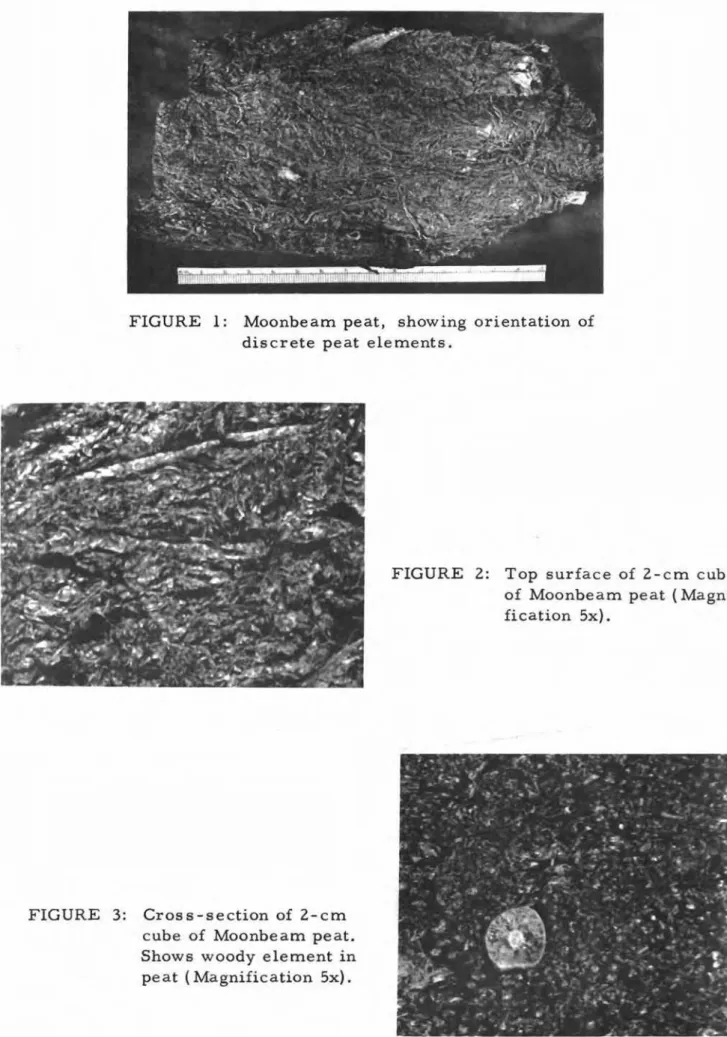
woody element. The characteristic macrostructural feature of this peat is its homogeneity, not only in its generic constitution, but also in the arrangement of the peat elements. Axes of the fossilized plant material are generally oriented horizontally and parallel to one another, presenting an appearance of remarkable consistency. This is illustrated by Figures 1 to 3, which show both large and small samples of the dried peat. This homogeneity of arrangement is primarily a function of the growth habit of the chief generic constituent of the peat.
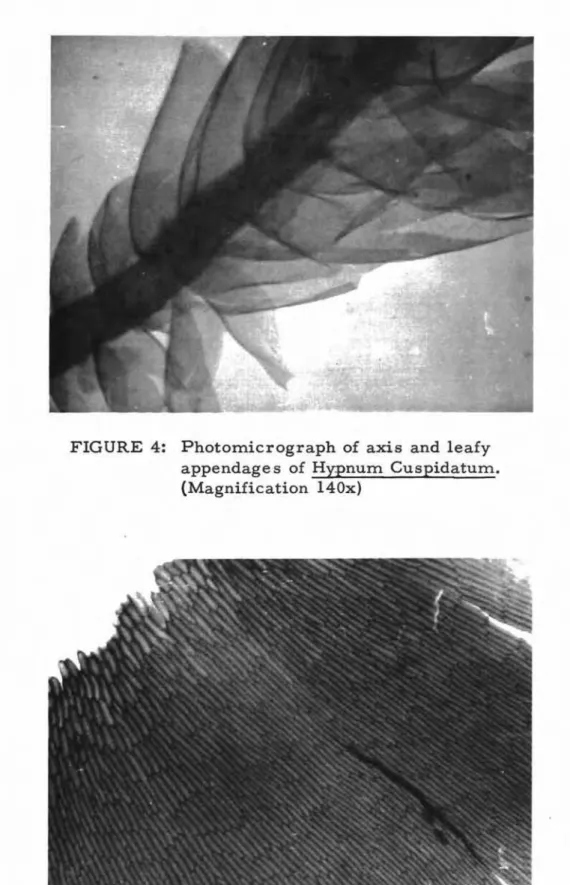
Viewed under the microscope, the peat elements (L e. the discrete fossilized particles) consist of a central axis, occasionally having branches and a spiral system of leafy appendages, the latter curled about the axis or branch and thereby providing an enormous number of capillary pores
(Figure 4). The axes are actually hollow tubes with an average outside diameter of 0.24 rnm when wet. Upon drying, the
diameter shrinks to about 0.126 mm on the average, representing a shrinkage perpendicular to the axis of 47. 5 per cent. Length-wise, the axis shrinks only slightly upon drying, which confirms Frey-Wys s lirig 's (1957) observations for living plants. The walls of the central axis are 3 to 5 cells thick; the leaves are only 1 cell in thickness. The elements vary in length from 5 to 32 rrrm with the median being 15 mm and the average length of 32 random sampleS being 15.8 rnrn , The number of leaf
appendages per millimeter of branch length was found, under a microscope to be 8.5 on the average.
The cell structure within the leaves and axis is regular and uniform in appearance. This is illustrated in Figure 5. The cellular structure of the Carex element in the peat is not nearly so evident under the microscope as is the Hypnum, as evidenced by Figure 6.
The peat has a water-carrying capacity of close to 1500 per cent of dry weight. The true specific gravity of the soil
solids is 1. 32. The loss on ignition is 96 per cent. The dry density of the peat sample is O. 139 gm/ cc ,
Development of Microconsolidometer
To assist in answering the questions posed at the beginning of the IIMicroconsolidation Test Program," a microconsolidometer apparatus was designed to permit observation under a microscope of a small peat sample under load. The load chamber was
designed to utilize small cube samples of 2 cm on a side. The consolidation chamber was constructed of 1ucite and incorporated thin "windows" to permit microscopic
observation of the sample. This was accomplished by making two of the chamber walls only 1. 5 mm thick, and highly polishing them so that they would be transparent. The other two walls were 1 cm in thickness. The chamber was made in two sections. The two thicker walls were in one piece and the "window" walls were a second piece and these two sections were attached with 6 screws. The chamber was 4 ern high. Attached to the bottom of the chamber {by screws} was a porous stone. A 1ucite loading piston 3 cm long was machined to fit closely into the 2 x 2 cm inside dimensions of the chamber. The consolidometer was closely fitted into a small base reservoir which supplied a water level up to the top of the porous stone. A view of the micro-consolidation chamber, with sample, loading piston and base reservoir, is given in Figure 7.
This apparatus was initially mounted on a base of a stripped down microscope, which provided four directions of movement relative to a fixed microscope: up and down, forward and back, sideways, and rotation through 90°. A monocular microscope was rigidly mounted horizontally and it was therefore possible to view the sample through the consolidometer "windows."
For a reasonable field of vision, magnification had to be kept generally below 20 times, which did not permit the structure to be observed in detail. This apparatus is shown in Figure 8.
Small lead weights were made up to provide a dead load for the sample and were placed directly onto the loading piston, but this arrangement was found to be entirely inadequate. Dead loading did not produce much observable effect in the peat sample; except for a momentary movement when the load was added,
little else was observable. Furthermore, photography proved to be a serious problem with the monocular microscope.
Focusing the camera was very difficult since the available light source did not provide adequate illumination through the microscope and camera (mounted onto the microscope) to give a sharp focus on the ground glass. Use of stronger directed light had a deleterious effect on the lucite chamber, which commenced to bubble from the heat.
Consequently, extensive revisions were made to the apparatus. A t:tinocular microscope (Olympus) was obtained,
together with an appropriate camera which made photomicrography a definite pos sibility. As the microscope is normally mounted vertically, a special base was de signed and constructed to permit it to be mounted horizontally. It consisted of a serie s of sliding plates and permitted the microscope to be raised and lowered as required, and to be moved forward and back and
sideways. The apparatus is illustrated in Figure 9.
The inadequacies of a dead loading system led to the use of a modified unconfined compression test loading device. This Tinius -Olsen machine permitted the load to be added at a more or less constant rate. A calibrated proving ring (see Appendix A) recorded the load applied to the sample and dial gauges measured the amount of settlement. The entire set-up is shown in Figure 1O.
Test Procedures
So far, no normal consolidation tests have been performed; instead, accelerated loading tests were effected. These gave qualitative results, but established the usefulness of the apparatus, and permitted preliminary conclusions to be drawn regarding the behaviour of the peat elements under load.
Peat sample s were te sted both in the dry and in the wet state. The chunk sample of peat which was made available
for testing was in the air-dried state. Dry samples 2 x 2 x 2 cm
were carefully cut and trimmed to fit snugly in the microconsolidometer. Any cavities around the edge were carefully filled with peat elements. To obtain saturated samples for the wet tests, the peat within the micro-consolidometer chamber (with the bottom porous stone removed) was immersed in a beaker of distilled water to which a small amount (one or two drops) of wetting agent had been added. This was then placed in a vacuum chamber for several hours - usually overnight. In this manner, the peat was completely saturated. The use of the wetting agent had the effect of speeding up the process. Comparative tests indicated that the ultimate water content of samples was essentially the same, whether the water had a wetting agent added or not, but that a much longer time was required for the water with no wetting agent to saturate the pores and interstices of the organic material.
When the sample inside the chamber was prepared for test, the porous stone was attached to the bottom of the chamber, which was set into the microconsolidometer base. For the wet samples, the base reservoir was filled with water. The loading piston was inserted into the chamber, the bearing plate of the loading apparatus brought into contact with the piston, and the dial gauges zeroed. The load was then slowly applied by turning the crank of the unconfined compression apparatus. Although the rate of loading was controlled by hand, care was taken to
maintain this rate as constant as pos s ible ,
At various intervals of loading, the load application was stopped and photomicrographs taken of specific peat elements exposed through the microconsolidometer "windows." The peat sample rebounded considerably (especially in the dry state) during the interval of cessation of loading. Black and white photographs were taken using Kodak Panatomic Film (ASA 32 D). One set of color photographs were taken using Kodacolor film (ASA 64). Photomicrographs of the dry peat sample give a considerably better image than those of the wet sample. The presence of the water caused diffusion of the light thereby
eliminating any background and preventing any impression of depth in the photographs. The rebound of the peat during the photographic process tended to draw air bubbles into the sample, which further limited the use of this technique.
In all cases, loading was stopped when it was considered that the load on the microconsolidometer was reaching its limit.
This was evidenced by cracking sounds from the microconsolidometer and the appearance of bulging at the periphery.
Test Results
Pertinent data for the test samples are given in Table III. Tables IV, V and VI present the results of tests 1, 2 and 3 respectively.
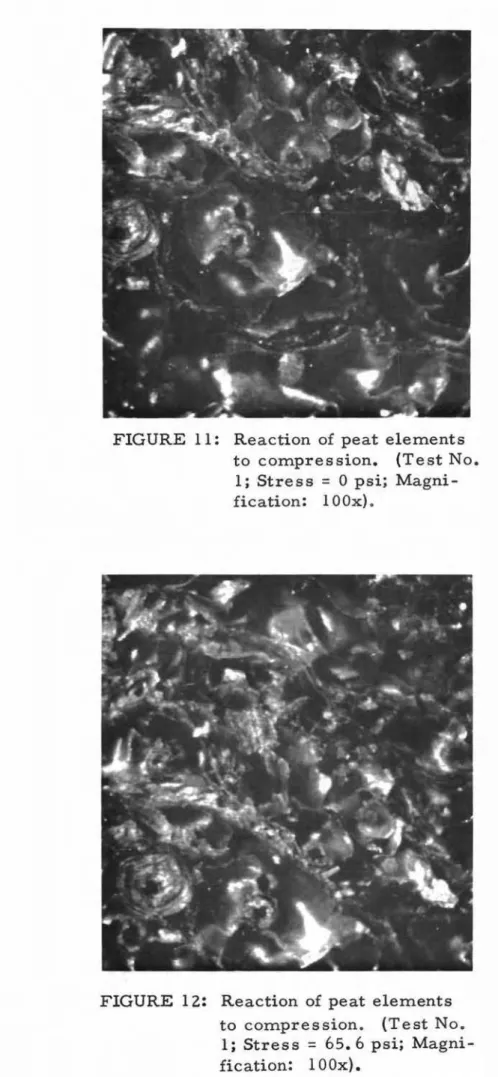
Figures 11 and 12 illustrate the effect on peat elements of varying the load during test No. 1. In these figures several discrete elements of peat are identifiable; these are cross-sections of the stem of Hypnum Cuspidatum.
Even in a qualitative sense, in the absence of any specific measurements, the movement of the elements relative to each other is evident. The plant elements, which are separated by void spaces and fragments of leaves and other debris, are compres sed closer together, the void spaces decreasing markedly in size and the leaves, etc. becoming quite tightly packed. It is particularly interesting to observe that there is virtually no distortion of the tubular peat elements; they are not flattened or collapsed. The effect of loading intensity on a woody element in the peat (similar to that in the lower left corner of Figure 3) is small, as little change is seen in the element de spite the fairly high load. Elements which consist of a leafy structure, however, do show some evidence of collapse.
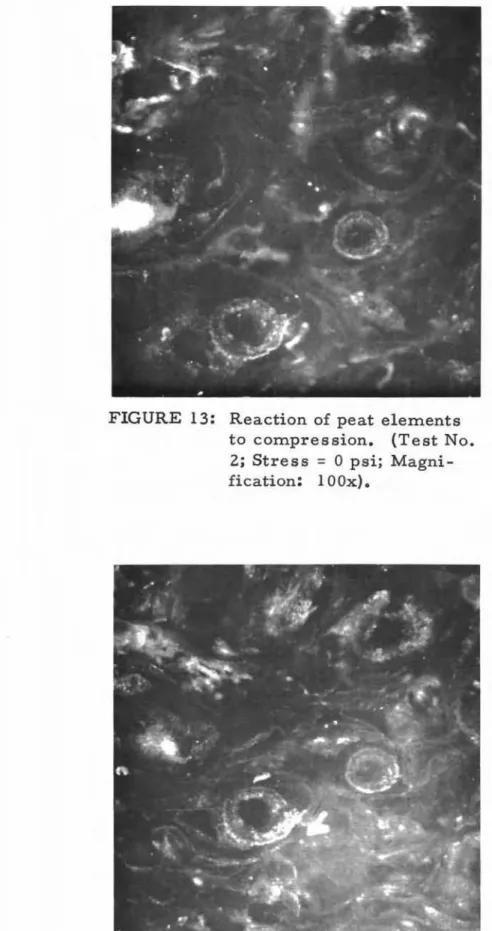
The effect of varying load intensity on a wet peat sample during test No.2 is illustrated in Figures 13 to 15; the effect of loading on discrete identifiable elements is
visible in these figures. These elements are obviously larger than those shown in the previous illustrations; this is due, in part at least, to the effect of wetting and consequent swelling. It is seen here that there is a slight flattening of the peat elements, a phenomenon that is particularly evident in the lower of the two elements. Introduction of water bubbles
into the sample (which occurred when the load had to be released to add an extension to the piston) made visual observation
difficult for part of the test and accounts for the obscurity of Figure 15.
Colour photographs were taken of test No.3. These confirm the results of test No.2, namely that there is a slight flattening of the peat elements under the heavier loads. A smoky effect in these photographs (due to reflection and refraction of light) conceals to a large extent the condition of the discrete elements in the sample. A portfolio of the se colour photographs, together with additional black and white photographs, are available and can be seen at the Division of Building Research, National Research Council.
Figures 20, 21 and 22 represent graphs of settlement versus load for Tests 1, 2 and 3, respectively, plotted on an arithmetic scale.
APPRAISAL OF OBSERVATIONS AND TESTS AND RECOMMENDATIONS FOR FURTHER RESEARCH
Although the te st program and the examination of the peat structure were limited by time, the study as carried out can provide certain preliminary conclusions regarding the structure of and the effect of compressional loads on the particular peat type under examination.
The hypothe sis outlined at the beginning of this report was that certain peats that have a single generic plant constituent control the quality of physical change in peat when it is subjected to compressional loading. The experiments reported herein on peat in general and on the Moonbeam peat in particular open up the investigation but neither prove or disprove the hypothesis. Much more examination and testing must be carried out on
other peats of a single generic constituent (such as a sphagnum) for a comparison to be made of the quality of physical change in the different peats, under compressional loading.
Structure
Considerable thought was given to the possibility of developing a mathematical formula whereby a given peat type could be represented by a single dimensionless number. Such a formula would incorporate both micro- and macrostructural features of the peat. For example, microstructural features that might be included are: the length of the discrete peat elements (dimensional symbol L), their diameter (L), the
wall thickness of the tubular elements (L), the number of leafy appendages per unit length (IlL), and the average leaf area (L2). Macrostructural features might include such fundamental properties of the peat as wet density (ML-3), dry density HmlMセL per cent moisture, specific gravity, porosity, void ratio, and per cent ash, all of which are related directly or indirectly to the structure of the peat. The complexity of the material, however, would ultimately result in such a complex formula that it would be, in effect, meaningless.
A structural model for peat, must therefore be developed, which will represent a range of micro- and macrostructural
features. The predominant discrete organic element in the
Moonbeam peat is characteristic of many peats - not necessarily genetically, but morphologically - and hence the de signation "fibrous peat". In Moonbeam peat it is specifically a Hypnum; elsewhere it may be a Sphagnum or certain other moss plants. It is possible, therefore, to describe this characteristic element in fairly precise terms and to give it a name. This element may be designated an AXON (see Figure 23) defined as follows:
"AXON - well preserved, non-woody fossilized plant component of peat, consisting of tubular axis, system of leafy appendages, the cellular structure clearly defined. The maximum outside diameter of the linear component of the axon (when wet) is 1 rnrn ,It
It is not immediately apparent how quantitative expressions for the various components of the axon may be included in the definition. Not only will these vary with the various plant
species, but they will also depend upon the extent of disintegration and decomposition of the fossilized plant element.
The Moonbeam peat may be termed "axonic peat" rather than "non-woody, fine-fibrous peat". In due course, expressions can be developed for the other distinctive discrete elements of the various peat types.
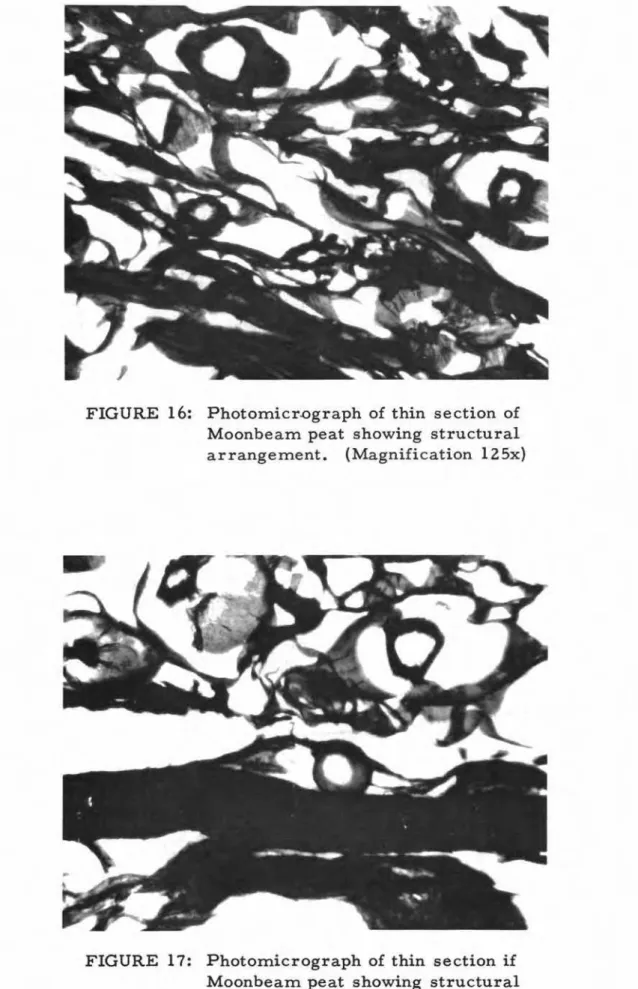
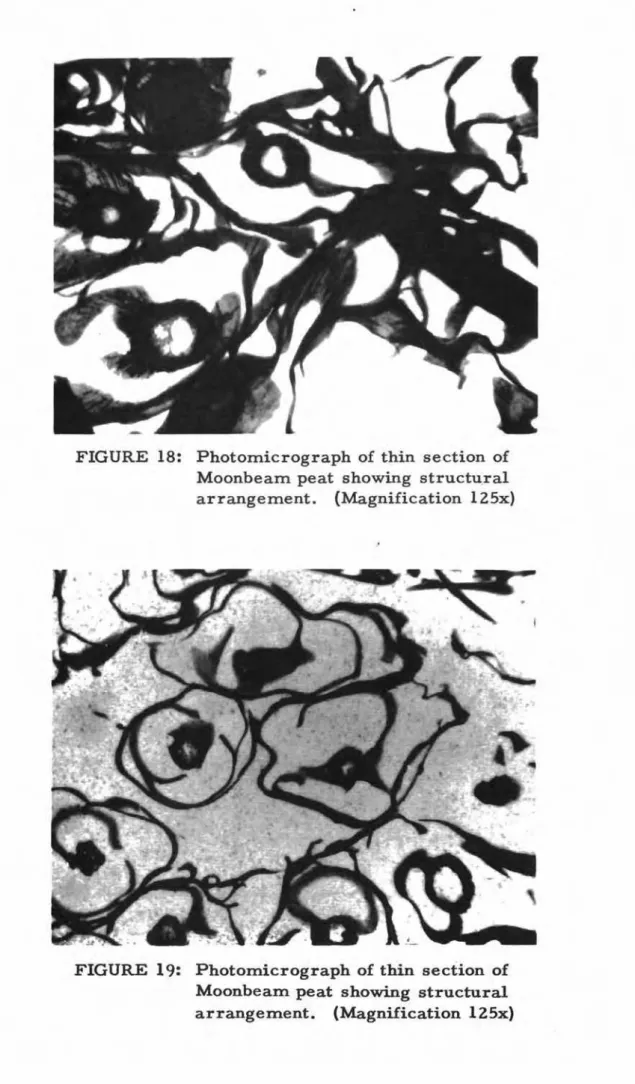
Figure 3 and Figures 16 to 19 illustrate a loosely packed arrangement of the axons relative to each other. In Figure 16 for example, the stems of the axons comprise only 14 per cent of the total eros s - sectional area shown in the photo-graph. Leaves and organic debris comprise some 54 per cent of the total area and external void spaces (i. e. not including the void space s in the hollow tubular axe s) make up the remaining 32 per cent. Similarly, in
Figure 18 the respective areas are 14, 23 and 63 per cent. Figure 19 represents the edge of the thin section and is not truly representative of the peat. Figure 17 is also not parti-cularly representative since an axon is shown traversing the section. On a macrostructural basis, Figure 3 illustrates quite well the proximity of the axon s to each other, the extent of void space s , etc.
It is now possible to propose, as a first approximation, a structural model of the Moonbeam peat, after the manner of Ohi r a (1962). As illustrated in Figure 23, it may be
represented as a loosely packed arrangement of hollow tubular organic elements (axons) of the same general configuration and consisting of an almost incompressible stem "a" and a highly compressible peripheral zone "b" of leafy appendages. Part of the voids (" c") are filled with organic fragments, the remainder with water and gases, including air. The angle of contact 0 of the loosely packed elements is 900
•
Studies will be continued to develop a rational mathematical expression for the proposed structural model. Such a quantitative expression will incorporate the deposition coefficient, porosity, density, specific gravity, water content, and other significant
characteristics. In a similar manner, structural models consisting of both axonic and other elements will be proposed for more
complex arrangements. Compre s sional Loading
The structural model as suggested is idealized. Under natural conditions, the axonic elements are not always in contact
with each other. It is not until SOme load has been imposed that the idealized condition is approached.
Figures 11 and 12 show that a compressional load,
even as high a load as 65.6 psi, does not result in any significant deformation of the axonic elements, particularly of the stem section "a". For the wet material, however, distortion and deformation of the axonic elements becomes visible (Figures 13 to 15) although it is not extensive even at the load of 65.6 psi. The water presumably provides a lubricant for the fibrils of the cell wall structure, which permits the distortion to occur
during loading. Physical change in both the dry and wet conditions consists basically of deformations of the organic debris external to the axonic elements, and a subsequent rearrangement of these ele-ments into a more closely packed condition. This visual observation confirms the suggestion made in "The Compression Process in Peats" that during consolidation it is doubtful if there is much rupture or
collapse of the discrete peat elements. As consolidation or compression proceeds and the void spaces become progressively smaller, the
permeability of the peat is markedly reduced.
The shape of the 'st r e s s - strain curve is similar for the dry and wet peat sample s (Figure s 20 and 21) except that the amount of settle-ment for a given load is 5 to 7 times greater for the wet sample than for the dry sample. Figures 20 and 21 represent a strain-controlled loading condition, i. e. the loading was stopped, for photographic examination, after equal increments of settlement as recorded on the dial gauge. Figure 22, on the other hand, represents a controlled
stress condition; loading was stopped at predetermined stresses. The method employed for examining the re sponse of the peat structure to compressional load is generally appropriate. For fur-ther tests, however, some revisions to the equipment would have to be made. This is particularly エイオセ of the lucite microconsolidation chamber. This material was chosen not only for the ability to observe the sample through the thin polished "windows , " but also because of its ability to withstand the anticipated high st re s se s , The lucite "windows," however, scratched quite easily, destroying their effectiveness to some extent. Strong lights were required to provide adequate illumination and the heat from these lights tended to melt or to bubble the lucite. Consequently, consideration should be given to having the viewing "windows" of glass. This may present some difficulty since two adjacent windows will be required, at 900
to each other, and connecting their edges may be a problem.
A method will have to be devised of measuring quantitatively the displacement and distortion of the discrete peat elements. In an attempt to do this, a small grid network was drawn on the outside face of one of the lucite windows. This was not a success however, as the grid quickly rubbed off; in any case, the lines (although very fine to the
naked eye) were enormously wide when observed through the microscope. Possibly, an ocular micrometer could be adapted for this purpose,
although it would have to be mounted in the objective lens so that it would be superimposed on the photographs.
The loading method was inadequate as it lacked proper control. In future tests, the load rate should be controlled by machine. With the apparatus developed for this stage of the inve stigation, the most appropriate type of loading was slow and continuous rather than a series of incremental loads. This enabled a general observation to be made regarding the nature and pattern of deformations. In a future series of tests,
however, regular consolidation tests should be run, with
photomicrographs taken at appropriate intervals. Some method will have to be developed to prevent the peat sample from
drying out during test, since for viewing purposes, it cannot be immersed in water.
The application of the method developed by G. Thaler (see Appendix C) for examining the microstructure of peat could be extended to the examination of the structure of a homogenous peat, sample s of which have been subjected to a range of compressional loads. In this way, the progressive deformation of the discrete peat elements could be observed from thin sections. Difficulties inherent in attempting this include the rebound which occurs in the peat after the load is removed (hence the structure for that particular load is not retained) as well as the much more serious rebound which Occurs when the s arnple is dried in preparation for impregnation by the resin.
This investigation was a preliminary examination of the structure of a single peat type. From a series of compressional loading tests, during which the samples were under microscopic observation, it has been possible to con-firm previous speculation regarding the behaviour of the
discrete peat elements during compression. It is recommended that this investigation be continued, not only into this parti-cular peat type, but also into other commonly occurring peat types. In this way, it should be possible ultimately to suggest
structural models for the various peat types, as well as mathematical expressions which will adequately describe the models.
ACKNOWLEDGEMENTS
The author wishes to acknowledge his indebtedness to Dr. N. W. Radforth, Chairman of the Department of Biology of McMaster University, for his advice and inspiration; to the
Organic and Associated Terrain Research Unit, through its Chairman, Dr. Radforth, for providing the opportunity to pursue this research project at McMaster University; to Professor N. E. Wilson of the Engineering Department for his kind co-operation and advice throughout; and to Mr. K. Ashdown of the Muskeg Laboratory for practical advice and assistance.